Today’s Lecture
❑ Radioactive Elements
Today’s Lecture
❑ Radioactivity of Elements
❑Types of Radioactive Rays
❑ Types of Nuclear Reactions
Radioactivity of
Elements
Radioactivity
• The nuclei of naturally occurring heavy
elements like U,
unstable and
Th, Ra and Po are
keep on emitting
spontaneously invisible rays or radiations
(α, β, γ -rays) and give more stable
elements.
Radioactivity
• These heavy elements
radioactive elements.
are called
• The property of emitting these rays is
called radioactivity of the elements.
• It is the nucleus of an atom of an
element which spontaneously disintegrates
to emit α, β or γ-rays.
• The rays emitted by radioactive element are
called radioactive rays
Radioactivity
Definition:
The phenomenon in which the nucleus of the
atom of an element undergoes spontaneous
and uncontrollable disintegration (or decay)
and emit α, β or γ-rays.
Radioactivity
Units of Radioactivity
Ionizing Radiations
The emitted α, β or γ-rays from unstable nuclei are
collectively called ionizing radiations.
Depending on how the nucleus loses this excess
energy either a lower energy atom of the same
form will result, or a completely different
nucleus and atom can be formed.
Ionization
is the addition or removal of an electron to create
an ion.
Ionizing radiation
is any type of particle (α, β) or electromagnetic
wave (γ) that carries enough energy to ionize or
remove electrons from an atom.
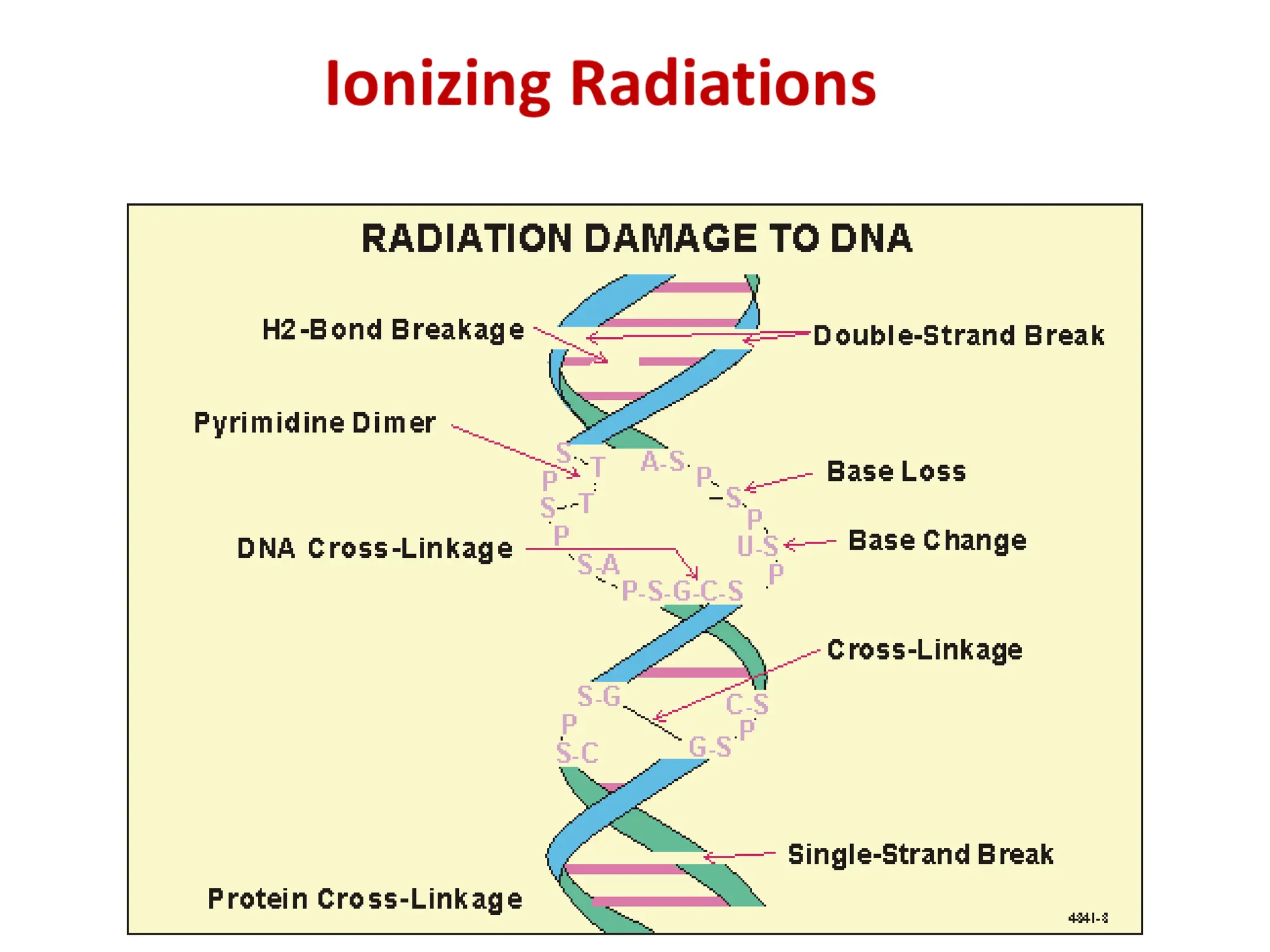
Ionizing Radiations
• These radiations are of such high energy
that when they interact with materials, they
can remove electrons from the atoms in
the material. This effect is the reason why
ionizing radiation is hazardous to health
Ionizing Radiations
Types of
Radioactive
Rays
Types of Radioactive Rays
• There are three types of radioactive rays
which are:-
– Alpha (α)
– Beta (β)
– Gamma (ᵞ) rays
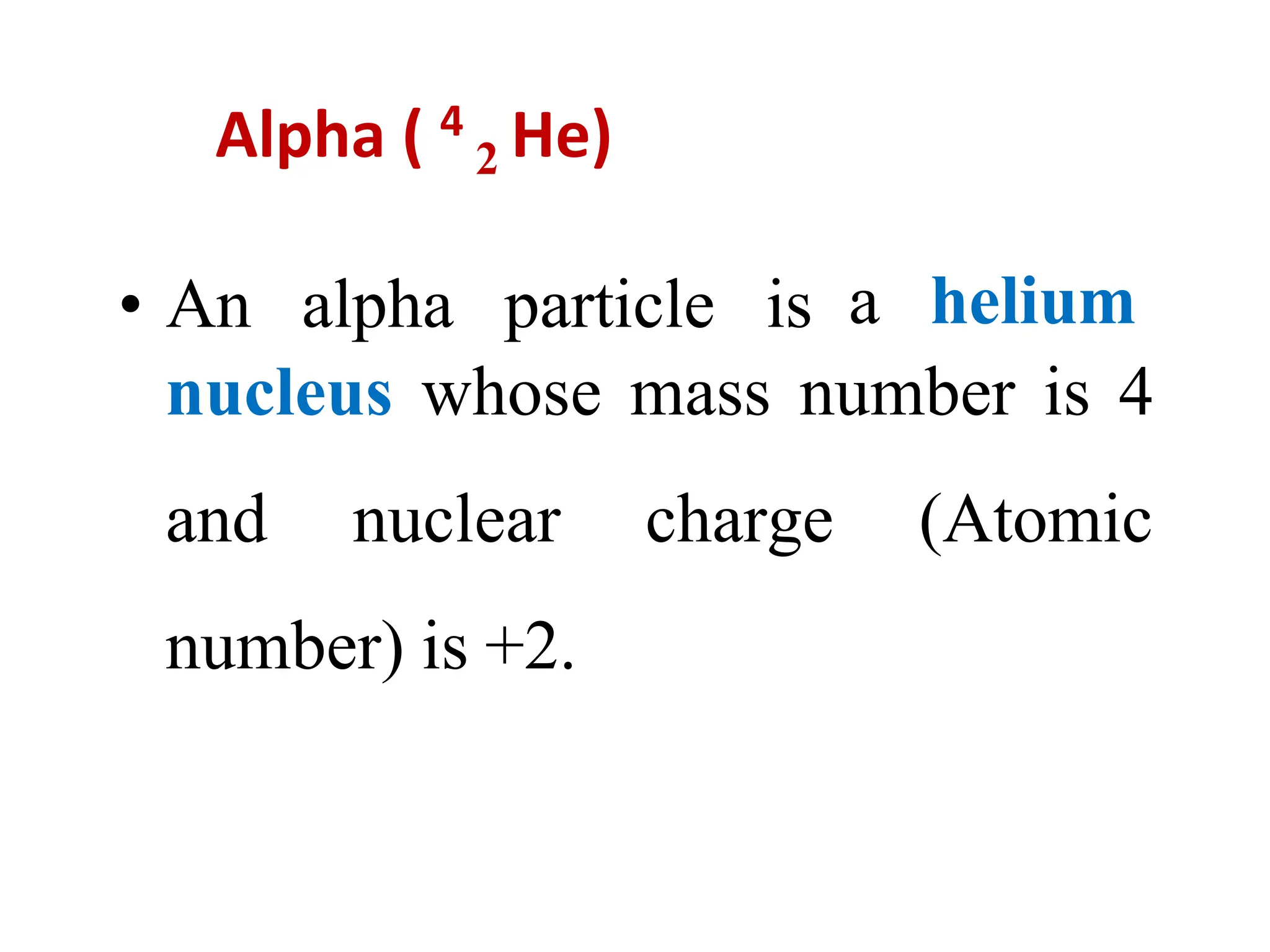
Alpha ( 4
2 He)
• An alpha particle is a helium
nucleus whose mass number is 4
and nuclear charge (Atomic
number) is +2.
Alpha- Particle Decay
• For proton- rich heavy nuclei, a
possible mode of decay to a more
stable is by alpha particle emission.
Alpha decay
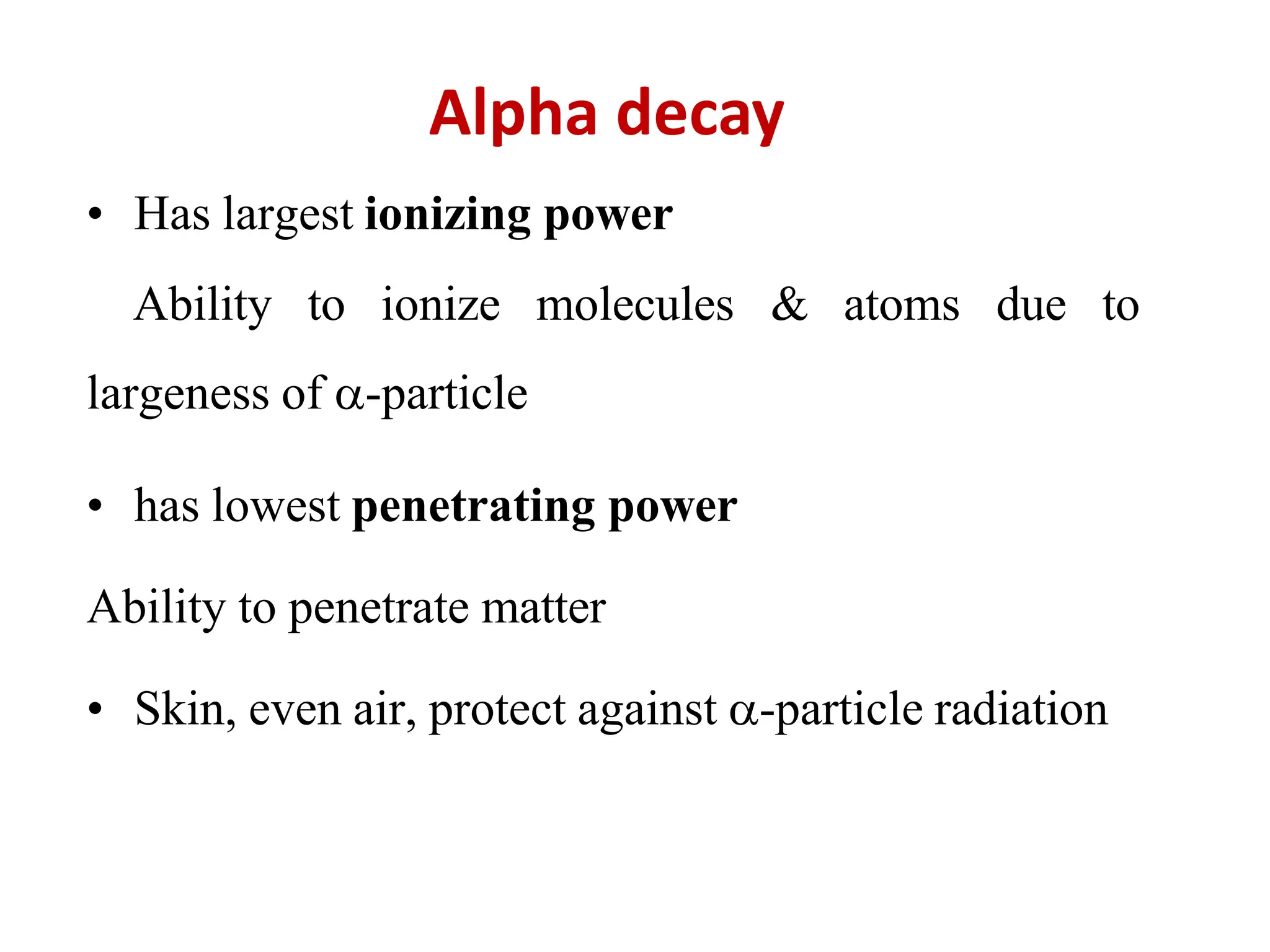
• Has largest ionizing power
Ability to ionize molecules & atoms due to
largeness of -particle
• has lowest penetrating power
Ability to penetrate matter
• Skin, even air, protect against -particle radiation
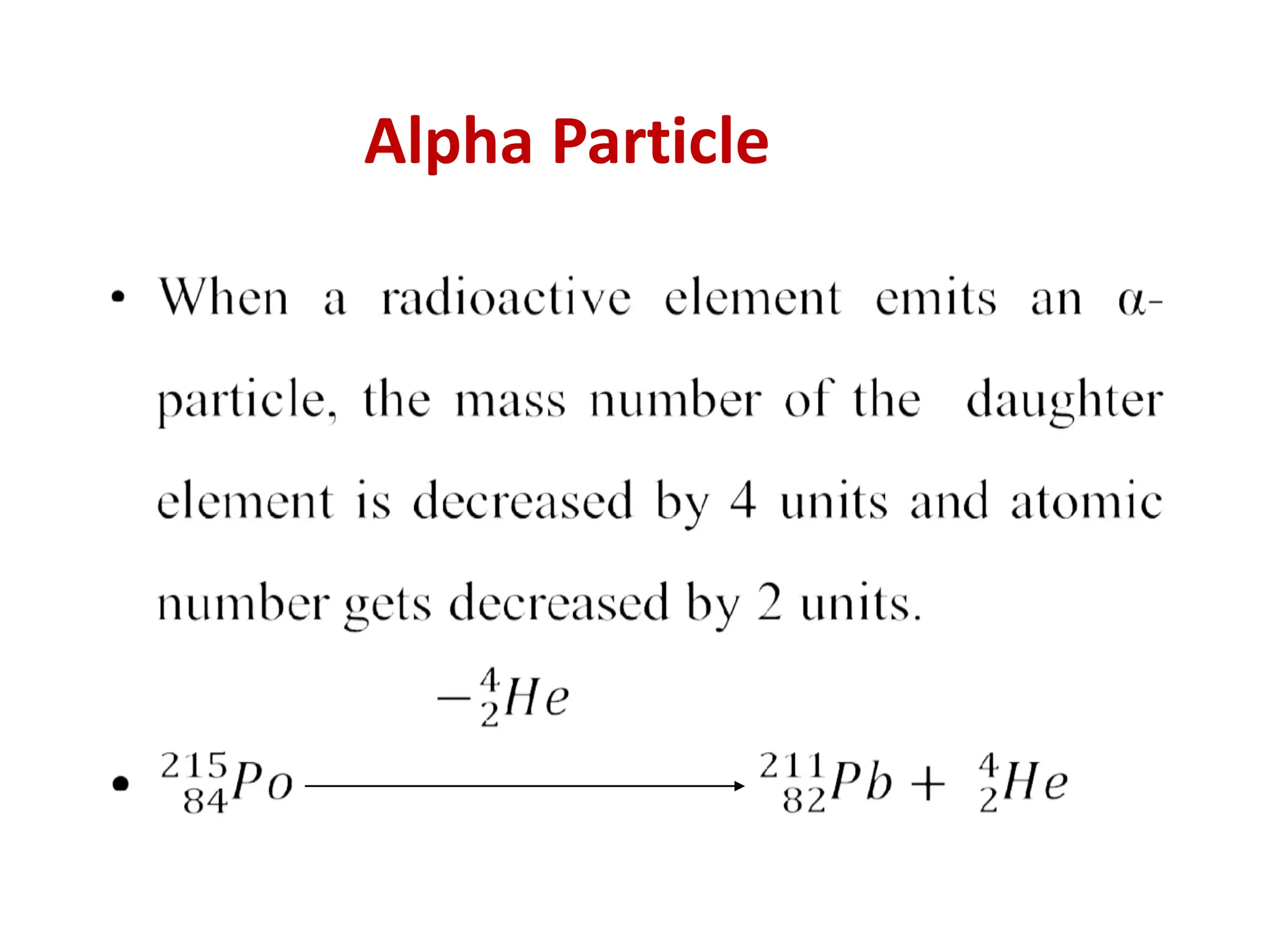
Alpha Particle
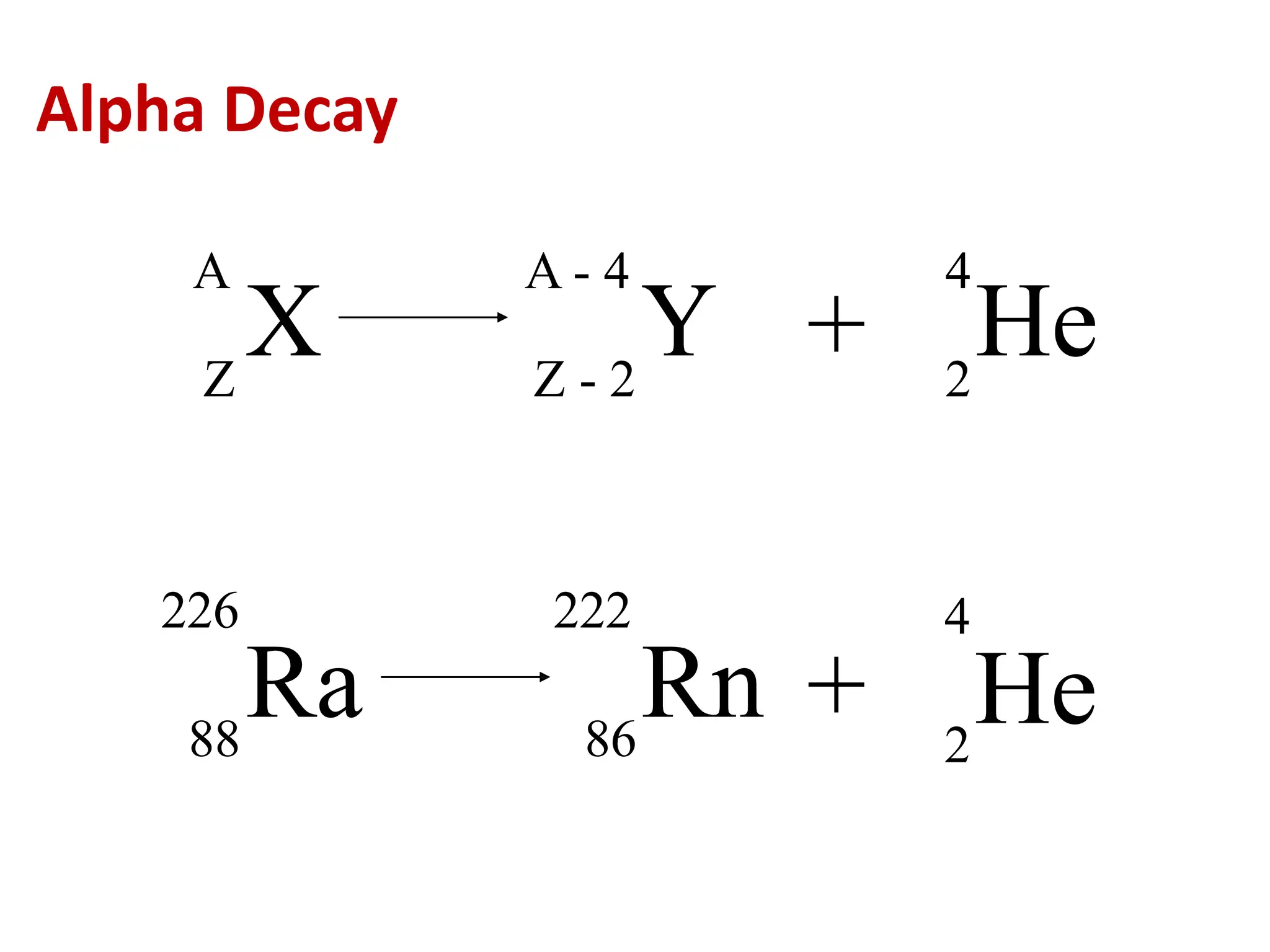
X
A
Z
Y
A - 4
Z - 2
+ He
4
2
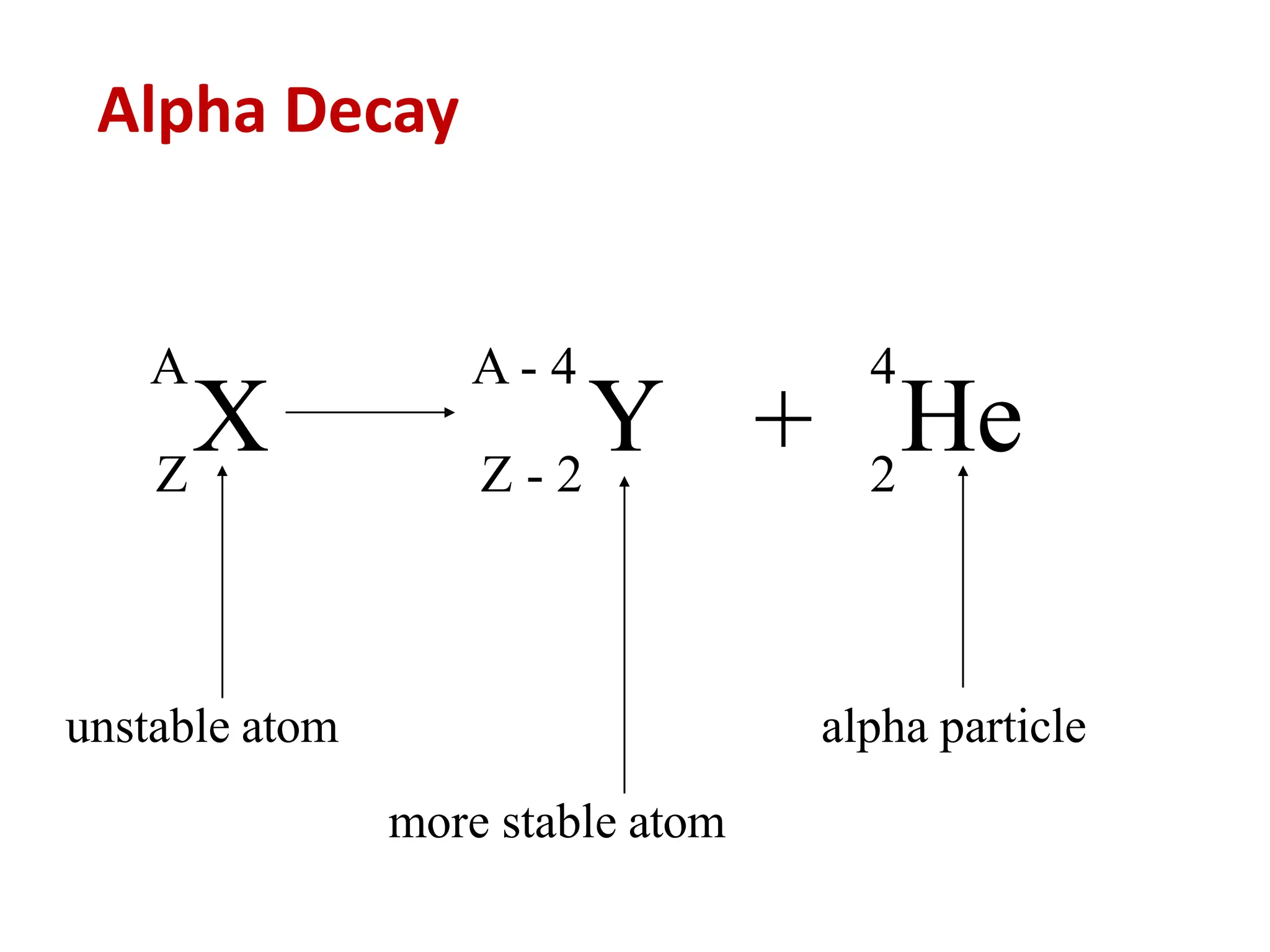
Alpha Decay
unstable atom
more stable atom
alpha particle
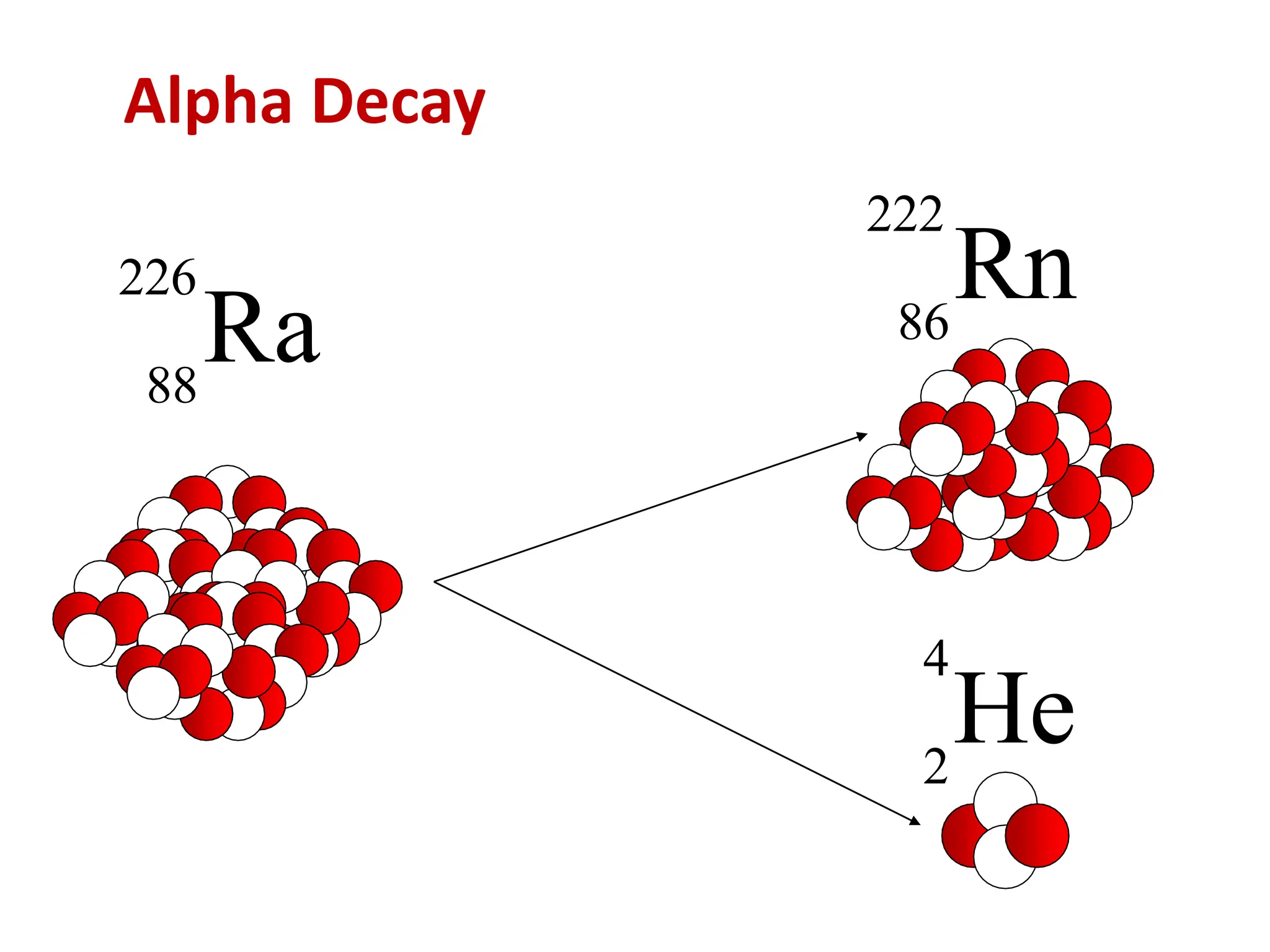
Alpha Decay
Ra
226
88
Rn
222
86
He
4
2
X
A
Z
Y
A - 4
Z - 2
+ He
4
2
226
Ra
88 86
222
Rn +
4
He
2
Alpha Decay
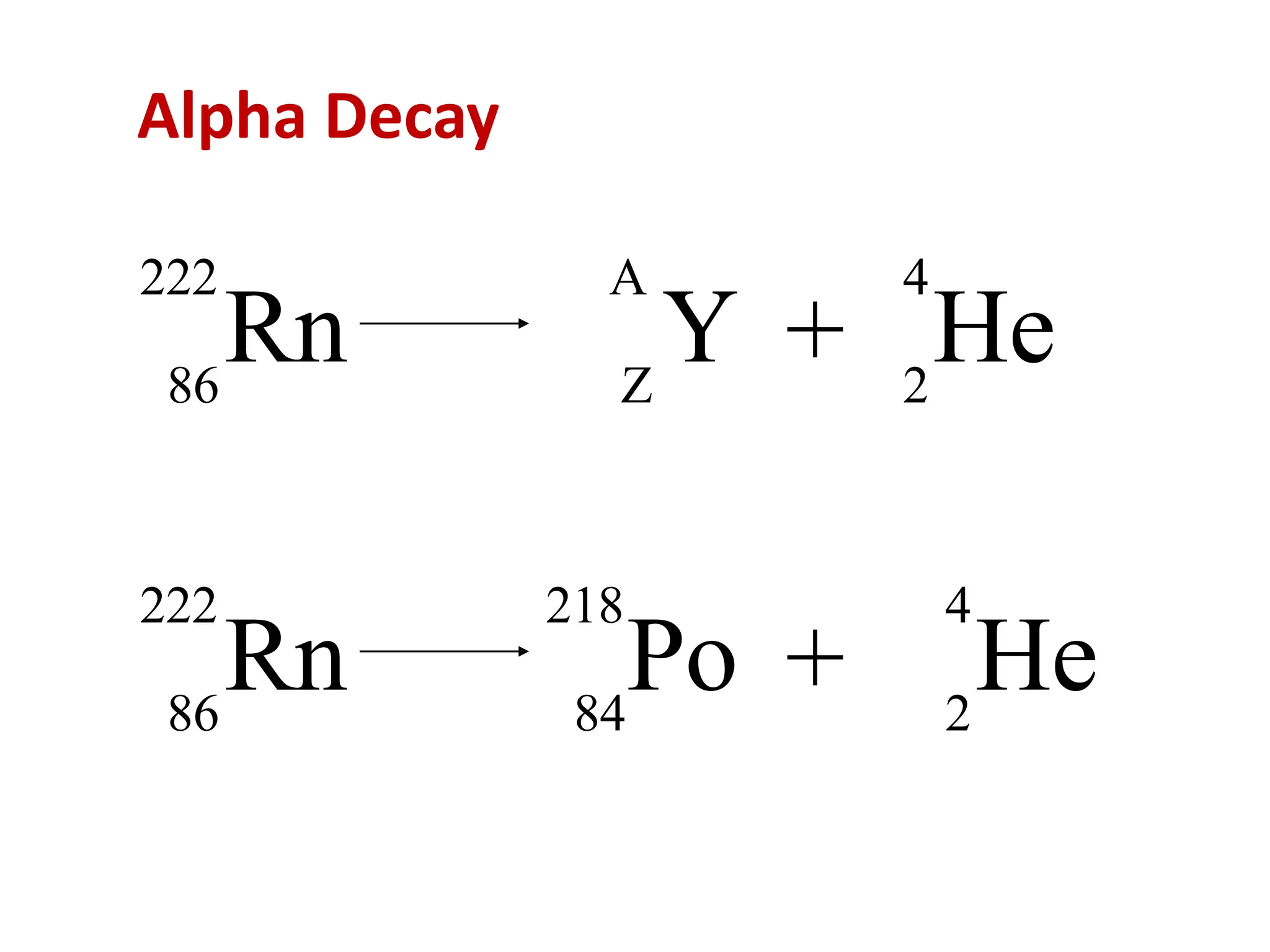
Rn
222
86
Po +
218
84
He
4
2
Rn
222
86
Y +
A
Z
He
4
2
Alpha Decay
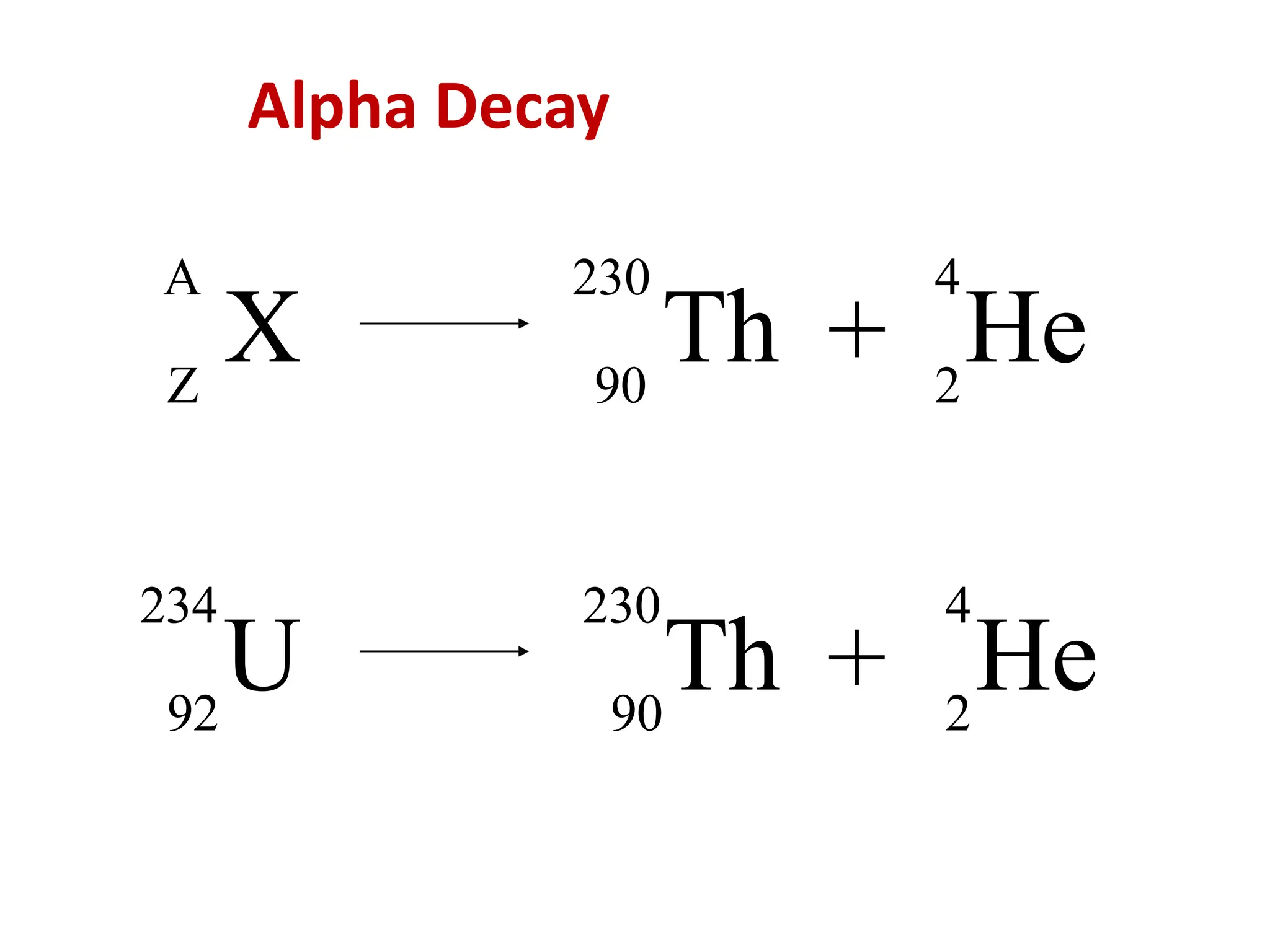
U
234
92
Th +
230
90
He
4
2
X
A
Z
Th +
230
90
He
4
2
Alpha Decay
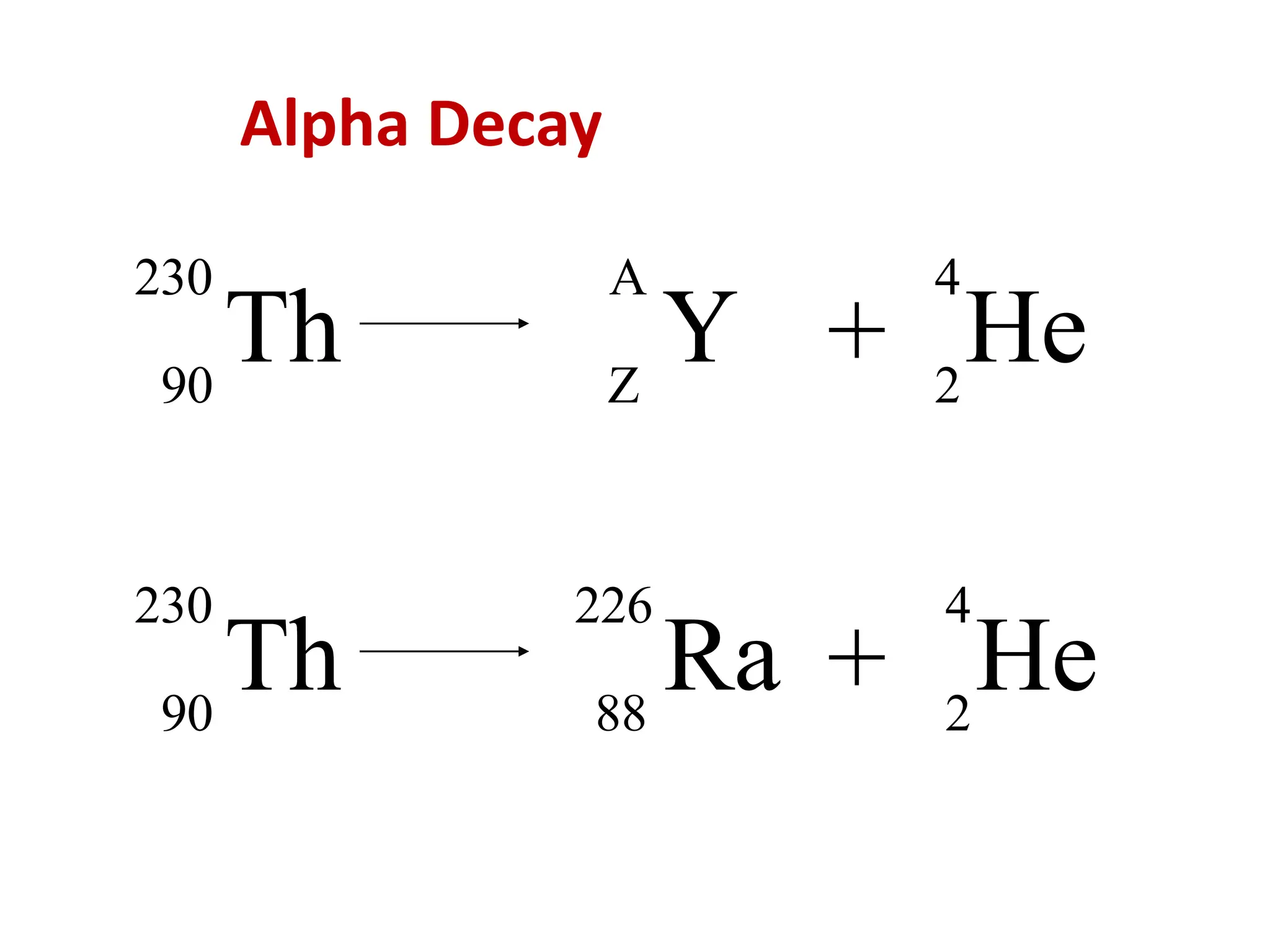
Th
230
90
+
Y
A
Z
He
4
2
Alpha Decay
Ra +
226
88
He
4
2
Th
230
90
X
A
Z
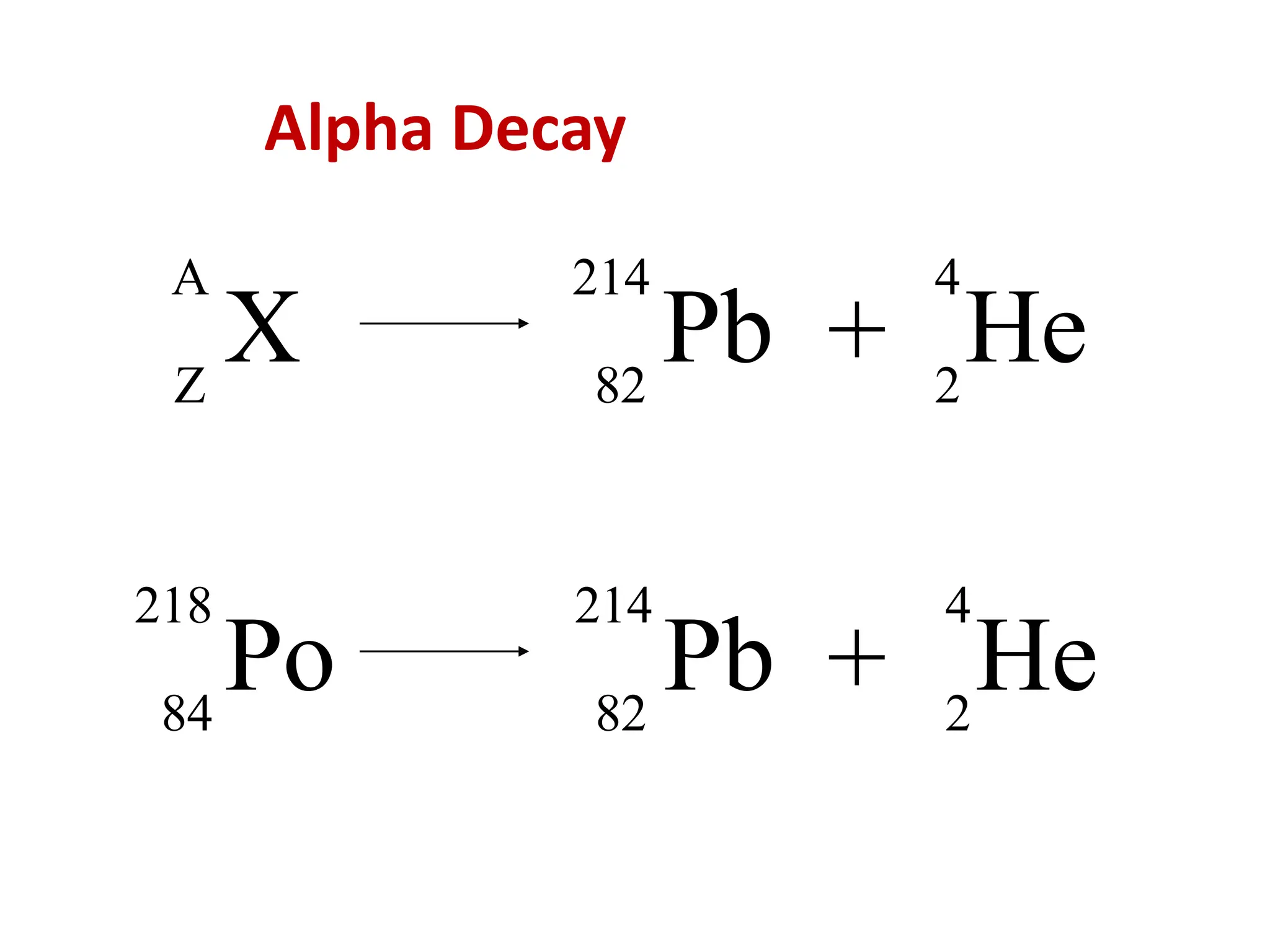
Pb +
214
82
He
4
2
Alpha Decay
Pb +
214
82
He
4
2
Po
218
84
Beta Decay
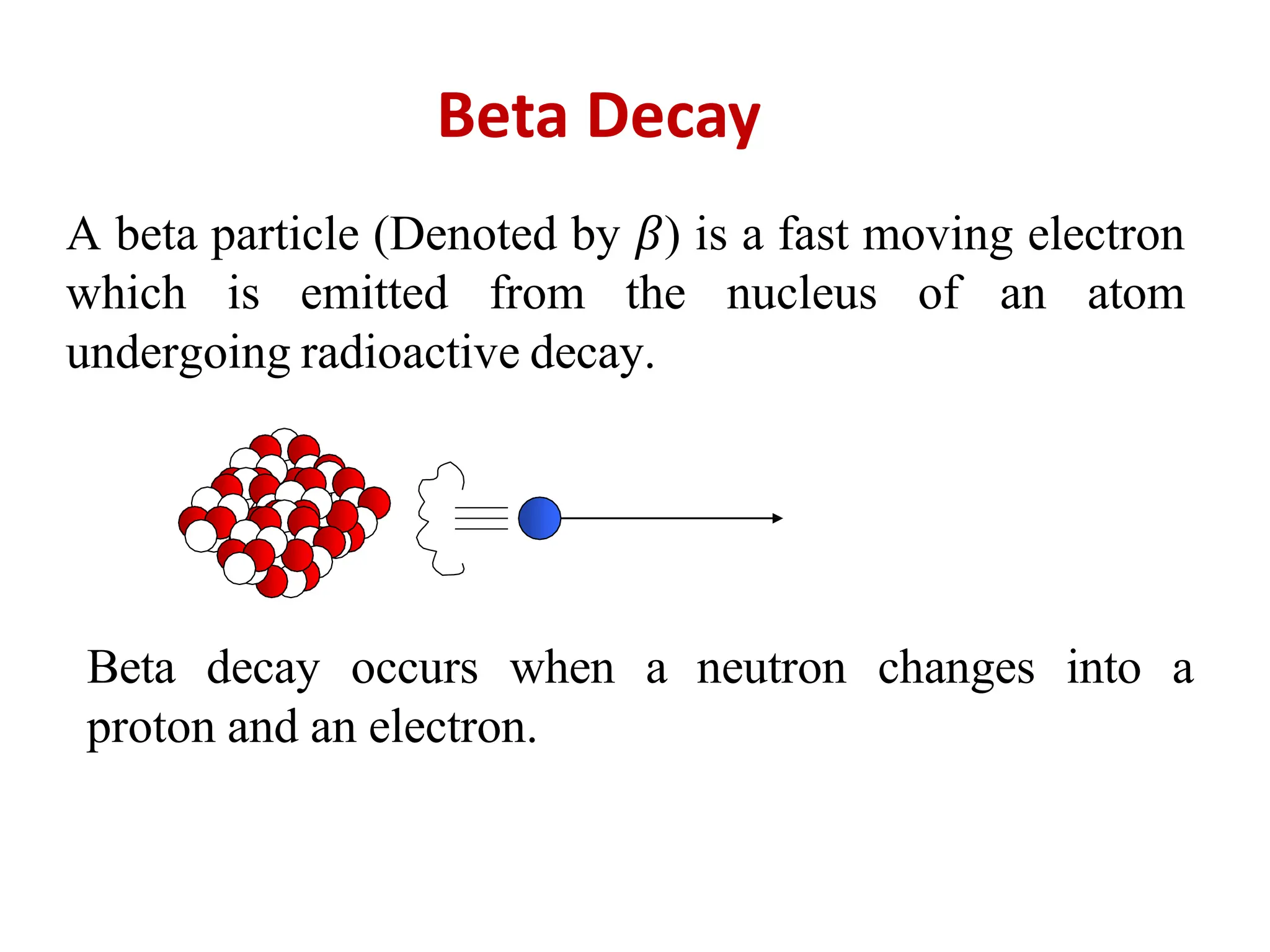
A beta particle (Denoted by 𝛽) is a fast moving electron
which is emitted from the nucleus of an atom
undergoing radioactive decay.
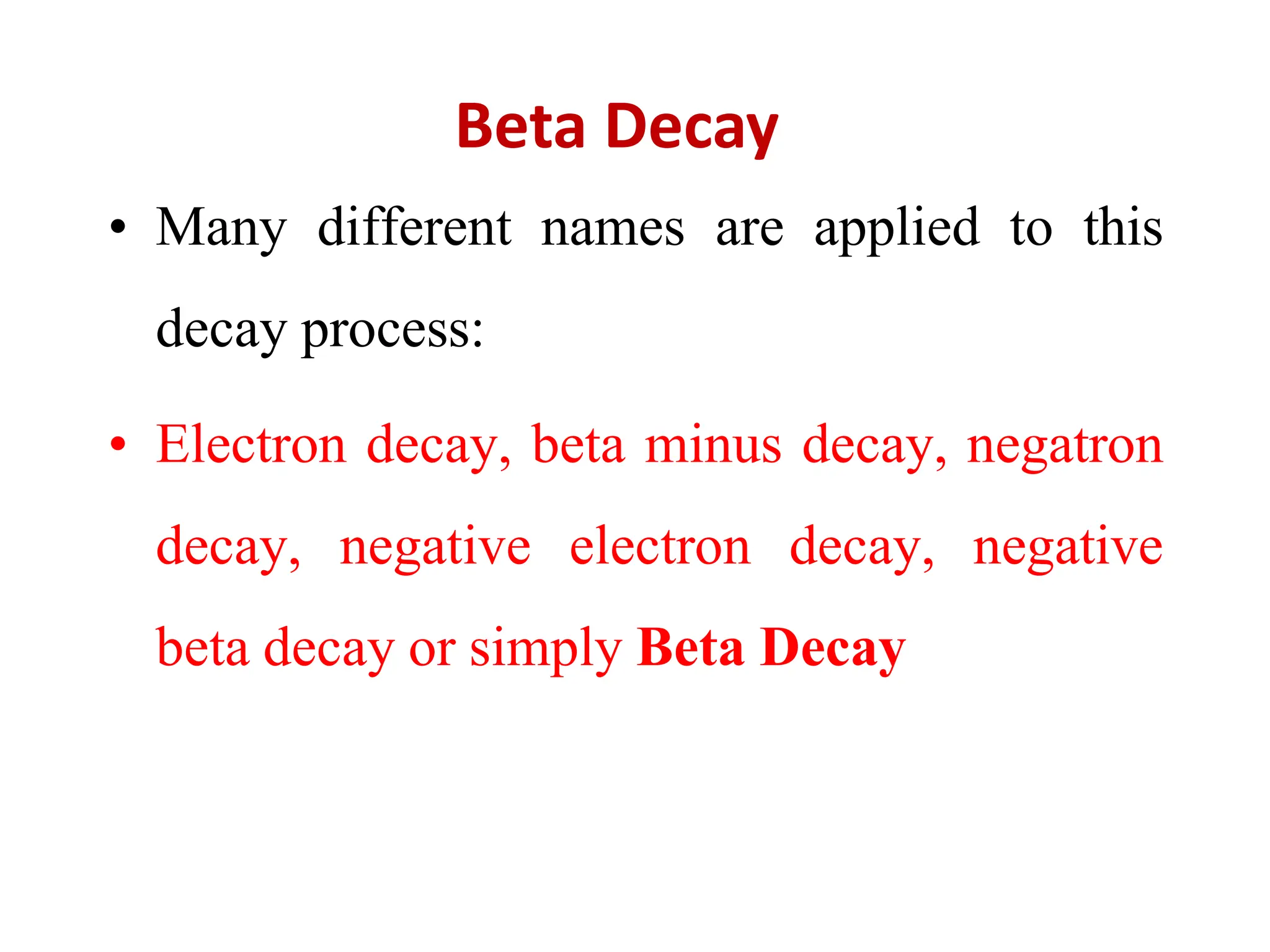
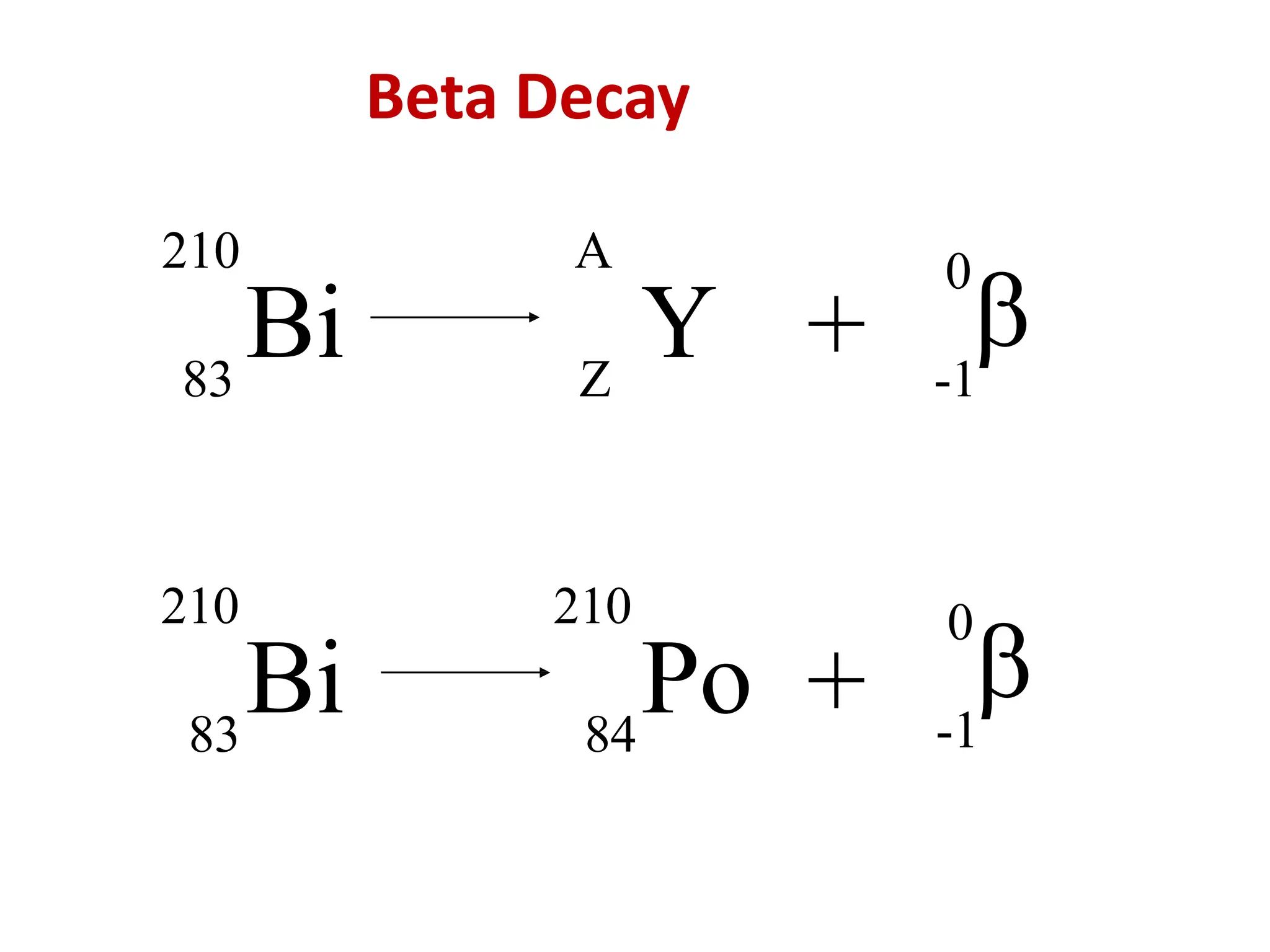
Beta decay occurs when a neutron changes into a
proton and an electron.
Beta Decay
• Many neutron-rich radioactive nuclides
decay by changing a neutron in the parent
nucleus into a proton and emitting an
energetic electron.
Beta Decay
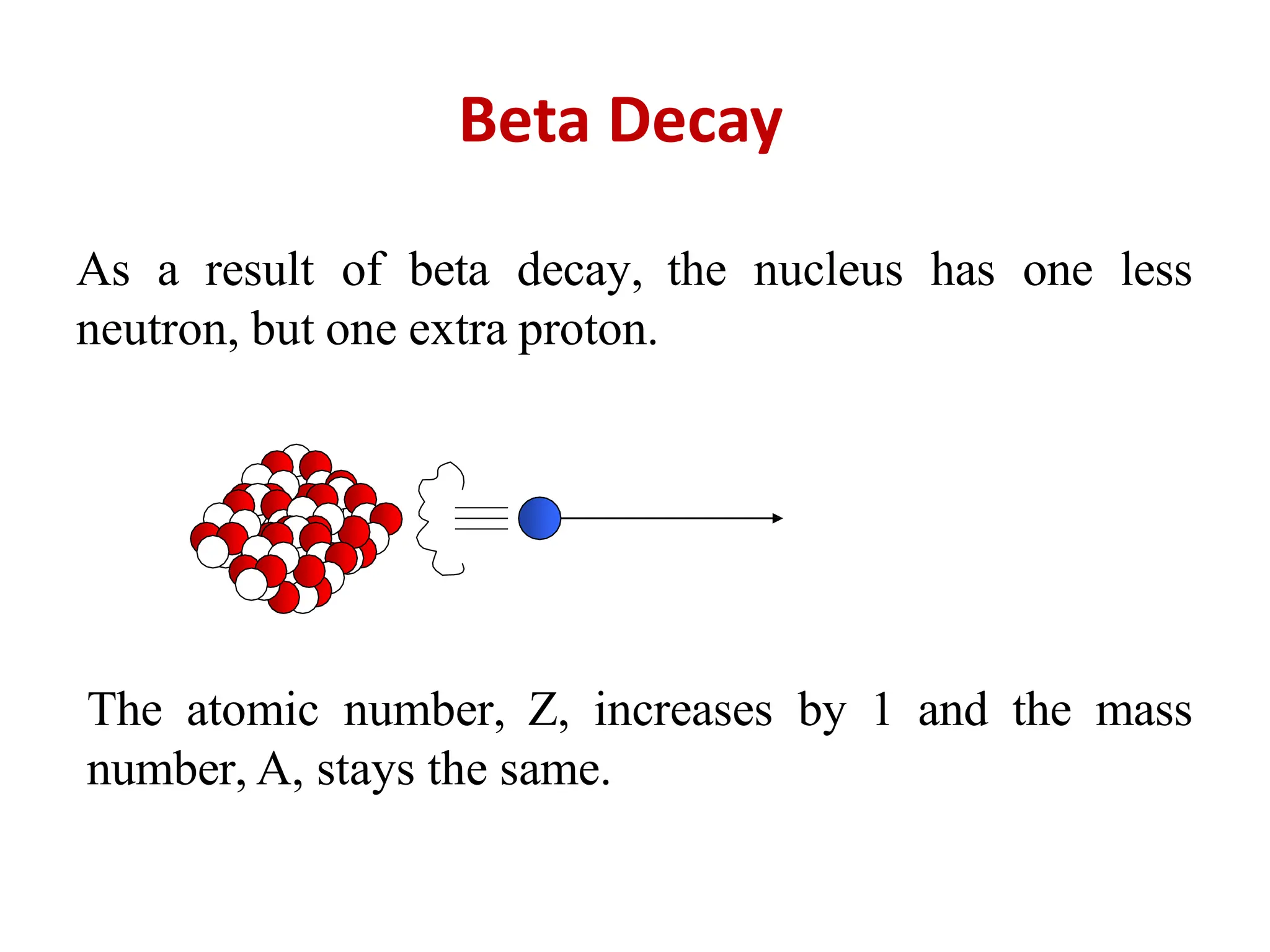
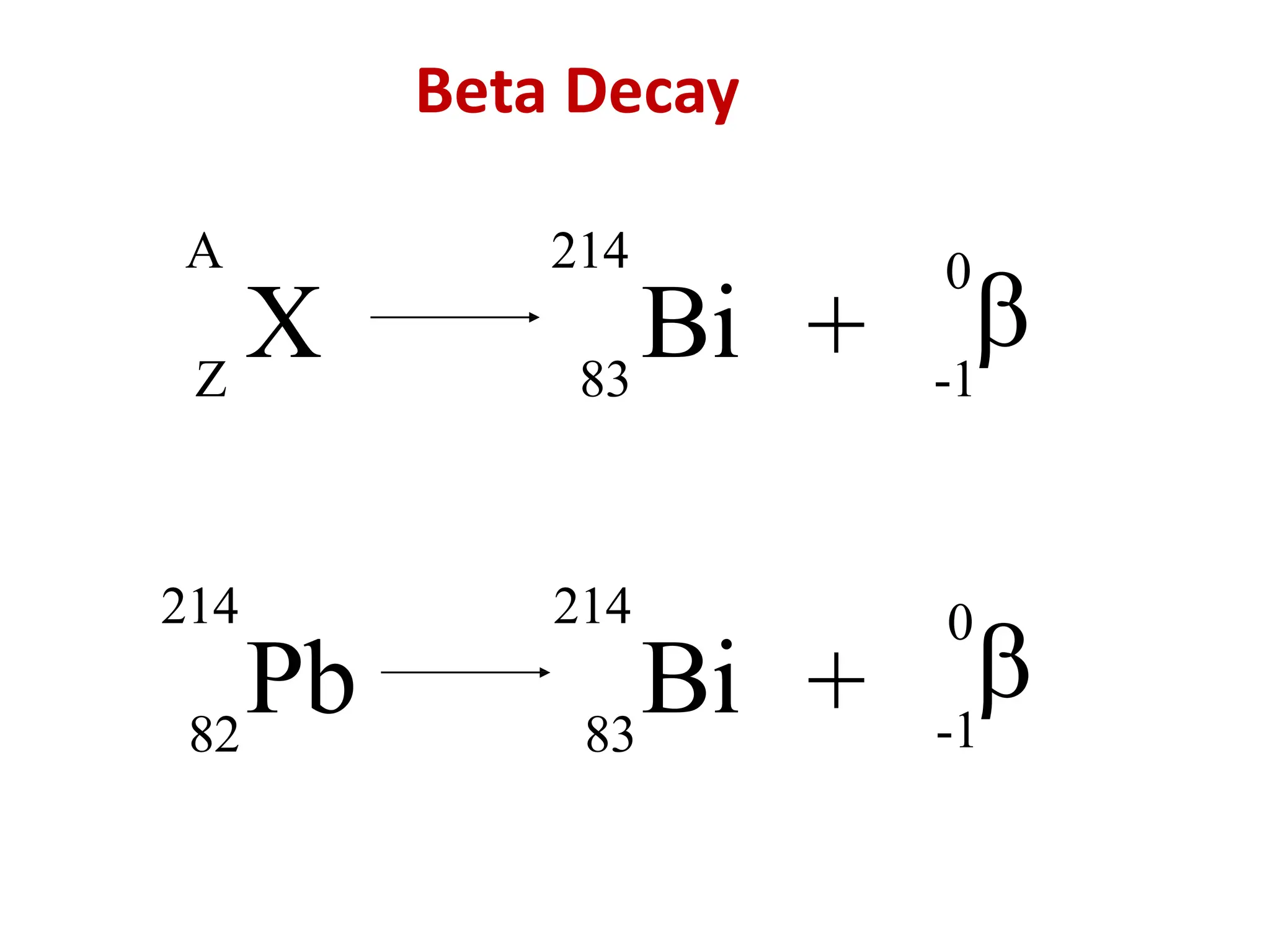
As a result of beta decay, the nucleus has one less
neutron, but one extra proton.
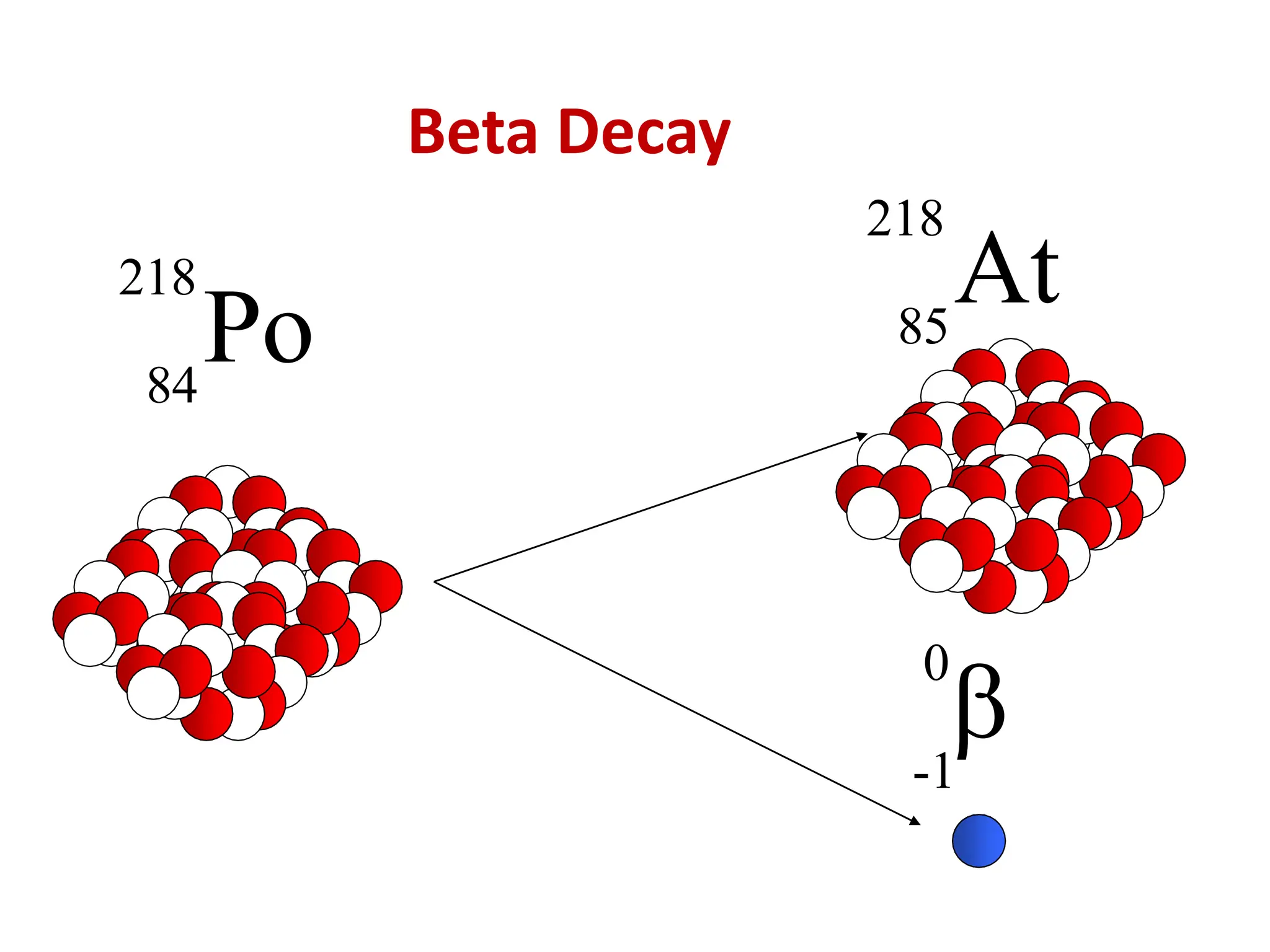
The atomic number, Z, increases by 1 and the mass
number, A, stays the same.
Beta Decay
• Many different names are applied to this
decay process:
• Electron decay, beta minus decay, negatron
decay, negative electron decay, negative
beta decay or simply Beta Decay
Beta Decay
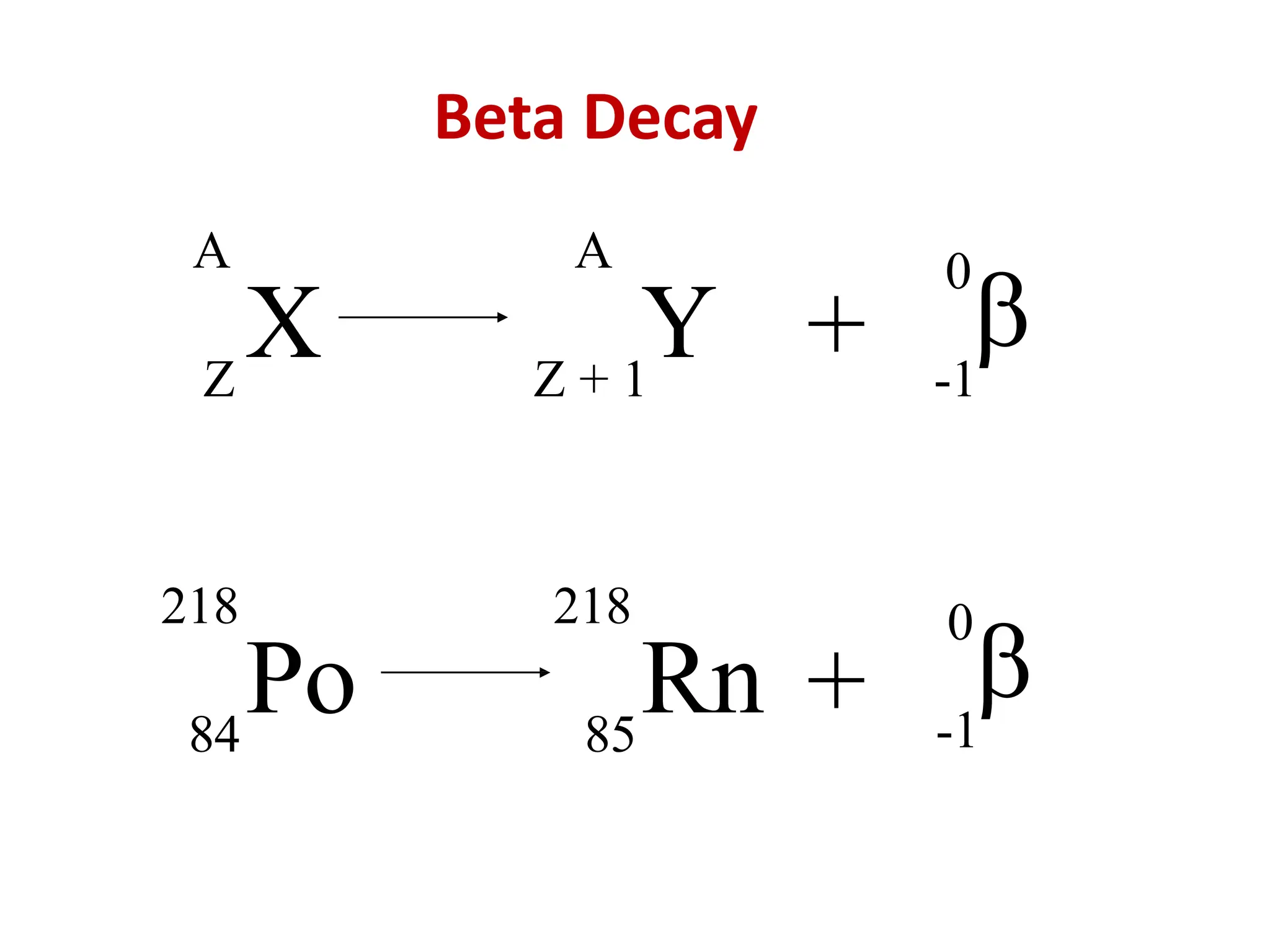
Po
218
84
0

-1
At
218
85
A
X
Z
A
Y
Z + 1
+
0

-1
Beta Decay
218
Po
84 85
218
Rn +
0

-1
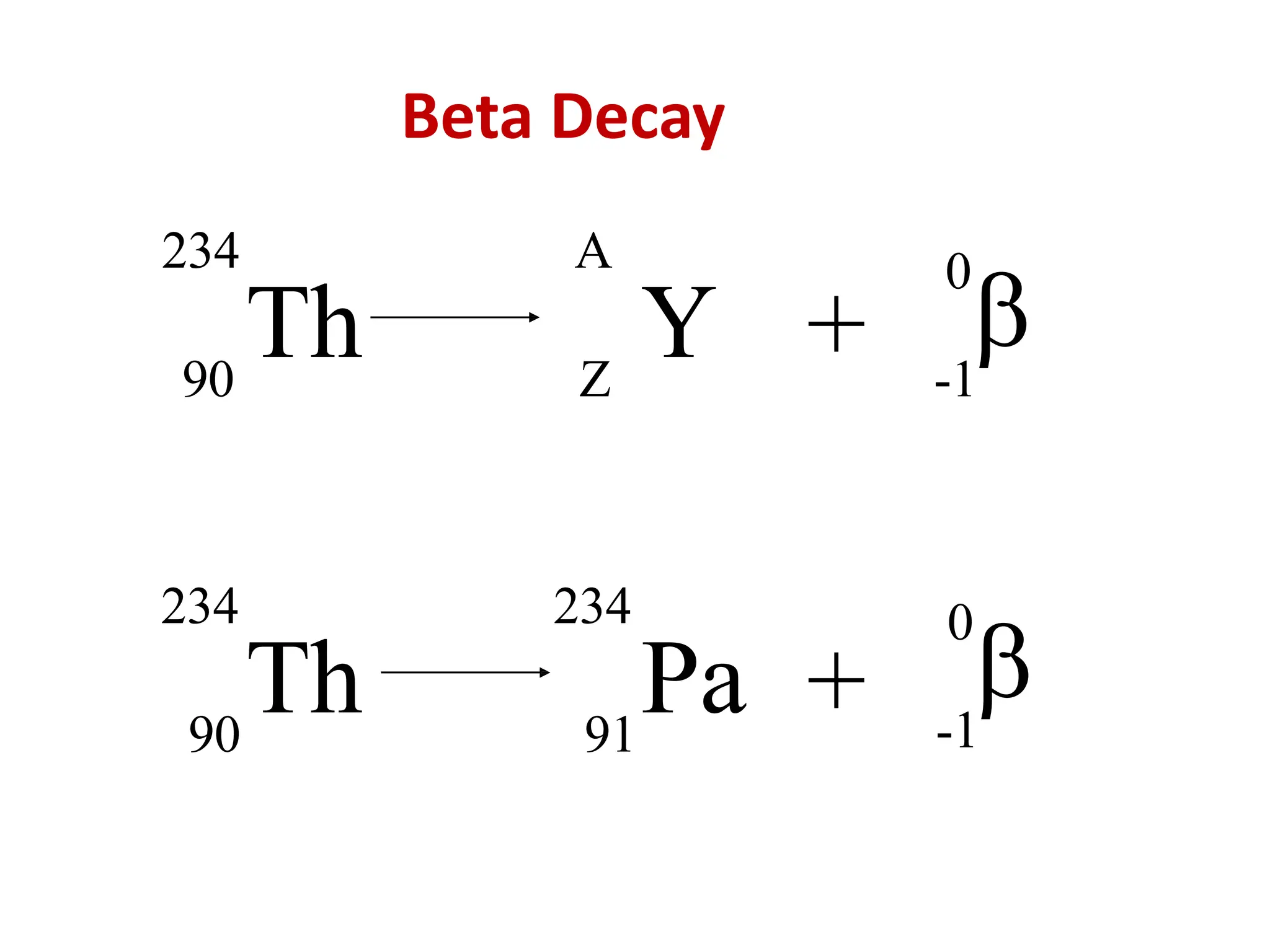
234
Th
90
A
Y
Z
+
0

-1
Beta Decay
234
Th
90 91
234
Pa +
0

-1
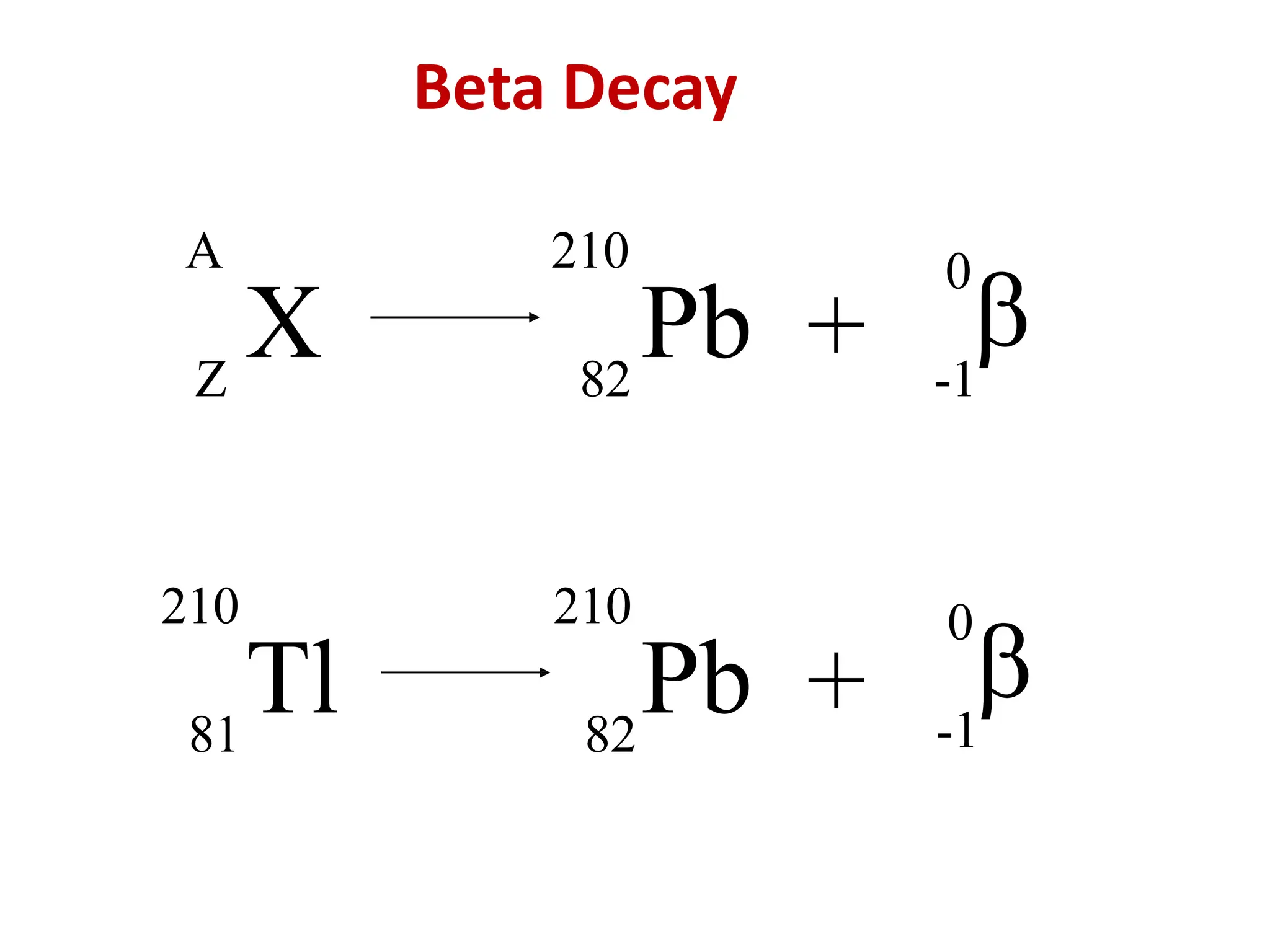
A
X
Z 82
210
Pb +
0

-1
Beta Decay
210
Tl
81 82
210
Pb +
0

-1
210
Bi
83
A
Y
Z
+
0

-1
Beta Decay
210
Bi
83 84
210
Po +
0

-1
A
X
Z 83
214
Bi +
0

-1
Beta Decay
214
Pb
82 83
214
Bi +
0

-1
Gamma Decay
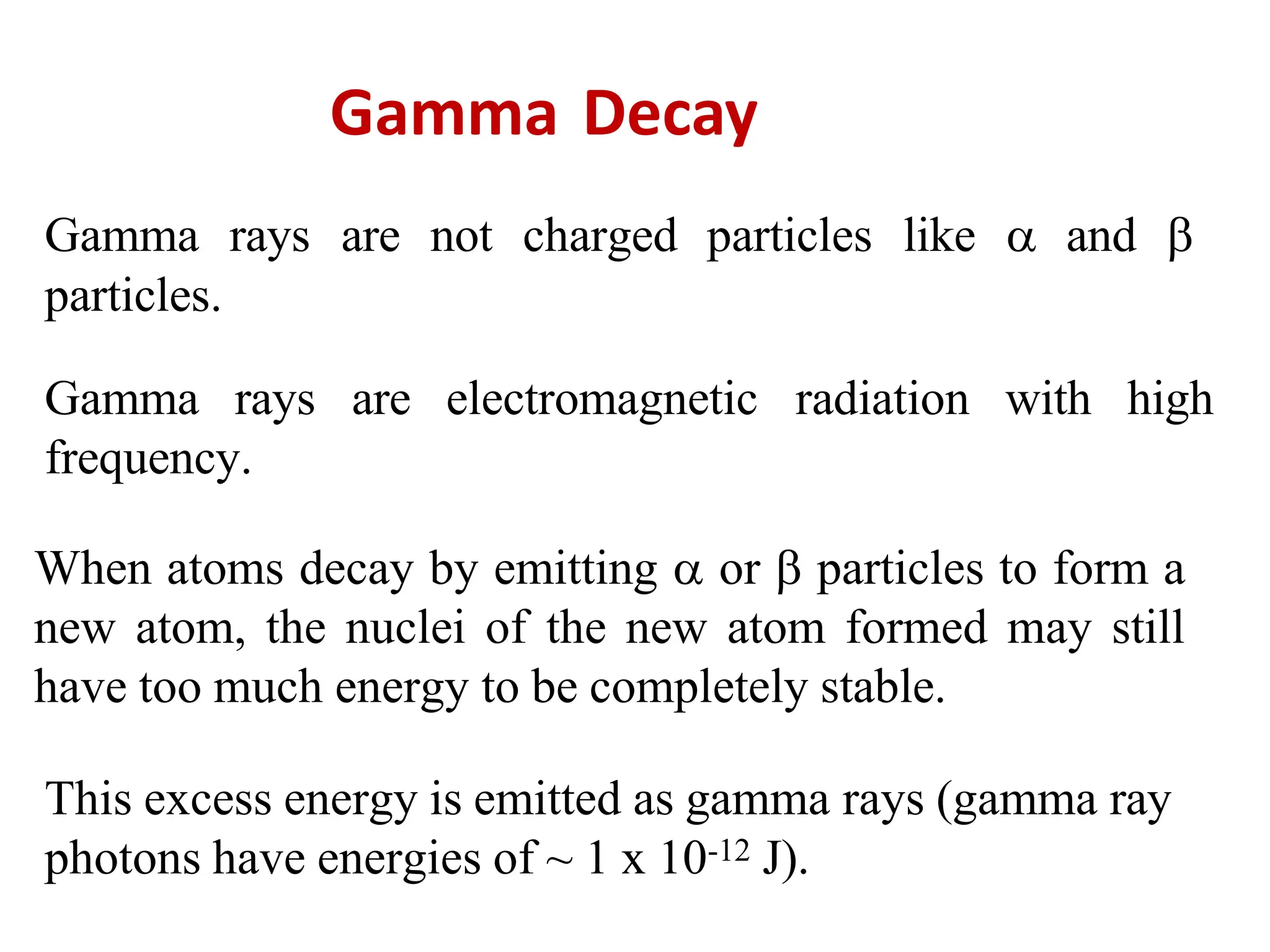
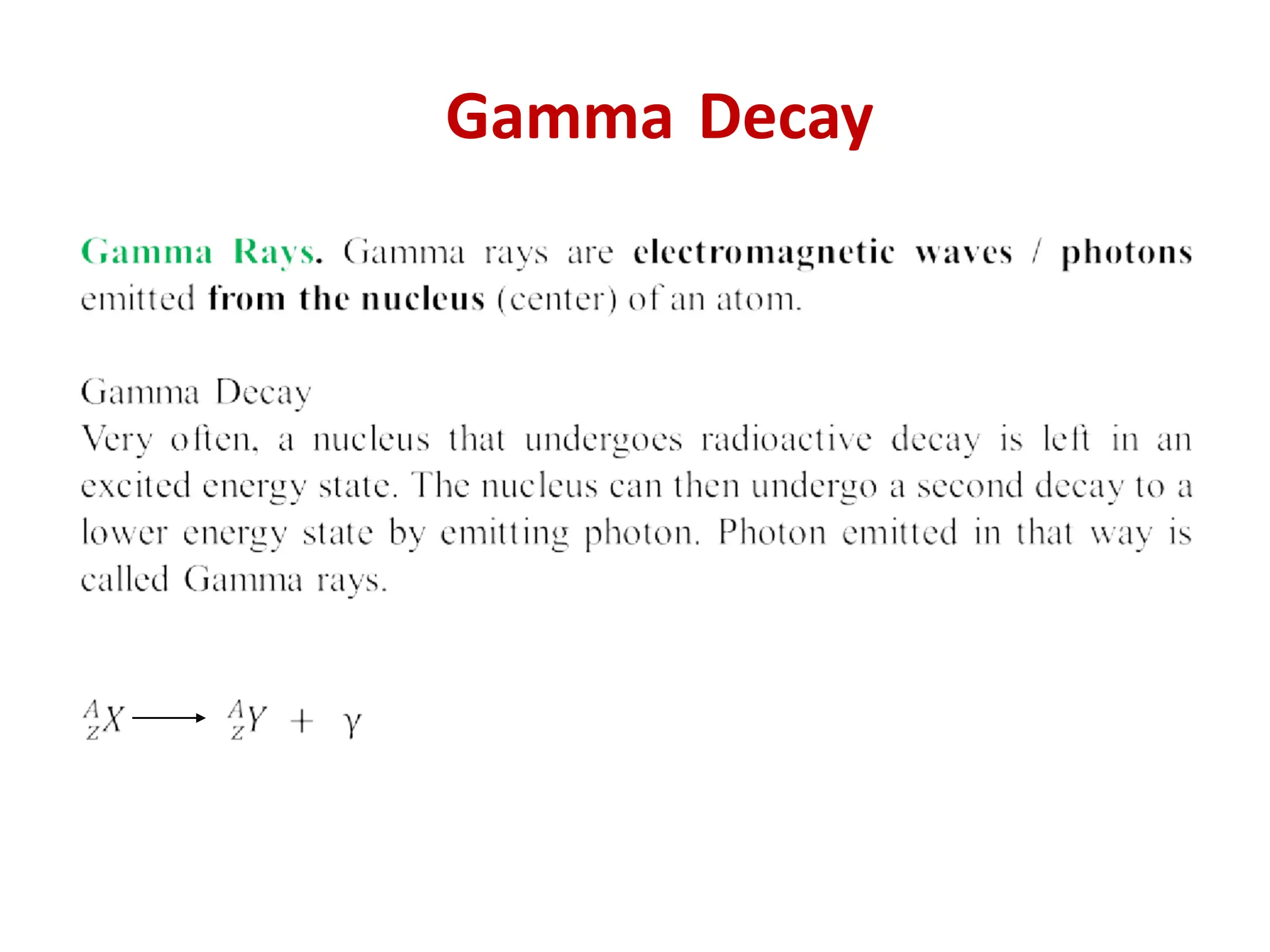
Gamma rays are not charged particles like  and 
particles.
Gamma rays are electromagnetic radiation with high
frequency.
When atoms decay by emitting  or  particles to form a
new atom, the nuclei of the new atom formed may still
have too much energy to be completely stable.
This excess energy is emitted as gamma rays (gamma ray
photons have energies of ~ 1 x 10-12 J).
Gamma Decay
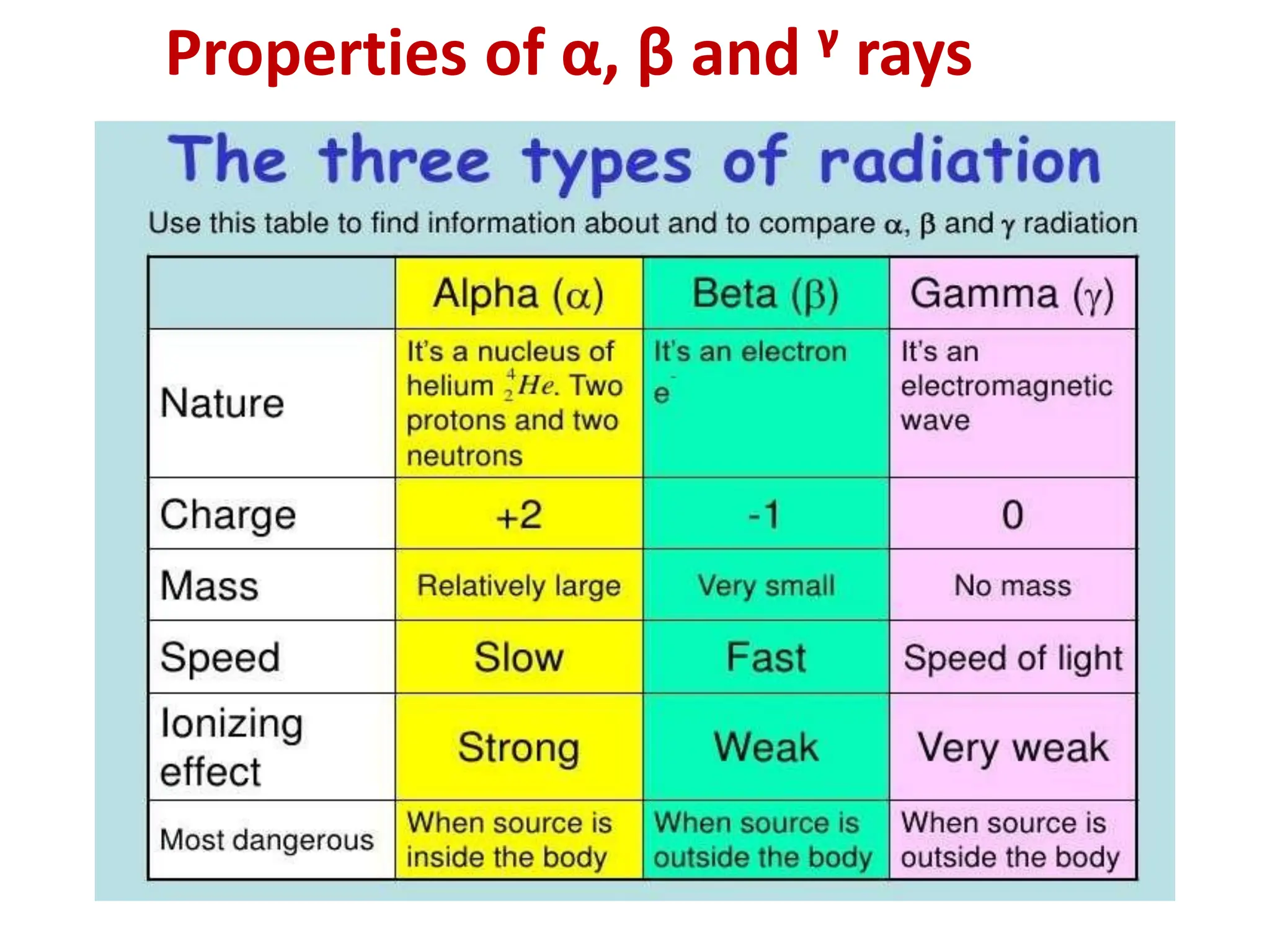
Properties of α, β and ᵞ rays
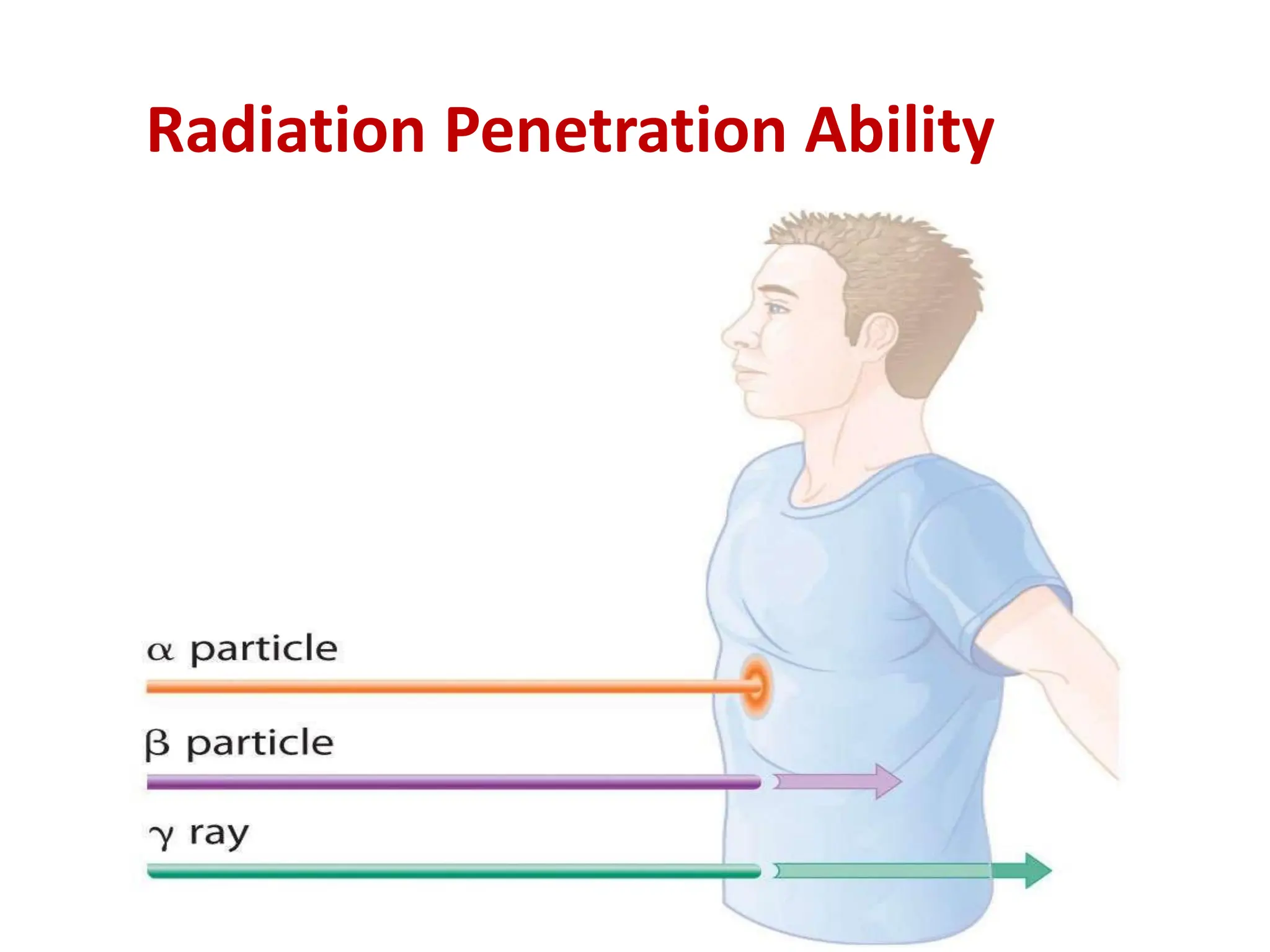
Radiation Penetration Ability
Nuclear
Reactions
Nuclear Reactions
• These are the reactions in which one
element is converted into the other either by
emitting α or β particles (spontaneous
disintegration) or by bombarding it with
suitable bombarding particle
(artificial transmutation of element).
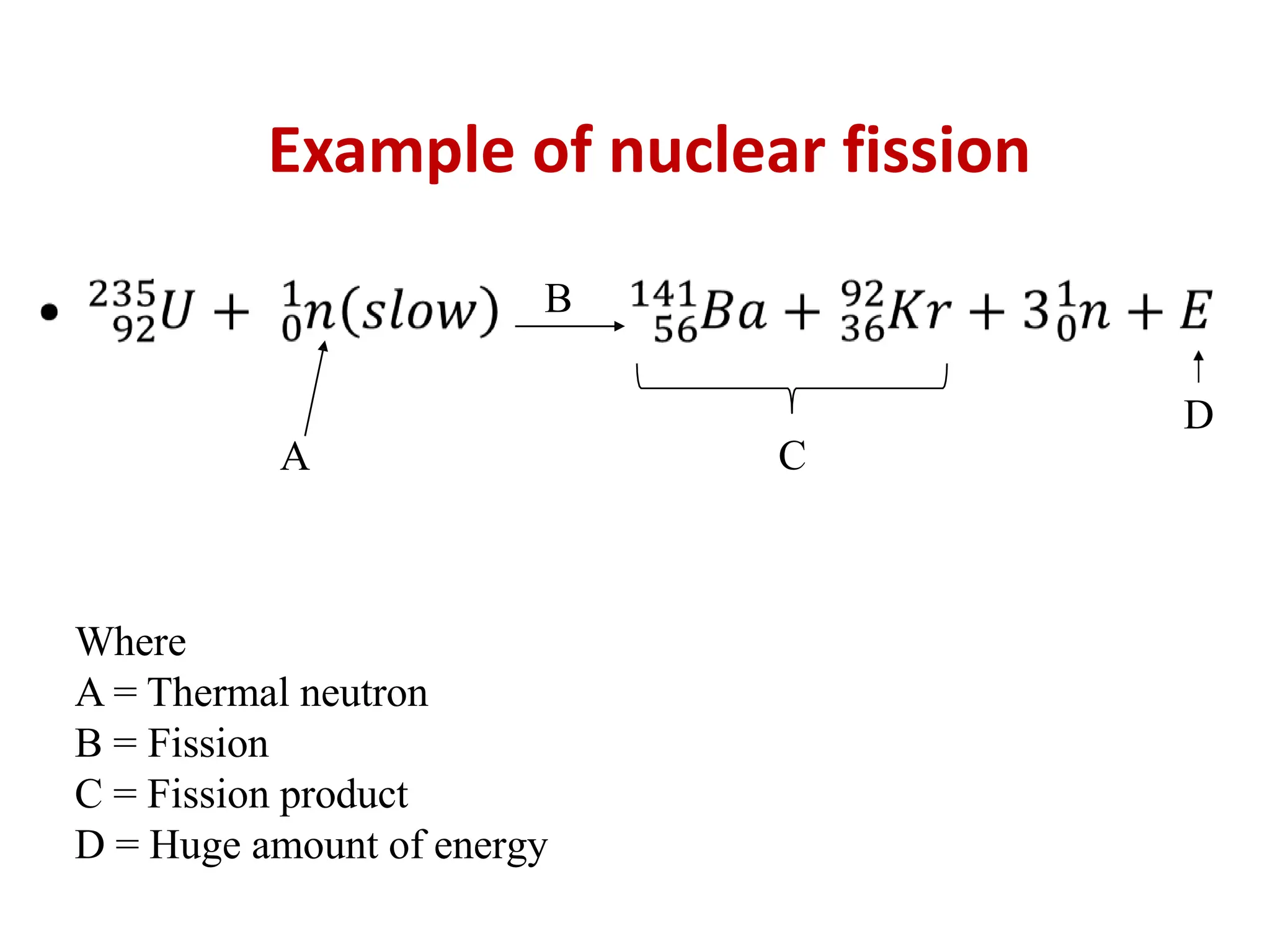
Nuclear Fission Reaction
• Is a nuclear reaction in which a heavy
nucleus, when bombarded with slow
moving neutrons, split into two nuclei of
near equal mass with the release of
anomalous amount of energy.
Example of nuclear fission
A
B
C
D
Where
A = Thermal neutron
B = Fission
C = Fission product
D = Huge amount of energy
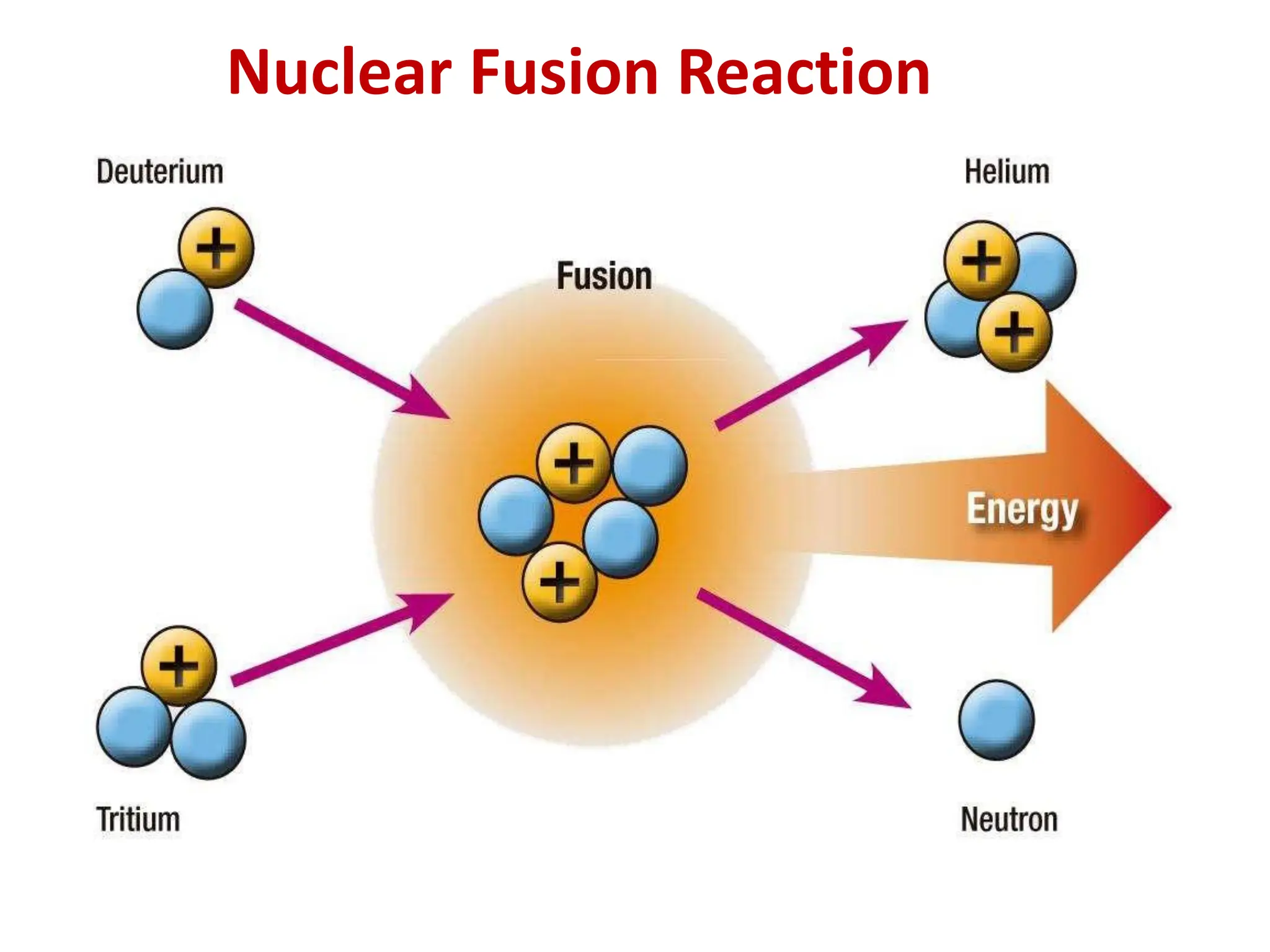
Nuclear Fusion
Also called Atomic Fusion
• Is the nuclear reaction in which lighter
nuclei combine together to form a single
heavy and more stable nucleus and large
amount of energy is released.
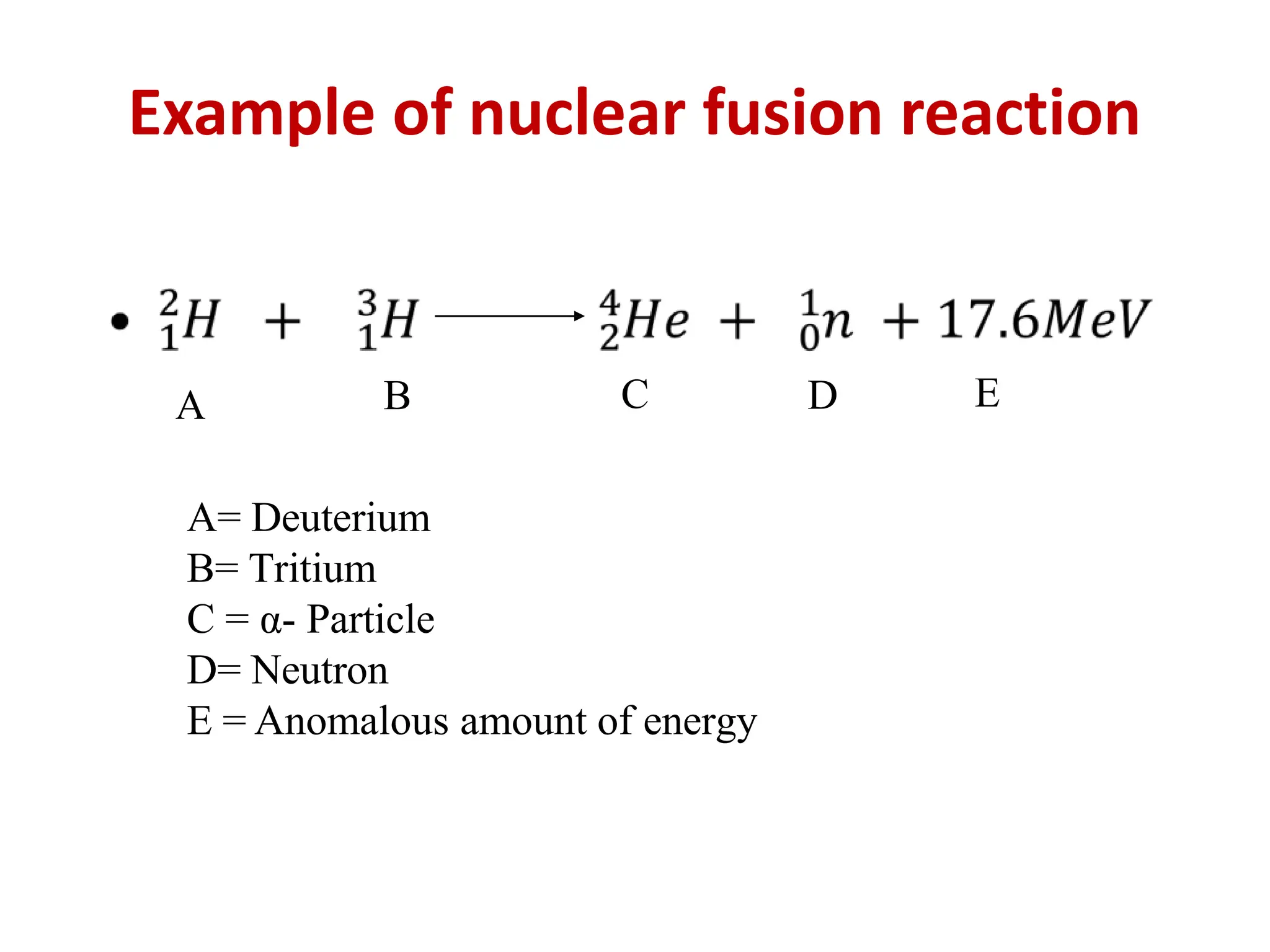
Example of nuclear fusion reaction
A B C D E
A= Deuterium
B= Tritium
C = α- Particle
D= Neutron
E = Anomalous amount of energy
Nuclear Fusion Reaction
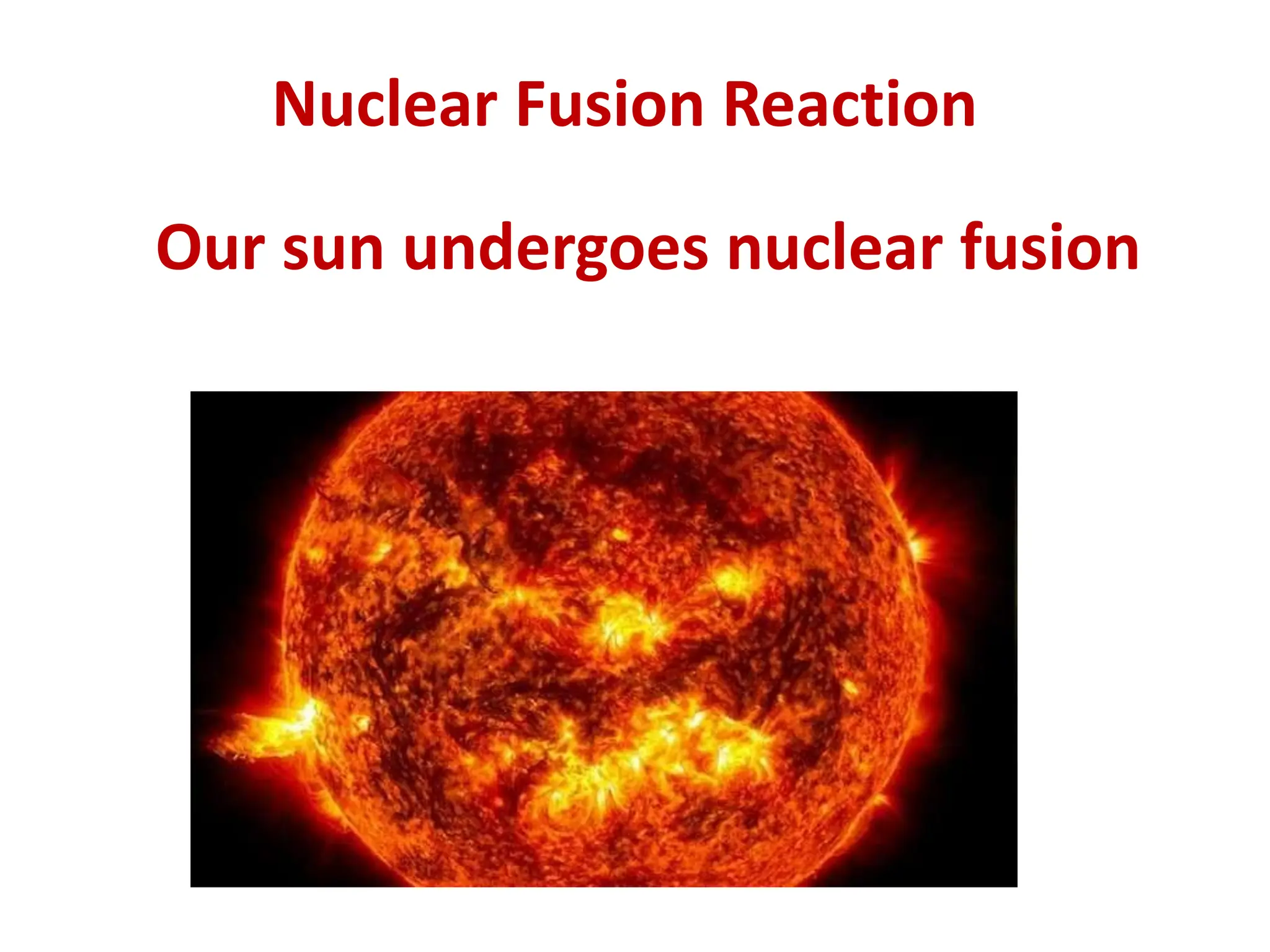
Our sun undergoes nuclear fusion
Nuclear Fusion Reaction

Lecture 5 Radioactive Elements.pdf 8 covers many of the characters and many of the radioactiveelementss it is very useful for the boys using by