Launch:10/5
  Grab a your binder and immediately take a seat
  Read “Effects of Radiation” handout
  Make a list of at least 5 different effects radiation
  has on the human body
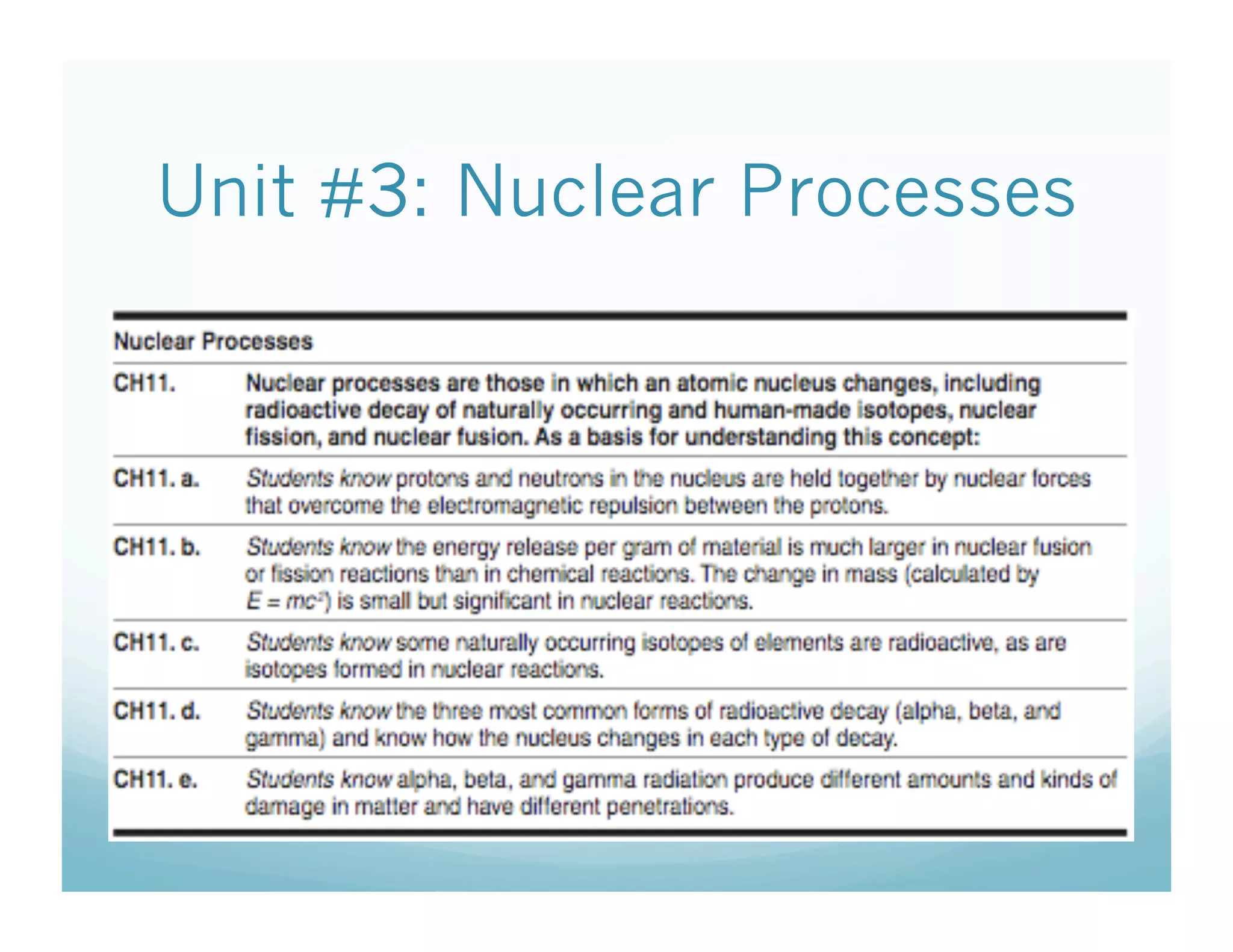
Unit #3: Nuclear Processes
What are the 3 types
of radioactive decay?
        Mr. Heffner
         10/5/09
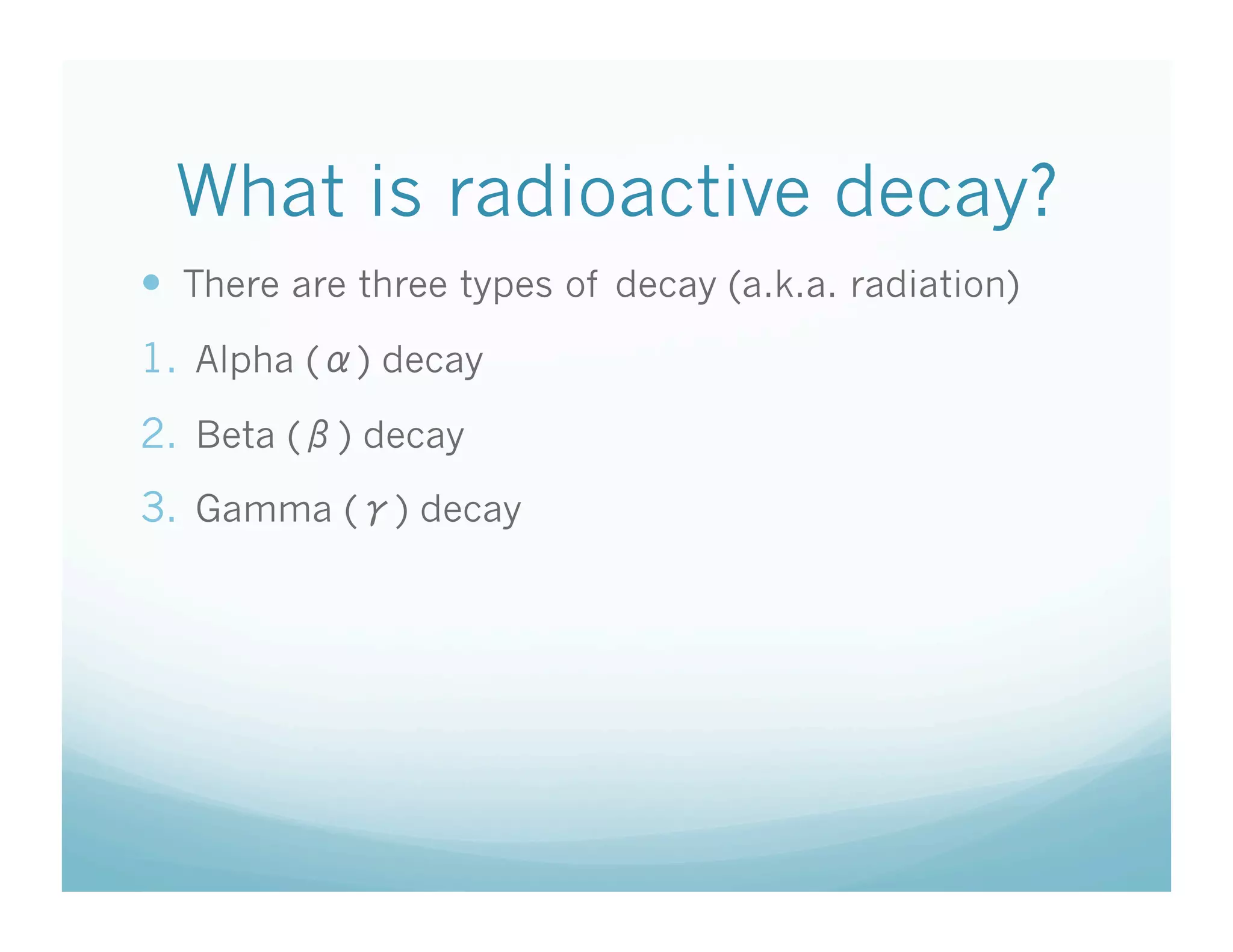
What is radioactive decay?
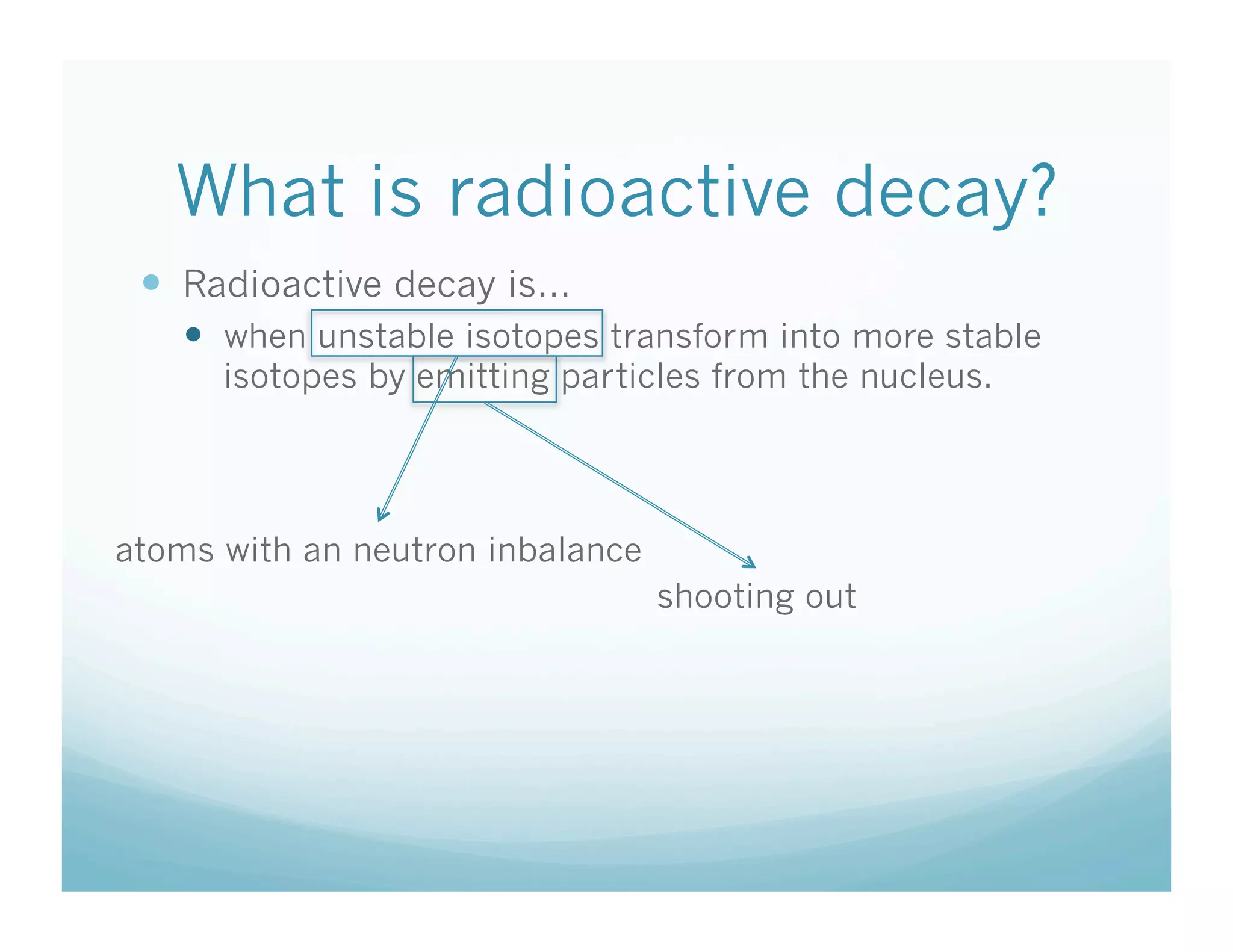
   Radioactive decay is…
      when unstable isotopes transform into more stable
      isotopes by emitting particles from the nucleus.


atoms with an neutron inbalance
                                  shooting out
What is radioactive decay?
  There are three types of decay (a.k.a. radiation)
1.  Alpha ( ) decay
2.  Beta ( ) decay
3.  Gamma ( ) decay
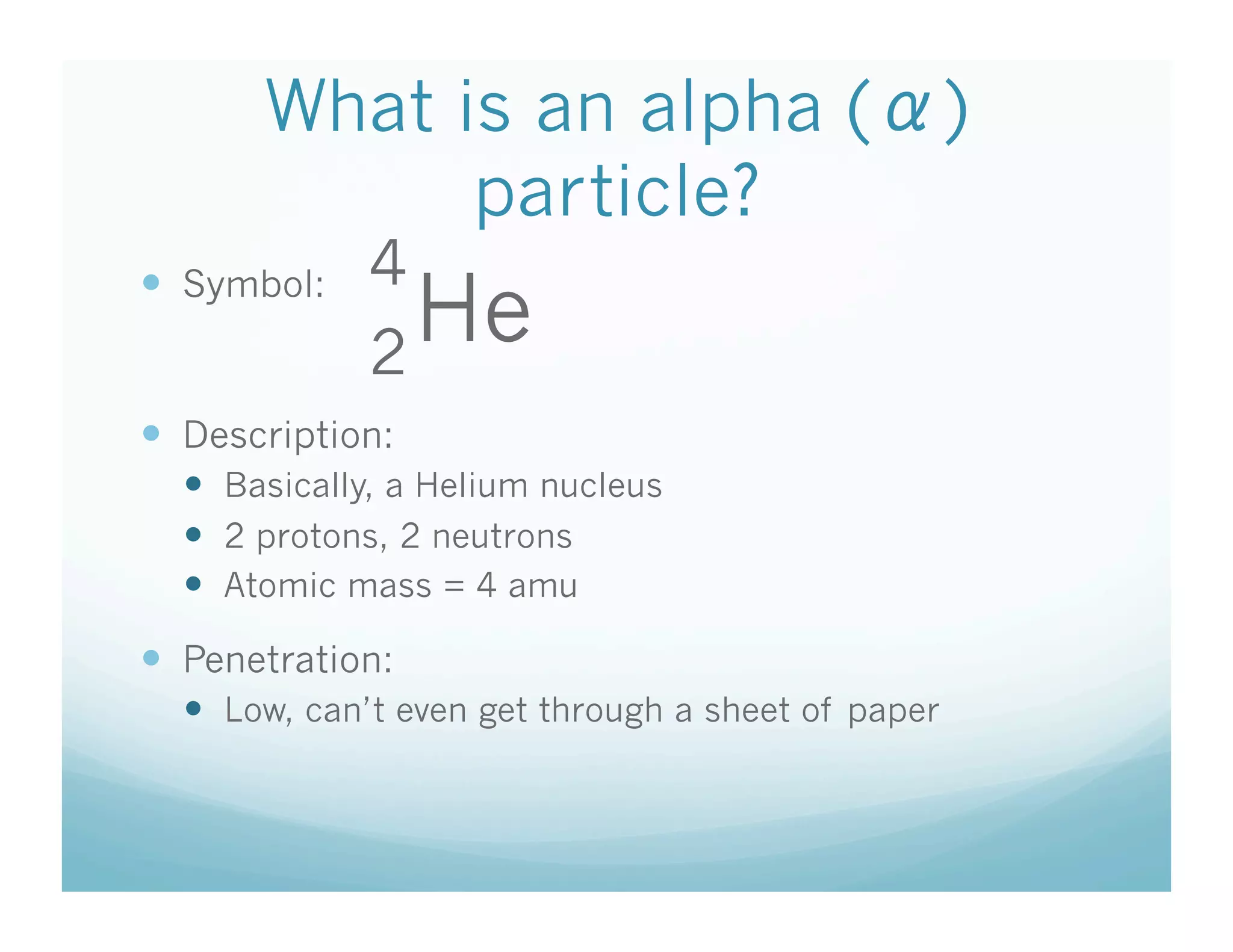
What is an alpha ( )
             particle?
             4
  Symbol:
             2
               He
  Description:
    Basically, a Helium nucleus
    2 protons, 2 neutrons
    Atomic mass = 4 amu

  Penetration:
    Low, can’t even get through a sheet of paper
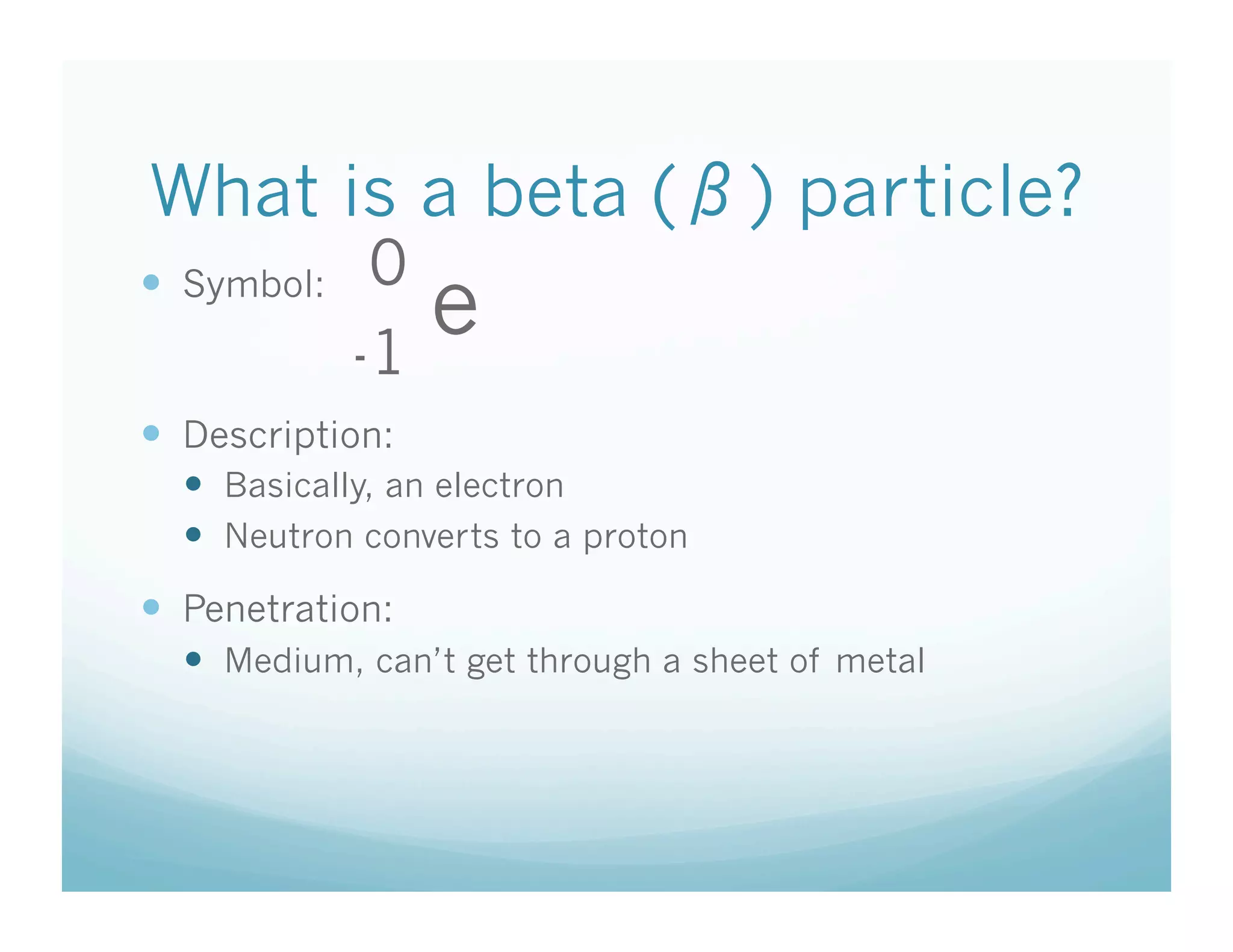
What is a beta ( ) particle?
              0
  Symbol:
             -1
                  e
  Description:
    Basically, an electron
    Neutron converts to a proton
  Penetration:
    Medium, can’t get through a sheet of metal
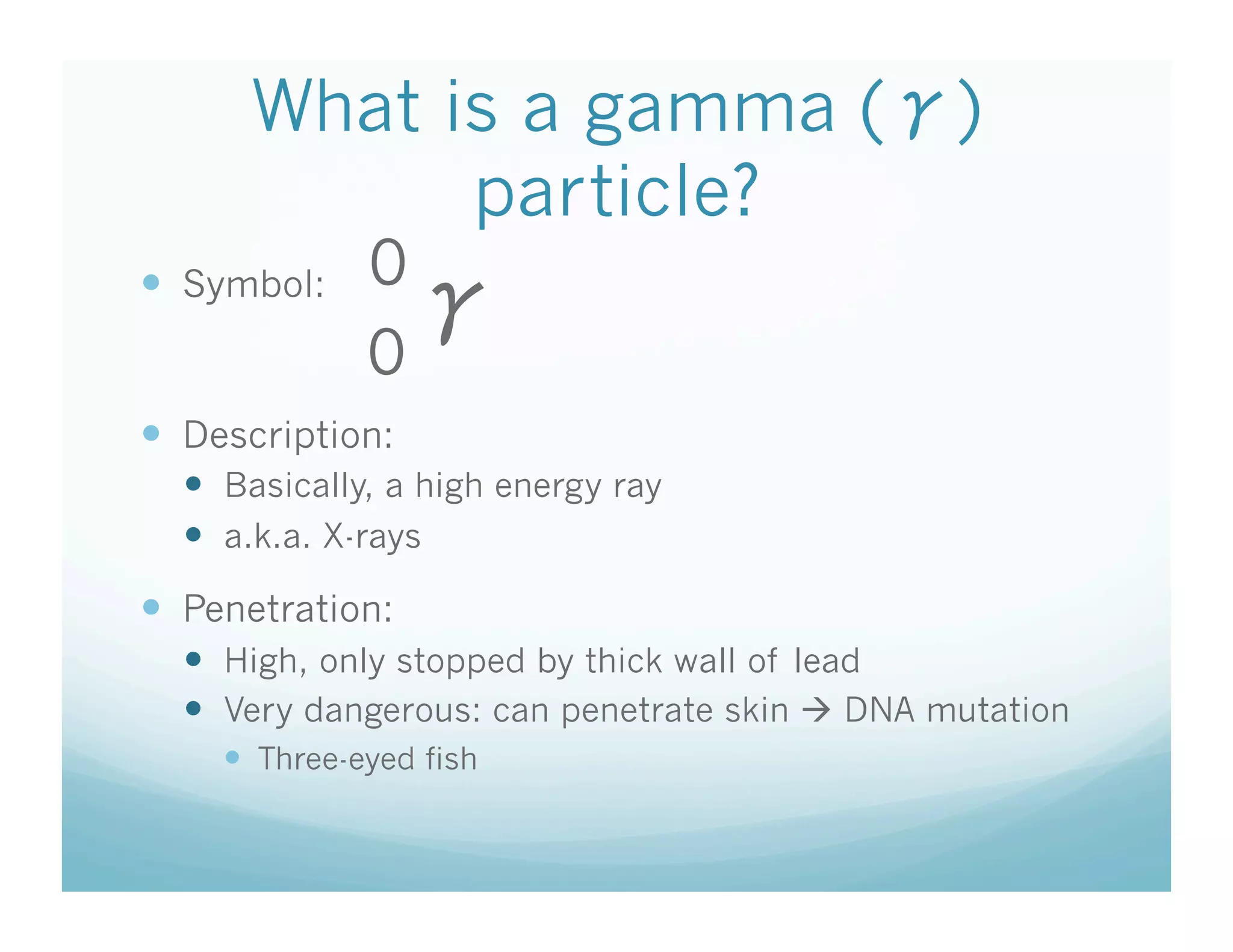
What is a gamma ( )
            particle?
  Symbol:    0
              0
  Description:
    Basically, a high energy ray
    a.k.a. X-rays
  Penetration:
    High, only stopped by thick wall of lead
    Very dangerous: can penetrate skin  DNA mutation
      Three-eyed fish
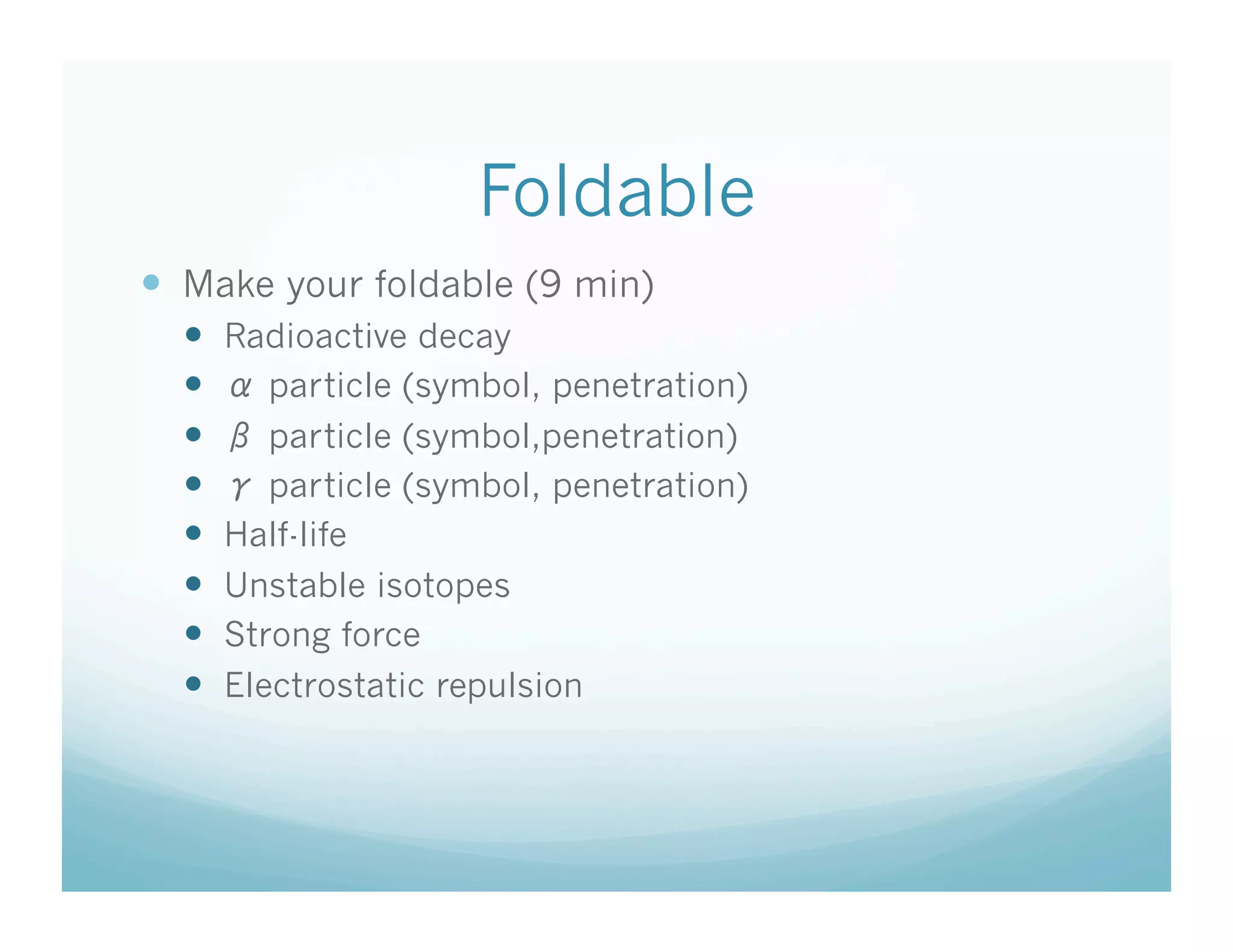
Foldable
  Make your foldable (9 min)
      Radioactive decay
        particle (symbol, penetration)
        particle (symbol,penetration)
        particle (symbol, penetration)
      Half-life
      Unstable isotopes
      Strong force
      Electrostatic repulsion
Foldable
  Review foldable by yourself (4 min)
    MEMORIZE THE SYMBOLS AND DEFINITIONS!
  Quiz your partner (4 min)
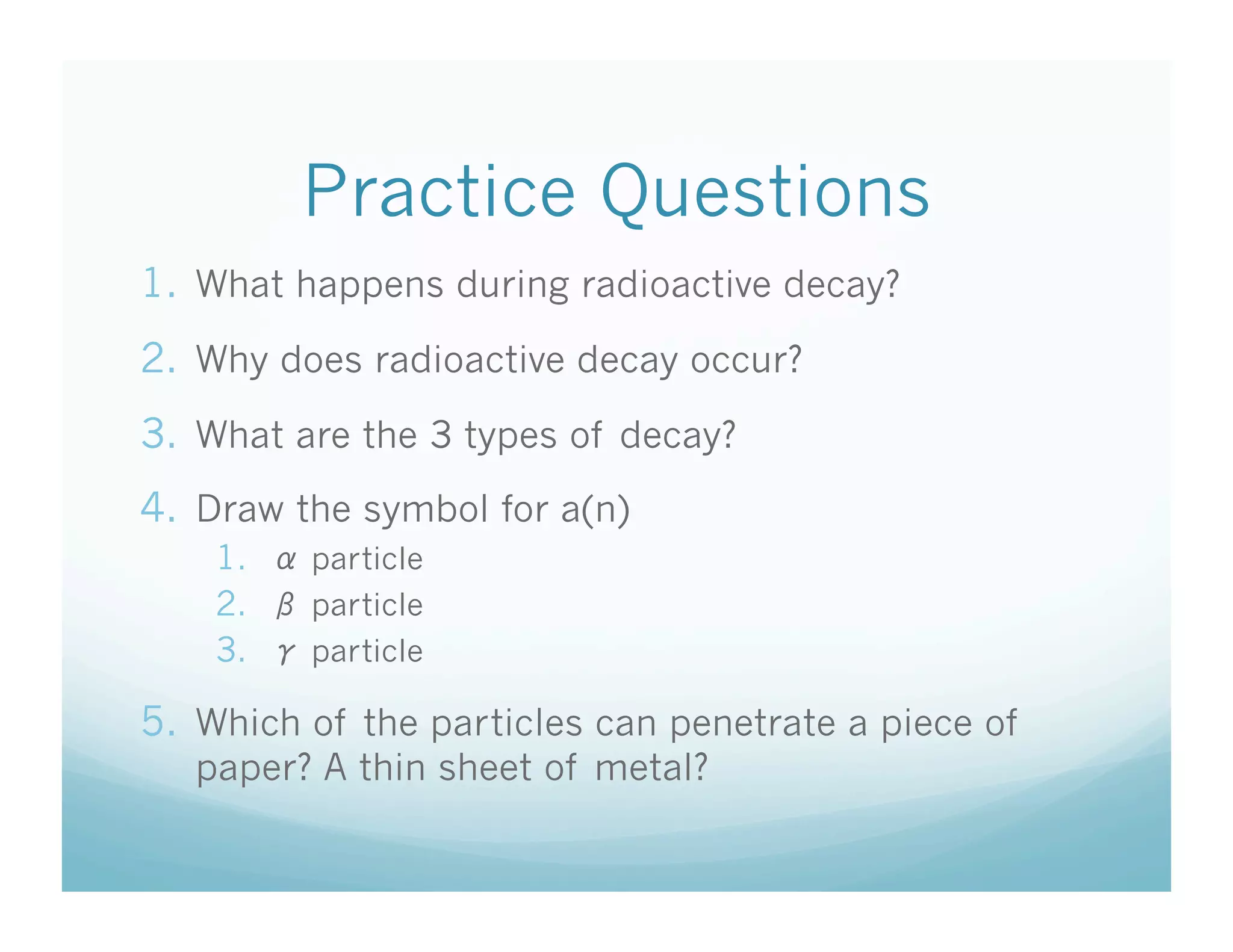
Practice Questions
1.  What happens during radioactive decay?
2.  Why does radioactive decay occur?
3.  What are the 3 types of decay?
4.  Draw the symbol for a(n)
    1.    particle
    2.    particle
    3.    particle

5.  Which of the particles can penetrate a piece of
   paper? A thin sheet of metal?
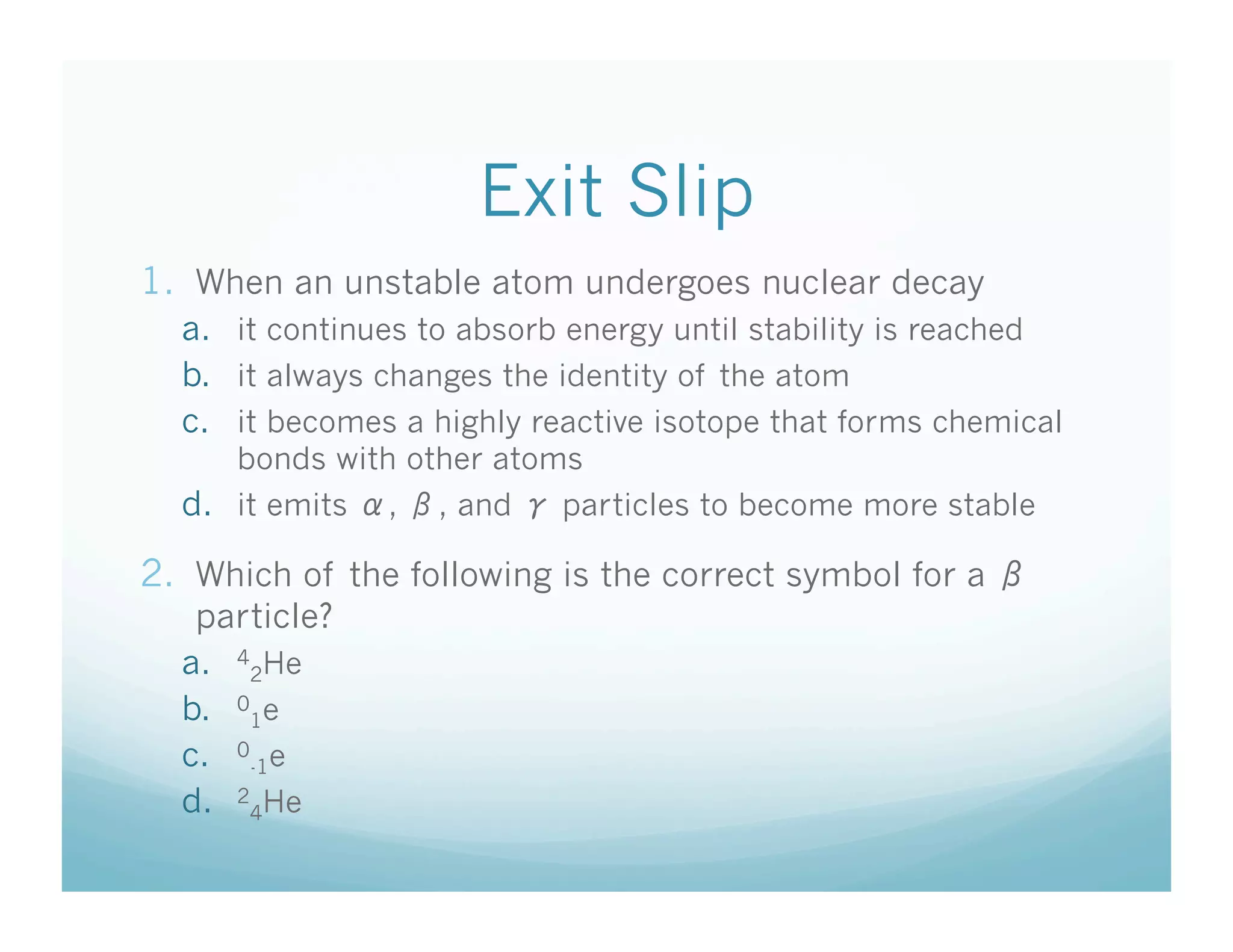
Exit Slip
1.  When an unstable atom undergoes nuclear decay
  a.  it continues to absorb energy until stability is reached
  b.  it always changes the identity of the atom
  c.  it becomes a highly reactive isotope that forms chemical
      bonds with other atoms
  d.  it emits   ,   , and   particles to become more stable

2.  Which of the following is the correct symbol for a
   particle?
  a.  42He
  b.  01e
  c.  0-1e
  d.  24He
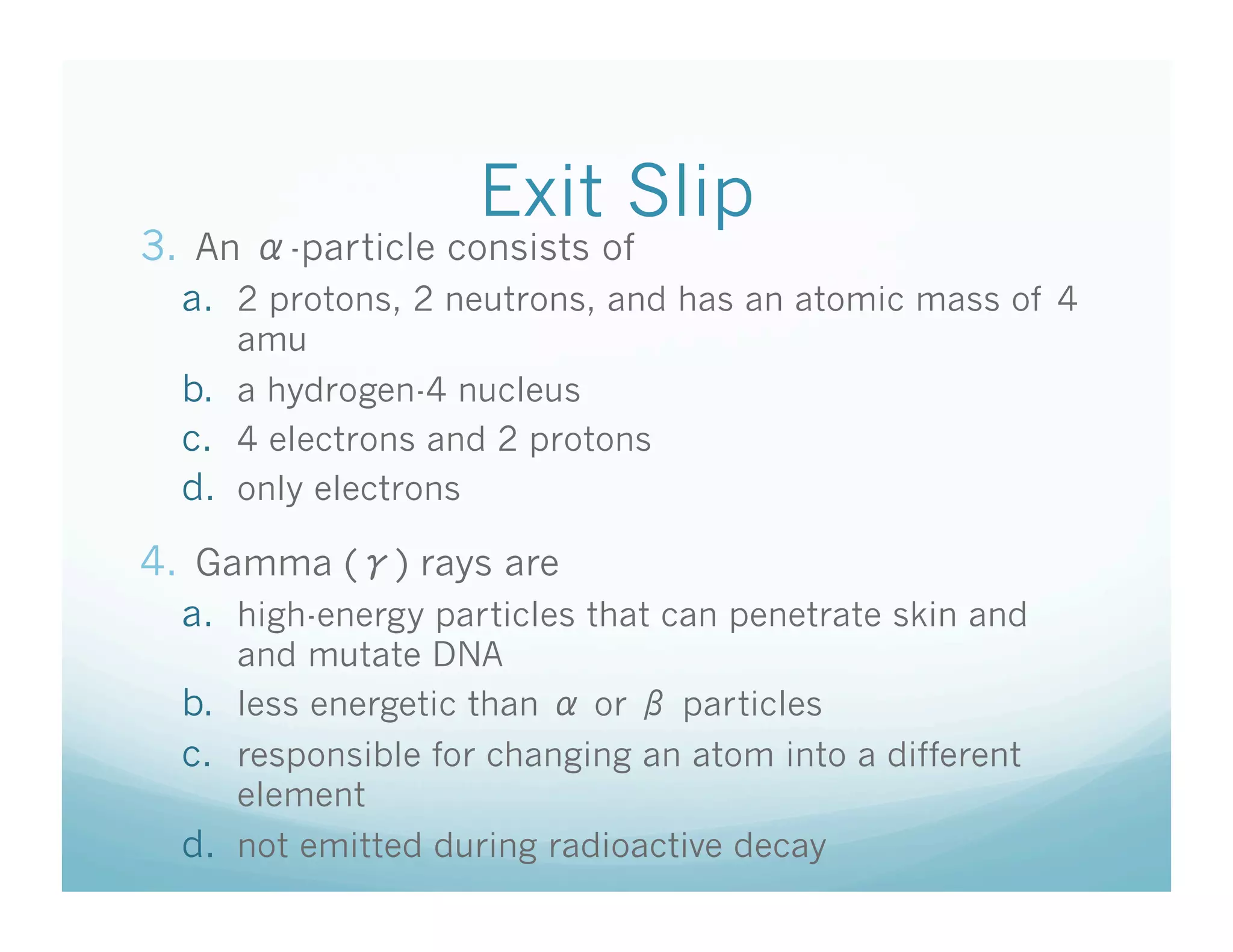
Exit Slip
3.  An   -particle consists of
  a.  2 protons, 2 neutrons, and has an atomic mass of 4
      amu
  b.  a hydrogen-4 nucleus
  c.  4 electrons and 2 protons
  d.  only electrons

4.  Gamma ( ) rays are
  a.  high-energy particles that can penetrate skin and
      and mutate DNA
  b.  less energetic than   or    particles
  c.  responsible for changing an atom into a different
      element
  d.  not emitted during radioactive decay
Exit Slip
5.  A 2-cm thick piece of cardboard placed over a
   radiation source would be most effective in
   protecting against which type of radiation?
  a.  alpha
  b.  beta
  c.  gamma
  d.  X-ray
Homework
  Pg. 657 #1
  Pg. 669 #6, 10

10/5 What are the three types of radioactive decay?

  • 1.
    Launch:10/5   Grab ayour binder and immediately take a seat   Read “Effects of Radiation” handout   Make a list of at least 5 different effects radiation has on the human body
  • 2.
  • 3.
    What are the3 types of radioactive decay? Mr. Heffner 10/5/09
  • 4.
    What is radioactivedecay?   Radioactive decay is…   when unstable isotopes transform into more stable isotopes by emitting particles from the nucleus. atoms with an neutron inbalance shooting out
  • 5.
    What is radioactivedecay?   There are three types of decay (a.k.a. radiation) 1.  Alpha ( ) decay 2.  Beta ( ) decay 3.  Gamma ( ) decay
  • 6.
    What is analpha ( ) particle? 4   Symbol: 2 He   Description:   Basically, a Helium nucleus   2 protons, 2 neutrons   Atomic mass = 4 amu   Penetration:   Low, can’t even get through a sheet of paper
  • 7.
    What is abeta ( ) particle? 0   Symbol: -1 e   Description:   Basically, an electron   Neutron converts to a proton   Penetration:   Medium, can’t get through a sheet of metal
  • 8.
    What is agamma ( ) particle?   Symbol: 0 0   Description:   Basically, a high energy ray   a.k.a. X-rays   Penetration:   High, only stopped by thick wall of lead   Very dangerous: can penetrate skin  DNA mutation   Three-eyed fish
  • 9.
    Foldable   Make yourfoldable (9 min)   Radioactive decay   particle (symbol, penetration)   particle (symbol,penetration)   particle (symbol, penetration)   Half-life   Unstable isotopes   Strong force   Electrostatic repulsion
  • 10.
    Foldable   Review foldableby yourself (4 min)   MEMORIZE THE SYMBOLS AND DEFINITIONS!   Quiz your partner (4 min)
  • 11.
    Practice Questions 1.  Whathappens during radioactive decay? 2.  Why does radioactive decay occur? 3.  What are the 3 types of decay? 4.  Draw the symbol for a(n) 1.  particle 2.  particle 3.  particle 5.  Which of the particles can penetrate a piece of paper? A thin sheet of metal?
  • 12.
    Exit Slip 1.  Whenan unstable atom undergoes nuclear decay a.  it continues to absorb energy until stability is reached b.  it always changes the identity of the atom c.  it becomes a highly reactive isotope that forms chemical bonds with other atoms d.  it emits , , and particles to become more stable 2.  Which of the following is the correct symbol for a particle? a.  42He b.  01e c.  0-1e d.  24He
  • 13.
    Exit Slip 3.  An -particle consists of a.  2 protons, 2 neutrons, and has an atomic mass of 4 amu b.  a hydrogen-4 nucleus c.  4 electrons and 2 protons d.  only electrons 4.  Gamma ( ) rays are a.  high-energy particles that can penetrate skin and and mutate DNA b.  less energetic than or particles c.  responsible for changing an atom into a different element d.  not emitted during radioactive decay
  • 14.
    Exit Slip 5.  A2-cm thick piece of cardboard placed over a radiation source would be most effective in protecting against which type of radiation? a.  alpha b.  beta c.  gamma d.  X-ray
  • 15.
    Homework   Pg. 657#1   Pg. 669 #6, 10