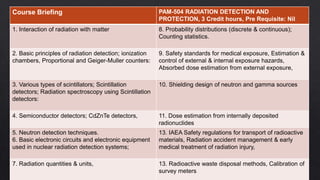
Course Briefing PAM-504 RADIATION DETECTION AND
PROTECTION, 3 Credit hours, Pre Requisite: Nil
1. Interaction of radiation with matter 8. Probability distributions (discrete & continuous);
Counting statistics.
2. Basic principles of radiation detection; ionization

chambers, Proportional and Geiger-Muller counters:
9. Safety standards for medical exposure, Estimation &
control of external & internal exposure hazards,
Absorbed dose estimation from external exposure,
3. Various types of scintillators; Scintillation
detectors; Radiation spectroscopy using Scintillation
detectors:
10. Shielding design of neutron and gamma sources
4. Semiconductor detectors; CdZnTe detectors, 11. Dose estimation from internally deposited
radionuclides
5. Neutron detection techniques.
6. Basic electronic circuits and electronic equipment
used in nuclear radiation detection systems;
13. IAEA Safety regulations for transport of radioactive
materials, Radiation accident management & early
medical treatment of radiation injury,
7. Radiation quantities & units, 13. Radioactive waste disposal methods, Calibration of
survey meters
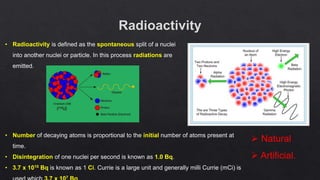
• Radioactivity is defined as the spontaneous split of a nuclei
into another nuclei or particle. In this process radiations are
emitted.
• Number of decaying atoms is proportional to the initial number of atoms present at
time.
• Disintegration of one nuclei per second is known as 1.0 Bq.
• 3.7 x 10¹⁰ Bq is known as 1 Ci. Currie is a large unit and generally milli Currie (mCi) is
7
 Natural
 Artificial.
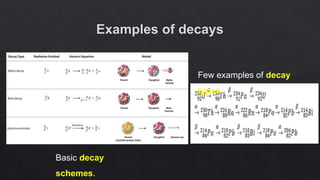
Example of radioactive decay of U235. Few more examples of radioactive
decay.
• Decay curve for C0-60 with half life of 5.27 y.
Type of Decay Particle Emitted Change in A Change in Z
Alpha decay Helium Nuclei Decrease by 4 Decrease by 2
Beta decay Beta particle No change Increase by 1
Gamma Emission Energy No change No change
Positron Emission Positron No change Decrease by 1
Electron capture X-Ray photon No change Decrease by 1
Few examples of decay
types.
Basic decay
schemes.
• Emitted radiations are of several
types, including Alpha, Beta, Gamma
and Neutrons.
• By passing them through electrostatic
field we can distinguish most of them.
• Alpha and Beta are
charged particles.
• Gamma and Neutrons
are neutral radiations.
• Alpha and Beta are called
directly ionizing while
gamma and neutron are
called indirectly ionizing
radiations.
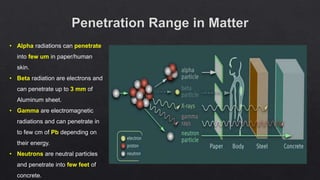
• Alpha radiations can penetrate
into few um in paper/human
skin.
• Beta radiation are electrons and
can penetrate up to 3 mm of
Aluminum sheet.
• Gamma are electromagnetic
radiations and can penetrate in
to few cm of Pb depending on
their energy.
• Neutrons are neutral particles
and penetrate into few feet of
concrete.
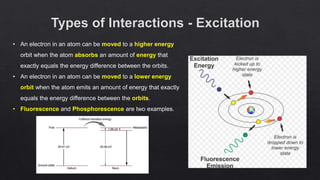
• An electron in an atom can be moved to a higher energy
orbit when the atom absorbs an amount of energy that
exactly equals the energy difference between the orbits.
• An electron in an atom can be moved to a lower energy
orbit when the atom emits an amount of energy that exactly
equals the energy difference between the orbits.
• Fluorescence and Phosphorescence are two examples.
• Ionization energy, also called ionization
potential, is the amount of energy required to
remove an electron from an
isolated atom or molecule.
• There is an ionization energy for each
successive electron removed; the ionization
energy associated with removal of the first (most
loosely held) electron, however, is most
commonly used.
• One mole of hydrogen atoms has an atomic
weight of 1.00 gram, and the ionization energy
• The average energy deposited per unit length of track by ionizing
radiation as it passes through and interacts with a medium along its
path.
• Is described in units of keV/um
• Is a very important factor in assessing potential tissue and organ
damage from exposure to ionizing radiation.
• LET (linear energy transfer) is the amount of energy
released by a radioactive particle or wave over the
length of its decay track. Specific Ionization is the
number of ion pairs produced per unit track length.
High LET radiation (like alpha & beta particles)
ionizes water into H and OH radicals over a very short
track. In the example, two events occur in a single cell
so as to form a pair of adjacent OH radicals that
recombine to form peroxide, H2O2, which can produce
oxidative damage in the cell.
Low LET radiation (like X- or gamma rays) also ionizes
water molecules, but over a much longer track. In the
example, two events occur in separate cells, such that
adjacent radicals are of the opposite type:
the H and OH radicals reunite and reform H2O.
• Ionization mainly depends on charge, mass, and K.E.
of the incoming radiation.
• Range is inversely proportional to the ionization
power of the radiation.
• High ionization means short range
• Low ionization means long range
• Similarly,
• High energy or momentum means long range
• Low energy means short range
• However,
• High Energy low ionization
• Low energy high ionization
 Coherent Scattering
 Compton Scattering
 Photoelectric Effect
 Pair Production
 Photodisintegration
• Energies below approximately 10 keV.
• Sometimes called classical scattering or
Thompson scattering, Rayleigh Scattering.
• No ionization.
• Most probable in heavy atoms.
• Hence, less important in biological tissues.
• Question: which material is more suitable for
coherent scattering, Carbon, Oxygen, Lead.
• In the Compton effect, the incident x-ray interacts
with an outer shell electron and ejects it from the
atom,
• thereby ionizing the atom.
• The ejected electron is called a Compton
electron or a secondary electron.
• The probability of the Compton effect is
inversely proportional to x-ray energy (1/E) and
independent of atomic number.
• Interacts with inner shell electrons
• X-rays are absorbed
• The electron removed from an atom is called
photoelectron.
• The probability of the photoelectric effect is
inversely proportional to the third power of the x-
ray energy (1/E)3.
• The probability of photoelectric effect is directly
proportional to the third power of the atomic
number of the absorbing material (Z3).
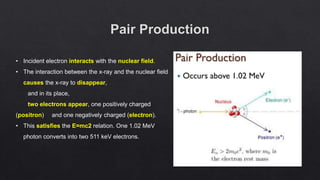
• Incident electron interacts with the nuclear field.
• The interaction between the x-ray and the nuclear field
causes the x-ray to disappear,
and in its place,
two electrons appear, one positively charged
(positron) and one negatively charged (electron).
• This satisfies the E=mc2 relation. One 1.02 MeV
photon converts into two 511 keV electrons.
• An incident photon causes a nucleus to split up
or disintegrate.
• Occurs with x-ray energies > 10 MeV
• The nucleus is raised to an excited state and
instantly emits a nucleon or other nuclear
fragments.
• These nuclear fragments can be of any form.
• Illustration of an alpha particle interacting with
matter.
• The alpha particle has a linear trajectory
through matter
• And
• loses energy through Coulomb collisions with
electrons in the
• Illustration of a beta particle interacting with
matter.
• The beta particle primarily loses energy
through Coulombic collisions with electrons
in the cloud.
• These electrons are energetic and can
undergo secondary, tertiary and high order
interactions.
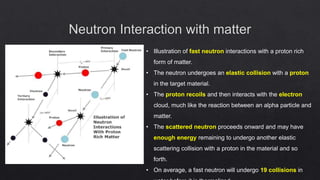
• Illustration of fast neutron interactions with a proton rich
form of matter.
• The neutron undergoes an elastic collision with a proton
in the target material.
• The proton recoils and then interacts with the electron
cloud, much like the reaction between an alpha particle and
matter.
• The scattered neutron proceeds onward and may have
enough energy remaining to undergo another elastic
scattering collision with a proton in the material and so
forth.
• On average, a fast neutron will undergo 19 collisions in
• In the energy range of radiation therapy, 4 types of interaction of
photons with matter are of interest:
• Coherent scattering, photoelectric effect, Compton scattering, and
pair production.
coh    c  
Incoming particle: 1 photon
Outgoing particle(s):
coherent photoelectric compton
Pair
production
1 photon 1 electron
1 electron +
1 photon
1 electron +
1 positron
Incident
photon
fluence
transmitted
photon
fluence
scattered
photons
detector
collimator
Ndx
dN
Ndx
dN




 is the linear attenuation
coefficient x
e
I
x
I
dx
I
dI
Idx
dI









0
)
(
Radiation Interactions.pptx

Radiation Interactions.pptx

  • 2.
    Course Briefing PAM-504RADIATION DETECTION AND PROTECTION, 3 Credit hours, Pre Requisite: Nil 1. Interaction of radiation with matter 8. Probability distributions (discrete & continuous); Counting statistics. 2. Basic principles of radiation detection; ionization chambers, Proportional and Geiger-Muller counters: 9. Safety standards for medical exposure, Estimation & control of external & internal exposure hazards, Absorbed dose estimation from external exposure, 3. Various types of scintillators; Scintillation detectors; Radiation spectroscopy using Scintillation detectors: 10. Shielding design of neutron and gamma sources 4. Semiconductor detectors; CdZnTe detectors, 11. Dose estimation from internally deposited radionuclides 5. Neutron detection techniques. 6. Basic electronic circuits and electronic equipment used in nuclear radiation detection systems; 13. IAEA Safety regulations for transport of radioactive materials, Radiation accident management & early medical treatment of radiation injury, 7. Radiation quantities & units, 13. Radioactive waste disposal methods, Calibration of survey meters
  • 4.
    • Radioactivity isdefined as the spontaneous split of a nuclei into another nuclei or particle. In this process radiations are emitted. • Number of decaying atoms is proportional to the initial number of atoms present at time. • Disintegration of one nuclei per second is known as 1.0 Bq. • 3.7 x 10¹⁰ Bq is known as 1 Ci. Currie is a large unit and generally milli Currie (mCi) is 7  Natural  Artificial.
  • 5.
    Example of radioactivedecay of U235. Few more examples of radioactive decay.
  • 6.
    • Decay curvefor C0-60 with half life of 5.27 y.
  • 8.
    Type of DecayParticle Emitted Change in A Change in Z Alpha decay Helium Nuclei Decrease by 4 Decrease by 2 Beta decay Beta particle No change Increase by 1 Gamma Emission Energy No change No change Positron Emission Positron No change Decrease by 1 Electron capture X-Ray photon No change Decrease by 1
  • 9.
    Few examples ofdecay types. Basic decay schemes.
  • 11.
    • Emitted radiationsare of several types, including Alpha, Beta, Gamma and Neutrons. • By passing them through electrostatic field we can distinguish most of them.
  • 12.
    • Alpha andBeta are charged particles. • Gamma and Neutrons are neutral radiations. • Alpha and Beta are called directly ionizing while gamma and neutron are called indirectly ionizing radiations.
  • 14.
    • Alpha radiationscan penetrate into few um in paper/human skin. • Beta radiation are electrons and can penetrate up to 3 mm of Aluminum sheet. • Gamma are electromagnetic radiations and can penetrate in to few cm of Pb depending on their energy. • Neutrons are neutral particles and penetrate into few feet of concrete.
  • 16.
    • An electronin an atom can be moved to a higher energy orbit when the atom absorbs an amount of energy that exactly equals the energy difference between the orbits. • An electron in an atom can be moved to a lower energy orbit when the atom emits an amount of energy that exactly equals the energy difference between the orbits. • Fluorescence and Phosphorescence are two examples.
  • 17.
    • Ionization energy,also called ionization potential, is the amount of energy required to remove an electron from an isolated atom or molecule. • There is an ionization energy for each successive electron removed; the ionization energy associated with removal of the first (most loosely held) electron, however, is most commonly used. • One mole of hydrogen atoms has an atomic weight of 1.00 gram, and the ionization energy
  • 19.
    • The averageenergy deposited per unit length of track by ionizing radiation as it passes through and interacts with a medium along its path. • Is described in units of keV/um • Is a very important factor in assessing potential tissue and organ damage from exposure to ionizing radiation.
  • 20.
    • LET (linearenergy transfer) is the amount of energy released by a radioactive particle or wave over the length of its decay track. Specific Ionization is the number of ion pairs produced per unit track length. High LET radiation (like alpha & beta particles) ionizes water into H and OH radicals over a very short track. In the example, two events occur in a single cell so as to form a pair of adjacent OH radicals that recombine to form peroxide, H2O2, which can produce oxidative damage in the cell. Low LET radiation (like X- or gamma rays) also ionizes water molecules, but over a much longer track. In the example, two events occur in separate cells, such that adjacent radicals are of the opposite type: the H and OH radicals reunite and reform H2O.
  • 22.
    • Ionization mainlydepends on charge, mass, and K.E. of the incoming radiation. • Range is inversely proportional to the ionization power of the radiation. • High ionization means short range • Low ionization means long range • Similarly, • High energy or momentum means long range • Low energy means short range • However, • High Energy low ionization • Low energy high ionization
  • 23.
     Coherent Scattering Compton Scattering  Photoelectric Effect  Pair Production  Photodisintegration
  • 24.
    • Energies belowapproximately 10 keV. • Sometimes called classical scattering or Thompson scattering, Rayleigh Scattering. • No ionization. • Most probable in heavy atoms. • Hence, less important in biological tissues. • Question: which material is more suitable for coherent scattering, Carbon, Oxygen, Lead.
  • 25.
    • In theCompton effect, the incident x-ray interacts with an outer shell electron and ejects it from the atom, • thereby ionizing the atom. • The ejected electron is called a Compton electron or a secondary electron. • The probability of the Compton effect is inversely proportional to x-ray energy (1/E) and independent of atomic number.
  • 26.
    • Interacts withinner shell electrons • X-rays are absorbed • The electron removed from an atom is called photoelectron. • The probability of the photoelectric effect is inversely proportional to the third power of the x- ray energy (1/E)3. • The probability of photoelectric effect is directly proportional to the third power of the atomic number of the absorbing material (Z3).
  • 27.
    • Incident electroninteracts with the nuclear field. • The interaction between the x-ray and the nuclear field causes the x-ray to disappear, and in its place, two electrons appear, one positively charged (positron) and one negatively charged (electron). • This satisfies the E=mc2 relation. One 1.02 MeV photon converts into two 511 keV electrons.
  • 29.
    • An incidentphoton causes a nucleus to split up or disintegrate. • Occurs with x-ray energies > 10 MeV • The nucleus is raised to an excited state and instantly emits a nucleon or other nuclear fragments. • These nuclear fragments can be of any form.
  • 30.
    • Illustration ofan alpha particle interacting with matter. • The alpha particle has a linear trajectory through matter • And • loses energy through Coulomb collisions with electrons in the
  • 31.
    • Illustration ofa beta particle interacting with matter. • The beta particle primarily loses energy through Coulombic collisions with electrons in the cloud. • These electrons are energetic and can undergo secondary, tertiary and high order interactions.
  • 32.
    • Illustration offast neutron interactions with a proton rich form of matter. • The neutron undergoes an elastic collision with a proton in the target material. • The proton recoils and then interacts with the electron cloud, much like the reaction between an alpha particle and matter. • The scattered neutron proceeds onward and may have enough energy remaining to undergo another elastic scattering collision with a proton in the material and so forth. • On average, a fast neutron will undergo 19 collisions in
  • 34.
    • In theenergy range of radiation therapy, 4 types of interaction of photons with matter are of interest: • Coherent scattering, photoelectric effect, Compton scattering, and pair production. coh    c   Incoming particle: 1 photon Outgoing particle(s): coherent photoelectric compton Pair production 1 photon 1 electron 1 electron + 1 photon 1 electron + 1 positron
  • 35.
    Incident photon fluence transmitted photon fluence scattered photons detector collimator Ndx dN Ndx dN      is thelinear attenuation coefficient x e I x I dx I dI Idx dI          0 ) (