ENTC 4390
MEDICAL IMAGING


 RADIOACTIVE DECAY
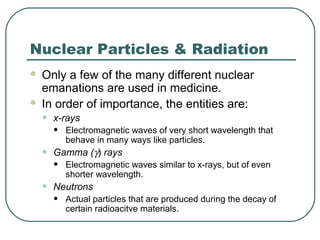
Nuclear Particles & Radiation
 Only a few of the many different nuclear
  emanations are used in medicine.
 In order of importance, the entities are:

    •   x-rays
        •   Electromagnetic waves of very short wavelength that
            behave in many ways like particles.
    •   Gamma (γ) rays
        •   Electromagnetic waves similar to x-rays, but of even
            shorter wavelength.
    •   Neutrons
        •   Actual particles that are produced during the decay of
            certain radioacitve materials.
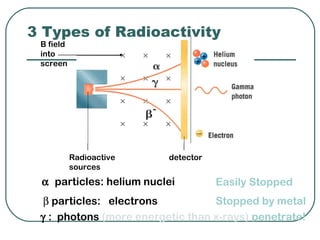
Radioactivity

                Don’t be confused by
                this picture!


                A single radioactive
                source does not emit
                all three types α, β
                and γ.
3 Types of Radioactivity
 B field
 into
 screen


           Radioactive   detector
           sources
 α particles: helium nuclei         Easily Stopped
  β particles: electrons          Stopped by metal
 γ : photons (more energetic than x-rays) penetrate!
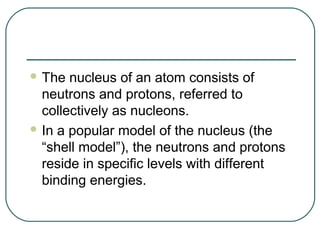
 The  nucleus of an atom consists of
  neutrons and protons, referred to
  collectively as nucleons.
 In a popular model of the nucleus (the
  “shell model”), the neutrons and protons
  reside in specific levels with different
  binding energies.
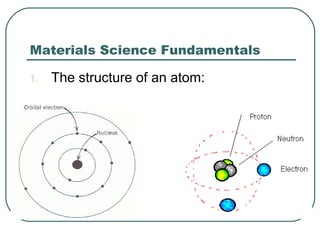
Materials Science Fundamentals

1.   The structure of an atom:
Materials Science Fundamentals

2. Elements/Atomic Number (Z) & Atomic
  Masses

Key: Chemical Behavior Determined by Z
 and Ionization
Materials Science Fundamentals
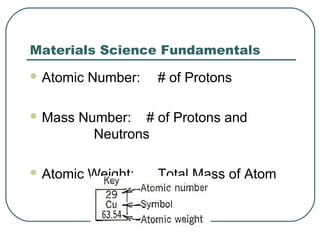
 Atomic   Number:   # of Protons

 Mass   Number: # of Protons and
           Neutrons

 Atomic   Weight:   Total Mass of Atom
   If a vacancy exists at a lower energy level, a
    neutron or proton in a higher level may fall to fill
    the vacancy
    •   This transition releases energy and yields a more
        stable nucleus.
         • The amount of energy released is related to the
             difference in binding energy between the higher and
             lower levels.
         •   The binding energy is much greater for neutrons and
             protons inside the nucleus than for electrons outside the
             nucleus.
               •   Hence, energy released during nuclear transitions is much
                   greater than that released during electron transitions.
   If a nucleus gains stability by transition of a neutron
    between neutron energy levels, or a proton between
    proton energy levels, the process is termed an isometric
    transition.
    •   In an isomeric transition, the nucleus releases energy
        without a change in its number of protons (Z) or neutrons
        (N).
         •   The initial and final energy states of the nucleus are said to be
             isomers.
         •   A common form of isomeric transition is gamma decay (γ) in
             which the energy is released as a packet of energy (a quantum
             or photon) termed a gamma (γ) ray
         •   An isomeric transition that competes with gamma decay is
             internal conversion, in which an electron from an extranuclear
             shell carries the energy out of the atom.
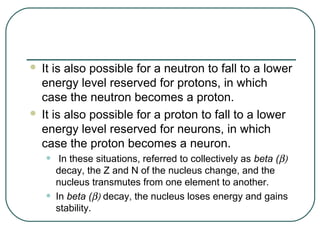
 It is also possible for a neutron to fall to a lower
  energy level reserved for protons, in which
  case the neutron becomes a proton.
 It is also possible for a proton to fall to a lower
  energy level reserved for neurons, in which
  case the proton becomes a neuron.
    •    In these situations, referred to collectively as beta (β)
        decay, the Z and N of the nucleus change, and the
        nucleus transmutes from one element to another.
    •   In beta (β) decay, the nucleus loses energy and gains
        stability.
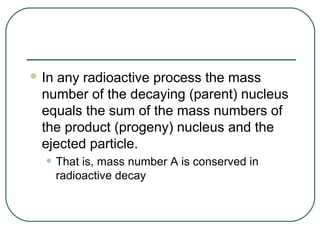
 In any radioactive process the mass
  number of the decaying (parent) nucleus
  equals the sum of the mass numbers of
  the product (progeny) nucleus and the
  ejected particle.
  • That is, mass number A is conserved in
       radioactive decay
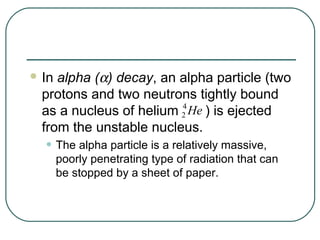
 In alpha (α) decay, an alpha particle (two
  protons and two neutrons tightly bound
                         4
  as a nucleus of helium 2 He ) is ejected
  from the unstable nucleus.
  • The alpha particle is a relatively massive,
       poorly penetrating type of radiation that can
       be stopped by a sheet of paper.
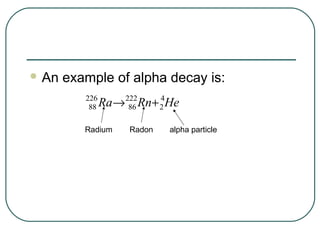
 An   example of alpha decay is:
          226
           88   Ra→ 222Rn+ 2 He
                     86
                           4


          Radium     Radon   alpha particle
ENTC 4390
MEDICAL IMAGING


  DECAY SCHEMES
A  decay scheme depicts the decay
 processes specific for a nuclide (nuclide
 is a generic term for any nuclear form).
 • Energy on the y axis, plotted against the
 • Atomic number of the nuclide on the x axis.
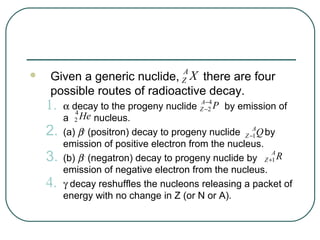
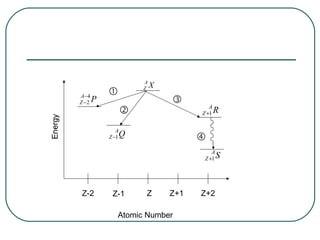
A
   Given a generic nuclide, X there are four
                                    Z
    possible routes of radioactive decay.
    1.                                  A−4
         α decay to the progeny nuclide Z −2 P by emission of
            4
         a 2 He nucleus.
    2.   (a) β+ (positron) decay to progeny nuclide Z −AQ by
                                                       1
         emission of positive electron from the nucleus.
    3.                                                     A
         (b) β− (negatron) decay to progeny nuclide by Z +1 R
         emission of negative electron from the nucleus.
    4.   γ decay reshuffles the nucleons releasing a packet of
         energy with no change in Z (or N or A).
A
                               Z X
         A− 4
                    
         Z −2   P                    
                                              A
                                          Z +1   R
Energy


                       A
                    Z −1Q                  
                                               A
                                            Z +1 S


         Z-2         Z-1        Z    Z+1   Z+2

                       Atomic Number
ENTC 4390


BETA DECAY
 Nucleitend to be most stable if they
 contain even numbers of protons and
 neutrons and least stable if they contain
 an odd number of both.
  • Nuclei are extraordinarily stable if they contain
    2, 8 ,14, 20, 28, 50, 82, or 126 protons.
     • These are termed nuclear magic numbers and
     • Reflect full occupancy of nuclear shells.
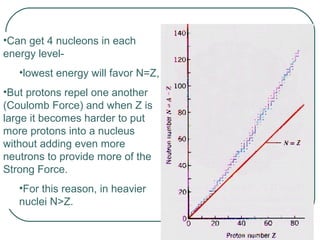
 The number of neutrons is about equal
 to the number of protons in low-Z stable
 nuclei.
  • As Z increases, the number of neutrons
   increases more rapidly than the number of
   protons in stable nuclei.
•Can get 4 nucleons in each
energy level-
   •lowest energy will favor N=Z,
•But protons repel one another
(Coulomb Force) and when Z is
large it becomes harder to put
more protons into a nucleus
without adding even more
neutrons to provide more of the
Strong Force.
   •For this reason, in heavier
   nuclei N>Z.
ENTC 4390


ISOMERIC TRANSITIONS
 Isomeric    transitions are always preceded
  by either electron capture or emission of
  an α or β (+ or -) particle.
 Sometimes one or more of the excited
  states of a progeny nuclide may exist for
  a finite lifetime.
  • An excited state is termed a metastable state
    if its half-life exceeds 10-6 seconds.
   An isometric transition can also occur by
    interaction of the nucleus with an electron in
    one of the electron shells.
    •   This process is called internal conversion.
         • The electron is ejected with kinetic energy E equal to
                                                       k
           the energy Eγ released by the nucleus, reduced by the
           binding energy Eb of the electron


         • The ejected electron is accompanied by x rays and
           Auger electrons as the extranuclear structure of the
           atom resumes a stable configuration.
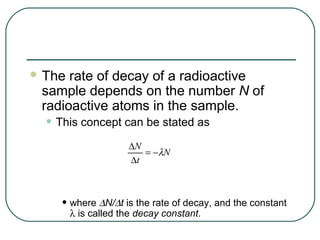
 The rate of decay of a radioactive
 sample depends on the number N of
 radioactive atoms in the sample.
  • This concept can be stated as
                     ∆N
                        = −λN
                     ∆t


     • where ∆N/∆t is the rate of decay, and the constant
        λ is called the decay constant.
 The decay constant has units of time .
 It has a characteristic value for each nuclide.

 It also reflects the nuclides degree of
  instability;
    •   a larger decay constant connotes a more unstable
        nuclide
         • i.e., one that decays more rapidly.
    •   The rate of decay is a measure of a sample’s activity.
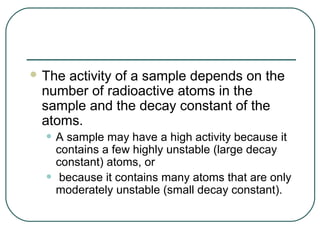
 Theactivity of a sample depends on the
 number of radioactive atoms in the
 sample and the decay constant of the
 atoms.
  • A sample may have a high activity because it
      contains a few highly unstable (large decay
      constant) atoms, or
  •    because it contains many atoms that are only
      moderately unstable (small decay constant).
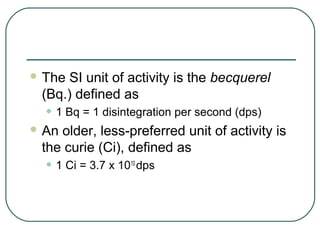
 The SI unit of activity is the becquerel
 (Bq.) defined as
  • 1 Bq = 1 disintegration per second (dps)
 Anolder, less-preferred unit of activity is
 the curie (Ci), defined as
  • 1 Ci = 3.7 x 10   10
                           dps
Example
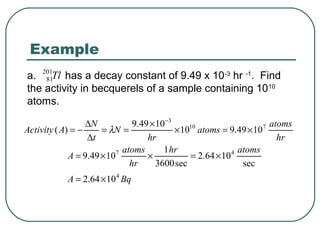
a. 201Tl has a decay constant of 9.49 x 10⁻³ hr -1. Find
    81
the activity in becquerels of a sample containing 1010
atoms.

                  ∆N            9.49 × 10 −3                           atoms
Activity ( A) = −     = λN =                 × 1010 atoms = 9.49 × 10⁷
                  ∆t                hr                                   hr
                           7 atoms       1 hr                4 atoms
             A = 9.49 × 10          ×            = 2.64 × 10
                               hr      3600 sec                 sec
            A = 2.64 × 10 4 Bq
Example
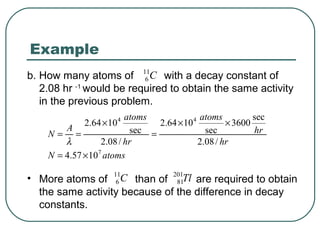
b. How many atoms of 11C with a decay constant of
                          6
   2.08 hr -1 would be required to obtain the same activity
   in the previous problem.
                         atoms              atoms          sec
             2.64 × 10 4        2.64 × 10 4         × 3600
        A                 sec =               sec          hr
    N= =
        λ         2.08 / hr                 2.08 / hr
    N = 4.57 × 10⁷ atoms

• More atoms of 11C than of 201Tl are required to obtain
                  6            81
  the same activity because of the difference in decay
  constants.
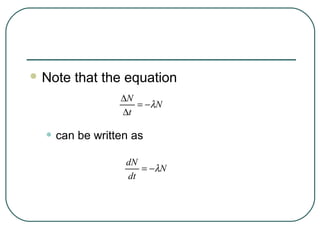
 Note   that the equation
                ∆N
                   = −λN
                ∆t

  • can be written as
                 dN
                    = −λN
                 dt
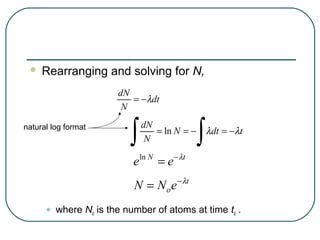
   Rearranging and solving for N,
                        dN
                           = −λdt
                         N


                           ∫                   ∫
natural log format             dN
                                  = ln N = −       λdt = −λt
                                N

                            e ln N = e − λt
                            N = N o e − λt

      •   where No is the number of atoms at time to .
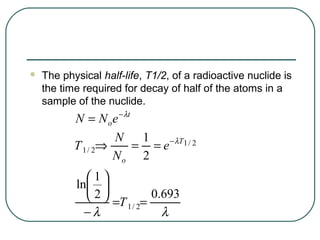
   The physical half-life, T1/2, of a radioactive nuclide is
    the time required for decay of half of the atoms in a
    sample of the nuclide.
           N = N o e − λt
                    N      1   − λT 1 / 2
           T 1 / 2⇒       = =e
                    No 2
             1
           ln 
              2  =T = 0.693
                     1/ 2
             −λ           λ
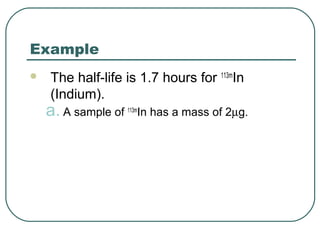
Example
   The half-life is 1.7 hours for 113mIn
    (Indium).
    a. A sample of      In has a mass of 2µg.
                     113m
ENTC 4390
MEDICAL IMAGING


  DECAY SCHEMES
X-Rays
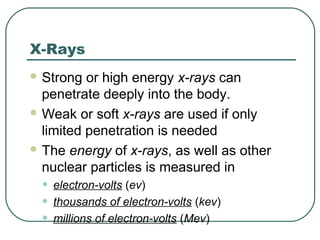
 Strong  or high energy x-rays can
  penetrate deeply into the body.
 Weak or soft x-rays are used if only
  limited penetration is needed
 The energy of x-rays, as well as other
  nuclear particles is measured in
 •   electron-volts (ev)
 •   thousands of electron-volts (kev)
 •   millions of electron-volts (Mev)
 The diagnostic use of x-ray depends on
 the fact that various types of absorbs x-
 rays to a greater or lesser degree.
 •   Absorption by bone is quite high,
 •   Absorption by fatty tissue is low.
 Thisallows the use of the x-ray beam for
 delineating the details of body structure.
Gamma Rays
 X-rays  are generally produced
  electrically.
 γ_rays are the result of a radioactive
  transition in a substance that has been
  activated in a nuclear reactor.
 Once again, energy is measured in

 •   electron-volts (ev)
 •   thousands of electron-volts (kev)
 •   millions of electron-volts (Mev)
higher energy γ-rays penetrate all
 The
 human tissue quite easily.
  γ-rays are used in conjunction with scanning
   systems to detect anomalies due to disease or
   neoplastic growth.
Neutrons
 Neutron    applications in medicine are
  limited.
 Again, energy is measured in

 •   electron-volts (ev)
 •   thousands of electron-volts (kev)
 •   millions of electron-volts (Mev)
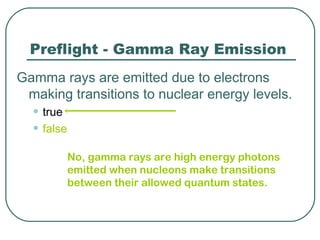
Preflight - Gamma Ray Emission
Gamma rays are emitted due to electrons
 making transitions to nuclear energy levels.
  • true
  • false
            No, gamma rays are high energy photons
            emitted when nucleons make transitions
            between their allowed quantum states.
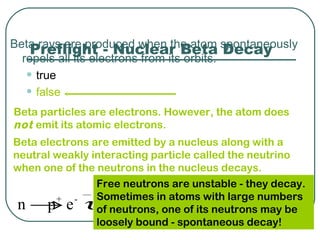
Beta rays are produced when the atom spontaneously
    Preflight - Nuclear Beta Decay
  repels all its electrons from its orbits.
   • true
   • false
Beta particles are electrons. However, the atom does
not emit its atomic electrons.
Beta electrons are emitted by a nucleus along with a
neutral weakly interacting particle called the neutrino
when one of the neutrons in the nucleus decays.
                Free neutrons are unstable - they decay.
                Sometimes in atoms with large numbers
      p + -
             υ
 n → e of neutrons, one of its neutrons may be
                loosely bound - spontaneous decay!
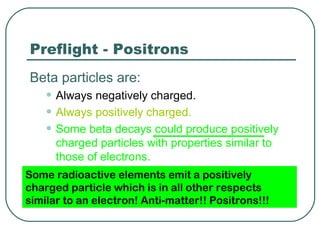
Preflight - Positrons
Beta particles are:
    • Always negatively charged.
    • Always positively charged.
    • Some beta decays could produce positively
      charged particles with properties similar to
      those of electrons.
Some radioactive elements emit a positively
charged particle which is in all other respects
similar to an electron! Anti-matter!! Positrons!!!
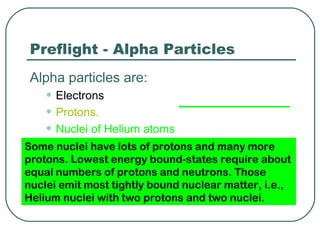
Preflight - Alpha Particles
 Alpha particles are:
   • Electrons
   • Protons.
   • Nuclei of Helium atoms
   • nuclei of Argon of protons and many more
Some Nuclei have lots atoms
protons. Lowest energy bound-states require about
equal numbers of protons and neutrons. Those
nuclei emit most tightly bound nuclear matter, i.e.,
Helium nuclei with two protons and two nuclei.
Facultyetsuedublantonlecture3radiationppt3714

  • 1.
    ENTC 4390 MEDICAL IMAGING RADIOACTIVE DECAY
  • 2.
    Nuclear Particles &Radiation  Only a few of the many different nuclear emanations are used in medicine.  In order of importance, the entities are: • x-rays • Electromagnetic waves of very short wavelength that behave in many ways like particles. • Gamma (γ) rays • Electromagnetic waves similar to x-rays, but of even shorter wavelength. • Neutrons • Actual particles that are produced during the decay of certain radioacitve materials.
  • 3.
    Radioactivity Don’t be confused by this picture! A single radioactive source does not emit all three types α, β and γ.
  • 4.
    3 Types ofRadioactivity B field into screen Radioactive detector sources α particles: helium nuclei Easily Stopped β particles: electrons Stopped by metal γ : photons (more energetic than x-rays) penetrate!
  • 5.
     The nucleus of an atom consists of neutrons and protons, referred to collectively as nucleons.  In a popular model of the nucleus (the “shell model”), the neutrons and protons reside in specific levels with different binding energies.
  • 6.
    Materials Science Fundamentals 1. The structure of an atom:
  • 7.
    Materials Science Fundamentals 2.Elements/Atomic Number (Z) & Atomic Masses Key: Chemical Behavior Determined by Z and Ionization
  • 8.
    Materials Science Fundamentals Atomic Number: # of Protons  Mass Number: # of Protons and Neutrons  Atomic Weight: Total Mass of Atom
  • 9.
    If a vacancy exists at a lower energy level, a neutron or proton in a higher level may fall to fill the vacancy • This transition releases energy and yields a more stable nucleus. • The amount of energy released is related to the difference in binding energy between the higher and lower levels. • The binding energy is much greater for neutrons and protons inside the nucleus than for electrons outside the nucleus. • Hence, energy released during nuclear transitions is much greater than that released during electron transitions.
  • 10.
    If a nucleus gains stability by transition of a neutron between neutron energy levels, or a proton between proton energy levels, the process is termed an isometric transition. • In an isomeric transition, the nucleus releases energy without a change in its number of protons (Z) or neutrons (N). • The initial and final energy states of the nucleus are said to be isomers. • A common form of isomeric transition is gamma decay (γ) in which the energy is released as a packet of energy (a quantum or photon) termed a gamma (γ) ray • An isomeric transition that competes with gamma decay is internal conversion, in which an electron from an extranuclear shell carries the energy out of the atom.
  • 11.
     It isalso possible for a neutron to fall to a lower energy level reserved for protons, in which case the neutron becomes a proton.  It is also possible for a proton to fall to a lower energy level reserved for neurons, in which case the proton becomes a neuron. • In these situations, referred to collectively as beta (β) decay, the Z and N of the nucleus change, and the nucleus transmutes from one element to another. • In beta (β) decay, the nucleus loses energy and gains stability.
  • 12.
     In anyradioactive process the mass number of the decaying (parent) nucleus equals the sum of the mass numbers of the product (progeny) nucleus and the ejected particle. • That is, mass number A is conserved in radioactive decay
  • 13.
     In alpha(α) decay, an alpha particle (two protons and two neutrons tightly bound 4 as a nucleus of helium 2 He ) is ejected from the unstable nucleus. • The alpha particle is a relatively massive, poorly penetrating type of radiation that can be stopped by a sheet of paper.
  • 14.
     An example of alpha decay is: 226 88 Ra→ 222Rn+ 2 He 86 4 Radium Radon alpha particle
  • 15.
  • 16.
    A decayscheme depicts the decay processes specific for a nuclide (nuclide is a generic term for any nuclear form). • Energy on the y axis, plotted against the • Atomic number of the nuclide on the x axis.
  • 17.
    A  Given a generic nuclide, X there are four Z possible routes of radioactive decay. 1. A−4 α decay to the progeny nuclide Z −2 P by emission of 4 a 2 He nucleus. 2. (a) β+ (positron) decay to progeny nuclide Z −AQ by 1 emission of positive electron from the nucleus. 3. A (b) β− (negatron) decay to progeny nuclide by Z +1 R emission of negative electron from the nucleus. 4. γ decay reshuffles the nucleons releasing a packet of energy with no change in Z (or N or A).
  • 18.
    A Z X A− 4  Z −2 P  A  Z +1 R Energy A Z −1Q  A Z +1 S Z-2 Z-1 Z Z+1 Z+2 Atomic Number
  • 19.
  • 20.
     Nucleitend tobe most stable if they contain even numbers of protons and neutrons and least stable if they contain an odd number of both. • Nuclei are extraordinarily stable if they contain 2, 8 ,14, 20, 28, 50, 82, or 126 protons. • These are termed nuclear magic numbers and • Reflect full occupancy of nuclear shells.
  • 21.
     The numberof neutrons is about equal to the number of protons in low-Z stable nuclei. • As Z increases, the number of neutrons increases more rapidly than the number of protons in stable nuclei.
  • 23.
    •Can get 4nucleons in each energy level- •lowest energy will favor N=Z, •But protons repel one another (Coulomb Force) and when Z is large it becomes harder to put more protons into a nucleus without adding even more neutrons to provide more of the Strong Force. •For this reason, in heavier nuclei N>Z.
  • 24.
  • 25.
     Isomeric transitions are always preceded by either electron capture or emission of an α or β (+ or -) particle.  Sometimes one or more of the excited states of a progeny nuclide may exist for a finite lifetime. • An excited state is termed a metastable state if its half-life exceeds 10-6 seconds.
  • 26.
    An isometric transition can also occur by interaction of the nucleus with an electron in one of the electron shells. • This process is called internal conversion. • The electron is ejected with kinetic energy E equal to k the energy Eγ released by the nucleus, reduced by the binding energy Eb of the electron • The ejected electron is accompanied by x rays and Auger electrons as the extranuclear structure of the atom resumes a stable configuration.
  • 27.
     The rateof decay of a radioactive sample depends on the number N of radioactive atoms in the sample. • This concept can be stated as ∆N = −λN ∆t • where ∆N/∆t is the rate of decay, and the constant λ is called the decay constant.
  • 28.
     The decayconstant has units of time .  It has a characteristic value for each nuclide.  It also reflects the nuclides degree of instability; • a larger decay constant connotes a more unstable nuclide • i.e., one that decays more rapidly. • The rate of decay is a measure of a sample’s activity.
  • 29.
     Theactivity ofa sample depends on the number of radioactive atoms in the sample and the decay constant of the atoms. • A sample may have a high activity because it contains a few highly unstable (large decay constant) atoms, or • because it contains many atoms that are only moderately unstable (small decay constant).
  • 30.
     The SIunit of activity is the becquerel (Bq.) defined as • 1 Bq = 1 disintegration per second (dps)  Anolder, less-preferred unit of activity is the curie (Ci), defined as • 1 Ci = 3.7 x 10 10 dps
  • 31.
    Example a. 201Tl hasa decay constant of 9.49 x 10⁻³ hr -1. Find 81 the activity in becquerels of a sample containing 1010 atoms. ∆N 9.49 × 10 −3 atoms Activity ( A) = − = λN = × 1010 atoms = 9.49 × 10⁷ ∆t hr hr 7 atoms 1 hr 4 atoms A = 9.49 × 10 × = 2.64 × 10 hr 3600 sec sec A = 2.64 × 10 4 Bq
  • 32.
    Example b. How manyatoms of 11C with a decay constant of 6 2.08 hr -1 would be required to obtain the same activity in the previous problem. atoms atoms sec 2.64 × 10 4 2.64 × 10 4 × 3600 A sec = sec hr N= = λ 2.08 / hr 2.08 / hr N = 4.57 × 10⁷ atoms • More atoms of 11C than of 201Tl are required to obtain 6 81 the same activity because of the difference in decay constants.
  • 33.
     Note that the equation ∆N = −λN ∆t • can be written as dN = −λN dt
  • 34.
    Rearranging and solving for N, dN = −λdt N ∫ ∫ natural log format dN = ln N = − λdt = −λt N e ln N = e − λt N = N o e − λt • where No is the number of atoms at time to .
  • 35.
    The physical half-life, T1/2, of a radioactive nuclide is the time required for decay of half of the atoms in a sample of the nuclide. N = N o e − λt N 1 − λT 1 / 2 T 1 / 2⇒ = =e No 2 1 ln   2  =T = 0.693 1/ 2 −λ λ
  • 36.
    Example  The half-life is 1.7 hours for 113mIn (Indium). a. A sample of In has a mass of 2µg. 113m
  • 37.
  • 38.
    X-Rays  Strong or high energy x-rays can penetrate deeply into the body.  Weak or soft x-rays are used if only limited penetration is needed  The energy of x-rays, as well as other nuclear particles is measured in • electron-volts (ev) • thousands of electron-volts (kev) • millions of electron-volts (Mev)
  • 39.
     The diagnosticuse of x-ray depends on the fact that various types of absorbs x- rays to a greater or lesser degree. • Absorption by bone is quite high, • Absorption by fatty tissue is low.  Thisallows the use of the x-ray beam for delineating the details of body structure.
  • 40.
    Gamma Rays  X-rays are generally produced electrically.  γ_rays are the result of a radioactive transition in a substance that has been activated in a nuclear reactor.  Once again, energy is measured in • electron-volts (ev) • thousands of electron-volts (kev) • millions of electron-volts (Mev)
  • 41.
    higher energy γ-rayspenetrate all  The human tissue quite easily.  γ-rays are used in conjunction with scanning systems to detect anomalies due to disease or neoplastic growth.
  • 42.
    Neutrons  Neutron applications in medicine are limited.  Again, energy is measured in • electron-volts (ev) • thousands of electron-volts (kev) • millions of electron-volts (Mev)
  • 43.
    Preflight - GammaRay Emission Gamma rays are emitted due to electrons making transitions to nuclear energy levels. • true • false No, gamma rays are high energy photons emitted when nucleons make transitions between their allowed quantum states.
  • 44.
    Beta rays areproduced when the atom spontaneously Preflight - Nuclear Beta Decay repels all its electrons from its orbits. • true • false Beta particles are electrons. However, the atom does not emit its atomic electrons. Beta electrons are emitted by a nucleus along with a neutral weakly interacting particle called the neutrino when one of the neutrons in the nucleus decays. Free neutrons are unstable - they decay. Sometimes in atoms with large numbers p + - υ n → e of neutrons, one of its neutrons may be loosely bound - spontaneous decay!
  • 45.
    Preflight - Positrons Betaparticles are: • Always negatively charged. • Always positively charged. • Some beta decays could produce positively charged particles with properties similar to those of electrons. Some radioactive elements emit a positively charged particle which is in all other respects similar to an electron! Anti-matter!! Positrons!!!
  • 46.
    Preflight - AlphaParticles Alpha particles are: • Electrons • Protons. • Nuclei of Helium atoms • nuclei of Argon of protons and many more Some Nuclei have lots atoms protons. Lowest energy bound-states require about equal numbers of protons and neutrons. Those nuclei emit most tightly bound nuclear matter, i.e., Helium nuclei with two protons and two nuclei.