24th March, 2017
Zakir Hossain
Teacher-Librarian
Quoting paraphrasing summarizing
Academic Writing
Why should you use and
acknowledge the work of others?
 Why do you think you should
incorporate the ideas of others into your
writing?
 Why is it important that you
acknowledge these ideas?
Share your thoughts in the discussion.
When you use and acknowledge
the work of others, you:
 Make meaningful connections between
other authors’ ideas and your own.
 Question and evaluate the ideas of other
authors.
 Provide credibility for your work and allow
your lecturer to track down the original
sources.
 Provide evidence that your ideas or
argument are backed up or supported.
 Give credit to the original author or
authors.© The University of
Auckland
How to integrate others’
ideas?
Quoting, paraphrasing and summariz
ing are three main ways of integrating
others’ ideas in your own academic
work.
Glossary
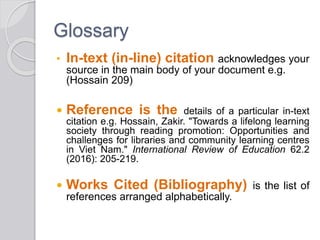
• In-text (in-line) citation acknowledges your
source in the main body of your document e.g.
(Hossain 209)
 Reference is the details of a particular in-text
citation e.g. Hossain, Zakir. "Towards a lifelong learning
society through reading promotion: Opportunities and
challenges for libraries and community learning centres
in Viet Nam." International Review of Education 62.2
(2016): 205-219.
 Works Cited (Bibliography) is the list of
references arranged alphabetically.
Glossary
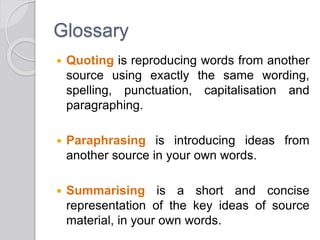
 Quoting is reproducing words from another
source using exactly the same wording,
spelling, punctuation, capitalisation and
paragraphing.
 Paraphrasing is introducing ideas from
another source in your own words.
 Summarising is a short and concise
representation of the key ideas of source
material, in your own words.
How to integrate a quote?
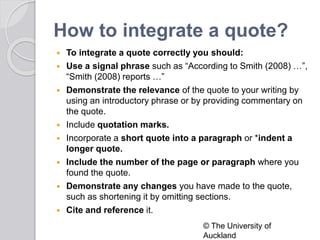
 To integrate a quote correctly you should:
 Use a signal phrase such as “According to Smith (2008) …”,
“Smith (2008) reports …”
 Demonstrate the relevance of the quote to your writing by
using an introductory phrase or by providing commentary on
the quote.
 Include quotation marks.
 Incorporate a short quote into a paragraph or *indent a
longer quote.
 Include the number of the page or paragraph where you
found the quote.
 Demonstrate any changes you have made to the quote,
such as shortening it by omitting sections.
 Cite and reference it.
© The University of
Auckland
Citing a direct quotation
When directly quoting a source, place
the parenthetical citation after the
quote.
Example:
Sanders explains that economic woes
are due to “the mortgage crisis and poor
risk assessment” (20).
Citing a long quote
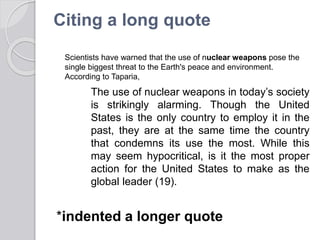
The use of nuclear weapons in today’s society
is strikingly alarming. Though the United
States is the only country to employ it in the
past, they are at the same time the country
that condemns its use the most. While this
may seem hypocritical, is it the most proper
action for the United States to make as the
global leader (19).
*indented a longer quote
Scientists have warned that the use of nuclear weapons pose the
single biggest threat to the Earth's peace and environment.
According to Taparia,
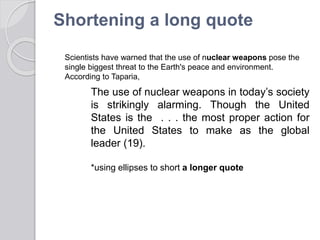
Shortening a long quote
The use of nuclear weapons in today’s society
is strikingly alarming. Though the United
States is the . . . the most proper action for
the United States to make as the global
leader (19).
*using ellipses to short a longer quote
Scientists have warned that the use of nuclear weapons pose the
single biggest threat to the Earth's peace and environment.
According to Taparia,
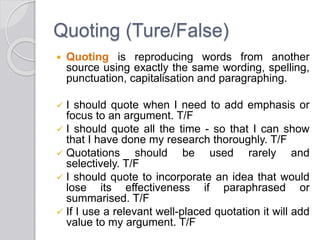
Quoting (Ture/False)
 Quoting is reproducing words from another
source using exactly the same wording, spelling,
punctuation, capitalisation and paragraphing.
 I should quote when I need to add emphasis or
focus to an argument. T/F
 I should quote all the time - so that I can show
that I have done my research thoroughly. T/F
 Quotations should be used rarely and
selectively. T/F
 I should quote to incorporate an idea that would
lose its effectiveness if paraphrased or
summarised. T/F
 If I use a relevant well-placed quotation it will add
value to my argument. T/F
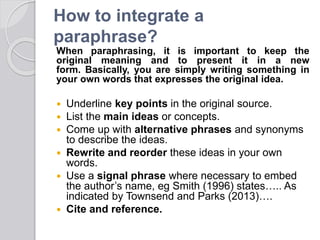
How to integrate a
paraphrase?
When paraphrasing, it is important to keep the
original meaning and to present it in a new
form. Basically, you are simply writing something in
your own words that expresses the original idea.
 Underline key points in the original source.
 List the main ideas or concepts.
 Come up with alternative phrases and synonyms
to describe the ideas.
 Rewrite and reorder these ideas in your own
words.
 Use a signal phrase where necessary to embed
the author’s name, eg Smith (1996) states….. As
indicated by Townsend and Parks (2013)….
 Cite and reference.
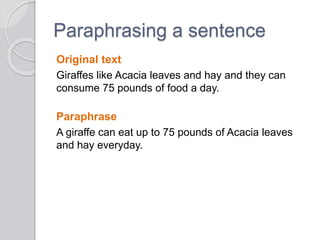
Paraphrasing a sentence
Original text
Giraffes like Acacia leaves and hay and they can
consume 75 pounds of food a day.
Paraphrase
A giraffe can eat up to 75 pounds of Acacia leaves
and hay everyday.
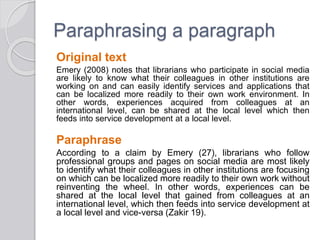
Paraphrasing a paragraph
Original text
Emery (2008) notes that librarians who participate in social media
are likely to know what their colleagues in other institutions are
working on and can easily identify services and applications that
can be localized more readily to their own work environment. In
other words, experiences acquired from colleagues at an
international level, can be shared at the local level which then
feeds into service development at a local level.
Paraphrase
According to a claim by Emery (27), librarians who follow
professional groups and pages on social media are most likely
to identify what their colleagues in other institutions are focusing
on which can be localized more readily to their own work without
reinventing the wheel. In other words, experiences can be
shared at the local level that gained from colleagues at an
international level, which then feeds into service development at
a local level and vice-versa (Zakir 19).
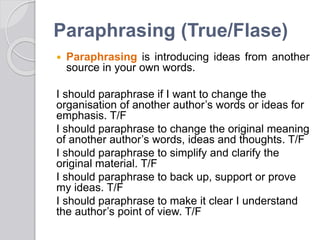
Paraphrasing (True/Flase)
 Paraphrasing is introducing ideas from another
source in your own words.
I should paraphrase if I want to change the
organisation of another author’s words or ideas for
emphasis. T/F
I should paraphrase to change the original meaning
of another author’s words, ideas and thoughts. T/F
I should paraphrase to simplify and clarify the
original material. T/F
I should paraphrase to back up, support or prove
my ideas. T/F
I should paraphrase to make it clear I understand
the author’s point of view. T/F
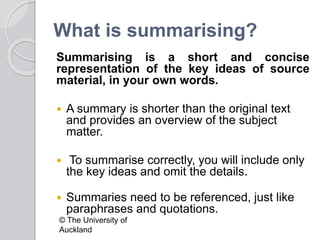
What is summarising?
Summarising is a short and concise
representation of the key ideas of source
material, in your own words.
 A summary is shorter than the original text
and provides an overview of the subject
matter.
 To summarise correctly, you will include only
the key ideas and omit the details.
 Summaries need to be referenced, just like
paraphrases and quotations.
© The University of
Auckland
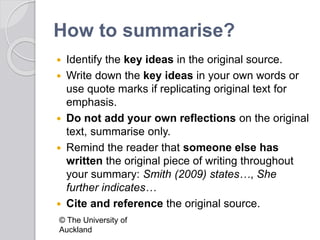
How to summarise?
 Identify the key ideas in the original source.
 Write down the key ideas in your own words or
use quote marks if replicating original text for
emphasis.
 Do not add your own reflections on the original
text, summarise only.
 Remind the reader that someone else has
written the original piece of writing throughout
your summary: Smith (2009) states…, She
further indicates…
 Cite and reference the original source.
© The University of
Auckland
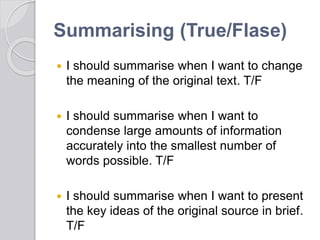
Summarising (True/Flase)
 I should summarise when I want to change
the meaning of the original text. T/F
 I should summarise when I want to
condense large amounts of information
accurately into the smallest number of
words possible. T/F
 I should summarise when I want to present
the key ideas of the original source in brief.
T/F
Some examples to compare
The original passage:
Students frequently overuse direct quotation in taking notes, and as a
result they overuse quotations in the final [research] paper. Probably
only about 10% of your final manuscript should appear as directly
quoted matter. Therefore, you should strive to limit the amount of exact
transcribing of source materials while taking notes. Lester, James
D. Writing Research Papers. 2nd ed. (1976): 46-47.
A legitimate paraphrase:
In research papers students often quote excessively, failing to keep
quoted material down to a desirable level. Since the problem usually
originates during note taking, it is essential to minimize the material
recorded verbatim (Lester 46-47).
An acceptable summary:
Students should take just a few notes in direct quotation from sources
to help minimize the amount of quoted material in a research paper
(Lester 46-47).
© OWL- Purdue online writing lab
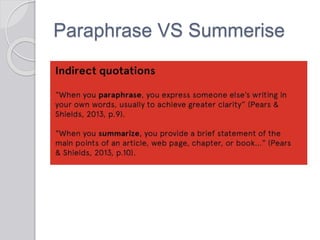
Paraphrase VS Summerise
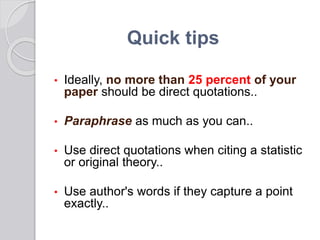
• Ideally, no more than 25 percent of your
paper should be direct quotations..
• Paraphrase as much as you can..
• Use direct quotations when citing a statistic
or original theory..
• Use author's words if they capture a point
exactly..
Quick tips
What you learned today
1. Quoting
2. Paraphrasing
3. Summerising
Good Luck building your research
paper. Use your EEC/DPC—we
can help you be Successful!
Cited works
OWL. “Purdue online writing lab.” [Paraphrase: Write It in Your Own Words:
Some examples to compare]. Retrieved on Jul 23, 2017 from
https://owl.english.purdue.edu/owl/resource/619/1/
Stephen, Jason. “Academic Integrity.” [week 3: Achieving with integrity: using
the works of others]. MOOC offered by University of Auckland. Retrieved on Jul
23, 2017 from https://www.futurelearn.com/courses/academic-
integrity/10/todo/8323
Questions? Corrections?
Contact Zakir, amity.du@gmail.com
www.getepic.com/sign-
in
XZM-3342

Quoting, Paraphrasing and Summarizing

  • 1.
    24th March, 2017 ZakirHossain Teacher-Librarian Quoting paraphrasing summarizing Academic Writing
  • 2.
    Why should youuse and acknowledge the work of others?  Why do you think you should incorporate the ideas of others into your writing?  Why is it important that you acknowledge these ideas? Share your thoughts in the discussion.
  • 3.
    When you useand acknowledge the work of others, you:  Make meaningful connections between other authors’ ideas and your own.  Question and evaluate the ideas of other authors.  Provide credibility for your work and allow your lecturer to track down the original sources.  Provide evidence that your ideas or argument are backed up or supported.  Give credit to the original author or authors.© The University of Auckland
  • 4.
    How to integrateothers’ ideas? Quoting, paraphrasing and summariz ing are three main ways of integrating others’ ideas in your own academic work.
  • 5.
    Glossary • In-text (in-line)citation acknowledges your source in the main body of your document e.g. (Hossain 209)  Reference is the details of a particular in-text citation e.g. Hossain, Zakir. "Towards a lifelong learning society through reading promotion: Opportunities and challenges for libraries and community learning centres in Viet Nam." International Review of Education 62.2 (2016): 205-219.  Works Cited (Bibliography) is the list of references arranged alphabetically.
  • 6.
    Glossary  Quoting isreproducing words from another source using exactly the same wording, spelling, punctuation, capitalisation and paragraphing.  Paraphrasing is introducing ideas from another source in your own words.  Summarising is a short and concise representation of the key ideas of source material, in your own words.
  • 7.
    How to integratea quote?  To integrate a quote correctly you should:  Use a signal phrase such as “According to Smith (2008) …”, “Smith (2008) reports …”  Demonstrate the relevance of the quote to your writing by using an introductory phrase or by providing commentary on the quote.  Include quotation marks.  Incorporate a short quote into a paragraph or *indent a longer quote.  Include the number of the page or paragraph where you found the quote.  Demonstrate any changes you have made to the quote, such as shortening it by omitting sections.  Cite and reference it. © The University of Auckland
  • 8.
    Citing a directquotation When directly quoting a source, place the parenthetical citation after the quote. Example: Sanders explains that economic woes are due to “the mortgage crisis and poor risk assessment” (20).
  • 9.
    Citing a longquote The use of nuclear weapons in today’s society is strikingly alarming. Though the United States is the only country to employ it in the past, they are at the same time the country that condemns its use the most. While this may seem hypocritical, is it the most proper action for the United States to make as the global leader (19). *indented a longer quote Scientists have warned that the use of nuclear weapons pose the single biggest threat to the Earth's peace and environment. According to Taparia,
  • 10.
    Shortening a longquote The use of nuclear weapons in today’s society is strikingly alarming. Though the United States is the . . . the most proper action for the United States to make as the global leader (19). *using ellipses to short a longer quote Scientists have warned that the use of nuclear weapons pose the single biggest threat to the Earth's peace and environment. According to Taparia,
  • 11.
    Quoting (Ture/False)  Quotingis reproducing words from another source using exactly the same wording, spelling, punctuation, capitalisation and paragraphing.  I should quote when I need to add emphasis or focus to an argument. T/F  I should quote all the time - so that I can show that I have done my research thoroughly. T/F  Quotations should be used rarely and selectively. T/F  I should quote to incorporate an idea that would lose its effectiveness if paraphrased or summarised. T/F  If I use a relevant well-placed quotation it will add value to my argument. T/F
  • 12.
    How to integratea paraphrase? When paraphrasing, it is important to keep the original meaning and to present it in a new form. Basically, you are simply writing something in your own words that expresses the original idea.  Underline key points in the original source.  List the main ideas or concepts.  Come up with alternative phrases and synonyms to describe the ideas.  Rewrite and reorder these ideas in your own words.  Use a signal phrase where necessary to embed the author’s name, eg Smith (1996) states….. As indicated by Townsend and Parks (2013)….  Cite and reference.
  • 13.
    Paraphrasing a sentence Originaltext Giraffes like Acacia leaves and hay and they can consume 75 pounds of food a day. Paraphrase A giraffe can eat up to 75 pounds of Acacia leaves and hay everyday.
  • 14.
    Paraphrasing a paragraph Originaltext Emery (2008) notes that librarians who participate in social media are likely to know what their colleagues in other institutions are working on and can easily identify services and applications that can be localized more readily to their own work environment. In other words, experiences acquired from colleagues at an international level, can be shared at the local level which then feeds into service development at a local level. Paraphrase According to a claim by Emery (27), librarians who follow professional groups and pages on social media are most likely to identify what their colleagues in other institutions are focusing on which can be localized more readily to their own work without reinventing the wheel. In other words, experiences can be shared at the local level that gained from colleagues at an international level, which then feeds into service development at a local level and vice-versa (Zakir 19).
  • 15.
    Paraphrasing (True/Flase)  Paraphrasingis introducing ideas from another source in your own words. I should paraphrase if I want to change the organisation of another author’s words or ideas for emphasis. T/F I should paraphrase to change the original meaning of another author’s words, ideas and thoughts. T/F I should paraphrase to simplify and clarify the original material. T/F I should paraphrase to back up, support or prove my ideas. T/F I should paraphrase to make it clear I understand the author’s point of view. T/F
  • 16.
    What is summarising? Summarisingis a short and concise representation of the key ideas of source material, in your own words.  A summary is shorter than the original text and provides an overview of the subject matter.  To summarise correctly, you will include only the key ideas and omit the details.  Summaries need to be referenced, just like paraphrases and quotations. © The University of Auckland
  • 17.
    How to summarise? Identify the key ideas in the original source.  Write down the key ideas in your own words or use quote marks if replicating original text for emphasis.  Do not add your own reflections on the original text, summarise only.  Remind the reader that someone else has written the original piece of writing throughout your summary: Smith (2009) states…, She further indicates…  Cite and reference the original source. © The University of Auckland
  • 18.
    Summarising (True/Flase)  Ishould summarise when I want to change the meaning of the original text. T/F  I should summarise when I want to condense large amounts of information accurately into the smallest number of words possible. T/F  I should summarise when I want to present the key ideas of the original source in brief. T/F
  • 19.
    Some examples tocompare The original passage: Students frequently overuse direct quotation in taking notes, and as a result they overuse quotations in the final [research] paper. Probably only about 10% of your final manuscript should appear as directly quoted matter. Therefore, you should strive to limit the amount of exact transcribing of source materials while taking notes. Lester, James D. Writing Research Papers. 2nd ed. (1976): 46-47. A legitimate paraphrase: In research papers students often quote excessively, failing to keep quoted material down to a desirable level. Since the problem usually originates during note taking, it is essential to minimize the material recorded verbatim (Lester 46-47). An acceptable summary: Students should take just a few notes in direct quotation from sources to help minimize the amount of quoted material in a research paper (Lester 46-47). © OWL- Purdue online writing lab
  • 20.
  • 21.
    • Ideally, nomore than 25 percent of your paper should be direct quotations.. • Paraphrase as much as you can.. • Use direct quotations when citing a statistic or original theory.. • Use author's words if they capture a point exactly.. Quick tips
  • 22.
    What you learnedtoday 1. Quoting 2. Paraphrasing 3. Summerising Good Luck building your research paper. Use your EEC/DPC—we can help you be Successful!
  • 23.
    Cited works OWL. “Purdueonline writing lab.” [Paraphrase: Write It in Your Own Words: Some examples to compare]. Retrieved on Jul 23, 2017 from https://owl.english.purdue.edu/owl/resource/619/1/ Stephen, Jason. “Academic Integrity.” [week 3: Achieving with integrity: using the works of others]. MOOC offered by University of Auckland. Retrieved on Jul 23, 2017 from https://www.futurelearn.com/courses/academic- integrity/10/todo/8323 Questions? Corrections? Contact Zakir, amity.du@gmail.com
  • 24.