Copyright or Copyleft
@
Fair Use
Creative Commons
Public Domain
Attribution@Cite
Permission
23nd Jan. 2020
Zakir Hossain
Teacher-Librarian
www.theresearchtl.net
CC BY-NC-SA 3.0
Questions for the Day
• What is Copyright
• What is Attribution/Citation
• What is Licensing/Subscription
• What is Fair Use
• What is Public Domain
• What is Creative Commons
• What is Copyright Permission
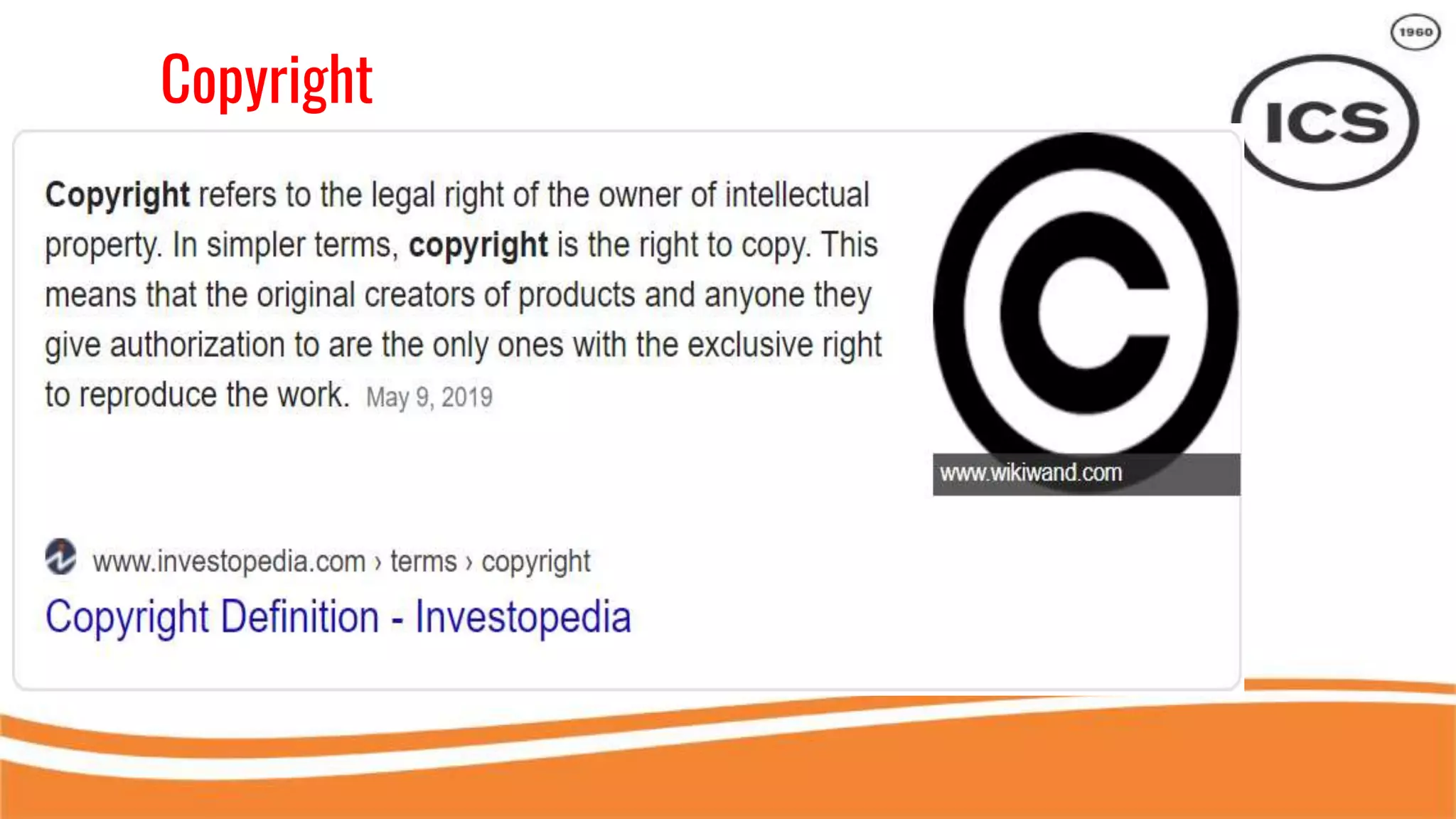
Copyright
What Copyright doesn’t protect?
Copyright law does not protect:
➔ titles of books or movies
➔ short phrases such as, “Make my day.””BYOD”
➔ established facts, ideas, theories and discoveries
➔ individual words, slogans; familiar symbols or designs
Attribution/Citation
• A citation tells a reader where we got information, facts, or ideas that are
not our own.
• A citation is a reference to a published or unpublished source.
• A "citation" is the way you tell your readers that certain material in your
work came from another source.
• To me, citation is an academic manner of attribution or acknowledgement,
simply giving credits to the creators.
ICS Library Website@Libguides
https://icsz.libguides.com/icszlibrary/myp
Copyright VS Citation VS Plagiarism
• Copyright is a legal/ statutory rights whereas Citation is an academic
manner.
• Copyright infringement can still occur even if the source, author, or
copyright-holder is cited.
• Plagiarism is a violation of moral, ethical, or organization norms not laws.
• Plagiarism is using someone else's work or ideas without giving proper
credit.
Note: Citation, does not cure copyright infringement, which is the unauthorized use of another's work.
If you copy an entire journal article by someone else, without permission, into a book you publish,
you probably have infringed copyright, even if you add a footnote citing the original author and
source (Smith).
Licensing VS Subscription
A licensing agreement is a written contract between two parties, in which a
owner permits another party to use his/her production/asset under a specific
set of parameters. A perpetual software license is paid up-front in one big
lump sum. Such as a song for movie license (Bloomenthal).
A subscription software is priced on a yearly or monthly basis and is an
ongoing subscription. Such as a library database.
Fair Use (Fair Dealing)
● Teaching
● News reporting
● Commentary/Criticism
● Parody
How is fair use determined?
➔ Purpose
➔ Nature of the copied work
➔ Amount and substantiality
➔ Effect on market value
(Beach)
Possible Guidelines of Fair Use for Educational usage
➔ Time (Portion/Movies)
Not more than 3 minutes or 10%
➔ Text
• Not more than 1000 words or 10%
➔ Music
• Not more than 30 seconds or 10%
➔ Photos
• Not more than 15 images or 10% of an individual published work
➔ Poem
● less than 250 words (Beach)
Note: these guidelines should be used cautiously
Creative Commons Licenses
A Creative Commons license is one of several
public copyright licenses that enable the free
distribution of an otherwise copyrighted "work".
A CC license is used when an author wants to give
other people the right to share, use, and build
upon a work that they have created.
Wikipedia
(https://en.wikipedia.org/wiki/Creative_Commons_license)
https://creativecommons.org/share-your-work/public-domain/freeworks/
Creative Commons Browser Extension
Google it
“CC Search Browser
Extension”
Link:
https://chrome.google.com/webstore/detai
l/cc-search-browser-
extensi/agohkbfananbebiaphblgcfhcclklfn
h
Public Domain
➔ 70 y after the death
of the author
➔ 1924 or earlier works
are on PD
(Woessner)
Copyright Free Images, Sounds and Artworks
@ Public Domain
Example Communication for Permission
https://www.slideshare.net/adamfox2052/music-permission-email-evidence-54304124
You don’t have to worry…
➔ If you create it yourself
➔ If you are licensed to use it
➔ If you get permission from the creator
➔ If it is in the public domain
➔ If it is licensed under creative commons
➔ If you use links to media instead of the media itself
➔ If you are only using the material within the confines of the classroom*
➔ If your use of the material isn’t affecting market value*
*conditions apply
https://images.app.goo.gl/SE6fcQTWQfshEbw58
Works Cited
Beach, Jason. “Copyright Fair Use Presentation.” LinkedIn SlideShare, 21 Jan. 2016, www.slideshare.net/JasonBeachPhD/copyright-
fair-use-presentation?qid=a288bcd2-8880-494e-a12e-2a481ce0f6f9&v=&b=&from_search=1.
Bloomenthal, Andrew. “The Lowdown on Licensing Agreements.” Investopedia, Investopedia, 18 Nov. 2019,
www.investopedia.com/terms/l/licensing-agreement.asp.
"Creative Commons license." Wikipedia, The Free Encyclopedia. Wikipedia, The Free Encyclopedia, 13 Jan. 2020. Web. 16 Jan. 2020,
https://en.wikipedia.org/wiki/Creative_Commons_license. Accessed 16 Jan. 2020.
Smith, Kevin. “If I Cite the Source I Am Using, Can It Still Be Copyright Infringement? (Weekly Widget).” Scholarly Communications
@ Duke: COPYRIGHT INFORMATION NOTES, 23 Mar. 2011, blogs.library.duke.edu/scholcomm/2007/11/30/citation-infringement/
Woessner, Patrick. “Copyright, Fair Use, And Creative Commons.” LinkedIn SlideShare, 15 Oct. 2008,
www.slideshare.net/pwoessner/copyright-fair-use-and-creative-commons-presentation?qid=86e48aa3-0234-47cf-980a-
2e2e4ac3ef00&v=&b=&from_search=3.

Copyright, Fair Use, Creative Commons, Public Domain

  • 1.
    Copyright or Copyleft @ FairUse Creative Commons Public Domain Attribution@Cite Permission 23nd Jan. 2020 Zakir Hossain Teacher-Librarian www.theresearchtl.net CC BY-NC-SA 3.0
  • 3.
    Questions for theDay • What is Copyright • What is Attribution/Citation • What is Licensing/Subscription • What is Fair Use • What is Public Domain • What is Creative Commons • What is Copyright Permission
  • 4.
  • 5.
    What Copyright doesn’tprotect? Copyright law does not protect: ➔ titles of books or movies ➔ short phrases such as, “Make my day.””BYOD” ➔ established facts, ideas, theories and discoveries ➔ individual words, slogans; familiar symbols or designs
  • 6.
    Attribution/Citation • A citationtells a reader where we got information, facts, or ideas that are not our own. • A citation is a reference to a published or unpublished source. • A "citation" is the way you tell your readers that certain material in your work came from another source. • To me, citation is an academic manner of attribution or acknowledgement, simply giving credits to the creators.
  • 7.
  • 8.
    Copyright VS CitationVS Plagiarism • Copyright is a legal/ statutory rights whereas Citation is an academic manner. • Copyright infringement can still occur even if the source, author, or copyright-holder is cited. • Plagiarism is a violation of moral, ethical, or organization norms not laws. • Plagiarism is using someone else's work or ideas without giving proper credit. Note: Citation, does not cure copyright infringement, which is the unauthorized use of another's work. If you copy an entire journal article by someone else, without permission, into a book you publish, you probably have infringed copyright, even if you add a footnote citing the original author and source (Smith).
  • 9.
    Licensing VS Subscription Alicensing agreement is a written contract between two parties, in which a owner permits another party to use his/her production/asset under a specific set of parameters. A perpetual software license is paid up-front in one big lump sum. Such as a song for movie license (Bloomenthal). A subscription software is priced on a yearly or monthly basis and is an ongoing subscription. Such as a library database.
  • 10.
    Fair Use (FairDealing) ● Teaching ● News reporting ● Commentary/Criticism ● Parody How is fair use determined? ➔ Purpose ➔ Nature of the copied work ➔ Amount and substantiality ➔ Effect on market value (Beach)
  • 11.
    Possible Guidelines ofFair Use for Educational usage ➔ Time (Portion/Movies) Not more than 3 minutes or 10% ➔ Text • Not more than 1000 words or 10% ➔ Music • Not more than 30 seconds or 10% ➔ Photos • Not more than 15 images or 10% of an individual published work ➔ Poem ● less than 250 words (Beach) Note: these guidelines should be used cautiously
  • 12.
    Creative Commons Licenses ACreative Commons license is one of several public copyright licenses that enable the free distribution of an otherwise copyrighted "work". A CC license is used when an author wants to give other people the right to share, use, and build upon a work that they have created. Wikipedia (https://en.wikipedia.org/wiki/Creative_Commons_license) https://creativecommons.org/share-your-work/public-domain/freeworks/
  • 13.
    Creative Commons BrowserExtension Google it “CC Search Browser Extension” Link: https://chrome.google.com/webstore/detai l/cc-search-browser- extensi/agohkbfananbebiaphblgcfhcclklfn h
  • 14.
    Public Domain ➔ 70y after the death of the author ➔ 1924 or earlier works are on PD (Woessner)
  • 15.
    Copyright Free Images,Sounds and Artworks @ Public Domain
  • 16.
    Example Communication forPermission https://www.slideshare.net/adamfox2052/music-permission-email-evidence-54304124
  • 17.
    You don’t haveto worry… ➔ If you create it yourself ➔ If you are licensed to use it ➔ If you get permission from the creator ➔ If it is in the public domain ➔ If it is licensed under creative commons ➔ If you use links to media instead of the media itself ➔ If you are only using the material within the confines of the classroom* ➔ If your use of the material isn’t affecting market value* *conditions apply
  • 18.
  • 19.
    Works Cited Beach, Jason.“Copyright Fair Use Presentation.” LinkedIn SlideShare, 21 Jan. 2016, www.slideshare.net/JasonBeachPhD/copyright- fair-use-presentation?qid=a288bcd2-8880-494e-a12e-2a481ce0f6f9&v=&b=&from_search=1. Bloomenthal, Andrew. “The Lowdown on Licensing Agreements.” Investopedia, Investopedia, 18 Nov. 2019, www.investopedia.com/terms/l/licensing-agreement.asp. "Creative Commons license." Wikipedia, The Free Encyclopedia. Wikipedia, The Free Encyclopedia, 13 Jan. 2020. Web. 16 Jan. 2020, https://en.wikipedia.org/wiki/Creative_Commons_license. Accessed 16 Jan. 2020. Smith, Kevin. “If I Cite the Source I Am Using, Can It Still Be Copyright Infringement? (Weekly Widget).” Scholarly Communications @ Duke: COPYRIGHT INFORMATION NOTES, 23 Mar. 2011, blogs.library.duke.edu/scholcomm/2007/11/30/citation-infringement/ Woessner, Patrick. “Copyright, Fair Use, And Creative Commons.” LinkedIn SlideShare, 15 Oct. 2008, www.slideshare.net/pwoessner/copyright-fair-use-and-creative-commons-presentation?qid=86e48aa3-0234-47cf-980a- 2e2e4ac3ef00&v=&b=&from_search=3.