READING AND WRITING
CRITICAL
READING AS
REASONING
OBJECTIVES
 Realize that critical reading is a way
of reasoning;
 Distinguish factual from opinionated
statements; and
 Construct a paragraph on a given
topic with facts, arguments, and
reasons.
Let us
review!
You are thinking critically when you
do not rest on accepting the message
of the text but coining it in your
personal experiences and
perspectives to help you formulate
logical and right assertions.
CRITICAL READING
after critically reading a piece
you should be able to take
notes, paraphrasing - in your
own words - the key points.
What the text says:
you should be confident that you
have understood the text sufficiently
to be able to use your own examples
and compare and contrast with other
writing on the subject in hand.
What the text
describes:
this means that you should
be able to fully analyze the
text and state a meaning for
the text.
Interpretation of the
text:
The reader really is challenged to
reason out and justify the actions,
thoughts, and ideas if the skill of
critical reading and thinking is
developed. The art of reasoning
as offshoot of critical reading and
thinking will be next to be
accomplished.
We can define evidence as
anything used to support the
validity of the assertions. Evidence
includes testimony, scientific
findings, statistics, physical objects,
and many more. Weighing all the
evidence can help us to decide on
something.
FACT
 is one that can be verified
or proved true by
objective means. It is
objective and observation
and experimentation are
means of verification.
EXAMPLE
FACT
 On July 20, 1969, Neil
Armstrong was the first
human being to set foot on
the moon.
OPINION
 is one that cannot be
verified or proved true by
objective means. An
opinion is subjective and
must be properly supported
with facts before it can be
accepted as valid.
EXAMPLE
OPINION
 A mechanical flaw in a
spacecraft could threaten
an astronaut’s life.
GROUP
ACTIVITY
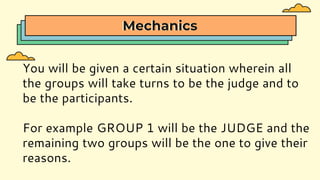
Mechanics
You will be given a certain situation wherein all
the groups will take turns to be the judge and to
be the participants.
For example GROUP 1 will be the JUDGE and the
remaining two groups will be the one to give their
reasons.
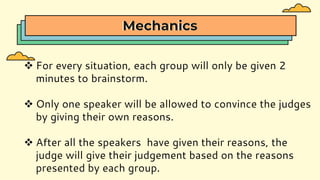
Mechanics
 For every situation, each group will only be given 2
minutes to brainstorm.
 Only one speaker will be allowed to convince the judges
by giving their own reasons.
 After all the speakers have given their reasons, the
judge will give their judgement based on the reasons
presented by each group.
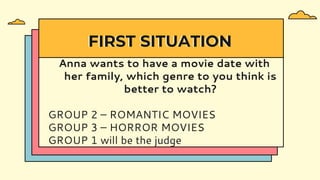
Anna wants to have a movie date with
her family, which genre to you think is
better to watch?
GROUP 2 – ROMANTIC MOVIES
GROUP 3 – HORROR MOVIES
GROUP 1 will be the judge
FIRST SITUATION
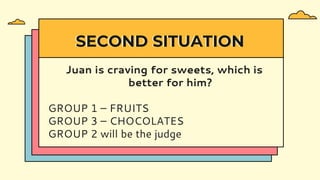
Juan is craving for sweets, which is
better for him?
GROUP 1 – FRUITS
GROUP 3 – CHOCOLATES
GROUP 2 will be the judge
SECOND SITUATION
Maria wants to go on a vacation, which
tourist destination is better for her to
go?
GROUP 1 – PALAWAN
GROUP 2 – BORACAY
GROUP 3 will be the judge
THIRD SITUATION
FOUR
FORMS OF
REASONING
INFERENCE
 is the drawing of a new conclusion
from information that is already
known. It can also be used to
predict reasonably or logically what
will happen in the future.
EXAMPLE:
My sister is excellent at surfing,
so she should be good at
skateboarding.
GENERALIZATION
 is a conclusion based on several
particular facts or cases. A valid
generalization is a statement that
holds true in many cases or is
supported by evidence.
EXAMPLE:
Every homeroom in our school
has more girls than boys, so
there are more girls than boys
in our school.
ANALOGY
 is a comparison between two things
that are similar in some ways but are
essentially unlike. A complete analogy
is one that compares two different
objects that are similar in some
important way.
EXAMPLE:
The cell is like a factory-it
processes raw materials,
produces energy, and
discharges wastes.
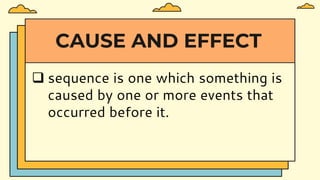
CAUSE AND EFFECT
 sequence is one which something is
caused by one or more events that
occurred before it.
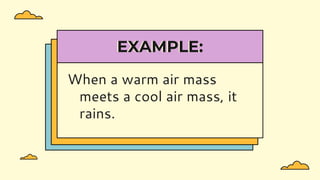
EXAMPLE:
When a warm air mass
meets a cool air mass, it
rains.
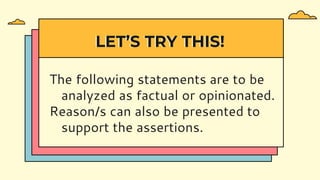
The following statements are to be
analyzed as factual or opinionated.
Reason/s can also be presented to
support the assertions.
LET’S TRY THIS!
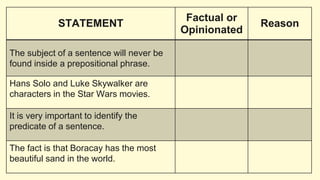
STATEMENT
Factual or
Opinionated
Reason
The subject of a sentence will never be
found inside a prepositional phrase.
Hans Solo and Luke Skywalker are
characters in the Star Wars movies.
It is very important to identify the
predicate of a sentence.
The fact is that Boracay has the most
beautiful sand in the world.
ACTIVITY
Write your own paragraph with 5-8 sentences.
You can have the working title “The
Effectivity of Face to Face classes in My
Education”. You can provide facts, opinions,
perspectives, experiences and even arguments.
You can also state some reasons if needed.
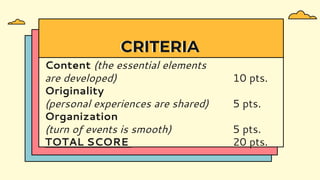
Content (the essential elements
are developed) 10 pts.
Originality
(personal experiences are shared) 5 pts.
Organization
(turn of events is smooth) 5 pts.
TOTAL SCORE 20 pts.
CRITERIA

Critical Reading as Reasoning

  • 1.
  • 2.
    OBJECTIVES  Realize thatcritical reading is a way of reasoning;  Distinguish factual from opinionated statements; and  Construct a paragraph on a given topic with facts, arguments, and reasons.
  • 3.
  • 4.
    You are thinkingcritically when you do not rest on accepting the message of the text but coining it in your personal experiences and perspectives to help you formulate logical and right assertions. CRITICAL READING
  • 5.
    after critically readinga piece you should be able to take notes, paraphrasing - in your own words - the key points. What the text says:
  • 6.
    you should beconfident that you have understood the text sufficiently to be able to use your own examples and compare and contrast with other writing on the subject in hand. What the text describes:
  • 7.
    this means thatyou should be able to fully analyze the text and state a meaning for the text. Interpretation of the text:
  • 8.
    The reader reallyis challenged to reason out and justify the actions, thoughts, and ideas if the skill of critical reading and thinking is developed. The art of reasoning as offshoot of critical reading and thinking will be next to be accomplished.
  • 9.
    We can defineevidence as anything used to support the validity of the assertions. Evidence includes testimony, scientific findings, statistics, physical objects, and many more. Weighing all the evidence can help us to decide on something.
  • 10.
    FACT  is onethat can be verified or proved true by objective means. It is objective and observation and experimentation are means of verification.
  • 11.
    EXAMPLE FACT  On July20, 1969, Neil Armstrong was the first human being to set foot on the moon.
  • 12.
    OPINION  is onethat cannot be verified or proved true by objective means. An opinion is subjective and must be properly supported with facts before it can be accepted as valid.
  • 13.
    EXAMPLE OPINION  A mechanicalflaw in a spacecraft could threaten an astronaut’s life.
  • 14.
  • 15.
    Mechanics You will begiven a certain situation wherein all the groups will take turns to be the judge and to be the participants. For example GROUP 1 will be the JUDGE and the remaining two groups will be the one to give their reasons.
  • 16.
    Mechanics  For everysituation, each group will only be given 2 minutes to brainstorm.  Only one speaker will be allowed to convince the judges by giving their own reasons.  After all the speakers have given their reasons, the judge will give their judgement based on the reasons presented by each group.
  • 17.
    Anna wants tohave a movie date with her family, which genre to you think is better to watch? GROUP 2 – ROMANTIC MOVIES GROUP 3 – HORROR MOVIES GROUP 1 will be the judge FIRST SITUATION
  • 18.
    Juan is cravingfor sweets, which is better for him? GROUP 1 – FRUITS GROUP 3 – CHOCOLATES GROUP 2 will be the judge SECOND SITUATION
  • 19.
    Maria wants togo on a vacation, which tourist destination is better for her to go? GROUP 1 – PALAWAN GROUP 2 – BORACAY GROUP 3 will be the judge THIRD SITUATION
  • 20.
  • 21.
    INFERENCE  is thedrawing of a new conclusion from information that is already known. It can also be used to predict reasonably or logically what will happen in the future.
  • 22.
    EXAMPLE: My sister isexcellent at surfing, so she should be good at skateboarding.
  • 23.
    GENERALIZATION  is aconclusion based on several particular facts or cases. A valid generalization is a statement that holds true in many cases or is supported by evidence.
  • 24.
    EXAMPLE: Every homeroom inour school has more girls than boys, so there are more girls than boys in our school.
  • 25.
    ANALOGY  is acomparison between two things that are similar in some ways but are essentially unlike. A complete analogy is one that compares two different objects that are similar in some important way.
  • 26.
    EXAMPLE: The cell islike a factory-it processes raw materials, produces energy, and discharges wastes.
  • 27.
    CAUSE AND EFFECT sequence is one which something is caused by one or more events that occurred before it.
  • 28.
    EXAMPLE: When a warmair mass meets a cool air mass, it rains.
  • 29.
    The following statementsare to be analyzed as factual or opinionated. Reason/s can also be presented to support the assertions. LET’S TRY THIS!
  • 30.
    STATEMENT Factual or Opinionated Reason The subjectof a sentence will never be found inside a prepositional phrase. Hans Solo and Luke Skywalker are characters in the Star Wars movies. It is very important to identify the predicate of a sentence. The fact is that Boracay has the most beautiful sand in the world.
  • 31.
    ACTIVITY Write your ownparagraph with 5-8 sentences. You can have the working title “The Effectivity of Face to Face classes in My Education”. You can provide facts, opinions, perspectives, experiences and even arguments. You can also state some reasons if needed.
  • 32.
    Content (the essentialelements are developed) 10 pts. Originality (personal experiences are shared) 5 pts. Organization (turn of events is smooth) 5 pts. TOTAL SCORE 20 pts. CRITERIA

Editor's Notes

  • #4 Let us recall our previous lesson on strategies for critical reading. We identify critical reading as engaging in what you read by asking yourself question pertaining to the main argument of the text as presented by the author. It is also understood that it is presenting a reasoned argument that evaluates and analyzes what you have read. Some strategies are annotating, contextualizing, reflecting, paraphrasing, outlining, summarizing, exploring the figurative language, and evaluating the logic of an argument.
  • #5 Critical reading entails active understanding of a processed and judged author’s words and its meaning. Of course, these assertions are backed up with strong evidence. As a critical reader you should reflect on:
  • #8 The interaction between the text and the reader is necessary because reading results from the negotiation of meaning between the text and the reader. By reading critically, you find out the author’s views on something, ask questions, evaluate the strengths and weaknesses of the author’s argument, and decide to agree or disagree with it. Thus, critical reading allows you to enter a dialogue with the author—–and this deepens your understanding of the issue or topic discussed. Therefore, to arrive at a sufficient interpretation of the text, you need to become a critical and active reader.
  • #9 It is to be understood that all reasoning is based on data, information, and evidence. All reasoning is expressed through, and shaped by, concepts and ideas. All reasoning contains inferences or interpretations by which we draw conclusions and give meaning to data. All reasoning leads somewhere or has implications and consequences. Having good logical reasoning skills will help you in decision making.
  • #10 It is practical for us to consider the text or the material as an argument of the author instead of as a fact. In analyzing the text, look for its reliability. To determine whether the material is reliable, you must be able to distinguish between fact and opinion.
  • #12 A written authority such as reference book or human authority as witness can be used to know the validity of the statement.
  • #13 It is important to remember that an opinion may be based on facts, but an opinion is not a fact. Look closely at the author’s use of persuasive words like ought to, should, and must do for it leads an opinionated statement that is subjective.
  • #14 This example expresses a judgment based on facts and is a valid opinion. Last thing to do is to draw valid conclusions from gathered evidence. Remember that there are four forms of reasoning - inference, generalization, analogy, and cause and effect.
  • #20 What did you feel while doing the activity? For the participants: How did come up with those kinds of reasons? For the judges: How were you able to make sound judgement?
  • #22 What a text means : analyzes the text and asserts a meaning for the text as a whole 
  • #23 This inference is valid because it is logical to conclude that similar skills are required in both sports.
  • #27 This analogy is complete because it compares functions that are similar.