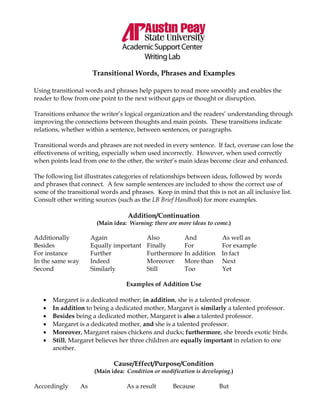
Transitional Words, Phrases and Examples

Using transitional words and phrases help papers to read more smoothly and enables the
reader to flow from one point to the next without gaps or thought or disruption.

Transitions enhance the writer’s logical organization and the readers’ understanding through
improving the connections between thoughts and main points. These transitions indicate
relations, whether within a sentence, between sentences, or paragraphs.

Transitional words and phrases are not needed in every sentence. If fact, overuse can lose the
effectiveness of writing, especially when used incorrectly. However, when used correctly
when points lead from one to the other, the writer’s main ideas become clear and enhanced.

The following list illustrates categories of relationships between ideas, followed by words
and phrases that connect. A few sample sentences are included to show the correct use of
some of the transitional words and phrases. Keep in mind that this is not an all inclusive list.
Consult other writing sources (such as the LB Brief Handbook) for more examples.

                                    Addition/Continuation
                         (Main idea: Warning: there are more ideas to come.)

Additionally           Again                Also          And           As well as
Besides                Equally important    Finally       For           For example
For instance           Further              Furthermore   In addition   In fact
In the same way        Indeed               Moreover      More than     Next
Second                 Similarly            Still         Too           Yet

                                    Examples of Addition Use

      Margaret is a dedicated mother; in addition, she is a talented professor.
      In addition to being a dedicated mother, Margaret is similarly a talented professor.
      Besides being a dedicated mother, Margaret is also a talented professor.
      Margaret is a dedicated mother, and she is a talented professor.
      Moreover, Margaret raises chickens and ducks; furthermore, she breeds exotic birds.
      Still, Margaret believes her three children are equally important in relation to one
       another.

                               Cause/Effect/Purpose/Condition
                        (Main idea: Condition or modification is developing.)

Accordingly       As                As a result      Because            But
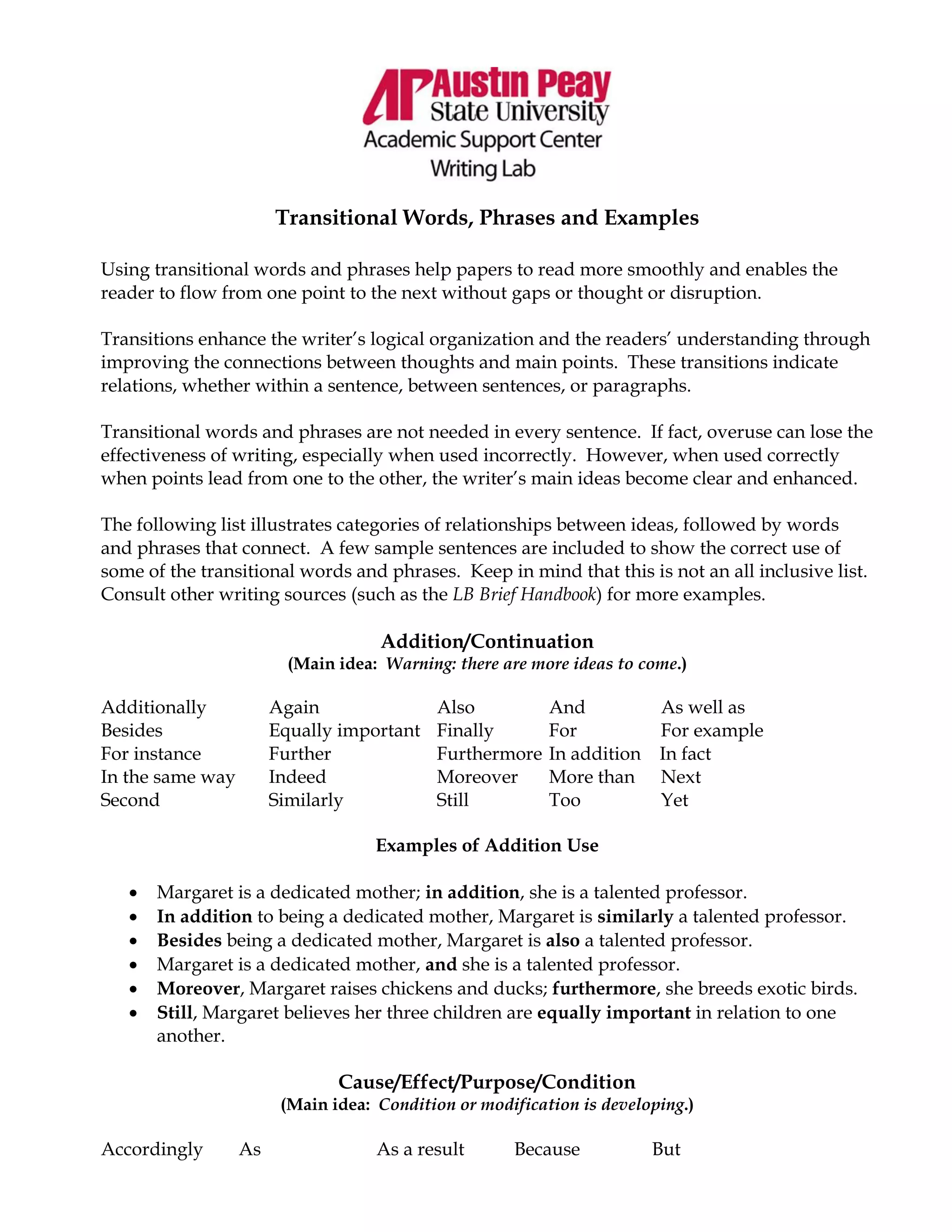
Consequently       For               From             Hence             If
In consequence     In order that     Initially        Of                Resulting from
So                 So that           Subsequently     That              Then
Therefore          Thus              To               Ultimately        Unless
Until              Without           Yet

                         Examples of Cause/Effect/Purpose/Condition Use:

       Unless the bald tires are changed, the vehicle is unsafe to drive.
       Until the children behave, they will not be allowed to watch television.
       Drivers who fail to decrease their speed in areas where roads are being repaired will
        subsequently be stopped by the police who will thus give them traffic tickets.
       Accordingly, drivers may have to pay heavy fines if they do not contest the infraction.
       As a result, they will accumulate points on their driving records. Ultimately,
        accumulation of too many points can cost them their licenses.
       Sherry neglected to wear her seatbelt; as a result, she was severely injured in a traffic
        accident.
       Sometimes people do not obey traffic laws; consequently, they are ticketed and face
        legal fines.


                                           Comparison
             (Main idea: We will now show how idea/thing B is the same as idea/thing A.)

Again                    Also               Analogous to                 And             As well as
Equally important        Even/evenly        In the same way              Like            Likewise
Much as                  Same as            Similarly                    Still           Too
While                    Yet

                                   Examples of Comparison Use

       To prepare for a job interview, Taiesha ironed her suit; likewise, Claude polished his
        shoes.
       Leo wants to earn a promotion as well as continue his studies at the local university.
       Failing to study for comprehensive exams is analogous to neglecting to prepare for
        renewing medical licensures.
       The students were late to class; similarly, the professors were ill prepared to teach.
       The amount of coffee in the cup was as much as the mixture of milk and sugar.

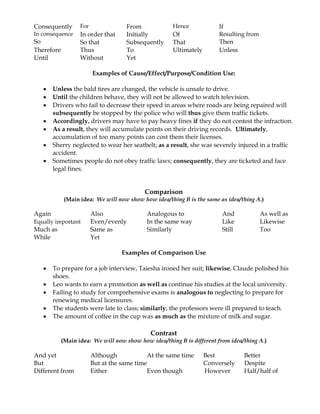
                                             Contrast
            (Main idea: We will now show how idea/thing B is different from idea/thing A.)

And yet                  Although            At the same time      Best          Better
But                      But at the same time                      Conversely    Despite
Different from           Either              Even though           However       Half/half of
In contrast           In spite of           Instead                  Less than     More often
More than             Most often            Nevertheless             Nonetheless Nor
Notwithstanding       On the contrary       On the other hand        Opposite from
Or                    Or else               Otherwise                Quite the contrary
Regardless            Rather                Rather than              Though          Whereas
Yet

                                    Examples of Contrast Use

      Annette wanted to go to the movies, but she has to babysit her siblings.
      Sharon desires to attend college; however, she hasn’t been accepted into a university.
      Even though Barry chooses to drive an expensive car, he cannot afford the monthly
       payments.
      The results of the test proved positive; whereas, the samples were different from their
       original sources.
      Nevertheless, the disease process is opposite from the researched material.
      Instead, doubt exists of its validity rather than confirms it.
      On the other hand, the samples needed to come from the same source or else the
       results will not be the same.


                                           Concession
(Main idea: After weighing your ideas with those of someone else’s or other resources, especially in a
               persuasive argument, you or the other person/resource may be right.)

Granted       Naturally       Of course

                                  Examples of Concession Use:

      Granted, while the idea of forcing all citizens to have health insurance ideally protects
       them from paying high out-of-pocket costs, not everyone can afford to buy insurance.
      Naturally, people want to be able to go to the doctor whenever they are sick, but of
       course. they choose not to go when they cannot afford the cost.

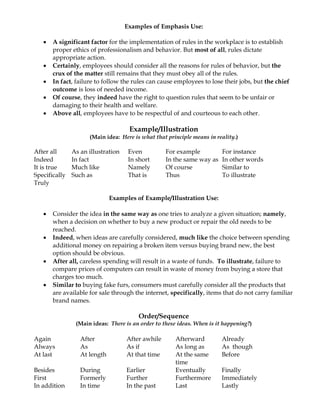
                                            Emphasis
                                   (Main idea: This is important.)

A central issue/idea          A key feature/issue/ides     A distinctive factor
A distinctive quality         A major development          A major event          A primary concern
A significant factor          A vital force                Above all              By the way
Certainly                     Especially important         Especially relevant
Especially valuable           Important to note            Indeed                 In fact
More than anything else       Most noteworthy              Most of all            Of course
Pay particular attention to   Remember that                Should be noted        The basic value
The chief outcome             The crux of the matter       The main value         The principle item
The most substantial issue
Examples of Emphasis Use:

      A significant factor for the implementation of rules in the workplace is to establish
       proper ethics of professionalism and behavior. But most of all, rules dictate
       appropriate action.
      Certainly, employees should consider all the reasons for rules of behavior, but the
       crux of the matter still remains that they must obey all of the rules.
      In fact, failure to follow the rules can cause employees to lose their jobs, but the chief
       outcome is loss of needed income.
      Of course, they indeed have the right to question rules that seem to be unfair or
       damaging to their health and welfare.
      Above all, employees have to be respectful of and courteous to each other.

                                     Example/Illustration
                     (Main idea: Here is what that principle means in reality.)

After all      As an illustration    Even          For example           For instance
Indeed         In fact               In short      In the same way as    In other words
It is true     Much like             Namely        Of course             Similar to
Specifically   Such as               That is       Thus                  To illustrate
Truly

                              Examples of Example/Illustration Use:

      Consider the idea in the same way as one tries to analyze a given situation; namely,
       when a decision on whether to buy a new product or repair the old needs to be
       reached.
      Indeed, when ideas are carefully considered, much like the choice between spending
       additional money on repairing a broken item versus buying brand new, the best
       option should be obvious.
      After all, careless spending will result in a waste of funds. To illustrate, failure to
       compare prices of computers can result in waste of money from buying a store that
       charges too much.
      Similar to buying fake furs, consumers must carefully consider all the products that
       are available for sale through the internet, specifically, items that do not carry familiar
       brand names.

                                        Order/Sequence
                (Main ideas: There is an order to these ideas. When is it happening?)

Again             After             After awhile       Afterward         Already
Always            As                As if              As long as        As though
At last           At length         At that time       At the same       Before
                                                       time
Besides           During            Earlier            Eventually        Finally
First             Formerly          Further            Furthermore       Immediately
In addition       In time           In the past        Last              Lastly
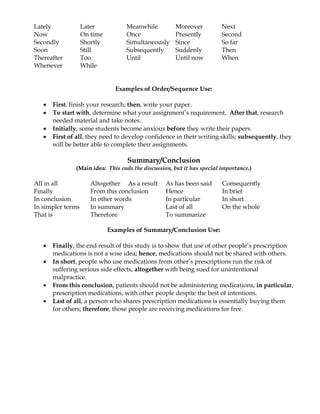
Lately             Later          Meanwhile           Moreover          Next
Now                On time        Once                Presently         Second
Secondly           Shortly        Simultaneously      Since             So far
Soon               Still          Subsequently        Suddenly          Then
Thereafter         Too            Until               Until now         When
Whenever           While


                               Examples of Order/Sequence Use:

      First, finish your research; then, write your paper.
      To start with, determine what your assignment’s requirement. After that, research
       needed material and take notes.
      Initially, some students become anxious before they write their papers.
      First of all, they need to develop confidence in their writing skills; subsequently, they
       will be better able to complete their assignments.

                                   Summary/Conclusion
               (Main idea: This ends the discussion, but it has special importance.)

All in all            Altogether As a result      As has been said      Consequently
Finally               From this conclusion        Hence                 In brief
In conclusion         In other words              In particular         In short
In simpler terms      In summary                  Last of all           On the whole
That is               Therefore                   To summarize

                             Examples of Summary/Conclusion Use:

      Finally, the end result of this study is to show that use of other people’s prescription
       medications is not a wise idea; hence, medications should not be shared with others.
      In short, people who use medications from other’s prescriptions run the risk of
       suffering serious side effects, altogether with being sued for unintentional
       malpractice.
      From this conclusion, patients should not be administering medications, in particular,
       prescription medications, with other people despite the best of intentions.
      Last of all, a person who shares prescription medications is essentially buying them
       for others; therefore, those people are receiving medications for free.

Transitional words and_phrases

  • 1.
    Transitional Words, Phrasesand Examples Using transitional words and phrases help papers to read more smoothly and enables the reader to flow from one point to the next without gaps or thought or disruption. Transitions enhance the writer’s logical organization and the readers’ understanding through improving the connections between thoughts and main points. These transitions indicate relations, whether within a sentence, between sentences, or paragraphs. Transitional words and phrases are not needed in every sentence. If fact, overuse can lose the effectiveness of writing, especially when used incorrectly. However, when used correctly when points lead from one to the other, the writer’s main ideas become clear and enhanced. The following list illustrates categories of relationships between ideas, followed by words and phrases that connect. A few sample sentences are included to show the correct use of some of the transitional words and phrases. Keep in mind that this is not an all inclusive list. Consult other writing sources (such as the LB Brief Handbook) for more examples. Addition/Continuation (Main idea: Warning: there are more ideas to come.) Additionally Again Also And As well as Besides Equally important Finally For For example For instance Further Furthermore In addition In fact In the same way Indeed Moreover More than Next Second Similarly Still Too Yet Examples of Addition Use  Margaret is a dedicated mother; in addition, she is a talented professor.  In addition to being a dedicated mother, Margaret is similarly a talented professor.  Besides being a dedicated mother, Margaret is also a talented professor.  Margaret is a dedicated mother, and she is a talented professor.  Moreover, Margaret raises chickens and ducks; furthermore, she breeds exotic birds.  Still, Margaret believes her three children are equally important in relation to one another. Cause/Effect/Purpose/Condition (Main idea: Condition or modification is developing.) Accordingly As As a result Because But
  • 2.
    Consequently For From Hence If In consequence In order that Initially Of Resulting from So So that Subsequently That Then Therefore Thus To Ultimately Unless Until Without Yet Examples of Cause/Effect/Purpose/Condition Use:  Unless the bald tires are changed, the vehicle is unsafe to drive.  Until the children behave, they will not be allowed to watch television.  Drivers who fail to decrease their speed in areas where roads are being repaired will subsequently be stopped by the police who will thus give them traffic tickets.  Accordingly, drivers may have to pay heavy fines if they do not contest the infraction.  As a result, they will accumulate points on their driving records. Ultimately, accumulation of too many points can cost them their licenses.  Sherry neglected to wear her seatbelt; as a result, she was severely injured in a traffic accident.  Sometimes people do not obey traffic laws; consequently, they are ticketed and face legal fines. Comparison (Main idea: We will now show how idea/thing B is the same as idea/thing A.) Again Also Analogous to And As well as Equally important Even/evenly In the same way Like Likewise Much as Same as Similarly Still Too While Yet Examples of Comparison Use  To prepare for a job interview, Taiesha ironed her suit; likewise, Claude polished his shoes.  Leo wants to earn a promotion as well as continue his studies at the local university.  Failing to study for comprehensive exams is analogous to neglecting to prepare for renewing medical licensures.  The students were late to class; similarly, the professors were ill prepared to teach.  The amount of coffee in the cup was as much as the mixture of milk and sugar. Contrast (Main idea: We will now show how idea/thing B is different from idea/thing A.) And yet Although At the same time Best Better But But at the same time Conversely Despite Different from Either Even though However Half/half of
  • 3.
    In contrast In spite of Instead Less than More often More than Most often Nevertheless Nonetheless Nor Notwithstanding On the contrary On the other hand Opposite from Or Or else Otherwise Quite the contrary Regardless Rather Rather than Though Whereas Yet Examples of Contrast Use  Annette wanted to go to the movies, but she has to babysit her siblings.  Sharon desires to attend college; however, she hasn’t been accepted into a university.  Even though Barry chooses to drive an expensive car, he cannot afford the monthly payments.  The results of the test proved positive; whereas, the samples were different from their original sources.  Nevertheless, the disease process is opposite from the researched material.  Instead, doubt exists of its validity rather than confirms it.  On the other hand, the samples needed to come from the same source or else the results will not be the same. Concession (Main idea: After weighing your ideas with those of someone else’s or other resources, especially in a persuasive argument, you or the other person/resource may be right.) Granted Naturally Of course Examples of Concession Use:  Granted, while the idea of forcing all citizens to have health insurance ideally protects them from paying high out-of-pocket costs, not everyone can afford to buy insurance.  Naturally, people want to be able to go to the doctor whenever they are sick, but of course. they choose not to go when they cannot afford the cost. Emphasis (Main idea: This is important.) A central issue/idea A key feature/issue/ides A distinctive factor A distinctive quality A major development A major event A primary concern A significant factor A vital force Above all By the way Certainly Especially important Especially relevant Especially valuable Important to note Indeed In fact More than anything else Most noteworthy Most of all Of course Pay particular attention to Remember that Should be noted The basic value The chief outcome The crux of the matter The main value The principle item The most substantial issue
  • 4.
    Examples of EmphasisUse:  A significant factor for the implementation of rules in the workplace is to establish proper ethics of professionalism and behavior. But most of all, rules dictate appropriate action.  Certainly, employees should consider all the reasons for rules of behavior, but the crux of the matter still remains that they must obey all of the rules.  In fact, failure to follow the rules can cause employees to lose their jobs, but the chief outcome is loss of needed income.  Of course, they indeed have the right to question rules that seem to be unfair or damaging to their health and welfare.  Above all, employees have to be respectful of and courteous to each other. Example/Illustration (Main idea: Here is what that principle means in reality.) After all As an illustration Even For example For instance Indeed In fact In short In the same way as In other words It is true Much like Namely Of course Similar to Specifically Such as That is Thus To illustrate Truly Examples of Example/Illustration Use:  Consider the idea in the same way as one tries to analyze a given situation; namely, when a decision on whether to buy a new product or repair the old needs to be reached.  Indeed, when ideas are carefully considered, much like the choice between spending additional money on repairing a broken item versus buying brand new, the best option should be obvious.  After all, careless spending will result in a waste of funds. To illustrate, failure to compare prices of computers can result in waste of money from buying a store that charges too much.  Similar to buying fake furs, consumers must carefully consider all the products that are available for sale through the internet, specifically, items that do not carry familiar brand names. Order/Sequence (Main ideas: There is an order to these ideas. When is it happening?) Again After After awhile Afterward Already Always As As if As long as As though At last At length At that time At the same Before time Besides During Earlier Eventually Finally First Formerly Further Furthermore Immediately In addition In time In the past Last Lastly
  • 5.
    Lately Later Meanwhile Moreover Next Now On time Once Presently Second Secondly Shortly Simultaneously Since So far Soon Still Subsequently Suddenly Then Thereafter Too Until Until now When Whenever While Examples of Order/Sequence Use:  First, finish your research; then, write your paper.  To start with, determine what your assignment’s requirement. After that, research needed material and take notes.  Initially, some students become anxious before they write their papers.  First of all, they need to develop confidence in their writing skills; subsequently, they will be better able to complete their assignments. Summary/Conclusion (Main idea: This ends the discussion, but it has special importance.) All in all Altogether As a result As has been said Consequently Finally From this conclusion Hence In brief In conclusion In other words In particular In short In simpler terms In summary Last of all On the whole That is Therefore To summarize Examples of Summary/Conclusion Use:  Finally, the end result of this study is to show that use of other people’s prescription medications is not a wise idea; hence, medications should not be shared with others.  In short, people who use medications from other’s prescriptions run the risk of suffering serious side effects, altogether with being sued for unintentional malpractice.  From this conclusion, patients should not be administering medications, in particular, prescription medications, with other people despite the best of intentions.  Last of all, a person who shares prescription medications is essentially buying them for others; therefore, those people are receiving medications for free.