Summarizing,
paraphrasing, and
synthesizing
Self-study Version
Summarizing, paraphrasing, and
synthesizing
When working on an academic text it is
likely that you are going to work with a
variety of text. You will also need to select
materials that are relevant for your work.
Once you have selected the materials you
want to work with, you need to make some
adjustments before you can include them in
your work.
Summarizing, paraphrasing, and
synthesizing
Before you can include other people’s ideas
in your work you need to do one or more of
these things:
• Summarize
• Paraphrase
• Synthesize
Summarize
• A summary is a shortened version of the
original text.
• It should contain the main points of the
original text but in a condensed version.
• It should be written in your own words.
• The source should be acknowledged.
Points to help you summarize
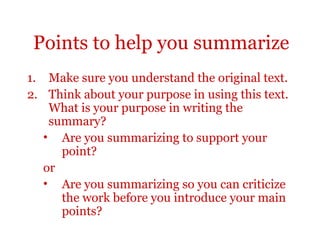
1. Make sure you understand the original text.
2. Think about your purpose in using this text.
What is your purpose in writing the
summary?
• Are you summarizing to support your
point?
or
• Are you summarizing so you can criticize
the work before you introduce your main
points?
Points to help you summarize
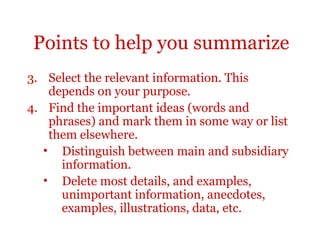
3. Select the relevant information. This
depends on your purpose.
4. Find the important ideas (words and
phrases) and mark them in some way or list
them elsewhere.
• Distinguish between main and subsidiary
information.
• Delete most details, and examples,
unimportant information, anecdotes,
examples, illustrations, data, etc.
Points to help you summarize
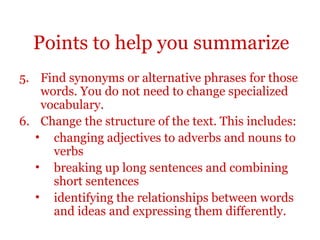
5. Find synonyms or alternative phrases for those
words. You do not need to change specialized
vocabulary.
6. Change the structure of the text. This includes:
• changing adjectives to adverbs and nouns to
verbs
• breaking up long sentences and combining
short sentences
• identifying the relationships between words
and ideas and expressing them differently.
Points to help you summarize
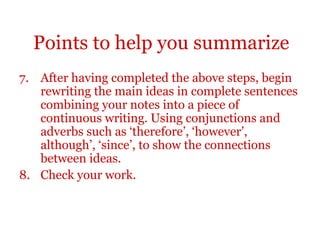
7. After having completed the above steps, begin
rewriting the main ideas in complete sentences
combining your notes into a piece of
continuous writing. Using conjunctions and
adverbs such as ‘therefore’, ‘however’,
although’, ‘since’, to show the connections
between ideas.
8. Check your work.
Points to help you summarize
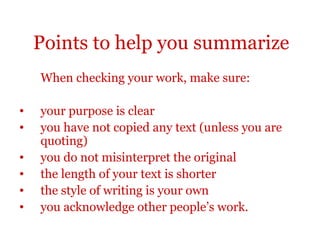
When checking your work, make sure:
• your purpose is clear
• you have not copied any text (unless you are
quoting)
• you do not misinterpret the original
• the length of your text is shorter
• the style of writing is your own
• you acknowledge other people’s work.
Now do the exercises on summarizing
on your worksheet.
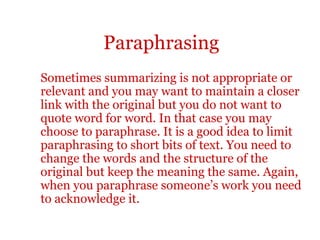
Paraphrasing
Sometimes summarizing is not appropriate or
relevant and you may want to maintain a closer
link with the original but you do not want to
quote word for word. In that case you may
choose to paraphrase. It is a good idea to limit
paraphrasing to short bits of text. You need to
change the words and the structure of the
original but keep the meaning the same. Again,
when you paraphrase someone’s work you need
to acknowledge it.
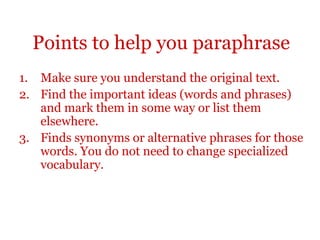
Points to help you paraphrase
1. Make sure you understand the original text.
2. Find the important ideas (words and phrases)
and mark them in some way or list them
elsewhere.
3. Finds synonyms or alternative phrases for those
words. You do not need to change specialized
vocabulary.
Points to help you paraphrase
4. Change the structure of the text. This includes:
• Changing adjectives to adverbs and nouns to
verbs
• Breaking up long sentences and combining
short sentences
• Identifying the relationships between words
and ideas and expressing them in a different
way. (Be careful not to change the meaning.)
4. Once you have completed the above steps,
rewrite the main ideas in complete sentences
combining you notes into a piece of continuous
writing.
Points to help you paraphrase
6. Check your work.
When checking your work, make sure:
• you have not copied any text
• the meaning is the same as the original
• the style of writing is your own
• your paraphrase is the same length as the
original
• you acknowledge other people’s work through
appropriate referencing.
Now do the exercises on paraphrasing
on your worksheet.
Synthesizing
When you synthesize you combine several texts
into one, usually shorter, piece of writing. After
you have selected the sources you want to use,
you need to use your summary and
paraphrasing skills to rewrite the information in
your own words. The information from all the
sources needs to fit together and form one
continuous text. The sources need to be
acknowledged and properly referenced.
Points to help you synthesize
• All the points for summarizing and
paraphrasing are relevant when you synthesize.
However, the following point can be added to
the summarizing points.
• Organize the information you have from
summarizing the different texts. You could
give all the similar ideas in different texts the
same number or color to help you group them
together.

Summarizing and Paraphrasing

  • 1.
  • 2.
    Summarizing, paraphrasing, and synthesizing Whenworking on an academic text it is likely that you are going to work with a variety of text. You will also need to select materials that are relevant for your work. Once you have selected the materials you want to work with, you need to make some adjustments before you can include them in your work.
  • 3.
    Summarizing, paraphrasing, and synthesizing Beforeyou can include other people’s ideas in your work you need to do one or more of these things: • Summarize • Paraphrase • Synthesize
  • 4.
    Summarize • A summaryis a shortened version of the original text. • It should contain the main points of the original text but in a condensed version. • It should be written in your own words. • The source should be acknowledged.
  • 5.
    Points to helpyou summarize 1. Make sure you understand the original text. 2. Think about your purpose in using this text. What is your purpose in writing the summary? • Are you summarizing to support your point? or • Are you summarizing so you can criticize the work before you introduce your main points?
  • 6.
    Points to helpyou summarize 3. Select the relevant information. This depends on your purpose. 4. Find the important ideas (words and phrases) and mark them in some way or list them elsewhere. • Distinguish between main and subsidiary information. • Delete most details, and examples, unimportant information, anecdotes, examples, illustrations, data, etc.
  • 7.
    Points to helpyou summarize 5. Find synonyms or alternative phrases for those words. You do not need to change specialized vocabulary. 6. Change the structure of the text. This includes: • changing adjectives to adverbs and nouns to verbs • breaking up long sentences and combining short sentences • identifying the relationships between words and ideas and expressing them differently.
  • 8.
    Points to helpyou summarize 7. After having completed the above steps, begin rewriting the main ideas in complete sentences combining your notes into a piece of continuous writing. Using conjunctions and adverbs such as ‘therefore’, ‘however’, although’, ‘since’, to show the connections between ideas. 8. Check your work.
  • 9.
    Points to helpyou summarize When checking your work, make sure: • your purpose is clear • you have not copied any text (unless you are quoting) • you do not misinterpret the original • the length of your text is shorter • the style of writing is your own • you acknowledge other people’s work.
  • 10.
    Now do theexercises on summarizing on your worksheet.
  • 11.
    Paraphrasing Sometimes summarizing isnot appropriate or relevant and you may want to maintain a closer link with the original but you do not want to quote word for word. In that case you may choose to paraphrase. It is a good idea to limit paraphrasing to short bits of text. You need to change the words and the structure of the original but keep the meaning the same. Again, when you paraphrase someone’s work you need to acknowledge it.
  • 12.
    Points to helpyou paraphrase 1. Make sure you understand the original text. 2. Find the important ideas (words and phrases) and mark them in some way or list them elsewhere. 3. Finds synonyms or alternative phrases for those words. You do not need to change specialized vocabulary.
  • 13.
    Points to helpyou paraphrase 4. Change the structure of the text. This includes: • Changing adjectives to adverbs and nouns to verbs • Breaking up long sentences and combining short sentences • Identifying the relationships between words and ideas and expressing them in a different way. (Be careful not to change the meaning.) 4. Once you have completed the above steps, rewrite the main ideas in complete sentences combining you notes into a piece of continuous writing.
  • 14.
    Points to helpyou paraphrase 6. Check your work. When checking your work, make sure: • you have not copied any text • the meaning is the same as the original • the style of writing is your own • your paraphrase is the same length as the original • you acknowledge other people’s work through appropriate referencing.
  • 15.
    Now do theexercises on paraphrasing on your worksheet.
  • 16.
    Synthesizing When you synthesizeyou combine several texts into one, usually shorter, piece of writing. After you have selected the sources you want to use, you need to use your summary and paraphrasing skills to rewrite the information in your own words. The information from all the sources needs to fit together and form one continuous text. The sources need to be acknowledged and properly referenced.
  • 17.
    Points to helpyou synthesize • All the points for summarizing and paraphrasing are relevant when you synthesize. However, the following point can be added to the summarizing points. • Organize the information you have from summarizing the different texts. You could give all the similar ideas in different texts the same number or color to help you group them together.