LESSON 1
ACADEMIC TEXT
At the end of Lesson 1, you are expected to
achieve the following objectives:
 Examine an academic text to establish its nature and
characteristics;
 Recognize the characteristics of language used in
academic texts;
 Analyze academic texts according to its language use;
and
 Evaluate academic texts based on its use of language.
Pre-Assessment:
Read and examine an excerpt of a book review written by a Grade 11 student for her
Reading and Writing class.
...I don’t think that the author of the book gave justice to the
characters. I was appalled with the idea that Sienna died at
the end. It was heart-breaking. I cried my heart out as I
finished reading the book. The book became my new favorite
and I don’t think I will be able to love another book as much
as I love this one...
Questions:
1. Is her choice of words appropriate for a
book review? Why or why not?
2. Point out 3 words that are inappropriate.
Suggest a more appropriate alternative for
each word.
3. What do you think should she do to improve
her writing task?
What have you written so far?
Poem, skits, letters, summer vacation,
and Christmas Vacation
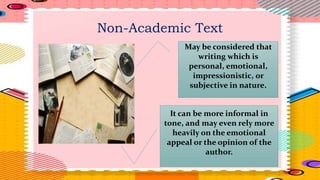
Non-Academic Text
May be considered that
writing which is
personal, emotional,
impressionistic, or
subjective in nature.
It can be more informal in
tone, and may even rely more
heavily on the emotional
appeal or the opinion of the
author.
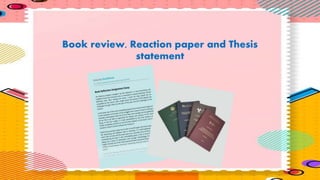
Book review, Reaction paper and Thesis
statement
Academic Text
Defined as objective,
specialized texts written by
experts or professionals in a
given field using formal
language.
This means that academic
text are based on facts with
objective (impersonal) with
solid basis.
What are some academic discipline?
Virus
Nature and Characteristics of an
Academic Text
Structure
Unlike fiction or journalistic writing, the
overall structure of an academic text is
formal and logical (Introduction, Body,
Conclusion). It must be cohesive and
possess a logically organized flow of
ideas; this means that various parts are
connected to form a unified whole.
Tone
The overall tone refers to the
attitude conveyed in a piece of
writing. The arguments of others
are fairly presented and with an
appropriate narrative tone.
When presenting a position or
argument that disagrees with
one’s perspectives, describe the
argument accurately without
loaded or biased language.
Language
It is important to use unambiguous language. Clear
topic sentences enable a reader to follow your line of
thinking without difficulty. Formal language and the
third person point-of view should be used. Technical
language appropriate to the area of study may also be
used, however it does not mean using “big words”
just for the sake of doing so.
Citation
Citing sources in the body of the paper
and providing a list of references as either
footnotes or endnotes is a very important
aspect of an academic text. It is essential
to always acknowledge the source of any
ideas, research findings, data, or quoted
text that have been used in a paper as a
defense against allegations of plagiarism.
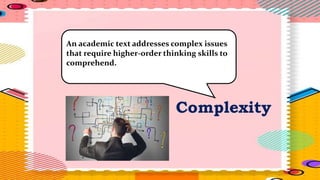
Complexity
An academic text addresses complex issues
that require higher-order thinking skills to
comprehend.
Evidence-based
Arguments
What is valued in an academic text is
that opinions are based on a sound
understanding of the pertinent body of
knowledge and academic debates that
exist within, and often external to a
specific discipline.
Thesis-
driven
The starting point of an academic
text is a particular perspective,
idea or position applied to the
chosen research problem, such as
establishing, proving, or
disproving solutions to the
questions posed for the topic.
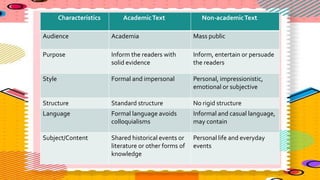
Characteristics AcademicText Non-academicText
Audience Academia Mass public
Purpose Inform the readers with
solid evidence
Inform, entertain or persuade
the readers
Style Formal and impersonal Personal, impressionistic,
emotional or subjective
Structure Standard structure No rigid structure
Language Formal language avoids
colloquialisms
Informal and casual language,
may contain
Subject/Content Shared historical events or
literature or other forms of
knowledge
Personal life and everyday
events
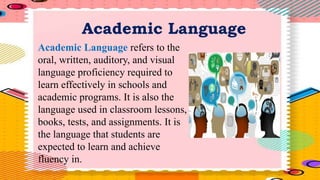
Academic Language refers to the
oral, written, auditory, and visual
language proficiency required to
learn effectively in schools and
academic programs. It is also the
language used in classroom lessons,
books, tests, and assignments. It is
the language that students are
expected to learn and achieve
fluency in.
Academic Language
What is difference between academic language and
social language?
Social language is the simple, informal language we use
when talking face to face with family members and
friends. It allows us to use contemporary or slang terms
like “cool,” “awesome,” or “dude.” We can also
communicate feelings, needs, and wants using symbolic
hand gestures for drink, eat, hot, cold, hurt, or tired.
Social language also includes writing emails, friendly
letters, and texts or retelling stories.
Academic language is different from everyday social
language. It is the vocabulary students or adults must
learn to succeed in the classroom or in the workplace.
We use academic language to describe and comprehend
complex ideas, process higher-order thinking, and
understand abstract concepts. Academic language is
what students read in textbooks and on tests and what
they hear during instruction in the classroom. Students
with limited or low academic language skills are more
than likely to have low academic performance in
classroom settings.
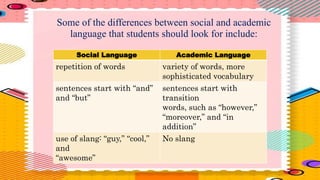
Some of the differences between social and academic
language that students should look for include:
Social Language Academic Language
repetition of words variety of words, more
sophisticated vocabulary
sentences start with “and”
and “but”
sentences start with
transition
words, such as “however,”
“moreover,” and “in
addition”
use of slang: “guy,” “cool,”
and
“awesome”
No slang
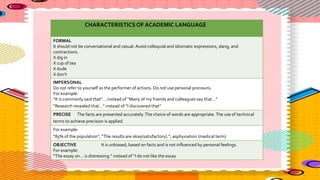
CHARACTERISTICS OF ACADEMIC LANGUAGE
FORMAL
It should not be conversational and casual. Avoid colloquial and idiomatic expressions, slang, and
contractions.
X dig in
X cup of tea
X dude
X don’t
IMPERSONAL
Do not refer to yourself as the performer of actions. Do not use personal pronouns.
For example:
“It is commonly said that”… instead of “Many of my friends and colleagues say that…”
“Research revealed that…” instead of “I discovered that”
PRECISE The facts are presented accurately.The choice of words are appropriate.The use of technical
terms to achieve precision is applied.
For example:
“85% of the population”, “The results are okay(satisfactory).”, asphyxiation (medical term)
OBJECTIVE It is unbiased, based on facts and is not influenced by personal feelings.
For example:
“The essay on… is distressing.” instead of “I do not like the essay
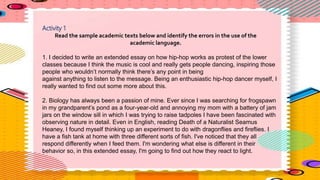
Activity 1
Read the sample academic texts below and identify the errors in the use of the
academic language.
1. I decided to write an extended essay on how hip-hop works as protest of the lower
classes because I think the music is cool and really gets people dancing, inspiring those
people who wouldn’t normally think there’s any point in being
against anything to listen to the message. Being an enthusiastic hip-hop dancer myself, I
really wanted to find out some more about this.
2. Biology has always been a passion of mine. Ever since I was searching for frogspawn
in my grandparent’s pond as a four-year-old and annoying my mom with a battery of jam
jars on the window sill in which I was trying to raise tadpoles I have been fascinated with
observing nature in detail. Even in English, reading Death of a Naturalist Seamus
Heaney, I found myself thinking up an experiment to do with dragonflies and fireflies. I
have a fish tank at home with three different sorts of fish. I've noticed that they all
respond differently when I feed them. I'm wondering what else is different in their
behavior so, in this extended essay, I'm going to find out how they react to light.
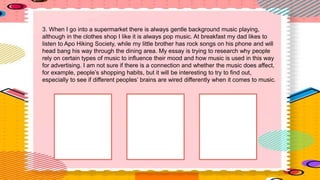
3. When I go into a supermarket there is always gentle background music playing,
although in the clothes shop I like it is always pop music. At breakfast my dad likes to
listen to Apo Hiking Society, while my little brother has rock songs on his phone and will
head bang his way through the dining area. My essay is trying to research why people
rely on certain types of music to influence their mood and how music is used in this way
for advertising. I am not sure if there is a connection and whether the music does affect,
for example, people’s shopping habits, but it will be interesting to try to find out,
especially to see if different peoples’ brains are wired differently when it comes to music.
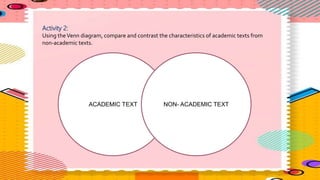
Activity 2:
Using theVenn diagram, compare and contrast the characteristics of academic texts from
non-academic texts.
ACADEMIC TEXT NON- ACADEMIC TEXT
1. How can academic texts affect your life as
a student?
2. Why is learning to appropriately use the
academic language vital in uplifting your
socio-economic status in life?
What I have Learned!
Thank You for listening!
God bless!


Lesson 1 academic text

  • 1.
  • 2.
    At the endof Lesson 1, you are expected to achieve the following objectives:  Examine an academic text to establish its nature and characteristics;  Recognize the characteristics of language used in academic texts;  Analyze academic texts according to its language use; and  Evaluate academic texts based on its use of language.
  • 3.
    Pre-Assessment: Read and examinean excerpt of a book review written by a Grade 11 student for her Reading and Writing class. ...I don’t think that the author of the book gave justice to the characters. I was appalled with the idea that Sienna died at the end. It was heart-breaking. I cried my heart out as I finished reading the book. The book became my new favorite and I don’t think I will be able to love another book as much as I love this one...
  • 4.
    Questions: 1. Is herchoice of words appropriate for a book review? Why or why not? 2. Point out 3 words that are inappropriate. Suggest a more appropriate alternative for each word. 3. What do you think should she do to improve her writing task?
  • 5.
    What have youwritten so far?
  • 6.
    Poem, skits, letters,summer vacation, and Christmas Vacation
  • 7.
    Non-Academic Text May beconsidered that writing which is personal, emotional, impressionistic, or subjective in nature. It can be more informal in tone, and may even rely more heavily on the emotional appeal or the opinion of the author.
  • 8.
    Book review, Reactionpaper and Thesis statement
  • 9.
    Academic Text Defined asobjective, specialized texts written by experts or professionals in a given field using formal language. This means that academic text are based on facts with objective (impersonal) with solid basis.
  • 10.
    What are someacademic discipline?
  • 11.
  • 12.
    Nature and Characteristicsof an Academic Text
  • 13.
    Structure Unlike fiction orjournalistic writing, the overall structure of an academic text is formal and logical (Introduction, Body, Conclusion). It must be cohesive and possess a logically organized flow of ideas; this means that various parts are connected to form a unified whole.
  • 14.
    Tone The overall tonerefers to the attitude conveyed in a piece of writing. The arguments of others are fairly presented and with an appropriate narrative tone. When presenting a position or argument that disagrees with one’s perspectives, describe the argument accurately without loaded or biased language.
  • 15.
    Language It is importantto use unambiguous language. Clear topic sentences enable a reader to follow your line of thinking without difficulty. Formal language and the third person point-of view should be used. Technical language appropriate to the area of study may also be used, however it does not mean using “big words” just for the sake of doing so.
  • 16.
    Citation Citing sources inthe body of the paper and providing a list of references as either footnotes or endnotes is a very important aspect of an academic text. It is essential to always acknowledge the source of any ideas, research findings, data, or quoted text that have been used in a paper as a defense against allegations of plagiarism.
  • 17.
    Complexity An academic textaddresses complex issues that require higher-order thinking skills to comprehend.
  • 18.
    Evidence-based Arguments What is valuedin an academic text is that opinions are based on a sound understanding of the pertinent body of knowledge and academic debates that exist within, and often external to a specific discipline.
  • 19.
    Thesis- driven The starting pointof an academic text is a particular perspective, idea or position applied to the chosen research problem, such as establishing, proving, or disproving solutions to the questions posed for the topic.
  • 20.
    Characteristics AcademicText Non-academicText AudienceAcademia Mass public Purpose Inform the readers with solid evidence Inform, entertain or persuade the readers Style Formal and impersonal Personal, impressionistic, emotional or subjective Structure Standard structure No rigid structure Language Formal language avoids colloquialisms Informal and casual language, may contain Subject/Content Shared historical events or literature or other forms of knowledge Personal life and everyday events
  • 21.
    Academic Language refersto the oral, written, auditory, and visual language proficiency required to learn effectively in schools and academic programs. It is also the language used in classroom lessons, books, tests, and assignments. It is the language that students are expected to learn and achieve fluency in. Academic Language
  • 22.
    What is differencebetween academic language and social language?
  • 23.
    Social language isthe simple, informal language we use when talking face to face with family members and friends. It allows us to use contemporary or slang terms like “cool,” “awesome,” or “dude.” We can also communicate feelings, needs, and wants using symbolic hand gestures for drink, eat, hot, cold, hurt, or tired. Social language also includes writing emails, friendly letters, and texts or retelling stories.
  • 24.
    Academic language isdifferent from everyday social language. It is the vocabulary students or adults must learn to succeed in the classroom or in the workplace. We use academic language to describe and comprehend complex ideas, process higher-order thinking, and understand abstract concepts. Academic language is what students read in textbooks and on tests and what they hear during instruction in the classroom. Students with limited or low academic language skills are more than likely to have low academic performance in classroom settings.
  • 25.
    Some of thedifferences between social and academic language that students should look for include: Social Language Academic Language repetition of words variety of words, more sophisticated vocabulary sentences start with “and” and “but” sentences start with transition words, such as “however,” “moreover,” and “in addition” use of slang: “guy,” “cool,” and “awesome” No slang
  • 26.
    CHARACTERISTICS OF ACADEMICLANGUAGE FORMAL It should not be conversational and casual. Avoid colloquial and idiomatic expressions, slang, and contractions. X dig in X cup of tea X dude X don’t IMPERSONAL Do not refer to yourself as the performer of actions. Do not use personal pronouns. For example: “It is commonly said that”… instead of “Many of my friends and colleagues say that…” “Research revealed that…” instead of “I discovered that” PRECISE The facts are presented accurately.The choice of words are appropriate.The use of technical terms to achieve precision is applied. For example: “85% of the population”, “The results are okay(satisfactory).”, asphyxiation (medical term) OBJECTIVE It is unbiased, based on facts and is not influenced by personal feelings. For example: “The essay on… is distressing.” instead of “I do not like the essay
  • 27.
    Activity 1 Read thesample academic texts below and identify the errors in the use of the academic language. 1. I decided to write an extended essay on how hip-hop works as protest of the lower classes because I think the music is cool and really gets people dancing, inspiring those people who wouldn’t normally think there’s any point in being against anything to listen to the message. Being an enthusiastic hip-hop dancer myself, I really wanted to find out some more about this. 2. Biology has always been a passion of mine. Ever since I was searching for frogspawn in my grandparent’s pond as a four-year-old and annoying my mom with a battery of jam jars on the window sill in which I was trying to raise tadpoles I have been fascinated with observing nature in detail. Even in English, reading Death of a Naturalist Seamus Heaney, I found myself thinking up an experiment to do with dragonflies and fireflies. I have a fish tank at home with three different sorts of fish. I've noticed that they all respond differently when I feed them. I'm wondering what else is different in their behavior so, in this extended essay, I'm going to find out how they react to light.
  • 28.
    3. When Igo into a supermarket there is always gentle background music playing, although in the clothes shop I like it is always pop music. At breakfast my dad likes to listen to Apo Hiking Society, while my little brother has rock songs on his phone and will head bang his way through the dining area. My essay is trying to research why people rely on certain types of music to influence their mood and how music is used in this way for advertising. I am not sure if there is a connection and whether the music does affect, for example, people’s shopping habits, but it will be interesting to try to find out, especially to see if different peoples’ brains are wired differently when it comes to music.
  • 29.
    Activity 2: Using theVenndiagram, compare and contrast the characteristics of academic texts from non-academic texts. ACADEMIC TEXT NON- ACADEMIC TEXT
  • 30.
    1. How canacademic texts affect your life as a student? 2. Why is learning to appropriately use the academic language vital in uplifting your socio-economic status in life? What I have Learned!
  • 31.
    Thank You forlistening! God bless! 