Properties of a Well-Written Text
Lesson 5 Na JUD! 2 More to go pa Guys! HAHA
KAYA NATIN TO!
Review
• Lesson 1 – Text as a Connected Discourse
• Lesson 2 –Transitional Devices (Conjunctions)
• Lesson 3 – Techniques in Selecting and Organizing Information
• Lesson 4 – Patterns of Development
In any piece of writing, the tone should be consistent
and identifiable. Good writing includes smart and
appropriate word choices and well-crafted sentences. A
well-written texts makes your readers use their critical
thinking skills to understand your text and it must be
presented in a way that is logical and aesthetically
pleasing. Everything you do that involves
communication – written, verbal, and nonverbal
must be well-organized, and clear piece of thought.
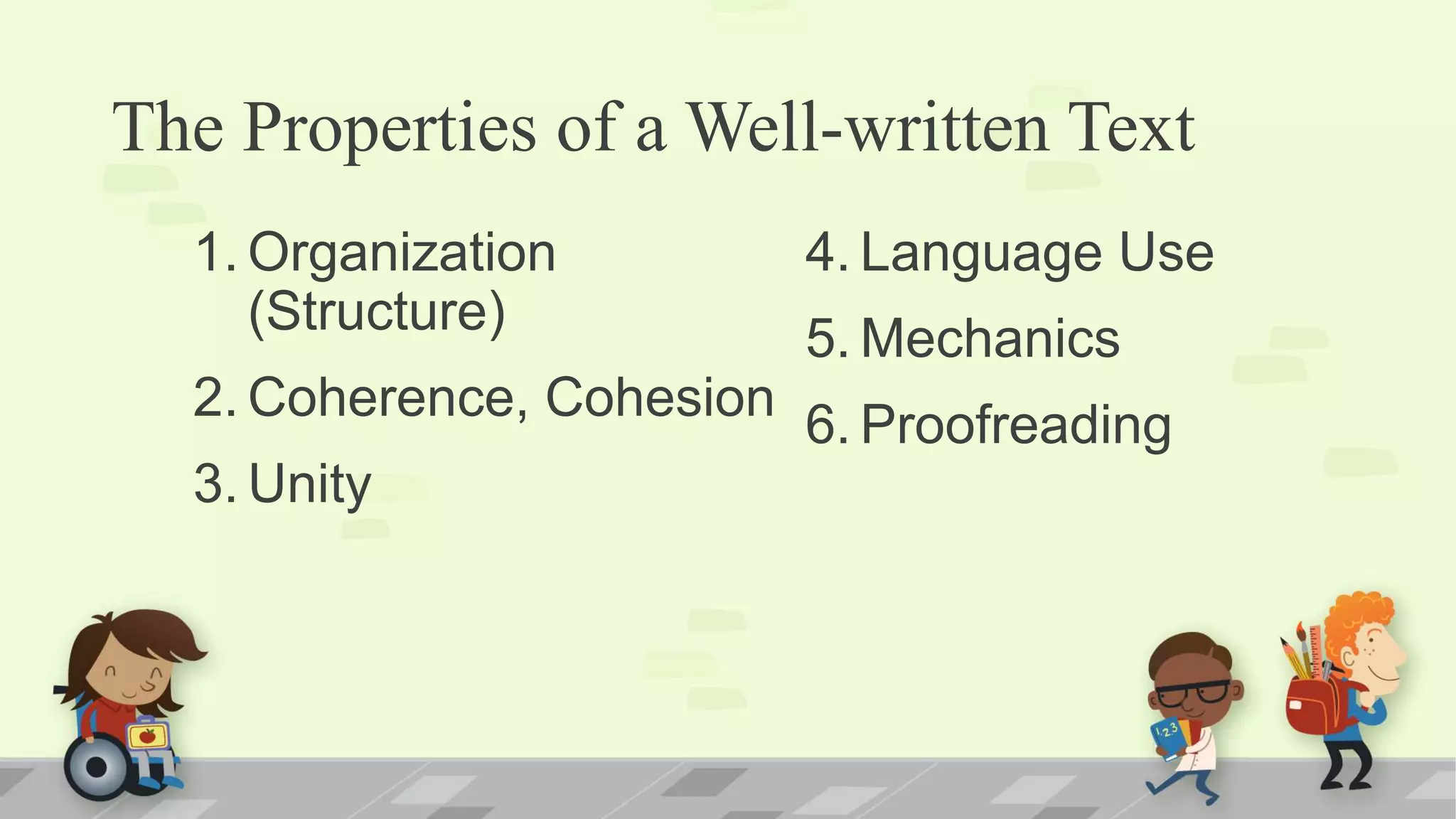
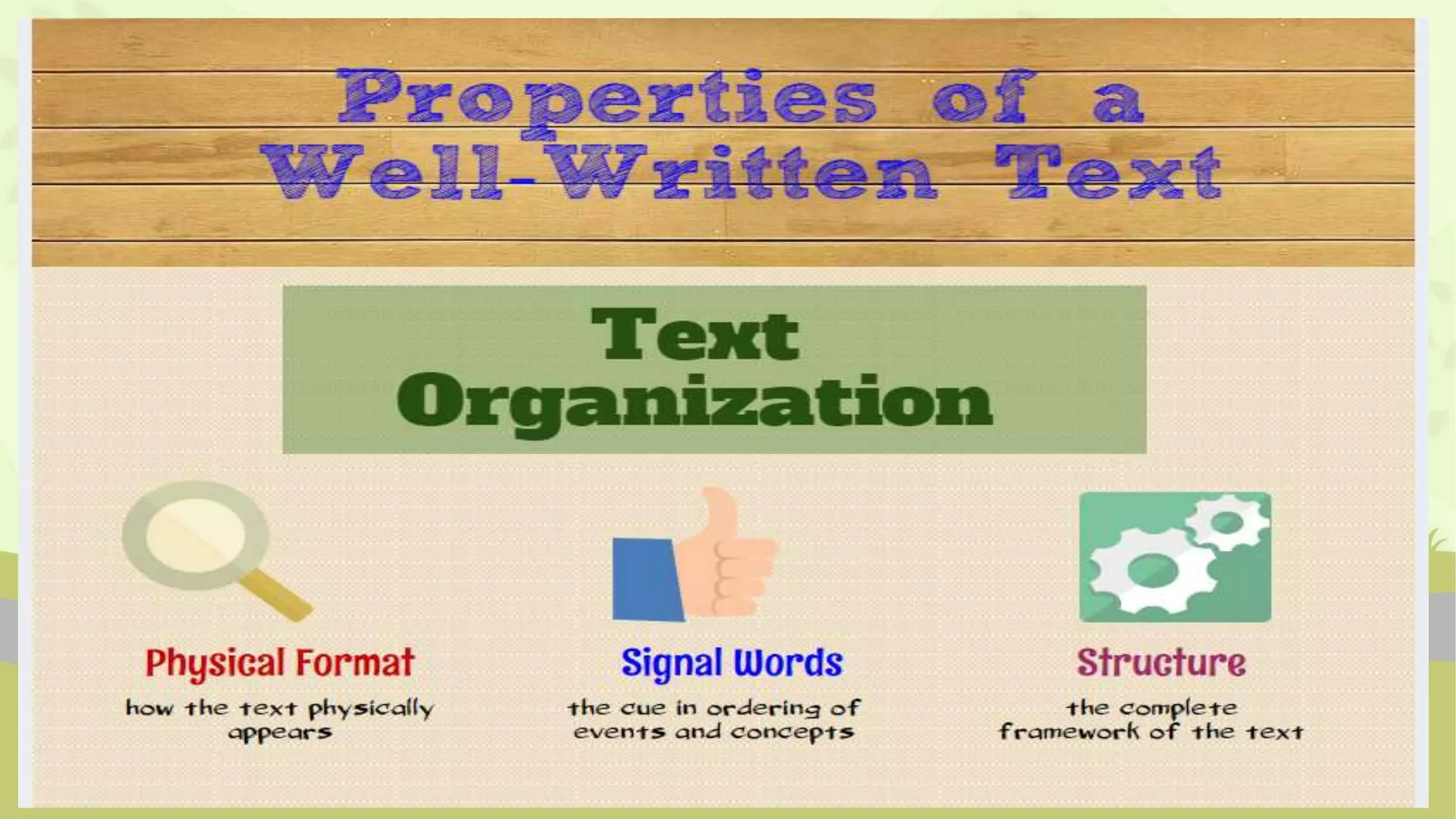
The Properties of a Well-written Text
1. Organization
(Structure)
2. Coherence, Cohesion
3. Unity
4. Language Use
5. Mechanics
6. Proofreading
Paragraph
• A paragraph is a series of sentences that are organized,
coherent, and are all related to a single topic.
• The first line of a paragraph is usually indented. This indentation
of a paragraph indicates where the paragraph begins.
Remember that you must capitalize the first word in each
sentence and end each sentence with a punctuation mark, most
often a period (.).
Introduction / Body / Conclusion
There are three reasons I don’t have a credit card. The first reason is that using
a piece of plastic instead of cash makes it too easy for me to buy things I can’t
afford. For instance, last week I saw a 4,000.00 pair of pink sandals in my
favorite shoe store. Of course, I don’t need pink sandals, nor can I afford them.
With a credit card, however, I would now own those sandals and be worrying
about for to pay for them. The second reason I don’t have a credit card is that I
would end up in debt like my friend Sara, the shopaholic. Sara got a credit card
last year, and she already owes 30,000.00. She buys things that she doesn’t
really need such as jewelry and designer sunglasses. Sara makes only
minimum payments, so her balance never decreases. She will be in debt for
years. The third reason I don’t have a credit card is the difficulty to understand
the fine print in the credit card contract. If I don’t read the fine print, I can be
surprised. For example, some credit card companies will raise my interest rate
if I make payment even one day late. To sum up, credit cards may be a
convenience for some people, but for me, they are plastic ticket to financial
disaster.
Introduction / Body / Conclusion
There are three reasons I don’t have a credit card. The first reason is that using
a piece of plastic instead of cash makes it too easy for me to buy things I can’t
afford. For instance, last week I saw a 4,000.00 pair of pink sandals in my
favorite shoe store. Of course, I don’t need pink sandals, nor can I afford them.
With a credit card, however, I would now own those sandals and be worrying
about for to pay for them. The second reason I don’t have a credit card is that I
would end up in debt like my friend Sara, the shopaholic. Sara got a credit card
last year, and she already owes 30,000.00. She buys things that she doesn’t
really need such as jewelry and designer sunglasses. Sara makes only
minimum payments, so her balance never decreases. She will be in debt for
years. The third reason I don’t have a credit card is the difficulty to understand
the fine print in the credit card contract. If I don’t read the fine print, I can be
surprised. For example, some credit card companies will raise my interest rate
if I make payment even one day late. To sum up, credit cards may be a
convenience for some people, but for me, they are plastic ticket to financial
disaster.
#1 ORGANIZATION
(STRUCTURE)
Organization
• Organization is the structural framework for writing.
It is important to effective writing because it provides
readers with a framework to help them fulfil their
expectations for the text.
• Organization is a logical progression and
completeness of ideas in a text.
• Instructions in organization focuses on two areas:
a) text structures specific to the particular genre and
b) the cohesive elements that tie clauses, sentences,
and paragraphs together into a cohesive whole.
Different arrangements for organization:
1. Chronological Order
2. Order of Importance
3. Spatial Order
4. Definition Order
5. Classification
6. Process
1. Cause and Effect
2. Comparison and Contrast
3. Listing
4. Clarification
5. Summary
6. Example
7. Addition
If there is a clear
statement of
purpose, position,
facts, examples,
specific details,
definitions,
explanation,
justifications, or
opposing
viewpoints,
Ideas are
formed and
well-developed
Organization
#2 Cohesion and
Coherence
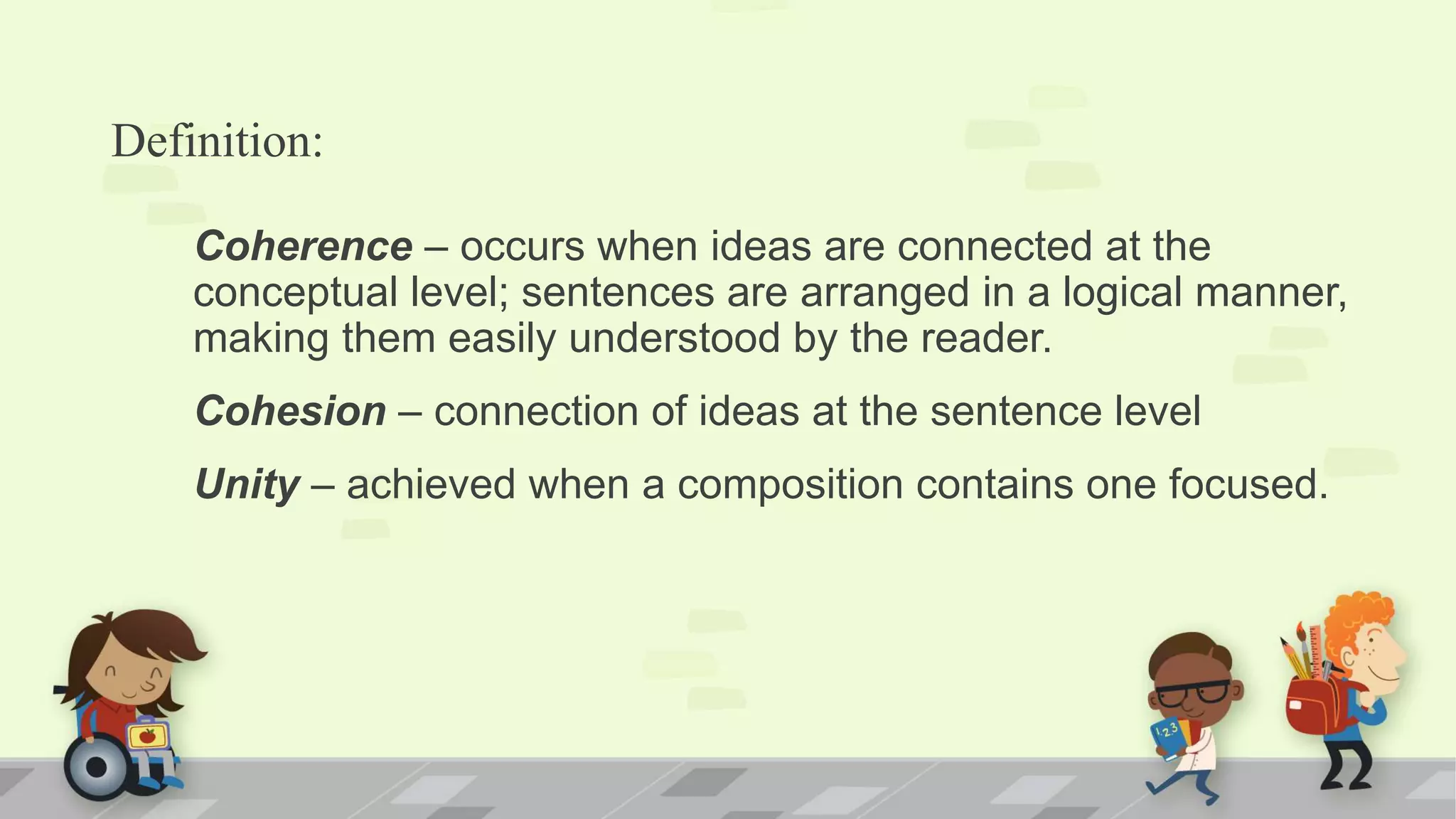
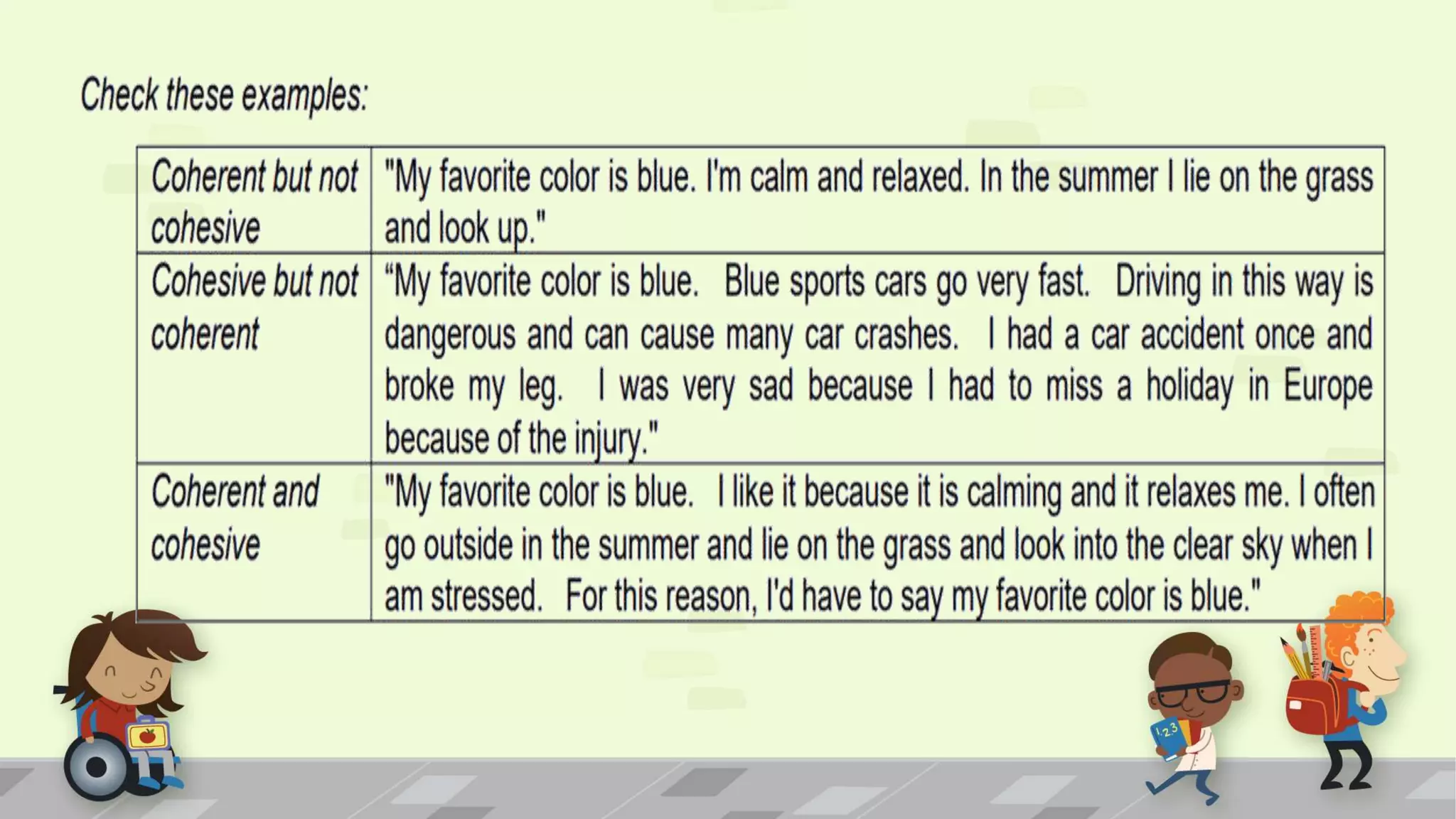
Definition:
Coherence – occurs when ideas are connected at the
conceptual level; sentences are arranged in a logical manner,
making them easily understood by the reader.
Cohesion – connection of ideas at the sentence level
Unity – achieved when a composition contains one focused.
Coherence and Cohesion can be arranged according to:
1. Chronological Order – What Comes First
2. Spatial Order – Top to Bottom, Bottom, to Top, Left to
Right, Right to Left
3. Emphatic Order – Least Important to Most Important,
Techniques to improve paragraph cohesion:
• Transitions – use of conjunction or conjunctive adverb
to link sentences with a particular logical relationship
6 Categories of Transition Words:
1. Spatial Order
2. Time Order
3. Numerical Order
4. Cause and Effect Order
5. Comparison / Contrast Order
6. General / Specific Order
• To Specify Sequence – again, and, also, then, first, second, third, moreover…
• To Specify Time – after a few days, as long as, at last, before, earlier, soon …
• To Specify Comparison – again, also, in the same way, likewise, once more…
• To Specify Contrast – although, but, despite, even though, however, yet…
• To Specify Examples – after all, for example, for instance, indeed, in fact …
• To Specify Cause and Effect – accordingly, as a result, because, consequently…
• To Specify Place – above, adjacent, below, beyond, closer to elsewhere, here, near…
• To Specify Concession – although it is true that, granted that, I admit that, of course…
• To Specify Summary, Repetition, or Conclusion – as a result, as I have said, in
conclusion, in other words, to summarize, therefore…
#3 Unity
Unity - is achieved when a composition is
focused on one idea. In a unified text, all
supporting ideas are relevant to the main
thought. Without unity, text will be
confusing.
#4 Language Use
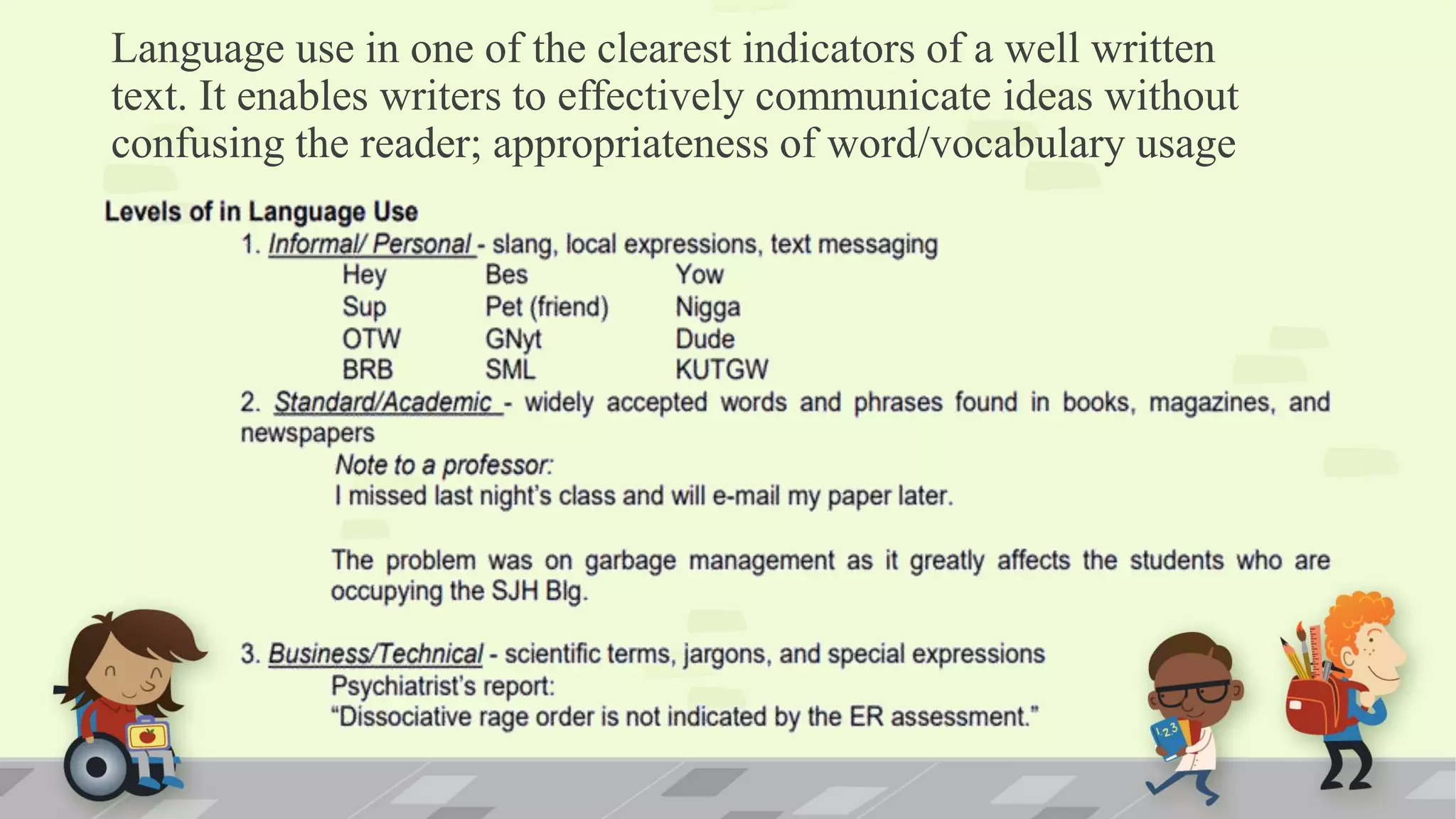
Language use in one of the clearest indicators of a well written
text. It enables writers to effectively communicate ideas without
confusing the reader; appropriateness of word/vocabulary usage
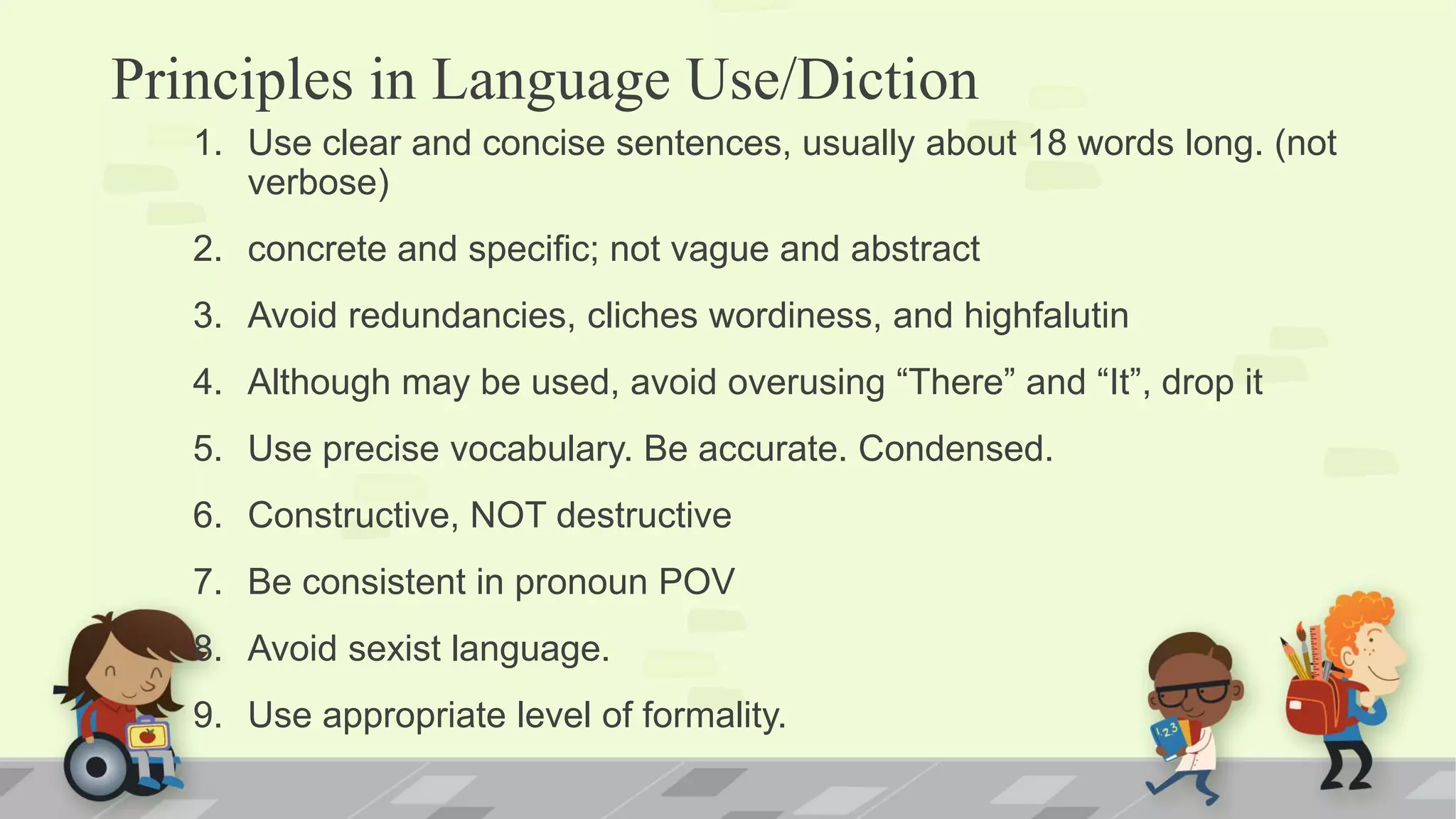
Principles in Language Use/Diction
1. Use clear and concise sentences, usually about 18 words long. (not
verbose)
2. concrete and specific; not vague and abstract
3. Avoid redundancies, cliches wordiness, and highfalutin
4. Although may be used, avoid overusing “There” and “It”, drop it
5. Use precise vocabulary. Be accurate. Condensed.
6. Constructive, NOT destructive
7. Be consistent in pronoun POV
8. Avoid sexist language.
9. Use appropriate level of formality.
#5 Mechanics
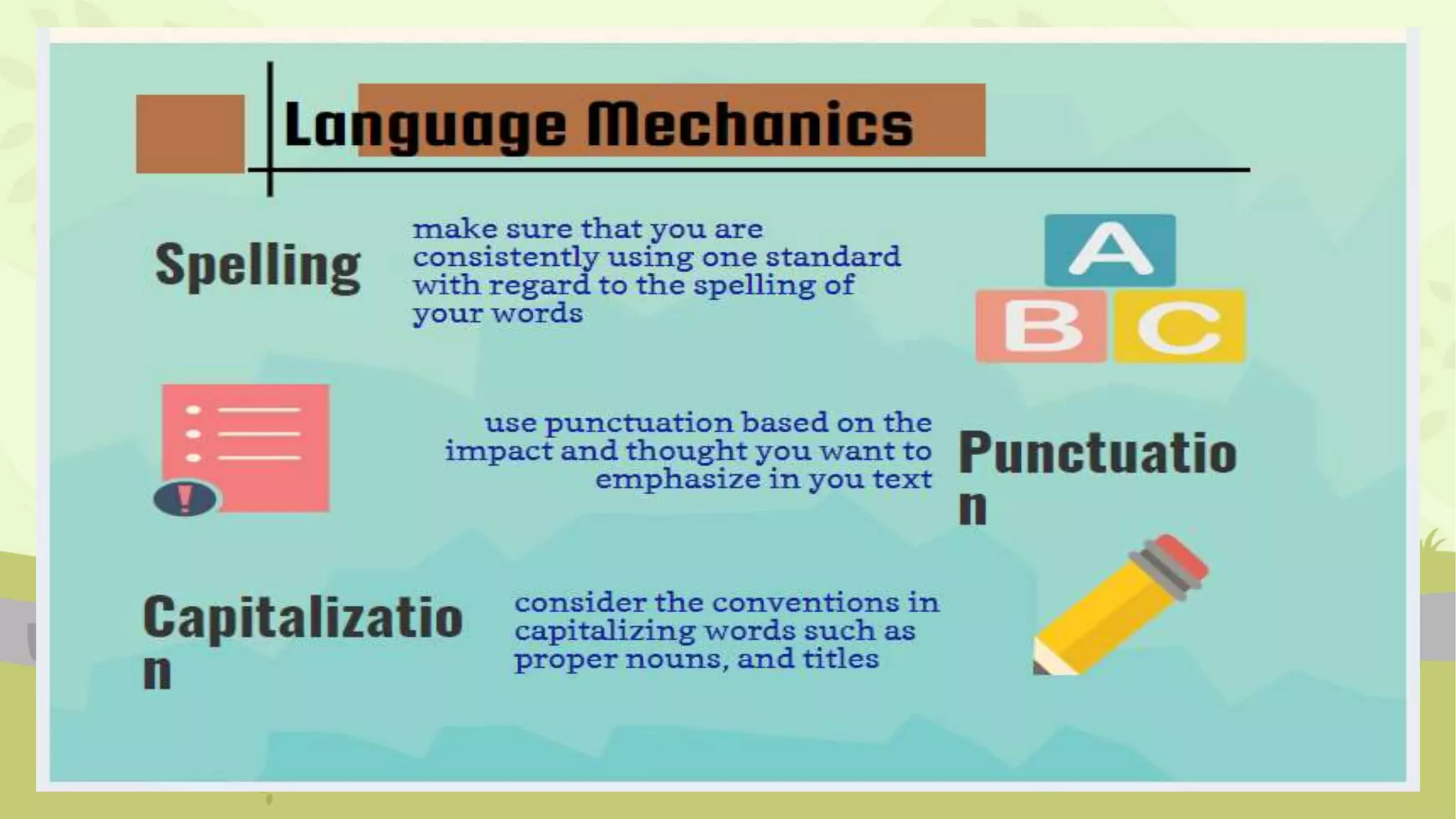
MECHANICS
focuses on the technicalities of the structure. It determines errors
on subject-verb agreement, prepositions, tenses, the grammar,
spelling, capitalization, abbreviations and acronyms, the use of
numbers as part of the statement, and the punctuation marks
• Spelling
• Capitalization
• Abbreviation and
Acronyms
• Numbers
• Punctuation Marks
• Grammar
Punctuation Marks
1. Period - .
2. Exclamation Point - !
3. Question Mark - ?
4. Apostrophe - ‘
5. Colon - :
6. Parentheses – ( )
7. Brackets – [ ]
8. Hyphen - -
9. Dash - --
10. Slash - /
11. Semicolon - ;
12. Ellipsis - …
13. Comma - ,
#6 Proofreading
Proofreading a sentence means
trying to find a mistake and
correct it with focus on the
mechanics such as Punctuation,
Capitalization, Grammar, and
Run-On sentences.
Lesson Summary
Short Quiz
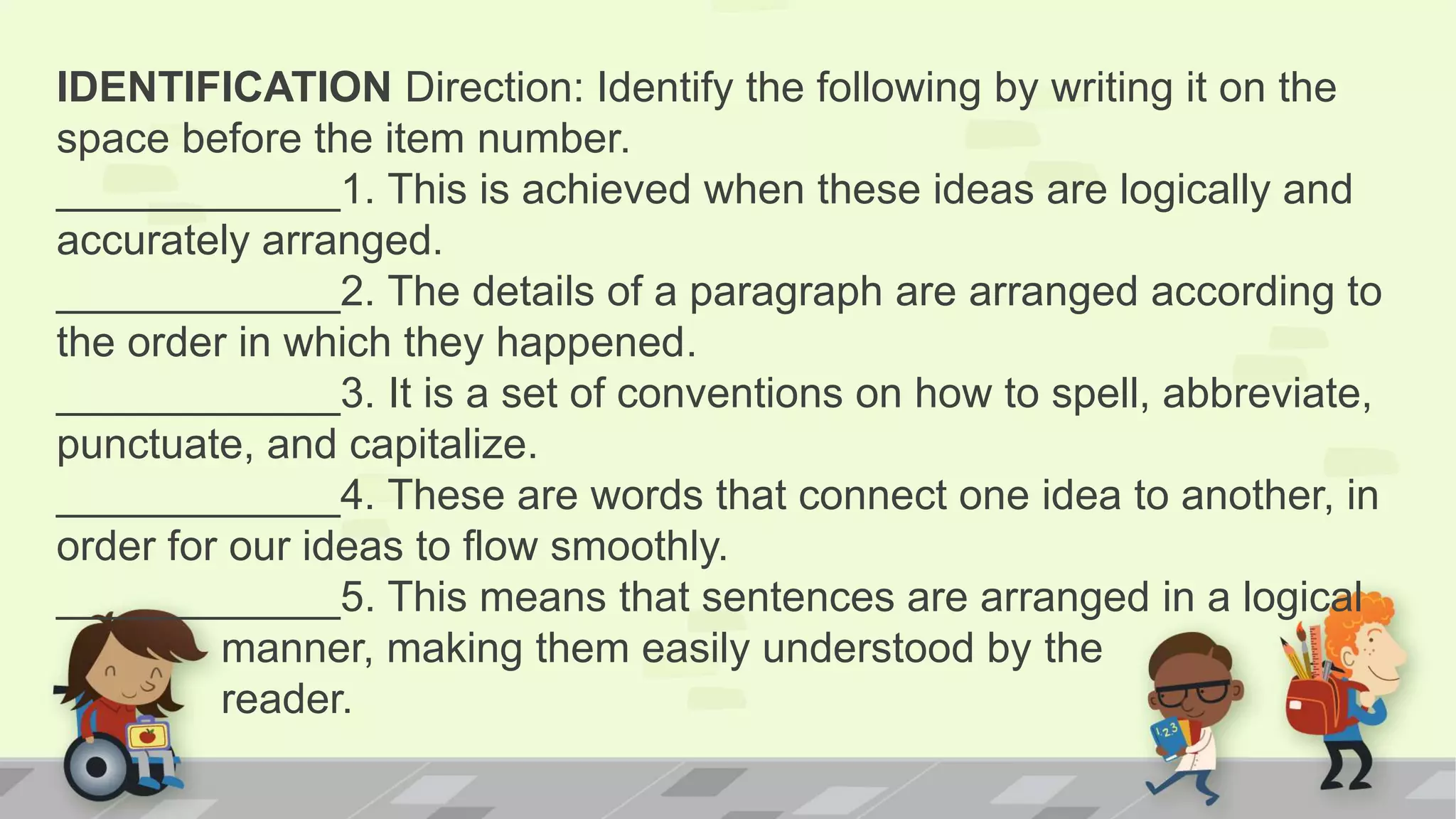
IDENTIFICATION Direction: Identify the following by writing it on the
space before the item number.
____________1. This is achieved when these ideas are logically and
accurately arranged.
____________2. The details of a paragraph are arranged according to
the order in which they happened.
____________3. It is a set of conventions on how to spell, abbreviate,
punctuate, and capitalize.
____________4. These are words that connect one idea to another, in
order for our ideas to flow smoothly.
____________5. This means that sentences are arranged in a logical
manner, making them easily understood by the
reader.
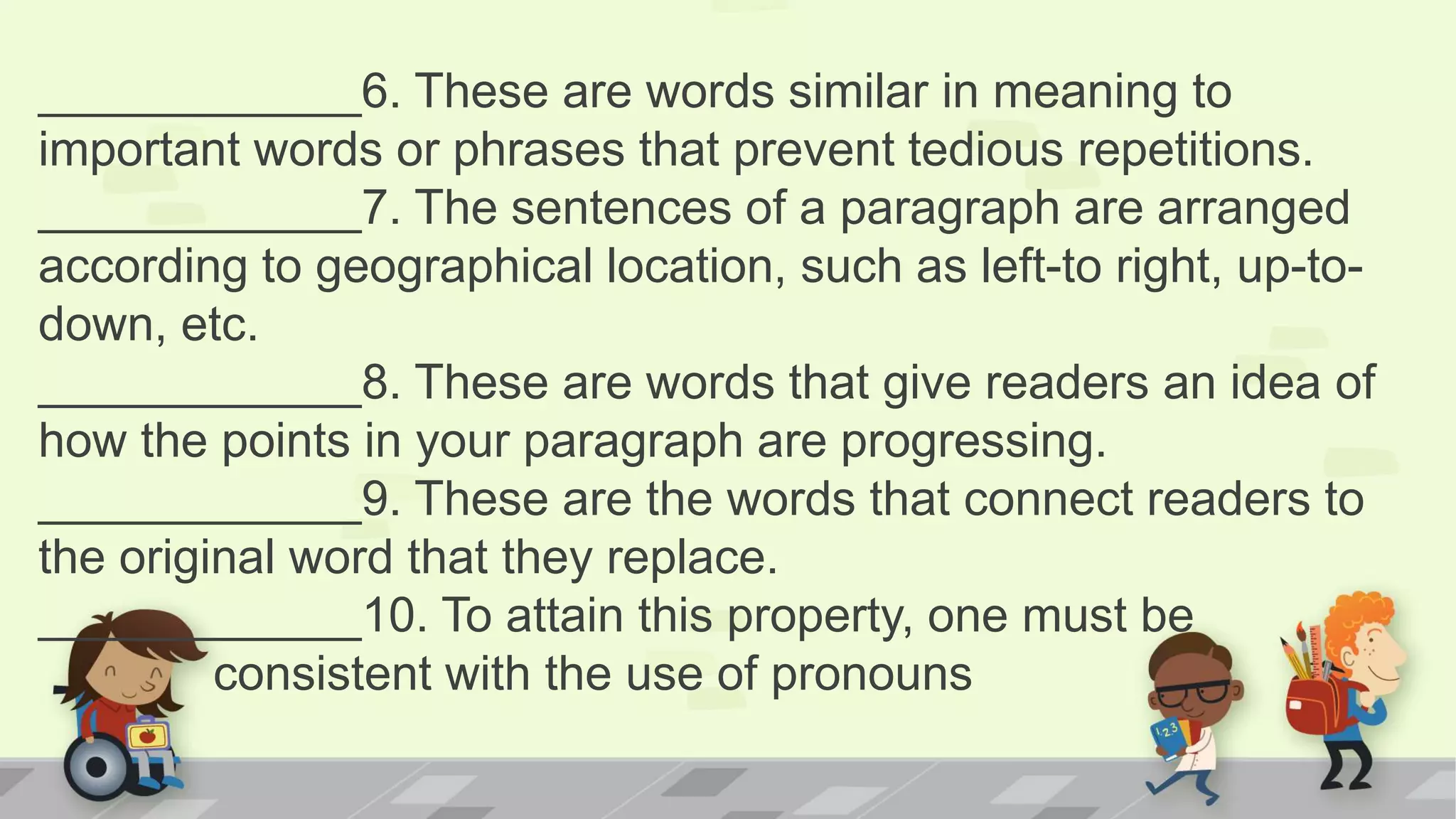
____________6. These are words similar in meaning to
important words or phrases that prevent tedious repetitions.
____________7. The sentences of a paragraph are arranged
according to geographical location, such as left-to right, up-to-
down, etc.
____________8. These are words that give readers an idea of
how the points in your paragraph are progressing.
____________9. These are the words that connect readers to
the original word that they replace.
____________10. To attain this property, one must be
consistent with the use of pronouns
Choices
A.Chronological/Order
B.Coherence
C.Language Use
D.Mechanics
E.Organization
F.Pronouns
G.Signal Devices
H.Spatial/Order
I. Synonyms
J. Transitions

Lesson-5-Properties-of-a-well-written-text.pptx

  • 1.
    Properties of aWell-Written Text Lesson 5 Na JUD! 2 More to go pa Guys! HAHA KAYA NATIN TO!
  • 2.
    Review • Lesson 1– Text as a Connected Discourse • Lesson 2 –Transitional Devices (Conjunctions) • Lesson 3 – Techniques in Selecting and Organizing Information • Lesson 4 – Patterns of Development
  • 3.
    In any pieceof writing, the tone should be consistent and identifiable. Good writing includes smart and appropriate word choices and well-crafted sentences. A well-written texts makes your readers use their critical thinking skills to understand your text and it must be presented in a way that is logical and aesthetically pleasing. Everything you do that involves communication – written, verbal, and nonverbal must be well-organized, and clear piece of thought.
  • 4.
    The Properties ofa Well-written Text 1. Organization (Structure) 2. Coherence, Cohesion 3. Unity 4. Language Use 5. Mechanics 6. Proofreading
  • 5.
    Paragraph • A paragraphis a series of sentences that are organized, coherent, and are all related to a single topic. • The first line of a paragraph is usually indented. This indentation of a paragraph indicates where the paragraph begins. Remember that you must capitalize the first word in each sentence and end each sentence with a punctuation mark, most often a period (.).
  • 6.
    Introduction / Body/ Conclusion There are three reasons I don’t have a credit card. The first reason is that using a piece of plastic instead of cash makes it too easy for me to buy things I can’t afford. For instance, last week I saw a 4,000.00 pair of pink sandals in my favorite shoe store. Of course, I don’t need pink sandals, nor can I afford them. With a credit card, however, I would now own those sandals and be worrying about for to pay for them. The second reason I don’t have a credit card is that I would end up in debt like my friend Sara, the shopaholic. Sara got a credit card last year, and she already owes 30,000.00. She buys things that she doesn’t really need such as jewelry and designer sunglasses. Sara makes only minimum payments, so her balance never decreases. She will be in debt for years. The third reason I don’t have a credit card is the difficulty to understand the fine print in the credit card contract. If I don’t read the fine print, I can be surprised. For example, some credit card companies will raise my interest rate if I make payment even one day late. To sum up, credit cards may be a convenience for some people, but for me, they are plastic ticket to financial disaster.
  • 7.
    Introduction / Body/ Conclusion There are three reasons I don’t have a credit card. The first reason is that using a piece of plastic instead of cash makes it too easy for me to buy things I can’t afford. For instance, last week I saw a 4,000.00 pair of pink sandals in my favorite shoe store. Of course, I don’t need pink sandals, nor can I afford them. With a credit card, however, I would now own those sandals and be worrying about for to pay for them. The second reason I don’t have a credit card is that I would end up in debt like my friend Sara, the shopaholic. Sara got a credit card last year, and she already owes 30,000.00. She buys things that she doesn’t really need such as jewelry and designer sunglasses. Sara makes only minimum payments, so her balance never decreases. She will be in debt for years. The third reason I don’t have a credit card is the difficulty to understand the fine print in the credit card contract. If I don’t read the fine print, I can be surprised. For example, some credit card companies will raise my interest rate if I make payment even one day late. To sum up, credit cards may be a convenience for some people, but for me, they are plastic ticket to financial disaster.
  • 8.
  • 9.
    Organization • Organization isthe structural framework for writing. It is important to effective writing because it provides readers with a framework to help them fulfil their expectations for the text. • Organization is a logical progression and completeness of ideas in a text. • Instructions in organization focuses on two areas: a) text structures specific to the particular genre and b) the cohesive elements that tie clauses, sentences, and paragraphs together into a cohesive whole.
  • 10.
    Different arrangements fororganization: 1. Chronological Order 2. Order of Importance 3. Spatial Order 4. Definition Order 5. Classification 6. Process 1. Cause and Effect 2. Comparison and Contrast 3. Listing 4. Clarification 5. Summary 6. Example 7. Addition
  • 11.
    If there isa clear statement of purpose, position, facts, examples, specific details, definitions, explanation, justifications, or opposing viewpoints, Ideas are formed and well-developed Organization
  • 12.
  • 13.
    Definition: Coherence – occurswhen ideas are connected at the conceptual level; sentences are arranged in a logical manner, making them easily understood by the reader. Cohesion – connection of ideas at the sentence level Unity – achieved when a composition contains one focused.
  • 14.
    Coherence and Cohesioncan be arranged according to: 1. Chronological Order – What Comes First 2. Spatial Order – Top to Bottom, Bottom, to Top, Left to Right, Right to Left 3. Emphatic Order – Least Important to Most Important,
  • 15.
    Techniques to improveparagraph cohesion: • Transitions – use of conjunction or conjunctive adverb to link sentences with a particular logical relationship 6 Categories of Transition Words: 1. Spatial Order 2. Time Order 3. Numerical Order 4. Cause and Effect Order 5. Comparison / Contrast Order 6. General / Specific Order
  • 16.
    • To SpecifySequence – again, and, also, then, first, second, third, moreover… • To Specify Time – after a few days, as long as, at last, before, earlier, soon … • To Specify Comparison – again, also, in the same way, likewise, once more… • To Specify Contrast – although, but, despite, even though, however, yet… • To Specify Examples – after all, for example, for instance, indeed, in fact … • To Specify Cause and Effect – accordingly, as a result, because, consequently… • To Specify Place – above, adjacent, below, beyond, closer to elsewhere, here, near… • To Specify Concession – although it is true that, granted that, I admit that, of course… • To Specify Summary, Repetition, or Conclusion – as a result, as I have said, in conclusion, in other words, to summarize, therefore…
  • 18.
  • 19.
    Unity - isachieved when a composition is focused on one idea. In a unified text, all supporting ideas are relevant to the main thought. Without unity, text will be confusing.
  • 21.
  • 22.
    Language use inone of the clearest indicators of a well written text. It enables writers to effectively communicate ideas without confusing the reader; appropriateness of word/vocabulary usage
  • 23.
    Principles in LanguageUse/Diction 1. Use clear and concise sentences, usually about 18 words long. (not verbose) 2. concrete and specific; not vague and abstract 3. Avoid redundancies, cliches wordiness, and highfalutin 4. Although may be used, avoid overusing “There” and “It”, drop it 5. Use precise vocabulary. Be accurate. Condensed. 6. Constructive, NOT destructive 7. Be consistent in pronoun POV 8. Avoid sexist language. 9. Use appropriate level of formality.
  • 24.
  • 25.
    MECHANICS focuses on thetechnicalities of the structure. It determines errors on subject-verb agreement, prepositions, tenses, the grammar, spelling, capitalization, abbreviations and acronyms, the use of numbers as part of the statement, and the punctuation marks • Spelling • Capitalization • Abbreviation and Acronyms • Numbers • Punctuation Marks • Grammar
  • 26.
    Punctuation Marks 1. Period- . 2. Exclamation Point - ! 3. Question Mark - ? 4. Apostrophe - ‘ 5. Colon - : 6. Parentheses – ( ) 7. Brackets – [ ] 8. Hyphen - - 9. Dash - -- 10. Slash - / 11. Semicolon - ; 12. Ellipsis - … 13. Comma - ,
  • 27.
    #6 Proofreading Proofreading asentence means trying to find a mistake and correct it with focus on the mechanics such as Punctuation, Capitalization, Grammar, and Run-On sentences.
  • 31.
  • 36.
  • 37.
    IDENTIFICATION Direction: Identifythe following by writing it on the space before the item number. ____________1. This is achieved when these ideas are logically and accurately arranged. ____________2. The details of a paragraph are arranged according to the order in which they happened. ____________3. It is a set of conventions on how to spell, abbreviate, punctuate, and capitalize. ____________4. These are words that connect one idea to another, in order for our ideas to flow smoothly. ____________5. This means that sentences are arranged in a logical manner, making them easily understood by the reader.
  • 38.
    ____________6. These arewords similar in meaning to important words or phrases that prevent tedious repetitions. ____________7. The sentences of a paragraph are arranged according to geographical location, such as left-to right, up-to- down, etc. ____________8. These are words that give readers an idea of how the points in your paragraph are progressing. ____________9. These are the words that connect readers to the original word that they replace. ____________10. To attain this property, one must be consistent with the use of pronouns
  • 39.

Editor's Notes

  • #11 When ideas are organized well, a text can achieve Coherence, Cohesion, and Unity
  • #39 Key to Correction: 1. Organization 2. Chronological/Order 3. Mechanics 4. Transitions 5. Coherence 6. Synonyms 7. Spatial/Order 8. Signal Devices 9. Pronouns 10. Language Use