Persuasive Writing How to Write a Convincing Argument
What is a persuasive essay? A persuasive essay provides a convincing argument for one to believe something or do something. You use persuasive language to convince your parents, teachers, siblings, etc. to do things all the time!
Choosing a Topic Choose an issue that is important to you. Ex. School uniforms, year-round school, censorship What are some things that you find important that you wish more people did or didn’t do?
Prewriting Research your topic. To complete your persuasion map, you will need to find a goal, three main reasons, and three facts or examples to support each main reason (nine facts/examples total).
What is a goal? The goal, or thesis, will be what you are trying to convince your reader to do or say.  You will use it in your introductory paragraph.  Ex. Students should not be forced to wear school uniforms. The goal is for schools not to have uniforms.
What are reasons? Your main reasons, or opinions, will serve as the meat of your essay. Your three main reasons will be used in the three body paragraphs. Ex. School uniforms infringe upon students’ needs for self-expression. Because this could not be proven, this is considered an opinion.
What are facts/examples? Your facts and examples will provide the most convincing part of your essay.  You need factual evidence in your body paragraphs to convince the reader. Ex. In a national study among students who wear school uniforms, the average student feels stifled by wearing the same thing every day. Facts like this make your argument seem more reasonable, sound, and ultimately, convincing.
Drafting Now you are ready to begin writing your essay. 1) Introductory Paragraph Hook- statistic, imagery, quotation, or rhetorical question (1-2 sentences) Transition from hook to thesis- mention three reasons of argument (1-2 sentences) Thesis- goal of your essay (1 sentence)
Drafting 2) Body Paragraph 1 Topic sentence- state main reason 1 (the most convincing argument) Remember to make it interesting! Facts and Examples (3-4 sentences) Conclusion sentence- refer to main reason 1 again (Restate your opinion in a new way!)
Drafting 3) Body Paragraph 2 Topic sentence- state main reason 2 (the second most convincing argument) Remember to make it interesting! Facts and Examples (3-4 sentences) Conclusion sentence- refer to main reason 2 again (Restate your opinion in a new way!)
Drafting 4) Body Paragraph 3 Topic sentence- state main reason 3 (the third most convincing argument) Remember to make it interesting! Facts and Examples (3-4 sentences) The Opposition- Mention the other side of the argument but then provide a fact or example to refute it. (2-3 sentences) Ex. School uniforms may reduce conflicts over expensive fashions, but isn’t student individuality more important? Conclusion sentence- refer to main reason 3 again (Restate your opinion in a new way!)
Persuasive Strategies Use the following strategies in your essay. (See p. 444) Anticipate and answer possible objections- What objections might your audience have to your goal or reasons?  Ex. Objection- School uniforms have a  one-time cost. Answer- Although students wear the same thing every day, students will still need clothes to wear on the weekends and after school.
Persuasive Strategies Cite precedents- a precedent is an earlier example of the action you are suggesting. Ex. Precedent- In previous generations, students have worn their own clothes to school without being harmed.
Persuasive Strategies Predict benefits- tell your audience how your goal will benefit them. Ex. If students are allowed to choose their own attire, students would be more comfortable in their learning environments.
Drafting 5) Concluding Paragraph Restate Thesis- Find a new way to say it though! Restate main reasons- Find new ways to say them! Conclusion sentence- Finish your essay with a powerful sentence.  Leave the reader thinking so that the argument stays with him/her for a long time.
Revising  You will use a checklist to revise your own draft. Revising will help you organize your thoughts clearly, strengthen your argument with persuasive words, and eliminate unnecessary details.
Transitional Words and Transitional Phrases Use the following words and/or phrases in the revising stage. (See p. 445) Transitional Words: because, therefore, thus, however, although, also, similarly, another, besides, furthermore, moreover, better, best, finally Transitional Phrases: as a result, for this reason, in conclusion, in contrast, in addition, for example, above all, equally important, to begin with
Editing How convincing can an essay be if it’s filled with grammatical and spelling errors? These errors are distracting and take the spotlight off your essay. You will use proofreading marks to correct your draft.
The Do’s and Don’t’s of Persuasive Writing Do  use persuasive vocabulary. Don’t  try to pass off opinions as facts. (If it can’t be proven, it’s only an opinion!) Do  use an exciting hook. Don’t  start every sentence with the same word. Do  remember to always support your three main reasons and your goal. Don’t  attack the opposition. (This will only weaken your argument!)
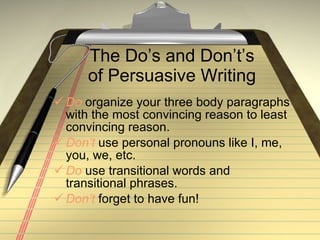
The Do’s and Don’t’s of Persuasive Writing Do  organize your three body paragraphs with the most convincing reason to least convincing reason. Don’t  use personal pronouns like I, me, you, we, etc. Do  use transitional words and transitional phrases. Don’t  forget to have fun!
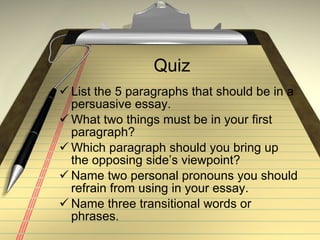
Quiz List the 5 paragraphs that should be in a persuasive essay. What two things must be in your first paragraph? Which paragraph should you bring up the opposing side’s viewpoint? Name two personal pronouns you should refrain from using in your essay. Name three transitional words or phrases.

Persuasive Writing

  • 1.
    Persuasive Writing Howto Write a Convincing Argument
  • 2.
    What is apersuasive essay? A persuasive essay provides a convincing argument for one to believe something or do something. You use persuasive language to convince your parents, teachers, siblings, etc. to do things all the time!
  • 3.
    Choosing a TopicChoose an issue that is important to you. Ex. School uniforms, year-round school, censorship What are some things that you find important that you wish more people did or didn’t do?
  • 4.
    Prewriting Research yourtopic. To complete your persuasion map, you will need to find a goal, three main reasons, and three facts or examples to support each main reason (nine facts/examples total).
  • 5.
    What is agoal? The goal, or thesis, will be what you are trying to convince your reader to do or say. You will use it in your introductory paragraph. Ex. Students should not be forced to wear school uniforms. The goal is for schools not to have uniforms.
  • 6.
    What are reasons?Your main reasons, or opinions, will serve as the meat of your essay. Your three main reasons will be used in the three body paragraphs. Ex. School uniforms infringe upon students’ needs for self-expression. Because this could not be proven, this is considered an opinion.
  • 7.
    What are facts/examples?Your facts and examples will provide the most convincing part of your essay. You need factual evidence in your body paragraphs to convince the reader. Ex. In a national study among students who wear school uniforms, the average student feels stifled by wearing the same thing every day. Facts like this make your argument seem more reasonable, sound, and ultimately, convincing.
  • 8.
    Drafting Now youare ready to begin writing your essay. 1) Introductory Paragraph Hook- statistic, imagery, quotation, or rhetorical question (1-2 sentences) Transition from hook to thesis- mention three reasons of argument (1-2 sentences) Thesis- goal of your essay (1 sentence)
  • 9.
    Drafting 2) BodyParagraph 1 Topic sentence- state main reason 1 (the most convincing argument) Remember to make it interesting! Facts and Examples (3-4 sentences) Conclusion sentence- refer to main reason 1 again (Restate your opinion in a new way!)
  • 10.
    Drafting 3) BodyParagraph 2 Topic sentence- state main reason 2 (the second most convincing argument) Remember to make it interesting! Facts and Examples (3-4 sentences) Conclusion sentence- refer to main reason 2 again (Restate your opinion in a new way!)
  • 11.
    Drafting 4) BodyParagraph 3 Topic sentence- state main reason 3 (the third most convincing argument) Remember to make it interesting! Facts and Examples (3-4 sentences) The Opposition- Mention the other side of the argument but then provide a fact or example to refute it. (2-3 sentences) Ex. School uniforms may reduce conflicts over expensive fashions, but isn’t student individuality more important? Conclusion sentence- refer to main reason 3 again (Restate your opinion in a new way!)
  • 12.
    Persuasive Strategies Usethe following strategies in your essay. (See p. 444) Anticipate and answer possible objections- What objections might your audience have to your goal or reasons? Ex. Objection- School uniforms have a one-time cost. Answer- Although students wear the same thing every day, students will still need clothes to wear on the weekends and after school.
  • 13.
    Persuasive Strategies Citeprecedents- a precedent is an earlier example of the action you are suggesting. Ex. Precedent- In previous generations, students have worn their own clothes to school without being harmed.
  • 14.
    Persuasive Strategies Predictbenefits- tell your audience how your goal will benefit them. Ex. If students are allowed to choose their own attire, students would be more comfortable in their learning environments.
  • 15.
    Drafting 5) ConcludingParagraph Restate Thesis- Find a new way to say it though! Restate main reasons- Find new ways to say them! Conclusion sentence- Finish your essay with a powerful sentence. Leave the reader thinking so that the argument stays with him/her for a long time.
  • 16.
    Revising Youwill use a checklist to revise your own draft. Revising will help you organize your thoughts clearly, strengthen your argument with persuasive words, and eliminate unnecessary details.
  • 17.
    Transitional Words andTransitional Phrases Use the following words and/or phrases in the revising stage. (See p. 445) Transitional Words: because, therefore, thus, however, although, also, similarly, another, besides, furthermore, moreover, better, best, finally Transitional Phrases: as a result, for this reason, in conclusion, in contrast, in addition, for example, above all, equally important, to begin with
  • 18.
    Editing How convincingcan an essay be if it’s filled with grammatical and spelling errors? These errors are distracting and take the spotlight off your essay. You will use proofreading marks to correct your draft.
  • 19.
    The Do’s andDon’t’s of Persuasive Writing Do use persuasive vocabulary. Don’t try to pass off opinions as facts. (If it can’t be proven, it’s only an opinion!) Do use an exciting hook. Don’t start every sentence with the same word. Do remember to always support your three main reasons and your goal. Don’t attack the opposition. (This will only weaken your argument!)
  • 20.
    The Do’s andDon’t’s of Persuasive Writing Do organize your three body paragraphs with the most convincing reason to least convincing reason. Don’t use personal pronouns like I, me, you, we, etc. Do use transitional words and transitional phrases. Don’t forget to have fun!
  • 21.
    Quiz List the5 paragraphs that should be in a persuasive essay. What two things must be in your first paragraph? Which paragraph should you bring up the opposing side’s viewpoint? Name two personal pronouns you should refrain from using in your essay. Name three transitional words or phrases.