Dr.Rahul
Asso. Prof. pharmacology
RMC, PIMS (DU)
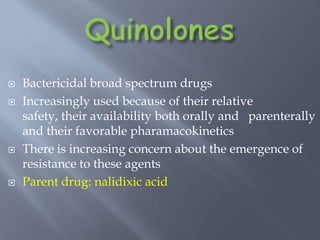
 Bactericidal broad spectrum drugs
 Increasingly used because of their relative
safety, their availability both orally and parenterally
and their favorable pharamacokinetics
 There is increasing concern about the emergence of
resistance to these agents
 Parent drug: nalidixic acid
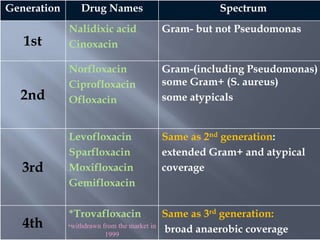
Generation Drug Names Spectrum
1st
Nalidixic acid
Cinoxacin
Gram- but not Pseudomonas
2nd
Norfloxacin
Ciprofloxacin
Ofloxacin
Gram-(including Pseudomonas)
some Gram+ (S. aureus)
some atypicals
3rd
Levofloxacin
Sparfloxacin
Moxifloxacin
Gemifloxacin
Same as 2nd generation:
extended Gram+ and atypical
coverage
4th
*Trovafloxacin Same as 3rd generation:
broad anaerobic coverage*withdrawn from the market in
1999
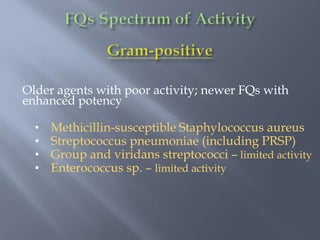
Older agents with poor activity; newer FQs with
enhanced potency
• Methicillin-susceptible Staphylococcus aureus
• Streptococcus pneumoniae (including PRSP)
• Group and viridans streptococci – limited activity
• Enterococcus sp. – limited activity
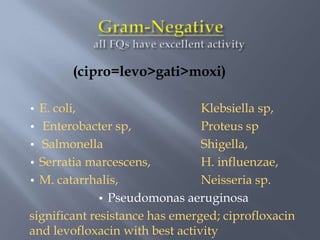
(cipro=levo>gati>moxi)
• E. coli, Klebsiella sp,
• Enterobacter sp, Proteus sp
• Salmonella Shigella,
• Serratia marcescens, H. influenzae,
• M. catarrhalis, Neisseria sp.
• Pseudomonas aeruginosa
significant resistance has emerged; ciprofloxacin
and levofloxacin with best activity
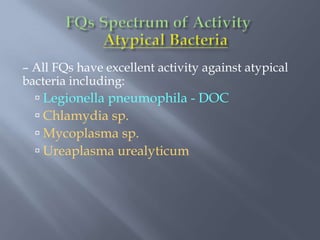
– All FQs have excellent activity against atypical
bacteria including:
 Legionella pneumophila - DOC
 Chlamydia sp.
 Mycoplasma sp.
 Ureaplasma urealyticum
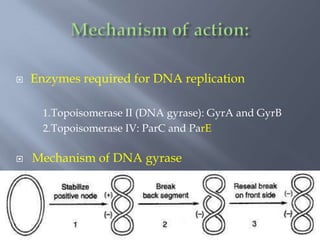
 Enzymes required for DNA replication
1.Topoisomerase II (DNA gyrase): GyrA and GyrB
2.Topoisomerase IV: ParC and ParE
 Mechanism of DNA gyrase
 Inhibit bacterial DNA synthesis by
inhibiting DNA gyrase and topoisomerase
IV  rapid cell death
 Mostly Topo II inhibition in G- bacterias
 Topo IV inhibition more in G+ bacterias
 Post antibiotic effect: lasts 1 to 2 hours,
increases with increasing concentration
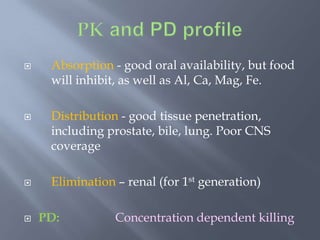
 Absorption - good oral availability, but food
will inhibit, as well as Al, Ca, Mag, Fe.
 Distribution - good tissue penetration,
including prostate, bile, lung. Poor CNS
coverage
 Elimination – renal (for 1st generation)
 PD: Concentration dependent killing
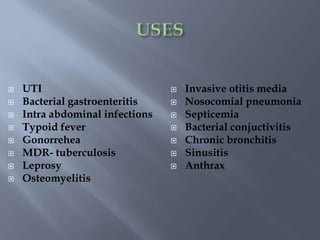
 UTI
 Bacterial gastroenteritis
 Intra abdominal infections
 Typoid fever
 Gonorrehea
 MDR- tuberculosis
 Leprosy
 Osteomyelitis
 Invasive otitis media
 Nosocomial pneumonia
 Septicemia
 Bacterial conjuctivitis
 Chronic bronchitis
 Sinusitis
 Anthrax
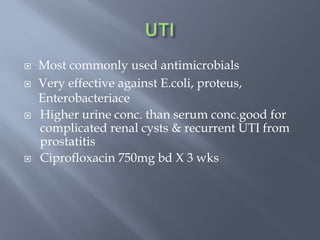
 Most commonly used antimicrobials
 Very effective against E.coli, proteus,
Enterobacteriace
 Higher urine conc. than serum conc.good for
complicated renal cysts & recurrent UTI from
prostatitis
 Ciprofloxacin 750mg bd X 3 wks
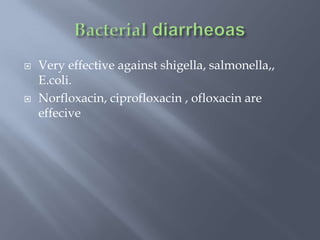
 Very effective against shigella, salmonella,,
E.coli.
 Norfloxacin, ciprofloxacin , ofloxacin are
effecive
(Comparative studies)
1) ciprofloxacin + metronidazole
2) Imipenem
3) Trovafloxacin
4) amoxicillin/clavulanate
similar activity
 Ciprofloxacin 750mg BD X 10 days
 Pefloxacin, Ofloxacin can also be used
 Cervicitis
 Urethritis
 PID
 Single dose :Cipro..500mg, Oflox. 400mg
 Problem : resistance
 So Ceftriaxone first drug of choice
 MDR tuberculosis
 MAC infections
 Leprosy (ROM theraphy)
 Trovafloxacin
approved by the FDA for treatment
of soft-tissue infections, including
DM foot
 Levofloxacin
Superior to ciprofloxacin in SSTI
caused by S. aureus
Community-acquired Pneumonia
 Outpatients : new fluoroquinolones
 Hospitalized
General wards : new FQs monotherapy
ICU : -lactam + new FQs
Upper respiratory infections
: acute sinusitis, chronic bronchitis
 Prophylaxis and treatment of infections in
neutropenic patients
 Conjunctivitis due to G-ve bacteria
 Invasive otitis media
 Prophylaxis and exposure Anthrax
 Respiratory infection : (Levofloxacin)
 Chronic bronchitis
 Nosocomial pneumonia
 Sinusitis
 Gastrointestinal – 5 %
 Nausea, vomiting, diarrhea, dyspepsia
 Central Nervous System
 Headache, agitation, insomnia, dizziness, rarely,
 hallucinations and seizures (elderly)
 Hepatotoxicity
 LFT elevation (led to withdrawal of trovafloxacin)
 Phototoxicity (uncommon with current FQs)
 More common with older FQs (halogen at position 8)
 Cardiac
 Variable prolongation in QTc interval
 Led to withdrawal of grepafloxacin, sparfloxacin
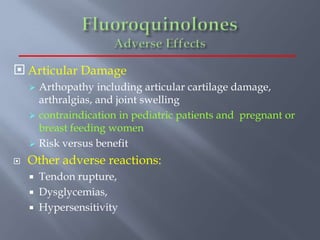
 Articular Damage
 Arthopathy including articular cartilage damage,
arthralgias, and joint swelling
 contraindication in pediatric patients and pregnant or
breast feeding women
 Risk versus benefit
 Other adverse reactions:
 Tendon rupture,
 Dysglycemias,
 Hypersensitivity
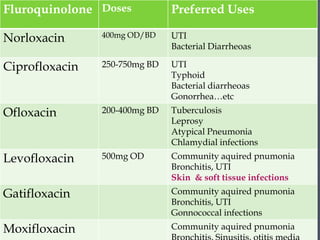
Fluroquinolone Doses Preferred Uses
Norloxacin 400mg OD/BD UTI
Bacterial Diarrheoas
Ciprofloxacin 250-750mg BD UTI
Typhoid
Bacterial diarrheoas
Gonorrhea…etc
Ofloxacin 200-400mg BD Tuberculosis
Leprosy
Atypical Pneumonia
Chlamydial infections
Levofloxacin 500mg OD Community aquired pnumonia
Bronchitis, UTI
Skin & soft tissue infections
Gatifloxacin Community aquired pnumonia
Bronchitis, UTI
Gonnococcal infections
Moxifloxacin Community aquired pnumonia

Quinolones

  • 1.
  • 2.
     Bactericidal broadspectrum drugs  Increasingly used because of their relative safety, their availability both orally and parenterally and their favorable pharamacokinetics  There is increasing concern about the emergence of resistance to these agents  Parent drug: nalidixic acid
  • 4.
    Generation Drug NamesSpectrum 1st Nalidixic acid Cinoxacin Gram- but not Pseudomonas 2nd Norfloxacin Ciprofloxacin Ofloxacin Gram-(including Pseudomonas) some Gram+ (S. aureus) some atypicals 3rd Levofloxacin Sparfloxacin Moxifloxacin Gemifloxacin Same as 2nd generation: extended Gram+ and atypical coverage 4th *Trovafloxacin Same as 3rd generation: broad anaerobic coverage*withdrawn from the market in 1999
  • 5.
    Older agents withpoor activity; newer FQs with enhanced potency • Methicillin-susceptible Staphylococcus aureus • Streptococcus pneumoniae (including PRSP) • Group and viridans streptococci – limited activity • Enterococcus sp. – limited activity
  • 6.
    (cipro=levo>gati>moxi) • E. coli,Klebsiella sp, • Enterobacter sp, Proteus sp • Salmonella Shigella, • Serratia marcescens, H. influenzae, • M. catarrhalis, Neisseria sp. • Pseudomonas aeruginosa significant resistance has emerged; ciprofloxacin and levofloxacin with best activity
  • 7.
    – All FQshave excellent activity against atypical bacteria including:  Legionella pneumophila - DOC  Chlamydia sp.  Mycoplasma sp.  Ureaplasma urealyticum
  • 8.
     Enzymes requiredfor DNA replication 1.Topoisomerase II (DNA gyrase): GyrA and GyrB 2.Topoisomerase IV: ParC and ParE  Mechanism of DNA gyrase
  • 9.
     Inhibit bacterialDNA synthesis by inhibiting DNA gyrase and topoisomerase IV  rapid cell death  Mostly Topo II inhibition in G- bacterias  Topo IV inhibition more in G+ bacterias  Post antibiotic effect: lasts 1 to 2 hours, increases with increasing concentration
  • 10.
     Absorption -good oral availability, but food will inhibit, as well as Al, Ca, Mag, Fe.  Distribution - good tissue penetration, including prostate, bile, lung. Poor CNS coverage  Elimination – renal (for 1st generation)  PD: Concentration dependent killing
  • 11.
     UTI  Bacterialgastroenteritis  Intra abdominal infections  Typoid fever  Gonorrehea  MDR- tuberculosis  Leprosy  Osteomyelitis  Invasive otitis media  Nosocomial pneumonia  Septicemia  Bacterial conjuctivitis  Chronic bronchitis  Sinusitis  Anthrax
  • 12.
     Most commonlyused antimicrobials  Very effective against E.coli, proteus, Enterobacteriace  Higher urine conc. than serum conc.good for complicated renal cysts & recurrent UTI from prostatitis  Ciprofloxacin 750mg bd X 3 wks
  • 13.
     Very effectiveagainst shigella, salmonella,, E.coli.  Norfloxacin, ciprofloxacin , ofloxacin are effecive
  • 14.
    (Comparative studies) 1) ciprofloxacin+ metronidazole 2) Imipenem 3) Trovafloxacin 4) amoxicillin/clavulanate similar activity
  • 15.
     Ciprofloxacin 750mgBD X 10 days  Pefloxacin, Ofloxacin can also be used
  • 16.
     Cervicitis  Urethritis PID  Single dose :Cipro..500mg, Oflox. 400mg  Problem : resistance  So Ceftriaxone first drug of choice
  • 17.
     MDR tuberculosis MAC infections  Leprosy (ROM theraphy)
  • 18.
     Trovafloxacin approved bythe FDA for treatment of soft-tissue infections, including DM foot  Levofloxacin Superior to ciprofloxacin in SSTI caused by S. aureus
  • 19.
    Community-acquired Pneumonia  Outpatients: new fluoroquinolones  Hospitalized General wards : new FQs monotherapy ICU : -lactam + new FQs Upper respiratory infections : acute sinusitis, chronic bronchitis
  • 20.
     Prophylaxis andtreatment of infections in neutropenic patients  Conjunctivitis due to G-ve bacteria  Invasive otitis media  Prophylaxis and exposure Anthrax  Respiratory infection : (Levofloxacin)  Chronic bronchitis  Nosocomial pneumonia  Sinusitis
  • 21.
     Gastrointestinal –5 %  Nausea, vomiting, diarrhea, dyspepsia  Central Nervous System  Headache, agitation, insomnia, dizziness, rarely,  hallucinations and seizures (elderly)  Hepatotoxicity  LFT elevation (led to withdrawal of trovafloxacin)  Phototoxicity (uncommon with current FQs)  More common with older FQs (halogen at position 8)  Cardiac  Variable prolongation in QTc interval  Led to withdrawal of grepafloxacin, sparfloxacin
  • 22.
     Articular Damage Arthopathy including articular cartilage damage, arthralgias, and joint swelling  contraindication in pediatric patients and pregnant or breast feeding women  Risk versus benefit  Other adverse reactions:  Tendon rupture,  Dysglycemias,  Hypersensitivity
  • 23.
    Fluroquinolone Doses PreferredUses Norloxacin 400mg OD/BD UTI Bacterial Diarrheoas Ciprofloxacin 250-750mg BD UTI Typhoid Bacterial diarrheoas Gonorrhea…etc Ofloxacin 200-400mg BD Tuberculosis Leprosy Atypical Pneumonia Chlamydial infections Levofloxacin 500mg OD Community aquired pnumonia Bronchitis, UTI Skin & soft tissue infections Gatifloxacin Community aquired pnumonia Bronchitis, UTI Gonnococcal infections Moxifloxacin Community aquired pnumonia