ANTICHOLINESTERASESANTICHOLINESTERASES
DR.RAHULDR.RAHUL
ASSO.PROF, RMC.ASSO.PROF, RMC.
ANTICHOLINESTERASESANTICHOLINESTERASES
 These are the agents which inhibit ChE, protectThese are the agents which inhibit ChE, protect
ACH from hydrolysis-produce and potentiatesACH from hydrolysis-produce and potentiates
cholinergic effects .cholinergic effects .
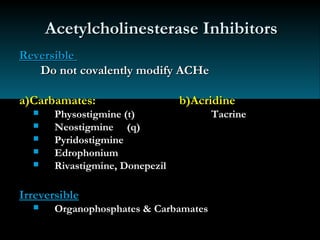
Acetylcholinesterase InhibitorsAcetylcholinesterase Inhibitors
ReversibleReversible
Do not covalently modify ACHeDo not covalently modify ACHe
a)Carbamates:a)Carbamates: b)Acridineb)Acridine
 Physostigmine (t)Physostigmine (t) TacrineTacrine
 Neostigmine (q)Neostigmine (q)
 PyridostigminePyridostigmine
 EdrophoniumEdrophonium
 Rivastigmine, DonepezilRivastigmine, Donepezil
IrreversibleIrreversible
 Organophosphates & CarbamatesOrganophosphates & Carbamates
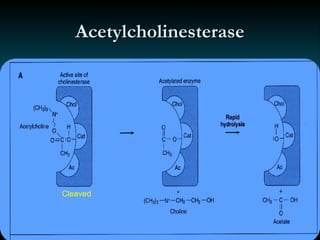
AcetylcholinesteraseAcetylcholinesterase
Cleaved
Mechanism of actionMechanism of action
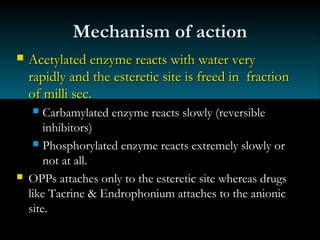
 Acetylated enzyme reacts with water veryAcetylated enzyme reacts with water very
rapidly and the esteretic site is freed in fractionrapidly and the esteretic site is freed in fraction
of milli sec.of milli sec.
 Carbamylated enzyme reacts slowly (reversibleCarbamylated enzyme reacts slowly (reversible
inhibitors)inhibitors)
 Phosphorylated enzyme reacts extremely slowly orPhosphorylated enzyme reacts extremely slowly or
not at all.not at all.
 OPPs attaches only to the esteretic site whereas drugsOPPs attaches only to the esteretic site whereas drugs
like Tacrine & Endrophonium attaches to the anioniclike Tacrine & Endrophonium attaches to the anionic
site.site.
Carbamate Inhibitors:Carbamate Inhibitors:
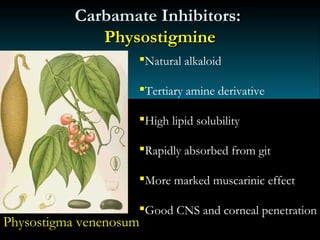
PhysostigminePhysostigmine
Physostigma venenosumPhysostigma venenosum
ļ‚§Natural alkaloid
ļ‚§Tertiary amine derivative
ļ‚§High lipid solubility
ļ‚§Rapidly absorbed from git
ļ‚§More marked muscarinic effect
ļ‚§Good CNS and corneal penetration
Carbamate Inhibitors :Carbamate Inhibitors :
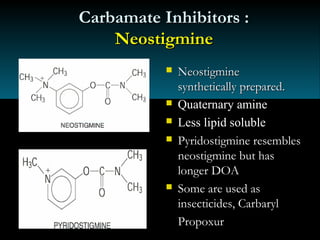
NeostigmineNeostigmine
 NeostigmineNeostigmine
synthetically prepared.synthetically prepared.
 Quaternary amine
 Less lipid soluble
 Pyridostigmine resemblesPyridostigmine resembles
neostigmine but hasneostigmine but has
longer DOAlonger DOA
 Some are used asSome are used as
insecticides, Carbarylinsecticides, Carbaryl
PropoxurPropoxur
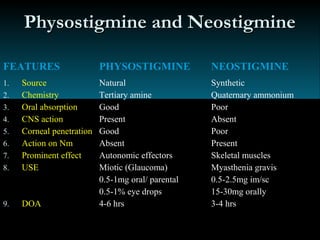
FEATURES PHYSOSTIGMINE NEOSTIGMINE
1. Source
2. Chemistry
3. Oral absorption
4. CNS action
5. Corneal penetration
6. Action on Nm
7. Prominent effect
8. USE
9. DOA
Natural
Tertiary amine
Good
Present
Good
Absent
Autonomic effectors
Miotic (Glaucoma)
0.5-1mg oral/ parental
0.5-1% eye drops
4-6 hrs
Synthetic
Quaternary ammonium
Poor
Absent
Poor
Present
Skeletal muscles
Myasthenia gravis
0.5-2.5mg im/sc
15-30mg orally
3-4 hrs
Physostigmine and NeostigminePhysostigmine and Neostigmine
Competitive Inhibitors :Competitive Inhibitors :
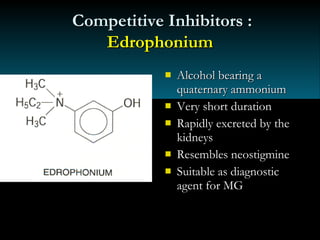
EdrophoniumEdrophonium
 Alcohol bearing aAlcohol bearing a
quaternary ammoniumquaternary ammonium
 Very short durationVery short duration
 Rapidly excreted by theRapidly excreted by the
kidneyskidneys
 Resembles neostigmineResembles neostigmine
 Suitable as diagnosticSuitable as diagnostic
agent for MGagent for MG
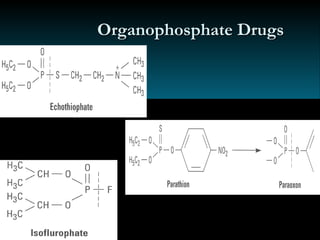
Organophosphate DrugsOrganophosphate Drugs
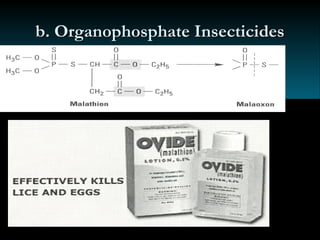
b. Organophosphate Insecticidesb. Organophosphate Insecticides
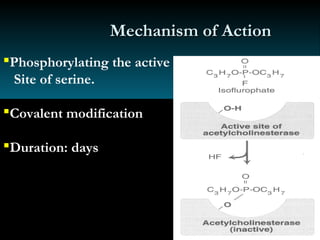
Mechanism of ActionMechanism of Action
ļ‚§Phosphorylating the active
Site of serine.
ļ‚§Covalent modification
ļ‚§Duration: days
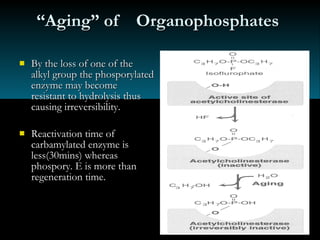
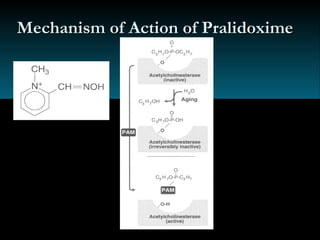
ā€œā€œAgingā€ of OrganophosphatesAgingā€ of Organophosphates
 By the loss of one of theBy the loss of one of the
alkyl group the phosporylatedalkyl group the phosporylated
enzyme may becomeenzyme may become
resistant to hydrolysis thusresistant to hydrolysis thus
causing irreversibility.causing irreversibility.
 Reactivation time ofReactivation time of
carbamylated enzyme iscarbamylated enzyme is
less(30mins) whereasless(30mins) whereas
phospory. E is more thanphospory. E is more than
regeneration time.regeneration time.
c. Organophosphate Weaponsc. Organophosphate Weapons
 Chemical warfare agents-nerve gasesChemical warfare agents-nerve gases
TabunTabun
SerinSerin
SomanSoman
Pharmacology of AChE InhibitorsPharmacology of AChE Inhibitors
 Act at both muscarinic and nicotinicAct at both muscarinic and nicotinic
synapsessynapses
 They potentiates synaptic transmission bothThey potentiates synaptic transmission both
parasympathetic and sympathetparasympathetic and sympatheticic
PHARMACOLOGICAL ACTIONSPHARMACOLOGICAL ACTIONS
a.a. Central nervous systemCentral nervous system::
 Ache inhibitors are Lipid solubleAche inhibitors are Lipid soluble
(Physostigmine and Ops) Cross BBB(Physostigmine and Ops) Cross BBB
 Low doses: CNS activationLow doses: CNS activation
 High: coma and respiratory arrestHigh: coma and respiratory arrest
b.b. Eye, respiratory tract, GI & urinary tract:Eye, respiratory tract, GI & urinary tract:
 The same as muscarinic agonistsThe same as muscarinic agonists
(regulated by parasympathetic neurons)(regulated by parasympathetic neurons)
PHARMACOLOGICAL ACTIONSPHARMACOLOGICAL ACTIONS
c.c. Cardiovascular:Cardiovascular:
 ComplexComplex
 Bradycardia, decrease contraction, cardiac outputBradycardia, decrease contraction, cardiac output
 Blood vessels? No effectBlood vessels? No effect
d.d. Neuromuscular junction:Neuromuscular junction:
 Increase force of contraction (low dose)Increase force of contraction (low dose)
 Muscle fasciculation and depolarizing blockadeMuscle fasciculation and depolarizing blockade
(high dose) weakness and paralysis(high dose) weakness and paralysis
Therapeutic UsesTherapeutic Uses
A. Eye:A. Eye:
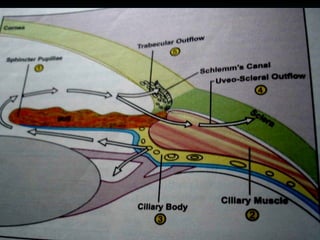
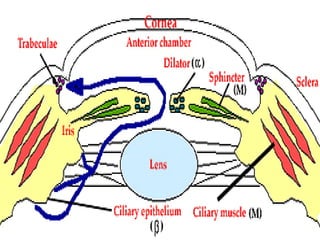
 Miosis and constriction of the ciliary muscle, and areMiosis and constriction of the ciliary muscle, and are
used to treat glaucomaused to treat glaucoma
B. GI and urinary tractB. GI and urinary tract:: Neostigmine 0.5-1mg s.cNeostigmine 0.5-1mg s.c..
 Paralysis of the stomach and intestinesParalysis of the stomach and intestines
(paralytic illeus)(paralytic illeus)
 Postpartum urinary retentionPostpartum urinary retention
C. Neuromuscular junctionC. Neuromuscular junction::
 Myastenia Gravis----Neostigmine 0.5-2mg i.v.Myastenia Gravis----Neostigmine 0.5-2mg i.v.
 Post operative decurarization induced by NMBPost operative decurarization induced by NMB
 Cobra biteCobra bite
D. CNSD. CNS::
 Belladona poisoningBelladona poisoning
 Alzheimer’s diseaseAlzheimer’s disease
 Overdose of phenothiazides, TCAsOverdose of phenothiazides, TCAs
GlaucomaGlaucoma
 Group of disease characterized by progressiveGroup of disease characterized by progressive
optic nerve damage ass. with raised IOToptic nerve damage ass. with raised IOT
 Treatment aims:Treatment aims:
Lower IOT byLower IOT by :1.Reducing aqueous secretion:1.Reducing aqueous secretion
2. Promoting its drainage.2. Promoting its drainage.
TypesTypes--
 Open angle glaucomaOpen angle glaucoma (wide angle, chronic simple)(wide angle, chronic simple)
 Closed angle glaucomaClosed angle glaucoma (narrow angle, acute congestive)(narrow angle, acute congestive)
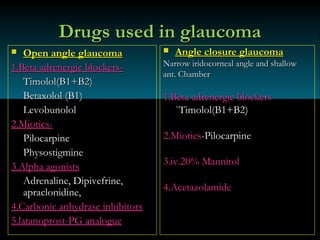
Drugs used in glaucomaDrugs used in glaucoma
 Open angle glaucomaOpen angle glaucoma
1.Beta adrenergic blockers-1.Beta adrenergic blockers-
Timolol(B1+B2)Timolol(B1+B2)
Betaxolol (B1)Betaxolol (B1)
LevobunololLevobunolol
2.Miotics-2.Miotics-
PilocarpinePilocarpine
PhysostigminePhysostigmine
3.Alpha agonists3.Alpha agonists
Adrenaline, Dipivefrine,Adrenaline, Dipivefrine,
apraclonidine,apraclonidine,
4.Carbonic anhydrase inhibitors4.Carbonic anhydrase inhibitors
5.latanoprost-PG analogue5.latanoprost-PG analogue
 Angle closure glaucomaAngle closure glaucoma
Narrow iridocorneal angle and shallowNarrow iridocorneal angle and shallow
ant. Chamberant. Chamber
1.Beta adrenergic blockers1.Beta adrenergic blockers
`Timolol(B1+B2)`Timolol(B1+B2)
2.Miotics2.Miotics-Pilocarpine-Pilocarpine
3.iv.20% Mannitol3.iv.20% Mannitol
4.Acetazolamide4.Acetazolamide
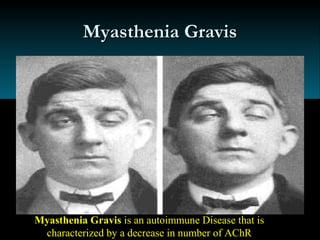
Myasthenia GravisMyasthenia Gravis
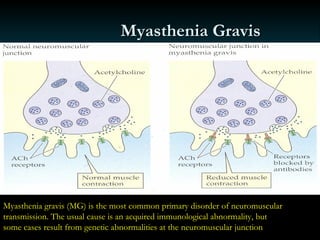
Myasthenia Gravis is an autoimmune Disease that is
characterized by a decrease in number of AChR
Myasthenia GravisMyasthenia Gravis
Myasthenia gravis (MG) is the most common primary disorder of neuromuscular
transmission. The usual cause is an acquired immunological abnormality, but
some cases result from genetic abnormalities at the neuromuscular junction
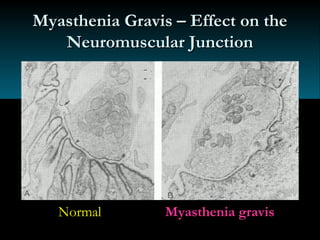
Myasthenia Gravis – Effect on theMyasthenia Gravis – Effect on the
Neuromuscular JunctionNeuromuscular Junction
NormalNormal Myasthenia gravisMyasthenia gravis
Myasthenia GravisMyasthenia Gravis
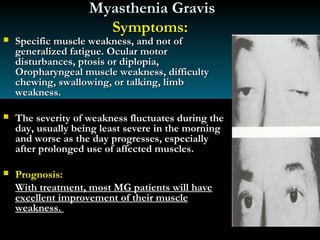
Symptoms:Symptoms:
 Specific muscle weakness, and not ofSpecific muscle weakness, and not of
generalized fatigue. Ocular motorgeneralized fatigue. Ocular motor
disturbances, ptosis or diplopia,disturbances, ptosis or diplopia,
Oropharyngeal muscle weakness, difficultyOropharyngeal muscle weakness, difficulty
chewing, swallowing, or talking, limbchewing, swallowing, or talking, limb
weakness.weakness.
 The severity of weakness fluctuates during theThe severity of weakness fluctuates during the
day, usually being least severe in the morningday, usually being least severe in the morning
and worse as the day progresses, especiallyand worse as the day progresses, especially
after prolonged use of affected muscles.after prolonged use of affected muscles.
 Prognosis:Prognosis:
With treatment, most MG patients will haveWith treatment, most MG patients will have
excellent improvement of their muscleexcellent improvement of their muscle
weakness.weakness.
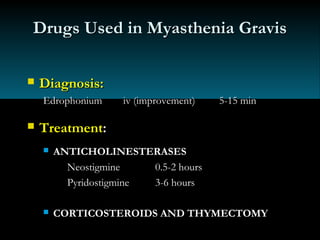
Drugs Used in Myasthenia GravisDrugs Used in Myasthenia Gravis
 Diagnosis:Diagnosis:
EdrophoniumEdrophonium iv (improvement)iv (improvement) 5-15 min5-15 min
 TreatmentTreatment::
 ANTICHOLINESTERASESANTICHOLINESTERASES
NeostigmineNeostigmine 0.5-2 hours0.5-2 hours
PyridostigminePyridostigmine 3-6 hours3-6 hours
 CORTICOSTEROIDS AND THYMECTOMYCORTICOSTEROIDS AND THYMECTOMY
Alzheimer’s Disease - SymptomsAlzheimer’s Disease - Symptoms
AD is a neurodegenerative disorderAD is a neurodegenerative disorder
Charcterized by progressive dementiaCharcterized by progressive dementia
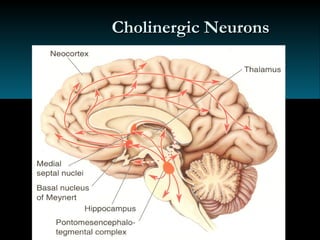
primarily affecting cholinergic neuronesprimarily affecting cholinergic neurones
in the brain.in the brain.
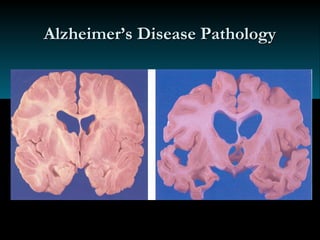
Alzheimer’s Disease PathologyAlzheimer’s Disease Pathology
Cholinergic NeuronsCholinergic Neurons
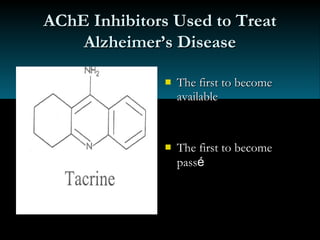
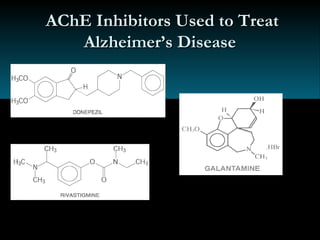
AChE Inhibitors Used to TreatAChE Inhibitors Used to Treat
Alzheimer’s DiseaseAlzheimer’s Disease
 The first to becomeThe first to become
availableavailable
 The first to becomeThe first to become
passpassƩƩ
AChE Inhibitors Used to TreatAChE Inhibitors Used to Treat
Alzheimer’s DiseaseAlzheimer’s Disease
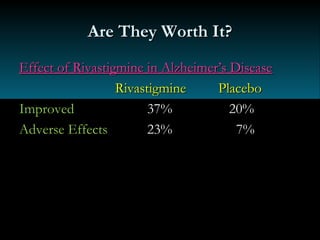
Are They Worth It?Are They Worth It?
Effect of Rivastigmine in Alzheimer’s DiseaseEffect of Rivastigmine in Alzheimer’s Disease
RivastigmineRivastigmine PlaceboPlacebo
ImprovedImproved 37%37% 20%20%
Adverse EffectsAdverse Effects 23%23% 7%7%
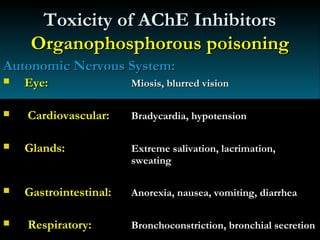
Toxicity of AChE InhibitorsToxicity of AChE Inhibitors
Organophosphorous poisoningOrganophosphorous poisoning
Autonomic Nervous System:Autonomic Nervous System:
 Eye:Eye: Miosis, blurred visionMiosis, blurred vision
 Cardiovascular:Cardiovascular: Bradycardia, hypotensionBradycardia, hypotension
 Glands:Glands: Extreme salivation, lacrimation,Extreme salivation, lacrimation,
sweatingsweating
 Gastrointestinal:Gastrointestinal: Anorexia, nausea, vomiting, diarrheaAnorexia, nausea, vomiting, diarrhea
 Respiratory:Respiratory: Bronchoconstriction, bronchial secretionBronchoconstriction, bronchial secretion
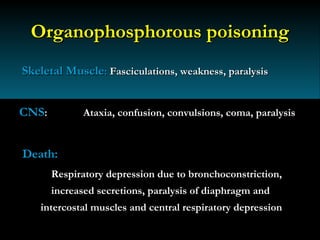
Organophosphorous poisoningOrganophosphorous poisoning
Skeletal MuscleSkeletal Muscle:: Fasciculations, weakness, paralysisFasciculations, weakness, paralysis
CNSCNS:: Ataxia, confusion, convulsions, coma, paralysisAtaxia, confusion, convulsions, coma, paralysis
Death:Death:
Respiratory depression due to bronchoconstriction,Respiratory depression due to bronchoconstriction,
increased secretions, paralysis of diaphragm andincreased secretions, paralysis of diaphragm and
intercostal muscles and central respiratory depressionintercostal muscles and central respiratory depression
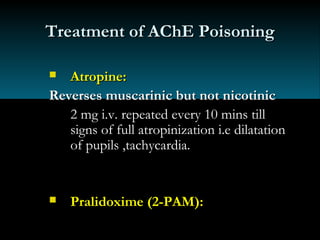
Treatment of AChE PoisoningTreatment of AChE Poisoning
 Atropine:Atropine:
Reverses muscarinic but not nicotinicReverses muscarinic but not nicotinic
2 mg i.v. repeated every 10 mins till2 mg i.v. repeated every 10 mins till
signs of full atropinization i.e dilatationsigns of full atropinization i.e dilatation
of pupils ,tachycardia.of pupils ,tachycardia.
 Pralidoxime (2-PAM):Pralidoxime (2-PAM):
Mechanism of Action of PralidoximeMechanism of Action of Pralidoxime
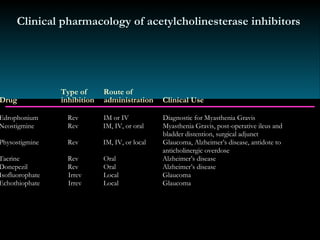
Clinical pharmacology of acetylcholinesterase inhibitorsClinical pharmacology of acetylcholinesterase inhibitors
Drug
Type of
inhibition
Route of
administration Clinical Use
Edrophonium Rev IM or IV Diagnostic for Myasthenia Gravis
Neostigmine Rev IM, IV, or oral Myasthenia Gravis, post-operative ileus and
bladder distention, surgical adjunct
Physostigmine Rev IM, IV, or local Glaucoma, Alzheimer’s disease, antidote to
anticholinergic overdose
Tacrine Rev Oral Alzheimer’s disease
Donepezil Rev Oral Alzheimer’s disease
Isofluorophate Irrev Local Glaucoma
Echothiophate Irrev Local Glaucoma