 -Lactam Antibiotics Carbapenems  Dr. Salman Khan  Department of Pharmacology LM&DC
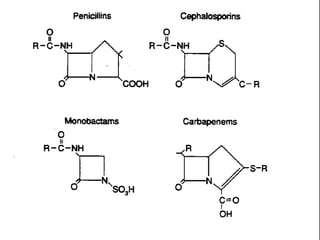
Carbapenems   Carbapenems are   - Lactams that contain fused   - Lactam ring system – different from penicillins. It is unsaturated and contains a carbon atom instead of the sulfur atom.
 
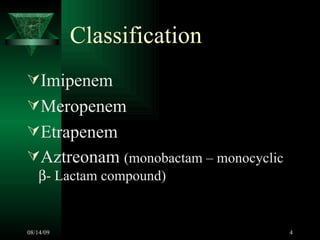
Classification Imipenem Meropenem Etrapenem Aztreonam  (monobactam – monocyclic   - Lactam compound)
Imipenem  Mechanism of Action: ß- lactam antibiotics inhibit the key enzyme in bacterial wall synthesis. (tanspeptidase) They also appear to activate one or more cell-wall autolytic enzymes, causing lysis of the bacterium.
Imipenem Spectrum: Aerobic & anaerobic micro-organisms Streptococci (including penicillin resistant  S. pneumoniae )
Spectrum continued… Enterococci  (except  E-Faecium  non-   - Lactamase producing penicillin resistant strains)  Staphylococci Listeria Some MRSA
Continued .. Pseudomonas Acinetobacter Bacteroides ( B. fragilis )
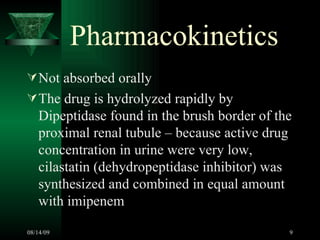
Pharmacokinetics Not absorbed orally The drug is hydrolyzed rapidly by Dipeptidase found in the brush border of the proximal renal tubule – because active drug concentration in urine were very low, cilastatin (dehydropeptidase inhibitor) was synthesized and combined in equal amount with imipenem
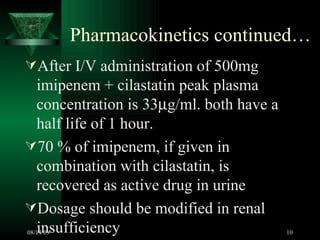
Pharmacokinetics continued… After I/V administration of 500mg imipenem + cilastatin peak plasma concentration is 33  g/ml. both have a half life of 1 hour. 70 % of imipenem, if given in combination with cilastatin, is recovered as active drug in urine Dosage should be modified in renal insufficiency
Adverse effects  Nausea and vomiting are most common (1% - 20%) Seizures – 1.5% (esp. if high doses are given in to patients with CNS lesions and in those with renal insufficiency)  Hypersensitivity – seen in patients allergic to other   - Lactam antibiotics.
Therapeutic uses Urinary tract infections Lower respiratory tract infections Intra-abdominal infections Gynecological infections Skin and soft tissue, bones and joint infections Cephalosporin-resistant nosocomial bacteria (Citrobacter Freundii, Enterobacter spp.)
Meropenem Newer drug Not sensitive to dipeptidase – cilastatin is not required Toxicity Similar to imipenem But less likely to cause seizures
Meropenem Spectrum Similar to imipenem but it is good  in vitro  against some imipenem resistant  P. aeruginosa,  while less against gram +ve cocci In clinical experience both the drugs are therapeutically equivalent
Ertapenem Larger serum half life – allows single daily dose Spectrum: Inferior activity against  P. aeruginosa  and Acinetobacter spp. Good against gram +ve enterobacteriaceae & anaerobes – makes it attractive for use in intra-abdominal and pelvic infections
Aztreonam  It is a monocyclic   - Lactam  compound (monobactam) Mechanism: Interacts with penicillin-binding proteins of susceptible micro-organisms and induces the formation of long filamentous bacterial structures It is resistant to many of the   - Lactamases that are elaborated by most gram-negative bacteria
Aztreonam  Spectrum Differs from other   - Lactam  antibiotics and closely resembles to aminoglycosides Active only against gram –ve bacteria  No activity against gram +ve bacteria and anaerobic organism However excellent against enterobacteriaceae and  P. aeruginosa  H. influenza  and gonococci ( in vitro )
Pharmacokinetics Administered I/M or I/V Peak conc. = 50  g/ml after 1g I/M dose T ½ = 1.7 hrs prolonged to 6 hrs in anephric patients Most of the drug is recovered unchanged in urine Dose = 2g every 6 -8 hrs (reduced in renal patients)
Adverse effects Usually well tolerated  Patients with penicillins or cephalosporin allergy appear not to react to aztreonam (except ceftazidine)
Uses Quite useful for treatment of gram negative infections that normally would be treated with a   - Lactam were it not for the history of prior allergic reaction

Carbapenems

  • 1.
     -Lactam AntibioticsCarbapenems Dr. Salman Khan Department of Pharmacology LM&DC
  • 2.
    Carbapenems Carbapenems are  - Lactams that contain fused  - Lactam ring system – different from penicillins. It is unsaturated and contains a carbon atom instead of the sulfur atom.
  • 3.
  • 4.
    Classification Imipenem MeropenemEtrapenem Aztreonam (monobactam – monocyclic  - Lactam compound)
  • 5.
    Imipenem Mechanismof Action: ß- lactam antibiotics inhibit the key enzyme in bacterial wall synthesis. (tanspeptidase) They also appear to activate one or more cell-wall autolytic enzymes, causing lysis of the bacterium.
  • 6.
    Imipenem Spectrum: Aerobic& anaerobic micro-organisms Streptococci (including penicillin resistant S. pneumoniae )
  • 7.
    Spectrum continued… Enterococci (except E-Faecium non-  - Lactamase producing penicillin resistant strains) Staphylococci Listeria Some MRSA
  • 8.
    Continued .. PseudomonasAcinetobacter Bacteroides ( B. fragilis )
  • 9.
    Pharmacokinetics Not absorbedorally The drug is hydrolyzed rapidly by Dipeptidase found in the brush border of the proximal renal tubule – because active drug concentration in urine were very low, cilastatin (dehydropeptidase inhibitor) was synthesized and combined in equal amount with imipenem
  • 10.
    Pharmacokinetics continued… AfterI/V administration of 500mg imipenem + cilastatin peak plasma concentration is 33  g/ml. both have a half life of 1 hour. 70 % of imipenem, if given in combination with cilastatin, is recovered as active drug in urine Dosage should be modified in renal insufficiency
  • 11.
    Adverse effects Nausea and vomiting are most common (1% - 20%) Seizures – 1.5% (esp. if high doses are given in to patients with CNS lesions and in those with renal insufficiency) Hypersensitivity – seen in patients allergic to other  - Lactam antibiotics.
  • 12.
    Therapeutic uses Urinarytract infections Lower respiratory tract infections Intra-abdominal infections Gynecological infections Skin and soft tissue, bones and joint infections Cephalosporin-resistant nosocomial bacteria (Citrobacter Freundii, Enterobacter spp.)
  • 13.
    Meropenem Newer drugNot sensitive to dipeptidase – cilastatin is not required Toxicity Similar to imipenem But less likely to cause seizures
  • 14.
    Meropenem Spectrum Similarto imipenem but it is good in vitro against some imipenem resistant P. aeruginosa, while less against gram +ve cocci In clinical experience both the drugs are therapeutically equivalent
  • 15.
    Ertapenem Larger serumhalf life – allows single daily dose Spectrum: Inferior activity against P. aeruginosa and Acinetobacter spp. Good against gram +ve enterobacteriaceae & anaerobes – makes it attractive for use in intra-abdominal and pelvic infections
  • 16.
    Aztreonam Itis a monocyclic  - Lactam compound (monobactam) Mechanism: Interacts with penicillin-binding proteins of susceptible micro-organisms and induces the formation of long filamentous bacterial structures It is resistant to many of the  - Lactamases that are elaborated by most gram-negative bacteria
  • 17.
    Aztreonam SpectrumDiffers from other  - Lactam antibiotics and closely resembles to aminoglycosides Active only against gram –ve bacteria No activity against gram +ve bacteria and anaerobic organism However excellent against enterobacteriaceae and P. aeruginosa H. influenza and gonococci ( in vitro )
  • 18.
    Pharmacokinetics Administered I/Mor I/V Peak conc. = 50  g/ml after 1g I/M dose T ½ = 1.7 hrs prolonged to 6 hrs in anephric patients Most of the drug is recovered unchanged in urine Dose = 2g every 6 -8 hrs (reduced in renal patients)
  • 19.
    Adverse effects Usuallywell tolerated Patients with penicillins or cephalosporin allergy appear not to react to aztreonam (except ceftazidine)
  • 20.
    Uses Quite usefulfor treatment of gram negative infections that normally would be treated with a  - Lactam were it not for the history of prior allergic reaction