QUINOLONES &
FLUOROQUINOLONES
DR. RESU NEHA REDDY
POST GRADUATE
MD PHARMACOLOGY
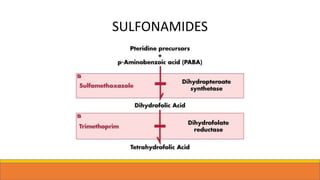
SULFONAMIDES
OBJECTIVES
 Introduction
 History
 Anti microbial spectrum
 Classification
 Mechanism of Action
 Resistance
 Pharmacokinetics
 Therapeutic uses
 Adverse Effects
 Interactions
INTRODUCTION
 The quinolones are a family of synthetic, broad-
spectrum antibiotic with bactericidal activity.
 The term quinolone refers to potent synthetic
chemotherapeutic antibacterial agent.
HISTORY
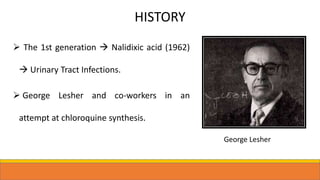
 The 1st generation  Nalidixic acid (1962)
 Urinary Tract Infections.
 George Lesher and co-workers in an
attempt at chloroquine synthesis.
George Lesher
HISTORY
 Nalidixic acid, not be used for systemic infections
 98.5% protein bound,
 Systemic levels were achieved only at the cost of toxicity.
 In 1980’s this obstacle was overcome
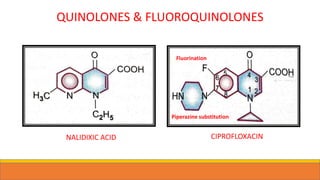
Fluoride group  Fluoroquinolones (ciprofloxacin)
QUINOLONES & FLUOROQUINOLONES
CIPROFLOXACINNALIDIXIC ACID
Fluorination
Piperazine substitution
HISTORY
Fluoroquinolones have
 Broader spectrum of action,
 Fewer side effects
 Relatively slower rate for microbial resistance.
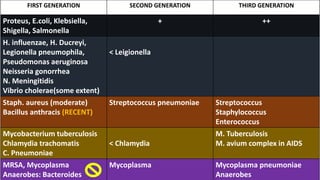
ANTI MICROBIAL SPECTRUM
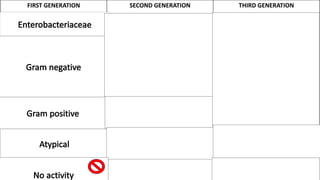
FIRST GENERATION SECOND GENERATION THIRD GENERATION
Proteus, E.coli, Klebsiella,
Shigella, Salmonella
+ ++
H. influenzae, H. Ducreyi,
Legionella pneumophila,
Pseudomonas aeruginosa
Neisseria gonorrhea
N. Meningitidis
Vibrio cholerae(some extent)
< Leigionella
Staph. aureus (moderate)
Bacillus anthracis (RECENT)
Streptococcus pneumoniae Streptococcus
Staphylococcus
Enterococcus
Mycobacterium tuberculosis
Chlamydia trachomatis
C. Pneumoniae
< Chlamydia
M. Tuberculosis
M. avium complex in AIDS
MRSA, Mycoplasma
Anaerobes: Bacteroides
Mycoplasma Mycoplasma pneumoniae
Anaerobes
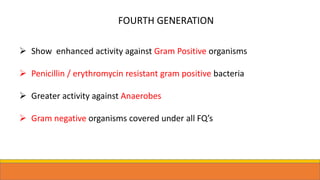
FOURTH GENERATION
 Show enhanced activity against Gram Positive organisms
 Penicillin / erythromycin resistant gram positive bacteria
 Greater activity against Anaerobes
 Gram negative organisms covered under all FQ’s
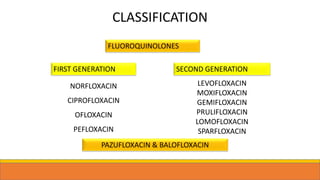
CLASSIFICATION
FLUOROQUINOLONES
FIRST GENERATION SECOND GENERATION
NORFLOXACIN
CIPROFLOXACIN
OFLOXACIN
PEFLOXACIN
LEVOFLOXACIN
MOXIFLOXACIN
GEMIFLOXACIN
PRULIFLOXACIN
LOMOFLOXACIN
SPARFLOXACIN
PAZUFLOXACIN & BALOFLOXACIN
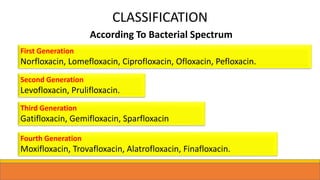
CLASSIFICATION
According To Bacterial Spectrum
First Generation
Norfloxacin, Lomefloxacin, Ciprofloxacin, Ofloxacin, Pefloxacin.
Second Generation
Levofloxacin, Prulifloxacin.
Third Generation
Gatifloxacin, Gemifloxacin, Sparfloxacin
Fourth Generation
Moxifloxacin, Trovafloxacin, Alatrofloxacin, Finafloxacin.
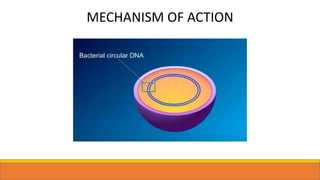
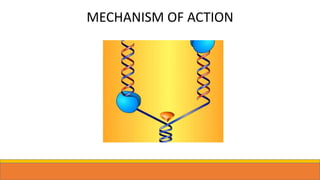
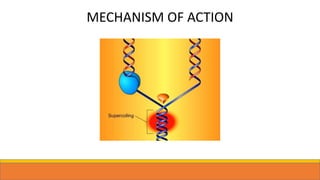
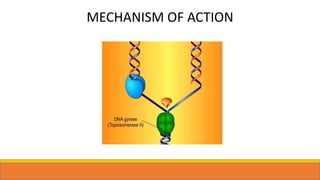
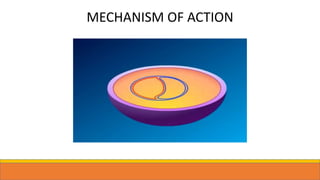
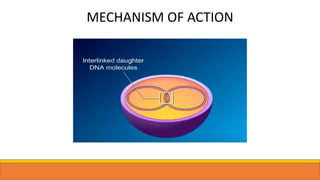
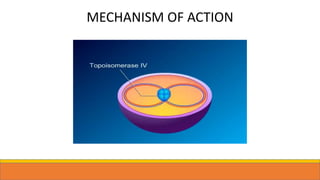
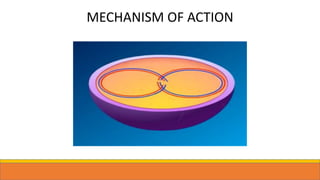
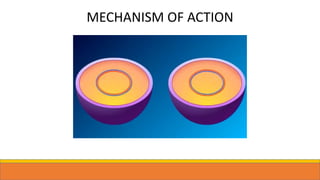
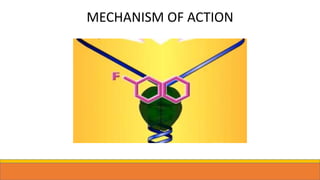
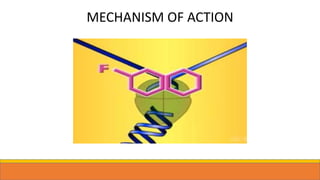
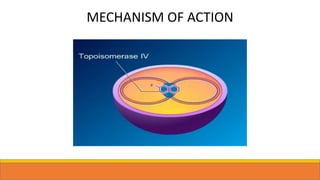
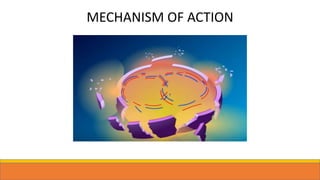
MECHANISM OF ACTION
MECHANISM OF ACTION
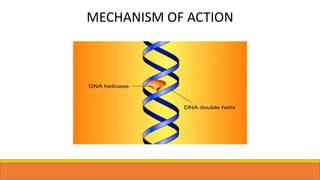
MECHANISM OF ACTION
MECHANISM OF ACTION
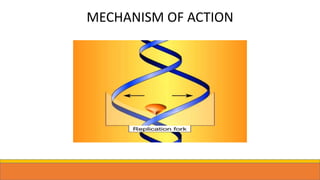
MECHANISM OF ACTION
MECHANISM OF ACTION
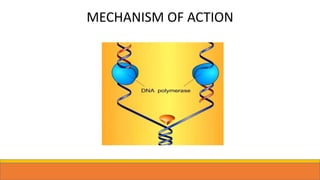
MECHANISM OF ACTION
MECHANISM OF ACTION
MECHANISM OF ACTION
MECHANISM OF ACTION
MECHANISM OF ACTION
MECHANISM OF ACTION
MECHANISM OF ACTION
MECHANISM OF ACTION
MECHANISM OF ACTION
MECHANISM OF ACTION
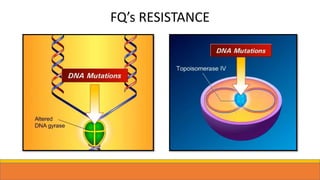
FQ’s RESISTANCE
POINT TO BE NOTED
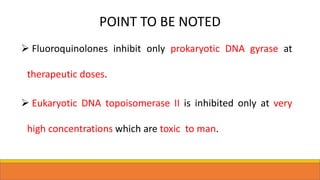
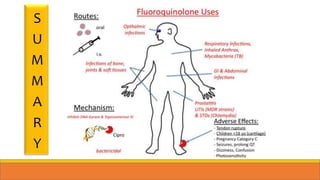
 Fluoroquinolones inhibit only prokaryotic DNA gyrase at
therapeutic doses.
 Eukaryotic DNA topoisomerase II is inhibited only at very
high concentrations which are toxic to man.
PHARMACOKINETICS
RFRF
PHARMACOKINETICS
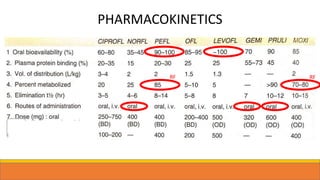
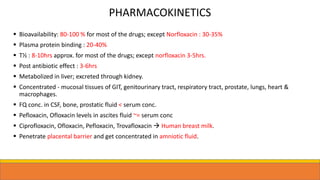
 Bioavailability: 80-100 % for most of the drugs; except Norfloxacin : 30-35%
 Plasma protein binding : 20-40%
 T½ : 8-10hrs approx. for most of the drugs; except norfloxacin 3-5hrs.
 Post antibiotic effect : 3-6hrs
 Metabolized in liver; excreted through kidney.
 Concentrated - mucosal tissues of GIT, genitourinary tract, respiratory tract, prostate, lungs, heart &
macrophages.
 FQ conc. in CSF, bone, prostatic fluid < serum conc.
 Pefloxacin, Ofloxacin levels in ascites fluid ~= serum conc
 Ciprofloxacin, Ofloxacin, Pefloxacin, Trovafloxacin  Human breast milk.
 Penetrate placental barrier and get concentrated in amniotic fluid.
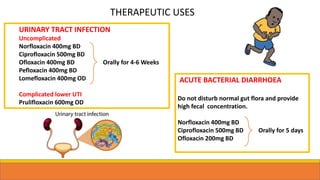
URINARY TRACT INFECTION
Uncomplicated
Norfloxacin 400mg BD
Ciprofloxacin 500mg BD
Ofloxacin 400mg BD Orally for 4-6 Weeks
Pefloxacin 400mg BD
Lomefloxacin 400mg OD
Complicated lower UTI
Prulifloxacin 600mg OD
ACUTE BACTERIAL DIARRHOEA
Do not disturb normal gut flora and provide
high fecal concentration.
Norfloxacin 400mg BD
Ciprofloxacin 500mg BD Orally for 5 days
Ofloxacin 200mg BD
THERAPEUTIC USES
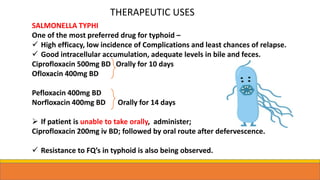
SALMONELLA TYPHI
One of the most preferred drug for typhoid –
 High efficacy, low incidence of Complications and least chances of relapse.
 Good intracellular accumulation, adequate levels in bile and feces.
Ciprofloxacin 500mg BD Orally for 10 days
Ofloxacin 400mg BD
Pefloxacin 400mg BD
Norfloxacin 400mg BD Orally for 14 days
 If patient is unable to take orally, administer;
Ciprofloxacin 200mg iv BD; followed by oral route after defervescence.
 Resistance to FQ’s in typhoid is also being observed.
THERAPEUTIC USES
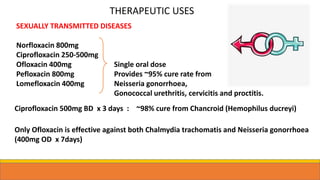
SEXUALLY TRANSMITTED DISEASES
Norfloxacin 800mg
Ciprofloxacin 250-500mg
Ofloxacin 400mg Single oral dose
Pefloxacin 800mg Provides ~95% cure rate from
Lomefloxacin 400mg Neisseria gonorrhoea,
Gonococcal urethritis, cervicitis and proctitis.
Ciprofloxacin 500mg BD x 3 days : ~98% cure from Chancroid (Hemophilus ducreyi)
Only Ofloxacin is effective against both Chalmydia trachomatis and Neisseria gonorrhoea
(400mg OD x 7days)
THERAPEUTIC USES
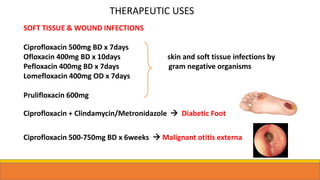
SOFT TISSUE & WOUND INFECTIONS
Ciprofloxacin 500mg BD x 7days
Ofloxacin 400mg BD x 10days skin and soft tissue infections by
Pefloxacin 400mg BD x 7days gram negative organisms
Lomefloxacin 400mg OD x 7days
Prulifloxacin 600mg
Ciprofloxacin + Clindamycin/Metronidazole  Diabetic Foot
Ciprofloxacin 500-750mg BD x 6weeks  Malignant otitis externa
THERAPEUTIC USES
RESPIRATORY INFECTIONS
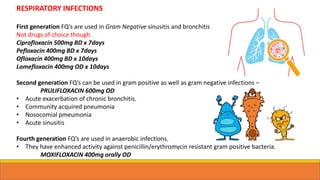
First generation FQ’s are used in Gram Negative sinusitis and bronchitis
Not drugs of choice though.
Ciprofloxacin 500mg BD x 7days
Pefloxacin 400mg BD x 7days
Ofloxacin 400mg BD x 10days
Lomefloxacin 400mg OD x 10days
Second generation FQ’s can be used in gram positive as well as gram negative infections –
PRULIFLOXACIN 600mg OD
• Acute exacerbation of chronic bronchitis.
• Community acquired pneumonia
• Nosocomial pmeumonia
• Acute sinusitis
Fourth generation FQ’s are used in anaerobic infections.
• They have enhanced activity against penicillin/erythromycin resistant gram positive bacteria.
MOXIFLOXACIN 400mg orally OD
THERAPEUTIC USES
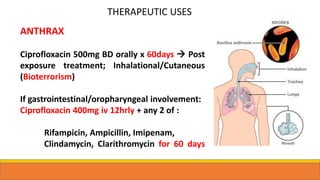
ANTHRAX
Ciprofloxacin 500mg BD orally x 60days  Post
exposure treatment; Inhalational/Cutaneous
(Bioterrorism)
If gastrointestinal/oropharyngeal involvement:
Ciprofloxacin 400mg iv 12hrly + any 2 of :
Rifampicin, Ampicillin, Imipenam,
Clindamycin, Clarithromycin for 60 days
TUBERCULOSIS
Ciprofloxacin/Ofloxacin are combined with anti TB drugs for Multidrug Resistance TB
For H+R resistance –
ZE + S/ Kanamycin/ Amikacin/ Capreomycin + Ciprofloxacin/ Ofloxacin ± Ethionamide
MYCOBACTERIUM AVIUM COMPLEX IN AIDS PATEINTS
Third generation FQ’s are used as adjuvant in treatment of MAC.
Intensive Phase (4drugs) :
Clarithromycin/ Azithromycin + Ethambutol + Rifabutin + FQ/ Clofazimine/ Ethionamide (2-6months)
Maintenance Phase (2drugs) :
Clarithromycin/ Azithromycin + Ethambutol/ FQ/ Rifabutin for 12 months – lifetime
MISCELLANEOUS
MENINGITIS : Pefloxacin concentrates more than
due to gram negative organisms other FQ’s on CSF
Chronic bacterial PROSTATITIS :
ciprofloxacin 500mg BD x 28days
pefloxacin 400mg BD x 28days
ofloxacin 300mg BD x 42days *Good Accumulation In Prostatic Fluid
Surgical Prophylaxis In Transurethral/Transrectal Procedures : Lomefloxacin
Prophylaxis in neutropenia : Ciprofloxacin + Gentamicin (in neutropenic cancer patients)
Cystic Fibrosis : Ciprofloxacin
Bacterial conjuctivitis, corneal ulcer
Topical eye drops/ointment : ~All FQ’s
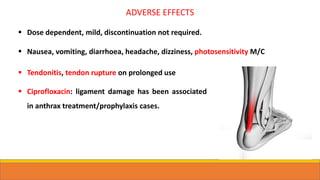
 Dose dependent, mild, discontinuation not required.
 Nausea, vomiting, diarrhoea, headache, dizziness, photosensitivity M/C
 Tendonitis, tendon rupture on prolonged use
 Ciprofloxacin: ligament damage has been associated
in anthrax treatment/prophylaxis cases.
ADVERSE EFFECTS
ADVERSE EFFECTS
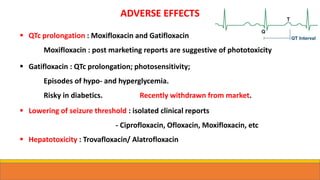
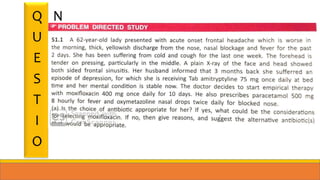
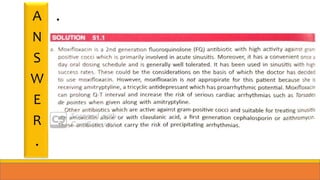
 QTc prolongation : Moxifloxacin and Gatifloxacin
Moxifloxacin : post marketing reports are suggestive of phototoxicity
 Gatifloxacin : QTc prolongation; photosensitivity;
Episodes of hypo- and hyperglycemia.
Risky in diabetics. Recently withdrawn from market.
 Lowering of seizure threshold : isolated clinical reports
- Ciprofloxacin, Ofloxacin, Moxifloxacin, etc
 Hepatotoxicity : Trovafloxacin/ Alatrofloxacin
ADVERSE EFFECTS
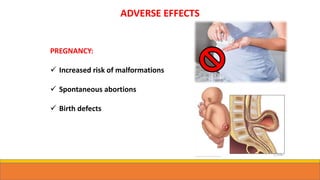
PREGNANCY:
 Increased risk of malformations
 Spontaneous abortions
 Birth defects
INTERACTIONS
 Oral absorption of FQ’s is decreased with:
Al+++ , Mg ++ , Ca ++ , containing antacids Form chelation complexes
Zn++ , Fe ++ salts
Sucralfate
 Theophylline metabolism is inhibited by FQ’s
except lomefloxacin, levofloxacin and sparfloxacin
 Warfarin metabolism is decreased by FQ’s  Enhanced effects
exceptions – Levofloxacin, Sparfloxacin.
 FQ’s prolonging QTc interval (caution/avoided)
class IA (quinidine, procainamide)
class III (amiodarone, sotalol, ibulitide)
other drugs prolonging QTc interval (erythromycin, cisapride, TCA’s, etc)
S
U
M
M
A
R
Y
Q
U
E
S
T
I
O
N
A
N
S
W
E
R
.
.
THANK YOU…