Dr. Rahul Kunkulol , Asso. professor, Dept. Of Pharmacology
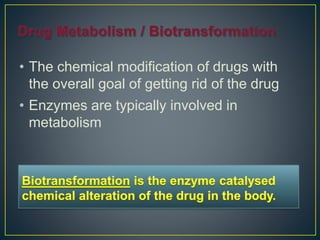
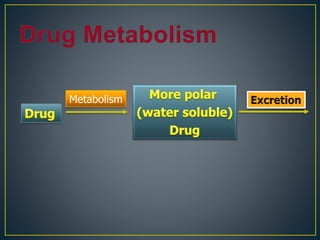
• The chemical modification of drugs with
the overall goal of getting rid of the drug
• Enzymes are typically involved in
metabolism
Metabolism
• Metabolism occurs in many tissues
• E.g. brain, kidney, lung, plasma, intestine.
Oral
Administration
Intestines
Liver
Intravenous
Administration
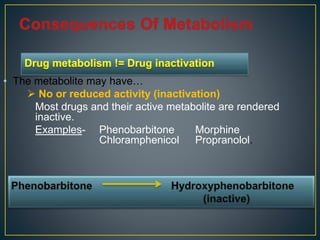
• The metabolite may have…
 No or reduced activity (inactivation)
Most drugs and their active metabolite are rendered
inactive.
Examples- Phenobarbitone Morphine
Chloramphenicol Propranolol.
The metabolite may have…
Equal activity to the drug
Many drugs have been found to be partially converted
to active metabolite.
Examples-
The metabolite may have…
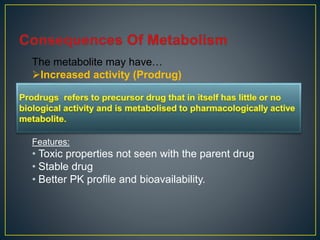
Increased activity (Prodrug)
Features:
• Toxic properties not seen with the parent drug
• Stable drug
• Better PK profile and bioavailability.
• Biotransformation of drug by liver or gut enzymes
before compound reaches systemic circulation
• Results in lower systemic bioavailbility of parent
compound, diminished therapeutic response.
• First pass effect may be bypassed if the drug is
administered IV or Sublingually.
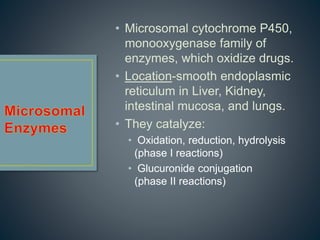
• Microsomal cytochrome P450,
monooxygenase family of
enzymes, which oxidize drugs.
• Location-smooth endoplasmic
reticulum in Liver, Kidney,
intestinal mucosa, and lungs.
• They catalyze:
• Oxidation, reduction, hydrolysis
(phase I reactions)
• Glucuronide conjugation
(phase II reactions)
RH + O2+ H++ NADPH ROH + H2O + NADP+
• Microsomal enzyme ranking first among Phase I
enzymes with respect to catalytic versatility
• Heme-containing proteins
Complex formed between Fe2+ and CO
absorbs light maximally at 450 (447-452nm)
Overall reaction proceeds by catalytic cycle:
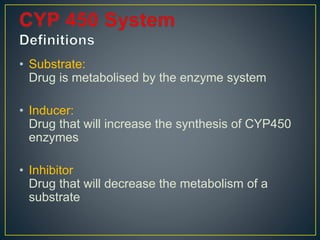
• Substrate:
Drug is metabolised by the enzyme system
• Inducer:
Drug that will increase the synthesis of CYP450
enzymes
• Inhibitor
Drug that will decrease the metabolism of a
substrate
• Specific forms of CYP 450 are classified into
• Families designated by numbers…
• Subfamilies designated by letters… based on
amino acid sequences
• Genes by another number
• At least 15 P450 enzymes identified in human
liver microsomes
CYP2D6
Family
Sub-Family Individual Gene
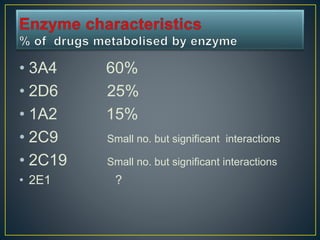
• 3A4 60%
• 2D6 25%
• 1A2 15%
• 2C9 Small no. but significant interactions
• 2C19 Small no. but significant interactions
• 2E1 ?
• Variation in levels, activity due to:
•Genetic polymorphism
•Environmental factors:
•Inducers, inhibitors, disease
•Multiple P450’s can catalyze same
reaction
•A single P450 can catalyze multiple
pathways
• Location :
• Cytoplasm, mitochondria of hepatic cells.
• Examples :
• Monoamine oxidases (MAO), Esterases,
Amidases, Transferases, Conjugages
• Reaction catalysed are all Phase II
reactions except_?...._____
• These are noninducible
• May show genetic variations
•Hoffman’s Elimination
• Example: some drugs like
atracurium (skeletal muscle
relaxant) are metabolized in
plasma through molecular
rearrangement without
involvement of enzyme action.
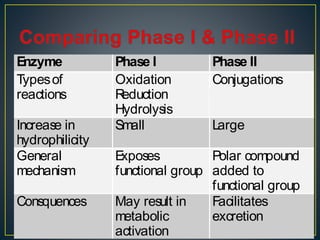
Enzyme Phase I Phase II
Typesof
reactions
Oxidation
Reduction
Hydrolysis
Conjugations
Increase in
hydrophilicity
Small Large
General
mechanism
Exposes
functional group
Polar compound
added to
functional group
Consquences May result in
metabolic
activation
Facilitates
excretion
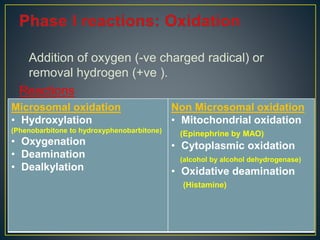
Addition of oxygen (-ve charged radical) or
removal hydrogen (+ve ).
Reactions
Microsomal oxidation
• Hydroxylation
(Phenobarbitone to hydroxyphenobarbitone)
• Oxygenation
• Deamination
• Dealkylation
Non Microsomal oxidation
• Mitochondrial oxidation
(Epinephrine by MAO)
• Cytoplasmic oxidation
(alcohol by alcohol dehydrogenase)
• Oxidative deamination
(Histamine)
• Azo reduction (Microsomal)
eg: prontosil to sulfanilamide
• Carbonyl reduction (Non microsomal)
Alcohol dehydrogenase (ADH)
• Chloral hydrate is reduced to trichlorothanol
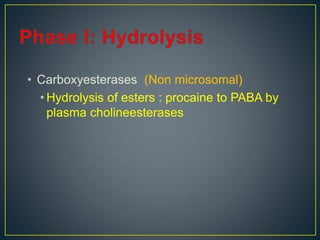
• Carboxyesterases (Non microsomal)
• Hydrolysis of esters : procaine to PABA by
plasma cholineesterases
• MICROSOMAL
Glucuronide
conjugation
• NON-MICROSOMAL
N acetyl conjugation
Sulfate conjugation
Methyl conjugation
Glutathione conjugation
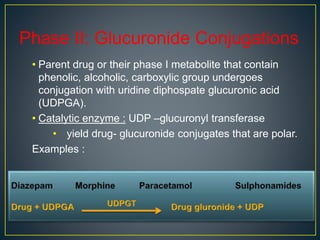
Phase II: Glucuronide Conjugations
• Parent drug or their phase I metabolite that contain
phenolic, alcoholic, carboxylic group undergoes
conjugation with uridine diphospate glucuronic acid
(UDPGA).
• Catalytic enzyme : UDP –glucuronyl transferase
• yield drug- glucuronide conjugates that are polar.
Examples :
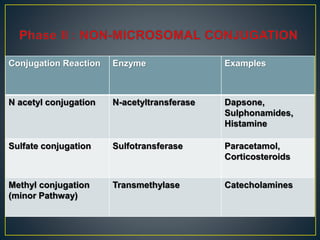
Conjugation Reaction Enzyme Examples
N acetyl conjugation N-acetyltransferase Dapsone,
Sulphonamides,
Histamine
Sulfate conjugation Sulfotransferase Paracetamol,
Corticosteroids
Methyl conjugation
(minor Pathway)
Transmethylase Catecholamines
• Several drugs (inducers) induce the growth of
smooth endoplasmic reticulum leading to
enhanced microsomal enzyme activity
Accelerates metabolism
Decrease pharmacological response of not only
the inducer itself but also of the coadministerd drug
(substrate)
• Occurs gradually over 1-2 weeks
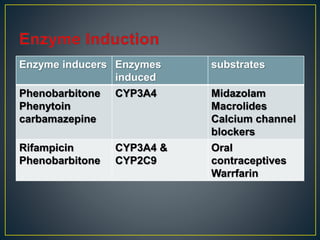
Enzyme inducers Enzymes
induced
substrates
Phenobarbitone
Phenytoin
carbamazepine
CYP3A4 Midazolam
Macrolides
Calcium channel
blockers
Rifampicin
Phenobarbitone
CYP3A4 &
CYP2C9
Oral
contraceptives
Warrfarin
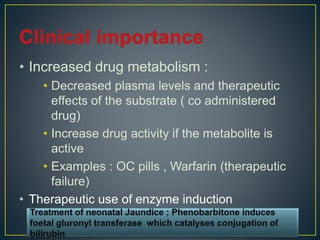
• Increased drug metabolism :
• Decreased plasma levels and therapeutic
effects of the substrate ( co administered
drug)
• Increase drug activity if the metabolite is
active
• Examples : OC pills , Warfarin (therapeutic
failure)
• Therapeutic use of enzyme induction
• Often rapid, reversible and relatively short acting.
• E.g. erythromycin and Terfanadine
• Erythromycin causes a rapid increase in plasma
Terfenadine concentration if given concurrently.
• Note: Erythromycin is a substrate and an
inhibitor of CYP 3A4
• Cimetidine
• Fluoxetine
• Erythromycin
• Chloramphenicol

Drug metabolism : Biotransformation

  • 1.
    Dr. Rahul Kunkulol, Asso. professor, Dept. Of Pharmacology
  • 2.
    • The chemicalmodification of drugs with the overall goal of getting rid of the drug • Enzymes are typically involved in metabolism
  • 3.
  • 4.
    • Metabolism occursin many tissues • E.g. brain, kidney, lung, plasma, intestine.
  • 5.
  • 6.
    • The metabolitemay have…  No or reduced activity (inactivation) Most drugs and their active metabolite are rendered inactive. Examples- Phenobarbitone Morphine Chloramphenicol Propranolol.
  • 7.
    The metabolite mayhave… Equal activity to the drug Many drugs have been found to be partially converted to active metabolite. Examples-
  • 8.
    The metabolite mayhave… Increased activity (Prodrug) Features: • Toxic properties not seen with the parent drug • Stable drug • Better PK profile and bioavailability.
  • 9.
    • Biotransformation ofdrug by liver or gut enzymes before compound reaches systemic circulation • Results in lower systemic bioavailbility of parent compound, diminished therapeutic response. • First pass effect may be bypassed if the drug is administered IV or Sublingually.
  • 11.
    • Microsomal cytochromeP450, monooxygenase family of enzymes, which oxidize drugs. • Location-smooth endoplasmic reticulum in Liver, Kidney, intestinal mucosa, and lungs. • They catalyze: • Oxidation, reduction, hydrolysis (phase I reactions) • Glucuronide conjugation (phase II reactions)
  • 12.
    RH + O2+H++ NADPH ROH + H2O + NADP+ • Microsomal enzyme ranking first among Phase I enzymes with respect to catalytic versatility • Heme-containing proteins Complex formed between Fe2+ and CO absorbs light maximally at 450 (447-452nm) Overall reaction proceeds by catalytic cycle:
  • 13.
    • Substrate: Drug ismetabolised by the enzyme system • Inducer: Drug that will increase the synthesis of CYP450 enzymes • Inhibitor Drug that will decrease the metabolism of a substrate
  • 14.
    • Specific formsof CYP 450 are classified into • Families designated by numbers… • Subfamilies designated by letters… based on amino acid sequences • Genes by another number • At least 15 P450 enzymes identified in human liver microsomes
  • 15.
  • 16.
    • 3A4 60% •2D6 25% • 1A2 15% • 2C9 Small no. but significant interactions • 2C19 Small no. but significant interactions • 2E1 ?
  • 17.
    • Variation inlevels, activity due to: •Genetic polymorphism •Environmental factors: •Inducers, inhibitors, disease •Multiple P450’s can catalyze same reaction •A single P450 can catalyze multiple pathways
  • 18.
    • Location : •Cytoplasm, mitochondria of hepatic cells. • Examples : • Monoamine oxidases (MAO), Esterases, Amidases, Transferases, Conjugages • Reaction catalysed are all Phase II reactions except_?...._____ • These are noninducible • May show genetic variations
  • 19.
    •Hoffman’s Elimination • Example:some drugs like atracurium (skeletal muscle relaxant) are metabolized in plasma through molecular rearrangement without involvement of enzyme action.
  • 21.
    Enzyme Phase IPhase II Typesof reactions Oxidation Reduction Hydrolysis Conjugations Increase in hydrophilicity Small Large General mechanism Exposes functional group Polar compound added to functional group Consquences May result in metabolic activation Facilitates excretion
  • 22.
    Addition of oxygen(-ve charged radical) or removal hydrogen (+ve ). Reactions Microsomal oxidation • Hydroxylation (Phenobarbitone to hydroxyphenobarbitone) • Oxygenation • Deamination • Dealkylation Non Microsomal oxidation • Mitochondrial oxidation (Epinephrine by MAO) • Cytoplasmic oxidation (alcohol by alcohol dehydrogenase) • Oxidative deamination (Histamine)
  • 23.
    • Azo reduction(Microsomal) eg: prontosil to sulfanilamide • Carbonyl reduction (Non microsomal) Alcohol dehydrogenase (ADH) • Chloral hydrate is reduced to trichlorothanol
  • 24.
    • Carboxyesterases (Nonmicrosomal) • Hydrolysis of esters : procaine to PABA by plasma cholineesterases
  • 25.
    • MICROSOMAL Glucuronide conjugation • NON-MICROSOMAL Nacetyl conjugation Sulfate conjugation Methyl conjugation Glutathione conjugation
  • 26.
    Phase II: GlucuronideConjugations • Parent drug or their phase I metabolite that contain phenolic, alcoholic, carboxylic group undergoes conjugation with uridine diphospate glucuronic acid (UDPGA). • Catalytic enzyme : UDP –glucuronyl transferase • yield drug- glucuronide conjugates that are polar. Examples :
  • 27.
    Conjugation Reaction EnzymeExamples N acetyl conjugation N-acetyltransferase Dapsone, Sulphonamides, Histamine Sulfate conjugation Sulfotransferase Paracetamol, Corticosteroids Methyl conjugation (minor Pathway) Transmethylase Catecholamines
  • 29.
    • Several drugs(inducers) induce the growth of smooth endoplasmic reticulum leading to enhanced microsomal enzyme activity Accelerates metabolism Decrease pharmacological response of not only the inducer itself but also of the coadministerd drug (substrate) • Occurs gradually over 1-2 weeks
  • 30.
    Enzyme inducers Enzymes induced substrates Phenobarbitone Phenytoin carbamazepine CYP3A4Midazolam Macrolides Calcium channel blockers Rifampicin Phenobarbitone CYP3A4 & CYP2C9 Oral contraceptives Warrfarin
  • 31.
    • Increased drugmetabolism : • Decreased plasma levels and therapeutic effects of the substrate ( co administered drug) • Increase drug activity if the metabolite is active • Examples : OC pills , Warfarin (therapeutic failure) • Therapeutic use of enzyme induction
  • 32.
    • Often rapid,reversible and relatively short acting. • E.g. erythromycin and Terfanadine • Erythromycin causes a rapid increase in plasma Terfenadine concentration if given concurrently. • Note: Erythromycin is a substrate and an inhibitor of CYP 3A4
  • 33.
    • Cimetidine • Fluoxetine •Erythromycin • Chloramphenicol