Quantitative Research
Quantitative research is a means for testing
objective theories by examining the relationship
among variables.
The final written report has a set structure consisting
of introduction, literature and theory, methods,
results, and discussion (Creswell, 2008).
What is
quantitative
research?
2
Quantitative research is the systematic empirical
investigation of observable phenomena via statistical,
mathematical or computational technique. The objective
of quantitative research is to develop and employ
mathematical models, theories, and hypotheses pertaining
to phenomena.
Quantitative research provides the fundamental
connection between empirical observation and
mathematical expression of quantitative relationship.
What is
quantitative
research?
3
“
In quantitative research the major characteristics are:
• Describing a research problem through a description of trends or a need for
an explanation of the relationship among variables
• Providing a major role for the literature through suggesting the research
questions to be asked and justifying the research problem and creating a
need for the direction (purpose statement and research questions or
hypotheses) of the study
• Creating purpose statements, research questions, and hypotheses that are
specific, narrow, measurable, and observable
Quantitative Research
Characteristics
“
In quantitative research the major characteristics are:
• Collecting numeric data from a large number of people using
instruments with preset questions and responses
• Analyzing trends, comparing groups, or relating variables using
statistical analysis, and interpreting results by comparing them with
prior predictions and past research
• Writing the research report using standard, fixed structures and
evaluation criteria, and taking an objective, unbiased approach
Quantitative Research
Characteristics
“
• In quantitative research, the investigator identifies a research problem based
on trends in the field or on the need to explain why something occurs.
• Some quantitative research problems require that you explain how one
variable affects another. By explaining a relation among variables, you are
interested in determining whether one or more variables might influence
another variable.
Quantitative Research
Characteristics
“
• In reviewing the literature in quantitative research, you will typically see a
substantial literature review at the beginning of the study.
• In quantitative research questions, you ask specific, narrow questions to obtain
measurable and observable data on variables. The major statements and
questions of direction in a study—the purpose statement, the research
questions, and the hypotheses—are specific and narrow because you identify
only a few variables to study.
Quantitative Research
Characteristics
“
• In quantitative data collection, you use an instrument to measure the variables in
the study. An instrument is a tool for measuring, observing, or documenting
quantitative data. It contains specific questions and response possibilities that you
establish or develop in advance of the study.
• In quantitative data analysis, you analyze the data using mathematical procedures,
called statistics. These analyses consist of breaking down the data into parts to
answer the research questions.
Quantitative Research
Characteristics
“
• In reporting and evaluating quantitative research, the overall format for a study
follows a predictable pattern: introduction, review of the literature, methods,
results, and discussion. This form creates a standardized structure for quantitative
studies.
• In quantitative research, you also use procedures to ensure that your own personal
biases and values do not influence the results. You use instruments that have
proven value and that have reliable and valid scores from past uses.
9
Quantitative Research
Characteristics
“
Tend to use quantitative research if your research problem requires
you to:
– Measure variables
– Assess the impact of these variables on an outcome
– Test theories or broad explanations
– Apply results to a large number of people.
1. Tend to use post positivist worldview, This worldview is sometimes called the
scientific method or doing science research. It is also called positivist/postpositivist
research, empirical science, and postpostivism. Postpositivists hold a deterministic
philosophy in which causes probably determine effects or outcomes.
2. Employ experiments and surveys as the strategies of inquiry.
3. Typically use close-ended questions, predetermined approaches, and numeric data.
4. The researchers uses tests or verifies theories, identifies variable to study, relates
variables in question or variables, uses standards of validity and reliability, observes
and measures information numerically.
Quantitative Approach
Literature Review
in Quantitative
Method
• Quantitative research includes a substantial amount
of literature at the beginning of a study to provide
direction for the research questions or hypotheses.
It is also used there to introduce a problem or to
describe in detail the existing literature in a section
titled “Related Literature” or “Review of Literature,”
or some other similar phrase. At the end of a study,
the literature is revisited by the researcher, and a
comparison is made between the results with the
existing findings in the literature.
QUANTITATIVE
THEORY USE
• In quantitative studies, one uses theory deductively
and places it toward the beginning of the proposal for
a study.
• The researcher tests or verifies a theory by examining
hypotheses or questions derived from it. These
hypotheses or questions contain variables (or
constructs) that the researcher needs to define.
Writing
Quantitative
Research
Questions
• Research questions describe the participants’ reactions to a single
variable, compare groups on an outcome, or relate to variables.
Research questions are found in all designs in quantitative
research, such as in experiments, correlational studies, and
surveys.
• Guidelines
The basic steps in forming a research question are:
– Pose a question
– Begin with “how,” “what,” or “why”
– Specify the independent, dependent, and mediating or
control variables
– Use the words describe, compare, or relate to indicate the
action or connection among the variables
– Indicate the participants and the research site for the study
The Steps in The
Process of
Quantitative Data
Analysis
• The first step is to prepare the data for analysis. This
involves determining how to assign numeric scores to the
data, assessing the types of scores to use, selecting a
statistical program, and inputting the data into a program,
and then cleaning up the database for analysis.
• The second step begins the data analysis. Typically you
conduct a descriptive analysis of the data reporting
measures of central tendency and variation.
• The next step is to report the results that are found using
tables, figures, and a discussion of the key results. Finally,
you interpret the results from the data analysis.
16
Survey Design provides a quantitative or numeric description of trends, attitudes, or
opinions of a population by studying a sample of that population. It includes;
1. cross-sectional (the researcher collects data at one point in time)
2. longitudinal studies (the survey procedure of collecting data about trends with
the same population, changes in a cohort group or subpopulation, or changes in
a panel group of the same individuals over time)
using questionnaires or structured interviews for data collection, with the intent of
generalizing from a sample to a population (Babbie, 1990).
• Components of Survey Design
•The Survey Design
•The Population and Sample
•Instrumentation
•Variables in the Study
•Data Analysis and Interpretation
•Methodology
17
In an experiment, you test an idea (or practice or procedure) to
determine whether it influences an outcome or dependent variable.
Components of experimental design
•Participants
•Variables
•Instrumentation and Materials
•Experimental Procedures
•The Procedure
•Data Analysis
•Interpreting Results
Although all experiments have common characteristics, their
use and applications vary depending on the type of design
used. The most common designs you will find in educational
research are:
◆ Between Group Designs
• True experiments (pre- and posttest, posttest only)
• Quasi-experiments (pre- and posttest, posttest only)
• Factorial designs
◆ Within Group or Individual Designs
• Time series experiments (interrupted, equivalent)
• Repeated measures experiments
• Single subject experiments
19
1. In quantitative research, hypotheses are used. In qualitative research, hypotheses
are not used; instead, inquirers use only research questions.
2. In quantitative research, the investigator identifies multiple variables and seeks to
measure them. In qualitative research, the term variable is not used, and instead
the inquirer seeks to gather information on a single concept.
3. In quantitative research, researchers often test theories, broad explanations that
predict the results from relating variables. In qualitative research, theories are
typically not tested.
Differentiating between Quantitative and Qualitative
Purpose Statements and Research Questions
20
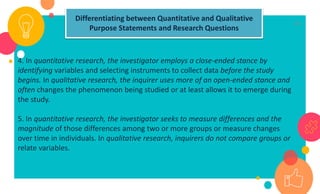
4. In quantitative research, the investigator employs a close-ended stance by
identifying variables and selecting instruments to collect data before the study
begins. In qualitative research, the inquirer uses more of an open-ended stance and
often changes the phenomenon being studied or at least allows it to emerge during
the study.
5. In quantitative research, the investigator seeks to measure differences and the
magnitude of those differences among two or more groups or measure changes
over time in individuals. In qualitative research, inquirers do not compare groups or
relate variables.
Differentiating between Quantitative and Qualitative
Purpose Statements and Research Questions
Advantages and disadvantages of
quantitative data analysis
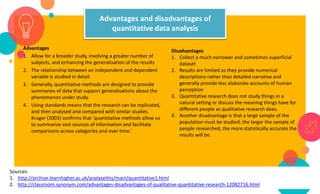
Advantages
1. Allow for a broader study, involving a greater number of
subjects, and enhancing the generalisation of the results
2. The relationship between an independent and dependent
variable is studied in detail.
3. Generally, quantitative methods are designed to provide
summaries of data that support generalisations about the
phenomenon under study.
4. Using standards means that the research can be replicated,
and then analysed and compared with similar studies.
Kruger (2003) confirms that 'quantitative methods allow us
to summarize vast sources of information and facilitate
comparisons across categories and over time.’
Disadvantages
1. Collect a much narrower and sometimes superficial
dataset
2. Results are limited as they provide numerical
descriptions rather than detailed narrative and
generally provide less elaborate accounts of human
perception
3. Quantitative research does not study things in a
natural setting or discuss the meaning things have for
different people as qualitative research does.
4. Another disadvantage is that a large sample of the
population must be studied; the larger the sample of
people researched, the more statistically accurate the
results will be.
Sources:
1. http://archive.learnhigher.ac.uk/analysethis/main/quantitative1.html
2. http://classroom.synonym.com/advantages-disadvantages-of-qualitative-quantitative-research-12082716.html
Thank you!
22

Quantitative Research

  • 1.
  • 2.
    Quantitative research isa means for testing objective theories by examining the relationship among variables. The final written report has a set structure consisting of introduction, literature and theory, methods, results, and discussion (Creswell, 2008). What is quantitative research? 2
  • 3.
    Quantitative research isthe systematic empirical investigation of observable phenomena via statistical, mathematical or computational technique. The objective of quantitative research is to develop and employ mathematical models, theories, and hypotheses pertaining to phenomena. Quantitative research provides the fundamental connection between empirical observation and mathematical expression of quantitative relationship. What is quantitative research? 3
  • 4.
    “ In quantitative researchthe major characteristics are: • Describing a research problem through a description of trends or a need for an explanation of the relationship among variables • Providing a major role for the literature through suggesting the research questions to be asked and justifying the research problem and creating a need for the direction (purpose statement and research questions or hypotheses) of the study • Creating purpose statements, research questions, and hypotheses that are specific, narrow, measurable, and observable Quantitative Research Characteristics
  • 5.
    “ In quantitative researchthe major characteristics are: • Collecting numeric data from a large number of people using instruments with preset questions and responses • Analyzing trends, comparing groups, or relating variables using statistical analysis, and interpreting results by comparing them with prior predictions and past research • Writing the research report using standard, fixed structures and evaluation criteria, and taking an objective, unbiased approach Quantitative Research Characteristics
  • 6.
    “ • In quantitativeresearch, the investigator identifies a research problem based on trends in the field or on the need to explain why something occurs. • Some quantitative research problems require that you explain how one variable affects another. By explaining a relation among variables, you are interested in determining whether one or more variables might influence another variable. Quantitative Research Characteristics
  • 7.
    “ • In reviewingthe literature in quantitative research, you will typically see a substantial literature review at the beginning of the study. • In quantitative research questions, you ask specific, narrow questions to obtain measurable and observable data on variables. The major statements and questions of direction in a study—the purpose statement, the research questions, and the hypotheses—are specific and narrow because you identify only a few variables to study. Quantitative Research Characteristics
  • 8.
    “ • In quantitativedata collection, you use an instrument to measure the variables in the study. An instrument is a tool for measuring, observing, or documenting quantitative data. It contains specific questions and response possibilities that you establish or develop in advance of the study. • In quantitative data analysis, you analyze the data using mathematical procedures, called statistics. These analyses consist of breaking down the data into parts to answer the research questions. Quantitative Research Characteristics
  • 9.
    “ • In reportingand evaluating quantitative research, the overall format for a study follows a predictable pattern: introduction, review of the literature, methods, results, and discussion. This form creates a standardized structure for quantitative studies. • In quantitative research, you also use procedures to ensure that your own personal biases and values do not influence the results. You use instruments that have proven value and that have reliable and valid scores from past uses. 9 Quantitative Research Characteristics
  • 10.
    “ Tend to usequantitative research if your research problem requires you to: – Measure variables – Assess the impact of these variables on an outcome – Test theories or broad explanations – Apply results to a large number of people.
  • 11.
    1. Tend touse post positivist worldview, This worldview is sometimes called the scientific method or doing science research. It is also called positivist/postpositivist research, empirical science, and postpostivism. Postpositivists hold a deterministic philosophy in which causes probably determine effects or outcomes. 2. Employ experiments and surveys as the strategies of inquiry. 3. Typically use close-ended questions, predetermined approaches, and numeric data. 4. The researchers uses tests or verifies theories, identifies variable to study, relates variables in question or variables, uses standards of validity and reliability, observes and measures information numerically. Quantitative Approach
  • 12.
    Literature Review in Quantitative Method •Quantitative research includes a substantial amount of literature at the beginning of a study to provide direction for the research questions or hypotheses. It is also used there to introduce a problem or to describe in detail the existing literature in a section titled “Related Literature” or “Review of Literature,” or some other similar phrase. At the end of a study, the literature is revisited by the researcher, and a comparison is made between the results with the existing findings in the literature.
  • 13.
    QUANTITATIVE THEORY USE • Inquantitative studies, one uses theory deductively and places it toward the beginning of the proposal for a study. • The researcher tests or verifies a theory by examining hypotheses or questions derived from it. These hypotheses or questions contain variables (or constructs) that the researcher needs to define.
  • 14.
    Writing Quantitative Research Questions • Research questionsdescribe the participants’ reactions to a single variable, compare groups on an outcome, or relate to variables. Research questions are found in all designs in quantitative research, such as in experiments, correlational studies, and surveys. • Guidelines The basic steps in forming a research question are: – Pose a question – Begin with “how,” “what,” or “why” – Specify the independent, dependent, and mediating or control variables – Use the words describe, compare, or relate to indicate the action or connection among the variables – Indicate the participants and the research site for the study
  • 15.
    The Steps inThe Process of Quantitative Data Analysis • The first step is to prepare the data for analysis. This involves determining how to assign numeric scores to the data, assessing the types of scores to use, selecting a statistical program, and inputting the data into a program, and then cleaning up the database for analysis. • The second step begins the data analysis. Typically you conduct a descriptive analysis of the data reporting measures of central tendency and variation. • The next step is to report the results that are found using tables, figures, and a discussion of the key results. Finally, you interpret the results from the data analysis.
  • 16.
    16 Survey Design providesa quantitative or numeric description of trends, attitudes, or opinions of a population by studying a sample of that population. It includes; 1. cross-sectional (the researcher collects data at one point in time) 2. longitudinal studies (the survey procedure of collecting data about trends with the same population, changes in a cohort group or subpopulation, or changes in a panel group of the same individuals over time) using questionnaires or structured interviews for data collection, with the intent of generalizing from a sample to a population (Babbie, 1990). • Components of Survey Design •The Survey Design •The Population and Sample •Instrumentation •Variables in the Study •Data Analysis and Interpretation •Methodology
  • 17.
    17 In an experiment,you test an idea (or practice or procedure) to determine whether it influences an outcome or dependent variable. Components of experimental design •Participants •Variables •Instrumentation and Materials •Experimental Procedures •The Procedure •Data Analysis •Interpreting Results
  • 18.
    Although all experimentshave common characteristics, their use and applications vary depending on the type of design used. The most common designs you will find in educational research are: ◆ Between Group Designs • True experiments (pre- and posttest, posttest only) • Quasi-experiments (pre- and posttest, posttest only) • Factorial designs ◆ Within Group or Individual Designs • Time series experiments (interrupted, equivalent) • Repeated measures experiments • Single subject experiments
  • 19.
    19 1. In quantitativeresearch, hypotheses are used. In qualitative research, hypotheses are not used; instead, inquirers use only research questions. 2. In quantitative research, the investigator identifies multiple variables and seeks to measure them. In qualitative research, the term variable is not used, and instead the inquirer seeks to gather information on a single concept. 3. In quantitative research, researchers often test theories, broad explanations that predict the results from relating variables. In qualitative research, theories are typically not tested. Differentiating between Quantitative and Qualitative Purpose Statements and Research Questions
  • 20.
    20 4. In quantitativeresearch, the investigator employs a close-ended stance by identifying variables and selecting instruments to collect data before the study begins. In qualitative research, the inquirer uses more of an open-ended stance and often changes the phenomenon being studied or at least allows it to emerge during the study. 5. In quantitative research, the investigator seeks to measure differences and the magnitude of those differences among two or more groups or measure changes over time in individuals. In qualitative research, inquirers do not compare groups or relate variables. Differentiating between Quantitative and Qualitative Purpose Statements and Research Questions
  • 21.
    Advantages and disadvantagesof quantitative data analysis Advantages 1. Allow for a broader study, involving a greater number of subjects, and enhancing the generalisation of the results 2. The relationship between an independent and dependent variable is studied in detail. 3. Generally, quantitative methods are designed to provide summaries of data that support generalisations about the phenomenon under study. 4. Using standards means that the research can be replicated, and then analysed and compared with similar studies. Kruger (2003) confirms that 'quantitative methods allow us to summarize vast sources of information and facilitate comparisons across categories and over time.’ Disadvantages 1. Collect a much narrower and sometimes superficial dataset 2. Results are limited as they provide numerical descriptions rather than detailed narrative and generally provide less elaborate accounts of human perception 3. Quantitative research does not study things in a natural setting or discuss the meaning things have for different people as qualitative research does. 4. Another disadvantage is that a large sample of the population must be studied; the larger the sample of people researched, the more statistically accurate the results will be. Sources: 1. http://archive.learnhigher.ac.uk/analysethis/main/quantitative1.html 2. http://classroom.synonym.com/advantages-disadvantages-of-qualitative-quantitative-research-12082716.html
  • 22.