Introduction to
Business Research Methods
Submitted by
Vamsi krishna
227016672069
 What is Business Research?
 What is Theory?
 Deduction & Induction
 Research Paradigms
 Ontology
 Epistemology
 Quantitative Research
 Qualitative Research
 Mixed Methods
 Q&A
 What is Business Research?
“The application of the scientific method in
searching for the truth about business phenomena.
These activities include defining business
opportunities and problems, generating and
evaluating ideas, monitoring performance, and
understanding the business process.”
(Zikmund, 2010, p5)
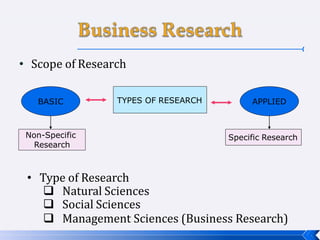
• Scope of Research
TYPES OF RESEARCHBASIC APPLIED
Non-Specific
Research
Specific Research
• Type of Research
 Natural Sciences
 Social Sciences
 Management Sciences (Business Research)
 What is Theory?
“Aformal, logical explanation of some events that
includes predictions of how things relate to one
another.”
(Zikmund, 2010, p39)
 What is Good Theory?
“Atheory is a good theory if it satisfies two
requirements. It must accurately describe a large
class of observations on the basis of a model that
contains only a few arbitrary elements. And it must
make definite predictions about the result of future
observations”
(Source: Stephen Hawking, A Brief History of Time, 1988 )
 A prediction about the relationship between two or more
variables.
 Prediction is about what researcher expects to find in his/her
research.
 Hypotheses are more specific than theories.
 A theory could have many different hypotheses.
 If the hypotheses offered by the theory are confirmed, the
theory is supported.
 If the hypotheses offered by the theory are rejected, the
theory is not supported and should be re-evaluated through
further research.
Null Hypothesis (H0)
 There is no relationship between two measured phenomena.
Eg. H0 :There is no link between smoking and cancer.
 Null Hypothesis can never be proven. It can either be rejected
or fail to reject.
Alternative Hypothesis (H1)
 A hypothesis to be adopted if the Null hypothesis implied to be
highly implausible. ie. The hypothesis to be accepted if the Null
hypothesis is rejected.
eg. H1 : There is significant link between smoking and cancer.
“Most confusing phrase in research: Fail to reject Null Hypothesis”
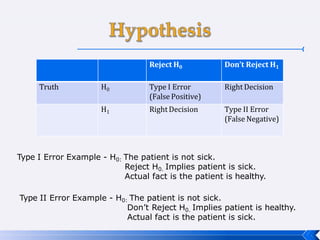
Reject H0 Don’t Reject H1
Truth H0 Type I Error
(False Positive)
Right Decision
H1 Right Decision Type II Error
(False Negative)
Type I Error Example - H0: The patient is not sick.
Reject H0. Implies patient is sick.
Actual fact is the patient is healthy.
Type II Error Example - H0: The patient is not sick.
Don’t Reject H0. Implies patient is healthy.
Actual fact is the patient is sick.
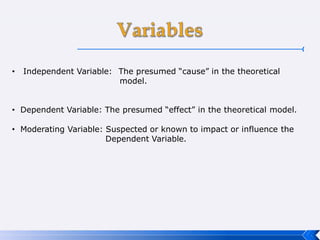
• Independent Variable: The presumed “cause” in the theoretical
model.
• Dependent Variable: The presumed “effect” in the theoretical model.
• Moderating Variable: Suspected or known to impact or influence the
Dependent Variable.
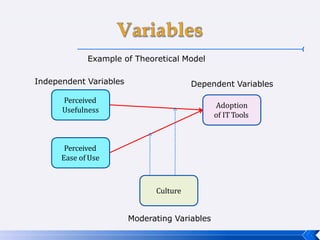
Perceived
Usefulness
Perceived
Ease of Use
Adoption
of IT Tools
Example of Theoretical Model
Independent Variables Dependent Variables
Culture
Moderating Variables
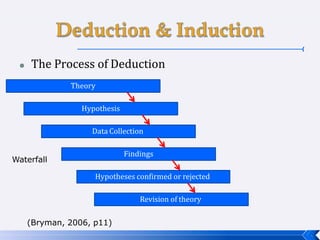
 The Process of Deduction
Theory
Hypothesis
Data Collection
Findings
Hypotheses confirmed or rejected
Revision of theory
(Bryman, 2006, p11)
Waterfall
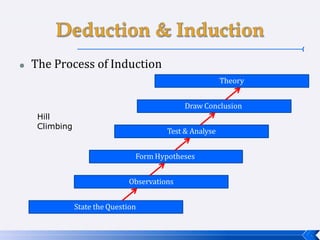
 The Process of Induction
Theory
Draw Conclusion
Test & Analyse
Form Hypotheses
Observations
Hill
Climbing
State the Question
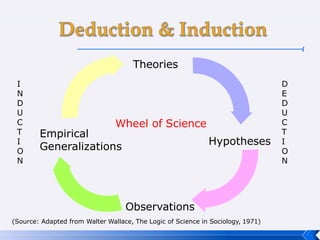
Theories
Hypotheses
Empirical
Generalizations
I
N
D
U
C
T
I
O
N
D
E
D
U
C
T
I
O
N
Observations
(Source: Adapted from Walter Wallace, The Logic of Science in Sociology, 1971)
Wheel of Science
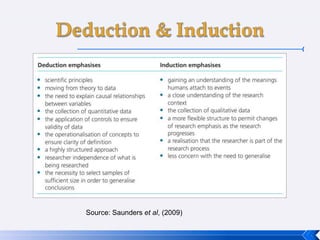
Source: Saunders et al, (2009)
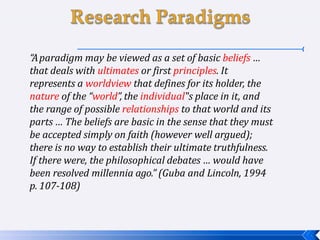
“Aparadigm may be viewed as a set of basic beliefs …
that deals with ultimates or first principles. It
represents a worldview that defines for its holder, the
nature of the “world”, the individual‟s place in it, and
the range of possible relationships to that world and its
parts … The beliefs are basic in the sense that they must
be accepted simply on faith (however well argued);
there is no way to establish their ultimate truthfulness.
If there were, the philosophical debates … would have
been resolved millennia ago.” (Guba and Lincoln, 1994
p. 107-108)
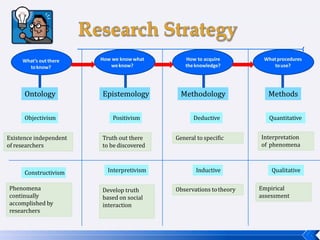
Ontology MethodologyEpistemology
Objectivism
Constructivism
Positivism
Interpretivism
Deductive
Inductive
What’s out there
toknow?
How we know what
weknow?
Truth out there
to be discovered
Develop truth
based on social
interaction
Existence independent
of researchers
Phenomena
continually
accomplished by
researchers
General to specific
Observations totheory
Methods
How to acquire
theknowledge?
Whatprocedures
touse?
Quantitative
Qualitative
Interpretation
of phenomena
Empirical
assessment
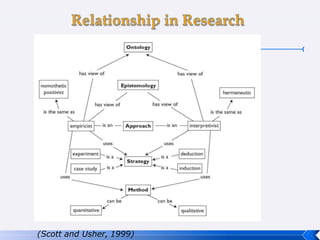
(Scott and Usher, 1999)
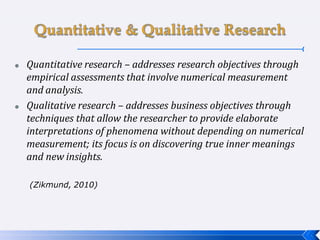
 Quantitative research – addresses research objectives through
empirical assessments that involve numerical measurement
and analysis.
 Qualitative research – addresses business objectives through
techniques that allow the researcher to provide elaborate
interpretations of phenomena without depending on numerical
measurement; its focus is on discovering true inner meanings
and new insights.
(Zikmund, 2010)
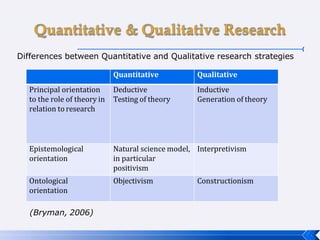
(Bryman, 2006)
Differences between Quantitative and Qualitative research strategies
Quantitative Qualitative
Principal orientation
to the role of theory in
relation to research
Deductive
Testing of theory
Inductive
Generation of theory
Epistemological
orientation
Natural science model,
in particular
positivism
Interpretivism
Ontological
orientation
Objectivism Constructionism
(Zikmund, 2010)
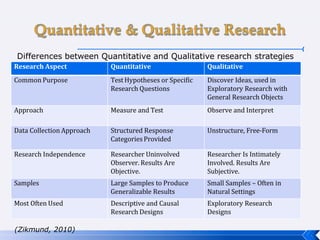
Differences between Quantitative and Qualitative research strategies
Research Aspect Quantitative Qualitative
Common Purpose Test Hypotheses or Specific
Research Questions
Discover Ideas, used in
Exploratory Research with
General Research Objects
Approach Measure and Test Observe and Interpret
Data Collection Approach Structured Response
CategoriesProvided
Unstructure, Free-Form
Research Independence Researcher Uninvolved
Observer. Results Are
Objective.
Researcher Is Intimately
Involved. Results Are
Subjective.
Samples Large Samples to Produce
Generalizable Results
Small Samples – Often in
Natural Settings
Most Often Used Descriptive and Causal
Research Designs
Exploratory Research
Designs
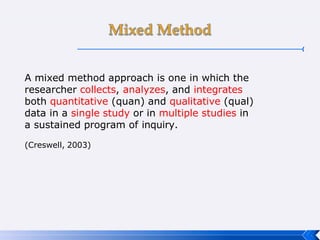
A mixed method approach is one in which the
researcher collects, analyzes, and integrates
both quantitative (quan) and qualitative (qual)
data in a single study or in multiple studies in
a sustained program of inquiry.
(Creswell, 2003)
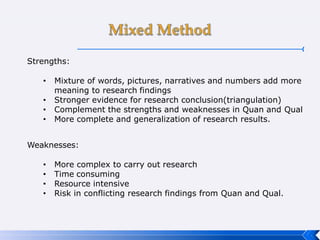
Strengths:
• Mixture of words, pictures, narratives and numbers add more
meaning to research findings
• Stronger evidence for research conclusion(triangulation)
• Complement the strengths and weaknesses in Quan and Qual
• More complete and generalization of research results.
Weaknesses:
• More complex to carry out research
• Time consuming
• Resource intensive
• Risk in conflicting research findings from Quan and Qual.
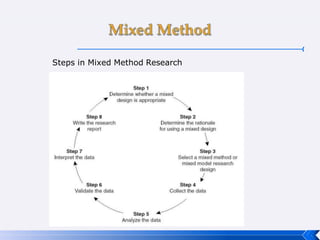
Steps in Mixed Method Research
Introduction to business research methods PPT

Introduction to business research methods PPT

  • 1.
    Introduction to Business ResearchMethods Submitted by Vamsi krishna 227016672069
  • 2.
     What isBusiness Research?  What is Theory?  Deduction & Induction  Research Paradigms  Ontology  Epistemology  Quantitative Research  Qualitative Research  Mixed Methods  Q&A
  • 3.
     What isBusiness Research? “The application of the scientific method in searching for the truth about business phenomena. These activities include defining business opportunities and problems, generating and evaluating ideas, monitoring performance, and understanding the business process.” (Zikmund, 2010, p5)
  • 4.
    • Scope ofResearch TYPES OF RESEARCHBASIC APPLIED Non-Specific Research Specific Research • Type of Research  Natural Sciences  Social Sciences  Management Sciences (Business Research)
  • 5.
     What isTheory? “Aformal, logical explanation of some events that includes predictions of how things relate to one another.” (Zikmund, 2010, p39)
  • 6.
     What isGood Theory? “Atheory is a good theory if it satisfies two requirements. It must accurately describe a large class of observations on the basis of a model that contains only a few arbitrary elements. And it must make definite predictions about the result of future observations” (Source: Stephen Hawking, A Brief History of Time, 1988 )
  • 7.
     A predictionabout the relationship between two or more variables.  Prediction is about what researcher expects to find in his/her research.  Hypotheses are more specific than theories.  A theory could have many different hypotheses.  If the hypotheses offered by the theory are confirmed, the theory is supported.  If the hypotheses offered by the theory are rejected, the theory is not supported and should be re-evaluated through further research.
  • 8.
    Null Hypothesis (H0) There is no relationship between two measured phenomena. Eg. H0 :There is no link between smoking and cancer.  Null Hypothesis can never be proven. It can either be rejected or fail to reject. Alternative Hypothesis (H1)  A hypothesis to be adopted if the Null hypothesis implied to be highly implausible. ie. The hypothesis to be accepted if the Null hypothesis is rejected. eg. H1 : There is significant link between smoking and cancer. “Most confusing phrase in research: Fail to reject Null Hypothesis”
  • 9.
    Reject H0 Don’tReject H1 Truth H0 Type I Error (False Positive) Right Decision H1 Right Decision Type II Error (False Negative) Type I Error Example - H0: The patient is not sick. Reject H0. Implies patient is sick. Actual fact is the patient is healthy. Type II Error Example - H0: The patient is not sick. Don’t Reject H0. Implies patient is healthy. Actual fact is the patient is sick.
  • 10.
    • Independent Variable:The presumed “cause” in the theoretical model. • Dependent Variable: The presumed “effect” in the theoretical model. • Moderating Variable: Suspected or known to impact or influence the Dependent Variable.
  • 11.
    Perceived Usefulness Perceived Ease of Use Adoption ofIT Tools Example of Theoretical Model Independent Variables Dependent Variables Culture Moderating Variables
  • 12.
     The Processof Deduction Theory Hypothesis Data Collection Findings Hypotheses confirmed or rejected Revision of theory (Bryman, 2006, p11) Waterfall
  • 13.
     The Processof Induction Theory Draw Conclusion Test & Analyse Form Hypotheses Observations Hill Climbing State the Question
  • 14.
  • 15.
  • 16.
    “Aparadigm may beviewed as a set of basic beliefs … that deals with ultimates or first principles. It represents a worldview that defines for its holder, the nature of the “world”, the individual‟s place in it, and the range of possible relationships to that world and its parts … The beliefs are basic in the sense that they must be accepted simply on faith (however well argued); there is no way to establish their ultimate truthfulness. If there were, the philosophical debates … would have been resolved millennia ago.” (Guba and Lincoln, 1994 p. 107-108)
  • 17.
    Ontology MethodologyEpistemology Objectivism Constructivism Positivism Interpretivism Deductive Inductive What’s outthere toknow? How we know what weknow? Truth out there to be discovered Develop truth based on social interaction Existence independent of researchers Phenomena continually accomplished by researchers General to specific Observations totheory Methods How to acquire theknowledge? Whatprocedures touse? Quantitative Qualitative Interpretation of phenomena Empirical assessment
  • 18.
  • 19.
     Quantitative research– addresses research objectives through empirical assessments that involve numerical measurement and analysis.  Qualitative research – addresses business objectives through techniques that allow the researcher to provide elaborate interpretations of phenomena without depending on numerical measurement; its focus is on discovering true inner meanings and new insights. (Zikmund, 2010)
  • 20.
    (Bryman, 2006) Differences betweenQuantitative and Qualitative research strategies Quantitative Qualitative Principal orientation to the role of theory in relation to research Deductive Testing of theory Inductive Generation of theory Epistemological orientation Natural science model, in particular positivism Interpretivism Ontological orientation Objectivism Constructionism
  • 21.
    (Zikmund, 2010) Differences betweenQuantitative and Qualitative research strategies Research Aspect Quantitative Qualitative Common Purpose Test Hypotheses or Specific Research Questions Discover Ideas, used in Exploratory Research with General Research Objects Approach Measure and Test Observe and Interpret Data Collection Approach Structured Response CategoriesProvided Unstructure, Free-Form Research Independence Researcher Uninvolved Observer. Results Are Objective. Researcher Is Intimately Involved. Results Are Subjective. Samples Large Samples to Produce Generalizable Results Small Samples – Often in Natural Settings Most Often Used Descriptive and Causal Research Designs Exploratory Research Designs
  • 22.
    A mixed methodapproach is one in which the researcher collects, analyzes, and integrates both quantitative (quan) and qualitative (qual) data in a single study or in multiple studies in a sustained program of inquiry. (Creswell, 2003)
  • 23.
    Strengths: • Mixture ofwords, pictures, narratives and numbers add more meaning to research findings • Stronger evidence for research conclusion(triangulation) • Complement the strengths and weaknesses in Quan and Qual • More complete and generalization of research results. Weaknesses: • More complex to carry out research • Time consuming • Resource intensive • Risk in conflicting research findings from Quan and Qual.
  • 24.
    Steps in MixedMethod Research