
Sampling and Sampling
Distribution
Sampling
– The process of obtaining information from a
subset of a larger group.
– A market researcher takes the results from
the sample to make estimates of the larger
group.
– Sampling a small percentage of a population
can result in very accurate estimates.
– The sample must be selected in a scientific
manner to ensure that it is representative of
the population from which it was selected
Why do we use sampling?
– Reduced costs It is cheaper to collect
information from 2000 people than from two
million
– Reduced field time Information is often
required with in specified time, so that a
decision can be made and action taken.
– Increased accuracy because, fewer units
are surveyed in a sample
• Population A population is the aggregate or
totality of units of a certain commodities.
Population may be finite or infinite
• Infinite population when it contains items
which are large or uncountable, for example
total number of leaves in a tree etc
• Finite population when it contains items
which are countable or it contains definite
number of items, for example no. of students
in a college etc
Basic Terms
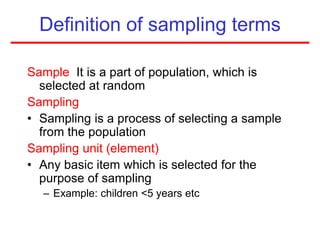
Definition of sampling terms
Sample It is a part of population, which is
selected at random
Sampling
• Sampling is a process of selecting a sample
from the population
Sampling unit (element)
• Any basic item which is selected for the
purpose of sampling
– Example: children <5 years etc
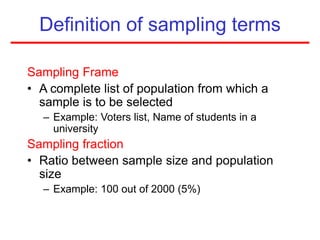
Definition of sampling terms
Sampling Frame
• A complete list of population from which a
sample is to be selected
– Example: Voters list, Name of students in a
university
Sampling fraction
• Ratio between sample size and population
size
– Example: 100 out of 2000 (5%)
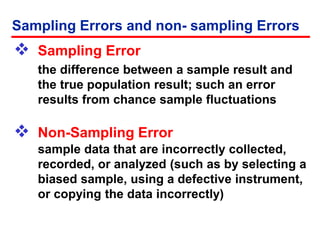
 Sampling Error
the difference between a sample result and
the true population result; such an error
results from chance sample fluctuations
 Non-Sampling Error
sample data that are incorrectly collected,
recorded, or analyzed (such as by selecting a
biased sample, using a defective instrument,
or copying the data incorrectly)
Sampling Errors and non- sampling Errors
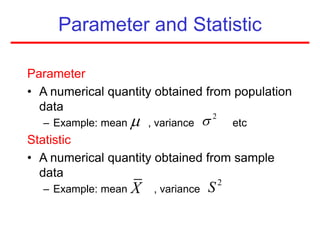
Parameter and Statistic
Parameter
• A numerical quantity obtained from population
data
– Example: mean , variance etc
Statistic
• A numerical quantity obtained from sample
data
– Example: mean , variance
 2

X 2
S
Sample Size
• The size of the sample (the number of people or
units sampled) is independent of the population
size.
• A large sample size will be more reliable than a
small sample taken from the same population.
• A population which is known to be very variable
(including no. of peoples with different opinions)
will require a large sample
Random Sampling
When equal probability of selection is attached to
each sampling unit at each draw, the selection
procedure, or
Members of the population are selected in such a way
that each individual member has an equal chance of
being selected is known as random sampling.
Suppose there are N units in the population, then
the probability of selection of each unit is 1/N.
Lottery system is the example of random sampling.
Types of sampling
• Probability Sampling Any method of
selection of a sample based on the theory
of probability.
• Non-Probability Sampling It is a process in
which the personal judgment determines
which units of the population are selected
for a sample. It is also called non-random
sampling.
Probability sampling
• Simple random sampling
• Stratified sampling
• Systematic sampling
• Cluster sampling
Simple random Sampling
• In simple random sampling each and every
unit of the population has an equal probability
of its being included in the sample.
• It is applied to the population when it
containing homogenous material.
• Random sample can be drawn by
a) Lottery system
b) Random marking method
Stratified random Sampling
• This is form of random sampling in which all
peoples or items in the sampling frame are
divided into groups or categories which are
mutually exclusive (that is, a person or unit
can be in one group only) these groups are
called ‘strata’.
• With in each of these group (stratum) a
simple random sample is selected.
Systematic Random Sampling
• This is the form of the random sampling,
involving a system. The system is one of
regularity. The sampling frame is chosen and
a name or unit is chosen at random. Then
from this chosen name or unit every nth item
is selected throughout the lis.
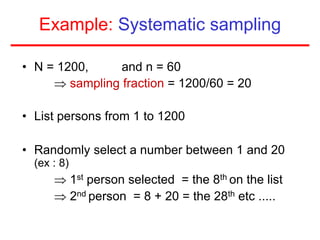
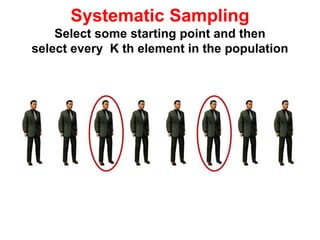
Example: Systematic sampling
• N = 1200, and n = 60
 sampling fraction = 1200/60 = 20
• List persons from 1 to 1200
• Randomly select a number between 1 and 20
(ex : 8)
 1st person selected = the 8th on the list
 2nd person = 8 + 20 = the 28th etc .....
Systematic Sampling
Select some starting point and then
select every K th element in the population
Cluster Sampling
• In many situations, the sampling frame for
elementary units of the population is not available,
moreover it is not easy to prepare it. But the
information is available for groups of elements so
called clusters.
• For instance, the list of houses may available but not
the persons residing in them. In this situation houses
are known as clusters and selection has to be made
of houses in the sample.
• Such a sampling procedure is known as cluster
sampling.
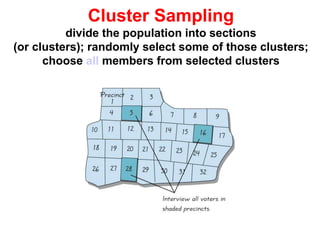
Cluster Sampling
divide the population into sections
(or clusters); randomly select some of those clusters;
choose all members from selected clusters
Non-Probability sampling
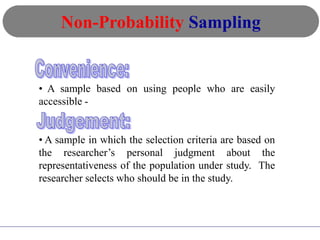
• Convenient Sampling
• Judgement Sampling
• Sequential Sampling
• Quota Sampling
• A sample based on using people who are easily
accessible -
• A sample in which the selection criteria are based on
the researcher’s personal judgment about the
representativeness of the population under study. The
researcher selects who should be in the study.
Non-Probability Sampling
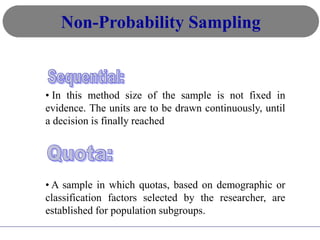
• In this method size of the sample is not fixed in
evidence. The units are to be drawn continuously, until
a decision is finally reached
• A sample in which quotas, based on demographic or
classification factors selected by the researcher, are
established for population subgroups.
Non-Probability Sampling
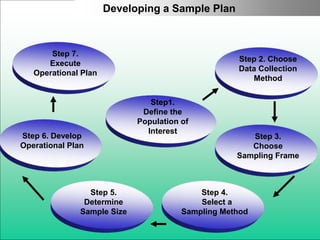
Step1.
Define the
Population of
Interest
Step 2. Choose
Data Collection
Method
Step 3.
Choose
Sampling Frame
Step 4.
Select a
Sampling Method
Step 5.
Determine
Sample Size
Step 6. Develop
Operational Plan
Step 7.
Execute
Operational Plan
Developing a Sample Plan
To learn the steps in developing
a sample plan.
Developing A
Sampling Plan
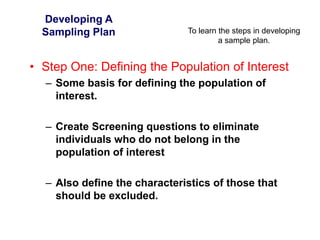
• Step One: Defining the Population of Interest
– Some basis for defining the population of
interest.
– Create Screening questions to eliminate
individuals who do not belong in the
population of interest
– Also define the characteristics of those that
should be excluded.
To learn the steps in developing
a sample plan.
Developing A
Sampling Plan
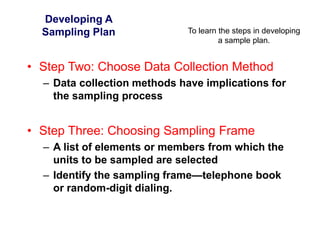
• Step Two: Choose Data Collection Method
– Data collection methods have implications for
the sampling process
• Step Three: Choosing Sampling Frame
– A list of elements or members from which the
units to be sampled are selected
– Identify the sampling frame—telephone book
or random-digit dialing.
To understand the differences between
probability samples and nonprobability samples
Developing A
Sampling Plan
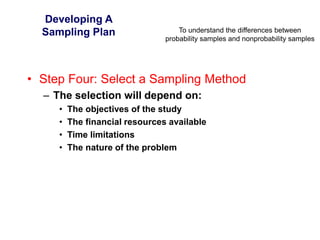
• Step Four: Select a Sampling Method
– The selection will depend on:
• The objectives of the study
• The financial resources available
• Time limitations
• The nature of the problem
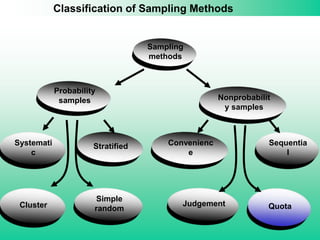
Sampling
methods
Probability
samples
Systemati
c
Cluster
Stratified
Simple
random
Nonprobabilit
y samples
Convenienc
e
Judgement
Sequentia
l
Quota
Classification of Sampling Methods
Steps In Developing A
Sampling Plan To learn the steps in developing
a sample plan.
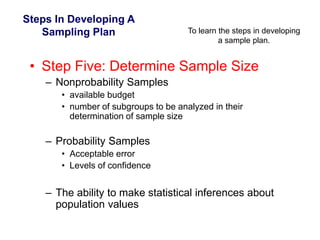
• Step Five: Determine Sample Size
– Nonprobability Samples
• available budget
• number of subgroups to be analyzed in their
determination of sample size
– Probability Samples
• Acceptable error
• Levels of confidence
– The ability to make statistical inferences about
population values
Steps In Developing A
Sampling Plan To learn the steps in developing
a sample plan.
• Step Six: Develop of Operational Procedures
for Selecting Sample Elements
– Specify whether a probability or nonprobability
sample is being used
– Procedures—detailed, clear, and unambiguous
• Step Seven: Execute the Sampling Plan
– Requires adequate checking to ensure that
specified procedures are done.
• THE END

Sampling and sampling distribution

  • 1.
  • 2.
    Sampling – The processof obtaining information from a subset of a larger group. – A market researcher takes the results from the sample to make estimates of the larger group. – Sampling a small percentage of a population can result in very accurate estimates. – The sample must be selected in a scientific manner to ensure that it is representative of the population from which it was selected
  • 3.
    Why do weuse sampling? – Reduced costs It is cheaper to collect information from 2000 people than from two million – Reduced field time Information is often required with in specified time, so that a decision can be made and action taken. – Increased accuracy because, fewer units are surveyed in a sample
  • 4.
    • Population Apopulation is the aggregate or totality of units of a certain commodities. Population may be finite or infinite • Infinite population when it contains items which are large or uncountable, for example total number of leaves in a tree etc • Finite population when it contains items which are countable or it contains definite number of items, for example no. of students in a college etc Basic Terms
  • 5.
    Definition of samplingterms Sample It is a part of population, which is selected at random Sampling • Sampling is a process of selecting a sample from the population Sampling unit (element) • Any basic item which is selected for the purpose of sampling – Example: children <5 years etc
  • 6.
    Definition of samplingterms Sampling Frame • A complete list of population from which a sample is to be selected – Example: Voters list, Name of students in a university Sampling fraction • Ratio between sample size and population size – Example: 100 out of 2000 (5%)
  • 7.
     Sampling Error thedifference between a sample result and the true population result; such an error results from chance sample fluctuations  Non-Sampling Error sample data that are incorrectly collected, recorded, or analyzed (such as by selecting a biased sample, using a defective instrument, or copying the data incorrectly) Sampling Errors and non- sampling Errors
  • 8.
    Parameter and Statistic Parameter •A numerical quantity obtained from population data – Example: mean , variance etc Statistic • A numerical quantity obtained from sample data – Example: mean , variance  2  X 2 S
  • 9.
    Sample Size • Thesize of the sample (the number of people or units sampled) is independent of the population size. • A large sample size will be more reliable than a small sample taken from the same population. • A population which is known to be very variable (including no. of peoples with different opinions) will require a large sample
  • 10.
    Random Sampling When equalprobability of selection is attached to each sampling unit at each draw, the selection procedure, or Members of the population are selected in such a way that each individual member has an equal chance of being selected is known as random sampling. Suppose there are N units in the population, then the probability of selection of each unit is 1/N. Lottery system is the example of random sampling.
  • 11.
    Types of sampling •Probability Sampling Any method of selection of a sample based on the theory of probability. • Non-Probability Sampling It is a process in which the personal judgment determines which units of the population are selected for a sample. It is also called non-random sampling.
  • 12.
    Probability sampling • Simplerandom sampling • Stratified sampling • Systematic sampling • Cluster sampling
  • 13.
    Simple random Sampling •In simple random sampling each and every unit of the population has an equal probability of its being included in the sample. • It is applied to the population when it containing homogenous material. • Random sample can be drawn by a) Lottery system b) Random marking method
  • 14.
    Stratified random Sampling •This is form of random sampling in which all peoples or items in the sampling frame are divided into groups or categories which are mutually exclusive (that is, a person or unit can be in one group only) these groups are called ‘strata’. • With in each of these group (stratum) a simple random sample is selected.
  • 15.
    Systematic Random Sampling •This is the form of the random sampling, involving a system. The system is one of regularity. The sampling frame is chosen and a name or unit is chosen at random. Then from this chosen name or unit every nth item is selected throughout the lis.
  • 16.
    Example: Systematic sampling •N = 1200, and n = 60  sampling fraction = 1200/60 = 20 • List persons from 1 to 1200 • Randomly select a number between 1 and 20 (ex : 8)  1st person selected = the 8th on the list  2nd person = 8 + 20 = the 28th etc .....
  • 17.
    Systematic Sampling Select somestarting point and then select every K th element in the population
  • 18.
    Cluster Sampling • Inmany situations, the sampling frame for elementary units of the population is not available, moreover it is not easy to prepare it. But the information is available for groups of elements so called clusters. • For instance, the list of houses may available but not the persons residing in them. In this situation houses are known as clusters and selection has to be made of houses in the sample. • Such a sampling procedure is known as cluster sampling.
  • 19.
    Cluster Sampling divide thepopulation into sections (or clusters); randomly select some of those clusters; choose all members from selected clusters
  • 20.
    Non-Probability sampling • ConvenientSampling • Judgement Sampling • Sequential Sampling • Quota Sampling
  • 21.
    • A samplebased on using people who are easily accessible - • A sample in which the selection criteria are based on the researcher’s personal judgment about the representativeness of the population under study. The researcher selects who should be in the study. Non-Probability Sampling
  • 22.
    • In thismethod size of the sample is not fixed in evidence. The units are to be drawn continuously, until a decision is finally reached • A sample in which quotas, based on demographic or classification factors selected by the researcher, are established for population subgroups. Non-Probability Sampling
  • 23.
    Step1. Define the Population of Interest Step2. Choose Data Collection Method Step 3. Choose Sampling Frame Step 4. Select a Sampling Method Step 5. Determine Sample Size Step 6. Develop Operational Plan Step 7. Execute Operational Plan Developing a Sample Plan
  • 24.
    To learn thesteps in developing a sample plan. Developing A Sampling Plan • Step One: Defining the Population of Interest – Some basis for defining the population of interest. – Create Screening questions to eliminate individuals who do not belong in the population of interest – Also define the characteristics of those that should be excluded.
  • 25.
    To learn thesteps in developing a sample plan. Developing A Sampling Plan • Step Two: Choose Data Collection Method – Data collection methods have implications for the sampling process • Step Three: Choosing Sampling Frame – A list of elements or members from which the units to be sampled are selected – Identify the sampling frame—telephone book or random-digit dialing.
  • 26.
    To understand thedifferences between probability samples and nonprobability samples Developing A Sampling Plan • Step Four: Select a Sampling Method – The selection will depend on: • The objectives of the study • The financial resources available • Time limitations • The nature of the problem
  • 27.
  • 28.
    Steps In DevelopingA Sampling Plan To learn the steps in developing a sample plan. • Step Five: Determine Sample Size – Nonprobability Samples • available budget • number of subgroups to be analyzed in their determination of sample size – Probability Samples • Acceptable error • Levels of confidence – The ability to make statistical inferences about population values
  • 29.
    Steps In DevelopingA Sampling Plan To learn the steps in developing a sample plan. • Step Six: Develop of Operational Procedures for Selecting Sample Elements – Specify whether a probability or nonprobability sample is being used – Procedures—detailed, clear, and unambiguous • Step Seven: Execute the Sampling Plan – Requires adequate checking to ensure that specified procedures are done.
  • 30.