














ADVANCED BUSINESS RESEACH
METHOD
/BADM662/
Credit hours: 3
Pre-requisite: BADM631
Dr Hailemariam Kebede
Definition
• Research may be considered as an organized, systematic, data based,
critical, objective, scientific inquiry or investigation into a specific
problem, undertaken with the purpose of finding answers or solutions
to it. In this way research provides the needed information that
guides the planners to make informed decisions to successfully deal
with the problems.
• “A studious inquiry or examination , especially a critical investigation
or experimentation having for its aim the discovery of new facts and
their correct interpretation, the revision of accepted conclusions,
theories, or laws in the light of new discovered facts or the practical
application of such conclusions, theories or laws.”
Important Characteristics of Scientific Method
• Empirical-Scientific method is concerned with the realities that are
observable through ―sensory experiences. It generates knowledge
which is verifiable by experience or observation.
• Verifiable-Observations made through scientific method are to be
verified again by using the senses to confirm or refute the previous
findings. Such confirmations may have to be made by the same
researcher or others.
• Cumulative-Prior to the start of any study the researchers try to scan
through the literature and see that their study is not a repetition in
ignorance. Instead of reinventing the wheel the researchers take stock
of the existing body of knowledge and try to build on it.
Important Characteristics…
• Deterministic-Science is based on the assumption that all events have
antecedent causes that are subject to identification and logical
understanding.
• Ethical and Ideological Neutrality-The conclusions drawn through
interpretation of the results of data analysis should be objective; that
is, they should be based on the facts of the findings derived from
actual data, and not on our own subjective or emotional values.
• Statistical Generalization-Generalizability refers to the scope of the
research findings in one organizational setting to other settings.
Obviously, the wider the range of applicability of the solutions
generated by research, the more useful the research is to users.
Important Characteristics…
• Rationalism-Science is fundamentally a rational activity, and the
scientific explanation must make sense. Religion may rest on
revelations, custom, or traditions, gambling on faith, but science must
rest on logical reason.
CLASSIFICATION OF RESEARCH
• For classification of research we shall look from four
dimensions:
• The purpose of doing research;
• The intended uses of research;
• How it treats time i.e. the time dimension in research;
and
• The research (data collection) techniques used in it
Purpose of Doing Research
• Exploratory /Formative Research
• You may be exploring a new topic or issue in order to learn about it. If
the issue was new or the researcher has written little on it, you began
at the beginning.
• Goals of Exploratory Research:
• Become familiar with the basic facts, setting, and concerns;
• Develop well-grounded picture of the situation;
• Develop tentative theories; generate new ideas, conjectures, or hypotheses;
• Determine the feasibility of conducting the study;
• Formulate questions and refine issues for more systematic inquiry; and
• Develop techniques and a sense of direction for future research.
Purpose of Doing Research…
• Descriptive Research
• Descriptive research presents a picture of the specific details of a situation,
social setting, or relationship. The major purpose of descriptive research,
as the term implies, is to describe characteristics of a population or
phenomenon.
• Goals of Descriptive Research
• Describe the situation in terms of its characteristics i.e. provide an accurate profile of
a group;
• Gives a verbal or numerical picture (%) of the situation;
• Presents background information;
• Creates a set of categories or classify the information;
• Clarifies sequence, set of stages; and
• Focuses on ‗who,‘ ‗what,‘ ‗when,‘ ‗where,‘ and ‗how‘ but not why?
Purpose of Doing Research…
• Explanatory Research
• When we encounter an issue that is already known and have a description of it,
we might begin to wonder why things are the way they are. The desire to
know ―why, to explain, is the purpose of Explanatory Research.
• Goals of Explanatory Research
• Explains things not just reporting. Why? It elaborates and enriches a theory‘s explanation.
• Determines which of several explanations is best.
• Determines the accuracy of the theory; tests a theory‘s predictions or principle.
• Advances knowledge about underlying process.
• Builds and elaborates a theory; elaborates and enriches a theory‘s predictions or principle.
• Extends a theory or principle to new areas, new issues, new topics:
• Provides evidence to support or refute an explanation or prediction.
• Tests a theory‘s predictions or principles
The Uses of Research
• Basic Research
• Basic research advances fundamental knowledge about the human
world. It focuses on refuting or supporting theories that explain how
this world operates, what makes things happen, why social relations
are a certain way, and why society changes. Basic research is the
source of most new scientific ideas and ways of thinking about the
world. It can be exploratory, descriptive, or explanatory; however,
explanatory research is the most common.
• Basic research generates new ideas, principles and theories, which
may not be immediately utilized; though are the foundations of
modern progress and development in different fields.
The Uses of Research…
• Applied Research
• Applied researchers try to solve specific policy problems or help
practitioners accomplish tasks. Theory is less central to them than
seeking a solution on a specific problem for a limited setting. Applied
research is frequently a descriptive research, and its main strength is
its immediate practical use. Applied research is conducted when
decision must be made about a specific real-life problem. Applied
research encompasses those studies undertaken to answer questions
about specific problems or to make decisions about a particular
course of action or policy.
The Uses of Research…
• Basic and Applied Research Compared
• The procedures and techniques utilized by basic and applied
researchers do not differ substantially. Both employ the scientific
method to answer the questions at hand.
• The scientific community is the primary consumer of basic research.
The consumers of applied research findings are practitioners such as
teachers, counselors, and caseworkers, or decision makers such as
managers, committees, and officials.
• Types of Applied Research
• Action research: The applied research that treats knowledge as a form
of power and abolishes the line between research and social action.
• Impact Assessment Research: Its purpose is to estimate the likely
consequences of a planned change.
• Evaluation Research: It addresses the question, ―Did it work? The
process of establishing value judgment based on evidence about the
achievement of the goals of a program.
The Time Dimension in Research
• Cross-Sectional Research. In cross-sectional research, researchers
observe at one point in time. Cross-sectional research is usually the
simplest and least costly alternative. Its disadvantage is that it cannot
capture the change processes. Cross-sectional research can be
exploratory, descriptive, or explanatory, but it is most consistent with
a descriptive approach to research.
• Longitudinal Research. Researchers using longitudinal research
examine features of people or other units at more than one time. It is
usually more complex and costly than cross-sectional research but it
is also more powerful, especially when researchers seek answers to
questions about change.
There are three types of longitudinal
research: time series, panel, and cohort.
• Time series research is longitudinal study in which the same type of
information is collected on a group of people or other units across multiple
time periods. Researcher can observe stability or change in the features of
the units or can track conditions overtime.
• The panel study is a powerful type of longitudinal research. In panel study,
the researcher observes exactly the same people, group, or organization
across time periods. It is a difficult to carry out such study. Tracking people
over time is often difficult because some people die or cannot be located.
• A cohort analysis is similar to the panel study, but rather than observing
the exact same people, a category of people who share a similar life
experience in a specified time period is studied. The focus is on the cohort,
or category, not on specific individuals.
Research (Data Collection) Techniques Used
• Every researcher collects data using one or more techniques. The
techniques may be grouped into two categories: quantitative,
collecting data in the form of numbers, and qualitative, collecting
data in the form of words or pictures.
Quantitative
• The main quantitative techniques are:
• Experiments
• Surveys
• Using Existing Statistics
Qualitative
• The major qualitative techniques of research are:
• Field Research
• Case Study
• Focus Group Discussion
Research paradigms and Logic of Research
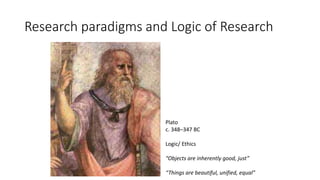
Plato
c. 348–347 BC
Logic/ Ethics
“Objects are inherently good, just”
“Things are beautiful, unified, equal”
Research paradigms and Logic of Research
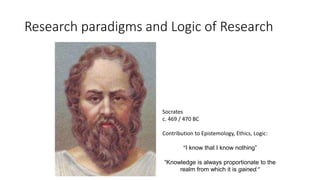
Socrates
c. 469 / 470 BC
Contribution to Epistemology, Ethics, Logic:
“I know that I know nothing”
“Knowledge is always proportionate to the
realm from which it is gained.”
Research Paradigms…
• The term paradigm refers to the progress of scientific practice based
on people's philosophies and assumptions about the world and the
nature of knowledge; in this context, it is about how research should
be conducted. Paradigms are ‗universally recognized scientific
achievements that for a time provide model problems and solutions
to a community of practitioners‘ (Kuhn, 1962, p. viii). They offer a
framework comprising an accepted set of theories, methods and ways
of defining data.
Research Paradigms…
• Unfortunately, the term paradigm is used quite loosely in academic
research and can mean different things to different people. To help
clarify the uncertainties, Morgan (1979) suggests that the term can be
used at three different levels:
• Philosophical level, where it is used to reflect basic beliefs about the world
• Social level, where it is used to provide guidelines about how the researcher
should conduct his or her endeavors
• Technical level, where it is used to specify the methods and techniques which
ideally should be adopted when conducting research.
What is a paradigm?
"universally recognized scientific achievements that, for a time,
provide model problems and solutions for a community of
researchers", i.e.,
• what is to be observed and scrutinised
• the kind of questions that are supposed to be asked and probed for
answers in relation to this subject
• how these questions are to be structured
• how the results of scientific investigations should be interpreted
• how is an experiment to be conducted, and what equipment is
available to conduct the experiment.
Kuhn, T S (1970) The Structure of Scientific Revolutions (2nd Edition) University of Chicago Press. Section
V, pages 43-51
What is a paradigm?
The word paradigm is used to:
- Indicate a pattern or model or an outstandingly clear or typical
example or archetype
Also:
- cultural themes
- worldviews
- Ideologies
- mindsets.
- It describes distinct concepts or thought patterns in any scientific
discipline or other epistemological context.
Main components of a Paradigm
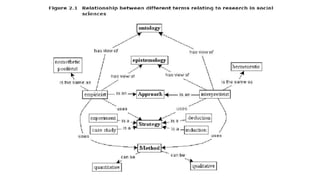
• Ontology:
• Assumptions about the nature of reality
• Epistemology:
• How the researcher comes to know that reality
• Methodology
• How the researcher access and report what is learned about the reality
Guba and Lincoln (1994)
Ontology
ORIGIN early 18th cent.: from modern Latin ontologia, from Greek ōn,
ont- ‘being’ + -logy.
Ontology is the starting point of all research, after which one’s
epistemological and methodological positions logically follow. A
dictionary definition of the term may describe it as the image of social
reality upon which a theory is based.
Ontology
• Denzin and Lincoln (1994) point out that it is crucial to consider the
researcher’s personal sentiments, beliefs and relationship to the
subject matter, as this may have a bearing on the method chosen, i.e.
the researcher’s Ontological persuasion
Ontology
• According to Bryman (2008:18) the ontological issues are having to do
with whether the social entities can and should be considered
objective entities that have a reality external to social actors, or
whether they can and should be considered social constructions built
up from the perception and actions of social actors.
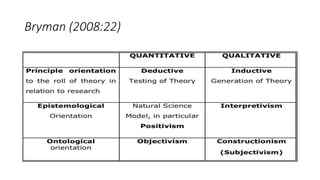
• These opposite points of view are referred to as Objectivism and
Constructivism respectively.
Objectivism
• This ontological position implies that social phenomenon is regarded
as a ‘fait accompli’, and that those external facts are beyond our
reach and therefore influence. A typical example is that of an
organisation. The organisation can be regarded as a “persona” having
rule and regulation, there is a system, there is a hierarchy, and from
the outside looking in, the member needs to adapt and align to the
workings of the organisation if he/she wants to survive. In this
instant, the organisation exhibits a constraining force that acts upon
and inhibits its members
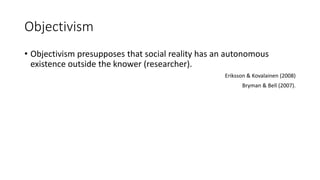
Objectivism
• Objectivism presupposes that social reality has an autonomous
existence outside the knower (researcher).
Eriksson & Kovalainen (2008)
Bryman & Bell (2007).
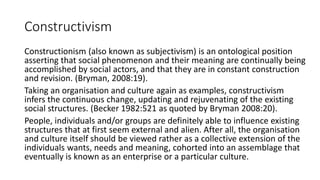
Constructivism
Constructionism (also known as subjectivism) is an ontological position
asserting that social phenomenon and their meaning are continually being
accomplished by social actors, and that they are in constant construction
and revision. (Bryman, 2008:19).
Taking an organisation and culture again as examples, constructivism
infers the continuous change, updating and rejuvenating of the existing
social structures. (Becker 1982:521 as quoted by Bryman 2008:20).
People, individuals and/or groups are definitely able to influence existing
structures that at first seem external and alien. After all, the organisation
and culture itself should be viewed rather as a collective extension of the
individuals wants, needs and meaning, cohorted into an assemblage that
eventually is known as an enterprise or a particular culture.
Bryman (2008:22)
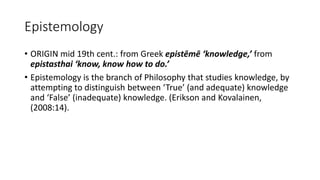
Epistemology
• ORIGIN mid 19th cent.: from Greek epistēmē ‘knowledge,’ from
epistasthai ‘know, know how to do.’
• Epistemology is the branch of Philosophy that studies knowledge, by
attempting to distinguish between ‘True’ (and adequate) knowledge
and ‘False’ (inadequate) knowledge. (Erikson and Kovalainen,
(2008:14).
Realism
• Emergence since the 1960’s of a second philosophical position within
the epistemological discourse, that of realism, and in particular,
Critical Realism. Critical Realism takes the view that change can only
take place if the structures responsible for the events and discourses
are known and influenced. As Bhaskar (1989:2) points out:
• These structures are not spontaneously apparent in the observable
patterns of events. They can only be identified through the practical
and theoretical work of the social sciences.
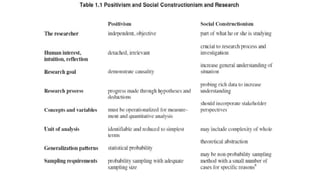
Interpretivism
Interpretivism, (also known as Post-positivism), is a term given to a
contrasting epistemology to that of Positivism. (Bryman 2008:16). It
concerns the theory and method of the interpretation of Human
Action. While positivist’s point of departure is to explain human
behaviour, the social sciences are more concerned about
understanding human behaviour.
As Max Weber (1864-1920) pointed out, time has come for us to
“Understand” social dynamics, and not simply to “measure” it.
Interpretivism
Interpretivism as a philosophical position within an epistemological
stance that treats reality as being fluid, knowledge is subjective,
everyone has a ‘common sense thinking’ and the truth lies within the
interpretation of the persons reality, upon which he/she accordingly
acts, reacts and interacts with that ‘reality’.
This phenomenon is subject to the person’s beliefs, values, culture,
standing, language, shared meaning and consciousness. (Bryman,
2008:17; Grbich, 2010; Meyers,
Interpretivism
• Interpretivism or interpretive theory as per Charmaz, (2006:126), calls
for the imaginative understanding of the studied phenomenon. This
type of theory assumes emergent, multiple realities; indeterminacy;
facts and values as linked; truth as provisional and social life as
processual.
Existentialism
• The following assumptions emerge:
• Existence is always particular and individual
• It is the problem of the mode of being and therefore also an investigation of
the meaning of being
• The investigation is continually faced with diverse possibilities, among which
the individual must make a selection and commit himself to
• Because these possibilities are determined by the individual’s relationships
with other human beings and things, existence is always a situation that limits
or conditions choice
• Versfeld (1992), Existentialism, 2011
Constructivism
• Constructionism or a constructivist grounded theory approach places
priority on the phenomenon of study and sees both data and analysis
as created from shared experiences and relationships with
participants. (Charmaz, 2006:130).
Positivism
• One of the central questions in epistemology is the question of
whether the social world can, and in fact should be, studied according
to the same principles, procedures and ethos as the natural sciences.
(Bryman 2008; Meyers, 2010; Eriksson & Kovalainen, 2008; Bryman &
Bell, 2007). When assuming an epistemological position based on the
natural sciences, i.e. the composition of reality from observable
material objects, it is known as Positivism.
Positivism
• Positivism adopts a quantitative approach to investigating
phenomena, assuming an Epistemological position that advocates the
application of the methods of the natural sciences to the study of
social reality, as opposed to post-positivist approaches, which aim to
describe and explore in-depth phenomena from a qualitative
perspective, according to Proctor (1998) and Bryman (2008).
Phenomenology
• Despite the fact that phenomenology has a theoretical orientation, it
does not generate deductions from propositions that may be
empirically tested (Darroch & Silvers 1982).
• Phenomenology operates more on a meta-level, and demonstrates its
premises through descriptive analyses of the procedures of the self,
and the situational and the social setting. Phenomenology is the
study of the contents of consciousness – phenomenon – and
phenomenological methods are ways in which these contents may be
described and analysed (Sokolowski, 2000).
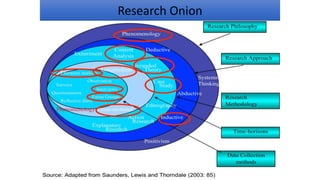
Research Onion
Summary
• Ontological assumption: There is a reality that can be apprehended. We can determine
“the way things are” and, often, discover the cause effect relations behind social reality.
At the least, we can find meaningful indicators of what is “really” happening.
• Epistemological assumption: The investigator and the object of investigation are
independent from each other and the object can be researched without being influenced
by the researcher. Any possible researcher influence can be anticipated, detected, and
accounted for (controlled).
• Axiological assumption: Values are excluded from the research process. They are
considered confounding variables-phenomena that cloud our view of reality.
• Methodological assumption: The most prevalent methods used include experiments,
quasi-experiments, and other hypothesis-testing techniques. Meaningful phenomena are
operationalized by determining variables that can be accurately measured.
• Rhetorical assumption: The research is written from the perspective of the disinterested
scientist. Typically, our report is couched in mathematical terms.
Philosophical underpinning
• At the heart of all research, is an endeavour to find out, to investigate,
confirm, probe, test, see or view, measure, correlate, compare,
evaluate, find meaning, gain understanding, or to discover new
emerging properties.
Bless, Higson & Kagee (2006)
Sparkes, 2007
• All researchers who plan to explore objectives should explain their
worldview, “since it uses a methodology of the heart to some extent
and at least begs for consideration”
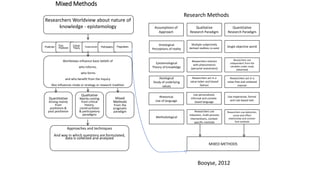
Assumptions of
Approach
Mixed Methods
Researchers Worldview about nature of
knowledge - epistemology
Approaches and techniques
And way in which questions are formulated,
data is collected and analyzed
Ontological
Perceptions of reality
Positivism Post
Positivism
Critical
Theory Constructivism Participatory
Worldviews influence basic beliefs of
who informs,
who forms
and who benefit from the inquiry
Also influences mode or strategy or research tradition
Quantitative
Arising mainly
from
positivism &
post positivism
Qualitative
Mainly coming
from critical
theory,
constructivism
& participatory
paradigms
Mixed
Methods
From the
pragmatic
paradigm
Research Methods
Qualitative
Research Paradigm
Quantitative
Research Paradigm
Multiple subjectively
derived realities co-exist
Single objective world
Epistemological
Theory of knowledge
Researchers interact
with phenomenon
(personal investment)
Researchers are
independent from the
variables under study
(detached)
Axiological
Study of underlying
values
Researchers act in a
value-laden and biased
fashion
Researchers act in a
value-free and unbiased
manner
Rhetorical
Use of language
Use personalized,
informal and context-
based language
Use impersonal, formal
and rule-based text
Methodological
Researchers use
induction, multi-process
interventions, context-
specific methods
Researchers use deduction,
cause-and-effect
relationship and context-
free methods
MIXED METHODS
Pragmatism
Booyse, 2012
Research
• Mouton (1996:28) simply states that: the predominant purpose of all
research is to arrive at results that are as close to the truth as
possible.
Research Design
• Cooper and Schindler (2011: 139, 727) concur that a research design
is “an activity- and time-based plan; a blueprint for fulfilling research
objectives and answering question”.
• A research design can be likened to a house plan, which shows on
paper what the final house is going to look like and guides a builder
on how the house should be built (Mouton: 2001).
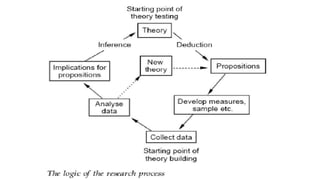
Lynham (2002)
• Two common theory building strategies
• Research-to theory strategy
• Theory-to-research strategy
• Inductive-deductive nature
• Well applied to behavioral and human sciences
• Post modernistic
• “data does not create theory or models, humans do” Mintzberg in Saha & Corley (2006)
Lynham (2002)
• 5 phases:
• Conceptual development
• Operationalization
• Application
• Confirmation or disconfirmation
• Continues refinement and development
Lynham (2002)
• Phase 1:
• Conceptual development
• Cresswell (2008)
• Use literature to identify themes and patterns in definitions and use of the concept to obtain
clarification in previous studies
• Develop an informed conceptual framework that provides an initial understanding and
explanation of the nature and dynamics of the phenomenon
Lynham (2002)
• Phase 2:
• Operationalization
• Explicit connection between the conceptualization phase and practice
• Link theoretial ideas, conepts, models to practice
• Form theoretical frameowk of the model to be build
• Include design and explanation of the model that could be applied in practice
• You continue until no substantively different information could be found and
saturation thus experienced (Shah and Corley, 2006)
Lynham (2002)
• Phase 3:
• Confirmation or disconfirmation
• This involves the planning, design, implementation and evaluation of a research agenda
• Literature search and review focused on the envisioned model to be
developed, to clarify and explain the model and to ensure that no reference
suggest probable falsification of theory behind model (Popper in Lynham,
2002)
Lynham (2002)
• Positivism
• If you believe that theories of phenomenon under study do exist out there
between the lines of scientist that use the concept but need to be fiound, also
on more post modernistic lines, to be explained
• Greggor and Jones (20007)
• Any researcher will find more or less the same result, independet of
their worldiew
• Dubin (1978) explains that by constructing theory this way, the aim is
to make sense of what is observed in the use of the concept, by
ordering the relationships among elements in the focus of the study
Lynham (2002)
• Phase 4:
• Application and empirical testing
• Phase 5: continuous refinement
• Continues literature review progress
Triangulation
• Easterby-Smith, Thorpe and Lowe (1991) as cited by Da Vinci
(2009:14), define the following four types of triangulation:
• Data Triangulation: Data is collected at different times and source
and combined, or compared to increase confidence;
• Investigator Triangulation: data is gathered by different
investigators, independently and compared/combined to increase
confidence;
• Methodological Triangulation: Using both qualitative and
quantitative methods to increase confidence, and
• Theories Triangulation: using two different theories to explain the
same problem.
UNIT TWO
REVIEW OF LITERATURE AND THEORETICAL FRAMEWORK IN
RESEARCH
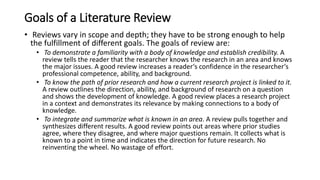
Goals of a Literature Review
• Reviews vary in scope and depth; they have to be strong enough to help
the fulfillment of different goals. The goals of review are:
• To demonstrate a familiarity with a body of knowledge and establish credibility. A
review tells the reader that the researcher knows the research in an area and knows
the major issues. A good review increases a reader‘s confidence in the researcher‘s
professional competence, ability, and background.
• To know the path of prior research and how a current research project is linked to it.
A review outlines the direction, ability, and background of research on a question
and shows the development of knowledge. A good review places a research project
in a context and demonstrates its relevance by making connections to a body of
knowledge.
• To integrate and summarize what is known in an area. A review pulls together and
synthesizes different results. A good review points out areas where prior studies
agree, where they disagree, and where major questions remain. It collects what is
known to a point in time and indicates the direction for future research. No
reinventing the wheel. No wastage of effort.
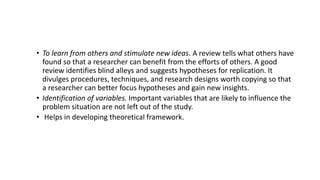
• To learn from others and stimulate new ideas. A review tells what others have
found so that a researcher can benefit from the efforts of others. A good
review identifies blind alleys and suggests hypotheses for replication. It
divulges procedures, techniques, and research designs worth copying so that
a researcher can better focus hypotheses and gain new insights.
• Identification of variables. Important variables that are likely to influence the
problem situation are not left out of the study.
• Helps in developing theoretical framework.
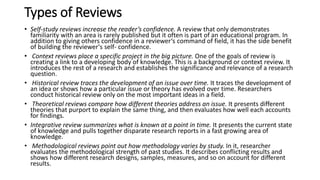
Types of Reviews
• Self-study reviews increase the reader’s confidence. A review that only demonstrates
familiarity with an area is rarely published but it often is part of an educational program. In
addition to giving others confidence in a reviewer‘s command of field, it has the side benefit
of building the reviewer‘s self- confidence.
• Context reviews place a specific project in the big picture. One of the goals of review is
creating a link to a developing body of knowledge. This is a background or context review. It
introduces the rest of a research and establishes the significance and relevance of a research
question.
• Historical review traces the development of an issue over time. It traces the development of
an idea or shows how a particular issue or theory has evolved over time. Researchers
conduct historical review only on the most important ideas in a field.
• Theoretical reviews compare how different theories address an issue. It presents different
theories that purport to explain the same thing, and then evaluates how well each accounts
for findings.
• Integrative review summarizes what is known at a point in time. It presents the current state
of knowledge and pulls together disparate research reports in a fast growing area of
knowledge.
• Methodological reviews point out how methodology varies by study. In it, researcher
evaluates the methodological strength of past studies. It describes conflicting results and
shows how different research designs, samples, measures, and so on account for different
results.
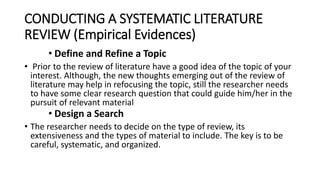
CONDUCTING A SYSTEMATIC LITERATURE
REVIEW (Empirical Evidences)
• Define and Refine a Topic
• Prior to the review of literature have a good idea of the topic of your
interest. Although, the new thoughts emerging out of the review of
literature may help in refocusing the topic, still the researcher needs
to have some clear research question that could guide him/her in the
pursuit of relevant material
• Design a Search
• The researcher needs to decide on the type of review, its
extensiveness and the types of material to include. The key is to be
careful, systematic, and organized.
• Locate Research Reports
• Locating research reports depends on the type of report or
―outlet‖ of research being searched. Use multiple search
strategies in order to counteract the limitations of single search
method.
• Articles in Scholarly Journals.
• Scholarly Books.
• Dissertations.
• Government Documents.
• Policy Reports and Presented Papers.
THEORY AND RESEARCH (THEORETICAL
FRAMEWORK)
•Theory
• As such theory is a systematic and general attempt to explain something
like: Why do people commit crimes? How do the media affect us? Why do
some people believe in God? Why do people get married? Why do kids
play truant from school? How is our identity shaped by culture? Each of
these questions contains a reference to some observed phenomenon.
• A suggested explanation for the observed phenomenon is theory. More
formally, a theory is a coherent set of general propositions, used as
principles of explanations of the apparent relationship of certain observed
phenomena. A key element in this definition is the term proposition.
• Concepts
• Theory development is essentially a process of describing
phenomena at increasingly higher levels of abstraction. A concept (or
construct) is a generalized idea about a class of objects, attributes,
occurrences, or processes that has been given a name. Such names
are created or developed or constructed for the identification of the
phenomenon, be it physical or non-physical. All these may be
considered as empirical realities e.g. leadership, productivity, morale,
motivation, inflation, happiness, banana.
• Propositions
• Concepts are the basic units of theory development. However,
theories require an understanding of the relationship among
concepts. Thus, once reality is abstracted into concepts, the scientist
is interested in the relationship among various concepts. Propositions
are statements concerned with the logical relationships among
concepts. A proposition explains the logical linkage among certain
concepts by asserting a universal connection between concepts.
• Theory and Research
• Basic to modern science is an intricate relation between theory and
research. The popular understanding of this relationship obscures
more than it illuminates. Popular opinion generally conceives of these
as direct opposites: theory is confused with speculation, and thus
theory remains speculation until it is proved. When this proof is
made, theory becomes fact. Facts are thought to be definite, certain,
without question, and their meaning to be self-evident.
•Definitions
• Confusion about the meaning of concepts can destroy a research
study‘s value without the researcher or client even knowing it. If
words have different meanings to the parties involved, then they are
not communicating on the same wave-length. Definitions are one way
to reduce this danger.
•
• Dictionary Definitions
• Researchers must struggle with two types of definitions. In the more
familiar dictionary, a concept is defined with synonyms. For example, a
customer is defined as a patron: a patron, in turn, is defined as customer or
client of an establishment; a client is defined as one who employs the
services of any professional …, also loosely, a patron of any shop.
• Operational Definition
• In research we must measure concepts and constructs, and this requires
more rigorous definitions. A concept must be made operational in order to
be measured. An operational definition gives meanings to a concept by
specifying the activities or operations necessary to measure it. An
operational definition specifies what must be done to measure the concept
under investigation.
The use of Theoretical Framework in Research
• There are six basic features that should be incorporated in any
theoretical framework. These features are:
• Make an inventory of variables:
• Specify the direction of relationship:
• Give a clear explanation of why we should expect the proposed relationships
to exist.
• Make an inventory of propositions:
• Arrange these propositions in a sequential order:
• Schematic diagram of the theoretical model be given
UNIT THREE
FORMULATING AND CLARIFYING THE RESEARCH TOPIC
• The research process consists of a number of steps. The first step in
any research is selecting the topic, which could start from the broad
area of interest. There is no formula set for the identification of a
topic of research. The best guide is to conduct research on something
that interests you in your area of specialization.
• Broad area of interest could be for example ‗labor unions.‘
Techniques for Narrowing a Topic into a
Research Question
• Examine the literature
• Talk over ideas with others.
• Apply to a specific context.
• Define the aim or desired outcome of the study.
THE RESEARCH PROBLEM
• What features should you look for which could lead you to a suitable
research problem? Here is a list of the most important:
• It should be of great interest to you. You will have to spend many months investigating the
problem. A lively interest in the subject will be an invaluable incentive to persevere.
• The problem should be significant. It is not worth time and effort investigating a trivial
problem or repeating work which has already been done elsewhere.
• It should be delineated. Consider the time you have to complete the work, and the depth to
which the problem will be addressed. You can cover a wide field only superficially, and the
more you restrict the field, the more detailed the study can be. You should also consider the
cost of necessary travel and other expenses..
• You should be able to obtain the information required. You cannot carry out research if you
fail to collect the relevant information needed to tackle your problem, either because you lack
access to documents or other sources, and/or because you have not obtained the co-
operation of individuals or organizations essential to your research.
• You should be able to draw conclusions related to the problem .The point of asking a question
is to find an answer. The problem should be one to which the research can offer some
solution, or at least the elimination of some false ‗solutions‘.
• You should be able to state the problem clearly and concisely
• Problem definition or problem statement is a clear, precise, and
succinct statement of the question or issue that is to be investigated
with the goal of finding an answer or solution. For example the
problem could pertain to:
• Existing business problems where the manager is looking for a
solution,
• Situation that may not pose any current problems but which the
manager feels have scope for improvement,
• Areas where some conceptual clarity is needed for better theory
building, or
• Situations in which a researcher is trying to answer a research
question empirically because of interest in the topic.
MEANING OF VARIABLES
• Variable is central idea in research. Simply defined, variable is a
concept that varies. There are two types of concepts: those that refer
to a fixed phenomenon and those that vary in quantity, intensity, or
amount (e.g. amount of education). The second type of concept and
measures of the concept are variables. A variable is defined as
anything that varies or changes in value. Variables take on two or
more values. Because variable represents a quality that can exhibit
differences in value, usually magnitude or strength, it may be said
that a variable generally is anything that may assume different
numerical or categorical values.
Types of Variable
• Continuous and Discontinuous variables
• Dependent and Independent Variables
• Moderating Variables
• Intervening Variables
• Extraneous Variables
HYPOTHESIS DEVELOPMENT
• If the phenomenon under consideration happens to be observable
reality then the said statement could be empirically tested. A
proposition that can be verified to determine its reality is a
hypothesis. Therefore one can say that a hypothesis is a verifiable
counterpart of a proposition. A hypothesis may be defined as a
logically conjectured relationship between two or more variables,
expressed in the form of a testable statement.
Types of Hypotheses
• Descriptive hypothesis
• Descriptive hypothesis contains only one variable thereby it is also
called as univariate hypothesis. Descriptive hypotheses typically state
the existence, size, form, or distribution of some variable. The first
hypothesis contains only one variable. It only shows the distribution
of the level of commitment among the officers of the organization
which is higher than average. Such a hypothesis is an example of a
Descriptive Hypothesis. Researchers usually use research questions
rather than descriptive hypothesis. For example a question can be:
What is the level of commitment of the officers in your organization?
• Relational Hypothesis
• These are the propositions that describe a relationship between two
variables. The relationship could be non-directional or directional,
positive or negative, causal or simply correlational. While stating the
relationship between the two variables, if the terms of positive,
negative, more than, or less than are used then such hypotheses are
directional because the direction of the relationship between the
variables (positive/negative) has been indicated. These hypotheses
are relational as well as directional. The directional hypothesis is the
one in which the direction of the relationship has been specified
• Correlational hypotheses
• State merely that the variables occur together in some specified manner without
implying that one causes the other. Such weak claims are often made when we
believe that there are more basic causal forces that affect both variables
• Explanatory (causal) hypotheses
• Imply the existence of, or a change in, one variable causes or leads to a change in
the other variable. This brings in the notions of independent and the
dependent variables. Cause means to ―help make happen.‖ So the
independent variable may not be the sole reason for the existence of, or change
in the dependent variable. The researcher may have to identify the other possible
causes, and control their effect in case the causal effect of independent variable
has to be determined on the dependent variable.
Different ways to state hypotheses
• Null Hypothesis
• It is used for testing the hypothesis formulated by the researcher.
Researchers treat evidence that supports a hypothesis differently
from the evidence that opposes it. They give negative evidence more
importance than to the positive one. It is because the negative
evidence tarnishes the hypothesis. It shows that the predictions made
by the hypothesis are wrong. The null hypothesis simply states that
there is no relationship between the variables or the relationship
between the variables is ―zero.‖ That is, how symbolically null
hypothesis is denoted as ―H0‖.
• H0 = There is no relationship between the level of job commitment
and the level of efficiency. Or
• H0 = the relationship between level of job commitment and the level
of efficiency is zero. Or
• The two variables are independent of each other.
• It does not take into consideration the direction of association (i.e. H0
is non-directional), which may be a second step in testing the
hypothesis. First we look whether or not there is an association then
we go for the direction of association and the strength of association.
Experts recommend that we test our hypothesis indirectly by testing
the null hypothesis.
• Alternative Hypothesis
• The alternative (to the null) hypothesis simply states that there is a
relationship between the variables under study. In our example it
could be: there is a relationship between the level of job commitment
and the level of efficiency. Not only there is an association between
the two variables under study but also the relationship is perfect
which is indicated by the number ―1‖. Thereby the alternative
hypothesis is symbolically denoted as ―H1‖.
The Role of Hypothesis
• It guides the direction of the study:
• It identifies facts that are relevant and those that are not:
• It suggests which form of research design is likely to be the most appropriate:
• It provides a framework for organizing the conclusions of the findings.
Characteristics of a Testable Hypothesis:
• Hypothesis must be conceptually clear.
• Hypothesis should have empirical referents.
• Hypothesis must be specific.
• Hypothesis should be related to available techniques of research.
• Hypothesis should be related to a body of theory.
UNIT FOUR
CONCEPTUALIZATION OF RESEARCH DESIGN AND
CHOICES
• Research design is needed because it facilitates the smooth sailing of
the various research operations, thereby making research as efficient
as possible yielding maximal information with minimal expenditure of
effort, time and money.
• More explicitly, the design decisions happen to be in respect of:
• What is the study about?
• Why is the study being made?
• Where will the study be carried out?
• What type of data is required?
• Where can the required data be found?
• What periods of time will the study include?
• What will be the sample design?
• What techniques of data collection will be used?
• How will the data be analyzed?
• In what style will the report be prepared?
• Keeping in view the above stated design decisions; one may split the
overall research design into the following parts:
• The sampling design which deals with the method of selecting items to be observed
for the given study;
• The observational design which relates to the conditions under which the
observations are to be made;
• The statistical design which concerns with the question of how many items are to be
observed and how the information and data gathered are to be analyzed; and
• The operational design which deals with the techniques by which the procedures
specified in the sampling, statistical and observational designs can be carried out.
•
From what has been stated above, we can state the important features of a
research design as under:
1- It is a plan that specifies the sources and types of information relevant to the
research problem.
2- It is a strategy specifying which approach will be used for gathering and analyzing
the data.
3- It also includes the time and cost budgets since most studies are done under these
two constraints.
• In brief, research design must, at least, contain:
• a clear statement of the research problem;
• procedures and techniques to be used for gathering information;
• the population to be studied; and
• methods to be used in processing and analyzing data.
•
Research Design versus Research Method
• Research design is different from the method by which data are
collected. Many research methods texts confuse research designs
with methods. It is not uncommon to see research design treated as a
mode of data collection rather than as a logical structure of the
inquiry. But there is nothing intrinsic about any research design that
requires a particular method of data collection.
•
Types of sampling
• Probability Sampling Techniques
• Simple Random sampling
• Systematic sampling
• Stratified random sampling
• Cluster sampling
• Multistage sampling
• Non-Probability Sampling Techniques
• Deliberate sampling
• Shopping Mall Intercept Sampling
• Sequential sampling
• Quota sampling
• Snowball sampling
• Panel samples
• Convenience sampling
UNIT FIVE
THE RESEARCH PROPOSAL
• A research proposal is a document that presents a plan for a project
to reviewers‘ evaluation. It can be a supervised project submitted to
instructors as part of an educational degree (e.g. a Master‘s thesis or
a Ph.D. dissertation) or it can be a research project proposed to a
funding agency.
• Its purpose is to convince reviewers that the researcher is capable of
successfully conducting the proposed research project.
• Reviewers have more confidence that a planned project will be
successfully completed if the proposal is well written and organized,
and carefully planned.
•
Writing the Research Proposal
• A research proposal is a written account of the research topic you
have chosen and why, a plan of your future research and an
explanation of how you will achieve it. The main questions you are
trying to answer when drafting your project proposal are:
• Is my proposed research interesting, important and relevant?
• Who has already done work in this area?
• What are my aims and objectives, my research questions?
• How do I intend to conduct the research?
• Where do I intend to do the research?
• What is my timetable for conducting the research?
• What do I expect the outcome of the research to be?
• The details you put into the proposal will depend on the nature of
your own particular research project
• Proposed title
• Proposed research problem
• Proposed research questions or hypotheses
• Proposed theoretical framework
• Preliminary literature review
• Proposed research design
• Proposed timetable
• References
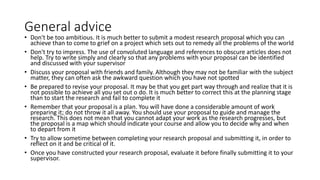
General advice
• Don't be too ambitious. It is much better to submit a modest research proposal which you can
achieve than to come to grief on a project which sets out to remedy all the problems of the world
• Don't try to impress. The use of convoluted language and references to obscure articles does not
help. Try to write simply and clearly so that any problems with your proposal can be identified
and discussed with your supervisor
• Discuss your proposal with friends and family. Although they may not be familiar with the subject
matter, they can often ask the awkward question which you have not spotted
• Be prepared to revise your proposal. It may be that you get part way through and realize that it is
not possible to achieve all you set out o do. It is much better to correct this at the planning stage
than to start the research and fail to complete it
• Remember that your proposal is a plan. You will have done a considerable amount of work
preparing it; do not throw it all away. You should use your proposal to guide and manage the
research. This does not mean that you cannot adapt your work as the research progresses, but
the proposal is a map which should indicate your course and allow you to decide why and when
to depart from it
• Try to allow sometime between completing your research proposal and submitting it, in order to
reflect on it and be critical of it.
• Once you have constructed your research proposal, evaluate it before finally submitting it to your
supervisor.
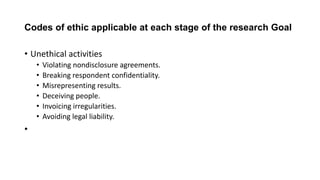
Codes of ethic applicable at each stage of the research Goal
• Unethical activities
• Violating nondisclosure agreements.
• Breaking respondent confidentiality.
• Misrepresenting results.
• Deceiving people.
• Invoicing irregularities.
• Avoiding legal liability.
•
CHAPTER SIX
DATA ANALYSIS
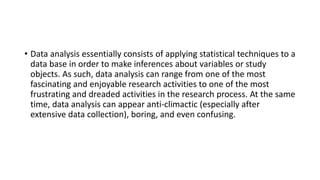
• Data analysis essentially consists of applying statistical techniques to a
data base in order to make inferences about variables or study
objects. As such, data analysis can range from one of the most
fascinating and enjoyable research activities to one of the most
frustrating and dreaded activities in the research process. At the same
time, data analysis can appear anti-climactic (especially after
extensive data collection), boring, and even confusing.
The data analysis activity consists of the
following:
• Formulating data analysis goals
• Stating assumptions
• Specifying hypotheses
• Selecting statistical techniques
• Determining significance levels and decision rules
• Calculating test statistics
• Conducting further analyses
• Drawing inferences
Qualitative Analysis
• Qualitative Analysis is the analysis of qualitative data such as text data
from interview transcripts.
• Unlike quantitative analysis, which is statistics driven and largely
independent of the researcher, qualitative analysis is heavily
dependent on the researcher‘s analytic and integrative skills and
personal knowledge of the social context where the data is collected.
• A creative and investigative mindset is needed for qualitative analysis,
based on a ethically enlightened and participant-in-context attitude,
and a set of analytic strategies.
•
Coding Techniques
• Qualitative Analysis is organized around concepts or key ideas. Examples of
concepts include organizational size and organizational mission.
• The size of text units may vary with the type of concept. For instance,
organizational size may include just a few words per coding unit, while
organizational mission may take a few pages.
• The reason is that organizational size is clear, unambiguous concept, while
organizational mission is an ambiguous concept that is viewed differently
by different participants. Some references to organizational mission may be
brief, while others may be lengthy. Hence, coding units does not have to be
standardized (to say, a certain length like a paragraph) in qualitative
analysis.
Content Analysis
• Content Analysis is a technique for gathering and analyzing the
content of a text. The content refers to words, meanings, pictures,
symbols, ideas, themes, or any message that can be communicated.
• The text is anything written, visual, or spoken that serves as a
medium of communication. Possible artifacts for study could be
books, newspaper or magazine articles, advertisements, poems,
letters, laws, constitutions, dramas, speeches, official documents,
films or videotapes, musical lyrics, photographs, articles of clothing,
or works of arts. All these works may be called as documents. The
documents can be:
• Personal – letters, diary, autobiography.
• Non-personal – interoffice memos, official documents, proceedings of
a meeting. Mass media – newspapers, magazines, fiction, films,
songs, poems, works of arts.
• Mass media – newspapers, magazines, fiction, films, songs, poems,
works of arts.
• In qualitative inquiry, it is acceptable to include numerical quantities
and analyze such data using quantitative techniques. Such analysis is
called mixed-method analysis.
• For example, while qualitative data from an interview transcript can
be analyzed qualitatively using content analysis, quantitative data
collected during the same process can be analyzed quantitatively
using measures of central tendency, correlation, and so forth.
• Combining qualitative and quantitative results can sometimes yield a
richer understanding of the phenomenon of interest that either type
of results alone.
Quantitative Analysis:
• Numeric data collected in a research project can be analyzed
quantitatively using statistical tools in two different ways.
• Descriptive analysis refers to statistically describing, aggregating, and
presenting the constructs of interest or associations between these
constructs.
• Inferential analysis refers to the statistical testing of hypotheses
(theory testing).
• Much of today‘s quantitative data analysis is conducted using
software programs such as SPSS or SAS. Readers are advised to
familiarize themselves with one of these programs for understanding
the concepts described in this discussion.
Data Preparation
• In research projects, data may be collected from a variety of sources: mail-
in surveys, interviews, pretest or posttest experimental data, observational
data, and so forth.
• This data must be converted into Data coding:
• Coding is the process of converting data into numeric format. A codebook
should be created to guide the coding process.
• A codebook is a comprehensive document containing detailed description
of each variable in a research study, items or measures for that variable,
the format of each item (numeric, text, etc.), the response scale for each
item (i.e., whether it is measured on a nominal, ordinal, interval, or ratio
scale; whether such scale is a five-point, seven-point, or some other type of
scale), and how to code each value into a numeric format
Data entry
• Coded data can be entered into a spreadsheet, database, text file, or
directly into a statistical program like SPSS. Most statistical programs
provide a data editor for entering data. However, these programs
• Missing values: Missing data is an inevitable part of any empirical data set.
• Data transformation: Sometimes, it is necessary to transform data values
before they can be meaningfully interpreted. For instance, reverse coded
items, where items convey the opposite meaning of that of their
underlying construct, should be reversed (e.g., in a 1-7 interval scale, 8
minus the observed value will reverse the value) before they can be
compared or combined with items that are not reverse coded.
Uni-variate Analysis
• Uni-variate analysis, or analysis of a single variable, refers to a set of
statistical techniques that can describe the general properties of one
variable. Uni-variatestatistics include:
• (1) frequency distribution,
• (2) central tendency, and
• (3) dispersion.
Bivariate Analysis
• Bivariate analysis examines how two variables are related to each
other. The most common bivariate statistic is the bivariate correlation
(often, simply called ―correlation‖), which is a number between -1
and +1 denoting the strength of the relationship between two
variables.
Inferential Statistics
• Inferential statistics are the statistical procedures that are used to
reach conclusions about associations between variables. They differ
from descriptive statistics in that they are explicitly designed to test
hypotheses. Numerous statistical procedures fall in this category,
most of which are supported by modern statistical software such as
SPSS and SAS.
Statistical tests
• Parametric Test
• Parametric tests are more powerful. The data in this test is derived
from interval and ratio measurement.
• In parametric tests, it is assumed that the data follows normal
distributions. Examples of parametric tests are (a) Z-Test, (b) T-Test
and (c) F-Test.
• Observations must be independent i.e., selection of any one item
should not affect the chances of selecting any others be included in
the sample.
• Non-parametric Test
• Non-parametric tests are used to test the hypothesis with nominal
and ordinal data.
• We do not make assumptions about the shape of population
distribution.
• These are distribution-free tests.
• The hypothesis of non-parametric test is concerned with something
other than the value of a population parameter.
• Easy to compute.
UNIT SEVEN
REPORT WRITING
• Report format: The general plan of organization for the parts of a
written or oral research report. The researchers tailor the format to
the project. The format of a research report may need adjustment for
two reasons: (1) to obtain the proper level of formality and (2) to
decrease the complexity of the report.
• We shall look at the most formal type i.e. a report for a large project
done within an organization or one done by a research agency for a
client company. This sort of report is usually bound with a permanent
cover and may be hundreds of pages long.
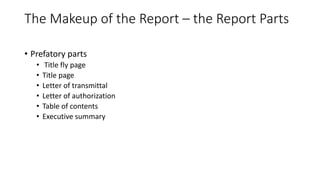
The Makeup of the Report – the Report Parts
• Prefatory parts
• Title fly page
• Title page
• Letter of transmittal
• Letter of authorization
• Table of contents
• Executive summary
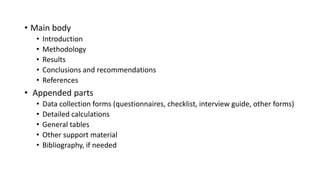
• Main body
• Introduction
• Methodology
• Results
• Conclusions and recommendations
• References
• Appended parts
• Data collection forms (questionnaires, checklist, interview guide, other forms)
• Detailed calculations
• General tables
• Other support material
• Bibliography, if needed
• Prefatory Parts
• Title Fly Page: Only the title appears on this page. For the most formal
reports, a title fly page precedes the title page. Most of the reports
don‘t have it. May be it is more like the dustcover of some books.
• Title Page: The title page should include four items: the title of the
report, the name(s) of the person(s) for whom the report was
prepared, the name(s) of person(s) who prepared it, and the date of
release or presentation.
• Letter of Transmittal: This element is included in relatively formal and
very formal reports. Its purpose is to release or deliver the report to
the recipient. It also serves to establish some rapport between the
reader and the writer. This is one part of the formal report where a
personal, or even a slightly informal, tone should be used. The
transmittal letter should not dive into report findings except in the
broadest terms. This letter may be like:
• Letter of Authorization: This is a letter to the researcher approving the
project, detailing who has responsibility for the project and indicating
what resources are available to support it. The letter not only shows
who sponsored the research but also delineates the original request.
• Table of Contents: A table of contents is essential to any report. It
should list the divisions and subdivisions of the report with page
references. The table of contents is based on the final outline of the
report, but it should include first-level subdivisions. For short reports
it is sufficient to include only the main divisions. If the report includes
many figures and tables, lists of these should immediately follow the
table of contents. If lots of abbreviations have been used in the
report, give a list of abbreviations, alphabetically arranged, after the
list of figures/tables.
• Executive Summary: It is vital part of the report. Studies have
indicated that most managers always read a report‘s summary,
whereas only a minority read the rest of the report. Thus the only
chance a writer may have to make an impact be in summary.
• Main Body
• The main body constitutes the bulk of the report. It includes:
Introduction, Methodology, Results, Conclusions, and
Recommendations of the study.
• Introduction: The introduction prepares the reader for the report by
describing the parts of the project - background material, the
problem statement, and research objectives of the study. In most
projects, introduction can be taken from the research proposal
submitted earlier by the consultant. The proposal itself was based on
the terms of reference (TOR) supplied by the client.
• Background: It helps in looking at the magnitude of the problem. It
may include the results of exploration from an experience survey,
focus group discussion, and secondary data from literature review.
• Problem statement contains the need for the research project. The
problem is usually represented by the research question raised by the
client. It explains why the project was worth doing. Research
objectives address the purpose of the project. These objectives may
be research questions and associated investigative questions. In
correlational or causal studies, the hypothesis statement may be
included. At the end of the study the researcher may see the extent
to which these objectives have been addressed
• Methodology: Technical procedures for carrying out the study must
be explained in a manner appropriate for the reader. It may be useful
to supplement the material in this section with more detailed
explanation in the appendix. This part of the report should address
seven topics:
• Results: The presentation of results will occupy the bulk of the report. This
section presents in some logical order those findings of the project that
bear on the objectives. The results should be organized as a continuous
narrative, designed to be convincing but not oversell the project. Summary
tables and charts should be used to aid the discussion. Tables and charts
may serve as points of reference to the data being discussed and free the
prose from an excess of facts and figures. Comprehensive or detailed
charts should be reserved for the appendix.
• Conclusions and recommendations: The last part of the body of the report
presents the conclusions and recommendations based on results. Findings
state facts; conclusions represent inferences drawn from findings. A writer
is sometimes reluctant to make conclusions and leaves the task to the
reader.
• References: All citations used in the study must be given by arranging
them alphabetically by the last name of the author.
• Appended Parts
• Appendix: The appendix presents the ―too …‖ material. Any
material that is too technical or too detailed to go to the body
should appear in appendix. This includes materials of interest only to
some readers, or subsidiary materials not directly related to the
objectives. Some examples of appendix material are data collection
forms (instruments), detailed calculations, discussions of highly
technical questions, detailed or comprehensive tables of results, and
a bibliography (if appropriate)
The end
Thank you!
Advanced research method

Advanced research method

  • 1.
    ADVANCED BUSINESS RESEACH METHOD /BADM662/ Credithours: 3 Pre-requisite: BADM631 Dr Hailemariam Kebede
  • 2.
    Definition • Research maybe considered as an organized, systematic, data based, critical, objective, scientific inquiry or investigation into a specific problem, undertaken with the purpose of finding answers or solutions to it. In this way research provides the needed information that guides the planners to make informed decisions to successfully deal with the problems. • “A studious inquiry or examination , especially a critical investigation or experimentation having for its aim the discovery of new facts and their correct interpretation, the revision of accepted conclusions, theories, or laws in the light of new discovered facts or the practical application of such conclusions, theories or laws.”
  • 3.
    Important Characteristics ofScientific Method • Empirical-Scientific method is concerned with the realities that are observable through ―sensory experiences. It generates knowledge which is verifiable by experience or observation. • Verifiable-Observations made through scientific method are to be verified again by using the senses to confirm or refute the previous findings. Such confirmations may have to be made by the same researcher or others. • Cumulative-Prior to the start of any study the researchers try to scan through the literature and see that their study is not a repetition in ignorance. Instead of reinventing the wheel the researchers take stock of the existing body of knowledge and try to build on it.
  • 4.
    Important Characteristics… • Deterministic-Scienceis based on the assumption that all events have antecedent causes that are subject to identification and logical understanding. • Ethical and Ideological Neutrality-The conclusions drawn through interpretation of the results of data analysis should be objective; that is, they should be based on the facts of the findings derived from actual data, and not on our own subjective or emotional values. • Statistical Generalization-Generalizability refers to the scope of the research findings in one organizational setting to other settings. Obviously, the wider the range of applicability of the solutions generated by research, the more useful the research is to users.
  • 5.
    Important Characteristics… • Rationalism-Scienceis fundamentally a rational activity, and the scientific explanation must make sense. Religion may rest on revelations, custom, or traditions, gambling on faith, but science must rest on logical reason.
  • 6.
    CLASSIFICATION OF RESEARCH •For classification of research we shall look from four dimensions: • The purpose of doing research; • The intended uses of research; • How it treats time i.e. the time dimension in research; and • The research (data collection) techniques used in it
  • 7.
    Purpose of DoingResearch • Exploratory /Formative Research • You may be exploring a new topic or issue in order to learn about it. If the issue was new or the researcher has written little on it, you began at the beginning. • Goals of Exploratory Research: • Become familiar with the basic facts, setting, and concerns; • Develop well-grounded picture of the situation; • Develop tentative theories; generate new ideas, conjectures, or hypotheses; • Determine the feasibility of conducting the study; • Formulate questions and refine issues for more systematic inquiry; and • Develop techniques and a sense of direction for future research.
  • 8.
    Purpose of DoingResearch… • Descriptive Research • Descriptive research presents a picture of the specific details of a situation, social setting, or relationship. The major purpose of descriptive research, as the term implies, is to describe characteristics of a population or phenomenon. • Goals of Descriptive Research • Describe the situation in terms of its characteristics i.e. provide an accurate profile of a group; • Gives a verbal or numerical picture (%) of the situation; • Presents background information; • Creates a set of categories or classify the information; • Clarifies sequence, set of stages; and • Focuses on ‗who,‘ ‗what,‘ ‗when,‘ ‗where,‘ and ‗how‘ but not why?
  • 9.
    Purpose of DoingResearch… • Explanatory Research • When we encounter an issue that is already known and have a description of it, we might begin to wonder why things are the way they are. The desire to know ―why, to explain, is the purpose of Explanatory Research. • Goals of Explanatory Research • Explains things not just reporting. Why? It elaborates and enriches a theory‘s explanation. • Determines which of several explanations is best. • Determines the accuracy of the theory; tests a theory‘s predictions or principle. • Advances knowledge about underlying process. • Builds and elaborates a theory; elaborates and enriches a theory‘s predictions or principle. • Extends a theory or principle to new areas, new issues, new topics: • Provides evidence to support or refute an explanation or prediction. • Tests a theory‘s predictions or principles
  • 10.
    The Uses ofResearch • Basic Research • Basic research advances fundamental knowledge about the human world. It focuses on refuting or supporting theories that explain how this world operates, what makes things happen, why social relations are a certain way, and why society changes. Basic research is the source of most new scientific ideas and ways of thinking about the world. It can be exploratory, descriptive, or explanatory; however, explanatory research is the most common. • Basic research generates new ideas, principles and theories, which may not be immediately utilized; though are the foundations of modern progress and development in different fields.
  • 11.
    The Uses ofResearch… • Applied Research • Applied researchers try to solve specific policy problems or help practitioners accomplish tasks. Theory is less central to them than seeking a solution on a specific problem for a limited setting. Applied research is frequently a descriptive research, and its main strength is its immediate practical use. Applied research is conducted when decision must be made about a specific real-life problem. Applied research encompasses those studies undertaken to answer questions about specific problems or to make decisions about a particular course of action or policy.
  • 12.
    The Uses ofResearch… • Basic and Applied Research Compared • The procedures and techniques utilized by basic and applied researchers do not differ substantially. Both employ the scientific method to answer the questions at hand. • The scientific community is the primary consumer of basic research. The consumers of applied research findings are practitioners such as teachers, counselors, and caseworkers, or decision makers such as managers, committees, and officials.
  • 13.
    • Types ofApplied Research • Action research: The applied research that treats knowledge as a form of power and abolishes the line between research and social action. • Impact Assessment Research: Its purpose is to estimate the likely consequences of a planned change. • Evaluation Research: It addresses the question, ―Did it work? The process of establishing value judgment based on evidence about the achievement of the goals of a program.
  • 14.
    The Time Dimensionin Research • Cross-Sectional Research. In cross-sectional research, researchers observe at one point in time. Cross-sectional research is usually the simplest and least costly alternative. Its disadvantage is that it cannot capture the change processes. Cross-sectional research can be exploratory, descriptive, or explanatory, but it is most consistent with a descriptive approach to research. • Longitudinal Research. Researchers using longitudinal research examine features of people or other units at more than one time. It is usually more complex and costly than cross-sectional research but it is also more powerful, especially when researchers seek answers to questions about change.
  • 15.
    There are threetypes of longitudinal research: time series, panel, and cohort. • Time series research is longitudinal study in which the same type of information is collected on a group of people or other units across multiple time periods. Researcher can observe stability or change in the features of the units or can track conditions overtime. • The panel study is a powerful type of longitudinal research. In panel study, the researcher observes exactly the same people, group, or organization across time periods. It is a difficult to carry out such study. Tracking people over time is often difficult because some people die or cannot be located. • A cohort analysis is similar to the panel study, but rather than observing the exact same people, a category of people who share a similar life experience in a specified time period is studied. The focus is on the cohort, or category, not on specific individuals.
  • 16.
    Research (Data Collection)Techniques Used • Every researcher collects data using one or more techniques. The techniques may be grouped into two categories: quantitative, collecting data in the form of numbers, and qualitative, collecting data in the form of words or pictures. Quantitative • The main quantitative techniques are: • Experiments • Surveys • Using Existing Statistics Qualitative • The major qualitative techniques of research are: • Field Research • Case Study • Focus Group Discussion
  • 17.
    Research paradigms andLogic of Research Plato c. 348–347 BC Logic/ Ethics “Objects are inherently good, just” “Things are beautiful, unified, equal”
  • 18.
    Research paradigms andLogic of Research Socrates c. 469 / 470 BC Contribution to Epistemology, Ethics, Logic: “I know that I know nothing” “Knowledge is always proportionate to the realm from which it is gained.”
  • 19.
    Research Paradigms… • Theterm paradigm refers to the progress of scientific practice based on people's philosophies and assumptions about the world and the nature of knowledge; in this context, it is about how research should be conducted. Paradigms are ‗universally recognized scientific achievements that for a time provide model problems and solutions to a community of practitioners‘ (Kuhn, 1962, p. viii). They offer a framework comprising an accepted set of theories, methods and ways of defining data.
  • 20.
    Research Paradigms… • Unfortunately,the term paradigm is used quite loosely in academic research and can mean different things to different people. To help clarify the uncertainties, Morgan (1979) suggests that the term can be used at three different levels: • Philosophical level, where it is used to reflect basic beliefs about the world • Social level, where it is used to provide guidelines about how the researcher should conduct his or her endeavors • Technical level, where it is used to specify the methods and techniques which ideally should be adopted when conducting research.
  • 21.
    What is aparadigm? "universally recognized scientific achievements that, for a time, provide model problems and solutions for a community of researchers", i.e., • what is to be observed and scrutinised • the kind of questions that are supposed to be asked and probed for answers in relation to this subject • how these questions are to be structured • how the results of scientific investigations should be interpreted • how is an experiment to be conducted, and what equipment is available to conduct the experiment. Kuhn, T S (1970) The Structure of Scientific Revolutions (2nd Edition) University of Chicago Press. Section V, pages 43-51
  • 22.
    What is aparadigm? The word paradigm is used to: - Indicate a pattern or model or an outstandingly clear or typical example or archetype Also: - cultural themes - worldviews - Ideologies - mindsets. - It describes distinct concepts or thought patterns in any scientific discipline or other epistemological context.
  • 23.
    Main components ofa Paradigm • Ontology: • Assumptions about the nature of reality • Epistemology: • How the researcher comes to know that reality • Methodology • How the researcher access and report what is learned about the reality Guba and Lincoln (1994)
  • 24.
    Ontology ORIGIN early 18thcent.: from modern Latin ontologia, from Greek ōn, ont- ‘being’ + -logy. Ontology is the starting point of all research, after which one’s epistemological and methodological positions logically follow. A dictionary definition of the term may describe it as the image of social reality upon which a theory is based.
  • 25.
    Ontology • Denzin andLincoln (1994) point out that it is crucial to consider the researcher’s personal sentiments, beliefs and relationship to the subject matter, as this may have a bearing on the method chosen, i.e. the researcher’s Ontological persuasion
  • 26.
    Ontology • According toBryman (2008:18) the ontological issues are having to do with whether the social entities can and should be considered objective entities that have a reality external to social actors, or whether they can and should be considered social constructions built up from the perception and actions of social actors. • These opposite points of view are referred to as Objectivism and Constructivism respectively.
  • 27.
    Objectivism • This ontologicalposition implies that social phenomenon is regarded as a ‘fait accompli’, and that those external facts are beyond our reach and therefore influence. A typical example is that of an organisation. The organisation can be regarded as a “persona” having rule and regulation, there is a system, there is a hierarchy, and from the outside looking in, the member needs to adapt and align to the workings of the organisation if he/she wants to survive. In this instant, the organisation exhibits a constraining force that acts upon and inhibits its members
  • 28.
    Objectivism • Objectivism presupposesthat social reality has an autonomous existence outside the knower (researcher). Eriksson & Kovalainen (2008) Bryman & Bell (2007).
  • 29.
    Constructivism Constructionism (also knownas subjectivism) is an ontological position asserting that social phenomenon and their meaning are continually being accomplished by social actors, and that they are in constant construction and revision. (Bryman, 2008:19). Taking an organisation and culture again as examples, constructivism infers the continuous change, updating and rejuvenating of the existing social structures. (Becker 1982:521 as quoted by Bryman 2008:20). People, individuals and/or groups are definitely able to influence existing structures that at first seem external and alien. After all, the organisation and culture itself should be viewed rather as a collective extension of the individuals wants, needs and meaning, cohorted into an assemblage that eventually is known as an enterprise or a particular culture.
  • 30.
  • 31.
    Epistemology • ORIGIN mid19th cent.: from Greek epistēmē ‘knowledge,’ from epistasthai ‘know, know how to do.’ • Epistemology is the branch of Philosophy that studies knowledge, by attempting to distinguish between ‘True’ (and adequate) knowledge and ‘False’ (inadequate) knowledge. (Erikson and Kovalainen, (2008:14).
  • 32.
    Realism • Emergence sincethe 1960’s of a second philosophical position within the epistemological discourse, that of realism, and in particular, Critical Realism. Critical Realism takes the view that change can only take place if the structures responsible for the events and discourses are known and influenced. As Bhaskar (1989:2) points out: • These structures are not spontaneously apparent in the observable patterns of events. They can only be identified through the practical and theoretical work of the social sciences.
  • 33.
    Interpretivism Interpretivism, (also knownas Post-positivism), is a term given to a contrasting epistemology to that of Positivism. (Bryman 2008:16). It concerns the theory and method of the interpretation of Human Action. While positivist’s point of departure is to explain human behaviour, the social sciences are more concerned about understanding human behaviour. As Max Weber (1864-1920) pointed out, time has come for us to “Understand” social dynamics, and not simply to “measure” it.
  • 34.
    Interpretivism Interpretivism as aphilosophical position within an epistemological stance that treats reality as being fluid, knowledge is subjective, everyone has a ‘common sense thinking’ and the truth lies within the interpretation of the persons reality, upon which he/she accordingly acts, reacts and interacts with that ‘reality’. This phenomenon is subject to the person’s beliefs, values, culture, standing, language, shared meaning and consciousness. (Bryman, 2008:17; Grbich, 2010; Meyers,
  • 35.
    Interpretivism • Interpretivism orinterpretive theory as per Charmaz, (2006:126), calls for the imaginative understanding of the studied phenomenon. This type of theory assumes emergent, multiple realities; indeterminacy; facts and values as linked; truth as provisional and social life as processual.
  • 36.
    Existentialism • The followingassumptions emerge: • Existence is always particular and individual • It is the problem of the mode of being and therefore also an investigation of the meaning of being • The investigation is continually faced with diverse possibilities, among which the individual must make a selection and commit himself to • Because these possibilities are determined by the individual’s relationships with other human beings and things, existence is always a situation that limits or conditions choice • Versfeld (1992), Existentialism, 2011
  • 37.
    Constructivism • Constructionism ora constructivist grounded theory approach places priority on the phenomenon of study and sees both data and analysis as created from shared experiences and relationships with participants. (Charmaz, 2006:130).
  • 38.
    Positivism • One ofthe central questions in epistemology is the question of whether the social world can, and in fact should be, studied according to the same principles, procedures and ethos as the natural sciences. (Bryman 2008; Meyers, 2010; Eriksson & Kovalainen, 2008; Bryman & Bell, 2007). When assuming an epistemological position based on the natural sciences, i.e. the composition of reality from observable material objects, it is known as Positivism.
  • 39.
    Positivism • Positivism adoptsa quantitative approach to investigating phenomena, assuming an Epistemological position that advocates the application of the methods of the natural sciences to the study of social reality, as opposed to post-positivist approaches, which aim to describe and explore in-depth phenomena from a qualitative perspective, according to Proctor (1998) and Bryman (2008).
  • 40.
    Phenomenology • Despite thefact that phenomenology has a theoretical orientation, it does not generate deductions from propositions that may be empirically tested (Darroch & Silvers 1982). • Phenomenology operates more on a meta-level, and demonstrates its premises through descriptive analyses of the procedures of the self, and the situational and the social setting. Phenomenology is the study of the contents of consciousness – phenomenon – and phenomenological methods are ways in which these contents may be described and analysed (Sokolowski, 2000).
  • 41.
  • 42.
    Summary • Ontological assumption:There is a reality that can be apprehended. We can determine “the way things are” and, often, discover the cause effect relations behind social reality. At the least, we can find meaningful indicators of what is “really” happening. • Epistemological assumption: The investigator and the object of investigation are independent from each other and the object can be researched without being influenced by the researcher. Any possible researcher influence can be anticipated, detected, and accounted for (controlled). • Axiological assumption: Values are excluded from the research process. They are considered confounding variables-phenomena that cloud our view of reality. • Methodological assumption: The most prevalent methods used include experiments, quasi-experiments, and other hypothesis-testing techniques. Meaningful phenomena are operationalized by determining variables that can be accurately measured. • Rhetorical assumption: The research is written from the perspective of the disinterested scientist. Typically, our report is couched in mathematical terms.
  • 43.
    Philosophical underpinning • Atthe heart of all research, is an endeavour to find out, to investigate, confirm, probe, test, see or view, measure, correlate, compare, evaluate, find meaning, gain understanding, or to discover new emerging properties. Bless, Higson & Kagee (2006)
  • 46.
    Sparkes, 2007 • Allresearchers who plan to explore objectives should explain their worldview, “since it uses a methodology of the heart to some extent and at least begs for consideration”
  • 47.
    Assumptions of Approach Mixed Methods ResearchersWorldview about nature of knowledge - epistemology Approaches and techniques And way in which questions are formulated, data is collected and analyzed Ontological Perceptions of reality Positivism Post Positivism Critical Theory Constructivism Participatory Worldviews influence basic beliefs of who informs, who forms and who benefit from the inquiry Also influences mode or strategy or research tradition Quantitative Arising mainly from positivism & post positivism Qualitative Mainly coming from critical theory, constructivism & participatory paradigms Mixed Methods From the pragmatic paradigm Research Methods Qualitative Research Paradigm Quantitative Research Paradigm Multiple subjectively derived realities co-exist Single objective world Epistemological Theory of knowledge Researchers interact with phenomenon (personal investment) Researchers are independent from the variables under study (detached) Axiological Study of underlying values Researchers act in a value-laden and biased fashion Researchers act in a value-free and unbiased manner Rhetorical Use of language Use personalized, informal and context- based language Use impersonal, formal and rule-based text Methodological Researchers use induction, multi-process interventions, context- specific methods Researchers use deduction, cause-and-effect relationship and context- free methods MIXED METHODS Pragmatism Booyse, 2012
  • 48.
    Research • Mouton (1996:28)simply states that: the predominant purpose of all research is to arrive at results that are as close to the truth as possible.
  • 49.
    Research Design • Cooperand Schindler (2011: 139, 727) concur that a research design is “an activity- and time-based plan; a blueprint for fulfilling research objectives and answering question”. • A research design can be likened to a house plan, which shows on paper what the final house is going to look like and guides a builder on how the house should be built (Mouton: 2001).
  • 50.
    Lynham (2002) • Twocommon theory building strategies • Research-to theory strategy • Theory-to-research strategy • Inductive-deductive nature • Well applied to behavioral and human sciences • Post modernistic • “data does not create theory or models, humans do” Mintzberg in Saha & Corley (2006)
  • 52.
    Lynham (2002) • 5phases: • Conceptual development • Operationalization • Application • Confirmation or disconfirmation • Continues refinement and development
  • 53.
    Lynham (2002) • Phase1: • Conceptual development • Cresswell (2008) • Use literature to identify themes and patterns in definitions and use of the concept to obtain clarification in previous studies • Develop an informed conceptual framework that provides an initial understanding and explanation of the nature and dynamics of the phenomenon
  • 54.
    Lynham (2002) • Phase2: • Operationalization • Explicit connection between the conceptualization phase and practice • Link theoretial ideas, conepts, models to practice • Form theoretical frameowk of the model to be build • Include design and explanation of the model that could be applied in practice • You continue until no substantively different information could be found and saturation thus experienced (Shah and Corley, 2006)
  • 55.
    Lynham (2002) • Phase3: • Confirmation or disconfirmation • This involves the planning, design, implementation and evaluation of a research agenda • Literature search and review focused on the envisioned model to be developed, to clarify and explain the model and to ensure that no reference suggest probable falsification of theory behind model (Popper in Lynham, 2002)
  • 56.
    Lynham (2002) • Positivism •If you believe that theories of phenomenon under study do exist out there between the lines of scientist that use the concept but need to be fiound, also on more post modernistic lines, to be explained • Greggor and Jones (20007) • Any researcher will find more or less the same result, independet of their worldiew • Dubin (1978) explains that by constructing theory this way, the aim is to make sense of what is observed in the use of the concept, by ordering the relationships among elements in the focus of the study
  • 57.
    Lynham (2002) • Phase4: • Application and empirical testing • Phase 5: continuous refinement • Continues literature review progress
  • 58.
    Triangulation • Easterby-Smith, Thorpeand Lowe (1991) as cited by Da Vinci (2009:14), define the following four types of triangulation: • Data Triangulation: Data is collected at different times and source and combined, or compared to increase confidence; • Investigator Triangulation: data is gathered by different investigators, independently and compared/combined to increase confidence; • Methodological Triangulation: Using both qualitative and quantitative methods to increase confidence, and • Theories Triangulation: using two different theories to explain the same problem.
  • 59.
    UNIT TWO REVIEW OFLITERATURE AND THEORETICAL FRAMEWORK IN RESEARCH
  • 60.
    Goals of aLiterature Review • Reviews vary in scope and depth; they have to be strong enough to help the fulfillment of different goals. The goals of review are: • To demonstrate a familiarity with a body of knowledge and establish credibility. A review tells the reader that the researcher knows the research in an area and knows the major issues. A good review increases a reader‘s confidence in the researcher‘s professional competence, ability, and background. • To know the path of prior research and how a current research project is linked to it. A review outlines the direction, ability, and background of research on a question and shows the development of knowledge. A good review places a research project in a context and demonstrates its relevance by making connections to a body of knowledge. • To integrate and summarize what is known in an area. A review pulls together and synthesizes different results. A good review points out areas where prior studies agree, where they disagree, and where major questions remain. It collects what is known to a point in time and indicates the direction for future research. No reinventing the wheel. No wastage of effort.
  • 61.
    • To learnfrom others and stimulate new ideas. A review tells what others have found so that a researcher can benefit from the efforts of others. A good review identifies blind alleys and suggests hypotheses for replication. It divulges procedures, techniques, and research designs worth copying so that a researcher can better focus hypotheses and gain new insights. • Identification of variables. Important variables that are likely to influence the problem situation are not left out of the study. • Helps in developing theoretical framework.
  • 62.
    Types of Reviews •Self-study reviews increase the reader’s confidence. A review that only demonstrates familiarity with an area is rarely published but it often is part of an educational program. In addition to giving others confidence in a reviewer‘s command of field, it has the side benefit of building the reviewer‘s self- confidence. • Context reviews place a specific project in the big picture. One of the goals of review is creating a link to a developing body of knowledge. This is a background or context review. It introduces the rest of a research and establishes the significance and relevance of a research question. • Historical review traces the development of an issue over time. It traces the development of an idea or shows how a particular issue or theory has evolved over time. Researchers conduct historical review only on the most important ideas in a field. • Theoretical reviews compare how different theories address an issue. It presents different theories that purport to explain the same thing, and then evaluates how well each accounts for findings. • Integrative review summarizes what is known at a point in time. It presents the current state of knowledge and pulls together disparate research reports in a fast growing area of knowledge. • Methodological reviews point out how methodology varies by study. In it, researcher evaluates the methodological strength of past studies. It describes conflicting results and shows how different research designs, samples, measures, and so on account for different results.
  • 63.
    CONDUCTING A SYSTEMATICLITERATURE REVIEW (Empirical Evidences) • Define and Refine a Topic • Prior to the review of literature have a good idea of the topic of your interest. Although, the new thoughts emerging out of the review of literature may help in refocusing the topic, still the researcher needs to have some clear research question that could guide him/her in the pursuit of relevant material • Design a Search • The researcher needs to decide on the type of review, its extensiveness and the types of material to include. The key is to be careful, systematic, and organized.
  • 64.
    • Locate ResearchReports • Locating research reports depends on the type of report or ―outlet‖ of research being searched. Use multiple search strategies in order to counteract the limitations of single search method. • Articles in Scholarly Journals. • Scholarly Books. • Dissertations. • Government Documents. • Policy Reports and Presented Papers.
  • 65.
    THEORY AND RESEARCH(THEORETICAL FRAMEWORK) •Theory • As such theory is a systematic and general attempt to explain something like: Why do people commit crimes? How do the media affect us? Why do some people believe in God? Why do people get married? Why do kids play truant from school? How is our identity shaped by culture? Each of these questions contains a reference to some observed phenomenon. • A suggested explanation for the observed phenomenon is theory. More formally, a theory is a coherent set of general propositions, used as principles of explanations of the apparent relationship of certain observed phenomena. A key element in this definition is the term proposition.
  • 66.
    • Concepts • Theorydevelopment is essentially a process of describing phenomena at increasingly higher levels of abstraction. A concept (or construct) is a generalized idea about a class of objects, attributes, occurrences, or processes that has been given a name. Such names are created or developed or constructed for the identification of the phenomenon, be it physical or non-physical. All these may be considered as empirical realities e.g. leadership, productivity, morale, motivation, inflation, happiness, banana.
  • 67.
    • Propositions • Conceptsare the basic units of theory development. However, theories require an understanding of the relationship among concepts. Thus, once reality is abstracted into concepts, the scientist is interested in the relationship among various concepts. Propositions are statements concerned with the logical relationships among concepts. A proposition explains the logical linkage among certain concepts by asserting a universal connection between concepts.
  • 68.
    • Theory andResearch • Basic to modern science is an intricate relation between theory and research. The popular understanding of this relationship obscures more than it illuminates. Popular opinion generally conceives of these as direct opposites: theory is confused with speculation, and thus theory remains speculation until it is proved. When this proof is made, theory becomes fact. Facts are thought to be definite, certain, without question, and their meaning to be self-evident.
  • 69.
    •Definitions • Confusion aboutthe meaning of concepts can destroy a research study‘s value without the researcher or client even knowing it. If words have different meanings to the parties involved, then they are not communicating on the same wave-length. Definitions are one way to reduce this danger. •
  • 70.
    • Dictionary Definitions •Researchers must struggle with two types of definitions. In the more familiar dictionary, a concept is defined with synonyms. For example, a customer is defined as a patron: a patron, in turn, is defined as customer or client of an establishment; a client is defined as one who employs the services of any professional …, also loosely, a patron of any shop. • Operational Definition • In research we must measure concepts and constructs, and this requires more rigorous definitions. A concept must be made operational in order to be measured. An operational definition gives meanings to a concept by specifying the activities or operations necessary to measure it. An operational definition specifies what must be done to measure the concept under investigation.
  • 71.
    The use ofTheoretical Framework in Research • There are six basic features that should be incorporated in any theoretical framework. These features are: • Make an inventory of variables: • Specify the direction of relationship: • Give a clear explanation of why we should expect the proposed relationships to exist. • Make an inventory of propositions: • Arrange these propositions in a sequential order: • Schematic diagram of the theoretical model be given
  • 72.
    UNIT THREE FORMULATING ANDCLARIFYING THE RESEARCH TOPIC
  • 73.
    • The researchprocess consists of a number of steps. The first step in any research is selecting the topic, which could start from the broad area of interest. There is no formula set for the identification of a topic of research. The best guide is to conduct research on something that interests you in your area of specialization. • Broad area of interest could be for example ‗labor unions.‘
  • 74.
    Techniques for Narrowinga Topic into a Research Question • Examine the literature • Talk over ideas with others. • Apply to a specific context. • Define the aim or desired outcome of the study.
  • 75.
    THE RESEARCH PROBLEM •What features should you look for which could lead you to a suitable research problem? Here is a list of the most important: • It should be of great interest to you. You will have to spend many months investigating the problem. A lively interest in the subject will be an invaluable incentive to persevere. • The problem should be significant. It is not worth time and effort investigating a trivial problem or repeating work which has already been done elsewhere. • It should be delineated. Consider the time you have to complete the work, and the depth to which the problem will be addressed. You can cover a wide field only superficially, and the more you restrict the field, the more detailed the study can be. You should also consider the cost of necessary travel and other expenses.. • You should be able to obtain the information required. You cannot carry out research if you fail to collect the relevant information needed to tackle your problem, either because you lack access to documents or other sources, and/or because you have not obtained the co- operation of individuals or organizations essential to your research. • You should be able to draw conclusions related to the problem .The point of asking a question is to find an answer. The problem should be one to which the research can offer some solution, or at least the elimination of some false ‗solutions‘. • You should be able to state the problem clearly and concisely
  • 76.
    • Problem definitionor problem statement is a clear, precise, and succinct statement of the question or issue that is to be investigated with the goal of finding an answer or solution. For example the problem could pertain to: • Existing business problems where the manager is looking for a solution, • Situation that may not pose any current problems but which the manager feels have scope for improvement, • Areas where some conceptual clarity is needed for better theory building, or • Situations in which a researcher is trying to answer a research question empirically because of interest in the topic.
  • 77.
    MEANING OF VARIABLES •Variable is central idea in research. Simply defined, variable is a concept that varies. There are two types of concepts: those that refer to a fixed phenomenon and those that vary in quantity, intensity, or amount (e.g. amount of education). The second type of concept and measures of the concept are variables. A variable is defined as anything that varies or changes in value. Variables take on two or more values. Because variable represents a quality that can exhibit differences in value, usually magnitude or strength, it may be said that a variable generally is anything that may assume different numerical or categorical values.
  • 78.
    Types of Variable •Continuous and Discontinuous variables • Dependent and Independent Variables • Moderating Variables • Intervening Variables • Extraneous Variables
  • 79.
    HYPOTHESIS DEVELOPMENT • Ifthe phenomenon under consideration happens to be observable reality then the said statement could be empirically tested. A proposition that can be verified to determine its reality is a hypothesis. Therefore one can say that a hypothesis is a verifiable counterpart of a proposition. A hypothesis may be defined as a logically conjectured relationship between two or more variables, expressed in the form of a testable statement.
  • 80.
    Types of Hypotheses •Descriptive hypothesis • Descriptive hypothesis contains only one variable thereby it is also called as univariate hypothesis. Descriptive hypotheses typically state the existence, size, form, or distribution of some variable. The first hypothesis contains only one variable. It only shows the distribution of the level of commitment among the officers of the organization which is higher than average. Such a hypothesis is an example of a Descriptive Hypothesis. Researchers usually use research questions rather than descriptive hypothesis. For example a question can be: What is the level of commitment of the officers in your organization?
  • 81.
    • Relational Hypothesis •These are the propositions that describe a relationship between two variables. The relationship could be non-directional or directional, positive or negative, causal or simply correlational. While stating the relationship between the two variables, if the terms of positive, negative, more than, or less than are used then such hypotheses are directional because the direction of the relationship between the variables (positive/negative) has been indicated. These hypotheses are relational as well as directional. The directional hypothesis is the one in which the direction of the relationship has been specified
  • 82.
    • Correlational hypotheses •State merely that the variables occur together in some specified manner without implying that one causes the other. Such weak claims are often made when we believe that there are more basic causal forces that affect both variables • Explanatory (causal) hypotheses • Imply the existence of, or a change in, one variable causes or leads to a change in the other variable. This brings in the notions of independent and the dependent variables. Cause means to ―help make happen.‖ So the independent variable may not be the sole reason for the existence of, or change in the dependent variable. The researcher may have to identify the other possible causes, and control their effect in case the causal effect of independent variable has to be determined on the dependent variable.
  • 83.
    Different ways tostate hypotheses • Null Hypothesis • It is used for testing the hypothesis formulated by the researcher. Researchers treat evidence that supports a hypothesis differently from the evidence that opposes it. They give negative evidence more importance than to the positive one. It is because the negative evidence tarnishes the hypothesis. It shows that the predictions made by the hypothesis are wrong. The null hypothesis simply states that there is no relationship between the variables or the relationship between the variables is ―zero.‖ That is, how symbolically null hypothesis is denoted as ―H0‖.
  • 84.
    • H0 =There is no relationship between the level of job commitment and the level of efficiency. Or • H0 = the relationship between level of job commitment and the level of efficiency is zero. Or • The two variables are independent of each other. • It does not take into consideration the direction of association (i.e. H0 is non-directional), which may be a second step in testing the hypothesis. First we look whether or not there is an association then we go for the direction of association and the strength of association. Experts recommend that we test our hypothesis indirectly by testing the null hypothesis.
  • 85.
    • Alternative Hypothesis •The alternative (to the null) hypothesis simply states that there is a relationship between the variables under study. In our example it could be: there is a relationship between the level of job commitment and the level of efficiency. Not only there is an association between the two variables under study but also the relationship is perfect which is indicated by the number ―1‖. Thereby the alternative hypothesis is symbolically denoted as ―H1‖.
  • 86.
    The Role ofHypothesis • It guides the direction of the study: • It identifies facts that are relevant and those that are not: • It suggests which form of research design is likely to be the most appropriate: • It provides a framework for organizing the conclusions of the findings.
  • 87.
    Characteristics of aTestable Hypothesis: • Hypothesis must be conceptually clear. • Hypothesis should have empirical referents. • Hypothesis must be specific. • Hypothesis should be related to available techniques of research. • Hypothesis should be related to a body of theory.
  • 88.
    UNIT FOUR CONCEPTUALIZATION OFRESEARCH DESIGN AND CHOICES
  • 89.
    • Research designis needed because it facilitates the smooth sailing of the various research operations, thereby making research as efficient as possible yielding maximal information with minimal expenditure of effort, time and money.
  • 90.
    • More explicitly,the design decisions happen to be in respect of: • What is the study about? • Why is the study being made? • Where will the study be carried out? • What type of data is required? • Where can the required data be found? • What periods of time will the study include? • What will be the sample design? • What techniques of data collection will be used? • How will the data be analyzed? • In what style will the report be prepared?
  • 91.
    • Keeping inview the above stated design decisions; one may split the overall research design into the following parts: • The sampling design which deals with the method of selecting items to be observed for the given study; • The observational design which relates to the conditions under which the observations are to be made; • The statistical design which concerns with the question of how many items are to be observed and how the information and data gathered are to be analyzed; and • The operational design which deals with the techniques by which the procedures specified in the sampling, statistical and observational designs can be carried out. •
  • 92.
    From what hasbeen stated above, we can state the important features of a research design as under: 1- It is a plan that specifies the sources and types of information relevant to the research problem. 2- It is a strategy specifying which approach will be used for gathering and analyzing the data. 3- It also includes the time and cost budgets since most studies are done under these two constraints. • In brief, research design must, at least, contain: • a clear statement of the research problem; • procedures and techniques to be used for gathering information; • the population to be studied; and • methods to be used in processing and analyzing data. •
  • 93.
    Research Design versusResearch Method • Research design is different from the method by which data are collected. Many research methods texts confuse research designs with methods. It is not uncommon to see research design treated as a mode of data collection rather than as a logical structure of the inquiry. But there is nothing intrinsic about any research design that requires a particular method of data collection. •
  • 94.
    Types of sampling •Probability Sampling Techniques • Simple Random sampling • Systematic sampling • Stratified random sampling • Cluster sampling • Multistage sampling
  • 95.
    • Non-Probability SamplingTechniques • Deliberate sampling • Shopping Mall Intercept Sampling • Sequential sampling • Quota sampling • Snowball sampling • Panel samples • Convenience sampling
  • 96.
  • 97.
    • A researchproposal is a document that presents a plan for a project to reviewers‘ evaluation. It can be a supervised project submitted to instructors as part of an educational degree (e.g. a Master‘s thesis or a Ph.D. dissertation) or it can be a research project proposed to a funding agency. • Its purpose is to convince reviewers that the researcher is capable of successfully conducting the proposed research project. • Reviewers have more confidence that a planned project will be successfully completed if the proposal is well written and organized, and carefully planned. •
  • 98.
    Writing the ResearchProposal • A research proposal is a written account of the research topic you have chosen and why, a plan of your future research and an explanation of how you will achieve it. The main questions you are trying to answer when drafting your project proposal are: • Is my proposed research interesting, important and relevant? • Who has already done work in this area? • What are my aims and objectives, my research questions? • How do I intend to conduct the research? • Where do I intend to do the research? • What is my timetable for conducting the research? • What do I expect the outcome of the research to be?
  • 99.
    • The detailsyou put into the proposal will depend on the nature of your own particular research project • Proposed title • Proposed research problem • Proposed research questions or hypotheses • Proposed theoretical framework • Preliminary literature review • Proposed research design • Proposed timetable • References
  • 100.
    General advice • Don'tbe too ambitious. It is much better to submit a modest research proposal which you can achieve than to come to grief on a project which sets out to remedy all the problems of the world • Don't try to impress. The use of convoluted language and references to obscure articles does not help. Try to write simply and clearly so that any problems with your proposal can be identified and discussed with your supervisor • Discuss your proposal with friends and family. Although they may not be familiar with the subject matter, they can often ask the awkward question which you have not spotted • Be prepared to revise your proposal. It may be that you get part way through and realize that it is not possible to achieve all you set out o do. It is much better to correct this at the planning stage than to start the research and fail to complete it • Remember that your proposal is a plan. You will have done a considerable amount of work preparing it; do not throw it all away. You should use your proposal to guide and manage the research. This does not mean that you cannot adapt your work as the research progresses, but the proposal is a map which should indicate your course and allow you to decide why and when to depart from it • Try to allow sometime between completing your research proposal and submitting it, in order to reflect on it and be critical of it. • Once you have constructed your research proposal, evaluate it before finally submitting it to your supervisor.
  • 101.
    Codes of ethicapplicable at each stage of the research Goal • Unethical activities • Violating nondisclosure agreements. • Breaking respondent confidentiality. • Misrepresenting results. • Deceiving people. • Invoicing irregularities. • Avoiding legal liability. •
  • 102.
  • 103.
    • Data analysisessentially consists of applying statistical techniques to a data base in order to make inferences about variables or study objects. As such, data analysis can range from one of the most fascinating and enjoyable research activities to one of the most frustrating and dreaded activities in the research process. At the same time, data analysis can appear anti-climactic (especially after extensive data collection), boring, and even confusing.
  • 104.
    The data analysisactivity consists of the following: • Formulating data analysis goals • Stating assumptions • Specifying hypotheses • Selecting statistical techniques • Determining significance levels and decision rules • Calculating test statistics • Conducting further analyses • Drawing inferences
  • 105.
    Qualitative Analysis • QualitativeAnalysis is the analysis of qualitative data such as text data from interview transcripts. • Unlike quantitative analysis, which is statistics driven and largely independent of the researcher, qualitative analysis is heavily dependent on the researcher‘s analytic and integrative skills and personal knowledge of the social context where the data is collected. • A creative and investigative mindset is needed for qualitative analysis, based on a ethically enlightened and participant-in-context attitude, and a set of analytic strategies. •
  • 106.
    Coding Techniques • QualitativeAnalysis is organized around concepts or key ideas. Examples of concepts include organizational size and organizational mission. • The size of text units may vary with the type of concept. For instance, organizational size may include just a few words per coding unit, while organizational mission may take a few pages. • The reason is that organizational size is clear, unambiguous concept, while organizational mission is an ambiguous concept that is viewed differently by different participants. Some references to organizational mission may be brief, while others may be lengthy. Hence, coding units does not have to be standardized (to say, a certain length like a paragraph) in qualitative analysis.
  • 107.
    Content Analysis • ContentAnalysis is a technique for gathering and analyzing the content of a text. The content refers to words, meanings, pictures, symbols, ideas, themes, or any message that can be communicated. • The text is anything written, visual, or spoken that serves as a medium of communication. Possible artifacts for study could be books, newspaper or magazine articles, advertisements, poems, letters, laws, constitutions, dramas, speeches, official documents, films or videotapes, musical lyrics, photographs, articles of clothing, or works of arts. All these works may be called as documents. The documents can be:
  • 108.
    • Personal –letters, diary, autobiography. • Non-personal – interoffice memos, official documents, proceedings of a meeting. Mass media – newspapers, magazines, fiction, films, songs, poems, works of arts. • Mass media – newspapers, magazines, fiction, films, songs, poems, works of arts.
  • 109.
    • In qualitativeinquiry, it is acceptable to include numerical quantities and analyze such data using quantitative techniques. Such analysis is called mixed-method analysis. • For example, while qualitative data from an interview transcript can be analyzed qualitatively using content analysis, quantitative data collected during the same process can be analyzed quantitatively using measures of central tendency, correlation, and so forth. • Combining qualitative and quantitative results can sometimes yield a richer understanding of the phenomenon of interest that either type of results alone.
  • 110.
    Quantitative Analysis: • Numericdata collected in a research project can be analyzed quantitatively using statistical tools in two different ways. • Descriptive analysis refers to statistically describing, aggregating, and presenting the constructs of interest or associations between these constructs. • Inferential analysis refers to the statistical testing of hypotheses (theory testing). • Much of today‘s quantitative data analysis is conducted using software programs such as SPSS or SAS. Readers are advised to familiarize themselves with one of these programs for understanding the concepts described in this discussion.
  • 111.
    Data Preparation • Inresearch projects, data may be collected from a variety of sources: mail- in surveys, interviews, pretest or posttest experimental data, observational data, and so forth. • This data must be converted into Data coding: • Coding is the process of converting data into numeric format. A codebook should be created to guide the coding process. • A codebook is a comprehensive document containing detailed description of each variable in a research study, items or measures for that variable, the format of each item (numeric, text, etc.), the response scale for each item (i.e., whether it is measured on a nominal, ordinal, interval, or ratio scale; whether such scale is a five-point, seven-point, or some other type of scale), and how to code each value into a numeric format
  • 112.
    Data entry • Codeddata can be entered into a spreadsheet, database, text file, or directly into a statistical program like SPSS. Most statistical programs provide a data editor for entering data. However, these programs • Missing values: Missing data is an inevitable part of any empirical data set. • Data transformation: Sometimes, it is necessary to transform data values before they can be meaningfully interpreted. For instance, reverse coded items, where items convey the opposite meaning of that of their underlying construct, should be reversed (e.g., in a 1-7 interval scale, 8 minus the observed value will reverse the value) before they can be compared or combined with items that are not reverse coded.
  • 113.
    Uni-variate Analysis • Uni-variateanalysis, or analysis of a single variable, refers to a set of statistical techniques that can describe the general properties of one variable. Uni-variatestatistics include: • (1) frequency distribution, • (2) central tendency, and • (3) dispersion.
  • 114.
    Bivariate Analysis • Bivariateanalysis examines how two variables are related to each other. The most common bivariate statistic is the bivariate correlation (often, simply called ―correlation‖), which is a number between -1 and +1 denoting the strength of the relationship between two variables.
  • 115.
    Inferential Statistics • Inferentialstatistics are the statistical procedures that are used to reach conclusions about associations between variables. They differ from descriptive statistics in that they are explicitly designed to test hypotheses. Numerous statistical procedures fall in this category, most of which are supported by modern statistical software such as SPSS and SAS.
  • 116.
    Statistical tests • ParametricTest • Parametric tests are more powerful. The data in this test is derived from interval and ratio measurement. • In parametric tests, it is assumed that the data follows normal distributions. Examples of parametric tests are (a) Z-Test, (b) T-Test and (c) F-Test. • Observations must be independent i.e., selection of any one item should not affect the chances of selecting any others be included in the sample.
  • 117.
    • Non-parametric Test •Non-parametric tests are used to test the hypothesis with nominal and ordinal data. • We do not make assumptions about the shape of population distribution. • These are distribution-free tests. • The hypothesis of non-parametric test is concerned with something other than the value of a population parameter. • Easy to compute.
  • 118.
  • 119.
    • Report format:The general plan of organization for the parts of a written or oral research report. The researchers tailor the format to the project. The format of a research report may need adjustment for two reasons: (1) to obtain the proper level of formality and (2) to decrease the complexity of the report. • We shall look at the most formal type i.e. a report for a large project done within an organization or one done by a research agency for a client company. This sort of report is usually bound with a permanent cover and may be hundreds of pages long.
  • 120.
    The Makeup ofthe Report – the Report Parts • Prefatory parts • Title fly page • Title page • Letter of transmittal • Letter of authorization • Table of contents • Executive summary
  • 121.
    • Main body •Introduction • Methodology • Results • Conclusions and recommendations • References • Appended parts • Data collection forms (questionnaires, checklist, interview guide, other forms) • Detailed calculations • General tables • Other support material • Bibliography, if needed
  • 122.
    • Prefatory Parts •Title Fly Page: Only the title appears on this page. For the most formal reports, a title fly page precedes the title page. Most of the reports don‘t have it. May be it is more like the dustcover of some books. • Title Page: The title page should include four items: the title of the report, the name(s) of the person(s) for whom the report was prepared, the name(s) of person(s) who prepared it, and the date of release or presentation.
  • 123.
    • Letter ofTransmittal: This element is included in relatively formal and very formal reports. Its purpose is to release or deliver the report to the recipient. It also serves to establish some rapport between the reader and the writer. This is one part of the formal report where a personal, or even a slightly informal, tone should be used. The transmittal letter should not dive into report findings except in the broadest terms. This letter may be like: • Letter of Authorization: This is a letter to the researcher approving the project, detailing who has responsibility for the project and indicating what resources are available to support it. The letter not only shows who sponsored the research but also delineates the original request.
  • 124.
    • Table ofContents: A table of contents is essential to any report. It should list the divisions and subdivisions of the report with page references. The table of contents is based on the final outline of the report, but it should include first-level subdivisions. For short reports it is sufficient to include only the main divisions. If the report includes many figures and tables, lists of these should immediately follow the table of contents. If lots of abbreviations have been used in the report, give a list of abbreviations, alphabetically arranged, after the list of figures/tables.
  • 125.
    • Executive Summary:It is vital part of the report. Studies have indicated that most managers always read a report‘s summary, whereas only a minority read the rest of the report. Thus the only chance a writer may have to make an impact be in summary.
  • 126.
    • Main Body •The main body constitutes the bulk of the report. It includes: Introduction, Methodology, Results, Conclusions, and Recommendations of the study. • Introduction: The introduction prepares the reader for the report by describing the parts of the project - background material, the problem statement, and research objectives of the study. In most projects, introduction can be taken from the research proposal submitted earlier by the consultant. The proposal itself was based on the terms of reference (TOR) supplied by the client.
  • 127.
    • Background: Ithelps in looking at the magnitude of the problem. It may include the results of exploration from an experience survey, focus group discussion, and secondary data from literature review. • Problem statement contains the need for the research project. The problem is usually represented by the research question raised by the client. It explains why the project was worth doing. Research objectives address the purpose of the project. These objectives may be research questions and associated investigative questions. In correlational or causal studies, the hypothesis statement may be included. At the end of the study the researcher may see the extent to which these objectives have been addressed
  • 128.
    • Methodology: Technicalprocedures for carrying out the study must be explained in a manner appropriate for the reader. It may be useful to supplement the material in this section with more detailed explanation in the appendix. This part of the report should address seven topics:
  • 129.
    • Results: Thepresentation of results will occupy the bulk of the report. This section presents in some logical order those findings of the project that bear on the objectives. The results should be organized as a continuous narrative, designed to be convincing but not oversell the project. Summary tables and charts should be used to aid the discussion. Tables and charts may serve as points of reference to the data being discussed and free the prose from an excess of facts and figures. Comprehensive or detailed charts should be reserved for the appendix. • Conclusions and recommendations: The last part of the body of the report presents the conclusions and recommendations based on results. Findings state facts; conclusions represent inferences drawn from findings. A writer is sometimes reluctant to make conclusions and leaves the task to the reader.
  • 130.
    • References: Allcitations used in the study must be given by arranging them alphabetically by the last name of the author.
  • 131.
    • Appended Parts •Appendix: The appendix presents the ―too …‖ material. Any material that is too technical or too detailed to go to the body should appear in appendix. This includes materials of interest only to some readers, or subsidiary materials not directly related to the objectives. Some examples of appendix material are data collection forms (instruments), detailed calculations, discussions of highly technical questions, detailed or comprehensive tables of results, and a bibliography (if appropriate)
  • 132.

Editor's Notes

  • #48 Exploratory - Suggests directions and feasibility of future research, Usually focused on the “what,” not the “why”. Frequently uses qualitative techniques to develop initial data and ideas Descriptive - Presents a picture with specific details of the situation or behavior, Requires a focused research question/topic, Often blurs with/follows exploratory research Focuses on “how” and “who” questions, Is necessary for good explanatory research Explanatory -Focuses on “why”, or the reason a situation or behavior occurs, Builds on exploratory and descriptive research, and other explanatory research Uses theory, Much of the research published in journals is explanatory