Microbiology and Sterility
Assurance
Dr. Tim Sandle
www.pharmamicroresources.com
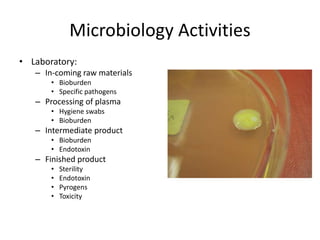
Microbiology Activities
• Laboratory:
– In-coming raw materials
• Bioburden
• Specific pathogens
– Processing of plasma
• Hygiene swabs
• Bioburden
– Intermediate product
• Bioburden
• Endotoxin
– Finished product
• Sterility
• Endotoxin
• Pyrogens
• Toxicity
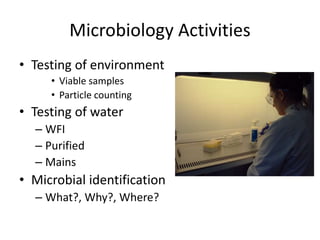
Microbiology Activities
• Testing of environment
• Viable samples
• Particle counting
• Testing of water
– WFI
– Purified
– Mains
• Microbial identification
– What?, Why?, Where?
Impact on Sterile Supplies
• Sterile Supplies is an EU GMP Grade C facility
(ISO 14644 class 8)
– Certified cleanroom: annual
– Environmental monitoring, based on risk:
• Types of activities
• Whether there are water sources
• Room history
– Water samples are taken from outlets
Impact on Aseptic Filling
• Routine monitoring programme of support rooms
– Monitored according to risk e.g. corridors monitored
more often than infrequently used rooms
– Monitoring is:
• Twice weekly
• Weekly
• Fortnightly
• Monthly
– Monitoring is for:
• Viable counts
• Particles
• Fungi
Impact on Aseptic Filling
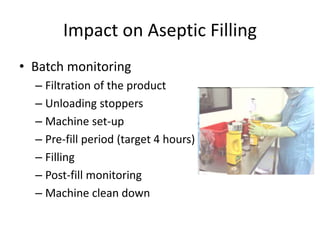
• Batch monitoring
– Filtration of the product
– Unloading stoppers
– Machine set-up
– Pre-fill period (target 4 hours)
– Filling
– Post-fill monitoring
– Machine clean down
Environmental Monitoring
• Samples
– Settle plates (deposition rate / 4 hours)
– Active air (cubic metre)
– Contact plates
– Swabs
– Finger plates (staff)
– Gloveport plates
– Gown plates
Environmental Monitoring
• Routine, support samples taken by
Microbiology
• Batch samples taken by Sterile Operations
• Samples contain tryptone soya agar
– Some contain neutraliser
– Samples incubated at a regime designed to
encourage the growth of bacteria and fungi.
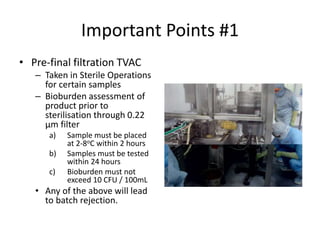
Important Points #1
• Pre-final filtration TVAC
– Taken in Sterile Operations
for certain samples
– Bioburden assessment of
product prior to
sterilisation through 0.22
µm filter
a) Sample must be placed
at 2-8oC within 2 hours
b) Samples must be tested
within 24 hours
c) Bioburden must not
exceed 10 CFU / 100mL
• Any of the above will lead
to batch rejection.
Important Points #2
• Media fills
– Qualify the filling line and the people
– Different vial sizes and numbers in rotation
• Maximum broth fill size sets maximum batch size
– Require a set number of aseptic interventions
– Contain the maximum stoppage
– Run every six-months per line
– Each person must participate once per year and
carry out an intervention
Important Points #3
• AFS qualification
– Gown test
• Visual check of change procedure against SOP
• Samples relating to environment and individual
– Aseptic qualification test
• Test of aseptic technique
– Conducted
• Three times for new staff or after a prolonged absence
• Six-monthly for qualified staff
• Zero tolerance for staff who miss due dates
Important Points #4
• Data is reviewed every month and summaries
are sent out to Sterile Ops Management
• Includes staff performance
– Each staff member is rated green, amber or red
– Includes:
• Gown test results
• Finger plate trends
• Exit suit plate trends
• Behavioural issues
Current issues
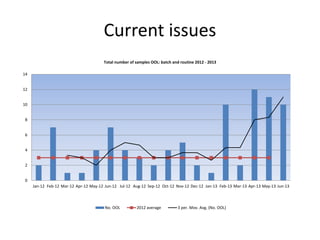
• There is currently an upward trend in the AFS
relating to environmental monitoring data.
• Trend began after the winter 2013 shutdown.
• Primarily relates to people, behaviours and
aseptic practices.
• Some issues linked to cleaning.
Current issues
0
2
4
6
8
10
12
14
Jan-12 Feb-12 Mar-12 Apr-12 May-12 Jun-12 Jul-12 Aug-12 Sep-12 Oct-12 Nov-12 Dec-12 Jan-13 Feb-13 Mar-13 Apr-13 May-13 Jun-13
Total number of samples OOL: batch and routine 2012 - 2013
No. OOL 2012 average 3 per. Mov. Avg. (No. OOL)
Current issues
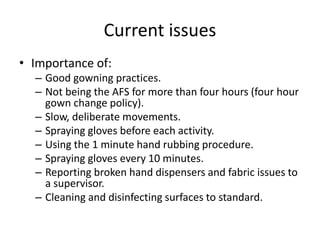
• Importance of:
– Good gowning practices.
– Not being the AFS for more than four hours (four hour
gown change policy).
– Slow, deliberate movements.
– Spraying gloves before each activity.
– Using the 1 minute hand rubbing procedure.
– Spraying gloves every 10 minutes.
– Reporting broken hand dispensers and fabric issues to
a supervisor.
– Cleaning and disinfecting surfaces to standard.
Thank you
Any questions?

Sterility assurance

  • 1.
    Microbiology and Sterility Assurance Dr.Tim Sandle www.pharmamicroresources.com
  • 2.
    Microbiology Activities • Laboratory: –In-coming raw materials • Bioburden • Specific pathogens – Processing of plasma • Hygiene swabs • Bioburden – Intermediate product • Bioburden • Endotoxin – Finished product • Sterility • Endotoxin • Pyrogens • Toxicity
  • 3.
    Microbiology Activities • Testingof environment • Viable samples • Particle counting • Testing of water – WFI – Purified – Mains • Microbial identification – What?, Why?, Where?
  • 4.
    Impact on SterileSupplies • Sterile Supplies is an EU GMP Grade C facility (ISO 14644 class 8) – Certified cleanroom: annual – Environmental monitoring, based on risk: • Types of activities • Whether there are water sources • Room history – Water samples are taken from outlets
  • 5.
    Impact on AsepticFilling • Routine monitoring programme of support rooms – Monitored according to risk e.g. corridors monitored more often than infrequently used rooms – Monitoring is: • Twice weekly • Weekly • Fortnightly • Monthly – Monitoring is for: • Viable counts • Particles • Fungi
  • 6.
    Impact on AsepticFilling • Batch monitoring – Filtration of the product – Unloading stoppers – Machine set-up – Pre-fill period (target 4 hours) – Filling – Post-fill monitoring – Machine clean down
  • 7.
    Environmental Monitoring • Samples –Settle plates (deposition rate / 4 hours) – Active air (cubic metre) – Contact plates – Swabs – Finger plates (staff) – Gloveport plates – Gown plates
  • 8.
    Environmental Monitoring • Routine,support samples taken by Microbiology • Batch samples taken by Sterile Operations • Samples contain tryptone soya agar – Some contain neutraliser – Samples incubated at a regime designed to encourage the growth of bacteria and fungi.
  • 9.
    Important Points #1 •Pre-final filtration TVAC – Taken in Sterile Operations for certain samples – Bioburden assessment of product prior to sterilisation through 0.22 µm filter a) Sample must be placed at 2-8oC within 2 hours b) Samples must be tested within 24 hours c) Bioburden must not exceed 10 CFU / 100mL • Any of the above will lead to batch rejection.
  • 10.
    Important Points #2 •Media fills – Qualify the filling line and the people – Different vial sizes and numbers in rotation • Maximum broth fill size sets maximum batch size – Require a set number of aseptic interventions – Contain the maximum stoppage – Run every six-months per line – Each person must participate once per year and carry out an intervention
  • 11.
    Important Points #3 •AFS qualification – Gown test • Visual check of change procedure against SOP • Samples relating to environment and individual – Aseptic qualification test • Test of aseptic technique – Conducted • Three times for new staff or after a prolonged absence • Six-monthly for qualified staff • Zero tolerance for staff who miss due dates
  • 12.
    Important Points #4 •Data is reviewed every month and summaries are sent out to Sterile Ops Management • Includes staff performance – Each staff member is rated green, amber or red – Includes: • Gown test results • Finger plate trends • Exit suit plate trends • Behavioural issues
  • 13.
    Current issues • Thereis currently an upward trend in the AFS relating to environmental monitoring data. • Trend began after the winter 2013 shutdown. • Primarily relates to people, behaviours and aseptic practices. • Some issues linked to cleaning.
  • 14.
    Current issues 0 2 4 6 8 10 12 14 Jan-12 Feb-12Mar-12 Apr-12 May-12 Jun-12 Jul-12 Aug-12 Sep-12 Oct-12 Nov-12 Dec-12 Jan-13 Feb-13 Mar-13 Apr-13 May-13 Jun-13 Total number of samples OOL: batch and routine 2012 - 2013 No. OOL 2012 average 3 per. Mov. Avg. (No. OOL)
  • 15.
    Current issues • Importanceof: – Good gowning practices. – Not being the AFS for more than four hours (four hour gown change policy). – Slow, deliberate movements. – Spraying gloves before each activity. – Using the 1 minute hand rubbing procedure. – Spraying gloves every 10 minutes. – Reporting broken hand dispensers and fabric issues to a supervisor. – Cleaning and disinfecting surfaces to standard.
  • 16.