AUTOMATION IN BACTERIOLOGY
PRESENTED BY:
Dr. Sumesh Kumar Dash
MODERATOR:
Prof (Dr.) Kundan Kumar Sahu
2
2
The technique of making an apparatus, a
process, or a system operate automatically
AUTOMATION
Webster's Dictionary
3
3
• Clinician need quicker result
• Faster identification & AST
• Saves time & Manpower
• Remove/Decrease manual error
• Helpful in processing whenever increased sample load
NEED OF AUTOMATION
4
4
• Time consuming
• Tedious
• Run the risk of introducing contaminants during procecing
• Incomplete Identification
• A limited no. of AST can be detected on one plate.
• MIC may not be determined
PROBLEM WITH
CONVENTIONAL METHOD
5
5
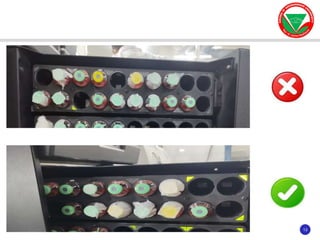
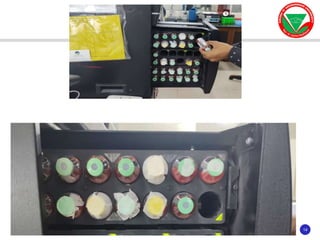
• Automated blood culture
• Vitek System
• Phoenix System
• MicroScan Walkaway system
• MALDI-TOF
VARIOUS AUTOMATED
SYSTEMS
6
6
AUTOMATED BLOOD CULTURE
7
7
AUTOMATED BLOOD CULTURE
• Automatically continuous reading of blood through computerized
system.
• Three such systems
• BacT/ALERT 3D (bioMérieux, Durham, NC)
• BD BACTEC (BD Diagnostic Systems)
• VersaTREK (ThermoScientific, Cleveland, OH)
• Each of these systems alerts if the culture is positive in the bottle.
• After that we have to do a subculture, Gram stain, Identification & AST
8
8
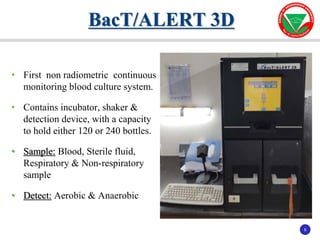
• First non radiometric continuous
monitoring blood culture system.
• Contains incubator, shaker &
detection device, with a capacity
to hold either 120 or 240 bottles.
• Sample: Blood, Sterile fluid,
Respiratory & Non-respiratory
sample
• Detect: Aerobic & Anaerobic
BacT/ALERT 3D
9
9
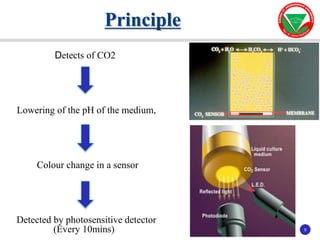
Principle
Detects of CO2
Lowering of the pH of the medium,
Colour change in a sensor
Detected by photosensitive detector
(Every 10mins)
10
10
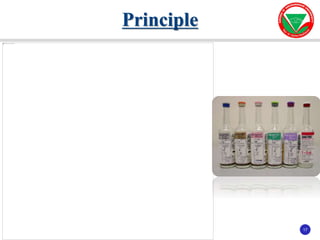
Media
AEROBIC CULTURE ANAEROBIC
MEDIA
MYCOBACTERIUM
MEDIA
BactAlert FA
Plus
BactAlert PA
Plus
BactAlert FN
Plus
BactAlert MB Process
SAMPLE
Blood & Sterile
Fluid
Blood Blood & Sterile
Fluid
All Specimens Except
Whole Blood
BOTTLE
CONTAINS
• 30 ml of Broth [BHI and TSB]
• Soduim poly-an-ethol-sulfonate
• Nutrients, Amino acids, Carbohydrate substrates
• APB (Adsorbent Polymeric Beads)
 In anaerobic media 40ml
• 10 ml Middle brook
7H9
• Pancreatic Digest of
casein.
• Bovin serum albumin.
• Catalase in purified
water
SAMPLE
VOLUME
5 to 10ml 1 to 4ml 1 to 10ml 0.5 ml after
decontamination
11
11
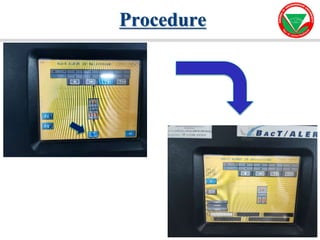
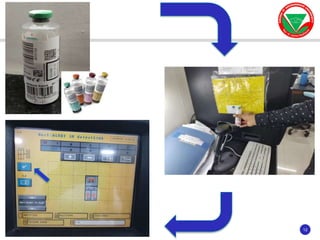
Procedure
12
12
13
13
14
14
15
15
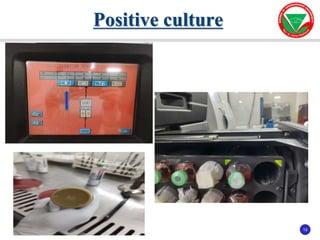
Positive culture
16
16
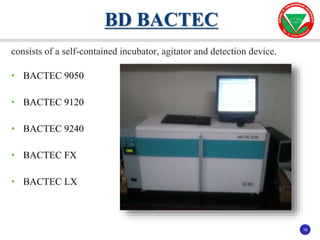
consists of a self-contained incubator, agitator and detection device.
• BACTEC 9050
• BACTEC 9120
• BACTEC 9240
• BACTEC FX
• BACTEC LX
BD BACTEC
17
17
Principle
18
18
Differs from the other
1. Monitored production of CO2
2. Both gas consumption and
production are monitored
3. Changes in the concentrations of
H, and O, also detected
Units with a capacity of 96 to 240 or
up to 528 bottles are currently
available.
VersaTREK
19
19
Pressure of the head-gas is continuously monitored
(Every 12 minutes)
Consumption of H and O / Production of CO2
Change in pressure
Reading by electrostatic precipitator (ESP) system
Lights are illuminated for positive bottle.
Principle
20
20
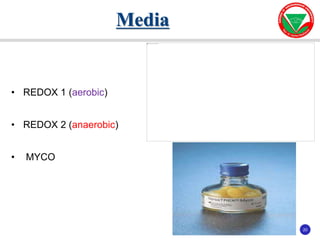
• REDOX 1 (aerobic)
• REDOX 2 (anaerobic)
• MYCO
Media
21
21
• Detects different gases produce or consume
• Detects organism when they enter to log phase.
• Detection microorganisms, that may not produce sufficient CO2.
Advantages
22
22
VITEK SYSTEM
23
23
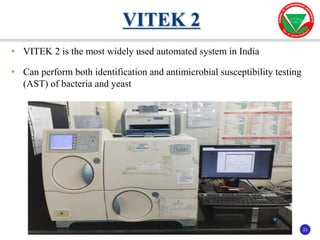
• VITEK 2 is the most widely used automated system in India
• Can perform both identification and antimicrobial susceptibility testing
(AST) of bacteria and yeast
VITEK 2
24
24
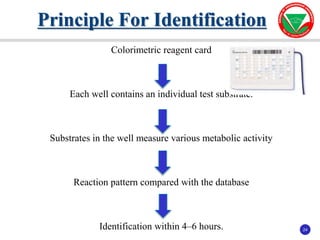
Colorimetric reagent card
Each well contains an individual test substrate.
Substrates in the well measure various metabolic activity
Reaction pattern compared with the database
Identification within 4–6 hours.
Principle For Identification
25
25
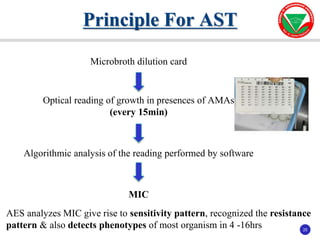
Microbroth dilution card
Optical reading of growth in presences of AMAs
(every 15min)
Algorithmic analysis of the reading performed by software
MIC
Principle For AST
AES analyzes MIC give rise to sensitivity pattern, recognized the resistance
pattern & also detects phenotypes of most organism in 4 -16hrs
26
26
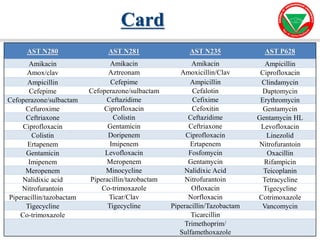
Card
AST N280 AST N281 AST N235 AST P628
Amikacin Amikacin Amikacin Ampicillin
Amox/clav Aztreonam Amoxicillin/Clav Ciprofloxacin
Ampicillin Cefepime Ampicillin Clindamycin
Cefepime Cefoperazone/sulbactam Cefalotin Daptomycin
Cefoperazone/sulbactam Ceftazidime Cefixime Erythromycin
Cefuroxime Ciprofloxacin Cefoxitin Gentamycin
Ceftriaxone Colistin Ceftazidime Gentamycin HL
Ciprofloxacin Gentamicin Ceftriaxone Levofloxacin
Colistin Doripenem Ciprofloxacin Linezolid
Ertapenem Imipenem Ertapenem Nitrofurantoin
Gentamicin Levofloxacin Fosfomycin Oxacillin
Imipenem Meropenem Gentamycin Rifampicin
Meropenem Minocycline Nalidixic Acid Teicoplanin
Nalidixic acid Piperacillin/tazobactam Nitrofurantoin Tetracycline
Nitrofurantoin Co-trimoxazole Ofloxacin Tigecycline
Piperacillin/tazobactam Ticar/Clav Norfloxacin Cotrimoxazole
Tigecycline Tigecycline Piperacillin/Tazobactam Vancomycin
Co-trimoxazole Ticarcillin
Trimethoprim/
Sulfamethoxazole
27
27
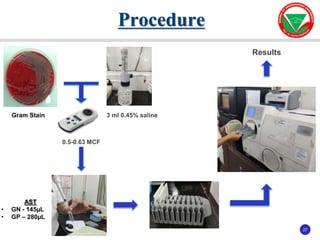
Procedure
0.5-0.63 MCF
3 ml 0.45% saline
Results
AST
• GN - 145µL
• GP – 280µL
Gram Stain
28
28
• Standardized procedure
• Fast turn around time
• Species level bacterial and fungal identification
• AST based on MIC
• Detection resistance pattern
• Validation of every result every time
Advantages
29
29
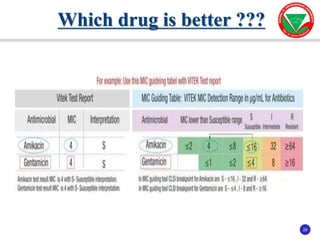
Which drug is better ???
30
30
PHOENIX SYSTEM
31
31
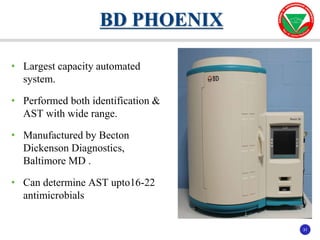
• Largest capacity automated
system.
• Performed both identification &
AST with wide range.
• Manufactured by Becton
Dickenson Diagnostics,
Baltimore MD .
• Can determine AST upto16-22
antimicrobials
BD PHOENIX
32
32
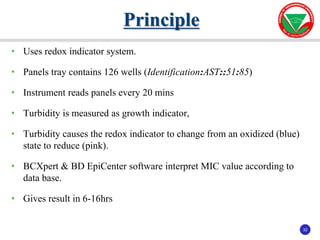
• Uses redox indicator system.
• Panels tray contains 126 wells (Identification:AST::51:85)
• Instrument reads panels every 20 mins
• Turbidity is measured as growth indicator,
• Turbidity causes the redox indicator to change from an oxidized (blue)
state to reduce (pink).
• BCXpert & BD EpiCenter software interpret MIC value according to
data base.
• Gives result in 6-16hrs
Principle
33
33
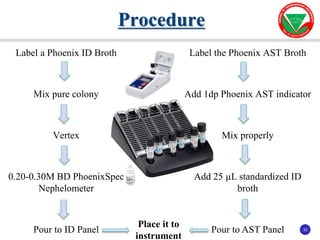
Procedure
Label a Phoenix ID Broth
Mix pure colony
Vertex
0.20-0.30M BD PhoenixSpec
Nephelometer
Pour to ID Panel
Label the Phoenix AST Broth
Add 1dp Phoenix AST indicator
Mix properly
Add 25 µL standardized ID
broth
Pour to AST Panel
Place it to
instrument
34
34
MICROSCAN WALKAWAY
SYSTEM
35
35
• Developed in 1980s
• Uses broth microdilution method to determine the MIC.
• Initially there is 2 major type
1. MicroScan: Reads turbidimetrically, over night incubation
2. Walkaway: Reads fluorometrically, 3.5 – 15hrs
• Type of panel
o MIC panel
o MIC combination panels
o Breakpoint combination panels
 Synergies Plus (2005)
• All system uses LabPro software to generate result.
MicroScan Walkaway
36
36
MASS SPECTROMETRY
37
37
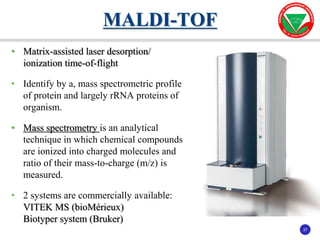
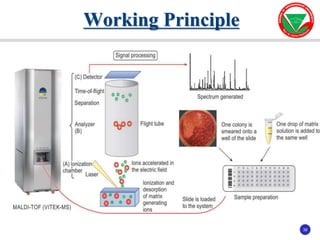
• Matrix-assisted laser desorption/
ionization time-of-flight
• Identify by a, mass spectrometric profile
of protein and largely rRNA proteins of
organism.
• Mass spectrometry is an analytical
technique in which chemical compounds
are ionized into charged molecules and
ratio of their mass-to-charge (m/z) is
measured.
• 2 systems are commercially available:
VITEK MS (bioMérieux)
Biotyper system (Bruker)
MALDI-TOF
38
38
Working Principle
39
39
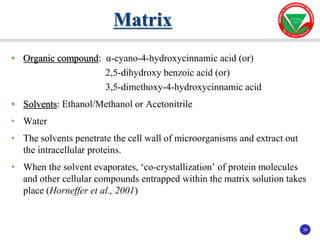
• Organic compound: α-cyano-4-hydroxycinnamic acid (or)
2,5-dihydroxy benzoic acid (or)
3,5-dimethoxy-4-hydroxycinnamic acid
• Solvents: Ethanol/Methanol or Acetonitrile
• Water
• The solvents penetrate the cell wall of microorganisms and extract out
the intracellular proteins.
• When the solvent evaporates, ‘co-crystallization’ of protein molecules
and other cellular compounds entrapped within the matrix solution takes
place (Horneffer et al., 2001)
Matrix
40
40
• Numerous gas and solid state lasers have been developed for use .
• Most MALDI devices use a pulsed UV laser
• N2 source at 337 nm
• Neodymium- yttrium aluminium garnet (Nd:YAG)
• Emits at 355 nm
• IR lasers are also used.
• Erbium doped- yttrium aluminium garnet (Er:YAG).
Laser
41
41
• Sample preparation for identification depends upon the its cell wall.
• Some microbes might be identified directly by MS, called Direct Cell
Profiling.
E.g. Neisseria spp. (Ilina et al., 2009)
Yersinia spp. (Stephan et al., 2011)
Vibrio spp. (Eddabra et al., 2012)
• Preparatory extraction was necessary for identification of Gram-positive
bacteria by MALDI-TOF MS, but not for Gram Negative bacteria
(Alatoom et al., 2011; Saffert et al., 2011).
• A ‘preparatory extraction’ of microbes with Formic Acid increased the
ability of MALDI-TOF MS for identifying Gram-positive species.
Sample Preparation
42
42
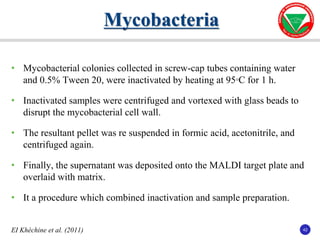
• Mycobacterial colonies collected in screw-cap tubes containing water
and 0.5% Tween 20, were inactivated by heating at 95◦C for 1 h.
• Inactivated samples were centrifuged and vortexed with glass beads to
disrupt the mycobacterial cell wall.
• The resultant pellet was re suspended in formic acid, acetonitrile, and
centrifuged again.
• Finally, the supernatant was deposited onto the MALDI target plate and
overlaid with matrix.
• It a procedure which combined inactivation and sample preparation.
Mycobacteria
EI Khéchine et al. (2011)
43
43
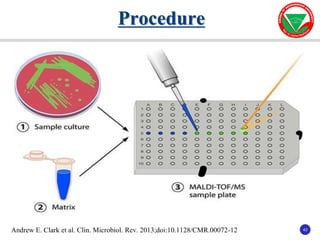
Procedure
Andrew E. Clark et al. Clin. Microbiol. Rev. 2013;doi:10.1128/CMR.00072-12
44
44
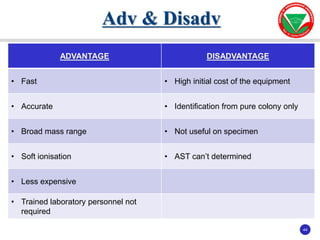
ADVANTAGE DISADVANTAGE
• Fast • High initial cost of the equipment
• Accurate • Identification from pure colony only
• Broad mass range • Not useful on specimen
• Soft ionisation • AST can’t determined
• Less expensive
• Trained laboratory personnel not
required
Adv & Disadv
45
45

Automation in bacteriology (dr.sumesh)

  • 1.
    AUTOMATION IN BACTERIOLOGY PRESENTEDBY: Dr. Sumesh Kumar Dash MODERATOR: Prof (Dr.) Kundan Kumar Sahu
  • 2.
    2 2 The technique ofmaking an apparatus, a process, or a system operate automatically AUTOMATION Webster's Dictionary
  • 3.
    3 3 • Clinician needquicker result • Faster identification & AST • Saves time & Manpower • Remove/Decrease manual error • Helpful in processing whenever increased sample load NEED OF AUTOMATION
  • 4.
    4 4 • Time consuming •Tedious • Run the risk of introducing contaminants during procecing • Incomplete Identification • A limited no. of AST can be detected on one plate. • MIC may not be determined PROBLEM WITH CONVENTIONAL METHOD
  • 5.
    5 5 • Automated bloodculture • Vitek System • Phoenix System • MicroScan Walkaway system • MALDI-TOF VARIOUS AUTOMATED SYSTEMS
  • 6.
  • 7.
    7 7 AUTOMATED BLOOD CULTURE •Automatically continuous reading of blood through computerized system. • Three such systems • BacT/ALERT 3D (bioMérieux, Durham, NC) • BD BACTEC (BD Diagnostic Systems) • VersaTREK (ThermoScientific, Cleveland, OH) • Each of these systems alerts if the culture is positive in the bottle. • After that we have to do a subculture, Gram stain, Identification & AST
  • 8.
    8 8 • First nonradiometric continuous monitoring blood culture system. • Contains incubator, shaker & detection device, with a capacity to hold either 120 or 240 bottles. • Sample: Blood, Sterile fluid, Respiratory & Non-respiratory sample • Detect: Aerobic & Anaerobic BacT/ALERT 3D
  • 9.
    9 9 Principle Detects of CO2 Loweringof the pH of the medium, Colour change in a sensor Detected by photosensitive detector (Every 10mins)
  • 10.
    10 10 Media AEROBIC CULTURE ANAEROBIC MEDIA MYCOBACTERIUM MEDIA BactAlertFA Plus BactAlert PA Plus BactAlert FN Plus BactAlert MB Process SAMPLE Blood & Sterile Fluid Blood Blood & Sterile Fluid All Specimens Except Whole Blood BOTTLE CONTAINS • 30 ml of Broth [BHI and TSB] • Soduim poly-an-ethol-sulfonate • Nutrients, Amino acids, Carbohydrate substrates • APB (Adsorbent Polymeric Beads)  In anaerobic media 40ml • 10 ml Middle brook 7H9 • Pancreatic Digest of casein. • Bovin serum albumin. • Catalase in purified water SAMPLE VOLUME 5 to 10ml 1 to 4ml 1 to 10ml 0.5 ml after decontamination
  • 11.
  • 12.
  • 13.
  • 14.
  • 15.
  • 16.
    16 16 consists of aself-contained incubator, agitator and detection device. • BACTEC 9050 • BACTEC 9120 • BACTEC 9240 • BACTEC FX • BACTEC LX BD BACTEC
  • 17.
  • 18.
    18 18 Differs from theother 1. Monitored production of CO2 2. Both gas consumption and production are monitored 3. Changes in the concentrations of H, and O, also detected Units with a capacity of 96 to 240 or up to 528 bottles are currently available. VersaTREK
  • 19.
    19 19 Pressure of thehead-gas is continuously monitored (Every 12 minutes) Consumption of H and O / Production of CO2 Change in pressure Reading by electrostatic precipitator (ESP) system Lights are illuminated for positive bottle. Principle
  • 20.
    20 20 • REDOX 1(aerobic) • REDOX 2 (anaerobic) • MYCO Media
  • 21.
    21 21 • Detects differentgases produce or consume • Detects organism when they enter to log phase. • Detection microorganisms, that may not produce sufficient CO2. Advantages
  • 22.
  • 23.
    23 23 • VITEK 2is the most widely used automated system in India • Can perform both identification and antimicrobial susceptibility testing (AST) of bacteria and yeast VITEK 2
  • 24.
    24 24 Colorimetric reagent card Eachwell contains an individual test substrate. Substrates in the well measure various metabolic activity Reaction pattern compared with the database Identification within 4–6 hours. Principle For Identification
  • 25.
    25 25 Microbroth dilution card Opticalreading of growth in presences of AMAs (every 15min) Algorithmic analysis of the reading performed by software MIC Principle For AST AES analyzes MIC give rise to sensitivity pattern, recognized the resistance pattern & also detects phenotypes of most organism in 4 -16hrs
  • 26.
    26 26 Card AST N280 ASTN281 AST N235 AST P628 Amikacin Amikacin Amikacin Ampicillin Amox/clav Aztreonam Amoxicillin/Clav Ciprofloxacin Ampicillin Cefepime Ampicillin Clindamycin Cefepime Cefoperazone/sulbactam Cefalotin Daptomycin Cefoperazone/sulbactam Ceftazidime Cefixime Erythromycin Cefuroxime Ciprofloxacin Cefoxitin Gentamycin Ceftriaxone Colistin Ceftazidime Gentamycin HL Ciprofloxacin Gentamicin Ceftriaxone Levofloxacin Colistin Doripenem Ciprofloxacin Linezolid Ertapenem Imipenem Ertapenem Nitrofurantoin Gentamicin Levofloxacin Fosfomycin Oxacillin Imipenem Meropenem Gentamycin Rifampicin Meropenem Minocycline Nalidixic Acid Teicoplanin Nalidixic acid Piperacillin/tazobactam Nitrofurantoin Tetracycline Nitrofurantoin Co-trimoxazole Ofloxacin Tigecycline Piperacillin/tazobactam Ticar/Clav Norfloxacin Cotrimoxazole Tigecycline Tigecycline Piperacillin/Tazobactam Vancomycin Co-trimoxazole Ticarcillin Trimethoprim/ Sulfamethoxazole
  • 27.
    27 27 Procedure 0.5-0.63 MCF 3 ml0.45% saline Results AST • GN - 145µL • GP – 280µL Gram Stain
  • 28.
    28 28 • Standardized procedure •Fast turn around time • Species level bacterial and fungal identification • AST based on MIC • Detection resistance pattern • Validation of every result every time Advantages
  • 29.
  • 30.
  • 31.
    31 31 • Largest capacityautomated system. • Performed both identification & AST with wide range. • Manufactured by Becton Dickenson Diagnostics, Baltimore MD . • Can determine AST upto16-22 antimicrobials BD PHOENIX
  • 32.
    32 32 • Uses redoxindicator system. • Panels tray contains 126 wells (Identification:AST::51:85) • Instrument reads panels every 20 mins • Turbidity is measured as growth indicator, • Turbidity causes the redox indicator to change from an oxidized (blue) state to reduce (pink). • BCXpert & BD EpiCenter software interpret MIC value according to data base. • Gives result in 6-16hrs Principle
  • 33.
    33 33 Procedure Label a PhoenixID Broth Mix pure colony Vertex 0.20-0.30M BD PhoenixSpec Nephelometer Pour to ID Panel Label the Phoenix AST Broth Add 1dp Phoenix AST indicator Mix properly Add 25 µL standardized ID broth Pour to AST Panel Place it to instrument
  • 34.
  • 35.
    35 35 • Developed in1980s • Uses broth microdilution method to determine the MIC. • Initially there is 2 major type 1. MicroScan: Reads turbidimetrically, over night incubation 2. Walkaway: Reads fluorometrically, 3.5 – 15hrs • Type of panel o MIC panel o MIC combination panels o Breakpoint combination panels  Synergies Plus (2005) • All system uses LabPro software to generate result. MicroScan Walkaway
  • 36.
  • 37.
    37 37 • Matrix-assisted laserdesorption/ ionization time-of-flight • Identify by a, mass spectrometric profile of protein and largely rRNA proteins of organism. • Mass spectrometry is an analytical technique in which chemical compounds are ionized into charged molecules and ratio of their mass-to-charge (m/z) is measured. • 2 systems are commercially available: VITEK MS (bioMérieux) Biotyper system (Bruker) MALDI-TOF
  • 38.
  • 39.
    39 39 • Organic compound:α-cyano-4-hydroxycinnamic acid (or) 2,5-dihydroxy benzoic acid (or) 3,5-dimethoxy-4-hydroxycinnamic acid • Solvents: Ethanol/Methanol or Acetonitrile • Water • The solvents penetrate the cell wall of microorganisms and extract out the intracellular proteins. • When the solvent evaporates, ‘co-crystallization’ of protein molecules and other cellular compounds entrapped within the matrix solution takes place (Horneffer et al., 2001) Matrix
  • 40.
    40 40 • Numerous gasand solid state lasers have been developed for use . • Most MALDI devices use a pulsed UV laser • N2 source at 337 nm • Neodymium- yttrium aluminium garnet (Nd:YAG) • Emits at 355 nm • IR lasers are also used. • Erbium doped- yttrium aluminium garnet (Er:YAG). Laser
  • 41.
    41 41 • Sample preparationfor identification depends upon the its cell wall. • Some microbes might be identified directly by MS, called Direct Cell Profiling. E.g. Neisseria spp. (Ilina et al., 2009) Yersinia spp. (Stephan et al., 2011) Vibrio spp. (Eddabra et al., 2012) • Preparatory extraction was necessary for identification of Gram-positive bacteria by MALDI-TOF MS, but not for Gram Negative bacteria (Alatoom et al., 2011; Saffert et al., 2011). • A ‘preparatory extraction’ of microbes with Formic Acid increased the ability of MALDI-TOF MS for identifying Gram-positive species. Sample Preparation
  • 42.
    42 42 • Mycobacterial coloniescollected in screw-cap tubes containing water and 0.5% Tween 20, were inactivated by heating at 95◦C for 1 h. • Inactivated samples were centrifuged and vortexed with glass beads to disrupt the mycobacterial cell wall. • The resultant pellet was re suspended in formic acid, acetonitrile, and centrifuged again. • Finally, the supernatant was deposited onto the MALDI target plate and overlaid with matrix. • It a procedure which combined inactivation and sample preparation. Mycobacteria EI Khéchine et al. (2011)
  • 43.
    43 43 Procedure Andrew E. Clarket al. Clin. Microbiol. Rev. 2013;doi:10.1128/CMR.00072-12
  • 44.
    44 44 ADVANTAGE DISADVANTAGE • Fast• High initial cost of the equipment • Accurate • Identification from pure colony only • Broad mass range • Not useful on specimen • Soft ionisation • AST can’t determined • Less expensive • Trained laboratory personnel not required Adv & Disadv
  • 45.

Editor's Notes

  • #11 Adsorbent Polymeric Beads Act as an Antibiotic Neutralizing Agent. APB contains numerous pores which increase the surface area. More pores equate to more surface area to bind antimicrobials It Contains: APBs1: Gold Beads (Bind with non-polar antimicrobials to neutralize such as vancomycin and others) APB 2: Brown Beads (bind to positively charged antimicrobials to neutralize such as the aminoglycosides and others) Cysteine (Neutralize Carbapenemase group of antibiotics) .
  • #17 Laser technology - directly measures changes in CO2 No intermediary reaction of sensor required. system incorporates stirring bars for agitation
  • #20 Oxygen consumption is accelerated at the time replicating organisms enter the log phase of growth. A reading may be possible, therefore, early in the incubation period before a detectable amount of CO, is produced. Testing multiple gases is a theoretical advantage for the electrostatic precipitator (ESP) system, especially for the detection of asaccharolytic microorganisms that may not produce sutficient CO, for detection by the indicator.
  • #39 The sample for analysis is prepared by mixing with solution called Matrix. When the matrix crystallizes on drying, the sample entrapped within the matrix also co-crystallizes. The sample within the matrix is ionized in an automated mode with a laser beam. Desorption and ionization with the laser beam generates singly protonated ions from analytes in the sample. The protonated ions are then accelerated at a fixed potential, where these separate from each other on the basis of their mass-to-charge ratio (m/z). The charged analytes are then detected and measured using time of flight (TOF) analyzers. Based on the TOF information, a characteristic spectrum called peptide mass fingerprint (PMF) is generated for analytes in the sample. Identification of microbes done by comparing the PMF of unknown organism with the PMFs contained in the database.
  • #41 Ultraviolet 10 nm – 400 nm Visible 400 nm – 700 nm Infrared 700 nm – 1 mm