CHAPTER 3

QUADRATIC
FUNCTIONS
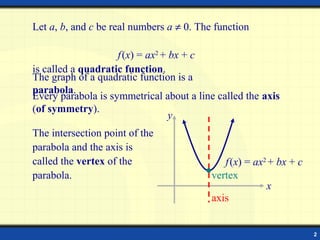
Let a, b, and c be real numbers a ≠ 0. The function

                    f (x) = ax2 + bx + c
is called a quadratic function.
The graph of a quadratic function is a
parabola.
Every parabola is symmetrical about a line called the axis
(of symmetry).
                                  y
The intersection point of the
parabola and the axis is
called the vertex of the                     f (x) = ax2 + bx + c
parabola.                                 vertex
                                                        x
                                          axis


                                                                    2
The leading coefficient of ax2 + bx + c is a.   y
                                      a>0
When the leading coefficient                        f(x) = ax2 + bx + c
                                     opens
is positive, the parabola            upward
opens upward and the                                        x
vertex is a minimum.          vertex
                             minimum
                                                y
                                                             x
When the leading           vertex
                          maximum                   f(x) = ax2 + bx + c
coefficient is negative,
the parabola opens downward        a<0
                                   opens
and the vertex is a maximum.     downward

                                                                      3
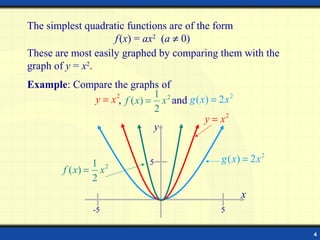
The simplest quadratic functions are of the form
                    f (x) = ax2 (a ≠ 0)
These are most easily graphed by comparing them with the
graph of y = x2.
Example: Compare the graphs of
                             1
            y = x 2, f ( x) = x 2 and g ( x) = 2 x 2
                             2
                                           y = x2
                             y


                 1 2           5                 g ( x) = 2 x 2
         f ( x) = x
                 2
                                                       x
                -5                              5

                                                                  4
Example: Graph f (x) = (x – 3)2 + 2 and find the vertex and axis.
    f (x) = (x – 3)2 + 2 is the same shape as the graph of
    g (x) = (x – 3)2 shifted upwards two units.
    g (x) = (x – 3)2 is the same shape as y = x2 shifted to the right
    three units.
                               y
                                                     f (x) = (x – 3)2 + 2

              y = x2                                g (x) = (x – 3)2
                            4


                                                 (3, 2)
                                                vertex
                                                   x
              -4                            4

                                                                            5
The standard form for the equation of a quadratic function is:
                  f (x) = a(x – h)2 + k (a ≠ 0)
The graph is a parabola opening upward if a > 0 and opening
downward if a < 0. The axis is x = h, and the vertex is (h, k).
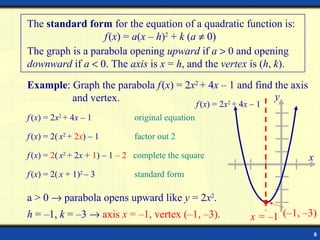
Example: Graph the parabola f (x) = 2x2 + 4x – 1 and find the axis
         and vertex.                                      y
                                              2
                                                  f (x) = 2x + 4x – 1
f (x) = 2x2 + 4x – 1          original equation

f (x) = 2( x2 + 2x) – 1       factor out 2

f (x) = 2( x2 + 2x + 1) – 1 – 2 complete the square                            x
f (x) = 2( x + 1)2 – 3        standard form

a > 0 → parabola opens upward like y = 2x2.
h = –1, k = –3 → axis x = –1, vertex (–1, –3).                    x = –1 (–1, –3)
                                                                                   6
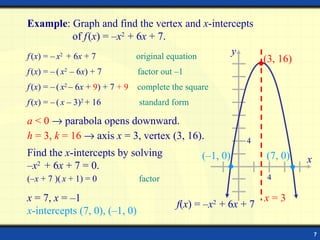
Example: Graph and find the vertex and x-intercepts
               of f (x) = –x2 + 6x + 7.
f (x) = – x2 + 6x + 7           original equation
                                                  y
                                                                    (3, 16)
f (x) = – ( x2 – 6x) + 7           factor out –1
f (x) = – ( x2 – 6x + 9) + 7 + 9   complete the square
f (x) = – ( x – 3)2 + 16           standard form

a < 0 → parabola opens downward.
h = 3, k = 16 → axis x = 3, vertex (3, 16).                    4
Find the x-intercepts by solving                    (–1, 0)         (7, 0)    x
–x2 + 6x + 7 = 0.
(–x + 7 )( x + 1) = 0              factor                           4

x = 7, x = –1                                                       x=3
                                              f(x) = –x2 + 6x + 7
x-intercepts (7, 0), (–1, 0)

                                                                                  7
Example: Find an equation for the parabola with vertex (2, –1)
         passing through the point (0, 1).
                        y
                                           y = f(x)


                      (0, 1)
                                                   x

                                       (2, –1)
f (x) = a(x – h)2 + k standard form
f (x) = a(x – 2)2 + (–1) vertex (2, –1) = (h, k)
Since (0, 1) is a point on the parabola: f (0) = a(0 – 2)2 – 1
                                                                1
                                              1 = 4a –1 and a =
         1                        1 2                           2
f ( x ) = ( x − 2) − 1 → f ( x ) = x − 2 x + 1
                  2

         2                        2
                                                                    8
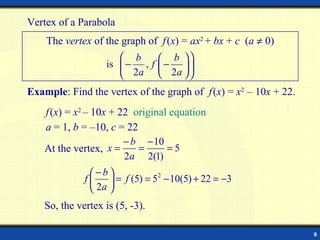
Vertex of a Parabola
    The vertex of the graph of f (x) = ax2 + bx + c (a ≠ 0)
                       b           b 
                   is  − ,      f − 
                       2a          2a  
Example: Find the vertex of the graph of f (x) = x2 – 10x + 22.
    f (x) = x2 – 10x + 22 original equation
    a = 1, b = –10, c = 22
                        − b − 10
    At the vertex, x =     =      =5
                        2a 2(1)
                −b
                     = f (5) = 5 − 10(5) + 22 = −3
                                 2
              f
                2a 
    So, the vertex is (5, -3).

                                                                  9
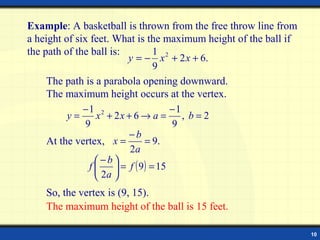
Example: A basketball is thrown from the free throw line from
a height of six feet. What is the maximum height of the ball if
the path of the ball is:           1 2
                          y = − x + 2 x + 6.
                                   9
     The path is a parabola opening downward.
     The maximum height occurs at the vertex.
              −1 2                     −1
          y=     x + 2x + 6 → a =         , b=2
               9                       9
                          −b
     At the vertex, x =         = 9.
                          2a
                  −b
                f     = f ( 9 ) = 15
                  2a 
    So, the vertex is (9, 15).
    The maximum height of the ball is 15 feet.

                                                                  10
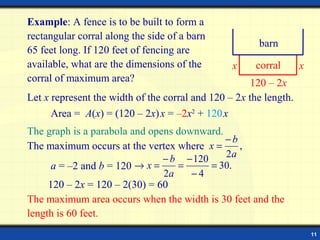
Example: A fence is to be built to form a
rectangular corral along the side of a barn
                                                       barn
65 feet long. If 120 feet of fencing are
available, what are the dimensions of the        x    corral       x
corral of maximum area?                               120 – 2x
Let x represent the width of the corral and 120 – 2x the length.
      Area = A(x) = (120 – 2x) x = –2x2 + 120 x
The graph is a parabola and opens downward.
                                            −b
The maximum occurs at the vertex where x =     ,
                               − b − 120    2a
      a = –2 and b = 120 → x =    =      = 30.
                               2a    −4
     120 – 2x = 120 – 2(30) = 60
The maximum area occurs when the width is 30 feet and the
length is 60 feet.
                                                                       11

Chapter 3

  • 1.
  • 2.
    Let a, b,and c be real numbers a ≠ 0. The function f (x) = ax2 + bx + c is called a quadratic function. The graph of a quadratic function is a parabola. Every parabola is symmetrical about a line called the axis (of symmetry). y The intersection point of the parabola and the axis is called the vertex of the f (x) = ax2 + bx + c parabola. vertex x axis 2
  • 3.
    The leading coefficientof ax2 + bx + c is a. y a>0 When the leading coefficient f(x) = ax2 + bx + c opens is positive, the parabola upward opens upward and the x vertex is a minimum. vertex minimum y x When the leading vertex maximum f(x) = ax2 + bx + c coefficient is negative, the parabola opens downward a<0 opens and the vertex is a maximum. downward 3
  • 4.
    The simplest quadraticfunctions are of the form f (x) = ax2 (a ≠ 0) These are most easily graphed by comparing them with the graph of y = x2. Example: Compare the graphs of 1 y = x 2, f ( x) = x 2 and g ( x) = 2 x 2 2 y = x2 y 1 2 5 g ( x) = 2 x 2 f ( x) = x 2 x -5 5 4
  • 5.
    Example: Graph f(x) = (x – 3)2 + 2 and find the vertex and axis. f (x) = (x – 3)2 + 2 is the same shape as the graph of g (x) = (x – 3)2 shifted upwards two units. g (x) = (x – 3)2 is the same shape as y = x2 shifted to the right three units. y f (x) = (x – 3)2 + 2 y = x2 g (x) = (x – 3)2 4 (3, 2) vertex x -4 4 5
  • 6.
    The standard formfor the equation of a quadratic function is: f (x) = a(x – h)2 + k (a ≠ 0) The graph is a parabola opening upward if a > 0 and opening downward if a < 0. The axis is x = h, and the vertex is (h, k). Example: Graph the parabola f (x) = 2x2 + 4x – 1 and find the axis and vertex. y 2 f (x) = 2x + 4x – 1 f (x) = 2x2 + 4x – 1 original equation f (x) = 2( x2 + 2x) – 1 factor out 2 f (x) = 2( x2 + 2x + 1) – 1 – 2 complete the square x f (x) = 2( x + 1)2 – 3 standard form a > 0 → parabola opens upward like y = 2x2. h = –1, k = –3 → axis x = –1, vertex (–1, –3). x = –1 (–1, –3) 6
  • 7.
    Example: Graph andfind the vertex and x-intercepts of f (x) = –x2 + 6x + 7. f (x) = – x2 + 6x + 7 original equation y (3, 16) f (x) = – ( x2 – 6x) + 7 factor out –1 f (x) = – ( x2 – 6x + 9) + 7 + 9 complete the square f (x) = – ( x – 3)2 + 16 standard form a < 0 → parabola opens downward. h = 3, k = 16 → axis x = 3, vertex (3, 16). 4 Find the x-intercepts by solving (–1, 0) (7, 0) x –x2 + 6x + 7 = 0. (–x + 7 )( x + 1) = 0 factor 4 x = 7, x = –1 x=3 f(x) = –x2 + 6x + 7 x-intercepts (7, 0), (–1, 0) 7
  • 8.
    Example: Find anequation for the parabola with vertex (2, –1) passing through the point (0, 1). y y = f(x) (0, 1) x (2, –1) f (x) = a(x – h)2 + k standard form f (x) = a(x – 2)2 + (–1) vertex (2, –1) = (h, k) Since (0, 1) is a point on the parabola: f (0) = a(0 – 2)2 – 1 1 1 = 4a –1 and a = 1 1 2 2 f ( x ) = ( x − 2) − 1 → f ( x ) = x − 2 x + 1 2 2 2 8
  • 9.
    Vertex of aParabola The vertex of the graph of f (x) = ax2 + bx + c (a ≠ 0)  b  b  is  − , f −   2a  2a   Example: Find the vertex of the graph of f (x) = x2 – 10x + 22. f (x) = x2 – 10x + 22 original equation a = 1, b = –10, c = 22 − b − 10 At the vertex, x = = =5 2a 2(1)  −b  = f (5) = 5 − 10(5) + 22 = −3 2 f  2a  So, the vertex is (5, -3). 9
  • 10.
    Example: A basketballis thrown from the free throw line from a height of six feet. What is the maximum height of the ball if the path of the ball is: 1 2 y = − x + 2 x + 6. 9 The path is a parabola opening downward. The maximum height occurs at the vertex. −1 2 −1 y= x + 2x + 6 → a = , b=2 9 9 −b At the vertex, x = = 9. 2a  −b f  = f ( 9 ) = 15  2a  So, the vertex is (9, 15). The maximum height of the ball is 15 feet. 10
  • 11.
    Example: A fenceis to be built to form a rectangular corral along the side of a barn barn 65 feet long. If 120 feet of fencing are available, what are the dimensions of the x corral x corral of maximum area? 120 – 2x Let x represent the width of the corral and 120 – 2x the length. Area = A(x) = (120 – 2x) x = –2x2 + 120 x The graph is a parabola and opens downward. −b The maximum occurs at the vertex where x = , − b − 120 2a a = –2 and b = 120 → x = = = 30. 2a −4 120 – 2x = 120 – 2(30) = 60 The maximum area occurs when the width is 30 feet and the length is 60 feet. 11