Graphing
Quadratic
Functions
y = ax2 + bx + c
Quadratic Functions
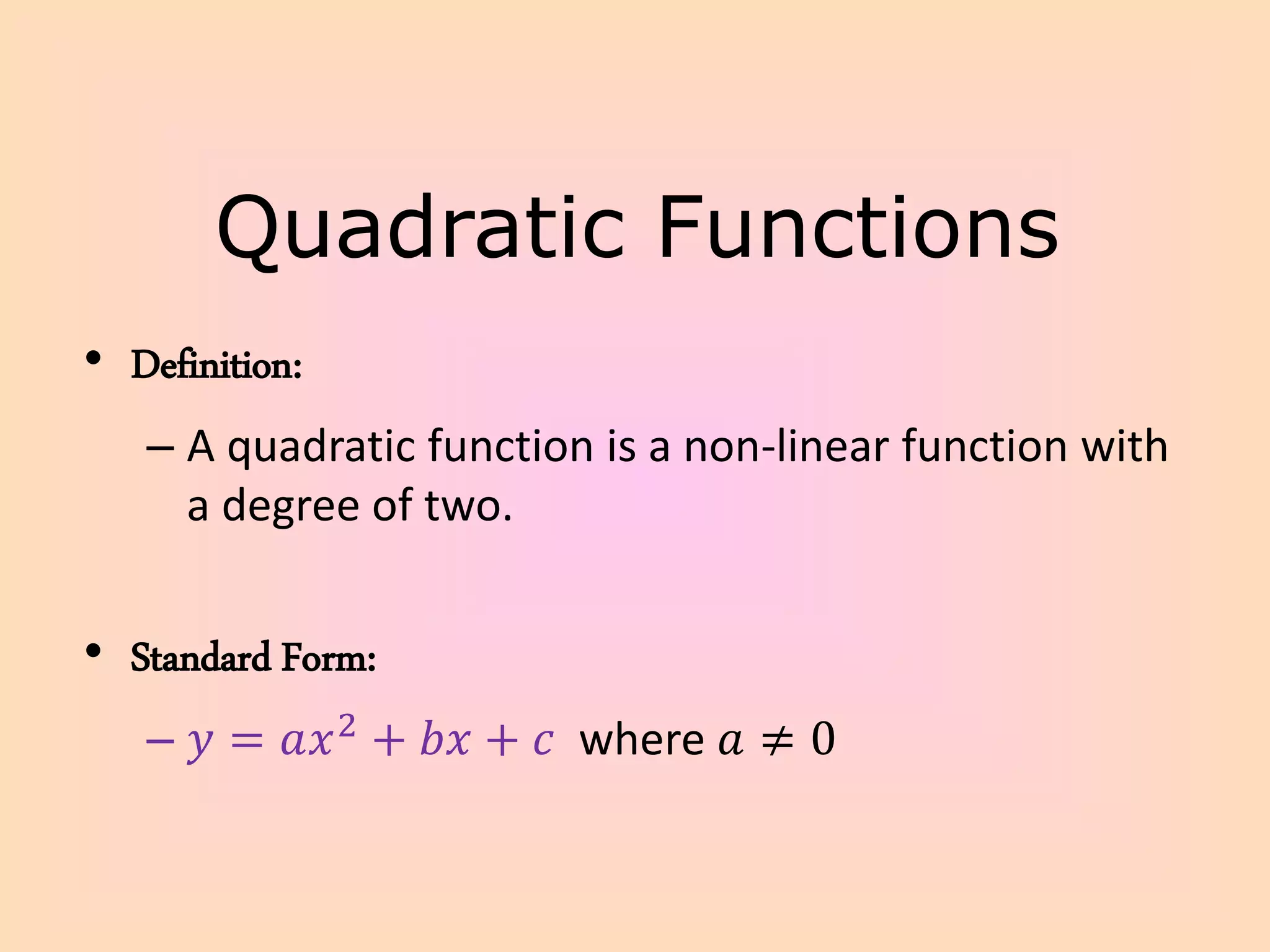
• Definition:
– A quadratic function is a non-linear function with
a degree of two.
• Standard Form:
– 𝑦 = 𝑎𝑥2 + 𝑏𝑥 + 𝑐 where 𝑎 ≠ 0
Graphs of Quadratics
The graph of a quadratic function
is a parabola.
A parabola can open up or down.
The “turning point” is called the
vertex.
If the parabola opens up, the
vertex is the lowest point and
called the minimum.
If the parabola opens down, the
vertex is the highest point and
called the maximum.
y
x
Vertex
Vertex
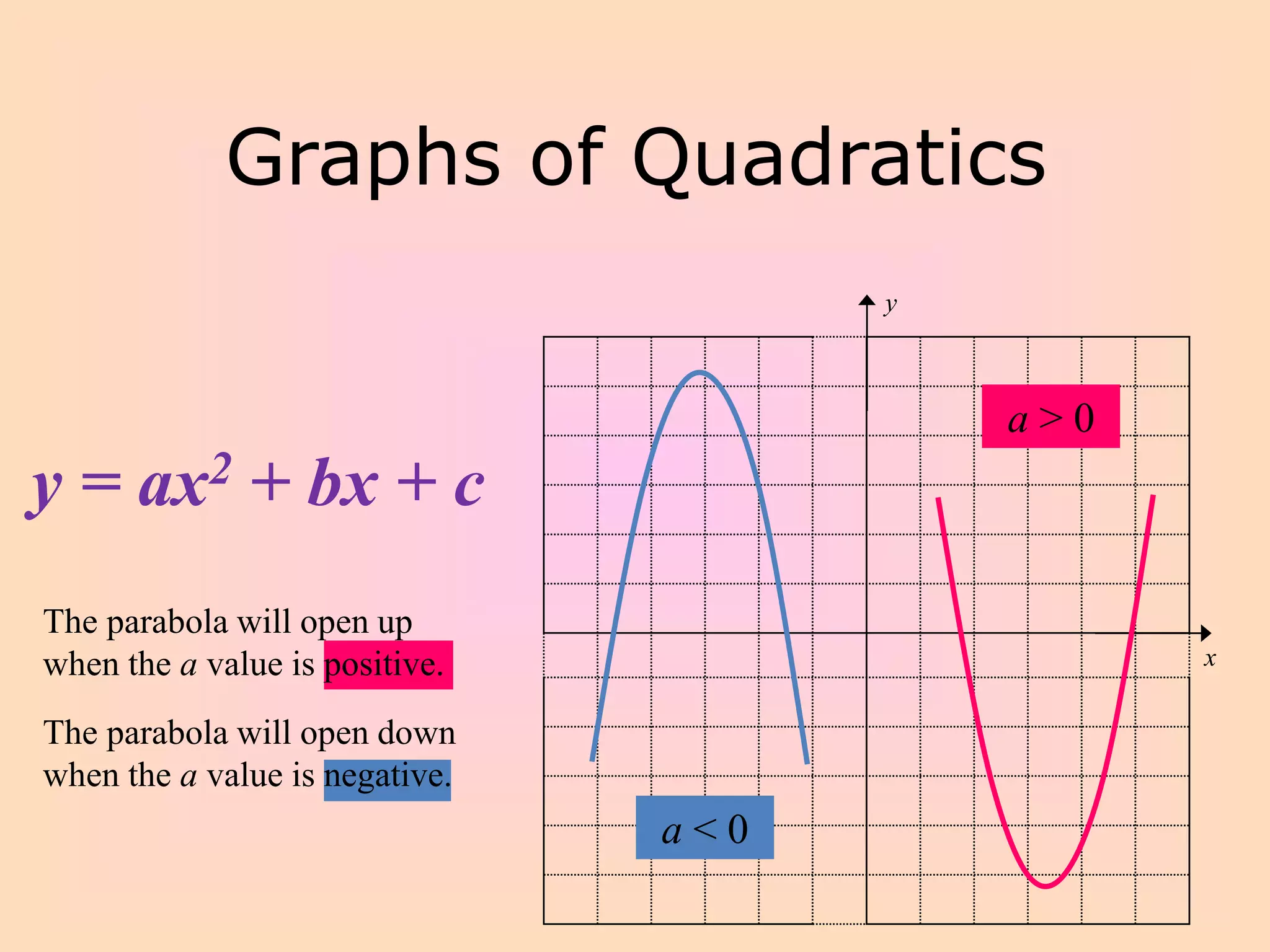
The parabola will open down
when the a value is negative.
The parabola will open up
when the a value is positive.
y
x
a > 0
a < 0
Graphs of Quadratics
y = ax2 + bx + c
y
x
Line of
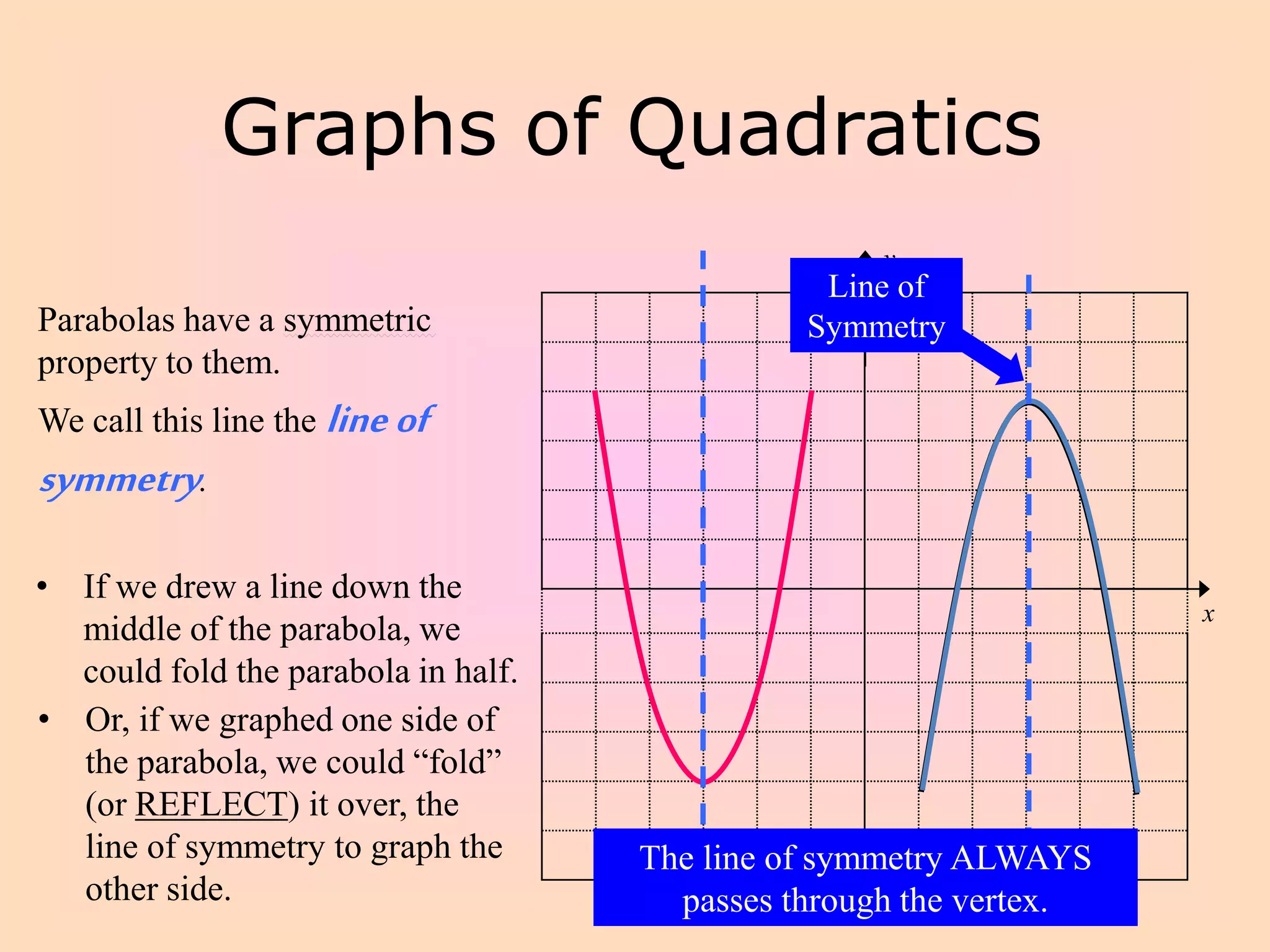
SymmetryParabolas have a symmetric
property to them.
• If we drew a line down the
middle of the parabola, we
could fold the parabola in half.
We call this line the lineof
symmetry.
The line of symmetry ALWAYS
passes through the vertex.
• Or, if we graphed one side of
the parabola, we could “fold”
(or REFLECT) it over, the
line of symmetry to graph the
other side.
Graphs of Quadratics
y
x
Y-Intercept
The y-intercept is where the
parabola will cross the y-axis.
Plug in 0 for x to solve!
In standard form, the y-intercept
is our “c” value!
Graphs of Quadratics
y
x
Use the
vertex to
find the
restriction!
Remember: Domain is the set
of all x-values for the function.
Range is the set of all y-values
for the function.
Are there any restrictions
on the domain?
Are there any restrictions on
the range?
Graphs of Quadratics
No! (−∞, ∞)
Yes! (−∞, 𝟑]
Find the line of symmetry of
y = 3x2 – 18x + 7
Finding the Line of
Symmetry
When a quadratic function is in
standard form
The equation ofthe line of
symmetryis:
y = ax2 + bx + c,
2
b
a
x 

For example…
Using the formula…
 
18
2 3
x 18
6
 3
Thus, the line of symmetry is x = 3.
Finding the
Vertex
We know the line of symmetry
always goes through the vertex.
Therefore, the line of symmetry
gives us the x – coordinate of
the vertex.
To find the y – coordinate of the
vertex, we need to plug the x –
value into the original equation.
STEP 1: Find the line of symmetry
STEP 2: Plug the x – value into the
original equation to find the y value.
y = –2x2 + 8x –3
8 8
2
2 2( 2) 4
b
a
x   
 
 
 
y = –2(2)2 + 8(2) –3
y = –2(4)+ 8(2) –3
y = –8+ 16 –3
y = 5
Therefore, the vertex is (2 , 5)
Graphing a Quadratic
There are 3 steps to graphing a
parabola in standard form…
STEP 1: Find the line of symmetry
STEP 2: Find the vertex
STEP 3: Graph at least four others points
using squares
STEP 1: Find the line of
symmetry
Example:
y = 2x2 – 4x – 1
( )
4
1
2 2 2
b
x
a
-
= = =
y
x
Thus the line of symmetry is x = 1
Graphing a Quadratic
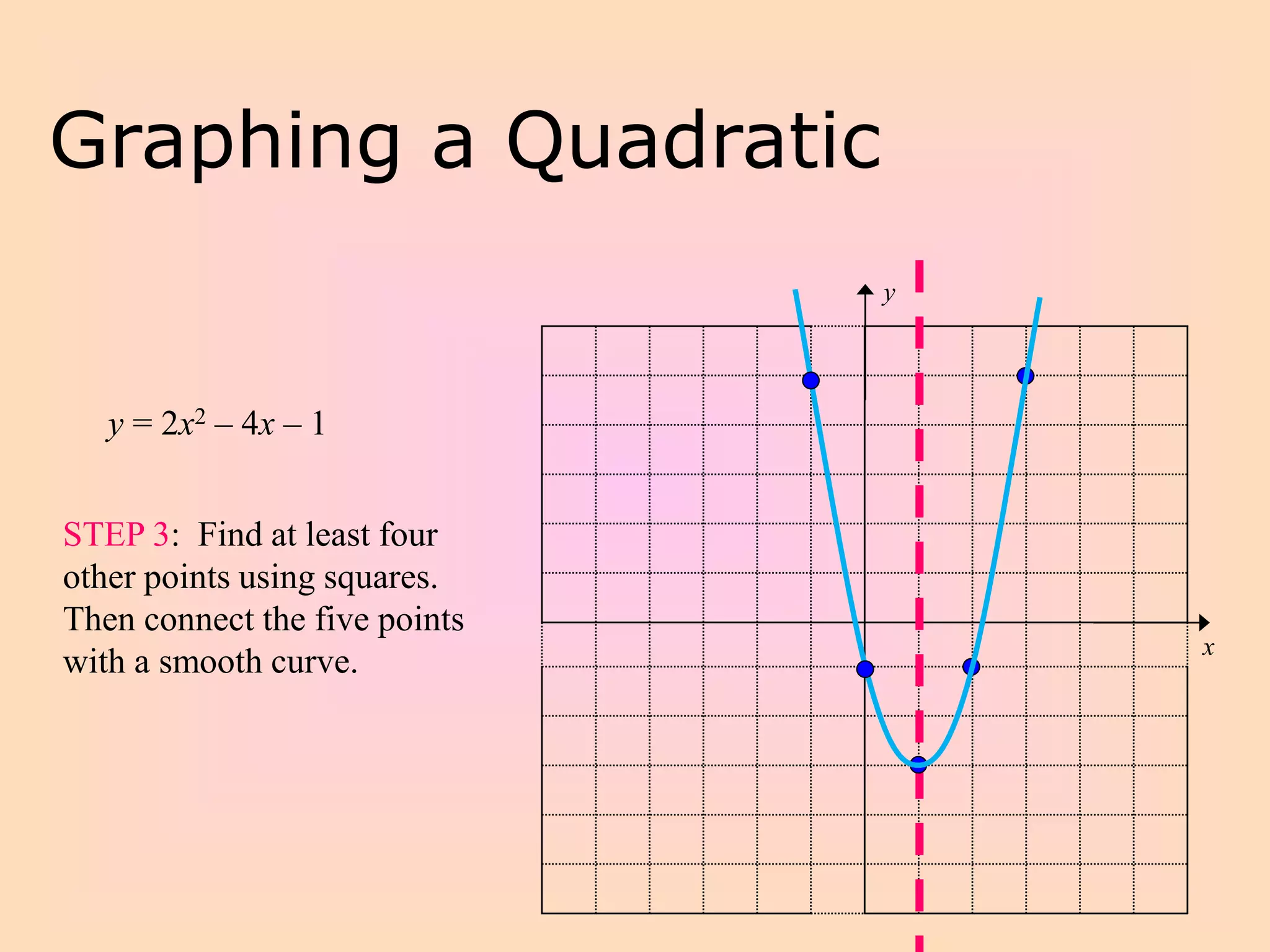
y = 2x2 – 4x – 1
STEP 2: Find the vertex
y
x
( ) ( )2
2 1 4 1 1 3y = - - = - Thus the vertex is (1 ,–3).
Since the x – value of the
vertex is given by the line of
symmetry, we need to plug
in x = 1 to find the y – value
of the vertex.
Graphing a Quadratic
y = 2x2 – 4x – 1
STEP 3: Find at least four
other points using squares.
Then connect the five points
with a smooth curve.
y
x
Graphing a Quadratic

Graphing Quadratic Functions in Standard Form

  • 1.
  • 2.
    Quadratic Functions • Definition: –A quadratic function is a non-linear function with a degree of two. • Standard Form: – 𝑦 = 𝑎𝑥2 + 𝑏𝑥 + 𝑐 where 𝑎 ≠ 0
  • 3.
    Graphs of Quadratics Thegraph of a quadratic function is a parabola. A parabola can open up or down. The “turning point” is called the vertex. If the parabola opens up, the vertex is the lowest point and called the minimum. If the parabola opens down, the vertex is the highest point and called the maximum. y x Vertex Vertex
  • 4.
    The parabola willopen down when the a value is negative. The parabola will open up when the a value is positive. y x a > 0 a < 0 Graphs of Quadratics y = ax2 + bx + c
  • 5.
    y x Line of SymmetryParabolas havea symmetric property to them. • If we drew a line down the middle of the parabola, we could fold the parabola in half. We call this line the lineof symmetry. The line of symmetry ALWAYS passes through the vertex. • Or, if we graphed one side of the parabola, we could “fold” (or REFLECT) it over, the line of symmetry to graph the other side. Graphs of Quadratics
  • 6.
    y x Y-Intercept The y-intercept iswhere the parabola will cross the y-axis. Plug in 0 for x to solve! In standard form, the y-intercept is our “c” value! Graphs of Quadratics
  • 7.
    y x Use the vertex to findthe restriction! Remember: Domain is the set of all x-values for the function. Range is the set of all y-values for the function. Are there any restrictions on the domain? Are there any restrictions on the range? Graphs of Quadratics No! (−∞, ∞) Yes! (−∞, 𝟑]
  • 8.
    Find the lineof symmetry of y = 3x2 – 18x + 7 Finding the Line of Symmetry When a quadratic function is in standard form The equation ofthe line of symmetryis: y = ax2 + bx + c, 2 b a x   For example… Using the formula…   18 2 3 x 18 6  3 Thus, the line of symmetry is x = 3.
  • 9.
    Finding the Vertex We knowthe line of symmetry always goes through the vertex. Therefore, the line of symmetry gives us the x – coordinate of the vertex. To find the y – coordinate of the vertex, we need to plug the x – value into the original equation. STEP 1: Find the line of symmetry STEP 2: Plug the x – value into the original equation to find the y value. y = –2x2 + 8x –3 8 8 2 2 2( 2) 4 b a x          y = –2(2)2 + 8(2) –3 y = –2(4)+ 8(2) –3 y = –8+ 16 –3 y = 5 Therefore, the vertex is (2 , 5)
  • 10.
    Graphing a Quadratic Thereare 3 steps to graphing a parabola in standard form… STEP 1: Find the line of symmetry STEP 2: Find the vertex STEP 3: Graph at least four others points using squares
  • 11.
    STEP 1: Findthe line of symmetry Example: y = 2x2 – 4x – 1 ( ) 4 1 2 2 2 b x a - = = = y x Thus the line of symmetry is x = 1 Graphing a Quadratic
  • 12.
    y = 2x2– 4x – 1 STEP 2: Find the vertex y x ( ) ( )2 2 1 4 1 1 3y = - - = - Thus the vertex is (1 ,–3). Since the x – value of the vertex is given by the line of symmetry, we need to plug in x = 1 to find the y – value of the vertex. Graphing a Quadratic
  • 13.
    y = 2x2– 4x – 1 STEP 3: Find at least four other points using squares. Then connect the five points with a smooth curve. y x Graphing a Quadratic