Mathematics 
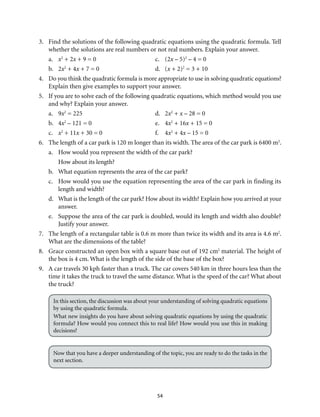
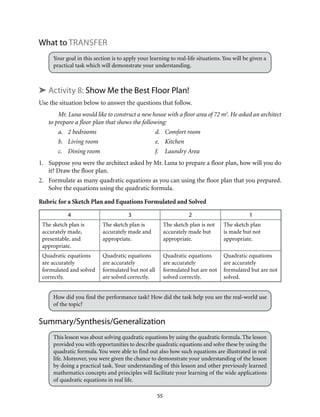
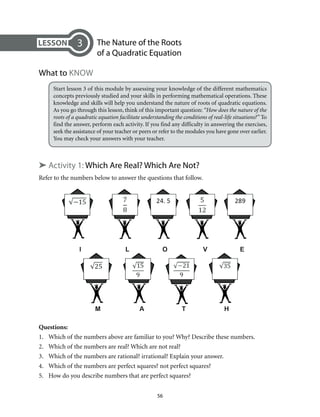
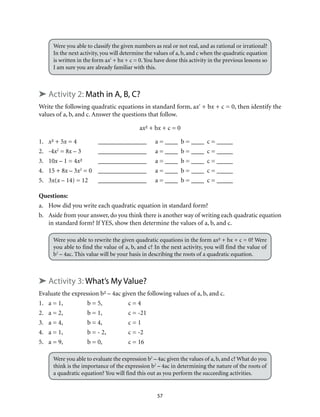
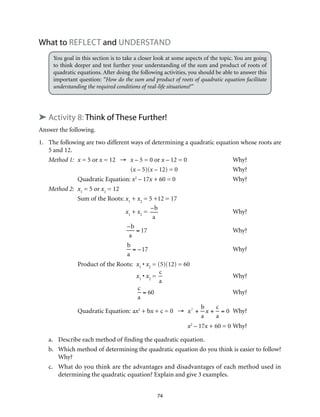
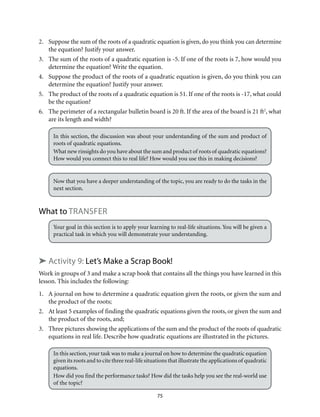
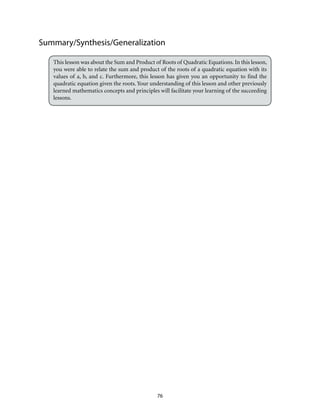
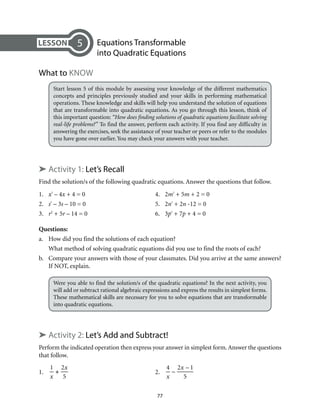
Learner’s Material 
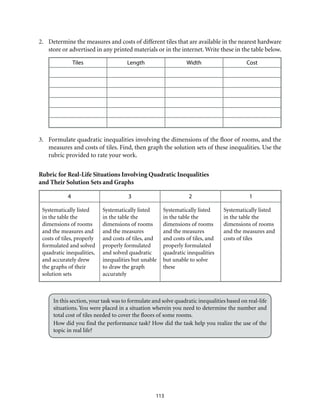
9 
Module 1: 
Quadratic Equations and 
Inequalities 
This instructional material was collaboratively developed and reviewed by 
educators from public and private schools, colleges, and/or universities. We encourage 
teachers and other education stakeholders to email their feedback, comments, and 
recommendations to the Department of Education at action@deped.gov.ph. 
We value your feedback and recommendations. 
Department of Education 
Republic of the Philippines
Math atics G a 9 
Learner’s Material 
First Edition, 2014 
ISBN: 978-971-9601-71-5 
Republic ct 8293, section 176 states that: No copyright shall subsist in any work of the 
Government of the Philippines. However, prior approval of the government agency or office 
wherein the work is created shall be necessary for exploitation of such work for profit. Such agency 
or office may, among other things, impose as a condition the payment of royalties. 
Borrowed materials (i.e., songs, stories, poems, pictures, photos, brand names, trade- marks, etc.) 
included in this book are owned by their respective copyright holders. DepEd is represented 
by the Filipinas Copyright Licensing Society (FILCOLS), Inc. in seeking permission to use these 
materials from their respective copyright owners. The publisher and authors do not represent nor 
claim ownership over them. 
Published by the Department of Education 
Secretary: Br. Armin A. Luistro FSC 
Undersecretary: Dina S. Ocampo, PhD 
Development eam of the Learner’s Material 
Authors: Merden L. Bryant, Leonides E. Bulalayao, Melvin M. Callanta, Jerry D. Cruz, Richard F. 
De Vera, Gilda T. Garcia, Sonia E. Javier, Roselle A. Lazaro, Bernadeth J. Mesterio, and 
Rommel Hero A. Saladino 
Consultants: Rosemarievic Villena-Diaz, PhD, Ian June L. Garces, PhD, Alex C. Gonzaga, PhD, and 
Soledad A. Ulep, PhD 
Editor: Debbie Marie B. Versoza, PhD 
Reviewers: Alma D. Angeles, Elino S. Garcia, Guiliver Eduard L. Van Zandt, Arlene A. Pascasio, PhD, 
and Debbie Marie B. Versoza, PhD 
Book Designer: Leonardo C. Rosete, Visual Communication Department, UP College of Fine Arts 
Management Team: Dir. Jocelyn DR. Andaya, Jose D. Tuguinayo Jr., Elizabeth G. Catao, Maribel S. 
Perez, and Nicanor M. San Gabriel Jr. 
Printed in the Philippines by Vibal Group, nc. 
Department of Education-Instructional Materials Council Secretariat (DepEd-IMCS) 
Office Address: 5th Floor Mabini Building, DepEd Complex 
Meralco Avenue, Pasig City, Philippines 1600 
Telefax: (02) 634-1054 o 634-1072 
E-mail Address: imcsetd@yahoo.com
Table of Contents 
Module 1. Quadratic Equations and inequalities ............................................................. 1 
Module Map .................................................................................................................................. 3 
Pre-Assessment ............................................................................................................................ 4 
Learning Goals and Targets ...................................................................................................... 10 
Lesson I. Illustrations of Quadratic Equations ................................................................... 11 
Lesson 2A. Solving Quadratic Equations by Extracting Square Roots ..................... 18 
Lesson 2B. Solving Quadratic Equations by Factoring ................................................... 27 
Lesson 2C. Solving Quadratic Equations by Completing the Square ....................... 35 
Lesson 2D. Solving Quadratic Equations by Using the Quadratic Formula ............ 47 
Lesson 3. The Nature of the Roots of a Quadratic Equation ......................................... 56 
Lesson 4. The Sum and the Product of Roots of Quadratic Equations ..................... 66 
Lesson 5. Equations Transformable into Quadratic Equations .................................... 77 
Lesson 6. Solving Problems Involving Quadratic Equations ........................................ 88 
Lesson 7. Quadratic Inequalities ............................................................................................ 96 
Glossary of Terms ......................................................................................................................... 114 
References and Websites Links Used in this Module ...................................................... 115
MODULE 1 
Quadratic Equations 
and Inequalities 
I. INTRODUCTION AND FOCUS QUESTIONS 
Was there any point in your life when you asked yourself about the different real-life quantities 
such as costs of goods or services, incomes, profits, yields and losses, amount of particular things, 
speed, area, and many others? Have you ever realized that these quantities can be mathematically 
represented to come up with practical decisions? 
Find out the answers to these questions and determine the vast applications of quadratic 
equations and quadratic inequalities through this module. 
1
II. LESSONS AND COVERAGE 
In this module, you will examine the above questions when you take the following lessons: 
Lesson 1 – ILLUSTRATIONS OF QUADRATIC EQUATIONS 
Lesson 2 – SOLVING QUADRATIC EQUATIONS 
EXTRACTING SQUARE ROOTS 
FACTORING 
COMPLETING THE SQUARE 
QUADRATIC FORMULA 
Lesson 3 – NATURE OF ROOTS OF QUADRATIC EQUATIONS 
Lesson 4 – SUM AND PRODUCT OF ROOTS OF QUADRATIC EQUATIONS 
Lesson 5 – EQUATIONS TRANSFORMABLE INTO QUADRATIC EQUATIONS 
(INCLUDING RATIONAL ALGEBRAIC EQUATIONS) 
Lesson 6 – APPLICATIONS OF QUADRATIC EQUATIONS AND RATIONAL ALGEBRAIC 
2 
EQUATIONS 
Lesson 7 – QUADRATIC INEQUALITIES 
Objectives 
In these lessons, you will learn to: 
Lesson 1 • illustrate quadratic equations; 
Lesson 2 • solve quadratic equations by: (a) extracting square roots; (b) factoring; (c) 
completing the square; (d) using the quadratic formula; 
Lesson 3 • characterize the roots of a quadratic equation using the discriminant; 
Lesson 4 • describe the relationship between the coefficients and the roots of a quadratic 
equation; 
Lesson 5 • solve equations transformable into quadratic equations (including rational 
algebraic equations); 
Lesson 6 • solve problems involving quadratic equations and rational algebraic equations; 
Lesson 7 
• illustrate quadratic inequalities; 
• solve quadratic inequalities; and 
• solve problems involving quadratic inequalities.
Module Map 
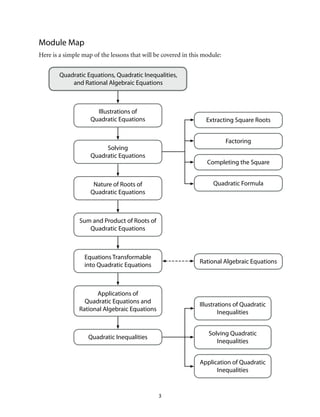
Here is a simple map of the lessons that will be covered in this module: 
Quadratic Equations, Quadratic Inequalities, 
and Rational Algebraic Equations 
3 
Illustrations of 
Quadratic Equations 
Solving 
Quadratic Equations 
Extracting Square Roots 
Factoring 
Completing the Square 
Quadratic Formula 
Illustrations of Quadratic 
Inequalities 
Solving Quadratic 
Inequalities 
Application of Quadratic 
Inequalities 
Nature of Roots of 
Quadratic Equations 
Sum and Product of Roots of 
Quadratic Equations 
Equations Transformable 
into Quadratic Equations 
Applications of 
Quadratic Equations and 
Rational Algebraic Equations 
Quadratic Inequalities 
Rational Algebraic Equations
4 
III. PRE-ASSESSMENT 
Part I 
Directions: Find out how much you already know about this module. Choose the letter that you 
think best answers the question. Please answer all items. Take note of the items that you were 
not able to answer correctly and find the right answer as you go through this module. 
1. It is a polynomial equation of degree two that can be written in the form ax2 + bx + c = 0, 
where a, b, and c are real numbers and a ≠ 0. 
A. Linear Equation C. Quadratic Equation 
B. Linear Inequality D. Quadratic Inequality 
2. Which of the following is a quadratic equation? 
A. 2r2 + 4r – 1 C. s2 + 5s – 4 = 0 
B. 3t – 7 = 2 D. 2x2 – 7x ≥ 3 
3. In the quadratic equation 3x2 + 7x – 4 = 0, which is the quadratic term? 
A. x2 C. 3x2 
B. 7x D. –4 
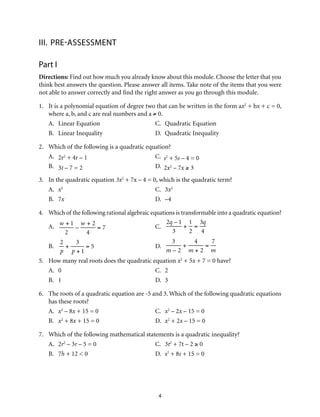
4. Which of the following rational algebraic equations is transformable into a quadratic equation? 
A. 
w + 1 
2 
– 
w + 2 
4 
= 7 C. 
2q – 1 
3 
+ 
1 
2 
= 
3q 
4 
B. 
2 
p 
+ 
3 
p + 1 
= 5 D. 
3 
m – 2 
+ 
4 
m + 2 
= 
7 
m 
5. How many real roots does the quadratic equation x2 + 5x + 7 = 0 have? 
A. 0 C. 2 
B. 1 D. 3 
6. The roots of a quadratic equation are -5 and 3. Which of the following quadratic equations 
has these roots? 
A. x2 – 8x + 15 = 0 C. x2 – 2x – 15 = 0 
B. x2 + 8x + 15 = 0 D. x2 + 2x – 15 = 0 
7. Which of the following mathematical statements is a quadratic inequality? 
A. 2r2 – 3r – 5 = 0 C. 3t2 + 7t – 2 ≥ 0 
B. 7h + 12 < 0 D. s2 + 8s + 15 = 0
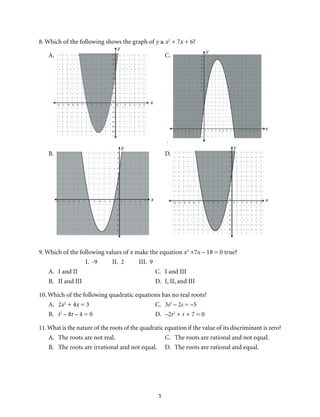
8. Which of the following shows the graph of y ≥ x2 + 7x + 6? 
A. C. 
B. D. 
9. Which of the following values of x make the equation x2 +7x – 18 = 0 true? 
5 
I. -9 II. 2 III. 9 
A. I and II C. I and III 
B. II and III D. I, II, and III 
10. Which of the following quadratic equations has no real roots? 
A. 2x2 + 4x = 3 C. 3s2 – 2s = –5 
B. t2 – 8t – 4 = 0 D. –2r2 + r + 7 = 0 
11. What is the nature of the roots of the quadratic equation if the value of its discriminant is zero? 
A. The roots are not real. C. The roots are rational and not equal. 
B. The roots are irrational and not equal. D. The roots are rational and equal.
12. One of the roots of 2x2 – 13x + 20 = 0 is 4. What is the other root? 
6 
A. 
– 
2 
5 
C. 
2 
5 
B. 
– 
5 
2 
D. 
5 
2 
13. What are the roots of the quadratic equation x2 + x – 56 = 0? 
A. 2 and -1 C. -8 and 7 
B. 8 and -7 D. 3 and -2 
14. What is the sum of the roots of the quadratic equation x2 + 6x – 14 = 0? 
A. -7 C. -3 
B. -6 D. 14 
15. Which of the following quadratic equations can be solved easily by extracting square roots? 
A. x2 + 7x + 12 = 0 C. 4t2 – 9 = 0 
B. 2w2 + 7w – 3 = 0 D. 3v2 + 2v – 8 = 0 
16. Which of the following coordinates of points belong to the solution set of the inequality 
y < 2x2 + 5x – 1? 
A. (-3, 2) C. (1, 6) 
B. (-2, 9) D. (3, 1) 
17. A 3 cm by 3 cm square piece of cardboard was cut from a bigger square cardboard. The area 
of the remaining cardboard was 40 cm2. If s represents the length of the bigger cardboard, 
which of the following expressions give the area of the remaining piece? 
A. s – 9 C. s2 – 9 
B. s2 + 9 D. s2 + 40 
18. The length of a wall is 12 m more than its width. If the area of the wall is less than 50 m2, 
which of the following could be its length? 
A. 3 m C. 15 m 
B. 4 m D. 16 m 
19. The length of a garden is 5 m longer than its width and the area is 14 m2. How long is the 
garden? 
A. 9 m C. 5 m 
B. 7 m D. 2 m
20. A car travels 20 kph faster than a truck. The car covers 480 km in two hours less than the 
time it takes the truck to travel the same distance. How fast does the car travel? 
A. 44 kph C. 80 kph 
B. 60 kph D. 140 kph 
21. A 12 cm by 16 cm picture is mounted with border of uniform width on a rectangular frame. 
If the total area of the border is 288 cm2, what is the length of the side of the frame? 
A. 8 cm C. 20 cm 
B. 16 cm D. 24 cm 
22. SamSon Electronics Company would like to come up with an LED TV such that its screen is 
560 square inches larger than the present ones. Suppose the length of the screen of the larger 
TV is 6 inches longer than its width and the area of the smaller TV is 520 square inches. What 
is the length of the screen of the larger LED TV? 
A. 26 in C. 33 in 
B. 30 in D. 36 in 
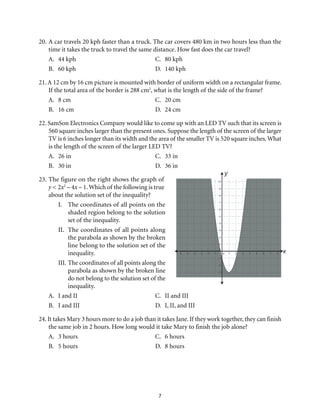
23. The figure on the right shows the graph of 
y < 2x2 – 4x – 1. Which of the following is true 
about the solution set of the inequality? 
I. The coordinates of all points on the 
shaded region belong to the solution 
set of the inequality. 
II. The coordinates of all points along 
the parabola as shown by the broken 
line belong to the solution set of the 
inequality. 
III. The coordinates of all points along the 
parabola as shown by the broken line 
do not belong to the solution set of the 
inequality. 
A. I and II C. II and III 
B. I and III D. I, II, and III 
24. It takes Mary 3 hours more to do a job than it takes Jane. If they work together, they can finish 
the same job in 2 hours. How long would it take Mary to finish the job alone? 
A. 3 hours C. 6 hours 
B. 5 hours D. 8 hours 
7
25. An open box is to be formed out of a rectangular piece of cardboard whose length is 12 cm 
longer than its width. To form the box, a square of side 5 cm will be removed from each 
corner of the cardboard. Then the edges of the remaining cardboard will be turned up. If 
the box is to hold at most 1900 cm3, what mathematical statement would represent the given 
situation? 
A. x2 – 12x ≤ 360 C. x2 – 8x ≤ 400 
B. x2 – 12x ≤ 380 D. x2 + 8x ≤ 400 
26. The length of a garden is 2 m more than twice its width and its area is 24 m2. Which of the 
following equations represents the given situation? 
A. x2 + x = 12 C. x2 + x = 24 
B. x2 + 2x = 12 D. x2 + 2x = 24 
27. From 2004 through 2012, the average weekly income of an employee in a certain company is 
estimated by the quadratic expression 0.16n2 + 5.44n + 2240, where n is the number of years 
after 2004. In what year was the average weekly income of an employee equal to Php2,271.20? 
A. 2007 C. 2009 
B. 2008 D. 2010 
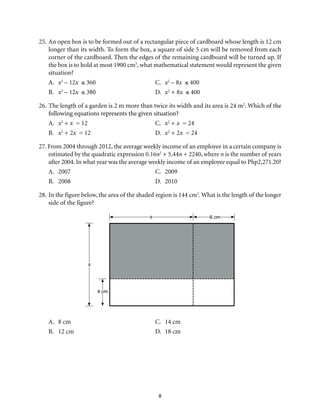
28. In the figure below, the area of the shaded region is 144 cm2. What is the length of the longer 
8 
side of the figure? 
s 
4 cm 
s 6 cm 
A. 8 cm C. 14 cm 
B. 12 cm D. 18 cm
Part II 
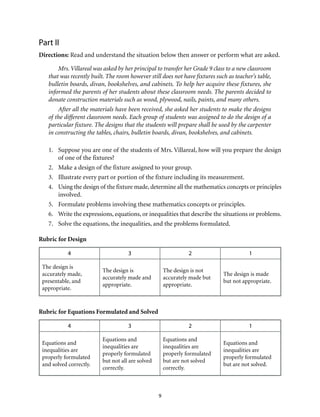
Directions: Read and understand the situation below then answer or perform what are asked. 
Mrs. Villareal was asked by her principal to transfer her Grade 9 class to a new classroom 
that was recently built. The room however still does not have fixtures such as teacher’s table, 
bulletin boards, divan, bookshelves, and cabinets. To help her acquire these fixtures, she 
informed the parents of her students about these classroom needs. The parents decided to 
donate construction materials such as wood, plywood, nails, paints, and many others. 
After all the materials have been received, she asked her students to make the designs 
of the different classroom needs. Each group of students was assigned to do the design of a 
particular fixture. The designs that the students will prepare shall be used by the carpenter 
in constructing the tables, chairs, bulletin boards, divan, bookshelves, and cabinets. 
1. Suppose you are one of the students of Mrs. Villareal, how will you prepare the design 
9 
of one of the fixtures? 
2. Make a design of the fixture assigned to your group. 
3. Illustrate every part or portion of the fixture including its measurement. 
4. Using the design of the fixture made, determine all the mathematics concepts or principles 
involved. 
5. Formulate problems involving these mathematics concepts or principles. 
6. Write the expressions, equations, or inequalities that describe the situations or problems. 
7. Solve the equations, the inequalities, and the problems formulated. 
Rubric for Design 
4 3 2 1 
The design is 
accurately made, 
presentable, and 
appropriate. 
The design is 
accurately made and 
appropriate. 
The design is not 
accurately made but 
appropriate. 
The design is made 
but not appropriate. 
Rubric for Equations Formulated and Solved 
4 3 2 1 
Equations and 
inequalities are 
properly formulated 
and solved correctly. 
Equations and 
inequalities are 
properly formulated 
but not all are solved 
correctly. 
Equations and 
inequalities are 
properly formulated 
but are not solved 
correctly. 
Equations and 
inequalities are 
properly formulated 
but are not solved.
10 
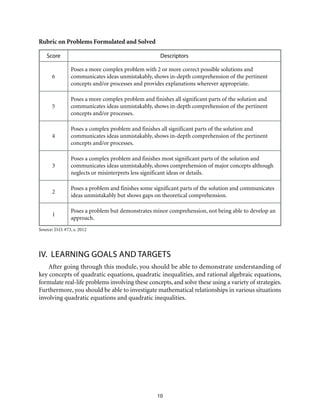
Rubric on Problems Formulated and Solved 
Score Descriptors 
6 
Poses a more complex problem with 2 or more correct possible solutions and 
communicates ideas unmistakably, shows in-depth comprehension of the pertinent 
concepts and/or processes and provides explanations wherever appropriate. 
5 
Poses a more complex problem and finishes all significant parts of the solution and 
communicates ideas unmistakably, shows in-depth comprehension of the pertinent 
concepts and/or processes. 
4 
Poses a complex problem and finishes all significant parts of the solution and 
communicates ideas unmistakably, shows in-depth comprehension of the pertinent 
concepts and/or processes. 
3 
Poses a complex problem and finishes most significant parts of the solution and 
communicates ideas unmistakably, shows comprehension of major concepts although 
neglects or misinterprets less significant ideas or details. 
2 
Poses a problem and finishes some significant parts of the solution and communicates 
ideas unmistakably but shows gaps on theoretical comprehension. 
1 
Poses a problem but demonstrates minor comprehension, not being able to develop an 
approach. 
Source: D.O. #73, s. 2012 
IV. LEARNING GOALS AND TARGETS 
After going through this module, you should be able to demonstrate understanding of 
key concepts of quadratic equations, quadratic inequalities, and rational algebraic equations, 
formulate real-life problems involving these concepts, and solve these using a variety of strategies. 
Furthermore, you should be able to investigate mathematical relationships in various situations 
involving quadratic equations and quadratic inequalities.
Illustrations of Quadratic Equations 
11 
1 
What to Know 
Start Lesson 1 of this module by assessing your knowledge of the different mathematics 
concepts previously studied and your skills in performing mathematical operations. These 
knowledge and skills will help you understand quadratic equations. As you go through this 
lesson, think of this important question: “How are quadratic equations used in solving real-life 
problems and in making decisions?” To find the answer, perform each activity. If you find 
any difficulty in answering the exercises, seek the assistance of your teacher or peers or refer 
to the modules you have gone over earlier. You may check your work with your teacher. 
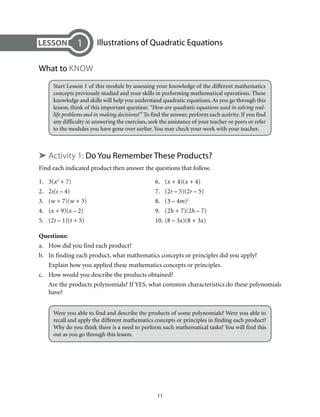
➤ Activity 1: Do You Remember These Products? 
Find each indicated product then answer the questions that follow. 
1. 3(x2 + 7) 6. (x + 4)(x + 4) 
2. 2s(s – 4) 7. (2r – 5)(2r – 5) 
3. (w + 7)(w + 3) 8. (3 – 4m)2 
4. (x + 9)(x – 2) 9. (2h + 7)(2h – 7) 
5. (2t – 1)(t + 5) 10. (8 – 3x)(8 + 3x) 
Questions: 
a. How did you find each product? 
b. In finding each product, what mathematics concepts or principles did you apply? 
Explain how you applied these mathematics concepts or principles. 
c. How would you describe the products obtained? 
Are the products polynomials? If YES, what common characteristics do these polynomials 
have? 
Were you able to find and describe the products of some polynomials? Were you able to 
recall and apply the different mathematics concepts or principles in finding each product? 
Why do you think there is a need to perform such mathematical tasks? You will find this 
out as you go through this lesson.
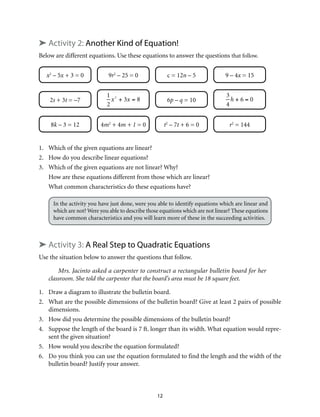
➤ Activity 2: Another Kind of Equation! 
Below are different equations. Use these equations to answer the questions that follow. 
x2 – 5x + 3 = 0 9r2 – 25 = 0 c = 12n – 5 9 – 4x = 15 
2s + 3t = –7 6p – q = 10 
12 
1 
2 
x2 + 3x = 8 
3 
4 
h + 6 = 0 
8k – 3 = 12 4m2 + 4m + 1 = 0 t2 – 7t + 6 = 0 r2 = 144 
1. Which of the given equations are linear? 
2. How do you describe linear equations? 
3. Which of the given equations are not linear? Why? 
How are these equations different from those which are linear? 
What common characteristics do these equations have? 
In the activity you have just done, were you able to identify equations which are linear and 
which are not? Were you able to describe those equations which are not linear? These equations 
have common characteristics and you will learn more of these in the succeeding activities. 
➤ Activity 3: A Real Step to Quadratic Equations 
Use the situation below to answer the questions that follow. 
Mrs. Jacinto asked a carpenter to construct a rectangular bulletin board for her 
classroom. She told the carpenter that the board’s area must be 18 square feet. 
1. Draw a diagram to illustrate the bulletin board. 
2. What are the possible dimensions of the bulletin board? Give at least 2 pairs of possible 
dimensions. 
3. How did you determine the possible dimensions of the bulletin board? 
4. Suppose the length of the board is 7 ft. longer than its width. What equation would repre-sent 
the given situation? 
5. How would you describe the equation formulated? 
6. Do you think you can use the equation formulated to find the length and the width of the 
bulletin board? Justify your answer.
How did you find the preceding activities? Are you ready to learn about quadratic equations? 
I’m sure you are!!! From the activities done, you were able to describe equations other than 
linear equations, and these are quadratic equations. You were able to find out how a particular 
quadratic equation is illustrated in real life. But how are quadratic equations used in solving 
real-life problems and in making decisions? You will find these out in the activities in the 
next section. Before doing these activities, read and understand first some important notes 
on quadratic equations and the examples presented. 
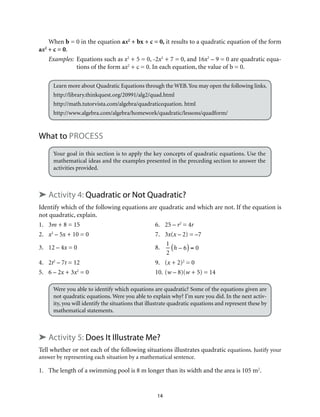
A quadratic equation in one variable is a mathematical sentence 
of degree 2 that can be written in the following standard form. 
ax2 + bx + c = 0, where a, b, and c are real numbers and a ≠ 0 
Why do you think a 
must not be equal to 
zero in the equation 
ax2 + bx + c = 0? 
In the equation, ax2 is the quadratic term, bx is the linear term, and c is the constant term. 
Example 1: 2x2 + 5x – 3 = 0 is a quadratic equation in standard form with a = 2, b = 5, and 
13 
c = -3. 
Example 2: 3x(x – 2) = 10 is a quadratic equation. However, it is not written in standard 
form. 
To write the equation in standard form, expand the product and make one side 
of the equation zero as shown below. 
3x(x – 2) = 10 → 3x2 – 6x = 10 
3x2 – 6x – 10 = 10 – 10 
3x2 – 6x – 10 = 0 
The equation becomes 3x2 – 6x – 10 = 0, which is in standard form. 
In the equation 3x2 – 6x – 10 = 0, a = 3, b = -6, and c = -10. 
Example 3: The equation (2x + 5)(x – 1) = -6 is also a quadratic equation but it is not written 
in standard form. 
Just like in Example 2, the equation (2x + 5)(x – 1) = -6 can be written in standard 
form by expanding the product and making one side of the equation zero as 
shown below. 
(2x + 5)(x – 1) = –6 → 2x2 – 2x + 5x – 5 = –6 
2x2 + 3x – 5 = –6 
2x2 + 3x – 5 + 6 = –6 + 6 
2x2 + 3x + 1 = 0 
The equation becomes 2x2 + 3x + 1 = 0, which is in standard form. 
In the equation 2x2 + 3x + 1 = 0, a = 2, b = 3, and c = 1.
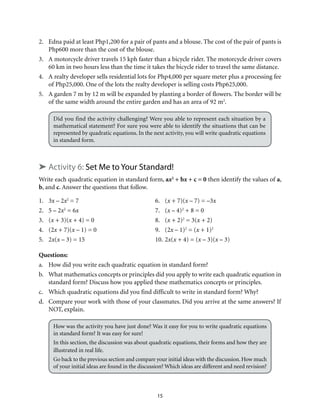
When b = 0 in the equation ax2 + bx + c = 0, it results to a quadratic equation of the form 
14 
ax2 + c = 0. 
Examples: Equations such as x2 + 5 = 0, -2x2 + 7 = 0, and 16x2 – 9 = 0 are quadratic equa-tions 
of the form ax2 + c = 0. In each equation, the value of b = 0. 
Learn more about Quadratic Equations through the WEB. You may open the following links. 
http://library.thinkquest.org/20991/alg2/quad.html 
http://math.tutorvista.com/algebra/quadraticequation. html 
http://www.algebra.com/algebra/homework/quadratic/lessons/quadform/ 
What to process 
Your goal in this section is to apply the key concepts of quadratic equations. Use the 
mathematical ideas and the examples presented in the preceding section to answer the 
activities provided. 
➤ Activity 4: Quadratic or Not Quadratic? 
Identify which of the following equations are quadratic and which are not. If the equation is 
not quadratic, explain. 
1. 3m + 8 = 15 6. 25 – r2 = 4r 
2. x2 – 5x + 10 = 0 7. 3x(x – 2) = –7 
3. 12 – 4x = 0 8. 
1 
2 
(h – 6) = 0 
4. 2t2 – 7t = 12 9. (x + 2)2 = 0 
5. 6 – 2x + 3x2 = 0 10. (w – 8)(w + 5) = 14 
Were you able to identify which equations are quadratic? Some of the equations given are 
not quadratic equations. Were you able to explain why? I’m sure you did. In the next activ-ity, 
you will identify the situations that illustrate quadratic equations and represent these by 
mathematical statements. 
➤ Activity 5: Does It Illustrate Me? 
Tell whether or not each of the following situations illustrates quadratic equations. Justify your 
answer by representing each situation by a mathematical sentence. 
1. The length of a swimming pool is 8 m longer than its width and the area is 105 m2.
2. Edna paid at least Php1,200 for a pair of pants and a blouse. The cost of the pair of pants is 
15 
Php600 more than the cost of the blouse. 
3. A motorcycle driver travels 15 kph faster than a bicycle rider. The motorcycle driver covers 
60 km in two hours less than the time it takes the bicycle rider to travel the same distance. 
4. A realty developer sells residential lots for Php4,000 per square meter plus a processing fee 
of Php25,000. One of the lots the realty developer is selling costs Php625,000. 
5. A garden 7 m by 12 m will be expanded by planting a border of flowers. The border will be 
of the same width around the entire garden and has an area of 92 m2. 
Did you find the activity challenging? Were you able to represent each situation by a 
mathematical statement? For sure you were able to identify the situations that can be 
represented by quadratic equations. In the next activity, you will write quadratic equations 
in standard form. 
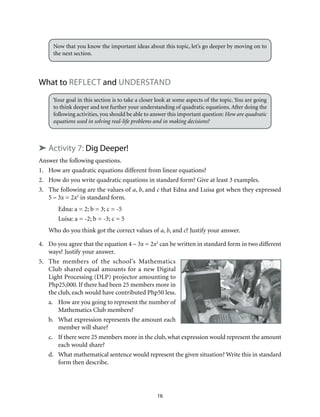
➤ Activity 6: Set Me to Your Standard! 
Write each quadratic equation in standard form, ax2 + bx + c = 0 then identify the values of a, 
b, and c. Answer the questions that follow. 
1. 3x – 2x2 = 7 6. (x + 7)(x – 7) = –3x 
2. 5 – 2x2 = 6x 7. (x – 4)2 + 8 = 0 
3. (x + 3)(x + 4) = 0 8. (x + 2)2 = 3(x + 2) 
4. (2x + 7)(x – 1) = 0 9. (2x – 1)2 = (x + 1)2 
5. 2x(x – 3) = 15 10. 2x(x + 4) = (x – 3)(x – 3) 
Questions: 
a. How did you write each quadratic equation in standard form? 
b. What mathematics concepts or principles did you apply to write each quadratic equation in 
standard form? Discuss how you applied these mathematics concepts or principles. 
c. Which quadratic equations did you find difficult to write in standard form? Why? 
d. Compare your work with those of your classmates. Did you arrive at the same answers? If 
NOT, explain. 
How was the activity you have just done? Was it easy for you to write quadratic equations 
in standard form? It was easy for sure! 
In this section, the discussion was about quadratic equations, their forms and how they are 
illustrated in real life. 
Go back to the previous section and compare your initial ideas with the discussion. How much 
of your initial ideas are found in the discussion? Which ideas are different and need revision?
Now that you know the important ideas about this topic, let’s go deeper by moving on to 
the next section. 
What to Reflect and understand 
Your goal in this section is to take a closer look at some aspects of the topic. You are going 
to think deeper and test further your understanding of quadratic equations. After doing the 
following activities, you should be able to answer this important question: How are quadratic 
equations used in solving real-life problems and in making decisions? 
➤ Activity 7: Dig Deeper! 
Answer the following questions. 
1. How are quadratic equations different from linear equations? 
2. How do you write quadratic equations in standard form? Give at least 3 examples. 
3. The following are the values of a, b, and c that Edna and Luisa got when they expressed 
16 
5 – 3x = 2x2 in standard form. 
Edna: a = 2; b = 3; c = -5 
Luisa: a = -2; b = -3; c = 5 
Who do you think got the correct values of a, b, and c? Justify your answer. 
4. Do you agree that the equation 4 – 3x = 2x2 can be written in standard form in two different 
ways? Justify your answer. 
5. The members of the school’s Mathematics 
Club shared equal amounts for a new Digital 
Light Processing (DLP) projector amounting to 
Php25,000. If there had been 25 members more in 
the club, each would have contributed Php50 less. 
a. How are you going to represent the number of 
Mathematics Club members? 
b. What expression represents the amount each 
member will share? 
c. If there were 25 members more in the club, what expression would represent the amount 
each would share? 
d. What mathematical sentence would represent the given situation? Write this in standard 
form then describe.
In this section, the discussion was about your understanding of quadratic equations and 
how they are illustrated in real life. 
What new realizations do you have about quadratic equations? How would you connect this 
to real life? How would you use this in making decisions? 
Now that you have a deeper understanding of the topic, you are ready to do the tasks in the 
next section. 
17 
What to Transfer 
Your goal in this section is to apply your learning to real-life situations. You will be given a 
practical task which will demonstrate your understanding of quadratic equations. 
➤ Activity 8: Where in the Real World? 
1. Give 5 examples of quadratic equations written in standard form. Identify the values of a, 
b, and c in each equation. 
2. Name some objects or cite situations in real life where quadratic equations are illustrated. 
Formulate quadratic equations out of these objects or situations then describe each. 
In this section, your task was to give examples of quadratic equations written in standard form 
and name some objects or cite real-life situations where quadratic equations are illustrated. 
How did you find the performance task? How did the task help you realize the importance 
of the topic in real life? 
Summary/Synthesis/Generalization: 
This lesson was about quadratic equations and how they are illustrated in real life. The les-son 
provided you with opportunities to describe quadratic equations using practical situations 
and their mathematical representations. Moreover, you were given the chance to formulate qua-dratic 
equations as illustrated in some real-life situations. Your understanding of this lesson and 
other previously learned mathematics concepts and principles will facilitate your learning of the 
next lesson, Solving Quadratic Equations.
Solving Quadratic Equations 
by Extracting Square Roots 
18 
2A 
What to Know 
Start Lesson 2A of this module by assessing your knowledge of the different mathematics 
concepts previously studied and your skills in performing mathematical operations. These 
knowledge and skills will help you in solving quadratic equations by extracting square roots. 
As you go through this lesson, think of this important question: “How does finding solutions 
of quadratic equations facilitate in solving real-life problems and in making decisions?” To find 
the answer, perform each activity. If you find any difficulty in answering the exercises, seek 
the assistance of your teacher or peers or refer to the modules you have gone over earlier. 
You may check your answers with your teacher. 
➤ Activity 1: Find My Roots! 
Find the following square roots. Answer the questions that follow. 
1. 16 = 6. – 289 = 
2. − 25 = 7. 0.16 = 
3. 49 = 8. ± 36 = 
4. – 64 = 9. 
16 
25 
= 
5. 121 = 10. 
± 
169 
256 
= 
Questions: 
a. How did you find each square root? 
b. How many square roots does a number have? Explain your answer. 
c. Does a negative number have a square root? Why? 
d. Describe the following numbers: 8 , – 40 , 60 , and – 90. 
Are the numbers rational or irrational? Explain your answer. 
How do you describe rational numbers? How about numbers that are irrational? 
Were you able to find the square roots of some numbers? Did the activity provide you with 
an opportunity to strengthen your understanding of rational and irrational numbers? In the 
next activity, you will be solving linear equations. Just like finding square roots of numbers, 
solving linear equations is also a skill which you need to develop further in order for you to 
understand the new lesson.
➤ Activity 2: What Would Make a Statement True? 
Solve each of the following equations in as many ways as you can. Answer the questions that follow. 
1. x + 7 = 12 6. –5x = 35 
2. t – 4 = 10 7. 3h – 2 = 16 
3. r + 5 = –3 8. –7x = –28 
4. x – 10 = –2 9. 3(x + 7) = 24 
5. 2s = 16 10. 2(3k – 1) = 28 
Questions: 
a. How did you solve each equation? 
b. What mathematics concepts or principles did you apply to come up with the solution of 
each equation? Explain how you applied these. 
c. Compare the solutions you got with those of your classmates. Did you arrive at the same 
19 
answers? If not, why? 
d. Which equations did you find difficult to solve? Why? 
How did you find the activity? Were you able to recall and apply the different mathematics 
concepts or principles in solving linear equations? I’m sure you were. In the next activity, you 
will be representing a situation using a mathematical sentence. Such mathematical sentence 
will be used to satisfy the conditions of the given situation. 
➤ Activity 3: Air Out! 
Use the situation below to answer the questions that follow. 
Mr. Cayetano plans to install a new exhaust fan on 
his room’s square-shaped wall. He asked a carpenter to 
make a square opening on the wall where the exhaust 
fan will be installed. The square opening must have an 
area of 0.25 m2. 
1. Draw a diagram to illustrate the given situation. 
2. How are you going to represent the length of a side of 
the square-shaped wall? How about its area? 
3. Suppose the area of the remaining part of the wall 
after the carpenter has made the square opening is 
6 m2. What equation would describe the area of the remaining part of the wall? 
4. How will you find the length of a side of the wall?
The activity you have just done shows how a real-life situation can be represented by a 
mathematical sentence. Were you able to represent the given situation by an equation? Do 
you now have an idea on how to use the equation in finding the length of a side of the wall? 
To further give you ideas in solving the equation or other similar equations, perform the 
next activity. 
➤ Activity 4: Learn to Solve Quadratic Equations!!! 
Use the quadratic equations below to answer the questions that follow. 
x2 = 36 t2 – 64 = 0 2s2 – 98 = 0 
1. Describe and compare the given equations. What statements can you make? 
2. Solve each equation in as many ways as you can. Determine the values of each variable to 
20 
make each equation true. 
3. How did you know that the values of the variable really satisfy the equation? 
4. Aside from the procedures that you followed in solving each equation, do you think there 
are other ways of solving it? Describe these ways if there are any. 
Were you able to determine the values of the variable that make each equation true? Were 
you able to find other ways of solving each equation? Let us extend your understanding of 
quadratic equations and learn more about their solutions by performing the next activity. 
➤ Activity 5: Anything Real or Nothing Real? 
Find the solutions of each of the following quadratic equations, then answer the questions that 
follow. 
x2 = 9 r2 = 0 w2 = –9 
1. How did you determine the solutions of each equation? 
2. How many solutions does each equation have? Explain your answer. 
3. What can you say about each quadratic equation based on the solutions obtained?
How did you find the preceding activities? Are you ready to learn about solving quadratic 
equations by extracting square roots? I’m sure you are! From the activities done, you were able 
to find the square roots of numbers, solve linear equations, represent a real-life situation by a 
mathematical sentence, and use different ways of solving a quadratic equation. But how does 
finding solutions of quadratic equations facilitate solving real-life problems and in making 
decisions? You will find these out in the activities in the next section. Before doing these 
activities, read and understand first some important notes on solving quadratic equations 
by extracting square roots and the examples presented. 
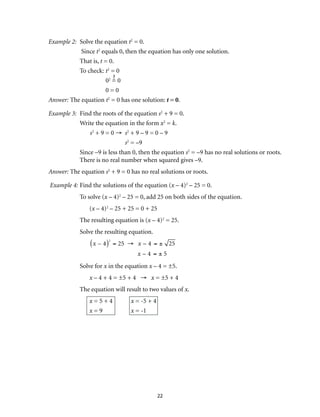
Quadratic equations that can be written in the form x2 = k can be solved by applying the 
21 
following properties: 
1. If k > 0, then x2 = k has two real solutions or roots: x = ± k . 
2. If k = 0, then x2 = k has one real solution or root: x = 0. 
3. If k < 0, then x2 = k has no real solutions or roots. 
The method of solving the quadratic equation x2 = k is called extracting square roots. 
Example 1: Find the solutions of the equation x2 – 16 = 0 by extracting square roots. 
Write the equation in the form x2 = k. 
x2 – 16 = 0 → x2 – 16 + 16 = 0 + 16 
x2 = 16 
Since 16 is greater than 0, then the first property above can be applied to find 
the values of x that will make the equation x2 – 16 = 0 true. 
x2 = 16 → x = ± 16 
x = ± 4 
To check, substitute these values in the original equation. 
For x = 4: For x = -4: 
x2 – 16 = 0 x2 – 16 = 0 
42 – 16 = 0 (–4)2 – 16 = 0 
16 – 16 = 0 16 – 16 = 0 
0 = 0 0 = 0 
Both values of x satisfy the given equation. So the equation x2 – 16 = 0 is true 
when x = 4 or when x = -4. 
Answer: The equation x2 – 16 = 0 has two solutions: x = 4 or x = -4.
22 
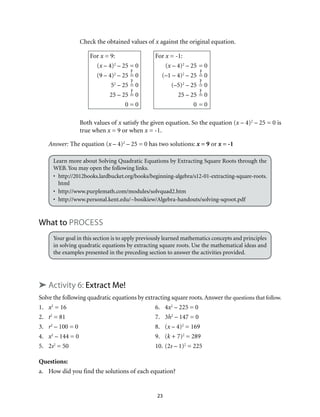
Example 2: Solve the equation t2 = 0. 
Since t2 equals 0, then the equation has only one solution. 
That is, t = 0. 
To check: t2 = 0 
02 = 0 
0 = 0 
Answer: The equation t2 = 0 has one solution: t = 0. 
Example 3: Find the roots of the equation s2 + 9 = 0. 
Write the equation in the form x2 = k. 
s2 + 9 = 0 → s2 + 9 – 9 = 0 – 9 
s2 = –9 
Since –9 is less than 0, then the equation s2 = –9 has no real solutions or roots. 
There is no real number when squared gives –9. 
Answer: The equation s2 + 9 = 0 has no real solutions or roots. 
Example 4: Find the solutions of the equation (x – 4)2 – 25 = 0. 
To solve (x – 4)2 – 25 = 0, add 25 on both sides of the equation. 
(x – 4)2 – 25 + 25 = 0 + 25 
The resulting equation is (x – 4)2 = 25. 
Solve the resulting equation. 
(x – 4)2 = 25 → x – 4 = ± 25 
x – 4 = ± 5 
Solve for x in the equation x – 4 = ±5. 
x – 4 + 4 = ±5 + 4 → x = ±5 + 4 
The equation will result to two values of x. 
x = 5 + 4 x = -5 + 4 
x = 9 x = -1
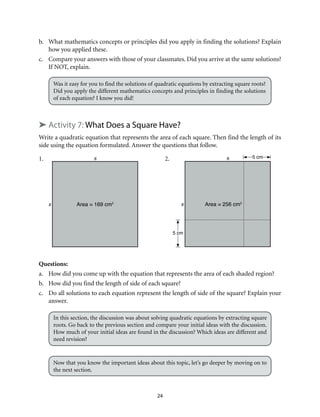
Check the obtained values of x against the original equation. 
For x = 9: For x = -1: 
(x – 4)2 – 25 = 0 (x – 4)2 – 25 = 0 
(9 – 4)2 – 25 = 0 (–1 – 4)2 – 25 = 0 
52 – 25 = 0 (–5)2 – 25 = 0 
25 – 25 = 0 25 – 25 = 0 
0 = 0 0 = 0 
Both values of x satisfy the given equation. So the equation (x – 4)2 – 25 = 0 is 
true when x = 9 or when x = -1. 
Answer: The equation (x – 4)2 – 25 = 0 has two solutions: x = 9 or x = -1 
Learn more about Solving Quadratic Equations by Extracting Square Roots through the 
WEB. You may open the following links. 
• http://2012books.lardbucket.org/books/beginning-algebra/s12-01-extracting-square-roots. 
html 
• http://www.purplemath.com/modules/solvquad2.htm 
• http://www.personal.kent.edu/~bosikiew/Algebra-handouts/solving-sqroot.pdf 
23 
What to Process 
Your goal in this section is to apply previously learned mathematics concepts and principles 
in solving quadratic equations by extracting square roots. Use the mathematical ideas and 
the examples presented in the preceding section to answer the activities provided. 
➤ Activity 6: Extract Me! 
Solve the following quadratic equations by extracting square roots. Answer the questions that follow. 
1. x2 = 16 6. 4x2 – 225 = 0 
2. t2 = 81 7. 3h2 – 147 = 0 
3. r2 – 100 = 0 8. (x – 4)2 = 169 
4. x2 – 144 = 0 9. (k + 7)2 = 289 
5. 2s2 = 50 10. (2s – 1)2 = 225 
Questions: 
a. How did you find the solutions of each equation?
b. What mathematics concepts or principles did you apply in finding the solutions? Explain 
24 
how you applied these. 
c. Compare your answers with those of your classmates. Did you arrive at the same solutions? 
If NOT, explain. 
Was it easy for you to find the solutions of quadratic equations by extracting square roots? 
Did you apply the different mathematics concepts and principles in finding the solutions 
of each equation? I know you did! 
➤ Activity 7: What Does a Square Have? 
Write a quadratic equation that represents the area of each square. Then find the length of its 
side using the equation formulated. Answer the questions that follow. 
1. 2. 
s 
s Area = 169 cm2 
s 
s Area = 256 cm2 
5 cm 
5 cm 
Questions: 
a. How did you come up with the equation that represents the area of each shaded region? 
b. How did you find the length of side of each square? 
c. Do all solutions to each equation represent the length of side of the square? Explain your 
answer. 
In this section, the discussion was about solving quadratic equations by extracting square 
roots. Go back to the previous section and compare your initial ideas with the discussion. 
How much of your initial ideas are found in the discussion? Which ideas are different and 
need revision? 
Now that you know the important ideas about this topic, let’s go deeper by moving on to 
the next section.
What to Reflect and Understand 
Your goal in this section is to take a closer look at some aspects of the topic. You are going to 
think deeper and test further your understanding of solving quadratic equations by extracting 
square roots. After doing the following activities, you should be able to answer this important 
question: How does finding solutions of quadratic equations facilitate in solving real-life problems 
and in making decisions? 
➤ Activity 8: Extract Then Describe Me! 
Solve each of the following quadratic equations by extracting square roots. Answer the ques-tions 
25 
that follow. 
1. 3t2 = 12 4. x2 = 150 
2. x2 – 7 = 0 5. 
x2 = 
9 
16 
3. 3r2 = 18 6. (s – 4)2 – 81 = 0 
Questions: 
a. How did you find the roots of each equation? 
b. Which equation did you find difficult to solve by extracting square roots? Why? 
c. Which roots are rational? Which are not? Explain your answer. 
d. How will you approximate those roots that are irrational? 
Were you able to find and describe the roots of each equation? Were you able to approximate 
the roots that are irrational? I’m sure you did! Deepen further your understanding of solving 
quadratic equations by extracting square roots by doing the next activity. 
➤ Activity 9: Intensify Your Understanding! 
Answer the following. 
1. Do you agree that a quadratic equation has at most two solutions? Justify your answer and 
give examples. 
2. Give examples of quadratic equations with (a) two real solutions, (b) one real solution, and 
(c) no real solution. 
3. Sheryl says that the solutions of the quadratic equations w2 = 49 and w2 + 49 = 0 are the 
same. Do you agree with Sheryl? Justify your answer. 
4. Mr. Cruz asked Emilio to construct a square table such that its area is 3 m2. Is it possible for 
Emilio to construct such table using an ordinary tape measure? Explain your answer.
5. A 9 ft2 square painting is mounted with border on a square frame. If the total area of the 
border is 3.25 ft2, what is the length of a side of the frame? 
In this section, the discussion was about your understanding of solving quadratic equations 
by extracting square roots. 
What new realizations do you have about solving quadratic equations by extracting square 
roots? How would you connect this to real life? How would you use this in making decisions? 
Now that you have a deeper understanding of the topic, you are ready to do the tasks in the 
next section. 
26 
What to Transfer 
Your goal in this section is to apply your learning to real-life situations. You will be given 
a practical task in which you will demonstrate your understanding of solving quadratic 
equations by extracting square roots. 
➤ Activity 10: What More Can I Do? 
Answer the following. 
1. Describe quadratic equations with 2 solutions, 1 solution, and no 
solution. Give at least two examples for each. 
2. Give at least five quadratic equations which can be solved by 
extracting square roots, then solve. 
3. Collect square tiles of different sizes. Using these tiles, formulate 
quadratic equations that can be solved by extracting square roots. 
Find the solutions or roots of these equations. 
How did you find the performance task? How did the task help 
you see the real-world use of the topic? 
Summary/Synthesis/Generalization 
This lesson was about solving quadratic equations by extracting square roots. The lesson 
provided you with opportunities to describe quadratic equations and solve these by extracting 
square roots. You were also able to find out how such equations are illustrated in real life. 
Moreover, you were given the chance to demonstrate your understanding of the lesson by doing 
a practical task. Your understanding of this lesson and other previously learned mathematics 
concepts and principles will enable you to learn about the wide applications of quadratic 
equations in real life.
Solving Quadratic Equations 
by Factoring 
27 
2B 
What to Know 
Start Lesson 2B of this module by assessing your knowledge of the different mathematics 
concepts previously studied and your skills in performing mathematical operations. These 
knowledge and skills will help you in understanding solving quadratic equations by factoring. 
As you go through this lesson, think of this important question: “How does finding solutions 
of quadratic equations facilitate solving real-life problems and making decisions?” To find the 
answer, perform each activity. If you find any difficulty in answering the exercises, seek the 
assistance of your teacher or peers or refer to the modules you have gone over earlier. You 
may check your answers with your teacher. 
➤ Activity 1: What Made Me? 
Factor each of the following polynomials. Answer the questions that follow. 
1. 2x2 – 8x 6. x2 – 10x + 21 
2. –3s2 + 9s 7. x2 + 5x – 6 
3. 4x + 20x2 8. 4r2 + 20r + 25 
4. 5t – 10t2 9. 9t2 – 4 
5. s2 + 8s + 12 10. 2x2 + 3x – 14 
Questions: 
a. How did you factor each polynomial? 
b. What factoring technique did you use to come up with the factors of each polynomial? 
Explain how you used this technique. 
c. How would you know if the factors you got are the correct ones? 
d. Which of the polynomials did you find difficult to factor? Why? 
How did you find the activity? Were you able to recall and apply the different mathematics 
concepts or principles in factoring polynomials? I’m sure you were. In the next activity, you 
will be representing a situation using a mathematical sentence. This mathematical sentence 
will be used to satisfy the conditions of the given situation.
➤ Activity 2: The Manhole 
Use the situation below to answer the questions that follow. 
A rectangular metal manhole with an area of 0.5 m2 is situated along a 
cemented pathway. The length of the pathway is 8 m longer than its width. 
1. Draw a diagram to illustrate the given situation. 
2. How are you going to represent the length and the width of the 
28 
pathway? How about its area? 
3. What expression would represent the area of the cemented portion 
of the pathway? 
4. Suppose the area of the cemented portion of the pathway is 
19.5 m2. What equation would describe its area? 
5. How will you find the length and the width of the pathway? 
The activity you have just done shows how a real-life situation can be represented by a 
mathematical sentence. Were you able to represent the given situation by an equation? Do 
you now have an idea on how to use the equation in finding the length and the width of 
the pathway? To further give you ideas in solving the equation or other similar equations, 
perform the next activity. 
➤ Activity 3: Why Is the Product Zero? 
Use the equations below to answer the following questions. 
x + 7 = 0 x – 4 = 0 (x + 7) (x – 4) = 0 
1. How would you compare the three equations? 
2. What value(s) of x would make each equation true? 
3. How would you know if the value of x that you got satisfies each equation? 
4. Compare the solutions of the given equations. What statement can you make? 
5. Are the solutions of x + 7 = 0 and x – 4 = 0 the same as the solutions of (x + 7)(x – 4) = 0? 
Why? 
6. How would you interpret the meaning of the equation (x + 7)(x – 4) = 0?
How did you find the preceding activities? Are you ready to learn about solving quadratic 
equations by factoring? I’m sure you are!!! From the activities done, you were able to find 
the factors of polynomials, represent a real-life situation by a mathematical statement, and 
interpret zero product. But how does finding solutions of quadratic equations facilitate solving 
real-life problems and making decisions? You will find these out in the activities in the next 
section. Before doing these activities, read and understand first some important notes on 
solving quadratic equations by factoring and the examples presented. 
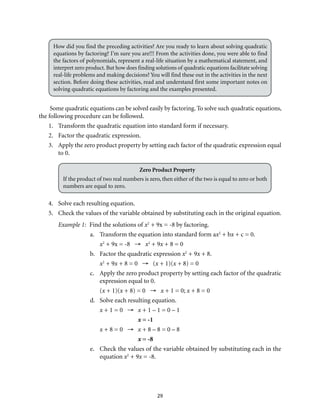
Some quadratic equations can be solved easily by factoring. To solve such quadratic equations, 
29 
the following procedure can be followed. 
1. Transform the quadratic equation into standard form if necessary. 
2. Factor the quadratic expression. 
3. Apply the zero product property by setting each factor of the quadratic expression equal 
to 0. 
Zero Product Property 
If the product of two real numbers is zero, then either of the two is equal to zero or both 
numbers are equal to zero. 
4. Solve each resulting equation. 
5. Check the values of the variable obtained by substituting each in the original equation. 
Example 1: Find the solutions of x2 + 9x = -8 by factoring. 
a. Transform the equation into standard form ax2 + bx + c = 0. 
x2 + 9x = -8 → x2 + 9x + 8 = 0 
b. Factor the quadratic expression x2 + 9x + 8. 
x2 + 9x + 8 = 0 → (x + 1)(x + 8) = 0 
c. Apply the zero product property by setting each factor of the quadratic 
expression equal to 0. 
(x + 1)(x + 8) = 0 → x + 1 = 0; x + 8 = 0 
d. Solve each resulting equation. 
x + 1 = 0 → x + 1 – 1 = 0 – 1 
x = -1 
x + 8 = 0 → x + 8 – 8 = 0 – 8 
x = -8 
e. Check the values of the variable obtained by substituting each in the 
equation x2 + 9x = -8.
For x = -1: For x = –8: 
x2 + 9x = –8 x2 + 9x = –8 
(–1)2 + 9(–1) = –8 (–8)2 + 9(–8) = –8 
1 – 9 = –8 64 – 72 = –8 
–8 = –8 –8 = –8 
Both values of x satisfy the given equation. So the equation x2 + 9x = –8 is 
true when x = -1 or when x = -8. 
Answer: The equation x2 + 9x = –8 has two solutions: x = -1 or x = -8 
Example 2: Solve 9x2 – 4 = 0 by factoring. 
To solve the equation, factor the quadratic expression 9x2 – 4. 
9x2 – 4 = 0 → (3x + 2)(3x – 2) = 0 
30 
Equate each factor to 0. 
3x + 2 = 0; 3x – 2 = 0 
Solve each resulting equation. 
3x + 2 = 0 → 
3x + 2 − 2 = 0 − 2 
3x = – 2 
3x 
= 
3 
–2 
3 
x = – 
2 
3 
3x + 2 = 0 → 
3x − 2 + 2 = 0 + 2 
3x = 2 
3x 
= 
3 
2 
3 
x = 
2 
3 
Check the values of the variable obtained by substituting each in the equation 
9x2 – 4 = 0. 
For 
x = 
−2 
3 
For 
x = 
2 
3 
9x2 – 4 = 0 
9 
–2 
3 
⎛⎝ ⎜ 
⎞⎠ ⎟ 
2 
– 4 = 0 
9 
4 
9 
⎛⎝ ⎜ 
⎞⎠ ⎟ 
– 4 = 0 
4 – 4 = 0 
0 = 0 
9x2 – 4 = 0 
9 
2 
3 
⎛⎝ ⎜ 
⎞⎠ ⎟ 
2 
– 4 = 0 
9 
4 
9 
⎛⎝ ⎜ 
⎞⎠ ⎟ 
– 4 = 0 
4 – 4 = 0 
0 = 0 
Both values of x satisfy the given equation. So the equation 9x2 – 4 = 0 is true 
when 
x = 
−2 
3 
or when 
x = 
2 
3 
.
Answer: The equation 9x2 – 4 = 0 has two solutions: 
31 
x = 
-2 
3 
or 
x = 
2 
3 
Learn more about Solving Quadratic Equations by Factoring through the WEB. You may 
open the following links. 
• http://2012books.lardbucket.org/books/beginning-algebra/s09-06-solving-equations-by-factoring. 
html 
• http://www.purplemath.com/modules/solvquad.htm 
• http://www.webmath.com/quadtri.html 
• http://www.mathwarehouse.com/quadratic/solve-quadratic-equation-by-factoring.php 
What to Process 
Your goal in this section is to apply previously learned mathematics concepts and principles 
in solving quadratic equations by factoring. Use the mathematical ideas and the examples 
presented in the preceding section to answer the activities provided. 
➤ Activity 4: Factor Then Solve! 
Solve the following quadratic equations by factoring. Answer the questions that follow. 
1. x2 + 7x = 0 6. x2 – 14 = 5x 
2. 6s2 + 18s = 0 7. 11r + 15 = –2r2 
3. t2 + 8t + 16 = 0 8. x2 – 25 = 0 
4. x2 – 10x + 25 = 0 9. 81 – 4x2 = 0 
5. h2 + 6h = 16 10. 4s2 + 9 = 12s 
Questions: 
a. How did you find the solutions of each equation? 
b. What mathematics concepts or principles did you apply in finding the solutions? Explain 
how you applied these. 
c. Compare your answers with those of your classmates. Did you arrive at the same solutions? 
If NOT, explain. 
Was it easy for you to find the solutions of quadratic equations by factoring? Did you apply 
the different mathematics concepts and principles in finding the solutions of each equation? 
I know you did!
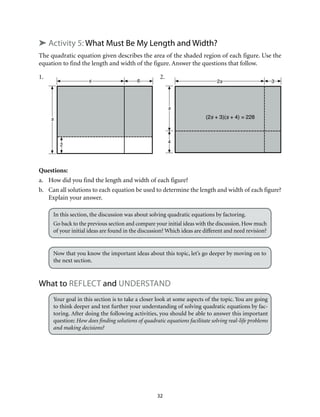
➤ Activity 5: What Must Be My Length and Width? 
The quadratic equation given describes the area of the shaded region of each figure. Use the 
equation to find the length and width of the figure. Answer the questions that follow. 
1. 2. 
s 
2 
s 6 
s 
4 
2s 3 
(2s + 3)(s + 4) = 228 
Questions: 
a. How did you find the length and width of each figure? 
b. Can all solutions to each equation be used to determine the length and width of each figure? 
32 
Explain your answer. 
In this section, the discussion was about solving quadratic equations by factoring. 
Go back to the previous section and compare your initial ideas with the discussion. How much 
of your initial ideas are found in the discussion? Which ideas are different and need revision? 
Now that you know the important ideas about this topic, let’s go deeper by moving on to 
the next section. 
What to Reflect and Understand 
Your goal in this section is to take a closer look at some aspects of the topic. You are going 
to think deeper and test further your understanding of solving quadratic equations by fac-toring. 
After doing the following activities, you should be able to answer this important 
question: How does finding solutions of quadratic equations facilitate solving real-life problems 
and making decisions?
➤ Activity 6: How Well Did I Understand? 
Answer each of the following. 
1. Which of the following quadratic equations may be solved more appropriately by factoring? 
Explain your answer. 
a. 2x2 = 72 c. w2 – 64 = 0 
b. t2 + 12t + 36 = 0 d. 2s2 + 8s – 10 = 0 
2. Patricia says that it’s more appropriate to use the method of factoring than extracting square 
roots in solving the quadratic equation 4x2 – 9 = 0. Do you agree with Patricia? Explain your 
answer. 
3. Do you agree that not all quadratic equations can be solved by factoring? Justify your answer 
33 
by giving examples. 
4. Find the solutions of each of the following quadratic equations by factoring. Explain how 
you arrived at your answer. 
a. (x + 3)2 = 25 c. (2t – 3)2 = 2t2 + 5t – 26 
b. (s + 4)2 = -2s d. 3(x + 2)2 = 2x2 + 3x – 8 
5. Do you agree that x2 + 5x – 14 = 0 and 14 – 5x – x2 = 0 have the same solutions? Justify your 
answer. 
6. Show that the equation (x – 4)2 = 9 can be solved both by factoring and extracting square 
roots. 
7. A computer manufacturing company would like to come up with a new laptop computer 
such that its monitor is 80 square inches smaller than the present ones. Suppose the length 
of the monitor of the larger computer is 5 inches longer than its width and the area of the 
smaller computer is 70 square inches. What are the dimensions of the monitor of the larger 
computer? 
In this section, the discussion was about your understanding of solving quadratic equations 
by factoring. 
What new insights do you have about solving quadratic equations by factoring? How would 
you connect this to real life? How would you use this in making decisions? 
Now that you have a deeper understanding of the topic, you are ready to do the tasks in the 
next section. 
What to transfer 
Your goal in this section is to apply your learning to real-life situations. You will be given a 
practical task which will demonstrate your understanding of solving quadratic equations 
by factoring.
34 
➤ Activity 7: Meet My Demands! 
Answer the following. 
Mr. Lakandula would like to increase his production of milkfish (bangus) due to its high 
demand in the market. He is thinking of making a larger fishpond in his 8000 sq m lot near 
a river. Help Mr. Lakandula by making a sketch plan of the fishpond to be made. Out of the 
given situation and the sketch plan made, formulate as many quadratic equations then solve by 
factoring. You may use the rubric below to rate your work. 
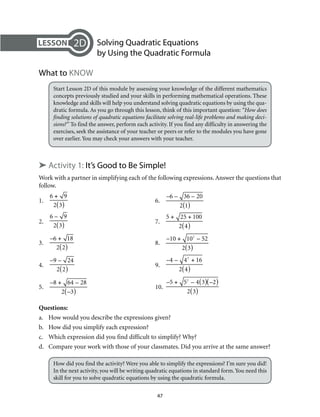
Rubric for the Sketch Plan and Equations Formulated and Solved 
4 3 2 1 
The sketch plan is 
accurately made, 
presentable, and 
appropriate. 
The sketch plan is 
accurately made and 
appropriate. 
The sketch plan is not 
accurately made but 
appropriate. 
The sketch plan 
is made but not 
appropriate. 
Quadratic equations 
are accurately 
formulated and solved 
correctly. 
Quadratic equations 
are accurately 
formulated but not all 
are solved correctly. 
Quadratic equations 
are accurately 
formulated but are not 
solved correctly. 
Quadratic equations 
are accurately 
formulated but are not 
solved. 
How did you find the performance task? How did the task help you see the real-world use 
of the topic? 
Summary/Synthesis/Generalization 
This lesson was about solving quadratic equations by factoring. The lesson provided you with 
opportunities to describe quadratic equations and solve these by factoring. You were able to 
find out also how such equations are illustrated in real life. Moreover, you were given the chance 
to demonstrate your understanding of the lesson by doing a practical task. Your understanding 
of this lesson and other previously learned mathematics concepts and principles will facilitate 
your learning of the wide applications of quadratic equations in real life.
Solving Quadratic Equations 
by Completing the Square 
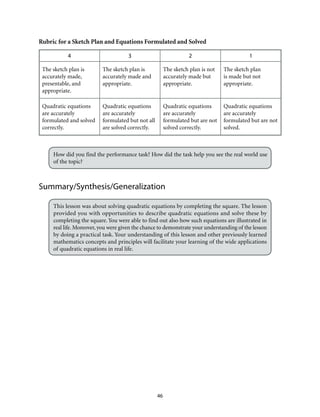
35 
2C 
What to Know 
Start Lesson 2C of this module by assessing your knowledge of the different mathematics 
concepts previously studied and your skills in performing mathematical operations. These 
knowledge and skills will help you understand Solving Quadratic Equations by Complet-ing 
the Square. As you go through this lesson, think of this important question: “How does 
finding solutions of quadratic equations facilitate solving real-life problems and making deci-sions?” 
To find the answer, perform each activity. If you find any difficulty in answering the 
exercises, seek the assistance of your teacher or peers or refer to the modules you have gone 
over earlier. You may check your answers with your teacher. 
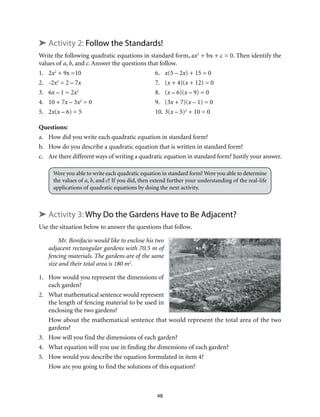
➤ Activity 1: How Many Solutions Do I Have? 
Find the solution/s of each of the following equations. Answer the questions that follow. 
1. x +12 = 17 6. 
x – 
3 
4 
= 
1 
2 
2. s + 15 = –9 7. (x + 10)2 = 36 
3. r – 25 = 12 8. (w – 9)2 = 12 
4. 
x – 
5 
6 
= 3 9. 
k + 
1 
2 
⎛⎝ ⎜ 
⎞⎠ ⎟ 
2 
= 
9 
16 
5. 
t + 
4 
7 
= 5 10. 
h – 
3 
5 
⎛⎝ ⎜ 
⎞⎠ ⎟ 
2 
= 
1 
2 
Questions: 
a. How did you find the solution(s) of each equation? 
b. Which of the equations has only one solution? Why? 
c. Which of the equations has two solutions? Why? 
d. Which of the equations has solutions that are irrational? Why? 
e. Were you able to simplify those solutions that are irrational? Why? 
f. How did you write those irrational solutions? 
How did you find the activity? Were you able to recall and apply the different mathematics 
concepts or principles in finding the solution/s of each equation? I’m sure you did! In the 
next activity, you will be expressing a perfect square trinomial as a square of a binomial. I 
know that you already have an idea on how to do this. This activity will help you solve qua-dratic 
equations by completing the square.
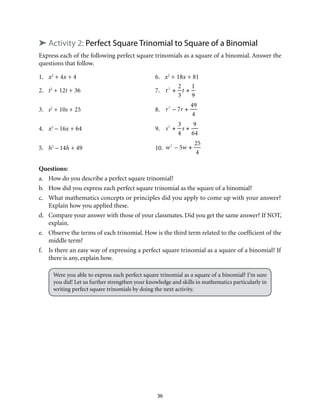
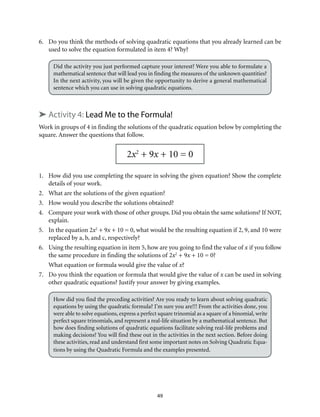
➤ Activity 2: Perfect Square Trinomial to Square of a Binomial 
Express each of the following perfect square trinomials as a square of a binomial. Answer the 
questions that follow. 
1. x2 + 4x + 4 6. x2 + 18x + 81 
2. t2 + 12t + 36 7. 
36 
t 2 + 
2 
3 
t + 
1 
9 
3. s2 + 10s + 25 8. 
r 2 – 7r + 
49 
4 
4. x2 – 16x + 64 9. 
s2 + 
3 
4 
s + 
9 
64 
5. h2 – 14h + 49 10. 
w2 – 5w + 
25 
4 
Questions: 
a. How do you describe a perfect square trinomial? 
b. How did you express each perfect square trinomial as the square of a binomial? 
c. What mathematics concepts or principles did you apply to come up with your answer? 
Explain how you applied these. 
d. Compare your answer with those of your classmates. Did you get the same answer? If NOT, 
explain. 
e. Observe the terms of each trinomial. How is the third term related to the coefficient of the 
middle term? 
f. Is there an easy way of expressing a perfect square trinomial as a square of a binomial? If 
there is any, explain how. 
Were you able to express each perfect square trinomial as a square of a binomial? I’m sure 
you did! Let us further strengthen your knowledge and skills in mathematics particularly in 
writing perfect square trinomials by doing the next activity.
➤ Activity 3: Make It Perfect!!! 
Determine a number that must be added to make each of the following a perfect square trinomial. 
Explain how you arrived at your answer. 
1. x2 + 2x + _____ 6. x2 + 11x + _____ 
2. t2 + 20t + _____ 7. x2 – 15x + _____ 
3. r2 – 16r + _____ 8. w2 + 21w + _____ 
10 m 
10 m 
4. r2 + 24r + _____ 9. 
37 
s2 – 
2 
3 
s + _____ 
5. x2 – 30x + _____ 10. 
h2 – 
3 
4 
h + _____ 
Was it easy for you to determine the number that must be added to the terms of a polynomial 
to make it a perfect square trinomial? Were you able to figure out how it can be easily done? 
In the next activity, you will be representing a situation using a mathematical sentence. Such 
a mathematical sentence will be used to satisfy the conditions of the given situation. 
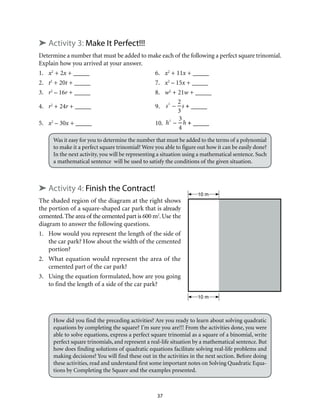
➤ Activity 4: Finish the Contract! 
The shaded region of the diagram at the right shows 
the portion of a square-shaped car park that is already 
cemented. The area of the cemented part is 600 m2. Use the 
diagram to answer the following questions. 
1. How would you represent the length of the side of 
the car park? How about the width of the cemented 
portion? 
2. What equation would represent the area of the 
cemented part of the car park? 
3. Using the equation formulated, how are you going 
to find the length of a side of the car park? 
How did you find the preceding activities? Are you ready to learn about solving quadratic 
equations by completing the square? I’m sure you are!!! From the activities done, you were 
able to solve equations, express a perfect square trinomial as a square of a binomial, write 
perfect square trinomials, and represent a real-life situation by a mathematical sentence. But 
how does finding solutions of quadratic equations facilitate solving real-life problems and 
making decisions? You will find these out in the activities in the next section. Before doing 
these activities, read and understand first some important notes on Solving Quadratic Equa-tions 
by Completing the Square and the examples presented.
Extracting square roots and factoring are usually used to solve quadratic equations of the 
form ax2 – c = 0. If the factors of the quadratic expression of ax2 + bx + c = 0 are determined, 
then it is more convenient to use factoring to solve it. 
Another method of solving quadratic equations is by completing the square. This method 
involves transforming the quadratic equation ax2 + bx + c = 0 into the form (x – h)2 = k, where 
k ≥ 0. Can you tell why the value of k should be positive? 
To solve the quadratic equation ax2 + bx + c = 0 by completing the square, the following 
38 
steps can be followed: 
1. Divide both sides of the equation by a then simplify. 
2. Write the equation such that the terms with variables are on the left side of the equation 
and the constant term is on the right side. 
3. Add the square of one-half of the coefficient of x on both sides of the resulting equation. 
The left side of the equation becomes a perfect square trinomial. 
4. Express the perfect square trinomial on the left side of the equation as a square of a 
binomial. 
5. Solve the resulting quadratic equation by extracting the square root. 
6. Solve the resulting linear equations. 
7. Check the solutions obtained against the original equation. 
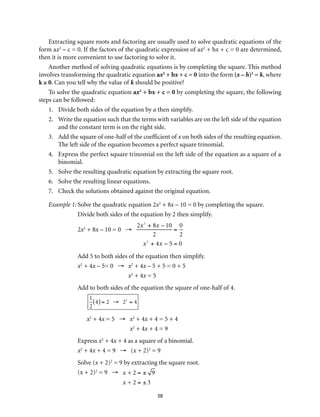
Example 1: Solve the quadratic equation 2x2 + 8x – 10 = 0 by completing the square. 
Divide both sides of the equation by 2 then simplify. 
2x2 + 8x – 10 = 0 → 
2x2 + 8x – 10 
2 
= 
0 
2 
x2 + 4x − 5 = 0 
Add 5 to both sides of the equation then simplify. 
x2 + 4x – 5= 0 → x2 + 4x – 5 + 5 = 0 + 5 
x2 + 4x = 5 
Add to both sides of the equation the square of one-half of 4. 
1 
2 
(4) = 2 → 22 = 4 
x2 + 4x = 5 → x2 + 4x + 4 = 5 + 4 
x2 + 4x + 4 = 9 
Express x2 + 4x + 4 as a square of a binomial. 
x2 + 4x + 4 = 9 → (x + 2)2 = 9 
Solve (x + 2)2 = 9 by extracting the square root. 
(x + 2)2 = 9 → 
x + 2 = ± 9 
x + 2 = ± 3
Solve the resulting linear equations. 
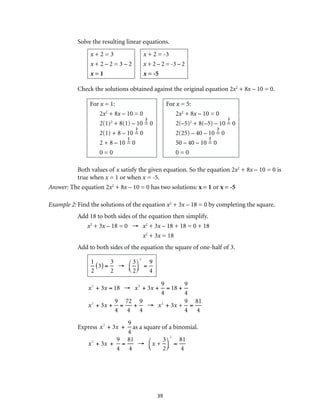
39 
x + 2 = 3 
x + 2 – 2 = 3 – 2 
x = 1 
x + 2 = -3 
x + 2 – 2 = -3 – 2 
x = -5 
Check the solutions obtained against the original equation 2x2 + 8x – 10 = 0. 
For x = 1: 
2x2 + 8x – 10 = 0 
2(1)2 + 8(1) – 10 = 0 
2(1) + 8 – 10 = 0 
2 + 8 – 10 = 0 
0 = 0 
For x = 5: 
2x2 + 8x – 10 = 0 
2(–5)2 + 8(–5) – 10 = 0 
2(25) – 40 – 10 = 0 
50 – 40 – 10 = 0 
0 = 0 
Both values of x satisfy the given equation. So the equation 2x2 + 8x – 10 = 0 is 
true when x = 1 or when x = -5. 
Answer: The equation 2x2 + 8x – 10 = 0 has two solutions: x = 1 or x = -5 
Example 2: Find the solutions of the equation x2 + 3x – 18 = 0 by completing the square. 
Add 18 to both sides of the equation then simplify. 
x2 + 3x – 18 = 0 → x2 + 3x – 18 + 18 = 0 + 18 
x2 + 3x = 18 
Add to both sides of the equation the square of one-half of 3. 
1 
2 
(3) = 
3 
2 
→ 
3 
2 
⎛⎝ ⎜ 
⎞ 
⎠ ⎟ 
2 
= 
9 
4 
x2 + 3x = 18 → x2 + 3x + 
9 
4 
= 18 + 
9 
4 
x2 + 3x + 
9 
4 
= 
72 
4 
+ 
9 
4 
→ x2 + 3x + 
9 
4 
= 
81 
4 
Express 
x2 + 3x + 
9 
4 
as a square of a binomial. 
x2 + 3x + 
9 
4 
= 
81 
4 
→ x + 
3 
2 
⎛⎝ ⎜ 
⎞⎠ ⎟ 
2 
= 
81 
4
40 
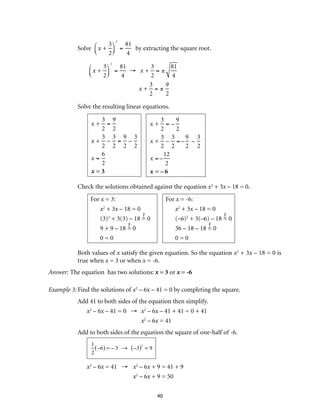
Solve 
x + 
3 
2 
⎛⎝ ⎜ 
⎞⎠ ⎟ 
2 
= 
81 
4 
by extracting the square root. 
x + 
3 
2 
⎛⎝ ⎜ 
⎞⎠ ⎟ 
2 
= 
81 
4 
→ x + 
3 
2 
= ± 
81 
4 
x + 
3 
2 
= ± 
9 
2 
Solve the resulting linear equations. 
x + 
3 
2 
= 
9 
2 
x + 
3 
2 
– 
3 
2 
= 
9 
2 
– 
3 
2 
x = 
6 
2 
x = 3 
x + 
3 
2 
= – 
9 
2 
x + 
3 
2 
– 
3 
2 
= – 
9 
2 
– 
3 
2 
x = – 
12 
2 
x = – 6 
Check the solutions obtained against the equation x2 + 3x – 18 = 0. 
For x = 3: 
x2 + 3x – 18 = 0 
(3)2 + 3(3) – 18 = 0 
9 + 9 – 18 = 0 
0 = 0 
For x = -6: 
x2 + 3x – 18 = 0 
(–6)2 + 3(–6) – 18 = 0 
36 – 18 – 18 = 0 
0 = 0 
Both values of x satisfy the given equation. So the equation x2 + 3x – 18 = 0 is 
true when x = 3 or when x = -6. 
Answer: The equation has two solutions: x = 3 or x = -6 
Example 3: Find the solutions of x2 – 6x – 41 = 0 by completing the square. 
Add 41 to both sides of the equation then simplify. 
x2 – 6x – 41 = 0 → x2 – 6x – 41 + 41 = 0 + 41 
x2 – 6x = 41 
Add to both sides of the equation the square of one-half of -6. 
1 
2 
(–6) = – 3 → (–3)2 = 9 
x2 – 6x = 41 → x2 – 6x + 9 = 41 + 9 
x2 – 6x + 9 = 50
Express x2 – 6x + 9 as a square of a binomial. 
x2 – 6x + 9 = 50 → (x – 3)2 = 50 
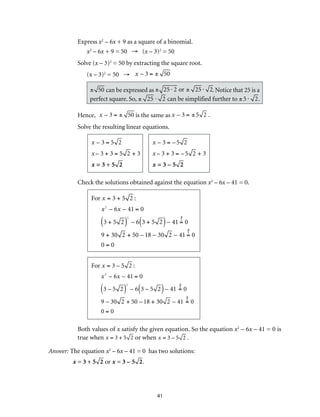
Solve (x – 3)2 = 50 by extracting the square root. 
(x – 3)2 = 50 → x – 3 = ± 50 
± 50 can be expressed as ± 25 ⋅ 2 or ± 25 ⋅ 2. Notice that 25 is a 
perfect square. So, ± 25 ⋅ 2 can be simplified further to ± 5 ⋅ 2. 
Hence, x – 3 = ± 50 is the same as x – 3 = ± 5 2 . 
Solve the resulting linear equations. 
41 
x – 3 = 5 2 
x – 3 + 3 = 5 2 + 3 
x = 3 + 5 2 
x – 3 = – 5 2 
x – 3 + 3 = – 5 2 + 3 
x = 3 – 5 2 
Check the solutions obtained against the equation x2 – 6x – 41 = 0. 
For x = 3 + 5 2 : 
x2 – 6x – 41 = 0 
(3 + 5 2)2 
– 6(3 + 5 2) – 41 = 0 
9 + 30 2 + 50 – 18 – 30 2 – 41 = 0 
0 = 0 
For x = 3 – 5 2 : 
x2 – 6x – 41 = 0 
(3 – 5 2)2 
– 6(3 – 5 2) – 41 = 0 
9 – 30 2 + 50 – 18 + 30 2 – 41 = 0 
0 = 0 
Both values of x satisfy the given equation. So the equation x2 – 6x – 41 = 0 is 
true when x = 3 + 5 2 or when x = 3 – 5 2 . 
Answer: The equation x2 – 6x – 41 = 0 has two solutions: 
x = 3 + 5 2 or x = 3 – 5 2.
Learn more about Solving Quadratic Equations by Completing the Square through the WEB. 
You may open the following links. 
• http://www.purplemath.com/modules/sqrquad.htm 
• http://2012books.lardbucket.org/books/beginning-algebra/s12-02-completing-the-square. 
html 
• http://www.regentsprep.org/Regents/math/algtrig/ATE12/indexATE12.htm 
• http://www.mathsisfun.com/algebra/completing-square.html 
42 
What to Process 
Your goal in this section is to apply the key concepts of solving quadratic equations by 
completing the square. Use the mathematical ideas and the examples presented in the 
preceding section to answer the activities provided. 
➤ Activity 5: Complete Me! 
Find the solutions of each of the following quadratic equations by completing the square. Answer 
the questions that follow. 
1. x2 – 2x = 3 6. 4x2 – 32x = -28 
2. s2 + 4s – 21 = 0 7. x2 – 5x – 6 = 0 
3. t2 + 10t + 9 = 0 8. 
m2 + 7m – 
51 
4 
= 0 
4. x2 + 14x = 32 9. r2 + 4r = -1 
5. r2 – 10r = -17 10. w2 + 6w – 11 = 0 
Questions: 
a. How did you find the solutions of each equation? 
b. What mathematics concepts or principles did you apply in finding the solutions? Explain 
how you applied these. 
c. Compare your answers with those of your classmates. Did you arrive at the same answers? 
If NOT, explain. 
Was it easy for you to find the solutions of quadratic equations by completing the square? 
Did you apply the different mathematics concepts and principles in finding the solutions of 
each equation? I know you did!
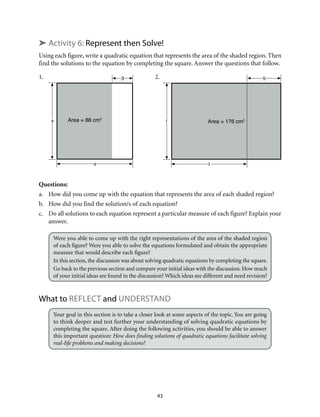
➤ Activity 6: Represent then Solve! 
Using each figure, write a quadratic equation that represents the area of the shaded region. Then 
find the solutions to the equation by completing the square. Answer the questions that follow. 
1. 2. 
t Area = 176 cm2 
t 
5 
s Area = 88 cm2 
s 
3 
Questions: 
a. How did you come up with the equation that represents the area of each shaded region? 
b. How did you find the solution/s of each equation? 
c. Do all solutions to each equation represent a particular measure of each figure? Explain your 
43 
answer. 
Were you able to come up with the right representations of the area of the shaded region 
of each figure? Were you able to solve the equations formulated and obtain the appropriate 
measure that would describe each figure? 
In this section, the discussion was about solving quadratic equations by completing the square. 
Go back to the previous section and compare your initial ideas with the discussion. How much 
of your initial ideas are found in the discussion? Which ideas are different and need revision? 
What to Reflect and Understand 
Your goal in this section is to take a closer look at some aspects of the topic. You are going 
to think deeper and test further your understanding of solving quadratic equations by 
completing the square. After doing the following activities, you should be able to answer 
this important question: How does finding solutions of quadratic equations facilitate solving 
real-life problems and making decisions?
➤ Activity 7: What Solving Quadratic Equations by Completing 
the Square Means to Me… 
Answer the following. 
1. Karen wants to use completing the square in solving the quadratic equation 4x2 – 25 = 0. 
Can she use it in finding the solutions of the equation? Explain why or why not. 
2. Do you agree that any quadratic equation can be solved by completing the square? Justify 
44 
your answer. 
3. If you are to choose between completing the square and factoring in finding the solutions of 
each of the following equations, which would you choose? Explain and solve the equations 
using your preferred method. 
a. 4x2 – 20x = 11 
b. x2 + 7x + 12 = 0 
4. Gregorio solved the equation 2x2 – 8x + 15 = 0. The first few parts of his solution are shown 
below. 
2x2 – 8x + 15 = 0 → 2x2 – 8x + 15 – 15 = 0 – 15 
2x2 – 8x = –15 
1 
2 
(–8) = – 4 ; (–4)2 = 16 
2x2 – 8x + 16 = –15 + 16 
Do you think Gregorio arrived at the correct solution of the equation? Justify your answer. 
5. An open box is to be formed out of a rectangular piece of cardboard whose length is 8 cm 
longer than its width. To form the box, a square of side 4 cm will be removed from each 
corner of the cardboard. Then the edges of the remaining cardboard will be turned up. 
a. Draw a diagram to illustrate the given situation. 
b. How would you represent the dimensions of the cardboard? 
c. What expressions represent the length, width, and height of the box? 
d. If the box is to hold 448 cm3, what mathematical sentence would represent the given 
situation? 
e. Using the mathematical sentence formulated, how are you going to find the dimensions 
of the rectangular piece of cardboard? 
f. What are the dimensions of the rectangular piece of cardboard? 
g. What is the length of the box? How about its width and height? 
6. From 2006 through 2012, the average weekly income of an employee in a certain company is 
estimated by the quadratic expression 0.18n2 + 6.48n + 3240, where n is the number of years 
after 2006. In what year did the average weekly income of an employee become Php3,268.80?
In this section, the discussion was about your understanding of solving quadratic equations 
by completing the square. 
What new insights do you have about solving quadratic equations by completing the square? 
How would you connect this to real life? How would you use this in making decisions? 
Now that you have a deeper understanding of the topic, you are ready to do the tasks in the 
next section. 
45 
What to Transfer 
Your goal in this section is to apply your learning to real-life situations. You will be given a 
practical task which will demonstrate your understanding of solving quadratic equations 
by completing the square. 
➤ Activity 8: Design Packaging Boxes 
Perform the following. 
A. Designing Open Boxes 
1. Make sketch plans of 5 rectangular open boxes such that: 
a. the heights of the boxes are the same; and 
b. the boxes can hold 240 cm3, 270 cm3, 504 cm3, 810 cm3, and 468 cm3, respectively. 
2. Write a quadratic equation that would represent the volume of each box. 
3. Solve each quadratic equation by completing the square to determine the dimensions of 
the materials to be used in constructing each box. 
B. Designing Covers of the Open Boxes 
1. Make sketch plans of covers of the open boxes in Part A such that: 
a. the heights of the covers are the same; and 
b. the base of each cover is rectangular. 
2. Write a quadratic equation that would represent the volume of the box’s cover. 
3. Solve each quadratic equation by completing the square to determine the dimensions of 
the materials to be used in constructing the box’s cover.
Rubric for a Sketch Plan and Equations Formulated and Solved 
4 3 2 1 
46 
The sketch plan is 
accurately made, 
presentable, and 
appropriate. 
The sketch plan is 
accurately made and 
appropriate. 
The sketch plan is not 
accurately made but 
appropriate. 
The sketch plan 
is made but not 
appropriate. 
Quadratic equations 
are accurately 
formulated and solved 
correctly. 
Quadratic equations 
are accurately 
formulated but not all 
are solved correctly. 
Quadratic equations 
are accurately 
formulated but are not 
solved correctly. 
Quadratic equations 
are accurately 
formulated but are not 
solved. 
How did you find the performance task? How did the task help you see the real world use 
of the topic? 
Summary/Synthesis/Generalization 
This lesson was about solving quadratic equations by completing the square. The lesson 
provided you with opportunities to describe quadratic equations and solve these by 
completing the square. You were able to find out also how such equations are illustrated in 
real life. Moreover, you were given the chance to demonstrate your understanding of the lesson 
by doing a practical task. Your understanding of this lesson and other previously learned 
mathematics concepts and principles will facilitate your learning of the wide applications 
of quadratic equations in real life.
Solving Quadratic Equations 
by Using the Quadratic Formula 
47 
2D 
What to Know 
Start Lesson 2D of this module by assessing your knowledge of the different mathematics 
concepts previously studied and your skills in performing mathematical operations. These 
knowledge and skills will help you understand solving quadratic equations by using the qua-dratic 
formula. As you go through this lesson, think of this important question: “How does 
finding solutions of quadratic equations facilitate solving real-life problems and making deci-sions?” 
To find the answer, perform each activity. If you find any difficulty in answering the 
exercises, seek the assistance of your teacher or peers or refer to the modules you have gone 
over earlier. You may check your answers with your teacher. 
➤ Activity 1: It’s Good to Be Simple! 
Work with a partner in simplifying each of the following expressions. Answer the questions that 
follow. 
1. 
6 + 9 
2(3) 6. 
–6 – 36 – 20 
2(1) 
2. 
6 – 9 
2(3) 7. 
5 + 25 + 100 
2(4) 
3. 
–6 + 18 
2(2) 
8. 
–10 + 102 – 52 
2(3) 
4. 
–9 – 24 
2(2) 9. 
–4 – 42 + 16 
2(4) 
5. 
–8 + 64 – 28 
2(–3) 
10. 
–5 + 52 – 4(3)(–2) 
2(3) 
Questions: 
a. How would you describe the expressions given? 
b. How did you simplify each expression? 
c. Which expression did you find difficult to simplify? Why? 
d. Compare your work with those of your classmates. Did you arrive at the same answer? 
How did you find the activity? Were you able to simplify the expressions? I’m sure you did! 
In the next activity, you will be writing quadratic equations in standard form. You need this 
skill for you to solve quadratic equations by using the quadratic formula.
➤ Activity 2: Follow the Standards! 
Write the following quadratic equations in standard form, ax2 + bx + c = 0. Then identify the 
values of a, b, and c. Answer the questions that follow. 
1. 2x2 + 9x =10 6. x(5 – 2x) + 15 = 0 
2. -2x2 = 2 – 7x 7. (x + 4)(x + 12) = 0 
3. 6x – 1 = 2x2 8. (x – 6)(x – 9) = 0 
4. 10 + 7x – 3x2 = 0 9. (3x + 7)(x – 1) = 0 
5. 2x(x – 6) = 5 10. 3(x – 5)2 + 10 = 0 
Questions: 
a. How did you write each quadratic equation in standard form? 
b. How do you describe a quadratic equation that is written in standard form? 
c. Are there different ways of writing a quadratic equation in standard form? Justify your answer. 
Were you able to write each quadratic equation in standard form? Were you able to determine 
the values of a, b, and c? If you did, then extend further your understanding of the real-life 
applications of quadratic equations by doing the next activity. 
➤ Activity 3: Why Do the Gardens Have to Be Adjacent? 
Use the situation below to answer the questions that follow. 
Mr. Bonifacio would like to enclose his two 
adjacent rectangular gardens with 70.5 m of 
fencing materials. The gardens are of the same 
size and their total area is 180 m2. 
1. How would you represent the dimensions of 
48 
each garden? 
2. What mathematical sentence would represent 
the length of fencing material to be used in 
enclosing the two gardens? 
How about the mathematical sentence that would represent the total area of the two 
gardens? 
3. How will you find the dimensions of each garden? 
4. What equation will you use in finding the dimensions of each garden? 
5. How would you describe the equation formulated in item 4? 
How are you going to find the solutions of this equation?
6. Do you think the methods of solving quadratic equations that you already learned can be 
used to solve the equation formulated in item 4? Why? 
Did the activity you just performed capture your interest? Were you able to formulate a 
mathematical sentence that will lead you in finding the measures of the unknown quantities? 
In the next activity, you will be given the opportunity to derive a general mathematical 
sentence which you can use in solving quadratic equations. 
➤ Activity 4: Lead Me to the Formula! 
Work in groups of 4 in finding the solutions of the quadratic equation below by completing the 
square. Answer the questions that follow. 
2x2 + 9x + 10 = 0 
1. How did you use completing the square in solving the given equation? Show the complete 
49 
details of your work. 
2. What are the solutions of the given equation? 
3. How would you describe the solutions obtained? 
4. Compare your work with those of other groups. Did you obtain the same solutions? If NOT, 
explain. 
5. In the equation 2x2 + 9x + 10 = 0, what would be the resulting equation if 2, 9, and 10 were 
replaced by a, b, and c, respectively? 
6. Using the resulting equation in item 5, how are you going to find the value of x if you follow 
the same procedure in finding the solutions of 2x2 + 9x + 10 = 0? 
What equation or formula would give the value of x? 
7. Do you think the equation or formula that would give the value of x can be used in solving 
other quadratic equations? Justify your answer by giving examples. 
How did you find the preceding activities? Are you ready to learn about solving quadratic 
equations by using the quadratic formula? I’m sure you are!!! From the activities done, you 
were able to solve equations, express a perfect square trinomial as a square of a binomial, write 
perfect square trinomials, and represent a real-life situation by a mathematical sentence. But 
how does finding solutions of quadratic equations facilitate solving real-life problems and 
making decisions? You will find these out in the activities in the next section. Before doing 
these activities, read and understand first some important notes on Solving Quadratic Equa-tions 
by using the Quadratic Formula and the examples presented.
The solutions of any quadratic equation ax2 + bx + c = 0 can be determined using the 
50 
quadratic formula 
x = 
–b ± b2 – 4ac 
2a 
, ,aa ≠≠ 00. T. his formula can be derived by applying the method 
of completing the square as shown below. 
ax2 + bx + c = 0 → ax2 + bx = -c Why? 
ax2 + bx 
a 
= 
–c 
a 
→ x2 + 
bx 
a 
= 
–c 
a 
Why? 
1 
2 
b 
a 
⎛⎝ ⎜ 
⎞⎠ ⎟ 
= 
b 
2a 
; 
b 
2a 
⎛⎝ ⎜ 
⎞⎠ ⎟ 
2 
= 
b2 
4a2 
Why? 
x2 + 
bx 
a 
+ 
b2 
4a2 = 
–c 
a 
+ 
b2 
4a2 
Why? 
x + 
b 
2a 
⎛⎝ ⎜ 
⎞⎠ ⎟ 
2 
= 
–4ac +b2 
4a2 = 
b2 – 4ac 
4a2 
Why? 
x + 
b 
2a 
= ± 
b2 – 4ac 
4a2 → x + 
b 
2a 
= 
± b2 – 4ac 
2a 
Why? 
x = 
± b2 – 4ac 
2a 
– 
b 
2a 
Why? 
x = 
–b ± b2 – 4ac 
2a 
Why? 
To solve any quadratic equation ax2 + bx + c = 0 using the quadratic formula, determine 
the values of a, b, and c, then substitute these in the equation 
x = 
–b ± b2 – 4ac 
2a 
. Simplify the 
result if possible, then check the solutions obtained against the original equation. 
Example 1: Find the solutions of the equation 2x2 + 3x = 27 using the quadratic formula. 
Write the equation in standard form. 
2x2 + 3x = 27 → 2x2 + 3x – 27 = 0 
Determine the values of a, b, and c. 
2x2 + 3x – 27 = 0 → a = 2; b = 3; c = -27 
Substitute the values of a, b, and c in the quadratic formula. 
x = 
–b ± b2 – 4ac 
2a 
→ x = 
–(3) ± (3)2 – 4 (2)(27) 
2(2)
51 
Simplify the result. 
x = 
–(3) ± (3)2 – 4 (2)(27) 
2(2) 
→ 
x = 
–3 ± 9 + 216 
4 
x = 
–3 ± 225 
4 
x = 
−3 ±15 
4 
x = 
–3 + 15 
4 
= 
12 
4 
x = 3 
x = 
–3 – 15 
4 
= 
–18 
4 
x = – 
9 
2 
Check the solutions obtained against the equation 2x2 + 3x = 27. 
When x = 3: 
2(3)2 + 3(3) = 27 → 2(9) + 3(3) = 27 
18 + 9 = 27 
27 = 27 
When 
x = – 
9 
2 
: 
2 – 
9 
2 
⎛⎝ ⎜ 
⎞⎠ ⎟ 
2 
+ 3 – 
9 
2 
⎛⎝ ⎜ 
⎞⎠ ⎟ 
= 27 → 
2 
81 
4 
⎛⎝ ⎜ 
⎞⎠ ⎟ 
+ 3 – 
9 
2 
⎛⎝ ⎜ 
⎞⎠ ⎟ 
= 27 
81 
2 
– 
27 
2 
= 27 
54 
2 
= 27 
27 = 27 
Both values of x satisfy the given equation. So the equation 2x2 + 3x = 27 is 
true when x = 3 or when 
x = – 
9 
2 
. 
Answer: The equation has two solutions: x = 3 or 
x = – 
9 
2 
. 
Learn more about Solving Quadratic Equations by Using the Quadratic Formula through 
the WEB. You may open the following links. 
• http://2012books.lardbucket.org/books/beginning-algebra/s12-03-quadratic-formula.html 
• http://www.regentsprep.org/Regents/math/algtrig/ATE3/quadformula.htm 
• http://www.purplemath.com/modules/quadform.htm 
• http://www.algebrahelp.com/lessons/equations/quadratic/
52 
What to Process 
Your goal in this section is to apply the key concepts of solving quadratic equations by using 
the quadratic formula. Use the mathematical ideas and the examples presented in the pre-ceding 
section to answer the activities provided. 
➤ Activity 5: Is the Formula Effective? 
Find the solutions of each of the following quadratic equations using the quadratic formula. 
Answer the questions that follow. 
1. x2 + 10x + 9 = 0 6. 2x2 + 7x + 9 = 0 
2. x2 – 12x + 35 = 0 7. 4x2 – 4x + 1 = 0 
3. x2 + 5x –14 = 0 8. 3x2 – 4x = 0 
4. x2 – 4x + 12 = 0 9. 9x2 – 72 = 0 
5. x2 + 7x = 4 10. 2x2 + 4x = 3 
Questions: 
a. How did you use the quadratic formula in finding the solution/s of each equation? 
b. How many solutions does each equation have? 
c. Is there any equation whose solutions are equal? If there is any, describe the equation. 
d. Is there any equation with zero as one of the solutions? Describe the equation if there is any. 
e. Compare your answers with those of your classmates. Did you arrive at the same solutions? 
If NOT, explain. 
Was it easy for you to find the solutions of quadratic equations by using the quadratic for-mula? 
Were you able to simplify the solutions obtained? I know you did! 
➤ Activity 6: Cut to Fit! 
Read and understand the situation below then answer the questions that follow. 
Mr. Bonifacio cuts different sizes of rectangular plywood to be used in the furniture that he 
makes. Some of these rectangular plywood are described below. 
Plywood 1: The length of the plywood is twice its width and the area is 4.5 sq ft. 
Plywood 2: The length of the plywood is 1.4 ft. less than twice its width and the area is 
16 sq ft. 
Plywood 3: The perimeter of the plywood is 10 ft. and its area is 6 sq ft.
Questions: 
1. What quadratic equation represents the area of each piece of plywood? Write the equation 
53 
in terms of the width of the plywood. 
2. Write each quadratic equation formulated in item 1 in standard form. Then determine the 
values of a, b, and c. 
3. Solve each quadratic equation using the quadratic formula. 
4. Which of the solutions or roots obtained represents the width of each plywood? Explain 
your answer. 
5. What is the length of each piece of plywood? Explain how you arrived at your answer. 
Were you able to come up with the quadratic equation that represents the area of each piece 
of plywood? Were you able to determine the length and width of each piece of plywood? 
In this section, the discussion was about solving quadratic equations by using the quadratic 
formula. 
Go back to the previous section and compare your initial ideas with the discussion. How much 
of your initial ideas are found in the discussion? Which ideas are different and need revision? 
Now that you know the important ideas about this topic, let’s go deeper by moving on to 
the next section. 
What to Reflect and Understand 
Your goal in this section is to take a closer look at some aspects of the topic. You are going 
to think deeper and test further your understanding of solving quadratic equations by using 
the quadratic formula. After doing the following activities, you should be able to answer this 
important question: How does finding solutions of quadratic equations facilitate solving real-life 
problems and making decisions? 
➤ Activity 7: Make the Most Out of It! 
Answer the following. 
1. The values of a, b, and c of a quadratic equation written in standard form are -2, 8, and 
3, respectively. Another quadratic equation has 2, -8, and -3 as the values of a, b, and c, 
respectively. Do you agree that the two equations have the same solutions? Justify your answer. 
2. How are you going to use the quadratic formula in determining whether a quadratic equation 
has no real solutions? Give at least two examples of quadratic equations with no real solutions.
3. Find the solutions of the following quadratic equations using the quadratic formula. Tell 
whether the solutions are real numbers or not real numbers. Explain your answer. 
a. x2 + 2x + 9 = 0 c. (2x – 5)2 – 4 = 0 
b. 2x2 + 4x + 7 = 0 d. (x + 2)2 = 3 + 10 
4. Do you think the quadratic formula is more appropriate to use in solving quadratic equations? 
Explain then give examples to support your answer. 
5. If you are to solve each of the following quadratic equations, which method would you use 
and why? Explain your answer. 
a. 9x2 = 225 d. 2x2 + x – 28 = 0 
b. 4x2 – 121 = 0 e. 4x2 + 16x + 15 = 0 
c. x2 + 11x + 30 = 0 f. 4x2 + 4x – 15 = 0 
6. The length of a car park is 120 m longer than its width. The area of the car park is 6400 m2. 
a. How would you represent the width of the car park? 
54 
How about its length? 
b. What equation represents the area of the car park? 
c. How would you use the equation representing the area of the car park in finding its 
length and width? 
d. What is the length of the car park? How about its width? Explain how you arrived at your 
answer. 
e. Suppose the area of the car park is doubled, would its length and width also double? 
Justify your answer. 
7. The length of a rectangular table is 0.6 m more than twice its width and its area is 4.6 m2. 
What are the dimensions of the table? 
8. Grace constructed an open box with a square base out of 192 cm2 material. The height of 
the box is 4 cm. What is the length of the side of the base of the box? 
9. A car travels 30 kph faster than a truck. The car covers 540 km in three hours less than the 
time it takes the truck to travel the same distance. What is the speed of the car? What about 
the truck? 
In this section, the discussion was about your understanding of solving quadratic equations 
by using the quadratic formula. 
What new insights do you have about solving quadratic equations by using the quadratic 
formula? How would you connect this to real life? How would you use this in making 
decisions? 
Now that you have a deeper understanding of the topic, you are ready to do the tasks in the 
next section.
55 
What to Transfer 
Your goal in this section is to apply your learning to real-life situations. You will be given a 
practical task which will demonstrate your understanding. 
➤ Activity 8: Show Me the Best Floor Plan! 
Use the situation below to answer the questions that follow. 
Mr. Luna would like to construct a new house with a floor area of 72 m2. He asked an architect 
to prepare a floor plan that shows the following: 
a. 2 bedrooms d. Comfort room 
b. Living room e. Kitchen 
c. Dining room f. Laundry Area 
1. Suppose you were the architect asked by Mr. Luna to prepare a floor plan, how will you do 
it? Draw the floor plan. 
2. Formulate as many quadratic equations as you can using the floor plan that you prepared. 
Solve the equations using the quadratic formula. 
Rubric for a Sketch Plan and Equations Formulated and Solved 
4 3 2 1 
The sketch plan is 
accurately made, 
presentable, and 
appropriate. 
The sketch plan is 
accurately made and 
appropriate. 
The sketch plan is not 
accurately made but 
appropriate. 
The sketch plan 
is made but not 
appropriate. 
Quadratic equations 
are accurately 
formulated and solved 
correctly. 
Quadratic equations 
are accurately 
formulated but not all 
are solved correctly. 
Quadratic equations 
are accurately 
formulated but are not 
solved correctly. 
Quadratic equations 
are accurately 
formulated but are not 
solved. 
How did you find the performance task? How did the task help you see the real-world use 
of the topic? 
Summary/Synthesis/Generalization 
This lesson was about solving quadratic equations by using the quadratic formula. The lesson 
provided you with opportunities to describe quadratic equations and solve these by using the 
quadratic formula. You were able to find out also how such equations are illustrated in real 
life. Moreover, you were given the chance to demonstrate your understanding of the lesson 
by doing a practical task. Your understanding of this lesson and other previously learned 
mathematics concepts and principles will facilitate your learning of the wide applications 
of quadratic equations in real life.
The Nature of the Roots 
of a Quadratic Equation 
56 
3 
What to Know 
Start lesson 3 of this module by assessing your knowledge of the different mathematics 
concepts previously studied and your skills in performing mathematical operations. These 
knowledge and skills will help you understand the nature of roots of quadratic equations. 
As you go through this lesson, think of this important question: “How does the nature of the 
roots of a quadratic equation facilitate understanding the conditions of real-life situations?” To 
find the answer, perform each activity. If you find any difficulty in answering the exercises, 
seek the assistance of your teacher or peers or refer to the modules you have gone over earlier. 
You may check your answers with your teacher. 
➤ Activity 1: Which Are Real? Which Are Not? 
Refer to the numbers below to answer the questions that follow. 
Questions: 
1. Which of the numbers above are familiar to you? Why? Describe these numbers. 
2. Which of the numbers are real? Which are not real? 
3. Which of the numbers are rational? irrational? Explain your answer. 
4. Which of the numbers are perfect squares? not perfect squares? 
5. How do you describe numbers that are perfect squares?
Were you able to classify the given numbers as real or not real, and as rational or irrational? 
In the next activity, you will determine the values of a, b, and c when the quadratic equation 
is written in the form ax² + bx + c = 0. You have done this activity in the previous lessons so 
I am sure you are already familiar with this. 
➤ Activity 2: Math in A, B, C? 
Write the following quadratic equations in standard form, ax² + bx + c = 0, then identify the 
values of a, b, and c. Answer the questions that follow. 
ax² + bx + c = 0 
1. x² + 5x = 4 _______________ a = ____ b = ____ c = _____ 
2. -4x2 = 8x – 3 _______________ a = ____ b = ____ c = _____ 
3. 10x – 1 = 4x² _______________ a = ____ b = ____ c = _____ 
4. 15 + 8x – 3x2 = 0 _______________ a = ____ b = ____ c = _____ 
5. 3x(x – 14) = 12 _______________ a = ____ b = ____ c = _____ 
Questions: 
a. How did you write each quadratic equation in standard form? 
b. Aside from your answer, do you think there is another way of writing each quadratic equation 
in standard form? If YES, show then determine the values of a, b, and c. 
Were you able to rewrite the given quadratic equations in the form ax² + bx + c = 0? Were 
you able to find the value of a, b, and c? In the next activity, you will find the value of 
b2 – 4ac. This value will be your basis in describing the roots of a quadratic equation. 
➤ Activity 3: What’s My Value? 
Evaluate the expression b² – 4ac given the following values of a, b, and c. 
1. a = 1, b = 5, c = 4 
2. a = 2, b = 1, c = -21 
3. a = 4, b = 4, c = 1 
4. a = 1, b = - 2, c = -2 
5. a = 9, b = 0, c = 16 
Were you able to evaluate the expression b2 – 4ac given the values of a, b, and c? What do you 
think is the importance of the expression b2 – 4ac in determining the nature of the roots of 
a quadratic equation? You will find this out as you perform the succeeding activities. 
57
➤ Activity 4: Find My Equation and Roots 
Using the values of a, b, and c in Activity 3, write the quadratic equation ax² + bx + c = 0. 
Then find the roots of each resulting equation. 
ax² + bx +c = 0 Roots 
1. _________________________ _________________ 
2. _________________________ _________________ 
3. _________________________ _________________ 
4. _________________________ _________________ 
5. _________________________ _________________ 
Were you able to write the quadratic equation given the values of a, b, and c? Were you able 
to find the roots of the resulting quadratic equation? In the next activity, you will describe 
the nature of the roots of quadratic equation using the value of b2 – 4ac. 
➤ Activity 5: Place Me on the Table! 
Answer the following. 
1. Complete the table below using your answers in activities 3 and 4. 
Equation b2 – 4ac Roots 
58 
1. 
2. 
3. 
4. 
5. 
2. How would you describe the roots of quadratic equation when the value of b2 – 4ac is 0? 
positive and perfect square? positive but not perfect square? negative? 
3. Which quadratic equation has roots that are real numbers and equal? rational numbers? 
irrational numbers? not real numbers? 
4. How do you determine the quadratic equation having roots that are real numbers and equal? 
rational numbers? irrational numbers? not real numbers? 
Were you able to relate the value of b² – 4ac to the nature of the roots of the quadratic 
equation? In the next activity, you will find out how the discriminant of the quadratic equation 
is illustrated in real-life situations.
➤ Activity 6: Let’s Shoot that Ball! 
Study the situation below and answer the questions that follow. 
A basketball player throws a ball vertically with an initial velocity of 100 ft./sec. The distance 
of the ball from the ground after t seconds is given by the expression 100t – 16t². 
1. What is the distance of the ball from the ground after 6 seconds? 
2. After how many seconds does the ball reach a distance of 50 ft. from the ground? 
3. How many seconds will it take for the ball to fall to the ground? 
4. Do you think the ball can reach the height of 160 ft.? Why? Why not? 
How did you find the preceding activities? Are you ready to learn more about the nature of the 
roots of quadratic equations? From the activities you have done, you were able to determine 
the nature of roots of quadratic equations, whether they are real numbers, not real numbers, 
rational or irrational numbers. Moreover, you were able to find out how quadratic equations 
are illustrated in real life. Find out more about the applications of quadratic equations by 
performing the activities in the next section. Before doing these activities, read and understand 
first some important notes on Quadratic Equations and the examples presented. 
The value of the expression b2 – 4ac is called the discriminant of the quadratic equation 
ax² + bx + c = 0. This value can be used to describe the nature of the roots of a quadratic equation. 
It can be zero, positive and perfect square, positive but not perfect square, or negative. 
1. When b2 – 4ac is equal to zero, then the roots are real numbers and are equal. 
Example: Describe the roots of x2 – 4x + 4 = 0. 
The values of a, b, and c in the equation are the following. 
a = 1 b = -4 c = 4 
Substitute these values of a, b, and c in the expression b² – 4ac. 
b2 – 4ac = (–4)2 – 4(1)(4) 
59 
= 16 – 16 
= 0 
Since the value of b2 – 4ac is zero, we can say that the roots of the quadratic 
equation x2 – 4x + 4 = 0 are real numbers and are equal. 
This can be checked by determining the roots of x2 – 4x + 4 = 0 using any of 
the methods of solving quadratic equations.
If the quadratic formula is used, the roots that can be obtained are the following. 
60 
x = 
–(–4) + (–4)2 – 4 (1)(4) 
2(1) 
x = 
4 + 16 – 16 
2 
= 
4 + 0 
2 
x = 
4 + 0 
2 
= 
4 
2 
x = 2 
x = 
–(–4) – (–4)2 – 4 (1)(4) 
2(1) 
x = 
4 – 16 – 16 
2 
= 
4 – 0 
2 
x = 
4 – 0 
2 
= 
4 
2 
x = 2 
The roots of the quadratic equation x2 – 4x + 4 = 0 are real numbers and are 
equal. 
2. When b2 – 4ac is greater than zero and a perfect square, then the roots are rational 
numbers but are not equal. 
Example: Determine the nature of the roots of x2 + 7x + 10 = 0. 
In the equation, the values of a, b, and c are 1, 7, and 10, respectively. Use these 
values to evaluate b² – 4ac. 
b2 – 4ac = (7)2 – 4(1)(10) 
= 49 – 40 
= 9 
Since the value of b2 – 4ac is greater than zero and a perfect square, then the 
roots of the quadratic equation x2 + 7x + 10 = 0 are rational numbers but are 
not equal. 
To check, solve for the roots of x2 + 7x + 10 = 0. 
x = 
–7 + 9 
2 
= 
–7 + 3 
2 
x = 
–4 
2 
x = – 2 
x = 
–7 – 9 
2 
= 
–7 – 3 
2 
x = 
–10 
2 
x = – 5 
The roots of the quadratic equation x2 – 7x + 10 = 0 are rational numbers but 
are not equal. 
3. When b2 – 4ac is greater than zero but not a perfect square, then the roots are irrational 
numbers and are not equal. 
Example: Describe the roots of x2 + 6x + 3 = 0. 
Evaluate the expression b² – 4ac using the values a, b, and c.
In the equation, the values of a, b, and c are 1, 6, and 3, respectively. 
61 
b2 – 4ac = (6)2 – 4(1)(3) 
= 36 – 12 
= 24 
Since the value of b2 – 4ac is greater than zero but not a perfect square, then 
the roots of the quadratic equation x2 + 6x + 3 = 0 are irrational numbers and 
are not equal. 
To check, solve for the roots of x2 + 6x + 3 = 0. 
x = 
–6 + 24 
2 
= 
–6 + 2 6 
2 
x = – 3 + 6 
x = 
–6 – 24 
2 
= 
–6 – 2 6 
2 
x = – 3 – 6 
The roots of the quadratic equation x2 – 6x + 3 = 0 are irrational numbers 
and are not equal. 
4. When b2 – 4ac is less than zero, then the equation has no real roots. 
Example: Determine the nature of the roots of x2 + 2x + 5 = 0. 
In the equation, the values of a, b, and c are 1, 2, and 5, respectively. Use these 
values to evaluate b2 – 4ac. 
b2 – 4ac = (2)2 – 4(1)(5) 
= 4 – 20 
= –16 
Since the value of b2 – 4ac is less than zero, then the quadratic equation 
x2 + 2x + 5 = 0 has no real roots. 
To check, solve for the roots of x2 + 2x + 5 = 0. 
x = 
–2 + 22 – 4(1)(5) 
2(1) 
x = 
–2 + 4 − 20 
2 
x = 
–2 + –16 
2 
x = 
–2 – 22 – 4(1)(5) 
2(1) 
x = 
–2 – 4 − 20 
2 
x = 
–2 – –16 
2 
The roots of the quadratic equation x2 + 2x + 5 = 0 are not real numbers.
Learn more about the Nature of the Roots of Quadratic Equations through the WEB. You 
may open the following links. 
• http://www.analyzemath.com/Equations/Quadratic-1.html 
• http://www.regentsprep.org/Regents/math/algtrig/ATE3/discriminant.htm 
• http://www.icoachmath.com/math_dictionary/discriminant.html 
Now that you have learned about the discriminant and how it determines the nature of the 
roots of a quadratic equation, you are ready to perform the succeeding activities. 
62 
What to Process 
Your goal in this section is to apply the key concepts of the discriminant of the quadratic 
equation. Use the mathematical ideas and examples presented in the preceding section to 
answer the activities provided. 
➤ Activity 7: What Is My Nature? 
Determine the nature of the roots of the following quadratic equations using the discriminant. 
Answer the questions that follow. 
1. x2 + 6x + 9 = 0 discriminant : ______ nature of the roots: _________ 
2. x2 + 9x + 20 = 0 discriminant: ______ nature of the roots: _________ 
3. 2x2 – 10x + 8 = 0 discriminant: ______ nature of the roots: _________ 
4. x2 + 5x + 10 = 0 discriminant: ______ nature of the roots: _________ 
5. x2 + 6x + 3 = 0 discriminant: ______ nature of the roots: _________ 
6. 2x2 + 6x + 4 = 0 discriminant: ______ nature of the roots: _________ 
7. 3x2 – 5x = -4 discriminant: ______ nature of the roots: _________ 
8. 9x2 – 6x = -9 discriminant: ______ nature of the roots: _________ 
9. 10x2 – 4x = 8 discriminant: ______ nature of the roots: _________ 
10. 3x2 – 2x – 5 = 0 discriminant: ______ nature of the roots: _________ 
Questions: 
a. How did you determine the nature of the roots of each quadratic equation? 
b. When do you say that the roots of a quadratic equation are real or not real numbers? rational 
or irrational numbers? equal or not equal? 
c. How does the knowledge of the discriminant help you in determining the nature of the roots 
of any quadratic equation?
Were you able to determine the nature of the roots of any quadratic equation? I know you did! 
➤ Activity 8: Let’s Make a Table! 
Study the situation below and answer the questions that follow. 
Mang Jose wants to make a table which has an area of 6 m2. The length of the table has to 
63 
be 1 m longer than the width. 
a. If the width of the table is p meters, what will be its length? 
b. Form a quadratic equation that represents the situation. 
c. Without actually computing for the roots, determine whether the dimensions of the table 
are rational numbers. Explain. 
d. Give the dimensions of the table. 
Was it easy for you to determine the nature of the roots of the quadratic equation? Try to 
compare your initial ideas with the discussion in this section. How much of your initial ideas 
were found in this section? Which ideas are different and need revision? 
Now that you know the important ideas about the topic, let’s go deeper by moving on to the 
next section. In the next section, you will develop further your understanding of the nature 
of the roots of quadratic equations. 
What to reflect and Understand 
Your goal in this section is to take a closer look at some aspects of the topic. You are going 
to think deeper and test further your understanding of the nature of the roots of quadratic 
equations. After doing the following activities, you should be able to answer this import-ant 
question: How is the concept of the discriminant of a quadratic equation used in solving 
real-life problems? 
➤ Activity 9: How Well Did I Understand the Lesson? 
Answer the following questions. 
1. Describe the roots of a quadratic equation when the discriminant is 
a. zero. c. positive but not perfect square. 
b. positive perfect square. d. negative. 
Give examples for each.
2. How do you determine the nature of the roots of a quadratic equation? 
3. Danica says that the quadratic equation 2x2 + 5x – 4 = 0 has two possible solutions because 
the value of its discriminant is positive. Do you agree with Danica? Justify your answer. 
4. When the quadratic expression ax2 + bx + c is a perfect square trinomial, do you agree that 
the value of its discriminant is zero? Justify your answer by giving at least two examples. 
5. You and a friend are camping. You want to hang your food pack from a branch 20 ft. from 
the ground. You will attach a rope to a stick and throw it over the branch. Your friend can 
throw the stick upward with an initial velocity of 29 feet per second. The distance of the stick 
after t seconds from an initial height of 6 feet is given by the expression –16t2 + 29t + 6. 
a. Form and describe the equation representing the situation. How did you come up with 
64 
the equation? 
b. With the given conditions, will the stick reach the branch when thrown? Justify your 
answer. 
In this section, the discussion was about your understanding of the nature of the roots of 
quadratic equations. 
What new insights do you have about the nature of the roots of quadratic equations? How 
would you connect this to real life? How would you use this in making decisions? 
Now that you have a deeper understanding of the topic, you are ready to do the tasks in the 
next section. 
What to Transfer 
Your goal in this section is to apply your learning to real-life situations. You will be given tasks 
which will demonstrate your understanding of the discriminant of a quadratic equation. 
➤ Activity 10: Will It or Will It Not? 
Answer the following. 
1. When a basketball player shoots a ball from his hand at an 
initial height of 2 m with an initial upward velocity of 10 
meters per second, the height of the ball can be modeled by 
the quadratic expression -4.9t² + 10t + 2 after t seconds. 
a. What will be the height of the ball after 2 seconds? 
b. How long will it take the ball to reach the height of 
4.5 m? How long will it take to touch the ground? 
c. Do you think the ball can reach the height of 12 m? Why?
d. Will the ball hit the ring if the ring is 3 m high? 
e. Write a similar situation but with varied initial height when the ball is thrown with an 
initial upward velocity. Then model the path of the ball by a quadratic expression. 
f. Using the situation and the quadratic expression you have written in item e, formulate 
and solve problems involving the height of the ball when it is thrown after a given time. 
2. Cite two more real-life situations where the discriminant of a quadratic equation is being 
applied or illustrated. 
Summary/Synthesis/Generalization 
This lesson was about the nature of the roots of quadratic equations. The lesson provided 
you with opportunities to describe the nature of the roots of quadratic equations using 
the discriminant even without solving the equation. More importantly, you were able to 
find out how the discriminant of a quadratic equation is illustrated in real-life situations. 
Your understanding of this lesson and other previously learned mathematical concepts and 
principles will facilitate your understanding of the succeeding lessons. 
65
The Sum and the Product of Roots 
of Quadratic Equations 
66 
4 
What to Know 
Start lesson 4 of this module by assessing your knowledge of the different mathematics 
concepts and principles previously studied and your skills in performing mathematical 
operations. These knowledge and skills will help you understand the sum and product of 
the roots of quadratic equations. As you go through this lesson, think of this important 
question: “How do the sum and product of roots of quadratic equations facilitate understanding 
the required conditions of real-life situations?” To find the answer, perform each activity. If 
you find any difficulty in answering the exercises, seek the assistance of your teacher or 
peers or refer to the modules you have gone over earlier. You may check your answers with 
your teacher. 
➤ Activity 1: Let’s Do Addition and Multiplication! 
Perform the indicated operation then answer the questions that follow. 
1. 7 + 15 = 6. (8)(15) = 
2. -9 + 14 = 7. (-4)(7) = 
3. -6 + (-17) = 8. (-6)(-12)= 
4. 
–3 
8 
⎛⎝ ⎜ 
⎞⎠ ⎟ 
+ 
1 
2 
= 9. 
–3 
7 
⎛⎝ ⎜ 
⎞⎠ ⎟ 
2 
5 
⎛⎝ ⎜ 
⎞⎠ ⎟= 
5. 
–5 
6 
⎛⎝ ⎜ 
⎞⎠ ⎟ 
+ 
–2 
3 
⎛⎝ ⎜ 
⎞⎠ ⎟ 
= 10. 
–4 
5 
⎛⎝ ⎜ 
⎞⎠ ⎟ 
–3 
8 
⎛⎝ ⎜ 
⎞⎠ ⎟ 
= 
Questions: 
a. How did you determine the result of each operation? 
b. What mathematics concepts and principles did you apply to arrive at each result? 
c. Compare your answers with those of your classmates. Did you arrive at the same answers? 
If NOT, explain why. 
Were you able to perform each indicated operation correctly? In the next activity, you will 
strengthen further your skills in finding the roots of quadratic equations.
➤ Activity 2: Find My Roots! 
Find the roots of each of the following quadratic equations using any method. Answer the 
questions that follow. 
1. x² + 3x + 2 = 0 6. 15h² – 7h – 2 = 0 
2. s² – 5s + 6 = 0 7. 12s² – 5s – 3 = 0 
3. r² + 2r – 8 = 0 8. 6t² – 7t – 3 = 0 
4. t² + 12t + 36 = 0 9. 3m² – 8m – 4 = 0 
5. 4x² + 16x + 15 = 0 10. 2w² – 3w – 20 = 0 
Questions: 
a. How did you find the roots of each quadratic equation? 
Which method of solving quadratic equations did you use in finding the roots? 
b. Which quadratic equation did you find difficult to solve? Why? 
c. Compare your answers with those of your classmates. Did you arrive at the same answers? 
67 
If NOT, explain why. 
Were you able to find the roots of each quadratic equation? In the next activity, you will 
evaluate the sum and product of the roots and their relation to the coefficients of the 
quadratic equation. 
➤ Activity 3: Relate Me to My Roots! 
Use the quadratic equations below to answer the questions that follow. You may work in groups 
of 4. 
x2 + 7x + 12 = 0 2x2 – 3x – 20 = 0 
1. What are the values of a, b, and c in each equation? 
a. x2 + 7x + 12 = 0; a = _____ b = _____ c = _____ 
b. 2x2 – 3x – 20 = 0; a = _____ b = _____ c = _____
2. Determine the roots of each quadratic equation using any method. 
a. x2 + 7x + 12 = 0; x1 = _______ x2 = _______ 
b. 2x2 – 3x – 20 = 0; x1 = _______ x2 = _______ 
68 
3. Complete the following table. 
Quadratic Equation Sum of Roots Product of Roots 
x2 + 7x + 12 = 0 
2x2 – 3x – 20 = 0 
4. What do you observe about the sum and the product of the roots of each quadratic equation 
in relation to the values of a, b, and c? 
5. Do you think a quadratic equation can be determined given its roots or solutions? Justify 
your answer by giving 3 examples. 
6. Do you think a quadratic equation can be determined given the sum and product of its roots? 
Justify your answer by giving 3 examples. 
Were you able to relate the values of a, b, and c of each quadratic equation with the sum and 
product of its roots? 
➤ Activity 4: What the Sum and Product Mean to Me… 
Study the situation below and answer the questions that follow. 
A rectangular garden has an area of 132 m2 and a perimeter of 46 m. 
Questions: 
1. What equation would describe the area of the garden? Write the equation in terms of the 
width of the garden. 
2. What can you say about the equation formulated in item 1? 
3. Find the roots of the equation formulated in item 1. What do the roots represent? 
4. What is the sum of the roots? How is this related to the perimeter? 
5. What is the product of the roots? How is this related to area?
Were you able to relate the sum and product of the roots of a quadratic equation with the 
values of a, b, and c? Suppose you are asked to find the quadratic equation given the sum 
and product of its roots, how will you do it? You will be able to answer this as you perform 
the succeeding activities. However, before performing these activities, read and understand 
first some important notes on the sum and product of the roots of quadratic equations and 
the examples presented. 
We now discuss how the sum and product of the roots of the quadratic equation 
ax2 + bx + c = 0 can be determined using the coefficients a, b, and c. 
Remember that the roots of a quadratic equation can be determined using the quadratic 
69 
formula, 
x = 
– b ± b2 – 4ac 
2a 
.. From the quadratic formula, let 
x1 = 
– b + b2 – 4ac 
2a 
and 
x2 = 
– b − b2 – 4ac 
2a 
be the roots. Let us now find the sum and the product of these roots. 
Sum of the Roots of Quadratic Equation 
x1 + x2 = 
–b + b2 – 4ac 
2a 
+ 
–b – b2 – 4ac 
2a 
x1 + x2 = 
–b + b2 – 4ac − b – b2 − 4ac 
2a 
x1 + x2 = 
–2b 
2a 
→ x1 + x2 = 
–b 
a 
The sum of the roots of quadratic equation is 
–b 
a 
. 
Product of the Roots of Quadratic Equation 
x1 ⋅ x2 = 
–b + b – 4ac 
2a 
⎛ 
⎝ ⎜ 
⎞ 
⎠ ⎟ 
–b – b2 – 4ac 
2a 
⎛ 
⎝ ⎜ 
⎞ 
⎠ ⎟ 
x1 ⋅ x2 = 
(–b)2 – b2 ( – 4ac )2 
(2a)2 → x1 ⋅ x2 = 
b2 – b2 + 4ac 
4a2 
x1 ⋅ x2 = 
4ac 
4a2 → x1 ⋅ x2 = 
c 
a 
The product of the roots of quadratic equation is 
c 
a 
.
Example 1: Find the sum and the product of the roots of 2x2 + 8x – 10 = 0. 
The values of a, b, and c in the equation are 2, 8, and -10, respectively. 
70 
Sum of the roots 
= 
–b 
a 
→ 
–b 
a 
= 
–(8) 
2 
= – 4 
The sum of the roots of 2x2 + 8x – 10 = 0 is –4. 
Product of the roots 
= 
c 
a 
→ 
c 
a 
= 
–10 
2 
= – 5 
The product of the roots of 2x2 + 8x – 10 = 0 is –5. 
To check, find the roots of 2x2 + 8x – 10 = 0 using any of the methods of solving 
quadratic equations. Then determine the sum and the product of the roots that 
will be obtained. 
The roots of the equation are 1 and -5. Find the sum and the product of these roots 
Let x1 = 1 and x2 = –5. 
Sum of the roots: x1 + x2 = 1 + (–5) = –4 
Product of the roots: x1 • x2 = (1)(–5) = –5 
Therefore, the sum and the product of the roots of 2x2 + 8x – 10 = 0 are –4 and 
–5, respectively. 
Example 2: Use the values of a, b, and c in finding the roots of the quadratic equation 
x2 + 7x – 18 = 0. 
The values of a, b, and c in the equation are 1, 7, and -18, respectively. Use these 
values to find the sum and the product of the roots of the equation. 
Sum of the roots 
= 
–b 
a 
→ 
–b 
a 
= 
–(7) 
1 
= – 7 
The sum of the roots of x2 + 7x – 18 = 0 is –7. 
The product of the roots 
= 
c 
a 
→ 
c 
a 
= 
–18 
1 
= –18 
The product of the roots of x2 + 7x – 18 = 0 is –18. 
If x1 and x2 are the roots of the quadratic equation x2 + 7x – 18 = 0, then the sum 
and the product of its roots are as follows: 
Sum of the roots: x1 + x2 = –7 
Product of the roots: x1 • x2 = –18
By inspection, the two numbers that give a sum of -7 and a product of -18 are 
-9 and 2. 
To check, let x1 = –9 and x2 = 2 then find their sum and product. 
71 
Sum: x1 + x2 = –7 
–9 + 2 = 7 
–7 = –7 
x1 + x2 = –7 is true for 
x1 = –9 and x2 = 2. 
Product: x1 • x2 = –18 
(–9)(2) = –18 
–18 = –18 
x1 • x2 = –18 is true for 
x1 = –9 and x2 = 2. 
Therefore, the roots of the quadratic equation x2 + 7x – 18 = 0 are: x = –9 and 
x = 2. These values of x make the equation true. 
Learn more about the Sum and the Product of Roots of Quadratic Equations through the 
WEB. You may open the following links. 
• http://www.regentsprep.org/Regents/math/algtrig/ATE4/natureofroots.htm 
• http://www.youtube.com/watch?v=l7FI4T19uIA 
• http://www.athometuition.com/QuadraticEquationsFormula.php 
• http://www.math-help-ace.com/Quadratic-Equation-Solver.html 
Now that you learned about the sum and product of the roots of quadratic equations, you 
may now try the activities in the next sections. 
What to Process 
Your goal in this section is to apply previously learned mathematics concepts and principles 
in writing and in determining the roots of quadratic equations. Use the mathematical ideas 
and the examples presented in the preceding section to answer the activities provided. 
➤ Activity 5: This Is My Sum and this Is My Product. 
Who Am I? 
Use the values of a, b, and c of each of the following quadratic equations in determining the 
sum and the product of its roots. Verify your answers by obtaining the roots of the equation. 
Answer the questions that follow. 
1. x2 + 4x + 3 = 0 Sum: _____Product: _____ Roots: _____________ 
2. 6x2 + 12x – 18 = 0 Sum: _____ Product: _____ Roots: _____________ 
3. x2 + 4x – 21 = 0 Sum: _____ Product: _____ Roots: _____________
4. 2x2 + 3x – 2 = 0 Sum: _____ Product: _____ Roots: _____________ 
5. 3x2 – 10x – 8 = 0 Sum: _____ Product: _____ Roots: _____________ 
6. 4x2 + 8x + 3 = 0 Sum: _____ Product: _____ Roots: _____________ 
7. 9x2 – 6x = 8 Sum: _____ Product: _____ Roots: _____________ 
8. 8x2 = 6x + 9 Sum: _____ Product: _____ Roots: _____________ 
9. 10x2 – 19x + 6 = 0 Sum: _____ Product: _____ Roots: _____________ 
10. 2x2 – 3x = 0 Sum: _____ Product: _____ Roots: _____________ 
Questions: 
a. How did you determine the sum and the product of the roots of each quadratic equation? 
b. Do you think it is always convenient to use the values of a, b, and c of a quadratic equation 
in determining its roots? Explain your answer. 
c. What do you think is the significance of knowing the sum and the product of the roots of 
72 
quadratic equations? 
Was it easy for you to determine the sum and the product of the roots of quadratic equations? 
Were you able to find out the importance of knowing these concepts? In the next activity, 
you will determine the quadratic equation given its roots. 
➤ Activity 6: Here Are the Roots. Where Is the Trunk? 
Write the quadratic equation in the form ax² + bx + c = 0 given the following roots. Answer the 
questions that follow. 
1. 5 and 9 6. -9 and 0 
2. 8 and 10 7. 2.5 and 4.5 
3. 6 and 3 8. -3 and -3 
4. -8 and -10 9. 
– 
5 
6 
and – 
1 
6 
5. -3 and 15 10. 
– 
2 
3 
and 
3 
4 
Questions: 
a. How did you determine the quadratic equation given its roots? 
b. What mathematics concepts or principles did you apply to arrive at the equation? 
c. Are there other ways of getting the quadratic equation given the roots? If there are any, explain 
and give examples. 
d. Compare your answers with those of your classmates. Did you arrive at the same answers? 
If NOT, explain.
Were you able to determine the quadratic equation given its roots? Did you use the sum 
and the product of the roots to determine the quadratic equation? I know you did! Let us 
now find out how the sum and the product of roots are illustrated in real life. Perform the 
next activity. 
➤ Activity 7: Fence My Lot! 
Read and understand the situation below to answer the questions that follow. 
Mang Juan owns a rectangular lot. The perimeter of the lot is 90 m and its area is 450 m2. 
Questions: 
1. What equation represents the perimeter of the lot? How about the equation that represents 
73 
its area? 
2. How is the given situation related to the lesson, the sum and the product of roots of quadratic 
equation? 
3. Using your idea of the sum and product of roots of a quadratic equation, how would you 
determine the length and the width of the rectangular lot? 
4. What are the dimensions of the rectangular lot? 
In this section, the discussion was about the sum and product of the roots of the quadratic 
equation ax2 + bx + c = 0 and how these are related to the values of a, b, and c. 
Go back to the previous section and compare your initial ideas with the discussion. How 
much of your initial ideas are found in the discussion? Which ideas are different and need 
revision? 
Now that you know the important ideas about the topic, let’s go deeper by moving on to 
the next section.
What to Reflect and Understand 
You goal in this section is to take a closer look at some aspects of the topic. You are going 
to think deeper and test further your understanding of the sum and product of roots of 
quadratic equations. After doing the following activities, you should be able to answer this 
important question: “How do the sum and product of roots of quadratic equation facilitate 
understanding the required conditions of real-life situations?” 
➤ Activity 8: Think of These Further! 
Answer the following. 
1. The following are two different ways of determining a quadratic equation whose roots are 
5 and 12. 
Method 1: x = 5 or x = 12 → x – 5 = 0 or x – 12 = 0 Why? 
(x – 5)(x – 12) = 0 Why? 
Quadratic Equation: x2 – 17x + 60 = 0 Why? 
74 
Method 2: x1 = 5 or x2 = 12 
Sum of the Roots: x1 + x2 = 5 +12 = 17 
x1 + x2 = 
–b 
a 
Why? 
–b 
a 
= 17 Why? 
b 
a 
= –17 Why? 
Product of the Roots: x1 • x2 = (5)(12) = 60 
x1 • x2 = 
c 
a 
Why? 
c 
a 
= 60 Why? 
Quadratic Equation: ax2 + bx + c = 0 → 
x2 + 
b 
a 
x + 
c 
a 
= 0 Why? 
x2 – 17x + 60 = 0 Why? 
a. Describe each method of finding the quadratic equation. 
b. Which method of determining the quadratic equation do you think is easier to follow? 
Why? 
c. What do you think are the advantages and disadvantages of each method used in 
determining the quadratic equation? Explain and give 3 examples.
2. Suppose the sum of the roots of a quadratic equation is given, do you think you can determine 
75 
the equation? Justify your answer. 
3. The sum of the roots of a quadratic equation is -5. If one of the roots is 7, how would you 
determine the equation? Write the equation. 
4. Suppose the product of the roots of a quadratic equation is given, do you think you can 
determine the equation? Justify your answer. 
5. The product of the roots of a quadratic equation is 51. If one of the roots is -17, what could 
be the equation? 
6. The perimeter of a rectangular bulletin board is 20 ft. If the area of the board is 21 ft2, what 
are its length and width? 
In this section, the discussion was about your understanding of the sum and product of 
roots of quadratic equations. 
What new rinsights do you have about the sum and product of roots of quadratic equations? 
How would you connect this to real life? How would you use this in making decisions? 
Now that you have a deeper understanding of the topic, you are ready to do the tasks in the 
next section. 
What to transfer 
Your goal in this section is to apply your learning to real-life situations. You will be given a 
practical task in which you will demonstrate your understanding. 
➤ Activity 9: Let’s Make a Scrap Book! 
Work in groups of 3 and make a scrap book that contains all the things you have learned in this 
lesson. This includes the following: 
1. A journal on how to determine a quadratic equation given the roots, or given the sum and 
the product of the roots; 
2. At least 5 examples of finding the quadratic equations given the roots, or given the sum and 
the product of the roots, and; 
3. Three pictures showing the applications of the sum and the product of the roots of quadratic 
equations in real life. Describe how quadratic equations are illustrated in the pictures. 
In this section, your task was to make a journal on how to determine the quadratic equation 
given its roots and to cite three real-life situations that illustrate the applications of quadratic 
equations. 
How did you find the performance tasks? How did the tasks help you see the real-world use 
of the topic?
Summary/Synthesis/Generalization 
This lesson was about the Sum and Product of Roots of Quadratic Equations. In this lesson, 
you were able to relate the sum and product of the roots of a quadratic equation with its 
values of a, b, and c. Furthermore, this lesson has given you an opportunity to find the 
quadratic equation given the roots. Your understanding of this lesson and other previously 
learned mathematics concepts and principles will facilitate your learning of the succeeding 
lessons. 
76
Equations Transformable 
into Quadratic Equations 
77 
What to Know 
Start lesson 5 of this module by assessing your knowledge of the different mathematics 
concepts and principles previously studied and your skills in performing mathematical 
operations. These knowledge and skills will help you understand the solution of equations 
that are transformable into quadratic equations. As you go through this lesson, think of 
this important question: “How does finding solutions of quadratic equations facilitate solving 
real-life problems?” To find the answer, perform each activity. If you find any difficulty in 
answering the exercises, seek the assistance of your teacher or peers or refer to the modules 
you have gone over earlier. You may check your answers with your teacher. 
➤ Activity 1: Let’s Recall 
Find the solution/s of the following quadratic equations. Answer the questions that follow. 
1. x² – 4x + 4 = 0 4. 2m² + 5m + 2 = 0 
2. s² – 3s – 10 = 0 5. 2n² + 2n -12 = 0 
3. r2 + 5r – 14 = 0 6. 3p² + 7p + 4 = 0 
Questions: 
a. How did you find the solutions of each equation? 
What method of solving quadratic equations did you use to find the roots of each? 
b. Compare your answers with those of your classmates. Did you arrive at the same answers? 
If NOT, explain. 
Were you able to find the solution/s of the quadratic equations? In the next activity, you 
will add or subtract rational algebraic expressions and express the results in simplest forms. 
These mathematical skills are necessary for you to solve equations that are transformable 
into quadratic equations. 
➤ Activity 2: Let’s Add and Subtract! 
Perform the indicated operation then express your answer in simplest form. Answer the questions 
that follow. 
1. 
1 
x 
+ 
2x 
5 
2. 
4 
x 
– 
2x – 1 
5 
5
78 
3. 
2x 
3 
+ 
x + 1 
x 
5. 
x – 5 
2x 
+ 
x + 1 
x – 2 
4. 
x +1 
2x 
– 
x + 2 
3x 
6. 
x 
x +1 
– 
2 
x + 2 
Questions: 
a. How did you find the sum or the difference of rational algebraic expressions? 
b. What mathematics concepts or principles did you apply in adding or subtracting rational 
algebraic expressions? 
c. How did you simplify the resulting expressions? 
Were you able to add or subtract the rational expressions and simplify the results? Suppose 
you were given a rational algebraic equation, how would you find its solution/s? You will 
learn this in the succeeding activities. 
➤ Activity 3: How Long Does It Take to Finish Your Job? 
Read and understand the situation below, then answer the questions that follow. 
Mary and Carol are doing a math project. Carol can do the work twice as fast as Mary. If 
they work together, they can finish the project in 4 hours. How long does it take Mary working 
alone to do the same project? 
Questions: 
1. If Mary can finish the job in x hours alone, how many hours will it take Carol to do the same 
job alone? 
2. How would you represent the amount of work that Mary can finish in 1 hour? How about 
the amount of work that Carol can finish in 1 hour? 
3. If they work together, what equation would represent the amount of work they can finish 
in 1 hour? 
4. How would you describe the equation formulated in item 3?
5. How would you solve the equation formulated? What mathematics concepts and principles 
79 
are you going to use? 
How did you find the preceding activities? Are you ready to learn more about rational algebraic 
equations? From the activities done, you were able to simplify rational algebraic expressions. 
Also, you were able to represent quantities in real life using rational algebraic expressions 
and equations. But how are quadratic equations used in solving real-life problems? You 
will find this out in the activities in the next section. Before doing these activities, read and 
understand first some important notes on equations that are transformable into quadratic 
equations and the examples presented. 
There are equations that are transformable into quadratic equations. These equations may 
be given in different forms. Hence, the procedures in transforming these equations into qua-dratic 
equations may also be different. 
Once the equations are transformed into quadratic equations, then they can be solved using 
the techniques learned in previous lessons. The different methods of solving quadratic equations, 
such as extracting square roots, factoring, completing the square, and using the quadratic formula, 
can be used to solve these transformed equations. 
Solving Quadratic Equations That Are Not Written in Standard Form 
Example 1: Solve x(x– 5) = 36. 
This is a quadratic equation that is not written in standard form. 
To write the quadratic equation in standard form, simplify the expression x(x – 5). 
x(x – 5) = 36 → x2 – 5x = 36 
Write the resulting quadratic equation in standard form. 
x2 – 5x = 36 → x2 – 5x – 36 = 0 
Use any of the four methods of solving quadratic equations in finding the solutions 
of the equation x2 – 5x – 36 = 0. 
Try factoring in finding the roots of the equation. 
x2 – 5x – 36 = 0 → (x – 9)(x + 4) = 0 Why? 
x – 9 = 0 or x + 4 = 0 Why? 
x = 9 or x = –4 Why? 
Check whether the obtained values of x make the equation x(x – 5) = 36 true. 
If the obtained values of x make the equation x(x – 5) = 36 true, then the solutions 
of the equation are: x = 9 or x = –4.
Example 2: Find the roots of the equation (x + 5)2 + (x – 2)2 = 37. 
The given equation is a quadratic equation but it is not written in standard form. 
Transform this equation to standard form, then solve it using any of the methods of 
solving quadratic equations. 
(x + 5)2 + (x – 2)2 = 37 → x2 + 10x + 25 + x2 – 4x + 4 = 37 Why? 
x2 + x2 + 10x – 4x + 25 + 4 = 37 Why? 
2x2 + 6x + 29 = 37 Why? 
2x2 + 6x – 8 = 0 Why? 
2x2 + 6x – 8 = 0 → (2x – 2)(x + 4) = 0 Why? 
2x – 2 = 0 or x + 4 = 0 Why? 
x = 1 or x = –4 Why? 
The solutions of the equation are: x = 1 or x = –4. These values of x make the equation 
(x + 5)2 + (x – 2)2 = 37 true. 
Solving Rational Algebraic Equations Transformable into Quadratic Equations 
Example 3: Solve the rational algebraic equation 
80 
6 
x 
+ 
x – 3 
4 
= 2 . 
The given rational algebraic equation can be transformed into a quadratic equation. 
To solve the equation, the following procedure can be followed. 
a. Multiply both sides of the equation by the Least Common Multiple (LCM) of all 
denominators. In the given equation, the LCM is 4x. 
6 
x – 3 
6 
x – 3 
+ 
= 2 → 
4x 
+ 
x 
4 
x 
4 
⎛⎝ ⎜ 
⎞⎠ ⎟ 
= 4x (2) 
24 + x2 – 3x = 8x 
Why? 
b. Write the resulting quadratic equation in standard form. 
24 + x2 – 3x = 8x → x2 – 11x + 24 = 0 Why? 
c. Find the roots of the resulting equation using any of the methods of solving 
quadratic equations. Try factoring in finding the roots of the equation. 
x2 – 11x + 24 = 0 → (x – 3)(x – 8) = 0 Why? 
x – 3 = 0 or x – 8 = 0 Why? 
x = 3 or x = 8 Why? 
Check whether the obtained values of x make the equation 
6 
x 
+ 
x – 3 
4 
= 2 true. 
If the obtained values of x make the equation 
6 
x 
+ 
x – 3 
4 
= 2 true, then the solutions 
of the equation are: x = 3 or x = 8.
81 
Example 4: Find the roots of 
x + 
8 
x – 2 
= 1 + 
4x 
x – 2 
. 
The equation 
x + 
8 
x – 2 
= 1 + 
4x 
x – 2 
is a rational algebraic equation that can be written 
in the form ax2 + bx + c = 0. 
To find the roots of the equation, you can follow the same procedure as in the previous 
examples of solving rational algebraic equations. 
a. Multiply both sides of the equation by the LCM of all denominators. In the given 
equation, the LCM is x – 2. 
x + 
8 
x – 2 
= 1 + 
4x 
x – 2 
→ 
(x – 2) x + 
8 
x – 2 
⎛ 
⎝ ⎜ 
⎞ 
⎠ ⎟ 
= (x – 2) 1 + 
4x 
x – 2 
⎛ 
⎝ ⎜ 
⎞ 
⎠ ⎟ 
Why? 
x2 – 2x + 8 = x – 2 + 4x Why? 
b. Write the resulting quadratic equation in standard form. 
x2 – 2x + 8 = x – 2 + 4x → x2 – 2x + 8 = 5x – 2 Why? 
x2 – 7x + 10 = 0 Why? 
c. Find the roots of the resulting equation using any of the methods of solving qua-dratic 
equations. Let us solve the equation by factoring. 
x2 – 7x + 10 = 0 → (x – 5)(x – 2) = 0 Why? 
x – 5 = 0 or x – 2 = 0 Why? 
x = 5 or x = 2 Why? 
The equation x2 – 7x + 10 = 0 has two solutions, x = 5 or x = 2. Check whether the 
obtained values of x make the equation 
x + 
8 
x – 2 
= 1 + 
4x 
x – 2 
true. 
For x = 5: 
x + 
8 
x – 2 
= 1 + 
4x 
x – 2 
→ 
5 + 
8 
5 – 2 
= 1 + 
4(5) 
5 – 2 
5 + 
8 
3 
= 1 + 
20 
3 
15 + 8 
3 
= 
3 + 20 
3 
23 
3 
= 
23 
3
82 
The equation 
x + 
8 
x – 2 
= 1 + 
4x 
x – 2 
is true when x = 5. Hence, x = 5 is a solution. 
Observe that at x = 2, the value of 
8 
x – 2 
is undefined or does not exist. The same 
is true with 
4x 
x – 2 
. Hence, x = 2 is an extraneous root or solution of the equation 
x + 
8 
x – 2 
= 1 + 
4x 
x – 2 
. An extraneous root or solution is a solution of an equation 
derived from an original equation. However, it is not a solution of the original 
equation. 
Learn more about Equations Transformable into Quadratic Equations through the WEB. 
You may open the following links. 
• http://www.analyzemath.com/Algebra2/Algebra2.html 
• http://mathvids.com/lesson/mathhelp/1437-solving-rational-equation-to-quadratic-1 
• http://www.analyzemath.com/Algebra2/algebra2_solutions.html 
What to Process 
Your goal in this section is to transform equations into quadratic equations and solve these. 
Use the mathematical ideas and examples presented in the preceding section to answer the 
activities provided. 
➤ Activity 4: View Me in Another Way! 
Transform each of the following equations into a quadratic equation in the form 
ax2 + bx + c = 0. Answer the questions that follow. 
1. x(x + 5) = 2 6. 
2x2 
5 
+ 
5x 
4 
= 10 
2. (s + 6)2 = 15 7. 
2 
t 
– 
3t 
2 
= 7 
3. (t + 2)2 + (t – 3)2 = 9 8. 
3 
x 
+ 
4 
2x 
= x – 1 
4. (2r + 3)2 + (r + 4)2 = 10 9. 
6 
s + 5 
+ 
s – 5 
2 
= 3 
5. (m – 4)2 + (m – 7)2 = 15 10. 
2 
r – 1 
+ 
4 
r + 5 
= 7
Questions: 
a. How did you transform each equation into a quadratic equation? What mathematics con-cepts 
83 
or principles did you apply? 
b. Did you find any difficulty in transforming each equation into a quadratic equation? Explain. 
c. Compare your answers with those of your classmates. Did you arrive at the same answer? If 
NOT, explain. 
Were you able to transform each equation into a quadratic equation? Why do you think 
there is a need for you to do such activity? Find this out in the next activity. 
➤ Activity 5: What Must Be the Right Value? 
Find the solution/s of each of the following equations. Answer the questions that follow. 
Equation 1: x(x – 10) = –21 Equation 2: (x + 1)2 + (x – 3)2 = 15 
Equation 3: 
1 
3x 
+ 
4x 
6 
= 1 
Questions: 
a. How did you solve each equation? What mathematics concepts or principles did you apply 
to solve each equation? 
b. Which equation did you find difficult to solve? Why? 
c. Compare your answers with those of your classmates. Did you arrive at the same answers? 
If NOT, explain. 
d. Do you think there are other ways of solving each equation? Show these if there are any. 
Were you able to solve the given equations? Was it easy for you to transform those equations 
into quadratic equations? In the next activity, you will solve equations that are transforma-ble 
into quadratic equations.
84 
➤ Activity 6: Let’s Be True! 
Find the solution set of the following. 
1. x(x + 3) = 28 6. 
1 
x 
– 
x 
6 
= 
2 
3 
2. 3s(s – 2) = 12s 7. 
4 
t – 3 
+ 
t 
2 
= – 2 
3. (t + 1)2 + (t – 8)2 = 45 8. 
5 
4x 
– 
x + 2 
3 
= x – 1 
4. (3r + 1)2 + (r + 2)2 = 65 9. 
s + 2 
2s 
– 
s + 2 
4 
= 
–1 
2 
5. 
(x + 2)2 
5 
+ 
(x – 2)2 
3 
= 
16 
3 
10. 
2s 
x – 5 
+ 
1 
x – 3 
= 3 
Were you able to find the solution of each equation above? Now it’s time to apply those 
equations in solving real-life problems. In the next activity, you will solve real-life problems 
using your knowledge in solving rational algebraic equations. 
➤ Activity 7: Let’s Paint the House! 
Read and understand the situation below, then answer the questions that follow. 
Jessie and Mark are planning to paint a house together. Jessie thinks that if he works alone, 
it would take him 5 hours more than the time Mark takes to paint the entire house. Working 
together, they can complete the job in 6 hours. 
Questions: 
1. If Mark can finish the job in m hours, how long will it take Jessie to finish the job? 
2. How would you represent the amount of work that Mark can finish in 1 hour? How about 
the amount of work that Jessie can finish in 1 hour? 
3. If they work together, what equation would represent the amount of work they can finish 
in 1 hour? 
4. How would you describe the equation formulated in item 3? 
5. How will you solve the equation formulated? What mathematics concepts and principles are 
you going to use?
In this section, the discussion was about the solutions of equations transformable into 
quadratic equations. 
Go back to the previous section and compare your initial ideas with the discussion. How 
much of your initial ideas are found in the discussion? Which ideas are different and need 
revision? 
Now that you know the important ideas about the topic, let’s go deeper by moving on to 
the next section. 
What to Reflect and Understand 
You goal in this section is to take a closer look at some aspects of the topic. You are going 
to think deeper and test further your understanding of the solution of equations that are 
transformable into quadratic equations. After doing the following activities, you should be 
able to answer this important question: How is the concept of quadratic equations used in 
solving real-life problems? 
➤ Activity 8: My Understanding of Equations 
Transformable into Quadratic 
Answer the following. 
1. How do you transform a rational algebraic equation into a quadratic equation? Explain and 
85 
give examples. 
2. How do you determine the solutions of quadratic equations? How about rational algebraic 
equations transformable into quadratic equations? 
3. Suppose a quadratic equation is derived from a rational algebraic equation. How do you 
check if the solutions of the quadratic equation are also the solutions of the rational algebraic 
equation? 
4. Which of the following equations have extraneous roots or solutions? Justify your answer. 
a. 
1 
x 
+ 
1 
x + 1 
= 
7 
12 
c. 
3x2 – 6 
8 – x 
= x – 2 
b. 
x2 – 5x 
x – 5 
= 15 – 2x d. 
3x + 4 
5 
– 
2 
x + 3 
= 
8 
5 
5. In a water refilling station, the time that a pipe takes to fill a tank is 10 minutes more than 
the time that another pipe takes to fill the same tank. If the two pipes are opened at the same 
time, they can fill the tank in 12 minutes. How many minutes does each pipe take to fill the 
tank?
In this section, the discussion was about your understanding of equations transformable 
into quadratic equations. What new insights do you have about this lesson? How would you 
connect this to real life? How would you use this in making decisions? 
Now that you have a deeper understanding of the topic, you are ready to do the tasks in the 
next section. 
86 
What to transfer 
Your goal in this section is to apply your learning to real-life situations. You will be given 
tasks which will demonstrate your understanding. 
➤ Activity 9: A Reality of Rational Algebraic Equation 
Cite a real-life situation where the concept of a rational algebraic equation transformable into a 
quadratic equation is being applied. Use the situation to answer the following questions. 
1. How is the concept of a rational algebraic equation transformable into a quadratic equation 
applied in the situation? 
2. What quantities are involved in the situation? Which of these quantities are known? How 
about the quantities that are unknown? 
3. Formulate, then solve a problem out of the given situation. 
4. What do the solutions obtained represent? Explain your answer. 
Rubric: Real-Life Situations Involving Rational Algebraic Equations 
Transformable into Quadratic Equations 
4 3 2 1 
The situation is 
clear, realistic and 
the use of a rational 
algebraic equation 
transformable into a 
quadratic equation 
and other mathematics 
concepts are properly 
illustrated. 
The situation 
is clear but the 
use of a rational 
algebraic equation 
transformable into a 
quadratic equation 
and other mathematics 
concepts are not 
properly illustrated. 
The situation is not 
so clear, and the 
use of a rational 
algebraic equation 
transformable into a 
quadratic equation is 
not illustrated. 
The situation is 
not clear and the 
use of a rational 
algebraic equation 
transformable into a 
quadratic equation is 
not illustrated.
87 
Rubric on Problems Formulated and Solved 
Score Descriptors 
6 
Poses a more complex problem with 2 or more correct possible solutions and 
communicates ideas unmistakably, shows in-depth comprehension of the pertinent 
concepts and/or processes and provides explanations wherever appropriate. 
5 
Poses a more complex problem and finishes all significant parts of the solution and 
communicates ideas unmistakably, shows in-depth comprehension of the pertinent 
concepts and/or processes. 
4 
Poses a complex problem and finishes all significant parts of the solution and 
communicates ideas unmistakably, shows in-depth comprehension of the pertinent 
concepts and/or processes. 
3 
Poses a complex problem and finishes most significant parts of the solution and 
communicates ideas unmistakably, shows comprehension of major concepts although 
neglects or misinterprets less significant ideas or details. 
2 
Poses a problem and finishes some significant parts of the solution and communicates 
ideas unmistakably but shows gaps on theoretical comprehension. 
1 
Poses a problem but demonstrates minor comprehension, not being able to develop an 
approach. 
Source: D.O. #73 s. 2012 
In this section, your task was to cite a real-life situation where the concept of a rational al-gebraic 
equation transformable into a quadratic equation is illustrated. 
How did you find the performance tasks? How did the tasks help you see the real-world use 
of the topic? 
Summary/Synthesis/Generalization 
This lesson was about the solutions of equations that are transformable into quadratic 
equations including rational algebraic equations. This lesson provided you with 
opportunities to transform equations into the form ax2 + bx + c = 0 and to solve these. 
Moreover, this lesson provided you with opportunities to solve real-life problems involving 
rational algebraic equations transformable into quadratic equations. Your understanding of 
this lesson and other previously learned mathematics concepts and principles will facilitate 
your understanding of the succeeding lessons.
Solving Problems Involving 
Quadratic Equations 
88 
6 
What to Know 
Start lesson 6 of this module by assessing your knowledge of the different mathematics 
concepts previously studied and your skills in performing mathematical operations. These 
knowledge and skills may help you understand the solutions to real-life problems involving 
quadratic equations. As you go through this lesson, think of this important question: “How 
are quadratic equations used in solving real-life problems and in making decisions?” To find 
the answer, perform each activity. If you find any difficulty in answering the exercises, seek 
the assistance of your teacher or peers or refer to the modules you have gone over earlier. 
You may check your answers with your teacher. 
➤ Activity 1: Find My Solutions! 
Solve each of the following quadratic equations. Explain how you arrived at your answers. 
1. x(2x – 5) = 0 6. (3m + 4)(m – 5) = 0 
2. 2t(t – 8) = 0 7. k2 – 4k – 45 = 0 
3. 6x(2x + 1) = 0 8. 2t2 – 7t – 49 = 0 
4. (r + 2)(r + 13) = 0 9. 3w2 – 11w = 4 
5. (h – 4)(h – 10) = 0 10. 4u2 + 4u = 15 
Were you able to find the solution of each quadratic equation? In the next activity, you will 
translate verbal phrases into mathematical expressions. This will help you solve real-life 
problems later on. 
➤ Activity 2: Translate into … 
Use a variable to represent the unknown quantity, then write an equation from the given infor-mation. 
Explain how you arrived at your answer. 
1. The area of a concrete rectangular pathway is 350 m2 and its perimeter pathway is 90 m. 
What is the length of the pathway? 
2. A rectangular lot has an area of 240 m2. What is the width of the lot if it requires 64 m of 
fencing materials to enclose it? 
3. The area of a garden is 160 m2. Suppose the length of the garden is 3 m more than twice its 
width. What is the length of the garden?
4. The length of a tarpaulin is 3 ft. more than thrice its width and its area is 126 ft.². What is 
89 
the length of the tarpaulin? 
5. Mario and Kenneth work in a car wash station. The time that Mario takes in washing a car 
alone is 20 minutes less than the time that Kenneth takes in washing the same car. If both of 
them work together in washing the car, it will take them 90 minutes. How long will it take 
each of them to wash the car? 
Were you able to represent each situation by an equation? If YES, then you are ready to 
perform the next activity. 
➤ Activity 3: What Are My Dimensions? 
Use the situation below to answer the questions that follow. 
The length of a rectangular floor is 5 m longer than its width. The area of the floor is 84 m2. 
Questions: 
1. What expression represents the width of the floor? How about the expression that represents 
its length? 
2. Formulate an equation relating the width, length, and the area of the floor. Explain how you 
arrived at the mathematical sentence. 
3. How would you describe the equation that you formulated? 
4. Using the equation, how will you determine the length and width of the floor? 
5. What is the width of the floor? How about its length? 
6. How did you find the length and width of the floor? 
Were you able to find the width and length of the rectangular floor correctly? In the next 
activity, you will find out how to solve real-life problems using quadratic equations but 
before we proceed to the next activities, read and understand the following note in solving 
word and real-life problems.
The concept of quadratic equations is illustrated in many real-life situations. Problems that 
arise from these situations, such as those involving area, work, profits, and many others, can 
be solved by applying the different mathematics concepts and principles previously studied 
including quadratic equations and the different ways of solving them. 
Example 1: A rectangular table has an area of 27 ft2 and a perimeter of 24 ft. What are the 
dimensions of the table? 
The product of the length and width of the rectangular table represents its area. 
Hence, length (l) times width (w) = 27 or lw = 27. 
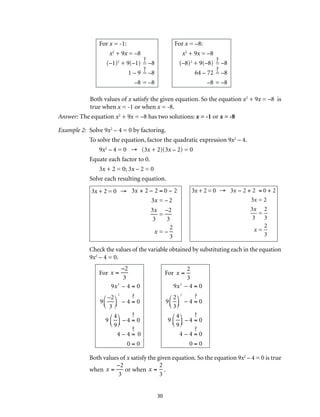
Also, twice the sum of the length and the width of the table gives the perimeter. 
Hence, 2l + 2w = 24. 
If we divide both sides of the equation 2l + 2w = 24 by 2, then l + w = 12. 
We can think of lw = 27 and l + w = 12 as the equations representing the product 
and sum of roots, respectively, of a quadratic equation. 
Remember that if the sum and the product of the roots of a quadratic equation are 
given, the roots can be determined. This can be done by inspection or by using the 
equation 
90 
x2 + 
b 
a 
+ 
c 
a 
= 0, where 
– 
b 
a 
is the sum of the roots and 
c 
a 
is the product. 
By inspection, the numbers whose product is 27 and whose sum is 12 are 3 and 9. 
Product: 3 • 9 = 27 
Sum: 3 + 9 = 12 
The roots of the quadratic equation then are 3 and 9. This implies that the width 
of the table is 3 ft. and its length is 9 ft. 
Another method of finding the roots is to use the equation 
x2 + 
b 
a 
x + 
c 
a 
= 0 . Let 
– 
b 
a 
= 12 or 
b 
a 
= –12 and 
c 
a 
= 27. Then substitute these values in the equation. 
x2 + 
b 
a 
x + 
c 
s 
= 0 → x2 + (–12)x + 27 = 0 
x – 3 = 0 or x – 9 = 0 
x = 3 or x = 9 
Solve the resulting equation x2 –12x + 27 = 0 using any of the methods of solving 
quadratic equations. Try factoring. 
x2 –12x + 27 = 0 → (x – 3)(x – 9) = 0 
x – 3 = 0 or x – 9 = 0 
x = 3 or x = 9
With the obtained roots of the quadratic equation, the dimensions of the table 
then are 3 ft. and 9 ft., respectively. 
Example 2: An amusement park wants to place a new rectangular billboard to inform visitors 
of their new attractions. Suppose the length of the billboard to be placed is 4 m 
longer than its width and the area is 96 m². What will be the length and the width 
of the billboard? 
If we represent the width of the billboard by x in meters, then its length is 
x + 4. Since the area of the billboard is 96 m², then (x)(x + 4) = 96. 
The equation (x)(x + 4) = 96 is a quadratic equation that can be written in the 
form ax2 + bx + c = 0. 
(x)(x + 4) = 96 → x2 + 4x = 96 
x2 + 4x – 96 = 0 
91 
Solve the resulting equation. 
x2 + 4x – 96 = 0 → (x – 8)(x + 12) = 0 
x – 8 = 0 or x + 12 = 0 
x = 8 or x = –12 
The equation has two solutions: x = 8 or x = -12. 
However, we only consider the positive value of x since the situation involves 
measure of length. Hence, the width of the billboard is 8 m and its length is 12 m. 
Learn more about the Applications of Quadratic Equations through the WEB. You may 
open the following links. 
http://www.mathsisfun.com/algebra/quadraticequation-real-world.html 
http://www.purplemath.com/modules/quadprob.htm 
http://tutorial.math.lamar.edu/Classes/Alg/QuadraticApps.aspx 
http://www.algebra.com/algebra/homework/quadratic/lessons/Using-quadratic-equa-tions- 
tosolve-word-problems.lesson 
http://www.slideshare.net/jchartiersjsd/quadratic-equation-word-problems 
http://www.tulyn.com/algebra/quadraticequations/wordproblems 
http://www.uwlax.edu/faculty/hasenbank/archived/mth126fa08/notes/11.10%20-%20 
Quadratic%20Applications.pdf 
http://www.pindling.org/Math/CA/By_Examples/1_4_Appls_Quadratic/1_4_Appls_ 
Quadratic.html 
Now that you have learned how to solve real-life problems involving quadratic equations, 
you may now try the activities in the next sections.
92 
What to Process 
Your goal in this section is to apply the key concepts of quadratic equations in solving re-al- 
life problems. Use the mathematical ideas and the examples presented in the preceding 
sections to answer the succeeding activities. 
➤ Activity 4: Let Me Try! 
Answer each of the following. 
1. A projectile that is fired vertically into the air with an initial velocity of 120 ft. per second 
can be modeled by the equation s = 120t – 16t2. In the equation, s is the distance in feet of 
the projectile above the ground after t seconds. 
a. How long will it take for a projectile to reach 216 feet? 
b. Is it possible for the projectile to reach 900 feet? Justify your answer. 
2. The length of a rectangular parking lot is 36 m longer than its width. The area of the parking 
lot is 5,152 m2. 
a. How would you represent the width of the parking lot? How about its length? 
b. What equation represents the area of the parking lot? 
c. How would you use the equation representing the area of the parking lot in finding its 
length and width? 
d. What is the length of the parking lot? How about its width? Explain how you arrived at 
your answer. 
e. Suppose the area of the parking lot is doubled, would its length and width also double? 
Justify your answer. 
3. The perimeter of a rectangular swimming pool is 86 m and its area is 450 m2. 
a. How would you represent the length and the width of the swimming pool? 
b. What equation represents the perimeter of the swimming pool? 
How about the equation that represents its area? 
c. How would you find the length and the width of the swimming pool? 
d. What is the length of the swimming pool? How about its width? Explain how you arrived 
at your answer. 
e. How would you check if the dimensions of the swimming pool obtained satisfy the 
conditions of the given situation? 
f. Suppose the dimensions of the swimming pool are both doubled, how would it affect 
its perimeter? How about its area?
In this section, the discussion was about solving real-life problems involving quadratic 
equations. 
Go back to the previous section and compare your initial ideas with the discussion. How 
much of your initial ideas are found in the discussion? Which ideas are different and need 
revision? 
Now that you know the important ideas about quadratic equations and their applications 
in real life, let’s go deeper by moving on to the next section. 
What to Reflect and Understand 
Your goal in this section is to take a closer look at some aspects of the topic. You are going to 
think deeper and test further your understanding of the real-life applications of quadratic 
equations. After doing the following activities, you should be able to answer this important 
question: “How are quadratic equations used in solving real-life problems and in making 
decisions?” 
➤ Activity 5: Find Those Missing! 
Solve the following problems. Explain how you arrived at your answers. 
1. A rectangular garden has an area of 84 m2 and a perimeter of 38 m. Find its length and width. 
2. A children’s park is 350 m long and 200 m wide. It is surrounded by a pathway of uniform 
width. Suppose the total area of the park and the pathway is 74,464 m2. How wide is the 
pathway? 
3. A car travels 20 kph faster than a truck. The car covers 350 km in two hours less than the 
time it takes the truck to travel the same distance. What is the speed of the car? How about 
the truck? 
4. Jane and Maria can clean the house in 8 hours if they work together. The time that Jane takes 
in cleaning the house alone is 4 hours more than the time Maria takes in cleaning the same 
house. How long does it take Jane to clean the house alone? How about Maria? 
5. If an amount of money P in pesos is invested at r percent compounded annually, it will grow 
to an amount A = P(1 + r)2 in two years. Suppose Miss Madrigal wants her money amounting 
to Php200,000 to grow to Php228,980 in two years. At what rate must she invest her money? 
In this section, the discussion was about your understanding of quadratic equations and 
their real-life applications. 
What new insights do you have about the real-life applications of quadratic equations? How 
would you connect this to your daily life? How would you use this in making decisions? 
93
Now that you have a deeper understanding of the topic, you are ready to do the tasks in the 
next section. 
94 
What to Transfer 
Your goal in this section is to apply your learning to real-life situations. You will be given 
tasks which will demonstrate your understanding of the lesson. 
➤ Activity 6: Let’s Draw! 
Make a design or sketch plan of a table than can be made out of ¾” × 4’ × 8’ plywood and 
2” × 3” × 8’ wood. Using the design or sketch plan, formulate problems that involve quadratic 
equations, then solve in as many ways as possible. 
Rubric for a Sketch Plan and Equations Formulated and Solved 
4 3 2 1 
The sketch plan is 
accurately made, 
presentable, and 
appropriate. 
The sketch plan is 
accurately made and 
appropriate. 
The sketch plan is not 
accurately made but 
appropriate. 
The sketch plan 
is made but not 
appropriate. 
Quadratic equations 
are accurately 
formulated and solved 
correctly. 
Quadratic equations 
are accurately 
formulated but not all 
are solved correctly. 
Quadratic equations 
are accurately 
formulated but are not 
solved correctly. 
Quadratic equations 
are accurately 
formulated but are not 
solved. 
➤ Activity 7: Play the Role of … 
Cite and role play a situation in real life where the concept of the quadratic equation is applied. 
Formulate and solve problems out of these situations.
Rubric for a Real-Life Situation Involving Quadratic Equations 
4 3 2 1 
95 
The situation is clear, 
realistic and the use 
of the quadratic 
equation and other 
mathematical 
concepts are properly 
illustrated. 
The situation is clear 
but the use of the 
quadratic equation 
and other mathematics 
concepts are not 
properly illustrated. 
The situation is not so 
clear, and the use of 
the quadratic equation 
is not illustrated. 
The situation is not 
clear and the use of the 
quadratic equation is 
not illustrated. 
Rubric on Problems Formulated and Solved 
Score Descriptors 
6 
Poses a more complex problem with 2 or more correct possible solutions and 
communicates ideas unmistakably, shows in-depth comprehension of the pertinent 
concepts and/or processes and provides explanations wherever appropriate. 
5 
Poses a more complex problem and finishes all significant parts of the solution and 
communicates ideas unmistakably, shows in-depth comprehension of the pertinent 
concepts and/or processes. 
4 
Poses a complex problem and finishes all significant parts of the solution and 
communicates ideas unmistakably, shows in-depth comprehension of the pertinent 
concepts and/or processes. 
3 
Poses a complex problem and finishes most significant parts of the solution and 
communicates ideas unmistakably, shows comprehension of major concepts although 
neglects or misinterprets less significant ideas or details. 
2 
Poses a problem and finishes some significant parts of the solution and communicates 
ideas unmistakably but shows gaps on theoretical comprehension. 
1 
Poses a problem but demonstrates minor comprehension, not being able to develop an 
approach. 
Source: D.O. #73 s. 2012 
Summary/Synthesis/Generalization 
This lesson was about solving real-life problems involving quadratic equations. The lesson 
provided you with opportunities to see the real-life applications of quadratic equations. 
Moreover, you were given opportunities to formulate and solve quadratic equations based 
on real-life situations. Your understanding of this lesson and other previously learned 
mathematics concepts and principles will facilitate your understanding of the succeeding 
lessons.
Quadratic Inequalities 
96 
7 
What to Know 
Start Lesson 7 of this module by assessing your knowledge of the different mathematics 
concepts previously studied and your skills in performing mathematical operations. These 
knowledge and skills will help you understand quadratic inequalities. As you go through 
this lesson, think of this important question: “How are quadratic inequalities used in solving 
real-life problems and in making decisions?” To find the answer, perform each activity. If you 
find any difficulty in answering the exercises, seek the assistance of your teacher or peers or 
refer to the modules you have gone over earlier. You may check your work with your teacher. 
➤ Activity 1: What Makes Me True? 
Find the solution/s of each of the following mathematical sentences. Answer the questions that 
follow. 
1. x + 5 > 8 6. x2 + 5x + 6 = 0 
2. r – 3 < 10 7. t2 – 8t + 7 = 0 
3. 2s + 7 ≥ 21 8. r2 + 7r = 18 
4. 3t – 2 ≤ 13 9. 2h2 – 5h – 12 = 0 
5. 12 – 5m > –8 10. 9s2 = 4 
Questions: 
a. How did you find the solution/s of each mathematical sentence? 
b. What mathematics concepts or principles did you apply to come up with the solution/s? 
c. Which mathematical sentence has only one solution? More than one solution? Describe these 
mathematical sentences. 
How did you find the activity? Were you able to find the solution/s of each mathematical 
sentence? Did you find difficulty in solving each mathematical sentence? If not, then you 
are ready to proceed to the next activity.
➤ Activity 2: Which Are Not Quadratic Equations? 
Use the mathematical sentences below to answer the questions that follow. 
97 
x2 + 9x + 20 = 0 
3w2 + 12w ≥ 0 
r2 + 10r ≤ –16 
2t2 < 21 – 9t 
2s2 + 7s + 5 > 0 15 – 6h2 = 10 
4x2 – 25 = 0 
m2 = 6m – 7 
1. Which of the given mathematical sentences are quadratic equations? 
2. How do you describe quadratic equations? 
3. Which of the given mathematical sentences are not quadratic equations? Why? 
4. How would you describe those mathematical sentences which are not quadratic equations? 
How are they different from those equations which are quadratic? 
In the activity done, were you able to distinguish mathematical sentences which are quadratic 
equations and which are not quadratic equations? Were you able to describe mathematical 
sentences that make use of equality and inequality symbols? In the next activity, you will 
learn how mathematical sentences involving inequalities are illustrated in real life. 
➤ Activity 3: Let’s Do Gardening! 
Use the situation below to answer the questions that follow. 
Mr. Bayani has a vacant lot in his backyard. He 
wants to make as many rectangular gardens as possible 
such that the length of each garden is 2 m longer than 
its width. He also wants the length of the garden with 
the smallest area to be 3 m. 
1. Illustrate the different rectangular gardens that Mr. 
Bayani could make. 
2. What are the dimensions of the different gardens that 
Mr. Bayani wants to make? 
3. What is the area of each garden in item 2? 
4. What is the area of the smallest garden that Mr. Bayani can make? How about the area of 
the largest garden? Explain your answer. 
5. What general mathematical sentence would represent the possible areas of the gardens? 
Describe the sentence. 
6. Using the mathematical sentence formulated, do you think you can find other possible 
dimensions of the gardens that Mr. Bayani wants to make? If YES, how? If NOT, explain.
7. Suppose the length of each garden that Mr. Bayani wants to make is 3 m longer than its width 
and the area of the smallest garden is 10 m2. What general mathematical sentence would 
represent the possible areas of the gardens? How are you going to solve the mathematical 
sentence formulated? Find at least 3 possible solutions of the mathematical sentence. 
8. Draw a graph to represent the solution set of the mathematical sentence formulated in item 
98 
7. What does the graph tell you? 
9. Are all solutions that can be obtained from the graph true to the given situation? Why? 
How did you find the preceding activities? Do you think you are already equipped with 
those knowledge and skills needed to learn the new lesson? I’m sure you are! From the 
activities done, you were able to find the solutions of different mathematical sentences. You 
were able to differentiate quadratic equations from those which are not. More importantly, 
you were able to perform an activity that will lead you in understanding the new lesson. But 
how are quadratic inequalities used in solving real-life problems and in making decisions? 
You will find these out in the activities in the next section. Before doing these activities, read 
and understand first some important notes on Quadratic Inequalities and the examples 
presented. 
A quadratic inequality is an inequality that contains a polynomial of degree 2 and can be 
written in any of the following forms. 
ax2 + bx + c > 0 ax2 + bx + c ≥ 0 
ax2 + bx + c < 0 ax2 + bx + c ≤ 0 
where a, b, and c are real numbers and a ≠ 0. 
Examples: 1. 2x2 + 5x + 1 > 0 3. 3r2 + r – 5 ≥ 0 
2. s2 – 9 < 2s 4. t2 + 4t ≤ 10 
To solve a quadratic inequality, find the roots of its corresponding equality. The points 
corresponding to the roots of the equality, when plotted on the number line, separates the line 
into two or three intervals. An interval is part of the solution of the inequality if a number in 
that interval makes the inequality true. 
Example 1: Find the solution set of x2 + 7x + 12 > 0. 
The corresponding equality of x2 + 7x + 12 > 0 is x2 + 7x + 12 = 0. 
Solve x2 + 7x + 12 = 0. 
(x + 3)(x + 4) = 0 Why? 
x + 3 = 0 and x + 4 = 0 Why 
x = –3 and x = –4 Why?
Plot the points corresponding to -3 and -4 on the number line. 
-10 -9 -8 -7 -6 -5 -4 -3 -2 -1 0 1 2 3 4 5 6 7 8 9 10 
The three intervals are: –∞ < x < –4, –4 < x < –3, and –3 < x < ∞. 
Test a number from each interval against the inequality. 
99 
For –∞ < x < –4, 
let x = –7 
For –4 < x < –3, 
let x = –3.6 
For –3 < x < ∞, 
let x = 0 
x2 + 7x + 12 > 0 
(–7)2 + 7(–7) + 12 > 0 
49 – 49 + 12 > 0 
12 > 0 (True) 
x2 + 7x + 12 > 0 
(–3.6)2 + 7(–3.6) + 12 > 0 
12.96 – 25.2 + 12 > 0 
–0.24 > 0 (False) 
x2 + 7x + 12 > 0 
(0)2 + 7(0) + 12 > 0 
0 + 0 + 12 > 0 
12 > 10 (True) 
We also test whether the points x = –3 and x = –4 satisfy the inequality. 
x2 + 7x + 12 > 0 
(–3)2 + 7(–3) + 12 > 0 
9 – 21 + 12 > 0 
0 > 0 (False) 
x2 + 7x + 12 > 0 
(–4)2 + 7(–4) + 12 > 0 
16 – 28 + 12 > 0 
0 > 0 (False) 
Therefore, the inequality is true for any value of x in the interval –∞ < x < –4 or 
–3 < x < ∞, and these intervals exclude –3 and –4. The solution set of the inequality 
is {x : x < –4 or x > –3}, and its graph is shown below. 
-10 -9 -8 -7 -6 -5 -4 -3 -2 -1 0 1 2 3 4 5 6 7 8 9 10 
Note that hollow circles are used in the graph to show that –3 and –4 are not 
part of the solution set. 
Another way of solving the quadratic inequality x2 + 7x + 12 > 0 is by following the procedure 
in solving quadratic equations. However, there are cases to be considered. Study the procedure in 
solving the quadratic inequality x2 + 7x + 12 > 0 below. Discuss the reason for each step followed. 
Notice that the quadratic expression x2 + 7x + 12 is greater than zero or positive. If we write 
the expression in factored form, what must be true about its factors?
100 
(x + 3)(x + 4) > 0 Why 
Case 1: 
(x + 3) > 0 and (x + 4) > 0 Why 
Case 2: 
(x + 3) < 0 and (x + 4) < 0 Why 
Case 1 
(x + 3) > 0 and (x + 4) > 0 
Case 2 
(x + 3) < 0 and (x + 4) < 0 
Why? 
x + 3 > 0 and x + 4 > 0 
x > –3 and x > –4 
x + 3 < 0 and x + 4 < 0 
x < –3 and x < –4 
x > –3 x < –4 
The solution set of the inequality is {x : x < –4 or x > –3}. Why? 
To check, consider any number greater than -3 or less than -4. Substitute this number to x 
in the inequality x2 + 7x + 12 > 0. 
Consider -2 and 3 which are both greater than -3. 
When x = -2: 
x2 + 7x + 12 > 0 → (–2)2 + 7(–2) + 12 > 0 
4 – 14 + 12 > 0 
2 > 0 (True) 
When x = 3: 
x2 + 7x + 12 > 0 → (3)2 + 7(3) + 12 > 0 
9 + 21+ 12 > 0 
42 > 0 (True) 
This shows that x2 + 7x + 12 > 0 is true for values of x greater than -3. 
This time, consider -5 and -8 which are both less than -4. 
When x = -5: 
x2 + 7x + 12 > 0 → (–5)2 + 7(–5) + 12 > 0 
25 – 35+ 12 > 0 
2 > 0 (True) 
When x = -8: 
x2 + 7x + 12 > 0 → (–8)2 + 7(–8) + 12 > 0 
64 – 56+ 12 > 0 
20 > 0 (True)
The inequality x2 + 7x + 12 > 0 is also true for values of x less than -4. 
Will the inequality be true for any value of x greater than or equal to -4 but less than or 
equal to -3? 
101 
When x = -3: 
x2 + 7x + 12 > 0 → (–3)2 + 7(–3) + 12 > 0 
9 – 21+ 12 > 0 
0 > 0 (Not True) 
The inequality is not true for x = -3. 
When x = -3.5: 
x2 + 7x + 12 > 0 → (–3.5)2 + 7(–3.5) + 12 > 0 
12.25 – 24.5+ 12 > 0 
–0.25 > 0 (Not True) 
The inequality is not true for x = -3.5. 
This shows that x2 + 7x + 12 > 0 is not true for values of x greater than or equal to -4 but 
less than or equal to -3. 
Example 2: 2x2 – 5x ≤ 3 
Rewrite 2x2 – 5x ≤ 3 to 2x2 – 5x – 3 ≤ 0. Why? 
Notice that the quadratic expression 2x2 – 5x – 3 is less than or equal to zero. If we write 
the expression in factored form, the product of these factors must be zero or negative to 
satisfy the inequality. Remember that if the product of two numbers is zero, either one or 
both factors are zeros. Likewise, if the product of two numbers is negative, then one of these 
numbers is positive and the other is negative. 
(2x + 1)(x – 3) ≤ 0 Why 
Case 1: 
(2x + 1) ≤ 0 and (x – 3) ≥ 0 Why 
Case 2: 
(2x + 1) ≥ 0 and (x – 3) ≤ 0 Why
102 
Case 1 
(2x + 1) ≤ 0 and (x – 3) ≥ 0 
Case 2 
(2x + 1) ≥ 0 and (x – 3) ≤ 0 
Why? 
2x + 1 ≤ 0 and x – 3 ≥ 0 
x ≤ 
– 
1 
2 
and x ≥ 3 
2x ≥ –1 and x ≤ 3 
x ≥ 
– 
1 
2 
and x ≤ 3 
No solution 
– 
1 
2 
≤ x ≤ 3 
The solution set of the inequality is 
{ 1 
x : – 
≤ x ≤ 3}. Why? 
2 
The figure below shows the graph of the solution set of the inequality. 
-10 -9 -8 -7 -6 -5 -4 -3 -2 -1 0 1 2 3 4 5 6 7 8 9 10 
Note that 
1 
2 
and 3 are represented by points, to indicate that they are part of the 
solution set. 
To check, consider any number greater than or equal to 
1 
2 
but less than or equal 
to 3. Substitute this number to x in the inequality 2x2 – 5x ≤ 3. 
When x = 0: 
2x2 – 5x ≤ 3 → 2(0)2 – 5(0) ≤ 3 
0 – 0 ≤ 3 
0 ≤ 3 (True) 
When x = 2: 
2x2 – 5x ≤ 3 → 2(2)2 – 5(2) ≤ 3 
8 – 10 ≤ 3 
–2 ≤ 3 (True) 
This shows that 2x2 – 5x ≤ 3 is true for values of x greater than or equal to 
– 
1 
but less than or equal to 3. 2 
Will the inequality be true for any value of x less than 
– 
1 
2 
or greater than 3? 
When x = -2: 
2x2 – 5x ≤ 3 → 2(–2)2 – 5(–2) ≤ 3 
8 + 10 ≤ 3 
18 ≤ 3 (Not True)
103 
When x = 5: 
2x2 – 5x ≤ 3 → 2(5)2 – 5(5) ≤ 3 
50 – 25 ≤ 3 
25 ≤ 3 (Not True) 
This shows that 2x2 – 5x ≤ 3 is not true for values of x less than 
– 
1 
2 
or greater 
than 3. 
There are quadratic inequalities that involve two variables. These inequalities can be writ-ten 
in any of the following forms. 
y > ax2 + bx + c y ≥ ax2 + bx + c 
y < ax2 + bx + c y ≤ ax2 + bx + c 
where a, b, and c are real numbers and a ≠ 0. 
Examples: 1. y < x2 + 3x + 2 3. y + 9 ≥ -4x2 
2. y > 2x2 – 5x + 1 4. y – 7x ≤ 2x2 
How are quadratic inequalities in two variables illustrated in real life? 
The following is a situation where quadratic inequality in two variables is illustrated. 
The city government is planning to construct a new children’s playground. It wants to fence 
in a rectangular ground using one of the walls of a building. The length of the new playground 
is 15 m longer than it is wide and its area is greater than the old playground. 
In the given situation, the width of the room can be represented by w and the length by 
w + 15. Why? 
If we represent the area of the old playground as A, then the quadratic inequality that would 
represent the given situation is w(w + 15) > A or w2 + 15w > A. Why? 
Suppose the area of the old playground is 2200 m2. What could be the area of the new 
playground? What could be its length and width? Is it possible that the value of w is negative? Why? 
The situation tells us that the area of the new playground is greater than the area of the old 
playground. This means that the area of the new playground is greater than 2200. It could be 
2300, 3500, 4600, and so on. 
One possible pair of dimensions of the new playground is 50 m and 65 m, respectively. With 
these dimensions, the area of the new playground is or 3250 m2. 
It is not possible for w to take a negative value because the situation involves measures of 
length.
The solution set of quadratic inequalities in two variables can be determined graphically. 
To do this, write the inequality as an equation, then show the graph. The graph of the resulting 
parabola will be used to graph the inequality. 
Example 1: Find the solution set of y < x2 + 3x + 2. 
Write the inequality to its corresponding equation. 
y < x2 + 3x + 2 → y = x2 + 3x + 2 
Construct table of values for x and y. 
x -5 -4 -3 -2 -1 0 1 2 
y 12 6 2 0 0 2 6 12 
Use these points to graph a parabola. Points B(0, 8), C(1, 6), and E(-3, 2) are points 
along the parabola. The coordinates of these points do not satisfy the inequality 
y < x2 + 3x + 2. Therefore, they are not part of the solution set of the inequality. 
We use a broken line to represent the parabola since the points on the parabola 
do not satisfy the given inequality. 
Parabola 
104
The parabola partitions the plane into two regions. Select one point in each 
region and check whether the given inequality is satisfied. For example, consider 
the origin (0, 0), and substitute this in the inequality. We obtain 0 < 0 + 0 + 2 or 
0 < 2, which is correct. Therefore, the entire region containing (0, 0) represents 
the solution set and we shade it. On the other hand, the point (0, 8) is on the 
other region. If we substitute this in the inequality, we obtain 8 < 0 + 0 + 2 or 
8 < 2, which is false. Therefore, this region is not part of the solution set and we 
do not shade this region. 
To check, points A(-6, 7), D(3, 3), and F(-2, -3) are some of the points in the 
shaded region. If the coordinates of these points are substituted in y < x2 + 3x + 
2, the inequality becomes true. Hence, they are part of the solution set. 
Example 2: Find the solution set of y ≥ 2x2 – 3x + 1. 
The figure above shows the graph of y ≥ 2x2 – 3x + 1. All points in the shaded 
region including those along the solid line (parabola) make up the solution set 
of the inequality. The coordinates of any point in this region make the inequal-ity 
true. Points B(1, 3), C(3, 10), D(0, 6), and E(0, 1) are some of the points on 
the shaded region and along the parabola. The coordinates of these points sat-isfy 
105 
the inequality.
Consider point B whose coordinates are (1, 3). If x = 1 and y = 3 are substituted 
in the inequality, then the mathematical statement becomes true. 
y ≥ 2x2 – 3x + 1 → 3 ≥ 2(1)2 – 3(1) + 1 
3 ≥ 2 – 3 + 1 
3 ≥ 0 
Hence, (1,3) is a solution to the inequality. 
Learn more about Quadratic Inequalities through the WEB. You may open the following 
links. 
• http://www.mathwarehouse.com/quadraticinequality/how-to-solve-and-graph-quad-raticinequality. 
106 
php 
• http://www.regentsprep.org/regents/math/algtrig/ate6/quadinequal.htm 
• http://www.mathsisfun.com/algebra/inequalityquadratic-solving.html 
• http://www.wtamu.edu/academic/anns/mps/math/mathlab/col_algebra/col_alg_tut23_ 
quadineq.htm 
• http://www.shelovesmath.com/algebra/intermediate-algebra/quadratic-inequalities/ 
• http://www.cliffsnotes.com/math/algebra/algebra-ii/quadratics-in-one-variable/solv-ingquadratic- 
inequalities 
What to Process 
Your goal in this section is to apply the key concepts of quadratic inequalities. Use the 
mathematical ideas and the examples presented in the preceding section to answer the 
activities provided. 
➤ Activity 4: Quadratic Inequalities or Not? 
Determine whether each mathematical sentence is a quadratic inequality or not. Answer the 
questions that follow. 
1. x2 + 9x + 14 > 0 6. 3m + 20 ≥ 0 
2. 3s2 – 5s = 1 7. (2r – 5)(r + 4) > 0 
3. 4t2­– 
7t + 2 ≤ 0 8. x2 – 1 < x + 1 
4. x2 < 10x – 3 9. (4h2 – 9) + (2h + 3) ≥ 0 
5. 12 – 5x + x2 = 0 10. 15 – 2x = 3x2 
Questions: 
a. How do you describe quadratic inequalities? 
b. How are quadratic inequalities different from linear inequalities?
c. Give at least three examples of quadratic inequalities. 
Were you able to determine which mathematical sentences are quadratic inequalities? In 
the next activity, you will find and describe the solution sets of quadratic inequalities. 
➤ Activity 5: Describe My Solutions! 
Find the solution set of each of the following quadratic inequalities then graph. Answer the 
questions that follow. 
1. x2 + 9x + 14 > 0 6. 2t2 + 11t + 12 < 0 
2. r2 – 10r + 16 < 0 7. 3x2 – 8x + 5 ≥ 0 
3. x2 + 6x ≥ –5 8. 4p2 ≤ 1 
4. m2 – 7m ≤ 10 9. 2x2 – 3x – 14 > 0 
5. x2 – 5x – 14 > 0 10. 3q2 + 2q ≥ 5 
Questions: 
a. How did you find the solution set of each inequality? 
b. What mathematics concepts or principles did you apply to come up with the solution set of 
107 
each mathematical sentence? 
c. How did you graph the solution set of each inequality? 
d. How would you describe the graph of the solution set of a quadratic inequality? 
e. How many solutions does each inequality have? 
f. Are the solution/s of each inequality real numbers? Why? 
g. Is it possible for a quadratic inequality not to have a real solution? Justify your answer by 
giving a particular example. 
Were you able to find and describe the solution set of each quadratic inequality? Were you 
able to show the graph of the solution set of each? In the next activity, you will determine if 
a point is a solution of a given quadratic inequality in two variables. 
➤ Activity 6: Am I a Solution or Not? 
Determine whether or not each of the following points is a solution of the inequality 
y < 2x2 + 3x – 5. Justify your answer. 
1. A (–1, 6) 4. D (3, 6) 
2. B (1, 8) 5. E (–3, 4) 
3. C (–5, 10) 6. F (2, 9)
7. G (–6, –2) 9. I (0, 0) 
8. H (1, –4) 10. J (–6, 7) 
How did you find the activity? Was it easy for you to determine if a point is a solution of 
the given inequality? Could you give other points that belong to the solution set of the 
inequality? I’m sure you could. In the next activity, you will determine the mathematical 
sentence that is described by a graph. 
➤ Activity 7: What Represents Me? 
Select from the list of mathematical sentences on the right side the inequality that is described 
by each of the following graphs. Answer the questions that follow. 
108 
y > x2 – 2x + 8 
y < 2x2 + 7x + 5 
y ≥ –x2 – 2x + 8 
y ≥ 2x2 + 7x + 5 
y < –x2 – 2x + 8 
y > 2x2 + 7x + 5 
y ≤ –x2 – 2x + 8 
y ≤ 2x2 + 7x + 5 
y > –x2 – 2x + 8 
1. 
2.
109 
y > x2 – 2x + 8 
y < 2x2 + 7x + 5 
y ≥ –x2 – 2x + 8 
y ≥ 2x2 + 7x + 5 
y < –x2 – 2x + 8 
y > 2x2 + 7x + 5 
y ≤ –x2 – 2x + 8 
y ≤ 2x2 + 7x + 5 
y > –x2 – 2x + 8 
3. 
4. 
Questions: 
a. How did you determine the quadratic inequality that is described by a given graph? 
b. In each graph, what does the shaded region represent? 
c. How do the points in the shaded region of each graph facilitate in determining the inequality 
that defines it? 
d. How would you describe the graphs of quadratic inequalities in two variables involving “less 
than”? “greater than”? “less than or equal to”? “greater than or equal to”? 
e. Suppose you are given a quadratic inequality in two variables. How will you graph it?
Were you able to identify the inequality that is described by each graph? Was it easy for you 
to perform this activity? I’m sure it was! If not, then try to find an easier way of doing this 
activity. I know you can do it. In the next activity, you will work on a situation involving 
quadratic inequalities. In this activity, you will further learn how quadratic inequalities are 
illustrated in real life. 
➤ Activity 8: Make It Real! 
Read the situation below then answer the questions that follow. 
The floor of a conference hall can be covered 
completely with tiles. Its length is 36 ft longer than its 
width. The area of the floor is less than 2040 square 
feet. 
1. How would you represent the width of the floor? 
110 
How about its length? 
2. What mathematical sentence would represent the 
given situation? 
3. What are the possible dimensions of the floor? 
How about the possible areas of the floor? 
4. Would it be realistic for the floor to have an area of 144 square feet? Explain your answer. 
In this section, the discussion was about quadratic inequalities and their solution sets and 
graphs. 
Go back to the previous section and compare your initial ideas with the discussion. How 
much of your initial ideas are found in the discussion? Which ideas are different and need 
revision? 
Now that you know the important ideas about this topic, let’s go deeper by moving on to 
the next section. 
What to Reflect and Understand 
Your goal in this section is to take a closer look at some aspects of the topic. You are going 
to think deeper and test further your understanding of quadratic inequalities. After doing 
the following activities, you should be able to answer the following question: “How are 
quadratic inequalities used in solving real-life problems and in making decisions?”
➤ Activity 9: How Well I Understood … 
Answer the following. 
1. How do you describe quadratic inequalities? 
2. Give at least three examples of quadratic inequalities. 
3. How do you find the solution set of a quadratic inequality in one variable? 
How about quadratic inequalities in two variables? 
4. How would you describe the solution set of each of the following quadratic inequalities? 
a. y < x2 + 9x + 14 c. y ≤ 2x2 + 11x + 5 
b. y > x2 – 3x – 18 d. y ≥ 3x2 + 10x – 8 
5. Do you agree that the solution sets of y < x2 + x – 20 and y > x2 + x – 20 is the set of all points 
on a plane? Justify your answer by graphing the solution set of each on a coordinate plane. 
6. Luisa says that the solutions of y > 2x2 – 8x + 7 are also solutions of y > x2 – 4x + 3. Do you 
111 
agree with Luisa? Justify your answer. 
7. A rectangular box is completely filled with dice. Each 
die has a volume of 1 cm3. The length of the box is 
3 cm greater than its width and its height is 5 cm. 
Suppose the box holds at most 140 dice. What are the 
possible dimensions of the box? 
8. A company decided to increase the size of the box for 
the packaging of their canned sardines. The length of 
the original packaging box was 40 cm longer than its 
width, the height was 12 cm, and the volume was at 
most 4800 cm3. 
a. How would you represent the width of the original packaging box? How about the length 
of the box? 
b. What expression would represent the volume of the original packaging box? 
How about the mathematical sentence that would represent its volume? Define the vari-ables 
used. 
c. What could be the greatest possible dimensions of the box if each dimension is in whole 
centimeters? Explain how you arrived at your answer. 
d. Suppose the length of the new packaging box is still 40 cm longer than its width and the 
height is 12 cm. What mathematical sentence would represent the volume of the new 
packaging box? Define the variables used. 
e. What could be the dimensions of the box? Give the possible dimensions of at least three 
different boxes.
In this section, the discussion was about your understanding of quadratic inequalities and 
their solution sets and graphs. 
What new insights do you have about quadratic inequalities and their solution sets and 
graphs? How would you connect this to real life? How would you use this in making deci-sions? 
Now that you have a deeper understanding of the topic, you are ready to do the tasks in the 
next section. 
Mathematical Investigation Written 
• Report Format 
• Title/Topic for Investigation 
• Introduction 
• Exploration 
• Conjectures 
• Testing of Conjectures 
• Justification for Conjectures 
• Conclusion 
112 
What to Transfer 
Your goal in this section is to apply your learning to real-life situations. You will be given a 
practical task which will demonstrate your understanding. 
➤ Activity 10: Investigate Me! 
Conduct a mathematical investigation for each of the following quadratic inequalities. Prepare 
a written report of your findings following the format at the right. 
1. ax2 + bx + c > 0, where b2 – 4ac < 0 
2. ax2 + bx + c < 0, where b2 – 4ac < 0 
3. ax2 + bx + c ≥ 0, where b2 – 4ac < 0 
4. ax2 + bx + c ≤ 0, where b2 – 4ac < 0 
➤ Activity 11: How Much Would It Cost to Tile a Floor? 
Perform the following activity. 
1. Find the dimensions of the floors of at least two rooms in your school. Indicate the measures 
obtained in the table below. 
Rooms Length Width
2. Determine the measures and costs of different tiles that are available in the nearest hardware 
store or advertised in any printed materials or in the internet. Write these in the table below. 
Tiles Length Width Cost 
3. Formulate quadratic inequalities involving the dimensions of the floor of rooms, and the 
measures and costs of tiles. Find, then graph the solution sets of these inequalities. Use the 
rubric provided to rate your work. 
Rubric for Real-Life Situations Involving Quadratic Inequalities 
and Their Solution Sets and Graphs 
4 3 2 1 
113 
Systematically listed 
in the table the 
dimensions of rooms 
and the measures and 
costs of tiles, properly 
formulated and solved 
quadratic inequalities, 
and accurately drew 
the graphs of their 
solution sets 
Systematically listed 
in the table the 
dimensions of rooms 
and the measures 
and costs of tiles, and 
properly formulated 
and solved quadratic 
inequalities but unable 
to draw the graph 
accurately 
Systematically listed 
in the table the 
dimensions of rooms 
and the measures 
and costs of tiles, and 
properly formulated 
quadratic inequalities 
but unable to solve 
these 
Systematically listed 
in the table the 
dimensions of rooms 
and the measures and 
costs of tiles 
In this section, your task was to formulate and solve quadratic inequalities based on real-life 
situations. You were placed in a situation wherein you need to determine the number and 
total cost of tiles needed to cover the floors of some rooms. 
How did you find the performance task? How did the task help you realize the use of the 
topic in real life?
Summary/Synthesis/Generalization 
This lesson was about quadratic inequalities and their solution sets and graphs. The lesson 
provided you with opportunities to describe quadratic inequalities and their solution sets 
using practical situations, mathematical expressions, and their graphs. Moreover, you were 
given the opportunity to draw and describe the graphs of quadratic inequalities and to 
demonstrate your understanding of the lesson by doing a practical task. Your understand-ing 
of this lesson and other previously learned mathematics concepts and principles will 
facilitate your learning of the next lesson, Quadratic Functions. 
Glossary of Terms 
Discriminant – This is the value of the expression b2 – 4ac in the quadratic formula. 
Extraneous Root or Solution – This is a solution of an equation derived from an original equa-tion. 
However, it is not a solution of the original equation. 
Irrational Roots – These are roots of equations which cannot be expressed as quotient of integers. 
Quadratic Equations in One Variable – These are mathematical sentences of degree 2 that can 
114 
be written in the form ax2 + bx + c = 0. 
Quadratic Formula – This is an equation that can be used to find the roots or solutions of the 
quadratic equation ax2 + bx + c = 0. The quadratic formula is 
x = 
–b ± b2 – 4ac 
2a 
. 
Quadratic Inequalities – These are mathematical sentences that can be written in any of the 
following forms: ax2 + bx + c > 0, ax2 + bx + c < 0, ax2 + bx + c ≥ 0, and ax2 + bx + c ≤ 0. 
Rational Algebraic Equations – These are mathematical sentences that contain rational algebraic 
expressions. 
Rational Roots – These are roots of equations which can be expressed as quotient of integers. 
Solutions or Roots of Quadratic Equations – These are the values of the variable/s that make 
quadratic equations true. 
Solutions or Roots of Quadratic Inequalities – These are the values of the variable/s that make 
quadratic inequalities true. 
DepEd Instructional Materials That Can Be Used 
as Additional Resources for the Lesson Quadratic 
Equations and Inequalities 
1. EASE Modules Year II Modules 1, 2, and 3 
2. BASIC EDUCATION ASSISTANCE FOR MINDANAO (BEAM) Mathematics 8 Module 4 
pp. 1 to 55
References and Website Links Used in this Module 
References 
Bellman, Allan E., et al. Algebra 2 Prentice Hall Mathematics, Pearson Prentice Hall, New Jer-sey 
115 
USA, 2004. 
Brown, Richard G., Mary P. Dolciani, Robert H. Sorgenfrey, and William L. Cole. Algebra, Struc-ture 
and Method, Book I, Houghton Mifflin Company, Boston MA, 1990. 
Brown, Richard G., Mary P. Dolciani, Robert H. Sorgenfrey, and Robert B. Kane. Algebra, Struc-ture 
and Method Book 2. Houghton Mifflin Company, Boston, 1990. 
Chapin, Illingworth, Landau, Masingila and McCracken. Prentice Hall Middle Grades Math, 
Tools for Success, Prentice-Hall, Inc., Upper Saddle River, New Jersey, 1997. 
Clements, Douglas H., Kenneth W. Jones, Lois Gordon Moseley, and Linda Schulman. Math in 
my World, McGraw-Hill Division, Farmington, New York, 1999. 
Coxford, Arthur F. and Joseph N. Payne. HBJ Algebra I, Second Edition, Harcourt Brace Jova-novich, 
Publishers, Orlando, Florida, 1990. 
Fair, Jan and Sadie C. Bragg. Prentice Hall Algebra I, Prentice-Hall, Inc., Englewood Cliffs, New 
Jersey, 1991. 
Gantert, Ann Xavier. Algebra 2 and Trigonometry. AMSCO School Publications, Inc., 2009. 
Larson, Ron, Laurie Boswell, Timothy D. Kanold, and Lee Stiff. Algebra 1, Applications, Equa-tions, 
and Graphs. McDougal Littell, A Houghton Mifflin Company, Illinois, 2004. 
Larson, Ron, Laurie Boswell, Timothy D. Kanold, and Lee Stiff. Algebra 2, Applications, Equa-tions, 
and Graphs. McDougal Littell, A Houghton Mifflin Company, Illinois, 2008. 
Smith, Charles, Dossey, Keedy and Bettinger. Addison-Wesley Algebra, Addison-Wesley Pub-lishing 
Company, 1992. 
Wesner, Terry H. and Harry L. Nustad. Elementary Algebra with Applications. Wm. C. Brown 
Publishers. IA, USA. 
Wilson, Patricia S., et. al. Mathematics, Applications and Connections, Course I, Glencoe Divi-sion 
of Macmillan/McGraw-Hill Publishing Company, Westerville, Ohio, 1993. 
Website Links as References and for Learning Activities 
Algebra.help. Solve by Using the Quadratic Equation Lessons. (2011). Retrieved November 7, 
2013, from http://www.algebrahelp.com/lessons/equations/quadratic/ 
Algebra II: Quadratic Equations. (2011). Retrieved November 7, 2013, from http://library. 
thinkquest.org/20991/alg2/quad.html 
At Home Tuition. Quadratic Equations. (2010). Retrieved November 7, 2013, from http://www. 
athometuition.com/QuadraticEquationsFormula.php 
Beginning Algebra (v. 1.0) Section 6.6 Solving Equations by Factoring. (2012). Retrieved 
November 7, 2013, from http://2012books.lardbucket.org/books/beginning-algebra/s09- 
06-solving-equations-by-factoring.html
Beginning Algebra (v. 1.0) Section 9.1 Extracting Square Roots. (2012). Retrieved November 7, 
2013, from http://2012books.lardbucket.org/books/beginning-algebra/s12-01-extracting-square- 
116 
roots.html 
Beginning Algebra (v. 1.0) Section 9.2 Completing the Square. (2012). Retrieved November 7, 
2013, from http://2012books.lardbucket.org/books/beginning-algebra/s12-02-completing-the- 
square.html 
Beginning Algebra (v. 1.0) Section 9.3 Quadratic Formula. (2012). Retrieved November 7, 2013, 
from http://2012books.lardbucket.org/books/beginning-algebra/s12-03-quadratic-formula. 
html 
Dawkins, Paul. Paul’s Online Math Notes. Quadratic Equations: A Summary. (2013). Retrieved 
November 7, 2013, from http://tutorial.math.lamar.edu/Classes/Alg/QuadraticApps.aspx 
Dendane, Abdelkader. Solutions to Quadratic Equations with Rational Expressions. (2012). 
Retrieved November 7, 2013, from http://www.analyzemath.com/Algebra2/algebra2_solu-tions. 
html 
Dendane, Abdelkader. Solve Quadratic Equations Using Discriminant. (2012). Retrieved Novem-ber 
7, 2013, from http://www.analyzemath.com/Equations/Quadratic-1.html 
Dendane, Abdelkader. Solve Quadratic Equations with Rational Expressions-Problems. (2012). 
Retrieved November 7, 2013, from http://www.analyzemath.com/Algebra2/Algebra2.html 
Discovery Education WEBMath. Solve a Quadratic Equation by Factoring. (2013). Retrieved 
November 7, 2013, from http://www.webmath.com/quadtri.html 
High Points Learning Inc. iCoachMath.Com. Discriminant. (2013). Retrieved November 7, 2013, 
from http://www.icoachmath.com/math_dictionary/discriminant.html 
Houghton Mifflin Harcourt Cliffs Notes. Solving Quadratic Inequalities. (2013). Retrieved 
November 7, 2013, from http://www.cliffsnotes.com/math/algebra/algebra-ii/ 
quadratics-in-one-variable/solving-quadratic-inequalities 
Lesson Using quadratic equations to solve word problems. Retrieved November 7, 2013, from 
http://www.algebra.com/algebra/homework/quadratic/lessons/Using-quadratic-equations-to- 
solve-word-problems.lesson 
Math-Help-Ace.com.Quadratic Equation Solver - Finding The Quadratic Equation With Given 
Roots, Examples, Exercise. (2008). Retrieved November 7, 2013, from http://www.math-help-ace. 
com/Quadratic-Equation-Solver.html 
Math is Fun Completing the Square. (2012). Retrieved November 7, 2013, from http://www. 
mathsisfun.com/algebra/completing-square.html 
Math is Fun Real World Examples of Quadratic Equations. (2012). Retrieved November 7, 2013, 
from http://www.mathsisfun.com/algebra/quadratic-equation-real-world.html 
Math is Fun Solving Quadratic Inequalities. (2012). Retrieved November 7, 2013, from http:// 
www.mathsisfun.com/algebra/inequality-quadratic-solving.html 
Math Warehouse How to Solve a Quadratic Inequality. Retrieved November 7, 2013, from http:// 
www.mathwarehouse.com/quadratic-inequality/how-to-solve-and-graph-quadratic-in-equality. 
php
Math Warehouse Solve a Quadratic Equation by Factoring. Retrieved November 7, 2013, from 
http://www.mathwarehouse.com/quadratic/solve-quadratic-equation-by-factoring.php 
NySphere International, Inc. Algebra: Quadratic Equations Word Problems. (2013). Retrieved 
November 7, 2013, from http://www.tulyn.com/algebra/quadratic-equations/wordproblems 
Oswego City School District Regents exam Prep Center. Algebra2 Trig. Completing the Square. 
(2012). Retrieved November 7, 2013, from http://www.regentsprep.org/Regents/math/alg-trig/ 
117 
ATE12/indexATE12.htm 
Oswego City School District Regents exam Prep Center. Algebra2 Trig. Discriminant. (2012). 
Retrieved November 7, 2013, from http://www.regentsprep.org/Regents/math/algtrig/ATE3/ 
discriminant.htm 
Oswego City School District Regents exam Prep Center. Algebra2 Trig. Nature of Roots (Sum and 
Product). (2012). Retrieved November 7, 2013, from http://www.regentsprep.org/Regents/ 
math/algtrig/ATE4/natureofroots.htm 
Oswego City School District Regents exam Prep Center. Algebra2 Trig. Quadratic Inequalities. 
(2012). Retrieved November 7, 2013, from http://www.regentsprep.org/regents/math/alg-trig/ 
ate6/quadinequal.htm 
Oswego City School District Regents exam Prep Center. Algebra2 Trig. Solving Quadratic Equa-tions 
with the Quadratic Formula. (2012). Retrieved November 7, 2013, from http://www. 
regentsprep.org/Regents/math/algtrig/ATE3/quadformula.htm 
Pindling.org. Math by Examples. College Algebra. “Chapter 1.4 Applications of Quadratic Equa-tions”. 
(2006). Retrieved November 7, 2013, from 
http://www.pindling.org/Math/CA/By_Examples/1_4_Appls_Quadratic/1_4_Appls_Quadratic. 
html 
Quadratic Equations Lesson. Retrieved November 7, 2013, from http://www.algebra.com/algebra/ 
homework/quadratic/lessons/quadform/ 
Seward, Kim. WTAMU and Kim Seward Virtual Math Lab College Algebra Tutorial 23A. Quadratic 
Inequalities. (2010). Retrieved November 7, 2013, from http://www.wtamu.edu/academic/ 
anns/mps/math/mathlab/col_algebra/col_alg_tut23_quadineq.htm 
She Loves Math Quadratic Inequalities. (2013). Retrieved November 7, 2013, from http://www. 
shelovesmath.com/algebra/intermediate-algebra/quadratic-inequalities/ 
Slideshare Inc. Quadratic Equation Word Problems. (2013). Retrieved November 7, 2013, from 
http://www.slideshare.net/jchartiersjsd/quadratic-equation-word-problems 
Solving Quadratic Equations by Using the Square Root Property. Retrieved November 7, 2013, 
from http://www.personal.kent.edu/~bosikiew/Algebra-handouts/solving-sqroot.pdf 
The Purple Math Forums Completing the Square Solving Quadratic Equations. (2012). Retrieved 
November 7, 2013, from http://www.purplemath.com/modules/sqrquad.htm 
The Purple Math Forums. Quadratic World Problems: Projectile Motion. (2012). Retrieved 
November 7, 2013, from http://www.purplemath.com/modules/quadprob.htm 
The Purple Math Forums Solving Quadratic Equations by Factoring. (2012). Retrieved Novem-ber 
7, 2013, from http://www.purplemath.com/modules/solvquad.htm
The Purple Math Forums Solving Quadratic Equations by Taking Square Roots. (2012). Retrieved 
November 7, 2013, from http://www.purplemath.com/modules/solvquad2.htm 
The Purple Math Forums. The Quadratic Formula Explained. (2012). Retrieved November 7, 
2013, from http://www.purplemath.com/modules/quadform.htm 
TutorVista.com. (2013). Algebra 1 Quadratic Equation. Retrieved November 7, 2013, from http:// 
math.tutorvista.com/algebra/quadratic-equation.html 
uwlax.edu. Retrieved November 7, 2013, from http://www.uwlax.edu/faculty/hasenbank/archived/ 
mth126fa08/notes/11.10%20-%20Quadratic%20Applications.pdf 
Website Link for Videos 
easymathk12. Retrieved November 7, 2013, from http://www.youtube.com/watch?v=l7FI4T19uIA 
Math Vids. Solving Rational Equation to Quadratic 1. (2013). Retrieved November 7, 2013, 
from http://mathvids.com/lesson/mathhelp/1437-solving-rational-equation-to-quadratic-1 
Website Links for Images 
Smith, Cameron. Kentucky girls basketball star scores all of her team’s first 40 points in win. 
(2012). Retrieved November 7, 2013, from http://sports.yahoo.com/blogs/highschool-prep-rally/ 
kentucky-girls-basketball-star-scores-her-team-first-181307906.html 
118

Grade 9: Mathematics Unit 1 Quadratic Equations and Inequalities.

  • 1.
    Mathematics Learner’s Material 9 Module 1: Quadratic Equations and Inequalities This instructional material was collaboratively developed and reviewed by educators from public and private schools, colleges, and/or universities. We encourage teachers and other education stakeholders to email their feedback, comments, and recommendations to the Department of Education at action@deped.gov.ph. We value your feedback and recommendations. Department of Education Republic of the Philippines
  • 2.
    Math atics Ga 9 Learner’s Material First Edition, 2014 ISBN: 978-971-9601-71-5 Republic ct 8293, section 176 states that: No copyright shall subsist in any work of the Government of the Philippines. However, prior approval of the government agency or office wherein the work is created shall be necessary for exploitation of such work for profit. Such agency or office may, among other things, impose as a condition the payment of royalties. Borrowed materials (i.e., songs, stories, poems, pictures, photos, brand names, trade- marks, etc.) included in this book are owned by their respective copyright holders. DepEd is represented by the Filipinas Copyright Licensing Society (FILCOLS), Inc. in seeking permission to use these materials from their respective copyright owners. The publisher and authors do not represent nor claim ownership over them. Published by the Department of Education Secretary: Br. Armin A. Luistro FSC Undersecretary: Dina S. Ocampo, PhD Development eam of the Learner’s Material Authors: Merden L. Bryant, Leonides E. Bulalayao, Melvin M. Callanta, Jerry D. Cruz, Richard F. De Vera, Gilda T. Garcia, Sonia E. Javier, Roselle A. Lazaro, Bernadeth J. Mesterio, and Rommel Hero A. Saladino Consultants: Rosemarievic Villena-Diaz, PhD, Ian June L. Garces, PhD, Alex C. Gonzaga, PhD, and Soledad A. Ulep, PhD Editor: Debbie Marie B. Versoza, PhD Reviewers: Alma D. Angeles, Elino S. Garcia, Guiliver Eduard L. Van Zandt, Arlene A. Pascasio, PhD, and Debbie Marie B. Versoza, PhD Book Designer: Leonardo C. Rosete, Visual Communication Department, UP College of Fine Arts Management Team: Dir. Jocelyn DR. Andaya, Jose D. Tuguinayo Jr., Elizabeth G. Catao, Maribel S. Perez, and Nicanor M. San Gabriel Jr. Printed in the Philippines by Vibal Group, nc. Department of Education-Instructional Materials Council Secretariat (DepEd-IMCS) Office Address: 5th Floor Mabini Building, DepEd Complex Meralco Avenue, Pasig City, Philippines 1600 Telefax: (02) 634-1054 o 634-1072 E-mail Address: imcsetd@yahoo.com
  • 3.
    Table of Contents Module 1. Quadratic Equations and inequalities ............................................................. 1 Module Map .................................................................................................................................. 3 Pre-Assessment ............................................................................................................................ 4 Learning Goals and Targets ...................................................................................................... 10 Lesson I. Illustrations of Quadratic Equations ................................................................... 11 Lesson 2A. Solving Quadratic Equations by Extracting Square Roots ..................... 18 Lesson 2B. Solving Quadratic Equations by Factoring ................................................... 27 Lesson 2C. Solving Quadratic Equations by Completing the Square ....................... 35 Lesson 2D. Solving Quadratic Equations by Using the Quadratic Formula ............ 47 Lesson 3. The Nature of the Roots of a Quadratic Equation ......................................... 56 Lesson 4. The Sum and the Product of Roots of Quadratic Equations ..................... 66 Lesson 5. Equations Transformable into Quadratic Equations .................................... 77 Lesson 6. Solving Problems Involving Quadratic Equations ........................................ 88 Lesson 7. Quadratic Inequalities ............................................................................................ 96 Glossary of Terms ......................................................................................................................... 114 References and Websites Links Used in this Module ...................................................... 115
  • 4.
    MODULE 1 QuadraticEquations and Inequalities I. INTRODUCTION AND FOCUS QUESTIONS Was there any point in your life when you asked yourself about the different real-life quantities such as costs of goods or services, incomes, profits, yields and losses, amount of particular things, speed, area, and many others? Have you ever realized that these quantities can be mathematically represented to come up with practical decisions? Find out the answers to these questions and determine the vast applications of quadratic equations and quadratic inequalities through this module. 1
  • 5.
    II. LESSONS ANDCOVERAGE In this module, you will examine the above questions when you take the following lessons: Lesson 1 – ILLUSTRATIONS OF QUADRATIC EQUATIONS Lesson 2 – SOLVING QUADRATIC EQUATIONS EXTRACTING SQUARE ROOTS FACTORING COMPLETING THE SQUARE QUADRATIC FORMULA Lesson 3 – NATURE OF ROOTS OF QUADRATIC EQUATIONS Lesson 4 – SUM AND PRODUCT OF ROOTS OF QUADRATIC EQUATIONS Lesson 5 – EQUATIONS TRANSFORMABLE INTO QUADRATIC EQUATIONS (INCLUDING RATIONAL ALGEBRAIC EQUATIONS) Lesson 6 – APPLICATIONS OF QUADRATIC EQUATIONS AND RATIONAL ALGEBRAIC 2 EQUATIONS Lesson 7 – QUADRATIC INEQUALITIES Objectives In these lessons, you will learn to: Lesson 1 • illustrate quadratic equations; Lesson 2 • solve quadratic equations by: (a) extracting square roots; (b) factoring; (c) completing the square; (d) using the quadratic formula; Lesson 3 • characterize the roots of a quadratic equation using the discriminant; Lesson 4 • describe the relationship between the coefficients and the roots of a quadratic equation; Lesson 5 • solve equations transformable into quadratic equations (including rational algebraic equations); Lesson 6 • solve problems involving quadratic equations and rational algebraic equations; Lesson 7 • illustrate quadratic inequalities; • solve quadratic inequalities; and • solve problems involving quadratic inequalities.
  • 6.
    Module Map Hereis a simple map of the lessons that will be covered in this module: Quadratic Equations, Quadratic Inequalities, and Rational Algebraic Equations 3 Illustrations of Quadratic Equations Solving Quadratic Equations Extracting Square Roots Factoring Completing the Square Quadratic Formula Illustrations of Quadratic Inequalities Solving Quadratic Inequalities Application of Quadratic Inequalities Nature of Roots of Quadratic Equations Sum and Product of Roots of Quadratic Equations Equations Transformable into Quadratic Equations Applications of Quadratic Equations and Rational Algebraic Equations Quadratic Inequalities Rational Algebraic Equations
  • 7.
    4 III. PRE-ASSESSMENT Part I Directions: Find out how much you already know about this module. Choose the letter that you think best answers the question. Please answer all items. Take note of the items that you were not able to answer correctly and find the right answer as you go through this module. 1. It is a polynomial equation of degree two that can be written in the form ax2 + bx + c = 0, where a, b, and c are real numbers and a ≠ 0. A. Linear Equation C. Quadratic Equation B. Linear Inequality D. Quadratic Inequality 2. Which of the following is a quadratic equation? A. 2r2 + 4r – 1 C. s2 + 5s – 4 = 0 B. 3t – 7 = 2 D. 2x2 – 7x ≥ 3 3. In the quadratic equation 3x2 + 7x – 4 = 0, which is the quadratic term? A. x2 C. 3x2 B. 7x D. –4 4. Which of the following rational algebraic equations is transformable into a quadratic equation? A. w + 1 2 – w + 2 4 = 7 C. 2q – 1 3 + 1 2 = 3q 4 B. 2 p + 3 p + 1 = 5 D. 3 m – 2 + 4 m + 2 = 7 m 5. How many real roots does the quadratic equation x2 + 5x + 7 = 0 have? A. 0 C. 2 B. 1 D. 3 6. The roots of a quadratic equation are -5 and 3. Which of the following quadratic equations has these roots? A. x2 – 8x + 15 = 0 C. x2 – 2x – 15 = 0 B. x2 + 8x + 15 = 0 D. x2 + 2x – 15 = 0 7. Which of the following mathematical statements is a quadratic inequality? A. 2r2 – 3r – 5 = 0 C. 3t2 + 7t – 2 ≥ 0 B. 7h + 12 < 0 D. s2 + 8s + 15 = 0
  • 8.
    8. Which ofthe following shows the graph of y ≥ x2 + 7x + 6? A. C. B. D. 9. Which of the following values of x make the equation x2 +7x – 18 = 0 true? 5 I. -9 II. 2 III. 9 A. I and II C. I and III B. II and III D. I, II, and III 10. Which of the following quadratic equations has no real roots? A. 2x2 + 4x = 3 C. 3s2 – 2s = –5 B. t2 – 8t – 4 = 0 D. –2r2 + r + 7 = 0 11. What is the nature of the roots of the quadratic equation if the value of its discriminant is zero? A. The roots are not real. C. The roots are rational and not equal. B. The roots are irrational and not equal. D. The roots are rational and equal.
  • 9.
    12. One ofthe roots of 2x2 – 13x + 20 = 0 is 4. What is the other root? 6 A. – 2 5 C. 2 5 B. – 5 2 D. 5 2 13. What are the roots of the quadratic equation x2 + x – 56 = 0? A. 2 and -1 C. -8 and 7 B. 8 and -7 D. 3 and -2 14. What is the sum of the roots of the quadratic equation x2 + 6x – 14 = 0? A. -7 C. -3 B. -6 D. 14 15. Which of the following quadratic equations can be solved easily by extracting square roots? A. x2 + 7x + 12 = 0 C. 4t2 – 9 = 0 B. 2w2 + 7w – 3 = 0 D. 3v2 + 2v – 8 = 0 16. Which of the following coordinates of points belong to the solution set of the inequality y < 2x2 + 5x – 1? A. (-3, 2) C. (1, 6) B. (-2, 9) D. (3, 1) 17. A 3 cm by 3 cm square piece of cardboard was cut from a bigger square cardboard. The area of the remaining cardboard was 40 cm2. If s represents the length of the bigger cardboard, which of the following expressions give the area of the remaining piece? A. s – 9 C. s2 – 9 B. s2 + 9 D. s2 + 40 18. The length of a wall is 12 m more than its width. If the area of the wall is less than 50 m2, which of the following could be its length? A. 3 m C. 15 m B. 4 m D. 16 m 19. The length of a garden is 5 m longer than its width and the area is 14 m2. How long is the garden? A. 9 m C. 5 m B. 7 m D. 2 m
  • 10.
    20. A cartravels 20 kph faster than a truck. The car covers 480 km in two hours less than the time it takes the truck to travel the same distance. How fast does the car travel? A. 44 kph C. 80 kph B. 60 kph D. 140 kph 21. A 12 cm by 16 cm picture is mounted with border of uniform width on a rectangular frame. If the total area of the border is 288 cm2, what is the length of the side of the frame? A. 8 cm C. 20 cm B. 16 cm D. 24 cm 22. SamSon Electronics Company would like to come up with an LED TV such that its screen is 560 square inches larger than the present ones. Suppose the length of the screen of the larger TV is 6 inches longer than its width and the area of the smaller TV is 520 square inches. What is the length of the screen of the larger LED TV? A. 26 in C. 33 in B. 30 in D. 36 in 23. The figure on the right shows the graph of y < 2x2 – 4x – 1. Which of the following is true about the solution set of the inequality? I. The coordinates of all points on the shaded region belong to the solution set of the inequality. II. The coordinates of all points along the parabola as shown by the broken line belong to the solution set of the inequality. III. The coordinates of all points along the parabola as shown by the broken line do not belong to the solution set of the inequality. A. I and II C. II and III B. I and III D. I, II, and III 24. It takes Mary 3 hours more to do a job than it takes Jane. If they work together, they can finish the same job in 2 hours. How long would it take Mary to finish the job alone? A. 3 hours C. 6 hours B. 5 hours D. 8 hours 7
  • 11.
    25. An openbox is to be formed out of a rectangular piece of cardboard whose length is 12 cm longer than its width. To form the box, a square of side 5 cm will be removed from each corner of the cardboard. Then the edges of the remaining cardboard will be turned up. If the box is to hold at most 1900 cm3, what mathematical statement would represent the given situation? A. x2 – 12x ≤ 360 C. x2 – 8x ≤ 400 B. x2 – 12x ≤ 380 D. x2 + 8x ≤ 400 26. The length of a garden is 2 m more than twice its width and its area is 24 m2. Which of the following equations represents the given situation? A. x2 + x = 12 C. x2 + x = 24 B. x2 + 2x = 12 D. x2 + 2x = 24 27. From 2004 through 2012, the average weekly income of an employee in a certain company is estimated by the quadratic expression 0.16n2 + 5.44n + 2240, where n is the number of years after 2004. In what year was the average weekly income of an employee equal to Php2,271.20? A. 2007 C. 2009 B. 2008 D. 2010 28. In the figure below, the area of the shaded region is 144 cm2. What is the length of the longer 8 side of the figure? s 4 cm s 6 cm A. 8 cm C. 14 cm B. 12 cm D. 18 cm
  • 12.
    Part II Directions:Read and understand the situation below then answer or perform what are asked. Mrs. Villareal was asked by her principal to transfer her Grade 9 class to a new classroom that was recently built. The room however still does not have fixtures such as teacher’s table, bulletin boards, divan, bookshelves, and cabinets. To help her acquire these fixtures, she informed the parents of her students about these classroom needs. The parents decided to donate construction materials such as wood, plywood, nails, paints, and many others. After all the materials have been received, she asked her students to make the designs of the different classroom needs. Each group of students was assigned to do the design of a particular fixture. The designs that the students will prepare shall be used by the carpenter in constructing the tables, chairs, bulletin boards, divan, bookshelves, and cabinets. 1. Suppose you are one of the students of Mrs. Villareal, how will you prepare the design 9 of one of the fixtures? 2. Make a design of the fixture assigned to your group. 3. Illustrate every part or portion of the fixture including its measurement. 4. Using the design of the fixture made, determine all the mathematics concepts or principles involved. 5. Formulate problems involving these mathematics concepts or principles. 6. Write the expressions, equations, or inequalities that describe the situations or problems. 7. Solve the equations, the inequalities, and the problems formulated. Rubric for Design 4 3 2 1 The design is accurately made, presentable, and appropriate. The design is accurately made and appropriate. The design is not accurately made but appropriate. The design is made but not appropriate. Rubric for Equations Formulated and Solved 4 3 2 1 Equations and inequalities are properly formulated and solved correctly. Equations and inequalities are properly formulated but not all are solved correctly. Equations and inequalities are properly formulated but are not solved correctly. Equations and inequalities are properly formulated but are not solved.
  • 13.
    10 Rubric onProblems Formulated and Solved Score Descriptors 6 Poses a more complex problem with 2 or more correct possible solutions and communicates ideas unmistakably, shows in-depth comprehension of the pertinent concepts and/or processes and provides explanations wherever appropriate. 5 Poses a more complex problem and finishes all significant parts of the solution and communicates ideas unmistakably, shows in-depth comprehension of the pertinent concepts and/or processes. 4 Poses a complex problem and finishes all significant parts of the solution and communicates ideas unmistakably, shows in-depth comprehension of the pertinent concepts and/or processes. 3 Poses a complex problem and finishes most significant parts of the solution and communicates ideas unmistakably, shows comprehension of major concepts although neglects or misinterprets less significant ideas or details. 2 Poses a problem and finishes some significant parts of the solution and communicates ideas unmistakably but shows gaps on theoretical comprehension. 1 Poses a problem but demonstrates minor comprehension, not being able to develop an approach. Source: D.O. #73, s. 2012 IV. LEARNING GOALS AND TARGETS After going through this module, you should be able to demonstrate understanding of key concepts of quadratic equations, quadratic inequalities, and rational algebraic equations, formulate real-life problems involving these concepts, and solve these using a variety of strategies. Furthermore, you should be able to investigate mathematical relationships in various situations involving quadratic equations and quadratic inequalities.
  • 14.
    Illustrations of QuadraticEquations 11 1 What to Know Start Lesson 1 of this module by assessing your knowledge of the different mathematics concepts previously studied and your skills in performing mathematical operations. These knowledge and skills will help you understand quadratic equations. As you go through this lesson, think of this important question: “How are quadratic equations used in solving real-life problems and in making decisions?” To find the answer, perform each activity. If you find any difficulty in answering the exercises, seek the assistance of your teacher or peers or refer to the modules you have gone over earlier. You may check your work with your teacher. ➤ Activity 1: Do You Remember These Products? Find each indicated product then answer the questions that follow. 1. 3(x2 + 7) 6. (x + 4)(x + 4) 2. 2s(s – 4) 7. (2r – 5)(2r – 5) 3. (w + 7)(w + 3) 8. (3 – 4m)2 4. (x + 9)(x – 2) 9. (2h + 7)(2h – 7) 5. (2t – 1)(t + 5) 10. (8 – 3x)(8 + 3x) Questions: a. How did you find each product? b. In finding each product, what mathematics concepts or principles did you apply? Explain how you applied these mathematics concepts or principles. c. How would you describe the products obtained? Are the products polynomials? If YES, what common characteristics do these polynomials have? Were you able to find and describe the products of some polynomials? Were you able to recall and apply the different mathematics concepts or principles in finding each product? Why do you think there is a need to perform such mathematical tasks? You will find this out as you go through this lesson.
  • 15.
    ➤ Activity 2:Another Kind of Equation! Below are different equations. Use these equations to answer the questions that follow. x2 – 5x + 3 = 0 9r2 – 25 = 0 c = 12n – 5 9 – 4x = 15 2s + 3t = –7 6p – q = 10 12 1 2 x2 + 3x = 8 3 4 h + 6 = 0 8k – 3 = 12 4m2 + 4m + 1 = 0 t2 – 7t + 6 = 0 r2 = 144 1. Which of the given equations are linear? 2. How do you describe linear equations? 3. Which of the given equations are not linear? Why? How are these equations different from those which are linear? What common characteristics do these equations have? In the activity you have just done, were you able to identify equations which are linear and which are not? Were you able to describe those equations which are not linear? These equations have common characteristics and you will learn more of these in the succeeding activities. ➤ Activity 3: A Real Step to Quadratic Equations Use the situation below to answer the questions that follow. Mrs. Jacinto asked a carpenter to construct a rectangular bulletin board for her classroom. She told the carpenter that the board’s area must be 18 square feet. 1. Draw a diagram to illustrate the bulletin board. 2. What are the possible dimensions of the bulletin board? Give at least 2 pairs of possible dimensions. 3. How did you determine the possible dimensions of the bulletin board? 4. Suppose the length of the board is 7 ft. longer than its width. What equation would repre-sent the given situation? 5. How would you describe the equation formulated? 6. Do you think you can use the equation formulated to find the length and the width of the bulletin board? Justify your answer.
  • 16.
    How did youfind the preceding activities? Are you ready to learn about quadratic equations? I’m sure you are!!! From the activities done, you were able to describe equations other than linear equations, and these are quadratic equations. You were able to find out how a particular quadratic equation is illustrated in real life. But how are quadratic equations used in solving real-life problems and in making decisions? You will find these out in the activities in the next section. Before doing these activities, read and understand first some important notes on quadratic equations and the examples presented. A quadratic equation in one variable is a mathematical sentence of degree 2 that can be written in the following standard form. ax2 + bx + c = 0, where a, b, and c are real numbers and a ≠ 0 Why do you think a must not be equal to zero in the equation ax2 + bx + c = 0? In the equation, ax2 is the quadratic term, bx is the linear term, and c is the constant term. Example 1: 2x2 + 5x – 3 = 0 is a quadratic equation in standard form with a = 2, b = 5, and 13 c = -3. Example 2: 3x(x – 2) = 10 is a quadratic equation. However, it is not written in standard form. To write the equation in standard form, expand the product and make one side of the equation zero as shown below. 3x(x – 2) = 10 → 3x2 – 6x = 10 3x2 – 6x – 10 = 10 – 10 3x2 – 6x – 10 = 0 The equation becomes 3x2 – 6x – 10 = 0, which is in standard form. In the equation 3x2 – 6x – 10 = 0, a = 3, b = -6, and c = -10. Example 3: The equation (2x + 5)(x – 1) = -6 is also a quadratic equation but it is not written in standard form. Just like in Example 2, the equation (2x + 5)(x – 1) = -6 can be written in standard form by expanding the product and making one side of the equation zero as shown below. (2x + 5)(x – 1) = –6 → 2x2 – 2x + 5x – 5 = –6 2x2 + 3x – 5 = –6 2x2 + 3x – 5 + 6 = –6 + 6 2x2 + 3x + 1 = 0 The equation becomes 2x2 + 3x + 1 = 0, which is in standard form. In the equation 2x2 + 3x + 1 = 0, a = 2, b = 3, and c = 1.
  • 17.
    When b =0 in the equation ax2 + bx + c = 0, it results to a quadratic equation of the form 14 ax2 + c = 0. Examples: Equations such as x2 + 5 = 0, -2x2 + 7 = 0, and 16x2 – 9 = 0 are quadratic equa-tions of the form ax2 + c = 0. In each equation, the value of b = 0. Learn more about Quadratic Equations through the WEB. You may open the following links. http://library.thinkquest.org/20991/alg2/quad.html http://math.tutorvista.com/algebra/quadraticequation. html http://www.algebra.com/algebra/homework/quadratic/lessons/quadform/ What to process Your goal in this section is to apply the key concepts of quadratic equations. Use the mathematical ideas and the examples presented in the preceding section to answer the activities provided. ➤ Activity 4: Quadratic or Not Quadratic? Identify which of the following equations are quadratic and which are not. If the equation is not quadratic, explain. 1. 3m + 8 = 15 6. 25 – r2 = 4r 2. x2 – 5x + 10 = 0 7. 3x(x – 2) = –7 3. 12 – 4x = 0 8. 1 2 (h – 6) = 0 4. 2t2 – 7t = 12 9. (x + 2)2 = 0 5. 6 – 2x + 3x2 = 0 10. (w – 8)(w + 5) = 14 Were you able to identify which equations are quadratic? Some of the equations given are not quadratic equations. Were you able to explain why? I’m sure you did. In the next activ-ity, you will identify the situations that illustrate quadratic equations and represent these by mathematical statements. ➤ Activity 5: Does It Illustrate Me? Tell whether or not each of the following situations illustrates quadratic equations. Justify your answer by representing each situation by a mathematical sentence. 1. The length of a swimming pool is 8 m longer than its width and the area is 105 m2.
  • 18.
    2. Edna paidat least Php1,200 for a pair of pants and a blouse. The cost of the pair of pants is 15 Php600 more than the cost of the blouse. 3. A motorcycle driver travels 15 kph faster than a bicycle rider. The motorcycle driver covers 60 km in two hours less than the time it takes the bicycle rider to travel the same distance. 4. A realty developer sells residential lots for Php4,000 per square meter plus a processing fee of Php25,000. One of the lots the realty developer is selling costs Php625,000. 5. A garden 7 m by 12 m will be expanded by planting a border of flowers. The border will be of the same width around the entire garden and has an area of 92 m2. Did you find the activity challenging? Were you able to represent each situation by a mathematical statement? For sure you were able to identify the situations that can be represented by quadratic equations. In the next activity, you will write quadratic equations in standard form. ➤ Activity 6: Set Me to Your Standard! Write each quadratic equation in standard form, ax2 + bx + c = 0 then identify the values of a, b, and c. Answer the questions that follow. 1. 3x – 2x2 = 7 6. (x + 7)(x – 7) = –3x 2. 5 – 2x2 = 6x 7. (x – 4)2 + 8 = 0 3. (x + 3)(x + 4) = 0 8. (x + 2)2 = 3(x + 2) 4. (2x + 7)(x – 1) = 0 9. (2x – 1)2 = (x + 1)2 5. 2x(x – 3) = 15 10. 2x(x + 4) = (x – 3)(x – 3) Questions: a. How did you write each quadratic equation in standard form? b. What mathematics concepts or principles did you apply to write each quadratic equation in standard form? Discuss how you applied these mathematics concepts or principles. c. Which quadratic equations did you find difficult to write in standard form? Why? d. Compare your work with those of your classmates. Did you arrive at the same answers? If NOT, explain. How was the activity you have just done? Was it easy for you to write quadratic equations in standard form? It was easy for sure! In this section, the discussion was about quadratic equations, their forms and how they are illustrated in real life. Go back to the previous section and compare your initial ideas with the discussion. How much of your initial ideas are found in the discussion? Which ideas are different and need revision?
  • 19.
    Now that youknow the important ideas about this topic, let’s go deeper by moving on to the next section. What to Reflect and understand Your goal in this section is to take a closer look at some aspects of the topic. You are going to think deeper and test further your understanding of quadratic equations. After doing the following activities, you should be able to answer this important question: How are quadratic equations used in solving real-life problems and in making decisions? ➤ Activity 7: Dig Deeper! Answer the following questions. 1. How are quadratic equations different from linear equations? 2. How do you write quadratic equations in standard form? Give at least 3 examples. 3. The following are the values of a, b, and c that Edna and Luisa got when they expressed 16 5 – 3x = 2x2 in standard form. Edna: a = 2; b = 3; c = -5 Luisa: a = -2; b = -3; c = 5 Who do you think got the correct values of a, b, and c? Justify your answer. 4. Do you agree that the equation 4 – 3x = 2x2 can be written in standard form in two different ways? Justify your answer. 5. The members of the school’s Mathematics Club shared equal amounts for a new Digital Light Processing (DLP) projector amounting to Php25,000. If there had been 25 members more in the club, each would have contributed Php50 less. a. How are you going to represent the number of Mathematics Club members? b. What expression represents the amount each member will share? c. If there were 25 members more in the club, what expression would represent the amount each would share? d. What mathematical sentence would represent the given situation? Write this in standard form then describe.
  • 20.
    In this section,the discussion was about your understanding of quadratic equations and how they are illustrated in real life. What new realizations do you have about quadratic equations? How would you connect this to real life? How would you use this in making decisions? Now that you have a deeper understanding of the topic, you are ready to do the tasks in the next section. 17 What to Transfer Your goal in this section is to apply your learning to real-life situations. You will be given a practical task which will demonstrate your understanding of quadratic equations. ➤ Activity 8: Where in the Real World? 1. Give 5 examples of quadratic equations written in standard form. Identify the values of a, b, and c in each equation. 2. Name some objects or cite situations in real life where quadratic equations are illustrated. Formulate quadratic equations out of these objects or situations then describe each. In this section, your task was to give examples of quadratic equations written in standard form and name some objects or cite real-life situations where quadratic equations are illustrated. How did you find the performance task? How did the task help you realize the importance of the topic in real life? Summary/Synthesis/Generalization: This lesson was about quadratic equations and how they are illustrated in real life. The les-son provided you with opportunities to describe quadratic equations using practical situations and their mathematical representations. Moreover, you were given the chance to formulate qua-dratic equations as illustrated in some real-life situations. Your understanding of this lesson and other previously learned mathematics concepts and principles will facilitate your learning of the next lesson, Solving Quadratic Equations.
  • 21.
    Solving Quadratic Equations by Extracting Square Roots 18 2A What to Know Start Lesson 2A of this module by assessing your knowledge of the different mathematics concepts previously studied and your skills in performing mathematical operations. These knowledge and skills will help you in solving quadratic equations by extracting square roots. As you go through this lesson, think of this important question: “How does finding solutions of quadratic equations facilitate in solving real-life problems and in making decisions?” To find the answer, perform each activity. If you find any difficulty in answering the exercises, seek the assistance of your teacher or peers or refer to the modules you have gone over earlier. You may check your answers with your teacher. ➤ Activity 1: Find My Roots! Find the following square roots. Answer the questions that follow. 1. 16 = 6. – 289 = 2. − 25 = 7. 0.16 = 3. 49 = 8. ± 36 = 4. – 64 = 9. 16 25 = 5. 121 = 10. ± 169 256 = Questions: a. How did you find each square root? b. How many square roots does a number have? Explain your answer. c. Does a negative number have a square root? Why? d. Describe the following numbers: 8 , – 40 , 60 , and – 90. Are the numbers rational or irrational? Explain your answer. How do you describe rational numbers? How about numbers that are irrational? Were you able to find the square roots of some numbers? Did the activity provide you with an opportunity to strengthen your understanding of rational and irrational numbers? In the next activity, you will be solving linear equations. Just like finding square roots of numbers, solving linear equations is also a skill which you need to develop further in order for you to understand the new lesson.
  • 22.
    ➤ Activity 2:What Would Make a Statement True? Solve each of the following equations in as many ways as you can. Answer the questions that follow. 1. x + 7 = 12 6. –5x = 35 2. t – 4 = 10 7. 3h – 2 = 16 3. r + 5 = –3 8. –7x = –28 4. x – 10 = –2 9. 3(x + 7) = 24 5. 2s = 16 10. 2(3k – 1) = 28 Questions: a. How did you solve each equation? b. What mathematics concepts or principles did you apply to come up with the solution of each equation? Explain how you applied these. c. Compare the solutions you got with those of your classmates. Did you arrive at the same 19 answers? If not, why? d. Which equations did you find difficult to solve? Why? How did you find the activity? Were you able to recall and apply the different mathematics concepts or principles in solving linear equations? I’m sure you were. In the next activity, you will be representing a situation using a mathematical sentence. Such mathematical sentence will be used to satisfy the conditions of the given situation. ➤ Activity 3: Air Out! Use the situation below to answer the questions that follow. Mr. Cayetano plans to install a new exhaust fan on his room’s square-shaped wall. He asked a carpenter to make a square opening on the wall where the exhaust fan will be installed. The square opening must have an area of 0.25 m2. 1. Draw a diagram to illustrate the given situation. 2. How are you going to represent the length of a side of the square-shaped wall? How about its area? 3. Suppose the area of the remaining part of the wall after the carpenter has made the square opening is 6 m2. What equation would describe the area of the remaining part of the wall? 4. How will you find the length of a side of the wall?
  • 23.
    The activity youhave just done shows how a real-life situation can be represented by a mathematical sentence. Were you able to represent the given situation by an equation? Do you now have an idea on how to use the equation in finding the length of a side of the wall? To further give you ideas in solving the equation or other similar equations, perform the next activity. ➤ Activity 4: Learn to Solve Quadratic Equations!!! Use the quadratic equations below to answer the questions that follow. x2 = 36 t2 – 64 = 0 2s2 – 98 = 0 1. Describe and compare the given equations. What statements can you make? 2. Solve each equation in as many ways as you can. Determine the values of each variable to 20 make each equation true. 3. How did you know that the values of the variable really satisfy the equation? 4. Aside from the procedures that you followed in solving each equation, do you think there are other ways of solving it? Describe these ways if there are any. Were you able to determine the values of the variable that make each equation true? Were you able to find other ways of solving each equation? Let us extend your understanding of quadratic equations and learn more about their solutions by performing the next activity. ➤ Activity 5: Anything Real or Nothing Real? Find the solutions of each of the following quadratic equations, then answer the questions that follow. x2 = 9 r2 = 0 w2 = –9 1. How did you determine the solutions of each equation? 2. How many solutions does each equation have? Explain your answer. 3. What can you say about each quadratic equation based on the solutions obtained?
  • 24.
    How did youfind the preceding activities? Are you ready to learn about solving quadratic equations by extracting square roots? I’m sure you are! From the activities done, you were able to find the square roots of numbers, solve linear equations, represent a real-life situation by a mathematical sentence, and use different ways of solving a quadratic equation. But how does finding solutions of quadratic equations facilitate solving real-life problems and in making decisions? You will find these out in the activities in the next section. Before doing these activities, read and understand first some important notes on solving quadratic equations by extracting square roots and the examples presented. Quadratic equations that can be written in the form x2 = k can be solved by applying the 21 following properties: 1. If k > 0, then x2 = k has two real solutions or roots: x = ± k . 2. If k = 0, then x2 = k has one real solution or root: x = 0. 3. If k < 0, then x2 = k has no real solutions or roots. The method of solving the quadratic equation x2 = k is called extracting square roots. Example 1: Find the solutions of the equation x2 – 16 = 0 by extracting square roots. Write the equation in the form x2 = k. x2 – 16 = 0 → x2 – 16 + 16 = 0 + 16 x2 = 16 Since 16 is greater than 0, then the first property above can be applied to find the values of x that will make the equation x2 – 16 = 0 true. x2 = 16 → x = ± 16 x = ± 4 To check, substitute these values in the original equation. For x = 4: For x = -4: x2 – 16 = 0 x2 – 16 = 0 42 – 16 = 0 (–4)2 – 16 = 0 16 – 16 = 0 16 – 16 = 0 0 = 0 0 = 0 Both values of x satisfy the given equation. So the equation x2 – 16 = 0 is true when x = 4 or when x = -4. Answer: The equation x2 – 16 = 0 has two solutions: x = 4 or x = -4.
  • 25.
    22 Example 2:Solve the equation t2 = 0. Since t2 equals 0, then the equation has only one solution. That is, t = 0. To check: t2 = 0 02 = 0 0 = 0 Answer: The equation t2 = 0 has one solution: t = 0. Example 3: Find the roots of the equation s2 + 9 = 0. Write the equation in the form x2 = k. s2 + 9 = 0 → s2 + 9 – 9 = 0 – 9 s2 = –9 Since –9 is less than 0, then the equation s2 = –9 has no real solutions or roots. There is no real number when squared gives –9. Answer: The equation s2 + 9 = 0 has no real solutions or roots. Example 4: Find the solutions of the equation (x – 4)2 – 25 = 0. To solve (x – 4)2 – 25 = 0, add 25 on both sides of the equation. (x – 4)2 – 25 + 25 = 0 + 25 The resulting equation is (x – 4)2 = 25. Solve the resulting equation. (x – 4)2 = 25 → x – 4 = ± 25 x – 4 = ± 5 Solve for x in the equation x – 4 = ±5. x – 4 + 4 = ±5 + 4 → x = ±5 + 4 The equation will result to two values of x. x = 5 + 4 x = -5 + 4 x = 9 x = -1
  • 26.
    Check the obtainedvalues of x against the original equation. For x = 9: For x = -1: (x – 4)2 – 25 = 0 (x – 4)2 – 25 = 0 (9 – 4)2 – 25 = 0 (–1 – 4)2 – 25 = 0 52 – 25 = 0 (–5)2 – 25 = 0 25 – 25 = 0 25 – 25 = 0 0 = 0 0 = 0 Both values of x satisfy the given equation. So the equation (x – 4)2 – 25 = 0 is true when x = 9 or when x = -1. Answer: The equation (x – 4)2 – 25 = 0 has two solutions: x = 9 or x = -1 Learn more about Solving Quadratic Equations by Extracting Square Roots through the WEB. You may open the following links. • http://2012books.lardbucket.org/books/beginning-algebra/s12-01-extracting-square-roots. html • http://www.purplemath.com/modules/solvquad2.htm • http://www.personal.kent.edu/~bosikiew/Algebra-handouts/solving-sqroot.pdf 23 What to Process Your goal in this section is to apply previously learned mathematics concepts and principles in solving quadratic equations by extracting square roots. Use the mathematical ideas and the examples presented in the preceding section to answer the activities provided. ➤ Activity 6: Extract Me! Solve the following quadratic equations by extracting square roots. Answer the questions that follow. 1. x2 = 16 6. 4x2 – 225 = 0 2. t2 = 81 7. 3h2 – 147 = 0 3. r2 – 100 = 0 8. (x – 4)2 = 169 4. x2 – 144 = 0 9. (k + 7)2 = 289 5. 2s2 = 50 10. (2s – 1)2 = 225 Questions: a. How did you find the solutions of each equation?
  • 27.
    b. What mathematicsconcepts or principles did you apply in finding the solutions? Explain 24 how you applied these. c. Compare your answers with those of your classmates. Did you arrive at the same solutions? If NOT, explain. Was it easy for you to find the solutions of quadratic equations by extracting square roots? Did you apply the different mathematics concepts and principles in finding the solutions of each equation? I know you did! ➤ Activity 7: What Does a Square Have? Write a quadratic equation that represents the area of each square. Then find the length of its side using the equation formulated. Answer the questions that follow. 1. 2. s s Area = 169 cm2 s s Area = 256 cm2 5 cm 5 cm Questions: a. How did you come up with the equation that represents the area of each shaded region? b. How did you find the length of side of each square? c. Do all solutions to each equation represent the length of side of the square? Explain your answer. In this section, the discussion was about solving quadratic equations by extracting square roots. Go back to the previous section and compare your initial ideas with the discussion. How much of your initial ideas are found in the discussion? Which ideas are different and need revision? Now that you know the important ideas about this topic, let’s go deeper by moving on to the next section.
  • 28.
    What to Reflectand Understand Your goal in this section is to take a closer look at some aspects of the topic. You are going to think deeper and test further your understanding of solving quadratic equations by extracting square roots. After doing the following activities, you should be able to answer this important question: How does finding solutions of quadratic equations facilitate in solving real-life problems and in making decisions? ➤ Activity 8: Extract Then Describe Me! Solve each of the following quadratic equations by extracting square roots. Answer the ques-tions 25 that follow. 1. 3t2 = 12 4. x2 = 150 2. x2 – 7 = 0 5. x2 = 9 16 3. 3r2 = 18 6. (s – 4)2 – 81 = 0 Questions: a. How did you find the roots of each equation? b. Which equation did you find difficult to solve by extracting square roots? Why? c. Which roots are rational? Which are not? Explain your answer. d. How will you approximate those roots that are irrational? Were you able to find and describe the roots of each equation? Were you able to approximate the roots that are irrational? I’m sure you did! Deepen further your understanding of solving quadratic equations by extracting square roots by doing the next activity. ➤ Activity 9: Intensify Your Understanding! Answer the following. 1. Do you agree that a quadratic equation has at most two solutions? Justify your answer and give examples. 2. Give examples of quadratic equations with (a) two real solutions, (b) one real solution, and (c) no real solution. 3. Sheryl says that the solutions of the quadratic equations w2 = 49 and w2 + 49 = 0 are the same. Do you agree with Sheryl? Justify your answer. 4. Mr. Cruz asked Emilio to construct a square table such that its area is 3 m2. Is it possible for Emilio to construct such table using an ordinary tape measure? Explain your answer.
  • 29.
    5. A 9ft2 square painting is mounted with border on a square frame. If the total area of the border is 3.25 ft2, what is the length of a side of the frame? In this section, the discussion was about your understanding of solving quadratic equations by extracting square roots. What new realizations do you have about solving quadratic equations by extracting square roots? How would you connect this to real life? How would you use this in making decisions? Now that you have a deeper understanding of the topic, you are ready to do the tasks in the next section. 26 What to Transfer Your goal in this section is to apply your learning to real-life situations. You will be given a practical task in which you will demonstrate your understanding of solving quadratic equations by extracting square roots. ➤ Activity 10: What More Can I Do? Answer the following. 1. Describe quadratic equations with 2 solutions, 1 solution, and no solution. Give at least two examples for each. 2. Give at least five quadratic equations which can be solved by extracting square roots, then solve. 3. Collect square tiles of different sizes. Using these tiles, formulate quadratic equations that can be solved by extracting square roots. Find the solutions or roots of these equations. How did you find the performance task? How did the task help you see the real-world use of the topic? Summary/Synthesis/Generalization This lesson was about solving quadratic equations by extracting square roots. The lesson provided you with opportunities to describe quadratic equations and solve these by extracting square roots. You were also able to find out how such equations are illustrated in real life. Moreover, you were given the chance to demonstrate your understanding of the lesson by doing a practical task. Your understanding of this lesson and other previously learned mathematics concepts and principles will enable you to learn about the wide applications of quadratic equations in real life.
  • 30.
    Solving Quadratic Equations by Factoring 27 2B What to Know Start Lesson 2B of this module by assessing your knowledge of the different mathematics concepts previously studied and your skills in performing mathematical operations. These knowledge and skills will help you in understanding solving quadratic equations by factoring. As you go through this lesson, think of this important question: “How does finding solutions of quadratic equations facilitate solving real-life problems and making decisions?” To find the answer, perform each activity. If you find any difficulty in answering the exercises, seek the assistance of your teacher or peers or refer to the modules you have gone over earlier. You may check your answers with your teacher. ➤ Activity 1: What Made Me? Factor each of the following polynomials. Answer the questions that follow. 1. 2x2 – 8x 6. x2 – 10x + 21 2. –3s2 + 9s 7. x2 + 5x – 6 3. 4x + 20x2 8. 4r2 + 20r + 25 4. 5t – 10t2 9. 9t2 – 4 5. s2 + 8s + 12 10. 2x2 + 3x – 14 Questions: a. How did you factor each polynomial? b. What factoring technique did you use to come up with the factors of each polynomial? Explain how you used this technique. c. How would you know if the factors you got are the correct ones? d. Which of the polynomials did you find difficult to factor? Why? How did you find the activity? Were you able to recall and apply the different mathematics concepts or principles in factoring polynomials? I’m sure you were. In the next activity, you will be representing a situation using a mathematical sentence. This mathematical sentence will be used to satisfy the conditions of the given situation.
  • 31.
    ➤ Activity 2:The Manhole Use the situation below to answer the questions that follow. A rectangular metal manhole with an area of 0.5 m2 is situated along a cemented pathway. The length of the pathway is 8 m longer than its width. 1. Draw a diagram to illustrate the given situation. 2. How are you going to represent the length and the width of the 28 pathway? How about its area? 3. What expression would represent the area of the cemented portion of the pathway? 4. Suppose the area of the cemented portion of the pathway is 19.5 m2. What equation would describe its area? 5. How will you find the length and the width of the pathway? The activity you have just done shows how a real-life situation can be represented by a mathematical sentence. Were you able to represent the given situation by an equation? Do you now have an idea on how to use the equation in finding the length and the width of the pathway? To further give you ideas in solving the equation or other similar equations, perform the next activity. ➤ Activity 3: Why Is the Product Zero? Use the equations below to answer the following questions. x + 7 = 0 x – 4 = 0 (x + 7) (x – 4) = 0 1. How would you compare the three equations? 2. What value(s) of x would make each equation true? 3. How would you know if the value of x that you got satisfies each equation? 4. Compare the solutions of the given equations. What statement can you make? 5. Are the solutions of x + 7 = 0 and x – 4 = 0 the same as the solutions of (x + 7)(x – 4) = 0? Why? 6. How would you interpret the meaning of the equation (x + 7)(x – 4) = 0?
  • 32.
    How did youfind the preceding activities? Are you ready to learn about solving quadratic equations by factoring? I’m sure you are!!! From the activities done, you were able to find the factors of polynomials, represent a real-life situation by a mathematical statement, and interpret zero product. But how does finding solutions of quadratic equations facilitate solving real-life problems and making decisions? You will find these out in the activities in the next section. Before doing these activities, read and understand first some important notes on solving quadratic equations by factoring and the examples presented. Some quadratic equations can be solved easily by factoring. To solve such quadratic equations, 29 the following procedure can be followed. 1. Transform the quadratic equation into standard form if necessary. 2. Factor the quadratic expression. 3. Apply the zero product property by setting each factor of the quadratic expression equal to 0. Zero Product Property If the product of two real numbers is zero, then either of the two is equal to zero or both numbers are equal to zero. 4. Solve each resulting equation. 5. Check the values of the variable obtained by substituting each in the original equation. Example 1: Find the solutions of x2 + 9x = -8 by factoring. a. Transform the equation into standard form ax2 + bx + c = 0. x2 + 9x = -8 → x2 + 9x + 8 = 0 b. Factor the quadratic expression x2 + 9x + 8. x2 + 9x + 8 = 0 → (x + 1)(x + 8) = 0 c. Apply the zero product property by setting each factor of the quadratic expression equal to 0. (x + 1)(x + 8) = 0 → x + 1 = 0; x + 8 = 0 d. Solve each resulting equation. x + 1 = 0 → x + 1 – 1 = 0 – 1 x = -1 x + 8 = 0 → x + 8 – 8 = 0 – 8 x = -8 e. Check the values of the variable obtained by substituting each in the equation x2 + 9x = -8.
  • 33.
    For x =-1: For x = –8: x2 + 9x = –8 x2 + 9x = –8 (–1)2 + 9(–1) = –8 (–8)2 + 9(–8) = –8 1 – 9 = –8 64 – 72 = –8 –8 = –8 –8 = –8 Both values of x satisfy the given equation. So the equation x2 + 9x = –8 is true when x = -1 or when x = -8. Answer: The equation x2 + 9x = –8 has two solutions: x = -1 or x = -8 Example 2: Solve 9x2 – 4 = 0 by factoring. To solve the equation, factor the quadratic expression 9x2 – 4. 9x2 – 4 = 0 → (3x + 2)(3x – 2) = 0 30 Equate each factor to 0. 3x + 2 = 0; 3x – 2 = 0 Solve each resulting equation. 3x + 2 = 0 → 3x + 2 − 2 = 0 − 2 3x = – 2 3x = 3 –2 3 x = – 2 3 3x + 2 = 0 → 3x − 2 + 2 = 0 + 2 3x = 2 3x = 3 2 3 x = 2 3 Check the values of the variable obtained by substituting each in the equation 9x2 – 4 = 0. For x = −2 3 For x = 2 3 9x2 – 4 = 0 9 –2 3 ⎛⎝ ⎜ ⎞⎠ ⎟ 2 – 4 = 0 9 4 9 ⎛⎝ ⎜ ⎞⎠ ⎟ – 4 = 0 4 – 4 = 0 0 = 0 9x2 – 4 = 0 9 2 3 ⎛⎝ ⎜ ⎞⎠ ⎟ 2 – 4 = 0 9 4 9 ⎛⎝ ⎜ ⎞⎠ ⎟ – 4 = 0 4 – 4 = 0 0 = 0 Both values of x satisfy the given equation. So the equation 9x2 – 4 = 0 is true when x = −2 3 or when x = 2 3 .
  • 34.
    Answer: The equation9x2 – 4 = 0 has two solutions: 31 x = -2 3 or x = 2 3 Learn more about Solving Quadratic Equations by Factoring through the WEB. You may open the following links. • http://2012books.lardbucket.org/books/beginning-algebra/s09-06-solving-equations-by-factoring. html • http://www.purplemath.com/modules/solvquad.htm • http://www.webmath.com/quadtri.html • http://www.mathwarehouse.com/quadratic/solve-quadratic-equation-by-factoring.php What to Process Your goal in this section is to apply previously learned mathematics concepts and principles in solving quadratic equations by factoring. Use the mathematical ideas and the examples presented in the preceding section to answer the activities provided. ➤ Activity 4: Factor Then Solve! Solve the following quadratic equations by factoring. Answer the questions that follow. 1. x2 + 7x = 0 6. x2 – 14 = 5x 2. 6s2 + 18s = 0 7. 11r + 15 = –2r2 3. t2 + 8t + 16 = 0 8. x2 – 25 = 0 4. x2 – 10x + 25 = 0 9. 81 – 4x2 = 0 5. h2 + 6h = 16 10. 4s2 + 9 = 12s Questions: a. How did you find the solutions of each equation? b. What mathematics concepts or principles did you apply in finding the solutions? Explain how you applied these. c. Compare your answers with those of your classmates. Did you arrive at the same solutions? If NOT, explain. Was it easy for you to find the solutions of quadratic equations by factoring? Did you apply the different mathematics concepts and principles in finding the solutions of each equation? I know you did!
  • 35.
    ➤ Activity 5:What Must Be My Length and Width? The quadratic equation given describes the area of the shaded region of each figure. Use the equation to find the length and width of the figure. Answer the questions that follow. 1. 2. s 2 s 6 s 4 2s 3 (2s + 3)(s + 4) = 228 Questions: a. How did you find the length and width of each figure? b. Can all solutions to each equation be used to determine the length and width of each figure? 32 Explain your answer. In this section, the discussion was about solving quadratic equations by factoring. Go back to the previous section and compare your initial ideas with the discussion. How much of your initial ideas are found in the discussion? Which ideas are different and need revision? Now that you know the important ideas about this topic, let’s go deeper by moving on to the next section. What to Reflect and Understand Your goal in this section is to take a closer look at some aspects of the topic. You are going to think deeper and test further your understanding of solving quadratic equations by fac-toring. After doing the following activities, you should be able to answer this important question: How does finding solutions of quadratic equations facilitate solving real-life problems and making decisions?
  • 36.
    ➤ Activity 6:How Well Did I Understand? Answer each of the following. 1. Which of the following quadratic equations may be solved more appropriately by factoring? Explain your answer. a. 2x2 = 72 c. w2 – 64 = 0 b. t2 + 12t + 36 = 0 d. 2s2 + 8s – 10 = 0 2. Patricia says that it’s more appropriate to use the method of factoring than extracting square roots in solving the quadratic equation 4x2 – 9 = 0. Do you agree with Patricia? Explain your answer. 3. Do you agree that not all quadratic equations can be solved by factoring? Justify your answer 33 by giving examples. 4. Find the solutions of each of the following quadratic equations by factoring. Explain how you arrived at your answer. a. (x + 3)2 = 25 c. (2t – 3)2 = 2t2 + 5t – 26 b. (s + 4)2 = -2s d. 3(x + 2)2 = 2x2 + 3x – 8 5. Do you agree that x2 + 5x – 14 = 0 and 14 – 5x – x2 = 0 have the same solutions? Justify your answer. 6. Show that the equation (x – 4)2 = 9 can be solved both by factoring and extracting square roots. 7. A computer manufacturing company would like to come up with a new laptop computer such that its monitor is 80 square inches smaller than the present ones. Suppose the length of the monitor of the larger computer is 5 inches longer than its width and the area of the smaller computer is 70 square inches. What are the dimensions of the monitor of the larger computer? In this section, the discussion was about your understanding of solving quadratic equations by factoring. What new insights do you have about solving quadratic equations by factoring? How would you connect this to real life? How would you use this in making decisions? Now that you have a deeper understanding of the topic, you are ready to do the tasks in the next section. What to transfer Your goal in this section is to apply your learning to real-life situations. You will be given a practical task which will demonstrate your understanding of solving quadratic equations by factoring.
  • 37.
    34 ➤ Activity7: Meet My Demands! Answer the following. Mr. Lakandula would like to increase his production of milkfish (bangus) due to its high demand in the market. He is thinking of making a larger fishpond in his 8000 sq m lot near a river. Help Mr. Lakandula by making a sketch plan of the fishpond to be made. Out of the given situation and the sketch plan made, formulate as many quadratic equations then solve by factoring. You may use the rubric below to rate your work. Rubric for the Sketch Plan and Equations Formulated and Solved 4 3 2 1 The sketch plan is accurately made, presentable, and appropriate. The sketch plan is accurately made and appropriate. The sketch plan is not accurately made but appropriate. The sketch plan is made but not appropriate. Quadratic equations are accurately formulated and solved correctly. Quadratic equations are accurately formulated but not all are solved correctly. Quadratic equations are accurately formulated but are not solved correctly. Quadratic equations are accurately formulated but are not solved. How did you find the performance task? How did the task help you see the real-world use of the topic? Summary/Synthesis/Generalization This lesson was about solving quadratic equations by factoring. The lesson provided you with opportunities to describe quadratic equations and solve these by factoring. You were able to find out also how such equations are illustrated in real life. Moreover, you were given the chance to demonstrate your understanding of the lesson by doing a practical task. Your understanding of this lesson and other previously learned mathematics concepts and principles will facilitate your learning of the wide applications of quadratic equations in real life.
  • 38.
    Solving Quadratic Equations by Completing the Square 35 2C What to Know Start Lesson 2C of this module by assessing your knowledge of the different mathematics concepts previously studied and your skills in performing mathematical operations. These knowledge and skills will help you understand Solving Quadratic Equations by Complet-ing the Square. As you go through this lesson, think of this important question: “How does finding solutions of quadratic equations facilitate solving real-life problems and making deci-sions?” To find the answer, perform each activity. If you find any difficulty in answering the exercises, seek the assistance of your teacher or peers or refer to the modules you have gone over earlier. You may check your answers with your teacher. ➤ Activity 1: How Many Solutions Do I Have? Find the solution/s of each of the following equations. Answer the questions that follow. 1. x +12 = 17 6. x – 3 4 = 1 2 2. s + 15 = –9 7. (x + 10)2 = 36 3. r – 25 = 12 8. (w – 9)2 = 12 4. x – 5 6 = 3 9. k + 1 2 ⎛⎝ ⎜ ⎞⎠ ⎟ 2 = 9 16 5. t + 4 7 = 5 10. h – 3 5 ⎛⎝ ⎜ ⎞⎠ ⎟ 2 = 1 2 Questions: a. How did you find the solution(s) of each equation? b. Which of the equations has only one solution? Why? c. Which of the equations has two solutions? Why? d. Which of the equations has solutions that are irrational? Why? e. Were you able to simplify those solutions that are irrational? Why? f. How did you write those irrational solutions? How did you find the activity? Were you able to recall and apply the different mathematics concepts or principles in finding the solution/s of each equation? I’m sure you did! In the next activity, you will be expressing a perfect square trinomial as a square of a binomial. I know that you already have an idea on how to do this. This activity will help you solve qua-dratic equations by completing the square.
  • 39.
    ➤ Activity 2:Perfect Square Trinomial to Square of a Binomial Express each of the following perfect square trinomials as a square of a binomial. Answer the questions that follow. 1. x2 + 4x + 4 6. x2 + 18x + 81 2. t2 + 12t + 36 7. 36 t 2 + 2 3 t + 1 9 3. s2 + 10s + 25 8. r 2 – 7r + 49 4 4. x2 – 16x + 64 9. s2 + 3 4 s + 9 64 5. h2 – 14h + 49 10. w2 – 5w + 25 4 Questions: a. How do you describe a perfect square trinomial? b. How did you express each perfect square trinomial as the square of a binomial? c. What mathematics concepts or principles did you apply to come up with your answer? Explain how you applied these. d. Compare your answer with those of your classmates. Did you get the same answer? If NOT, explain. e. Observe the terms of each trinomial. How is the third term related to the coefficient of the middle term? f. Is there an easy way of expressing a perfect square trinomial as a square of a binomial? If there is any, explain how. Were you able to express each perfect square trinomial as a square of a binomial? I’m sure you did! Let us further strengthen your knowledge and skills in mathematics particularly in writing perfect square trinomials by doing the next activity.
  • 40.
    ➤ Activity 3:Make It Perfect!!! Determine a number that must be added to make each of the following a perfect square trinomial. Explain how you arrived at your answer. 1. x2 + 2x + _____ 6. x2 + 11x + _____ 2. t2 + 20t + _____ 7. x2 – 15x + _____ 3. r2 – 16r + _____ 8. w2 + 21w + _____ 10 m 10 m 4. r2 + 24r + _____ 9. 37 s2 – 2 3 s + _____ 5. x2 – 30x + _____ 10. h2 – 3 4 h + _____ Was it easy for you to determine the number that must be added to the terms of a polynomial to make it a perfect square trinomial? Were you able to figure out how it can be easily done? In the next activity, you will be representing a situation using a mathematical sentence. Such a mathematical sentence will be used to satisfy the conditions of the given situation. ➤ Activity 4: Finish the Contract! The shaded region of the diagram at the right shows the portion of a square-shaped car park that is already cemented. The area of the cemented part is 600 m2. Use the diagram to answer the following questions. 1. How would you represent the length of the side of the car park? How about the width of the cemented portion? 2. What equation would represent the area of the cemented part of the car park? 3. Using the equation formulated, how are you going to find the length of a side of the car park? How did you find the preceding activities? Are you ready to learn about solving quadratic equations by completing the square? I’m sure you are!!! From the activities done, you were able to solve equations, express a perfect square trinomial as a square of a binomial, write perfect square trinomials, and represent a real-life situation by a mathematical sentence. But how does finding solutions of quadratic equations facilitate solving real-life problems and making decisions? You will find these out in the activities in the next section. Before doing these activities, read and understand first some important notes on Solving Quadratic Equa-tions by Completing the Square and the examples presented.
  • 41.
    Extracting square rootsand factoring are usually used to solve quadratic equations of the form ax2 – c = 0. If the factors of the quadratic expression of ax2 + bx + c = 0 are determined, then it is more convenient to use factoring to solve it. Another method of solving quadratic equations is by completing the square. This method involves transforming the quadratic equation ax2 + bx + c = 0 into the form (x – h)2 = k, where k ≥ 0. Can you tell why the value of k should be positive? To solve the quadratic equation ax2 + bx + c = 0 by completing the square, the following 38 steps can be followed: 1. Divide both sides of the equation by a then simplify. 2. Write the equation such that the terms with variables are on the left side of the equation and the constant term is on the right side. 3. Add the square of one-half of the coefficient of x on both sides of the resulting equation. The left side of the equation becomes a perfect square trinomial. 4. Express the perfect square trinomial on the left side of the equation as a square of a binomial. 5. Solve the resulting quadratic equation by extracting the square root. 6. Solve the resulting linear equations. 7. Check the solutions obtained against the original equation. Example 1: Solve the quadratic equation 2x2 + 8x – 10 = 0 by completing the square. Divide both sides of the equation by 2 then simplify. 2x2 + 8x – 10 = 0 → 2x2 + 8x – 10 2 = 0 2 x2 + 4x − 5 = 0 Add 5 to both sides of the equation then simplify. x2 + 4x – 5= 0 → x2 + 4x – 5 + 5 = 0 + 5 x2 + 4x = 5 Add to both sides of the equation the square of one-half of 4. 1 2 (4) = 2 → 22 = 4 x2 + 4x = 5 → x2 + 4x + 4 = 5 + 4 x2 + 4x + 4 = 9 Express x2 + 4x + 4 as a square of a binomial. x2 + 4x + 4 = 9 → (x + 2)2 = 9 Solve (x + 2)2 = 9 by extracting the square root. (x + 2)2 = 9 → x + 2 = ± 9 x + 2 = ± 3
  • 42.
    Solve the resultinglinear equations. 39 x + 2 = 3 x + 2 – 2 = 3 – 2 x = 1 x + 2 = -3 x + 2 – 2 = -3 – 2 x = -5 Check the solutions obtained against the original equation 2x2 + 8x – 10 = 0. For x = 1: 2x2 + 8x – 10 = 0 2(1)2 + 8(1) – 10 = 0 2(1) + 8 – 10 = 0 2 + 8 – 10 = 0 0 = 0 For x = 5: 2x2 + 8x – 10 = 0 2(–5)2 + 8(–5) – 10 = 0 2(25) – 40 – 10 = 0 50 – 40 – 10 = 0 0 = 0 Both values of x satisfy the given equation. So the equation 2x2 + 8x – 10 = 0 is true when x = 1 or when x = -5. Answer: The equation 2x2 + 8x – 10 = 0 has two solutions: x = 1 or x = -5 Example 2: Find the solutions of the equation x2 + 3x – 18 = 0 by completing the square. Add 18 to both sides of the equation then simplify. x2 + 3x – 18 = 0 → x2 + 3x – 18 + 18 = 0 + 18 x2 + 3x = 18 Add to both sides of the equation the square of one-half of 3. 1 2 (3) = 3 2 → 3 2 ⎛⎝ ⎜ ⎞ ⎠ ⎟ 2 = 9 4 x2 + 3x = 18 → x2 + 3x + 9 4 = 18 + 9 4 x2 + 3x + 9 4 = 72 4 + 9 4 → x2 + 3x + 9 4 = 81 4 Express x2 + 3x + 9 4 as a square of a binomial. x2 + 3x + 9 4 = 81 4 → x + 3 2 ⎛⎝ ⎜ ⎞⎠ ⎟ 2 = 81 4
  • 43.
    40 Solve x+ 3 2 ⎛⎝ ⎜ ⎞⎠ ⎟ 2 = 81 4 by extracting the square root. x + 3 2 ⎛⎝ ⎜ ⎞⎠ ⎟ 2 = 81 4 → x + 3 2 = ± 81 4 x + 3 2 = ± 9 2 Solve the resulting linear equations. x + 3 2 = 9 2 x + 3 2 – 3 2 = 9 2 – 3 2 x = 6 2 x = 3 x + 3 2 = – 9 2 x + 3 2 – 3 2 = – 9 2 – 3 2 x = – 12 2 x = – 6 Check the solutions obtained against the equation x2 + 3x – 18 = 0. For x = 3: x2 + 3x – 18 = 0 (3)2 + 3(3) – 18 = 0 9 + 9 – 18 = 0 0 = 0 For x = -6: x2 + 3x – 18 = 0 (–6)2 + 3(–6) – 18 = 0 36 – 18 – 18 = 0 0 = 0 Both values of x satisfy the given equation. So the equation x2 + 3x – 18 = 0 is true when x = 3 or when x = -6. Answer: The equation has two solutions: x = 3 or x = -6 Example 3: Find the solutions of x2 – 6x – 41 = 0 by completing the square. Add 41 to both sides of the equation then simplify. x2 – 6x – 41 = 0 → x2 – 6x – 41 + 41 = 0 + 41 x2 – 6x = 41 Add to both sides of the equation the square of one-half of -6. 1 2 (–6) = – 3 → (–3)2 = 9 x2 – 6x = 41 → x2 – 6x + 9 = 41 + 9 x2 – 6x + 9 = 50
  • 44.
    Express x2 –6x + 9 as a square of a binomial. x2 – 6x + 9 = 50 → (x – 3)2 = 50 Solve (x – 3)2 = 50 by extracting the square root. (x – 3)2 = 50 → x – 3 = ± 50 ± 50 can be expressed as ± 25 ⋅ 2 or ± 25 ⋅ 2. Notice that 25 is a perfect square. So, ± 25 ⋅ 2 can be simplified further to ± 5 ⋅ 2. Hence, x – 3 = ± 50 is the same as x – 3 = ± 5 2 . Solve the resulting linear equations. 41 x – 3 = 5 2 x – 3 + 3 = 5 2 + 3 x = 3 + 5 2 x – 3 = – 5 2 x – 3 + 3 = – 5 2 + 3 x = 3 – 5 2 Check the solutions obtained against the equation x2 – 6x – 41 = 0. For x = 3 + 5 2 : x2 – 6x – 41 = 0 (3 + 5 2)2 – 6(3 + 5 2) – 41 = 0 9 + 30 2 + 50 – 18 – 30 2 – 41 = 0 0 = 0 For x = 3 – 5 2 : x2 – 6x – 41 = 0 (3 – 5 2)2 – 6(3 – 5 2) – 41 = 0 9 – 30 2 + 50 – 18 + 30 2 – 41 = 0 0 = 0 Both values of x satisfy the given equation. So the equation x2 – 6x – 41 = 0 is true when x = 3 + 5 2 or when x = 3 – 5 2 . Answer: The equation x2 – 6x – 41 = 0 has two solutions: x = 3 + 5 2 or x = 3 – 5 2.
  • 45.
    Learn more aboutSolving Quadratic Equations by Completing the Square through the WEB. You may open the following links. • http://www.purplemath.com/modules/sqrquad.htm • http://2012books.lardbucket.org/books/beginning-algebra/s12-02-completing-the-square. html • http://www.regentsprep.org/Regents/math/algtrig/ATE12/indexATE12.htm • http://www.mathsisfun.com/algebra/completing-square.html 42 What to Process Your goal in this section is to apply the key concepts of solving quadratic equations by completing the square. Use the mathematical ideas and the examples presented in the preceding section to answer the activities provided. ➤ Activity 5: Complete Me! Find the solutions of each of the following quadratic equations by completing the square. Answer the questions that follow. 1. x2 – 2x = 3 6. 4x2 – 32x = -28 2. s2 + 4s – 21 = 0 7. x2 – 5x – 6 = 0 3. t2 + 10t + 9 = 0 8. m2 + 7m – 51 4 = 0 4. x2 + 14x = 32 9. r2 + 4r = -1 5. r2 – 10r = -17 10. w2 + 6w – 11 = 0 Questions: a. How did you find the solutions of each equation? b. What mathematics concepts or principles did you apply in finding the solutions? Explain how you applied these. c. Compare your answers with those of your classmates. Did you arrive at the same answers? If NOT, explain. Was it easy for you to find the solutions of quadratic equations by completing the square? Did you apply the different mathematics concepts and principles in finding the solutions of each equation? I know you did!
  • 46.
    ➤ Activity 6:Represent then Solve! Using each figure, write a quadratic equation that represents the area of the shaded region. Then find the solutions to the equation by completing the square. Answer the questions that follow. 1. 2. t Area = 176 cm2 t 5 s Area = 88 cm2 s 3 Questions: a. How did you come up with the equation that represents the area of each shaded region? b. How did you find the solution/s of each equation? c. Do all solutions to each equation represent a particular measure of each figure? Explain your 43 answer. Were you able to come up with the right representations of the area of the shaded region of each figure? Were you able to solve the equations formulated and obtain the appropriate measure that would describe each figure? In this section, the discussion was about solving quadratic equations by completing the square. Go back to the previous section and compare your initial ideas with the discussion. How much of your initial ideas are found in the discussion? Which ideas are different and need revision? What to Reflect and Understand Your goal in this section is to take a closer look at some aspects of the topic. You are going to think deeper and test further your understanding of solving quadratic equations by completing the square. After doing the following activities, you should be able to answer this important question: How does finding solutions of quadratic equations facilitate solving real-life problems and making decisions?
  • 47.
    ➤ Activity 7:What Solving Quadratic Equations by Completing the Square Means to Me… Answer the following. 1. Karen wants to use completing the square in solving the quadratic equation 4x2 – 25 = 0. Can she use it in finding the solutions of the equation? Explain why or why not. 2. Do you agree that any quadratic equation can be solved by completing the square? Justify 44 your answer. 3. If you are to choose between completing the square and factoring in finding the solutions of each of the following equations, which would you choose? Explain and solve the equations using your preferred method. a. 4x2 – 20x = 11 b. x2 + 7x + 12 = 0 4. Gregorio solved the equation 2x2 – 8x + 15 = 0. The first few parts of his solution are shown below. 2x2 – 8x + 15 = 0 → 2x2 – 8x + 15 – 15 = 0 – 15 2x2 – 8x = –15 1 2 (–8) = – 4 ; (–4)2 = 16 2x2 – 8x + 16 = –15 + 16 Do you think Gregorio arrived at the correct solution of the equation? Justify your answer. 5. An open box is to be formed out of a rectangular piece of cardboard whose length is 8 cm longer than its width. To form the box, a square of side 4 cm will be removed from each corner of the cardboard. Then the edges of the remaining cardboard will be turned up. a. Draw a diagram to illustrate the given situation. b. How would you represent the dimensions of the cardboard? c. What expressions represent the length, width, and height of the box? d. If the box is to hold 448 cm3, what mathematical sentence would represent the given situation? e. Using the mathematical sentence formulated, how are you going to find the dimensions of the rectangular piece of cardboard? f. What are the dimensions of the rectangular piece of cardboard? g. What is the length of the box? How about its width and height? 6. From 2006 through 2012, the average weekly income of an employee in a certain company is estimated by the quadratic expression 0.18n2 + 6.48n + 3240, where n is the number of years after 2006. In what year did the average weekly income of an employee become Php3,268.80?
  • 48.
    In this section,the discussion was about your understanding of solving quadratic equations by completing the square. What new insights do you have about solving quadratic equations by completing the square? How would you connect this to real life? How would you use this in making decisions? Now that you have a deeper understanding of the topic, you are ready to do the tasks in the next section. 45 What to Transfer Your goal in this section is to apply your learning to real-life situations. You will be given a practical task which will demonstrate your understanding of solving quadratic equations by completing the square. ➤ Activity 8: Design Packaging Boxes Perform the following. A. Designing Open Boxes 1. Make sketch plans of 5 rectangular open boxes such that: a. the heights of the boxes are the same; and b. the boxes can hold 240 cm3, 270 cm3, 504 cm3, 810 cm3, and 468 cm3, respectively. 2. Write a quadratic equation that would represent the volume of each box. 3. Solve each quadratic equation by completing the square to determine the dimensions of the materials to be used in constructing each box. B. Designing Covers of the Open Boxes 1. Make sketch plans of covers of the open boxes in Part A such that: a. the heights of the covers are the same; and b. the base of each cover is rectangular. 2. Write a quadratic equation that would represent the volume of the box’s cover. 3. Solve each quadratic equation by completing the square to determine the dimensions of the materials to be used in constructing the box’s cover.
  • 49.
    Rubric for aSketch Plan and Equations Formulated and Solved 4 3 2 1 46 The sketch plan is accurately made, presentable, and appropriate. The sketch plan is accurately made and appropriate. The sketch plan is not accurately made but appropriate. The sketch plan is made but not appropriate. Quadratic equations are accurately formulated and solved correctly. Quadratic equations are accurately formulated but not all are solved correctly. Quadratic equations are accurately formulated but are not solved correctly. Quadratic equations are accurately formulated but are not solved. How did you find the performance task? How did the task help you see the real world use of the topic? Summary/Synthesis/Generalization This lesson was about solving quadratic equations by completing the square. The lesson provided you with opportunities to describe quadratic equations and solve these by completing the square. You were able to find out also how such equations are illustrated in real life. Moreover, you were given the chance to demonstrate your understanding of the lesson by doing a practical task. Your understanding of this lesson and other previously learned mathematics concepts and principles will facilitate your learning of the wide applications of quadratic equations in real life.
  • 50.
    Solving Quadratic Equations by Using the Quadratic Formula 47 2D What to Know Start Lesson 2D of this module by assessing your knowledge of the different mathematics concepts previously studied and your skills in performing mathematical operations. These knowledge and skills will help you understand solving quadratic equations by using the qua-dratic formula. As you go through this lesson, think of this important question: “How does finding solutions of quadratic equations facilitate solving real-life problems and making deci-sions?” To find the answer, perform each activity. If you find any difficulty in answering the exercises, seek the assistance of your teacher or peers or refer to the modules you have gone over earlier. You may check your answers with your teacher. ➤ Activity 1: It’s Good to Be Simple! Work with a partner in simplifying each of the following expressions. Answer the questions that follow. 1. 6 + 9 2(3) 6. –6 – 36 – 20 2(1) 2. 6 – 9 2(3) 7. 5 + 25 + 100 2(4) 3. –6 + 18 2(2) 8. –10 + 102 – 52 2(3) 4. –9 – 24 2(2) 9. –4 – 42 + 16 2(4) 5. –8 + 64 – 28 2(–3) 10. –5 + 52 – 4(3)(–2) 2(3) Questions: a. How would you describe the expressions given? b. How did you simplify each expression? c. Which expression did you find difficult to simplify? Why? d. Compare your work with those of your classmates. Did you arrive at the same answer? How did you find the activity? Were you able to simplify the expressions? I’m sure you did! In the next activity, you will be writing quadratic equations in standard form. You need this skill for you to solve quadratic equations by using the quadratic formula.
  • 51.
    ➤ Activity 2:Follow the Standards! Write the following quadratic equations in standard form, ax2 + bx + c = 0. Then identify the values of a, b, and c. Answer the questions that follow. 1. 2x2 + 9x =10 6. x(5 – 2x) + 15 = 0 2. -2x2 = 2 – 7x 7. (x + 4)(x + 12) = 0 3. 6x – 1 = 2x2 8. (x – 6)(x – 9) = 0 4. 10 + 7x – 3x2 = 0 9. (3x + 7)(x – 1) = 0 5. 2x(x – 6) = 5 10. 3(x – 5)2 + 10 = 0 Questions: a. How did you write each quadratic equation in standard form? b. How do you describe a quadratic equation that is written in standard form? c. Are there different ways of writing a quadratic equation in standard form? Justify your answer. Were you able to write each quadratic equation in standard form? Were you able to determine the values of a, b, and c? If you did, then extend further your understanding of the real-life applications of quadratic equations by doing the next activity. ➤ Activity 3: Why Do the Gardens Have to Be Adjacent? Use the situation below to answer the questions that follow. Mr. Bonifacio would like to enclose his two adjacent rectangular gardens with 70.5 m of fencing materials. The gardens are of the same size and their total area is 180 m2. 1. How would you represent the dimensions of 48 each garden? 2. What mathematical sentence would represent the length of fencing material to be used in enclosing the two gardens? How about the mathematical sentence that would represent the total area of the two gardens? 3. How will you find the dimensions of each garden? 4. What equation will you use in finding the dimensions of each garden? 5. How would you describe the equation formulated in item 4? How are you going to find the solutions of this equation?
  • 52.
    6. Do youthink the methods of solving quadratic equations that you already learned can be used to solve the equation formulated in item 4? Why? Did the activity you just performed capture your interest? Were you able to formulate a mathematical sentence that will lead you in finding the measures of the unknown quantities? In the next activity, you will be given the opportunity to derive a general mathematical sentence which you can use in solving quadratic equations. ➤ Activity 4: Lead Me to the Formula! Work in groups of 4 in finding the solutions of the quadratic equation below by completing the square. Answer the questions that follow. 2x2 + 9x + 10 = 0 1. How did you use completing the square in solving the given equation? Show the complete 49 details of your work. 2. What are the solutions of the given equation? 3. How would you describe the solutions obtained? 4. Compare your work with those of other groups. Did you obtain the same solutions? If NOT, explain. 5. In the equation 2x2 + 9x + 10 = 0, what would be the resulting equation if 2, 9, and 10 were replaced by a, b, and c, respectively? 6. Using the resulting equation in item 5, how are you going to find the value of x if you follow the same procedure in finding the solutions of 2x2 + 9x + 10 = 0? What equation or formula would give the value of x? 7. Do you think the equation or formula that would give the value of x can be used in solving other quadratic equations? Justify your answer by giving examples. How did you find the preceding activities? Are you ready to learn about solving quadratic equations by using the quadratic formula? I’m sure you are!!! From the activities done, you were able to solve equations, express a perfect square trinomial as a square of a binomial, write perfect square trinomials, and represent a real-life situation by a mathematical sentence. But how does finding solutions of quadratic equations facilitate solving real-life problems and making decisions? You will find these out in the activities in the next section. Before doing these activities, read and understand first some important notes on Solving Quadratic Equa-tions by using the Quadratic Formula and the examples presented.
  • 53.
    The solutions ofany quadratic equation ax2 + bx + c = 0 can be determined using the 50 quadratic formula x = –b ± b2 – 4ac 2a , ,aa ≠≠ 00. T. his formula can be derived by applying the method of completing the square as shown below. ax2 + bx + c = 0 → ax2 + bx = -c Why? ax2 + bx a = –c a → x2 + bx a = –c a Why? 1 2 b a ⎛⎝ ⎜ ⎞⎠ ⎟ = b 2a ; b 2a ⎛⎝ ⎜ ⎞⎠ ⎟ 2 = b2 4a2 Why? x2 + bx a + b2 4a2 = –c a + b2 4a2 Why? x + b 2a ⎛⎝ ⎜ ⎞⎠ ⎟ 2 = –4ac +b2 4a2 = b2 – 4ac 4a2 Why? x + b 2a = ± b2 – 4ac 4a2 → x + b 2a = ± b2 – 4ac 2a Why? x = ± b2 – 4ac 2a – b 2a Why? x = –b ± b2 – 4ac 2a Why? To solve any quadratic equation ax2 + bx + c = 0 using the quadratic formula, determine the values of a, b, and c, then substitute these in the equation x = –b ± b2 – 4ac 2a . Simplify the result if possible, then check the solutions obtained against the original equation. Example 1: Find the solutions of the equation 2x2 + 3x = 27 using the quadratic formula. Write the equation in standard form. 2x2 + 3x = 27 → 2x2 + 3x – 27 = 0 Determine the values of a, b, and c. 2x2 + 3x – 27 = 0 → a = 2; b = 3; c = -27 Substitute the values of a, b, and c in the quadratic formula. x = –b ± b2 – 4ac 2a → x = –(3) ± (3)2 – 4 (2)(27) 2(2)
  • 54.
    51 Simplify theresult. x = –(3) ± (3)2 – 4 (2)(27) 2(2) → x = –3 ± 9 + 216 4 x = –3 ± 225 4 x = −3 ±15 4 x = –3 + 15 4 = 12 4 x = 3 x = –3 – 15 4 = –18 4 x = – 9 2 Check the solutions obtained against the equation 2x2 + 3x = 27. When x = 3: 2(3)2 + 3(3) = 27 → 2(9) + 3(3) = 27 18 + 9 = 27 27 = 27 When x = – 9 2 : 2 – 9 2 ⎛⎝ ⎜ ⎞⎠ ⎟ 2 + 3 – 9 2 ⎛⎝ ⎜ ⎞⎠ ⎟ = 27 → 2 81 4 ⎛⎝ ⎜ ⎞⎠ ⎟ + 3 – 9 2 ⎛⎝ ⎜ ⎞⎠ ⎟ = 27 81 2 – 27 2 = 27 54 2 = 27 27 = 27 Both values of x satisfy the given equation. So the equation 2x2 + 3x = 27 is true when x = 3 or when x = – 9 2 . Answer: The equation has two solutions: x = 3 or x = – 9 2 . Learn more about Solving Quadratic Equations by Using the Quadratic Formula through the WEB. You may open the following links. • http://2012books.lardbucket.org/books/beginning-algebra/s12-03-quadratic-formula.html • http://www.regentsprep.org/Regents/math/algtrig/ATE3/quadformula.htm • http://www.purplemath.com/modules/quadform.htm • http://www.algebrahelp.com/lessons/equations/quadratic/
  • 55.
    52 What toProcess Your goal in this section is to apply the key concepts of solving quadratic equations by using the quadratic formula. Use the mathematical ideas and the examples presented in the pre-ceding section to answer the activities provided. ➤ Activity 5: Is the Formula Effective? Find the solutions of each of the following quadratic equations using the quadratic formula. Answer the questions that follow. 1. x2 + 10x + 9 = 0 6. 2x2 + 7x + 9 = 0 2. x2 – 12x + 35 = 0 7. 4x2 – 4x + 1 = 0 3. x2 + 5x –14 = 0 8. 3x2 – 4x = 0 4. x2 – 4x + 12 = 0 9. 9x2 – 72 = 0 5. x2 + 7x = 4 10. 2x2 + 4x = 3 Questions: a. How did you use the quadratic formula in finding the solution/s of each equation? b. How many solutions does each equation have? c. Is there any equation whose solutions are equal? If there is any, describe the equation. d. Is there any equation with zero as one of the solutions? Describe the equation if there is any. e. Compare your answers with those of your classmates. Did you arrive at the same solutions? If NOT, explain. Was it easy for you to find the solutions of quadratic equations by using the quadratic for-mula? Were you able to simplify the solutions obtained? I know you did! ➤ Activity 6: Cut to Fit! Read and understand the situation below then answer the questions that follow. Mr. Bonifacio cuts different sizes of rectangular plywood to be used in the furniture that he makes. Some of these rectangular plywood are described below. Plywood 1: The length of the plywood is twice its width and the area is 4.5 sq ft. Plywood 2: The length of the plywood is 1.4 ft. less than twice its width and the area is 16 sq ft. Plywood 3: The perimeter of the plywood is 10 ft. and its area is 6 sq ft.
  • 56.
    Questions: 1. Whatquadratic equation represents the area of each piece of plywood? Write the equation 53 in terms of the width of the plywood. 2. Write each quadratic equation formulated in item 1 in standard form. Then determine the values of a, b, and c. 3. Solve each quadratic equation using the quadratic formula. 4. Which of the solutions or roots obtained represents the width of each plywood? Explain your answer. 5. What is the length of each piece of plywood? Explain how you arrived at your answer. Were you able to come up with the quadratic equation that represents the area of each piece of plywood? Were you able to determine the length and width of each piece of plywood? In this section, the discussion was about solving quadratic equations by using the quadratic formula. Go back to the previous section and compare your initial ideas with the discussion. How much of your initial ideas are found in the discussion? Which ideas are different and need revision? Now that you know the important ideas about this topic, let’s go deeper by moving on to the next section. What to Reflect and Understand Your goal in this section is to take a closer look at some aspects of the topic. You are going to think deeper and test further your understanding of solving quadratic equations by using the quadratic formula. After doing the following activities, you should be able to answer this important question: How does finding solutions of quadratic equations facilitate solving real-life problems and making decisions? ➤ Activity 7: Make the Most Out of It! Answer the following. 1. The values of a, b, and c of a quadratic equation written in standard form are -2, 8, and 3, respectively. Another quadratic equation has 2, -8, and -3 as the values of a, b, and c, respectively. Do you agree that the two equations have the same solutions? Justify your answer. 2. How are you going to use the quadratic formula in determining whether a quadratic equation has no real solutions? Give at least two examples of quadratic equations with no real solutions.
  • 57.
    3. Find thesolutions of the following quadratic equations using the quadratic formula. Tell whether the solutions are real numbers or not real numbers. Explain your answer. a. x2 + 2x + 9 = 0 c. (2x – 5)2 – 4 = 0 b. 2x2 + 4x + 7 = 0 d. (x + 2)2 = 3 + 10 4. Do you think the quadratic formula is more appropriate to use in solving quadratic equations? Explain then give examples to support your answer. 5. If you are to solve each of the following quadratic equations, which method would you use and why? Explain your answer. a. 9x2 = 225 d. 2x2 + x – 28 = 0 b. 4x2 – 121 = 0 e. 4x2 + 16x + 15 = 0 c. x2 + 11x + 30 = 0 f. 4x2 + 4x – 15 = 0 6. The length of a car park is 120 m longer than its width. The area of the car park is 6400 m2. a. How would you represent the width of the car park? 54 How about its length? b. What equation represents the area of the car park? c. How would you use the equation representing the area of the car park in finding its length and width? d. What is the length of the car park? How about its width? Explain how you arrived at your answer. e. Suppose the area of the car park is doubled, would its length and width also double? Justify your answer. 7. The length of a rectangular table is 0.6 m more than twice its width and its area is 4.6 m2. What are the dimensions of the table? 8. Grace constructed an open box with a square base out of 192 cm2 material. The height of the box is 4 cm. What is the length of the side of the base of the box? 9. A car travels 30 kph faster than a truck. The car covers 540 km in three hours less than the time it takes the truck to travel the same distance. What is the speed of the car? What about the truck? In this section, the discussion was about your understanding of solving quadratic equations by using the quadratic formula. What new insights do you have about solving quadratic equations by using the quadratic formula? How would you connect this to real life? How would you use this in making decisions? Now that you have a deeper understanding of the topic, you are ready to do the tasks in the next section.
  • 58.
    55 What toTransfer Your goal in this section is to apply your learning to real-life situations. You will be given a practical task which will demonstrate your understanding. ➤ Activity 8: Show Me the Best Floor Plan! Use the situation below to answer the questions that follow. Mr. Luna would like to construct a new house with a floor area of 72 m2. He asked an architect to prepare a floor plan that shows the following: a. 2 bedrooms d. Comfort room b. Living room e. Kitchen c. Dining room f. Laundry Area 1. Suppose you were the architect asked by Mr. Luna to prepare a floor plan, how will you do it? Draw the floor plan. 2. Formulate as many quadratic equations as you can using the floor plan that you prepared. Solve the equations using the quadratic formula. Rubric for a Sketch Plan and Equations Formulated and Solved 4 3 2 1 The sketch plan is accurately made, presentable, and appropriate. The sketch plan is accurately made and appropriate. The sketch plan is not accurately made but appropriate. The sketch plan is made but not appropriate. Quadratic equations are accurately formulated and solved correctly. Quadratic equations are accurately formulated but not all are solved correctly. Quadratic equations are accurately formulated but are not solved correctly. Quadratic equations are accurately formulated but are not solved. How did you find the performance task? How did the task help you see the real-world use of the topic? Summary/Synthesis/Generalization This lesson was about solving quadratic equations by using the quadratic formula. The lesson provided you with opportunities to describe quadratic equations and solve these by using the quadratic formula. You were able to find out also how such equations are illustrated in real life. Moreover, you were given the chance to demonstrate your understanding of the lesson by doing a practical task. Your understanding of this lesson and other previously learned mathematics concepts and principles will facilitate your learning of the wide applications of quadratic equations in real life.
  • 59.
    The Nature ofthe Roots of a Quadratic Equation 56 3 What to Know Start lesson 3 of this module by assessing your knowledge of the different mathematics concepts previously studied and your skills in performing mathematical operations. These knowledge and skills will help you understand the nature of roots of quadratic equations. As you go through this lesson, think of this important question: “How does the nature of the roots of a quadratic equation facilitate understanding the conditions of real-life situations?” To find the answer, perform each activity. If you find any difficulty in answering the exercises, seek the assistance of your teacher or peers or refer to the modules you have gone over earlier. You may check your answers with your teacher. ➤ Activity 1: Which Are Real? Which Are Not? Refer to the numbers below to answer the questions that follow. Questions: 1. Which of the numbers above are familiar to you? Why? Describe these numbers. 2. Which of the numbers are real? Which are not real? 3. Which of the numbers are rational? irrational? Explain your answer. 4. Which of the numbers are perfect squares? not perfect squares? 5. How do you describe numbers that are perfect squares?
  • 60.
    Were you ableto classify the given numbers as real or not real, and as rational or irrational? In the next activity, you will determine the values of a, b, and c when the quadratic equation is written in the form ax² + bx + c = 0. You have done this activity in the previous lessons so I am sure you are already familiar with this. ➤ Activity 2: Math in A, B, C? Write the following quadratic equations in standard form, ax² + bx + c = 0, then identify the values of a, b, and c. Answer the questions that follow. ax² + bx + c = 0 1. x² + 5x = 4 _______________ a = ____ b = ____ c = _____ 2. -4x2 = 8x – 3 _______________ a = ____ b = ____ c = _____ 3. 10x – 1 = 4x² _______________ a = ____ b = ____ c = _____ 4. 15 + 8x – 3x2 = 0 _______________ a = ____ b = ____ c = _____ 5. 3x(x – 14) = 12 _______________ a = ____ b = ____ c = _____ Questions: a. How did you write each quadratic equation in standard form? b. Aside from your answer, do you think there is another way of writing each quadratic equation in standard form? If YES, show then determine the values of a, b, and c. Were you able to rewrite the given quadratic equations in the form ax² + bx + c = 0? Were you able to find the value of a, b, and c? In the next activity, you will find the value of b2 – 4ac. This value will be your basis in describing the roots of a quadratic equation. ➤ Activity 3: What’s My Value? Evaluate the expression b² – 4ac given the following values of a, b, and c. 1. a = 1, b = 5, c = 4 2. a = 2, b = 1, c = -21 3. a = 4, b = 4, c = 1 4. a = 1, b = - 2, c = -2 5. a = 9, b = 0, c = 16 Were you able to evaluate the expression b2 – 4ac given the values of a, b, and c? What do you think is the importance of the expression b2 – 4ac in determining the nature of the roots of a quadratic equation? You will find this out as you perform the succeeding activities. 57
  • 61.
    ➤ Activity 4:Find My Equation and Roots Using the values of a, b, and c in Activity 3, write the quadratic equation ax² + bx + c = 0. Then find the roots of each resulting equation. ax² + bx +c = 0 Roots 1. _________________________ _________________ 2. _________________________ _________________ 3. _________________________ _________________ 4. _________________________ _________________ 5. _________________________ _________________ Were you able to write the quadratic equation given the values of a, b, and c? Were you able to find the roots of the resulting quadratic equation? In the next activity, you will describe the nature of the roots of quadratic equation using the value of b2 – 4ac. ➤ Activity 5: Place Me on the Table! Answer the following. 1. Complete the table below using your answers in activities 3 and 4. Equation b2 – 4ac Roots 58 1. 2. 3. 4. 5. 2. How would you describe the roots of quadratic equation when the value of b2 – 4ac is 0? positive and perfect square? positive but not perfect square? negative? 3. Which quadratic equation has roots that are real numbers and equal? rational numbers? irrational numbers? not real numbers? 4. How do you determine the quadratic equation having roots that are real numbers and equal? rational numbers? irrational numbers? not real numbers? Were you able to relate the value of b² – 4ac to the nature of the roots of the quadratic equation? In the next activity, you will find out how the discriminant of the quadratic equation is illustrated in real-life situations.
  • 62.
    ➤ Activity 6:Let’s Shoot that Ball! Study the situation below and answer the questions that follow. A basketball player throws a ball vertically with an initial velocity of 100 ft./sec. The distance of the ball from the ground after t seconds is given by the expression 100t – 16t². 1. What is the distance of the ball from the ground after 6 seconds? 2. After how many seconds does the ball reach a distance of 50 ft. from the ground? 3. How many seconds will it take for the ball to fall to the ground? 4. Do you think the ball can reach the height of 160 ft.? Why? Why not? How did you find the preceding activities? Are you ready to learn more about the nature of the roots of quadratic equations? From the activities you have done, you were able to determine the nature of roots of quadratic equations, whether they are real numbers, not real numbers, rational or irrational numbers. Moreover, you were able to find out how quadratic equations are illustrated in real life. Find out more about the applications of quadratic equations by performing the activities in the next section. Before doing these activities, read and understand first some important notes on Quadratic Equations and the examples presented. The value of the expression b2 – 4ac is called the discriminant of the quadratic equation ax² + bx + c = 0. This value can be used to describe the nature of the roots of a quadratic equation. It can be zero, positive and perfect square, positive but not perfect square, or negative. 1. When b2 – 4ac is equal to zero, then the roots are real numbers and are equal. Example: Describe the roots of x2 – 4x + 4 = 0. The values of a, b, and c in the equation are the following. a = 1 b = -4 c = 4 Substitute these values of a, b, and c in the expression b² – 4ac. b2 – 4ac = (–4)2 – 4(1)(4) 59 = 16 – 16 = 0 Since the value of b2 – 4ac is zero, we can say that the roots of the quadratic equation x2 – 4x + 4 = 0 are real numbers and are equal. This can be checked by determining the roots of x2 – 4x + 4 = 0 using any of the methods of solving quadratic equations.
  • 63.
    If the quadraticformula is used, the roots that can be obtained are the following. 60 x = –(–4) + (–4)2 – 4 (1)(4) 2(1) x = 4 + 16 – 16 2 = 4 + 0 2 x = 4 + 0 2 = 4 2 x = 2 x = –(–4) – (–4)2 – 4 (1)(4) 2(1) x = 4 – 16 – 16 2 = 4 – 0 2 x = 4 – 0 2 = 4 2 x = 2 The roots of the quadratic equation x2 – 4x + 4 = 0 are real numbers and are equal. 2. When b2 – 4ac is greater than zero and a perfect square, then the roots are rational numbers but are not equal. Example: Determine the nature of the roots of x2 + 7x + 10 = 0. In the equation, the values of a, b, and c are 1, 7, and 10, respectively. Use these values to evaluate b² – 4ac. b2 – 4ac = (7)2 – 4(1)(10) = 49 – 40 = 9 Since the value of b2 – 4ac is greater than zero and a perfect square, then the roots of the quadratic equation x2 + 7x + 10 = 0 are rational numbers but are not equal. To check, solve for the roots of x2 + 7x + 10 = 0. x = –7 + 9 2 = –7 + 3 2 x = –4 2 x = – 2 x = –7 – 9 2 = –7 – 3 2 x = –10 2 x = – 5 The roots of the quadratic equation x2 – 7x + 10 = 0 are rational numbers but are not equal. 3. When b2 – 4ac is greater than zero but not a perfect square, then the roots are irrational numbers and are not equal. Example: Describe the roots of x2 + 6x + 3 = 0. Evaluate the expression b² – 4ac using the values a, b, and c.
  • 64.
    In the equation,the values of a, b, and c are 1, 6, and 3, respectively. 61 b2 – 4ac = (6)2 – 4(1)(3) = 36 – 12 = 24 Since the value of b2 – 4ac is greater than zero but not a perfect square, then the roots of the quadratic equation x2 + 6x + 3 = 0 are irrational numbers and are not equal. To check, solve for the roots of x2 + 6x + 3 = 0. x = –6 + 24 2 = –6 + 2 6 2 x = – 3 + 6 x = –6 – 24 2 = –6 – 2 6 2 x = – 3 – 6 The roots of the quadratic equation x2 – 6x + 3 = 0 are irrational numbers and are not equal. 4. When b2 – 4ac is less than zero, then the equation has no real roots. Example: Determine the nature of the roots of x2 + 2x + 5 = 0. In the equation, the values of a, b, and c are 1, 2, and 5, respectively. Use these values to evaluate b2 – 4ac. b2 – 4ac = (2)2 – 4(1)(5) = 4 – 20 = –16 Since the value of b2 – 4ac is less than zero, then the quadratic equation x2 + 2x + 5 = 0 has no real roots. To check, solve for the roots of x2 + 2x + 5 = 0. x = –2 + 22 – 4(1)(5) 2(1) x = –2 + 4 − 20 2 x = –2 + –16 2 x = –2 – 22 – 4(1)(5) 2(1) x = –2 – 4 − 20 2 x = –2 – –16 2 The roots of the quadratic equation x2 + 2x + 5 = 0 are not real numbers.
  • 65.
    Learn more aboutthe Nature of the Roots of Quadratic Equations through the WEB. You may open the following links. • http://www.analyzemath.com/Equations/Quadratic-1.html • http://www.regentsprep.org/Regents/math/algtrig/ATE3/discriminant.htm • http://www.icoachmath.com/math_dictionary/discriminant.html Now that you have learned about the discriminant and how it determines the nature of the roots of a quadratic equation, you are ready to perform the succeeding activities. 62 What to Process Your goal in this section is to apply the key concepts of the discriminant of the quadratic equation. Use the mathematical ideas and examples presented in the preceding section to answer the activities provided. ➤ Activity 7: What Is My Nature? Determine the nature of the roots of the following quadratic equations using the discriminant. Answer the questions that follow. 1. x2 + 6x + 9 = 0 discriminant : ______ nature of the roots: _________ 2. x2 + 9x + 20 = 0 discriminant: ______ nature of the roots: _________ 3. 2x2 – 10x + 8 = 0 discriminant: ______ nature of the roots: _________ 4. x2 + 5x + 10 = 0 discriminant: ______ nature of the roots: _________ 5. x2 + 6x + 3 = 0 discriminant: ______ nature of the roots: _________ 6. 2x2 + 6x + 4 = 0 discriminant: ______ nature of the roots: _________ 7. 3x2 – 5x = -4 discriminant: ______ nature of the roots: _________ 8. 9x2 – 6x = -9 discriminant: ______ nature of the roots: _________ 9. 10x2 – 4x = 8 discriminant: ______ nature of the roots: _________ 10. 3x2 – 2x – 5 = 0 discriminant: ______ nature of the roots: _________ Questions: a. How did you determine the nature of the roots of each quadratic equation? b. When do you say that the roots of a quadratic equation are real or not real numbers? rational or irrational numbers? equal or not equal? c. How does the knowledge of the discriminant help you in determining the nature of the roots of any quadratic equation?
  • 66.
    Were you ableto determine the nature of the roots of any quadratic equation? I know you did! ➤ Activity 8: Let’s Make a Table! Study the situation below and answer the questions that follow. Mang Jose wants to make a table which has an area of 6 m2. The length of the table has to 63 be 1 m longer than the width. a. If the width of the table is p meters, what will be its length? b. Form a quadratic equation that represents the situation. c. Without actually computing for the roots, determine whether the dimensions of the table are rational numbers. Explain. d. Give the dimensions of the table. Was it easy for you to determine the nature of the roots of the quadratic equation? Try to compare your initial ideas with the discussion in this section. How much of your initial ideas were found in this section? Which ideas are different and need revision? Now that you know the important ideas about the topic, let’s go deeper by moving on to the next section. In the next section, you will develop further your understanding of the nature of the roots of quadratic equations. What to reflect and Understand Your goal in this section is to take a closer look at some aspects of the topic. You are going to think deeper and test further your understanding of the nature of the roots of quadratic equations. After doing the following activities, you should be able to answer this import-ant question: How is the concept of the discriminant of a quadratic equation used in solving real-life problems? ➤ Activity 9: How Well Did I Understand the Lesson? Answer the following questions. 1. Describe the roots of a quadratic equation when the discriminant is a. zero. c. positive but not perfect square. b. positive perfect square. d. negative. Give examples for each.
  • 67.
    2. How doyou determine the nature of the roots of a quadratic equation? 3. Danica says that the quadratic equation 2x2 + 5x – 4 = 0 has two possible solutions because the value of its discriminant is positive. Do you agree with Danica? Justify your answer. 4. When the quadratic expression ax2 + bx + c is a perfect square trinomial, do you agree that the value of its discriminant is zero? Justify your answer by giving at least two examples. 5. You and a friend are camping. You want to hang your food pack from a branch 20 ft. from the ground. You will attach a rope to a stick and throw it over the branch. Your friend can throw the stick upward with an initial velocity of 29 feet per second. The distance of the stick after t seconds from an initial height of 6 feet is given by the expression –16t2 + 29t + 6. a. Form and describe the equation representing the situation. How did you come up with 64 the equation? b. With the given conditions, will the stick reach the branch when thrown? Justify your answer. In this section, the discussion was about your understanding of the nature of the roots of quadratic equations. What new insights do you have about the nature of the roots of quadratic equations? How would you connect this to real life? How would you use this in making decisions? Now that you have a deeper understanding of the topic, you are ready to do the tasks in the next section. What to Transfer Your goal in this section is to apply your learning to real-life situations. You will be given tasks which will demonstrate your understanding of the discriminant of a quadratic equation. ➤ Activity 10: Will It or Will It Not? Answer the following. 1. When a basketball player shoots a ball from his hand at an initial height of 2 m with an initial upward velocity of 10 meters per second, the height of the ball can be modeled by the quadratic expression -4.9t² + 10t + 2 after t seconds. a. What will be the height of the ball after 2 seconds? b. How long will it take the ball to reach the height of 4.5 m? How long will it take to touch the ground? c. Do you think the ball can reach the height of 12 m? Why?
  • 68.
    d. Will theball hit the ring if the ring is 3 m high? e. Write a similar situation but with varied initial height when the ball is thrown with an initial upward velocity. Then model the path of the ball by a quadratic expression. f. Using the situation and the quadratic expression you have written in item e, formulate and solve problems involving the height of the ball when it is thrown after a given time. 2. Cite two more real-life situations where the discriminant of a quadratic equation is being applied or illustrated. Summary/Synthesis/Generalization This lesson was about the nature of the roots of quadratic equations. The lesson provided you with opportunities to describe the nature of the roots of quadratic equations using the discriminant even without solving the equation. More importantly, you were able to find out how the discriminant of a quadratic equation is illustrated in real-life situations. Your understanding of this lesson and other previously learned mathematical concepts and principles will facilitate your understanding of the succeeding lessons. 65
  • 69.
    The Sum andthe Product of Roots of Quadratic Equations 66 4 What to Know Start lesson 4 of this module by assessing your knowledge of the different mathematics concepts and principles previously studied and your skills in performing mathematical operations. These knowledge and skills will help you understand the sum and product of the roots of quadratic equations. As you go through this lesson, think of this important question: “How do the sum and product of roots of quadratic equations facilitate understanding the required conditions of real-life situations?” To find the answer, perform each activity. If you find any difficulty in answering the exercises, seek the assistance of your teacher or peers or refer to the modules you have gone over earlier. You may check your answers with your teacher. ➤ Activity 1: Let’s Do Addition and Multiplication! Perform the indicated operation then answer the questions that follow. 1. 7 + 15 = 6. (8)(15) = 2. -9 + 14 = 7. (-4)(7) = 3. -6 + (-17) = 8. (-6)(-12)= 4. –3 8 ⎛⎝ ⎜ ⎞⎠ ⎟ + 1 2 = 9. –3 7 ⎛⎝ ⎜ ⎞⎠ ⎟ 2 5 ⎛⎝ ⎜ ⎞⎠ ⎟= 5. –5 6 ⎛⎝ ⎜ ⎞⎠ ⎟ + –2 3 ⎛⎝ ⎜ ⎞⎠ ⎟ = 10. –4 5 ⎛⎝ ⎜ ⎞⎠ ⎟ –3 8 ⎛⎝ ⎜ ⎞⎠ ⎟ = Questions: a. How did you determine the result of each operation? b. What mathematics concepts and principles did you apply to arrive at each result? c. Compare your answers with those of your classmates. Did you arrive at the same answers? If NOT, explain why. Were you able to perform each indicated operation correctly? In the next activity, you will strengthen further your skills in finding the roots of quadratic equations.
  • 70.
    ➤ Activity 2:Find My Roots! Find the roots of each of the following quadratic equations using any method. Answer the questions that follow. 1. x² + 3x + 2 = 0 6. 15h² – 7h – 2 = 0 2. s² – 5s + 6 = 0 7. 12s² – 5s – 3 = 0 3. r² + 2r – 8 = 0 8. 6t² – 7t – 3 = 0 4. t² + 12t + 36 = 0 9. 3m² – 8m – 4 = 0 5. 4x² + 16x + 15 = 0 10. 2w² – 3w – 20 = 0 Questions: a. How did you find the roots of each quadratic equation? Which method of solving quadratic equations did you use in finding the roots? b. Which quadratic equation did you find difficult to solve? Why? c. Compare your answers with those of your classmates. Did you arrive at the same answers? 67 If NOT, explain why. Were you able to find the roots of each quadratic equation? In the next activity, you will evaluate the sum and product of the roots and their relation to the coefficients of the quadratic equation. ➤ Activity 3: Relate Me to My Roots! Use the quadratic equations below to answer the questions that follow. You may work in groups of 4. x2 + 7x + 12 = 0 2x2 – 3x – 20 = 0 1. What are the values of a, b, and c in each equation? a. x2 + 7x + 12 = 0; a = _____ b = _____ c = _____ b. 2x2 – 3x – 20 = 0; a = _____ b = _____ c = _____
  • 71.
    2. Determine theroots of each quadratic equation using any method. a. x2 + 7x + 12 = 0; x1 = _______ x2 = _______ b. 2x2 – 3x – 20 = 0; x1 = _______ x2 = _______ 68 3. Complete the following table. Quadratic Equation Sum of Roots Product of Roots x2 + 7x + 12 = 0 2x2 – 3x – 20 = 0 4. What do you observe about the sum and the product of the roots of each quadratic equation in relation to the values of a, b, and c? 5. Do you think a quadratic equation can be determined given its roots or solutions? Justify your answer by giving 3 examples. 6. Do you think a quadratic equation can be determined given the sum and product of its roots? Justify your answer by giving 3 examples. Were you able to relate the values of a, b, and c of each quadratic equation with the sum and product of its roots? ➤ Activity 4: What the Sum and Product Mean to Me… Study the situation below and answer the questions that follow. A rectangular garden has an area of 132 m2 and a perimeter of 46 m. Questions: 1. What equation would describe the area of the garden? Write the equation in terms of the width of the garden. 2. What can you say about the equation formulated in item 1? 3. Find the roots of the equation formulated in item 1. What do the roots represent? 4. What is the sum of the roots? How is this related to the perimeter? 5. What is the product of the roots? How is this related to area?
  • 72.
    Were you ableto relate the sum and product of the roots of a quadratic equation with the values of a, b, and c? Suppose you are asked to find the quadratic equation given the sum and product of its roots, how will you do it? You will be able to answer this as you perform the succeeding activities. However, before performing these activities, read and understand first some important notes on the sum and product of the roots of quadratic equations and the examples presented. We now discuss how the sum and product of the roots of the quadratic equation ax2 + bx + c = 0 can be determined using the coefficients a, b, and c. Remember that the roots of a quadratic equation can be determined using the quadratic 69 formula, x = – b ± b2 – 4ac 2a .. From the quadratic formula, let x1 = – b + b2 – 4ac 2a and x2 = – b − b2 – 4ac 2a be the roots. Let us now find the sum and the product of these roots. Sum of the Roots of Quadratic Equation x1 + x2 = –b + b2 – 4ac 2a + –b – b2 – 4ac 2a x1 + x2 = –b + b2 – 4ac − b – b2 − 4ac 2a x1 + x2 = –2b 2a → x1 + x2 = –b a The sum of the roots of quadratic equation is –b a . Product of the Roots of Quadratic Equation x1 ⋅ x2 = –b + b – 4ac 2a ⎛ ⎝ ⎜ ⎞ ⎠ ⎟ –b – b2 – 4ac 2a ⎛ ⎝ ⎜ ⎞ ⎠ ⎟ x1 ⋅ x2 = (–b)2 – b2 ( – 4ac )2 (2a)2 → x1 ⋅ x2 = b2 – b2 + 4ac 4a2 x1 ⋅ x2 = 4ac 4a2 → x1 ⋅ x2 = c a The product of the roots of quadratic equation is c a .
  • 73.
    Example 1: Findthe sum and the product of the roots of 2x2 + 8x – 10 = 0. The values of a, b, and c in the equation are 2, 8, and -10, respectively. 70 Sum of the roots = –b a → –b a = –(8) 2 = – 4 The sum of the roots of 2x2 + 8x – 10 = 0 is –4. Product of the roots = c a → c a = –10 2 = – 5 The product of the roots of 2x2 + 8x – 10 = 0 is –5. To check, find the roots of 2x2 + 8x – 10 = 0 using any of the methods of solving quadratic equations. Then determine the sum and the product of the roots that will be obtained. The roots of the equation are 1 and -5. Find the sum and the product of these roots Let x1 = 1 and x2 = –5. Sum of the roots: x1 + x2 = 1 + (–5) = –4 Product of the roots: x1 • x2 = (1)(–5) = –5 Therefore, the sum and the product of the roots of 2x2 + 8x – 10 = 0 are –4 and –5, respectively. Example 2: Use the values of a, b, and c in finding the roots of the quadratic equation x2 + 7x – 18 = 0. The values of a, b, and c in the equation are 1, 7, and -18, respectively. Use these values to find the sum and the product of the roots of the equation. Sum of the roots = –b a → –b a = –(7) 1 = – 7 The sum of the roots of x2 + 7x – 18 = 0 is –7. The product of the roots = c a → c a = –18 1 = –18 The product of the roots of x2 + 7x – 18 = 0 is –18. If x1 and x2 are the roots of the quadratic equation x2 + 7x – 18 = 0, then the sum and the product of its roots are as follows: Sum of the roots: x1 + x2 = –7 Product of the roots: x1 • x2 = –18
  • 74.
    By inspection, thetwo numbers that give a sum of -7 and a product of -18 are -9 and 2. To check, let x1 = –9 and x2 = 2 then find their sum and product. 71 Sum: x1 + x2 = –7 –9 + 2 = 7 –7 = –7 x1 + x2 = –7 is true for x1 = –9 and x2 = 2. Product: x1 • x2 = –18 (–9)(2) = –18 –18 = –18 x1 • x2 = –18 is true for x1 = –9 and x2 = 2. Therefore, the roots of the quadratic equation x2 + 7x – 18 = 0 are: x = –9 and x = 2. These values of x make the equation true. Learn more about the Sum and the Product of Roots of Quadratic Equations through the WEB. You may open the following links. • http://www.regentsprep.org/Regents/math/algtrig/ATE4/natureofroots.htm • http://www.youtube.com/watch?v=l7FI4T19uIA • http://www.athometuition.com/QuadraticEquationsFormula.php • http://www.math-help-ace.com/Quadratic-Equation-Solver.html Now that you learned about the sum and product of the roots of quadratic equations, you may now try the activities in the next sections. What to Process Your goal in this section is to apply previously learned mathematics concepts and principles in writing and in determining the roots of quadratic equations. Use the mathematical ideas and the examples presented in the preceding section to answer the activities provided. ➤ Activity 5: This Is My Sum and this Is My Product. Who Am I? Use the values of a, b, and c of each of the following quadratic equations in determining the sum and the product of its roots. Verify your answers by obtaining the roots of the equation. Answer the questions that follow. 1. x2 + 4x + 3 = 0 Sum: _____Product: _____ Roots: _____________ 2. 6x2 + 12x – 18 = 0 Sum: _____ Product: _____ Roots: _____________ 3. x2 + 4x – 21 = 0 Sum: _____ Product: _____ Roots: _____________
  • 75.
    4. 2x2 +3x – 2 = 0 Sum: _____ Product: _____ Roots: _____________ 5. 3x2 – 10x – 8 = 0 Sum: _____ Product: _____ Roots: _____________ 6. 4x2 + 8x + 3 = 0 Sum: _____ Product: _____ Roots: _____________ 7. 9x2 – 6x = 8 Sum: _____ Product: _____ Roots: _____________ 8. 8x2 = 6x + 9 Sum: _____ Product: _____ Roots: _____________ 9. 10x2 – 19x + 6 = 0 Sum: _____ Product: _____ Roots: _____________ 10. 2x2 – 3x = 0 Sum: _____ Product: _____ Roots: _____________ Questions: a. How did you determine the sum and the product of the roots of each quadratic equation? b. Do you think it is always convenient to use the values of a, b, and c of a quadratic equation in determining its roots? Explain your answer. c. What do you think is the significance of knowing the sum and the product of the roots of 72 quadratic equations? Was it easy for you to determine the sum and the product of the roots of quadratic equations? Were you able to find out the importance of knowing these concepts? In the next activity, you will determine the quadratic equation given its roots. ➤ Activity 6: Here Are the Roots. Where Is the Trunk? Write the quadratic equation in the form ax² + bx + c = 0 given the following roots. Answer the questions that follow. 1. 5 and 9 6. -9 and 0 2. 8 and 10 7. 2.5 and 4.5 3. 6 and 3 8. -3 and -3 4. -8 and -10 9. – 5 6 and – 1 6 5. -3 and 15 10. – 2 3 and 3 4 Questions: a. How did you determine the quadratic equation given its roots? b. What mathematics concepts or principles did you apply to arrive at the equation? c. Are there other ways of getting the quadratic equation given the roots? If there are any, explain and give examples. d. Compare your answers with those of your classmates. Did you arrive at the same answers? If NOT, explain.
  • 76.
    Were you ableto determine the quadratic equation given its roots? Did you use the sum and the product of the roots to determine the quadratic equation? I know you did! Let us now find out how the sum and the product of roots are illustrated in real life. Perform the next activity. ➤ Activity 7: Fence My Lot! Read and understand the situation below to answer the questions that follow. Mang Juan owns a rectangular lot. The perimeter of the lot is 90 m and its area is 450 m2. Questions: 1. What equation represents the perimeter of the lot? How about the equation that represents 73 its area? 2. How is the given situation related to the lesson, the sum and the product of roots of quadratic equation? 3. Using your idea of the sum and product of roots of a quadratic equation, how would you determine the length and the width of the rectangular lot? 4. What are the dimensions of the rectangular lot? In this section, the discussion was about the sum and product of the roots of the quadratic equation ax2 + bx + c = 0 and how these are related to the values of a, b, and c. Go back to the previous section and compare your initial ideas with the discussion. How much of your initial ideas are found in the discussion? Which ideas are different and need revision? Now that you know the important ideas about the topic, let’s go deeper by moving on to the next section.
  • 77.
    What to Reflectand Understand You goal in this section is to take a closer look at some aspects of the topic. You are going to think deeper and test further your understanding of the sum and product of roots of quadratic equations. After doing the following activities, you should be able to answer this important question: “How do the sum and product of roots of quadratic equation facilitate understanding the required conditions of real-life situations?” ➤ Activity 8: Think of These Further! Answer the following. 1. The following are two different ways of determining a quadratic equation whose roots are 5 and 12. Method 1: x = 5 or x = 12 → x – 5 = 0 or x – 12 = 0 Why? (x – 5)(x – 12) = 0 Why? Quadratic Equation: x2 – 17x + 60 = 0 Why? 74 Method 2: x1 = 5 or x2 = 12 Sum of the Roots: x1 + x2 = 5 +12 = 17 x1 + x2 = –b a Why? –b a = 17 Why? b a = –17 Why? Product of the Roots: x1 • x2 = (5)(12) = 60 x1 • x2 = c a Why? c a = 60 Why? Quadratic Equation: ax2 + bx + c = 0 → x2 + b a x + c a = 0 Why? x2 – 17x + 60 = 0 Why? a. Describe each method of finding the quadratic equation. b. Which method of determining the quadratic equation do you think is easier to follow? Why? c. What do you think are the advantages and disadvantages of each method used in determining the quadratic equation? Explain and give 3 examples.
  • 78.
    2. Suppose thesum of the roots of a quadratic equation is given, do you think you can determine 75 the equation? Justify your answer. 3. The sum of the roots of a quadratic equation is -5. If one of the roots is 7, how would you determine the equation? Write the equation. 4. Suppose the product of the roots of a quadratic equation is given, do you think you can determine the equation? Justify your answer. 5. The product of the roots of a quadratic equation is 51. If one of the roots is -17, what could be the equation? 6. The perimeter of a rectangular bulletin board is 20 ft. If the area of the board is 21 ft2, what are its length and width? In this section, the discussion was about your understanding of the sum and product of roots of quadratic equations. What new rinsights do you have about the sum and product of roots of quadratic equations? How would you connect this to real life? How would you use this in making decisions? Now that you have a deeper understanding of the topic, you are ready to do the tasks in the next section. What to transfer Your goal in this section is to apply your learning to real-life situations. You will be given a practical task in which you will demonstrate your understanding. ➤ Activity 9: Let’s Make a Scrap Book! Work in groups of 3 and make a scrap book that contains all the things you have learned in this lesson. This includes the following: 1. A journal on how to determine a quadratic equation given the roots, or given the sum and the product of the roots; 2. At least 5 examples of finding the quadratic equations given the roots, or given the sum and the product of the roots, and; 3. Three pictures showing the applications of the sum and the product of the roots of quadratic equations in real life. Describe how quadratic equations are illustrated in the pictures. In this section, your task was to make a journal on how to determine the quadratic equation given its roots and to cite three real-life situations that illustrate the applications of quadratic equations. How did you find the performance tasks? How did the tasks help you see the real-world use of the topic?
  • 79.
    Summary/Synthesis/Generalization This lessonwas about the Sum and Product of Roots of Quadratic Equations. In this lesson, you were able to relate the sum and product of the roots of a quadratic equation with its values of a, b, and c. Furthermore, this lesson has given you an opportunity to find the quadratic equation given the roots. Your understanding of this lesson and other previously learned mathematics concepts and principles will facilitate your learning of the succeeding lessons. 76
  • 80.
    Equations Transformable intoQuadratic Equations 77 What to Know Start lesson 5 of this module by assessing your knowledge of the different mathematics concepts and principles previously studied and your skills in performing mathematical operations. These knowledge and skills will help you understand the solution of equations that are transformable into quadratic equations. As you go through this lesson, think of this important question: “How does finding solutions of quadratic equations facilitate solving real-life problems?” To find the answer, perform each activity. If you find any difficulty in answering the exercises, seek the assistance of your teacher or peers or refer to the modules you have gone over earlier. You may check your answers with your teacher. ➤ Activity 1: Let’s Recall Find the solution/s of the following quadratic equations. Answer the questions that follow. 1. x² – 4x + 4 = 0 4. 2m² + 5m + 2 = 0 2. s² – 3s – 10 = 0 5. 2n² + 2n -12 = 0 3. r2 + 5r – 14 = 0 6. 3p² + 7p + 4 = 0 Questions: a. How did you find the solutions of each equation? What method of solving quadratic equations did you use to find the roots of each? b. Compare your answers with those of your classmates. Did you arrive at the same answers? If NOT, explain. Were you able to find the solution/s of the quadratic equations? In the next activity, you will add or subtract rational algebraic expressions and express the results in simplest forms. These mathematical skills are necessary for you to solve equations that are transformable into quadratic equations. ➤ Activity 2: Let’s Add and Subtract! Perform the indicated operation then express your answer in simplest form. Answer the questions that follow. 1. 1 x + 2x 5 2. 4 x – 2x – 1 5 5
  • 81.
    78 3. 2x 3 + x + 1 x 5. x – 5 2x + x + 1 x – 2 4. x +1 2x – x + 2 3x 6. x x +1 – 2 x + 2 Questions: a. How did you find the sum or the difference of rational algebraic expressions? b. What mathematics concepts or principles did you apply in adding or subtracting rational algebraic expressions? c. How did you simplify the resulting expressions? Were you able to add or subtract the rational expressions and simplify the results? Suppose you were given a rational algebraic equation, how would you find its solution/s? You will learn this in the succeeding activities. ➤ Activity 3: How Long Does It Take to Finish Your Job? Read and understand the situation below, then answer the questions that follow. Mary and Carol are doing a math project. Carol can do the work twice as fast as Mary. If they work together, they can finish the project in 4 hours. How long does it take Mary working alone to do the same project? Questions: 1. If Mary can finish the job in x hours alone, how many hours will it take Carol to do the same job alone? 2. How would you represent the amount of work that Mary can finish in 1 hour? How about the amount of work that Carol can finish in 1 hour? 3. If they work together, what equation would represent the amount of work they can finish in 1 hour? 4. How would you describe the equation formulated in item 3?
  • 82.
    5. How wouldyou solve the equation formulated? What mathematics concepts and principles 79 are you going to use? How did you find the preceding activities? Are you ready to learn more about rational algebraic equations? From the activities done, you were able to simplify rational algebraic expressions. Also, you were able to represent quantities in real life using rational algebraic expressions and equations. But how are quadratic equations used in solving real-life problems? You will find this out in the activities in the next section. Before doing these activities, read and understand first some important notes on equations that are transformable into quadratic equations and the examples presented. There are equations that are transformable into quadratic equations. These equations may be given in different forms. Hence, the procedures in transforming these equations into qua-dratic equations may also be different. Once the equations are transformed into quadratic equations, then they can be solved using the techniques learned in previous lessons. The different methods of solving quadratic equations, such as extracting square roots, factoring, completing the square, and using the quadratic formula, can be used to solve these transformed equations. Solving Quadratic Equations That Are Not Written in Standard Form Example 1: Solve x(x– 5) = 36. This is a quadratic equation that is not written in standard form. To write the quadratic equation in standard form, simplify the expression x(x – 5). x(x – 5) = 36 → x2 – 5x = 36 Write the resulting quadratic equation in standard form. x2 – 5x = 36 → x2 – 5x – 36 = 0 Use any of the four methods of solving quadratic equations in finding the solutions of the equation x2 – 5x – 36 = 0. Try factoring in finding the roots of the equation. x2 – 5x – 36 = 0 → (x – 9)(x + 4) = 0 Why? x – 9 = 0 or x + 4 = 0 Why? x = 9 or x = –4 Why? Check whether the obtained values of x make the equation x(x – 5) = 36 true. If the obtained values of x make the equation x(x – 5) = 36 true, then the solutions of the equation are: x = 9 or x = –4.
  • 83.
    Example 2: Findthe roots of the equation (x + 5)2 + (x – 2)2 = 37. The given equation is a quadratic equation but it is not written in standard form. Transform this equation to standard form, then solve it using any of the methods of solving quadratic equations. (x + 5)2 + (x – 2)2 = 37 → x2 + 10x + 25 + x2 – 4x + 4 = 37 Why? x2 + x2 + 10x – 4x + 25 + 4 = 37 Why? 2x2 + 6x + 29 = 37 Why? 2x2 + 6x – 8 = 0 Why? 2x2 + 6x – 8 = 0 → (2x – 2)(x + 4) = 0 Why? 2x – 2 = 0 or x + 4 = 0 Why? x = 1 or x = –4 Why? The solutions of the equation are: x = 1 or x = –4. These values of x make the equation (x + 5)2 + (x – 2)2 = 37 true. Solving Rational Algebraic Equations Transformable into Quadratic Equations Example 3: Solve the rational algebraic equation 80 6 x + x – 3 4 = 2 . The given rational algebraic equation can be transformed into a quadratic equation. To solve the equation, the following procedure can be followed. a. Multiply both sides of the equation by the Least Common Multiple (LCM) of all denominators. In the given equation, the LCM is 4x. 6 x – 3 6 x – 3 + = 2 → 4x + x 4 x 4 ⎛⎝ ⎜ ⎞⎠ ⎟ = 4x (2) 24 + x2 – 3x = 8x Why? b. Write the resulting quadratic equation in standard form. 24 + x2 – 3x = 8x → x2 – 11x + 24 = 0 Why? c. Find the roots of the resulting equation using any of the methods of solving quadratic equations. Try factoring in finding the roots of the equation. x2 – 11x + 24 = 0 → (x – 3)(x – 8) = 0 Why? x – 3 = 0 or x – 8 = 0 Why? x = 3 or x = 8 Why? Check whether the obtained values of x make the equation 6 x + x – 3 4 = 2 true. If the obtained values of x make the equation 6 x + x – 3 4 = 2 true, then the solutions of the equation are: x = 3 or x = 8.
  • 84.
    81 Example 4:Find the roots of x + 8 x – 2 = 1 + 4x x – 2 . The equation x + 8 x – 2 = 1 + 4x x – 2 is a rational algebraic equation that can be written in the form ax2 + bx + c = 0. To find the roots of the equation, you can follow the same procedure as in the previous examples of solving rational algebraic equations. a. Multiply both sides of the equation by the LCM of all denominators. In the given equation, the LCM is x – 2. x + 8 x – 2 = 1 + 4x x – 2 → (x – 2) x + 8 x – 2 ⎛ ⎝ ⎜ ⎞ ⎠ ⎟ = (x – 2) 1 + 4x x – 2 ⎛ ⎝ ⎜ ⎞ ⎠ ⎟ Why? x2 – 2x + 8 = x – 2 + 4x Why? b. Write the resulting quadratic equation in standard form. x2 – 2x + 8 = x – 2 + 4x → x2 – 2x + 8 = 5x – 2 Why? x2 – 7x + 10 = 0 Why? c. Find the roots of the resulting equation using any of the methods of solving qua-dratic equations. Let us solve the equation by factoring. x2 – 7x + 10 = 0 → (x – 5)(x – 2) = 0 Why? x – 5 = 0 or x – 2 = 0 Why? x = 5 or x = 2 Why? The equation x2 – 7x + 10 = 0 has two solutions, x = 5 or x = 2. Check whether the obtained values of x make the equation x + 8 x – 2 = 1 + 4x x – 2 true. For x = 5: x + 8 x – 2 = 1 + 4x x – 2 → 5 + 8 5 – 2 = 1 + 4(5) 5 – 2 5 + 8 3 = 1 + 20 3 15 + 8 3 = 3 + 20 3 23 3 = 23 3
  • 85.
    82 The equation x + 8 x – 2 = 1 + 4x x – 2 is true when x = 5. Hence, x = 5 is a solution. Observe that at x = 2, the value of 8 x – 2 is undefined or does not exist. The same is true with 4x x – 2 . Hence, x = 2 is an extraneous root or solution of the equation x + 8 x – 2 = 1 + 4x x – 2 . An extraneous root or solution is a solution of an equation derived from an original equation. However, it is not a solution of the original equation. Learn more about Equations Transformable into Quadratic Equations through the WEB. You may open the following links. • http://www.analyzemath.com/Algebra2/Algebra2.html • http://mathvids.com/lesson/mathhelp/1437-solving-rational-equation-to-quadratic-1 • http://www.analyzemath.com/Algebra2/algebra2_solutions.html What to Process Your goal in this section is to transform equations into quadratic equations and solve these. Use the mathematical ideas and examples presented in the preceding section to answer the activities provided. ➤ Activity 4: View Me in Another Way! Transform each of the following equations into a quadratic equation in the form ax2 + bx + c = 0. Answer the questions that follow. 1. x(x + 5) = 2 6. 2x2 5 + 5x 4 = 10 2. (s + 6)2 = 15 7. 2 t – 3t 2 = 7 3. (t + 2)2 + (t – 3)2 = 9 8. 3 x + 4 2x = x – 1 4. (2r + 3)2 + (r + 4)2 = 10 9. 6 s + 5 + s – 5 2 = 3 5. (m – 4)2 + (m – 7)2 = 15 10. 2 r – 1 + 4 r + 5 = 7
  • 86.
    Questions: a. Howdid you transform each equation into a quadratic equation? What mathematics con-cepts 83 or principles did you apply? b. Did you find any difficulty in transforming each equation into a quadratic equation? Explain. c. Compare your answers with those of your classmates. Did you arrive at the same answer? If NOT, explain. Were you able to transform each equation into a quadratic equation? Why do you think there is a need for you to do such activity? Find this out in the next activity. ➤ Activity 5: What Must Be the Right Value? Find the solution/s of each of the following equations. Answer the questions that follow. Equation 1: x(x – 10) = –21 Equation 2: (x + 1)2 + (x – 3)2 = 15 Equation 3: 1 3x + 4x 6 = 1 Questions: a. How did you solve each equation? What mathematics concepts or principles did you apply to solve each equation? b. Which equation did you find difficult to solve? Why? c. Compare your answers with those of your classmates. Did you arrive at the same answers? If NOT, explain. d. Do you think there are other ways of solving each equation? Show these if there are any. Were you able to solve the given equations? Was it easy for you to transform those equations into quadratic equations? In the next activity, you will solve equations that are transforma-ble into quadratic equations.
  • 87.
    84 ➤ Activity6: Let’s Be True! Find the solution set of the following. 1. x(x + 3) = 28 6. 1 x – x 6 = 2 3 2. 3s(s – 2) = 12s 7. 4 t – 3 + t 2 = – 2 3. (t + 1)2 + (t – 8)2 = 45 8. 5 4x – x + 2 3 = x – 1 4. (3r + 1)2 + (r + 2)2 = 65 9. s + 2 2s – s + 2 4 = –1 2 5. (x + 2)2 5 + (x – 2)2 3 = 16 3 10. 2s x – 5 + 1 x – 3 = 3 Were you able to find the solution of each equation above? Now it’s time to apply those equations in solving real-life problems. In the next activity, you will solve real-life problems using your knowledge in solving rational algebraic equations. ➤ Activity 7: Let’s Paint the House! Read and understand the situation below, then answer the questions that follow. Jessie and Mark are planning to paint a house together. Jessie thinks that if he works alone, it would take him 5 hours more than the time Mark takes to paint the entire house. Working together, they can complete the job in 6 hours. Questions: 1. If Mark can finish the job in m hours, how long will it take Jessie to finish the job? 2. How would you represent the amount of work that Mark can finish in 1 hour? How about the amount of work that Jessie can finish in 1 hour? 3. If they work together, what equation would represent the amount of work they can finish in 1 hour? 4. How would you describe the equation formulated in item 3? 5. How will you solve the equation formulated? What mathematics concepts and principles are you going to use?
  • 88.
    In this section,the discussion was about the solutions of equations transformable into quadratic equations. Go back to the previous section and compare your initial ideas with the discussion. How much of your initial ideas are found in the discussion? Which ideas are different and need revision? Now that you know the important ideas about the topic, let’s go deeper by moving on to the next section. What to Reflect and Understand You goal in this section is to take a closer look at some aspects of the topic. You are going to think deeper and test further your understanding of the solution of equations that are transformable into quadratic equations. After doing the following activities, you should be able to answer this important question: How is the concept of quadratic equations used in solving real-life problems? ➤ Activity 8: My Understanding of Equations Transformable into Quadratic Answer the following. 1. How do you transform a rational algebraic equation into a quadratic equation? Explain and 85 give examples. 2. How do you determine the solutions of quadratic equations? How about rational algebraic equations transformable into quadratic equations? 3. Suppose a quadratic equation is derived from a rational algebraic equation. How do you check if the solutions of the quadratic equation are also the solutions of the rational algebraic equation? 4. Which of the following equations have extraneous roots or solutions? Justify your answer. a. 1 x + 1 x + 1 = 7 12 c. 3x2 – 6 8 – x = x – 2 b. x2 – 5x x – 5 = 15 – 2x d. 3x + 4 5 – 2 x + 3 = 8 5 5. In a water refilling station, the time that a pipe takes to fill a tank is 10 minutes more than the time that another pipe takes to fill the same tank. If the two pipes are opened at the same time, they can fill the tank in 12 minutes. How many minutes does each pipe take to fill the tank?
  • 89.
    In this section,the discussion was about your understanding of equations transformable into quadratic equations. What new insights do you have about this lesson? How would you connect this to real life? How would you use this in making decisions? Now that you have a deeper understanding of the topic, you are ready to do the tasks in the next section. 86 What to transfer Your goal in this section is to apply your learning to real-life situations. You will be given tasks which will demonstrate your understanding. ➤ Activity 9: A Reality of Rational Algebraic Equation Cite a real-life situation where the concept of a rational algebraic equation transformable into a quadratic equation is being applied. Use the situation to answer the following questions. 1. How is the concept of a rational algebraic equation transformable into a quadratic equation applied in the situation? 2. What quantities are involved in the situation? Which of these quantities are known? How about the quantities that are unknown? 3. Formulate, then solve a problem out of the given situation. 4. What do the solutions obtained represent? Explain your answer. Rubric: Real-Life Situations Involving Rational Algebraic Equations Transformable into Quadratic Equations 4 3 2 1 The situation is clear, realistic and the use of a rational algebraic equation transformable into a quadratic equation and other mathematics concepts are properly illustrated. The situation is clear but the use of a rational algebraic equation transformable into a quadratic equation and other mathematics concepts are not properly illustrated. The situation is not so clear, and the use of a rational algebraic equation transformable into a quadratic equation is not illustrated. The situation is not clear and the use of a rational algebraic equation transformable into a quadratic equation is not illustrated.
  • 90.
    87 Rubric onProblems Formulated and Solved Score Descriptors 6 Poses a more complex problem with 2 or more correct possible solutions and communicates ideas unmistakably, shows in-depth comprehension of the pertinent concepts and/or processes and provides explanations wherever appropriate. 5 Poses a more complex problem and finishes all significant parts of the solution and communicates ideas unmistakably, shows in-depth comprehension of the pertinent concepts and/or processes. 4 Poses a complex problem and finishes all significant parts of the solution and communicates ideas unmistakably, shows in-depth comprehension of the pertinent concepts and/or processes. 3 Poses a complex problem and finishes most significant parts of the solution and communicates ideas unmistakably, shows comprehension of major concepts although neglects or misinterprets less significant ideas or details. 2 Poses a problem and finishes some significant parts of the solution and communicates ideas unmistakably but shows gaps on theoretical comprehension. 1 Poses a problem but demonstrates minor comprehension, not being able to develop an approach. Source: D.O. #73 s. 2012 In this section, your task was to cite a real-life situation where the concept of a rational al-gebraic equation transformable into a quadratic equation is illustrated. How did you find the performance tasks? How did the tasks help you see the real-world use of the topic? Summary/Synthesis/Generalization This lesson was about the solutions of equations that are transformable into quadratic equations including rational algebraic equations. This lesson provided you with opportunities to transform equations into the form ax2 + bx + c = 0 and to solve these. Moreover, this lesson provided you with opportunities to solve real-life problems involving rational algebraic equations transformable into quadratic equations. Your understanding of this lesson and other previously learned mathematics concepts and principles will facilitate your understanding of the succeeding lessons.
  • 91.
    Solving Problems Involving Quadratic Equations 88 6 What to Know Start lesson 6 of this module by assessing your knowledge of the different mathematics concepts previously studied and your skills in performing mathematical operations. These knowledge and skills may help you understand the solutions to real-life problems involving quadratic equations. As you go through this lesson, think of this important question: “How are quadratic equations used in solving real-life problems and in making decisions?” To find the answer, perform each activity. If you find any difficulty in answering the exercises, seek the assistance of your teacher or peers or refer to the modules you have gone over earlier. You may check your answers with your teacher. ➤ Activity 1: Find My Solutions! Solve each of the following quadratic equations. Explain how you arrived at your answers. 1. x(2x – 5) = 0 6. (3m + 4)(m – 5) = 0 2. 2t(t – 8) = 0 7. k2 – 4k – 45 = 0 3. 6x(2x + 1) = 0 8. 2t2 – 7t – 49 = 0 4. (r + 2)(r + 13) = 0 9. 3w2 – 11w = 4 5. (h – 4)(h – 10) = 0 10. 4u2 + 4u = 15 Were you able to find the solution of each quadratic equation? In the next activity, you will translate verbal phrases into mathematical expressions. This will help you solve real-life problems later on. ➤ Activity 2: Translate into … Use a variable to represent the unknown quantity, then write an equation from the given infor-mation. Explain how you arrived at your answer. 1. The area of a concrete rectangular pathway is 350 m2 and its perimeter pathway is 90 m. What is the length of the pathway? 2. A rectangular lot has an area of 240 m2. What is the width of the lot if it requires 64 m of fencing materials to enclose it? 3. The area of a garden is 160 m2. Suppose the length of the garden is 3 m more than twice its width. What is the length of the garden?
  • 92.
    4. The lengthof a tarpaulin is 3 ft. more than thrice its width and its area is 126 ft.². What is 89 the length of the tarpaulin? 5. Mario and Kenneth work in a car wash station. The time that Mario takes in washing a car alone is 20 minutes less than the time that Kenneth takes in washing the same car. If both of them work together in washing the car, it will take them 90 minutes. How long will it take each of them to wash the car? Were you able to represent each situation by an equation? If YES, then you are ready to perform the next activity. ➤ Activity 3: What Are My Dimensions? Use the situation below to answer the questions that follow. The length of a rectangular floor is 5 m longer than its width. The area of the floor is 84 m2. Questions: 1. What expression represents the width of the floor? How about the expression that represents its length? 2. Formulate an equation relating the width, length, and the area of the floor. Explain how you arrived at the mathematical sentence. 3. How would you describe the equation that you formulated? 4. Using the equation, how will you determine the length and width of the floor? 5. What is the width of the floor? How about its length? 6. How did you find the length and width of the floor? Were you able to find the width and length of the rectangular floor correctly? In the next activity, you will find out how to solve real-life problems using quadratic equations but before we proceed to the next activities, read and understand the following note in solving word and real-life problems.
  • 93.
    The concept ofquadratic equations is illustrated in many real-life situations. Problems that arise from these situations, such as those involving area, work, profits, and many others, can be solved by applying the different mathematics concepts and principles previously studied including quadratic equations and the different ways of solving them. Example 1: A rectangular table has an area of 27 ft2 and a perimeter of 24 ft. What are the dimensions of the table? The product of the length and width of the rectangular table represents its area. Hence, length (l) times width (w) = 27 or lw = 27. Also, twice the sum of the length and the width of the table gives the perimeter. Hence, 2l + 2w = 24. If we divide both sides of the equation 2l + 2w = 24 by 2, then l + w = 12. We can think of lw = 27 and l + w = 12 as the equations representing the product and sum of roots, respectively, of a quadratic equation. Remember that if the sum and the product of the roots of a quadratic equation are given, the roots can be determined. This can be done by inspection or by using the equation 90 x2 + b a + c a = 0, where – b a is the sum of the roots and c a is the product. By inspection, the numbers whose product is 27 and whose sum is 12 are 3 and 9. Product: 3 • 9 = 27 Sum: 3 + 9 = 12 The roots of the quadratic equation then are 3 and 9. This implies that the width of the table is 3 ft. and its length is 9 ft. Another method of finding the roots is to use the equation x2 + b a x + c a = 0 . Let – b a = 12 or b a = –12 and c a = 27. Then substitute these values in the equation. x2 + b a x + c s = 0 → x2 + (–12)x + 27 = 0 x – 3 = 0 or x – 9 = 0 x = 3 or x = 9 Solve the resulting equation x2 –12x + 27 = 0 using any of the methods of solving quadratic equations. Try factoring. x2 –12x + 27 = 0 → (x – 3)(x – 9) = 0 x – 3 = 0 or x – 9 = 0 x = 3 or x = 9
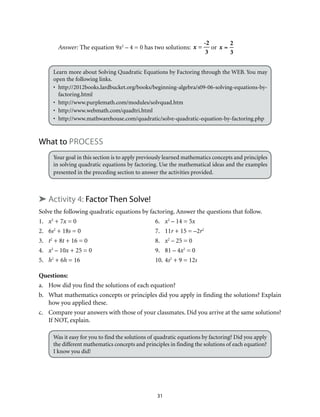
  • 94.
    With the obtainedroots of the quadratic equation, the dimensions of the table then are 3 ft. and 9 ft., respectively. Example 2: An amusement park wants to place a new rectangular billboard to inform visitors of their new attractions. Suppose the length of the billboard to be placed is 4 m longer than its width and the area is 96 m². What will be the length and the width of the billboard? If we represent the width of the billboard by x in meters, then its length is x + 4. Since the area of the billboard is 96 m², then (x)(x + 4) = 96. The equation (x)(x + 4) = 96 is a quadratic equation that can be written in the form ax2 + bx + c = 0. (x)(x + 4) = 96 → x2 + 4x = 96 x2 + 4x – 96 = 0 91 Solve the resulting equation. x2 + 4x – 96 = 0 → (x – 8)(x + 12) = 0 x – 8 = 0 or x + 12 = 0 x = 8 or x = –12 The equation has two solutions: x = 8 or x = -12. However, we only consider the positive value of x since the situation involves measure of length. Hence, the width of the billboard is 8 m and its length is 12 m. Learn more about the Applications of Quadratic Equations through the WEB. You may open the following links. http://www.mathsisfun.com/algebra/quadraticequation-real-world.html http://www.purplemath.com/modules/quadprob.htm http://tutorial.math.lamar.edu/Classes/Alg/QuadraticApps.aspx http://www.algebra.com/algebra/homework/quadratic/lessons/Using-quadratic-equa-tions- tosolve-word-problems.lesson http://www.slideshare.net/jchartiersjsd/quadratic-equation-word-problems http://www.tulyn.com/algebra/quadraticequations/wordproblems http://www.uwlax.edu/faculty/hasenbank/archived/mth126fa08/notes/11.10%20-%20 Quadratic%20Applications.pdf http://www.pindling.org/Math/CA/By_Examples/1_4_Appls_Quadratic/1_4_Appls_ Quadratic.html Now that you have learned how to solve real-life problems involving quadratic equations, you may now try the activities in the next sections.
  • 95.
    92 What toProcess Your goal in this section is to apply the key concepts of quadratic equations in solving re-al- life problems. Use the mathematical ideas and the examples presented in the preceding sections to answer the succeeding activities. ➤ Activity 4: Let Me Try! Answer each of the following. 1. A projectile that is fired vertically into the air with an initial velocity of 120 ft. per second can be modeled by the equation s = 120t – 16t2. In the equation, s is the distance in feet of the projectile above the ground after t seconds. a. How long will it take for a projectile to reach 216 feet? b. Is it possible for the projectile to reach 900 feet? Justify your answer. 2. The length of a rectangular parking lot is 36 m longer than its width. The area of the parking lot is 5,152 m2. a. How would you represent the width of the parking lot? How about its length? b. What equation represents the area of the parking lot? c. How would you use the equation representing the area of the parking lot in finding its length and width? d. What is the length of the parking lot? How about its width? Explain how you arrived at your answer. e. Suppose the area of the parking lot is doubled, would its length and width also double? Justify your answer. 3. The perimeter of a rectangular swimming pool is 86 m and its area is 450 m2. a. How would you represent the length and the width of the swimming pool? b. What equation represents the perimeter of the swimming pool? How about the equation that represents its area? c. How would you find the length and the width of the swimming pool? d. What is the length of the swimming pool? How about its width? Explain how you arrived at your answer. e. How would you check if the dimensions of the swimming pool obtained satisfy the conditions of the given situation? f. Suppose the dimensions of the swimming pool are both doubled, how would it affect its perimeter? How about its area?
  • 96.
    In this section,the discussion was about solving real-life problems involving quadratic equations. Go back to the previous section and compare your initial ideas with the discussion. How much of your initial ideas are found in the discussion? Which ideas are different and need revision? Now that you know the important ideas about quadratic equations and their applications in real life, let’s go deeper by moving on to the next section. What to Reflect and Understand Your goal in this section is to take a closer look at some aspects of the topic. You are going to think deeper and test further your understanding of the real-life applications of quadratic equations. After doing the following activities, you should be able to answer this important question: “How are quadratic equations used in solving real-life problems and in making decisions?” ➤ Activity 5: Find Those Missing! Solve the following problems. Explain how you arrived at your answers. 1. A rectangular garden has an area of 84 m2 and a perimeter of 38 m. Find its length and width. 2. A children’s park is 350 m long and 200 m wide. It is surrounded by a pathway of uniform width. Suppose the total area of the park and the pathway is 74,464 m2. How wide is the pathway? 3. A car travels 20 kph faster than a truck. The car covers 350 km in two hours less than the time it takes the truck to travel the same distance. What is the speed of the car? How about the truck? 4. Jane and Maria can clean the house in 8 hours if they work together. The time that Jane takes in cleaning the house alone is 4 hours more than the time Maria takes in cleaning the same house. How long does it take Jane to clean the house alone? How about Maria? 5. If an amount of money P in pesos is invested at r percent compounded annually, it will grow to an amount A = P(1 + r)2 in two years. Suppose Miss Madrigal wants her money amounting to Php200,000 to grow to Php228,980 in two years. At what rate must she invest her money? In this section, the discussion was about your understanding of quadratic equations and their real-life applications. What new insights do you have about the real-life applications of quadratic equations? How would you connect this to your daily life? How would you use this in making decisions? 93
  • 97.
    Now that youhave a deeper understanding of the topic, you are ready to do the tasks in the next section. 94 What to Transfer Your goal in this section is to apply your learning to real-life situations. You will be given tasks which will demonstrate your understanding of the lesson. ➤ Activity 6: Let’s Draw! Make a design or sketch plan of a table than can be made out of ¾” × 4’ × 8’ plywood and 2” × 3” × 8’ wood. Using the design or sketch plan, formulate problems that involve quadratic equations, then solve in as many ways as possible. Rubric for a Sketch Plan and Equations Formulated and Solved 4 3 2 1 The sketch plan is accurately made, presentable, and appropriate. The sketch plan is accurately made and appropriate. The sketch plan is not accurately made but appropriate. The sketch plan is made but not appropriate. Quadratic equations are accurately formulated and solved correctly. Quadratic equations are accurately formulated but not all are solved correctly. Quadratic equations are accurately formulated but are not solved correctly. Quadratic equations are accurately formulated but are not solved. ➤ Activity 7: Play the Role of … Cite and role play a situation in real life where the concept of the quadratic equation is applied. Formulate and solve problems out of these situations.
  • 98.
    Rubric for aReal-Life Situation Involving Quadratic Equations 4 3 2 1 95 The situation is clear, realistic and the use of the quadratic equation and other mathematical concepts are properly illustrated. The situation is clear but the use of the quadratic equation and other mathematics concepts are not properly illustrated. The situation is not so clear, and the use of the quadratic equation is not illustrated. The situation is not clear and the use of the quadratic equation is not illustrated. Rubric on Problems Formulated and Solved Score Descriptors 6 Poses a more complex problem with 2 or more correct possible solutions and communicates ideas unmistakably, shows in-depth comprehension of the pertinent concepts and/or processes and provides explanations wherever appropriate. 5 Poses a more complex problem and finishes all significant parts of the solution and communicates ideas unmistakably, shows in-depth comprehension of the pertinent concepts and/or processes. 4 Poses a complex problem and finishes all significant parts of the solution and communicates ideas unmistakably, shows in-depth comprehension of the pertinent concepts and/or processes. 3 Poses a complex problem and finishes most significant parts of the solution and communicates ideas unmistakably, shows comprehension of major concepts although neglects or misinterprets less significant ideas or details. 2 Poses a problem and finishes some significant parts of the solution and communicates ideas unmistakably but shows gaps on theoretical comprehension. 1 Poses a problem but demonstrates minor comprehension, not being able to develop an approach. Source: D.O. #73 s. 2012 Summary/Synthesis/Generalization This lesson was about solving real-life problems involving quadratic equations. The lesson provided you with opportunities to see the real-life applications of quadratic equations. Moreover, you were given opportunities to formulate and solve quadratic equations based on real-life situations. Your understanding of this lesson and other previously learned mathematics concepts and principles will facilitate your understanding of the succeeding lessons.
  • 99.
    Quadratic Inequalities 96 7 What to Know Start Lesson 7 of this module by assessing your knowledge of the different mathematics concepts previously studied and your skills in performing mathematical operations. These knowledge and skills will help you understand quadratic inequalities. As you go through this lesson, think of this important question: “How are quadratic inequalities used in solving real-life problems and in making decisions?” To find the answer, perform each activity. If you find any difficulty in answering the exercises, seek the assistance of your teacher or peers or refer to the modules you have gone over earlier. You may check your work with your teacher. ➤ Activity 1: What Makes Me True? Find the solution/s of each of the following mathematical sentences. Answer the questions that follow. 1. x + 5 > 8 6. x2 + 5x + 6 = 0 2. r – 3 < 10 7. t2 – 8t + 7 = 0 3. 2s + 7 ≥ 21 8. r2 + 7r = 18 4. 3t – 2 ≤ 13 9. 2h2 – 5h – 12 = 0 5. 12 – 5m > –8 10. 9s2 = 4 Questions: a. How did you find the solution/s of each mathematical sentence? b. What mathematics concepts or principles did you apply to come up with the solution/s? c. Which mathematical sentence has only one solution? More than one solution? Describe these mathematical sentences. How did you find the activity? Were you able to find the solution/s of each mathematical sentence? Did you find difficulty in solving each mathematical sentence? If not, then you are ready to proceed to the next activity.
  • 100.
    ➤ Activity 2:Which Are Not Quadratic Equations? Use the mathematical sentences below to answer the questions that follow. 97 x2 + 9x + 20 = 0 3w2 + 12w ≥ 0 r2 + 10r ≤ –16 2t2 < 21 – 9t 2s2 + 7s + 5 > 0 15 – 6h2 = 10 4x2 – 25 = 0 m2 = 6m – 7 1. Which of the given mathematical sentences are quadratic equations? 2. How do you describe quadratic equations? 3. Which of the given mathematical sentences are not quadratic equations? Why? 4. How would you describe those mathematical sentences which are not quadratic equations? How are they different from those equations which are quadratic? In the activity done, were you able to distinguish mathematical sentences which are quadratic equations and which are not quadratic equations? Were you able to describe mathematical sentences that make use of equality and inequality symbols? In the next activity, you will learn how mathematical sentences involving inequalities are illustrated in real life. ➤ Activity 3: Let’s Do Gardening! Use the situation below to answer the questions that follow. Mr. Bayani has a vacant lot in his backyard. He wants to make as many rectangular gardens as possible such that the length of each garden is 2 m longer than its width. He also wants the length of the garden with the smallest area to be 3 m. 1. Illustrate the different rectangular gardens that Mr. Bayani could make. 2. What are the dimensions of the different gardens that Mr. Bayani wants to make? 3. What is the area of each garden in item 2? 4. What is the area of the smallest garden that Mr. Bayani can make? How about the area of the largest garden? Explain your answer. 5. What general mathematical sentence would represent the possible areas of the gardens? Describe the sentence. 6. Using the mathematical sentence formulated, do you think you can find other possible dimensions of the gardens that Mr. Bayani wants to make? If YES, how? If NOT, explain.
  • 101.
    7. Suppose thelength of each garden that Mr. Bayani wants to make is 3 m longer than its width and the area of the smallest garden is 10 m2. What general mathematical sentence would represent the possible areas of the gardens? How are you going to solve the mathematical sentence formulated? Find at least 3 possible solutions of the mathematical sentence. 8. Draw a graph to represent the solution set of the mathematical sentence formulated in item 98 7. What does the graph tell you? 9. Are all solutions that can be obtained from the graph true to the given situation? Why? How did you find the preceding activities? Do you think you are already equipped with those knowledge and skills needed to learn the new lesson? I’m sure you are! From the activities done, you were able to find the solutions of different mathematical sentences. You were able to differentiate quadratic equations from those which are not. More importantly, you were able to perform an activity that will lead you in understanding the new lesson. But how are quadratic inequalities used in solving real-life problems and in making decisions? You will find these out in the activities in the next section. Before doing these activities, read and understand first some important notes on Quadratic Inequalities and the examples presented. A quadratic inequality is an inequality that contains a polynomial of degree 2 and can be written in any of the following forms. ax2 + bx + c > 0 ax2 + bx + c ≥ 0 ax2 + bx + c < 0 ax2 + bx + c ≤ 0 where a, b, and c are real numbers and a ≠ 0. Examples: 1. 2x2 + 5x + 1 > 0 3. 3r2 + r – 5 ≥ 0 2. s2 – 9 < 2s 4. t2 + 4t ≤ 10 To solve a quadratic inequality, find the roots of its corresponding equality. The points corresponding to the roots of the equality, when plotted on the number line, separates the line into two or three intervals. An interval is part of the solution of the inequality if a number in that interval makes the inequality true. Example 1: Find the solution set of x2 + 7x + 12 > 0. The corresponding equality of x2 + 7x + 12 > 0 is x2 + 7x + 12 = 0. Solve x2 + 7x + 12 = 0. (x + 3)(x + 4) = 0 Why? x + 3 = 0 and x + 4 = 0 Why x = –3 and x = –4 Why?
  • 102.
    Plot the pointscorresponding to -3 and -4 on the number line. -10 -9 -8 -7 -6 -5 -4 -3 -2 -1 0 1 2 3 4 5 6 7 8 9 10 The three intervals are: –∞ < x < –4, –4 < x < –3, and –3 < x < ∞. Test a number from each interval against the inequality. 99 For –∞ < x < –4, let x = –7 For –4 < x < –3, let x = –3.6 For –3 < x < ∞, let x = 0 x2 + 7x + 12 > 0 (–7)2 + 7(–7) + 12 > 0 49 – 49 + 12 > 0 12 > 0 (True) x2 + 7x + 12 > 0 (–3.6)2 + 7(–3.6) + 12 > 0 12.96 – 25.2 + 12 > 0 –0.24 > 0 (False) x2 + 7x + 12 > 0 (0)2 + 7(0) + 12 > 0 0 + 0 + 12 > 0 12 > 10 (True) We also test whether the points x = –3 and x = –4 satisfy the inequality. x2 + 7x + 12 > 0 (–3)2 + 7(–3) + 12 > 0 9 – 21 + 12 > 0 0 > 0 (False) x2 + 7x + 12 > 0 (–4)2 + 7(–4) + 12 > 0 16 – 28 + 12 > 0 0 > 0 (False) Therefore, the inequality is true for any value of x in the interval –∞ < x < –4 or –3 < x < ∞, and these intervals exclude –3 and –4. The solution set of the inequality is {x : x < –4 or x > –3}, and its graph is shown below. -10 -9 -8 -7 -6 -5 -4 -3 -2 -1 0 1 2 3 4 5 6 7 8 9 10 Note that hollow circles are used in the graph to show that –3 and –4 are not part of the solution set. Another way of solving the quadratic inequality x2 + 7x + 12 > 0 is by following the procedure in solving quadratic equations. However, there are cases to be considered. Study the procedure in solving the quadratic inequality x2 + 7x + 12 > 0 below. Discuss the reason for each step followed. Notice that the quadratic expression x2 + 7x + 12 is greater than zero or positive. If we write the expression in factored form, what must be true about its factors?
  • 103.
    100 (x +3)(x + 4) > 0 Why Case 1: (x + 3) > 0 and (x + 4) > 0 Why Case 2: (x + 3) < 0 and (x + 4) < 0 Why Case 1 (x + 3) > 0 and (x + 4) > 0 Case 2 (x + 3) < 0 and (x + 4) < 0 Why? x + 3 > 0 and x + 4 > 0 x > –3 and x > –4 x + 3 < 0 and x + 4 < 0 x < –3 and x < –4 x > –3 x < –4 The solution set of the inequality is {x : x < –4 or x > –3}. Why? To check, consider any number greater than -3 or less than -4. Substitute this number to x in the inequality x2 + 7x + 12 > 0. Consider -2 and 3 which are both greater than -3. When x = -2: x2 + 7x + 12 > 0 → (–2)2 + 7(–2) + 12 > 0 4 – 14 + 12 > 0 2 > 0 (True) When x = 3: x2 + 7x + 12 > 0 → (3)2 + 7(3) + 12 > 0 9 + 21+ 12 > 0 42 > 0 (True) This shows that x2 + 7x + 12 > 0 is true for values of x greater than -3. This time, consider -5 and -8 which are both less than -4. When x = -5: x2 + 7x + 12 > 0 → (–5)2 + 7(–5) + 12 > 0 25 – 35+ 12 > 0 2 > 0 (True) When x = -8: x2 + 7x + 12 > 0 → (–8)2 + 7(–8) + 12 > 0 64 – 56+ 12 > 0 20 > 0 (True)
  • 104.
    The inequality x2+ 7x + 12 > 0 is also true for values of x less than -4. Will the inequality be true for any value of x greater than or equal to -4 but less than or equal to -3? 101 When x = -3: x2 + 7x + 12 > 0 → (–3)2 + 7(–3) + 12 > 0 9 – 21+ 12 > 0 0 > 0 (Not True) The inequality is not true for x = -3. When x = -3.5: x2 + 7x + 12 > 0 → (–3.5)2 + 7(–3.5) + 12 > 0 12.25 – 24.5+ 12 > 0 –0.25 > 0 (Not True) The inequality is not true for x = -3.5. This shows that x2 + 7x + 12 > 0 is not true for values of x greater than or equal to -4 but less than or equal to -3. Example 2: 2x2 – 5x ≤ 3 Rewrite 2x2 – 5x ≤ 3 to 2x2 – 5x – 3 ≤ 0. Why? Notice that the quadratic expression 2x2 – 5x – 3 is less than or equal to zero. If we write the expression in factored form, the product of these factors must be zero or negative to satisfy the inequality. Remember that if the product of two numbers is zero, either one or both factors are zeros. Likewise, if the product of two numbers is negative, then one of these numbers is positive and the other is negative. (2x + 1)(x – 3) ≤ 0 Why Case 1: (2x + 1) ≤ 0 and (x – 3) ≥ 0 Why Case 2: (2x + 1) ≥ 0 and (x – 3) ≤ 0 Why
  • 105.
    102 Case 1 (2x + 1) ≤ 0 and (x – 3) ≥ 0 Case 2 (2x + 1) ≥ 0 and (x – 3) ≤ 0 Why? 2x + 1 ≤ 0 and x – 3 ≥ 0 x ≤ – 1 2 and x ≥ 3 2x ≥ –1 and x ≤ 3 x ≥ – 1 2 and x ≤ 3 No solution – 1 2 ≤ x ≤ 3 The solution set of the inequality is { 1 x : – ≤ x ≤ 3}. Why? 2 The figure below shows the graph of the solution set of the inequality. -10 -9 -8 -7 -6 -5 -4 -3 -2 -1 0 1 2 3 4 5 6 7 8 9 10 Note that 1 2 and 3 are represented by points, to indicate that they are part of the solution set. To check, consider any number greater than or equal to 1 2 but less than or equal to 3. Substitute this number to x in the inequality 2x2 – 5x ≤ 3. When x = 0: 2x2 – 5x ≤ 3 → 2(0)2 – 5(0) ≤ 3 0 – 0 ≤ 3 0 ≤ 3 (True) When x = 2: 2x2 – 5x ≤ 3 → 2(2)2 – 5(2) ≤ 3 8 – 10 ≤ 3 –2 ≤ 3 (True) This shows that 2x2 – 5x ≤ 3 is true for values of x greater than or equal to – 1 but less than or equal to 3. 2 Will the inequality be true for any value of x less than – 1 2 or greater than 3? When x = -2: 2x2 – 5x ≤ 3 → 2(–2)2 – 5(–2) ≤ 3 8 + 10 ≤ 3 18 ≤ 3 (Not True)
  • 106.
    103 When x= 5: 2x2 – 5x ≤ 3 → 2(5)2 – 5(5) ≤ 3 50 – 25 ≤ 3 25 ≤ 3 (Not True) This shows that 2x2 – 5x ≤ 3 is not true for values of x less than – 1 2 or greater than 3. There are quadratic inequalities that involve two variables. These inequalities can be writ-ten in any of the following forms. y > ax2 + bx + c y ≥ ax2 + bx + c y < ax2 + bx + c y ≤ ax2 + bx + c where a, b, and c are real numbers and a ≠ 0. Examples: 1. y < x2 + 3x + 2 3. y + 9 ≥ -4x2 2. y > 2x2 – 5x + 1 4. y – 7x ≤ 2x2 How are quadratic inequalities in two variables illustrated in real life? The following is a situation where quadratic inequality in two variables is illustrated. The city government is planning to construct a new children’s playground. It wants to fence in a rectangular ground using one of the walls of a building. The length of the new playground is 15 m longer than it is wide and its area is greater than the old playground. In the given situation, the width of the room can be represented by w and the length by w + 15. Why? If we represent the area of the old playground as A, then the quadratic inequality that would represent the given situation is w(w + 15) > A or w2 + 15w > A. Why? Suppose the area of the old playground is 2200 m2. What could be the area of the new playground? What could be its length and width? Is it possible that the value of w is negative? Why? The situation tells us that the area of the new playground is greater than the area of the old playground. This means that the area of the new playground is greater than 2200. It could be 2300, 3500, 4600, and so on. One possible pair of dimensions of the new playground is 50 m and 65 m, respectively. With these dimensions, the area of the new playground is or 3250 m2. It is not possible for w to take a negative value because the situation involves measures of length.
  • 107.
    The solution setof quadratic inequalities in two variables can be determined graphically. To do this, write the inequality as an equation, then show the graph. The graph of the resulting parabola will be used to graph the inequality. Example 1: Find the solution set of y < x2 + 3x + 2. Write the inequality to its corresponding equation. y < x2 + 3x + 2 → y = x2 + 3x + 2 Construct table of values for x and y. x -5 -4 -3 -2 -1 0 1 2 y 12 6 2 0 0 2 6 12 Use these points to graph a parabola. Points B(0, 8), C(1, 6), and E(-3, 2) are points along the parabola. The coordinates of these points do not satisfy the inequality y < x2 + 3x + 2. Therefore, they are not part of the solution set of the inequality. We use a broken line to represent the parabola since the points on the parabola do not satisfy the given inequality. Parabola 104
  • 108.
    The parabola partitionsthe plane into two regions. Select one point in each region and check whether the given inequality is satisfied. For example, consider the origin (0, 0), and substitute this in the inequality. We obtain 0 < 0 + 0 + 2 or 0 < 2, which is correct. Therefore, the entire region containing (0, 0) represents the solution set and we shade it. On the other hand, the point (0, 8) is on the other region. If we substitute this in the inequality, we obtain 8 < 0 + 0 + 2 or 8 < 2, which is false. Therefore, this region is not part of the solution set and we do not shade this region. To check, points A(-6, 7), D(3, 3), and F(-2, -3) are some of the points in the shaded region. If the coordinates of these points are substituted in y < x2 + 3x + 2, the inequality becomes true. Hence, they are part of the solution set. Example 2: Find the solution set of y ≥ 2x2 – 3x + 1. The figure above shows the graph of y ≥ 2x2 – 3x + 1. All points in the shaded region including those along the solid line (parabola) make up the solution set of the inequality. The coordinates of any point in this region make the inequal-ity true. Points B(1, 3), C(3, 10), D(0, 6), and E(0, 1) are some of the points on the shaded region and along the parabola. The coordinates of these points sat-isfy 105 the inequality.
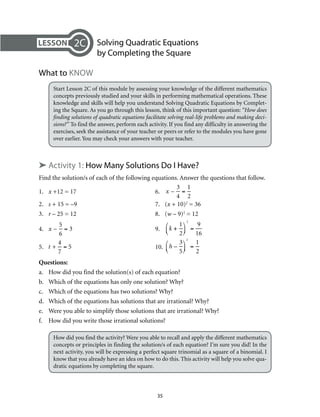
  • 109.
    Consider point Bwhose coordinates are (1, 3). If x = 1 and y = 3 are substituted in the inequality, then the mathematical statement becomes true. y ≥ 2x2 – 3x + 1 → 3 ≥ 2(1)2 – 3(1) + 1 3 ≥ 2 – 3 + 1 3 ≥ 0 Hence, (1,3) is a solution to the inequality. Learn more about Quadratic Inequalities through the WEB. You may open the following links. • http://www.mathwarehouse.com/quadraticinequality/how-to-solve-and-graph-quad-raticinequality. 106 php • http://www.regentsprep.org/regents/math/algtrig/ate6/quadinequal.htm • http://www.mathsisfun.com/algebra/inequalityquadratic-solving.html • http://www.wtamu.edu/academic/anns/mps/math/mathlab/col_algebra/col_alg_tut23_ quadineq.htm • http://www.shelovesmath.com/algebra/intermediate-algebra/quadratic-inequalities/ • http://www.cliffsnotes.com/math/algebra/algebra-ii/quadratics-in-one-variable/solv-ingquadratic- inequalities What to Process Your goal in this section is to apply the key concepts of quadratic inequalities. Use the mathematical ideas and the examples presented in the preceding section to answer the activities provided. ➤ Activity 4: Quadratic Inequalities or Not? Determine whether each mathematical sentence is a quadratic inequality or not. Answer the questions that follow. 1. x2 + 9x + 14 > 0 6. 3m + 20 ≥ 0 2. 3s2 – 5s = 1 7. (2r – 5)(r + 4) > 0 3. 4t2­– 7t + 2 ≤ 0 8. x2 – 1 < x + 1 4. x2 < 10x – 3 9. (4h2 – 9) + (2h + 3) ≥ 0 5. 12 – 5x + x2 = 0 10. 15 – 2x = 3x2 Questions: a. How do you describe quadratic inequalities? b. How are quadratic inequalities different from linear inequalities?
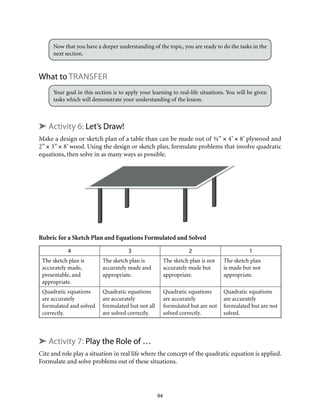
  • 110.
    c. Give atleast three examples of quadratic inequalities. Were you able to determine which mathematical sentences are quadratic inequalities? In the next activity, you will find and describe the solution sets of quadratic inequalities. ➤ Activity 5: Describe My Solutions! Find the solution set of each of the following quadratic inequalities then graph. Answer the questions that follow. 1. x2 + 9x + 14 > 0 6. 2t2 + 11t + 12 < 0 2. r2 – 10r + 16 < 0 7. 3x2 – 8x + 5 ≥ 0 3. x2 + 6x ≥ –5 8. 4p2 ≤ 1 4. m2 – 7m ≤ 10 9. 2x2 – 3x – 14 > 0 5. x2 – 5x – 14 > 0 10. 3q2 + 2q ≥ 5 Questions: a. How did you find the solution set of each inequality? b. What mathematics concepts or principles did you apply to come up with the solution set of 107 each mathematical sentence? c. How did you graph the solution set of each inequality? d. How would you describe the graph of the solution set of a quadratic inequality? e. How many solutions does each inequality have? f. Are the solution/s of each inequality real numbers? Why? g. Is it possible for a quadratic inequality not to have a real solution? Justify your answer by giving a particular example. Were you able to find and describe the solution set of each quadratic inequality? Were you able to show the graph of the solution set of each? In the next activity, you will determine if a point is a solution of a given quadratic inequality in two variables. ➤ Activity 6: Am I a Solution or Not? Determine whether or not each of the following points is a solution of the inequality y < 2x2 + 3x – 5. Justify your answer. 1. A (–1, 6) 4. D (3, 6) 2. B (1, 8) 5. E (–3, 4) 3. C (–5, 10) 6. F (2, 9)
  • 111.
    7. G (–6,–2) 9. I (0, 0) 8. H (1, –4) 10. J (–6, 7) How did you find the activity? Was it easy for you to determine if a point is a solution of the given inequality? Could you give other points that belong to the solution set of the inequality? I’m sure you could. In the next activity, you will determine the mathematical sentence that is described by a graph. ➤ Activity 7: What Represents Me? Select from the list of mathematical sentences on the right side the inequality that is described by each of the following graphs. Answer the questions that follow. 108 y > x2 – 2x + 8 y < 2x2 + 7x + 5 y ≥ –x2 – 2x + 8 y ≥ 2x2 + 7x + 5 y < –x2 – 2x + 8 y > 2x2 + 7x + 5 y ≤ –x2 – 2x + 8 y ≤ 2x2 + 7x + 5 y > –x2 – 2x + 8 1. 2.
  • 112.
    109 y >x2 – 2x + 8 y < 2x2 + 7x + 5 y ≥ –x2 – 2x + 8 y ≥ 2x2 + 7x + 5 y < –x2 – 2x + 8 y > 2x2 + 7x + 5 y ≤ –x2 – 2x + 8 y ≤ 2x2 + 7x + 5 y > –x2 – 2x + 8 3. 4. Questions: a. How did you determine the quadratic inequality that is described by a given graph? b. In each graph, what does the shaded region represent? c. How do the points in the shaded region of each graph facilitate in determining the inequality that defines it? d. How would you describe the graphs of quadratic inequalities in two variables involving “less than”? “greater than”? “less than or equal to”? “greater than or equal to”? e. Suppose you are given a quadratic inequality in two variables. How will you graph it?
  • 113.
    Were you ableto identify the inequality that is described by each graph? Was it easy for you to perform this activity? I’m sure it was! If not, then try to find an easier way of doing this activity. I know you can do it. In the next activity, you will work on a situation involving quadratic inequalities. In this activity, you will further learn how quadratic inequalities are illustrated in real life. ➤ Activity 8: Make It Real! Read the situation below then answer the questions that follow. The floor of a conference hall can be covered completely with tiles. Its length is 36 ft longer than its width. The area of the floor is less than 2040 square feet. 1. How would you represent the width of the floor? 110 How about its length? 2. What mathematical sentence would represent the given situation? 3. What are the possible dimensions of the floor? How about the possible areas of the floor? 4. Would it be realistic for the floor to have an area of 144 square feet? Explain your answer. In this section, the discussion was about quadratic inequalities and their solution sets and graphs. Go back to the previous section and compare your initial ideas with the discussion. How much of your initial ideas are found in the discussion? Which ideas are different and need revision? Now that you know the important ideas about this topic, let’s go deeper by moving on to the next section. What to Reflect and Understand Your goal in this section is to take a closer look at some aspects of the topic. You are going to think deeper and test further your understanding of quadratic inequalities. After doing the following activities, you should be able to answer the following question: “How are quadratic inequalities used in solving real-life problems and in making decisions?”
  • 114.
    ➤ Activity 9:How Well I Understood … Answer the following. 1. How do you describe quadratic inequalities? 2. Give at least three examples of quadratic inequalities. 3. How do you find the solution set of a quadratic inequality in one variable? How about quadratic inequalities in two variables? 4. How would you describe the solution set of each of the following quadratic inequalities? a. y < x2 + 9x + 14 c. y ≤ 2x2 + 11x + 5 b. y > x2 – 3x – 18 d. y ≥ 3x2 + 10x – 8 5. Do you agree that the solution sets of y < x2 + x – 20 and y > x2 + x – 20 is the set of all points on a plane? Justify your answer by graphing the solution set of each on a coordinate plane. 6. Luisa says that the solutions of y > 2x2 – 8x + 7 are also solutions of y > x2 – 4x + 3. Do you 111 agree with Luisa? Justify your answer. 7. A rectangular box is completely filled with dice. Each die has a volume of 1 cm3. The length of the box is 3 cm greater than its width and its height is 5 cm. Suppose the box holds at most 140 dice. What are the possible dimensions of the box? 8. A company decided to increase the size of the box for the packaging of their canned sardines. The length of the original packaging box was 40 cm longer than its width, the height was 12 cm, and the volume was at most 4800 cm3. a. How would you represent the width of the original packaging box? How about the length of the box? b. What expression would represent the volume of the original packaging box? How about the mathematical sentence that would represent its volume? Define the vari-ables used. c. What could be the greatest possible dimensions of the box if each dimension is in whole centimeters? Explain how you arrived at your answer. d. Suppose the length of the new packaging box is still 40 cm longer than its width and the height is 12 cm. What mathematical sentence would represent the volume of the new packaging box? Define the variables used. e. What could be the dimensions of the box? Give the possible dimensions of at least three different boxes.
  • 115.
    In this section,the discussion was about your understanding of quadratic inequalities and their solution sets and graphs. What new insights do you have about quadratic inequalities and their solution sets and graphs? How would you connect this to real life? How would you use this in making deci-sions? Now that you have a deeper understanding of the topic, you are ready to do the tasks in the next section. Mathematical Investigation Written • Report Format • Title/Topic for Investigation • Introduction • Exploration • Conjectures • Testing of Conjectures • Justification for Conjectures • Conclusion 112 What to Transfer Your goal in this section is to apply your learning to real-life situations. You will be given a practical task which will demonstrate your understanding. ➤ Activity 10: Investigate Me! Conduct a mathematical investigation for each of the following quadratic inequalities. Prepare a written report of your findings following the format at the right. 1. ax2 + bx + c > 0, where b2 – 4ac < 0 2. ax2 + bx + c < 0, where b2 – 4ac < 0 3. ax2 + bx + c ≥ 0, where b2 – 4ac < 0 4. ax2 + bx + c ≤ 0, where b2 – 4ac < 0 ➤ Activity 11: How Much Would It Cost to Tile a Floor? Perform the following activity. 1. Find the dimensions of the floors of at least two rooms in your school. Indicate the measures obtained in the table below. Rooms Length Width
  • 116.
    2. Determine themeasures and costs of different tiles that are available in the nearest hardware store or advertised in any printed materials or in the internet. Write these in the table below. Tiles Length Width Cost 3. Formulate quadratic inequalities involving the dimensions of the floor of rooms, and the measures and costs of tiles. Find, then graph the solution sets of these inequalities. Use the rubric provided to rate your work. Rubric for Real-Life Situations Involving Quadratic Inequalities and Their Solution Sets and Graphs 4 3 2 1 113 Systematically listed in the table the dimensions of rooms and the measures and costs of tiles, properly formulated and solved quadratic inequalities, and accurately drew the graphs of their solution sets Systematically listed in the table the dimensions of rooms and the measures and costs of tiles, and properly formulated and solved quadratic inequalities but unable to draw the graph accurately Systematically listed in the table the dimensions of rooms and the measures and costs of tiles, and properly formulated quadratic inequalities but unable to solve these Systematically listed in the table the dimensions of rooms and the measures and costs of tiles In this section, your task was to formulate and solve quadratic inequalities based on real-life situations. You were placed in a situation wherein you need to determine the number and total cost of tiles needed to cover the floors of some rooms. How did you find the performance task? How did the task help you realize the use of the topic in real life?
  • 117.
    Summary/Synthesis/Generalization This lessonwas about quadratic inequalities and their solution sets and graphs. The lesson provided you with opportunities to describe quadratic inequalities and their solution sets using practical situations, mathematical expressions, and their graphs. Moreover, you were given the opportunity to draw and describe the graphs of quadratic inequalities and to demonstrate your understanding of the lesson by doing a practical task. Your understand-ing of this lesson and other previously learned mathematics concepts and principles will facilitate your learning of the next lesson, Quadratic Functions. Glossary of Terms Discriminant – This is the value of the expression b2 – 4ac in the quadratic formula. Extraneous Root or Solution – This is a solution of an equation derived from an original equa-tion. However, it is not a solution of the original equation. Irrational Roots – These are roots of equations which cannot be expressed as quotient of integers. Quadratic Equations in One Variable – These are mathematical sentences of degree 2 that can 114 be written in the form ax2 + bx + c = 0. Quadratic Formula – This is an equation that can be used to find the roots or solutions of the quadratic equation ax2 + bx + c = 0. The quadratic formula is x = –b ± b2 – 4ac 2a . Quadratic Inequalities – These are mathematical sentences that can be written in any of the following forms: ax2 + bx + c > 0, ax2 + bx + c < 0, ax2 + bx + c ≥ 0, and ax2 + bx + c ≤ 0. Rational Algebraic Equations – These are mathematical sentences that contain rational algebraic expressions. Rational Roots – These are roots of equations which can be expressed as quotient of integers. Solutions or Roots of Quadratic Equations – These are the values of the variable/s that make quadratic equations true. Solutions or Roots of Quadratic Inequalities – These are the values of the variable/s that make quadratic inequalities true. DepEd Instructional Materials That Can Be Used as Additional Resources for the Lesson Quadratic Equations and Inequalities 1. EASE Modules Year II Modules 1, 2, and 3 2. BASIC EDUCATION ASSISTANCE FOR MINDANAO (BEAM) Mathematics 8 Module 4 pp. 1 to 55
  • 118.
    References and WebsiteLinks Used in this Module References Bellman, Allan E., et al. Algebra 2 Prentice Hall Mathematics, Pearson Prentice Hall, New Jer-sey 115 USA, 2004. Brown, Richard G., Mary P. Dolciani, Robert H. Sorgenfrey, and William L. Cole. Algebra, Struc-ture and Method, Book I, Houghton Mifflin Company, Boston MA, 1990. Brown, Richard G., Mary P. Dolciani, Robert H. Sorgenfrey, and Robert B. Kane. Algebra, Struc-ture and Method Book 2. Houghton Mifflin Company, Boston, 1990. Chapin, Illingworth, Landau, Masingila and McCracken. Prentice Hall Middle Grades Math, Tools for Success, Prentice-Hall, Inc., Upper Saddle River, New Jersey, 1997. Clements, Douglas H., Kenneth W. Jones, Lois Gordon Moseley, and Linda Schulman. Math in my World, McGraw-Hill Division, Farmington, New York, 1999. Coxford, Arthur F. and Joseph N. Payne. HBJ Algebra I, Second Edition, Harcourt Brace Jova-novich, Publishers, Orlando, Florida, 1990. Fair, Jan and Sadie C. Bragg. Prentice Hall Algebra I, Prentice-Hall, Inc., Englewood Cliffs, New Jersey, 1991. Gantert, Ann Xavier. Algebra 2 and Trigonometry. AMSCO School Publications, Inc., 2009. Larson, Ron, Laurie Boswell, Timothy D. Kanold, and Lee Stiff. Algebra 1, Applications, Equa-tions, and Graphs. McDougal Littell, A Houghton Mifflin Company, Illinois, 2004. Larson, Ron, Laurie Boswell, Timothy D. Kanold, and Lee Stiff. Algebra 2, Applications, Equa-tions, and Graphs. McDougal Littell, A Houghton Mifflin Company, Illinois, 2008. Smith, Charles, Dossey, Keedy and Bettinger. Addison-Wesley Algebra, Addison-Wesley Pub-lishing Company, 1992. Wesner, Terry H. and Harry L. Nustad. Elementary Algebra with Applications. Wm. C. Brown Publishers. IA, USA. Wilson, Patricia S., et. al. Mathematics, Applications and Connections, Course I, Glencoe Divi-sion of Macmillan/McGraw-Hill Publishing Company, Westerville, Ohio, 1993. Website Links as References and for Learning Activities Algebra.help. Solve by Using the Quadratic Equation Lessons. (2011). Retrieved November 7, 2013, from http://www.algebrahelp.com/lessons/equations/quadratic/ Algebra II: Quadratic Equations. (2011). Retrieved November 7, 2013, from http://library. thinkquest.org/20991/alg2/quad.html At Home Tuition. Quadratic Equations. (2010). Retrieved November 7, 2013, from http://www. athometuition.com/QuadraticEquationsFormula.php Beginning Algebra (v. 1.0) Section 6.6 Solving Equations by Factoring. (2012). Retrieved November 7, 2013, from http://2012books.lardbucket.org/books/beginning-algebra/s09- 06-solving-equations-by-factoring.html
  • 119.
    Beginning Algebra (v.1.0) Section 9.1 Extracting Square Roots. (2012). Retrieved November 7, 2013, from http://2012books.lardbucket.org/books/beginning-algebra/s12-01-extracting-square- 116 roots.html Beginning Algebra (v. 1.0) Section 9.2 Completing the Square. (2012). Retrieved November 7, 2013, from http://2012books.lardbucket.org/books/beginning-algebra/s12-02-completing-the- square.html Beginning Algebra (v. 1.0) Section 9.3 Quadratic Formula. (2012). Retrieved November 7, 2013, from http://2012books.lardbucket.org/books/beginning-algebra/s12-03-quadratic-formula. html Dawkins, Paul. Paul’s Online Math Notes. Quadratic Equations: A Summary. (2013). Retrieved November 7, 2013, from http://tutorial.math.lamar.edu/Classes/Alg/QuadraticApps.aspx Dendane, Abdelkader. Solutions to Quadratic Equations with Rational Expressions. (2012). Retrieved November 7, 2013, from http://www.analyzemath.com/Algebra2/algebra2_solu-tions. html Dendane, Abdelkader. Solve Quadratic Equations Using Discriminant. (2012). Retrieved Novem-ber 7, 2013, from http://www.analyzemath.com/Equations/Quadratic-1.html Dendane, Abdelkader. Solve Quadratic Equations with Rational Expressions-Problems. (2012). Retrieved November 7, 2013, from http://www.analyzemath.com/Algebra2/Algebra2.html Discovery Education WEBMath. Solve a Quadratic Equation by Factoring. (2013). Retrieved November 7, 2013, from http://www.webmath.com/quadtri.html High Points Learning Inc. iCoachMath.Com. Discriminant. (2013). Retrieved November 7, 2013, from http://www.icoachmath.com/math_dictionary/discriminant.html Houghton Mifflin Harcourt Cliffs Notes. Solving Quadratic Inequalities. (2013). Retrieved November 7, 2013, from http://www.cliffsnotes.com/math/algebra/algebra-ii/ quadratics-in-one-variable/solving-quadratic-inequalities Lesson Using quadratic equations to solve word problems. Retrieved November 7, 2013, from http://www.algebra.com/algebra/homework/quadratic/lessons/Using-quadratic-equations-to- solve-word-problems.lesson Math-Help-Ace.com.Quadratic Equation Solver - Finding The Quadratic Equation With Given Roots, Examples, Exercise. (2008). Retrieved November 7, 2013, from http://www.math-help-ace. com/Quadratic-Equation-Solver.html Math is Fun Completing the Square. (2012). Retrieved November 7, 2013, from http://www. mathsisfun.com/algebra/completing-square.html Math is Fun Real World Examples of Quadratic Equations. (2012). Retrieved November 7, 2013, from http://www.mathsisfun.com/algebra/quadratic-equation-real-world.html Math is Fun Solving Quadratic Inequalities. (2012). Retrieved November 7, 2013, from http:// www.mathsisfun.com/algebra/inequality-quadratic-solving.html Math Warehouse How to Solve a Quadratic Inequality. Retrieved November 7, 2013, from http:// www.mathwarehouse.com/quadratic-inequality/how-to-solve-and-graph-quadratic-in-equality. php
  • 120.
    Math Warehouse Solvea Quadratic Equation by Factoring. Retrieved November 7, 2013, from http://www.mathwarehouse.com/quadratic/solve-quadratic-equation-by-factoring.php NySphere International, Inc. Algebra: Quadratic Equations Word Problems. (2013). Retrieved November 7, 2013, from http://www.tulyn.com/algebra/quadratic-equations/wordproblems Oswego City School District Regents exam Prep Center. Algebra2 Trig. Completing the Square. (2012). Retrieved November 7, 2013, from http://www.regentsprep.org/Regents/math/alg-trig/ 117 ATE12/indexATE12.htm Oswego City School District Regents exam Prep Center. Algebra2 Trig. Discriminant. (2012). Retrieved November 7, 2013, from http://www.regentsprep.org/Regents/math/algtrig/ATE3/ discriminant.htm Oswego City School District Regents exam Prep Center. Algebra2 Trig. Nature of Roots (Sum and Product). (2012). Retrieved November 7, 2013, from http://www.regentsprep.org/Regents/ math/algtrig/ATE4/natureofroots.htm Oswego City School District Regents exam Prep Center. Algebra2 Trig. Quadratic Inequalities. (2012). Retrieved November 7, 2013, from http://www.regentsprep.org/regents/math/alg-trig/ ate6/quadinequal.htm Oswego City School District Regents exam Prep Center. Algebra2 Trig. Solving Quadratic Equa-tions with the Quadratic Formula. (2012). Retrieved November 7, 2013, from http://www. regentsprep.org/Regents/math/algtrig/ATE3/quadformula.htm Pindling.org. Math by Examples. College Algebra. “Chapter 1.4 Applications of Quadratic Equa-tions”. (2006). Retrieved November 7, 2013, from http://www.pindling.org/Math/CA/By_Examples/1_4_Appls_Quadratic/1_4_Appls_Quadratic. html Quadratic Equations Lesson. Retrieved November 7, 2013, from http://www.algebra.com/algebra/ homework/quadratic/lessons/quadform/ Seward, Kim. WTAMU and Kim Seward Virtual Math Lab College Algebra Tutorial 23A. Quadratic Inequalities. (2010). Retrieved November 7, 2013, from http://www.wtamu.edu/academic/ anns/mps/math/mathlab/col_algebra/col_alg_tut23_quadineq.htm She Loves Math Quadratic Inequalities. (2013). Retrieved November 7, 2013, from http://www. shelovesmath.com/algebra/intermediate-algebra/quadratic-inequalities/ Slideshare Inc. Quadratic Equation Word Problems. (2013). Retrieved November 7, 2013, from http://www.slideshare.net/jchartiersjsd/quadratic-equation-word-problems Solving Quadratic Equations by Using the Square Root Property. Retrieved November 7, 2013, from http://www.personal.kent.edu/~bosikiew/Algebra-handouts/solving-sqroot.pdf The Purple Math Forums Completing the Square Solving Quadratic Equations. (2012). Retrieved November 7, 2013, from http://www.purplemath.com/modules/sqrquad.htm The Purple Math Forums. Quadratic World Problems: Projectile Motion. (2012). Retrieved November 7, 2013, from http://www.purplemath.com/modules/quadprob.htm The Purple Math Forums Solving Quadratic Equations by Factoring. (2012). Retrieved Novem-ber 7, 2013, from http://www.purplemath.com/modules/solvquad.htm
  • 121.
    The Purple MathForums Solving Quadratic Equations by Taking Square Roots. (2012). Retrieved November 7, 2013, from http://www.purplemath.com/modules/solvquad2.htm The Purple Math Forums. The Quadratic Formula Explained. (2012). Retrieved November 7, 2013, from http://www.purplemath.com/modules/quadform.htm TutorVista.com. (2013). Algebra 1 Quadratic Equation. Retrieved November 7, 2013, from http:// math.tutorvista.com/algebra/quadratic-equation.html uwlax.edu. Retrieved November 7, 2013, from http://www.uwlax.edu/faculty/hasenbank/archived/ mth126fa08/notes/11.10%20-%20Quadratic%20Applications.pdf Website Link for Videos easymathk12. Retrieved November 7, 2013, from http://www.youtube.com/watch?v=l7FI4T19uIA Math Vids. Solving Rational Equation to Quadratic 1. (2013). Retrieved November 7, 2013, from http://mathvids.com/lesson/mathhelp/1437-solving-rational-equation-to-quadratic-1 Website Links for Images Smith, Cameron. Kentucky girls basketball star scores all of her team’s first 40 points in win. (2012). Retrieved November 7, 2013, from http://sports.yahoo.com/blogs/highschool-prep-rally/ kentucky-girls-basketball-star-scores-her-team-first-181307906.html 118