P1 Chapter 2 :: Quadratics
jfrost@tiffin.kingston.sch.uk
www.drfrostmaths.com
@DrFrostMaths
Last modified: 31th May 2020
www.drfrostmaths.com
Everything is completely free.
Why not register?
Teaching videos with topic
tests to check understanding.
Register now to interactively practise questions on this topic, including
past paper questions and extension questions (including MAT + UKMT).
Teachers: you can create student accounts (or students can register
themselves), to set work, monitor progress and even create worksheets.
Dashboard with points,
trophies, notifications
and student progress.
With questions by:
Questions organised by topic,
difficulty and past paper.
Chapter Overview
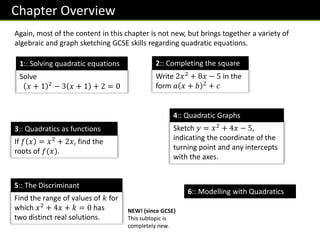
Again, most of the content in this chapter is not new, but brings together a variety of
algebraic and graph sketching GCSE skills regarding quadratic equations.
Solve
𝑥 + 1 2 − 3 𝑥 + 1 + 2 = 0
1:: Solving quadratic equations
Write 2𝑥2 + 8𝑥 − 5 in the
form 𝑎 𝑥 + 𝑏 2
+ 𝑐
2:: Completing the square
If 𝑓 𝑥 = 𝑥2 + 2𝑥, find the
roots of 𝑓(𝑥).
3:: Quadratics as functions Sketch 𝑦 = 𝑥2
+ 4𝑥 − 5,
indicating the coordinate of the
turning point and any intercepts
with the axes.
4:: Quadratic Graphs
Find the range of values of 𝑘 for
which 𝑥2
+ 4𝑥 + 𝑘 = 0 has
two distinct real solutions.
5:: The Discriminant
NEW! (since GCSE)
This subtopic is
completely new.
6:: Modelling with Quadratics
Why do we care about quadratics…
Good question!
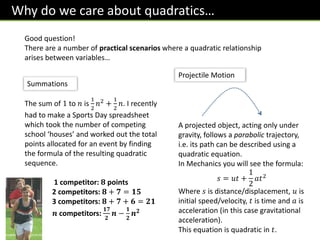
There are a number of practical scenarios where a quadratic relationship
arises between variables…
Summations
The sum of 1 to 𝑛 is
1
2
𝑛2
+
1
2
𝑛. I recently
had to make a Sports Day spreadsheet
which took the number of competing
school ‘houses’ and worked out the total
points allocated for an event by finding
the formula of the resulting quadratic
sequence.
1 competitor: 𝟖 points
2 competitors: 𝟖 + 𝟕 = 𝟏𝟓
3 competitors: 𝟖 + 𝟕 + 𝟔 = 𝟐𝟏
𝒏 competitors:
𝟏𝟕
𝟐
𝒏 −
𝟏
𝟐
𝒏𝟐
Projectile Motion
A projected object, acting only under
gravity, follows a parabolic trajectory,
i.e. its path can be described using a
quadratic equation.
In Mechanics you will see the formula:
𝑠 = 𝑢𝑡 +
1
2
𝑎𝑡2
Where 𝑠 is distance/displacement, 𝑢 is
initial speed/velocity, 𝑡 is time and 𝑎 is
acceleration (in this case gravitational
acceleration).
This equation is quadratic in 𝑡.
Why do we care about quadratics…
Hannah’s sweets
Quadratic expressions also regularly emerge when there’s
a product of two expressions involving the same variable
(in this case because Hannah ate two orange sweets).
1 :: Solving Quadratic Equations
𝑥2
+ 5𝑥 = 6
There are three ways of solving a quadratic equation.
One is by completing the square, which we’ll do later.
What are the other two ways?
By factorisation
𝑥2 + 5𝑥 − 6 = 0
𝑥 + 6 𝑥 − 1 = 0
𝑥 = −6, 𝑥 = 1
Put in form.
𝑎𝑥2
+ 𝑏𝑥 + 𝑐 = 0
with 0 on one side
Factorise. If the
product of two
things is 0, at least
one must be 0.
?
Using the quadratic formula.
If 𝑎𝑥2
+ 𝑏𝑥 + 𝑐 = 0 then
𝑥 =
−𝑏 ± 𝑏2 − 4𝑎𝑐
2𝑎
𝑥2 + 5𝑥 − 6 = 0
𝑎 = 1, 𝑏 = 5, 𝑐 = −6
𝑥 =
−5 ± 25 + 24
2
=
−5 ± 7
2
= 1 𝑜𝑟 − 6
?
1 :: Solving Quadratic Equations
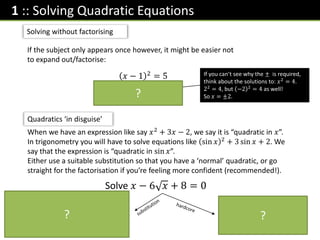
If the subject only appears once however, it might be easier not
to expand out/factorise:
𝑥 − 1 2 = 5
𝑥 − 1 = ± 5
𝑥 = 1 ± 5
If you can’t see why the ± is required,
think about the solutions to: 𝑥2
= 4.
22
= 4, but −2 2
= 4 as well!
So 𝑥 = ±2.
When we have an expression like say 𝑥2
+ 3𝑥 − 2, we say it is “quadratic in 𝑥”.
In trigonometry you will have to solve equations like sin 𝑥 2
+ 3 sin 𝑥 + 2. We
say that the expression is “quadratic in sin 𝑥”.
Either use a suitable substitution so that you have a ‘normal’ quadratic, or go
straight for the factorisation if you’re feeling more confident (recommended!).
Quadratics ‘in disguise’
Solving without factorising
Solve 𝑥 − 6 𝑥 + 8 = 0
Let 𝑦 = 𝑥, then:
𝑦2
− 6𝑦 + 8 = 0
𝑦 − 2 𝑦 − 4 = 0
𝑦 = 2, 𝑦 = 4 → 𝑥 = 2, 𝑥 = 4
𝑥 = 4 𝑜𝑟 𝑥 = 16
𝑥 − 2 𝑥 − 4 = 0
𝑥 = 2 𝑜𝑟 𝑥 = 4
𝑥 = 4 𝑜𝑟 𝑥 = 16
?
?
?
Test Your Understanding
Solve 𝑥 + 3 2 = 𝑥 + 5 using
factorisation.
𝑥2
+ 6𝑥 + 9 = 𝑥 + 5
𝑥2 + 5𝑥 + 4 = 0
𝑥 + 4 𝑥 + 1 = 0
𝑥 = −4 𝑜𝑟 𝑥 = −1
Solve 2𝑥 + 𝑥 − 1 = 0
2 𝑥 − 1 𝑥 + 1 = 0
𝑥 =
1
2
𝑜𝑟 𝑥 = −1
𝑥 =
1
4
The latter gives no solution because the
square root of a number can’t give a
negative number.
Solve 2𝑥 + 1 2
= 5
2𝑥 + 1 = ± 5
2𝑥 = −1 ± 5
𝑥 = −
1
2
±
1
2
5
Solve 𝑥 + 3 = 𝑥 − 3
Squaring both sides:
𝑥 + 3 = 𝑥 − 3 2
𝑥 + 3 = 𝑥2
− 6𝑥 + 9
𝑥2
− 7𝑥 + 6 = 0
𝑥 − 6 𝑥 − 1 = 0
𝑥 = 1 𝑜𝑟 𝑥 = 6
However, squaring both sides of an
equation can generate false solutions.
e.g. If 𝑥 = −2, squaring gives 𝑥2
= 4,
which falsely creates the extra solution
𝑥 = 2! We therefore need to check by
substituting into the original equation,
where we find only 𝑥 = 6 works.
?
?
?
?
1 2
3 4
“Use of Technology” Monkey says:
The ‘equation’ mode on your calculator will solve
quadratics in the form 𝑎𝑥2
+ 𝑏𝑥 + 𝑐 = 0. When you’re
asked for the ‘order’, use 2 (we’ll see why later).
Exercise 2A/2B
Pearson Pure Mathematics Year 1/AS
Pages 20-22
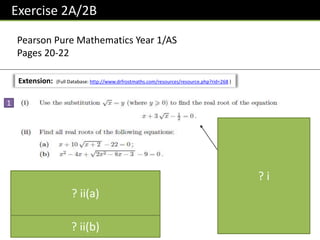
1
Extension: (Full Database: http://www.drfrostmaths.com/resources/resource.php?rid=268 )
𝑦2
+ 3𝑦 −
1
2
= 0
2𝑦2
+ 6𝑦 − 1 = 0
𝑦 =
−6 ± 36 + 8
4
𝑥 = −
3
2
±
11
2
Since 𝑥 > 0:
𝑥 = −
3
2
+
11
2
𝑥 = 5 −
3
2
11
? i
(ii)(a)
Use 𝑦 = 𝑥 + 2, thus 𝑥 = 𝑦2 − 2
→ 𝑦2
− 2 + 10𝑦 − 22 = 0
… → 𝑥 = 2
(ii)(b): 𝑥 = 2 ± 10
? ii(a)
? ii(b)
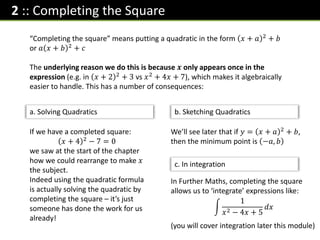
2 :: Completing the Square
“Completing the square” means putting a quadratic in the form 𝑥 + 𝑎 2
+ 𝑏
or 𝑎 𝑥 + 𝑏 2 + 𝑐
The underlying reason we do this is because 𝒙 only appears once in the
expression (e.g. in 𝑥 + 2 2 + 3 vs 𝑥2 + 4𝑥 + 7), which makes it algebraically
easier to handle. This has a number of consequences:
a. Solving Quadratics
If we have a completed square:
𝑥 + 4 2
− 7 = 0
we saw at the start of the chapter
how we could rearrange to make 𝑥
the subject.
Indeed using the quadratic formula
is actually solving the quadratic by
completing the square – it’s just
someone has done the work for us
already!
b. Sketching Quadratics
We’ll see later that if 𝑦 = 𝑥 + 𝑎 2 + 𝑏,
then the minimum point is −𝑎, 𝑏
c. In integration
In Further Maths, completing the square
allows us to ‘integrate’ expressions like:
1
𝑥2 − 4𝑥 + 5
𝑑𝑥
(you will cover integration later this module)
Completing the Square Recap
Textbook Note:
The textbook uses the formula
𝑥2
+ 𝑏𝑥 = 𝑥 +
𝑏
2
2
−
𝑏
2
2
and similarly
𝑎𝑥2
+ 𝑏𝑥 + 𝑐
= 𝑎 𝑥 +
𝑏
2𝑎
2
+ 𝑐 −
𝑏2
4𝑎
My personal judgement is that it’s
not worth memorising these and
you should instead think through the
steps. Even the textbook agrees!
Expand:
𝑥 + 𝟗 2 = 𝑥2 + 𝟏𝟖𝑥 + 81
𝑥 − 𝟓 2 = 𝑥2 − 𝟏𝟎𝑥 + 25
What do you notice about the relationship
between the bold numbers?
The 𝒂 in 𝒙 + 𝒂 𝟐
is half the coefficient of 𝒙 in the
expansion.
Therefore if we had 𝑥2
+ 12𝑥, how could we
write it in the form 𝑥 + 𝑎 2
+ 𝑏?
𝑥2 + 12𝑥 = 𝒙 + 𝟔 𝟐 − 𝟑𝟔 Since 𝑥 + 6 2
= 𝑥2
+ 12𝑥 + 36, we
want to discard the 36, so ‘throw it
away’ by subtracting.
Further Examples:
𝑥2 + 8𝑥 = 𝒙 + 𝟒 𝟐 − 𝟏𝟔
𝑥2 − 2𝑥 = 𝒙 − 𝟏 𝟐 − 𝟏
𝑥2 − 6𝑥 + 7 = 𝒙 − 𝟑 𝟐 − 𝟗 + 𝟕
= 𝒙 − 𝟑 𝟐 − 𝟐
Notice that despite the 𝑎 being
negative, we still subtract after the
bracket as −1 2
is positive.
?
?
?
?
?
?
?
Completing the Square
Express 2𝑥2 + 12𝑥 + 7 in the form 𝑎 𝑥 + 𝑏 2 + 𝑐
= 2 𝑥2 + 6𝑥 + 7
= 2 𝑥 + 3 2 − 9 + 7
= 2 𝑥 + 3 2 − 18 + 7
= 2 𝑥 + 3 2 − 11
Factorise out coefficient of 𝑥2
.
You can leave the constant
term outside the bracket.
Complete the square inside
the bracket (you should
have two sets of brackets)
Expand out outer bracket.
?
?
?
?
Express 5 − 3𝑥2 + 6𝑥 in the form 𝑎 − 𝑏 𝑥 + 𝑐 2
= −3𝑥2 + 6𝑥 + 5
= −3 𝑥2 − 2𝑥 + 5
= −3 𝑥 − 1 2 − 1 + 5
= −3 𝑥 − 1 2 + 3 + 5
= 8 − 3 𝑥 − 1 2
?
?
?
?
?
It may help to write in the
form 𝑎𝑥2 + 𝑏𝑥 + 𝑐 first.
Test Your Understanding
Express 3𝑥2 − 18𝑥 + 4 in the form 𝑎 𝑥 + 𝑏 2 + 𝑐
= 3 𝑥2
− 6𝑥 + 4
= 3 𝑥 − 3 2 − 9 + 4
= 3 𝑥 − 3 2 − 27 + 4
= 3 𝑥 − 3 2 − 23
Express 20𝑥 − 5𝑥2
+ 3 in the form 𝑎 − 𝑏 𝑥 + 𝑐 2
= −5𝑥2
+ 20𝑥 + 3
= −5 𝑥2 − 4𝑥 + 3
= −5 𝑥 − 2 2 − 4 + 3
= −5 𝑥 − 2 2 + 20 + 3
= 23 − 5 𝑥 − 2 2
?
?
Solving by Completing the Square
Solve the equation:
3𝑥2 − 18𝑥 + 4 = 0
𝑥2 − 6𝑥 +
4
3
= 0
𝑥 − 3 2 − 9 +
4
3
= 0
𝑥 − 3 2
=
23
3
𝑥 − 3 = ±
23
3
𝑥 = 3 ±
23
3
? First step
? And the rest…
Froflections: Previously we
factorised out the 3. This is
because 3𝑥2
− 18𝑥 + 4 on its
own is an expression, so dividing
by 3 (instead of factorising)
would change the expression.
However, in an equation, we can
divide both sides by 3 without
affecting the solutions.
Exercise 2C/2D
Pearson Pure Mathematics Year 1/AS
Page 23-24
Proving the Quadratic Formula
If 𝑎𝑥2 + 𝑏𝑥 + 𝑐 = 0, prove that 𝑥 =
−𝑏± 𝑏2−4𝑎𝑐
2𝑎
Just use exactly the same
method as you usually would!
𝑎𝑥2 + 𝑏𝑥 + 𝑐 = 0
𝑥2 +
𝑏
𝑎
𝑥 +
𝑐
𝑎
= 0
𝑥 +
𝑏
2𝑎
2
−
𝑏2
4𝑎2
+
𝑐
𝑎
= 0
𝑥 +
𝑏
2𝑎
2
=
𝑏2
4𝑎2
−
𝑐
𝑎
𝑥 +
𝑏
2𝑎
2
=
𝑏2
− 4𝑎𝑐
4𝑎2
𝑥 +
𝑏
2𝑎
=
± 𝑏2 − 4𝑎𝑐
2𝑎
𝑥 =
−𝑏 ± 𝑏2 − 4𝑎𝑐
2𝑎
!
?
3 :: Functions
𝑓(𝑥) = 2𝑥
𝑓
𝑥 2𝑥
Input Output
A function is something which provides a rule on how to map inputs to outputs.
We saw at GCSE that functions were a formal way of describing a ‘number
machine’:
Input Output
Name of the function
(often 𝑓 or 𝑔)
?
3 :: Functions
You’ll cover functions extensively in future chapters, but for now, you need to
understand the following concepts:
𝑓 𝑥
= 𝑥2
-1
0
1.7
2
...
3.1
1
0
2.89
4
...
9.61
Inputs Outputs
! The domain of a
function is the set of
possible inputs.
! The range of a function
is the set of possible
outputs.
The domain of a function
could potentially be any real
number. If so, we’d write:
𝑥 ∈ ℝ
The input 𝑥…
is a member of…
the set of real numbers
We might be interested in
what inputs 𝑥 give an output
of 0. These are known as the
roots of the function.
! The roots/zeroes of a
function are the values of
𝑥 for which 𝑓 𝑥 = 0.
?
?
Examples
If 𝑓 𝑥 = 𝑥2 − 3𝑥 and 𝑔 𝑥 = 𝑥 + 5, 𝑥 ∈ ℝ
a) Find 𝑓(−4)
b) Find the values of 𝑥 for which 𝑓 𝑥 = 𝑔(𝑥)
c) Find the roots of 𝑓(𝑥).
d) Find the roots of 𝑔(𝑥).
Fro Note: The domain is
usually stated for you.
a 𝑓 −4 = −4 2 − 3 −4
= 28
b
c
Conceptually, we’re looking for the
inputs of the functions which give the
same outputs. We can just equate the
output expressions.
𝑥2
− 3𝑥 = 𝑥 + 5
𝑥2
− 4𝑥 − 5 = 0
𝑥 − 5 𝑥 + 1 = 0
𝑥 = 5 𝑜𝑟 𝑥 = −1
The roots are the inputs which give an
output of 0. So set output expression
to 0.
𝑥2 − 3𝑥 = 0
𝑥 𝑥 − 3 = 0
𝑥 = 0 𝑜𝑟 𝑥 = 3
d 𝑥 + 5 = 0
𝑥 = −5
?
?
?
?
Examples
Determine the minimum value of the function
𝑓 𝑥 = 𝑥2 − 6𝑥 + 2, and state the value of 𝑥 for
which this minimum occurs.
You might try a (clumsy) approach of trying a few values of 𝑥
and try to see what makes the output as small as possible…
This means we want to
minimise the output of
the function.
𝑓 1 = 1 − 6 + 2 = −3
𝑓 2 = 4 − 12 + 2 = −6
𝑓 3 = 9 − 18 + 2 = −7
𝑓 4 = 16 − 24 + 2 = −6
This looks like the
minimum as the value
starts going up after.
But the best way to find the minimum/maximum value of a
quadratic is to complete the square:
𝑓 𝑥 = 𝑥 − 3 2
− 7
𝑓 1 = −2 2
− 7 = −3
𝑓 2 = −1 2
− 7 = −6
𝑓 3 = 02 − 7 = −7
𝑓 4 = 12 − 7 = −6
Since anything squared is at
least 0, the smallest we can
make the bracket is 0, which
occurs when 𝑥 = 3.
?
! If 𝑓 𝑥 = 𝑥 + 𝑎 2 + 𝑏, the
minimum value of 𝑓(𝑥) is 𝑏,
which occurs when 𝑥 = −𝑎.
?
Quickfire Questions
𝒇(𝒙) Completed square Min/max value of 𝒇(𝒙) 𝒙 for which this
min/max occurs
𝑥2
+ 4𝑥 + 9 𝑥 + 2 2
+ 5 5 −2
𝑥2
− 10𝑥 + 21 𝑥 − 5 2
− 4 −4 5
10 − 𝑥2 Already completed 10 0
8 − 𝑥2 + 6𝑥 17 − 𝑥 − 3 2 17 3
? ? ?
? ? ?
? ? ?
? ? ?
Test Your Understanding
Find the minimum value of
𝑓 𝑥 = 2𝑥2 + 12𝑥 − 5 and
state the value of 𝑥 for
which this occurs.
Find the roots of the function
𝑓 𝑥 = 2𝑥2
+ 3𝑥 + 1
Find the roots of the function
𝑓 𝑥 = 𝑥4
− 𝑥2
− 6
𝑓 𝑥 = 2 𝑥2
+ 6𝑥 − 5
= 2 𝑥 + 3 2 − 9 − 5
= 2 𝑥 + 3 2
− 18 − 5
= 2 𝑥 + 3 2
− 23
Minimum value is -23.
𝑥 at which this occurs is -3.
2𝑥2 + 3𝑥 + 1 = 0
2𝑥 + 1 𝑥 + 1 = 0
𝑥 = −
1
2
𝑜𝑟 𝑥 = −1
𝑥4
− 𝑥2
− 6 = 0
𝑥2
+ 2 𝑥2
− 3 = 0
𝑥2 = −2 𝑜𝑟 𝑥2 = 3
𝑥 = ± 3
1 2
3
?
?
?
Exercise 2E
Pearson Pure Mathematics Year 1/AS
Page 26-27
Recall that 𝑥 refers to the input of a function, and the expression 𝑓(𝑥) refers to the
output. For graph sketches, we often write 𝑦 = 𝑓(𝑥), i.e. we set the 𝑦 values to be the
output of the function.
4 :: Quadratic Graphs
𝑥
𝑦
Features needed in
sketch of quadratic?
Roots
𝑦-intercept
General shape:
Smiley face or hill?
?
?
?
Turning point
?
A ‘sketch’ in maths has a clearly
defined meaning:
• We care about the general
shape of the graph, not exact
points.
• The axes should have no scale.
• Generally the only coordinates
indicated are intercepts with
the axis or other points of
interest (e.g. intersections of
multiple graphs)
Recall a root of a
function is where
the output, in
this case the 𝑦
value, is 0.
Example
Sketch the graph of 𝑦 = 𝑥2 + 3𝑥 − 4 and find the
coordinates of the turning point.
Roots: 𝒙𝟐 + 𝟑𝒙 − 𝟒 = 𝟎
𝒙 + 𝟒 𝒙 − 𝟏 = 𝟎
𝒙 = −𝟒 𝒐𝒓 𝒙 = 𝟏
𝑦-intercept: When 𝒙 = 𝟎,
𝒚 = 𝟎𝟐
+ 𝟑 𝟎 − 𝟒 = −𝟒
Turning point:
𝒚 = 𝒙 +
𝟑
𝟐
𝟐
−
𝟗
𝟒
− 𝟒
𝒚 = 𝒙 +
𝟑
𝟐
𝟐
−
𝟐𝟓
𝟒
Min point: −
𝟑
𝟐
, −
𝟐𝟓
𝟒
Recall that if 𝑓 𝑥 = 𝑥 + 𝑎 2
+ 𝑏, the
minimum output is 𝑏 and −𝑎 is the 𝑥 value
which minimises it. i.e. Turning point is (−𝑎, 𝑏)
?
?
? -4 1
-4
−
3
2
, −
25
4
𝑥
𝑦
Example
Sketch the graph of 𝑦 = 4𝑥 − 2𝑥2 − 3 and find the coordinates of the
turning point. Write down the equation of the line of symmetry.
Roots: −𝟐𝒙𝟐 + 𝟒𝒙 − 𝟑 = 𝟎
𝒂 = −𝟐, 𝒃 = 𝟒, 𝒄 = −𝟑
𝒙 =
−𝟒 ± 𝟒𝟐 − 𝟒 × −𝟐 × −𝟑
−𝟒
=
−𝟒 ± −𝟖
−𝟒
This has no solutions, so the 𝒚 value
can never be 0, i.e. the parabola
does not touch the 𝒙-axis.
𝑦-intercept: -3 (by inspection)
Turning point: 𝒚 = −𝟐𝒙𝟐
+ 𝟒𝒙 − 𝟑
= −𝟐 𝒙𝟐
− 𝟐𝒙 − 𝟑
= −𝟐 𝒙 − 𝟏 𝟐
− 𝟏 − 𝟑
= −𝟐 𝒙 − 𝟏 𝟐
+ 𝟐 − 𝟑
= −𝟐 𝒙 − 𝟏 𝟐
− 𝟏
Max point is (𝟏, −𝟏)
?
?
-3
1, −1
𝑥
𝑦
?
Line of reflection: 𝒙 = 𝟏
𝑥 = 1
?
Test Your Understanding
Sketch the following, indicating any intercepts with the axis, the turning point
and the equation of the line of symmetry.
𝑦 = 𝑥2
+ 4
a
𝑦 = 𝑥2
− 7𝑥 + 10
b
𝑦 = 5𝑥 + 3 − 2𝑥2
c
𝑦 = 𝑥2
+ 4𝑥 + 11
d
𝑥
𝑦
𝑥
5
2
10
0,4
7
2
, −
9
4
𝑥 =
7
2
𝑥
3
−
1
2
3
5
4
,
49
8
𝑥 =
5
4
𝑥
𝑥 = −2
11
−2,7
𝑥 = 0
?
?
?
?
Determining the Equation using a Graph
𝑥
𝑦
2
-3
-12
Determine the equation of this quadratic
graph, in the form 𝑦 = 𝑎𝑥2 + 𝑏𝑥 + 𝑐.
Since the roots are −3 and 2, a good start
would be:
𝑦 = (𝑥 + 3)(𝑥 − 2)
noting that this gives us the correct
‘positive quadratic’ shape.
However, expanding, we get the wrong 𝑦-
intercept of -6:
𝑦 = 𝑥2
+ 𝑥 − 6
We can simply scale the 𝑦-value
appropriately without affecting the roots:
𝑦 = 2 𝑥 + 3 𝑥 − 2
= 2𝑥2 + 2𝑥 − 12
?
Further Example
𝑥
𝑦
3.5
-1
Determine the equation of this quadratic
graph, in the form 𝑦 = 𝑎𝑥2 + 𝑏𝑥 + 𝑐,
where 𝑎, 𝑏, 𝑐 are integers.
A good start would be:
𝑦 = −(𝑥 + 1)(𝑥 − 3.5)
The minus on the front ensures we get a
negative 𝑥2
term for the correct shape.
Expanding:
𝑦 = −𝑥2
+ 2.5𝑥 + 3.5
Note that no 𝑦-intercept has been
specified, so we can scale the whole
expression without affecting the roots (i.e.
we only scale in the 𝑦 direction). Doubling:
𝒚 = −𝟐𝒙𝟐 + 𝟓𝒙 + 𝟕
?
Test Your Understanding
𝑥
𝑦
3
-3
10
Determine an equation of this quadratic
graph.
A good start to get the roots correct is:
𝑦 = −(𝑥 + 3)(𝑥 − 3)
The minus on the front ensures we get a
negative 𝑥2
term for the correct shape.
Expanding this gives us the incorrect 𝑦-
intercept of 9:
𝑦 = −𝑥2
+ 9
To scale 9 to 10, without affecting the root,
we need to scale by
10
9
:
𝑦 = −
10
9
(𝑥 + 3)(𝑥 − 3)
Or more cleanly:
𝒚 =
𝟏𝟎
𝟗
𝒙 + 𝟑 𝟑 − 𝒙
?
Exercise 2F
Pearson Pure Mathematics Year 1/AS
Page 30
[MAT 2003 1H] Into how many regions is the plane divided when
the following three parabolas are drawn?
𝑦 = 𝑥2
𝑦 = 𝑥2
− 2𝑥
𝑦 = 𝑥2
+ 2𝑥 + 2
Extension Question:
Completing the square:
𝒚 = 𝒙𝟐
𝒚 = 𝒙 − 𝟏 𝟐 − 𝟏
𝒚 = 𝒙 + 𝟏 𝟐
+ 𝟏
5
1
2
3
6
7
4
𝑦
𝑥
?
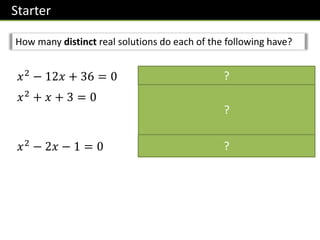
How many distinct real solutions do each of the following have?
𝑥2 − 12𝑥 + 36 = 0 𝒙 = 𝟔 (1 distinct solution)
𝑥2 + 𝑥 + 3 = 0 𝑥 =
−1± −11
2
We can’t square root -11,
Therefore no real solutions.
𝑥2 − 2𝑥 − 1 = 0 𝒙 = 𝟏 ± 𝟐 (2 distinct solutions)
?
?
?
Starter
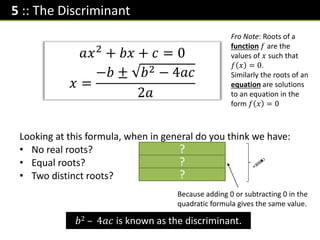
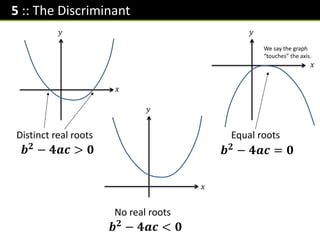
5 :: The Discriminant
Looking at this formula, when in general do you think we have:
• No real roots? 𝒃𝟐 − 𝟒𝒂𝒄 < 𝟎
• Equal roots? 𝒃𝟐 − 𝟒𝒂𝒄 = 𝟎
• Two distinct roots? 𝒃𝟐 − 𝟒𝒂𝒄 > 𝟎
𝑎𝑥2
+ 𝑏𝑥 + 𝑐 = 0
𝑥 =
−𝑏 ± 𝑏2 − 4𝑎𝑐
2𝑎
𝑏2 – 4𝑎𝑐 is known as the discriminant.
?
?
?
!
Fro Note: Roots of a
function 𝑓 are the
values of 𝑥 such that
𝑓 𝑥 = 0.
Similarly the roots of an
equation are solutions
to an equation in the
form 𝑓 𝑥 = 0
Because adding 0 or subtracting 0 in the
quadratic formula gives the same value.
5 :: The Discriminant
𝑥
𝑦
𝒃𝟐
− 𝟒𝒂𝒄 > 𝟎
Distinct real roots
𝑥
𝑦
𝒃𝟐
− 𝟒𝒂𝒄 = 𝟎
Equal roots
𝑥
𝑦
𝒃𝟐 − 𝟒𝒂𝒄 < 𝟎
No real roots
We say the graph
“touches” the axis.
Just for your interest…
Why do we say “Equal Roots” not “One root”?
𝑥2
− 12𝑥 + 36 = 0
Using the quadratic formula gives us the
same value in both + and − cases: 𝑥 = 6.
You might wonder why we say “it has one
repeated root” or “it has equal roots”, i.e.
indicating we have 2 roots (but with the
same value). Why not say it has 1 root?
“Every polynomial of order 𝑛
has exactly 𝑛 roots.”
A polynomial is an
expression with
non-negative integer
powers of 𝑥, i.e.
𝑎 + 𝑏𝑥 + 𝑐𝑥2
+ 𝑑𝑥3
+ ⋯
All linear, quadratic and
cubic expressions are
examples of polynomials.
The order of a
polynomial is
its highest
power of 𝑥. So
the order of a
quadratic is 2,
and a cubic 3.
These roots might be
repeated or might not be
‘real’ roots. −1 is known
as a complex number,
which you will encounter if
you do FM. But it is still a
value!
The theorem means that a
quadratic (order 2) will
always have 2 roots. This is
why you should say “no real
roots” when 𝑏2
− 4𝑎𝑐 < 0
rather than “no roots”,
because there are still roots
– it’s just they’re not ‘real’!
Similarly we must say “equal
roots” because there are
still 2 roots.
It is due to the Fundamental
Theorem of Algebra:
Despite the theorem being a simple statement, it was only
until 1806 that it was first proven by Argand. Clearly by using
the quadratic formula we can show a quadratic equation has
2 roots. We can use similar formulas to show that a cubic
has 3 roots and a quartic 4 roots. But there is provably no
such formulae for order 5 (quintics) and beyond. So we have
to prove for example that 5 roots exist for a quintic, despite
us having no way to find these exact roots!
One side result of the Fundamental Theorem of Algebra is
that every polynomial can be written as a product of linear
and/or quadratic expressions.
Leibniz claimed in 1702 that a polynomial of the form
𝑥4
+ 𝑎4
cannot be written in this way. He then got
completely burned by Euler in 1742 who managed to do so:
𝑥4
+ 𝑎4
= 𝑥2
+ 𝑎 2 𝑥 + 𝑎2
𝑥2
− 𝑎 2 𝑥 + 𝑎2
There are various other ‘Fundamental
Laws’. The ‘FL of Arithmetic’ you
encountered at KS3, which states that
“every positive integer > 1 can be
written as a product of primes in one
way only”. You will encounter the ‘FL
of Calculus’ in Chapter 13.
Quickfire Questions
𝑥2
+ 3𝑥 + 4 = 0
Equation Discriminant
Number of Distinct
Real Roots
−7 0
𝑥2
− 4𝑥 + 1 = 0 12 2
𝑥2
− 4𝑥 + 4 = 0 0 1
2𝑥2
− 6𝑥 − 3 = 0 60 2
𝑥 − 4 − 3𝑥2
= 0 −47 0
1 − 𝑥2
= 0 4 2
? ?
? ?
? ?
? ?
? ?
? ?
Problems involving the discriminant
a) 𝑎 = 1, 𝑏 = 2𝑝, 𝑐 = 3𝑝 + 4
2𝑝 2 − 4 1 3𝑝 + 4 = 0
4𝑝2 − 12𝑝 − 16 = 0
𝑝2
− 3𝑝 − 4 = 0
𝑝 + 1 𝑝 − 4 = 0
𝑝 = 4
b) When 𝑝 = 4: 𝑥2 + 8𝑥 + 16 = 0
𝑥 + 4 2 = 0, 𝑥 = −4
?
?
? ?
?
Fro Tip: Always start by
writing out 𝑎, 𝑏 and 𝑐
explicitly.
Test Your Understanding
𝑥2
+ 5𝑘𝑥 + 10𝑘 + 5 = 0
where 𝑘 is a constant.
Given that this equation has equal roots, determine the value of 𝑘.
𝑎 = 1, 𝑏 = 5𝑘, 𝑐 = 10𝑘 + 5
5𝑘 2 − 4 1 10𝑘 + 5 = 0
25𝑘2 − 40𝑘 − 20 = 0
5𝑘2 − 8𝑘 − 4 = 0
5𝑘 + 2 𝑘 − 2 = 0
𝑘 = 2
Find the range of values of 𝑘 for which 𝑥2 + 6𝑥 + 𝑘 = 0 has two distinct
real solutions.
𝑎 = 1, 𝑏 = 6, 𝑐 = 𝑘
36 − 4 1 𝑘 = 36 − 4𝑘 > 0
36 > 4𝑘
𝑘 < 9
?
?
Exercise 2G
Pearson Pure Mathematics Year 1/AS
Page 32
[MAT 2011 1B] A rectangle has
perimeter 𝑃 and area 𝐴. The
values 𝑃 and 𝐴 must satisfy:
A) 𝑃3
> 𝐴
B) 𝐴2
> 2𝑃 + 1
C) 𝑃2
≥ 16𝐴
D) 𝑃𝐴 > 𝐴 + 𝑃
Let 𝒙 and 𝒚 be the width and height.
Then 𝑨 = 𝒙𝒚, 𝑷 = 𝟐𝒙 + 𝟐𝒚.
Substituting:
𝑷 = 𝟐𝒙 + 𝟐
𝑨
𝒙
𝑷𝒙 = 𝟐𝒙𝟐
+ 𝟐𝑨
𝟐𝒙𝟐
− 𝑷𝒙 + 𝟐𝑨 = 𝟎
Discriminant: 𝒂 = 𝟐, 𝒃 = −𝑷, 𝒄 = 𝟐𝑨
−𝑷 𝟐
− 𝟒 𝟐 𝟐𝑨 ≥ 𝟎
𝑷𝟐
− 𝟏𝟔𝑨 ≥ 𝟎
𝑷𝟐
≥ 𝟏𝟔𝑨
[MAT 2006 1B] The
equation
2 + 𝑥 − 𝑥2 2
= 16 has
how many real root(s)?
𝟐 + 𝒙 − 𝒙𝟐
= ±𝟒
First case:
𝟐 + 𝒙 − 𝒙𝟐
= 𝟒
𝒙𝟐
− 𝒙 + 𝟐 = 𝟎
As 𝒃𝟐
− 𝟒𝒂𝒄 < 𝟎 no real
roots.
Second case:
𝟐 + 𝒙 − 𝒙𝟐
= −𝟒
𝒙𝟐
− 𝒙 − 𝟔 = 𝟎
𝒙 + 𝟐 𝒙 − 𝟑 = 𝟎
𝒙 = −𝟐 𝒐𝒓 𝒙 = 𝟑
So 2 distinct real roots.
1 2 3
?
?
Extension Questions:
[MAT 2009 1C] Given a real constant
𝑐, the equation
𝑥4
= 𝑥 − 𝑐 2
Has four real solutions (including
possible repeated roots) for:
A) 𝑐 ≤
1
4
B) −
1
4
≤ 𝑐 ≤
1
4
C) 𝑐 ≤ −
1
4
D) all values of 𝑐
Square rooting: 𝒙𝟐
= ±(𝒙 − 𝒄)
Case 1:
𝒙𝟐
− 𝒙 + 𝒄 = 𝟎
Discriminant: 𝟏 − 𝟒𝒄 ≥ 𝟎 ∴ 𝒄 ≤
𝟏
𝟒
Case 2:
𝒙𝟐
+ 𝒙 − 𝒄 = 𝟎
Discriminant: 𝟏 + 𝟒𝒄 ≥ 𝟎 ∴ 𝒄 ≥ −
𝟏
𝟒
Answer is B.
?
Modelling
The new A Level has a particular emphasis of the application of theory to real-life
situations. A mathematical model is the maths used to model such a situation,
possibly with some simplifying assumptions.
Example (from textbook): A spear is thrown over level ground from the top of a tower.
The height, in metres, of the spear above the ground after 𝑡 seconds is modelled by the
function: ℎ 𝑡 = 12.25 + 14.7𝑡 − 4.9𝑡2, 𝑡 ≥ 0
a) Interpret the meaning of the constant term 12.25 in the model.
b) After how many seconds does the spear hit the ground?
c) Write ℎ(𝑡) in the form 𝐴 − 𝐵 𝑡 − 𝐶 2, where 𝐴, 𝐵 and 𝐶 are constants to be found.
d) Using your answer to part c or otherwise, find the maximum height of the spear
above the ground, and the time at which this maximum height is reached?
When the time is 0, clearly ℎ 0 = 12.25. So the 12.25m is the height of the tower.
(In general, the constant term of an expression is often the ‘initial value’.
When it hits the ground, ℎ 𝑡 = 0, thus: 12.25 + 14.7𝑡 − 4.9𝑡2
Solving gives 𝑡 = −0.679 𝑜𝑟 𝑡 = 3.68 (to 3sf) but as 𝑡 ≥ 0, 𝑡 = 3.68 (to 3sf)
By completing the square: 23.275 − 4.9 𝑡 − 1.5 2
The maximum height of the spear is 23.275m, 1.5 seconds after spear is thrown.
a
b
c
d
?
?
?
?
Exercise 2H
Pearson Pure Mathematics Year 1/AS
Page 34
Would you like $1,000,000 for finding roots?
We saw earlier that the roots of a function 𝑓 are the values 𝑥 such that 𝑓 𝑥 = 0.
The Riemann Zeta Function
is a function that allows you
to do the infinite sum of
powers of reciprocals, e.g.
𝜁 2 =
1
12
+
1
22
+
1
32
+ ⋯
𝜁 3 =
1
13
+
1
23
+
1
33
+ ⋯
One of the 8 ‘Clay
Millennium Problems’ (for
which solving any attracts a
$1,000,000 prize) is to
showing all roots of this
function have some
particular form, i.e. the form
of 𝑥 such that 𝜁 𝑥 = 0.

P1-Chp2-Quadratics.pptx

  • 1.
    P1 Chapter 2:: Quadratics jfrost@tiffin.kingston.sch.uk www.drfrostmaths.com @DrFrostMaths Last modified: 31th May 2020
  • 2.
    www.drfrostmaths.com Everything is completelyfree. Why not register? Teaching videos with topic tests to check understanding. Register now to interactively practise questions on this topic, including past paper questions and extension questions (including MAT + UKMT). Teachers: you can create student accounts (or students can register themselves), to set work, monitor progress and even create worksheets. Dashboard with points, trophies, notifications and student progress. With questions by: Questions organised by topic, difficulty and past paper.
  • 3.
    Chapter Overview Again, mostof the content in this chapter is not new, but brings together a variety of algebraic and graph sketching GCSE skills regarding quadratic equations. Solve 𝑥 + 1 2 − 3 𝑥 + 1 + 2 = 0 1:: Solving quadratic equations Write 2𝑥2 + 8𝑥 − 5 in the form 𝑎 𝑥 + 𝑏 2 + 𝑐 2:: Completing the square If 𝑓 𝑥 = 𝑥2 + 2𝑥, find the roots of 𝑓(𝑥). 3:: Quadratics as functions Sketch 𝑦 = 𝑥2 + 4𝑥 − 5, indicating the coordinate of the turning point and any intercepts with the axes. 4:: Quadratic Graphs Find the range of values of 𝑘 for which 𝑥2 + 4𝑥 + 𝑘 = 0 has two distinct real solutions. 5:: The Discriminant NEW! (since GCSE) This subtopic is completely new. 6:: Modelling with Quadratics
  • 4.
    Why do wecare about quadratics… Good question! There are a number of practical scenarios where a quadratic relationship arises between variables… Summations The sum of 1 to 𝑛 is 1 2 𝑛2 + 1 2 𝑛. I recently had to make a Sports Day spreadsheet which took the number of competing school ‘houses’ and worked out the total points allocated for an event by finding the formula of the resulting quadratic sequence. 1 competitor: 𝟖 points 2 competitors: 𝟖 + 𝟕 = 𝟏𝟓 3 competitors: 𝟖 + 𝟕 + 𝟔 = 𝟐𝟏 𝒏 competitors: 𝟏𝟕 𝟐 𝒏 − 𝟏 𝟐 𝒏𝟐 Projectile Motion A projected object, acting only under gravity, follows a parabolic trajectory, i.e. its path can be described using a quadratic equation. In Mechanics you will see the formula: 𝑠 = 𝑢𝑡 + 1 2 𝑎𝑡2 Where 𝑠 is distance/displacement, 𝑢 is initial speed/velocity, 𝑡 is time and 𝑎 is acceleration (in this case gravitational acceleration). This equation is quadratic in 𝑡.
  • 5.
    Why do wecare about quadratics… Hannah’s sweets Quadratic expressions also regularly emerge when there’s a product of two expressions involving the same variable (in this case because Hannah ate two orange sweets).
  • 6.
    1 :: SolvingQuadratic Equations 𝑥2 + 5𝑥 = 6 There are three ways of solving a quadratic equation. One is by completing the square, which we’ll do later. What are the other two ways? By factorisation 𝑥2 + 5𝑥 − 6 = 0 𝑥 + 6 𝑥 − 1 = 0 𝑥 = −6, 𝑥 = 1 Put in form. 𝑎𝑥2 + 𝑏𝑥 + 𝑐 = 0 with 0 on one side Factorise. If the product of two things is 0, at least one must be 0. ? Using the quadratic formula. If 𝑎𝑥2 + 𝑏𝑥 + 𝑐 = 0 then 𝑥 = −𝑏 ± 𝑏2 − 4𝑎𝑐 2𝑎 𝑥2 + 5𝑥 − 6 = 0 𝑎 = 1, 𝑏 = 5, 𝑐 = −6 𝑥 = −5 ± 25 + 24 2 = −5 ± 7 2 = 1 𝑜𝑟 − 6 ?
  • 7.
    1 :: SolvingQuadratic Equations If the subject only appears once however, it might be easier not to expand out/factorise: 𝑥 − 1 2 = 5 𝑥 − 1 = ± 5 𝑥 = 1 ± 5 If you can’t see why the ± is required, think about the solutions to: 𝑥2 = 4. 22 = 4, but −2 2 = 4 as well! So 𝑥 = ±2. When we have an expression like say 𝑥2 + 3𝑥 − 2, we say it is “quadratic in 𝑥”. In trigonometry you will have to solve equations like sin 𝑥 2 + 3 sin 𝑥 + 2. We say that the expression is “quadratic in sin 𝑥”. Either use a suitable substitution so that you have a ‘normal’ quadratic, or go straight for the factorisation if you’re feeling more confident (recommended!). Quadratics ‘in disguise’ Solving without factorising Solve 𝑥 − 6 𝑥 + 8 = 0 Let 𝑦 = 𝑥, then: 𝑦2 − 6𝑦 + 8 = 0 𝑦 − 2 𝑦 − 4 = 0 𝑦 = 2, 𝑦 = 4 → 𝑥 = 2, 𝑥 = 4 𝑥 = 4 𝑜𝑟 𝑥 = 16 𝑥 − 2 𝑥 − 4 = 0 𝑥 = 2 𝑜𝑟 𝑥 = 4 𝑥 = 4 𝑜𝑟 𝑥 = 16 ? ? ?
  • 8.
    Test Your Understanding Solve𝑥 + 3 2 = 𝑥 + 5 using factorisation. 𝑥2 + 6𝑥 + 9 = 𝑥 + 5 𝑥2 + 5𝑥 + 4 = 0 𝑥 + 4 𝑥 + 1 = 0 𝑥 = −4 𝑜𝑟 𝑥 = −1 Solve 2𝑥 + 𝑥 − 1 = 0 2 𝑥 − 1 𝑥 + 1 = 0 𝑥 = 1 2 𝑜𝑟 𝑥 = −1 𝑥 = 1 4 The latter gives no solution because the square root of a number can’t give a negative number. Solve 2𝑥 + 1 2 = 5 2𝑥 + 1 = ± 5 2𝑥 = −1 ± 5 𝑥 = − 1 2 ± 1 2 5 Solve 𝑥 + 3 = 𝑥 − 3 Squaring both sides: 𝑥 + 3 = 𝑥 − 3 2 𝑥 + 3 = 𝑥2 − 6𝑥 + 9 𝑥2 − 7𝑥 + 6 = 0 𝑥 − 6 𝑥 − 1 = 0 𝑥 = 1 𝑜𝑟 𝑥 = 6 However, squaring both sides of an equation can generate false solutions. e.g. If 𝑥 = −2, squaring gives 𝑥2 = 4, which falsely creates the extra solution 𝑥 = 2! We therefore need to check by substituting into the original equation, where we find only 𝑥 = 6 works. ? ? ? ? 1 2 3 4 “Use of Technology” Monkey says: The ‘equation’ mode on your calculator will solve quadratics in the form 𝑎𝑥2 + 𝑏𝑥 + 𝑐 = 0. When you’re asked for the ‘order’, use 2 (we’ll see why later).
  • 9.
    Exercise 2A/2B Pearson PureMathematics Year 1/AS Pages 20-22 1 Extension: (Full Database: http://www.drfrostmaths.com/resources/resource.php?rid=268 ) 𝑦2 + 3𝑦 − 1 2 = 0 2𝑦2 + 6𝑦 − 1 = 0 𝑦 = −6 ± 36 + 8 4 𝑥 = − 3 2 ± 11 2 Since 𝑥 > 0: 𝑥 = − 3 2 + 11 2 𝑥 = 5 − 3 2 11 ? i (ii)(a) Use 𝑦 = 𝑥 + 2, thus 𝑥 = 𝑦2 − 2 → 𝑦2 − 2 + 10𝑦 − 22 = 0 … → 𝑥 = 2 (ii)(b): 𝑥 = 2 ± 10 ? ii(a) ? ii(b)
  • 10.
    2 :: Completingthe Square “Completing the square” means putting a quadratic in the form 𝑥 + 𝑎 2 + 𝑏 or 𝑎 𝑥 + 𝑏 2 + 𝑐 The underlying reason we do this is because 𝒙 only appears once in the expression (e.g. in 𝑥 + 2 2 + 3 vs 𝑥2 + 4𝑥 + 7), which makes it algebraically easier to handle. This has a number of consequences: a. Solving Quadratics If we have a completed square: 𝑥 + 4 2 − 7 = 0 we saw at the start of the chapter how we could rearrange to make 𝑥 the subject. Indeed using the quadratic formula is actually solving the quadratic by completing the square – it’s just someone has done the work for us already! b. Sketching Quadratics We’ll see later that if 𝑦 = 𝑥 + 𝑎 2 + 𝑏, then the minimum point is −𝑎, 𝑏 c. In integration In Further Maths, completing the square allows us to ‘integrate’ expressions like: 1 𝑥2 − 4𝑥 + 5 𝑑𝑥 (you will cover integration later this module)
  • 11.
    Completing the SquareRecap Textbook Note: The textbook uses the formula 𝑥2 + 𝑏𝑥 = 𝑥 + 𝑏 2 2 − 𝑏 2 2 and similarly 𝑎𝑥2 + 𝑏𝑥 + 𝑐 = 𝑎 𝑥 + 𝑏 2𝑎 2 + 𝑐 − 𝑏2 4𝑎 My personal judgement is that it’s not worth memorising these and you should instead think through the steps. Even the textbook agrees! Expand: 𝑥 + 𝟗 2 = 𝑥2 + 𝟏𝟖𝑥 + 81 𝑥 − 𝟓 2 = 𝑥2 − 𝟏𝟎𝑥 + 25 What do you notice about the relationship between the bold numbers? The 𝒂 in 𝒙 + 𝒂 𝟐 is half the coefficient of 𝒙 in the expansion. Therefore if we had 𝑥2 + 12𝑥, how could we write it in the form 𝑥 + 𝑎 2 + 𝑏? 𝑥2 + 12𝑥 = 𝒙 + 𝟔 𝟐 − 𝟑𝟔 Since 𝑥 + 6 2 = 𝑥2 + 12𝑥 + 36, we want to discard the 36, so ‘throw it away’ by subtracting. Further Examples: 𝑥2 + 8𝑥 = 𝒙 + 𝟒 𝟐 − 𝟏𝟔 𝑥2 − 2𝑥 = 𝒙 − 𝟏 𝟐 − 𝟏 𝑥2 − 6𝑥 + 7 = 𝒙 − 𝟑 𝟐 − 𝟗 + 𝟕 = 𝒙 − 𝟑 𝟐 − 𝟐 Notice that despite the 𝑎 being negative, we still subtract after the bracket as −1 2 is positive. ? ? ? ? ? ? ?
  • 12.
    Completing the Square Express2𝑥2 + 12𝑥 + 7 in the form 𝑎 𝑥 + 𝑏 2 + 𝑐 = 2 𝑥2 + 6𝑥 + 7 = 2 𝑥 + 3 2 − 9 + 7 = 2 𝑥 + 3 2 − 18 + 7 = 2 𝑥 + 3 2 − 11 Factorise out coefficient of 𝑥2 . You can leave the constant term outside the bracket. Complete the square inside the bracket (you should have two sets of brackets) Expand out outer bracket. ? ? ? ? Express 5 − 3𝑥2 + 6𝑥 in the form 𝑎 − 𝑏 𝑥 + 𝑐 2 = −3𝑥2 + 6𝑥 + 5 = −3 𝑥2 − 2𝑥 + 5 = −3 𝑥 − 1 2 − 1 + 5 = −3 𝑥 − 1 2 + 3 + 5 = 8 − 3 𝑥 − 1 2 ? ? ? ? ? It may help to write in the form 𝑎𝑥2 + 𝑏𝑥 + 𝑐 first.
  • 13.
    Test Your Understanding Express3𝑥2 − 18𝑥 + 4 in the form 𝑎 𝑥 + 𝑏 2 + 𝑐 = 3 𝑥2 − 6𝑥 + 4 = 3 𝑥 − 3 2 − 9 + 4 = 3 𝑥 − 3 2 − 27 + 4 = 3 𝑥 − 3 2 − 23 Express 20𝑥 − 5𝑥2 + 3 in the form 𝑎 − 𝑏 𝑥 + 𝑐 2 = −5𝑥2 + 20𝑥 + 3 = −5 𝑥2 − 4𝑥 + 3 = −5 𝑥 − 2 2 − 4 + 3 = −5 𝑥 − 2 2 + 20 + 3 = 23 − 5 𝑥 − 2 2 ? ?
  • 14.
    Solving by Completingthe Square Solve the equation: 3𝑥2 − 18𝑥 + 4 = 0 𝑥2 − 6𝑥 + 4 3 = 0 𝑥 − 3 2 − 9 + 4 3 = 0 𝑥 − 3 2 = 23 3 𝑥 − 3 = ± 23 3 𝑥 = 3 ± 23 3 ? First step ? And the rest… Froflections: Previously we factorised out the 3. This is because 3𝑥2 − 18𝑥 + 4 on its own is an expression, so dividing by 3 (instead of factorising) would change the expression. However, in an equation, we can divide both sides by 3 without affecting the solutions.
  • 15.
    Exercise 2C/2D Pearson PureMathematics Year 1/AS Page 23-24
  • 16.
    Proving the QuadraticFormula If 𝑎𝑥2 + 𝑏𝑥 + 𝑐 = 0, prove that 𝑥 = −𝑏± 𝑏2−4𝑎𝑐 2𝑎 Just use exactly the same method as you usually would! 𝑎𝑥2 + 𝑏𝑥 + 𝑐 = 0 𝑥2 + 𝑏 𝑎 𝑥 + 𝑐 𝑎 = 0 𝑥 + 𝑏 2𝑎 2 − 𝑏2 4𝑎2 + 𝑐 𝑎 = 0 𝑥 + 𝑏 2𝑎 2 = 𝑏2 4𝑎2 − 𝑐 𝑎 𝑥 + 𝑏 2𝑎 2 = 𝑏2 − 4𝑎𝑐 4𝑎2 𝑥 + 𝑏 2𝑎 = ± 𝑏2 − 4𝑎𝑐 2𝑎 𝑥 = −𝑏 ± 𝑏2 − 4𝑎𝑐 2𝑎 ! ?
  • 17.
    3 :: Functions 𝑓(𝑥)= 2𝑥 𝑓 𝑥 2𝑥 Input Output A function is something which provides a rule on how to map inputs to outputs. We saw at GCSE that functions were a formal way of describing a ‘number machine’: Input Output Name of the function (often 𝑓 or 𝑔) ?
  • 18.
    3 :: Functions You’llcover functions extensively in future chapters, but for now, you need to understand the following concepts: 𝑓 𝑥 = 𝑥2 -1 0 1.7 2 ... 3.1 1 0 2.89 4 ... 9.61 Inputs Outputs ! The domain of a function is the set of possible inputs. ! The range of a function is the set of possible outputs. The domain of a function could potentially be any real number. If so, we’d write: 𝑥 ∈ ℝ The input 𝑥… is a member of… the set of real numbers We might be interested in what inputs 𝑥 give an output of 0. These are known as the roots of the function. ! The roots/zeroes of a function are the values of 𝑥 for which 𝑓 𝑥 = 0. ? ?
  • 19.
    Examples If 𝑓 𝑥= 𝑥2 − 3𝑥 and 𝑔 𝑥 = 𝑥 + 5, 𝑥 ∈ ℝ a) Find 𝑓(−4) b) Find the values of 𝑥 for which 𝑓 𝑥 = 𝑔(𝑥) c) Find the roots of 𝑓(𝑥). d) Find the roots of 𝑔(𝑥). Fro Note: The domain is usually stated for you. a 𝑓 −4 = −4 2 − 3 −4 = 28 b c Conceptually, we’re looking for the inputs of the functions which give the same outputs. We can just equate the output expressions. 𝑥2 − 3𝑥 = 𝑥 + 5 𝑥2 − 4𝑥 − 5 = 0 𝑥 − 5 𝑥 + 1 = 0 𝑥 = 5 𝑜𝑟 𝑥 = −1 The roots are the inputs which give an output of 0. So set output expression to 0. 𝑥2 − 3𝑥 = 0 𝑥 𝑥 − 3 = 0 𝑥 = 0 𝑜𝑟 𝑥 = 3 d 𝑥 + 5 = 0 𝑥 = −5 ? ? ? ?
  • 20.
    Examples Determine the minimumvalue of the function 𝑓 𝑥 = 𝑥2 − 6𝑥 + 2, and state the value of 𝑥 for which this minimum occurs. You might try a (clumsy) approach of trying a few values of 𝑥 and try to see what makes the output as small as possible… This means we want to minimise the output of the function. 𝑓 1 = 1 − 6 + 2 = −3 𝑓 2 = 4 − 12 + 2 = −6 𝑓 3 = 9 − 18 + 2 = −7 𝑓 4 = 16 − 24 + 2 = −6 This looks like the minimum as the value starts going up after. But the best way to find the minimum/maximum value of a quadratic is to complete the square: 𝑓 𝑥 = 𝑥 − 3 2 − 7 𝑓 1 = −2 2 − 7 = −3 𝑓 2 = −1 2 − 7 = −6 𝑓 3 = 02 − 7 = −7 𝑓 4 = 12 − 7 = −6 Since anything squared is at least 0, the smallest we can make the bracket is 0, which occurs when 𝑥 = 3. ? ! If 𝑓 𝑥 = 𝑥 + 𝑎 2 + 𝑏, the minimum value of 𝑓(𝑥) is 𝑏, which occurs when 𝑥 = −𝑎. ?
  • 21.
    Quickfire Questions 𝒇(𝒙) Completedsquare Min/max value of 𝒇(𝒙) 𝒙 for which this min/max occurs 𝑥2 + 4𝑥 + 9 𝑥 + 2 2 + 5 5 −2 𝑥2 − 10𝑥 + 21 𝑥 − 5 2 − 4 −4 5 10 − 𝑥2 Already completed 10 0 8 − 𝑥2 + 6𝑥 17 − 𝑥 − 3 2 17 3 ? ? ? ? ? ? ? ? ? ? ? ?
  • 22.
    Test Your Understanding Findthe minimum value of 𝑓 𝑥 = 2𝑥2 + 12𝑥 − 5 and state the value of 𝑥 for which this occurs. Find the roots of the function 𝑓 𝑥 = 2𝑥2 + 3𝑥 + 1 Find the roots of the function 𝑓 𝑥 = 𝑥4 − 𝑥2 − 6 𝑓 𝑥 = 2 𝑥2 + 6𝑥 − 5 = 2 𝑥 + 3 2 − 9 − 5 = 2 𝑥 + 3 2 − 18 − 5 = 2 𝑥 + 3 2 − 23 Minimum value is -23. 𝑥 at which this occurs is -3. 2𝑥2 + 3𝑥 + 1 = 0 2𝑥 + 1 𝑥 + 1 = 0 𝑥 = − 1 2 𝑜𝑟 𝑥 = −1 𝑥4 − 𝑥2 − 6 = 0 𝑥2 + 2 𝑥2 − 3 = 0 𝑥2 = −2 𝑜𝑟 𝑥2 = 3 𝑥 = ± 3 1 2 3 ? ? ?
  • 23.
    Exercise 2E Pearson PureMathematics Year 1/AS Page 26-27
  • 24.
    Recall that 𝑥refers to the input of a function, and the expression 𝑓(𝑥) refers to the output. For graph sketches, we often write 𝑦 = 𝑓(𝑥), i.e. we set the 𝑦 values to be the output of the function. 4 :: Quadratic Graphs 𝑥 𝑦 Features needed in sketch of quadratic? Roots 𝑦-intercept General shape: Smiley face or hill? ? ? ? Turning point ? A ‘sketch’ in maths has a clearly defined meaning: • We care about the general shape of the graph, not exact points. • The axes should have no scale. • Generally the only coordinates indicated are intercepts with the axis or other points of interest (e.g. intersections of multiple graphs) Recall a root of a function is where the output, in this case the 𝑦 value, is 0.
  • 25.
    Example Sketch the graphof 𝑦 = 𝑥2 + 3𝑥 − 4 and find the coordinates of the turning point. Roots: 𝒙𝟐 + 𝟑𝒙 − 𝟒 = 𝟎 𝒙 + 𝟒 𝒙 − 𝟏 = 𝟎 𝒙 = −𝟒 𝒐𝒓 𝒙 = 𝟏 𝑦-intercept: When 𝒙 = 𝟎, 𝒚 = 𝟎𝟐 + 𝟑 𝟎 − 𝟒 = −𝟒 Turning point: 𝒚 = 𝒙 + 𝟑 𝟐 𝟐 − 𝟗 𝟒 − 𝟒 𝒚 = 𝒙 + 𝟑 𝟐 𝟐 − 𝟐𝟓 𝟒 Min point: − 𝟑 𝟐 , − 𝟐𝟓 𝟒 Recall that if 𝑓 𝑥 = 𝑥 + 𝑎 2 + 𝑏, the minimum output is 𝑏 and −𝑎 is the 𝑥 value which minimises it. i.e. Turning point is (−𝑎, 𝑏) ? ? ? -4 1 -4 − 3 2 , − 25 4 𝑥 𝑦
  • 26.
    Example Sketch the graphof 𝑦 = 4𝑥 − 2𝑥2 − 3 and find the coordinates of the turning point. Write down the equation of the line of symmetry. Roots: −𝟐𝒙𝟐 + 𝟒𝒙 − 𝟑 = 𝟎 𝒂 = −𝟐, 𝒃 = 𝟒, 𝒄 = −𝟑 𝒙 = −𝟒 ± 𝟒𝟐 − 𝟒 × −𝟐 × −𝟑 −𝟒 = −𝟒 ± −𝟖 −𝟒 This has no solutions, so the 𝒚 value can never be 0, i.e. the parabola does not touch the 𝒙-axis. 𝑦-intercept: -3 (by inspection) Turning point: 𝒚 = −𝟐𝒙𝟐 + 𝟒𝒙 − 𝟑 = −𝟐 𝒙𝟐 − 𝟐𝒙 − 𝟑 = −𝟐 𝒙 − 𝟏 𝟐 − 𝟏 − 𝟑 = −𝟐 𝒙 − 𝟏 𝟐 + 𝟐 − 𝟑 = −𝟐 𝒙 − 𝟏 𝟐 − 𝟏 Max point is (𝟏, −𝟏) ? ? -3 1, −1 𝑥 𝑦 ? Line of reflection: 𝒙 = 𝟏 𝑥 = 1 ?
  • 27.
    Test Your Understanding Sketchthe following, indicating any intercepts with the axis, the turning point and the equation of the line of symmetry. 𝑦 = 𝑥2 + 4 a 𝑦 = 𝑥2 − 7𝑥 + 10 b 𝑦 = 5𝑥 + 3 − 2𝑥2 c 𝑦 = 𝑥2 + 4𝑥 + 11 d 𝑥 𝑦 𝑥 5 2 10 0,4 7 2 , − 9 4 𝑥 = 7 2 𝑥 3 − 1 2 3 5 4 , 49 8 𝑥 = 5 4 𝑥 𝑥 = −2 11 −2,7 𝑥 = 0 ? ? ? ?
  • 28.
    Determining the Equationusing a Graph 𝑥 𝑦 2 -3 -12 Determine the equation of this quadratic graph, in the form 𝑦 = 𝑎𝑥2 + 𝑏𝑥 + 𝑐. Since the roots are −3 and 2, a good start would be: 𝑦 = (𝑥 + 3)(𝑥 − 2) noting that this gives us the correct ‘positive quadratic’ shape. However, expanding, we get the wrong 𝑦- intercept of -6: 𝑦 = 𝑥2 + 𝑥 − 6 We can simply scale the 𝑦-value appropriately without affecting the roots: 𝑦 = 2 𝑥 + 3 𝑥 − 2 = 2𝑥2 + 2𝑥 − 12 ?
  • 29.
    Further Example 𝑥 𝑦 3.5 -1 Determine theequation of this quadratic graph, in the form 𝑦 = 𝑎𝑥2 + 𝑏𝑥 + 𝑐, where 𝑎, 𝑏, 𝑐 are integers. A good start would be: 𝑦 = −(𝑥 + 1)(𝑥 − 3.5) The minus on the front ensures we get a negative 𝑥2 term for the correct shape. Expanding: 𝑦 = −𝑥2 + 2.5𝑥 + 3.5 Note that no 𝑦-intercept has been specified, so we can scale the whole expression without affecting the roots (i.e. we only scale in the 𝑦 direction). Doubling: 𝒚 = −𝟐𝒙𝟐 + 𝟓𝒙 + 𝟕 ?
  • 30.
    Test Your Understanding 𝑥 𝑦 3 -3 10 Determinean equation of this quadratic graph. A good start to get the roots correct is: 𝑦 = −(𝑥 + 3)(𝑥 − 3) The minus on the front ensures we get a negative 𝑥2 term for the correct shape. Expanding this gives us the incorrect 𝑦- intercept of 9: 𝑦 = −𝑥2 + 9 To scale 9 to 10, without affecting the root, we need to scale by 10 9 : 𝑦 = − 10 9 (𝑥 + 3)(𝑥 − 3) Or more cleanly: 𝒚 = 𝟏𝟎 𝟗 𝒙 + 𝟑 𝟑 − 𝒙 ?
  • 31.
    Exercise 2F Pearson PureMathematics Year 1/AS Page 30 [MAT 2003 1H] Into how many regions is the plane divided when the following three parabolas are drawn? 𝑦 = 𝑥2 𝑦 = 𝑥2 − 2𝑥 𝑦 = 𝑥2 + 2𝑥 + 2 Extension Question: Completing the square: 𝒚 = 𝒙𝟐 𝒚 = 𝒙 − 𝟏 𝟐 − 𝟏 𝒚 = 𝒙 + 𝟏 𝟐 + 𝟏 5 1 2 3 6 7 4 𝑦 𝑥 ?
  • 32.
    How many distinctreal solutions do each of the following have? 𝑥2 − 12𝑥 + 36 = 0 𝒙 = 𝟔 (1 distinct solution) 𝑥2 + 𝑥 + 3 = 0 𝑥 = −1± −11 2 We can’t square root -11, Therefore no real solutions. 𝑥2 − 2𝑥 − 1 = 0 𝒙 = 𝟏 ± 𝟐 (2 distinct solutions) ? ? ? Starter
  • 33.
    5 :: TheDiscriminant Looking at this formula, when in general do you think we have: • No real roots? 𝒃𝟐 − 𝟒𝒂𝒄 < 𝟎 • Equal roots? 𝒃𝟐 − 𝟒𝒂𝒄 = 𝟎 • Two distinct roots? 𝒃𝟐 − 𝟒𝒂𝒄 > 𝟎 𝑎𝑥2 + 𝑏𝑥 + 𝑐 = 0 𝑥 = −𝑏 ± 𝑏2 − 4𝑎𝑐 2𝑎 𝑏2 – 4𝑎𝑐 is known as the discriminant. ? ? ? ! Fro Note: Roots of a function 𝑓 are the values of 𝑥 such that 𝑓 𝑥 = 0. Similarly the roots of an equation are solutions to an equation in the form 𝑓 𝑥 = 0 Because adding 0 or subtracting 0 in the quadratic formula gives the same value.
  • 34.
    5 :: TheDiscriminant 𝑥 𝑦 𝒃𝟐 − 𝟒𝒂𝒄 > 𝟎 Distinct real roots 𝑥 𝑦 𝒃𝟐 − 𝟒𝒂𝒄 = 𝟎 Equal roots 𝑥 𝑦 𝒃𝟐 − 𝟒𝒂𝒄 < 𝟎 No real roots We say the graph “touches” the axis.
  • 35.
    Just for yourinterest… Why do we say “Equal Roots” not “One root”? 𝑥2 − 12𝑥 + 36 = 0 Using the quadratic formula gives us the same value in both + and − cases: 𝑥 = 6. You might wonder why we say “it has one repeated root” or “it has equal roots”, i.e. indicating we have 2 roots (but with the same value). Why not say it has 1 root? “Every polynomial of order 𝑛 has exactly 𝑛 roots.” A polynomial is an expression with non-negative integer powers of 𝑥, i.e. 𝑎 + 𝑏𝑥 + 𝑐𝑥2 + 𝑑𝑥3 + ⋯ All linear, quadratic and cubic expressions are examples of polynomials. The order of a polynomial is its highest power of 𝑥. So the order of a quadratic is 2, and a cubic 3. These roots might be repeated or might not be ‘real’ roots. −1 is known as a complex number, which you will encounter if you do FM. But it is still a value! The theorem means that a quadratic (order 2) will always have 2 roots. This is why you should say “no real roots” when 𝑏2 − 4𝑎𝑐 < 0 rather than “no roots”, because there are still roots – it’s just they’re not ‘real’! Similarly we must say “equal roots” because there are still 2 roots. It is due to the Fundamental Theorem of Algebra: Despite the theorem being a simple statement, it was only until 1806 that it was first proven by Argand. Clearly by using the quadratic formula we can show a quadratic equation has 2 roots. We can use similar formulas to show that a cubic has 3 roots and a quartic 4 roots. But there is provably no such formulae for order 5 (quintics) and beyond. So we have to prove for example that 5 roots exist for a quintic, despite us having no way to find these exact roots! One side result of the Fundamental Theorem of Algebra is that every polynomial can be written as a product of linear and/or quadratic expressions. Leibniz claimed in 1702 that a polynomial of the form 𝑥4 + 𝑎4 cannot be written in this way. He then got completely burned by Euler in 1742 who managed to do so: 𝑥4 + 𝑎4 = 𝑥2 + 𝑎 2 𝑥 + 𝑎2 𝑥2 − 𝑎 2 𝑥 + 𝑎2 There are various other ‘Fundamental Laws’. The ‘FL of Arithmetic’ you encountered at KS3, which states that “every positive integer > 1 can be written as a product of primes in one way only”. You will encounter the ‘FL of Calculus’ in Chapter 13.
  • 36.
    Quickfire Questions 𝑥2 + 3𝑥+ 4 = 0 Equation Discriminant Number of Distinct Real Roots −7 0 𝑥2 − 4𝑥 + 1 = 0 12 2 𝑥2 − 4𝑥 + 4 = 0 0 1 2𝑥2 − 6𝑥 − 3 = 0 60 2 𝑥 − 4 − 3𝑥2 = 0 −47 0 1 − 𝑥2 = 0 4 2 ? ? ? ? ? ? ? ? ? ? ? ?
  • 37.
    Problems involving thediscriminant a) 𝑎 = 1, 𝑏 = 2𝑝, 𝑐 = 3𝑝 + 4 2𝑝 2 − 4 1 3𝑝 + 4 = 0 4𝑝2 − 12𝑝 − 16 = 0 𝑝2 − 3𝑝 − 4 = 0 𝑝 + 1 𝑝 − 4 = 0 𝑝 = 4 b) When 𝑝 = 4: 𝑥2 + 8𝑥 + 16 = 0 𝑥 + 4 2 = 0, 𝑥 = −4 ? ? ? ? ? Fro Tip: Always start by writing out 𝑎, 𝑏 and 𝑐 explicitly.
  • 38.
    Test Your Understanding 𝑥2 +5𝑘𝑥 + 10𝑘 + 5 = 0 where 𝑘 is a constant. Given that this equation has equal roots, determine the value of 𝑘. 𝑎 = 1, 𝑏 = 5𝑘, 𝑐 = 10𝑘 + 5 5𝑘 2 − 4 1 10𝑘 + 5 = 0 25𝑘2 − 40𝑘 − 20 = 0 5𝑘2 − 8𝑘 − 4 = 0 5𝑘 + 2 𝑘 − 2 = 0 𝑘 = 2 Find the range of values of 𝑘 for which 𝑥2 + 6𝑥 + 𝑘 = 0 has two distinct real solutions. 𝑎 = 1, 𝑏 = 6, 𝑐 = 𝑘 36 − 4 1 𝑘 = 36 − 4𝑘 > 0 36 > 4𝑘 𝑘 < 9 ? ?
  • 39.
    Exercise 2G Pearson PureMathematics Year 1/AS Page 32 [MAT 2011 1B] A rectangle has perimeter 𝑃 and area 𝐴. The values 𝑃 and 𝐴 must satisfy: A) 𝑃3 > 𝐴 B) 𝐴2 > 2𝑃 + 1 C) 𝑃2 ≥ 16𝐴 D) 𝑃𝐴 > 𝐴 + 𝑃 Let 𝒙 and 𝒚 be the width and height. Then 𝑨 = 𝒙𝒚, 𝑷 = 𝟐𝒙 + 𝟐𝒚. Substituting: 𝑷 = 𝟐𝒙 + 𝟐 𝑨 𝒙 𝑷𝒙 = 𝟐𝒙𝟐 + 𝟐𝑨 𝟐𝒙𝟐 − 𝑷𝒙 + 𝟐𝑨 = 𝟎 Discriminant: 𝒂 = 𝟐, 𝒃 = −𝑷, 𝒄 = 𝟐𝑨 −𝑷 𝟐 − 𝟒 𝟐 𝟐𝑨 ≥ 𝟎 𝑷𝟐 − 𝟏𝟔𝑨 ≥ 𝟎 𝑷𝟐 ≥ 𝟏𝟔𝑨 [MAT 2006 1B] The equation 2 + 𝑥 − 𝑥2 2 = 16 has how many real root(s)? 𝟐 + 𝒙 − 𝒙𝟐 = ±𝟒 First case: 𝟐 + 𝒙 − 𝒙𝟐 = 𝟒 𝒙𝟐 − 𝒙 + 𝟐 = 𝟎 As 𝒃𝟐 − 𝟒𝒂𝒄 < 𝟎 no real roots. Second case: 𝟐 + 𝒙 − 𝒙𝟐 = −𝟒 𝒙𝟐 − 𝒙 − 𝟔 = 𝟎 𝒙 + 𝟐 𝒙 − 𝟑 = 𝟎 𝒙 = −𝟐 𝒐𝒓 𝒙 = 𝟑 So 2 distinct real roots. 1 2 3 ? ? Extension Questions: [MAT 2009 1C] Given a real constant 𝑐, the equation 𝑥4 = 𝑥 − 𝑐 2 Has four real solutions (including possible repeated roots) for: A) 𝑐 ≤ 1 4 B) − 1 4 ≤ 𝑐 ≤ 1 4 C) 𝑐 ≤ − 1 4 D) all values of 𝑐 Square rooting: 𝒙𝟐 = ±(𝒙 − 𝒄) Case 1: 𝒙𝟐 − 𝒙 + 𝒄 = 𝟎 Discriminant: 𝟏 − 𝟒𝒄 ≥ 𝟎 ∴ 𝒄 ≤ 𝟏 𝟒 Case 2: 𝒙𝟐 + 𝒙 − 𝒄 = 𝟎 Discriminant: 𝟏 + 𝟒𝒄 ≥ 𝟎 ∴ 𝒄 ≥ − 𝟏 𝟒 Answer is B. ?
  • 40.
    Modelling The new ALevel has a particular emphasis of the application of theory to real-life situations. A mathematical model is the maths used to model such a situation, possibly with some simplifying assumptions. Example (from textbook): A spear is thrown over level ground from the top of a tower. The height, in metres, of the spear above the ground after 𝑡 seconds is modelled by the function: ℎ 𝑡 = 12.25 + 14.7𝑡 − 4.9𝑡2, 𝑡 ≥ 0 a) Interpret the meaning of the constant term 12.25 in the model. b) After how many seconds does the spear hit the ground? c) Write ℎ(𝑡) in the form 𝐴 − 𝐵 𝑡 − 𝐶 2, where 𝐴, 𝐵 and 𝐶 are constants to be found. d) Using your answer to part c or otherwise, find the maximum height of the spear above the ground, and the time at which this maximum height is reached? When the time is 0, clearly ℎ 0 = 12.25. So the 12.25m is the height of the tower. (In general, the constant term of an expression is often the ‘initial value’. When it hits the ground, ℎ 𝑡 = 0, thus: 12.25 + 14.7𝑡 − 4.9𝑡2 Solving gives 𝑡 = −0.679 𝑜𝑟 𝑡 = 3.68 (to 3sf) but as 𝑡 ≥ 0, 𝑡 = 3.68 (to 3sf) By completing the square: 23.275 − 4.9 𝑡 − 1.5 2 The maximum height of the spear is 23.275m, 1.5 seconds after spear is thrown. a b c d ? ? ? ?
  • 41.
    Exercise 2H Pearson PureMathematics Year 1/AS Page 34
  • 42.
    Would you like$1,000,000 for finding roots? We saw earlier that the roots of a function 𝑓 are the values 𝑥 such that 𝑓 𝑥 = 0. The Riemann Zeta Function is a function that allows you to do the infinite sum of powers of reciprocals, e.g. 𝜁 2 = 1 12 + 1 22 + 1 32 + ⋯ 𝜁 3 = 1 13 + 1 23 + 1 33 + ⋯ One of the 8 ‘Clay Millennium Problems’ (for which solving any attracts a $1,000,000 prize) is to showing all roots of this function have some particular form, i.e. the form of 𝑥 such that 𝜁 𝑥 = 0.