
Punctuation and Mechanics
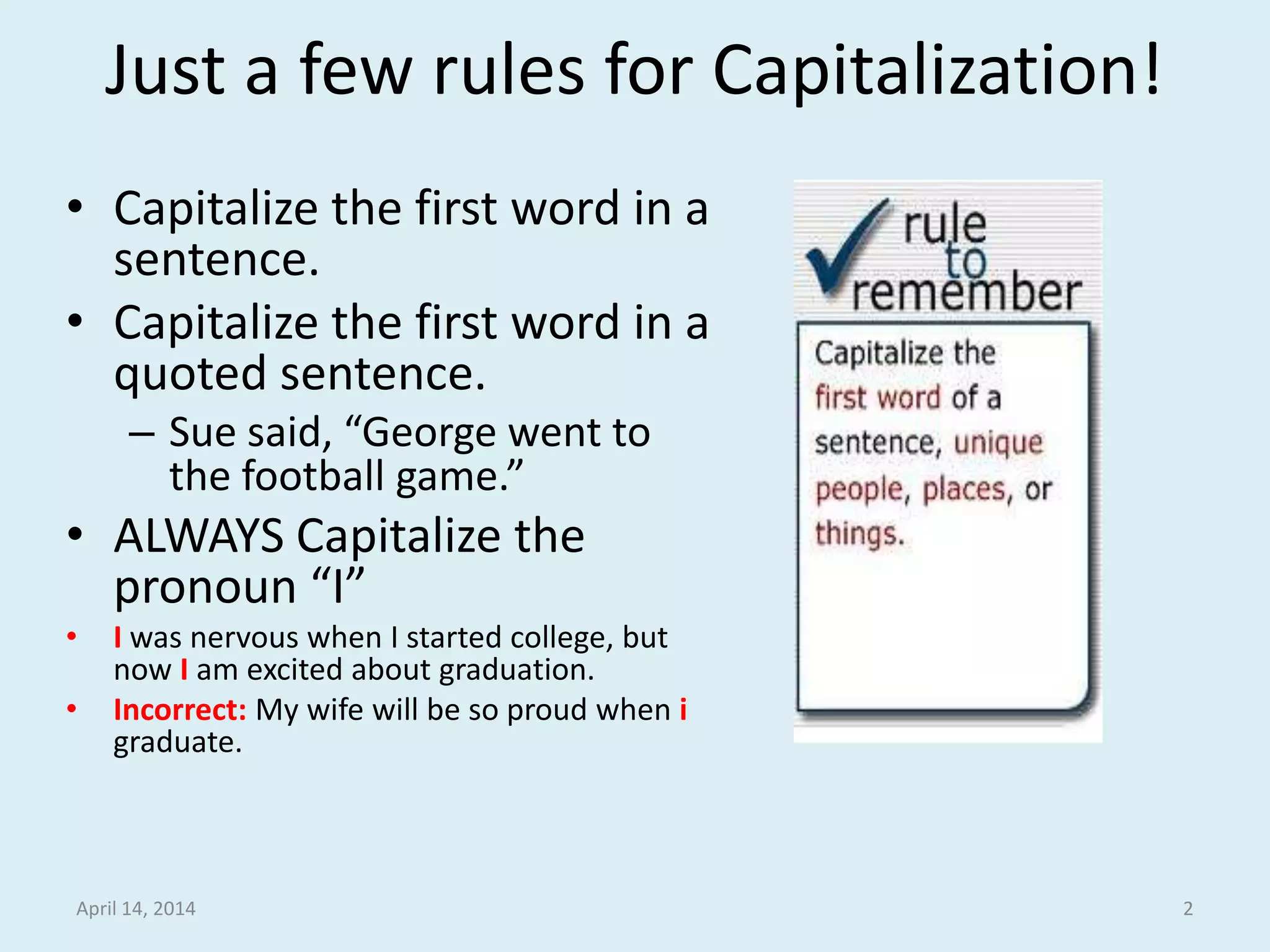
• Capitalize the first word in a
sentence.
• Capitalize the first word in a
quoted sentence.
– Sue said, “George went to
the football game.”
• ALWAYS Capitalize the
pronoun “I”
• I was nervous when I started college, but
now I am excited about graduation.
• Incorrect: My wife will be so proud when i
graduate.
Just a few rules for Capitalization!
April 14, 2014 2
Swiss Alps
The Golden Gate Bridge
The Taj Majal
Venice
Paris
McDonalds
Bill
Cristo Redentor
Proper Nouns
Capitalize the names of:
• People - Abraham Lincoln, Jerry Seinfeld, Tim Tebow, Jeremy Lin
• Places- Lincoln, Nebraska; Paris, New York,
• Landmarks – the Statue of Liberty, the Eiffel Tower, Central Park, the Golden Gate Bridge
• Businesses and brands – Nike, Coke, Banana Republic, Guess
• Languages – English, Spanish, Arabic
• Names of races, ethnic groups, and nationalities -Hispanic, African American,
Native American
• Adjectives using a country’s name – Chinese noodles,
American pie, Egyptian mummies, German cars, Italian food,
• Units of time – Saturday, Monday, December, February
• Holidays – Christmas, Thanksgiving, Independence Day,
• Do not capitalize seasons:
• fall summer spring winter
Capitalize Titles
• Capitalize major words in the titles (books, movies, articles,
journals…)
• Do not capitalize little words like articles (a, an, the), prepositions,
(in, on , at_ or conjunctions (and, but, so ) –Gone with the Wind
– Raiders of the Lost Arch
– Of Mice and Men
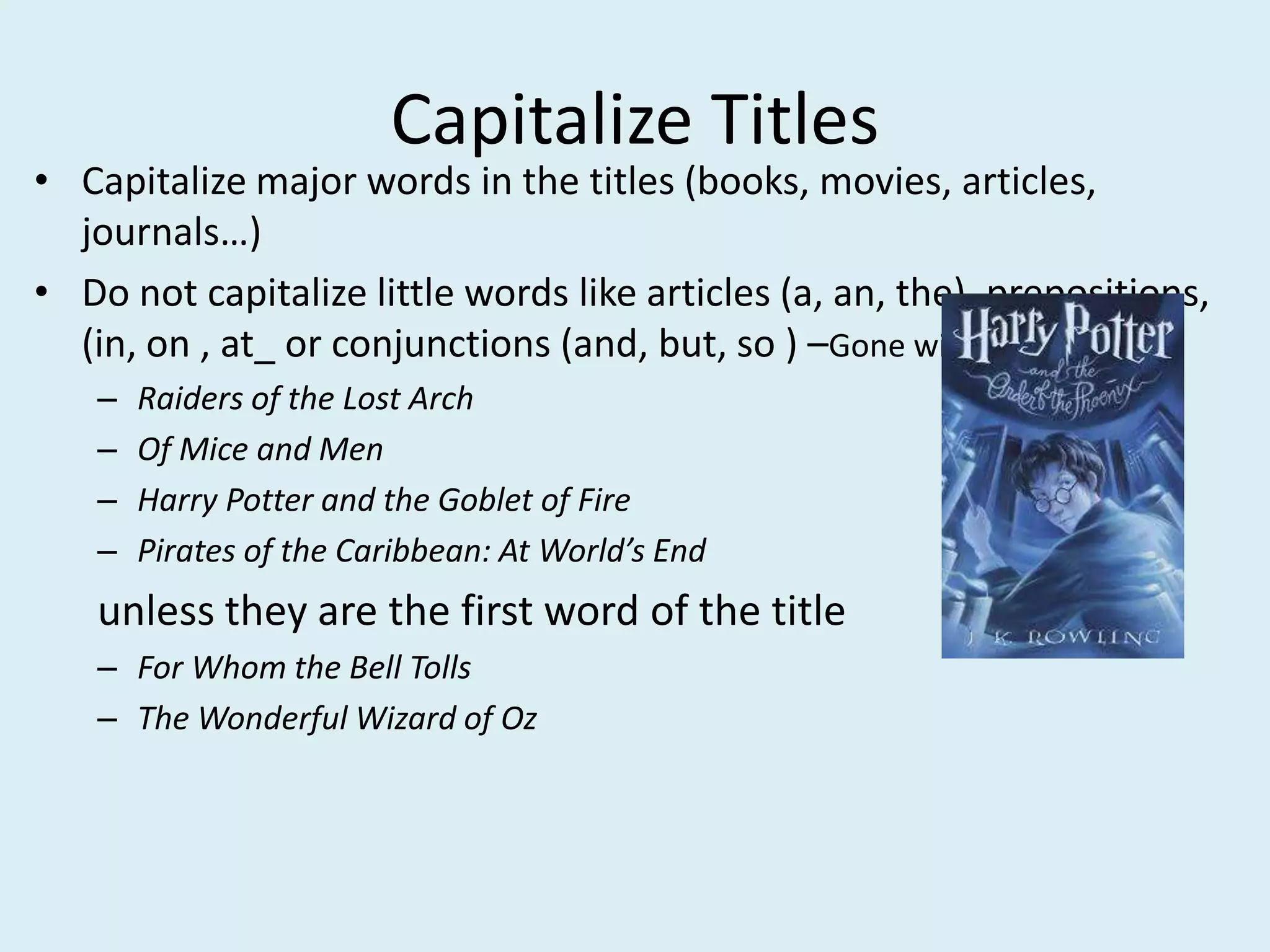
– Harry Potter and the Goblet of Fire
– Pirates of the Caribbean: At World’s End
unless they are the first word of the title
– For Whom the Bell Tolls
– The Wonderful Wizard of Oz
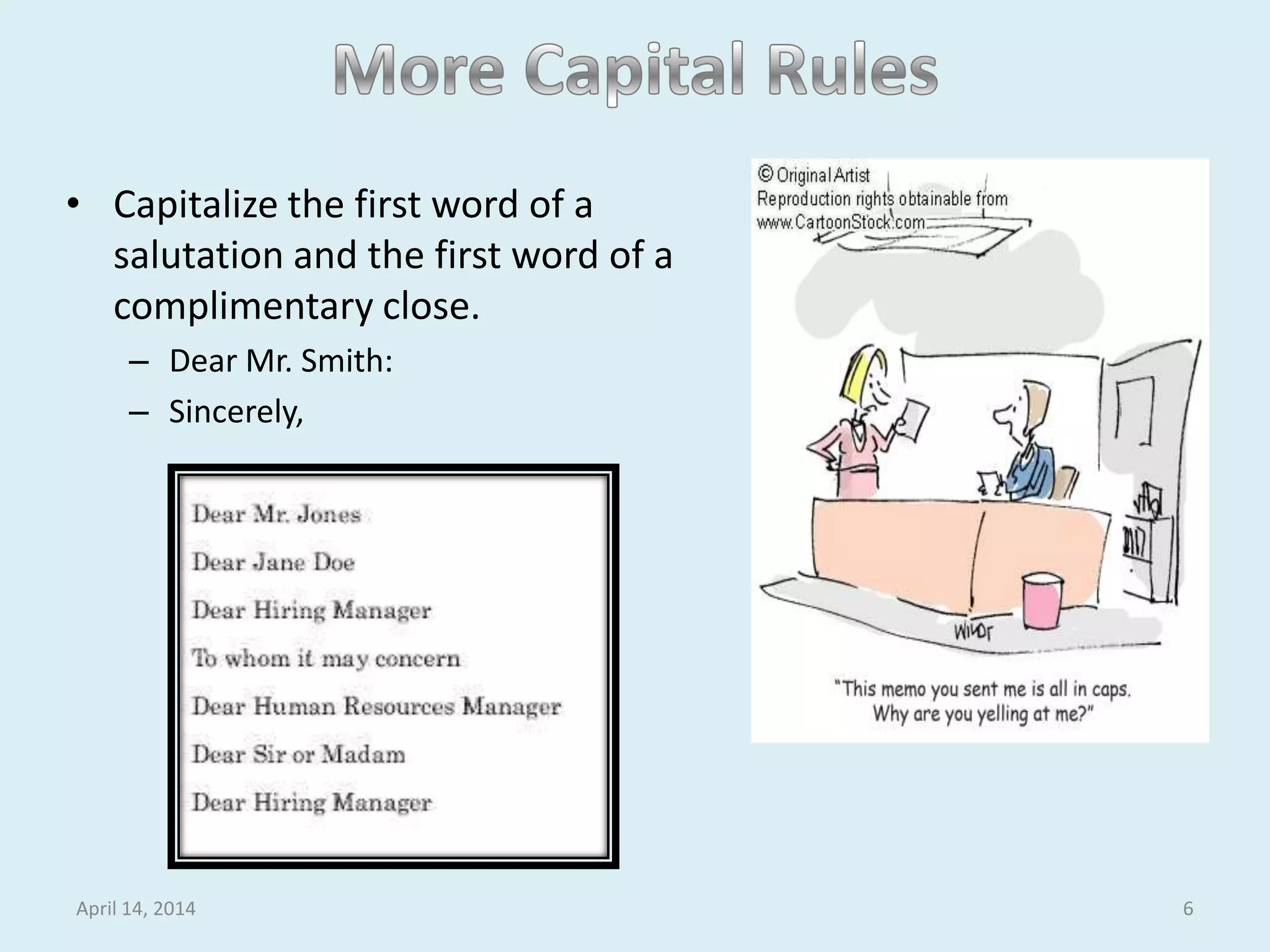
• Capitalize the first word of a
salutation and the first word of a
complimentary close.
– Dear Mr. Smith:
– Sincerely,
April 14, 2014 6
7
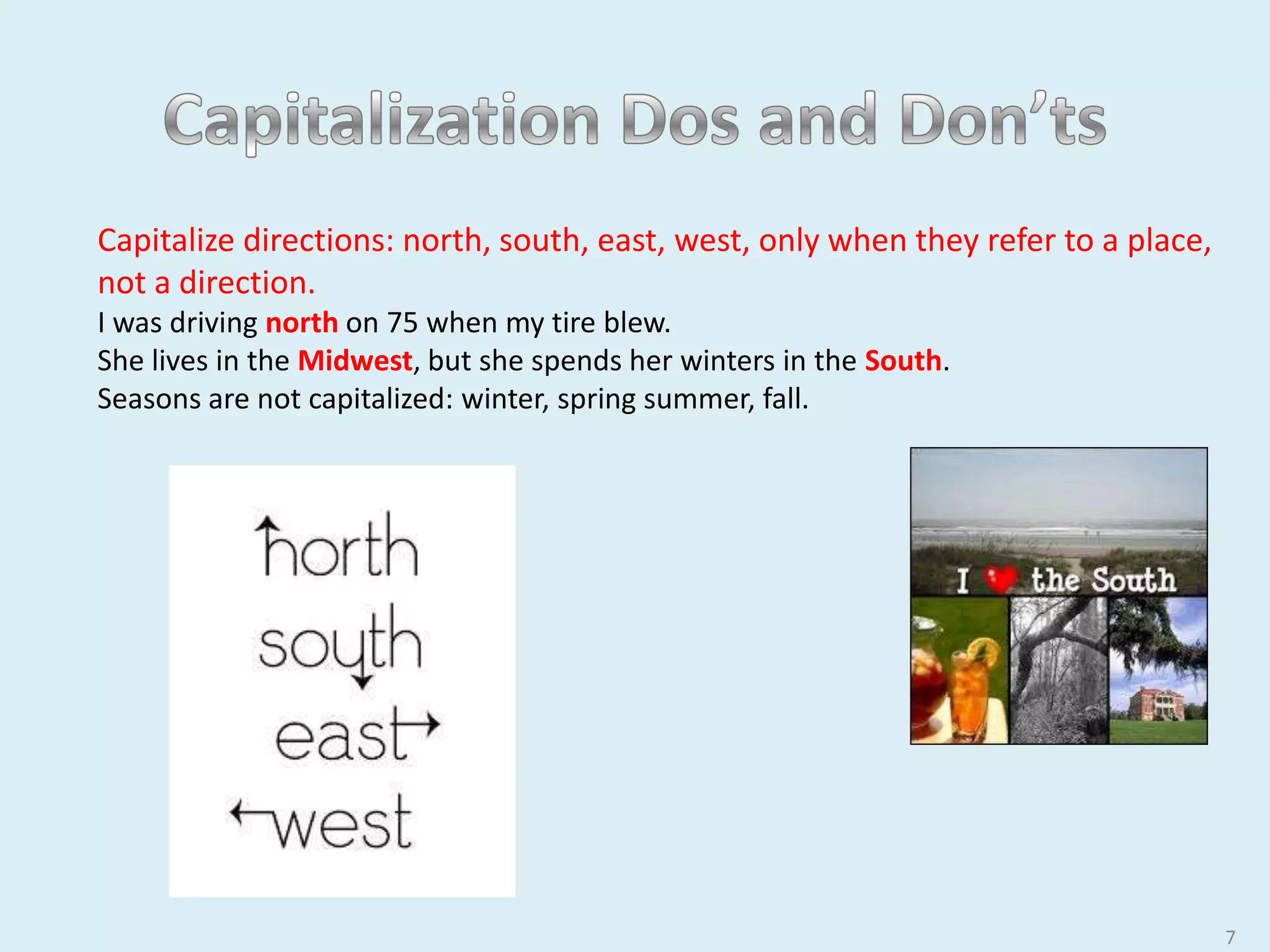
Capitalize directions: north, south, east, west, only when they refer to a place,
not a direction.
I was driving north on 75 when my tire blew.
She lives in the Midwest, but she spends her winters in the South.
Seasons are not capitalized: winter, spring summer, fall.
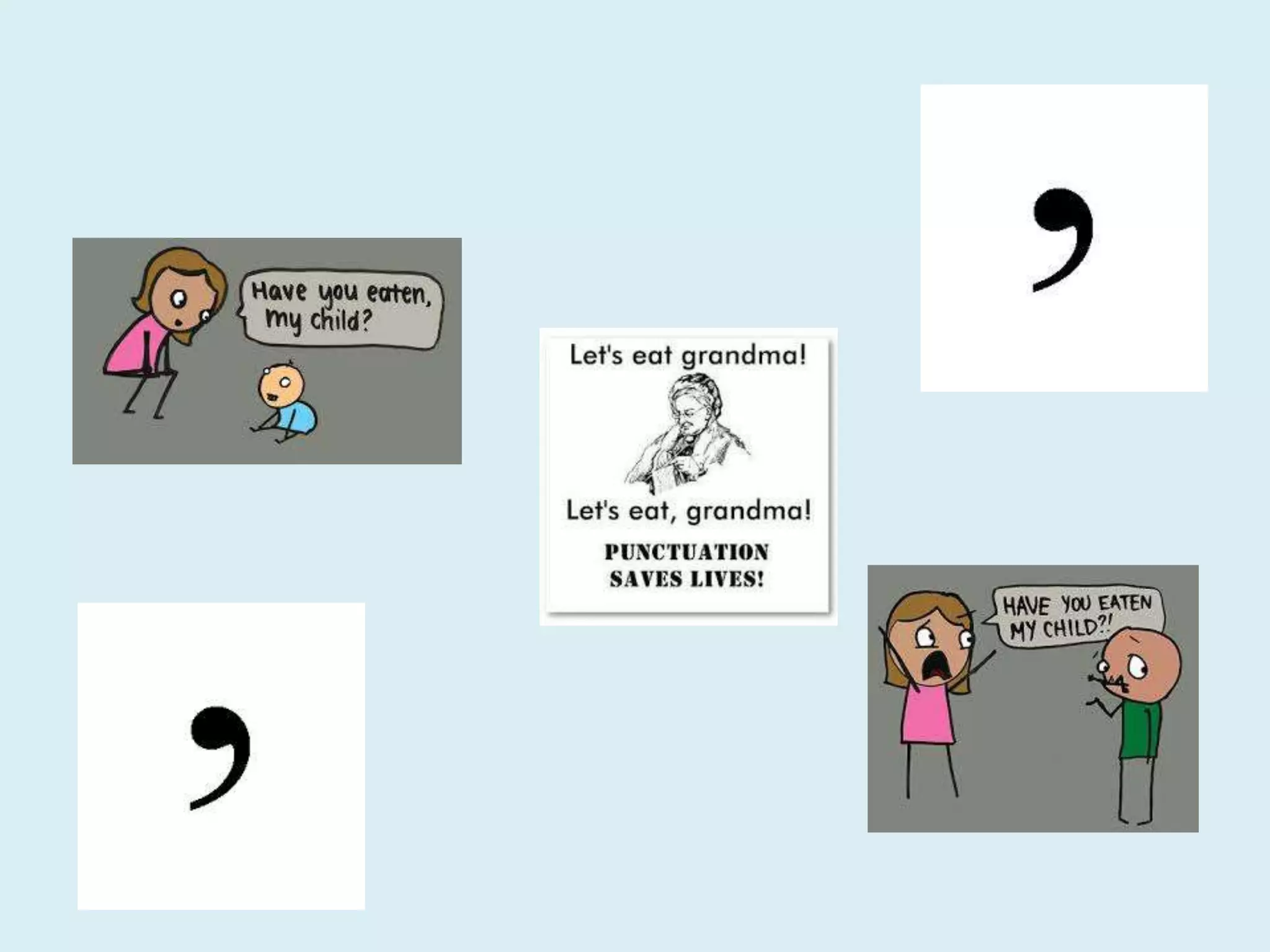
Comma
• A comma is used to mark off different
elements in a sentence.
• A comma helps the reader understand which
words go together.
• A comma indicates a pause.
Missing commas!
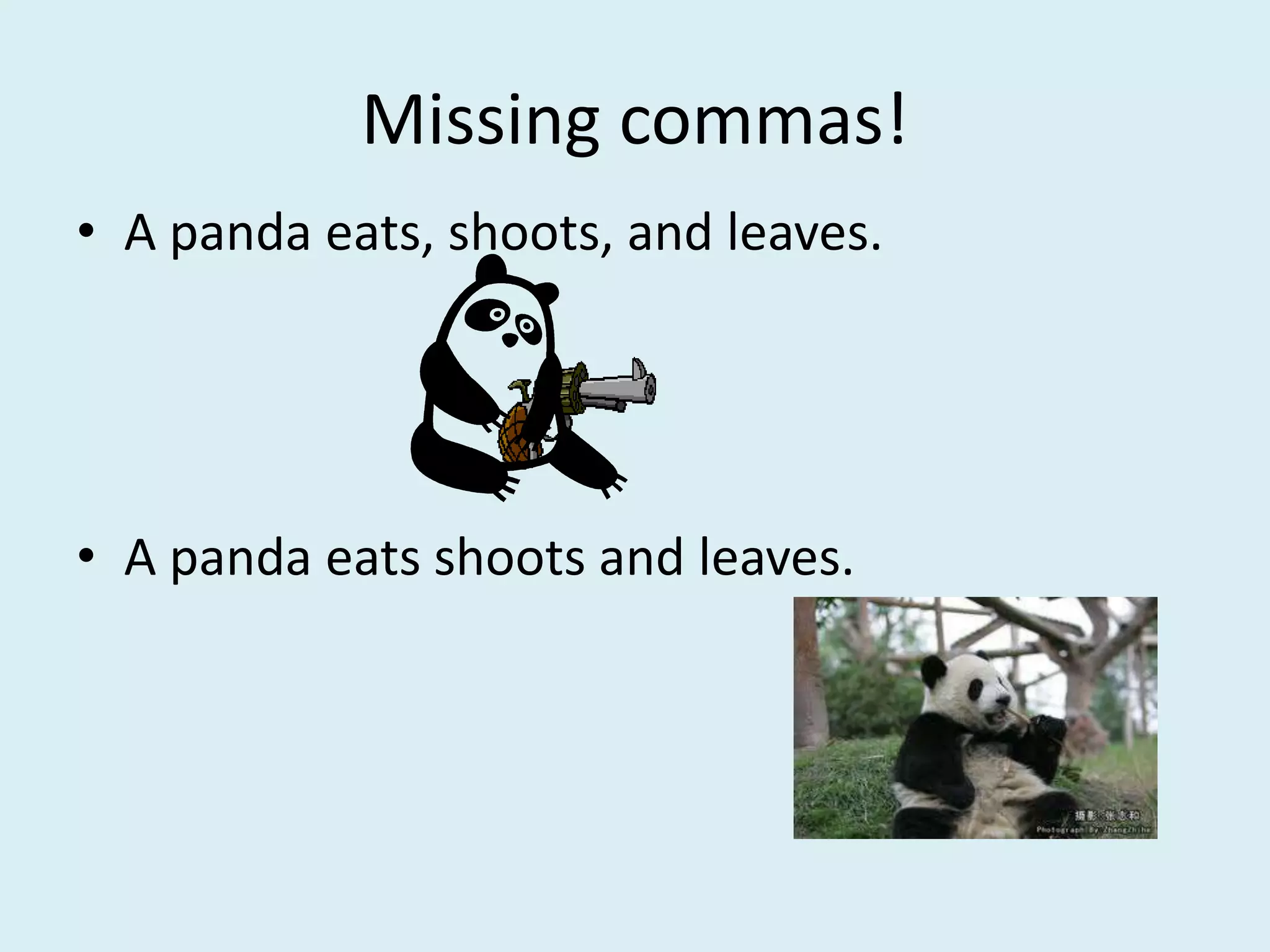
• A panda eats, shoots, and leaves.
• A panda eats shoots and leaves.
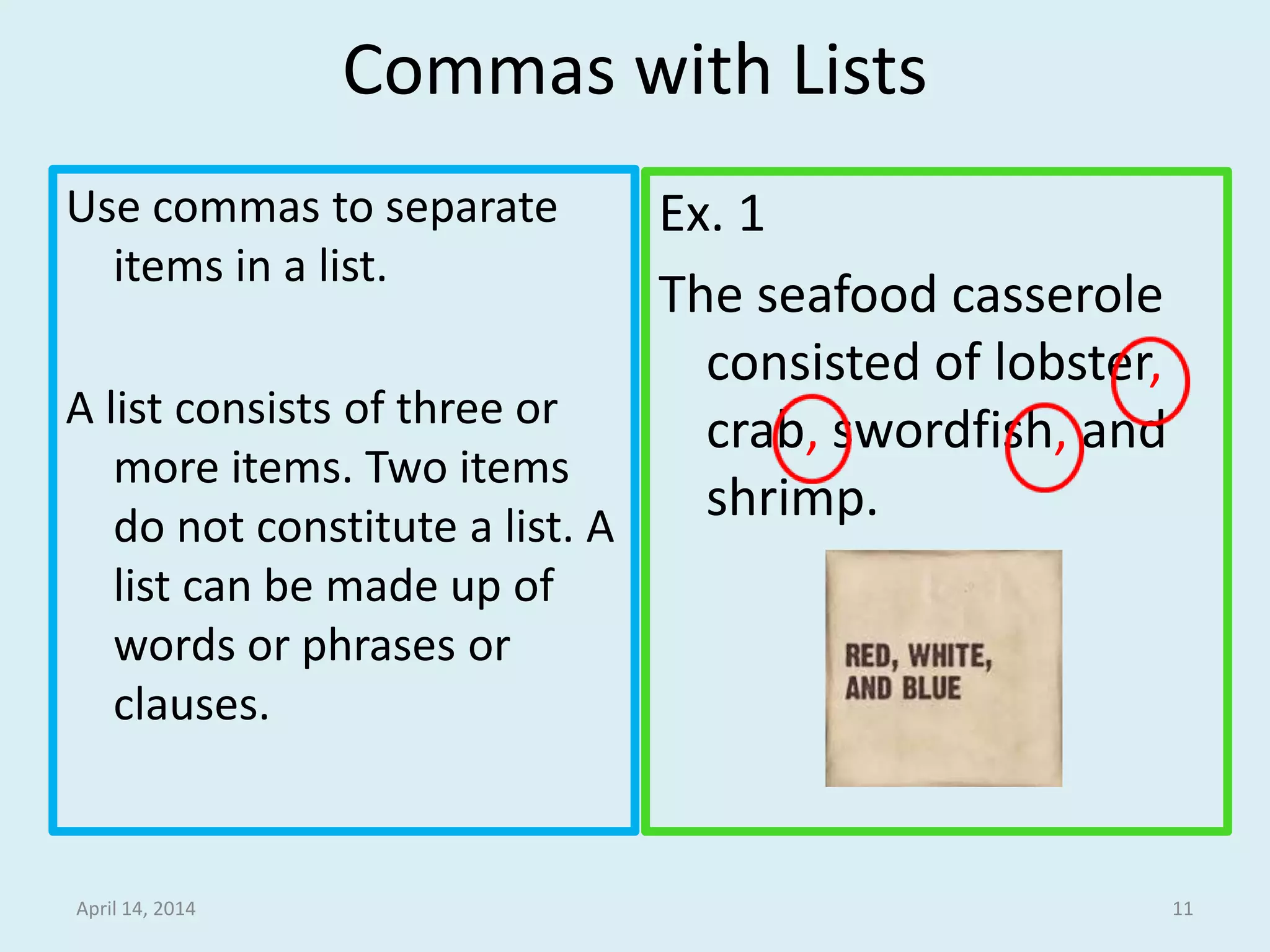
Commas with Lists
Use commas to separate
items in a list.
A list consists of three or
more items. Two items
do not constitute a list. A
list can be made up of
words or phrases or
clauses.
Ex. 1
The seafood casserole
consisted of lobster,
crab, swordfish, and
shrimp.
April 14, 2014 11
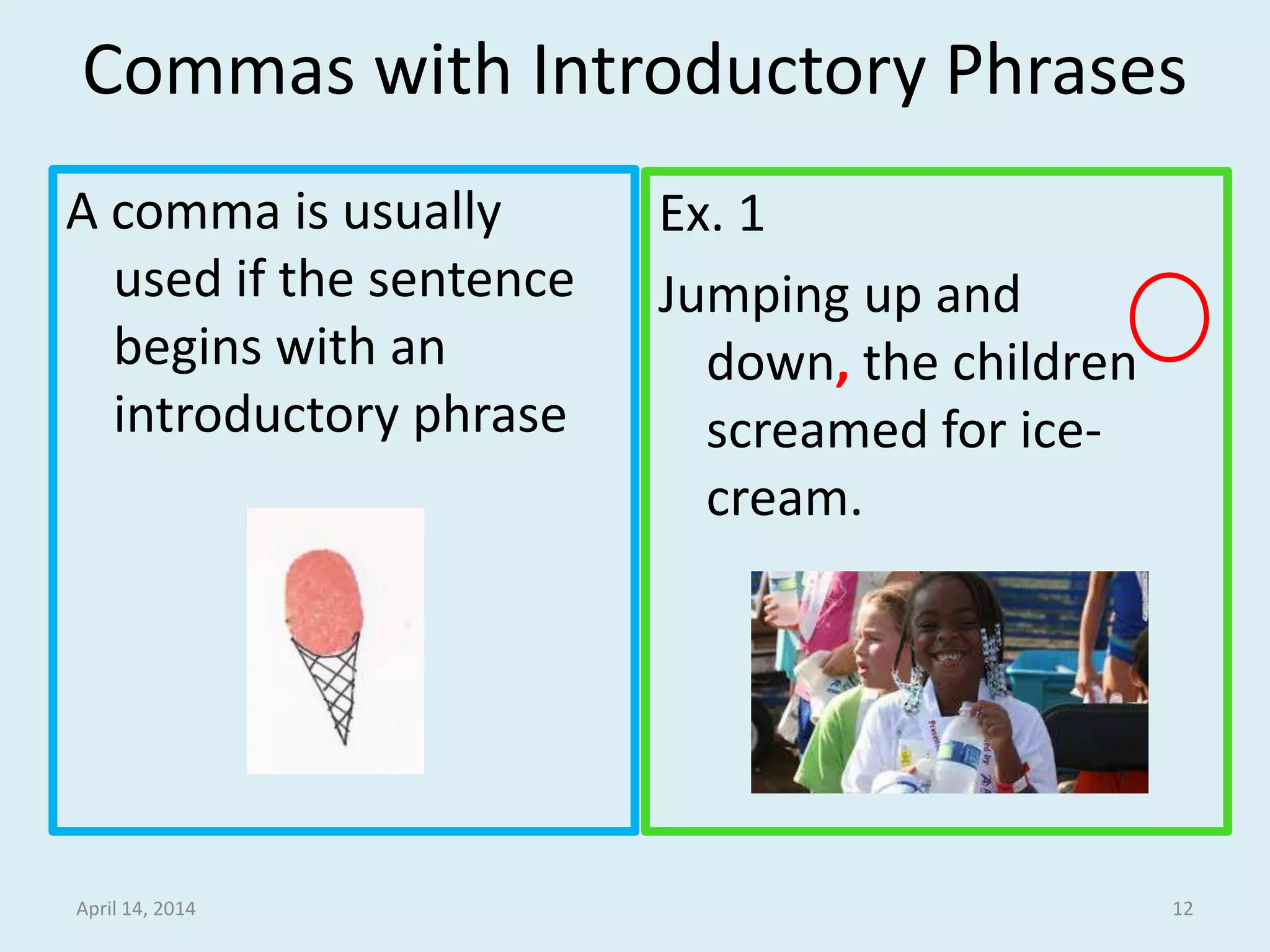
Commas with Introductory Phrases
A comma is usually
used if the sentence
begins with an
introductory phrase
Ex. 1
Jumping up and
down, the children
screamed for ice-
cream.
April 14, 2014 12
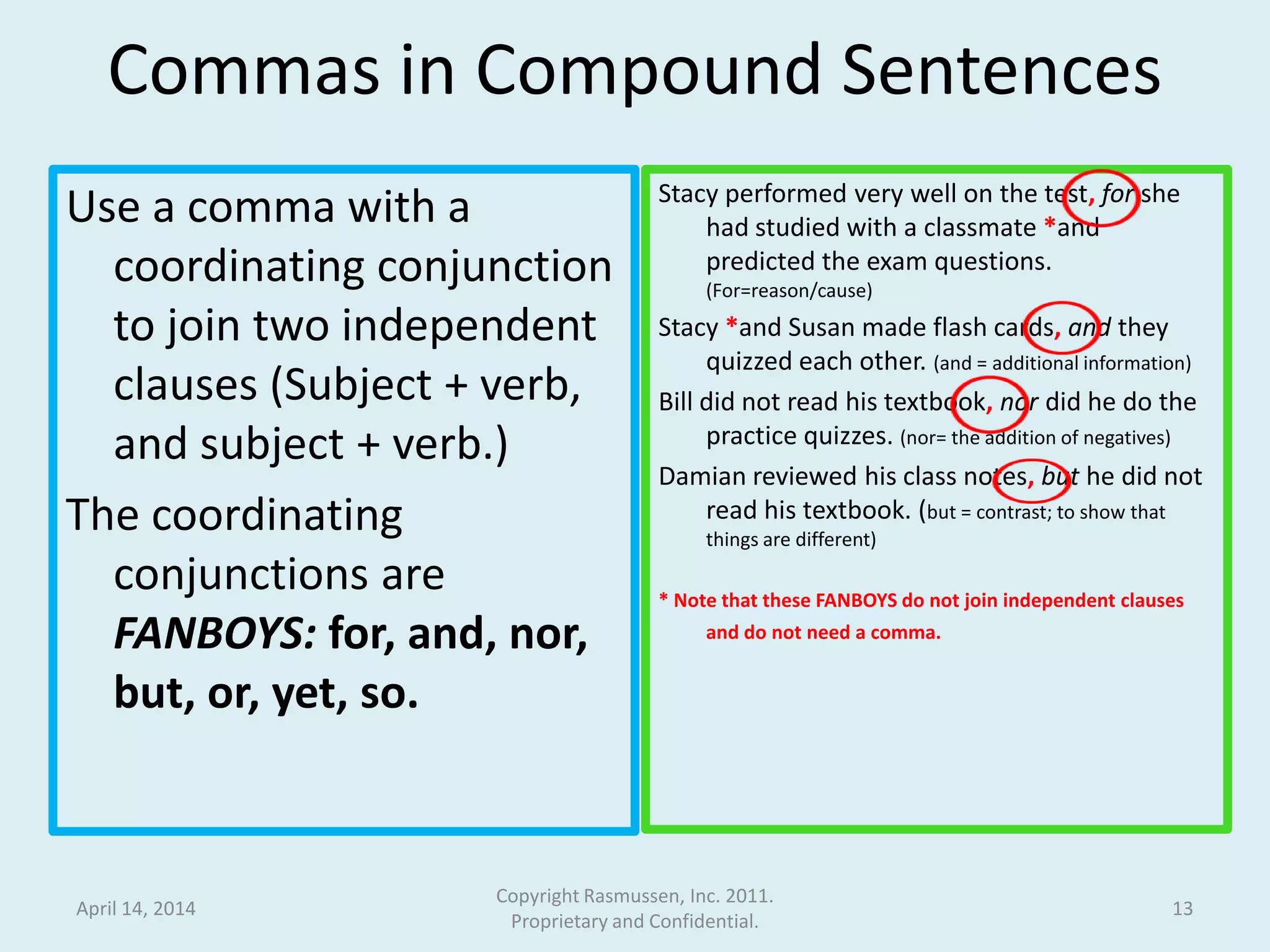
Commas in Compound Sentences
Use a comma with a
coordinating conjunction
to join two independent
clauses (Subject + verb,
and subject + verb.)
The coordinating
conjunctions are
FANBOYS: for, and, nor,
but, or, yet, so.
Stacy performed very well on the test, for she
had studied with a classmate *and
predicted the exam questions.
(For=reason/cause)
Stacy *and Susan made flash cards, and they
quizzed each other. (and = additional information)
Bill did not read his textbook, nor did he do the
practice quizzes. (nor= the addition of negatives)
Damian reviewed his class notes, but he did not
read his textbook. (but = contrast; to show that
things are different)
* Note that these FANBOYS do not join independent clauses
and do not need a comma.
April 14, 2014
Copyright Rasmussen, Inc. 2011.
Proprietary and Confidential.
13
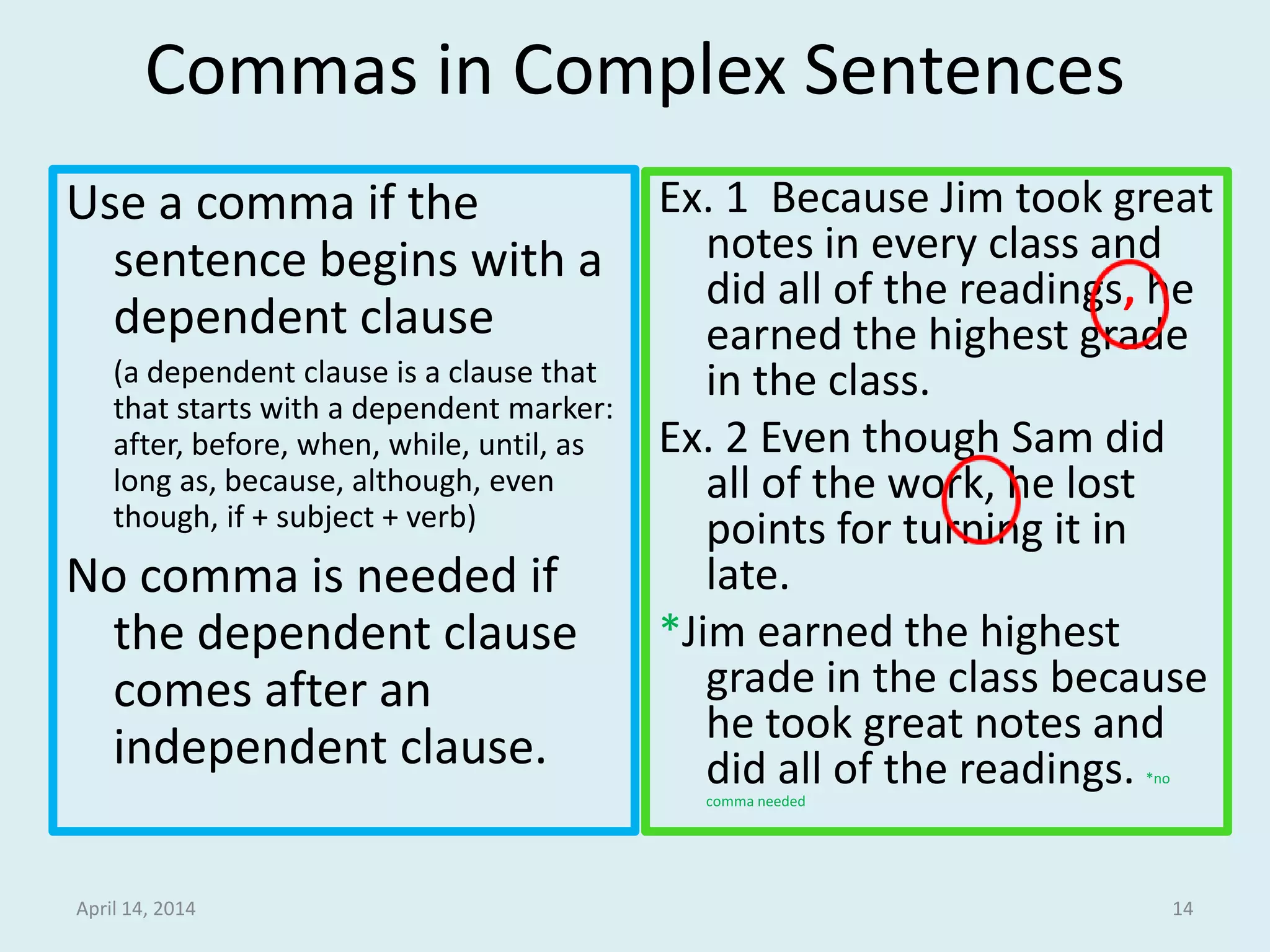
Commas in Complex Sentences
Use a comma if the
sentence begins with a
dependent clause
(a dependent clause is a clause that
that starts with a dependent marker:
after, before, when, while, until, as
long as, because, although, even
though, if + subject + verb)
No comma is needed if
the dependent clause
comes after an
independent clause.
Ex. 1 Because Jim took great
notes in every class and
did all of the readings, he
earned the highest grade
in the class.
Ex. 2 Even though Sam did
all of the work, he lost
points for turning it in
late.
*Jim earned the highest
grade in the class because
he took great notes and
did all of the readings. *no
comma needed
April 14, 2014 14
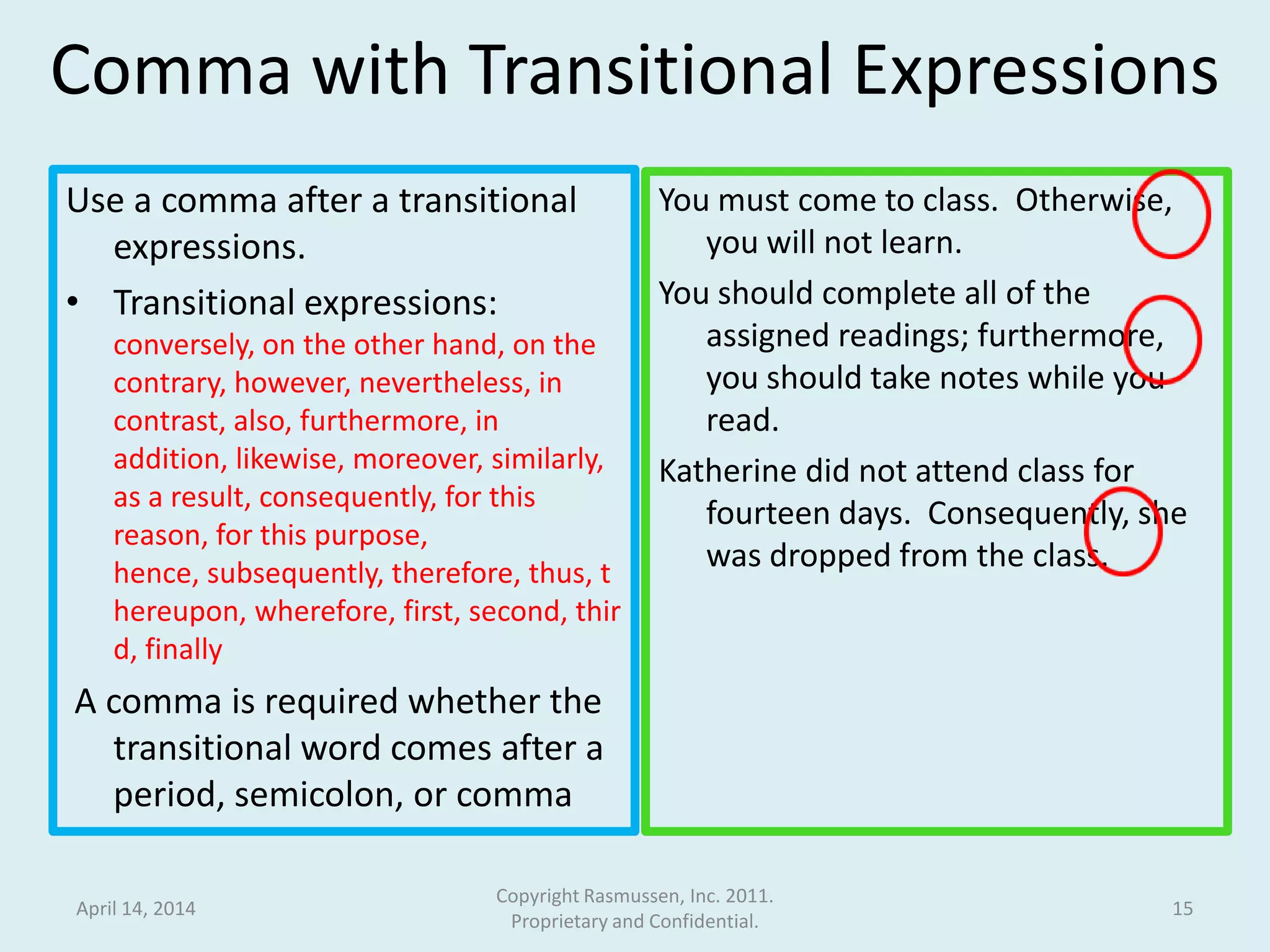
Comma with Transitional Expressions
Use a comma after a transitional
expressions.
• Transitional expressions:
conversely, on the other hand, on the
contrary, however, nevertheless, in
contrast, also, furthermore, in
addition, likewise, moreover, similarly,
as a result, consequently, for this
reason, for this purpose,
hence, subsequently, therefore, thus, t
hereupon, wherefore, first, second, thir
d, finally
A comma is required whether the
transitional word comes after a
period, semicolon, or comma
You must come to class. Otherwise,
you will not learn.
You should complete all of the
assigned readings; furthermore,
you should take notes while you
read.
Katherine did not attend class for
fourteen days. Consequently, she
was dropped from the class.
April 14, 2014
Copyright Rasmussen, Inc. 2011.
Proprietary and Confidential.
15
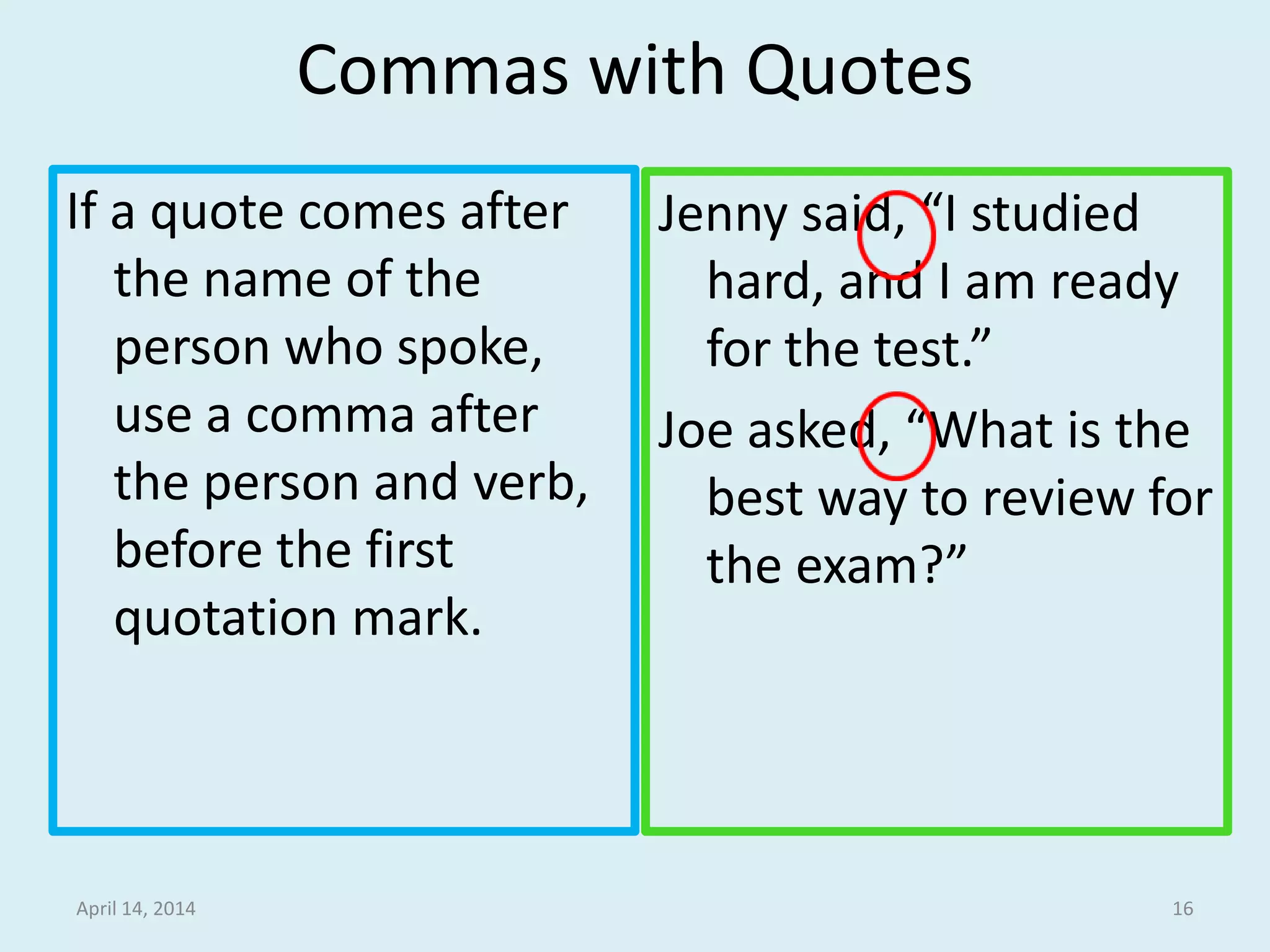
Commas with Quotes
If a quote comes after
the name of the
person who spoke,
use a comma after
the person and verb,
before the first
quotation mark.
Jenny said, “I studied
hard, and I am ready
for the test.”
Joe asked, “What is the
best way to review for
the exam?”
April 14, 2014 16
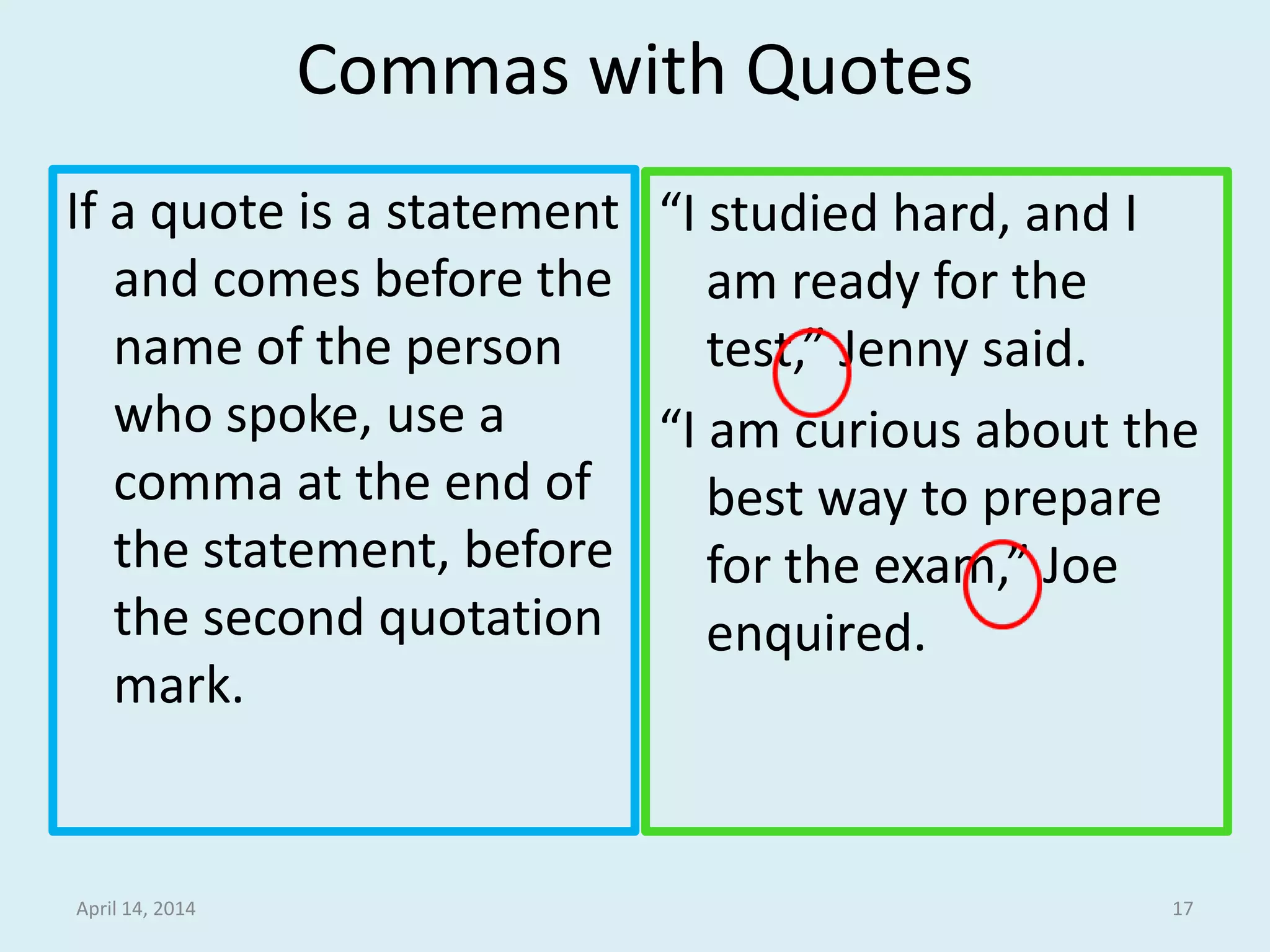
Commas with Quotes
If a quote is a statement
and comes before the
name of the person
who spoke, use a
comma at the end of
the statement, before
the second quotation
mark.
“I studied hard, and I
am ready for the
test,” Jenny said.
“I am curious about the
best way to prepare
for the exam,” Joe
enquired.
April 14, 2014 17
Commas with Interrupters
• Extra information
• Non-essential clauses
• Appositives
• Direct address
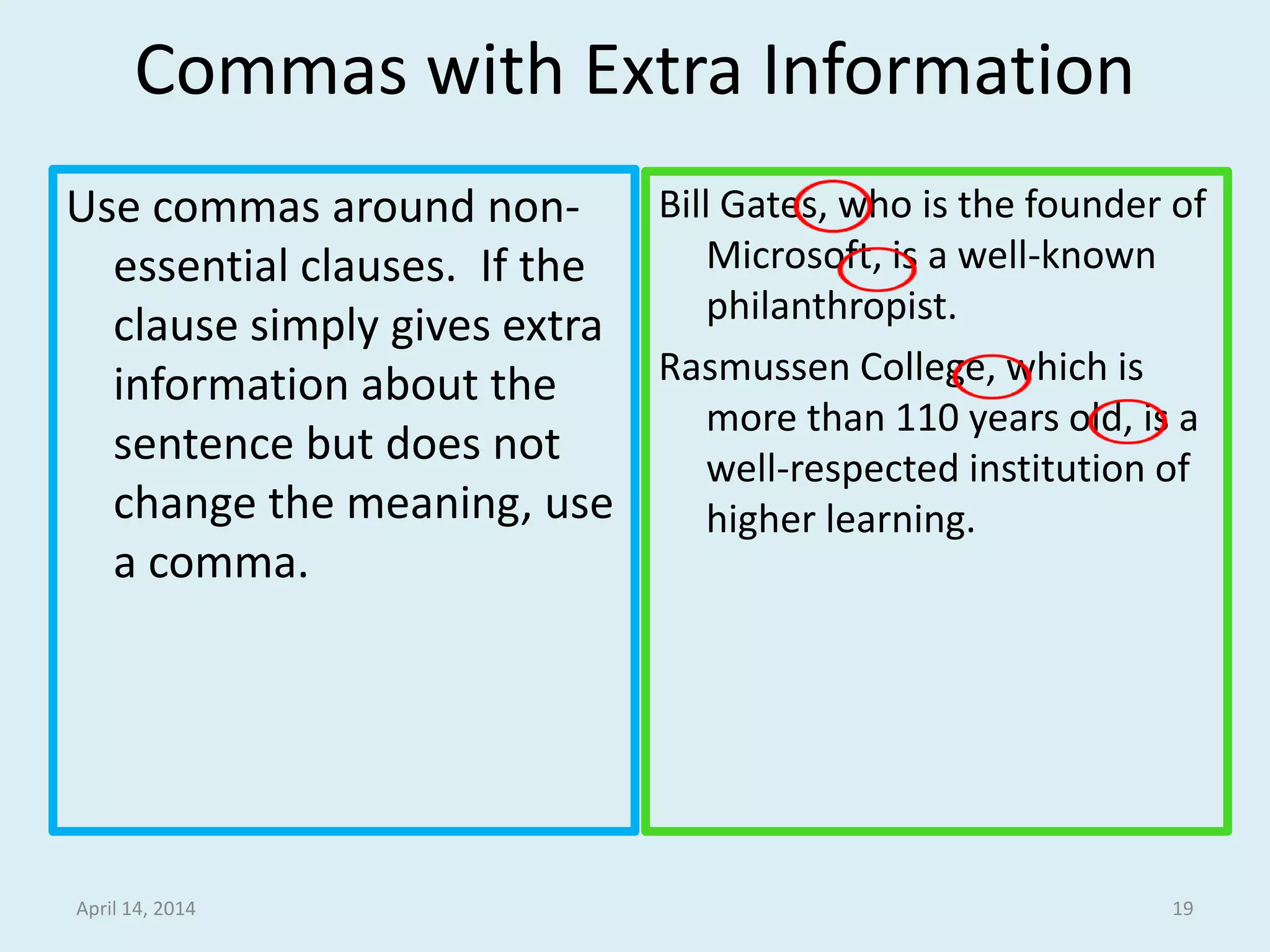
Commas with Extra Information
Use commas around non-
essential clauses. If the
clause simply gives extra
information about the
sentence but does not
change the meaning, use
a comma.
Bill Gates, who is the founder of
Microsoft, is a well-known
philanthropist.
Rasmussen College, which is
more than 110 years old, is a
well-respected institution of
higher learning.
April 14, 2014 19
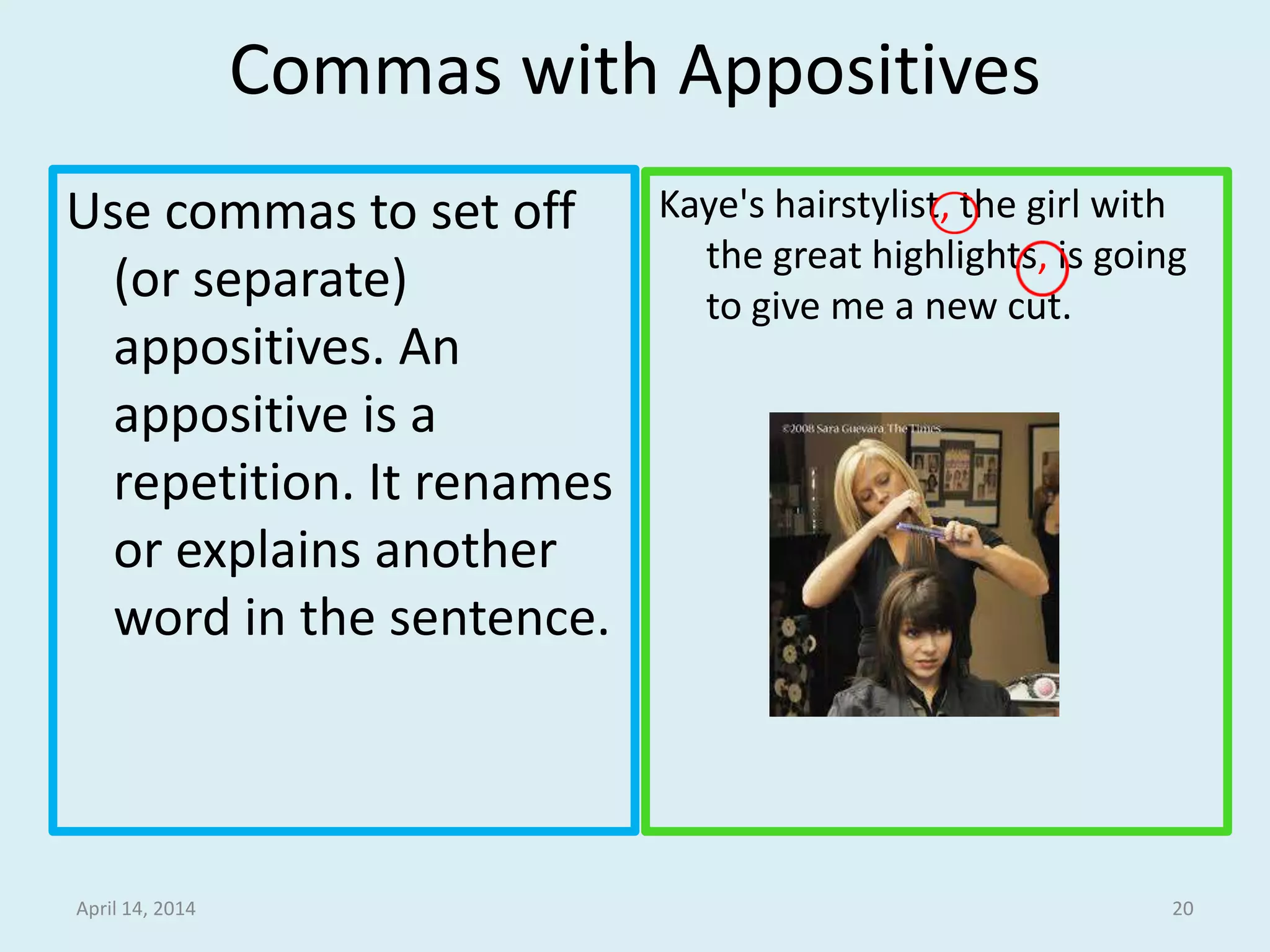
Commas with Appositives
Use commas to set off
(or separate)
appositives. An
appositive is a
repetition. It renames
or explains another
word in the sentence.
Kaye's hairstylist, the girl with
the great highlights, is going
to give me a new cut.
April 14, 2014 20
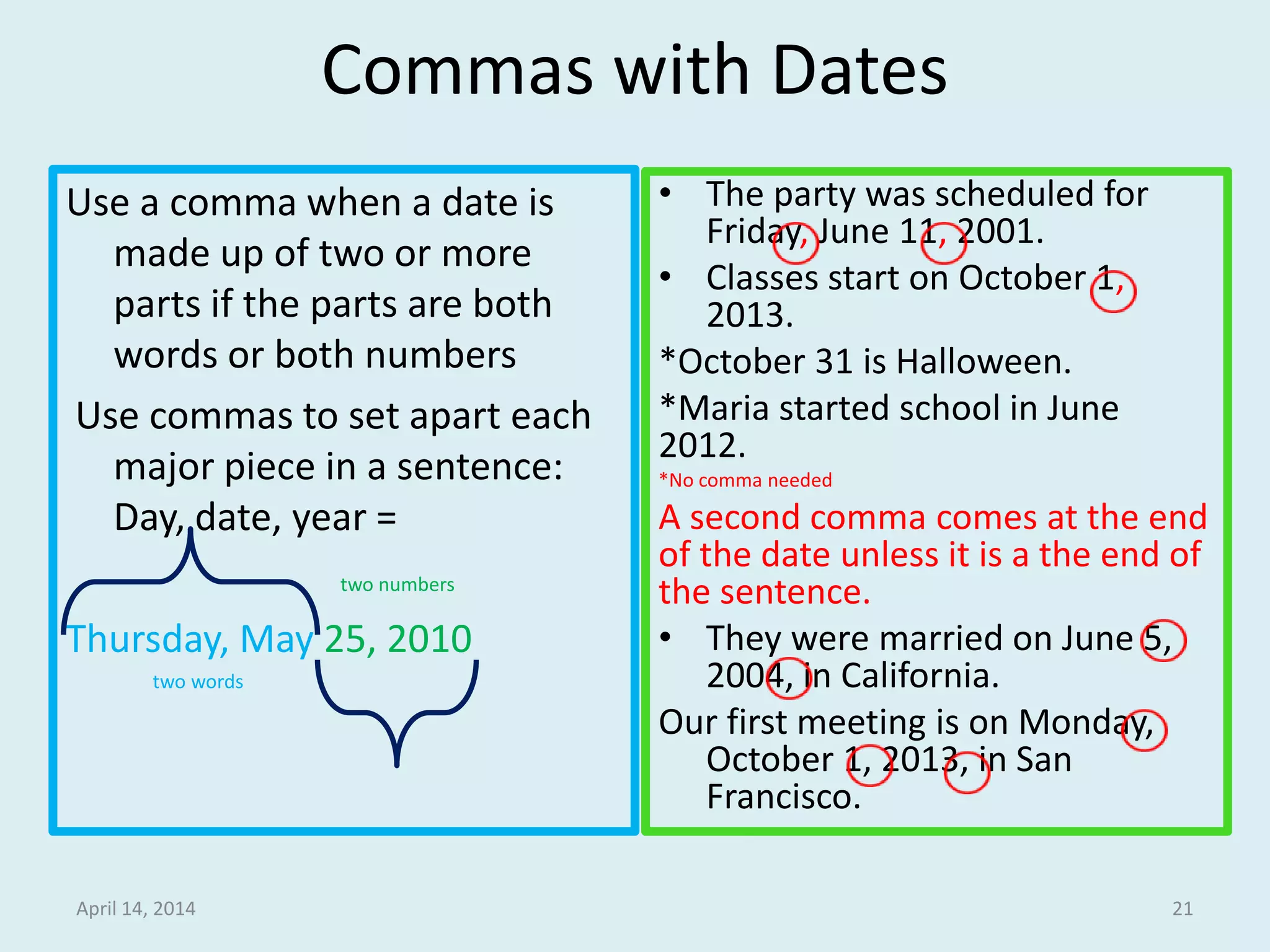
Commas with Dates
Use a comma when a date is
made up of two or more
parts if the parts are both
words or both numbers
Use commas to set apart each
major piece in a sentence:
Day, date, year =
two numbers
Thursday, May 25, 2010
two words
• The party was scheduled for
Friday, June 11, 2001.
• Classes start on October 1,
2013.
*October 31 is Halloween.
*Maria started school in June
2012.
*No comma needed
A second comma comes at the end
of the date unless it is a the end of
the sentence.
• They were married on June 5,
2004, in California.
Our first meeting is on Monday,
October 1, 2013, in San
Francisco.
April 14, 2014 21
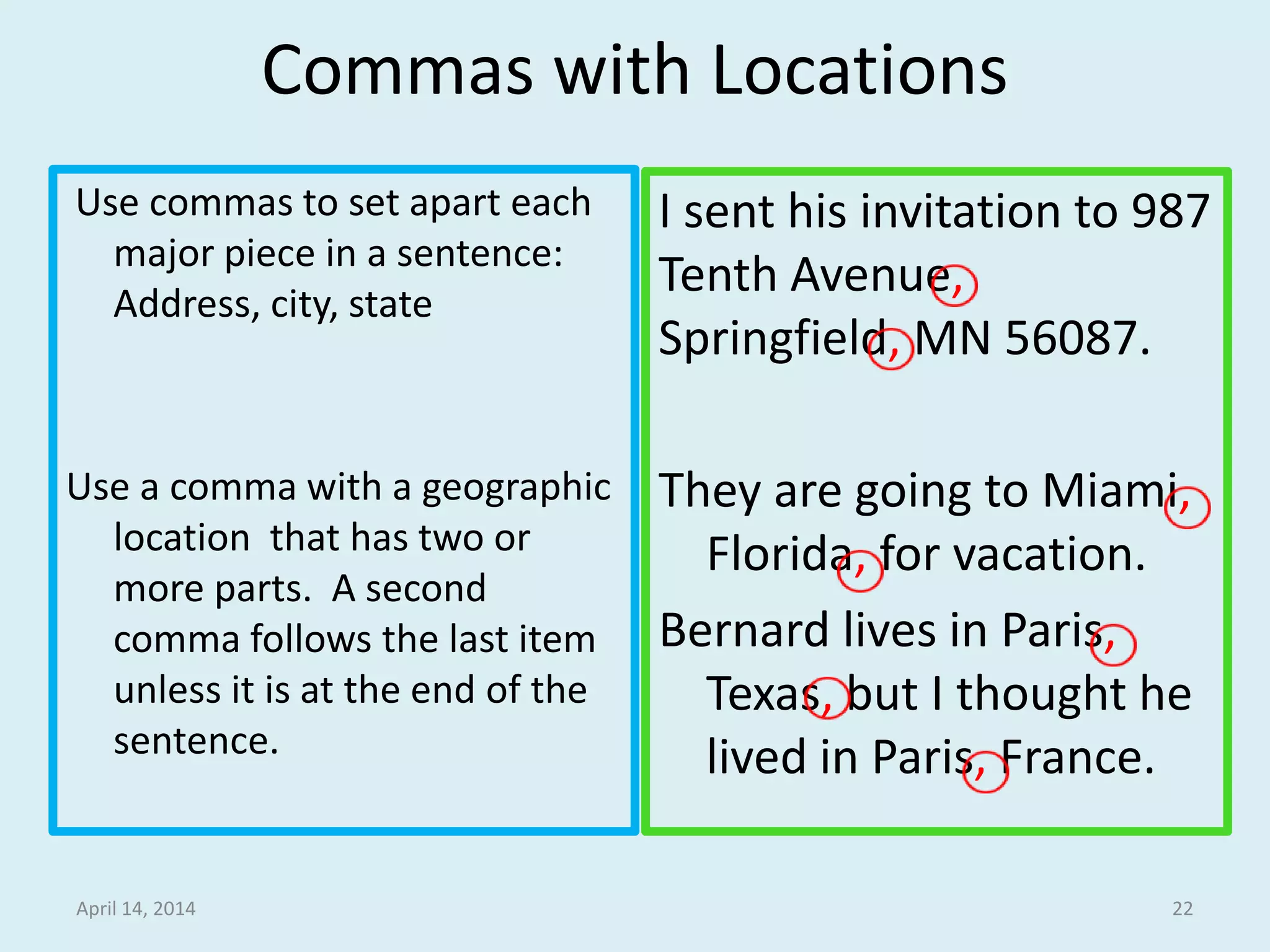
Commas with Locations
Use commas to set apart each
major piece in a sentence:
Address, city, state
Use a comma with a geographic
location that has two or
more parts. A second
comma follows the last item
unless it is at the end of the
sentence.
I sent his invitation to 987
Tenth Avenue,
Springfield, MN 56087.
They are going to Miami,
Florida, for vacation.
Bernard lives in Paris,
Texas, but I thought he
lived in Paris, France.
April 14, 2014 22
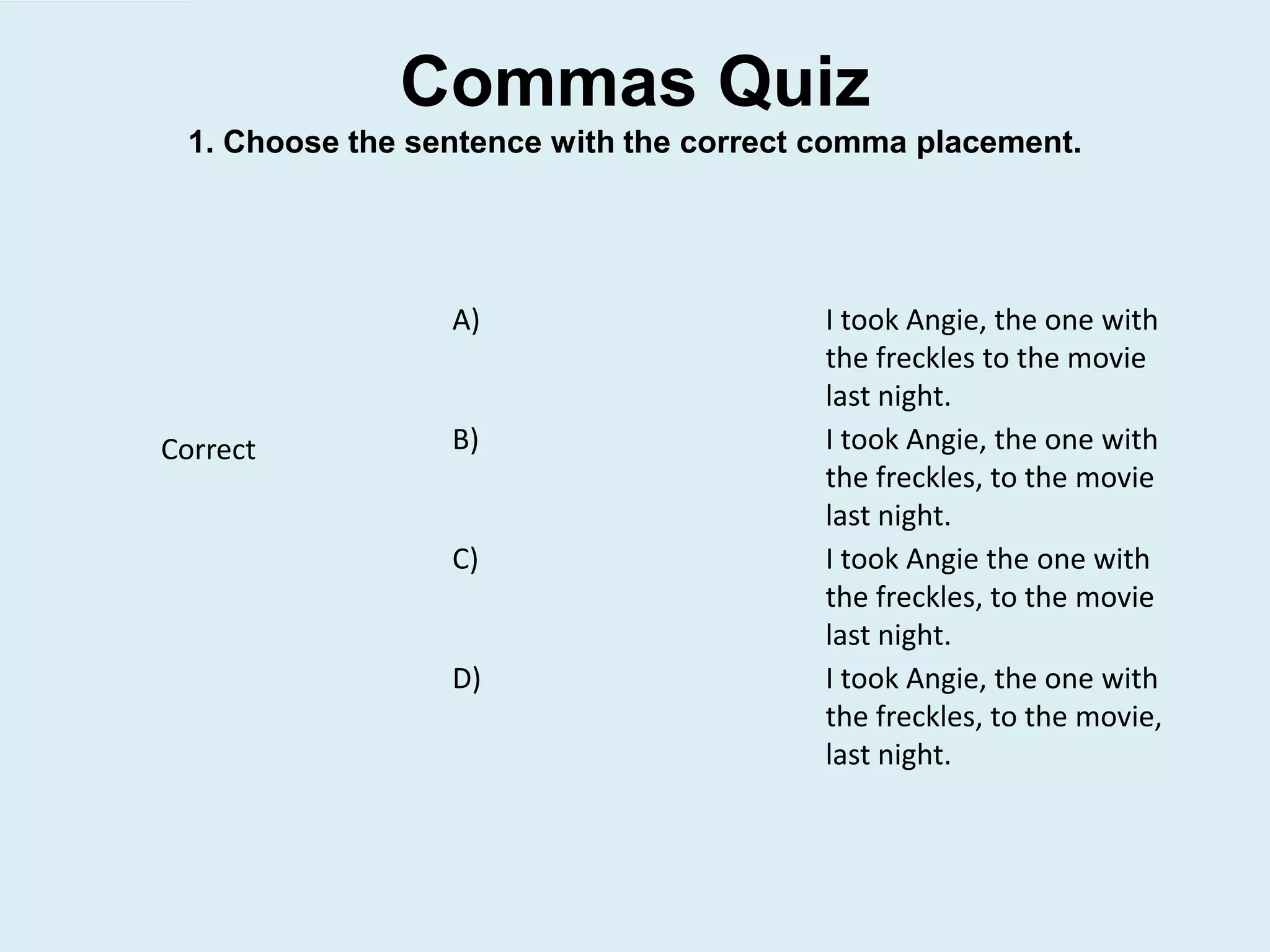
Commas Quiz
1. Choose the sentence with the correct comma placement.
A) I took Angie, the one with
the freckles to the movie
last night.
B) I took Angie, the one with
the freckles, to the movie
last night.
C) I took Angie the one with
the freckles, to the movie
last night.
D) I took Angie, the one with
the freckles, to the movie,
last night.
Correct

Punctuation and Mechanics

  • 1.
  • 2.
    • Capitalize thefirst word in a sentence. • Capitalize the first word in a quoted sentence. – Sue said, “George went to the football game.” • ALWAYS Capitalize the pronoun “I” • I was nervous when I started college, but now I am excited about graduation. • Incorrect: My wife will be so proud when i graduate. Just a few rules for Capitalization! April 14, 2014 2
  • 3.
    Swiss Alps The GoldenGate Bridge The Taj Majal Venice Paris McDonalds Bill Cristo Redentor
  • 4.
    Proper Nouns Capitalize thenames of: • People - Abraham Lincoln, Jerry Seinfeld, Tim Tebow, Jeremy Lin • Places- Lincoln, Nebraska; Paris, New York, • Landmarks – the Statue of Liberty, the Eiffel Tower, Central Park, the Golden Gate Bridge • Businesses and brands – Nike, Coke, Banana Republic, Guess • Languages – English, Spanish, Arabic • Names of races, ethnic groups, and nationalities -Hispanic, African American, Native American • Adjectives using a country’s name – Chinese noodles, American pie, Egyptian mummies, German cars, Italian food, • Units of time – Saturday, Monday, December, February • Holidays – Christmas, Thanksgiving, Independence Day, • Do not capitalize seasons: • fall summer spring winter
  • 5.
    Capitalize Titles • Capitalizemajor words in the titles (books, movies, articles, journals…) • Do not capitalize little words like articles (a, an, the), prepositions, (in, on , at_ or conjunctions (and, but, so ) –Gone with the Wind – Raiders of the Lost Arch – Of Mice and Men – Harry Potter and the Goblet of Fire – Pirates of the Caribbean: At World’s End unless they are the first word of the title – For Whom the Bell Tolls – The Wonderful Wizard of Oz
  • 6.
    • Capitalize thefirst word of a salutation and the first word of a complimentary close. – Dear Mr. Smith: – Sincerely, April 14, 2014 6
  • 7.
    7 Capitalize directions: north,south, east, west, only when they refer to a place, not a direction. I was driving north on 75 when my tire blew. She lives in the Midwest, but she spends her winters in the South. Seasons are not capitalized: winter, spring summer, fall.
  • 8.
    Comma • A commais used to mark off different elements in a sentence. • A comma helps the reader understand which words go together. • A comma indicates a pause.
  • 9.
    Missing commas! • Apanda eats, shoots, and leaves. • A panda eats shoots and leaves.
  • 11.
    Commas with Lists Usecommas to separate items in a list. A list consists of three or more items. Two items do not constitute a list. A list can be made up of words or phrases or clauses. Ex. 1 The seafood casserole consisted of lobster, crab, swordfish, and shrimp. April 14, 2014 11
  • 12.
    Commas with IntroductoryPhrases A comma is usually used if the sentence begins with an introductory phrase Ex. 1 Jumping up and down, the children screamed for ice- cream. April 14, 2014 12
  • 13.
    Commas in CompoundSentences Use a comma with a coordinating conjunction to join two independent clauses (Subject + verb, and subject + verb.) The coordinating conjunctions are FANBOYS: for, and, nor, but, or, yet, so. Stacy performed very well on the test, for she had studied with a classmate *and predicted the exam questions. (For=reason/cause) Stacy *and Susan made flash cards, and they quizzed each other. (and = additional information) Bill did not read his textbook, nor did he do the practice quizzes. (nor= the addition of negatives) Damian reviewed his class notes, but he did not read his textbook. (but = contrast; to show that things are different) * Note that these FANBOYS do not join independent clauses and do not need a comma. April 14, 2014 Copyright Rasmussen, Inc. 2011. Proprietary and Confidential. 13
  • 14.
    Commas in ComplexSentences Use a comma if the sentence begins with a dependent clause (a dependent clause is a clause that that starts with a dependent marker: after, before, when, while, until, as long as, because, although, even though, if + subject + verb) No comma is needed if the dependent clause comes after an independent clause. Ex. 1 Because Jim took great notes in every class and did all of the readings, he earned the highest grade in the class. Ex. 2 Even though Sam did all of the work, he lost points for turning it in late. *Jim earned the highest grade in the class because he took great notes and did all of the readings. *no comma needed April 14, 2014 14
  • 15.
    Comma with TransitionalExpressions Use a comma after a transitional expressions. • Transitional expressions: conversely, on the other hand, on the contrary, however, nevertheless, in contrast, also, furthermore, in addition, likewise, moreover, similarly, as a result, consequently, for this reason, for this purpose, hence, subsequently, therefore, thus, t hereupon, wherefore, first, second, thir d, finally A comma is required whether the transitional word comes after a period, semicolon, or comma You must come to class. Otherwise, you will not learn. You should complete all of the assigned readings; furthermore, you should take notes while you read. Katherine did not attend class for fourteen days. Consequently, she was dropped from the class. April 14, 2014 Copyright Rasmussen, Inc. 2011. Proprietary and Confidential. 15
  • 16.
    Commas with Quotes Ifa quote comes after the name of the person who spoke, use a comma after the person and verb, before the first quotation mark. Jenny said, “I studied hard, and I am ready for the test.” Joe asked, “What is the best way to review for the exam?” April 14, 2014 16
  • 17.
    Commas with Quotes Ifa quote is a statement and comes before the name of the person who spoke, use a comma at the end of the statement, before the second quotation mark. “I studied hard, and I am ready for the test,” Jenny said. “I am curious about the best way to prepare for the exam,” Joe enquired. April 14, 2014 17
  • 18.
    Commas with Interrupters •Extra information • Non-essential clauses • Appositives • Direct address
  • 19.
    Commas with ExtraInformation Use commas around non- essential clauses. If the clause simply gives extra information about the sentence but does not change the meaning, use a comma. Bill Gates, who is the founder of Microsoft, is a well-known philanthropist. Rasmussen College, which is more than 110 years old, is a well-respected institution of higher learning. April 14, 2014 19
  • 20.
    Commas with Appositives Usecommas to set off (or separate) appositives. An appositive is a repetition. It renames or explains another word in the sentence. Kaye's hairstylist, the girl with the great highlights, is going to give me a new cut. April 14, 2014 20
  • 21.
    Commas with Dates Usea comma when a date is made up of two or more parts if the parts are both words or both numbers Use commas to set apart each major piece in a sentence: Day, date, year = two numbers Thursday, May 25, 2010 two words • The party was scheduled for Friday, June 11, 2001. • Classes start on October 1, 2013. *October 31 is Halloween. *Maria started school in June 2012. *No comma needed A second comma comes at the end of the date unless it is a the end of the sentence. • They were married on June 5, 2004, in California. Our first meeting is on Monday, October 1, 2013, in San Francisco. April 14, 2014 21
  • 22.
    Commas with Locations Usecommas to set apart each major piece in a sentence: Address, city, state Use a comma with a geographic location that has two or more parts. A second comma follows the last item unless it is at the end of the sentence. I sent his invitation to 987 Tenth Avenue, Springfield, MN 56087. They are going to Miami, Florida, for vacation. Bernard lives in Paris, Texas, but I thought he lived in Paris, France. April 14, 2014 22
  • 23.
    Commas Quiz 1. Choosethe sentence with the correct comma placement. A) I took Angie, the one with the freckles to the movie last night. B) I took Angie, the one with the freckles, to the movie last night. C) I took Angie the one with the freckles, to the movie last night. D) I took Angie, the one with the freckles, to the movie, last night. Correct