Pronouns
Pronoun Rules
Subjects
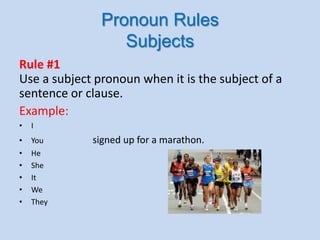
Rule #1
Use a subject pronoun when it is the subject of a
sentence or clause.
Example:
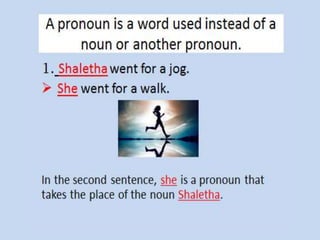
• I
• You signed up for a marathon.
• He
• She
• It
• We
• They
Pronoun Rules
Object Pronouns
Rule #2
When the pronoun takes the
place of a noun in the object
position, use an object
pronoun.
Common mistake: Janice
invited Jamal and I to the
party.
Correct: Janice invited Jamal
and me to the party.
The party surprised_______.
Singular
• me
• you
• him, her, it
Plural
• us
• you
• them
Object Pronouns
When the pronoun takes the
place of a noun in the object
position, use an object
pronoun:
• me
• you
• him
• her
• it
• us
• them
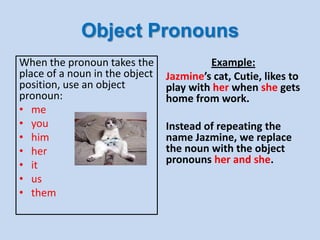
Example:
Jazmine’s cat, Cutie, likes to
play with her when she gets
home from work.
Instead of repeating the
name Jazmine, we replace
the noun with the object
pronouns her and she.
Pronoun Rules Object Pronouns
Rule #3
Use the object pronoun when it is the object of a
preposition.
• The party was for_______.
Singular
• me
• you
• him, her, it
Plural
• us
• you
• them
Possessive Pronouns
Rule #4 A possessive pronoun takes the place of
a noun and tells us who the noun belongs to.
• The sundae is______.
Singular Plural
my, mine our, ours
your, yours your, yours
his, her, hers their, theirs
* Never use an apostrophe with a possessive
pronoun.
Pronouns as Possessive
Adjectives
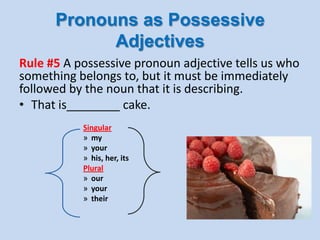
Rule #5 A possessive pronoun adjective tells us who
something belongs to, but it must be immediately
followed by the noun that it is describing.
• That is________ cake.
Singular
» my
» your
» his, her, its
Plural
» our
» your
» their
Pronoun –Antecedent
Agreement
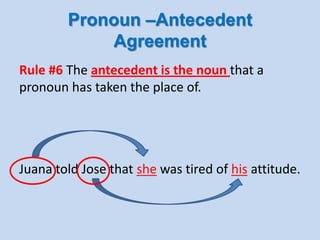
Rule #6 The antecedent is the noun that a
pronoun has taken the place of.
Juana told Jose that she was tired of his attitude.
Practice
1. A student can receive feedback on (his or her, their)
papers in the online writing lab.
– The singular antecedent student must agree with the
singular pronoun his or her.
2. When people train for a marathon, (you, they)
should not run every day.
– The plural antecedent people must agree with the plural
pronoun they.
Tricky Antecedents: Indefinite pronouns
everyone, everybody, someone, somebody, anyone, anybody
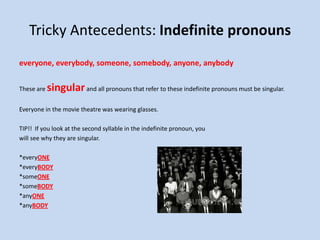
These are singularand all pronouns that refer to these indefinite pronouns must be singular.
Everyone in the movie theatre was wearing glasses.
TIP!! If you look at the second syllable in the indefinite pronoun, you
will see why they are singular.
*everyONE
*everyBODY
*someONE
*someBODY
*anyONE
*anyBODY
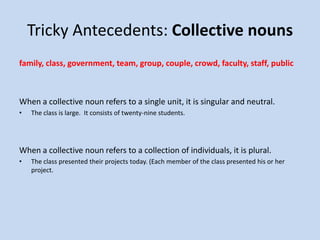
Tricky Antecedents: Collective nouns
family, class, government, team, group, couple, crowd, faculty, staff, public
When a collective noun refers to a single unit, it is singular and neutral.
• The class is large. It consists of twenty-nine students.
When a collective noun refers to a collection of individuals, it is plural.
• The class presented their projects today. (Each member of the class presented his or her
project.

Pronouns

  • 1.
  • 3.
    Pronoun Rules Subjects Rule #1 Usea subject pronoun when it is the subject of a sentence or clause. Example: • I • You signed up for a marathon. • He • She • It • We • They
  • 4.
    Pronoun Rules Object Pronouns Rule#2 When the pronoun takes the place of a noun in the object position, use an object pronoun. Common mistake: Janice invited Jamal and I to the party. Correct: Janice invited Jamal and me to the party. The party surprised_______. Singular • me • you • him, her, it Plural • us • you • them
  • 5.
    Object Pronouns When thepronoun takes the place of a noun in the object position, use an object pronoun: • me • you • him • her • it • us • them Example: Jazmine’s cat, Cutie, likes to play with her when she gets home from work. Instead of repeating the name Jazmine, we replace the noun with the object pronouns her and she.
  • 6.
    Pronoun Rules ObjectPronouns Rule #3 Use the object pronoun when it is the object of a preposition. • The party was for_______. Singular • me • you • him, her, it Plural • us • you • them
  • 7.
    Possessive Pronouns Rule #4A possessive pronoun takes the place of a noun and tells us who the noun belongs to. • The sundae is______. Singular Plural my, mine our, ours your, yours your, yours his, her, hers their, theirs * Never use an apostrophe with a possessive pronoun.
  • 8.
    Pronouns as Possessive Adjectives Rule#5 A possessive pronoun adjective tells us who something belongs to, but it must be immediately followed by the noun that it is describing. • That is________ cake. Singular » my » your » his, her, its Plural » our » your » their
  • 9.
    Pronoun –Antecedent Agreement Rule #6The antecedent is the noun that a pronoun has taken the place of. Juana told Jose that she was tired of his attitude.
  • 10.
    Practice 1. A studentcan receive feedback on (his or her, their) papers in the online writing lab. – The singular antecedent student must agree with the singular pronoun his or her. 2. When people train for a marathon, (you, they) should not run every day. – The plural antecedent people must agree with the plural pronoun they.
  • 11.
    Tricky Antecedents: Indefinitepronouns everyone, everybody, someone, somebody, anyone, anybody These are singularand all pronouns that refer to these indefinite pronouns must be singular. Everyone in the movie theatre was wearing glasses. TIP!! If you look at the second syllable in the indefinite pronoun, you will see why they are singular. *everyONE *everyBODY *someONE *someBODY *anyONE *anyBODY
  • 12.
    Tricky Antecedents: Collectivenouns family, class, government, team, group, couple, crowd, faculty, staff, public When a collective noun refers to a single unit, it is singular and neutral. • The class is large. It consists of twenty-nine students. When a collective noun refers to a collection of individuals, it is plural. • The class presented their projects today. (Each member of the class presented his or her project.