Punctuation
Comma Usage
What is a
Comma?
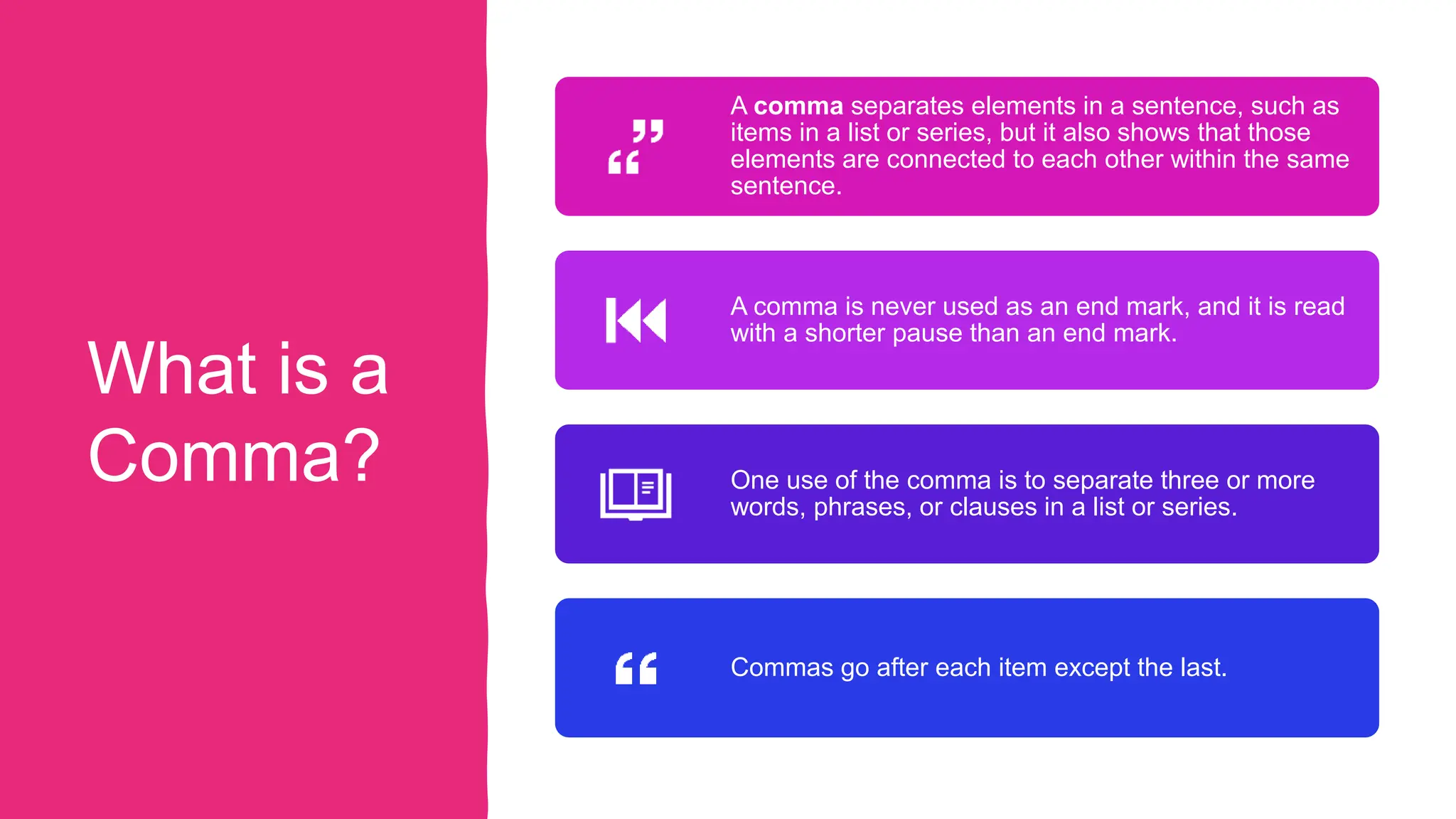
A comma separates elements in a sentence, such as
items in a list or series, but it also shows that those
elements are connected to each other within the same
sentence.
A comma is never used as an end mark, and it is read
with a shorter pause than an end mark.
One use of the comma is to separate three or more
words, phrases, or clauses in a list or series.
Commas go after each item except the last.
Commas in
a Series
Words
in a
Series
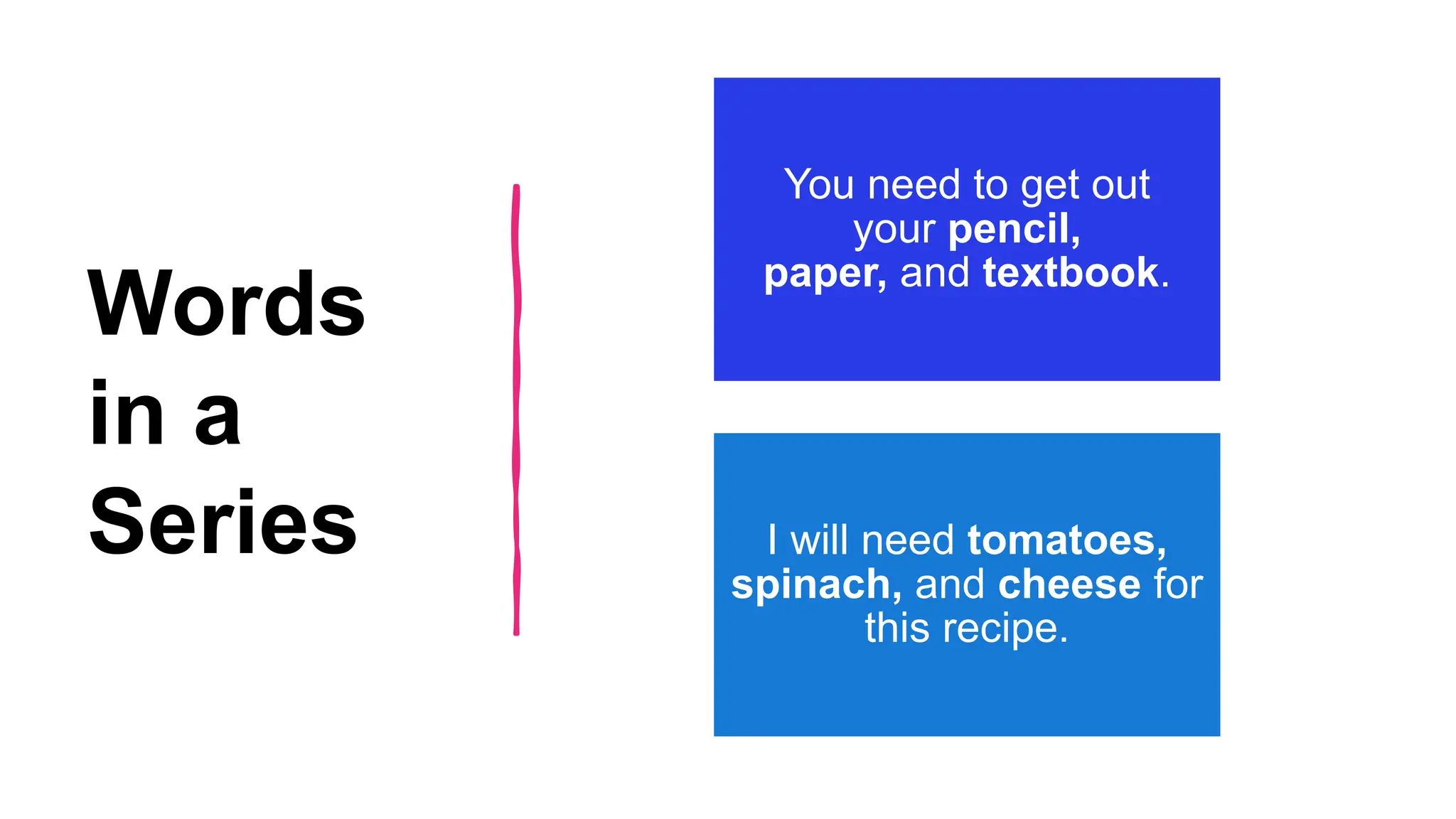
You need to get out
your pencil,
paper, and textbook.
I will need tomatoes,
spinach, and cheese for
this recipe.
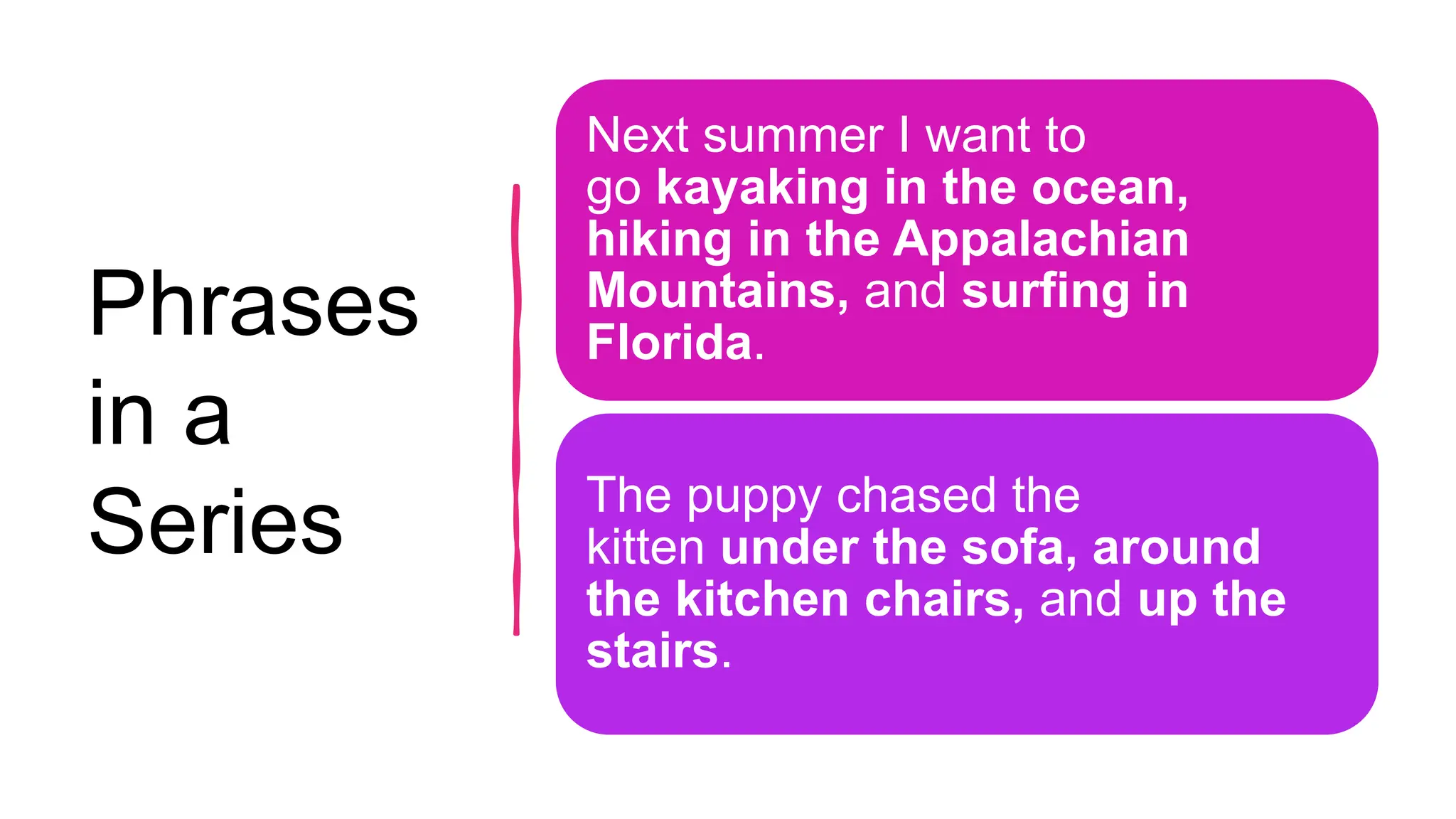
Phrases
in a
Series
Next summer I want to
go kayaking in the ocean,
hiking in the Appalachian
Mountains, and surfing in
Florida.
The puppy chased the
kitten under the sofa, around
the kitchen chairs, and up the
stairs.
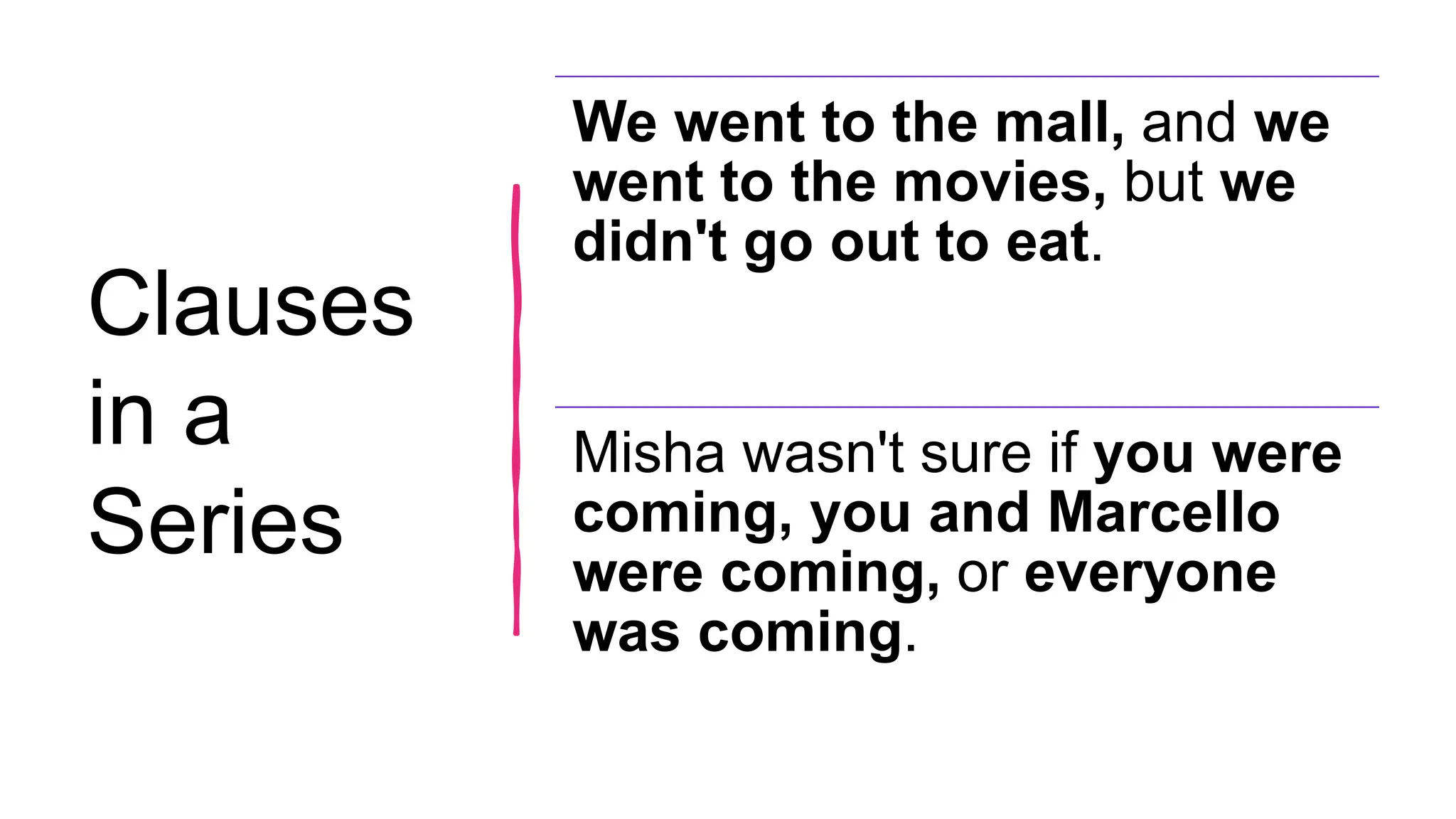
Clauses
in a
Series
We went to the mall, and we
went to the movies, but we
didn't go out to eat.
Misha wasn't sure if you were
coming, you and Marcello
were coming, or everyone
was coming.
Commas
with
Adjectives
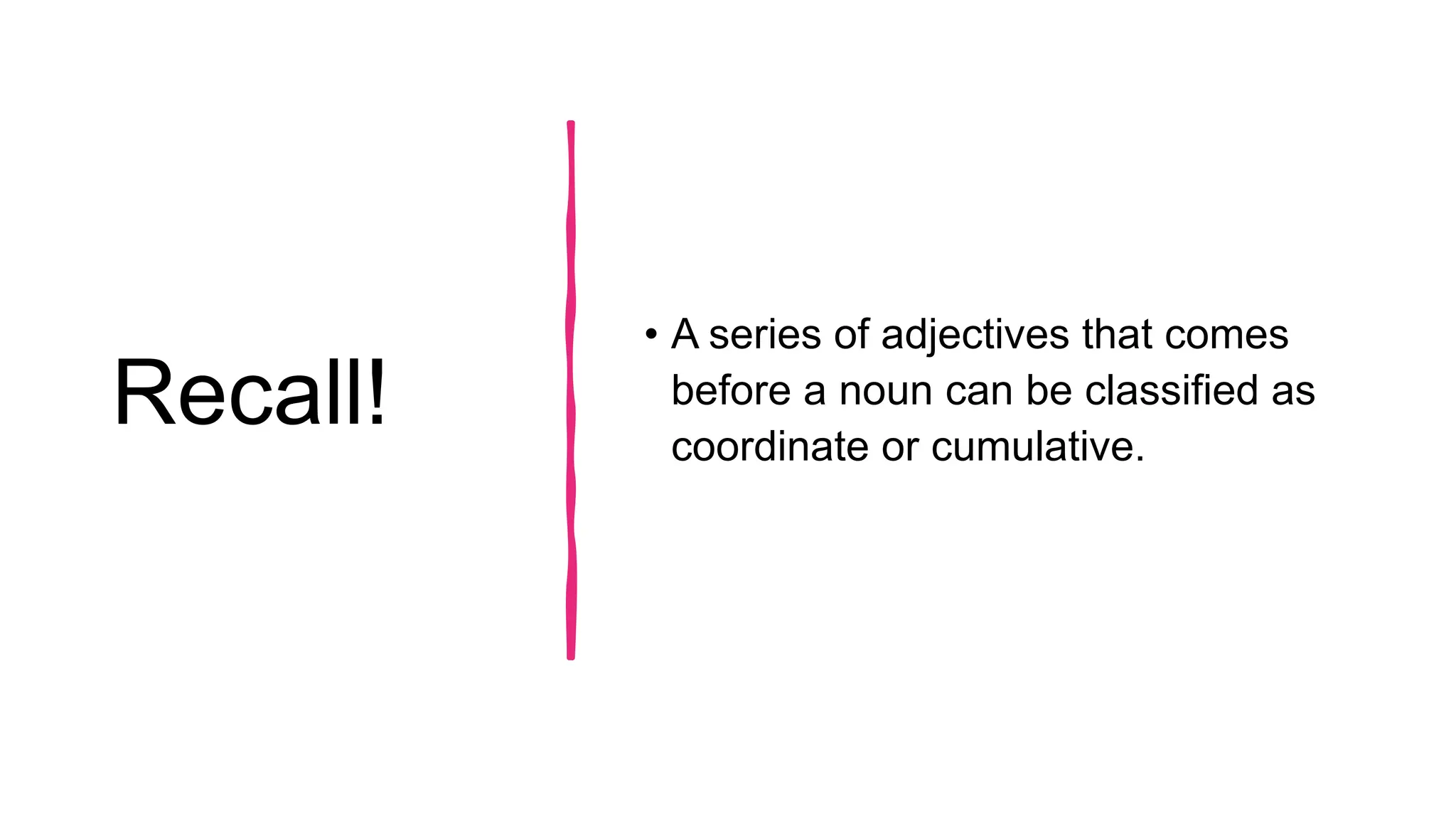
Recall!
• A series of adjectives that comes
before a noun can be classified as
coordinate or cumulative.
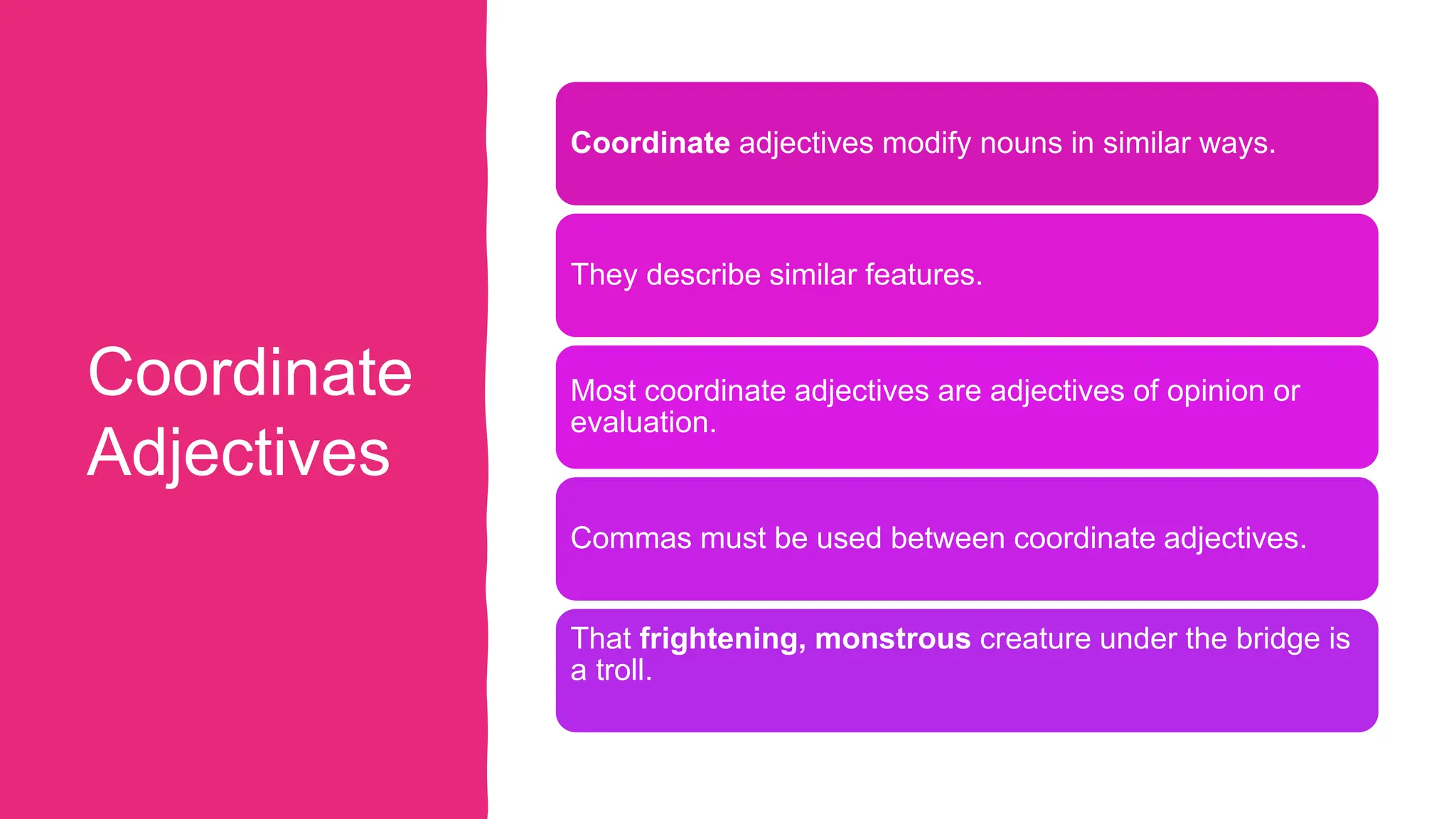
Coordinate
Adjectives
Coordinate adjectives modify nouns in similar ways.
They describe similar features.
Most coordinate adjectives are adjectives of opinion or
evaluation.
Commas must be used between coordinate adjectives.
That frightening, monstrous creature under the bridge is
a troll.
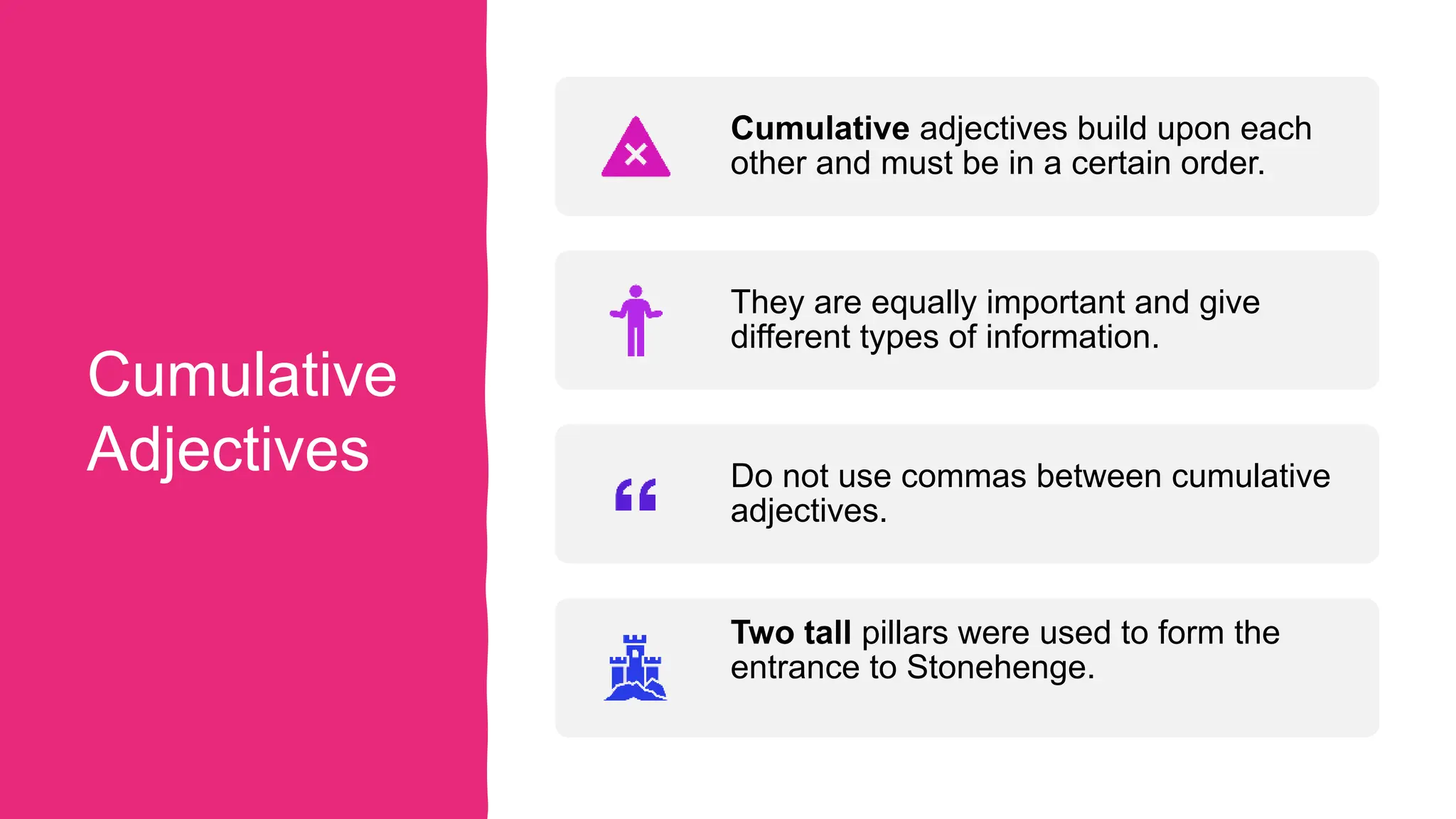
Cumulative
Adjectives
Cumulative adjectives build upon each
other and must be in a certain order.
They are equally important and give
different types of information.
Do not use commas between cumulative
adjectives.
Two tall pillars were used to form the
entrance to Stonehenge.
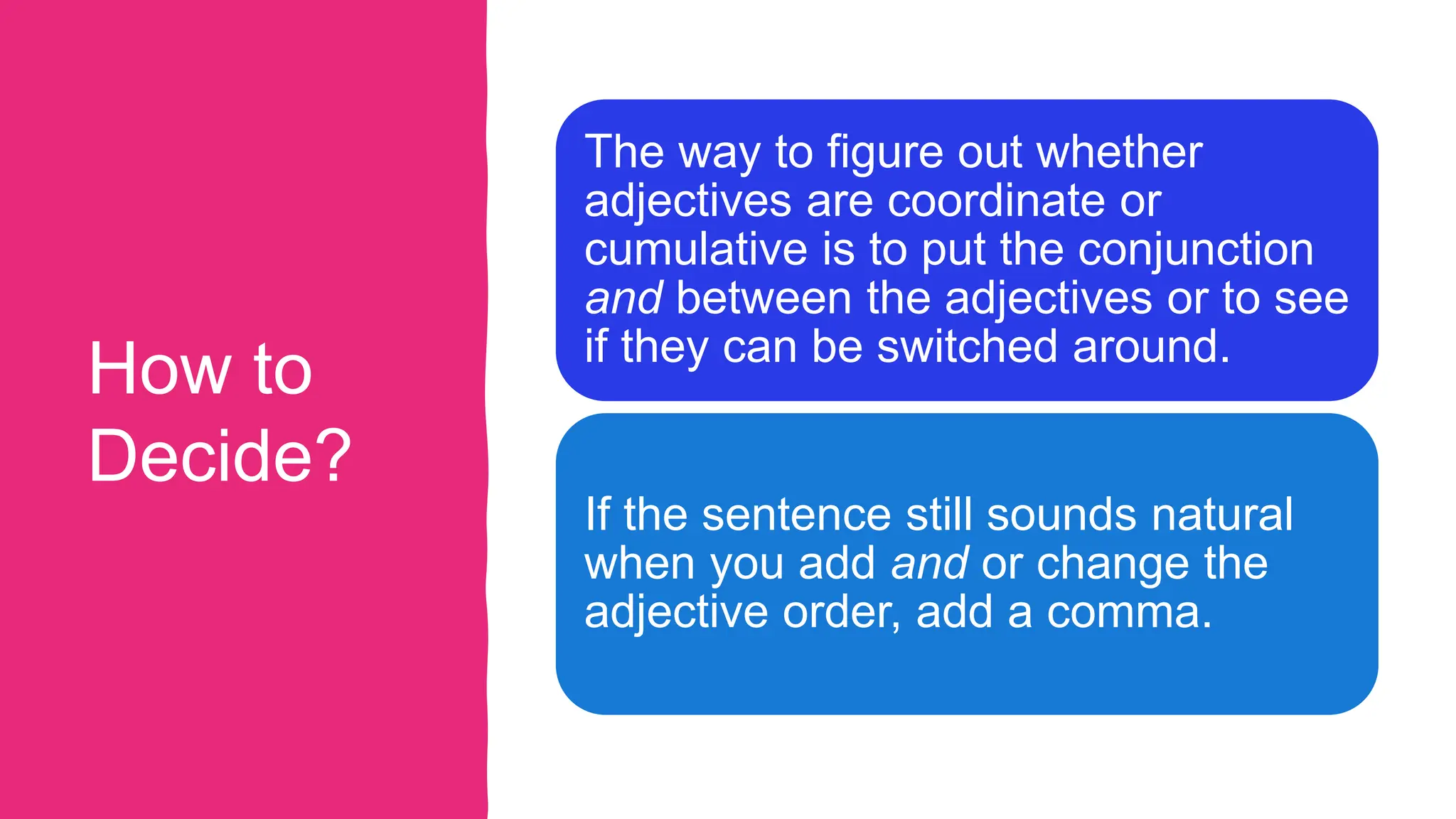
How to
Decide?
The way to figure out whether
adjectives are coordinate or
cumulative is to put the conjunction
and between the adjectives or to see
if they can be switched around.
If the sentence still sounds natural
when you add and or change the
adjective order, add a comma.
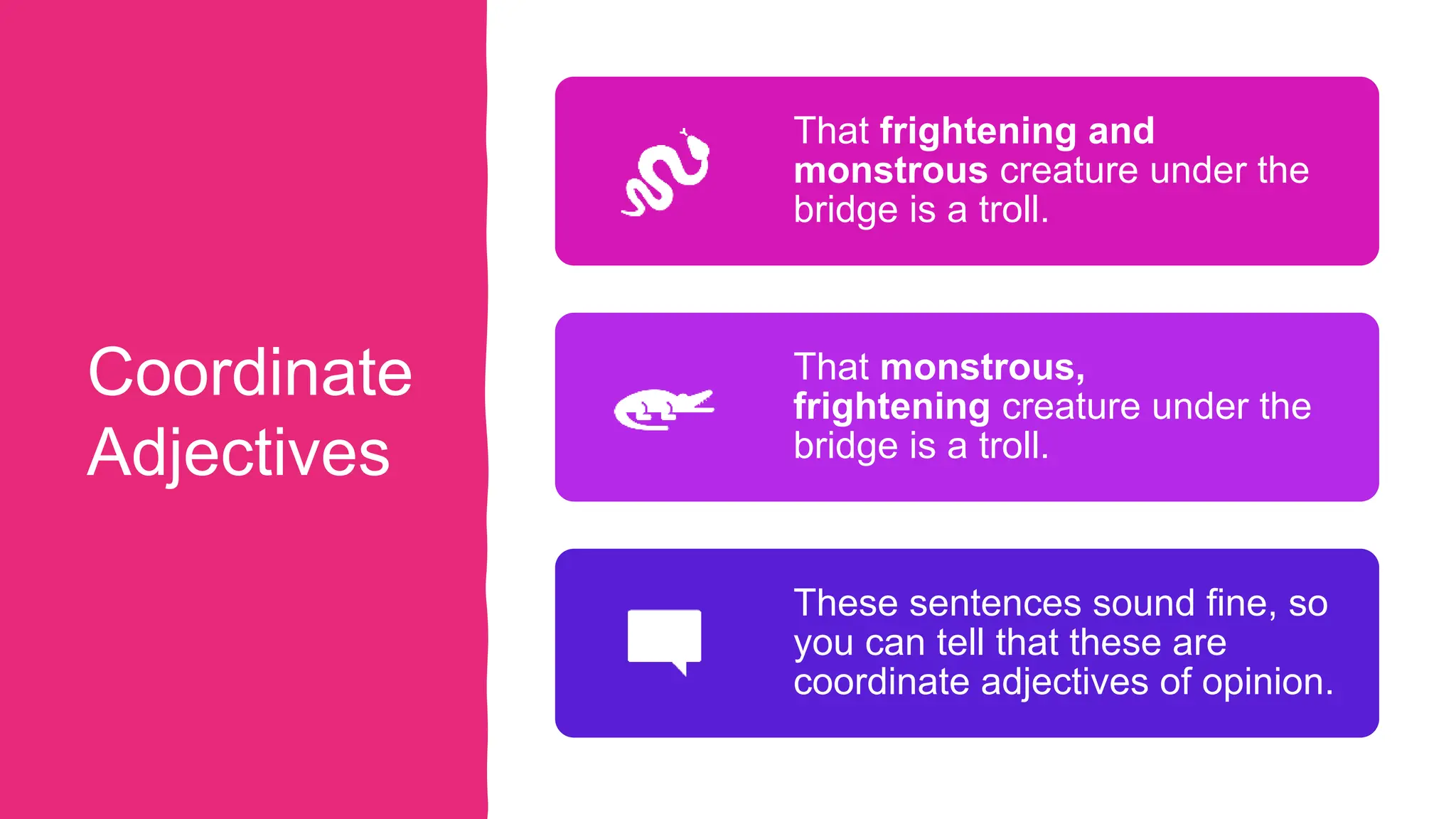
Coordinate
Adjectives
That frightening and
monstrous creature under the
bridge is a troll.
That monstrous,
frightening creature under the
bridge is a troll.
These sentences sound fine, so
you can tell that these are
coordinate adjectives of opinion.
Cumulative
Adjectives
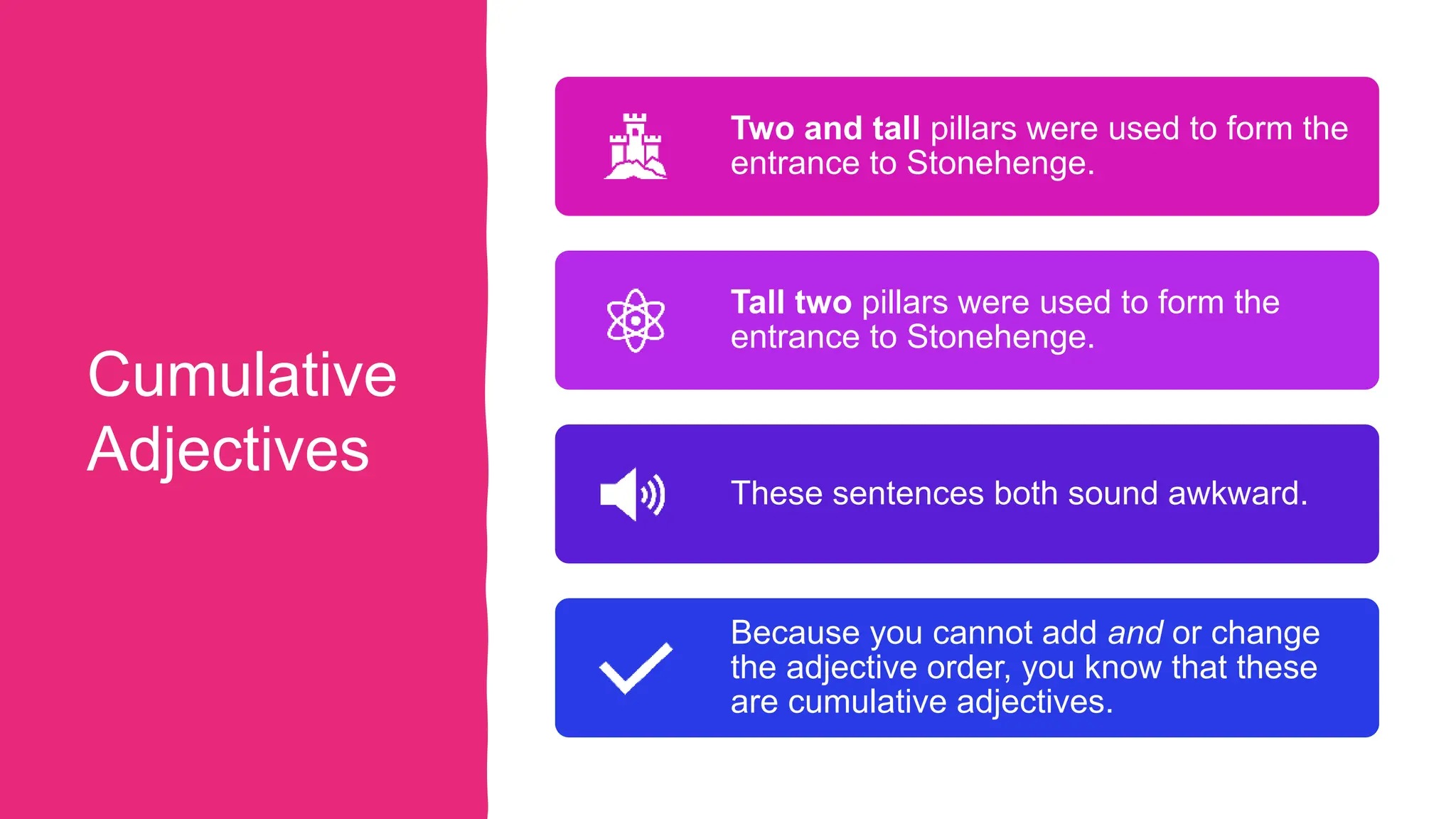
Two and tall pillars were used to form the
entrance to Stonehenge.
Tall two pillars were used to form the
entrance to Stonehenge.
These sentences both sound awkward.
Because you cannot add and or change
the adjective order, you know that these
are cumulative adjectives.
Add a
Comma for
Clarity
Sometimes a comma is inserted to
clarify that two adjectives modify an
adjective-noun combination.
Example -
1
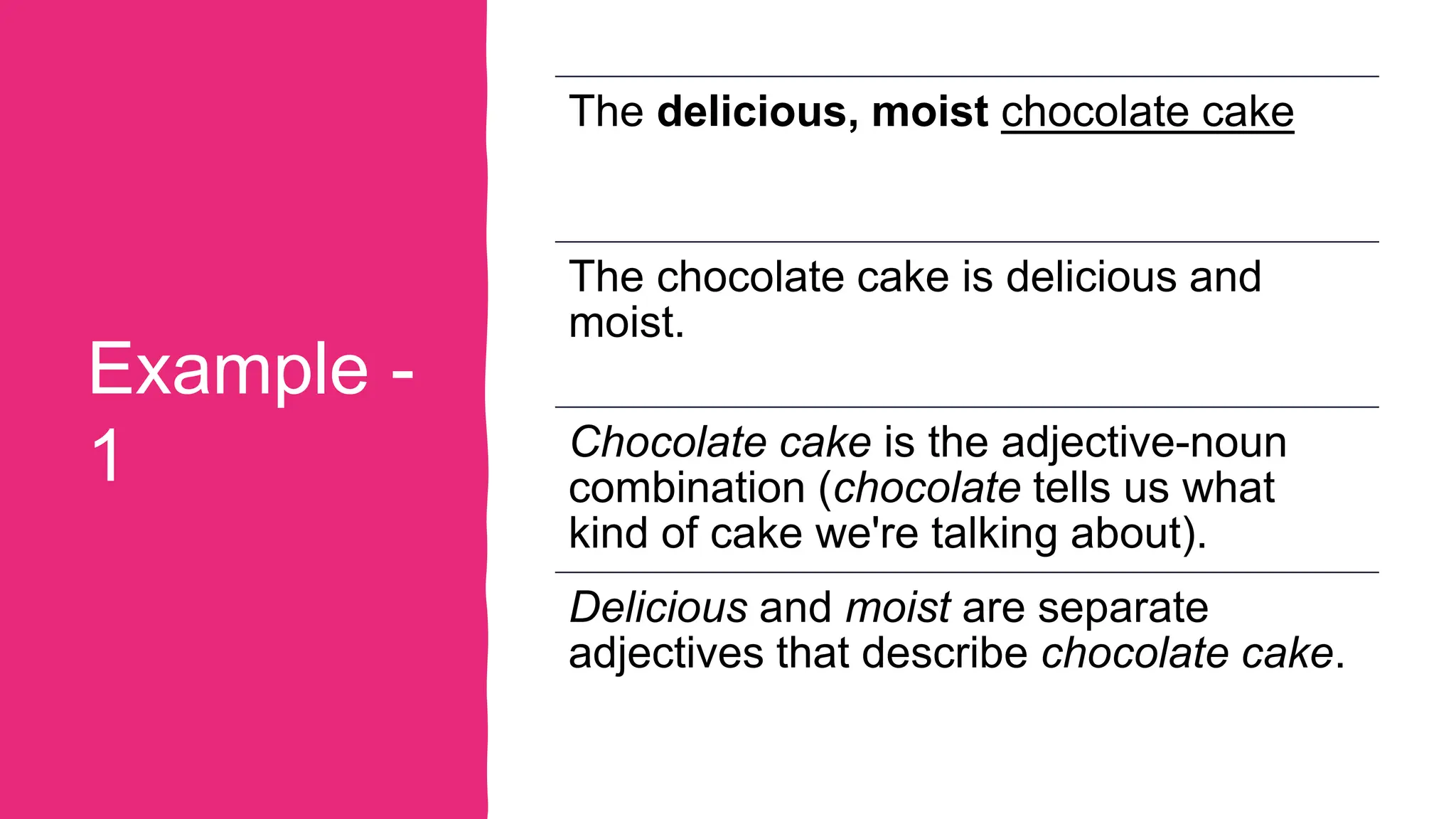
The delicious, moist chocolate cake
The chocolate cake is delicious and
moist.
Chocolate cake is the adjective-noun
combination (chocolate tells us what
kind of cake we're talking about).
Delicious and moist are separate
adjectives that describe chocolate cake.
Example - 2
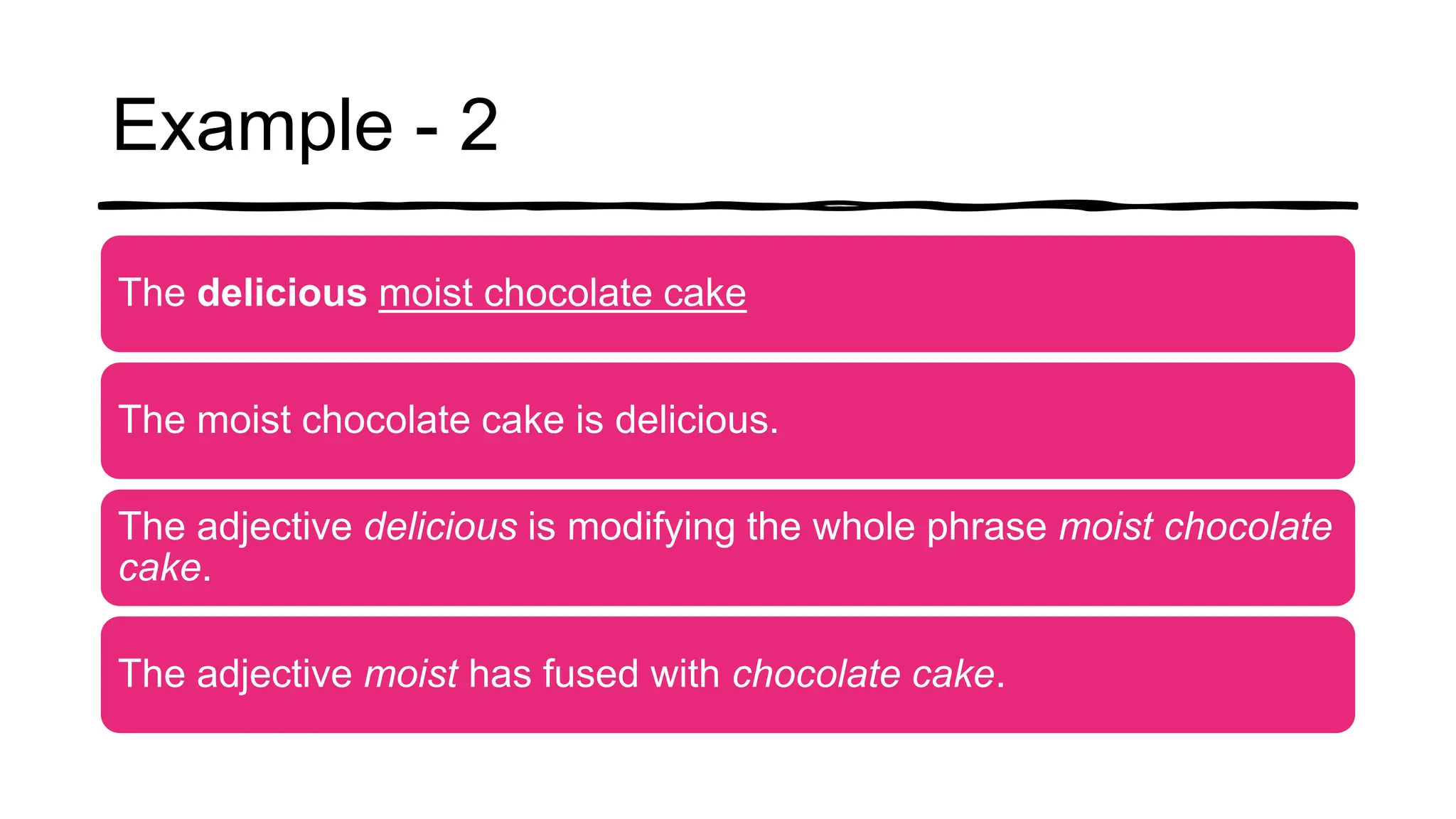
The delicious moist chocolate cake
The moist chocolate cake is delicious.
The adjective delicious is modifying the whole phrase moist chocolate
cake.
The adjective moist has fused with chocolate cake.
Commas in
Compound
Sentences
Recall!
• A comma is generally used to separate two or
more independent clauses in a compound sentence that is
joined by a coordinating or, occasionally, a correlative
conjunction.
• Coordinating conjunctions are for, and, nor, but, or, yet and
so.
• Correlative conjunctions are both/and, either/or, neither/nor,
whether/or, not only/but also, rather/than and such/that.
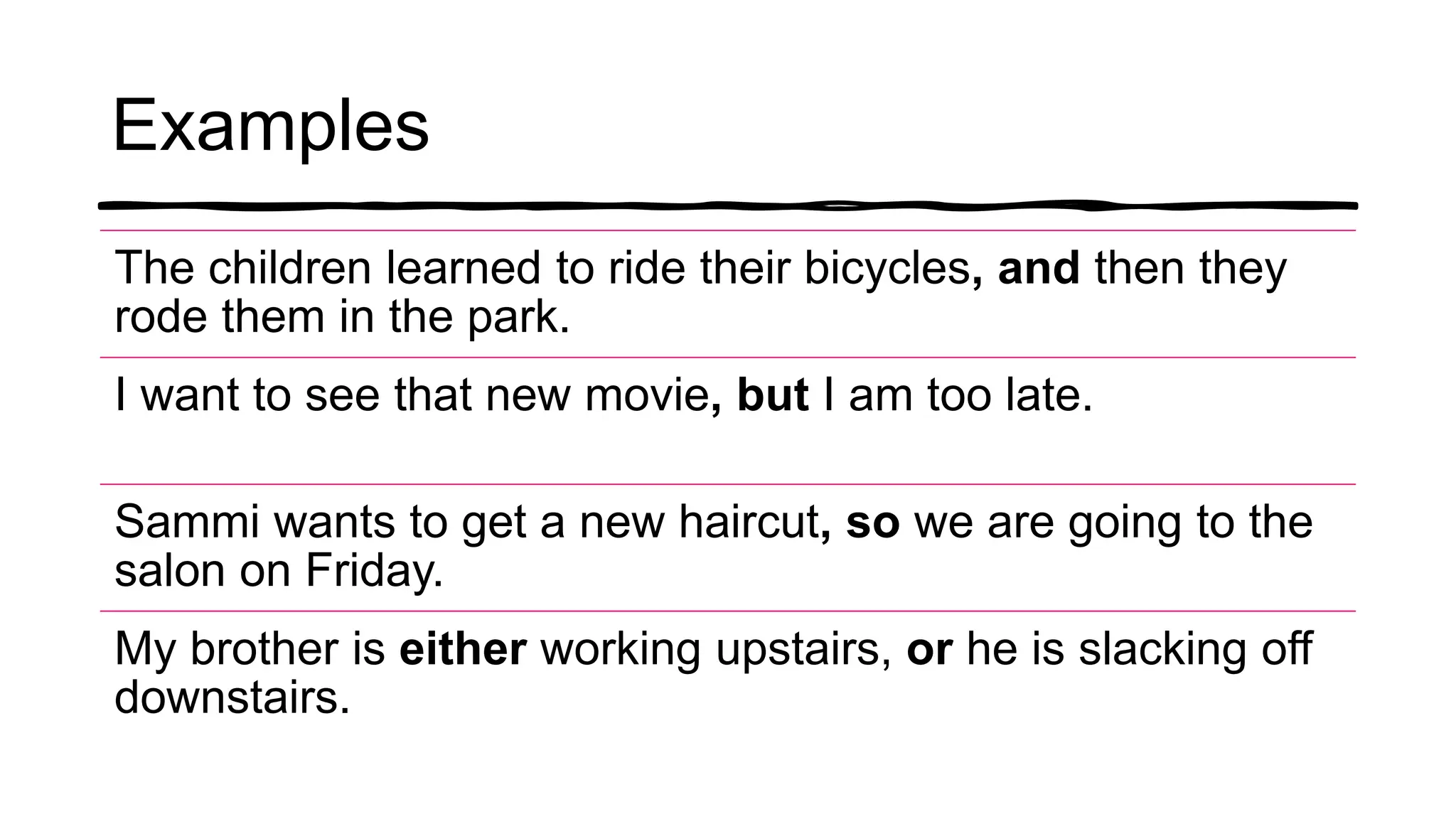
Examples
The children learned to ride their bicycles, and then they
rode them in the park.
I want to see that new movie, but I am too late.
Sammi wants to get a new haircut, so we are going to the
salon on Friday.
My brother is either working upstairs, or he is slacking off
downstairs.
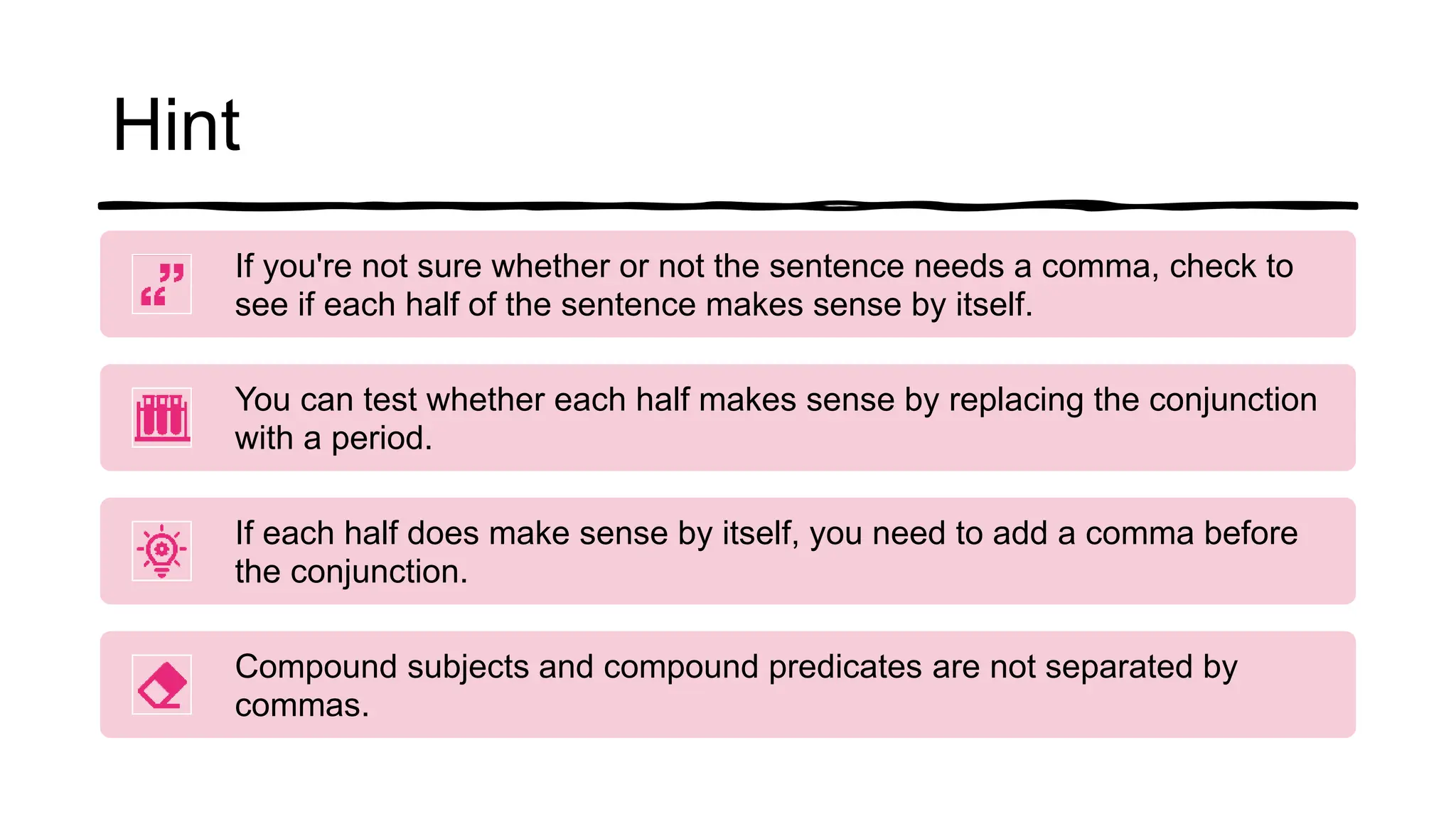
Hint
If you're not sure whether or not the sentence needs a comma, check to
see if each half of the sentence makes sense by itself.
You can test whether each half makes sense by replacing the conjunction
with a period.
If each half does make sense by itself, you need to add a comma before
the conjunction.
Compound subjects and compound predicates are not separated by
commas.
Example
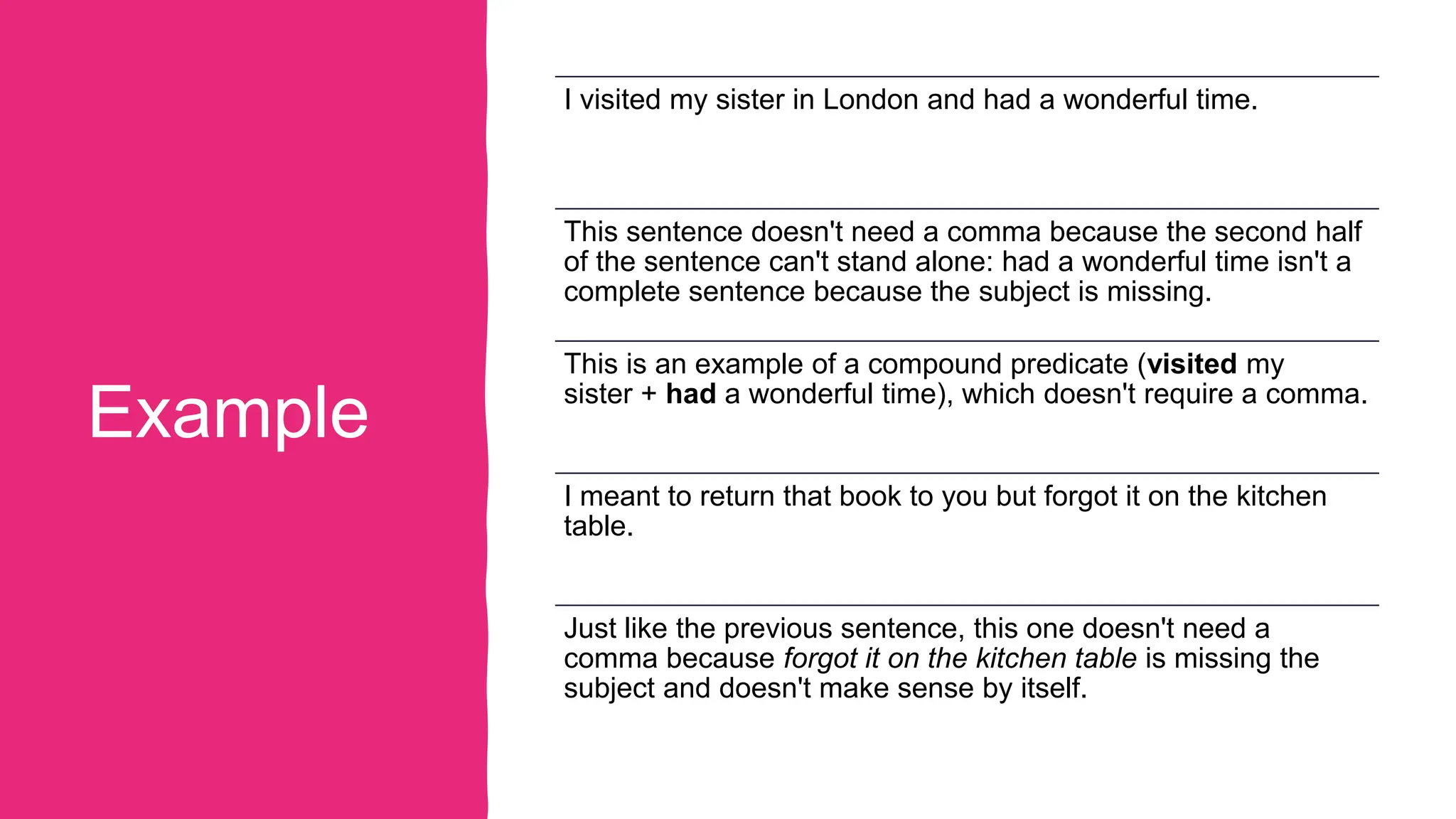
I visited my sister in London and had a wonderful time.
This sentence doesn't need a comma because the second half
of the sentence can't stand alone: had a wonderful time isn't a
complete sentence because the subject is missing.
This is an example of a compound predicate (visited my
sister + had a wonderful time), which doesn't require a comma.
I meant to return that book to you but forgot it on the kitchen
table.
Just like the previous sentence, this one doesn't need a
comma because forgot it on the kitchen table is missing the
subject and doesn't make sense by itself.
Commas in
Complex
Sentences
Recall!
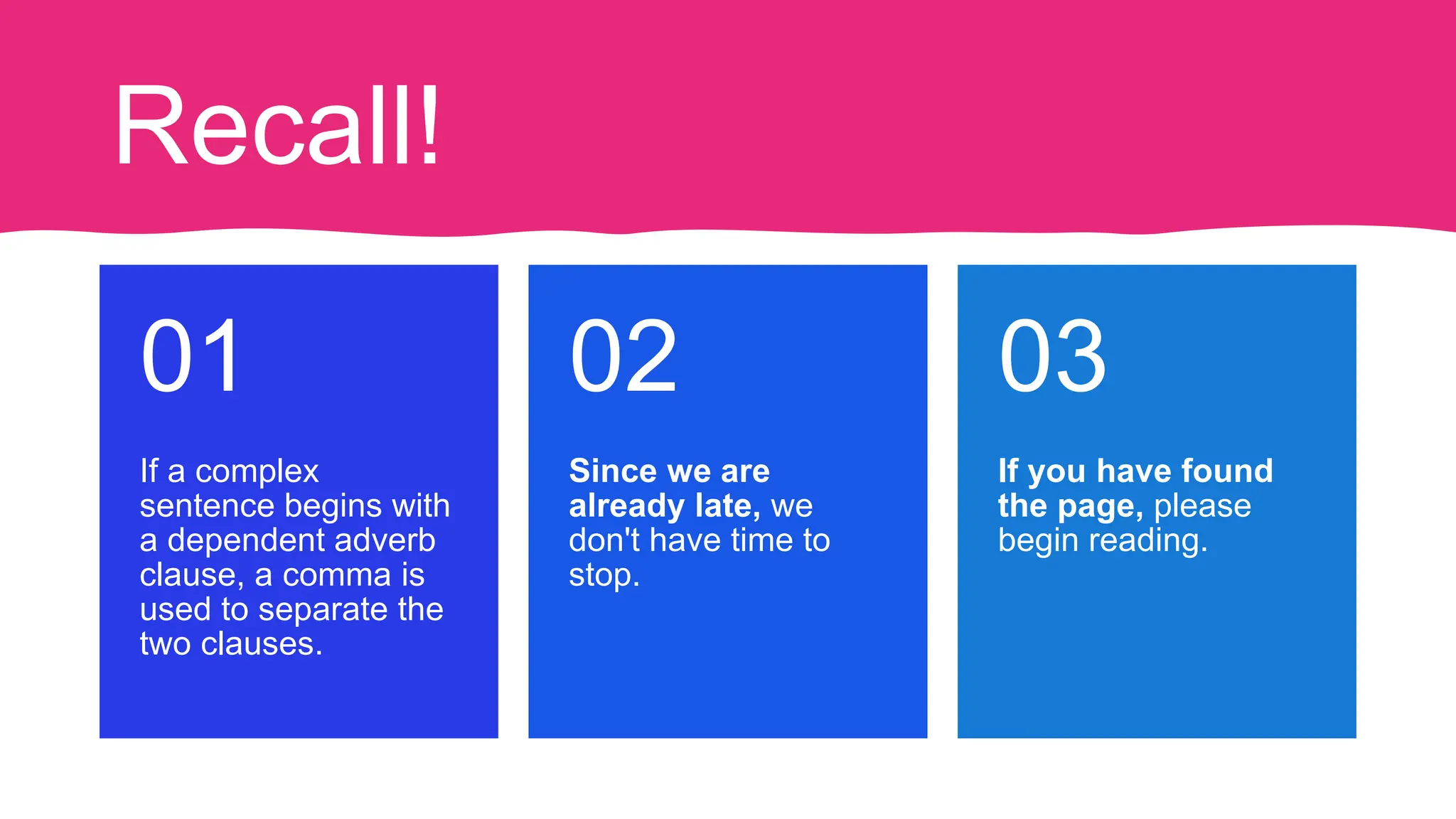
If a complex
sentence begins with
a dependent adverb
clause, a comma is
used to separate the
two clauses.
01
Since we are
already late, we
don't have time to
stop.
02
If you have found
the page, please
begin reading.
03
Recall!
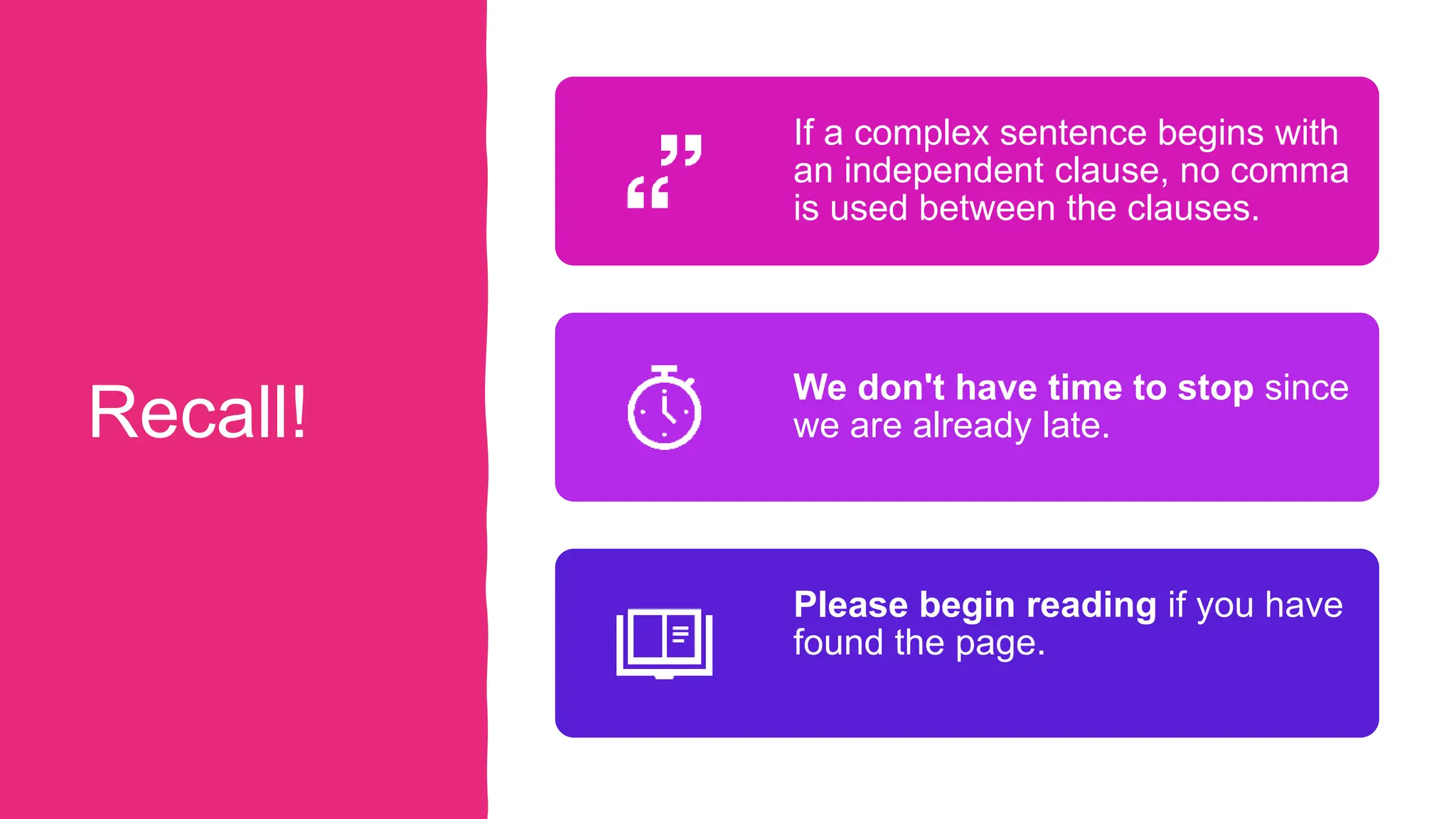
If a complex sentence begins with
an independent clause, no comma
is used between the clauses.
We don't have time to stop since
we are already late.
Please begin reading if you have
found the page.
Commas with
Introductory
Elements
Introductory Elements
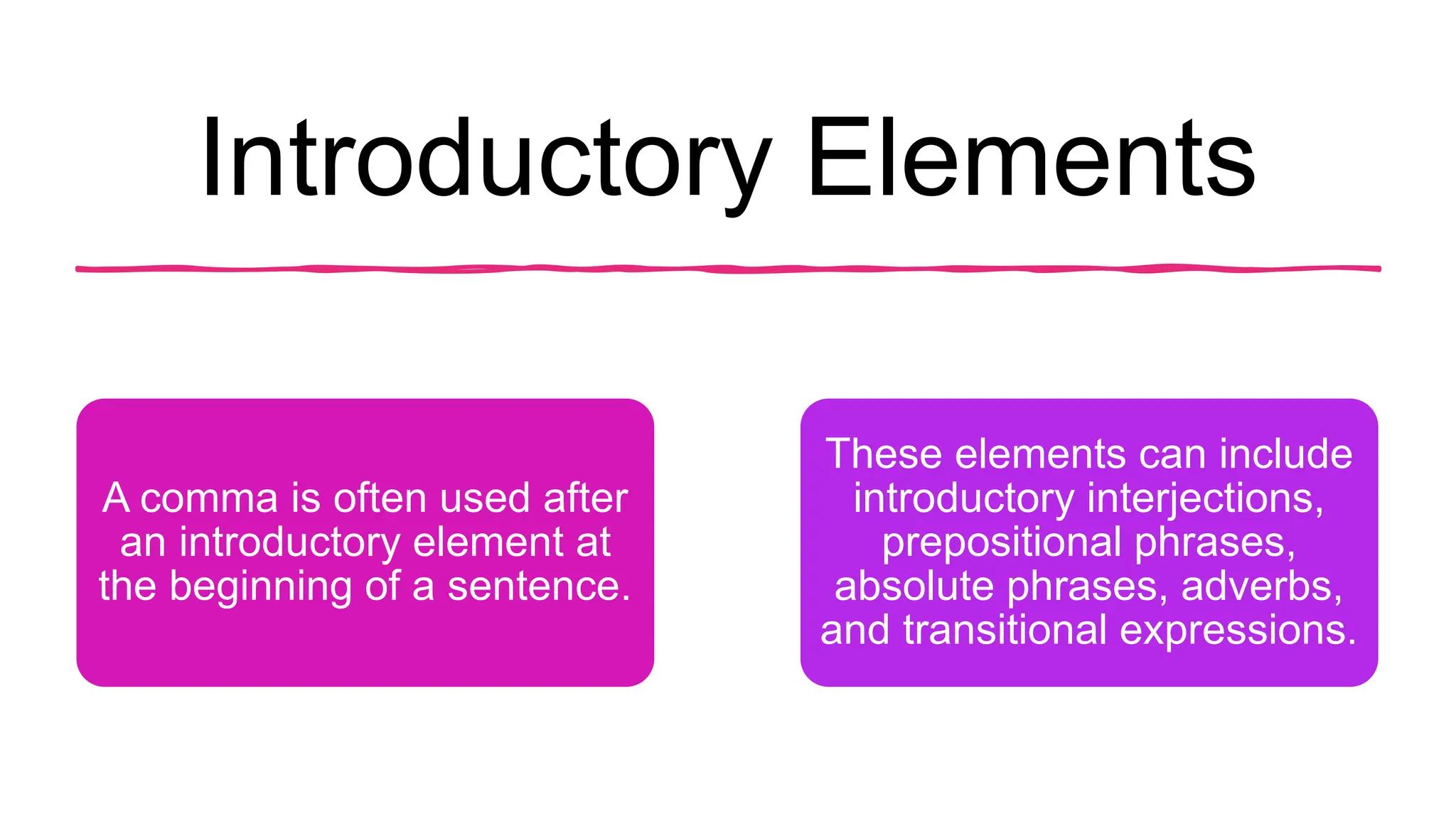
A comma is often used after
an introductory element at
the beginning of a sentence.
These elements can include
introductory interjections,
prepositional phrases,
absolute phrases, adverbs,
and transitional expressions.
Introductory Interjections
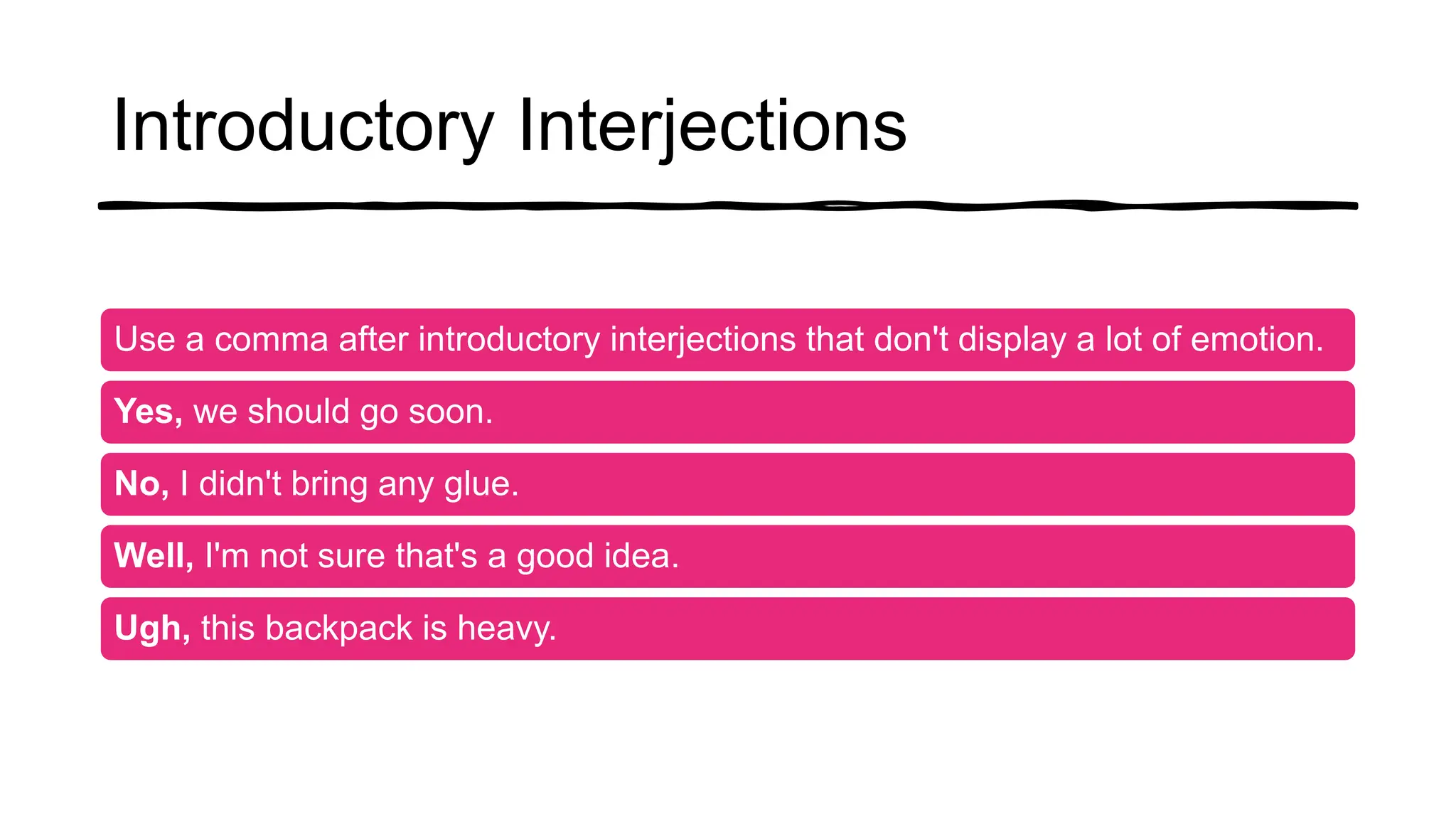
Use a comma after introductory interjections that don't display a lot of emotion.
Yes, we should go soon.
No, I didn't bring any glue.
Well, I'm not sure that's a good idea.
Ugh, this backpack is heavy.
Introductory Adverb Prepositional Phrases
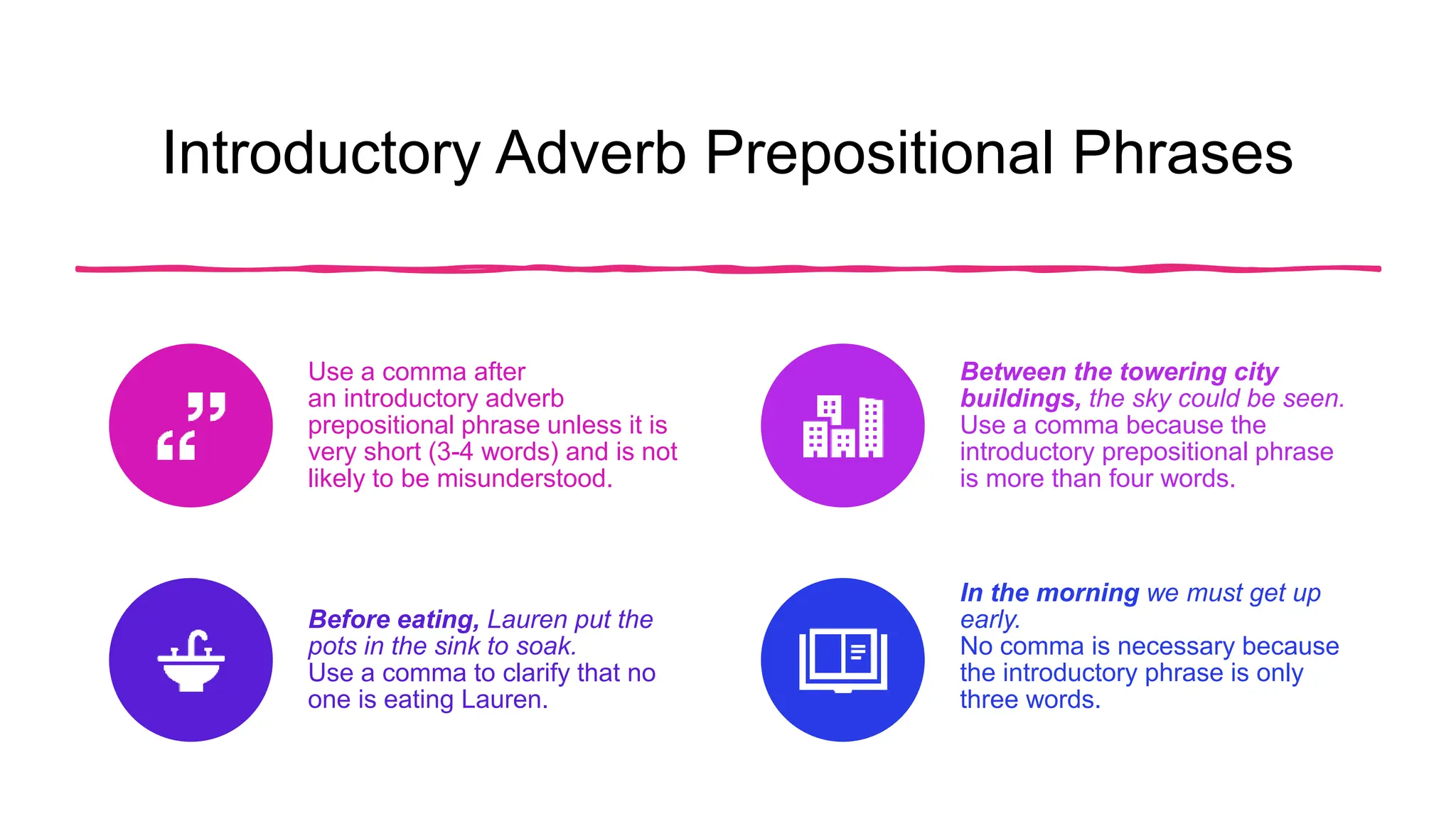
Use a comma after
an introductory adverb
prepositional phrase unless it is
very short (3-4 words) and is not
likely to be misunderstood.
Between the towering city
buildings, the sky could be seen.
Use a comma because the
introductory prepositional phrase
is more than four words.
Before eating, Lauren put the
pots in the sink to soak.
Use a comma to clarify that no
one is eating Lauren.
In the morning we must get up
early.
No comma is necessary because
the introductory phrase is only
three words.
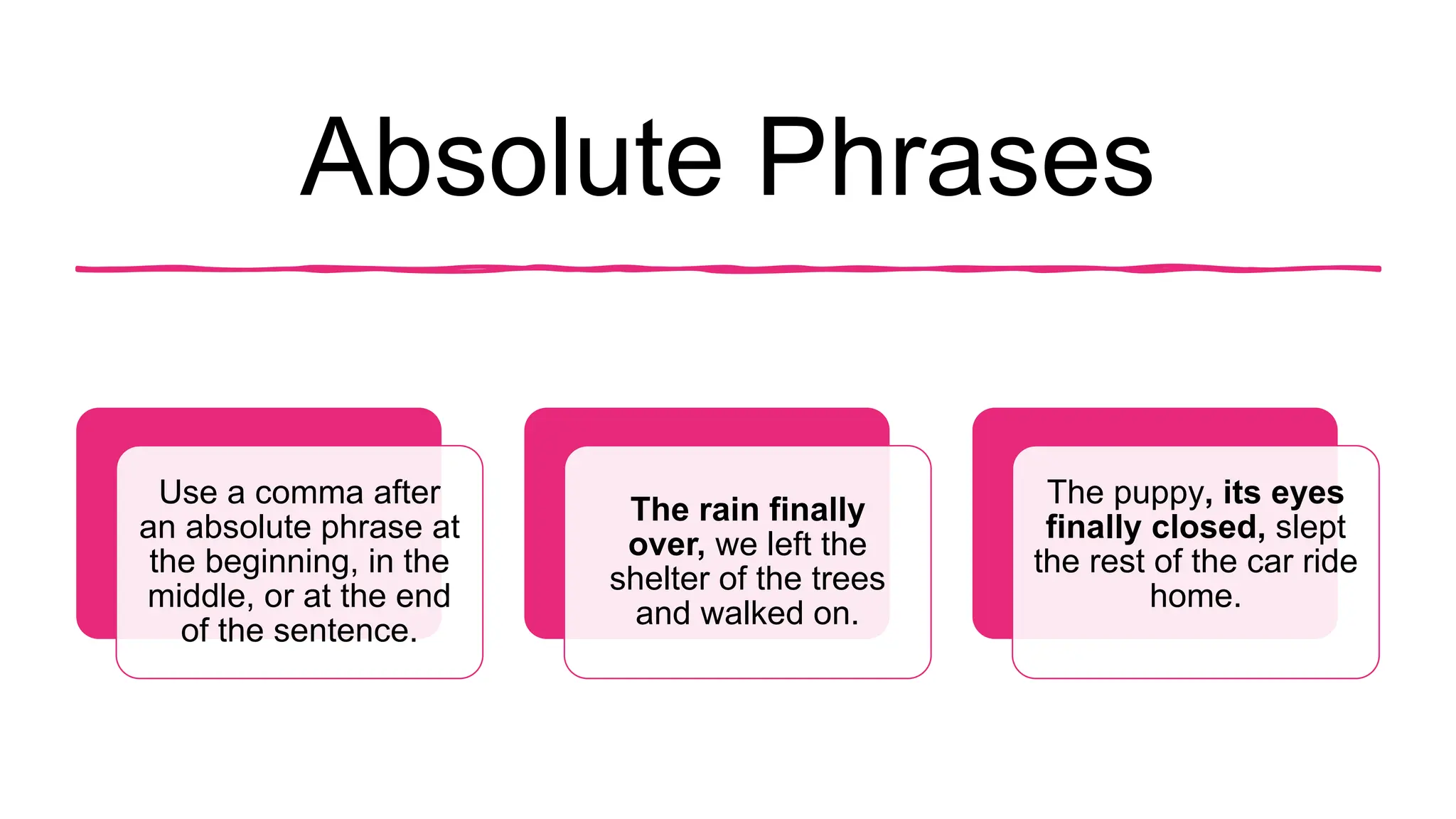
Absolute Phrases
Use a comma after
an absolute phrase at
the beginning, in the
middle, or at the end
of the sentence.
The rain finally
over, we left the
shelter of the trees
and walked on.
The puppy, its eyes
finally closed, slept
the rest of the car ride
home.
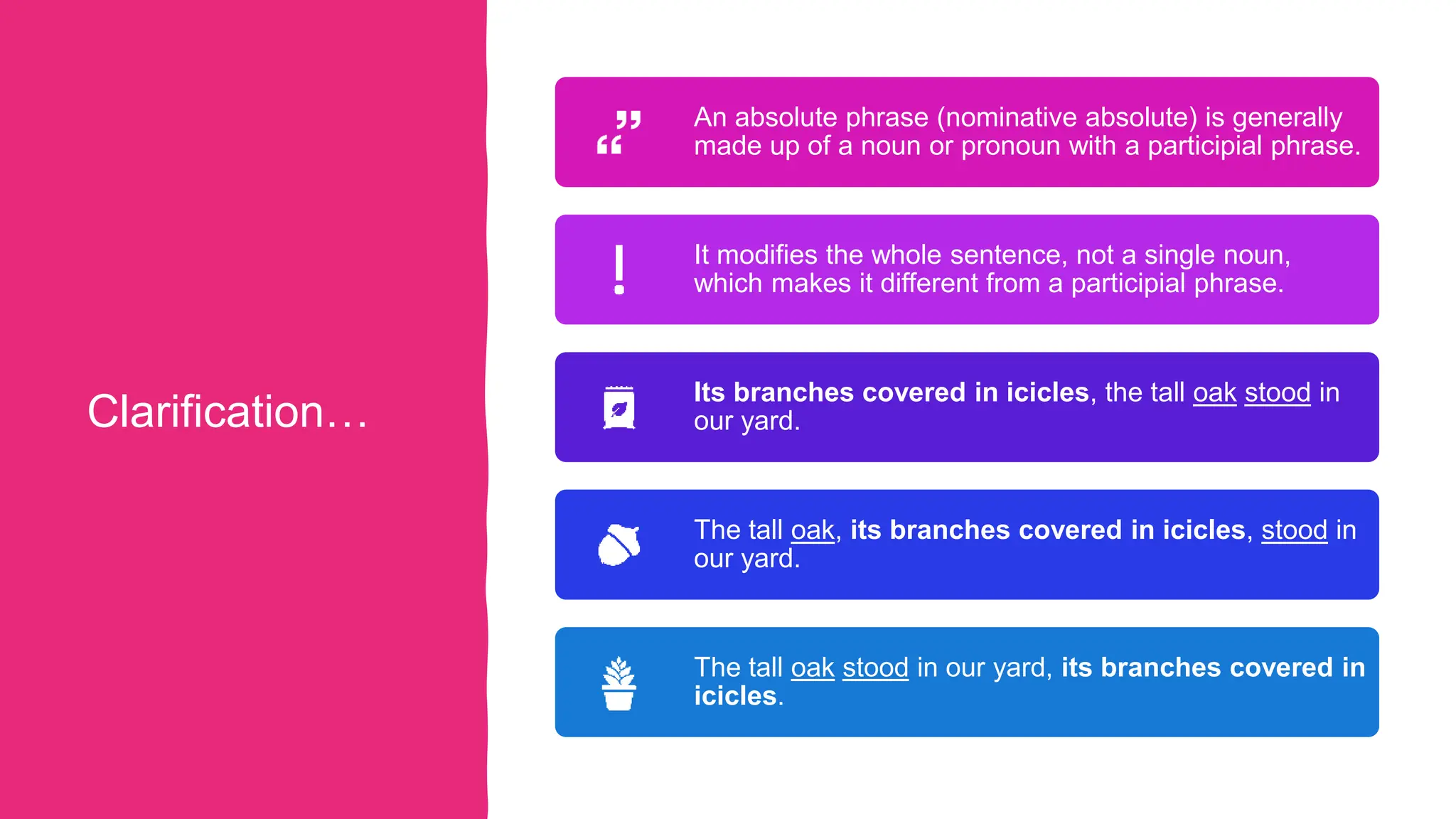
Clarification…
An absolute phrase (nominative absolute) is generally
made up of a noun or pronoun with a participial phrase.
It modifies the whole sentence, not a single noun,
which makes it different from a participial phrase.
Its branches covered in icicles, the tall oak stood in
our yard.
The tall oak, its branches covered in icicles, stood in
our yard.
The tall oak stood in our yard, its branches covered in
icicles.
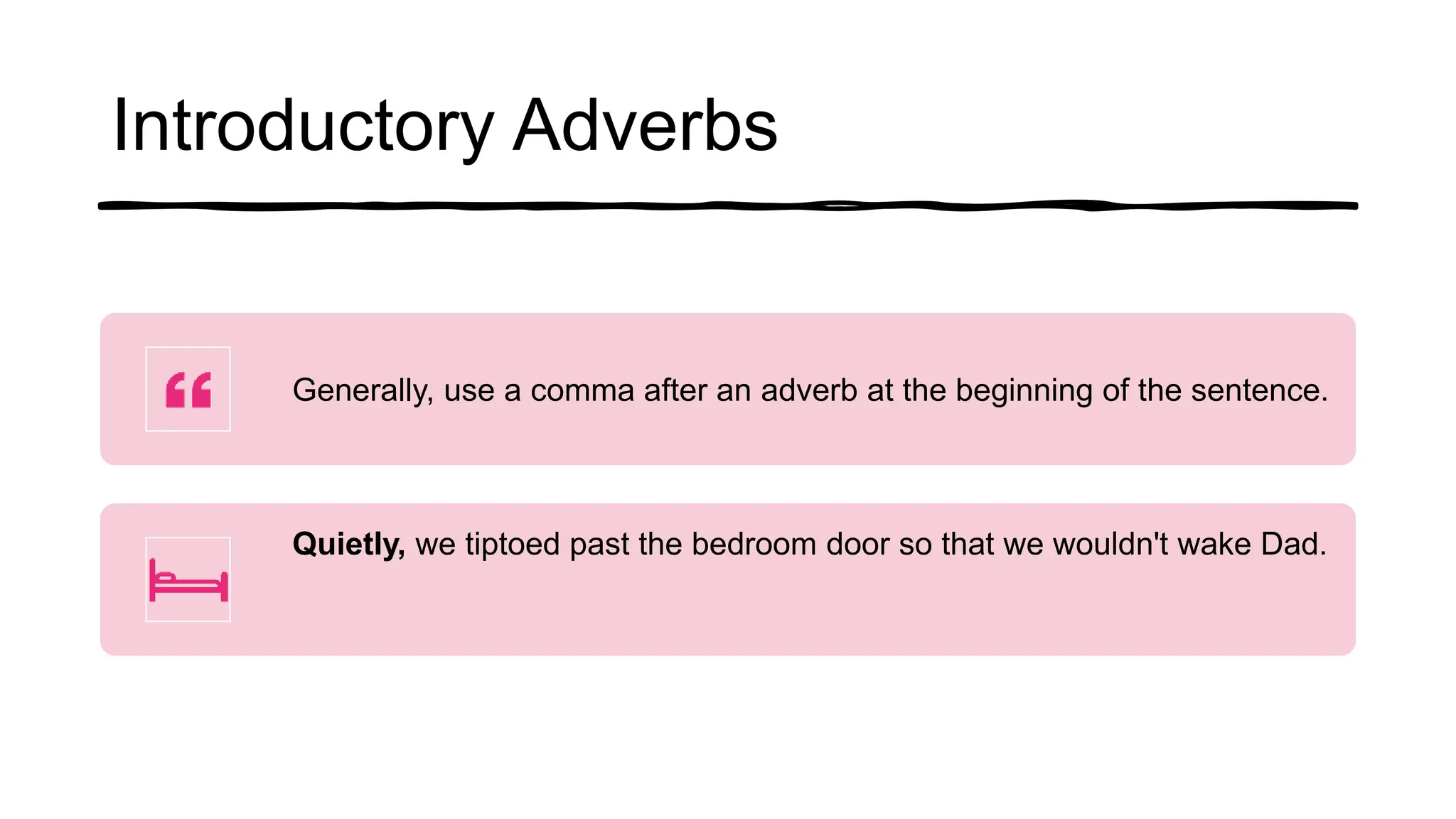
Introductory Adverbs
Generally, use a comma after an adverb at the beginning of the sentence.
Quietly, we tiptoed past the bedroom door so that we wouldn't wake Dad.
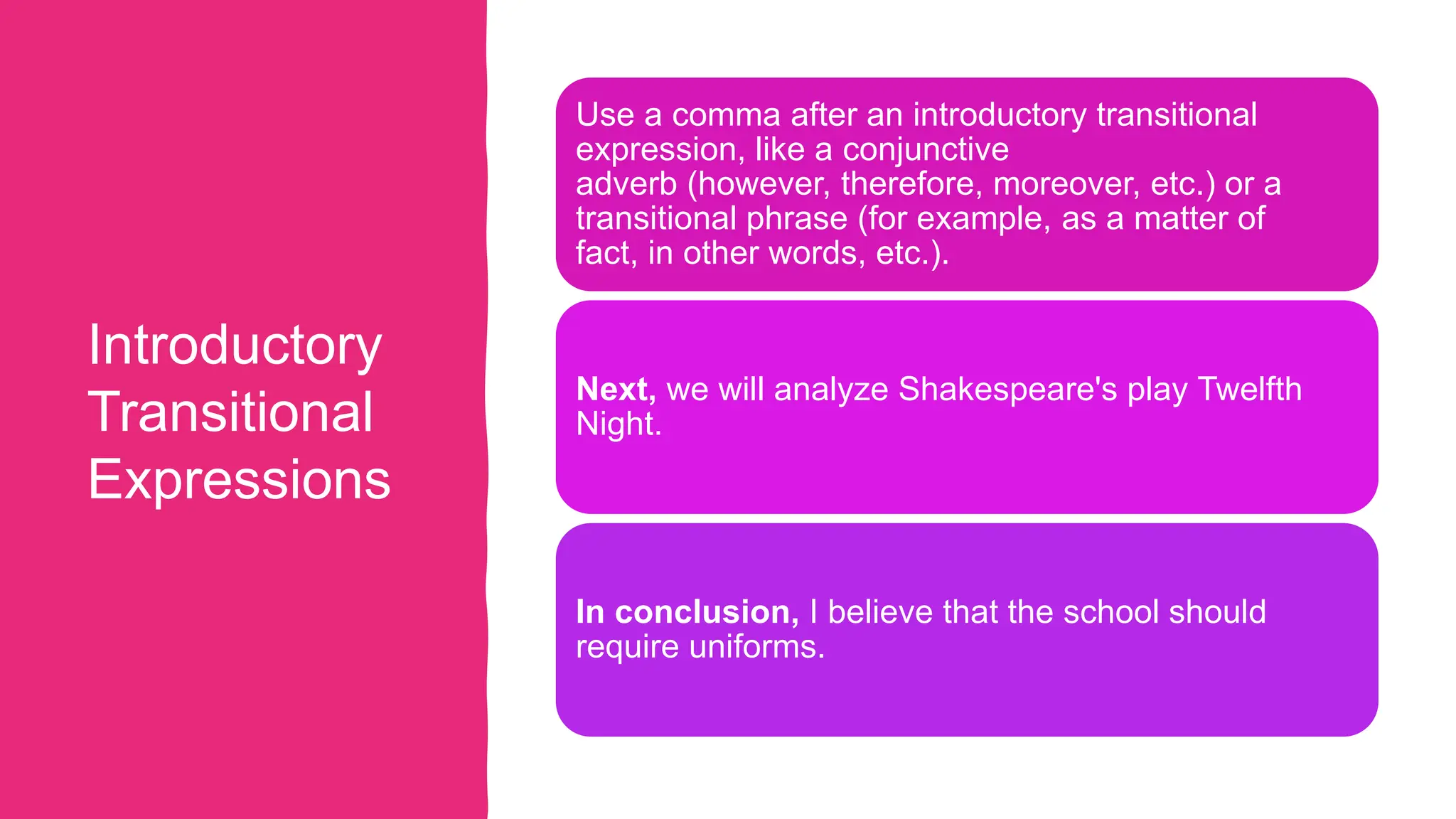
Introductory
Transitional
Expressions
Use a comma after an introductory transitional
expression, like a conjunctive
adverb (however, therefore, moreover, etc.) or a
transitional phrase (for example, as a matter of
fact, in other words, etc.).
Next, we will analyze Shakespeare's play Twelfth
Night.
In conclusion, I believe that the school should
require uniforms.
Commas with
Interruptions
General
Rule
• Commas are used to set off
elements that interrupt a sentence
or that are not essential to a
sentence.
Parenthetical
and
Transitional
Expressions
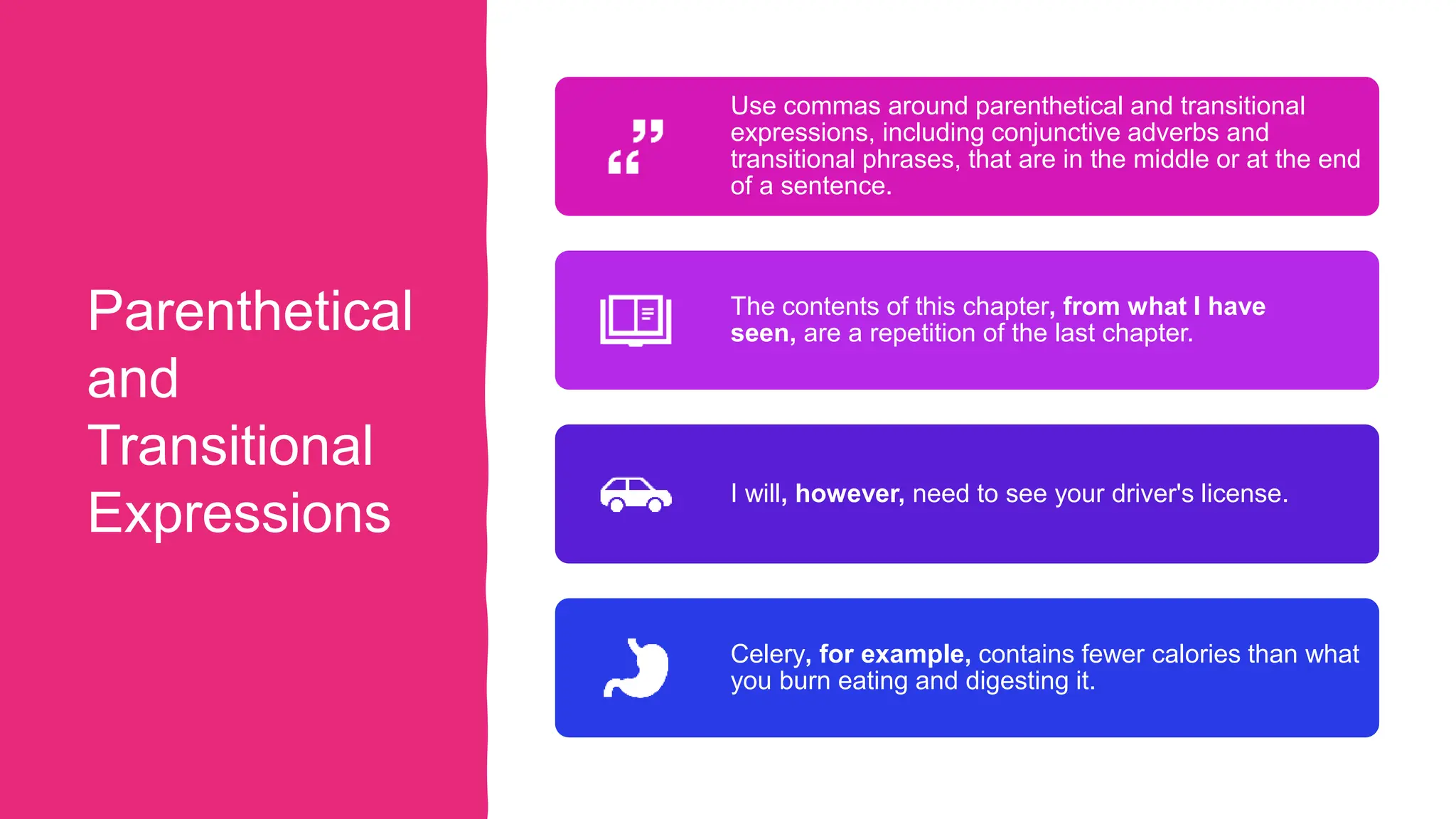
Use commas around parenthetical and transitional
expressions, including conjunctive adverbs and
transitional phrases, that are in the middle or at the end
of a sentence.
The contents of this chapter, from what I have
seen, are a repetition of the last chapter.
I will, however, need to see your driver's license.
Celery, for example, contains fewer calories than what
you burn eating and digesting it.
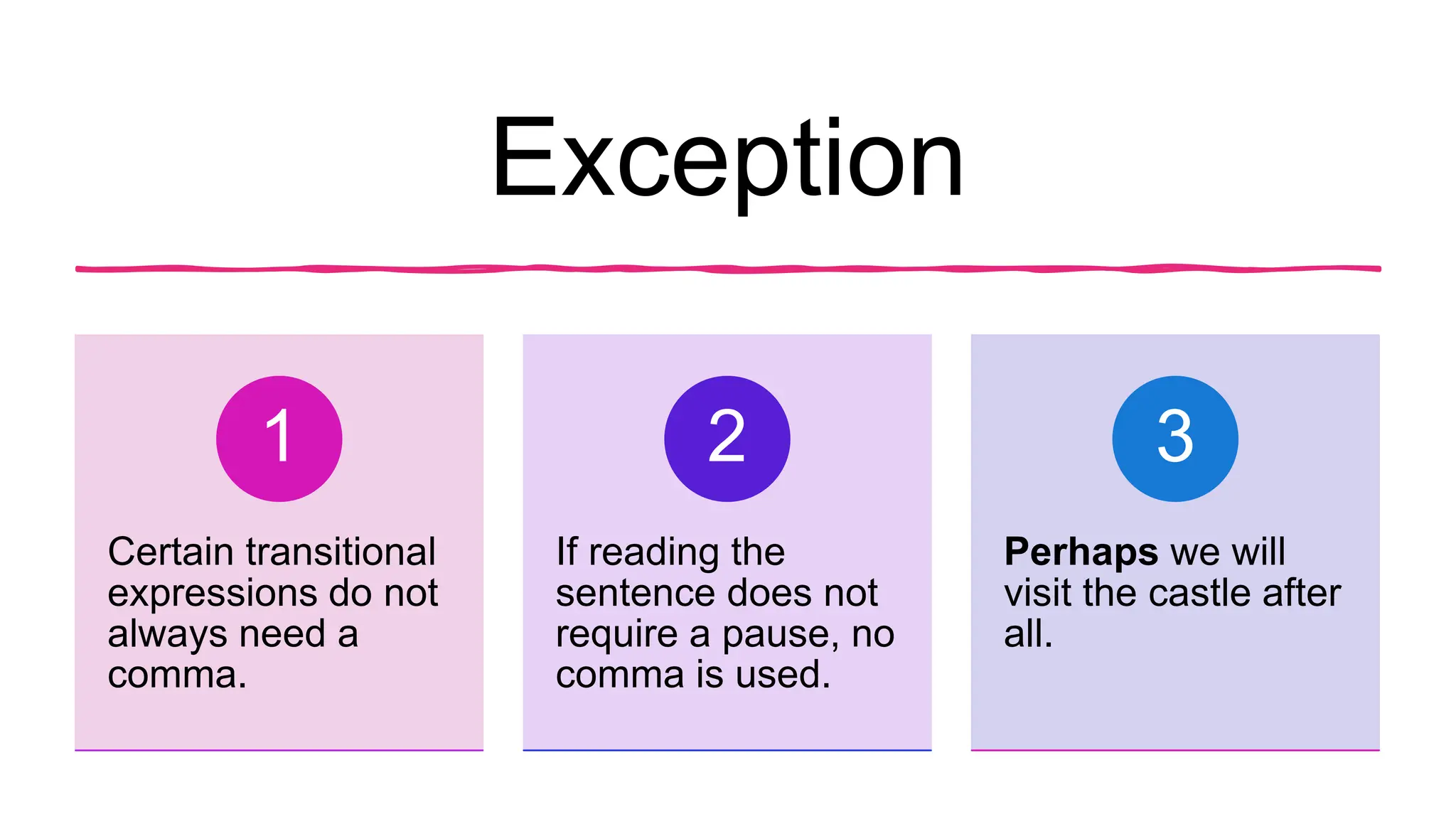
Exception
Certain transitional
expressions do not
always need a
comma.
1
If reading the
sentence does not
require a pause, no
comma is used.
2
Perhaps we will
visit the castle after
all.
3
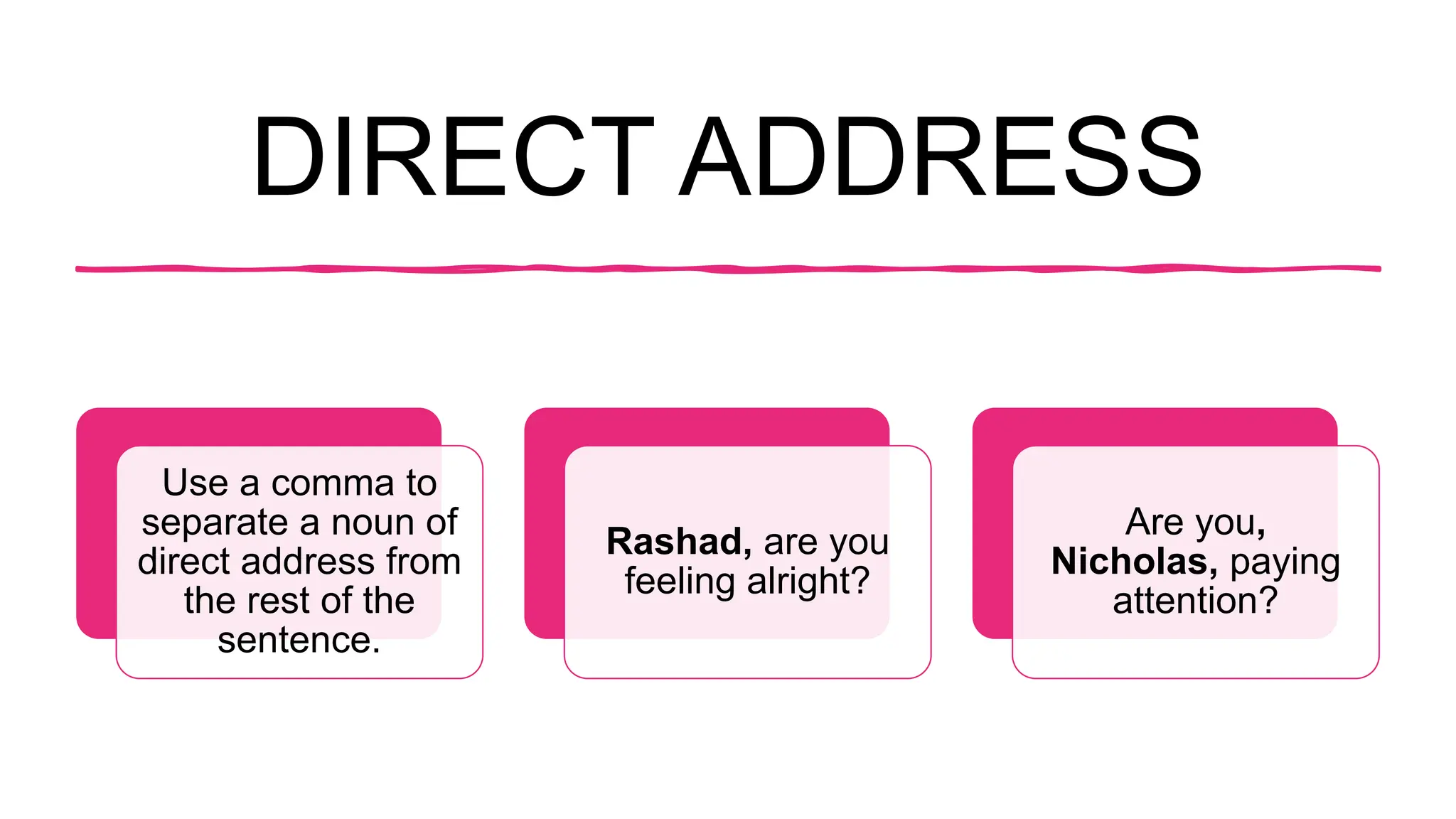
DIRECT ADDRESS
Use a comma to
separate a noun of
direct address from
the rest of the
sentence.
Rashad, are you
feeling alright?
Are you,
Nicholas, paying
attention?
INTERROGATIVE TAGS
Use a comma to separate ending interrogative
tags from the rest of the sentence.
You did read the book, didn't you?
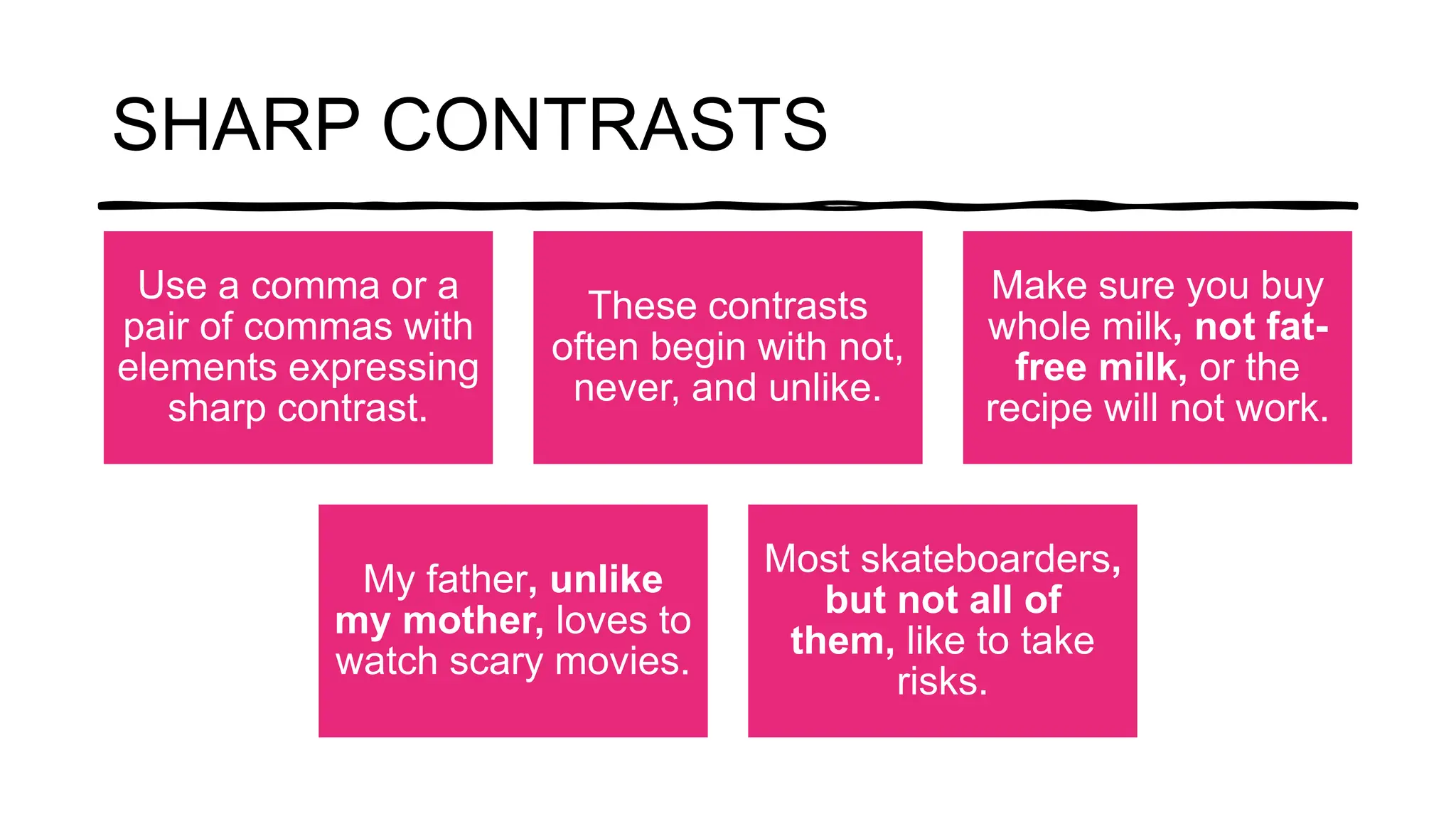
SHARP CONTRASTS
Use a comma or a
pair of commas with
elements expressing
sharp contrast.
These contrasts
often begin with not,
never, and unlike.
Make sure you buy
whole milk, not fat-
free milk, or the
recipe will not work.
My father, unlike
my mother, loves to
watch scary movies.
Most skateboarders,
but not all of
them, like to take
risks.
COMMAS WITH
NONESSENTIAL
ELEMENTS
GENERAL RULE
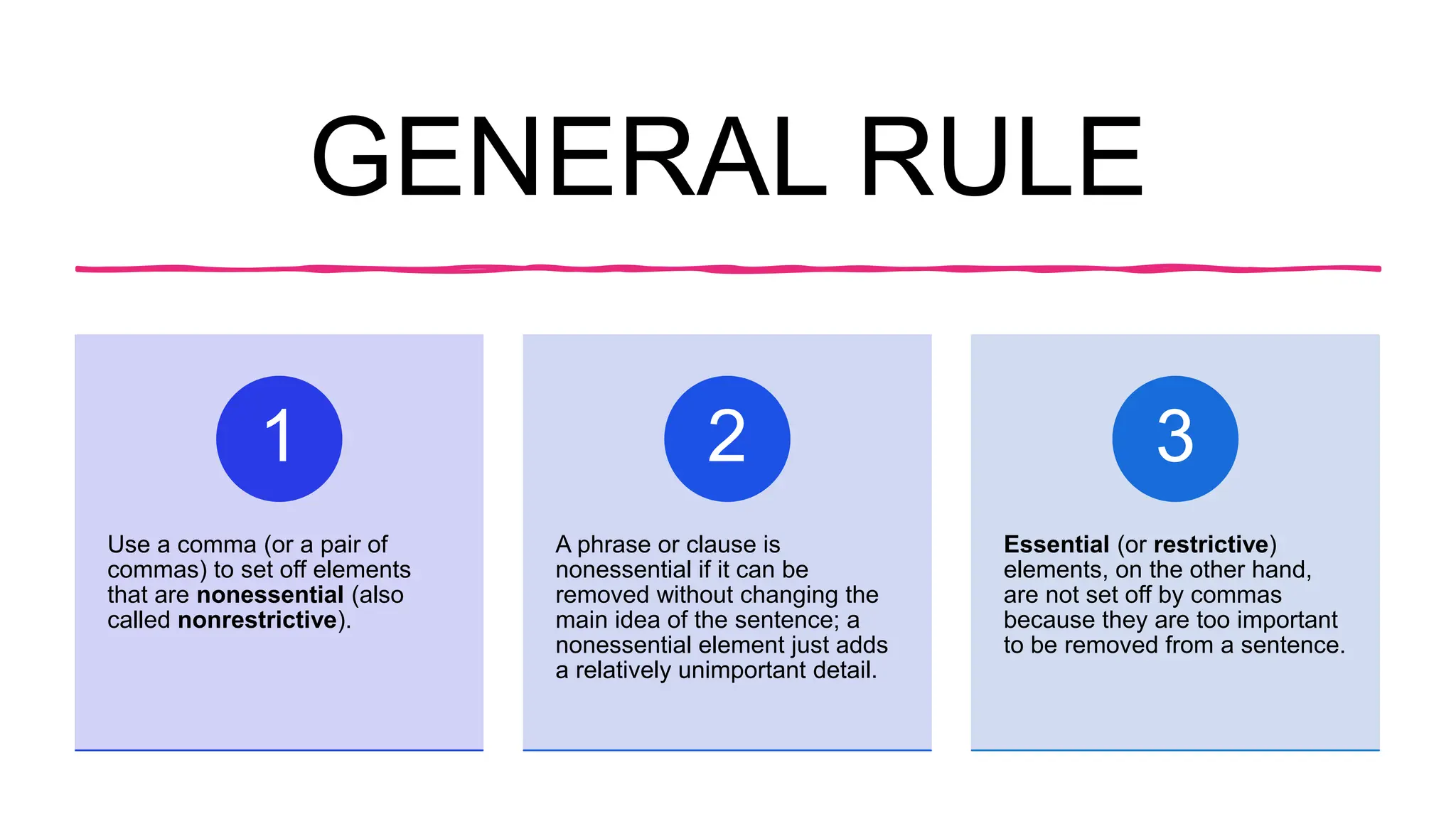
Use a comma (or a pair of
commas) to set off elements
that are nonessential (also
called nonrestrictive).
1
A phrase or clause is
nonessential if it can be
removed without changing the
main idea of the sentence; a
nonessential element just adds
a relatively unimportant detail.
2
Essential (or restrictive)
elements, on the other hand,
are not set off by commas
because they are too important
to be removed from a sentence.
3
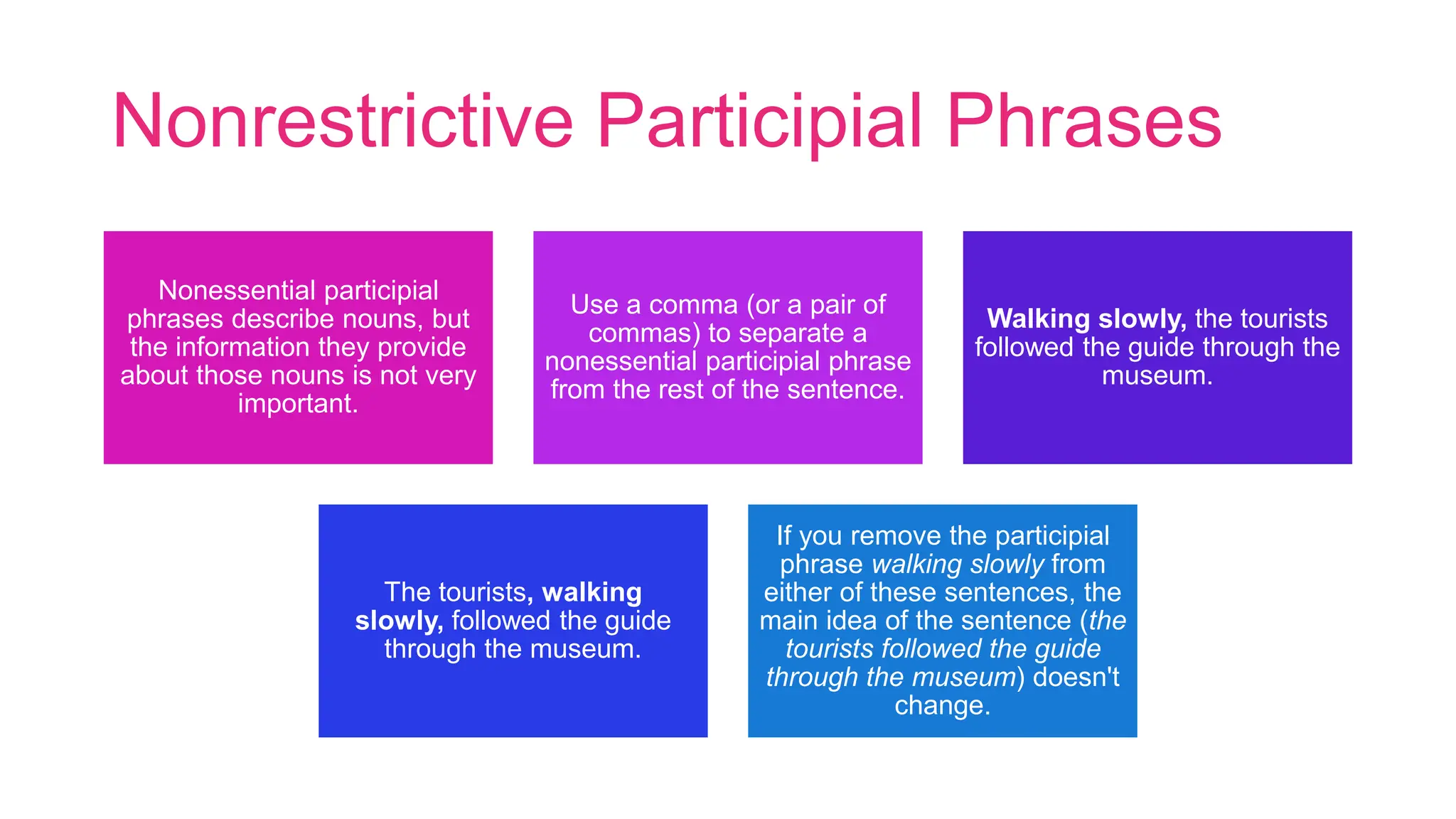
Nonrestrictive Participial Phrases
Nonessential participial
phrases describe nouns, but
the information they provide
about those nouns is not very
important.
Use a comma (or a pair of
commas) to separate a
nonessential participial phrase
from the rest of the sentence.
Walking slowly, the tourists
followed the guide through the
museum.
The tourists, walking
slowly, followed the guide
through the museum.
If you remove the participial
phrase walking slowly from
either of these sentences, the
main idea of the sentence (the
tourists followed the guide
through the museum) doesn't
change.
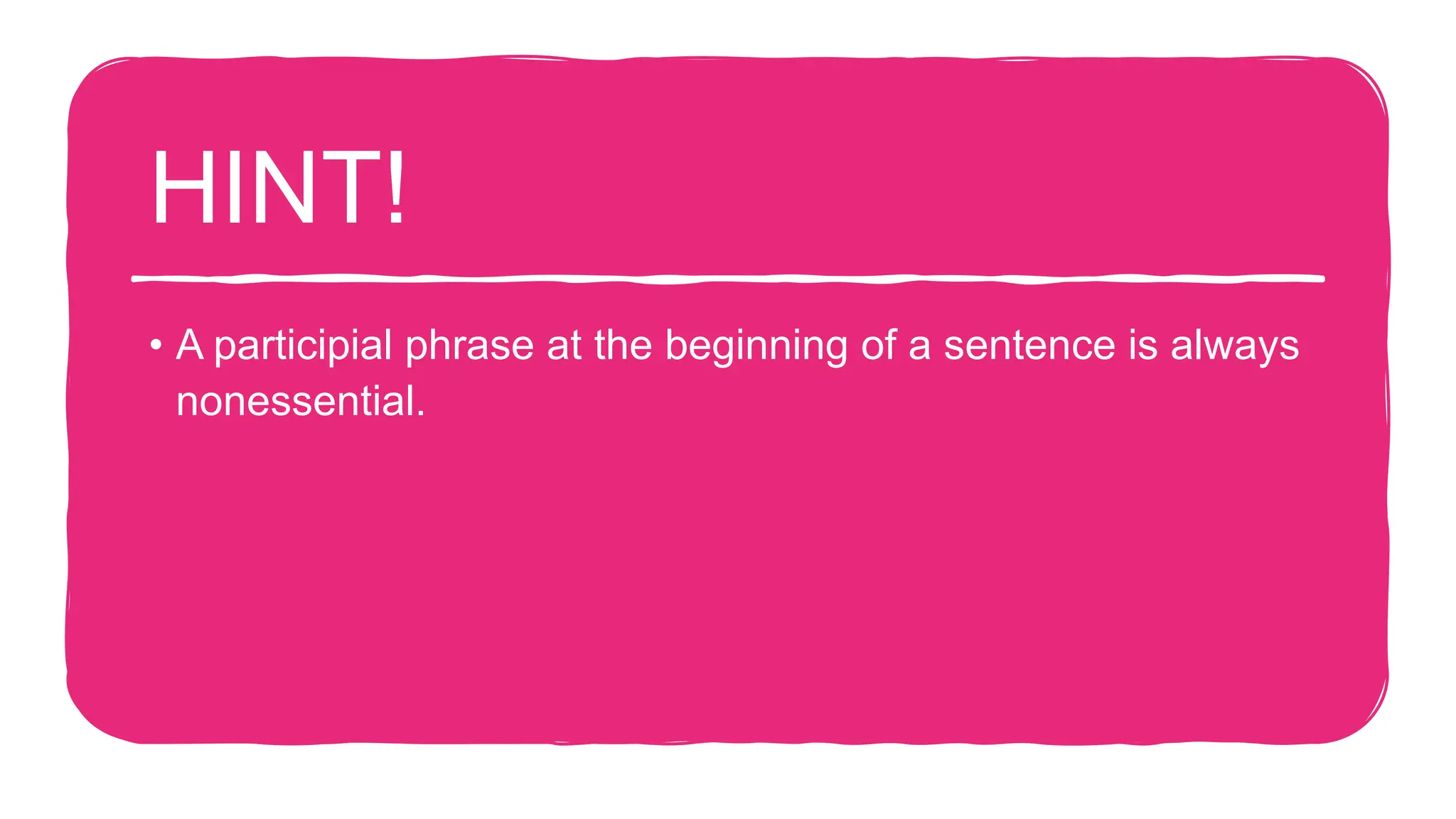
HINT!
• A participial phrase at the beginning of a sentence is always
nonessential.
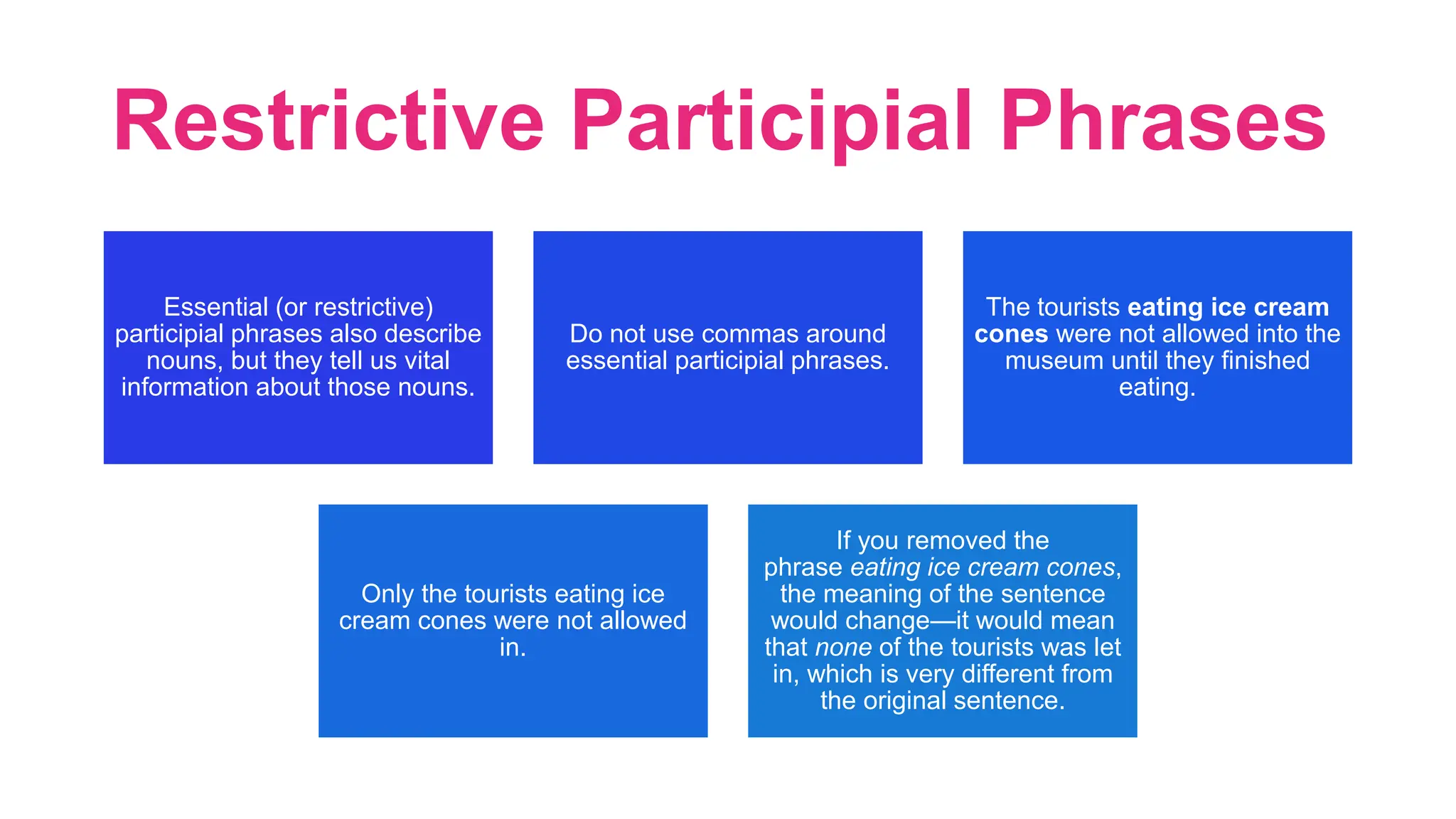
Restrictive Participial Phrases
Essential (or restrictive)
participial phrases also describe
nouns, but they tell us vital
information about those nouns.
Do not use commas around
essential participial phrases.
The tourists eating ice cream
cones were not allowed into the
museum until they finished
eating.
Only the tourists eating ice
cream cones were not allowed
in.
If you removed the
phrase eating ice cream cones,
the meaning of the sentence
would change—it would mean
that none of the tourists was let
in, which is very different from
the original sentence.
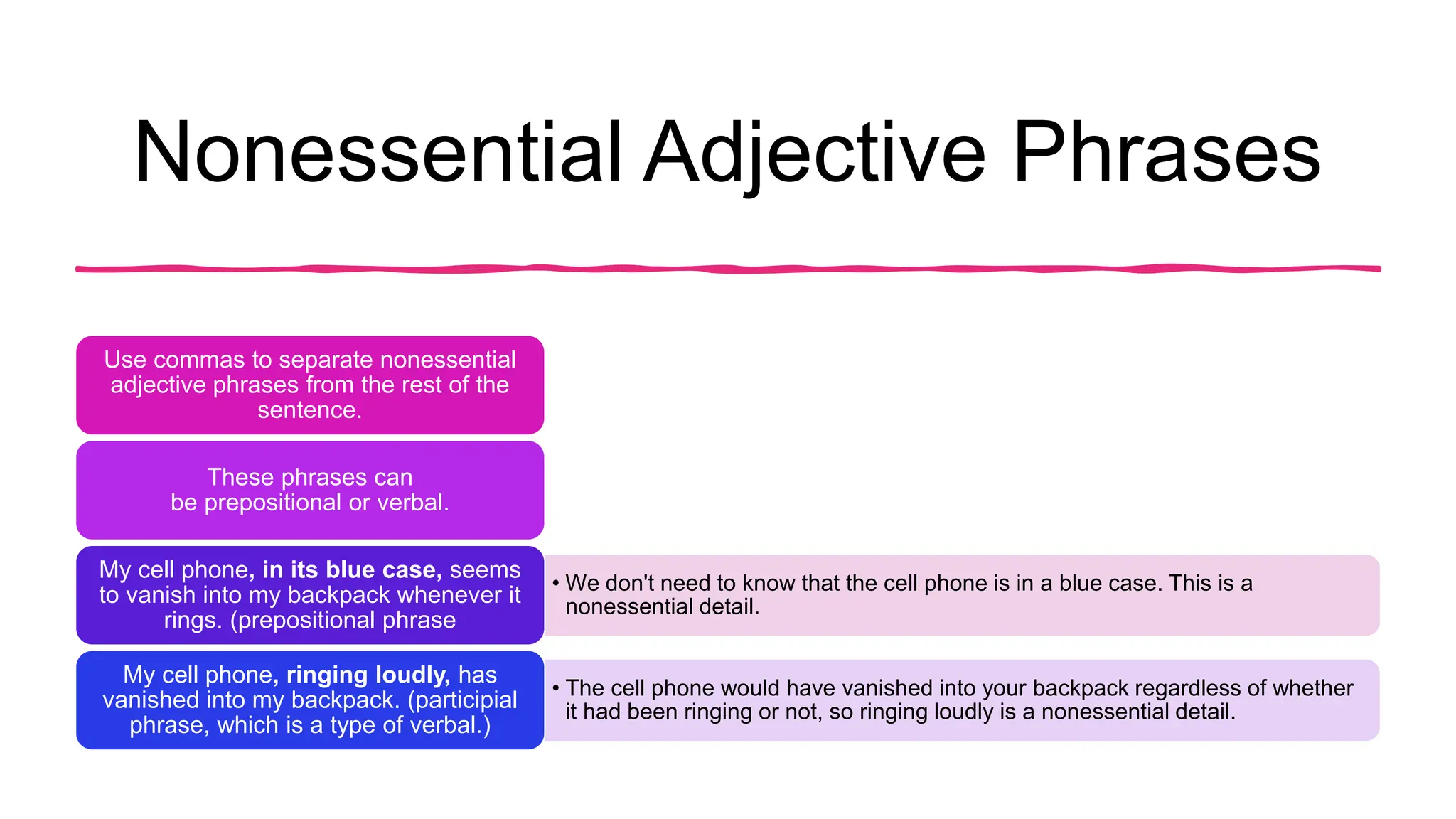
Nonessential Adjective Phrases
Use commas to separate nonessential
adjective phrases from the rest of the
sentence.
These phrases can
be prepositional or verbal.
• We don't need to know that the cell phone is in a blue case. This is a
nonessential detail.
My cell phone, in its blue case, seems
to vanish into my backpack whenever it
rings. (prepositional phrase
• The cell phone would have vanished into your backpack regardless of whether
it had been ringing or not, so ringing loudly is a nonessential detail.
My cell phone, ringing loudly, has
vanished into my backpack. (participial
phrase, which is a type of verbal.)
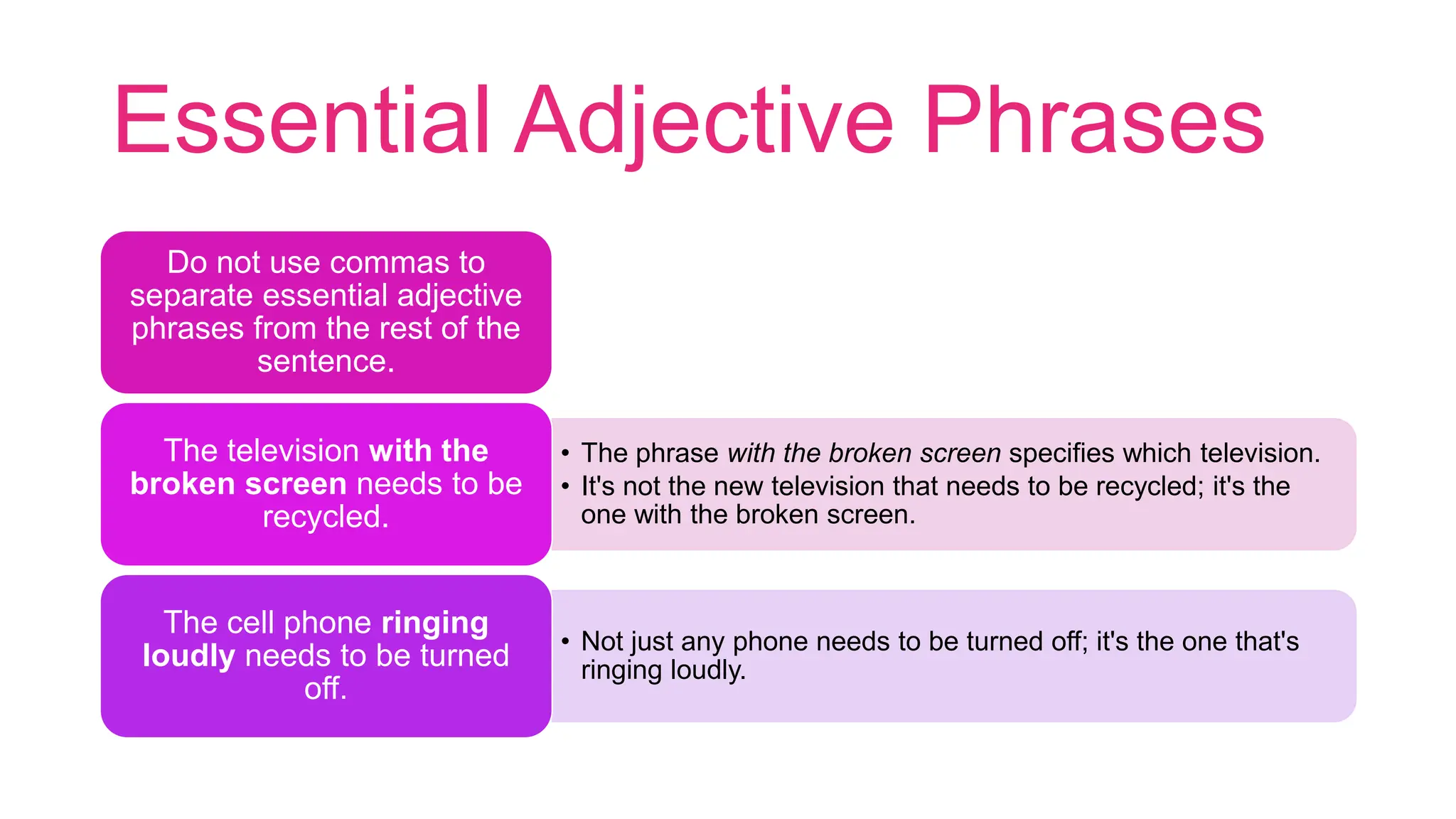
Essential Adjective Phrases
Do not use commas to
separate essential adjective
phrases from the rest of the
sentence.
• The phrase with the broken screen specifies which television.
• It's not the new television that needs to be recycled; it's the
one with the broken screen.
The television with the
broken screen needs to be
recycled.
• Not just any phone needs to be turned off; it's the one that's
ringing loudly.
The cell phone ringing
loudly needs to be turned
off.
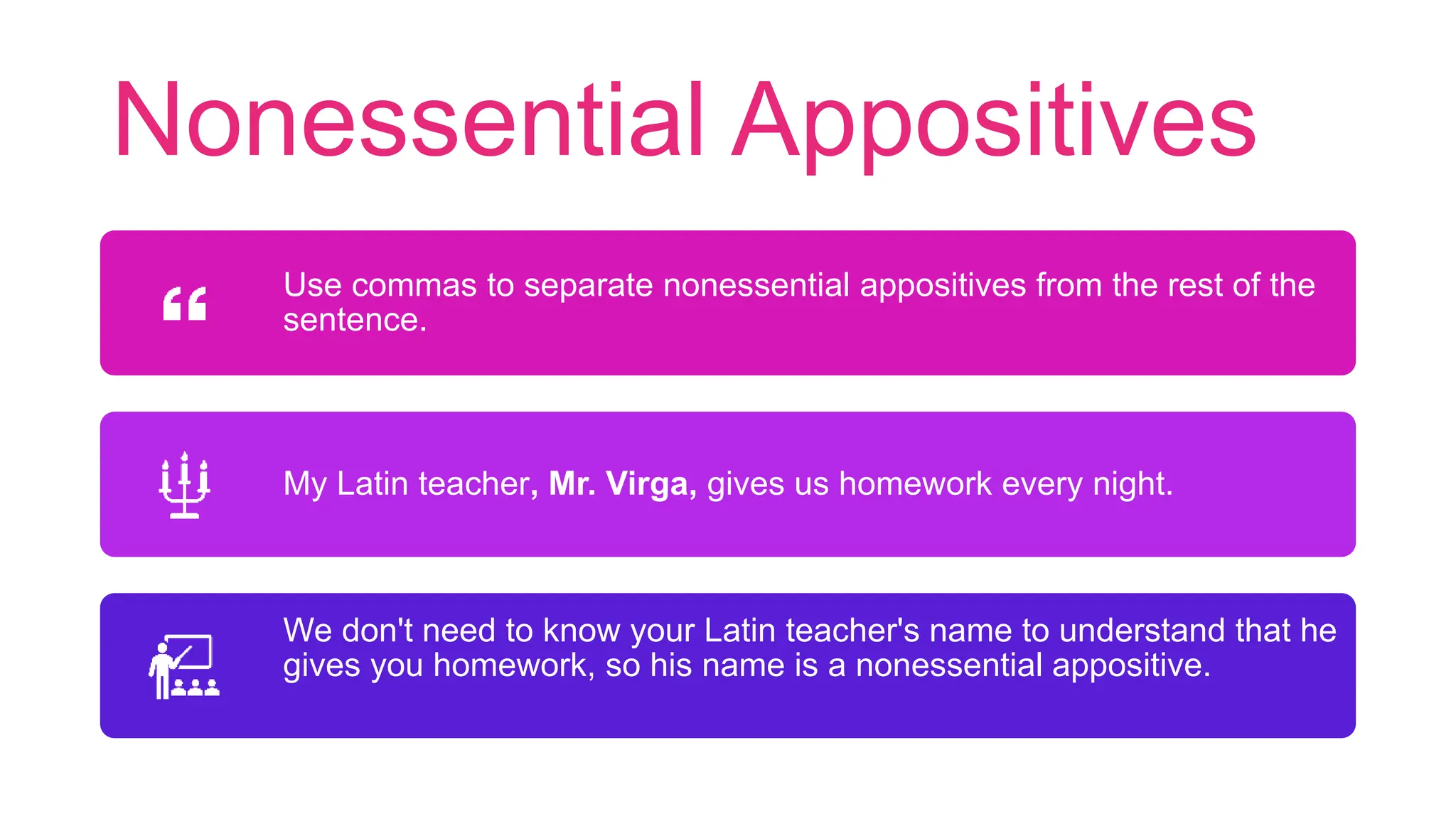
Nonessential Appositives
Use commas to separate nonessential appositives from the rest of the
sentence.
My Latin teacher, Mr. Virga, gives us homework every night.
We don't need to know your Latin teacher's name to understand that he
gives you homework, so his name is a nonessential appositive.
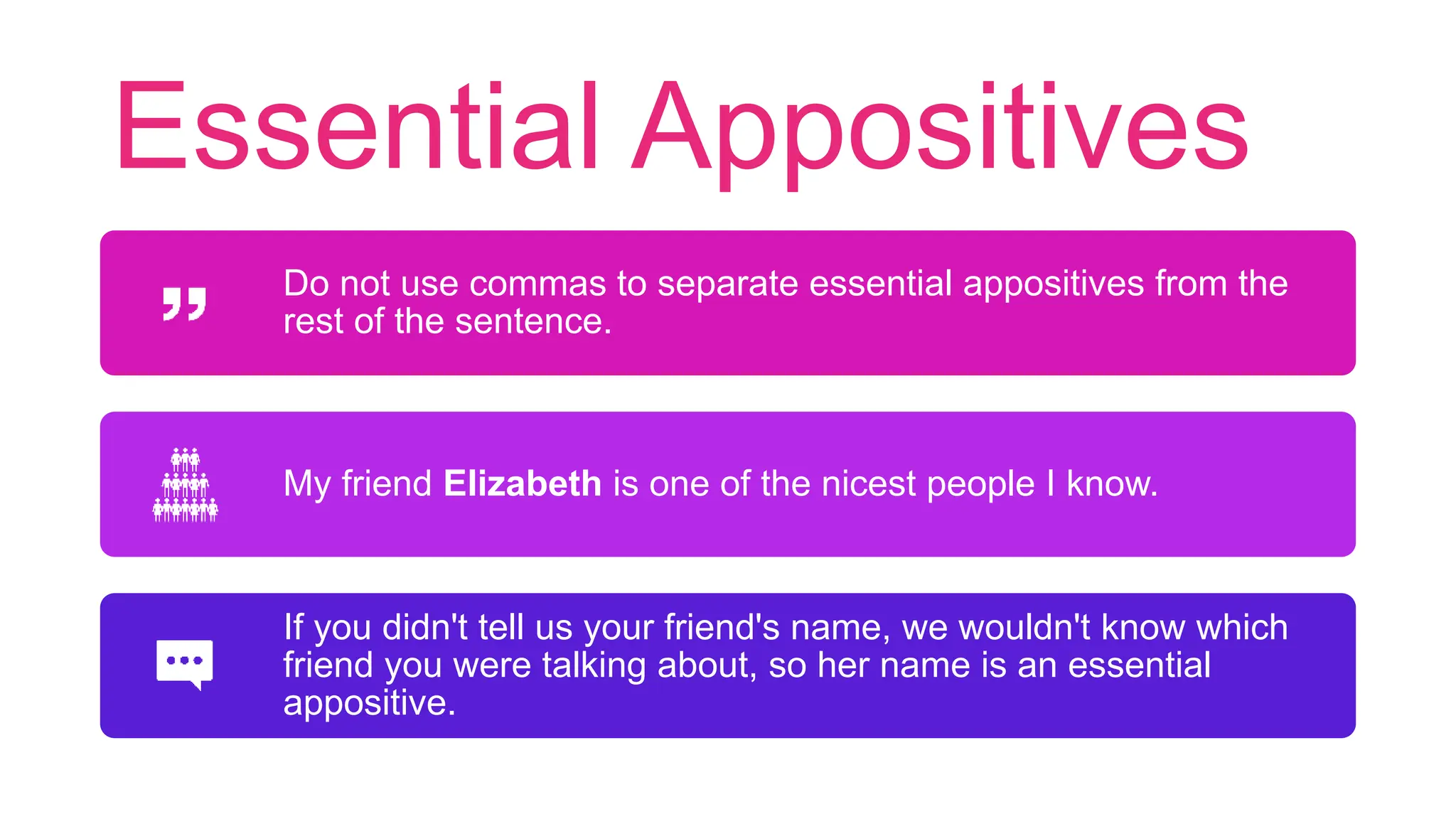
Essential Appositives
Do not use commas to separate essential appositives from the
rest of the sentence.
My friend Elizabeth is one of the nicest people I know.
If you didn't tell us your friend's name, we wouldn't know which
friend you were talking about, so her name is an essential
appositive.
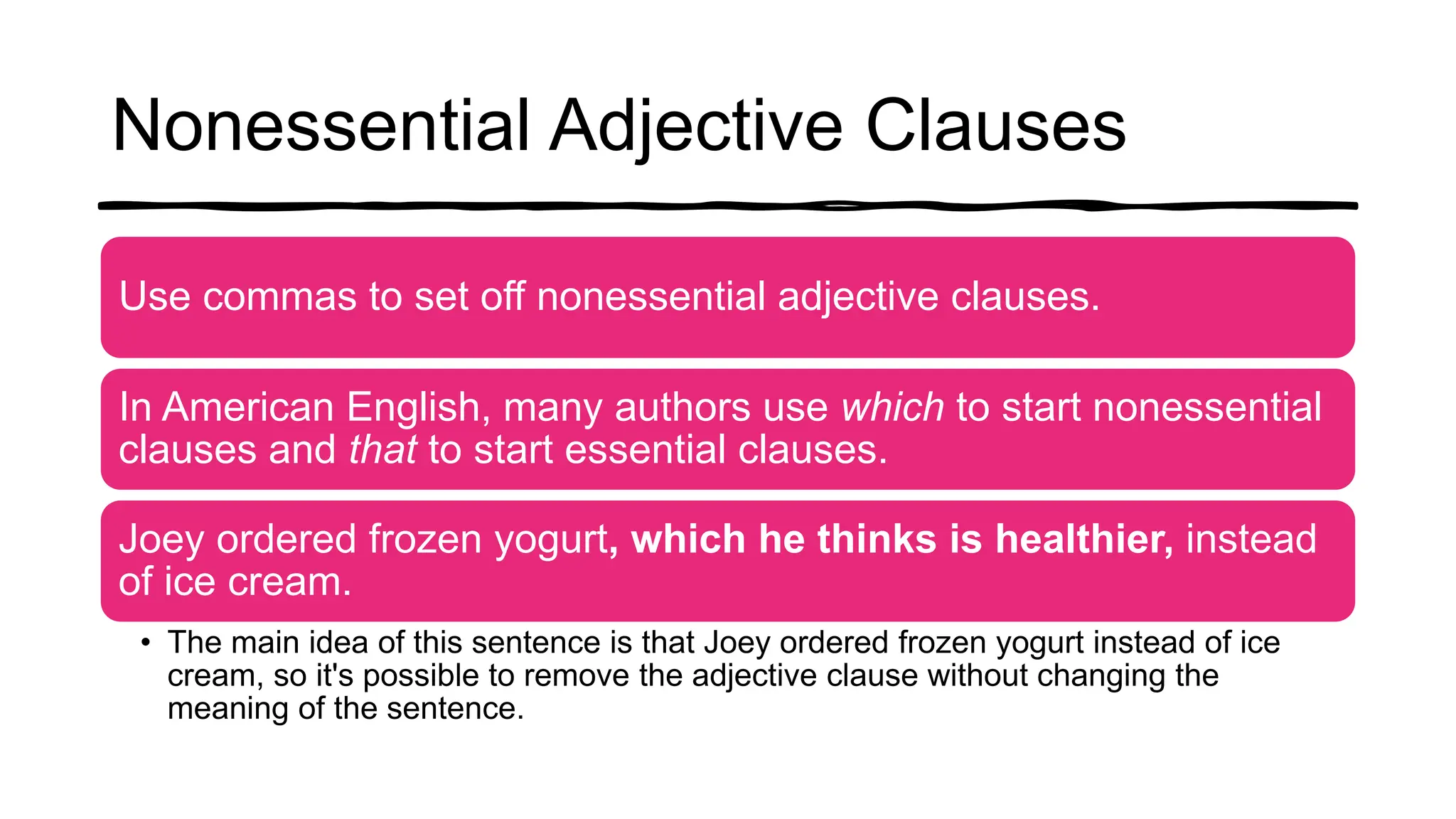
Nonessential Adjective Clauses
Use commas to set off nonessential adjective clauses.
In American English, many authors use which to start nonessential
clauses and that to start essential clauses.
Joey ordered frozen yogurt, which he thinks is healthier, instead
of ice cream.
• The main idea of this sentence is that Joey ordered frozen yogurt instead of ice
cream, so it's possible to remove the adjective clause without changing the
meaning of the sentence.
Essential Adjective Clauses
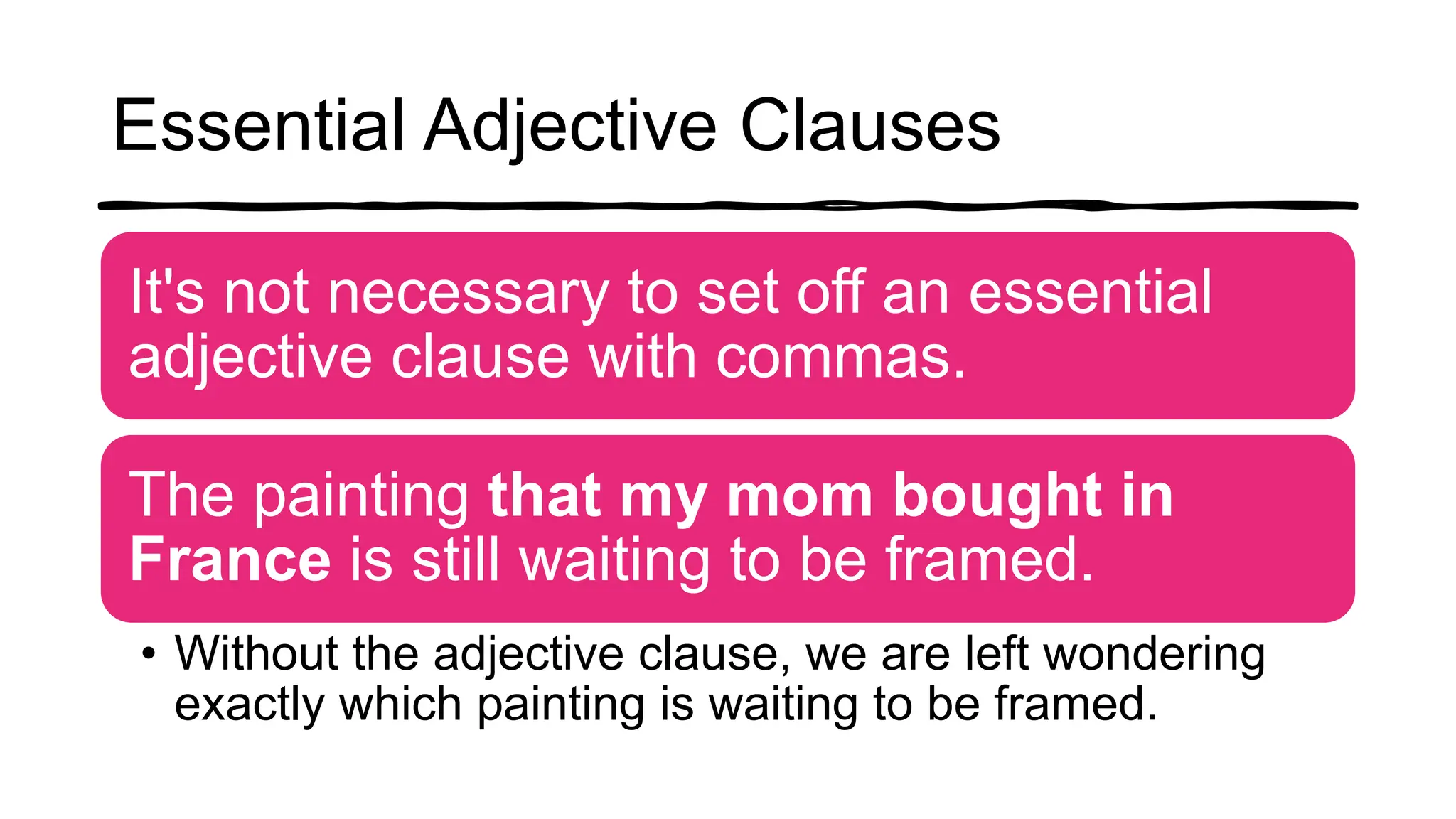
It's not necessary to set off an essential
adjective clause with commas.
The painting that my mom bought in
France is still waiting to be framed.
• Without the adjective clause, we are left wondering
exactly which painting is waiting to be framed.
Using Commas to
Avoid the Absurd
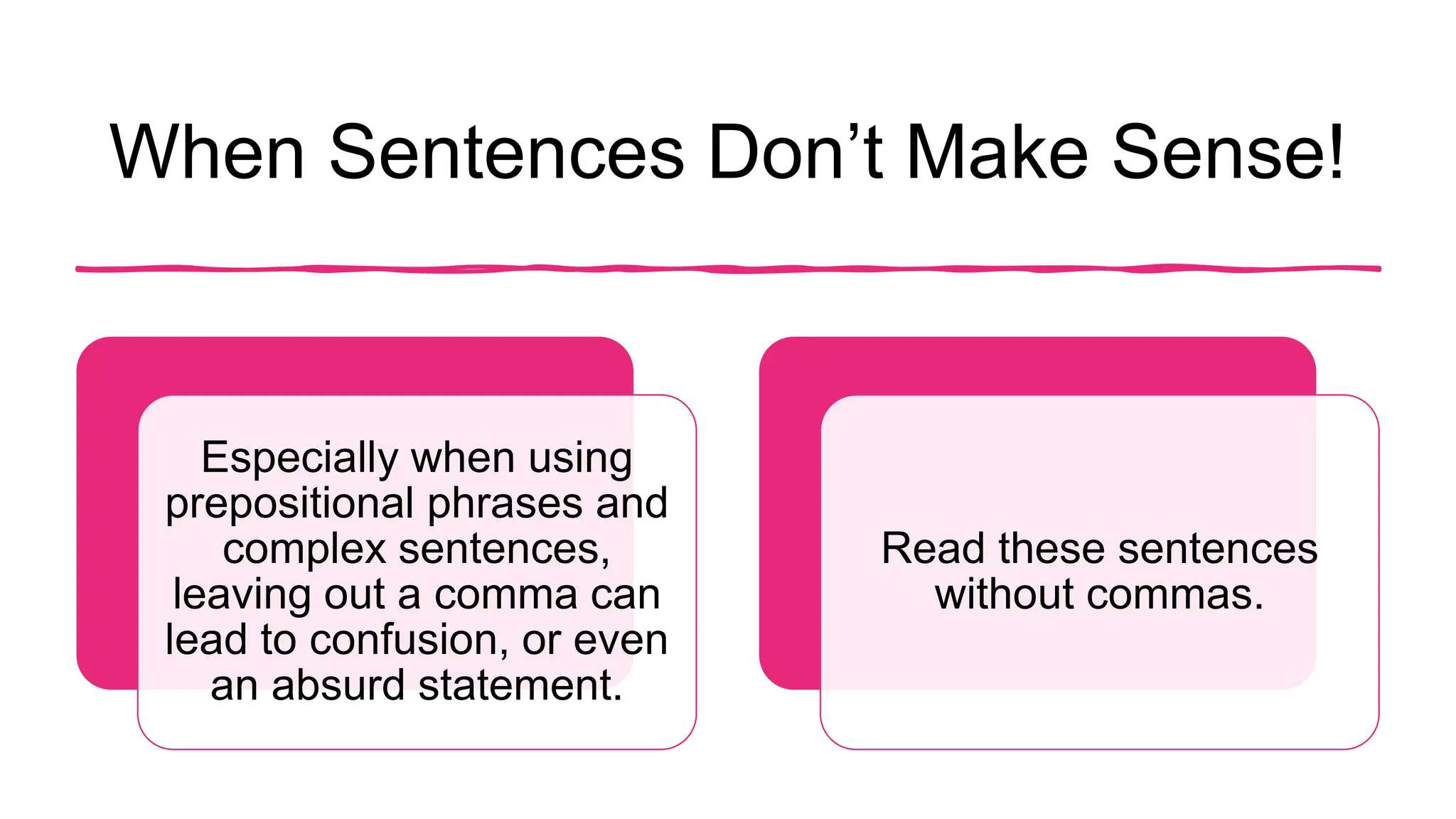
When Sentences Don’t Make Sense!
Especially when using
prepositional phrases and
complex sentences,
leaving out a comma can
lead to confusion, or even
an absurd statement.
Read these sentences
without commas.
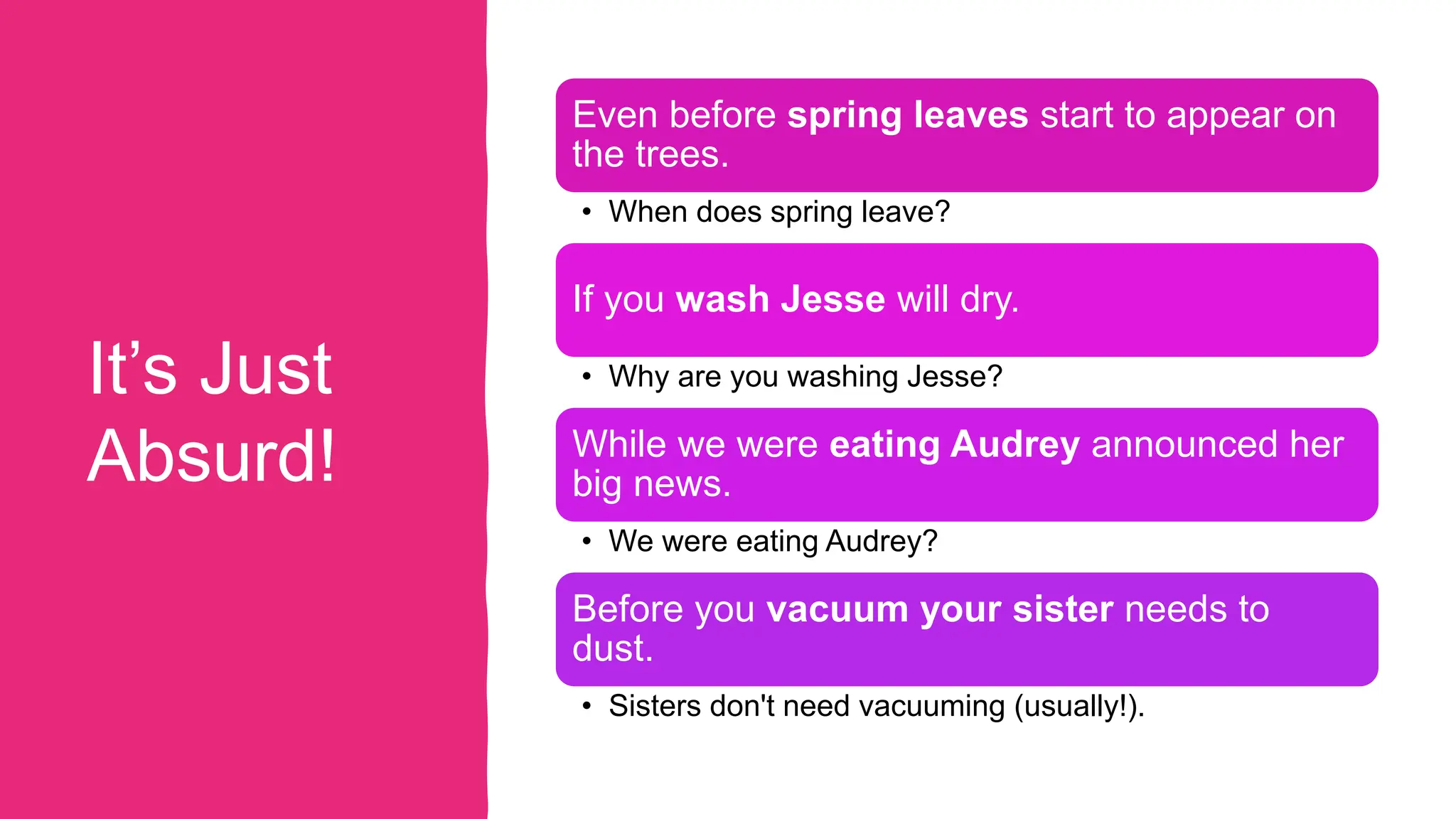
It’s Just
Absurd!
Even before spring leaves start to appear on
the trees.
• When does spring leave?
If you wash Jesse will dry.
• Why are you washing Jesse?
While we were eating Audrey announced her
big news.
• We were eating Audrey?
Before you vacuum your sister needs to
dust.
• Sisters don't need vacuuming (usually!).
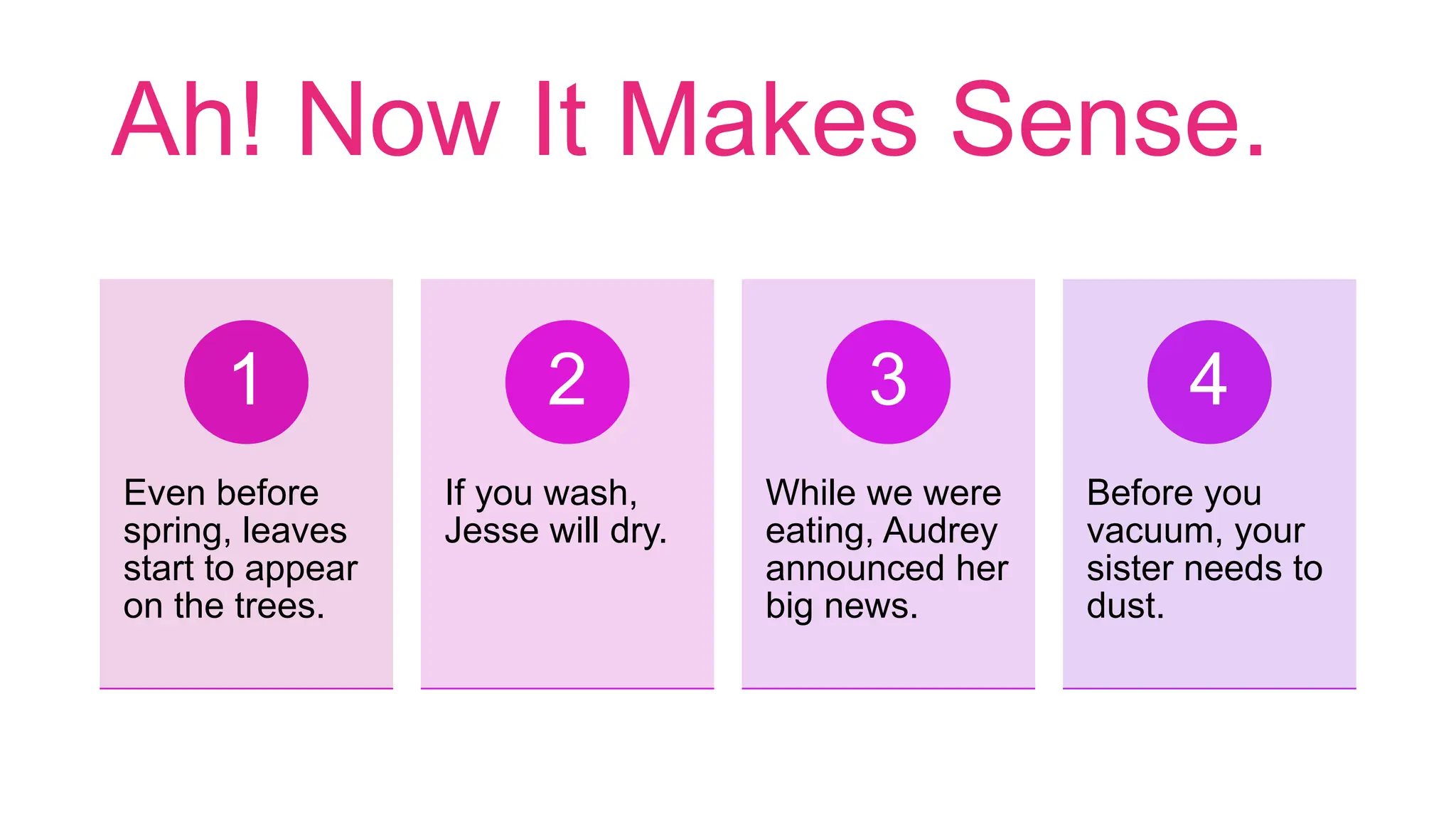
Ah! Now It Makes Sense.
Even before
spring, leaves
start to appear
on the trees.
1
If you wash,
Jesse will dry.
2
While we were
eating, Audrey
announced her
big news.
3
Before you
vacuum, your
sister needs to
dust.
4
Comma
Conventions
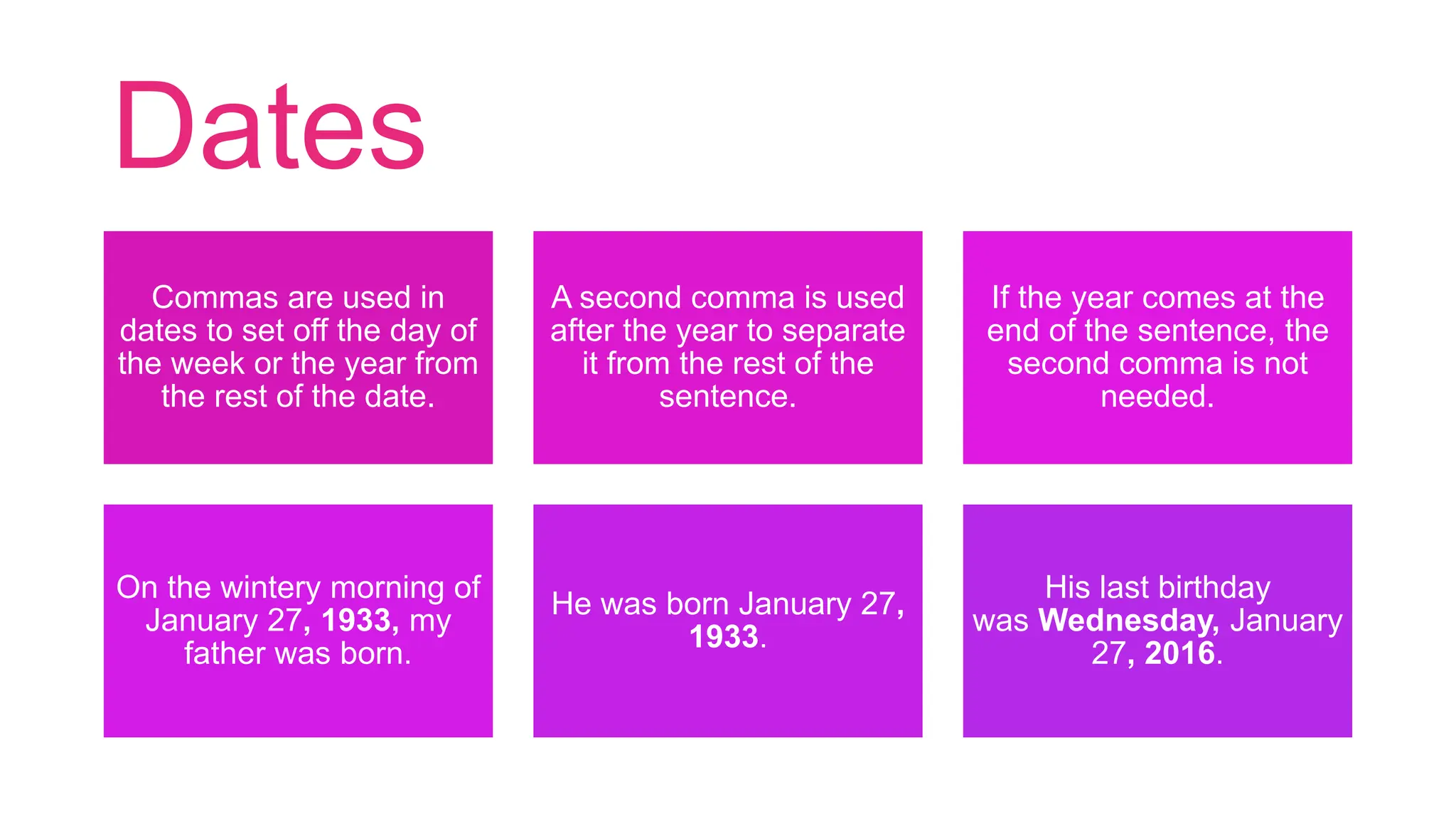
Dates
Commas are used in
dates to set off the day of
the week or the year from
the rest of the date.
A second comma is used
after the year to separate
it from the rest of the
sentence.
If the year comes at the
end of the sentence, the
second comma is not
needed.
On the wintery morning of
January 27, 1933, my
father was born.
He was born January 27,
1933.
His last birthday
was Wednesday, January
27, 2016.
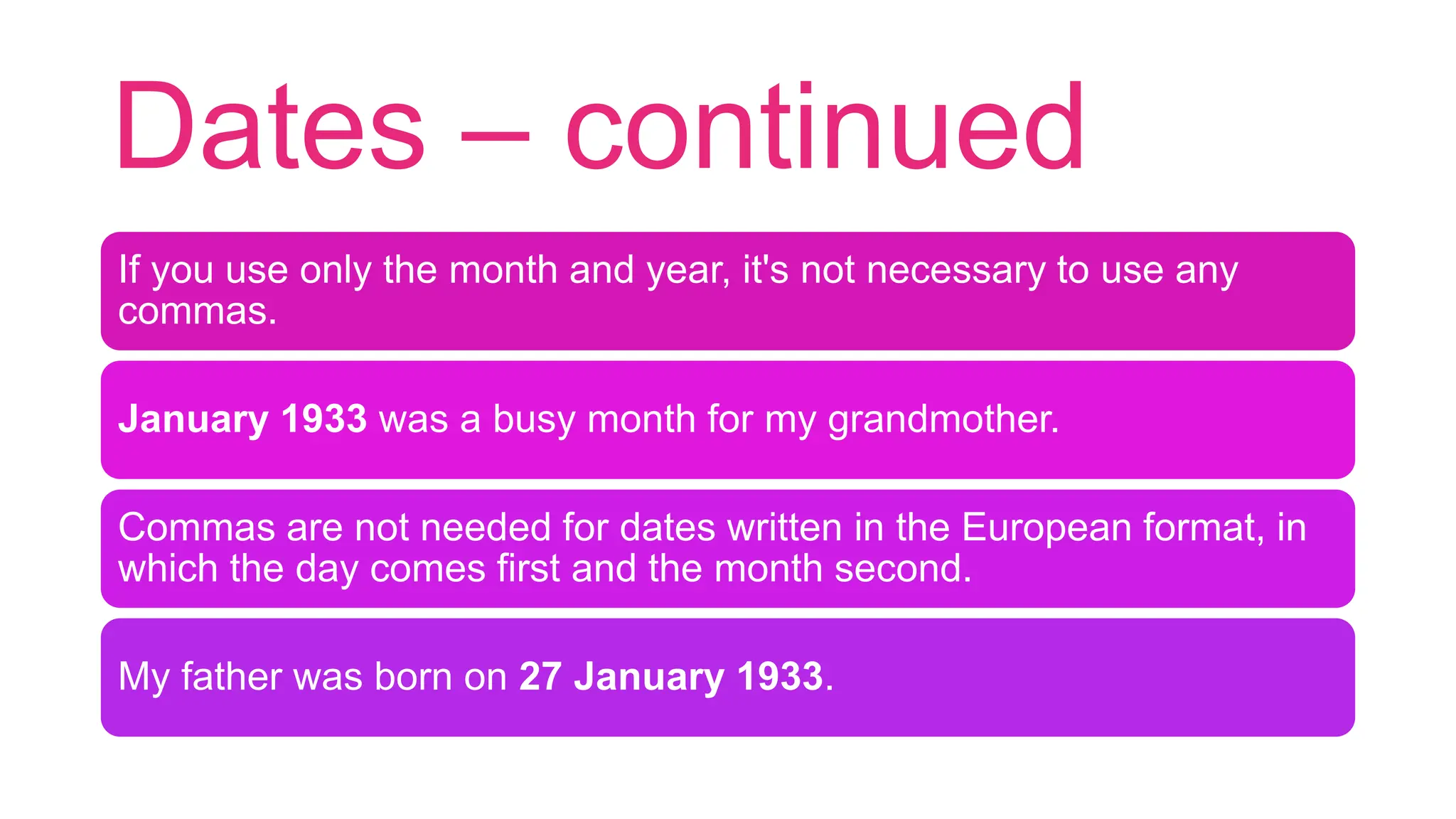
Dates – continued
If you use only the month and year, it's not necessary to use any
commas.
January 1933 was a busy month for my grandmother.
Commas are not needed for dates written in the European format, in
which the day comes first and the month second.
My father was born on 27 January 1933.
Addresses
When writing a city and
state, the state is set off
from the rest of the
sentence by a pair of
commas.
I was visiting
Naples,
Florida, last
weekend.
If the state comes at the
end of the sentence, the
second comma is not
needed.
Last weekend I
was visiting
Naples,
Florida.
Addresses – continued
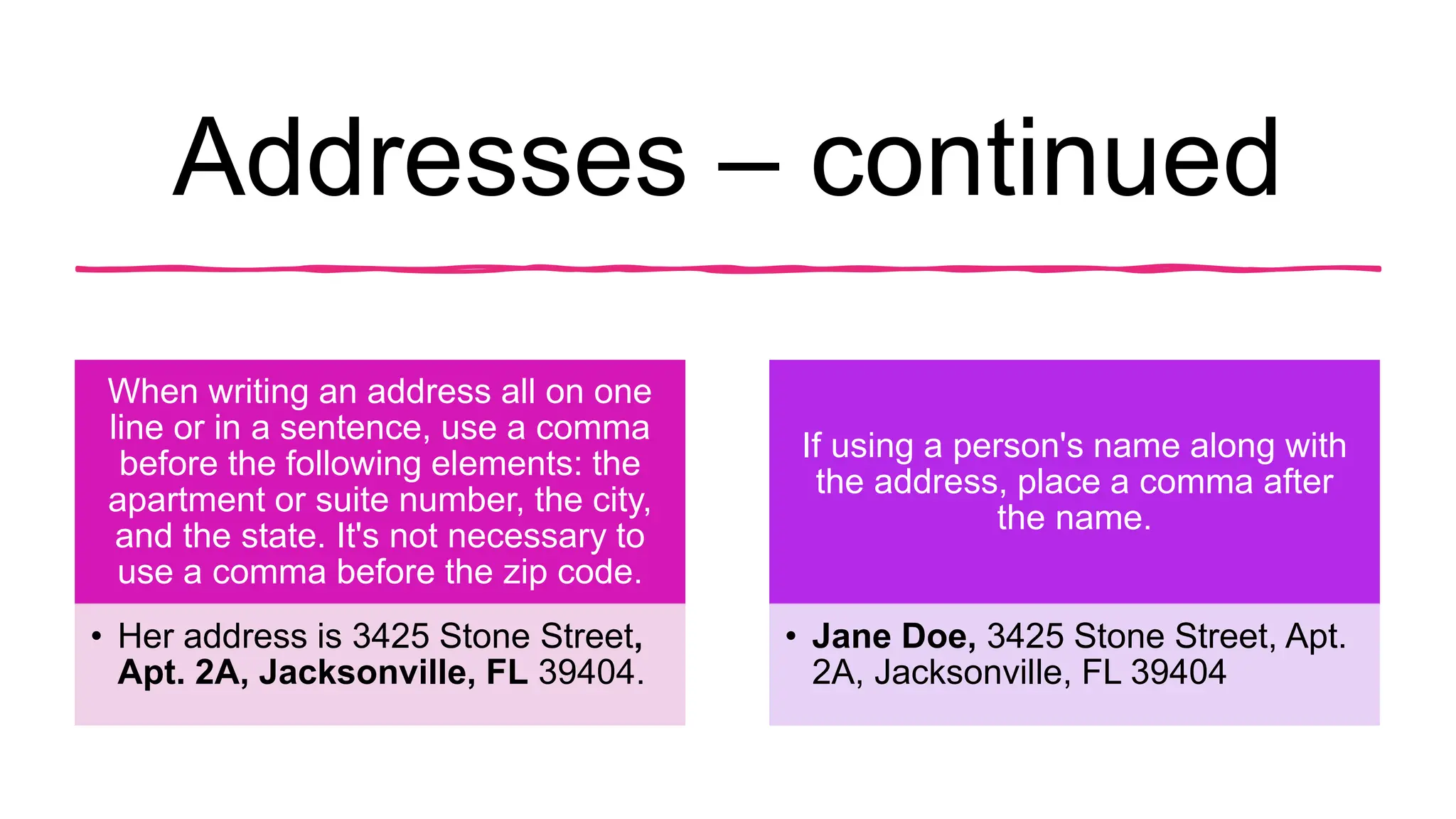
When writing an address all on one
line or in a sentence, use a comma
before the following elements: the
apartment or suite number, the city,
and the state. It's not necessary to
use a comma before the zip code.
• Her address is 3425 Stone Street,
Apt. 2A, Jacksonville, FL 39404.
If using a person's name along with
the address, place a comma after
the name.
• Jane Doe, 3425 Stone Street, Apt.
2A, Jacksonville, FL 39404
Addresses – continued
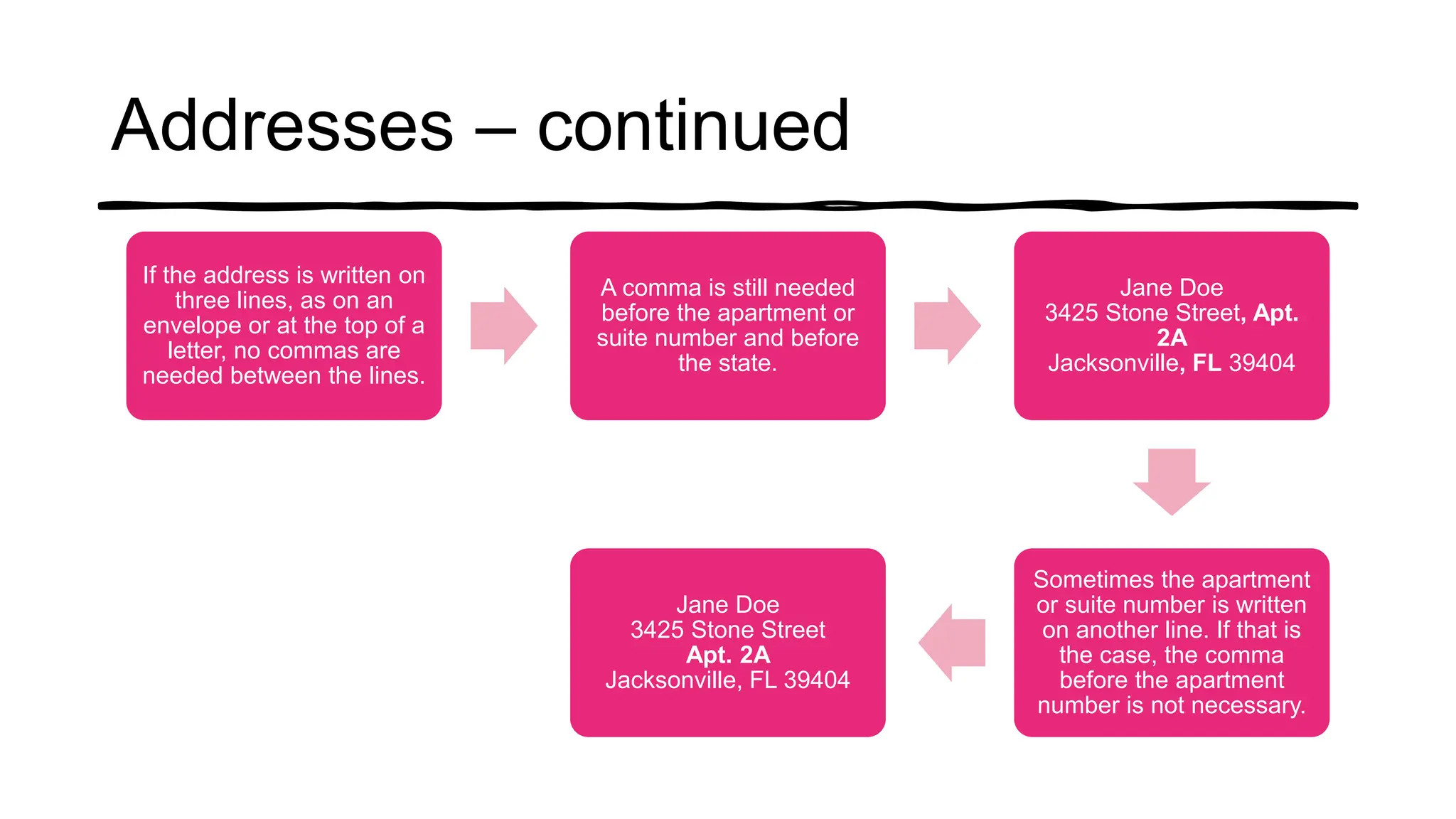
If the address is written on
three lines, as on an
envelope or at the top of a
letter, no commas are
needed between the lines.
A comma is still needed
before the apartment or
suite number and before
the state.
Jane Doe
3425 Stone Street, Apt.
2A
Jacksonville, FL 39404
Sometimes the apartment
or suite number is written
on another line. If that is
the case, the comma
before the apartment
number is not necessary.
Jane Doe
3425 Stone Street
Apt. 2A
Jacksonville, FL 39404
Titles
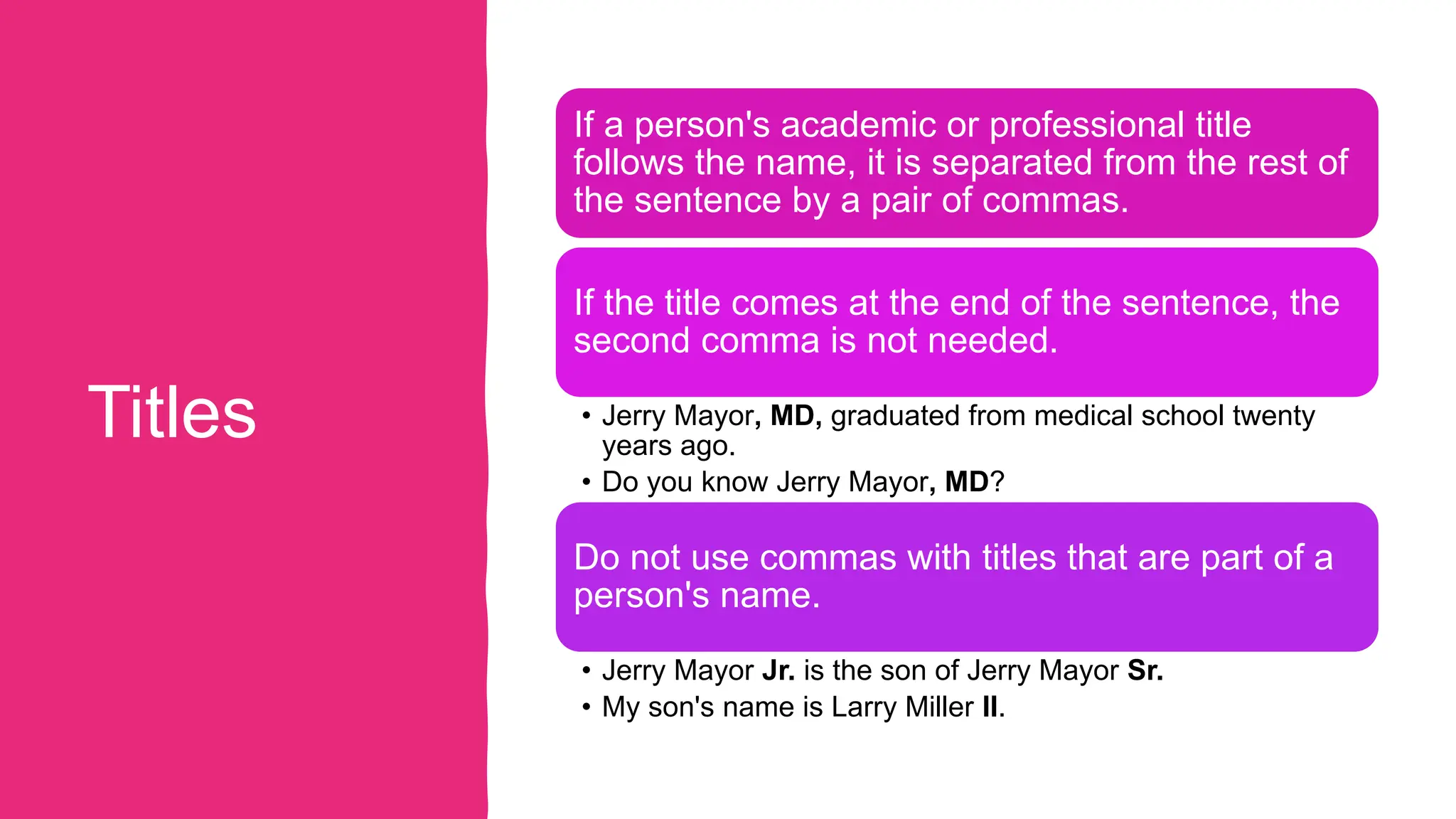
If a person's academic or professional title
follows the name, it is separated from the rest of
the sentence by a pair of commas.
If the title comes at the end of the sentence, the
second comma is not needed.
• Jerry Mayor, MD, graduated from medical school twenty
years ago.
• Do you know Jerry Mayor, MD?
Do not use commas with titles that are part of a
person's name.
• Jerry Mayor Jr. is the son of Jerry Mayor Sr.
• My son's name is Larry Miller II.
Numbers
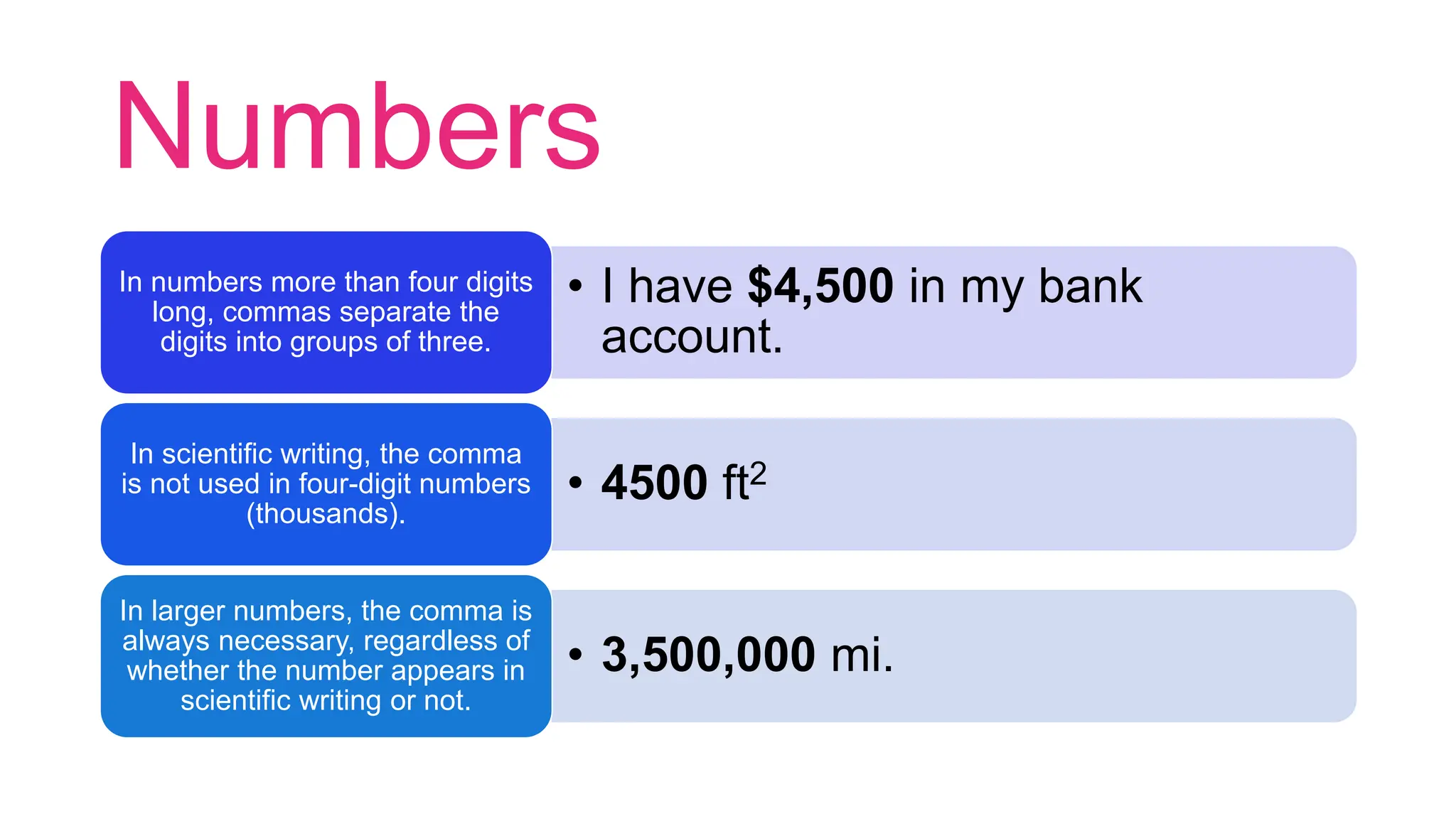
• I have $4,500 in my bank
account.
In numbers more than four digits
long, commas separate the
digits into groups of three.
• 4500 ft2
In scientific writing, the comma
is not used in four-digit numbers
(thousands).
• 3,500,000 mi.
In larger numbers, the comma is
always necessary, regardless of
whether the number appears in
scientific writing or not.
Hint!
• In order to figure out where to place
commas in a large number, count
backwards in groups of three digits,
not forwards.
Numbers
–
continued
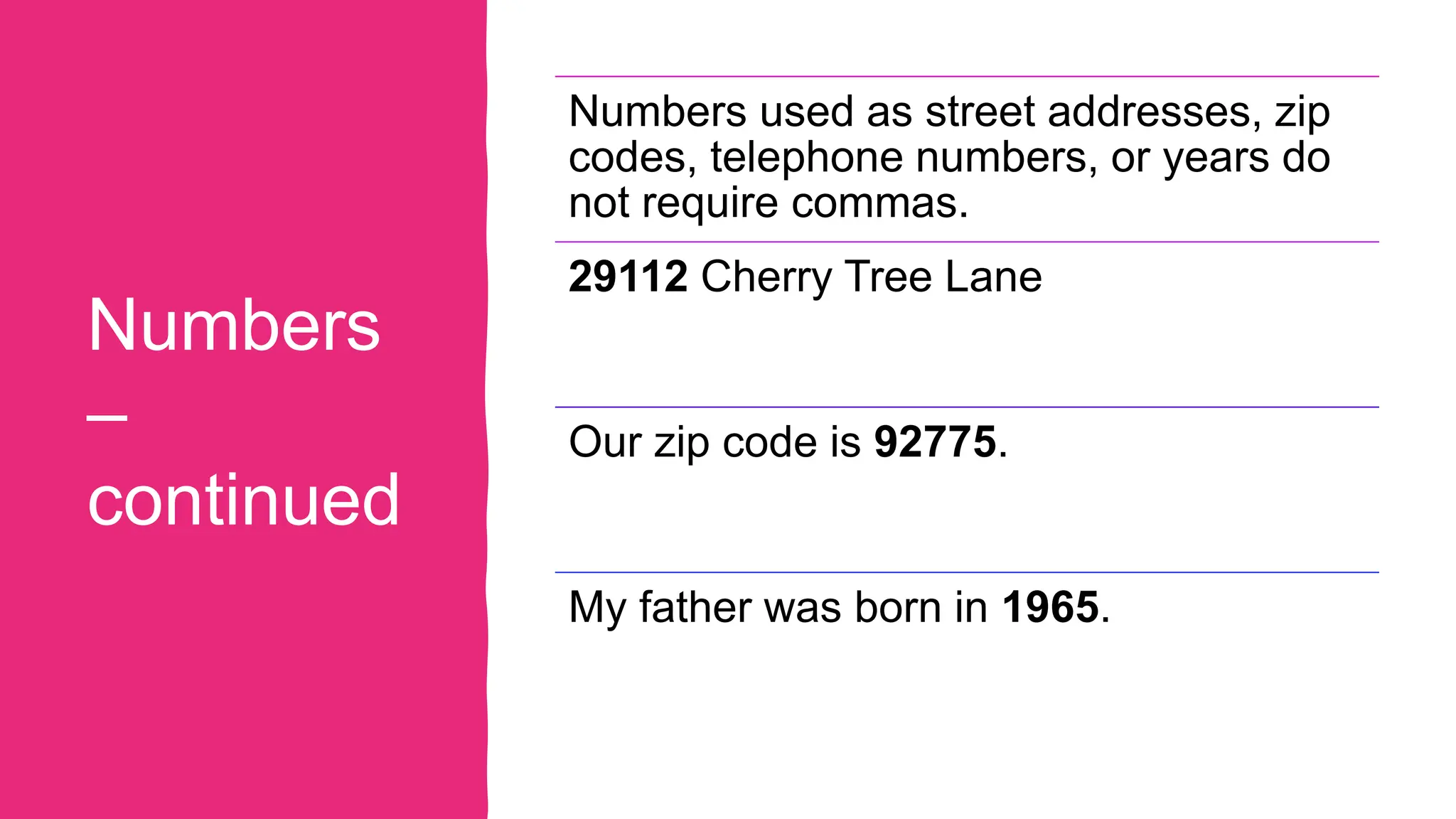
Numbers used as street addresses, zip
codes, telephone numbers, or years do
not require commas.
29112 Cherry Tree Lane
Our zip code is 92775.
My father was born in 1965.
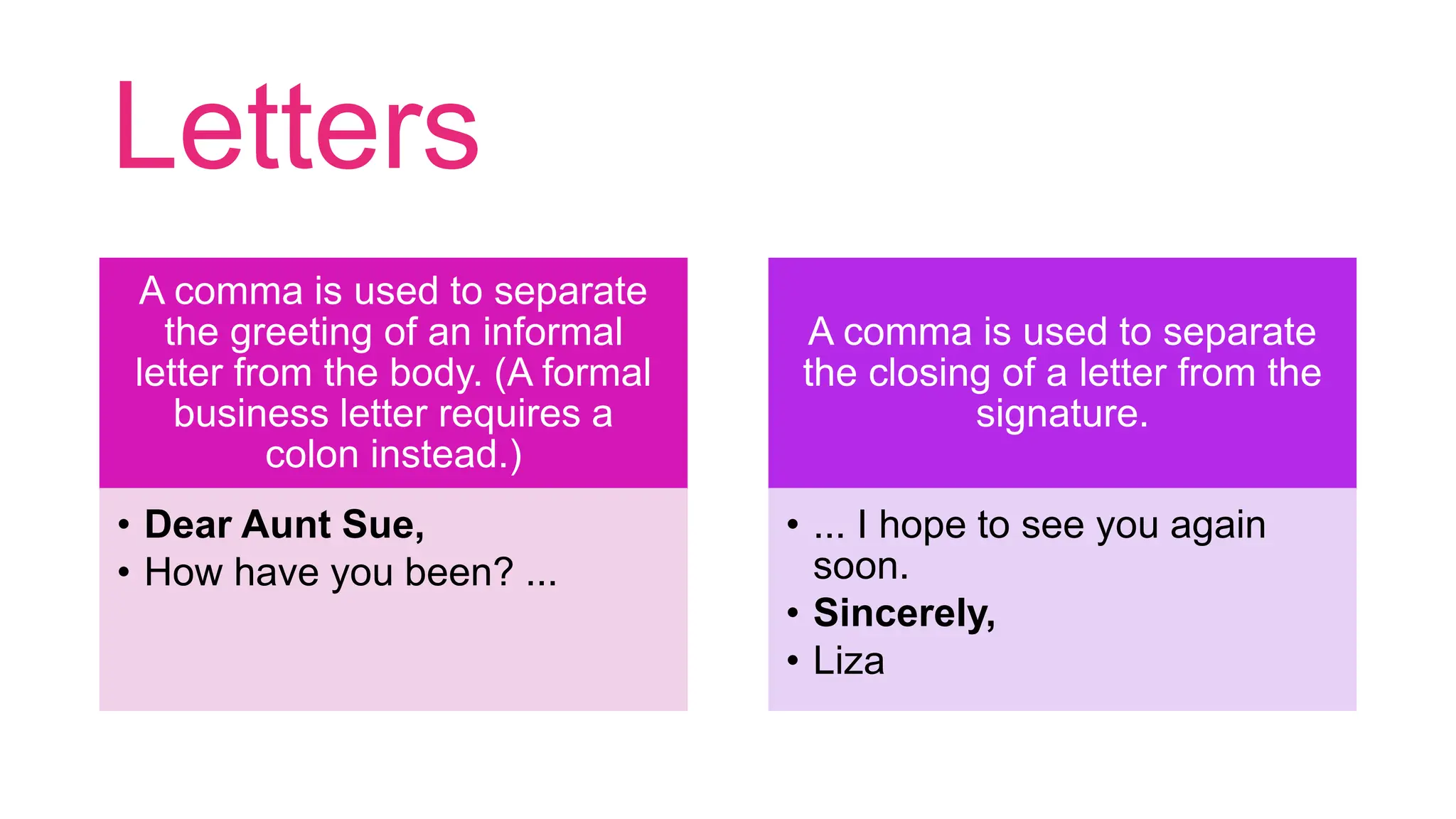
Letters
A comma is used to separate
the greeting of an informal
letter from the body. (A formal
business letter requires a
colon instead.)
• Dear Aunt Sue,
• How have you been? ...
A comma is used to separate
the closing of a letter from the
signature.
• ... I hope to see you again
soon.
• Sincerely,
• Liza
Punctuation - How to Use Commas Correctly

Punctuation - How to Use Commas Correctly

  • 1.
  • 2.
    What is a Comma? Acomma separates elements in a sentence, such as items in a list or series, but it also shows that those elements are connected to each other within the same sentence. A comma is never used as an end mark, and it is read with a shorter pause than an end mark. One use of the comma is to separate three or more words, phrases, or clauses in a list or series. Commas go after each item except the last.
  • 3.
  • 4.
    Words in a Series You needto get out your pencil, paper, and textbook. I will need tomatoes, spinach, and cheese for this recipe.
  • 5.
    Phrases in a Series Next summerI want to go kayaking in the ocean, hiking in the Appalachian Mountains, and surfing in Florida. The puppy chased the kitten under the sofa, around the kitchen chairs, and up the stairs.
  • 6.
    Clauses in a Series We wentto the mall, and we went to the movies, but we didn't go out to eat. Misha wasn't sure if you were coming, you and Marcello were coming, or everyone was coming.
  • 7.
  • 8.
    Recall! • A seriesof adjectives that comes before a noun can be classified as coordinate or cumulative.
  • 9.
    Coordinate Adjectives Coordinate adjectives modifynouns in similar ways. They describe similar features. Most coordinate adjectives are adjectives of opinion or evaluation. Commas must be used between coordinate adjectives. That frightening, monstrous creature under the bridge is a troll.
  • 10.
    Cumulative Adjectives Cumulative adjectives buildupon each other and must be in a certain order. They are equally important and give different types of information. Do not use commas between cumulative adjectives. Two tall pillars were used to form the entrance to Stonehenge.
  • 11.
    How to Decide? The wayto figure out whether adjectives are coordinate or cumulative is to put the conjunction and between the adjectives or to see if they can be switched around. If the sentence still sounds natural when you add and or change the adjective order, add a comma.
  • 12.
    Coordinate Adjectives That frightening and monstrouscreature under the bridge is a troll. That monstrous, frightening creature under the bridge is a troll. These sentences sound fine, so you can tell that these are coordinate adjectives of opinion.
  • 13.
    Cumulative Adjectives Two and tallpillars were used to form the entrance to Stonehenge. Tall two pillars were used to form the entrance to Stonehenge. These sentences both sound awkward. Because you cannot add and or change the adjective order, you know that these are cumulative adjectives.
  • 14.
    Add a Comma for Clarity Sometimesa comma is inserted to clarify that two adjectives modify an adjective-noun combination.
  • 15.
    Example - 1 The delicious,moist chocolate cake The chocolate cake is delicious and moist. Chocolate cake is the adjective-noun combination (chocolate tells us what kind of cake we're talking about). Delicious and moist are separate adjectives that describe chocolate cake.
  • 16.
    Example - 2 Thedelicious moist chocolate cake The moist chocolate cake is delicious. The adjective delicious is modifying the whole phrase moist chocolate cake. The adjective moist has fused with chocolate cake.
  • 17.
  • 18.
    Recall! • A commais generally used to separate two or more independent clauses in a compound sentence that is joined by a coordinating or, occasionally, a correlative conjunction. • Coordinating conjunctions are for, and, nor, but, or, yet and so. • Correlative conjunctions are both/and, either/or, neither/nor, whether/or, not only/but also, rather/than and such/that.
  • 19.
    Examples The children learnedto ride their bicycles, and then they rode them in the park. I want to see that new movie, but I am too late. Sammi wants to get a new haircut, so we are going to the salon on Friday. My brother is either working upstairs, or he is slacking off downstairs.
  • 20.
    Hint If you're notsure whether or not the sentence needs a comma, check to see if each half of the sentence makes sense by itself. You can test whether each half makes sense by replacing the conjunction with a period. If each half does make sense by itself, you need to add a comma before the conjunction. Compound subjects and compound predicates are not separated by commas.
  • 21.
    Example I visited mysister in London and had a wonderful time. This sentence doesn't need a comma because the second half of the sentence can't stand alone: had a wonderful time isn't a complete sentence because the subject is missing. This is an example of a compound predicate (visited my sister + had a wonderful time), which doesn't require a comma. I meant to return that book to you but forgot it on the kitchen table. Just like the previous sentence, this one doesn't need a comma because forgot it on the kitchen table is missing the subject and doesn't make sense by itself.
  • 22.
  • 23.
    Recall! If a complex sentencebegins with a dependent adverb clause, a comma is used to separate the two clauses. 01 Since we are already late, we don't have time to stop. 02 If you have found the page, please begin reading. 03
  • 24.
    Recall! If a complexsentence begins with an independent clause, no comma is used between the clauses. We don't have time to stop since we are already late. Please begin reading if you have found the page.
  • 25.
  • 26.
    Introductory Elements A commais often used after an introductory element at the beginning of a sentence. These elements can include introductory interjections, prepositional phrases, absolute phrases, adverbs, and transitional expressions.
  • 27.
    Introductory Interjections Use acomma after introductory interjections that don't display a lot of emotion. Yes, we should go soon. No, I didn't bring any glue. Well, I'm not sure that's a good idea. Ugh, this backpack is heavy.
  • 28.
    Introductory Adverb PrepositionalPhrases Use a comma after an introductory adverb prepositional phrase unless it is very short (3-4 words) and is not likely to be misunderstood. Between the towering city buildings, the sky could be seen. Use a comma because the introductory prepositional phrase is more than four words. Before eating, Lauren put the pots in the sink to soak. Use a comma to clarify that no one is eating Lauren. In the morning we must get up early. No comma is necessary because the introductory phrase is only three words.
  • 29.
    Absolute Phrases Use acomma after an absolute phrase at the beginning, in the middle, or at the end of the sentence. The rain finally over, we left the shelter of the trees and walked on. The puppy, its eyes finally closed, slept the rest of the car ride home.
  • 30.
    Clarification… An absolute phrase(nominative absolute) is generally made up of a noun or pronoun with a participial phrase. It modifies the whole sentence, not a single noun, which makes it different from a participial phrase. Its branches covered in icicles, the tall oak stood in our yard. The tall oak, its branches covered in icicles, stood in our yard. The tall oak stood in our yard, its branches covered in icicles.
  • 31.
    Introductory Adverbs Generally, usea comma after an adverb at the beginning of the sentence. Quietly, we tiptoed past the bedroom door so that we wouldn't wake Dad.
  • 32.
    Introductory Transitional Expressions Use a commaafter an introductory transitional expression, like a conjunctive adverb (however, therefore, moreover, etc.) or a transitional phrase (for example, as a matter of fact, in other words, etc.). Next, we will analyze Shakespeare's play Twelfth Night. In conclusion, I believe that the school should require uniforms.
  • 33.
  • 34.
    General Rule • Commas areused to set off elements that interrupt a sentence or that are not essential to a sentence.
  • 35.
    Parenthetical and Transitional Expressions Use commas aroundparenthetical and transitional expressions, including conjunctive adverbs and transitional phrases, that are in the middle or at the end of a sentence. The contents of this chapter, from what I have seen, are a repetition of the last chapter. I will, however, need to see your driver's license. Celery, for example, contains fewer calories than what you burn eating and digesting it.
  • 36.
    Exception Certain transitional expressions donot always need a comma. 1 If reading the sentence does not require a pause, no comma is used. 2 Perhaps we will visit the castle after all. 3
  • 37.
    DIRECT ADDRESS Use acomma to separate a noun of direct address from the rest of the sentence. Rashad, are you feeling alright? Are you, Nicholas, paying attention?
  • 38.
    INTERROGATIVE TAGS Use acomma to separate ending interrogative tags from the rest of the sentence. You did read the book, didn't you?
  • 39.
    SHARP CONTRASTS Use acomma or a pair of commas with elements expressing sharp contrast. These contrasts often begin with not, never, and unlike. Make sure you buy whole milk, not fat- free milk, or the recipe will not work. My father, unlike my mother, loves to watch scary movies. Most skateboarders, but not all of them, like to take risks.
  • 40.
  • 41.
    GENERAL RULE Use acomma (or a pair of commas) to set off elements that are nonessential (also called nonrestrictive). 1 A phrase or clause is nonessential if it can be removed without changing the main idea of the sentence; a nonessential element just adds a relatively unimportant detail. 2 Essential (or restrictive) elements, on the other hand, are not set off by commas because they are too important to be removed from a sentence. 3
  • 42.
    Nonrestrictive Participial Phrases Nonessentialparticipial phrases describe nouns, but the information they provide about those nouns is not very important. Use a comma (or a pair of commas) to separate a nonessential participial phrase from the rest of the sentence. Walking slowly, the tourists followed the guide through the museum. The tourists, walking slowly, followed the guide through the museum. If you remove the participial phrase walking slowly from either of these sentences, the main idea of the sentence (the tourists followed the guide through the museum) doesn't change.
  • 43.
    HINT! • A participialphrase at the beginning of a sentence is always nonessential.
  • 44.
    Restrictive Participial Phrases Essential(or restrictive) participial phrases also describe nouns, but they tell us vital information about those nouns. Do not use commas around essential participial phrases. The tourists eating ice cream cones were not allowed into the museum until they finished eating. Only the tourists eating ice cream cones were not allowed in. If you removed the phrase eating ice cream cones, the meaning of the sentence would change—it would mean that none of the tourists was let in, which is very different from the original sentence.
  • 45.
    Nonessential Adjective Phrases Usecommas to separate nonessential adjective phrases from the rest of the sentence. These phrases can be prepositional or verbal. • We don't need to know that the cell phone is in a blue case. This is a nonessential detail. My cell phone, in its blue case, seems to vanish into my backpack whenever it rings. (prepositional phrase • The cell phone would have vanished into your backpack regardless of whether it had been ringing or not, so ringing loudly is a nonessential detail. My cell phone, ringing loudly, has vanished into my backpack. (participial phrase, which is a type of verbal.)
  • 46.
    Essential Adjective Phrases Donot use commas to separate essential adjective phrases from the rest of the sentence. • The phrase with the broken screen specifies which television. • It's not the new television that needs to be recycled; it's the one with the broken screen. The television with the broken screen needs to be recycled. • Not just any phone needs to be turned off; it's the one that's ringing loudly. The cell phone ringing loudly needs to be turned off.
  • 47.
    Nonessential Appositives Use commasto separate nonessential appositives from the rest of the sentence. My Latin teacher, Mr. Virga, gives us homework every night. We don't need to know your Latin teacher's name to understand that he gives you homework, so his name is a nonessential appositive.
  • 48.
    Essential Appositives Do notuse commas to separate essential appositives from the rest of the sentence. My friend Elizabeth is one of the nicest people I know. If you didn't tell us your friend's name, we wouldn't know which friend you were talking about, so her name is an essential appositive.
  • 49.
    Nonessential Adjective Clauses Usecommas to set off nonessential adjective clauses. In American English, many authors use which to start nonessential clauses and that to start essential clauses. Joey ordered frozen yogurt, which he thinks is healthier, instead of ice cream. • The main idea of this sentence is that Joey ordered frozen yogurt instead of ice cream, so it's possible to remove the adjective clause without changing the meaning of the sentence.
  • 50.
    Essential Adjective Clauses It'snot necessary to set off an essential adjective clause with commas. The painting that my mom bought in France is still waiting to be framed. • Without the adjective clause, we are left wondering exactly which painting is waiting to be framed.
  • 51.
  • 52.
    When Sentences Don’tMake Sense! Especially when using prepositional phrases and complex sentences, leaving out a comma can lead to confusion, or even an absurd statement. Read these sentences without commas.
  • 53.
    It’s Just Absurd! Even beforespring leaves start to appear on the trees. • When does spring leave? If you wash Jesse will dry. • Why are you washing Jesse? While we were eating Audrey announced her big news. • We were eating Audrey? Before you vacuum your sister needs to dust. • Sisters don't need vacuuming (usually!).
  • 54.
    Ah! Now ItMakes Sense. Even before spring, leaves start to appear on the trees. 1 If you wash, Jesse will dry. 2 While we were eating, Audrey announced her big news. 3 Before you vacuum, your sister needs to dust. 4
  • 55.
  • 56.
    Dates Commas are usedin dates to set off the day of the week or the year from the rest of the date. A second comma is used after the year to separate it from the rest of the sentence. If the year comes at the end of the sentence, the second comma is not needed. On the wintery morning of January 27, 1933, my father was born. He was born January 27, 1933. His last birthday was Wednesday, January 27, 2016.
  • 57.
    Dates – continued Ifyou use only the month and year, it's not necessary to use any commas. January 1933 was a busy month for my grandmother. Commas are not needed for dates written in the European format, in which the day comes first and the month second. My father was born on 27 January 1933.
  • 58.
    Addresses When writing acity and state, the state is set off from the rest of the sentence by a pair of commas. I was visiting Naples, Florida, last weekend. If the state comes at the end of the sentence, the second comma is not needed. Last weekend I was visiting Naples, Florida.
  • 59.
    Addresses – continued Whenwriting an address all on one line or in a sentence, use a comma before the following elements: the apartment or suite number, the city, and the state. It's not necessary to use a comma before the zip code. • Her address is 3425 Stone Street, Apt. 2A, Jacksonville, FL 39404. If using a person's name along with the address, place a comma after the name. • Jane Doe, 3425 Stone Street, Apt. 2A, Jacksonville, FL 39404
  • 60.
    Addresses – continued Ifthe address is written on three lines, as on an envelope or at the top of a letter, no commas are needed between the lines. A comma is still needed before the apartment or suite number and before the state. Jane Doe 3425 Stone Street, Apt. 2A Jacksonville, FL 39404 Sometimes the apartment or suite number is written on another line. If that is the case, the comma before the apartment number is not necessary. Jane Doe 3425 Stone Street Apt. 2A Jacksonville, FL 39404
  • 61.
    Titles If a person'sacademic or professional title follows the name, it is separated from the rest of the sentence by a pair of commas. If the title comes at the end of the sentence, the second comma is not needed. • Jerry Mayor, MD, graduated from medical school twenty years ago. • Do you know Jerry Mayor, MD? Do not use commas with titles that are part of a person's name. • Jerry Mayor Jr. is the son of Jerry Mayor Sr. • My son's name is Larry Miller II.
  • 62.
    Numbers • I have$4,500 in my bank account. In numbers more than four digits long, commas separate the digits into groups of three. • 4500 ft2 In scientific writing, the comma is not used in four-digit numbers (thousands). • 3,500,000 mi. In larger numbers, the comma is always necessary, regardless of whether the number appears in scientific writing or not.
  • 63.
    Hint! • In orderto figure out where to place commas in a large number, count backwards in groups of three digits, not forwards.
  • 64.
    Numbers – continued Numbers used asstreet addresses, zip codes, telephone numbers, or years do not require commas. 29112 Cherry Tree Lane Our zip code is 92775. My father was born in 1965.
  • 65.
    Letters A comma isused to separate the greeting of an informal letter from the body. (A formal business letter requires a colon instead.) • Dear Aunt Sue, • How have you been? ... A comma is used to separate the closing of a letter from the signature. • ... I hope to see you again soon. • Sincerely, • Liza