ANDRES BONIFACIO COLLEGE
College Park, Dipolog City
SCHOOL OF EDUCATION
A DETAILED LESSON PLAN IN CREATIVE NONFICTION
Senior High Department
I. OBJECTIVES
At the end of the lesson, the students can:
A. Share insights about the video clip being shown
B. Formulate appropriate words suitable for the set of pictures
C. Define the difficult words found in the sample text
D. Identify the five elements of dramatic writing based on the text
E. Analyze the situation of the sample reading text
F. Devise a concept map discussing the certain elements found in the text
G. Develop the web based on the sample reading text
H. Find out the main purpose of writing the sample reading text
II. SUBJECT MATTER
Topic: Dramatic Writing
References:
 Creative Nonfiction; Claiming Spaces: Understanding, Reading and
Writing Creative Nonfiction (A Textbook on Humanities and Social
Sciences)
 Authors: Noel Christian A. Moratilla, Ph. D and John Iremil E. Teodoro
 Project Director: Elineth Elizabeth L. Suarez, Ed. D
 Phoenix Publishing House
Instructional Materials:
 Visual aids and pictures
 Worksheets for the students
 Video clip of a father and a daughter
Value Focus: The understanding of dramatic writing and the importance of it
in the field of literary arts and the daily lives of people.
III. PROCEDURE
TEACHER’S ACTIVITY STUDENT’S ACTIVITY
A. Preparation
1. Opening Prayer
2. Greetings
Good morning, class.
How is your day today?
That is good to know, class.
3. Attendance
(Teacher refers to the students’
seating arrangement chart)
Who’s absent today?
4. Review
The teacher calls students to
name the important elements of
drama.
Good morning, ma’am.
It is good and great, ma’am.
There is none, ma’am.
The five important elements of drama:
 Situation
 Character
 Dialogue
 Plot
 Style
B. Motivation
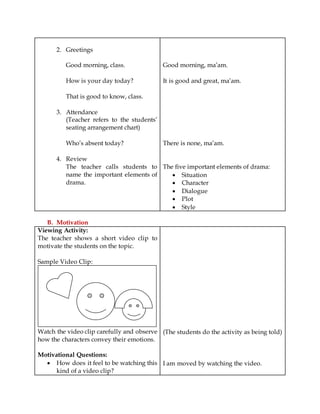
Viewing Activity:
The teacher shows a short video clip to
motivate the students on the topic.
Sample Video Clip:
Watch the video clip carefully and observe
how the characters convey their emotions.
Motivational Questions:
 How does it feel to be watching this
kind of a video clip?
(The students do the activity as being told)
I am moved by watching the video.
 Why were you moved by the video?
(Question comes after the answer of
the students)
 What do you think the video is all
about?
 Do the characters in the video
express a good amount of emotion?
If so, then why?
 What element is found in the video
that moves your emotion?
Very good!
The video has a dramatic element that
enables the audience to feel the same way
as to what the characters in the video are
feeling.
The dramatic also has a connection to the
lesson that I am about to teach to you. And
for us to know, I have a game for you to
play.
I am moved by the video because I can feel
that the father would do anything for his
daughter’s future.
I think the video is all about the love of the
father for his daughter.
I can see and feel that the characters
express a good amount of emotion because
they have moved the minds and the hearts
of the audience.
The video contains a dramatic element
that moves my emotion while watching it.
C. Presentation of the Topic
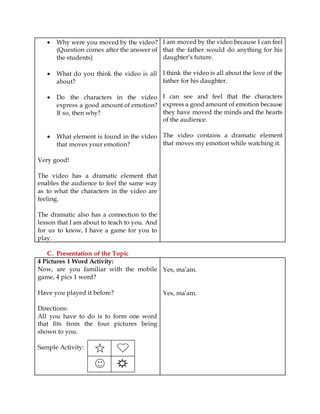
4 Pictures 1 Word Activity:
Now, are you familiar with the mobile
game, 4 pics 1 word?
Have you played it before?
Directions:
All you have to do is to form one word
that fits from the four pictures being
shown to you.
Sample Activity:
Yes, ma’am.
Yes, ma’am.
The teacher facilitates the students of the
activity.
First picture set
Second picture set
Very good!
So, what do you think will be our lesson
for today?
The teacher gives a short introduction
about the topic, dramatic writing.
Setting Objectives for Students:
Before we continue, we have objectives for
our class today.
Let us all read our goals for today, class.
Objectives:
A. Identify the five elements of
dramatic writing based on the
sample reading text
B. Analyze the situation of the sample
reading text
C. Devise a concept map discussing
the certain elements found in the
text
D. Develop the web based on the
sample reading text
E. Find out the main purpose of
writing the sample reading text
The students guess the words from the
four pictures being shown to them.
First word answer: DRAMATIC
Second word answer: WRITING
Dramatic writing, ma’am.
The students read today’s goals found on
the board.
D. Unlocking of Difficulties
We will have reading activity for today,
class. Before we continue, let us first define
the difficult words in the text.
1. Staccato
Sentence: A staccato of the different
Staccato means a short clear-cut playing or
singing of tones or chords.
musical instruments is melodious to hear.
2. Trek
Sentence: Our car broke down and we had
a long trek back to town.
3. Tenure
Sentence: His tenure as head coach of the
basketball team will end next month.
4. Mynah
Sentence: The mynah was kept in a small
cage that it is unable to fly when freed.
5. Lush
Sentence: The frequent rainfall brings the
growth lush of trees, ferns and shrubs.
With that short activity, we are now ready
to read the sample text. But before we
proceed, is there anything you want to
know about the topic?
Trek means a long and difficult journey
that is made especially by walking.
Tenure means the act, right, manner or
term of holding something as property.
Mynah means a black bird from Asia that
is often kept as a pet and trained to copy
the sounds of words.
Lush means having a lot of full and
healthy growth.
(The students listen to the teacher)
E. Discussion
The teacher distributes the copies for
reading.
Reading Material:
“Caught in the Forest Fire”
John Iremil Teodoro
Direction: You are to read a nonfiction text
for 5 minutes.
The text is entitled, “Caught in the Forest
Fire” by John Iremil Teodoro.
Before we read the text, what would be the
standards of reading the text?
(The teacher calls students to name the
standards in silent reading)
(The students follow the teacher)
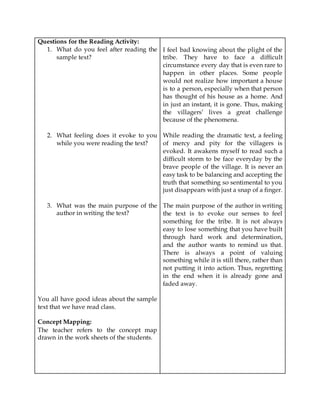
Questions for the Reading Activity:
1. What do you feel after reading the
sample text?
2. What feeling does it evoke to you
while you were reading the text?
3. What was the main purpose of the
author in writing the text?
You all have good ideas about the sample
text that we have read class.
Concept Mapping:
The teacher refers to the concept map
drawn in the work sheets of the students.
I feel bad knowing about the plight of the
tribe. They have to face a difficult
circumstance every day that is even rare to
happen in other places. Some people
would not realize how important a house
is to a person, especially when that person
has thought of his house as a home. And
in just an instant, it is gone. Thus, making
the villagers’ lives a great challenge
because of the phenomena.
While reading the dramatic text, a feeling
of mercy and pity for the villagers is
evoked. It awakens myself to read such a
difficult storm to be face everyday by the
brave people of the village. It is never an
easy task to be balancing and accepting the
truth that something so sentimental to you
just disappears with just a snap of a finger.
The main purpose of the author in writing
the text is to evoke our senses to feel
something for the tribe. It is not always
easy to lose something that you have built
through hard work and determination,
and the author wants to remind us that.
There is always a point of valuing
something while it is still there, rather than
not putting it into action. Thus, regretting
in the end when it is already gone and
faded away.
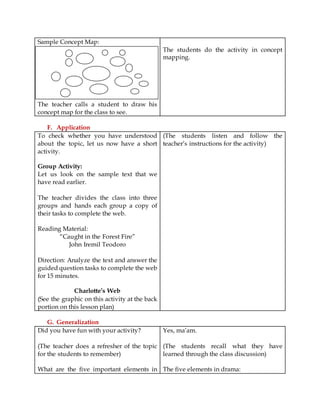
Sample Concept Map:
The teacher calls a student to draw his
concept map for the class to see.
The students do the activity in concept
mapping.
F. Application
To check whether you have understood
about the topic, let us now have a short
activity.
Group Activity:
Let us look on the sample text that we
have read earlier.
The teacher divides the class into three
groups and hands each group a copy of
their tasks to complete the web.
Reading Material:
“Caught in the Forest Fire”
John Iremil Teodoro
Direction: Analyze the text and answer the
guided question tasks to complete the web
for 15 minutes.
Charlotte’s Web
(See the graphic on this activity at the back
portion on this lesson plan)
(The students listen and follow the
teacher’s instructions for the activity)
G. Generalization
Did you have fun with your activity?
(The teacher does a refresher of the topic
for the students to remember)
What are the five important elements in
Yes, ma’am.
(The students recall what they have
learned through the class discussion)
The five elements in drama:
dramatic writing?
Why is dramatic writing applicable to our
daily lives, class?
Very good!
Now to check whether you have
understood the lesson, le us have a writing
evaluation for you to apply your learning
about the lesson.
 Situation
 Character
 Dialogue
 Plot
 Style
(The students express their ideas and
answers may vary)
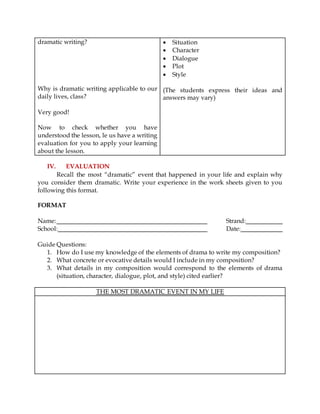
IV. EVALUATION
Recall the most “dramatic” event that happened in your life and explain why
you consider them dramatic. Write your experience in the work sheets given to you
following this format.
FORMAT
Name: Strand:
School: Date:
Guide Questions:
1. How do I use my knowledge of the elements of drama to write my composition?
2. What concrete or evocative details would I include in my composition?
3. What details in my composition would correspond to the elements of drama
(situation, character, dialogue, plot, and style) cited earlier?
THE MOST DRAMATIC EVENT IN MY LIFE
Be guided by the following criteria for scoring (60 points):
Details – 10 points
Organization – 10 points
Conventions – 10 points
Word Choice – 10 points
Task Completion – 20 points
V. ASSIGNMENT
Research for the most popular dramatic event in the world.

Detailed Lesson Plan (Creative Nonfiction) Dramatic Writing

  • 1.
    ANDRES BONIFACIO COLLEGE CollegePark, Dipolog City SCHOOL OF EDUCATION A DETAILED LESSON PLAN IN CREATIVE NONFICTION Senior High Department I. OBJECTIVES At the end of the lesson, the students can: A. Share insights about the video clip being shown B. Formulate appropriate words suitable for the set of pictures C. Define the difficult words found in the sample text D. Identify the five elements of dramatic writing based on the text E. Analyze the situation of the sample reading text F. Devise a concept map discussing the certain elements found in the text G. Develop the web based on the sample reading text H. Find out the main purpose of writing the sample reading text II. SUBJECT MATTER Topic: Dramatic Writing References:  Creative Nonfiction; Claiming Spaces: Understanding, Reading and Writing Creative Nonfiction (A Textbook on Humanities and Social Sciences)  Authors: Noel Christian A. Moratilla, Ph. D and John Iremil E. Teodoro  Project Director: Elineth Elizabeth L. Suarez, Ed. D  Phoenix Publishing House Instructional Materials:  Visual aids and pictures  Worksheets for the students  Video clip of a father and a daughter Value Focus: The understanding of dramatic writing and the importance of it in the field of literary arts and the daily lives of people. III. PROCEDURE TEACHER’S ACTIVITY STUDENT’S ACTIVITY A. Preparation 1. Opening Prayer
  • 2.
    2. Greetings Good morning,class. How is your day today? That is good to know, class. 3. Attendance (Teacher refers to the students’ seating arrangement chart) Who’s absent today? 4. Review The teacher calls students to name the important elements of drama. Good morning, ma’am. It is good and great, ma’am. There is none, ma’am. The five important elements of drama:  Situation  Character  Dialogue  Plot  Style B. Motivation Viewing Activity: The teacher shows a short video clip to motivate the students on the topic. Sample Video Clip: Watch the video clip carefully and observe how the characters convey their emotions. Motivational Questions:  How does it feel to be watching this kind of a video clip? (The students do the activity as being told) I am moved by watching the video.
  • 3.
     Why wereyou moved by the video? (Question comes after the answer of the students)  What do you think the video is all about?  Do the characters in the video express a good amount of emotion? If so, then why?  What element is found in the video that moves your emotion? Very good! The video has a dramatic element that enables the audience to feel the same way as to what the characters in the video are feeling. The dramatic also has a connection to the lesson that I am about to teach to you. And for us to know, I have a game for you to play. I am moved by the video because I can feel that the father would do anything for his daughter’s future. I think the video is all about the love of the father for his daughter. I can see and feel that the characters express a good amount of emotion because they have moved the minds and the hearts of the audience. The video contains a dramatic element that moves my emotion while watching it. C. Presentation of the Topic 4 Pictures 1 Word Activity: Now, are you familiar with the mobile game, 4 pics 1 word? Have you played it before? Directions: All you have to do is to form one word that fits from the four pictures being shown to you. Sample Activity: Yes, ma’am. Yes, ma’am.
  • 4.
    The teacher facilitatesthe students of the activity. First picture set Second picture set Very good! So, what do you think will be our lesson for today? The teacher gives a short introduction about the topic, dramatic writing. Setting Objectives for Students: Before we continue, we have objectives for our class today. Let us all read our goals for today, class. Objectives: A. Identify the five elements of dramatic writing based on the sample reading text B. Analyze the situation of the sample reading text C. Devise a concept map discussing the certain elements found in the text D. Develop the web based on the sample reading text E. Find out the main purpose of writing the sample reading text The students guess the words from the four pictures being shown to them. First word answer: DRAMATIC Second word answer: WRITING Dramatic writing, ma’am. The students read today’s goals found on the board. D. Unlocking of Difficulties We will have reading activity for today, class. Before we continue, let us first define the difficult words in the text. 1. Staccato Sentence: A staccato of the different Staccato means a short clear-cut playing or singing of tones or chords.
  • 5.
    musical instruments ismelodious to hear. 2. Trek Sentence: Our car broke down and we had a long trek back to town. 3. Tenure Sentence: His tenure as head coach of the basketball team will end next month. 4. Mynah Sentence: The mynah was kept in a small cage that it is unable to fly when freed. 5. Lush Sentence: The frequent rainfall brings the growth lush of trees, ferns and shrubs. With that short activity, we are now ready to read the sample text. But before we proceed, is there anything you want to know about the topic? Trek means a long and difficult journey that is made especially by walking. Tenure means the act, right, manner or term of holding something as property. Mynah means a black bird from Asia that is often kept as a pet and trained to copy the sounds of words. Lush means having a lot of full and healthy growth. (The students listen to the teacher) E. Discussion The teacher distributes the copies for reading. Reading Material: “Caught in the Forest Fire” John Iremil Teodoro Direction: You are to read a nonfiction text for 5 minutes. The text is entitled, “Caught in the Forest Fire” by John Iremil Teodoro. Before we read the text, what would be the standards of reading the text? (The teacher calls students to name the standards in silent reading) (The students follow the teacher)
  • 6.
    Questions for theReading Activity: 1. What do you feel after reading the sample text? 2. What feeling does it evoke to you while you were reading the text? 3. What was the main purpose of the author in writing the text? You all have good ideas about the sample text that we have read class. Concept Mapping: The teacher refers to the concept map drawn in the work sheets of the students. I feel bad knowing about the plight of the tribe. They have to face a difficult circumstance every day that is even rare to happen in other places. Some people would not realize how important a house is to a person, especially when that person has thought of his house as a home. And in just an instant, it is gone. Thus, making the villagers’ lives a great challenge because of the phenomena. While reading the dramatic text, a feeling of mercy and pity for the villagers is evoked. It awakens myself to read such a difficult storm to be face everyday by the brave people of the village. It is never an easy task to be balancing and accepting the truth that something so sentimental to you just disappears with just a snap of a finger. The main purpose of the author in writing the text is to evoke our senses to feel something for the tribe. It is not always easy to lose something that you have built through hard work and determination, and the author wants to remind us that. There is always a point of valuing something while it is still there, rather than not putting it into action. Thus, regretting in the end when it is already gone and faded away.
  • 7.
    Sample Concept Map: Theteacher calls a student to draw his concept map for the class to see. The students do the activity in concept mapping. F. Application To check whether you have understood about the topic, let us now have a short activity. Group Activity: Let us look on the sample text that we have read earlier. The teacher divides the class into three groups and hands each group a copy of their tasks to complete the web. Reading Material: “Caught in the Forest Fire” John Iremil Teodoro Direction: Analyze the text and answer the guided question tasks to complete the web for 15 minutes. Charlotte’s Web (See the graphic on this activity at the back portion on this lesson plan) (The students listen and follow the teacher’s instructions for the activity) G. Generalization Did you have fun with your activity? (The teacher does a refresher of the topic for the students to remember) What are the five important elements in Yes, ma’am. (The students recall what they have learned through the class discussion) The five elements in drama:
  • 8.
    dramatic writing? Why isdramatic writing applicable to our daily lives, class? Very good! Now to check whether you have understood the lesson, le us have a writing evaluation for you to apply your learning about the lesson.  Situation  Character  Dialogue  Plot  Style (The students express their ideas and answers may vary) IV. EVALUATION Recall the most “dramatic” event that happened in your life and explain why you consider them dramatic. Write your experience in the work sheets given to you following this format. FORMAT Name: Strand: School: Date: Guide Questions: 1. How do I use my knowledge of the elements of drama to write my composition? 2. What concrete or evocative details would I include in my composition? 3. What details in my composition would correspond to the elements of drama (situation, character, dialogue, plot, and style) cited earlier? THE MOST DRAMATIC EVENT IN MY LIFE
  • 9.
    Be guided bythe following criteria for scoring (60 points): Details – 10 points Organization – 10 points Conventions – 10 points Word Choice – 10 points Task Completion – 20 points V. ASSIGNMENT Research for the most popular dramatic event in the world.