The Process Model of Communication
Background 1. Came out of telephone development 2. Concerned with efficiency 3 Is the message that was sent the  same  as the message received? 4.  What are the barriers to communication, called ‘noise’?
One way street 1. Process favours sender 2. Sender controls communication 3. Jug and mugs theory 4. The physical form of the message is more more important than its content 5. Success depends on efficient transmission  message is
What is missing from process model? 1. Feedback 2. Awareness of meanings in message 3. Involvement of receiver 4. Relevance of culture and context 5. Importance of ambiguity in many messages
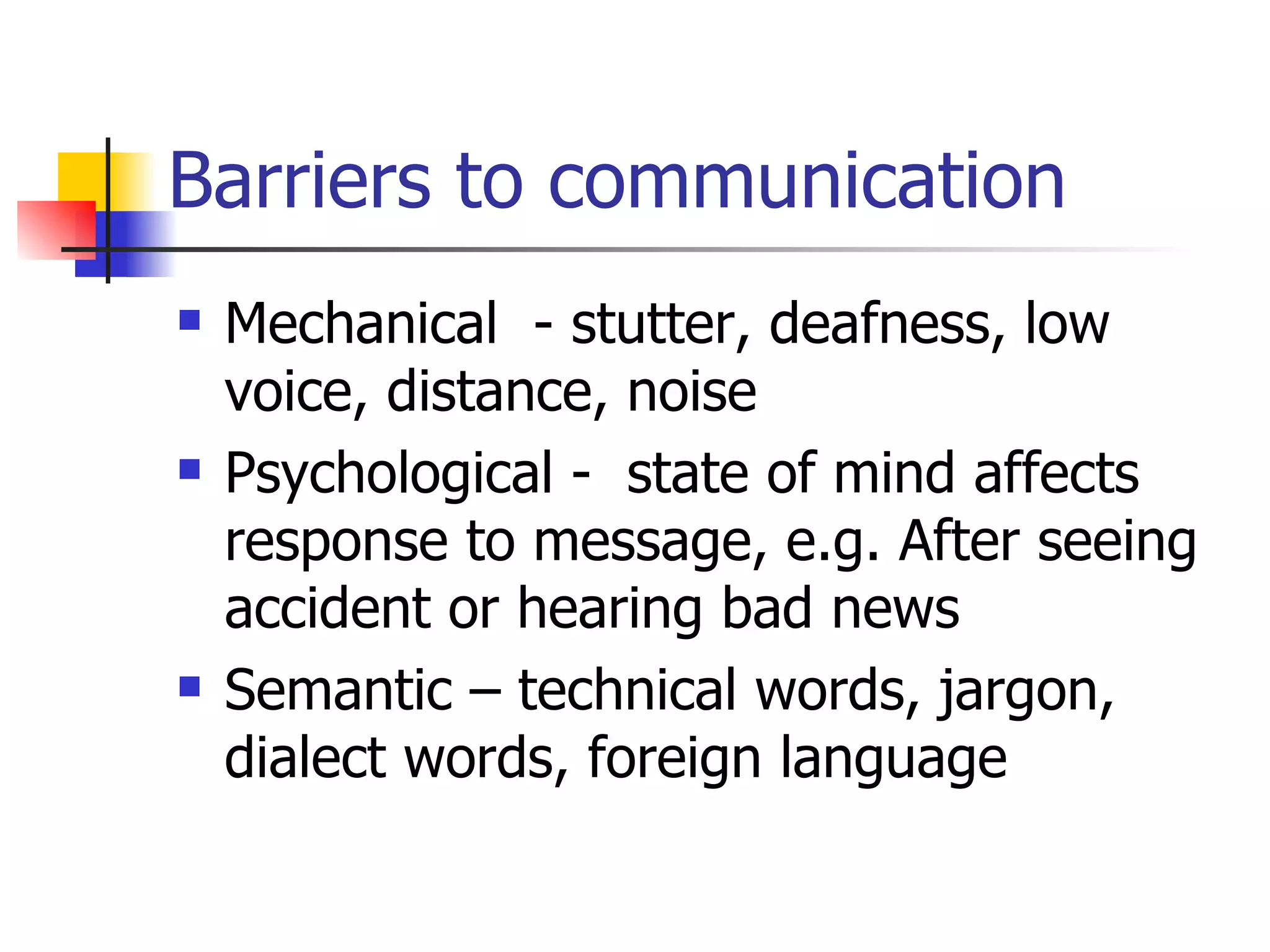
Barriers to communication Mechanical  - stutter, deafness, low voice, distance, noise Psychological -  state of mind affects response to message, e.g. After seeing accident or hearing bad news Semantic – technical words, jargon, dialect words, foreign language
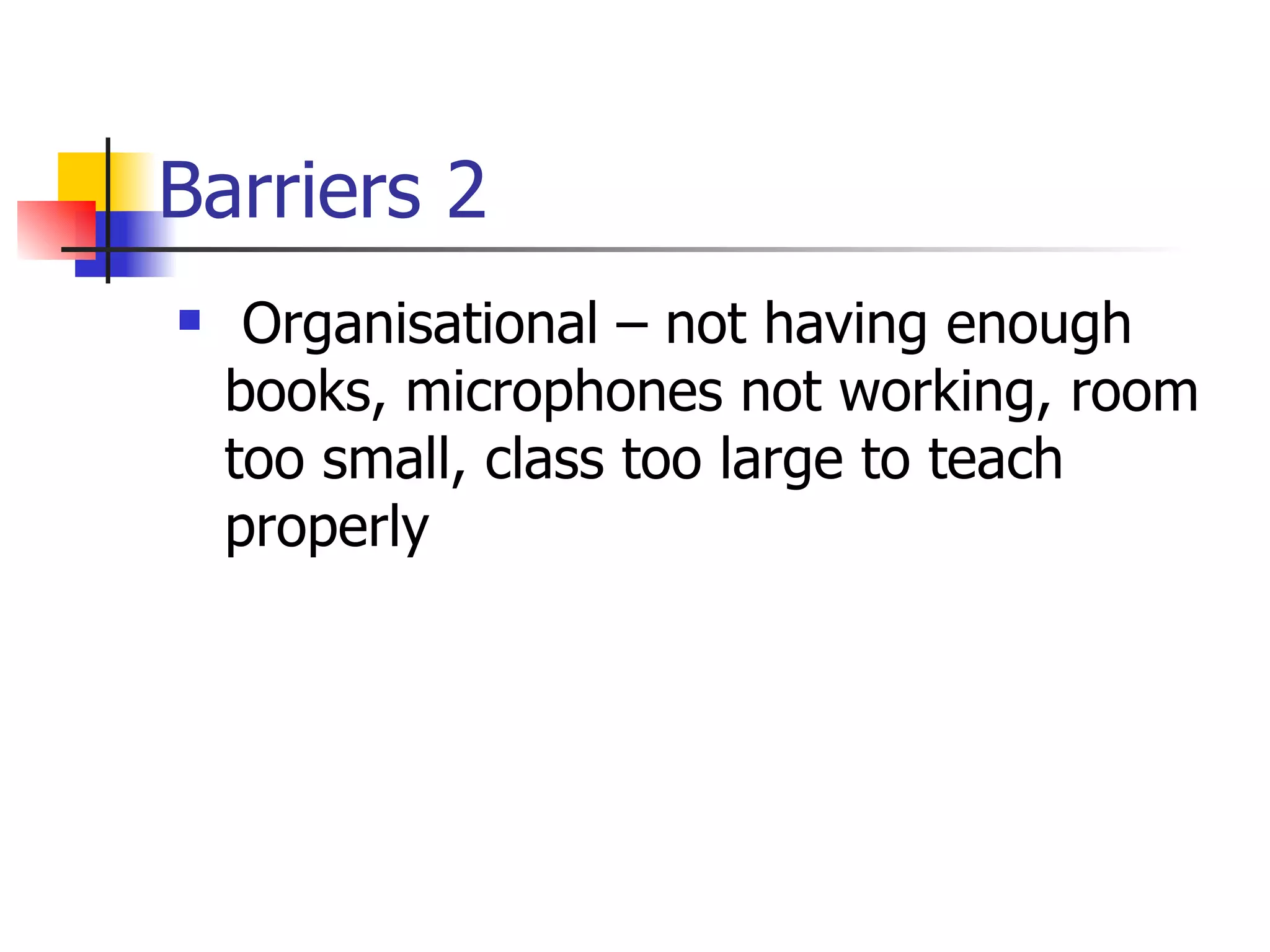
Barriers 2 Organisational – not having enough books, microphones not working, room too small, class too large to teach properly
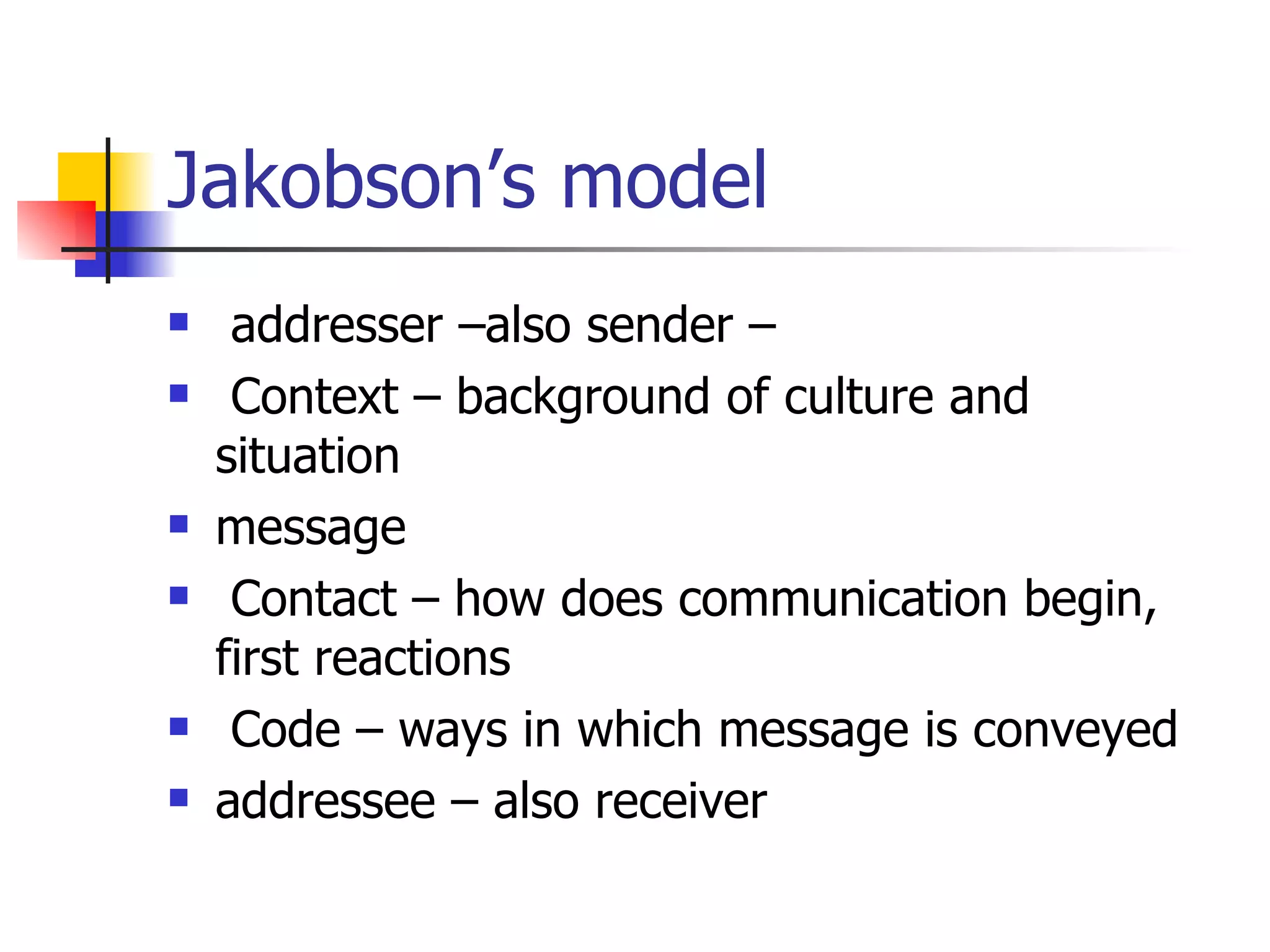
Jakobson’s model addresser –also sender –  Context – background of culture and situation message Contact – how does communication begin, first reactions Code – ways in which message is conveyed addressee – also receiver
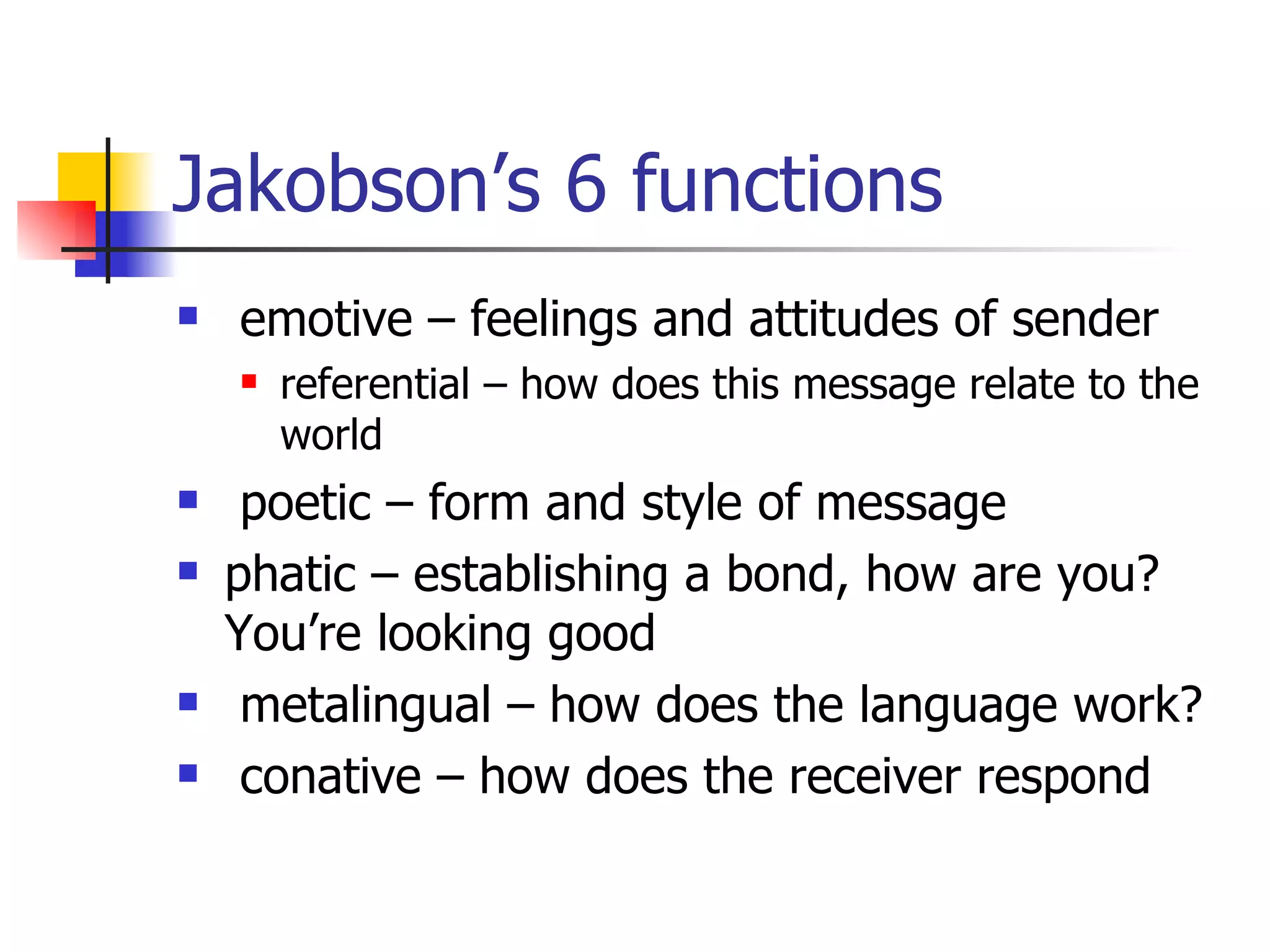
Jakobson’s 6 functions emotive – feelings and attitudes of sender referential – how does this message relate to the world poetic – form and style of message phatic – establishing a bond, how are you? You’re looking good metalingual – how does the language work? conative – how does the receiver respond
Benetton advert emotive – Benetton sets out to shock referential – the world is a violent place poetic – black and bleak, grim faces, Benetton is brighter? phatic – stomach churning, you are caught up in drama Metalingual – We bring the colour back to the world Conative- the reader is paralysed, but reads and is aware of Benetton

The process model of communication

  • 1.
    The Process Modelof Communication
  • 2.
    Background 1. Cameout of telephone development 2. Concerned with efficiency 3 Is the message that was sent the same as the message received? 4. What are the barriers to communication, called ‘noise’?
  • 3.
    One way street1. Process favours sender 2. Sender controls communication 3. Jug and mugs theory 4. The physical form of the message is more more important than its content 5. Success depends on efficient transmission message is
  • 4.
    What is missingfrom process model? 1. Feedback 2. Awareness of meanings in message 3. Involvement of receiver 4. Relevance of culture and context 5. Importance of ambiguity in many messages
  • 5.
    Barriers to communicationMechanical - stutter, deafness, low voice, distance, noise Psychological - state of mind affects response to message, e.g. After seeing accident or hearing bad news Semantic – technical words, jargon, dialect words, foreign language
  • 6.
    Barriers 2 Organisational– not having enough books, microphones not working, room too small, class too large to teach properly
  • 7.
    Jakobson’s model addresser–also sender – Context – background of culture and situation message Contact – how does communication begin, first reactions Code – ways in which message is conveyed addressee – also receiver
  • 8.
    Jakobson’s 6 functionsemotive – feelings and attitudes of sender referential – how does this message relate to the world poetic – form and style of message phatic – establishing a bond, how are you? You’re looking good metalingual – how does the language work? conative – how does the receiver respond
  • 9.
    Benetton advert emotive– Benetton sets out to shock referential – the world is a violent place poetic – black and bleak, grim faces, Benetton is brighter? phatic – stomach churning, you are caught up in drama Metalingual – We bring the colour back to the world Conative- the reader is paralysed, but reads and is aware of Benetton