TEACHING
READING
INTRODUC
TIONMaking every child a competent reader and a
functional learner is the ultimate goal of teaching
children to read. To become a competent reader,
one should be able to construct meaning from
print using appropriate active strategies to relate
what he reads with his background knowledge and
experience. Through continuous practice, fluency
and skill are enhanced and the child’s motivation
to read increases. Naturally his constant
engagement with different text exposes him to
varied learning and insights which enable him to
cope better with life situations.
OBJECTIVES
 Increase students’ motivation, interest, and
enjoyment in reading by involving them in activities;
 Discuss current perspectives on reading and draw out
implications in teaching beginning reading;
 Teaching lessons that incorporate principles of
effective comprehension strategy instruction before,
during, and after reading;
 Promote teamwork, create a sense of
interdependence, and accountability by using
cooperative learning strategies to facilitate literacy.
What is
Reading?Reading is a complex cognitive
process of decoding symbols in
order to construct or derive
meaning(reading comprehension).
It is a means of language
acquisition, of communication, and
of sharing information and ideas.
Five Areas to the National of Reading Instruction
Phonemic Awareness
This is the ability to notice, think about, and work with
the individual sounds in spoken words. Before children learn
to read print, they need to become aware of how to use the
sounds in words work. They must understand that words are
made up of speech sounds or phonemes.
Level 1: Rhymes and Alliteration
Children Develop “ ear” language as they identify and make oral rhymes.
Examples:
• RHYMES: I once saw a cat sitting next to a dog.
I once saw a bat sitting next to a frog.
• ALLITERATION: Six snakes sell sodas and snacks.
• ASSONANCE: The leaf, the bean, the peach all were within reach.
Level 2: Parts of a Word
Children listen to sounds within words. They identify and
work and on sets and rimes in spoken syllables or one-syllable
words.
Example: The first part of kite is K.
The last part of mice is –ICE.
Level 3: Sequence of Sounds
Children direct attention to specific positions of
sounds within a word. They identify and work with
syllables in spoken words.
Example: I can clap the parts in my name: Ti-na.
Level 4: Blending of Sounds
Children at this level have acquired a good sense of
phonemic awareness and are ready to divide words
into separate sounds or phonemes or blend them to
form the recognizable sounds
Example: What word is /h/ /ae/ /t/? – hat
What word is /s/ /k/ /u/ /i/? –school
Level 5: Phoneme Segmentation
Children manipulate sounds within words by adding ,
exchanging, deleting, or transporting phonemes to form a
new word.
Example: How many sounds /phonemes do you hear in
bell?
three (3) : /b/ /e/ /l/
How many sounds do you hear in write?
three (3) /r/ /ay/ /t/
Phonics and Decoding
Phonics instruction enables beginning readers to understand the
relationship between letters (graphemes) of written language and the
sounds (phonemes) of spoken language. It teaches them to use these
relationships to read and write words. Systematic and explicit phonics
instruction is most effective when it starts in kindergarten or first grade,
the enabling children to develop solid word attack skill from the
beginning of their introduction to reading.
Phonics instruction is not an entire leading program for beginning
readers. Along with phonics instruction, young children should be
solidifying their knowledge of the alphabet, engaging phonemic
awareness tasks, and listening to stories and informational texts read
aloud to them. They should also be reading texts (both aloud and
silently), and writing letters, words messages and stories.
Phonics instruction is important because it leads to an
understanding of the alphabetic principle, which is the systematic and
predictable relationships between written letters and spoken sounds.
Vocabulary Instruction
Vocabulary is the meaning and pronunciation of words
that we use to communicate effectively. It is simply the
number of words that we understand or can actively use to
listen, speak , read or write. It plays a vital role in every aspect
of reading from understanding the plot or gist of a simple text
to interpreting and appreciating the most complex text.
Scientifically-based research tell us that children learn
the meanings of most words indirectly, through everyday
experiences with oral and written language. However, it is also
important for teachers to address word learning directly.
Direct instruction in word meanings is effective, can make a
significant difference in a student’s overall vocabulary, and is
critical for those students who do not read extensively. This
includes providing students with specific words instruction in
teaching them word-learning strategies.
Fluency
This is the ability to read a text accurately,
smoothly, quickly, and with expression. Some students
are able to read orally with speed, expression, and
smooth decoding but they do not understand what they
read. These students are not yet fluent readers because
fluency also requires comprehension. To be termed “
fluent reader” with a particular text an individual must
be able to read effortlessly, use expression, and read
and recognize words quickly. He must have developed
automaticity and must understand how to group words
quickly to gain meaning from the text. When a student
possesses automaticity, he does not have to attend to
the task of decoding and can focus his energy on
comprehension.
Fluency instruction may be the missing element in reading
instruction for most teachers because most of us learn to teach reading
with a focus on accuracy and comprehension, while few of us were
taught to read quickly and automatically. Though some students will
learn to read fluently, with little direct instruction from teachers, many
will require practice and support from peers and teachers to improve
their fluency and make reading a more valid activity.
The following activities can improve fluency:
a. Reading with a model reader. The model reader can be a teacher,
another adult, or an older student.
b. Choral reading. In choral or unison reading, students read along as
a group with the teacher (or another fluent reader). Students follow
along as teacher reads from a book. For choral reading, choose a book
that is not too long and that can be read independently by most
students. Patterned or predictable books are particularly useful
because their repetitive style invites students to join in.
c. Tape-assisted reading. In tape-assisted reading, students read along in their
books as they hear a fluent reader read the book on an audiotape. For tape-
assisted reading, you need a book at a student’s independent reading level
and a tape recording of the book read by a fluent reader at about 80-120
words per minute. The tape should not have sound effects or music.
d. Readers’ theater. This is rehearsing and performing before an audience of a
dialogue-rich script derived from a book. In readers’ theater, students rehearse
and perform a play for peers or others. They read from scripts that have been
derived from books that are rich in dialogue. The critical aspect of the exercise
is that students read the text repeatedly until they can recite it fluently and
with prosody.
e. Partner reading. In partner reading, paired students take turns reading
aloud to each other. For partner reading, more fluent readers can be paired
with less fluent readers. The stronger reader reads a paragraph or page first
providing a model of fluent reading.
Teacher should assess fluency regularly (National Reading Panel). Monitoring
student progress in reading fluency is useful in evaluating instruction and
instructional goals. It can be motivating to students to see their fluency
growth reflected in graphs.
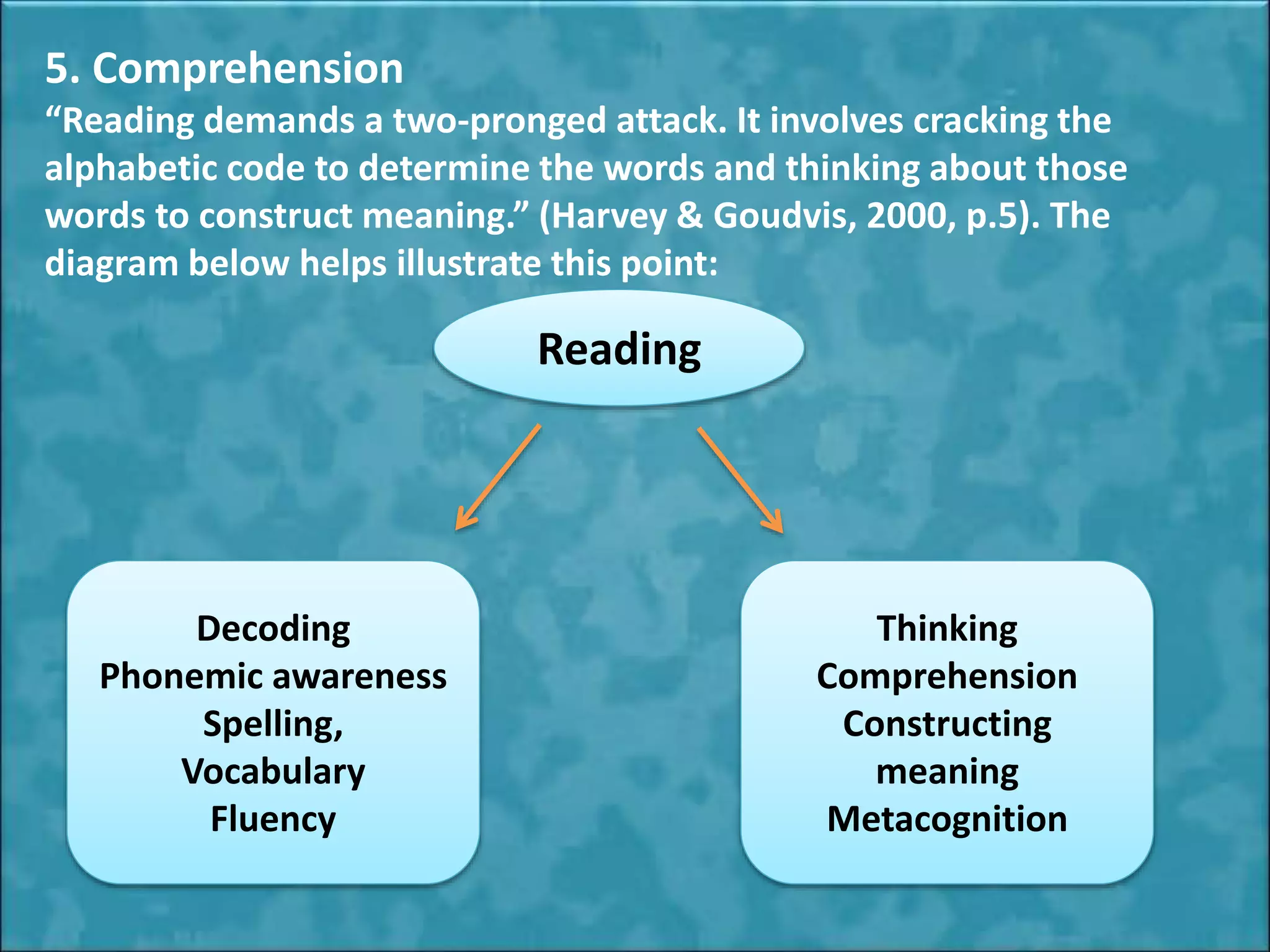
5. Comprehension
“Reading demands a two-pronged attack. It involves cracking the
alphabetic code to determine the words and thinking about those
words to construct meaning.” (Harvey & Goudvis, 2000, p.5). The
diagram below helps illustrate this point:
Reading
Decoding
Phonemic awareness
Spelling,
Vocabulary
Fluency
Thinking
Comprehension
Constructing
meaning
Metacognition
The skills on the left are those skills essential to mastering
the code and are considered the basics of beginning reading
instruction. The skills listed on the right point to comprehension as
a separate aspect of reading that requires the same amount of
direct instruction and teaching time as the decoding skills. Once
thought of as a natural result of decoding plus oral language,
comprehension is now viewed as a much more complex process
involving knowledge, experience, thinking and teaching (Fielding &
Pearson, 2003).
The notion of “something happening” while we read is the
essence of comprehension. The “something happening” is the
interactive construction of meaning inside our heads, which creates
understanding. Sadly, the “something happening” does not
naturally occur inside all readers and so there is a felt need to teach
them how to use their experience and their knowledge to make
sense of what they are reading (Gear, 2006, p.15).
Profile of a Proficient Reader
What made a child a better reader than all the other children? In a
study of proficient readers, David Pearson (1970) was able to
determine several common strategies used by proficient readers that
enabled them to make sense of the text. A condensed version of this
research is what is deed as the “profile” of a proficient
reader (Gear, 2006).
A good reader is metacognitive – aware of and able to use and articulate
the following strategies in order to interact with the text and enhanced
meaning.
1. Make connections. A good reader is able to draw from background
knowledge and personal experiences while reading to help create
meaning from the text.
2. Ask questions. A good reader asks both literal and inferential questions
before, during, and after reading to clarify meaning and deepen
understanding.
3. Visualize. A good reader is able to create multi-sensory images in
the “minds eye” while reading to help make sense of the text.
4. Determine importance. A good reader is able to sort through
information in the text, select key ideas, and remember them.
5. Draw inferences. A good reader knows that not all information is
included in a text, and is able to reasonably “fill in”, hypothesize,
and predict, based on the evidence on the text.
6. Analyze and synthesize. A good reader is able to break down
information and to draw conclusions based on both the text and his
or her thinking.
7. Monitor comprehension. A good reader is able to stop, go back,
and reread in order for understanding to occur.
Three Stages of Teaching Reading
The major goal of reading
instruction should be the provision of
learning activities that will enable
students to think about and react to
what they read-in short, to read for
meaning. To achieve that goal, a
reading lesson should have three basic
parts representing phases of the lesson
that take place before, during, and after
reading.
1. Pre-reading Strategies
All reading and learning depends on what the learner
brings to the task. For this reason, the pre-reading stage is
considered the most important phase of a reading lesson. It
is here where students are guided to reflect on what they
already know or think about a topic so that it can help them
understand what they are going to read.
PRE-READING
Activating prior
knowledge and
building background
information
Developing
motivation and
purpose for readingDeveloping concept
and vocabulary
Activating Prior Knowledge and Building
Background Information
There is “something in our head” that we carry around
with us all the time (Smith, 1985). This “something in our
head” is background or prior knowledge and is referred to as
schema. According to Williams and Moran (1989), this is an
abstract structure representing concepts stored in memory.
Such concepts are formed and developed into a kind of
“system” as a result of how one experiences the world which,
in turn, serves as a basis of his or her understanding and
learning about it.
According to the schema theory, a reader’s knowledge of the
world, or prior knowledge, plays a crucial role in his/her
understanding of the text and especially in working out
implicit information (Silberstein, 1994). There are several
techniques to activate a readers’ schema.
1. Preview and Predict
Have students browse through the selection to get a sense of
its format. Point out the different text areas: the text at the
top, the speech balloons, and the “glosses” along the margin.
 Ask a question to help students see whether the selection is
fiction or non-fiction. Then have students predict what the
selection is all about.
2. Text Previews
A text preview helps students better comprehend a
difficult text. It helps students understand concepts, vocabulary,
and structure of the reading selection so that they can build
higher level understanding.
3. Story Impressions
The steps are as follows:
a. Preview text section or story and select key words
which indicate plot, setting, and characters.
b. Arrange the words vertically with arrows in the order
they are presented in the story.
c. In pairs, have students make predictions and write a
collaborative story using all the terms in the chain.
d. Have students read their assigned story and compare
their impressions with the author’s version (Mc Guinley
and Denner, 1987).
4. Group Predictions
Students in small groups brainstorm ideas
that relate to a topic or theme in a reading
selection prior to the reading. After reading,
students return to the groups’ predictions to
validate how much their discussion before
reading enhanced their comprehension.
Developing Concept and Vocabulary
There are practical techniques in vocabulary development and they are as follows:
Through realia or actual objects. Introducing a new word, especially to very young
readers, requires a multi-sensory device. This makes for a rich and more meaningful
experience. For example, in introducing the word pebble, you may say: “Look what I
have in my hand. What do you see? (a small stone). Would you like to touch it? (Pass i
around.) What can you say about the small stone? (smooth, not rough like ordinary
stone) This small stone is called a pebble. (Write pebble on the blackboard). Where can
you find pebbles?
Through visuals. The next best thing to an actual object is a replica or a likeness of it.
Visuals may be in the form of photographs, sketches, slides, collages, and other similar
illustrations.)
To introduce the word mansion, you may show a picture and ask: “What does the picture
show? (house, shelter) What can you say about the people living in it? (well- to- do, rich).
This is a mansion. What kind of house is a mansion?
Through demonstration or gesture. This technique is ideal when unlocking the meaning
of a noun or an action word. You may demonstrate the meaning yourself or better still,
you may train a student or two before the class begins to act out the word for the rest of
the class.
Through context clues. The word is used in a sentence
that carries with it a clue that directs the learner to the
meaning in focus. For example: The Japanese paper is
flimsy and thin. It is easily torn.
Semantic mapping. This strategy helps students see the
relationship among words.
The basic steps are as follows:
a. Select an important word or topic in the selection.
This word should be familiar enough to the students
such that they can list related words.
b. Write the word on the board and encircle it. Encircling
marks the word as the core of the vocabulary activity.
Developing Motivation and Setting the Purpose
for Reading
Before actual reading, assist students in
analyzing the material. Take “picture walks” through
the book if there are pictures besides making
predictions as to content, story progression, or
conclusion. In the absence of pictures, help students
get a “feel” for the book and assist them in identifying
the purpose for their reading. Are students expected
to gather information of some type as they read? Will
they do something with the data after reading? In this
case, a KWL chart, a graphic organizer, or an
anticipation guide will help students better to prepare
for reading.
Three factors contribute to motivation:
• Attitude–the force which motivates a person to continue with
a task.
• Interest–the desire to know about or explore a topic.
• Self-concept– a fair and sincere feedback enhancing students’
positive view of themselves
The Motivation Question–Motive Question Tandem
Two questions are asked to prepare the students for reading:
• Motivation question–This to activate prior knowledge related
to the selection. Responses to this question are experience-
based.
• Motive question–This is to test the comprehension of the
selection. It is usually parallel with the motivation question.
2. During Reading Strategies
Reading of the text, which is the most obvious aspect
of the reading phase, may be taken to mean that the
students read the text silently in the classroom or at home
as part of the assignment. Provide some guide questions so
that they can focus better while reading. In the early grades
the teacher reads aloud as the students listen. Reading
aloud to children is the single most important activity for
building the knowledge required for eventual success in
reading. (Anderson et.al. 1985). It should be used for
learners in all levels. High school students should get a
read-aloud treat every now and then.
Read-Aloud
Here are some tips for more effective read-aloud:
1. Read at a slower rate than normal conversational speech in order
to be heard in all parts of the room.
2. Focus on the students from the second to the last row. Look at
their faces as you read. Make them your barometer for volume.
Establish eye contact. Your listeners should be reminded you are
reading to them. Do not hesitate to pause while reading so as to
catch the attention of those who aren’t paying attention.
4. Make distinctions between characters when you read. You may
ask some students to assist you in reading by appointing them to
read the lines of specific characters.
5. Use minimal gestures. Some slow movements of the hands or
body will help emphasize some parts.
6. As much as possible, provide your students with a copy of the text
you are reading aloud so that they can follow your reading silently.
Strategy that may be used for read-aloud is partner predictions. This
incorporates the use of predictions and elements of cooperative
learning following these steps:
1. Identify the places in the story for prediction.
fore reading aloud to the class, read through the story and select three
or four places where it would be appropriate to stop and have your
students predict what may happen next in the story.
Read aloud and have students predict.
Place students in pairs. Read the title and perhaps several paragraphs
of the story you are going to read aloud. Ask the students: “What do
you think the story will be about?”
3. Ask students to share their ideas with their partners.
4. Call on some students to share what their partners think the story
will be about. Suggest to students that they begin their response by
saying: My partner_____ thinks that _______________.
5. Read another section of the story and have students predict. Ask
students again; “What do you think will happen next?”
Fix-Up Strategies for Comprehension Building
During Reading
For primary students, here are some steps for teaching good
comprehension strategies:
• Look at the picture for clues; make a prediction or guess
about what the word might mean. Does it make sense in
this context?
• Reread the sentence and see if it makes sense the second
time.
• Read on and ignore the word and see if you still
understand what is being said.
• If you come to a word you don’t know, sound it out, say it
slow and “snap” it together, or make a word substitution
that makes sense.
• Ask for help from the teacher if you are still confused.
3. Post Reading Strategies
Post reading is the last phase of the reading lesson. It is
after reading when readers want to share and discuss ideas with
others. Post reading activities might include the following:
discussion, engagement activities, and reading-writing link. This
is illustrated by the diagram that follows:
POST READING STRATEGIES
Engagement
Activities
Reading-Writing
Link
Discussion
Discussion
After reading, discussion follows to check students’ comprehension of
the text. The discussion usually begins with the motive question. The
rest of the questions are planned in anticipation of the answers the
children will give. The flow proceeds as conversation activities that are
interspersed between questions so that the discussion will not drag.
GPU: Gradual Psychological Unfolding
GPU is a discussion technique developed by the late Prof. Basilisa
Manhit, founder of the Department of Reading of the University of the
Philippines. As its name suggests, the story is unraveled through a
slow yet logical manner with questions and activities prepared by the
teacher. The guide or clues from the teacher enable the learners to
gradually understand the events in the story, perceive the author’s
message, determine his perception of an emotional phenomenon or
of life, and to select and assimilate values relayed through the
selection.
The students go through all the dimensions of reading
comprehension (Bloom).
1. First Dimension: Knowledge or Literal Understanding
A literal understanding of a selection provides the reader with the
most basic structure through which the writer expresses his
philosophy in life.
Answers to information or Wh-questions are explicitly stated in the
text.
Sample Questions:
• What is the title of the story?
• Who are the characters?
• Where does the grasshopper stay?
• Why does the ant save food?
2. Second Dimension: Comprehension or Interpretation
(Grasping Fully the Writer’s Ideas)
The reader is tasked to read between the lines to make
inferences. Sufficient clues are given to enable the reader
to arrive at the writer’s ideas. Questions on the second
dimension are still about the story though the answers are
derived and not lifted from the selection.
Sample Questions:
• Compare the grasshopper and the ant.
• What words describe the ant? the grasshopper?
• What does the saying “Save for a rainy day” mean?
3. Third Dimension: Application
The reader uses or applies learned materials in new and concrete
situations, processes, effects, conclusions.
Sample Question:
• If you were the grasshopper, what would you have done?
• Why is it important to practice thrift and economy?
Fourth Dimension: Analysis
he reader breaks down the material into component facts so that its
organizational structure can be understood such as elements, hypothesis,
statement of facts, others.
Sample Questions:
• What is the writer’s purpose for writing the story?
• What literary device did the writer use to make the selection
interesting to the readers?
5. Fifth Dimension: Synthesis
The reader puts parts together to form a whole new
pattern, structure, or design. He suggests or makes plans
of action.
ample Questions:
What other things can you save in order to economize?
What ways can you suggest to save on the following:
• Food?
• Electricity?
• Water?
• Clothing?
• Other resources?
Sixth Dimension: Evaluation
This is judging the value of something using internal
criteria.
Sample Questions:
• Prove that the ant did right in storing food for the
rainy day.
• Did the grasshopper deserve to go hungry? Cite
reasons for your answer.
Engagement Activities
Going beyond the literature after reading enables students to
elaborate on and reconsider the selection. Elaboration is based
on the notion that when readers actively integrate new
information with existing knowledge, greater understanding
and use of the new material will result (McNeil, 1987).
Comparing perspectives, debating, recollecting, summarizing,
and writing and reacting to the literature in a variety of ways
are all forms of elaboration or engagement activities for
students to reinforce, heighten, and develop ownership of
the reading experience. These are usually interspersed with
the questions asked during discussion.
• Cued Retelling–This is a highly interactive strategy for
having students retell a selection either orally or in written
form.
• Story Mapping
A story map includes the elements most stories represent such as a character’s
attempts to solve problem, the set of attempts to achieve the goal (usually the
major events or actions in the story), and the resolution (what happened in the
end, how the problem was solved). A story map is like the summary of a
narrative.
• Venn Diagrams for Comparing and Contrasting Stories /
Characters / Setting / and Personal Experiences
The Venn Diagram for comparing and contrasting lends itself well for use as a pre-
reading or follow-up to a reading task.
• Discussion Web
This incorporates the four language arts using cooperative learning ideas for
students to interact. It is especially useful for discussions in literature and in social
studies.
Reading-Writing Link
Students may do journal writing in response to literature through the following
activities:
• Writing an ending to a story
• Retelling the story or a part of the story from the point of view of a character
• Reading response journal
• Doing a news write-up about the exciting events in the story
• Summary journal – This should describe the action of the story, development
of the characters, impact of the setting on the plot, comments on the author’s
style, or other ideas the reader has after reading the selection.
Reading Intervention and Remediation
The Problem and Context
According to research, children who encounter problems in the beginning stages of
learning to read fall farther and farther behind their peers. There is nearly a 90%
chance that a child who is a poor reader at the end of
Grade 1 will remain a poor reader at the end of Grade 4 (Juel 1998). Although
most reading failure is necessary, it has been noted that 20% of students have
significant reading problems.
Who are the students at risk?
At- risk students have been identified as those who are likely to fail either in
life or in school . Children have been said to be at risk if they are identified as
having any six of some 45 factors which include the following:
• Children with a history of preschool language impairment
• Children with limited proficiency in English
• Children whose parents had difficulty learning to read
• Children with attention deficit – hyperactivity disorder
• Children who lock motivation to learn
• Children from poor neighborhoods
• Children who attend schools in which the classroom practices are deemed
ineffective
• Children who score low in standardized tests
• Children whose IQ is below 90
• Children who have negative self-image
• Children who are ill
• Children who have excessive absence from school
• Children who have been retained in a grade
The Solution to the Problem: Prevention
The basic intent of many remedial programs is to help students catch up so
that they can then learn with their peers. However, an ounce of
prevention is worth a pound of cure. Over the last decade, a number of
programs have been created that are designed to help those students who
are more at risk of failing to learn to read and write. There are a number
of highly successful intervention programs which do not require extensive
training and maybe implemented with small groups of students by the
classroom teacher. These include the following:
• Early intervention in Reading – this is a program in which the first-grade
teacher spends twenty minutes a day working with five to seven of the
lowest achieving students. In this program, phonemic awareness and
phonics are emphasized. Phonics is thought through a pattern approach
and applied through children’s book that incorporate the patterns
presented. The program maybe adopted for use in second and third
grades: meeting in groups of no more from seven for 20-30 minutes,
students study word patterns, read easy chapter books, and engage in
writing activities.
Success for All – This is an early intervention program designed for an entire
elementary school. Success for All stresses prevention of reading problems and
teaching in such a way that children are successful. “ getting reading right the first
time” is a kind of motto for the program, which is rooted in the researched-based
finding that a reading failure in the early grades is fundamentally preventable .
In general, the techniques that work with achieving readers also work with
students who are at risk. The chief difference in working with achieving and at-
risk students is making appropriate adoptions and modifications. The following
framework for Building Literacy (Gunning, 1999). This framework has been
designed to provide a basis for planning an intervention program that can be
thought by a classroom teacher. The program is designed for the students who
lack proficiency with word analysis skills and strategies. Skills ranged from
working with phonemic awareness and initial consonants through working with
multisyllabic words. However, the program can be adapted to focus on
comprehension by introducing comprehension strategies
and vocabulary instead of phonics or syllabic patterns.
Building Literacy: A Classroom Intervention Program
Goals and Objectives
Objectives should be those that are most likely to result in maximum improvement
in literacy.
Direct, Systematic Instruction
Struggling readers and writers need direct, systematic instruction, geared to their
strengths. High-quality instructional techniques emphasized in this text feature Word
Building; guided reading, including text walk; shared reading; language experience,
including shared writing and interactive writing; and use of graphic organizers,
Request, reciprocal teaching, and Questioning the Author.
Selecting Students
Select students with the greatest needs in reading and writing. Depending on
student’s levels, use an informal reading inventory and/or assessment devices. Also
use observation, sample of students work, and portfolios, if available.
Scheduling Instruction
Intervention instruction is most beneficial when it is in addition to the
instruction already provided. Students who are behind need more
instructional time if they are expected to catch up. Before school, and
summer programs are recommended. However, if this is not practical,
arranged intervention sessions when they would best fit into the daily
schedule. You might hold intervention sessions when the rest of the class is
engaged in sustained reading, working at learning centers, or working on
individual or group projects. Intervention groups should be scheduled every
day, if possible, but not less than three times a week. Sessions can last from
twenty to forty-five minutes, with forty minutes being the recommended
duration.
Materials
Use high-interest materials. Select materials that are attractive, are well
illustrated, and don’t have a whole lot of print on a page. Make sure that
materials are on the appropriate level of difficulty. Easy books could be use as a
starting point. Also, have students use technology, such as talking software, to
help them overcome learning difficulties.
Evaluation
Continuously monitor student’s progress. Keep records of books read and conduct
a running record of modified IRI monthly or weekly, if possible. Observe and make
note of student’s daily progress. Maintain a portfolio of work samples.
Periodically, at least once a month, review each student’s progress and make any
necessary adjustments.
Parental Involvement
Let the parents know about the program. Keep them informed about the
children’s progress. Also, enlist their support. Students in the program should
read twenty minutes a night at least at four times a week. Discuss with parents
how they might help their children fulfill this requirement. Parents might also
volunteer to help out. They might work with individuals on experience stories or
listen to them read.
Professional Support
Discuss your program with the principal and enlist her or his
support. Also, talk it over with the professionals. They may have
suggestions for improvement or may provide assistance should
serious problem arise.
Parts of Building Literacy Lesson
A building literacy lesson should include certain key elements. At
a maximum, there should be a review of past materials: an
introduction or extension of a new skill or strategy by reading a
selection. If times allows, there should be a writing activity.
Conclude the session with a brief activity chosen by the student:
a game, computer time, or reading of a riddle or a verse, for
instance. Students should also have a take-home activity, such as
a book or periodical to read or read.
GROUP 3:
Salinas, Jill
Frances
Dequilla, Monica
Ligna, Merill
Lynch
Serad, Lucky
Tricia
Sumiller, Shara
Fel
Submitted to:
Ms. Mary
Leanne
Laganhon
What is Reading ?

What is Reading ?

  • 1.
  • 2.
    INTRODUC TIONMaking every childa competent reader and a functional learner is the ultimate goal of teaching children to read. To become a competent reader, one should be able to construct meaning from print using appropriate active strategies to relate what he reads with his background knowledge and experience. Through continuous practice, fluency and skill are enhanced and the child’s motivation to read increases. Naturally his constant engagement with different text exposes him to varied learning and insights which enable him to cope better with life situations.
  • 3.
    OBJECTIVES  Increase students’motivation, interest, and enjoyment in reading by involving them in activities;  Discuss current perspectives on reading and draw out implications in teaching beginning reading;  Teaching lessons that incorporate principles of effective comprehension strategy instruction before, during, and after reading;  Promote teamwork, create a sense of interdependence, and accountability by using cooperative learning strategies to facilitate literacy.
  • 4.
    What is Reading?Reading isa complex cognitive process of decoding symbols in order to construct or derive meaning(reading comprehension). It is a means of language acquisition, of communication, and of sharing information and ideas.
  • 5.
    Five Areas tothe National of Reading Instruction Phonemic Awareness This is the ability to notice, think about, and work with the individual sounds in spoken words. Before children learn to read print, they need to become aware of how to use the sounds in words work. They must understand that words are made up of speech sounds or phonemes. Level 1: Rhymes and Alliteration Children Develop “ ear” language as they identify and make oral rhymes. Examples: • RHYMES: I once saw a cat sitting next to a dog. I once saw a bat sitting next to a frog. • ALLITERATION: Six snakes sell sodas and snacks. • ASSONANCE: The leaf, the bean, the peach all were within reach.
  • 6.
    Level 2: Partsof a Word Children listen to sounds within words. They identify and work and on sets and rimes in spoken syllables or one-syllable words. Example: The first part of kite is K. The last part of mice is –ICE. Level 3: Sequence of Sounds Children direct attention to specific positions of sounds within a word. They identify and work with syllables in spoken words. Example: I can clap the parts in my name: Ti-na.
  • 7.
    Level 4: Blendingof Sounds Children at this level have acquired a good sense of phonemic awareness and are ready to divide words into separate sounds or phonemes or blend them to form the recognizable sounds Example: What word is /h/ /ae/ /t/? – hat What word is /s/ /k/ /u/ /i/? –school Level 5: Phoneme Segmentation Children manipulate sounds within words by adding , exchanging, deleting, or transporting phonemes to form a new word. Example: How many sounds /phonemes do you hear in bell? three (3) : /b/ /e/ /l/ How many sounds do you hear in write? three (3) /r/ /ay/ /t/
  • 8.
    Phonics and Decoding Phonicsinstruction enables beginning readers to understand the relationship between letters (graphemes) of written language and the sounds (phonemes) of spoken language. It teaches them to use these relationships to read and write words. Systematic and explicit phonics instruction is most effective when it starts in kindergarten or first grade, the enabling children to develop solid word attack skill from the beginning of their introduction to reading. Phonics instruction is not an entire leading program for beginning readers. Along with phonics instruction, young children should be solidifying their knowledge of the alphabet, engaging phonemic awareness tasks, and listening to stories and informational texts read aloud to them. They should also be reading texts (both aloud and silently), and writing letters, words messages and stories. Phonics instruction is important because it leads to an understanding of the alphabetic principle, which is the systematic and predictable relationships between written letters and spoken sounds.
  • 9.
    Vocabulary Instruction Vocabulary isthe meaning and pronunciation of words that we use to communicate effectively. It is simply the number of words that we understand or can actively use to listen, speak , read or write. It plays a vital role in every aspect of reading from understanding the plot or gist of a simple text to interpreting and appreciating the most complex text. Scientifically-based research tell us that children learn the meanings of most words indirectly, through everyday experiences with oral and written language. However, it is also important for teachers to address word learning directly. Direct instruction in word meanings is effective, can make a significant difference in a student’s overall vocabulary, and is critical for those students who do not read extensively. This includes providing students with specific words instruction in teaching them word-learning strategies.
  • 10.
    Fluency This is theability to read a text accurately, smoothly, quickly, and with expression. Some students are able to read orally with speed, expression, and smooth decoding but they do not understand what they read. These students are not yet fluent readers because fluency also requires comprehension. To be termed “ fluent reader” with a particular text an individual must be able to read effortlessly, use expression, and read and recognize words quickly. He must have developed automaticity and must understand how to group words quickly to gain meaning from the text. When a student possesses automaticity, he does not have to attend to the task of decoding and can focus his energy on comprehension.
  • 11.
    Fluency instruction maybe the missing element in reading instruction for most teachers because most of us learn to teach reading with a focus on accuracy and comprehension, while few of us were taught to read quickly and automatically. Though some students will learn to read fluently, with little direct instruction from teachers, many will require practice and support from peers and teachers to improve their fluency and make reading a more valid activity. The following activities can improve fluency: a. Reading with a model reader. The model reader can be a teacher, another adult, or an older student. b. Choral reading. In choral or unison reading, students read along as a group with the teacher (or another fluent reader). Students follow along as teacher reads from a book. For choral reading, choose a book that is not too long and that can be read independently by most students. Patterned or predictable books are particularly useful because their repetitive style invites students to join in.
  • 12.
    c. Tape-assisted reading.In tape-assisted reading, students read along in their books as they hear a fluent reader read the book on an audiotape. For tape- assisted reading, you need a book at a student’s independent reading level and a tape recording of the book read by a fluent reader at about 80-120 words per minute. The tape should not have sound effects or music. d. Readers’ theater. This is rehearsing and performing before an audience of a dialogue-rich script derived from a book. In readers’ theater, students rehearse and perform a play for peers or others. They read from scripts that have been derived from books that are rich in dialogue. The critical aspect of the exercise is that students read the text repeatedly until they can recite it fluently and with prosody. e. Partner reading. In partner reading, paired students take turns reading aloud to each other. For partner reading, more fluent readers can be paired with less fluent readers. The stronger reader reads a paragraph or page first providing a model of fluent reading. Teacher should assess fluency regularly (National Reading Panel). Monitoring student progress in reading fluency is useful in evaluating instruction and instructional goals. It can be motivating to students to see their fluency growth reflected in graphs.
  • 13.
    5. Comprehension “Reading demandsa two-pronged attack. It involves cracking the alphabetic code to determine the words and thinking about those words to construct meaning.” (Harvey & Goudvis, 2000, p.5). The diagram below helps illustrate this point: Reading Decoding Phonemic awareness Spelling, Vocabulary Fluency Thinking Comprehension Constructing meaning Metacognition
  • 14.
    The skills onthe left are those skills essential to mastering the code and are considered the basics of beginning reading instruction. The skills listed on the right point to comprehension as a separate aspect of reading that requires the same amount of direct instruction and teaching time as the decoding skills. Once thought of as a natural result of decoding plus oral language, comprehension is now viewed as a much more complex process involving knowledge, experience, thinking and teaching (Fielding & Pearson, 2003). The notion of “something happening” while we read is the essence of comprehension. The “something happening” is the interactive construction of meaning inside our heads, which creates understanding. Sadly, the “something happening” does not naturally occur inside all readers and so there is a felt need to teach them how to use their experience and their knowledge to make sense of what they are reading (Gear, 2006, p.15).
  • 15.
    Profile of aProficient Reader What made a child a better reader than all the other children? In a study of proficient readers, David Pearson (1970) was able to determine several common strategies used by proficient readers that enabled them to make sense of the text. A condensed version of this research is what is deed as the “profile” of a proficient reader (Gear, 2006). A good reader is metacognitive – aware of and able to use and articulate the following strategies in order to interact with the text and enhanced meaning. 1. Make connections. A good reader is able to draw from background knowledge and personal experiences while reading to help create meaning from the text. 2. Ask questions. A good reader asks both literal and inferential questions before, during, and after reading to clarify meaning and deepen understanding.
  • 16.
    3. Visualize. Agood reader is able to create multi-sensory images in the “minds eye” while reading to help make sense of the text. 4. Determine importance. A good reader is able to sort through information in the text, select key ideas, and remember them. 5. Draw inferences. A good reader knows that not all information is included in a text, and is able to reasonably “fill in”, hypothesize, and predict, based on the evidence on the text. 6. Analyze and synthesize. A good reader is able to break down information and to draw conclusions based on both the text and his or her thinking. 7. Monitor comprehension. A good reader is able to stop, go back, and reread in order for understanding to occur.
  • 17.
    Three Stages ofTeaching Reading The major goal of reading instruction should be the provision of learning activities that will enable students to think about and react to what they read-in short, to read for meaning. To achieve that goal, a reading lesson should have three basic parts representing phases of the lesson that take place before, during, and after reading.
  • 18.
    1. Pre-reading Strategies Allreading and learning depends on what the learner brings to the task. For this reason, the pre-reading stage is considered the most important phase of a reading lesson. It is here where students are guided to reflect on what they already know or think about a topic so that it can help them understand what they are going to read. PRE-READING Activating prior knowledge and building background information Developing motivation and purpose for readingDeveloping concept and vocabulary
  • 19.
    Activating Prior Knowledgeand Building Background Information There is “something in our head” that we carry around with us all the time (Smith, 1985). This “something in our head” is background or prior knowledge and is referred to as schema. According to Williams and Moran (1989), this is an abstract structure representing concepts stored in memory. Such concepts are formed and developed into a kind of “system” as a result of how one experiences the world which, in turn, serves as a basis of his or her understanding and learning about it. According to the schema theory, a reader’s knowledge of the world, or prior knowledge, plays a crucial role in his/her understanding of the text and especially in working out implicit information (Silberstein, 1994). There are several techniques to activate a readers’ schema.
  • 20.
    1. Preview andPredict Have students browse through the selection to get a sense of its format. Point out the different text areas: the text at the top, the speech balloons, and the “glosses” along the margin.  Ask a question to help students see whether the selection is fiction or non-fiction. Then have students predict what the selection is all about. 2. Text Previews A text preview helps students better comprehend a difficult text. It helps students understand concepts, vocabulary, and structure of the reading selection so that they can build higher level understanding.
  • 21.
    3. Story Impressions Thesteps are as follows: a. Preview text section or story and select key words which indicate plot, setting, and characters. b. Arrange the words vertically with arrows in the order they are presented in the story. c. In pairs, have students make predictions and write a collaborative story using all the terms in the chain. d. Have students read their assigned story and compare their impressions with the author’s version (Mc Guinley and Denner, 1987).
  • 22.
    4. Group Predictions Studentsin small groups brainstorm ideas that relate to a topic or theme in a reading selection prior to the reading. After reading, students return to the groups’ predictions to validate how much their discussion before reading enhanced their comprehension.
  • 23.
    Developing Concept andVocabulary There are practical techniques in vocabulary development and they are as follows: Through realia or actual objects. Introducing a new word, especially to very young readers, requires a multi-sensory device. This makes for a rich and more meaningful experience. For example, in introducing the word pebble, you may say: “Look what I have in my hand. What do you see? (a small stone). Would you like to touch it? (Pass i around.) What can you say about the small stone? (smooth, not rough like ordinary stone) This small stone is called a pebble. (Write pebble on the blackboard). Where can you find pebbles? Through visuals. The next best thing to an actual object is a replica or a likeness of it. Visuals may be in the form of photographs, sketches, slides, collages, and other similar illustrations.) To introduce the word mansion, you may show a picture and ask: “What does the picture show? (house, shelter) What can you say about the people living in it? (well- to- do, rich). This is a mansion. What kind of house is a mansion? Through demonstration or gesture. This technique is ideal when unlocking the meaning of a noun or an action word. You may demonstrate the meaning yourself or better still, you may train a student or two before the class begins to act out the word for the rest of the class.
  • 24.
    Through context clues.The word is used in a sentence that carries with it a clue that directs the learner to the meaning in focus. For example: The Japanese paper is flimsy and thin. It is easily torn. Semantic mapping. This strategy helps students see the relationship among words. The basic steps are as follows: a. Select an important word or topic in the selection. This word should be familiar enough to the students such that they can list related words. b. Write the word on the board and encircle it. Encircling marks the word as the core of the vocabulary activity.
  • 25.
    Developing Motivation andSetting the Purpose for Reading Before actual reading, assist students in analyzing the material. Take “picture walks” through the book if there are pictures besides making predictions as to content, story progression, or conclusion. In the absence of pictures, help students get a “feel” for the book and assist them in identifying the purpose for their reading. Are students expected to gather information of some type as they read? Will they do something with the data after reading? In this case, a KWL chart, a graphic organizer, or an anticipation guide will help students better to prepare for reading.
  • 26.
    Three factors contributeto motivation: • Attitude–the force which motivates a person to continue with a task. • Interest–the desire to know about or explore a topic. • Self-concept– a fair and sincere feedback enhancing students’ positive view of themselves The Motivation Question–Motive Question Tandem Two questions are asked to prepare the students for reading: • Motivation question–This to activate prior knowledge related to the selection. Responses to this question are experience- based. • Motive question–This is to test the comprehension of the selection. It is usually parallel with the motivation question.
  • 27.
    2. During ReadingStrategies Reading of the text, which is the most obvious aspect of the reading phase, may be taken to mean that the students read the text silently in the classroom or at home as part of the assignment. Provide some guide questions so that they can focus better while reading. In the early grades the teacher reads aloud as the students listen. Reading aloud to children is the single most important activity for building the knowledge required for eventual success in reading. (Anderson et.al. 1985). It should be used for learners in all levels. High school students should get a read-aloud treat every now and then.
  • 28.
    Read-Aloud Here are sometips for more effective read-aloud: 1. Read at a slower rate than normal conversational speech in order to be heard in all parts of the room. 2. Focus on the students from the second to the last row. Look at their faces as you read. Make them your barometer for volume. Establish eye contact. Your listeners should be reminded you are reading to them. Do not hesitate to pause while reading so as to catch the attention of those who aren’t paying attention. 4. Make distinctions between characters when you read. You may ask some students to assist you in reading by appointing them to read the lines of specific characters. 5. Use minimal gestures. Some slow movements of the hands or body will help emphasize some parts. 6. As much as possible, provide your students with a copy of the text you are reading aloud so that they can follow your reading silently.
  • 29.
    Strategy that maybe used for read-aloud is partner predictions. This incorporates the use of predictions and elements of cooperative learning following these steps: 1. Identify the places in the story for prediction. fore reading aloud to the class, read through the story and select three or four places where it would be appropriate to stop and have your students predict what may happen next in the story. Read aloud and have students predict. Place students in pairs. Read the title and perhaps several paragraphs of the story you are going to read aloud. Ask the students: “What do you think the story will be about?” 3. Ask students to share their ideas with their partners. 4. Call on some students to share what their partners think the story will be about. Suggest to students that they begin their response by saying: My partner_____ thinks that _______________. 5. Read another section of the story and have students predict. Ask students again; “What do you think will happen next?”
  • 30.
    Fix-Up Strategies forComprehension Building During Reading For primary students, here are some steps for teaching good comprehension strategies: • Look at the picture for clues; make a prediction or guess about what the word might mean. Does it make sense in this context? • Reread the sentence and see if it makes sense the second time. • Read on and ignore the word and see if you still understand what is being said. • If you come to a word you don’t know, sound it out, say it slow and “snap” it together, or make a word substitution that makes sense. • Ask for help from the teacher if you are still confused.
  • 31.
    3. Post ReadingStrategies Post reading is the last phase of the reading lesson. It is after reading when readers want to share and discuss ideas with others. Post reading activities might include the following: discussion, engagement activities, and reading-writing link. This is illustrated by the diagram that follows: POST READING STRATEGIES Engagement Activities Reading-Writing Link Discussion
  • 32.
    Discussion After reading, discussionfollows to check students’ comprehension of the text. The discussion usually begins with the motive question. The rest of the questions are planned in anticipation of the answers the children will give. The flow proceeds as conversation activities that are interspersed between questions so that the discussion will not drag. GPU: Gradual Psychological Unfolding GPU is a discussion technique developed by the late Prof. Basilisa Manhit, founder of the Department of Reading of the University of the Philippines. As its name suggests, the story is unraveled through a slow yet logical manner with questions and activities prepared by the teacher. The guide or clues from the teacher enable the learners to gradually understand the events in the story, perceive the author’s message, determine his perception of an emotional phenomenon or of life, and to select and assimilate values relayed through the selection.
  • 33.
    The students gothrough all the dimensions of reading comprehension (Bloom). 1. First Dimension: Knowledge or Literal Understanding A literal understanding of a selection provides the reader with the most basic structure through which the writer expresses his philosophy in life. Answers to information or Wh-questions are explicitly stated in the text. Sample Questions: • What is the title of the story? • Who are the characters? • Where does the grasshopper stay? • Why does the ant save food?
  • 34.
    2. Second Dimension:Comprehension or Interpretation (Grasping Fully the Writer’s Ideas) The reader is tasked to read between the lines to make inferences. Sufficient clues are given to enable the reader to arrive at the writer’s ideas. Questions on the second dimension are still about the story though the answers are derived and not lifted from the selection. Sample Questions: • Compare the grasshopper and the ant. • What words describe the ant? the grasshopper? • What does the saying “Save for a rainy day” mean?
  • 35.
    3. Third Dimension:Application The reader uses or applies learned materials in new and concrete situations, processes, effects, conclusions. Sample Question: • If you were the grasshopper, what would you have done? • Why is it important to practice thrift and economy? Fourth Dimension: Analysis he reader breaks down the material into component facts so that its organizational structure can be understood such as elements, hypothesis, statement of facts, others. Sample Questions: • What is the writer’s purpose for writing the story? • What literary device did the writer use to make the selection interesting to the readers?
  • 36.
    5. Fifth Dimension:Synthesis The reader puts parts together to form a whole new pattern, structure, or design. He suggests or makes plans of action. ample Questions: What other things can you save in order to economize? What ways can you suggest to save on the following: • Food? • Electricity? • Water? • Clothing? • Other resources?
  • 37.
    Sixth Dimension: Evaluation Thisis judging the value of something using internal criteria. Sample Questions: • Prove that the ant did right in storing food for the rainy day. • Did the grasshopper deserve to go hungry? Cite reasons for your answer.
  • 38.
    Engagement Activities Going beyondthe literature after reading enables students to elaborate on and reconsider the selection. Elaboration is based on the notion that when readers actively integrate new information with existing knowledge, greater understanding and use of the new material will result (McNeil, 1987). Comparing perspectives, debating, recollecting, summarizing, and writing and reacting to the literature in a variety of ways are all forms of elaboration or engagement activities for students to reinforce, heighten, and develop ownership of the reading experience. These are usually interspersed with the questions asked during discussion. • Cued Retelling–This is a highly interactive strategy for having students retell a selection either orally or in written form.
  • 39.
    • Story Mapping Astory map includes the elements most stories represent such as a character’s attempts to solve problem, the set of attempts to achieve the goal (usually the major events or actions in the story), and the resolution (what happened in the end, how the problem was solved). A story map is like the summary of a narrative. • Venn Diagrams for Comparing and Contrasting Stories / Characters / Setting / and Personal Experiences The Venn Diagram for comparing and contrasting lends itself well for use as a pre- reading or follow-up to a reading task. • Discussion Web This incorporates the four language arts using cooperative learning ideas for students to interact. It is especially useful for discussions in literature and in social studies.
  • 40.
    Reading-Writing Link Students maydo journal writing in response to literature through the following activities: • Writing an ending to a story • Retelling the story or a part of the story from the point of view of a character • Reading response journal • Doing a news write-up about the exciting events in the story • Summary journal – This should describe the action of the story, development of the characters, impact of the setting on the plot, comments on the author’s style, or other ideas the reader has after reading the selection. Reading Intervention and Remediation The Problem and Context According to research, children who encounter problems in the beginning stages of learning to read fall farther and farther behind their peers. There is nearly a 90% chance that a child who is a poor reader at the end of
  • 41.
    Grade 1 willremain a poor reader at the end of Grade 4 (Juel 1998). Although most reading failure is necessary, it has been noted that 20% of students have significant reading problems. Who are the students at risk? At- risk students have been identified as those who are likely to fail either in life or in school . Children have been said to be at risk if they are identified as having any six of some 45 factors which include the following: • Children with a history of preschool language impairment • Children with limited proficiency in English • Children whose parents had difficulty learning to read • Children with attention deficit – hyperactivity disorder • Children who lock motivation to learn • Children from poor neighborhoods • Children who attend schools in which the classroom practices are deemed ineffective • Children who score low in standardized tests • Children whose IQ is below 90 • Children who have negative self-image • Children who are ill • Children who have excessive absence from school • Children who have been retained in a grade
  • 42.
    The Solution tothe Problem: Prevention The basic intent of many remedial programs is to help students catch up so that they can then learn with their peers. However, an ounce of prevention is worth a pound of cure. Over the last decade, a number of programs have been created that are designed to help those students who are more at risk of failing to learn to read and write. There are a number of highly successful intervention programs which do not require extensive training and maybe implemented with small groups of students by the classroom teacher. These include the following: • Early intervention in Reading – this is a program in which the first-grade teacher spends twenty minutes a day working with five to seven of the lowest achieving students. In this program, phonemic awareness and phonics are emphasized. Phonics is thought through a pattern approach and applied through children’s book that incorporate the patterns presented. The program maybe adopted for use in second and third grades: meeting in groups of no more from seven for 20-30 minutes, students study word patterns, read easy chapter books, and engage in writing activities.
  • 43.
    Success for All– This is an early intervention program designed for an entire elementary school. Success for All stresses prevention of reading problems and teaching in such a way that children are successful. “ getting reading right the first time” is a kind of motto for the program, which is rooted in the researched-based finding that a reading failure in the early grades is fundamentally preventable . In general, the techniques that work with achieving readers also work with students who are at risk. The chief difference in working with achieving and at- risk students is making appropriate adoptions and modifications. The following framework for Building Literacy (Gunning, 1999). This framework has been designed to provide a basis for planning an intervention program that can be thought by a classroom teacher. The program is designed for the students who lack proficiency with word analysis skills and strategies. Skills ranged from working with phonemic awareness and initial consonants through working with multisyllabic words. However, the program can be adapted to focus on comprehension by introducing comprehension strategies and vocabulary instead of phonics or syllabic patterns.
  • 44.
    Building Literacy: AClassroom Intervention Program Goals and Objectives Objectives should be those that are most likely to result in maximum improvement in literacy. Direct, Systematic Instruction Struggling readers and writers need direct, systematic instruction, geared to their strengths. High-quality instructional techniques emphasized in this text feature Word Building; guided reading, including text walk; shared reading; language experience, including shared writing and interactive writing; and use of graphic organizers, Request, reciprocal teaching, and Questioning the Author. Selecting Students Select students with the greatest needs in reading and writing. Depending on student’s levels, use an informal reading inventory and/or assessment devices. Also use observation, sample of students work, and portfolios, if available.
  • 45.
    Scheduling Instruction Intervention instructionis most beneficial when it is in addition to the instruction already provided. Students who are behind need more instructional time if they are expected to catch up. Before school, and summer programs are recommended. However, if this is not practical, arranged intervention sessions when they would best fit into the daily schedule. You might hold intervention sessions when the rest of the class is engaged in sustained reading, working at learning centers, or working on individual or group projects. Intervention groups should be scheduled every day, if possible, but not less than three times a week. Sessions can last from twenty to forty-five minutes, with forty minutes being the recommended duration.
  • 46.
    Materials Use high-interest materials.Select materials that are attractive, are well illustrated, and don’t have a whole lot of print on a page. Make sure that materials are on the appropriate level of difficulty. Easy books could be use as a starting point. Also, have students use technology, such as talking software, to help them overcome learning difficulties. Evaluation Continuously monitor student’s progress. Keep records of books read and conduct a running record of modified IRI monthly or weekly, if possible. Observe and make note of student’s daily progress. Maintain a portfolio of work samples. Periodically, at least once a month, review each student’s progress and make any necessary adjustments. Parental Involvement Let the parents know about the program. Keep them informed about the children’s progress. Also, enlist their support. Students in the program should read twenty minutes a night at least at four times a week. Discuss with parents how they might help their children fulfill this requirement. Parents might also volunteer to help out. They might work with individuals on experience stories or listen to them read.
  • 47.
    Professional Support Discuss yourprogram with the principal and enlist her or his support. Also, talk it over with the professionals. They may have suggestions for improvement or may provide assistance should serious problem arise. Parts of Building Literacy Lesson A building literacy lesson should include certain key elements. At a maximum, there should be a review of past materials: an introduction or extension of a new skill or strategy by reading a selection. If times allows, there should be a writing activity. Conclude the session with a brief activity chosen by the student: a game, computer time, or reading of a riddle or a verse, for instance. Students should also have a take-home activity, such as a book or periodical to read or read.
  • 48.
    GROUP 3: Salinas, Jill Frances Dequilla,Monica Ligna, Merill Lynch Serad, Lucky Tricia Sumiller, Shara Fel Submitted to: Ms. Mary Leanne Laganhon