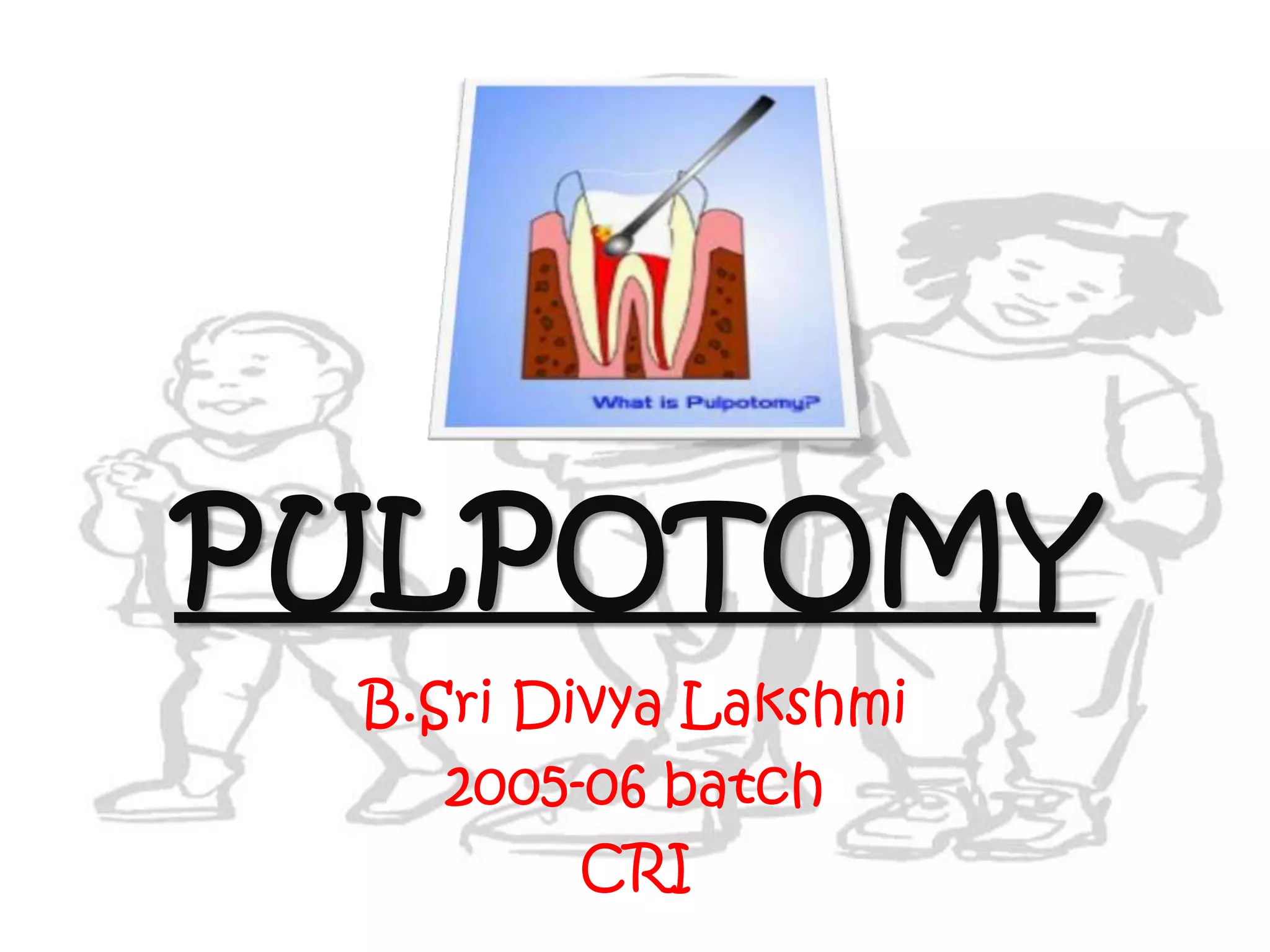



PULPOTOMYB.SriDivyaLakshmi2005-06 batchCRI
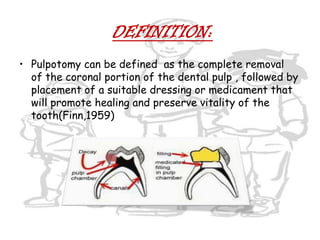
DEFINITION:Pulpotomy can be defined  as the complete removal  of the coronal portion of the dental pulp , followed by placement of a suitable dressing or medicament that will promote healing and preserve vitality of the tooth(Finn,1959)
Cariously exposed primary teeth, when their retention is more advantageous than extraction.When inflammation is confined to the coronal portion of the pulp.Vital tooth with healthy periodontiumPain,if present not spontaneous  nor persists after removal of the stimulusTooth-restorableTooth-2/3rd root lengthHemorrhage from the amputation site is pale red & easy to controlIn mixed dentition stage primary tooth is preferable to  a space maintainerINDICATION:
fistula or swelling,
the tooth crown is nonrestorable,
absent hemorrhage; profuse hemorrhage,
marked tenderness to percussion,
mobility,
radiolucency exists in the furcal or periradicular areas,
spontaneous pain, especially at night
necrotic pulp,
dystrophic calcification (pulp stones)CONTRAINDICAITON:
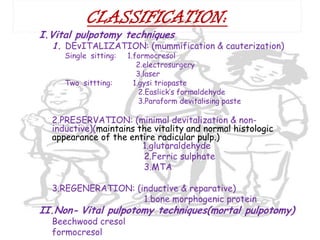
CLASSIFICATION:I.Vitalpulpotomy techniques1. DEvITALIZATION: (mummification & cauterization)Single  sitting:     1.formocresol                                        2.electrosurgery                                        3.laserTwo  sittting:         1.gysi triopaste                                         2.Easlick’s formaldehyde                                         3.Paraform devitalising paste2.PRESERVATION: (minimal devitalization & non-inductive)(maintains the vitality and normal histologic appearance of the entire radicular pulp.)                                  1.glutaraldehyde                                          2.Ferric sulphate                                          3.MTA3.REGENERATION: (inductive & reparative)  1.bone morphogenic proteinII.Non-Vital pulpotomy techniques(mortal pulpotomy)Beechwood cresolformocresol
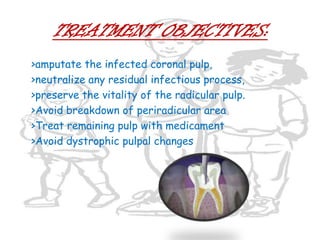
TREATMENT OBJECTIVES:>amputate the infected coronal pulp,>neutralize any residual infectious process,>preserve the vitality of the radicular pulp.>Avoid breakdown of periradicular area>Treat remaining pulp with medicament>Avoid dystrophic pulpal changes
DEVIALIZATION-single sittingFormocresol pulpotomy techniqueFirst advocated by SWEET(1930)FORMOCRESOL SOLUTION:           *19% formaldehyde           *35% cresol           *15% glycerineBuckley’s solution: 1:5 conc. Of  formocresol solution.Mechanism of action:formocresol prevents tissue autolysis by bonding to protein. This is reversible process and is accomplished  iwthout changing the basic overall structure of the protein moleculesFormocresol: (1) fixative;                      (2) chronic inflammation;                                  (3) possibly mutagenic or carcinogenic; 		              	         (4) 83.8% success rate.
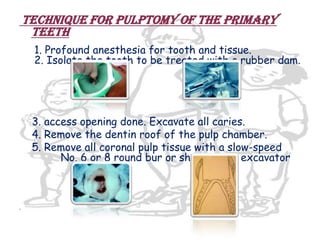
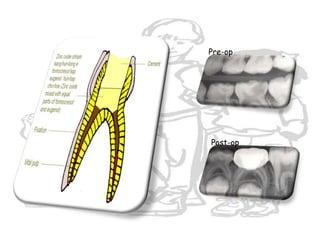
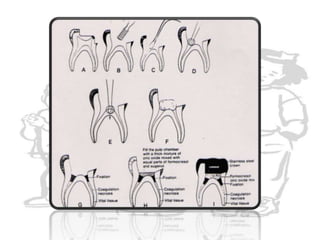
Technique for Pulptomy of the Primary Teeth 1. Profound anesthesia for tooth and tissue. 2. Isolate the tooth to be treated with a rubber dam.    3. access opening done. Excavate all caries.    4. Remove the dentin roof of the pulp chamber.     5. Remove all coronal pulp tissue with a slow-speed        	   No. 6 or 8 round bur or sharp spoon excavator.
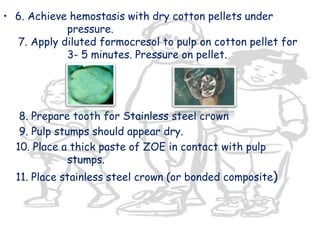
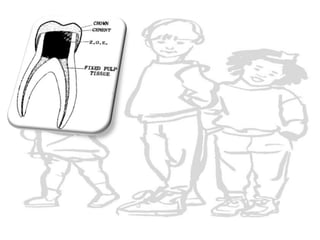
6. Achieve hemostasis with dry cotton pellets under     	 	          	pressure. 7. Apply diluted formocresol to pulp on cotton pellet for     	          	3- 5 minutes. Pressure on pellet.     8. Prepare tooth for Stainless steel crown     9. Pulp stumps should appear dry.    10. Place a thick paste of ZOE in contact with pulp          		stumps.    11. Place stainless steel crown (or bonded composite)
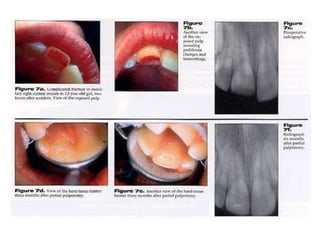
Pre-opPost-op
DEVIALIZATION-two sittingformacresolpulpotomy technique~Two stage procedure involves use of paraformaldehyde to fix the entire coronal & radicular pulp tissue.~The medicaments used in this technique have a devitalizing,mummifying and bactericidal action.Indications:.Profuse bleeding
.Difficulty in controlling bleeding
.Spontaneous pain
.Slight purulence discharge
.Thickened PDLcontraindication:.Non restorable
.Necrotic
.Soon to be exfoliatedFormula of each agent used are as follows:1.GYSI TRIOPASTE FORMULA:                     *tricresol 10 ml                     *cresol 20 ml                     *glyserine 4 ml                     *paraformaldehyde 20 ml                     *zinc oxide 60 gm2.EASLICK’S PARAFORMALDEHYDE FORMULA:               *paraformaldehyde  1 gm                      *procaine base 0.03 gm                      *powdered asbestos 0.05 gm                      *petroleum jelly 125 gm                      *carimine to colour3.PARAFORM DEVITALIZING PASTE:                      *paraformaldehyde  1gm                      *lignocaine 0.06 gm                      *propylene glycol 0.05 ml                       *carbowax 1500  1.30 gm                       *carmine to colour
First appointment:isolation of the affected teeth with rubber dam
Preparation of the cavity,excavate the caries
On excavaction of deep caries pulp exposure is encountered,ensure that the exposed site is free of debris.
Enlarge the cavity with round bur
Cotton pellet incorporated with paraformaldehyde is placed in the exposure site ,seal it for 1 to 2 weeks(formaldehyde gas liberated from the paraformaldehyde permeates thru the coronal & radicular pulp, fixing the tisues)
Second appointmentIn the second appt,pulpotomy Is carried with the help of LA.The roof of the pulp chamber is removed and cleaned with saline and dried with cotton pellet

Pulpotomy.pptmine

  • 1.
  • 2.
    DEFINITION:Pulpotomy can bedefined as the complete removal of the coronal portion of the dental pulp , followed by placement of a suitable dressing or medicament that will promote healing and preserve vitality of the tooth(Finn,1959)
  • 3.
    Cariously exposed primaryteeth, when their retention is more advantageous than extraction.When inflammation is confined to the coronal portion of the pulp.Vital tooth with healthy periodontiumPain,if present not spontaneous nor persists after removal of the stimulusTooth-restorableTooth-2/3rd root lengthHemorrhage from the amputation site is pale red & easy to controlIn mixed dentition stage primary tooth is preferable to a space maintainerINDICATION:
  • 4.
  • 5.
    the tooth crownis nonrestorable,
  • 6.
  • 7.
  • 8.
  • 9.
    radiolucency exists inthe furcal or periradicular areas,
  • 10.
  • 11.
  • 12.
    dystrophic calcification (pulpstones)CONTRAINDICAITON:
  • 13.
    CLASSIFICATION:I.Vitalpulpotomy techniques1. DEvITALIZATION:(mummification & cauterization)Single sitting: 1.formocresol 2.electrosurgery 3.laserTwo sittting: 1.gysi triopaste 2.Easlick’s formaldehyde 3.Paraform devitalising paste2.PRESERVATION: (minimal devitalization & non-inductive)(maintains the vitality and normal histologic appearance of the entire radicular pulp.) 1.glutaraldehyde 2.Ferric sulphate 3.MTA3.REGENERATION: (inductive & reparative) 1.bone morphogenic proteinII.Non-Vital pulpotomy techniques(mortal pulpotomy)Beechwood cresolformocresol
  • 14.
    TREATMENT OBJECTIVES:>amputate theinfected coronal pulp,>neutralize any residual infectious process,>preserve the vitality of the radicular pulp.>Avoid breakdown of periradicular area>Treat remaining pulp with medicament>Avoid dystrophic pulpal changes
  • 15.
    DEVIALIZATION-single sittingFormocresol pulpotomytechniqueFirst advocated by SWEET(1930)FORMOCRESOL SOLUTION: *19% formaldehyde *35% cresol *15% glycerineBuckley’s solution: 1:5 conc. Of formocresol solution.Mechanism of action:formocresol prevents tissue autolysis by bonding to protein. This is reversible process and is accomplished iwthout changing the basic overall structure of the protein moleculesFormocresol: (1) fixative; (2) chronic inflammation; (3) possibly mutagenic or carcinogenic; (4) 83.8% success rate.
  • 16.
    Technique for Pulptomyof the Primary Teeth 1. Profound anesthesia for tooth and tissue. 2. Isolate the tooth to be treated with a rubber dam. 3. access opening done. Excavate all caries. 4. Remove the dentin roof of the pulp chamber. 5. Remove all coronal pulp tissue with a slow-speed No. 6 or 8 round bur or sharp spoon excavator.
  • 17.
    6. Achieve hemostasiswith dry cotton pellets under pressure. 7. Apply diluted formocresol to pulp on cotton pellet for 3- 5 minutes. Pressure on pellet. 8. Prepare tooth for Stainless steel crown 9. Pulp stumps should appear dry. 10. Place a thick paste of ZOE in contact with pulp stumps. 11. Place stainless steel crown (or bonded composite)
  • 18.
  • 20.
    DEVIALIZATION-two sittingformacresolpulpotomy technique~Twostage procedure involves use of paraformaldehyde to fix the entire coronal & radicular pulp tissue.~The medicaments used in this technique have a devitalizing,mummifying and bactericidal action.Indications:.Profuse bleeding
  • 21.
  • 22.
  • 23.
  • 24.
  • 25.
  • 26.
    .Soon to beexfoliatedFormula of each agent used are as follows:1.GYSI TRIOPASTE FORMULA: *tricresol 10 ml *cresol 20 ml *glyserine 4 ml *paraformaldehyde 20 ml *zinc oxide 60 gm2.EASLICK’S PARAFORMALDEHYDE FORMULA: *paraformaldehyde 1 gm *procaine base 0.03 gm *powdered asbestos 0.05 gm *petroleum jelly 125 gm *carimine to colour3.PARAFORM DEVITALIZING PASTE: *paraformaldehyde 1gm *lignocaine 0.06 gm *propylene glycol 0.05 ml *carbowax 1500 1.30 gm *carmine to colour
  • 27.
    First appointment:isolation ofthe affected teeth with rubber dam
  • 28.
    Preparation of thecavity,excavate the caries
  • 29.
    On excavaction ofdeep caries pulp exposure is encountered,ensure that the exposed site is free of debris.
  • 30.
    Enlarge the cavitywith round bur
  • 31.
    Cotton pellet incorporatedwith paraformaldehyde is placed in the exposure site ,seal it for 1 to 2 weeks(formaldehyde gas liberated from the paraformaldehyde permeates thru the coronal & radicular pulp, fixing the tisues)
  • 32.
    Second appointmentIn thesecond appt,pulpotomy Is carried with the help of LA.The roof of the pulp chamber is removed and cleaned with saline and dried with cotton pellet