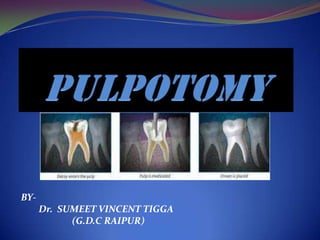
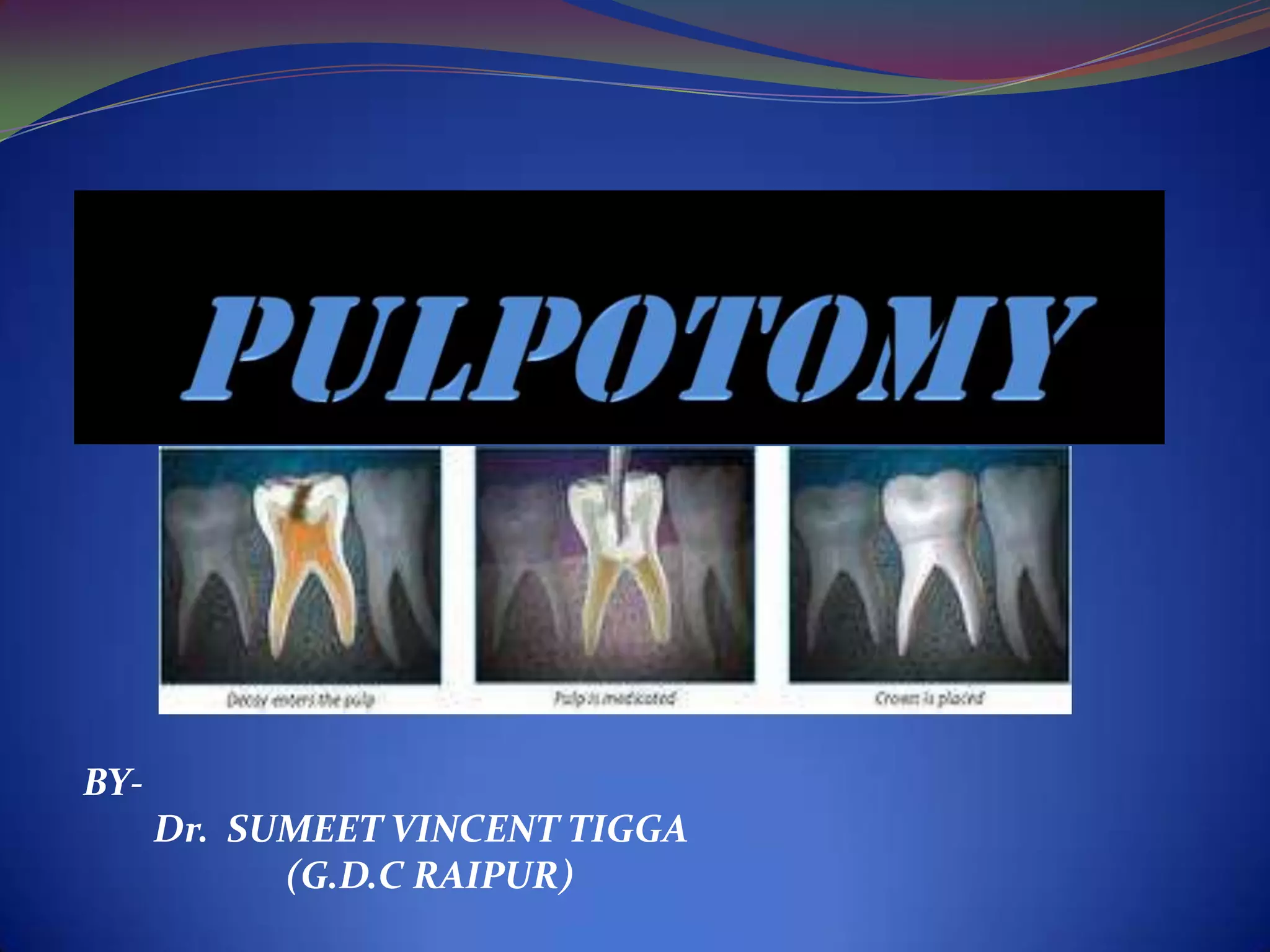
PULPOTOMYBY- Dr.  SUMEET VINCENT TIGGA                       (G.D.C RAIPUR)
DEFINATION-:PULPOTOMY  CAN BE DEFINED AS THE COMPLETE REMOVAL OF CORONAL PORTION OF THE DENTAL PULP , FOLLOWED BY PLACEMENT OF SUITABLE DRESSING OR MEDICAMENT THAT WILL PROMOTE HEALING & PRESERVE VITALITY OF THE TOOTH (Finn,1985 )
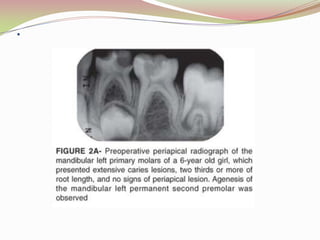
INDICATION-:Cariously exposed primary teeth, when their retention is more advantageous than extraction.
Vital tooth with healthy periodontium
Pain, if present not spontaneous nor persists after removal of the stimulus
Tooth which is restorable
Tooth with-2/3rd root length
Hemorrhage from the amputation site is pale red & easy to control
In mixed dentition stage primary tooth is preferable to a space maintainer.
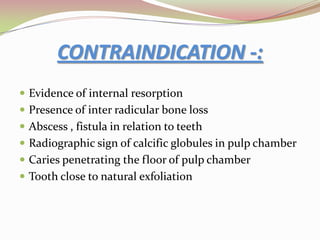
CONTRAINDICATION -:Evidence of internal resorptionPresence of inter radicular bone lossAbscess , fistula in relation to teethRadiographic sign of calcific globules in pulp chamberCaries penetrating the floor of pulp chamberTooth close to natural exfoliation
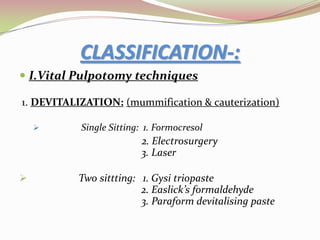
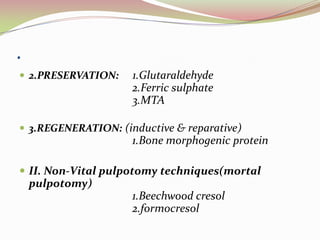
CLASSIFICATION-:I.VitalPulpotomy techniques 1. DEVITALIZATION:(mummification & cauterization)                 Single Sitting:  1. Formocresol                                                 2. Electrosurgery                                             3. Laser                    Two sittting:   1. Gysitriopaste                                             2. Easlick’s formaldehyde                                             3. Paraform devitalising paste.2.PRESERVATION:     1.Glutaraldehyde                                      2.Ferric sulphate                                      3.MTA3.REGENERATION: (inductive & reparative)                                      1.Bone morphogenic proteinII. Non-Vital pulpotomy techniques(mortal pulpotomy)                                      1.Beechwood cresol                                      2.formocresol
TREATMENT OBJECTIVES-:>Amputate the infected coronal pulp,>Neutralize any residual infectious process,>Preserve the vitality of the radicular pulp.>Avoid breakdown of periradicular area>Treat remaining pulp with medicament>Avoid dystrophic pulpal changes
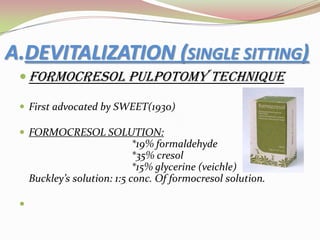
A.DEVITALIZATION (SINGLE SITTING)FORMOCRESOL PULPOTOMY TECHNIQUEFirst advocated by SWEET(1930)FORMOCRESOL SOLUTION:                                         *19% formaldehyde                                         *35% cresol                                         *15% glycerine (veichle)Buckley’s solution: 1:5 conc. Of formocresol solution.
..To prepare a 1:5 conc. Of this formula-First thoroughly mix  3 part of glycerinre with 1 part of distilled water Then add 4 parts of this preparation to 1 part Buckley’s formocresol & thoroughly mix againMechanism Of Action:Formocresol prevents tissue autolysis by bonding to protein. This is reversible process and is accomplished without changing the basic overall structure of the protein molecules
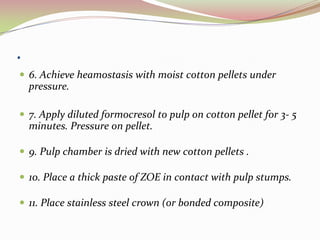
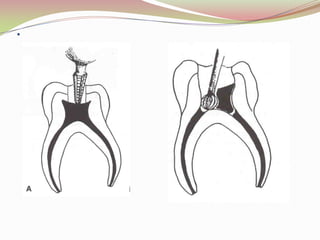
Technique  for  Pulptomy  of  thePrimary  Teeth1. Profound anaesthesia for tooth and tissue. 2. Isolate the tooth to be treated with a rubber dam.3. Excavate all caries.4. Remove the dentin roof of the pulp chamber. 5. Remove all coronal pulp tissue with a slow-speed No. 6 or 8 round bur or sharp spoon excavator
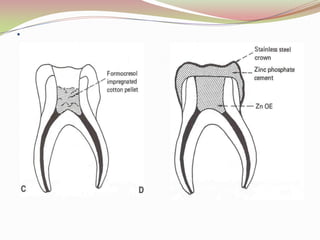
.6. Achieve heamostasis with moist cotton pellets under pressure. 7. Apply diluted formocresol to pulp on cotton pellet for 3- 5 minutes. Pressure on pellet.9. Pulp chamber is dried with new cotton pellets .10. Place a thick paste of ZOE in contact with pulp stumps.11. Place stainless steel crown (or bonded composite)
.
.
.
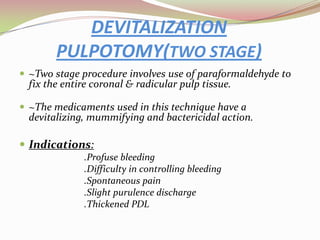
DEVITALIZATION PULPOTOMY(TWO STAGE)~Two stage procedure involves use of paraformaldehyde to fix the entire coronal & radicular pulp tissue.~The medicaments used in this technique have a devitalizing, mummifying and bactericidal action.Indications:                      .Profuse bleeding                      .Difficulty in controlling bleeding                      .Spontaneous pain                      .Slight purulence discharge                      .Thickened PDL
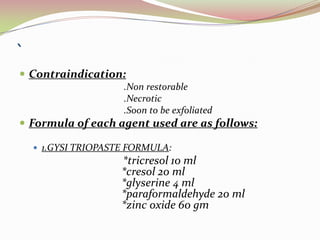
`Contraindication:                                       .Non restorable                                       .Necrotic                                       .Soon to be exfoliatedFormula of each agent used are as follows:1.GYSI TRIOPASTE FORMULA:                                      *tricresol 10 ml                                  *cresol 20 ml                                  *glyserine 4 ml                                  *paraformaldehyde 20 ml                                  *zinc oxide 60 gm
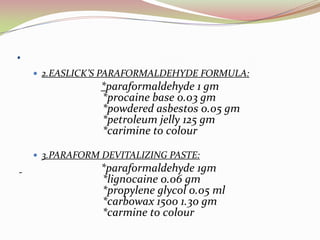
.2.EASLICK’S PARAFORMALDEHYDE FORMULA:*paraformaldehyde 1 gm                           *procaine base 0.03 gm                           *powdered asbestos 0.05 gm                           *petroleum jelly 125 gm                           *carimine to colour3.PARAFORM DEVITALIZING PASTE:                             *paraformaldehyde 1gm                           *lignocaine 0.06 gm                           *propylene glycol 0.05 ml                           *carbowax 1500 1.30 gm                           *carmine to colour
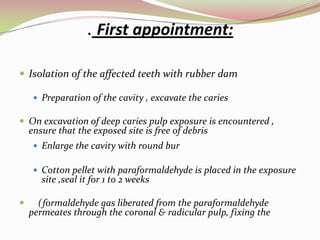
.First appointment:Isolation of the affected teeth with rubber damPreparation of the cavity , excavate the cariesOn excavation of deep caries pulp exposure is encountered , ensure that the exposed site is free of debrisEnlarge the cavity with round burCotton pellet with paraformaldehyde is placed in the exposure site ,seal it for 1 to 2 weeks    (formaldehyde gas liberated from the paraformaldehyde permeates through the coronal & radicular pulp, fixing the
.Second appointmentIn the second appointment pulpotomy is carried with the help of L.A.The roof of the pulp chamber is removed and cleaned with saline and dried with cotton pelletThe pulp chamber is then filled with antiseptic paste and the tooth is restored.
PARTIAL PULPOTOMY The partial pulpotomy for traumatic exposures is a procedure in which the inflamed pulp tissue beneath an exposure is removed to a depth of 1-3 mm to reach the deeper healthy tissue -Indicated for a vital , traumatically exposed, young permanent tooth, especially one with an incompletely formed apex.-Calcium hydroxide or MTA is used
OBJECTIVES FOR Ca(OH)₂ PULPOTOMY OF YOUNG PERMANANT TEETH-:Preserve radicular vitality,Maximize the opportunity for apexogenesis (apical development and closure),Enhance continual root dentin formation..there should be no adverse clinical signs or symptoms of sensitivity, pain or swelling
PROPERTIES OF CALCIUM HYDROXIDECalcific bridge formation(91% success)Germicidal activityVital pulp remainsClinical success to be 65% Hystological success 35%
CLINICAL TECHNIQUE FOR THE Ca(OH)₂ PULPOTOMY 1.Anesthetize the tooth and isolate under a rubber dam.2. Excavate all caries and establish a cavity outline.3. Irrigate the cavity and lightly dry with cotton pellets4. Remove the roof of the pulp chamber5. Amputate the coronal pulp with a large low-speed round bur or a high-speed diamond stone with a light touch..6. Control hemorrhage with a cotton pellet applied with pressure or a damp pellet of hydrogen peroxide
. 7. Place a calcium hydroxide mixture over the radicular pulp stumps at the canal orifices and dry with a cotton pellet. 8. Place quick-setting ZOE cement or resin-reinforced glass ionomer cement over the calcium hydroxide to seal and fill the chamber.
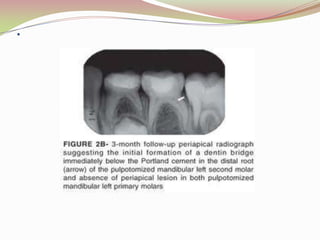
PROPERTIES OF MTA (MINERAL TRIOXIDE AGGREGATE) 93% clinical success rateBetter biocompatibilityBetter sealing ability-prevents leakage in pulpal & periapical tissuesLess time needed for procedurePromotes regeneration of original pulp tissueDentinal bridge formation is seen
USING MTA INSTEAD OF FORMOCRESOL FOR PULPOTOMY • In this new technique, the MTA paste is allowed to cover the dry pulp stumps (instead of formocresol).• MTA is a powder composed of                                        -Tricalcium silicate,                                        -Bismuth oxide,                                        -Dicalcium silicate,                                        -Tricalciumaluminate,                                       -Tetracalciumaluminoferrite,                                       -Calcium sulfatedihydrate.
.The cement’s setting time is 3 to 4 hours. MTA paste is obtained by mixing MTA powder with   sterile saline at a 3:1 powder/saline ratio. IRM is place over the MTA.

PULPOTOMY

  • 1.
    PULPOTOMYBY- Dr. SUMEET VINCENT TIGGA (G.D.C RAIPUR)
  • 2.
    DEFINATION-:PULPOTOMY CANBE DEFINED AS THE COMPLETE REMOVAL OF CORONAL PORTION OF THE DENTAL PULP , FOLLOWED BY PLACEMENT OF SUITABLE DRESSING OR MEDICAMENT THAT WILL PROMOTE HEALING & PRESERVE VITALITY OF THE TOOTH (Finn,1985 )
  • 3.
    INDICATION-:Cariously exposed primaryteeth, when their retention is more advantageous than extraction.
  • 4.
    Vital tooth withhealthy periodontium
  • 5.
    Pain, if presentnot spontaneous nor persists after removal of the stimulus
  • 6.
    Tooth which isrestorable
  • 7.
  • 8.
    Hemorrhage from theamputation site is pale red & easy to control
  • 9.
    In mixed dentitionstage primary tooth is preferable to a space maintainer.
  • 10.
    CONTRAINDICATION -:Evidence ofinternal resorptionPresence of inter radicular bone lossAbscess , fistula in relation to teethRadiographic sign of calcific globules in pulp chamberCaries penetrating the floor of pulp chamberTooth close to natural exfoliation
  • 11.
    CLASSIFICATION-:I.VitalPulpotomy techniques 1.DEVITALIZATION:(mummification & cauterization) Single Sitting: 1. Formocresol 2. Electrosurgery 3. Laser Two sittting: 1. Gysitriopaste 2. Easlick’s formaldehyde 3. Paraform devitalising paste.2.PRESERVATION: 1.Glutaraldehyde 2.Ferric sulphate 3.MTA3.REGENERATION: (inductive & reparative) 1.Bone morphogenic proteinII. Non-Vital pulpotomy techniques(mortal pulpotomy) 1.Beechwood cresol 2.formocresol
  • 12.
    TREATMENT OBJECTIVES-:>Amputate theinfected coronal pulp,>Neutralize any residual infectious process,>Preserve the vitality of the radicular pulp.>Avoid breakdown of periradicular area>Treat remaining pulp with medicament>Avoid dystrophic pulpal changes
  • 13.
    A.DEVITALIZATION (SINGLE SITTING)FORMOCRESOLPULPOTOMY TECHNIQUEFirst advocated by SWEET(1930)FORMOCRESOL SOLUTION: *19% formaldehyde *35% cresol *15% glycerine (veichle)Buckley’s solution: 1:5 conc. Of formocresol solution.
  • 14.
    ..To prepare a1:5 conc. Of this formula-First thoroughly mix 3 part of glycerinre with 1 part of distilled water Then add 4 parts of this preparation to 1 part Buckley’s formocresol & thoroughly mix againMechanism Of Action:Formocresol prevents tissue autolysis by bonding to protein. This is reversible process and is accomplished without changing the basic overall structure of the protein molecules
  • 15.
    Technique for Pulptomy of thePrimary Teeth1. Profound anaesthesia for tooth and tissue. 2. Isolate the tooth to be treated with a rubber dam.3. Excavate all caries.4. Remove the dentin roof of the pulp chamber. 5. Remove all coronal pulp tissue with a slow-speed No. 6 or 8 round bur or sharp spoon excavator
  • 16.
    .6. Achieve heamostasiswith moist cotton pellets under pressure. 7. Apply diluted formocresol to pulp on cotton pellet for 3- 5 minutes. Pressure on pellet.9. Pulp chamber is dried with new cotton pellets .10. Place a thick paste of ZOE in contact with pulp stumps.11. Place stainless steel crown (or bonded composite)
  • 17.
  • 18.
  • 19.
  • 20.
    DEVITALIZATION PULPOTOMY(TWO STAGE)~Twostage procedure involves use of paraformaldehyde to fix the entire coronal & radicular pulp tissue.~The medicaments used in this technique have a devitalizing, mummifying and bactericidal action.Indications: .Profuse bleeding .Difficulty in controlling bleeding .Spontaneous pain .Slight purulence discharge .Thickened PDL
  • 21.
    `Contraindication: .Non restorable .Necrotic .Soon to be exfoliatedFormula of each agent used are as follows:1.GYSI TRIOPASTE FORMULA: *tricresol 10 ml *cresol 20 ml *glyserine 4 ml *paraformaldehyde 20 ml *zinc oxide 60 gm
  • 22.
    .2.EASLICK’S PARAFORMALDEHYDE FORMULA:*paraformaldehyde1 gm *procaine base 0.03 gm *powdered asbestos 0.05 gm *petroleum jelly 125 gm *carimine to colour3.PARAFORM DEVITALIZING PASTE: *paraformaldehyde 1gm *lignocaine 0.06 gm *propylene glycol 0.05 ml *carbowax 1500 1.30 gm *carmine to colour
  • 23.
    .First appointment:Isolation ofthe affected teeth with rubber damPreparation of the cavity , excavate the cariesOn excavation of deep caries pulp exposure is encountered , ensure that the exposed site is free of debrisEnlarge the cavity with round burCotton pellet with paraformaldehyde is placed in the exposure site ,seal it for 1 to 2 weeks (formaldehyde gas liberated from the paraformaldehyde permeates through the coronal & radicular pulp, fixing the
  • 24.
    .Second appointmentIn thesecond appointment pulpotomy is carried with the help of L.A.The roof of the pulp chamber is removed and cleaned with saline and dried with cotton pelletThe pulp chamber is then filled with antiseptic paste and the tooth is restored.
  • 25.
    PARTIAL PULPOTOMY The partialpulpotomy for traumatic exposures is a procedure in which the inflamed pulp tissue beneath an exposure is removed to a depth of 1-3 mm to reach the deeper healthy tissue -Indicated for a vital , traumatically exposed, young permanent tooth, especially one with an incompletely formed apex.-Calcium hydroxide or MTA is used
  • 26.
    OBJECTIVES FOR Ca(OH)₂PULPOTOMY OF YOUNG PERMANANT TEETH-:Preserve radicular vitality,Maximize the opportunity for apexogenesis (apical development and closure),Enhance continual root dentin formation..there should be no adverse clinical signs or symptoms of sensitivity, pain or swelling
  • 27.
    PROPERTIES OF CALCIUMHYDROXIDECalcific bridge formation(91% success)Germicidal activityVital pulp remainsClinical success to be 65% Hystological success 35%
  • 28.
    CLINICAL TECHNIQUE FORTHE Ca(OH)₂ PULPOTOMY 1.Anesthetize the tooth and isolate under a rubber dam.2. Excavate all caries and establish a cavity outline.3. Irrigate the cavity and lightly dry with cotton pellets4. Remove the roof of the pulp chamber5. Amputate the coronal pulp with a large low-speed round bur or a high-speed diamond stone with a light touch..6. Control hemorrhage with a cotton pellet applied with pressure or a damp pellet of hydrogen peroxide
  • 29.
    . 7. Placea calcium hydroxide mixture over the radicular pulp stumps at the canal orifices and dry with a cotton pellet. 8. Place quick-setting ZOE cement or resin-reinforced glass ionomer cement over the calcium hydroxide to seal and fill the chamber.
  • 30.
    PROPERTIES OF MTA(MINERAL TRIOXIDE AGGREGATE) 93% clinical success rateBetter biocompatibilityBetter sealing ability-prevents leakage in pulpal & periapical tissuesLess time needed for procedurePromotes regeneration of original pulp tissueDentinal bridge formation is seen
  • 31.
    USING MTA INSTEADOF FORMOCRESOL FOR PULPOTOMY • In this new technique, the MTA paste is allowed to cover the dry pulp stumps (instead of formocresol).• MTA is a powder composed of -Tricalcium silicate, -Bismuth oxide, -Dicalcium silicate, -Tricalciumaluminate, -Tetracalciumaluminoferrite, -Calcium sulfatedihydrate.
  • 32.
    .The cement’s settingtime is 3 to 4 hours. MTA paste is obtained by mixing MTA powder with sterile saline at a 3:1 powder/saline ratio. IRM is place over the MTA.