PRESENTED BY  PRIYANK PAREEK IV  B.D.S. DEPARTMENT OF PEDIATRIC AND PREVENTIVE DENTISTRY NAIR HOSPITAL DENTAL COLLEGE,MUMBAI
 
Ideally a non vital pulp should be treated by pulpectomy and root canal filling NON – NEGOTIABLE ROOT CANALS LIMITED PATIENT’S CO-OPERATION Hence , a   two – stage pulpotomy  technique  is advocated MORTAL PULPOTOMY  ( NON – VITAL PULPOTOMY )
Sellection criteria History of spontaneous pain Swelling soreness or redness of mucosa Tooth mobility Tendernedd to percussion Radiographic evidence of pathologic root resorption
Necrotic coronal pulp is removed Pulp chamber is  irrigated with saline Infected radicular pulp is treated with a strong antiseptic solution such as  beechwood cresol Seal the cavity with temporary cement for one or two weeks FIRST APPOINTMENT
Remove the temporary dressing and pellet containing beeechwood cresol Note the  symptoms   if  persist  or no signs of resolution of sinus Repeat the treatment   or   Extract the tooth If there are  no symptoms Antiseptic paste  is filled in the pulp chamber and is firmly pushed into the root canals Restoration with  Stainless Steel Crown Second appointment
 
Complete removal of necrotic pulp tissue from the root canals and coronal portion of devital primary teeth to maintain the tooth in the dental arch Justification Removal of diseased tissue Space management Pulpectomy -general PULPECTOMY
1. Following the treatment , the infectious process should resolve 2. There should be radiographic evidence of successful filling without  gross overextension or underfilling 3. The treatment should permit resorption of the primary root structures at the appropriate time to permit normal eruption of succedaneous tooth 4. No radiographic evidence of  further breakdown of supporting tissues 5. Should prevent further pain and swelling 6. No internal or external resorption or other pathology Pulpectomy -general OBJECTIVES OF PULPECTOMY
1. Strategically important tooth (in case of the deciduous second molar where the permanent first molar has not erupted) 2. Irreversible pulpits 3. Minimal periapical changes with sufficient bone support 4. At least 2/3 rd  of the root length available 5. Internal resorption without any obvious perforation Pulpectomy -general INDICATIONS
1. Excessively mobile and/or reduced bone support 2. Non restorable tooth 3. Internal resorption of the pulp chamber and root canal 4. Underlying dentigerous or follicular cyst 5. Pathology extending to the developing permanent tooth bud 6. Less than2/3 rd  of root length remaining 7. Perforation of pulpal floor 8. Medically compromised children Pulpectomy -general CONTRAINDICATIONS
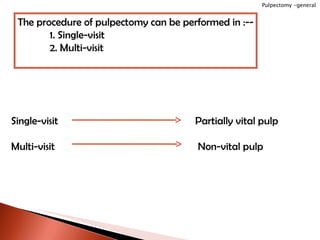
The procedure of pulpectomy can be performed in :-- 1. Single-visit 2. Multi-visit Single-visit   Partially vital pulp Multi-visit   Non-vital pulp Pulpectomy -general
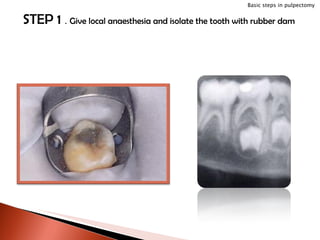
STEP 1  .  Give local anaesthesia and isolate the tooth with rubber dam Basic steps in pulpectomy
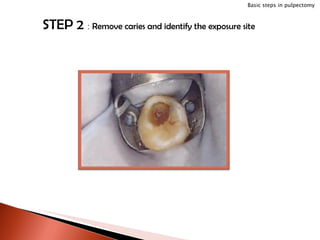
STEP 2  :  Remove caries and identify the exposure site Basic steps in pulpectomy
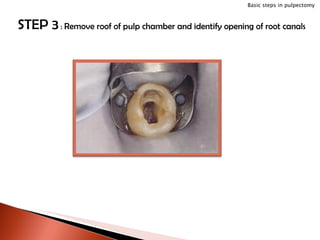
STEP 3  :  Remove roof of pulp chamber and identify opening of root canals Basic steps in pulpectomy
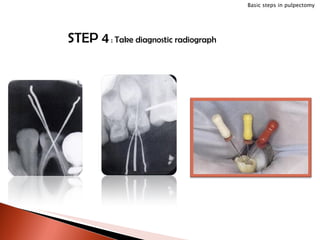
STEP 4  :  Take diagnostic radiograph Basic steps in pulpectomy
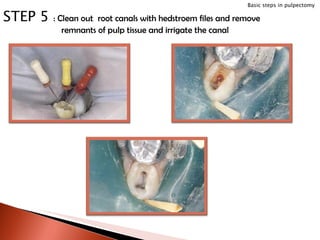
STEP 5  : Clean out  root canals with hedstroem files and remove remnants of pulp tissue and irrigate the canal Basic steps in pulpectomy
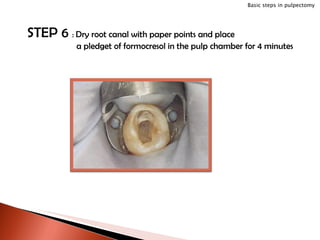
STEP 6  :  Dry root canal with paper points and place a pledget of formocresol in the pulp chamber for 4 minutes Basic steps in pulpectomy
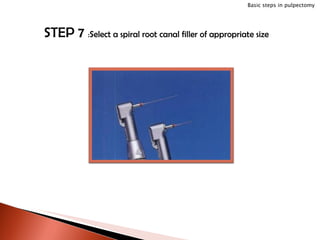
STEP 7  : Select a spiral root canal filler of appropriate size Basic steps in pulpectomy
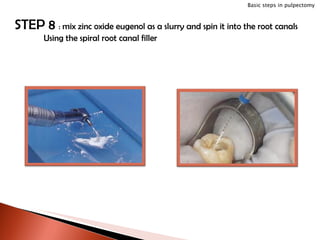
STEP 8  :  mix zinc oxide eugenol as a slurry and spin it into the root canals Using the spiral root canal filler Basic steps in pulpectomy
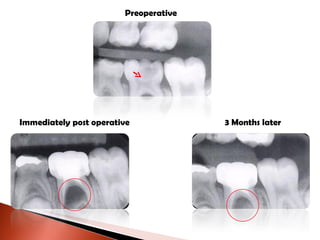
Preoperative Immediately post operative 3 Months later
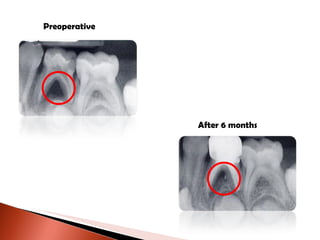
After 6 months Preoperative
1. Access opening for pulpectomy in primary teeth  It is defined as That endodontic coronal preparation which enables unobstructed  access to the canal orifice , a straight line access to the apical foramen, complete authority over the enlarging instrument and to accommodate the filling  technique SINGLE VISIT PULPECTOMY TECHNIQUE
1. Complete removal of pulp chamber roof 2. Removal of coronal pulp 3. Straight line access to facilitate placement of endodontic instruments and obturation material These ideals are balanced with following constraints Conservation of tooth structure Retention and esthetics Final restoration SINGLE VISIT PULPECTOMY TECHNIQUE IDEALS FOR ENDODONTIC ACCESS
3  main objectives 1.  obtaining a straight line access to the apical foramen or to the Initial curvature of the canal to aid in -improved instrumentation control -improved obturation -decreases the incidence of procedural error 2.  Conservation of tooth structure   -to minimize weakening of remaining tooth structure 3.  Unroofing the pulp chamber and removal of the pulp horns to aid in -locating the root canal orifice -maximum visibility -locate canals -permit straight line preparation -prevents discoloration of teeth due to pulpal remnants Access openning OBJECTIVES
To achieve optimal preparation  3  factors of internal anatomy must be considered 1.  Size of the pulp chamber -more extensive preparations due to large pulp chambers 2.  Shape of the pulp chamber -the finished outline form  should accurately reflect the    shape of the pulp chamber Example : the floor of the pulp chamber in molar is usually    triangular --- triangular position of canal orifice   this shape is so extended to the walls of the cavity   onto the occlusal surface---- final outline form is    usually triangular 3.  Number position and curvature of root canals Access openning
Primary root canal anatomy The clinician must have a thorough knowledge of the anatomy of the Primary root canal and the variations that normally exist Access openning
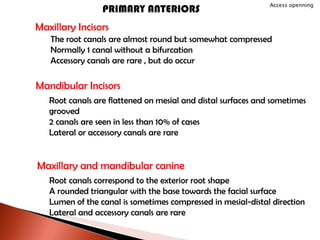
Maxillary and mandibular canine Root canals correspond to the exterior root shape A rounded triangular with the base towards the facial surface Lumen of the canal is sometimes compressed in mesial-distal direction Lateral and accessory canals are rare PRIMARY ANTERIORS Maxillary Incisors The root canals are almost round but somewhat compressed Normally 1 canal without a bifurcation Accessory canals are rare , but do occur Mandibular Incisors Root canals are flattened on mesial and distal surfaces and sometimes grooved 2 canals are seen in less than 10% of cases Lateral or accessory canals are rare Access openning
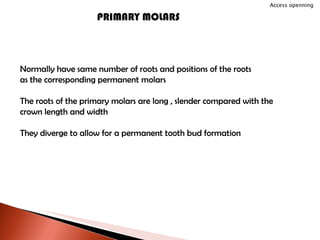
PRIMARY MOLARS Normally have same number of roots and positions of the roots as the corresponding permanent molars The roots of the primary molars are long , slender compared with the  crown length and width They diverge to allow for a permanent tooth bud formation Access openning
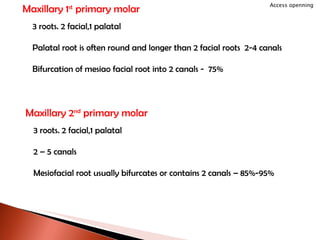
Maxillary 2 nd  primary molar 3 roots. 2 facial,1 palatal 2 – 5 canals Mesiofacial root usually bifurcates or contains 2 canals – 85%-95% Maxillary 1 st  primary molar 3 roots. 2 facial,1 palatal Palatal root is often round and longer than 2 facial roots  2-4 canals Bifurcation of mesiao facial root into 2 canals -  75% Access openning
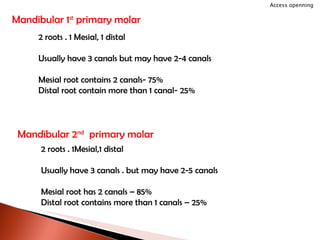
Mandibular 1 st  primary molar 2 roots . 1 Mesial, 1 distal Usually have 3 canals but may have 2-4 canals Mesial root contains 2 canals- 75% Distal root contain more than 1 canal- 25% Mandibular 2 nd   primary molar 2 roots . 1Mesial,1 distal Usually have 3 canals . but may have 2-5 canals Mesial root has 2 canals – 85% Distal root contains more than 1 canals – 25% Access openning
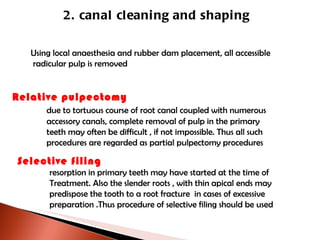
2. canal cleaning and shaping Using local anaesthesia and rubber dam placement, all accessible radicular pulp is removed Relative pulpectomy   due to tortuous course of root canal coupled with numerous    accessory canals, complete removal of pulp in the primary    teeth may often be difficult , if not impossible. Thus all such    procedures are regarded as partial pulpectomy procedures Selective filing resorption in primary teeth may have started at the time of  Treatment. Also the slender roots , with thin apical ends may  predispose the tooth to a root fracture  in cases of excessive  preparation .Thus procedure of selective filing should be used
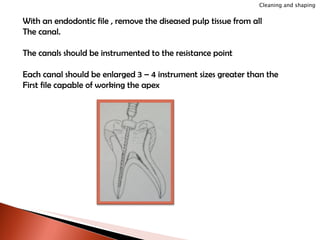
With an endodontic file , remove the diseased pulp tissue from all  The canal. The canals should be instrumented to the resistance point Each canal should be enlarged 3 – 4 instrument sizes greater than the First file capable of working the apex Cleaning and shaping
It is not necessary to take an X-ray to determine file length  as is done in  Permanent teeth endodontic procedure Visual comparision of file and root canal length on the pre operative  Periapical radiograph will result in sufficient clinical acccuracy In the primary tooth attempts  to mechanically prepare a circular  apical 1/3 rd  may result in lateral perforation of the canal because of its Hour glass shape Because of the bizzare anatomy of primary molar root canals the use of  barbed broaches  as in conventional endodontics may be unsuccessful Also the ribbon shape  of the root canals, with a narrow mesiodistal width Compared to their buccolingual dimension, discourages gross enlargement Of the canals Hedstrom files are recommended since they remove hard tissue only on withdrawal , which prevents pushing infected through the apices. For this  Reason reamers are not recommended Cleaning and shaping
Instruments used in conjunction with irrigating solution  reduce the possibility of fracture because of the lubricant action of the  solution 5% solution of sodium hypochlorite has an excellent solvent action and  is dilute enough to cause only mild irritation when contacting periapical Tissue - Schilder & Amsterdam,1970 After filing ,the canal should be irrigated and then dried with cotton pellet Or paper points Cleaning and shaping
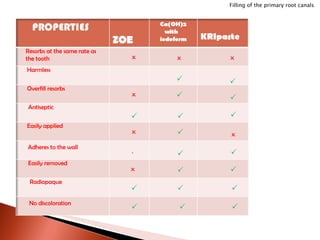
3. Filling of the primary root canals Ideal requirements are as follows 1 .  Should resorb at the similar rate as the primary root 2.  Should be harmless to the periapical tissues and to the    permanent tooth germ ; if pressed beyond the apex it should   resorb readily 3.  Should have a stable disinfecting power 4.  Should be inserted into the root canal and be removed easily    if necessary 5.  Should adhere to the walls of the canals and should not shrink 6.  Should not be soluble in water 7.  Should be radiopaque and not discolor the tooth
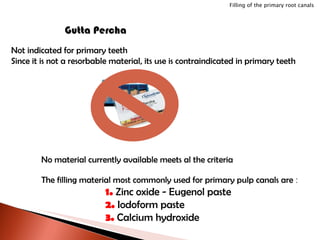
Gutta Percha Not indicated for primary teeth Since it is not a resorbable material, its use is contraindicated in primary teeth No material currently available meets al the criteria The filling material most commonly used for primary pulp canals are  : 1.  Zinc oxide - Eugenol paste 2.  Iodoform paste 3.  Calcium hydroxide Filling of the primary root canals
Resorbs at the same rate as the tooth Harmless Overfill resorbs Antiseptic Easily applied Adheres to the wall Easily removed Radiopaque No discoloration                            Filling of the primary root canals
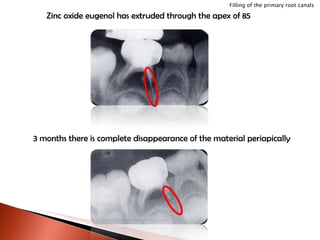
Zinc oxide eugenol has extruded through the apex of 85 3 months there is complete disappearance of the material periapically Filling of the primary root canals
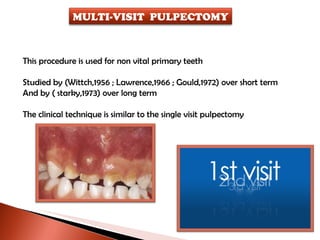
This procedure is used for non vital primary teeth Studied by (Wittch,1956 ; Lawrence,1966 ; Gould,1972) over short term  And by ( starky,1973) over long term The clinical technique is similar to the single visit pulpectomy MULTI-VISIT  PULPECTOMY
Local anaesthesia and rubber dam placement are recommended In cases of swelling and cellulites this can be omitted Instrumentation of the canal is not recommended at the first visit in in 1. Mobile tooth 2. If swelling or a fistula is present 3. If pus is present in the canals In absence of signs and symptoms instrumentation can proceed Between and after instrumentation canals are irrigated Between appointment antibacterial drug is sealed in the pulp chamber, maintained with a temporary cement In some cases the degree of pre operative cellulites will dictate that  drainage will have to be established A smooth broach is used to  perforate the apices and the tooth left open  to drain for no more than 1 day  If kept open for more than 24 hrs usually results in food packing into the canal Multi – visit pulpectomy
Systemic antibiotic therapy is also indicated External heat should not be applied as this may result in extra-oral Drainage of the infection In these cases the coronal pulp chamber can be  filled with beechwood  Cresol soaked cotton pellet after 24 hrs drainage Appointments are 7 – 10 days apart . The number of appointments and Timing and extent of instrumentation will be determined by signs and  symptoms at each visit The canals should not be filled until they are dry and all other signs and symptoms  have been eliminated -(lawrence,1966) Multi – visit pulpectomy
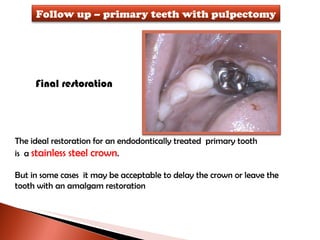
Final restoration The ideal restoration for an endodontically treated  primary tooth  is  a  stainless steel crown .  But in some cases  it may be acceptable to delay the crown or leave the tooth with an amalgam restoration Follow up – primary teeth with pulpectomy
Post operative follow up at 6 month interval should include an evaluation  Of signs and symptoms evidence of failure Clinical Pathological mobility Presence of fistula Pain on percussion Radiographic Increased size of radiolucency external or internal root resorption Assessment of success
Non vital teeth treated with pulpectomy ,  premature root resorption  is more marked The filling material is not the same texture or hardness as normal tooth Or vital pulp When the erupting permanent successor meets root canal filling material there is  increased possibility of deflection Most problems associated with resorption arise when the erupting tooth Has resorbed the pulpal floor of the primary molar and is contacting the  material in the coronal pulp chamber Eruption of permanent successor
 
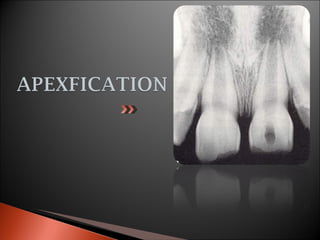
It is a method to induce a calcified barrier in a root with  an open apex or the continued apical development of an incomplete root in  teeth with necrotic pulp (A.A.E.,2003) APEXIFICATION
Causes of open apex:- 1.  Incomplete development- Pulpal necrosis  before root growth and development are complete 2.  Extensive apical root resorption due to trauma , periapical pathosis , orthodontic treatment
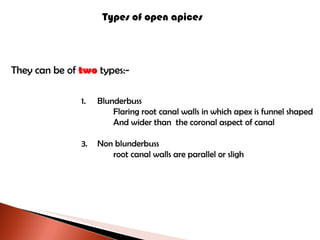
Types of open apices They can be of   two   types:- Blunderbuss Flaring root canal walls in which apex is funnel shaped And wider than  the coronal aspect of canal Non blunderbuss root canal walls are parallel or sligh
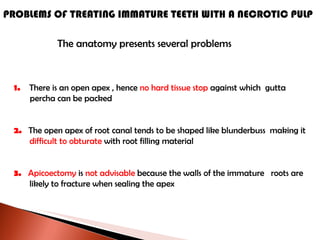
PROBLEMS OF TREATING IMMATURE TEETH WITH A NECROTIC PULP The anatomy presents several problems 1.  There is an open apex , hence  no hard tissue stop  against which  gutta percha can be packed 2.  The open apex of root canal tends to be shaped like blunderbuss  making it difficult to obturate  with root filling material 3.  Apicoectomy  is  not advisable  because the walls of the immature  roots are likely to fracture when sealing the apex
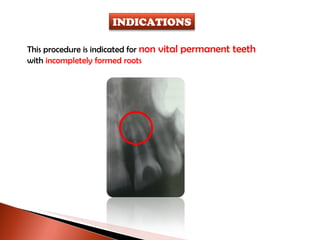
This procedure is indicated for  non vital permanent teeth  with  incompletely formed roots INDICATIONS
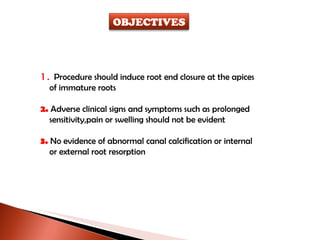
1.  Procedure should induce root end closure at the apices of immature roots 2.  Adverse clinical signs and symptoms such as prolonged sensitivity,pain or swelling should not be evident 3.  No evidence of abnormal canal calcification or internal  or external root resorption OBJECTIVES
MATERIALS  USED Antiseptic and antibiotic paste (Frank)  ZnO and metacresylacetate-camphorated parachlorophenol tricalcium phosphate collagen Ca phosphate gel resorbable tri calcium phosphate ceramic Calcium hydroxide
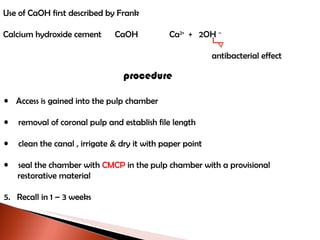
procedure Use of CaOH first described by Frank Calcium hydroxide cement  CaOH  Ca 2+   +  2OH  –   antibacterial effect Access is gained into the pulp chamber removal of coronal pulp and establish file length clean the canal , irrigate & dry it with paper point seal the chamber with  CMCP  in the pulp chamber with a provisional  restorative material 5.  Recall in 1 – 3 weeks
In first recall , remove the restoration and clean the canal Take care to void any instrumentation of the walls of the dentin near  the apex paste of  CaOH  and  CMCP   is filled in the canal  The objective is to fill the canal completely Obtain a radiograph to check for the accuracy
6 month recall Radiographic evidence of apical closure is seen It is necessary to test the quality of the apical barrier with a size 35 file If file easily penetrates continue apexification  Reschedule the patient for another 3 months recall The follow up evaluation is repeated every 3 months until successful  apical bridging has occurred
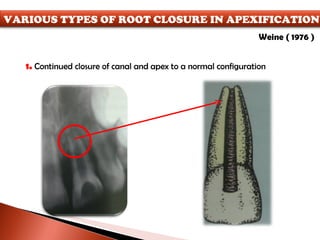
1.  Continued closure of canal and apex to a normal configuration Weine ( 1976 ) VARIOUS TYPES OF ROOT CLOSURE IN APEXIFICATION
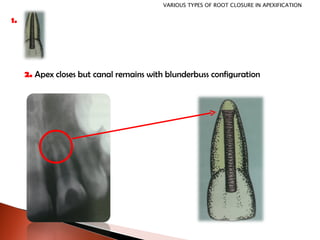
2.  Apex closes but canal remains with blunderbuss configuration 1. VARIOUS TYPES OF ROOT CLOSURE IN APEXIFICATION
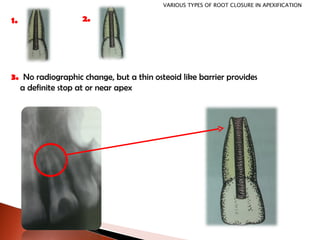
3.  No radiographic change, but a thin osteoid like barrier provides  a definite stop at or near apex 1. 2. VARIOUS TYPES OF ROOT CLOSURE IN APEXIFICATION
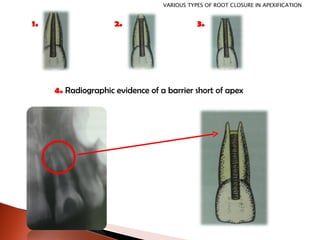
4.  Radiographic evidence of a barrier short of apex 1. 2. 3. VARIOUS TYPES OF ROOT CLOSURE IN APEXIFICATION
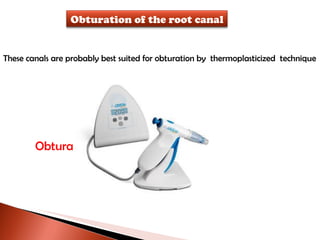
These canals are probably best suited for obturation by  thermoplasticized  technique Obtura Obturation of the root canal
1.  Mineral trioxide aggregate ( M.T.A. ) 1. Allows for the overgrowth of cementum 2. May facilitate the regeneration of PDL MTA was first described in dental literature in  1993  by  torabinejad Mechanism of action stimulated cytokine  release from bone cells  Alternatives of conventional apexification
Composition Tricalcium silicate Dicalcium silicate Tricalcium aluminate Calcium sulphate dehydrate Bismuth oxide P.H.  is  12.5 Limitations cost storage problems . sets in presence of moisture ( 4 hrs ) 2. Metapex { ( CaOH)  and  Iodoform }
Patient compliance (for attending the recalls)  Increased risk of tooth fracture after dressing with the material for extended periods.   3.  Although the open apex might be closed by a calcific barrier,  apexification does not promote the continued development of the root DISADVANTAGES


The distance from a coronal reference point to the point at which canal preparation  and obturation should terminate Anatomical considerations Root apex Anatomic apex  :  tip or end of the root determined    morphologically Radiographic apex  :  tip or end of the root determined    radiographically Histological apex  :  it is represented by cementodentinal junction WORKING LENGTH DETERMINATION
Apical foramen  :- histologically it is the area where blood vessels and nerve plexus enter the tooth , but is not seen radiographically major diameter  : it is the main apical opening of the root canal. It is frequently eccentrically located away from the anatomic or radiographic apex minor diameter  :   apical portion of the root canal havig the narrowest   diameter
Cementodentinal junction  : region where dentin and cementum are united it is a histologic landmark does not always coincide with the apical construction is located .5 – 3 mm short of anatomic apex
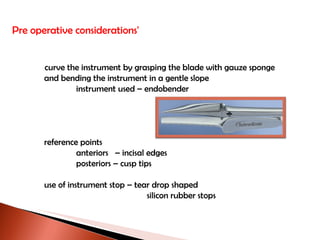
Pre operative considerations'   curve the instrument by grasping the blade with gauze sponge and bending the instrument in a gentle slope instrument used – endobender reference points anteriors  – incisal edges posteriors – cusp tips use of instrument stop – tear drop shaped   silicon rubber stops
Cleaning , shaping and obturation of the root canal systems cannot be  accomplished accurately unless the working length is determined correctly. Failure leads to : Working long  :  may lead to  overfilling  or  overextension Working short  :   results in incomplete cleaning   persistent  discomfort as the pulpal remnants are left NEED FOR DETERMINING WORKING LENGTH
Loss of working length occurs due to  : Straightening of curved canals Accumulation of dentinal and pulpal debris in apical 2-3 mm of canal Failing to maintain foramen patency Failing to irrigate the apical 1/3 rd
Methods of determining working length Conventional methods of working length determination 1.  Grossman’s formula 2.  Radiographic method 3.  Weine’s method 4.  Kuttler’s method 5.  Digital tactile sense 6.  Apical periodontal sensitivity 7.  Paper point method 8.  Radiographic grid 9.  Endometric probe Advanced method of working length determination 10.  Electronic method 11.  Direct digital radiography 12.  Xeroradiology 13.  Subtraction radiography
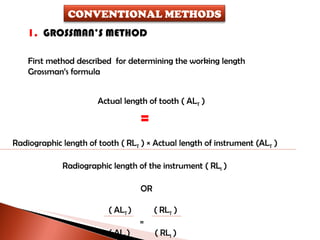
1.  GROSSMAN’S METHOD First method described  for determining the working length Grossman’s formula Actual length of tooth ( AL T  )  = Radiographic length of tooth ( RL T  ) × Actual length of instrument (AL T  )   Radiographic length of the instrument ( RL I  ) OR ( AL T  )  ( RL T  )   = ( AL I  )  ( RL I  ) CONVENTIONAL METHODS
Working kength determination in multirooted tooth Working length determination is done for each root canal example : in mandibular molar , the mesial root has 2 canals . if both the mesial canals are overlapping , then K-file is inserted in one canal and H-file is inserted in the other canal and radiographs   at 20 degree to 40 degree mesial or distal angulations are  taken to view all the canals
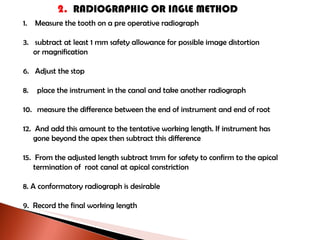
2.  RADIOGRAPHIC OR INGLE METHOD Measure the tooth on a pre operative radiograph subtract at least 1 mm safety allowance for possible image distortion or magnification Adjust the stop place the instrument in the canal and take another radiograph measure the difference between the end of instrument and end of root And add this amount to the tentative working length. If instrument has gone beyond the apex then subtract this difference From the adjusted length subtract 1mm for safety to confirm to the apical termination of  root canal at apical constriction 8. A conformatory radiograph is desirable 9.  Record the final working length
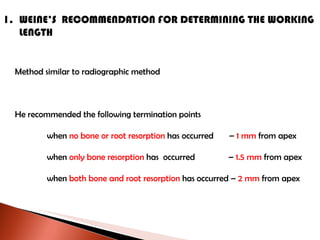
WEINE’S  RECOMMENDATION FOR DETERMINING THE WORKING LENGTH Method similar to radiographic method He recommended the following termination points when  no bone or root resorption  has occurred  –  1 mm  from apex when  only bone resorption  has  occurred  –  1.5 mm  from apex when  both bone and root resorption  has occurred –  2 mm  from apex
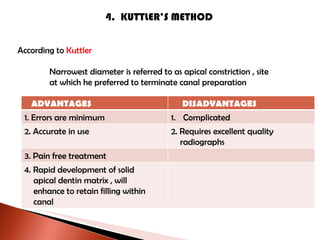
4.  KUTTLER’S METHOD According to  Kuttler Narrowest diameter is referred to as apical constriction , site at which he preferred to terminate canal preparation ADVANTAGES  DISADVANTAGES 1. Errors are minimum Complicated 2. Accurate in use 2. Requires excellent quality  radiographs 3. Pain free treatment 4. Rapid development of solid  apical dentin matrix , will enhance to retain filling within canal
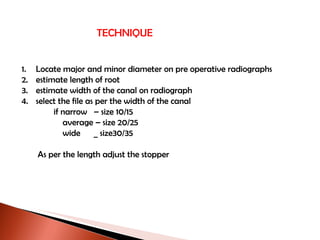
TECHNIQUE Locate major and minor diameter on pre operative radiographs estimate length of root estimate width of the canal on radiograph select the file as per the width of the canal if narrow  – size 10/15   average – size 20/25   wide  _ size30/35  As per the length adjust the stopper
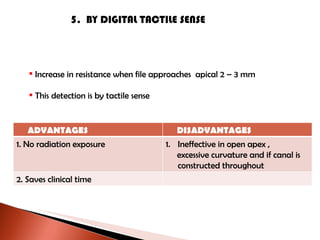
5.  BY DIGITAL TACTILE SENSE Increase in resistance when file approaches  apical 2 – 3 mm  This detection is by tactile sense ADVANTAGES DISADVANTAGES 1. No radiation exposure Ineffective in open apex ,  excessive curvature and if canal is constructed throughout 2. Saves clinical time
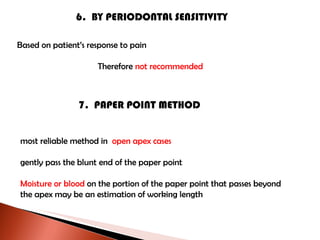
6.  BY PERIODONTAL SENSITIVITY Based on patient’s response to pain Therefore  not recommended 7.  PAPER POINT METHOD most reliable method in  open apex cases gently pass the blunt end of the paper point Moisture or blood  on the portion of the paper point that passes beyond  the apex may be an estimation of working length
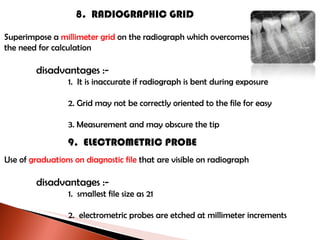
8.  RADIOGRAPHIC GRID Superimpose a  millimeter grid  on the radiograph which overcomes the need for calculation disadvantages :- 1.  It is inaccurate if radiograph is bent during exposure 2. Grid may not be correctly oriented to the file for easy 3. Measurement and may obscure the tip 9.  ELECTROMETRIC PROBE Use of  graduations on diagnostic file  that are visible on radiograph disadvantages :- 1.  smallest file size as 21 2.  electrometric probes are etched at millimeter increments
ADVANCED METHODS
 
the current concept of root canal preparation is not cleaning and  shaping but is  SHAPING AND CLEANING CLEANING AND SHAPING OF PULP SPACE
Clinical objectives Shaping facilitates cleaning by  removing restrictive dentin Allows an  effective volume of irrigant  to work deeper into all aspects  of root canal Elimination  of pulp , bacteria ,and their endotoxins Shaping  facilitates obturation Biological objectives to completely remove the pulp space of 1.  Pulp tissue 2.  Bacteria, microorganisms and their endotoxins OBJECTIVES OF CLEANING AND SHAPING
Mechanical objectives Continuously tapering preparation Maintain original anatomy Maintaining the position of apical foramen Foramen as small as practically possible
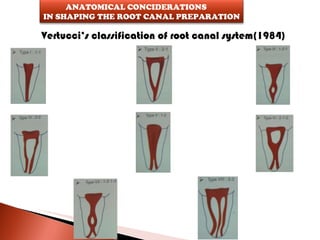
Vertucci’s classification of root canal system(1984) ANATOMICAL CONCIDERATIONS  IN SHAPING THE ROOT CANAL PREPARATION
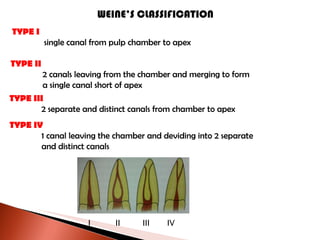
WEINE’S CLASSIFICATION TYPE I single canal from pulp chamber to apex TYPE II 2 canals leaving from the chamber and merging to form a single canal short of apex TYPE III 2 separate and distinct canals from chamber to apex TYPE IV 1 canal leaving the chamber and deviding into 2 separate and distinct canals I  II  III  IV
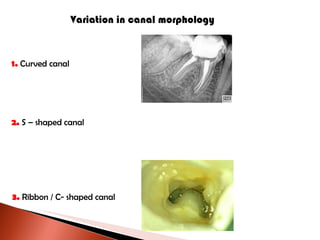
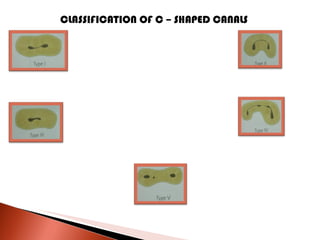
Variation in canal morphology 1.  Curved canal 2.  S – shaped canal 3.  Ribbon / C- shaped canal
CLASSIFICATION OF C – SHAPED CANALS
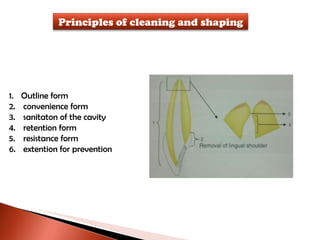
Outline form convenience form sanitaton of the cavity retention form resistance form extention for prevention Principles of cleaning and shaping
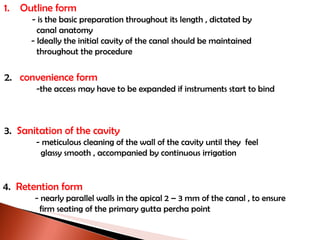
Outline form - is the basic preparation throughout its length , dictated by    canal anatomy - Ideally the initial cavity of the canal should be maintained   throughout the procedure 2.  convenience form -the access may have to be expanded if instruments start to bind 3.  Sanitation of the cavity - meticulous cleaning of the wall of the cavity until they  feel   glassy smooth , accompanied by continuous irrigation 4.  Retention form - nearly parallel walls in the apical 2 – 3 mm of the canal , to ensure   firm seating of the primary gutta percha point
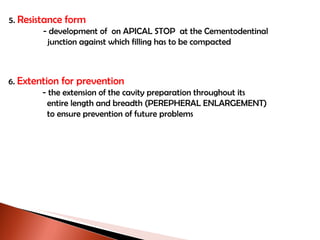
5.  Resistance form   - development of  on APICAL STOP  at the Cementodentinal    junction against which filling has to be compacted 6.   Extention for prevention   - the extension of the cavity preparation throughout its   entire length and breadth (PEREPHERAL ENLARGEMENT)   to ensure prevention of future problems
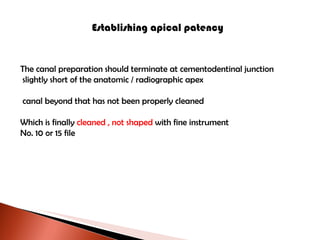
Establishing apical patency The canal preparation should terminate at cementodentinal junction slightly short of the anatomic / radiographic apex canal beyond that has not been properly cleaned Which is finally  cleaned , not shaped  with fine instrument No. 10 or 15 file
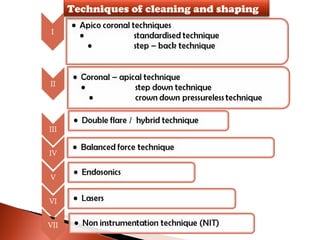
Techniques of cleaning and shaping
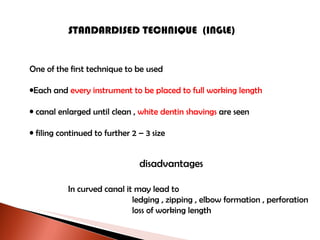
STANDARDISED TECHNIQUE  (INGLE) One of the first technique to be used Each and  every instrument to be placed to full working length canal enlarged until clean ,  white dentin shavings  are seen filing continued to further 2 – 3 size disadvantages In curved canal it may lead to ledging , zipping , elbow formation , perforation loss of working length
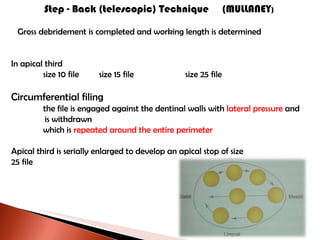
Gross debridement is completed and working length is determined In apical third size 10 file  size 15 file  size 25 file Circumferential filing the file is engaged against the dentinal walls with  lateral pressure  and is withdrawn which is  repeated around the entire perimeter Apical third is serially enlarged to develop an apical stop of size 25 file Step - Back (telescopic) Technique  (MULLANEY )
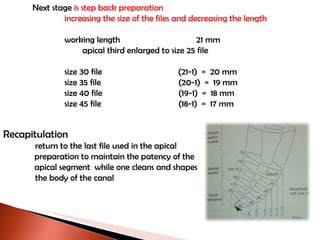
Next stage  is step back preparation increasing the size of the files and decreasing the length working length  21 mm   apical third enlarged to size 25 file size 30 file  (21-1)  =  20 mm  size 35 file   (20-1)  =  19 mm size 40 file    (19-1)  =  18 mm size 45 file    (18-1)  =  17 mm Recapitulation return to the last file used in the apical  preparation to maintain the patency of the apical segment  while one cleans and shapes  the body of the canal
Once body of canal preparation is complete number 2 and 3 gates glidden Are used to further funnel the preparation coronally Circumferential filing with the master apical file to smooth out the steps Created by the step-back
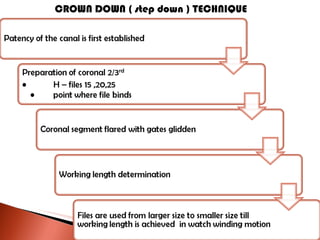
CROWN DOWN ( step down ) TECHNIQUE
Recapitulation  with a size 10 or 15 file in between each change of instrument Canal should be irrigated appropriately with irrigants The final canal taper is accomplished by the master apical file  Used in  circumferential filing  motion advantages Shaping of canal is  easier removal of coronal obstruction removes bulk tissue before apical shaping Extrusion of debris  is  minimized Better access Better penetration of irrigants Working length is likely to change
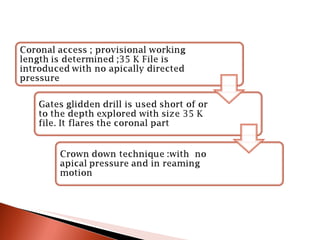
CROWN DOWN PRESSURELESS TECHNIQUE Crown down  : early coronal flaring   incremental removal of dentin from coronal to apical Pressureless  : K – files ; large to small sequences ;reaming motion   no apical pressure
 
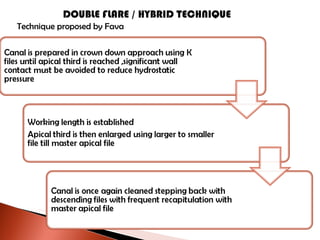
DOUBLE FLARE / HYBRID TECHNIQUE Technique proposed by Fava
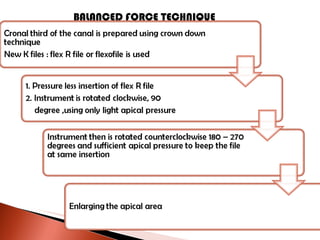
BALANCED FORCE TECHNIQUE
advantages Reduced canal transportation and ledging
ENDOSONICS Application of ultrasonic principles to endodontics Mechanism of action :- Acoustic streaming  : process by which a vibrating file generates a stream of liquid to produce eddies and flows of oscillation
2. Cavitation or implosion vibrating file leads to development of negative pressure within the exposed cell which causes implosion
LASER lasers have the ability to ablate necrotic organic material and reduce microorganisms root canal is widened by conventional means before laser probe  can be placed in the canal Argon laser
 
Ideal  requirements Antimicrobial activity Mechanically flushes out the debris from the root canal 3.  Non toxic and biocompatible in nature 4.  Dissolves and necrotic pulp tissue 5.  Serves as a lubricant 6.  Removes the smear layer 7.  Low surface tension
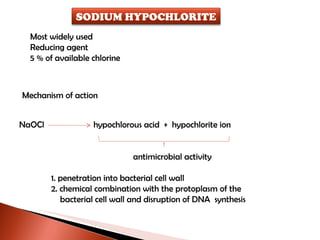
Most widely used Reducing agent 5 % of available chlorine Mechanism of action NaOCl  hypochlorous acid  +  hypochlorite ion   antimicrobial activity 1. penetration into bacterial cell wall 2. chemical combination with the protoplasm of the      bacterial cell wall and disruption of DNA  synthesis SODIUM HYPOCHLORITE
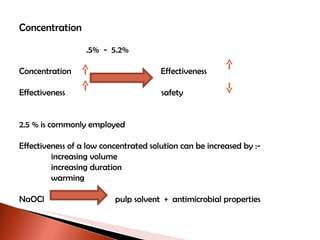
Concentration .5%  -  5.2% Concentration  Effectiveness Effectiveness  safety  2.5 % is commonly employed Effectiveness of a low concentrated solution can be increased by :- increasing volume increasing duration warming  NaOCl  pulp solvent  +  antimicrobial properties
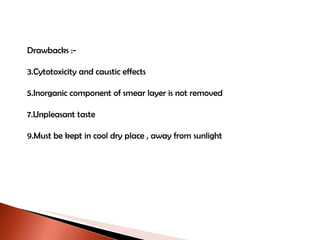
Drawbacks :- Cytotoxicity and caustic effects  Inorganic component of smear layer is not removed Unpleasant taste Must be kept in cool dry place , away from sunlight
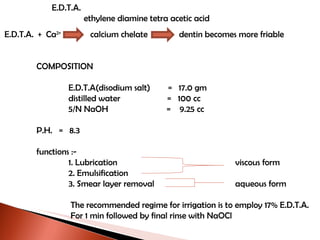
E.D.T.A. ethylene diamine tetra acetic acid E.D.T.A.  +  Ca 2+  calcium chelate  dentin becomes more friable COMPOSITION E.D.T.A(disodium salt)  =  17.0 gm distilled water  =  100 cc 5/N NaOH  =  9.25 cc P.H.  =  8.3 functions :- 1. Lubrication   viscous form 2. Emulsification 3. Smear layer removal   aqueous form The recommended regime for irrigation is to employ 17% E.D.T.A. For 1 min followed by final rinse with NaOCl
2 % solution is used Broad spectrum antimicrobial activity against the most common Endodontic pathogens Effective against Ent. Fecalis Property of substantivity Does not remove smear layer hence hence should always be employed  in conjunction with other irrigants CHLORHEXIDINE DIGLUCONATE
Mixture of tetra cyclic isomer , citric acid and detergent (Tween 80) Used after initial irrigation with 1.3% NaOCl antibacterial effect  is due to tetracycline M.T.A.D
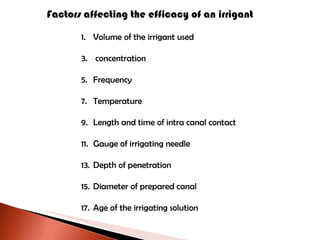
Factors affecting the efficacy of an irrigant Volume of the irrigant used concentration Frequency Temperature  Length and time of intra canal contact Gauge of irrigating needle Depth of penetration Diameter of prepared canal Age of the irrigating solution
Irrigation guidelines The only instrument required is disposable luer lock syringe With an endodontic blunt ended side vented needle Sufficient room between needle and canal wall allows for the return Flow of the solution The objective is to wash the canaland not to force the solution under pressure into peri radicular tissue The return flow of solution is caught on a gauze sponge or is aspirated
They are used for root canal disinfection as part of control asepsis in an infected root canal INTRACANAL MEDICAMENT
Ideal requirement of root canal medicament ( Grossman ) 1. Effective antimicrobial agent 2. Non irritating to the peri radicular tissues 3. Stable in solution 4. Prolonged anti microbial effect 5. Should be active in presence of blood , serum , and protein derivatives  of tissue 6. Low surface tension 7. Should not interfere with the repair of peri radicular tissues 8. Not stain tooth structure 9. Should not induce cell mediated  immune response
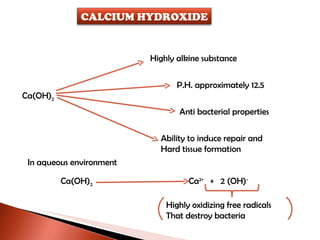
Highly alkine substance P.H. approximately 12.5 Anti bacterial properties Ability to induce repair and  Hard tissue formation Ca(OH) 2 In aqueous environment Ca(OH) 2 Ca 2+   +  2 (OH) - Highly oxidizing free radicals That destroy bacteria CALCIUM HYDROXIDE
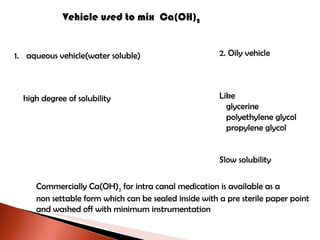
Vehicle used to mix  Ca(OH) 2 aqueous vehicle(water soluble) high degree of solubility 2. Oily vehicle Like glycerine polyethylene glycol propylene glycol Slow solubility Commercially Ca(OH) 2  for intra canal medication is available as a  non settable form which can be sealed inside with a pre sterile paper point and washed off with minimum instrumentation
Recommended bots as root canal irrigant and intra canal medicament As a medicament is used as  2% CHX gel mixture of CHX and Ca(OH)  It has been shown to be effective against both  Ent. Fecalis  and Candida albicans CHLORHEXIDINE DIGLUCONATE
Intracanal medicament dressing should be renewed in a week and not  longer than 2 weeks because dressings become diluted by periradicular  Exudate and are decomposed by interaction with microorganisms Requirements Impervious to fluids of the mouth and bacteria hermetically seal the access cavity peripherally not cause pressure on the dressing while insertion hardens within a few minutes of insertion withstand the forces of mastication be easy to manipulate and remove harmonize with the color of tooth structure   cavit and IRM are satisfactory temporary filling material TEMPORARY FILLING MATERIAL
 
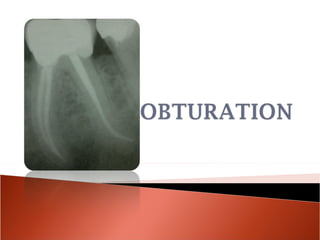
Defined as  three dimensional filling of the entire root canal as close to  the cementodentional junction possible to obtain a fluid  pervious seal which will hinder the invasion of microorganisms and potential nutrients that would support biological growth Hermetic seal  Grossman  ( 1960 ) OBTURATION OF THE RADICULAR SPACE
Biologic objectives To establish a barrier to the passage of microorganisms from the  oral cavity to the peri radicular tissues by a perfect access cavity  restoration 2. Isolate any microorganisms that may survive the cleaning and shaping procedures by use of an anti bacterial sealer 3. Prevent leakage ,into the canal system ,of potential nutrients that would support biologic growth  4. To reduce the risk of bacterial movement and fluid percolation into the canal system from gingival sulcus or a periodontal pocket OBJECTIVES OF OBTURATION
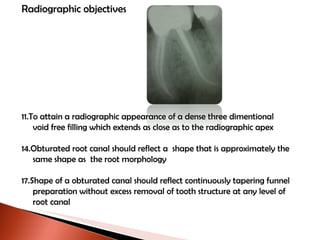
Radiographic objectives To attain a radiographic appearance of a dense three dimentional void free filling which extends as close as to the radiographic apex Obturated root canal should reflect a  shape that is approximately the  same shape as  the root morphology Shape of a obturated canal should reflect continuously tapering funnel  preparation without excess removal of tooth structure at any level of  root canal
When should the root canal system be obturated ???  The root canal system should be obturated   after thorough debridement absence of persistent exudates without any symptoms of pain and swelling
SOLID – CORE MATERIAL metals plastics cements/pastes SEALERS plastics cements pastes CLASSIFICATION OF ROOT CANAL FILLING MATERIAL (BY GROSSMAN)
(Suggested by Grossman) Material should be easily introduced into the root canal It should seal the cavity laterally as well as apically It should not shrink after inserted It should be impervious to moisture It should be bacericidal , or atleast should discourage the growth It should be radio opaque It should not stain tooth structure It should not irritate periradicular tissue or affect tooth structure It should be sterile , or should be easily or quickly sterilized  immediately before insertion 10.  It should be easily removed from the root canal if necessary REQUIREMENTS FOR AN IDEAL ROOT CANAL FILLING MATERIAL
Cold lateral condensation Warm vertical condensation (warm gutta percha) Continuous wave compaction technique McSpadden thermochemical compaction Thermo plasticized gutta percha injection Carrier based gutta percha thermafil thermo plasticized simplifil sectional obturation  7.  Chemically plasticized gutta percha 8.  Custom cone GUTTA – PERCHA OBTURATION TECHNIQUE
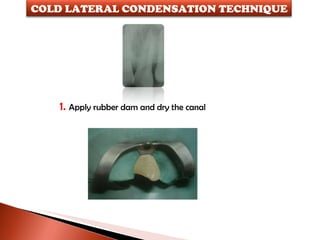
1.  Apply rubber dam and dry the canal COLD LATERAL CONDENSATION TECHNIQUE
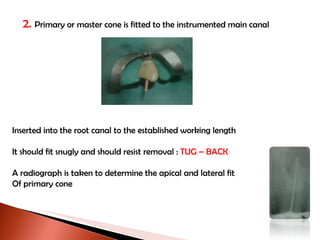
2.  Primary or master cone is fitted to the instrumented main canal Inserted into the root canal to the established working length It should fit snugly and should resist removal :  TUG – BACK A radiograph is taken to determine the apical and lateral fit Of primary cone
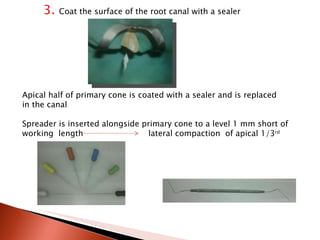
3.  Coat the surface of the root canal with a sealer Apical half of primary cone is coated with a sealer and is replaced  in the canal Spreader is inserted alongside primary cone to a level 1 mm short of  working  length  lateral compaction  of apical 1/3 rd
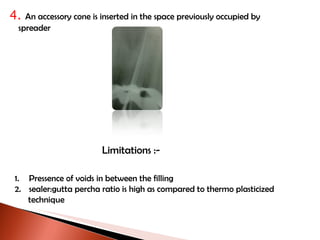
4.  An accessory cone is inserted in the space previously occupied by  spreader Limitations :- Pressence of voids in between the filling sealer:gutta percha ratio is high as compared to thermo plasticized  technique
Primary Gutta percha cone is seated  up to the working length Heat carrier is used to soften the Gutta Percha  touch n heat system B Vertical condensation is done with a plugger requirements Apical foramen should be as small as practically possible Root canal should be prepared so that it flows with the shape Of the original canal WARM VERTICAL CONDENSATION METHOD
Advantages Excellent seal apically and laterally Obturation of larger lateral and accessory canal Disadvantages Amount of time it takes Risk of vertical root fracture Overfilling
Variation of warm vertical condensation Gutta Percha cones and pluggers mimic the tapered preperation Tapered Ni Ti systems are used to prepare the canal Pluggers are selected  in consistence with the size of the shaping instrument used CONTINUOUS WAVE COMPACTION TECHNIQUE
Heat is used to decrease gutta percha viscosity Rotating a compacting instrument in a slow speed contra angle hand piece Flutes are similar to that of H- File, but in reverse , forces the softened  Gutta percha apically and laterally Mc Spadden thermochemical compaction method
Advantages Ease of selection and insertion of gutta percha cones Economy of time Rapid filling of canal apically and laterally Disadvantages 1.  Inability to use the technique in narrow canal Frequent breakage of compactor blade frequent overfilling Shrinkage of the cooled , set filling
OBTURA III - heats gutta percha at 200 degrees - Hand held gun that contains a chamber surrounded by a heating   element where gutta percha pellets are loaded - needle kept 3-5 mm short of working length - gutta percha is then compacted using pluggers Disadvantages : lack of precision in delivering the gutta percha  near the apical  foramen THERMOPLASTICIZED GUTTA PERCHA INJECTION TECHNIQUE
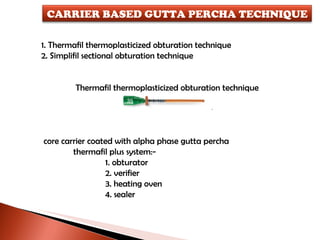
1. Thermafil thermoplasticized obturation technique 2. Simplifil sectional obturation technique   Thermafil thermoplasticized obturation technique core carrier coated with alpha phase gutta percha thermafil plus system:- 1. obturator 2. verifier 3. heating oven 4. sealer CARRIER BASED GUTTA PERCHA TECHNIQUE
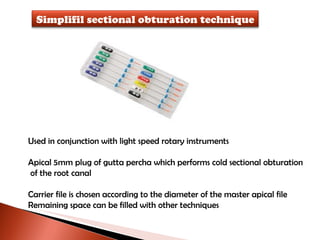
Used in conjunction with light speed rotary instruments Apical 5mm plug of gutta percha which performs cold sectional obturation of the root canal Carrier file is chosen according to the diameter of the master apical file Remaining space can be filled with other techniques Simplifil sectional obturation technique
Plasticized by chemical solvents chloroform eucalyptol xylol Disadvantages inability to control overfilling , with resultant periapical tissue reaction and shrinkage of the filling after setting CHEMICALLY PLASTICIZED GUTTA PERCHA TECHNIQUE
Chair side procedure Customizing the gutta percha in wide canals where traditional master  cone cannot be adapted The cones are rolled and fused together between two glass slabs to the desired shape CUSTOM CONE
 
According to Grossman , an ideal root canal sealer should Provide an excellent seal when set provide adequate adhesion among it, the canal walls, and the filling material Be radiopaque Be non staining Be dimensionally stable Be easily mixed and introduced into the canal Be easily removed if necessary Be insoluble in tissue fluids Be bactericidal or discourage bacterial growth Be non irritating to peri radicular tissues Be slow setting to ensure sufficient working
 
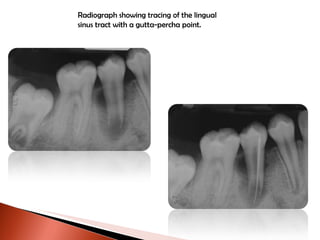
Radiograph showing tracing of the lingual sinus tract with a gutta-percha point.
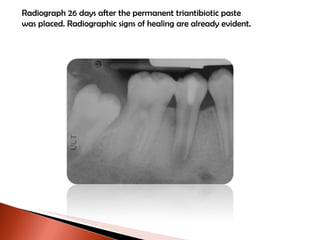
Radiograph 26 days after the permanent triantibiotic paste was placed. Radiographic signs of healing are already evident.
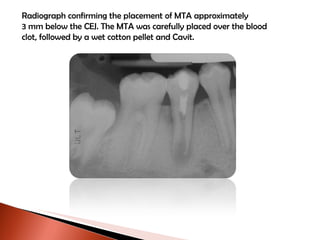
Radiograph confirming the placement of MTA approximately 3 mm below the CEJ. The MTA was carefully placed over the blood clot, followed by a wet cotton pellet and Cavit.
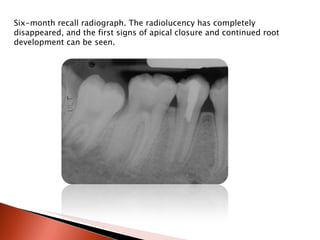
Six-month recall radiograph. The radiolucency has completely disappeared, and the first signs of apical closure and continued root development can be seen.
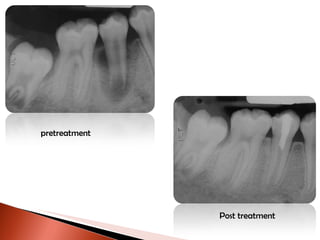
pretreatment Post treatment
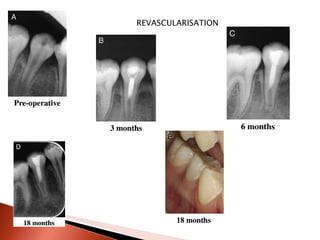
REVASCULARISATION
REFERENCES
 

Nonvital pulp therapy in pediatric dentistry

  • 1.
    PRESENTED BY PRIYANK PAREEK IV B.D.S. DEPARTMENT OF PEDIATRIC AND PREVENTIVE DENTISTRY NAIR HOSPITAL DENTAL COLLEGE,MUMBAI
  • 2.
  • 3.
    Ideally a nonvital pulp should be treated by pulpectomy and root canal filling NON – NEGOTIABLE ROOT CANALS LIMITED PATIENT’S CO-OPERATION Hence , a two – stage pulpotomy technique is advocated MORTAL PULPOTOMY ( NON – VITAL PULPOTOMY )
  • 4.
    Sellection criteria Historyof spontaneous pain Swelling soreness or redness of mucosa Tooth mobility Tendernedd to percussion Radiographic evidence of pathologic root resorption
  • 5.
    Necrotic coronal pulpis removed Pulp chamber is irrigated with saline Infected radicular pulp is treated with a strong antiseptic solution such as beechwood cresol Seal the cavity with temporary cement for one or two weeks FIRST APPOINTMENT
  • 6.
    Remove the temporarydressing and pellet containing beeechwood cresol Note the symptoms if persist or no signs of resolution of sinus Repeat the treatment or Extract the tooth If there are no symptoms Antiseptic paste is filled in the pulp chamber and is firmly pushed into the root canals Restoration with Stainless Steel Crown Second appointment
  • 7.
  • 8.
    Complete removal ofnecrotic pulp tissue from the root canals and coronal portion of devital primary teeth to maintain the tooth in the dental arch Justification Removal of diseased tissue Space management Pulpectomy -general PULPECTOMY
  • 9.
    1. Following thetreatment , the infectious process should resolve 2. There should be radiographic evidence of successful filling without gross overextension or underfilling 3. The treatment should permit resorption of the primary root structures at the appropriate time to permit normal eruption of succedaneous tooth 4. No radiographic evidence of further breakdown of supporting tissues 5. Should prevent further pain and swelling 6. No internal or external resorption or other pathology Pulpectomy -general OBJECTIVES OF PULPECTOMY
  • 10.
    1. Strategically importanttooth (in case of the deciduous second molar where the permanent first molar has not erupted) 2. Irreversible pulpits 3. Minimal periapical changes with sufficient bone support 4. At least 2/3 rd of the root length available 5. Internal resorption without any obvious perforation Pulpectomy -general INDICATIONS
  • 11.
    1. Excessively mobileand/or reduced bone support 2. Non restorable tooth 3. Internal resorption of the pulp chamber and root canal 4. Underlying dentigerous or follicular cyst 5. Pathology extending to the developing permanent tooth bud 6. Less than2/3 rd of root length remaining 7. Perforation of pulpal floor 8. Medically compromised children Pulpectomy -general CONTRAINDICATIONS
  • 12.
    The procedure ofpulpectomy can be performed in :-- 1. Single-visit 2. Multi-visit Single-visit Partially vital pulp Multi-visit Non-vital pulp Pulpectomy -general
  • 13.
    STEP 1 . Give local anaesthesia and isolate the tooth with rubber dam Basic steps in pulpectomy
  • 14.
    STEP 2 : Remove caries and identify the exposure site Basic steps in pulpectomy
  • 15.
    STEP 3 : Remove roof of pulp chamber and identify opening of root canals Basic steps in pulpectomy
  • 16.
    STEP 4 : Take diagnostic radiograph Basic steps in pulpectomy
  • 17.
    STEP 5 : Clean out root canals with hedstroem files and remove remnants of pulp tissue and irrigate the canal Basic steps in pulpectomy
  • 18.
    STEP 6 : Dry root canal with paper points and place a pledget of formocresol in the pulp chamber for 4 minutes Basic steps in pulpectomy
  • 19.
    STEP 7 : Select a spiral root canal filler of appropriate size Basic steps in pulpectomy
  • 20.
    STEP 8 : mix zinc oxide eugenol as a slurry and spin it into the root canals Using the spiral root canal filler Basic steps in pulpectomy
  • 21.
    Preoperative Immediately postoperative 3 Months later
  • 22.
    After 6 monthsPreoperative
  • 23.
    1. Access openingfor pulpectomy in primary teeth It is defined as That endodontic coronal preparation which enables unobstructed access to the canal orifice , a straight line access to the apical foramen, complete authority over the enlarging instrument and to accommodate the filling technique SINGLE VISIT PULPECTOMY TECHNIQUE
  • 24.
    1. Complete removalof pulp chamber roof 2. Removal of coronal pulp 3. Straight line access to facilitate placement of endodontic instruments and obturation material These ideals are balanced with following constraints Conservation of tooth structure Retention and esthetics Final restoration SINGLE VISIT PULPECTOMY TECHNIQUE IDEALS FOR ENDODONTIC ACCESS
  • 25.
    3 mainobjectives 1. obtaining a straight line access to the apical foramen or to the Initial curvature of the canal to aid in -improved instrumentation control -improved obturation -decreases the incidence of procedural error 2. Conservation of tooth structure -to minimize weakening of remaining tooth structure 3. Unroofing the pulp chamber and removal of the pulp horns to aid in -locating the root canal orifice -maximum visibility -locate canals -permit straight line preparation -prevents discoloration of teeth due to pulpal remnants Access openning OBJECTIVES
  • 26.
    To achieve optimalpreparation 3 factors of internal anatomy must be considered 1. Size of the pulp chamber -more extensive preparations due to large pulp chambers 2. Shape of the pulp chamber -the finished outline form should accurately reflect the shape of the pulp chamber Example : the floor of the pulp chamber in molar is usually triangular --- triangular position of canal orifice this shape is so extended to the walls of the cavity onto the occlusal surface---- final outline form is usually triangular 3. Number position and curvature of root canals Access openning
  • 27.
    Primary root canalanatomy The clinician must have a thorough knowledge of the anatomy of the Primary root canal and the variations that normally exist Access openning
  • 28.
    Maxillary and mandibularcanine Root canals correspond to the exterior root shape A rounded triangular with the base towards the facial surface Lumen of the canal is sometimes compressed in mesial-distal direction Lateral and accessory canals are rare PRIMARY ANTERIORS Maxillary Incisors The root canals are almost round but somewhat compressed Normally 1 canal without a bifurcation Accessory canals are rare , but do occur Mandibular Incisors Root canals are flattened on mesial and distal surfaces and sometimes grooved 2 canals are seen in less than 10% of cases Lateral or accessory canals are rare Access openning
  • 29.
    PRIMARY MOLARS Normallyhave same number of roots and positions of the roots as the corresponding permanent molars The roots of the primary molars are long , slender compared with the crown length and width They diverge to allow for a permanent tooth bud formation Access openning
  • 30.
    Maxillary 2 nd primary molar 3 roots. 2 facial,1 palatal 2 – 5 canals Mesiofacial root usually bifurcates or contains 2 canals – 85%-95% Maxillary 1 st primary molar 3 roots. 2 facial,1 palatal Palatal root is often round and longer than 2 facial roots 2-4 canals Bifurcation of mesiao facial root into 2 canals - 75% Access openning
  • 31.
    Mandibular 1 st primary molar 2 roots . 1 Mesial, 1 distal Usually have 3 canals but may have 2-4 canals Mesial root contains 2 canals- 75% Distal root contain more than 1 canal- 25% Mandibular 2 nd primary molar 2 roots . 1Mesial,1 distal Usually have 3 canals . but may have 2-5 canals Mesial root has 2 canals – 85% Distal root contains more than 1 canals – 25% Access openning
  • 32.
    2. canal cleaningand shaping Using local anaesthesia and rubber dam placement, all accessible radicular pulp is removed Relative pulpectomy due to tortuous course of root canal coupled with numerous accessory canals, complete removal of pulp in the primary teeth may often be difficult , if not impossible. Thus all such procedures are regarded as partial pulpectomy procedures Selective filing resorption in primary teeth may have started at the time of Treatment. Also the slender roots , with thin apical ends may predispose the tooth to a root fracture in cases of excessive preparation .Thus procedure of selective filing should be used
  • 33.
    With an endodonticfile , remove the diseased pulp tissue from all The canal. The canals should be instrumented to the resistance point Each canal should be enlarged 3 – 4 instrument sizes greater than the First file capable of working the apex Cleaning and shaping
  • 34.
    It is notnecessary to take an X-ray to determine file length as is done in Permanent teeth endodontic procedure Visual comparision of file and root canal length on the pre operative Periapical radiograph will result in sufficient clinical acccuracy In the primary tooth attempts to mechanically prepare a circular apical 1/3 rd may result in lateral perforation of the canal because of its Hour glass shape Because of the bizzare anatomy of primary molar root canals the use of barbed broaches as in conventional endodontics may be unsuccessful Also the ribbon shape of the root canals, with a narrow mesiodistal width Compared to their buccolingual dimension, discourages gross enlargement Of the canals Hedstrom files are recommended since they remove hard tissue only on withdrawal , which prevents pushing infected through the apices. For this Reason reamers are not recommended Cleaning and shaping
  • 35.
    Instruments used inconjunction with irrigating solution reduce the possibility of fracture because of the lubricant action of the solution 5% solution of sodium hypochlorite has an excellent solvent action and is dilute enough to cause only mild irritation when contacting periapical Tissue - Schilder & Amsterdam,1970 After filing ,the canal should be irrigated and then dried with cotton pellet Or paper points Cleaning and shaping
  • 36.
    3. Filling ofthe primary root canals Ideal requirements are as follows 1 . Should resorb at the similar rate as the primary root 2. Should be harmless to the periapical tissues and to the permanent tooth germ ; if pressed beyond the apex it should resorb readily 3. Should have a stable disinfecting power 4. Should be inserted into the root canal and be removed easily if necessary 5. Should adhere to the walls of the canals and should not shrink 6. Should not be soluble in water 7. Should be radiopaque and not discolor the tooth
  • 37.
    Gutta Percha Notindicated for primary teeth Since it is not a resorbable material, its use is contraindicated in primary teeth No material currently available meets al the criteria The filling material most commonly used for primary pulp canals are : 1. Zinc oxide - Eugenol paste 2. Iodoform paste 3. Calcium hydroxide Filling of the primary root canals
  • 38.
    Resorbs at thesame rate as the tooth Harmless Overfill resorbs Antiseptic Easily applied Adheres to the wall Easily removed Radiopaque No discoloration                            Filling of the primary root canals
  • 39.
    Zinc oxide eugenolhas extruded through the apex of 85 3 months there is complete disappearance of the material periapically Filling of the primary root canals
  • 40.
    This procedure isused for non vital primary teeth Studied by (Wittch,1956 ; Lawrence,1966 ; Gould,1972) over short term And by ( starky,1973) over long term The clinical technique is similar to the single visit pulpectomy MULTI-VISIT PULPECTOMY
  • 41.
    Local anaesthesia andrubber dam placement are recommended In cases of swelling and cellulites this can be omitted Instrumentation of the canal is not recommended at the first visit in in 1. Mobile tooth 2. If swelling or a fistula is present 3. If pus is present in the canals In absence of signs and symptoms instrumentation can proceed Between and after instrumentation canals are irrigated Between appointment antibacterial drug is sealed in the pulp chamber, maintained with a temporary cement In some cases the degree of pre operative cellulites will dictate that drainage will have to be established A smooth broach is used to perforate the apices and the tooth left open to drain for no more than 1 day If kept open for more than 24 hrs usually results in food packing into the canal Multi – visit pulpectomy
  • 42.
    Systemic antibiotic therapyis also indicated External heat should not be applied as this may result in extra-oral Drainage of the infection In these cases the coronal pulp chamber can be filled with beechwood Cresol soaked cotton pellet after 24 hrs drainage Appointments are 7 – 10 days apart . The number of appointments and Timing and extent of instrumentation will be determined by signs and symptoms at each visit The canals should not be filled until they are dry and all other signs and symptoms have been eliminated -(lawrence,1966) Multi – visit pulpectomy
  • 43.
    Final restoration Theideal restoration for an endodontically treated primary tooth is a stainless steel crown . But in some cases it may be acceptable to delay the crown or leave the tooth with an amalgam restoration Follow up – primary teeth with pulpectomy
  • 44.
    Post operative followup at 6 month interval should include an evaluation Of signs and symptoms evidence of failure Clinical Pathological mobility Presence of fistula Pain on percussion Radiographic Increased size of radiolucency external or internal root resorption Assessment of success
  • 45.
    Non vital teethtreated with pulpectomy , premature root resorption is more marked The filling material is not the same texture or hardness as normal tooth Or vital pulp When the erupting permanent successor meets root canal filling material there is increased possibility of deflection Most problems associated with resorption arise when the erupting tooth Has resorbed the pulpal floor of the primary molar and is contacting the material in the coronal pulp chamber Eruption of permanent successor
  • 46.
  • 47.
    It is amethod to induce a calcified barrier in a root with an open apex or the continued apical development of an incomplete root in teeth with necrotic pulp (A.A.E.,2003) APEXIFICATION
  • 48.
    Causes of openapex:- 1. Incomplete development- Pulpal necrosis before root growth and development are complete 2. Extensive apical root resorption due to trauma , periapical pathosis , orthodontic treatment
  • 49.
    Types of openapices They can be of two types:- Blunderbuss Flaring root canal walls in which apex is funnel shaped And wider than the coronal aspect of canal Non blunderbuss root canal walls are parallel or sligh
  • 50.
    PROBLEMS OF TREATINGIMMATURE TEETH WITH A NECROTIC PULP The anatomy presents several problems 1. There is an open apex , hence no hard tissue stop against which gutta percha can be packed 2. The open apex of root canal tends to be shaped like blunderbuss making it difficult to obturate with root filling material 3. Apicoectomy is not advisable because the walls of the immature roots are likely to fracture when sealing the apex
  • 51.
    This procedure isindicated for non vital permanent teeth with incompletely formed roots INDICATIONS
  • 52.
    1. Procedureshould induce root end closure at the apices of immature roots 2. Adverse clinical signs and symptoms such as prolonged sensitivity,pain or swelling should not be evident 3. No evidence of abnormal canal calcification or internal or external root resorption OBJECTIVES
  • 53.
    MATERIALS USEDAntiseptic and antibiotic paste (Frank) ZnO and metacresylacetate-camphorated parachlorophenol tricalcium phosphate collagen Ca phosphate gel resorbable tri calcium phosphate ceramic Calcium hydroxide
  • 54.
    procedure Use ofCaOH first described by Frank Calcium hydroxide cement CaOH Ca 2+ + 2OH – antibacterial effect Access is gained into the pulp chamber removal of coronal pulp and establish file length clean the canal , irrigate & dry it with paper point seal the chamber with CMCP in the pulp chamber with a provisional restorative material 5. Recall in 1 – 3 weeks
  • 55.
    In first recall, remove the restoration and clean the canal Take care to void any instrumentation of the walls of the dentin near the apex paste of CaOH and CMCP is filled in the canal The objective is to fill the canal completely Obtain a radiograph to check for the accuracy
  • 56.
    6 month recallRadiographic evidence of apical closure is seen It is necessary to test the quality of the apical barrier with a size 35 file If file easily penetrates continue apexification Reschedule the patient for another 3 months recall The follow up evaluation is repeated every 3 months until successful apical bridging has occurred
  • 57.
    1. Continuedclosure of canal and apex to a normal configuration Weine ( 1976 ) VARIOUS TYPES OF ROOT CLOSURE IN APEXIFICATION
  • 58.
    2. Apexcloses but canal remains with blunderbuss configuration 1. VARIOUS TYPES OF ROOT CLOSURE IN APEXIFICATION
  • 59.
    3. Noradiographic change, but a thin osteoid like barrier provides a definite stop at or near apex 1. 2. VARIOUS TYPES OF ROOT CLOSURE IN APEXIFICATION
  • 60.
    4. Radiographicevidence of a barrier short of apex 1. 2. 3. VARIOUS TYPES OF ROOT CLOSURE IN APEXIFICATION
  • 61.
    These canals areprobably best suited for obturation by thermoplasticized technique Obtura Obturation of the root canal
  • 62.
    1. Mineraltrioxide aggregate ( M.T.A. ) 1. Allows for the overgrowth of cementum 2. May facilitate the regeneration of PDL MTA was first described in dental literature in 1993 by torabinejad Mechanism of action stimulated cytokine release from bone cells Alternatives of conventional apexification
  • 63.
    Composition Tricalcium silicateDicalcium silicate Tricalcium aluminate Calcium sulphate dehydrate Bismuth oxide P.H. is 12.5 Limitations cost storage problems . sets in presence of moisture ( 4 hrs ) 2. Metapex { ( CaOH) and Iodoform }
  • 64.
    Patient compliance (forattending the recalls) Increased risk of tooth fracture after dressing with the material for extended periods. 3. Although the open apex might be closed by a calcific barrier, apexification does not promote the continued development of the root DISADVANTAGES
  • 65.
  • 66.
  • 67.
  • 68.
    The distance froma coronal reference point to the point at which canal preparation and obturation should terminate Anatomical considerations Root apex Anatomic apex : tip or end of the root determined morphologically Radiographic apex : tip or end of the root determined radiographically Histological apex : it is represented by cementodentinal junction WORKING LENGTH DETERMINATION
  • 69.
    Apical foramen :- histologically it is the area where blood vessels and nerve plexus enter the tooth , but is not seen radiographically major diameter : it is the main apical opening of the root canal. It is frequently eccentrically located away from the anatomic or radiographic apex minor diameter : apical portion of the root canal havig the narrowest diameter
  • 70.
    Cementodentinal junction : region where dentin and cementum are united it is a histologic landmark does not always coincide with the apical construction is located .5 – 3 mm short of anatomic apex
  • 71.
    Pre operative considerations' curve the instrument by grasping the blade with gauze sponge and bending the instrument in a gentle slope instrument used – endobender reference points anteriors – incisal edges posteriors – cusp tips use of instrument stop – tear drop shaped silicon rubber stops
  • 72.
    Cleaning , shapingand obturation of the root canal systems cannot be accomplished accurately unless the working length is determined correctly. Failure leads to : Working long : may lead to overfilling or overextension Working short : results in incomplete cleaning persistent discomfort as the pulpal remnants are left NEED FOR DETERMINING WORKING LENGTH
  • 73.
    Loss of workinglength occurs due to : Straightening of curved canals Accumulation of dentinal and pulpal debris in apical 2-3 mm of canal Failing to maintain foramen patency Failing to irrigate the apical 1/3 rd
  • 74.
    Methods of determiningworking length Conventional methods of working length determination 1. Grossman’s formula 2. Radiographic method 3. Weine’s method 4. Kuttler’s method 5. Digital tactile sense 6. Apical periodontal sensitivity 7. Paper point method 8. Radiographic grid 9. Endometric probe Advanced method of working length determination 10. Electronic method 11. Direct digital radiography 12. Xeroradiology 13. Subtraction radiography
  • 75.
    1. GROSSMAN’SMETHOD First method described for determining the working length Grossman’s formula Actual length of tooth ( AL T ) = Radiographic length of tooth ( RL T ) × Actual length of instrument (AL T ) Radiographic length of the instrument ( RL I ) OR ( AL T ) ( RL T ) = ( AL I ) ( RL I ) CONVENTIONAL METHODS
  • 76.
    Working kength determinationin multirooted tooth Working length determination is done for each root canal example : in mandibular molar , the mesial root has 2 canals . if both the mesial canals are overlapping , then K-file is inserted in one canal and H-file is inserted in the other canal and radiographs at 20 degree to 40 degree mesial or distal angulations are taken to view all the canals
  • 77.
    2. RADIOGRAPHICOR INGLE METHOD Measure the tooth on a pre operative radiograph subtract at least 1 mm safety allowance for possible image distortion or magnification Adjust the stop place the instrument in the canal and take another radiograph measure the difference between the end of instrument and end of root And add this amount to the tentative working length. If instrument has gone beyond the apex then subtract this difference From the adjusted length subtract 1mm for safety to confirm to the apical termination of root canal at apical constriction 8. A conformatory radiograph is desirable 9. Record the final working length
  • 78.
    WEINE’S RECOMMENDATIONFOR DETERMINING THE WORKING LENGTH Method similar to radiographic method He recommended the following termination points when no bone or root resorption has occurred – 1 mm from apex when only bone resorption has occurred – 1.5 mm from apex when both bone and root resorption has occurred – 2 mm from apex
  • 79.
    4. KUTTLER’SMETHOD According to Kuttler Narrowest diameter is referred to as apical constriction , site at which he preferred to terminate canal preparation ADVANTAGES DISADVANTAGES 1. Errors are minimum Complicated 2. Accurate in use 2. Requires excellent quality radiographs 3. Pain free treatment 4. Rapid development of solid apical dentin matrix , will enhance to retain filling within canal
  • 80.
    TECHNIQUE Locate majorand minor diameter on pre operative radiographs estimate length of root estimate width of the canal on radiograph select the file as per the width of the canal if narrow – size 10/15 average – size 20/25 wide _ size30/35 As per the length adjust the stopper
  • 81.
    5. BYDIGITAL TACTILE SENSE Increase in resistance when file approaches apical 2 – 3 mm This detection is by tactile sense ADVANTAGES DISADVANTAGES 1. No radiation exposure Ineffective in open apex , excessive curvature and if canal is constructed throughout 2. Saves clinical time
  • 82.
    6. BYPERIODONTAL SENSITIVITY Based on patient’s response to pain Therefore not recommended 7. PAPER POINT METHOD most reliable method in open apex cases gently pass the blunt end of the paper point Moisture or blood on the portion of the paper point that passes beyond the apex may be an estimation of working length
  • 83.
    8. RADIOGRAPHICGRID Superimpose a millimeter grid on the radiograph which overcomes the need for calculation disadvantages :- 1. It is inaccurate if radiograph is bent during exposure 2. Grid may not be correctly oriented to the file for easy 3. Measurement and may obscure the tip 9. ELECTROMETRIC PROBE Use of graduations on diagnostic file that are visible on radiograph disadvantages :- 1. smallest file size as 21 2. electrometric probes are etched at millimeter increments
  • 84.
  • 85.
  • 86.
    the current conceptof root canal preparation is not cleaning and shaping but is SHAPING AND CLEANING CLEANING AND SHAPING OF PULP SPACE
  • 87.
    Clinical objectives Shapingfacilitates cleaning by removing restrictive dentin Allows an effective volume of irrigant to work deeper into all aspects of root canal Elimination of pulp , bacteria ,and their endotoxins Shaping facilitates obturation Biological objectives to completely remove the pulp space of 1. Pulp tissue 2. Bacteria, microorganisms and their endotoxins OBJECTIVES OF CLEANING AND SHAPING
  • 88.
    Mechanical objectives Continuouslytapering preparation Maintain original anatomy Maintaining the position of apical foramen Foramen as small as practically possible
  • 89.
    Vertucci’s classification ofroot canal system(1984) ANATOMICAL CONCIDERATIONS IN SHAPING THE ROOT CANAL PREPARATION
  • 90.
    WEINE’S CLASSIFICATION TYPEI single canal from pulp chamber to apex TYPE II 2 canals leaving from the chamber and merging to form a single canal short of apex TYPE III 2 separate and distinct canals from chamber to apex TYPE IV 1 canal leaving the chamber and deviding into 2 separate and distinct canals I II III IV
  • 91.
    Variation in canalmorphology 1. Curved canal 2. S – shaped canal 3. Ribbon / C- shaped canal
  • 92.
    CLASSIFICATION OF C– SHAPED CANALS
  • 93.
    Outline form convenienceform sanitaton of the cavity retention form resistance form extention for prevention Principles of cleaning and shaping
  • 94.
    Outline form -is the basic preparation throughout its length , dictated by canal anatomy - Ideally the initial cavity of the canal should be maintained throughout the procedure 2. convenience form -the access may have to be expanded if instruments start to bind 3. Sanitation of the cavity - meticulous cleaning of the wall of the cavity until they feel glassy smooth , accompanied by continuous irrigation 4. Retention form - nearly parallel walls in the apical 2 – 3 mm of the canal , to ensure firm seating of the primary gutta percha point
  • 95.
    5. Resistanceform - development of on APICAL STOP at the Cementodentinal junction against which filling has to be compacted 6. Extention for prevention - the extension of the cavity preparation throughout its entire length and breadth (PEREPHERAL ENLARGEMENT) to ensure prevention of future problems
  • 96.
    Establishing apical patencyThe canal preparation should terminate at cementodentinal junction slightly short of the anatomic / radiographic apex canal beyond that has not been properly cleaned Which is finally cleaned , not shaped with fine instrument No. 10 or 15 file
  • 97.
  • 98.
    STANDARDISED TECHNIQUE (INGLE) One of the first technique to be used Each and every instrument to be placed to full working length canal enlarged until clean , white dentin shavings are seen filing continued to further 2 – 3 size disadvantages In curved canal it may lead to ledging , zipping , elbow formation , perforation loss of working length
  • 99.
    Gross debridement iscompleted and working length is determined In apical third size 10 file size 15 file size 25 file Circumferential filing the file is engaged against the dentinal walls with lateral pressure and is withdrawn which is repeated around the entire perimeter Apical third is serially enlarged to develop an apical stop of size 25 file Step - Back (telescopic) Technique (MULLANEY )
  • 100.
    Next stage is step back preparation increasing the size of the files and decreasing the length working length 21 mm apical third enlarged to size 25 file size 30 file (21-1) = 20 mm size 35 file (20-1) = 19 mm size 40 file (19-1) = 18 mm size 45 file (18-1) = 17 mm Recapitulation return to the last file used in the apical preparation to maintain the patency of the apical segment while one cleans and shapes the body of the canal
  • 101.
    Once body ofcanal preparation is complete number 2 and 3 gates glidden Are used to further funnel the preparation coronally Circumferential filing with the master apical file to smooth out the steps Created by the step-back
  • 102.
    CROWN DOWN (step down ) TECHNIQUE
  • 103.
    Recapitulation witha size 10 or 15 file in between each change of instrument Canal should be irrigated appropriately with irrigants The final canal taper is accomplished by the master apical file Used in circumferential filing motion advantages Shaping of canal is easier removal of coronal obstruction removes bulk tissue before apical shaping Extrusion of debris is minimized Better access Better penetration of irrigants Working length is likely to change
  • 104.
    CROWN DOWN PRESSURELESSTECHNIQUE Crown down : early coronal flaring incremental removal of dentin from coronal to apical Pressureless : K – files ; large to small sequences ;reaming motion no apical pressure
  • 105.
  • 106.
    DOUBLE FLARE /HYBRID TECHNIQUE Technique proposed by Fava
  • 107.
  • 108.
    advantages Reduced canaltransportation and ledging
  • 109.
    ENDOSONICS Application ofultrasonic principles to endodontics Mechanism of action :- Acoustic streaming : process by which a vibrating file generates a stream of liquid to produce eddies and flows of oscillation
  • 110.
    2. Cavitation orimplosion vibrating file leads to development of negative pressure within the exposed cell which causes implosion
  • 111.
    LASER lasers havethe ability to ablate necrotic organic material and reduce microorganisms root canal is widened by conventional means before laser probe can be placed in the canal Argon laser
  • 112.
  • 113.
    Ideal requirementsAntimicrobial activity Mechanically flushes out the debris from the root canal 3. Non toxic and biocompatible in nature 4. Dissolves and necrotic pulp tissue 5. Serves as a lubricant 6. Removes the smear layer 7. Low surface tension
  • 114.
    Most widely usedReducing agent 5 % of available chlorine Mechanism of action NaOCl hypochlorous acid + hypochlorite ion antimicrobial activity 1. penetration into bacterial cell wall 2. chemical combination with the protoplasm of the bacterial cell wall and disruption of DNA synthesis SODIUM HYPOCHLORITE
  • 115.
    Concentration .5% - 5.2% Concentration Effectiveness Effectiveness safety 2.5 % is commonly employed Effectiveness of a low concentrated solution can be increased by :- increasing volume increasing duration warming NaOCl pulp solvent + antimicrobial properties
  • 116.
    Drawbacks :- Cytotoxicityand caustic effects Inorganic component of smear layer is not removed Unpleasant taste Must be kept in cool dry place , away from sunlight
  • 117.
    E.D.T.A. ethylene diaminetetra acetic acid E.D.T.A. + Ca 2+ calcium chelate dentin becomes more friable COMPOSITION E.D.T.A(disodium salt) = 17.0 gm distilled water = 100 cc 5/N NaOH = 9.25 cc P.H. = 8.3 functions :- 1. Lubrication viscous form 2. Emulsification 3. Smear layer removal aqueous form The recommended regime for irrigation is to employ 17% E.D.T.A. For 1 min followed by final rinse with NaOCl
  • 118.
    2 % solutionis used Broad spectrum antimicrobial activity against the most common Endodontic pathogens Effective against Ent. Fecalis Property of substantivity Does not remove smear layer hence hence should always be employed in conjunction with other irrigants CHLORHEXIDINE DIGLUCONATE
  • 119.
    Mixture of tetracyclic isomer , citric acid and detergent (Tween 80) Used after initial irrigation with 1.3% NaOCl antibacterial effect is due to tetracycline M.T.A.D
  • 120.
    Factors affecting theefficacy of an irrigant Volume of the irrigant used concentration Frequency Temperature Length and time of intra canal contact Gauge of irrigating needle Depth of penetration Diameter of prepared canal Age of the irrigating solution
  • 121.
    Irrigation guidelines Theonly instrument required is disposable luer lock syringe With an endodontic blunt ended side vented needle Sufficient room between needle and canal wall allows for the return Flow of the solution The objective is to wash the canaland not to force the solution under pressure into peri radicular tissue The return flow of solution is caught on a gauze sponge or is aspirated
  • 122.
    They are usedfor root canal disinfection as part of control asepsis in an infected root canal INTRACANAL MEDICAMENT
  • 123.
    Ideal requirement ofroot canal medicament ( Grossman ) 1. Effective antimicrobial agent 2. Non irritating to the peri radicular tissues 3. Stable in solution 4. Prolonged anti microbial effect 5. Should be active in presence of blood , serum , and protein derivatives of tissue 6. Low surface tension 7. Should not interfere with the repair of peri radicular tissues 8. Not stain tooth structure 9. Should not induce cell mediated immune response
  • 124.
    Highly alkine substanceP.H. approximately 12.5 Anti bacterial properties Ability to induce repair and Hard tissue formation Ca(OH) 2 In aqueous environment Ca(OH) 2 Ca 2+ + 2 (OH) - Highly oxidizing free radicals That destroy bacteria CALCIUM HYDROXIDE
  • 125.
    Vehicle used tomix Ca(OH) 2 aqueous vehicle(water soluble) high degree of solubility 2. Oily vehicle Like glycerine polyethylene glycol propylene glycol Slow solubility Commercially Ca(OH) 2 for intra canal medication is available as a non settable form which can be sealed inside with a pre sterile paper point and washed off with minimum instrumentation
  • 126.
    Recommended bots asroot canal irrigant and intra canal medicament As a medicament is used as 2% CHX gel mixture of CHX and Ca(OH) It has been shown to be effective against both Ent. Fecalis and Candida albicans CHLORHEXIDINE DIGLUCONATE
  • 127.
    Intracanal medicament dressingshould be renewed in a week and not longer than 2 weeks because dressings become diluted by periradicular Exudate and are decomposed by interaction with microorganisms Requirements Impervious to fluids of the mouth and bacteria hermetically seal the access cavity peripherally not cause pressure on the dressing while insertion hardens within a few minutes of insertion withstand the forces of mastication be easy to manipulate and remove harmonize with the color of tooth structure cavit and IRM are satisfactory temporary filling material TEMPORARY FILLING MATERIAL
  • 128.
  • 129.
    Defined as three dimensional filling of the entire root canal as close to the cementodentional junction possible to obtain a fluid pervious seal which will hinder the invasion of microorganisms and potential nutrients that would support biological growth Hermetic seal Grossman ( 1960 ) OBTURATION OF THE RADICULAR SPACE
  • 130.
    Biologic objectives Toestablish a barrier to the passage of microorganisms from the oral cavity to the peri radicular tissues by a perfect access cavity restoration 2. Isolate any microorganisms that may survive the cleaning and shaping procedures by use of an anti bacterial sealer 3. Prevent leakage ,into the canal system ,of potential nutrients that would support biologic growth 4. To reduce the risk of bacterial movement and fluid percolation into the canal system from gingival sulcus or a periodontal pocket OBJECTIVES OF OBTURATION
  • 131.
    Radiographic objectives Toattain a radiographic appearance of a dense three dimentional void free filling which extends as close as to the radiographic apex Obturated root canal should reflect a shape that is approximately the same shape as the root morphology Shape of a obturated canal should reflect continuously tapering funnel preparation without excess removal of tooth structure at any level of root canal
  • 132.
    When should theroot canal system be obturated ??? The root canal system should be obturated after thorough debridement absence of persistent exudates without any symptoms of pain and swelling
  • 133.
    SOLID – COREMATERIAL metals plastics cements/pastes SEALERS plastics cements pastes CLASSIFICATION OF ROOT CANAL FILLING MATERIAL (BY GROSSMAN)
  • 134.
    (Suggested by Grossman)Material should be easily introduced into the root canal It should seal the cavity laterally as well as apically It should not shrink after inserted It should be impervious to moisture It should be bacericidal , or atleast should discourage the growth It should be radio opaque It should not stain tooth structure It should not irritate periradicular tissue or affect tooth structure It should be sterile , or should be easily or quickly sterilized immediately before insertion 10. It should be easily removed from the root canal if necessary REQUIREMENTS FOR AN IDEAL ROOT CANAL FILLING MATERIAL
  • 135.
    Cold lateral condensationWarm vertical condensation (warm gutta percha) Continuous wave compaction technique McSpadden thermochemical compaction Thermo plasticized gutta percha injection Carrier based gutta percha thermafil thermo plasticized simplifil sectional obturation 7. Chemically plasticized gutta percha 8. Custom cone GUTTA – PERCHA OBTURATION TECHNIQUE
  • 136.
    1. Applyrubber dam and dry the canal COLD LATERAL CONDENSATION TECHNIQUE
  • 137.
    2. Primaryor master cone is fitted to the instrumented main canal Inserted into the root canal to the established working length It should fit snugly and should resist removal : TUG – BACK A radiograph is taken to determine the apical and lateral fit Of primary cone
  • 138.
    3. Coatthe surface of the root canal with a sealer Apical half of primary cone is coated with a sealer and is replaced in the canal Spreader is inserted alongside primary cone to a level 1 mm short of working length lateral compaction of apical 1/3 rd
  • 139.
    4. Anaccessory cone is inserted in the space previously occupied by spreader Limitations :- Pressence of voids in between the filling sealer:gutta percha ratio is high as compared to thermo plasticized technique
  • 140.
    Primary Gutta perchacone is seated up to the working length Heat carrier is used to soften the Gutta Percha touch n heat system B Vertical condensation is done with a plugger requirements Apical foramen should be as small as practically possible Root canal should be prepared so that it flows with the shape Of the original canal WARM VERTICAL CONDENSATION METHOD
  • 141.
    Advantages Excellent sealapically and laterally Obturation of larger lateral and accessory canal Disadvantages Amount of time it takes Risk of vertical root fracture Overfilling
  • 142.
    Variation of warmvertical condensation Gutta Percha cones and pluggers mimic the tapered preperation Tapered Ni Ti systems are used to prepare the canal Pluggers are selected in consistence with the size of the shaping instrument used CONTINUOUS WAVE COMPACTION TECHNIQUE
  • 143.
    Heat is usedto decrease gutta percha viscosity Rotating a compacting instrument in a slow speed contra angle hand piece Flutes are similar to that of H- File, but in reverse , forces the softened Gutta percha apically and laterally Mc Spadden thermochemical compaction method
  • 144.
    Advantages Ease ofselection and insertion of gutta percha cones Economy of time Rapid filling of canal apically and laterally Disadvantages 1. Inability to use the technique in narrow canal Frequent breakage of compactor blade frequent overfilling Shrinkage of the cooled , set filling
  • 145.
    OBTURA III -heats gutta percha at 200 degrees - Hand held gun that contains a chamber surrounded by a heating element where gutta percha pellets are loaded - needle kept 3-5 mm short of working length - gutta percha is then compacted using pluggers Disadvantages : lack of precision in delivering the gutta percha near the apical foramen THERMOPLASTICIZED GUTTA PERCHA INJECTION TECHNIQUE
  • 146.
    1. Thermafil thermoplasticizedobturation technique 2. Simplifil sectional obturation technique Thermafil thermoplasticized obturation technique core carrier coated with alpha phase gutta percha thermafil plus system:- 1. obturator 2. verifier 3. heating oven 4. sealer CARRIER BASED GUTTA PERCHA TECHNIQUE
  • 147.
    Used in conjunctionwith light speed rotary instruments Apical 5mm plug of gutta percha which performs cold sectional obturation of the root canal Carrier file is chosen according to the diameter of the master apical file Remaining space can be filled with other techniques Simplifil sectional obturation technique
  • 148.
    Plasticized by chemicalsolvents chloroform eucalyptol xylol Disadvantages inability to control overfilling , with resultant periapical tissue reaction and shrinkage of the filling after setting CHEMICALLY PLASTICIZED GUTTA PERCHA TECHNIQUE
  • 149.
    Chair side procedureCustomizing the gutta percha in wide canals where traditional master cone cannot be adapted The cones are rolled and fused together between two glass slabs to the desired shape CUSTOM CONE
  • 150.
  • 151.
    According to Grossman, an ideal root canal sealer should Provide an excellent seal when set provide adequate adhesion among it, the canal walls, and the filling material Be radiopaque Be non staining Be dimensionally stable Be easily mixed and introduced into the canal Be easily removed if necessary Be insoluble in tissue fluids Be bactericidal or discourage bacterial growth Be non irritating to peri radicular tissues Be slow setting to ensure sufficient working
  • 152.
  • 153.
    Radiograph showing tracingof the lingual sinus tract with a gutta-percha point.
  • 154.
    Radiograph 26 daysafter the permanent triantibiotic paste was placed. Radiographic signs of healing are already evident.
  • 155.
    Radiograph confirming theplacement of MTA approximately 3 mm below the CEJ. The MTA was carefully placed over the blood clot, followed by a wet cotton pellet and Cavit.
  • 156.
    Six-month recall radiograph.The radiolucency has completely disappeared, and the first signs of apical closure and continued root development can be seen.
  • 157.
  • 158.
  • 159.
  • 160.