Dr. A. YOGHA PADHMA
2nd YEAR POSTGRADUATE
DEPT OF CONSERVATIVE DENTISTRY
 Introduction
 History
 Definitions
 Why to restore endodontically treated teeth?
 Post and core systems
 Principles of tooth preparation
 Procedure
- Post and core fabrication
- Investing and casting
- Evaluation and cementation
 Removal of existing posts
 Conclusion
 References
 The restoration of the endodontically treated
tooth is complicated
- Destruction by caries
- Previous restorations
- Trauma
- Endodontic access preparation
 The endodontically treated teeth require
restoration because of
- dehydrated dentin
- decreased structural integrity
- impaired neurosensory feedback mechanism
Increase the clinical longevity of the
teeth
Schwartz et al., 1983 –
Failure in endodontically
treated teeth – double in
cases with inadequate
restoration
Weine 1996 –
Endodontically treated
teeth – lost due to poor
restoration
Helfer AR et al., Determination of moisture content of vital and
pulpless teeth. Oral Surg Oral Med Oral Path 34:661,1972
Gutmann 1992
. Moisture loss
. Architectural behavior
. Biomechanical behavior
. Dentinal toughness
. Collagen alteration
William Robbins 2002
Dentin diff – Vital dentin
Structural integrity – lost
Neurosensory feedback
mechanisms
Sorensen and Martinoff., 1984
Aquilino and Caplan., 1982
Manocci et al., 2002
Nagasiri and Chitmongkolsuk et al., 2005
 DOWEL(POST):
Restorative material in the radicular portion
of a non vital tooth
 CORE:
Properly shaped substructure which replaces
missing coronal structure and retains the final
restoration.
 FERRULE(EISSMAN & RADKE): A band of metal that
protectively encircles the remaining tooth
structure
Henry and Bower, 1977
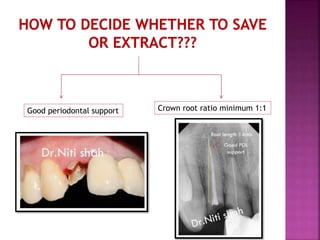
Good periodontal support Crown root ratio minimum 1:1
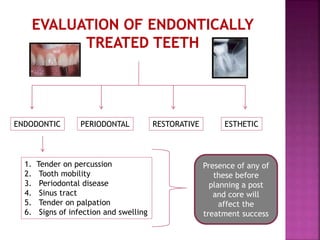
ENDODONTIC RESTORATIVEPERIODONTAL ESTHETIC
1. Tender on percussion
2. Tooth mobility
3. Periodontal disease
4. Sinus tract
5. Tender on palpation
6. Signs of infection and swelling
Presence of any of
these before
planning a post
and core will
affect the
treatment success
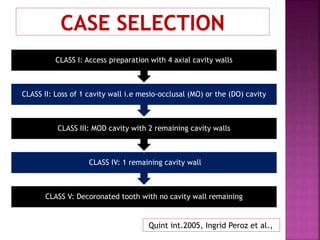
CLASS V: Decoronated tooth with no cavity wall remaining
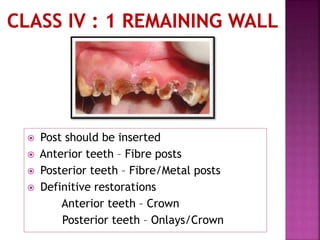
CLASS IV: 1 remaining cavity wall
CLASS III: MOD cavity with 2 remaining cavity walls
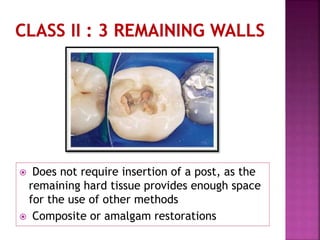
CLASS II: Loss of 1 cavity wall i.e mesio-occlusal (MO) or the (DO) cavity
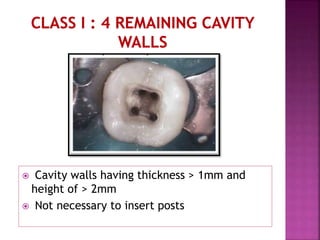
CLASS I: Access preparation with 4 axial cavity walls
Quint int.2005, Ingrid Peroz et al.,
 Cavity walls having thickness > 1mm and
height of > 2mm
 Not necessary to insert posts
 Does not require insertion of a post, as the
remaining hard tissue provides enough space
for the use of other methods
 Composite or amalgam restorations
 Loss of 2 proximal surfaces leads to 60%
reduction in tooth strength, hence insertion
of post followed by core and a definitive
restoration in the form of crown or onlay.
 Post should be inserted
 Anterior teeth – Fibre posts
 Posterior teeth – Fibre/Metal posts
 Definitive restorations
Anterior teeth – Crown
Posterior teeth – Onlays/Crown
 Insertion of post – core retention
 Ferrule effect – Increase the FR
 Deep destruction – sufficient ferrule
impossible – surgical crown lengthening
 1728 – Pierre Fauchard - “TENONS” – metal
posts – screwed - roots of teeth to retain the
prosthesis
 1745 – Claude Mouton - gold crown with a gold
post
 1830-1870 –Wood replaced metal as the material
of choice for posts.
 1871 – Harries introduced wooden posts.
However, they swelled and caused roots fracture.
 “Pivot crown” – a wooden post fitted to an
artificial crown and to root canal
 1884 – Richmond crown
 1884 – Logan crown
 Later 19th century, single piece post crown.
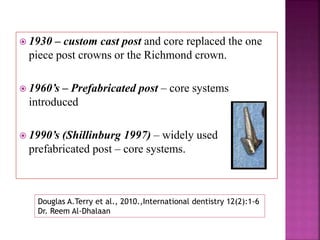
 1930 – custom cast post and core replaced the one
piece post crowns or the Richmond crown.
 1960’s – Prefabricated post – core systems
introduced
 1990’s (Shillinburg 1997) – widely used
prefabricated post – core systems.
Douglas A.Terry et al., 2010.,International dentistry 12(2):1-6
Dr. Reem Al-Dhalaan
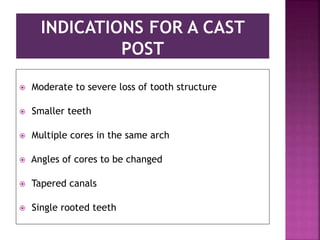
 Moderate to severe loss of tooth structure
 Smaller teeth
 Multiple cores in the same arch
 Angles of cores to be changed
 Tapered canals
 Single rooted teeth
 Sufficient tooth structure for prefabricated
post
 Short roots, thin roots
 Flared canals
 When esthetics is a major concern
 High strength
 Custom fit to the root configuration
 Minimal alteration of canal anatomy
 Adaptable to large irregularly shaped canals and
orifices
 Changes in core angulation is possible
Henry and Bower, 1977
Christensen, 2004
Fredriksson et al., 1998
 Rigidity – Root fracture
 Tapered canals – wedging effect
 Expensive
 Two or more appointments
 Temporization between appointments – more difficult
 Risk of casting inaccuracies
 Unesthetic appearance
 Difficult to retrieve
Martinez-Insua et al., 1998
Dean et al., 1998
Bateman et al., 2003
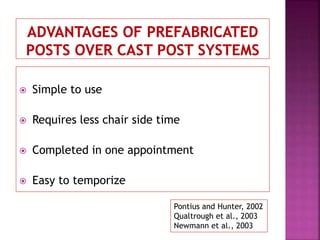
 Simple to use
 Requires less chair side time
 Completed in one appointment
 Easy to temporize
Pontius and Hunter, 2002
Qualtrough et al., 2003
Newmann et al., 2003
 Root is designed to accept the post rather
than the post being designed to fit the root
 Application – limited – considerable coronal
tooth structure is lost
 Chemical reactions – post and core –
dissimilar metals
Teixeira at al., 2006, Robbertset al., 2004, Cormier et al., 2001, Christensen, 2004
POSTS
METALLIC
CUSTOM CAST
PREFABRICAT
ED
NON
METALLIC
CARBON
FIBRE
TOOTH
COLOURED
WOVEN FIBRE
COMPOSTE
DCNA 2002
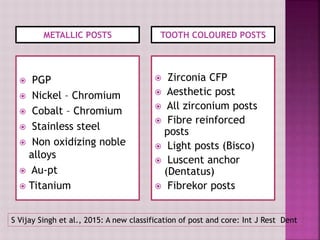
METALLIC POSTS TOOTH COLOURED POSTS
 PGP
 Nickel – Chromium
 Cobalt – Chromium
 Stainless steel
 Non oxidizing noble
alloys
 Au-pt
 Titanium
 Zirconia CFP
 Aesthetic post
 All zirconium posts
 Fibre reinforced
posts
 Light posts (Bisco)
 Luscent anchor
(Dentatus)
 Fibrekor posts
S Vijay Singh et al., 2015: A new classification of post and core: Int J Rest Dent
- CUSTOM CAST POSTS
- PREFABRICATED POSTS
 Tapered,smooth-sided posts
 Parallel-sided posts
 Tapered,self-threading screws
 Parallel-sided, threaded posts
 Parallel-sided, tapered apical end posts
- CUSTOM CAST POSTS
- PREFABRICATED POSTS
 Tapered,smooth-sided posts
 Parallel-sided posts,serrated and vented posts
 Tapered,self-threading post systems
 Parallel-sided, threaded posts
- Self threading
- Thread with use of matched taps
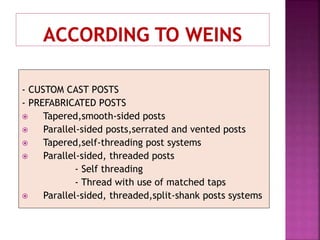
 Parallel-sided, threaded,split-shank posts systems
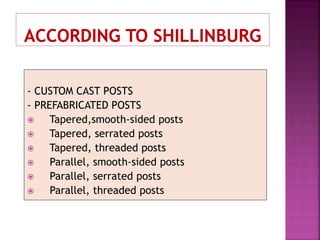
- CUSTOM CAST POSTS
- PREFABRICATED POSTS
 Tapered,smooth-sided posts
 Tapered, serrated posts
 Tapered, threaded posts
 Parallel, smooth-sided posts
 Parallel, serrated posts
 Parallel, threaded posts
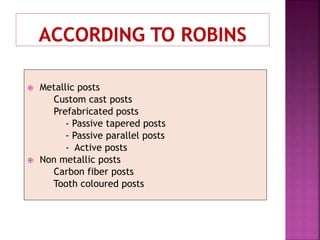
 Metallic posts
Custom cast posts
Prefabricated posts
- Passive tapered posts
- Passive parallel posts
- Active posts
 Non metallic posts
Carbon fiber posts
Tooth coloured posts
 CONSERVATION OF TOOTH STRUCTURE
- Preparation of the canal
- Preparation of coronal tissue
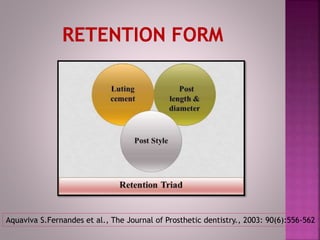
 RETENTION FORM
- Anterior teeth
- Posterior teeth
 RESISTANCE FORM
- Stress distribution
- Rotational resistance
PREPARATION OF THE CANAL:
 Remove minimal tooth structure
 Excessive enlargement – perforate/weaken the root
 Thickness of the remaining dentin – Fracture resistance
of the root
 Teeth cemented with thicker posts (1.8mm) fractured
more easily than those with a thinner (1.3mm) one
 PHOTO ELASTIC STUDIES: internal stresses are reduced
with thinner posts
Akkayan B et al., 2002 & Trabert KC et al., 1978
Helfer AR et al., 1972
 Felton DA 1991 – most fractures originate
from these concavities – RDT is minimal
 Root canal - enlarged only enough to enable
the post to fit accurately yet passively
insuring strength and retention
Reisbick and Shillinburg., 1975
Goodacre et al., 2001
 Coronal tooth structure – conserved – reduce the stress
concentration at the gingival margin
 Milton P and Srein R S 1992 – if more than 2mm of
coronal tooth structure remains – post design has limited
role in FR
 Key element – Incorporation of ferrule
Hoag and Dwyer., 1982
Barkhordar RA et al., 1989
Bregman et al., 1989
Assif et al., 1989
Milot and Stein., 1992
Rosenstiel, Contemporary Fixed Prosthodontics, 4th Ed, 2006
Bracing of the complete
crown over the remaining
tooth structure to prevent
fracture
Rosen 1961 - :”Hugging action” of a
collar of cast metal for extracoronal
bracing
Eissman & Radke 1987 – “Ferrule
effect” – 360degree ring of cast metal
around the tooth structure
 Minimum of 2mm dentinal axial wall height
 Parallel axial walls
 Crown – totally encircle the tooth
 Margins of crown – sound tooth structure
 Margins - should not invade the attachment
apparatus
Wagnild 2002
Richard S. Schwartz et al., 2004 : Post placement and
restoration of endodontically treated teeth : A
literature review
“Invitro fracture resistance of endodontically treated central
incisors with varying ferrule heights and configurations” – Tan et
al., Journal of Prosthetic Dentistry, 2005
“Effect of a crown ferrule on the fracture resistance of endodontically
treated teeth restored with prefabricated posts” – Perreira et al, Journal
of Prosthetic Dentistry, 2006
Effect of crown lenghtening and ferrule placement on static load failure
of cemented cast poat-cores and crowns” – Gegauff, Journal of
Prosthetic Dentistry, 2000
 1.5mm of ferrule height
 Philip et al., 2005 – investigated the resistance to
static loading of endodontically treated teeth with
uniform and non uniform ferrule configuration
 2mm uniform > 0.5-2mm ferrule height non uniform
2mm unifrom and
0.5 – 2mm ferrule height non unifrom
NO FERRULE>
Effectiveness of ferrule:
Fracture testing
Impact testing
Fatigue testing
Photo elastic stress analysis
N.R. Stankiewicz et al., 2002 : The ferrule effect : a literature review: IEJ
 SURGICAL: Crown lengthening
Allows ferrule
Less favourable crown root ratio
Increased leverage on the root during function
 Gegauff 1999 : weaker rather than
a stronger restored tooth
 ORTHODONTIC EXTRUSION:
CROWN LENGTHENING / EXTRUSION
Aquaviva S.Fernandes et al., The Journal of Prosthetic dentistry., 2003: 90(6):556-562
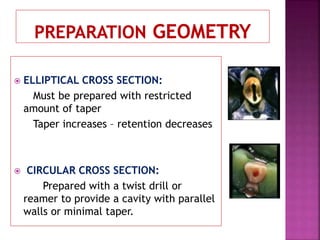
 ELLIPTICAL CROSS SECTION:
Must be prepared with restricted
amount of taper
Taper increases – retention decreases
 CIRCULAR CROSS SECTION:
Prepared with a twist drill or
reamer to provide a cavity with parallel
walls or minimal taper.
Threaded posts
 Increase the retention
 Not recommended because of residual
stress in dentin
 Standlee JP et al – parallel sided posts are
more retentive than tapered posts
Rosenstiel, CFP,4th ed,2006
Kurer et al., 1977
Cooney et al., 1986
Standlee and Caputo , 1992
 Greater the post length – better the retention
 Preserve 3 to 5mm of apical gutta percha to maintain
apical seal
 Molars with short roots – Place more than one post –
Additional retention
Mattison CD et al., 1984, Kvist T et al., 1989
Standlee JP et al., 1978 & 1972
Hirshfeld Z et al., 1972
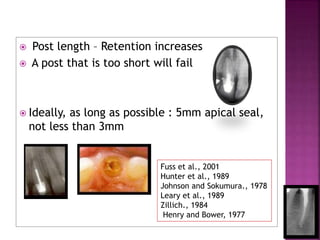
 Post length – Retention increases
 A post that is too short will fail
 Ideally, as long as possible : 5mm apical seal,
not less than 3mm
Fuss et al., 2001
Hunter et al., 1989
Johnson and Sokumura., 1978
Leary et al., 1989
Zillich., 1984
Henry and Bower, 1977
 Equal to occlusocervical dimension of the
crown
 Longer than the crown
 One-third of the crown length
 Half the root length
 2/3rd of root length
Harper RH et al., 1976, Mondelli J et al., 1971, Goldrich N et
al., 1970, Rosenberg PA et al., 1971
Silverstein WH et al., 1964
Dooley BS et., 1967
Baraban DJ., 1967, Jacoby WE 1976
Dewhirst RB et al., 1969, Hamilton AI 1959, Larato DC et
al., 1966, Christy JM et al., 1967, Bartlett SO., 1968
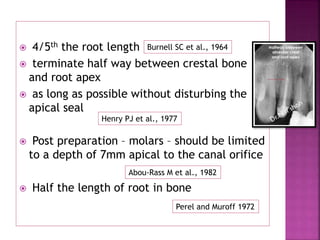
 4/5th the root length
 terminate half way between crestal bone
and root apex
 as long as possible without disturbing the
apical seal
 Post preparation – molars – should be limited
to a depth of 7mm apical to the canal orifice
 Half the length of root in bone
Burnell SC et al., 1964
Henry PJ et al., 1977
Abou-Rass M et al., 1982
Perel and Muroff 1972
 Ideally
No wider than 1/3rd root
2mm of tooth structure
Diameter increases –
stress increses – FR decreses
Tilk M A et al., 1500 teeth (125 of each teeth)
0.6mm – Mandibular incisors
1.0mm – Maxillary CI, Maxillary and Mandibular canines,
Palatal root of maxillary first molar
0.8mm – Other teeth
Mattison 1982, Trabert 1978)
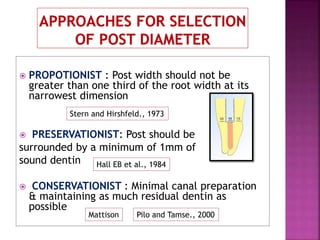
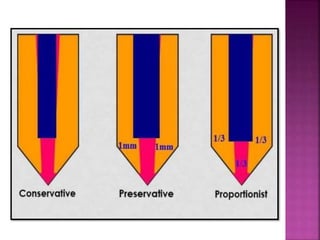
 PROPOTIONIST : Post width should not be
greater than one third of the root width at its
narrowest dimension
 PRESERVATIONIST: Post should be
surrounded by a minimum of 1mm of
sound dentin
 CONSERVATIONIST : Minimal canal preparation
& maintaining as much residual dentin as
possible
Stern and Hirshfeld., 1973
Hall EB et al., 1984
Pilo and Tamse., 2000Mattison
 Shillinburg et al., 1982 – study of 100 teeth
PEESO SIZES:
Maxilaary CI - #1-4
Maxillary LI - #1-3
Maxillary canine - #1-4
(Goodacre)
Tilk MA et al.,
 Serrated / roughened post – more retentive
than a smooth post
 Controlled grooving of the post and root
canal – increases retention of tapered post
 Roughening - Sandblasting
Joana Machado et al., 2017: Currently used systems of dental posts : Sci direct
Henry & Bower 1977
 Traditional cements – little effect
 Commonly used : Zinc phosphate, GIC,
RMGIC
 Adhesive resin luting cements – increased
retension
C Goracci et al., 2011: Current perspectives on post systems: a
literature review: Australian Dental Association
 Choice between custom designed post or
prefabricated post – Parallel, Tapered, Parallel
tapered
 Extensive preparation – Well adapted cast post
and core restoration
 Funnel shaped canals – Prefabricated parallel
sided posts
 Tapered canals – Parallel post – fill remaining
space with luting agent / Cast post
Ash M jr.et al., 1993 and Smith TC et al., 1997
Cohen BI et al., 1996
 Long posts - avoided
curved roots
Ribbon shaped canals
 Retention – 2 or more relatively short posts in the
divergent canals
 Cast post
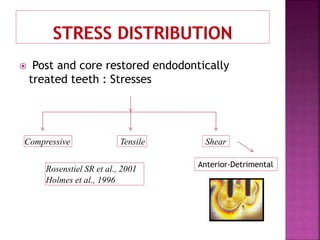
 Post and core restored endodontically
treated teeth : Stresses
Compressive ShearTensile
Anterior-Detrimental
Rosenstiel SR et al., 2001
Holmes et al., 1996
Stress are reduced as post
length increases
PARALLEL SIDED POSTS TAPERED POSTS
High stresses – insertion – parallel sided posts
Wedging effect – Stress conc @
coronal portion of the root
Unifrom stress distribution
Standlee JP et al., 1980, Johnson JK et al., 1978
Cooney JP et al., 1986, Ross RS et al., 1991
 Threaded posts
Joanna N et al., A systematic review of post and core materials
and systems 2009: Journal of prosthodontics
 Torsional forces – Lead to loosening and
displacement of the post from the canal
 More – round canals
 Active post – greater torsional resistance
than a passive post
 Rotation – prevented by vertical
coronal wall, a small grove - canal
Burgess JO et al., 1992
Cohen BI et al., 1995
 Cementation – Enhancing retention, stress
distribution, sealing irregularities b/w tooth
& post
 Increase in stress within the root canal –
develops hydrostatic pressure
 Proper post design with a cement vent –
permit escape of luting agent
Turner CH et al., 1981
Peters MT et al., 1983
Rosenstiel SR et al., 2001
1. Removal of endodontic filling
material
2. Preparation of coronal tooth
structure
3. Post and core fabrication
 GP – removed – warm condenser –
immediately after obturation
 Rotary instrumentation – disturb apical
seal – immediately after obturation
1. Chemical removal
2. Thermal removal
3. Mechanical removal
Schnell FJ 1978 & Bourgeois RS & Lemon RR 1981
Dickey DJ et al., 1982
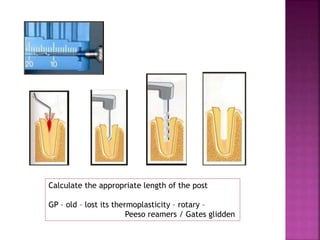
Calculate the appropriate length of the post
GP – old – lost its thermoplasticity – rotary –
Peeso reamers / Gates glidden
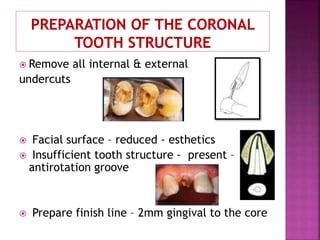
 Remove all internal & external
undercuts
 Facial surface – reduced - esthetics
 Insufficient tooth structure - present –
antirotation groove
 Prepare finish line – 2mm gingival to the core
 In addition to ferrule
 Contrabevel – flame shaped diamond
@ junction of core and tooth structure
 Bevel – metal collar, prevents over seating &
wedging effect of post
 Eliminate sharp angles & establish smooth
finish lines
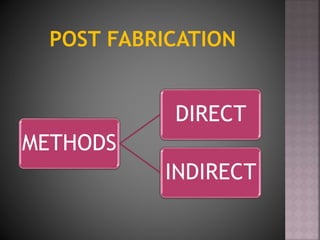
METHODS
DIRECT
INDIRECT
 Reliable – described by Barker in 1963
 Disadvantage – 2 visits
 Wax with plastic rod as carrier
 Wax with dental bur, acrylic resin with a solid
sprue
 core of acrylic resin with an endodontic file coated
with wax
Barker BC., 1963, Dewhirst RB et al., 1969 and Gentile D et al., 1965)
DeDomenico RJ., 1977 and Stern., 1972
Miller AW et al., 1978
DISINFECTION OF CANAL
Trim – 14 gauge solid plastic sprue - slides
easily into the canal to the apical end
Cut a small notch – facial portion – orientation
Mix acrylic resin monomer and polymer – runny consistency
Lubricate – Petroleum jelly/cotton wrapped on peeso reamer
Fill the orifice - as full as possible – acrylic resin with
plastic filling instrument –
1. Bead brush technique
2. Roll the resin – thin cylinder – doughy stage
Seat the monomer coated sprue - canal
Acrylic resin – tough and doughy – pump the pattern in and out
Polymerizes – remove post
Talim ST et al., A clinical approach to restoration of endodontically treated teeth
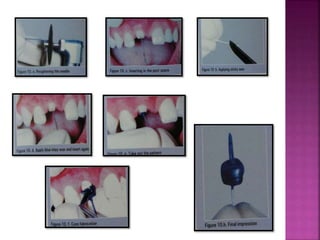
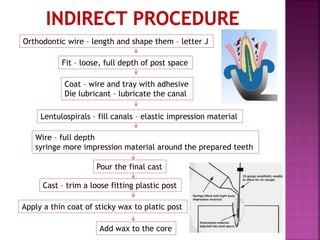
Orthodontic wire – length and shape them – letter J
Fit – loose, full depth of post space
Coat – wire and tray with adhesive
Die lubricant – lubricate the canal
Lentulospirals – fill canals – elastic impression material
Wire – full depth
syringe more impression material around the prepared teeth
Pour the final cast
Cast – trim a loose fitting plastic post
Apply a thin coat of sticky wax to platic post
Add wax to the core
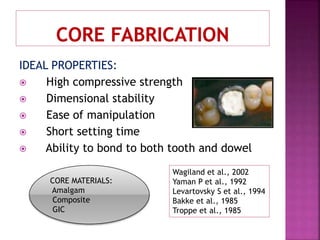
IDEAL PROPERTIES:
 High compressive strength
 Dimensional stability
 Ease of manipulation
 Short setting time
 Ability to bond to both tooth and dowel
Wagiland et al., 2002
Yaman P et al., 1992
Levartovsky S et al., 1994
Bakke et al., 1985
Troppe et al., 1985
CORE MATERIALS:
Amalgam
Composite
GIC
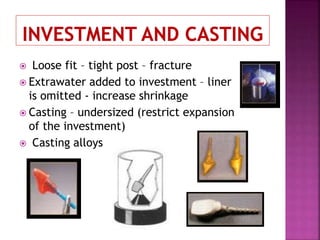
 Loose fit – tight post – fracture
 Extrawater added to investment – liner
is omitted - increase shrinkage
 Casting – undersized (restrict expansion
of the investment)
 Casting alloys
 Luting agents - fill the dead space in root canal
 Voids  lateral canal PDL inflammation
 Lentulo spirals used to load cement in post space
 Post core inserted gently to avoid hydrostatic pressure
[root fracture]
 Groove given in parallel sided post [excess cement
escapes]
Zinc phosphate – Excellent choice
Polycarboxylate – Lower compressive strength
GIC – Slow setting
RMGIC – Significant setting expansion
Adhesive resin cement – Widely used
Anusavice KJ et al., 1996
Matsuya S et al., 1996
Duncan JP et al., 1998
Goldman M et al., 1984
Nathanson D et al., 1993
Standlee and Caputo., 1992
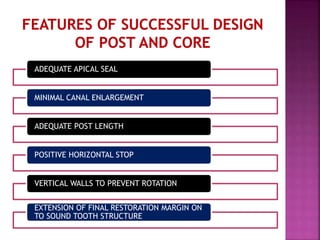
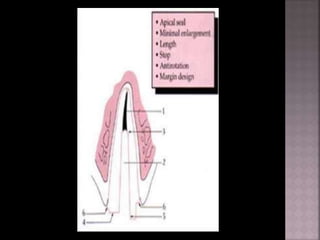
ADEQUATE APICAL SEAL
MINIMAL CANAL ENLARGEMENT
ADEQUATE POST LENGTH
POSITIVE HORIZONTAL STOP
VERTICAL WALLS TO PREVENT ROTATION
EXTENSION OF FINAL RESTORATION MARGIN ON
TO SOUND TOOTH STRUCTURE
Prosthetic failures
Periodontal failures
Endodontic failures
Vire et al.,
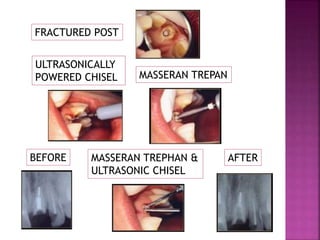
 Thin beaked forceps
 Ultrasonic removal
 Post puller
 Masserann kit
 Eggler post removal (Ruddle)
 Special hollow end-cutting tubes (trephines)
 Drilled out
 Ceramic and Zirconium posts – Difficult to
retrieve and sometimes impossible
Dr. Reem AL-Dhalaan
Abbott PV et al., 2002
FRACTURED POST
ULTRASONICALLY
POWERED CHISEL MASSERAN TREPAN
BEFORE MASSERAN TREPHAN &
ULTRASONIC CHISEL
AFTER
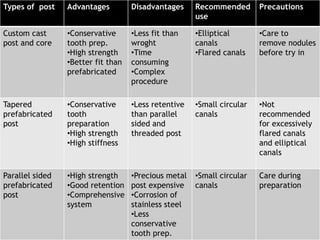
Types of post Advantages Disadvantages Recommended
use
Precautions
Custom cast
post and core
•Conservative
tooth prep.
•High strength
•Better fit than
prefabricated
•Less fit than
wroght
•Time
consuming
•Complex
procedure
•Elliptical
canals
•Flared canals
•Care to
remove nodules
before try in
Tapered
prefabricated
post
•Conservative
tooth
preparation
•High strength
•High stiffness
•Less retentive
than parallel
sided and
threaded post
•Small circular
canals
•Not
recommended
for excessively
flared canals
and elliptical
canals
Parallel sided
prefabricated
post
•High strength
•Good retention
•Comprehensive
system
•Precious metal
post expensive
•Corrosion of
stainless steel
•Less
conservative
tooth prep.
•Small circular
canals
Care during
preparation
 Ingle’s endodontics 6th edition
 Stephen Cohen “ Pathways of pulp”, 8th edition, 765-795
 Herbert Shillinburg “ Fundamentals of fixed prosthodontics”, 3rd
edition, 194-209
 Rosensteil, “Contemporary Fixed Prosthodonrics”, 3rd edition ,
272-312
 Franklin S.Weine, “ Endodontic therapy”,4th edition, 653-698
 Tylman’s, “Theory and practice of fixed prosthodontics”, 8th
edition, 407-417
 Herbert T.Shillinburg, “ Restoration of the endodontically
treated teeth: 1982 edition
 Herbert shillinburg, “Fundamentals of tooth preparation”
2nd edition, 321-358
 Nageshwara Rao: Advacnced endodontics: Post endodontic
restoration
 Gutmann, “Problem solving in endodontics”, 3rd edition
325-346
 Endod Dental traumatology 1996,14.59-63
 John J.Maggio, When to palce a post and how: A Scientific
approach
 Joanna N. Theodosopoulou: A systematic review of dowel
and core materials and systems: Journal of Prosthodontics
2009: 18:464-472
 Dr. Reem Al-Dhalaan : Posthodontic management of
endodontically treated teeth
 Joana Machado et al., 2017: Currently used systems of dental
posts for endodontic treatment 5:27-33
 N R Stankiewicz et al., 2002: The ferrule effect : aliterature
review 35:575-581
 Talim ST et al., A clinical approach to restoration of
endodntically treated teeth
 C Goracci et al., 2011: Current perspectives on post systems: a
literature review
 S Vijay Singh etal., 2015 : A new classification of post and core
 Richard S Schwartz et al., 2004: Post placement and restoration
of endodontically treated teeth : a literature review
Cast post - Restoration of endodontically treated teeth

Cast post - Restoration of endodontically treated teeth

  • 1.
    Dr. A. YOGHAPADHMA 2nd YEAR POSTGRADUATE DEPT OF CONSERVATIVE DENTISTRY
  • 4.
     Introduction  History Definitions  Why to restore endodontically treated teeth?  Post and core systems  Principles of tooth preparation  Procedure - Post and core fabrication - Investing and casting - Evaluation and cementation  Removal of existing posts  Conclusion  References
  • 5.
     The restorationof the endodontically treated tooth is complicated - Destruction by caries - Previous restorations - Trauma - Endodontic access preparation  The endodontically treated teeth require restoration because of - dehydrated dentin - decreased structural integrity - impaired neurosensory feedback mechanism
  • 6.
    Increase the clinicallongevity of the teeth Schwartz et al., 1983 – Failure in endodontically treated teeth – double in cases with inadequate restoration Weine 1996 – Endodontically treated teeth – lost due to poor restoration Helfer AR et al., Determination of moisture content of vital and pulpless teeth. Oral Surg Oral Med Oral Path 34:661,1972
  • 7.
    Gutmann 1992 . Moistureloss . Architectural behavior . Biomechanical behavior . Dentinal toughness . Collagen alteration William Robbins 2002 Dentin diff – Vital dentin Structural integrity – lost Neurosensory feedback mechanisms Sorensen and Martinoff., 1984 Aquilino and Caplan., 1982 Manocci et al., 2002 Nagasiri and Chitmongkolsuk et al., 2005
  • 8.
     DOWEL(POST): Restorative materialin the radicular portion of a non vital tooth  CORE: Properly shaped substructure which replaces missing coronal structure and retains the final restoration.  FERRULE(EISSMAN & RADKE): A band of metal that protectively encircles the remaining tooth structure
  • 9.
  • 10.
    Good periodontal supportCrown root ratio minimum 1:1
  • 11.
    ENDODONTIC RESTORATIVEPERIODONTAL ESTHETIC 1.Tender on percussion 2. Tooth mobility 3. Periodontal disease 4. Sinus tract 5. Tender on palpation 6. Signs of infection and swelling Presence of any of these before planning a post and core will affect the treatment success
  • 12.
    CLASS V: Decoronatedtooth with no cavity wall remaining CLASS IV: 1 remaining cavity wall CLASS III: MOD cavity with 2 remaining cavity walls CLASS II: Loss of 1 cavity wall i.e mesio-occlusal (MO) or the (DO) cavity CLASS I: Access preparation with 4 axial cavity walls Quint int.2005, Ingrid Peroz et al.,
  • 13.
     Cavity wallshaving thickness > 1mm and height of > 2mm  Not necessary to insert posts
  • 14.
     Does notrequire insertion of a post, as the remaining hard tissue provides enough space for the use of other methods  Composite or amalgam restorations
  • 15.
     Loss of2 proximal surfaces leads to 60% reduction in tooth strength, hence insertion of post followed by core and a definitive restoration in the form of crown or onlay.
  • 16.
     Post shouldbe inserted  Anterior teeth – Fibre posts  Posterior teeth – Fibre/Metal posts  Definitive restorations Anterior teeth – Crown Posterior teeth – Onlays/Crown
  • 17.
     Insertion ofpost – core retention  Ferrule effect – Increase the FR  Deep destruction – sufficient ferrule impossible – surgical crown lengthening
  • 19.
     1728 –Pierre Fauchard - “TENONS” – metal posts – screwed - roots of teeth to retain the prosthesis  1745 – Claude Mouton - gold crown with a gold post  1830-1870 –Wood replaced metal as the material of choice for posts.
  • 20.
     1871 –Harries introduced wooden posts. However, they swelled and caused roots fracture.  “Pivot crown” – a wooden post fitted to an artificial crown and to root canal  1884 – Richmond crown  1884 – Logan crown  Later 19th century, single piece post crown.
  • 21.
     1930 –custom cast post and core replaced the one piece post crowns or the Richmond crown.  1960’s – Prefabricated post – core systems introduced  1990’s (Shillinburg 1997) – widely used prefabricated post – core systems. Douglas A.Terry et al., 2010.,International dentistry 12(2):1-6 Dr. Reem Al-Dhalaan
  • 22.
     Moderate tosevere loss of tooth structure  Smaller teeth  Multiple cores in the same arch  Angles of cores to be changed  Tapered canals  Single rooted teeth
  • 23.
     Sufficient toothstructure for prefabricated post  Short roots, thin roots  Flared canals  When esthetics is a major concern
  • 24.
     High strength Custom fit to the root configuration  Minimal alteration of canal anatomy  Adaptable to large irregularly shaped canals and orifices  Changes in core angulation is possible Henry and Bower, 1977 Christensen, 2004 Fredriksson et al., 1998
  • 25.
     Rigidity –Root fracture  Tapered canals – wedging effect  Expensive  Two or more appointments  Temporization between appointments – more difficult  Risk of casting inaccuracies  Unesthetic appearance  Difficult to retrieve Martinez-Insua et al., 1998 Dean et al., 1998 Bateman et al., 2003
  • 26.
     Simple touse  Requires less chair side time  Completed in one appointment  Easy to temporize Pontius and Hunter, 2002 Qualtrough et al., 2003 Newmann et al., 2003
  • 27.
     Root isdesigned to accept the post rather than the post being designed to fit the root  Application – limited – considerable coronal tooth structure is lost  Chemical reactions – post and core – dissimilar metals Teixeira at al., 2006, Robbertset al., 2004, Cormier et al., 2001, Christensen, 2004
  • 28.
  • 29.
    METALLIC POSTS TOOTHCOLOURED POSTS  PGP  Nickel – Chromium  Cobalt – Chromium  Stainless steel  Non oxidizing noble alloys  Au-pt  Titanium  Zirconia CFP  Aesthetic post  All zirconium posts  Fibre reinforced posts  Light posts (Bisco)  Luscent anchor (Dentatus)  Fibrekor posts S Vijay Singh et al., 2015: A new classification of post and core: Int J Rest Dent
  • 30.
    - CUSTOM CASTPOSTS - PREFABRICATED POSTS  Tapered,smooth-sided posts  Parallel-sided posts  Tapered,self-threading screws  Parallel-sided, threaded posts  Parallel-sided, tapered apical end posts
  • 31.
    - CUSTOM CASTPOSTS - PREFABRICATED POSTS  Tapered,smooth-sided posts  Parallel-sided posts,serrated and vented posts  Tapered,self-threading post systems  Parallel-sided, threaded posts - Self threading - Thread with use of matched taps  Parallel-sided, threaded,split-shank posts systems
  • 32.
    - CUSTOM CASTPOSTS - PREFABRICATED POSTS  Tapered,smooth-sided posts  Tapered, serrated posts  Tapered, threaded posts  Parallel, smooth-sided posts  Parallel, serrated posts  Parallel, threaded posts
  • 33.
     Metallic posts Customcast posts Prefabricated posts - Passive tapered posts - Passive parallel posts - Active posts  Non metallic posts Carbon fiber posts Tooth coloured posts
  • 34.
     CONSERVATION OFTOOTH STRUCTURE - Preparation of the canal - Preparation of coronal tissue  RETENTION FORM - Anterior teeth - Posterior teeth  RESISTANCE FORM - Stress distribution - Rotational resistance
  • 35.
    PREPARATION OF THECANAL:  Remove minimal tooth structure  Excessive enlargement – perforate/weaken the root  Thickness of the remaining dentin – Fracture resistance of the root  Teeth cemented with thicker posts (1.8mm) fractured more easily than those with a thinner (1.3mm) one  PHOTO ELASTIC STUDIES: internal stresses are reduced with thinner posts Akkayan B et al., 2002 & Trabert KC et al., 1978 Helfer AR et al., 1972
  • 36.
     Felton DA1991 – most fractures originate from these concavities – RDT is minimal  Root canal - enlarged only enough to enable the post to fit accurately yet passively insuring strength and retention Reisbick and Shillinburg., 1975 Goodacre et al., 2001
  • 37.
     Coronal toothstructure – conserved – reduce the stress concentration at the gingival margin  Milton P and Srein R S 1992 – if more than 2mm of coronal tooth structure remains – post design has limited role in FR  Key element – Incorporation of ferrule Hoag and Dwyer., 1982 Barkhordar RA et al., 1989 Bregman et al., 1989
  • 38.
    Assif et al.,1989 Milot and Stein., 1992 Rosenstiel, Contemporary Fixed Prosthodontics, 4th Ed, 2006 Bracing of the complete crown over the remaining tooth structure to prevent fracture Rosen 1961 - :”Hugging action” of a collar of cast metal for extracoronal bracing Eissman & Radke 1987 – “Ferrule effect” – 360degree ring of cast metal around the tooth structure
  • 39.
     Minimum of2mm dentinal axial wall height  Parallel axial walls  Crown – totally encircle the tooth  Margins of crown – sound tooth structure  Margins - should not invade the attachment apparatus Wagnild 2002 Richard S. Schwartz et al., 2004 : Post placement and restoration of endodontically treated teeth : A literature review
  • 40.
    “Invitro fracture resistanceof endodontically treated central incisors with varying ferrule heights and configurations” – Tan et al., Journal of Prosthetic Dentistry, 2005
  • 41.
    “Effect of acrown ferrule on the fracture resistance of endodontically treated teeth restored with prefabricated posts” – Perreira et al, Journal of Prosthetic Dentistry, 2006 Effect of crown lenghtening and ferrule placement on static load failure of cemented cast poat-cores and crowns” – Gegauff, Journal of Prosthetic Dentistry, 2000
  • 42.
     1.5mm offerrule height  Philip et al., 2005 – investigated the resistance to static loading of endodontically treated teeth with uniform and non uniform ferrule configuration  2mm uniform > 0.5-2mm ferrule height non uniform 2mm unifrom and 0.5 – 2mm ferrule height non unifrom NO FERRULE> Effectiveness of ferrule: Fracture testing Impact testing Fatigue testing Photo elastic stress analysis N.R. Stankiewicz et al., 2002 : The ferrule effect : a literature review: IEJ
  • 43.
     SURGICAL: Crownlengthening Allows ferrule Less favourable crown root ratio Increased leverage on the root during function  Gegauff 1999 : weaker rather than a stronger restored tooth  ORTHODONTIC EXTRUSION: CROWN LENGTHENING / EXTRUSION
  • 44.
    Aquaviva S.Fernandes etal., The Journal of Prosthetic dentistry., 2003: 90(6):556-562
  • 45.
     ELLIPTICAL CROSSSECTION: Must be prepared with restricted amount of taper Taper increases – retention decreases  CIRCULAR CROSS SECTION: Prepared with a twist drill or reamer to provide a cavity with parallel walls or minimal taper.
  • 46.
    Threaded posts  Increasethe retention  Not recommended because of residual stress in dentin  Standlee JP et al – parallel sided posts are more retentive than tapered posts Rosenstiel, CFP,4th ed,2006 Kurer et al., 1977 Cooney et al., 1986 Standlee and Caputo , 1992
  • 47.
     Greater thepost length – better the retention  Preserve 3 to 5mm of apical gutta percha to maintain apical seal  Molars with short roots – Place more than one post – Additional retention Mattison CD et al., 1984, Kvist T et al., 1989 Standlee JP et al., 1978 & 1972 Hirshfeld Z et al., 1972
  • 48.
     Post length– Retention increases  A post that is too short will fail  Ideally, as long as possible : 5mm apical seal, not less than 3mm Fuss et al., 2001 Hunter et al., 1989 Johnson and Sokumura., 1978 Leary et al., 1989 Zillich., 1984 Henry and Bower, 1977
  • 49.
     Equal toocclusocervical dimension of the crown  Longer than the crown  One-third of the crown length  Half the root length  2/3rd of root length Harper RH et al., 1976, Mondelli J et al., 1971, Goldrich N et al., 1970, Rosenberg PA et al., 1971 Silverstein WH et al., 1964 Dooley BS et., 1967 Baraban DJ., 1967, Jacoby WE 1976 Dewhirst RB et al., 1969, Hamilton AI 1959, Larato DC et al., 1966, Christy JM et al., 1967, Bartlett SO., 1968
  • 50.
     4/5th theroot length  terminate half way between crestal bone and root apex  as long as possible without disturbing the apical seal  Post preparation – molars – should be limited to a depth of 7mm apical to the canal orifice  Half the length of root in bone Burnell SC et al., 1964 Henry PJ et al., 1977 Abou-Rass M et al., 1982 Perel and Muroff 1972
  • 51.
     Ideally No widerthan 1/3rd root 2mm of tooth structure Diameter increases – stress increses – FR decreses Tilk M A et al., 1500 teeth (125 of each teeth) 0.6mm – Mandibular incisors 1.0mm – Maxillary CI, Maxillary and Mandibular canines, Palatal root of maxillary first molar 0.8mm – Other teeth Mattison 1982, Trabert 1978)
  • 52.
     PROPOTIONIST :Post width should not be greater than one third of the root width at its narrowest dimension  PRESERVATIONIST: Post should be surrounded by a minimum of 1mm of sound dentin  CONSERVATIONIST : Minimal canal preparation & maintaining as much residual dentin as possible Stern and Hirshfeld., 1973 Hall EB et al., 1984 Pilo and Tamse., 2000Mattison
  • 54.
     Shillinburg etal., 1982 – study of 100 teeth PEESO SIZES: Maxilaary CI - #1-4 Maxillary LI - #1-3 Maxillary canine - #1-4 (Goodacre) Tilk MA et al.,
  • 55.
     Serrated /roughened post – more retentive than a smooth post  Controlled grooving of the post and root canal – increases retention of tapered post  Roughening - Sandblasting Joana Machado et al., 2017: Currently used systems of dental posts : Sci direct Henry & Bower 1977
  • 56.
     Traditional cements– little effect  Commonly used : Zinc phosphate, GIC, RMGIC  Adhesive resin luting cements – increased retension C Goracci et al., 2011: Current perspectives on post systems: a literature review: Australian Dental Association
  • 57.
     Choice betweencustom designed post or prefabricated post – Parallel, Tapered, Parallel tapered  Extensive preparation – Well adapted cast post and core restoration  Funnel shaped canals – Prefabricated parallel sided posts  Tapered canals – Parallel post – fill remaining space with luting agent / Cast post Ash M jr.et al., 1993 and Smith TC et al., 1997 Cohen BI et al., 1996
  • 58.
     Long posts- avoided curved roots Ribbon shaped canals  Retention – 2 or more relatively short posts in the divergent canals  Cast post
  • 60.
     Post andcore restored endodontically treated teeth : Stresses Compressive ShearTensile Anterior-Detrimental Rosenstiel SR et al., 2001 Holmes et al., 1996
  • 61.
    Stress are reducedas post length increases PARALLEL SIDED POSTS TAPERED POSTS High stresses – insertion – parallel sided posts Wedging effect – Stress conc @ coronal portion of the root Unifrom stress distribution Standlee JP et al., 1980, Johnson JK et al., 1978 Cooney JP et al., 1986, Ross RS et al., 1991
  • 62.
     Threaded posts JoannaN et al., A systematic review of post and core materials and systems 2009: Journal of prosthodontics
  • 63.
     Torsional forces– Lead to loosening and displacement of the post from the canal  More – round canals  Active post – greater torsional resistance than a passive post  Rotation – prevented by vertical coronal wall, a small grove - canal Burgess JO et al., 1992 Cohen BI et al., 1995
  • 64.
     Cementation –Enhancing retention, stress distribution, sealing irregularities b/w tooth & post  Increase in stress within the root canal – develops hydrostatic pressure  Proper post design with a cement vent – permit escape of luting agent Turner CH et al., 1981 Peters MT et al., 1983 Rosenstiel SR et al., 2001
  • 65.
    1. Removal ofendodontic filling material 2. Preparation of coronal tooth structure 3. Post and core fabrication
  • 66.
     GP –removed – warm condenser – immediately after obturation  Rotary instrumentation – disturb apical seal – immediately after obturation 1. Chemical removal 2. Thermal removal 3. Mechanical removal Schnell FJ 1978 & Bourgeois RS & Lemon RR 1981 Dickey DJ et al., 1982
  • 67.
    Calculate the appropriatelength of the post GP – old – lost its thermoplasticity – rotary – Peeso reamers / Gates glidden
  • 69.
     Remove allinternal & external undercuts  Facial surface – reduced - esthetics  Insufficient tooth structure - present – antirotation groove  Prepare finish line – 2mm gingival to the core
  • 70.
     In additionto ferrule  Contrabevel – flame shaped diamond @ junction of core and tooth structure  Bevel – metal collar, prevents over seating & wedging effect of post  Eliminate sharp angles & establish smooth finish lines
  • 71.
  • 72.
     Reliable –described by Barker in 1963  Disadvantage – 2 visits  Wax with plastic rod as carrier  Wax with dental bur, acrylic resin with a solid sprue  core of acrylic resin with an endodontic file coated with wax Barker BC., 1963, Dewhirst RB et al., 1969 and Gentile D et al., 1965) DeDomenico RJ., 1977 and Stern., 1972 Miller AW et al., 1978
  • 74.
  • 75.
    Trim – 14gauge solid plastic sprue - slides easily into the canal to the apical end Cut a small notch – facial portion – orientation Mix acrylic resin monomer and polymer – runny consistency Lubricate – Petroleum jelly/cotton wrapped on peeso reamer Fill the orifice - as full as possible – acrylic resin with plastic filling instrument – 1. Bead brush technique 2. Roll the resin – thin cylinder – doughy stage Seat the monomer coated sprue - canal Acrylic resin – tough and doughy – pump the pattern in and out Polymerizes – remove post
  • 77.
    Talim ST etal., A clinical approach to restoration of endodontically treated teeth
  • 78.
    Orthodontic wire –length and shape them – letter J Fit – loose, full depth of post space Coat – wire and tray with adhesive Die lubricant – lubricate the canal Lentulospirals – fill canals – elastic impression material Wire – full depth syringe more impression material around the prepared teeth Pour the final cast Cast – trim a loose fitting plastic post Apply a thin coat of sticky wax to platic post Add wax to the core
  • 79.
    IDEAL PROPERTIES:  Highcompressive strength  Dimensional stability  Ease of manipulation  Short setting time  Ability to bond to both tooth and dowel Wagiland et al., 2002 Yaman P et al., 1992 Levartovsky S et al., 1994 Bakke et al., 1985 Troppe et al., 1985 CORE MATERIALS: Amalgam Composite GIC
  • 80.
     Loose fit– tight post – fracture  Extrawater added to investment – liner is omitted - increase shrinkage  Casting – undersized (restrict expansion of the investment)  Casting alloys
  • 81.
     Luting agents- fill the dead space in root canal  Voids  lateral canal PDL inflammation  Lentulo spirals used to load cement in post space  Post core inserted gently to avoid hydrostatic pressure [root fracture]  Groove given in parallel sided post [excess cement escapes]
  • 82.
    Zinc phosphate –Excellent choice Polycarboxylate – Lower compressive strength GIC – Slow setting RMGIC – Significant setting expansion Adhesive resin cement – Widely used Anusavice KJ et al., 1996 Matsuya S et al., 1996 Duncan JP et al., 1998 Goldman M et al., 1984 Nathanson D et al., 1993 Standlee and Caputo., 1992
  • 83.
    ADEQUATE APICAL SEAL MINIMALCANAL ENLARGEMENT ADEQUATE POST LENGTH POSITIVE HORIZONTAL STOP VERTICAL WALLS TO PREVENT ROTATION EXTENSION OF FINAL RESTORATION MARGIN ON TO SOUND TOOTH STRUCTURE
  • 85.
  • 86.
     Thin beakedforceps  Ultrasonic removal  Post puller  Masserann kit  Eggler post removal (Ruddle)  Special hollow end-cutting tubes (trephines)  Drilled out  Ceramic and Zirconium posts – Difficult to retrieve and sometimes impossible Dr. Reem AL-Dhalaan Abbott PV et al., 2002
  • 87.
    FRACTURED POST ULTRASONICALLY POWERED CHISELMASSERAN TREPAN BEFORE MASSERAN TREPHAN & ULTRASONIC CHISEL AFTER
  • 88.
    Types of postAdvantages Disadvantages Recommended use Precautions Custom cast post and core •Conservative tooth prep. •High strength •Better fit than prefabricated •Less fit than wroght •Time consuming •Complex procedure •Elliptical canals •Flared canals •Care to remove nodules before try in Tapered prefabricated post •Conservative tooth preparation •High strength •High stiffness •Less retentive than parallel sided and threaded post •Small circular canals •Not recommended for excessively flared canals and elliptical canals Parallel sided prefabricated post •High strength •Good retention •Comprehensive system •Precious metal post expensive •Corrosion of stainless steel •Less conservative tooth prep. •Small circular canals Care during preparation
  • 89.
     Ingle’s endodontics6th edition  Stephen Cohen “ Pathways of pulp”, 8th edition, 765-795  Herbert Shillinburg “ Fundamentals of fixed prosthodontics”, 3rd edition, 194-209  Rosensteil, “Contemporary Fixed Prosthodonrics”, 3rd edition , 272-312  Franklin S.Weine, “ Endodontic therapy”,4th edition, 653-698  Tylman’s, “Theory and practice of fixed prosthodontics”, 8th edition, 407-417  Herbert T.Shillinburg, “ Restoration of the endodontically treated teeth: 1982 edition
  • 90.
     Herbert shillinburg,“Fundamentals of tooth preparation” 2nd edition, 321-358  Nageshwara Rao: Advacnced endodontics: Post endodontic restoration  Gutmann, “Problem solving in endodontics”, 3rd edition 325-346  Endod Dental traumatology 1996,14.59-63  John J.Maggio, When to palce a post and how: A Scientific approach  Joanna N. Theodosopoulou: A systematic review of dowel and core materials and systems: Journal of Prosthodontics 2009: 18:464-472
  • 91.
     Dr. ReemAl-Dhalaan : Posthodontic management of endodontically treated teeth  Joana Machado et al., 2017: Currently used systems of dental posts for endodontic treatment 5:27-33  N R Stankiewicz et al., 2002: The ferrule effect : aliterature review 35:575-581  Talim ST et al., A clinical approach to restoration of endodntically treated teeth  C Goracci et al., 2011: Current perspectives on post systems: a literature review  S Vijay Singh etal., 2015 : A new classification of post and core  Richard S Schwartz et al., 2004: Post placement and restoration of endodontically treated teeth : a literature review