PROSTHODONTICS definition Prosthodontics is the dental specialty pertaining to the diagnosis, treatment planning, rehabilitation and maintenance of the oral function, comfort, appearance and health of patients with clinical conditions associated with missing or deficient teeth and/or maxillofacial tissues using biocompatible substitutes
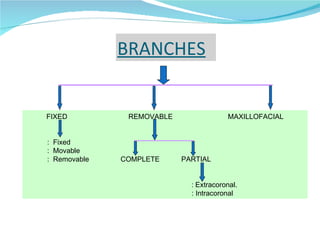
BRANCHES   FIXED  REMOVABLE  MAXILLOFACIAL :  Fixed :  Movable :  Removable  COMPLETE  PARTIAL : Extracoronal. : Intracoronal
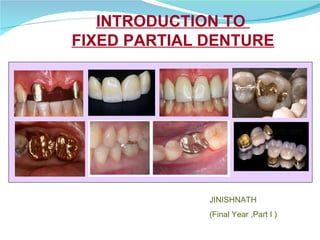
JINISHNATH (Final Year ,Part I ) INTRODUCTION TO  FIXED PARTIAL DENTURE
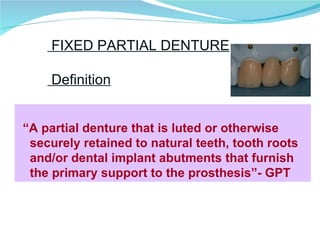
FIXED PARTIAL DENTURE Definition “ A partial denture that is luted or otherwise securely retained to natural teeth, tooth roots and/or dental implant abutments that furnish the primary support to the prosthesis”- GPT
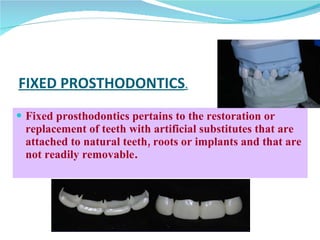
FIXED PROSTHODONTICS . Fixed prosthodontics pertains to the restoration or replacement of teeth with artificial substitutes that are attached to natural teeth, roots or implants and that are not readily removable .
FOR SUCESSFUL TREATMENT Meticulous  attention to every details patient  interview diagnosis and education prevention of dental disease periodont. Therapy (if indicated) occl. Consideration Appropriate treatment plan operative skills and treatment follow up care
Usually belongs following categories following categories comfort social function appearance Personal details Medical history Medical condition affecting treatment method, treatment plan and systemic condition
Dental history Periodontal history Restorative history Endodontic history Surgical history Tmj dysfunction history
Examination General examination Extra oral examination Tmj Muscles Lips Intraoral examination Periodontal Occusal Radiographic examination
One or two adjacent teeth are missing in the same arch or short span edentulous arches.  The supportive tissues are healthy.  Suitable abutment teeth are present.  The patient is in good health and wants to have the prosthesis placed.  The patient has the skills and motivation to maintain good oral hygiene.  Patient’s preference INDICATIONS OF FIXED PROSTHESIS.
Contraindications for a Fixed Prosthesis Necessary supportive tissues are diseased or missing.  Suitable abutment teeth are not present.  The patient is in poor health.  The patient is not motivated to have the prosthesis placed.  The patient has poor oral hygiene habits.  The patient cannot afford the treatment.
Common Terms   CROWN Laminate Veneers/Facial Veneers INLAY ONLAY ABUTMENT PONTIC CONNECTORS RETAINER
CROWN It is a cemented extracoronal restoration that covers or veneers the outer surface of the clinical crown. Primary function is to protect the underlying tooth structure & restore the function, form and esthetics. 1 )  Full veneer crown. 2) Partial veneer crown. :-three quarter crowns :-reverse three-quarter crowns :-seven-eight crowns :-pinledges :-inlay :-onlay TYPES
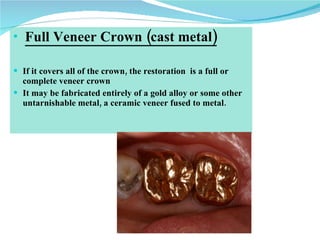
Full Veneer Crown (cast metal) If it covers all of the crown, the restoration  is a full or complete veneer crown It may be fabricated entirely of a gold alloy or some other untarnishable metal, a ceramic veneer fused to metal.
INDICATIONS Teeth that have extensive coronal destructions by caries or trauma Restoration of choice whenever maximum retention is needed Indicated on endodontically treated teeth Correction of occlusal plane CONTRAINDICATIONS If less than maximum retention and resistance is needed Wherever intact buccal or lingual wall exists Enameloplasty For  high esthetic needed exists like anterior teeth
Advantages Strong High retentive qualities Can be modify form and occlusion Easy to obtain adequate resistance form Disadvantages Removal of large amount of tooth structure Display of metal
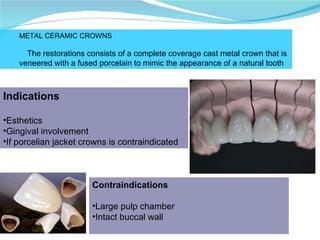
METAL CERAMIC CROWNS The restorations consists of a complete coverage cast metal crown that is veneered with a fused porcelain to mimic the appearance of a natural tooth Indications Esthetics Gingival involvement If porcelian jacket crowns is contraindicated Contraindications Large pulp chamber Intact buccal wall
Advantages Superior esthetics Retentive qualities are excellent Disadvantages Removal of substantial tooth structure Fracture can occur  Difficult to obtain accurate occlusion in glazed porcelain expensive
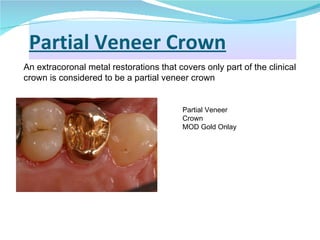
Partial Veneer Crown An extracoronal metal restorations that covers only part of the clinical crown is considered to be a partial veneer crown Partial Veneer Crown MOD Gold Onlay
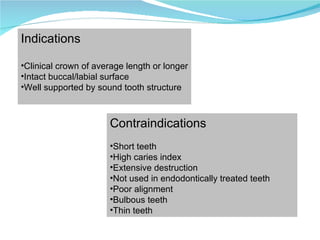
Indications Clinical crown of average length or longer Intact buccal/labial surface Well supported by sound tooth structure Contraindications Short teeth High caries index Extensive destruction Not used in endodontically treated teeth Poor alignment Bulbous teeth Thin teeth
Disadvantages Less retentive than full crown Limited adjustment of path of withdrawal Not indicated on vital teeth Advantages Conservative of tooth  structure Easy access to margins Less gingival involvement Verification of seating simple
Three-quarter crowns This type of crowns restore the occlusal surfaces and the three of the four axial surfaces but not including the facial surfaces
Pinledge Indications High esthetic requirement Undamaged anterior teeth When proximal grooves are impossible to prepare To alter lingual contour of maxillary anterior teeth A partial veneer retainer preparation incorporating pins holes to provide retention
Contraindications Large pulp Non vital teeth Thin teeth carious involvement Advantages Minimal tooth reduction Minimal marginal length Minimal gingival involvement Adequate retention Excellent esthetics Disadvantages Less retentive Techanically demanding
INLAY A fixed intracoronal restoration; a dental restoration made outside of a tooth to correspond to the form of the prepared cavity, which is then luted into the tooth Inlay may be used as a single tooth restorations for proximo-occlusal or gingival lesions with minimal to moderate extensions. They may be made up of gold alloy or ceramic material. Inlays are similar to fillings but the entire work lies within the cusps on the chewing surface of the tooth .
Indications Small carious lesion  Adequate dentinal support Low caries rate Patient request for gold restorations Contraindications high caries index Poor plaque control MODs Poor dentinal support require wide preparation
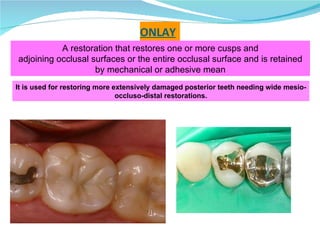
ONLAY A restoration that restores one or more cusps and adjoining occlusal surfaces or the entire occlusal surface and is retained by mechanical or adhesive mean It is used for restoring more extensively damaged posterior teeth needing wide mesio-occluso-distal restorations. All Ceramic Onlay
Indications Worn or carious teeth with intact buccal and lingual cusps MOD amalgam requiring replacements Low caries rate Contraindications High caries  risk poor plaque control Short clinical crown/extruded tooth bruxism
Laminate Veneers/Facial Veneers It consists of a thin layer of dental porcelain or cast ceramic that is bonded to the facial surfaces of the tooth with an appropriate resin It is used in situations requiring an improved cosmetic appearance on the anterior tooth.
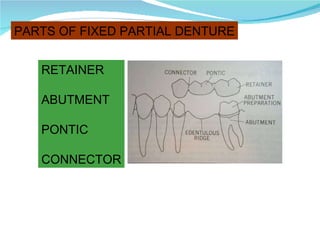
PARTS OF FIXED PARTIAL DENTURE RETAINER ABUTMENT PONTIC CONNECTOR
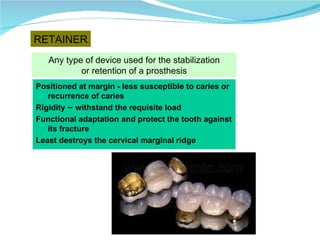
RETAINER Any type of device used for the stabilization or retention of a prosthesis Positioned at margin - less susceptible to caries or recurrence of caries Rigidity  –  withstand the requisite load Functional adaptation and protect the tooth against its fracture Least destroys the cervical marginal ridge
Types of retainer Full veneer crowns Partial veneer crowns Conservative retainers All metal retainers Metal ceramic retainers All ceramic retainers All acrylic retainers
Pontics An artificial tooth on a fixed dental prosthesis that replaces a missing natural tooth, restores its function, and usually fills the space previously occupied by the clinical crown Pontics
Requirements  of pontics -restore function -provide esthetics and comfort -be biologically acceptable -permit effective oral hygeine -preserve underlying residual mucosa Material used Metal-ceramic pontics Resin veneered All metal Facings
ABUTMENT A tooth, a portion of a tooth, or that portion of a dental implant that serves to  support and/or retain a prosthesis
Connectors Fixed dental prosthodontics, the portion of a fixed dental prosthesis that unites the retainer(s) and pontics Types- -Rigid connectors -Non rigid connectors -tenon mortise connectors -loop connectors -split pontic connectors -cross pin and wing connectors
Nonrigid connectors
Loop connectors Loop connectors are used for when existing diastema is to be maintained in the planned fixed prosthesis T he connector consists of a loop on the lingual aspect of the prosthesis that connects adjacent retainers and /or pontics
FUNCTIONS OF FIXED PARTIAL DENTURE Provide proper occlusal function. Maintain arch integrity/tooth position. Maintain occlusal relationships. Protect and preserve the remaining structures.
REFERENCE Fundamentals of Fixed Prosthodontics Third edition. Herbert.T.Shillingburg. Theory and practice of Fixed Prosthodontics. Tylman’s Contemporary Fixed Prosthodontics.stephen F Rosenstiel
Have a nice day Keep smiling……………………

Introduction to fixed partial denture

  • 1.
  • 2.
    PROSTHODONTICS definition Prosthodonticsis the dental specialty pertaining to the diagnosis, treatment planning, rehabilitation and maintenance of the oral function, comfort, appearance and health of patients with clinical conditions associated with missing or deficient teeth and/or maxillofacial tissues using biocompatible substitutes
  • 3.
    BRANCHES FIXED REMOVABLE MAXILLOFACIAL : Fixed : Movable : Removable COMPLETE PARTIAL : Extracoronal. : Intracoronal
  • 4.
    JINISHNATH (Final Year,Part I ) INTRODUCTION TO FIXED PARTIAL DENTURE
  • 5.
    FIXED PARTIAL DENTUREDefinition “ A partial denture that is luted or otherwise securely retained to natural teeth, tooth roots and/or dental implant abutments that furnish the primary support to the prosthesis”- GPT
  • 6.
    FIXED PROSTHODONTICS .Fixed prosthodontics pertains to the restoration or replacement of teeth with artificial substitutes that are attached to natural teeth, roots or implants and that are not readily removable .
  • 7.
    FOR SUCESSFUL TREATMENTMeticulous attention to every details patient interview diagnosis and education prevention of dental disease periodont. Therapy (if indicated) occl. Consideration Appropriate treatment plan operative skills and treatment follow up care
  • 8.
    Usually belongs followingcategories following categories comfort social function appearance Personal details Medical history Medical condition affecting treatment method, treatment plan and systemic condition
  • 9.
    Dental history Periodontalhistory Restorative history Endodontic history Surgical history Tmj dysfunction history
  • 10.
    Examination General examinationExtra oral examination Tmj Muscles Lips Intraoral examination Periodontal Occusal Radiographic examination
  • 11.
    One or twoadjacent teeth are missing in the same arch or short span edentulous arches. The supportive tissues are healthy. Suitable abutment teeth are present. The patient is in good health and wants to have the prosthesis placed. The patient has the skills and motivation to maintain good oral hygiene. Patient’s preference INDICATIONS OF FIXED PROSTHESIS.
  • 12.
    Contraindications for aFixed Prosthesis Necessary supportive tissues are diseased or missing. Suitable abutment teeth are not present. The patient is in poor health. The patient is not motivated to have the prosthesis placed. The patient has poor oral hygiene habits. The patient cannot afford the treatment.
  • 13.
    Common Terms CROWN Laminate Veneers/Facial Veneers INLAY ONLAY ABUTMENT PONTIC CONNECTORS RETAINER
  • 14.
    CROWN It isa cemented extracoronal restoration that covers or veneers the outer surface of the clinical crown. Primary function is to protect the underlying tooth structure & restore the function, form and esthetics. 1 ) Full veneer crown. 2) Partial veneer crown. :-three quarter crowns :-reverse three-quarter crowns :-seven-eight crowns :-pinledges :-inlay :-onlay TYPES
  • 15.
    Full Veneer Crown(cast metal) If it covers all of the crown, the restoration is a full or complete veneer crown It may be fabricated entirely of a gold alloy or some other untarnishable metal, a ceramic veneer fused to metal.
  • 16.
    INDICATIONS Teeth thathave extensive coronal destructions by caries or trauma Restoration of choice whenever maximum retention is needed Indicated on endodontically treated teeth Correction of occlusal plane CONTRAINDICATIONS If less than maximum retention and resistance is needed Wherever intact buccal or lingual wall exists Enameloplasty For high esthetic needed exists like anterior teeth
  • 17.
    Advantages Strong Highretentive qualities Can be modify form and occlusion Easy to obtain adequate resistance form Disadvantages Removal of large amount of tooth structure Display of metal
  • 18.
    METAL CERAMIC CROWNSThe restorations consists of a complete coverage cast metal crown that is veneered with a fused porcelain to mimic the appearance of a natural tooth Indications Esthetics Gingival involvement If porcelian jacket crowns is contraindicated Contraindications Large pulp chamber Intact buccal wall
  • 19.
    Advantages Superior estheticsRetentive qualities are excellent Disadvantages Removal of substantial tooth structure Fracture can occur Difficult to obtain accurate occlusion in glazed porcelain expensive
  • 20.
    Partial Veneer CrownAn extracoronal metal restorations that covers only part of the clinical crown is considered to be a partial veneer crown Partial Veneer Crown MOD Gold Onlay
  • 21.
    Indications Clinical crownof average length or longer Intact buccal/labial surface Well supported by sound tooth structure Contraindications Short teeth High caries index Extensive destruction Not used in endodontically treated teeth Poor alignment Bulbous teeth Thin teeth
  • 22.
    Disadvantages Less retentivethan full crown Limited adjustment of path of withdrawal Not indicated on vital teeth Advantages Conservative of tooth structure Easy access to margins Less gingival involvement Verification of seating simple
  • 23.
    Three-quarter crowns Thistype of crowns restore the occlusal surfaces and the three of the four axial surfaces but not including the facial surfaces
  • 24.
    Pinledge Indications Highesthetic requirement Undamaged anterior teeth When proximal grooves are impossible to prepare To alter lingual contour of maxillary anterior teeth A partial veneer retainer preparation incorporating pins holes to provide retention
  • 25.
    Contraindications Large pulpNon vital teeth Thin teeth carious involvement Advantages Minimal tooth reduction Minimal marginal length Minimal gingival involvement Adequate retention Excellent esthetics Disadvantages Less retentive Techanically demanding
  • 26.
    INLAY A fixedintracoronal restoration; a dental restoration made outside of a tooth to correspond to the form of the prepared cavity, which is then luted into the tooth Inlay may be used as a single tooth restorations for proximo-occlusal or gingival lesions with minimal to moderate extensions. They may be made up of gold alloy or ceramic material. Inlays are similar to fillings but the entire work lies within the cusps on the chewing surface of the tooth .
  • 27.
    Indications Small cariouslesion Adequate dentinal support Low caries rate Patient request for gold restorations Contraindications high caries index Poor plaque control MODs Poor dentinal support require wide preparation
  • 28.
    ONLAY A restorationthat restores one or more cusps and adjoining occlusal surfaces or the entire occlusal surface and is retained by mechanical or adhesive mean It is used for restoring more extensively damaged posterior teeth needing wide mesio-occluso-distal restorations. All Ceramic Onlay
  • 29.
    Indications Worn orcarious teeth with intact buccal and lingual cusps MOD amalgam requiring replacements Low caries rate Contraindications High caries risk poor plaque control Short clinical crown/extruded tooth bruxism
  • 30.
    Laminate Veneers/Facial VeneersIt consists of a thin layer of dental porcelain or cast ceramic that is bonded to the facial surfaces of the tooth with an appropriate resin It is used in situations requiring an improved cosmetic appearance on the anterior tooth.
  • 31.
    PARTS OF FIXEDPARTIAL DENTURE RETAINER ABUTMENT PONTIC CONNECTOR
  • 32.
    RETAINER Any typeof device used for the stabilization or retention of a prosthesis Positioned at margin - less susceptible to caries or recurrence of caries Rigidity – withstand the requisite load Functional adaptation and protect the tooth against its fracture Least destroys the cervical marginal ridge
  • 33.
    Types of retainerFull veneer crowns Partial veneer crowns Conservative retainers All metal retainers Metal ceramic retainers All ceramic retainers All acrylic retainers
  • 34.
    Pontics An artificialtooth on a fixed dental prosthesis that replaces a missing natural tooth, restores its function, and usually fills the space previously occupied by the clinical crown Pontics
  • 35.
    Requirements ofpontics -restore function -provide esthetics and comfort -be biologically acceptable -permit effective oral hygeine -preserve underlying residual mucosa Material used Metal-ceramic pontics Resin veneered All metal Facings
  • 36.
    ABUTMENT A tooth,a portion of a tooth, or that portion of a dental implant that serves to support and/or retain a prosthesis
  • 37.
    Connectors Fixed dentalprosthodontics, the portion of a fixed dental prosthesis that unites the retainer(s) and pontics Types- -Rigid connectors -Non rigid connectors -tenon mortise connectors -loop connectors -split pontic connectors -cross pin and wing connectors
  • 38.
  • 39.
    Loop connectors Loopconnectors are used for when existing diastema is to be maintained in the planned fixed prosthesis T he connector consists of a loop on the lingual aspect of the prosthesis that connects adjacent retainers and /or pontics
  • 40.
    FUNCTIONS OF FIXEDPARTIAL DENTURE Provide proper occlusal function. Maintain arch integrity/tooth position. Maintain occlusal relationships. Protect and preserve the remaining structures.
  • 41.
    REFERENCE Fundamentals ofFixed Prosthodontics Third edition. Herbert.T.Shillingburg. Theory and practice of Fixed Prosthodontics. Tylman’s Contemporary Fixed Prosthodontics.stephen F Rosenstiel
  • 42.
    Have a niceday Keep smiling……………………