PULPOTOMY PROCEDURES IN PRIMARY DENTITION
index Definition Classification Technique Formocresol pulpotomy Ca(OH) 2  pulpotomy  Other procedures Summary References
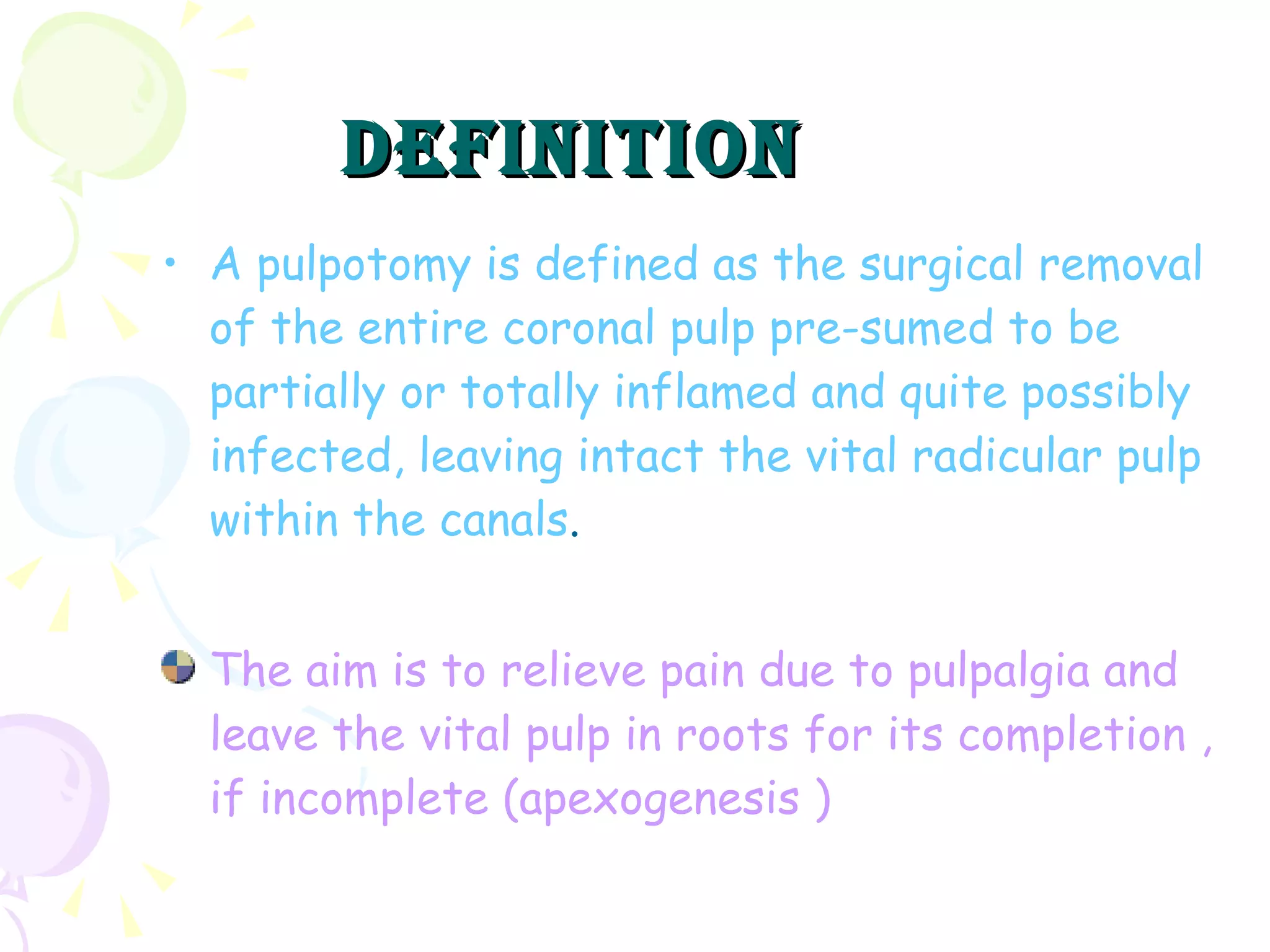
A pulpotomy is defined as the surgical removal of the entire coronal pulp pre-sumed to be partially or totally inflamed and quite possibly infected, leaving intact the vital radicular pulp within the canals . The aim is to relieve pain due to pulpalgia and leave the vital pulp in roots for its completion , if incomplete (apexogenesis ) DEFINITION
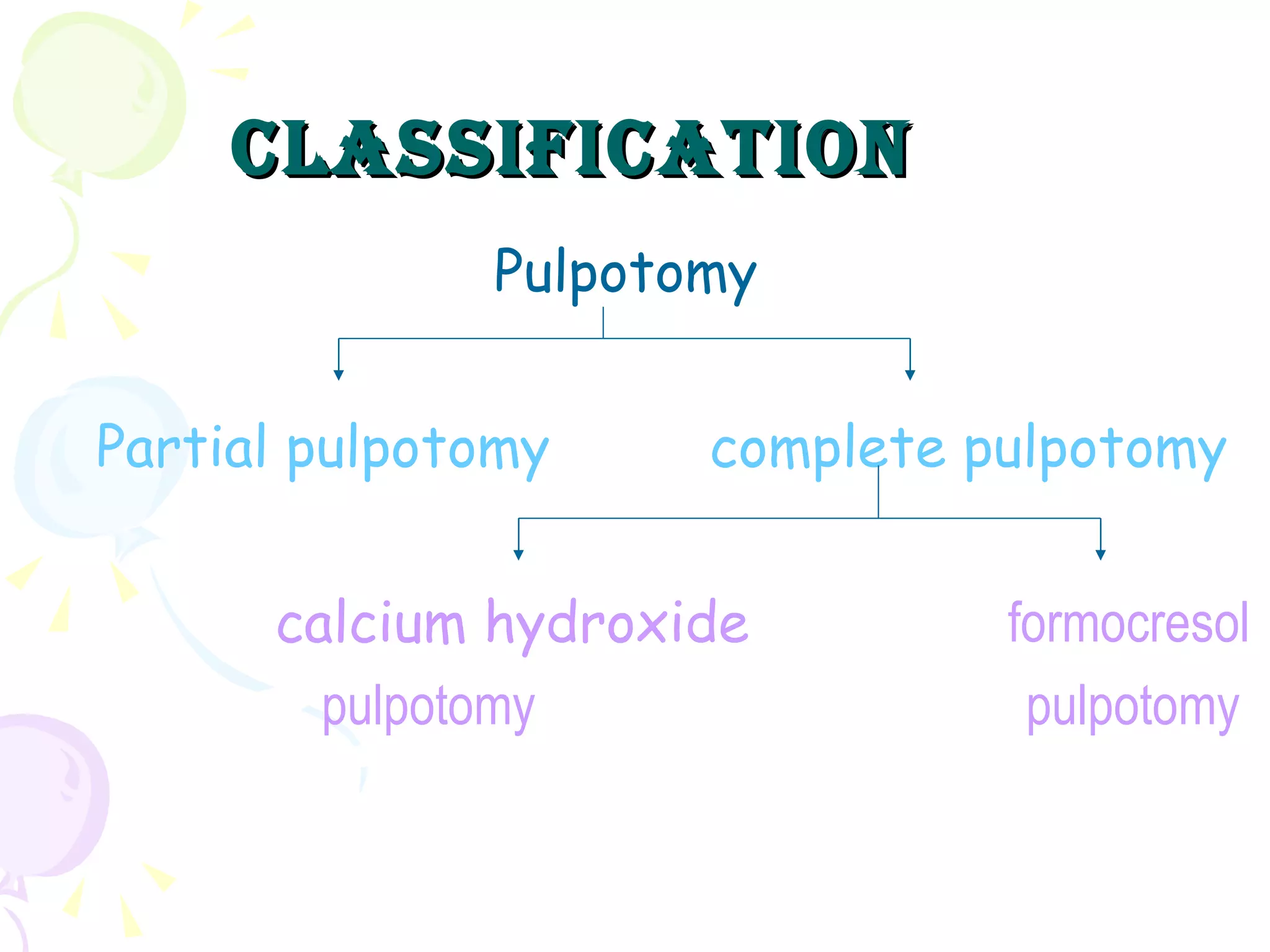
classification Pulpotomy Partial pulpotomy   complete pulpotomy calcium hydroxide   formocresol pulpotomy  pulpotomy
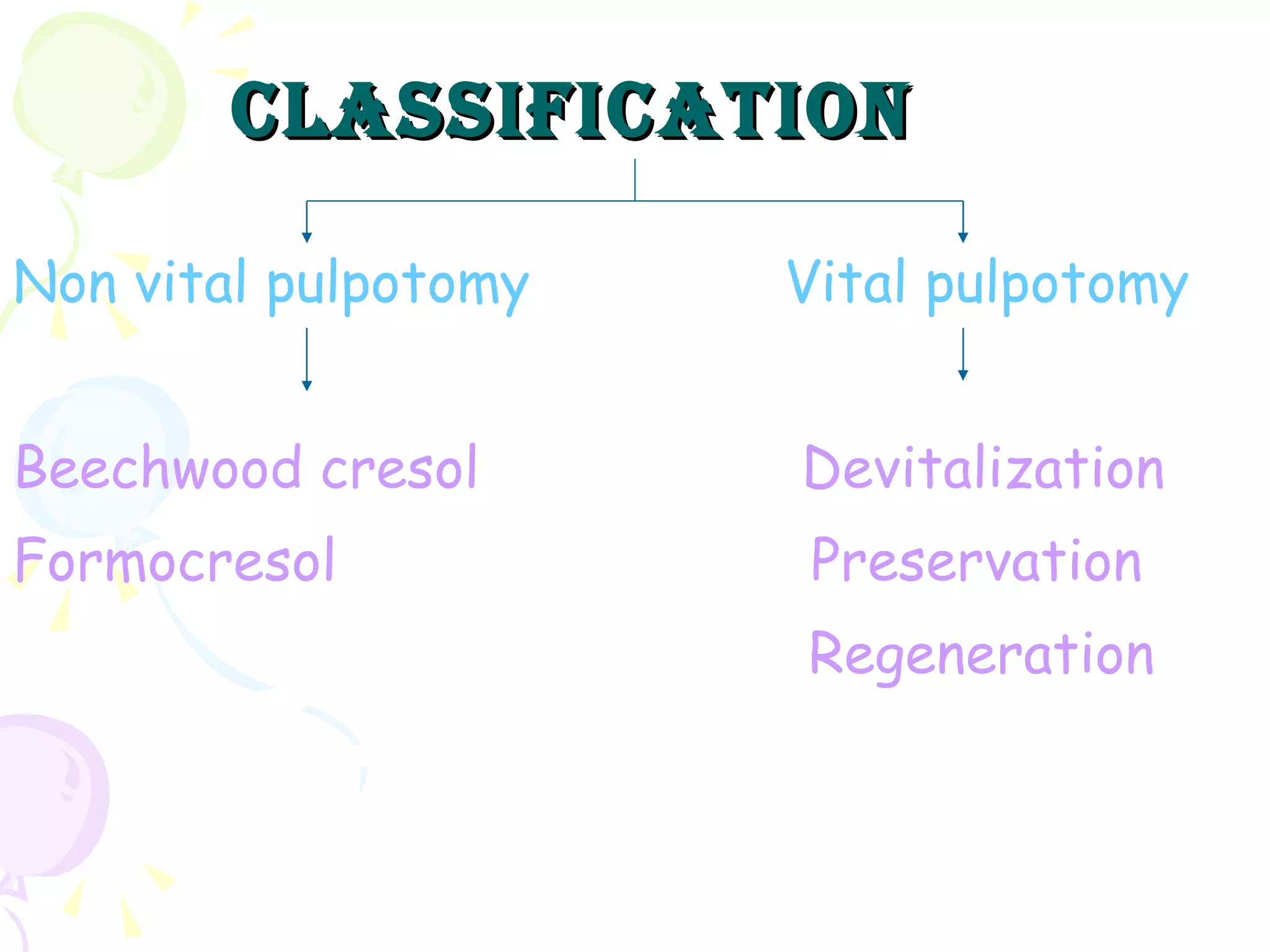
CLASSIFICATION Non vital pulpotomy  Vital pulpotomy Beechwood cresol  Devitalization Formocresol  Preservation Regeneration
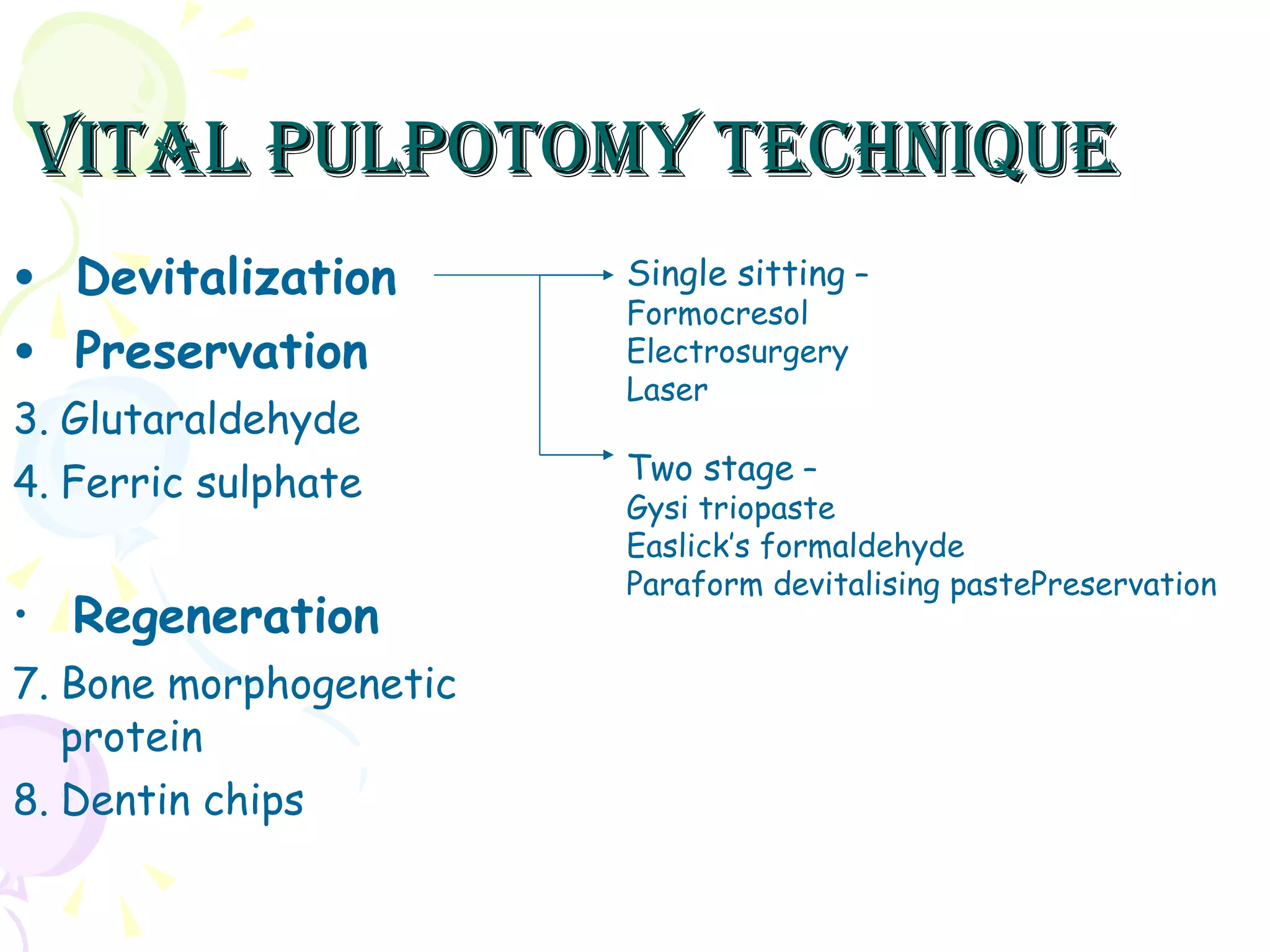
Vital pulpotomy technique Devitalization  Preservation Glutaraldehyde Ferric sulphate Regeneration Bone morphogenetic protein Dentin chips Single sitting  –  Formocresol Electrosurgery Laser Two stage  – Gysi triopaste Easlick’s formaldehyde Paraform devitalising pastePreservation
Formocresol pulpotomy Formocresol was introduced in 1904 by Buckley, who contended that equal parts of formalin and tricresol would react chemically with the intermediate and end products of pulp inflammation to form a “ new, colorless, and non-infective compound of a harmless nature.” Buckley’s formula formocresol, consists of tricresol, 19% aqueous formaldehyde, glycerine, and water.
indications Carious / mechanical exposure in vital asymptomatic tooth Tooth free of radicular pulpitis Presence of atleast 2/3 rd  root length Absence of abscess or fistula. Absence of inter radicular bone loss Absence of internal root resorption Permanent posterior teeth for the expedient treatment of pulpalgia. (it relieves pain in emergency as formocresol fixes the contiguous pulp left in the root canal.)
Contraindications Local : - Spontaneous pain / pain at night Pathologic mobility Swelling or fistula Internal resorption Less than 2/3 rd  root remaining Periapical inter radicular radiolucency Pus / serous exudate at exposure site Uncontrolled haemorrhage from amputed pulp Excesive pulp calcification Medical : - Cardiac condition Immunocompromised children
TECHNIQUE The formocresol pulpotomy technique was first advocated  by  SWEET [1930]   He used a multiple sitting technique, which has been subsequently modified to either a single or two stage technique. FORMULA   :-  19% Formaldehyde 35% cresol  15% Glycerin & Water  To prepare  1.5%concentration  of this formula,  first mix 3 parts of glycerin with 1 part of distilled water ,  then add 4 parts of this preparation to 1 part buckley’s formocresol , and throughly mix again.
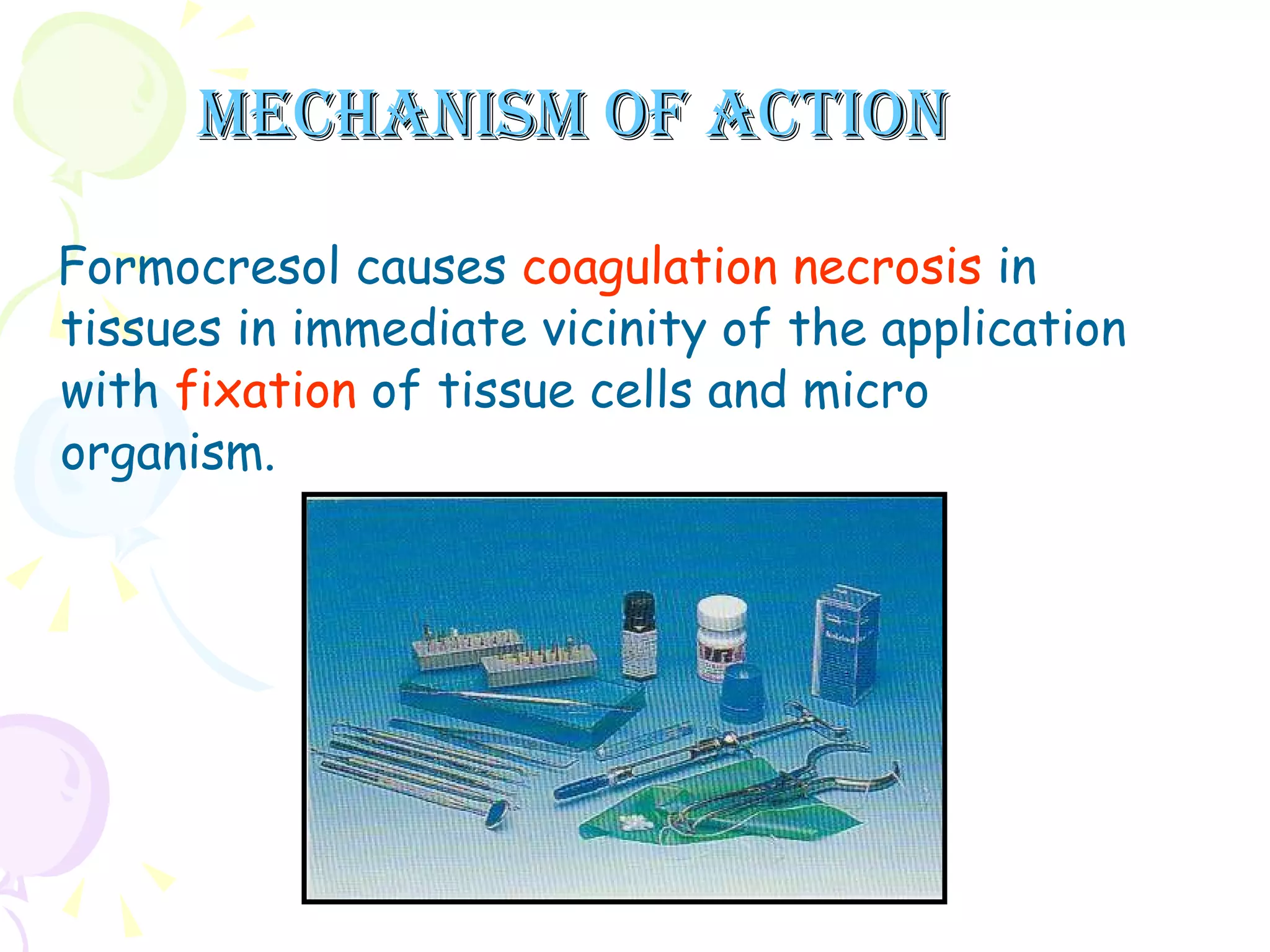
Mechanism of action Formocresol causes  coagulation necrosis  in tissues in immediate vicinity of the application with  fixation  of tissue cells and micro organism.
One-Appointment Pulpotomy. Indications :- only on those restorable teeth in which it has been determined that inflammation is confined to the coronal portion of the pulp. Contraindications :- Teeth with a history of spontaneous pain Profuse haemorrhage Pathologic or internal root resorption Inter radicular bone loss Presence of fistulas or pus in the chamber
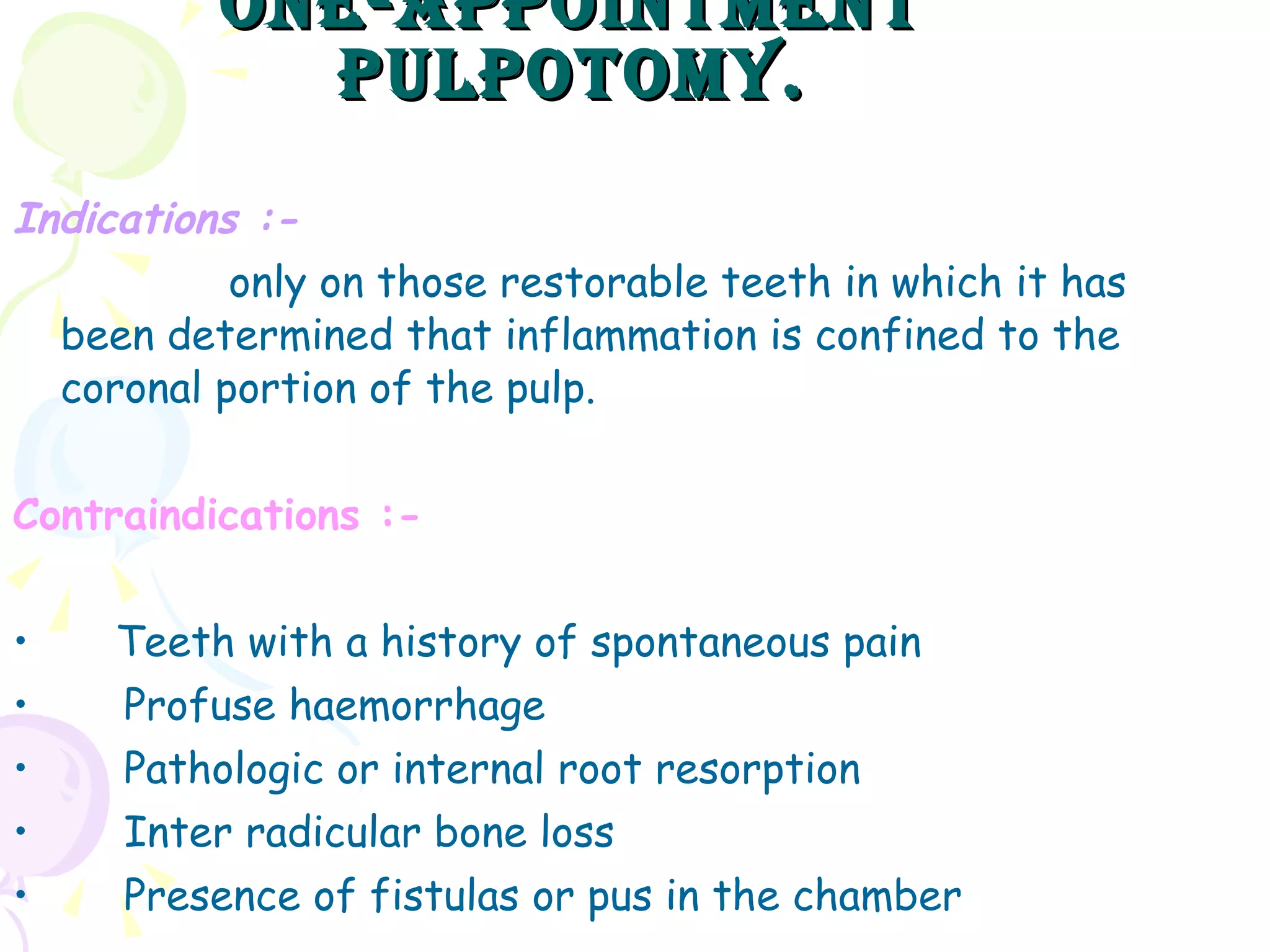
PROCEDURE Anesthetize the tooth and tissue.
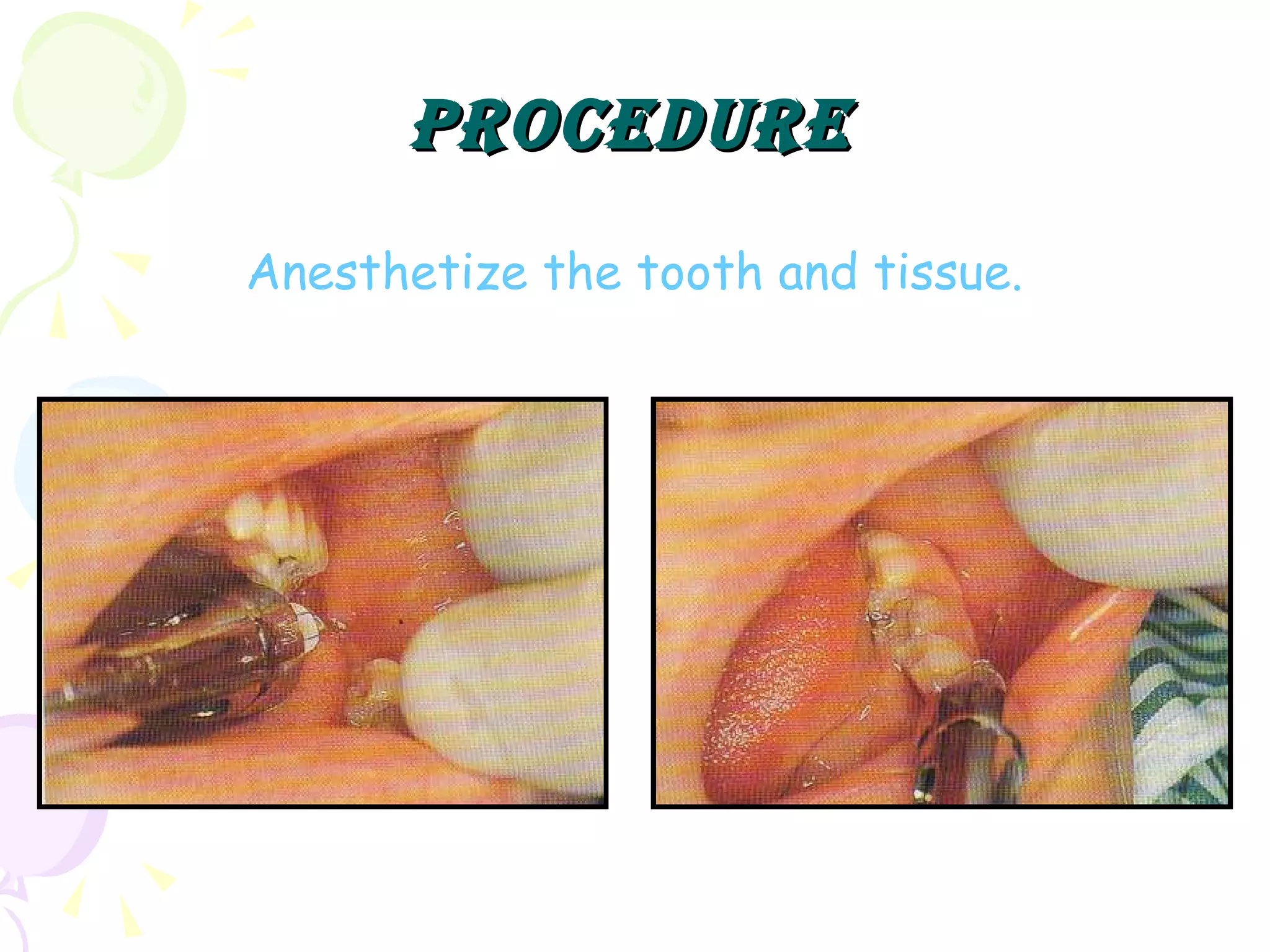
Isolate the tooth with rubber dam
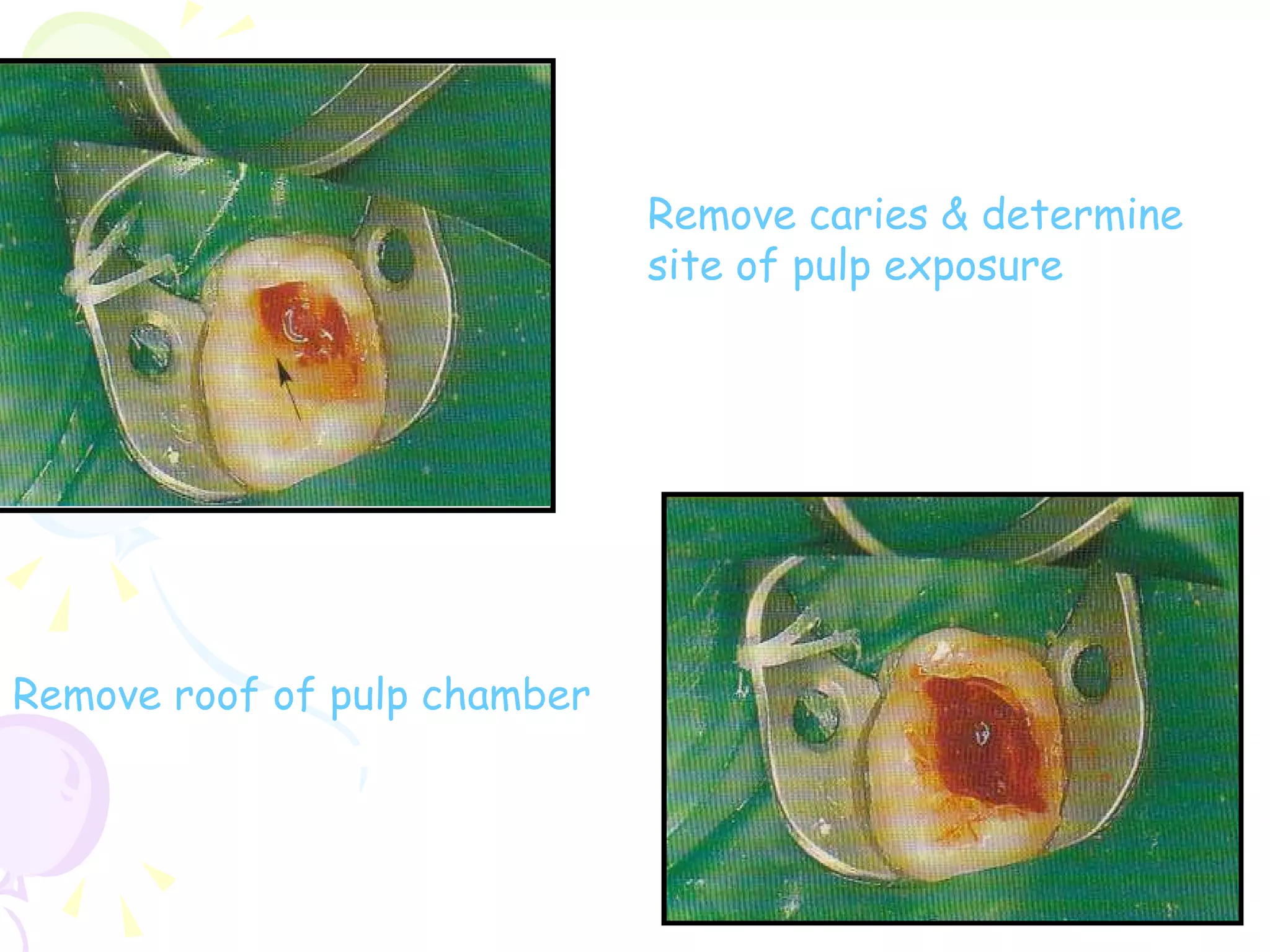
Remove caries & determine site of pulp exposure Remove roof of pulp chamber
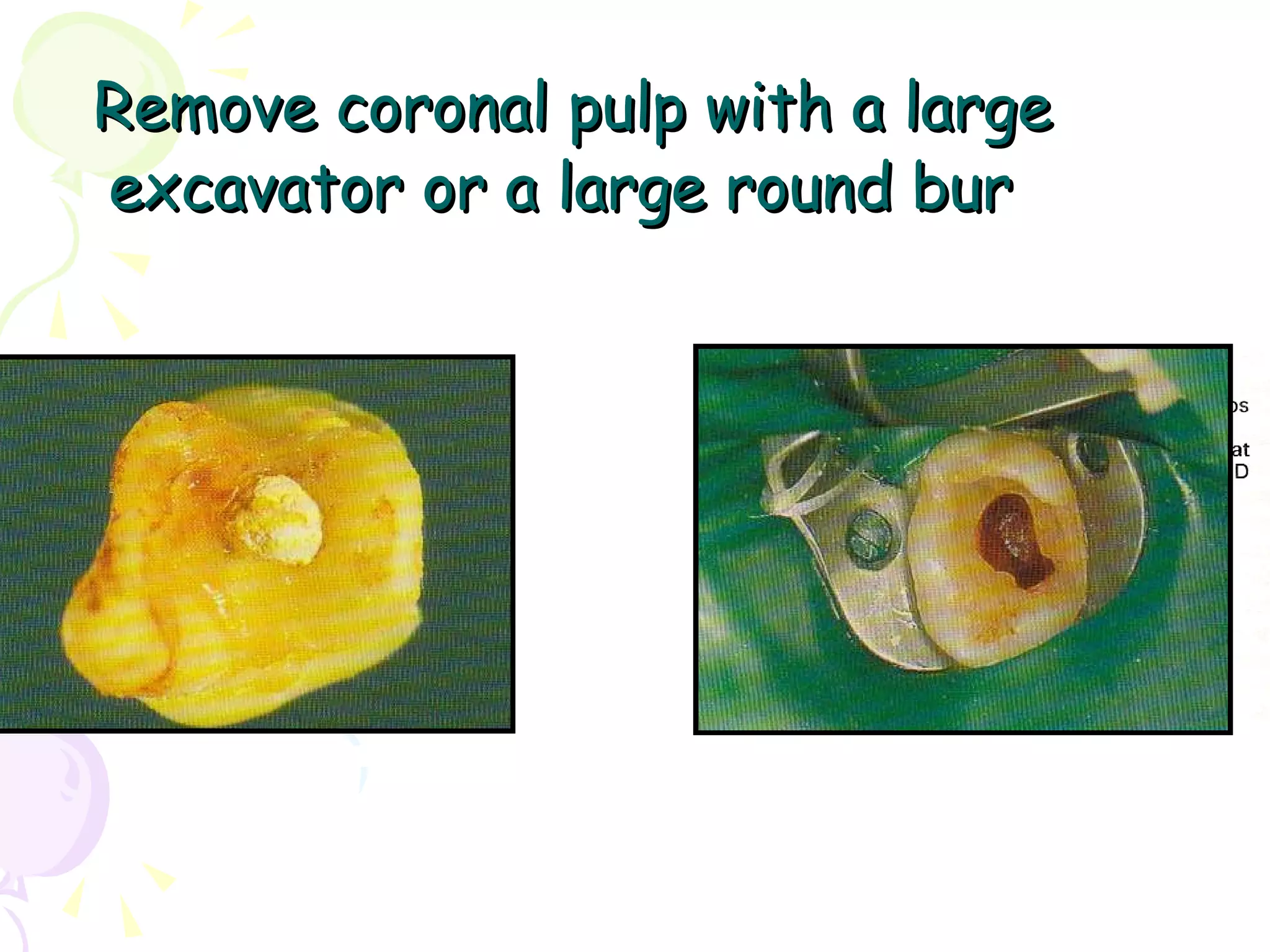
Remove coronal pulp with a large excavator or a large round bur
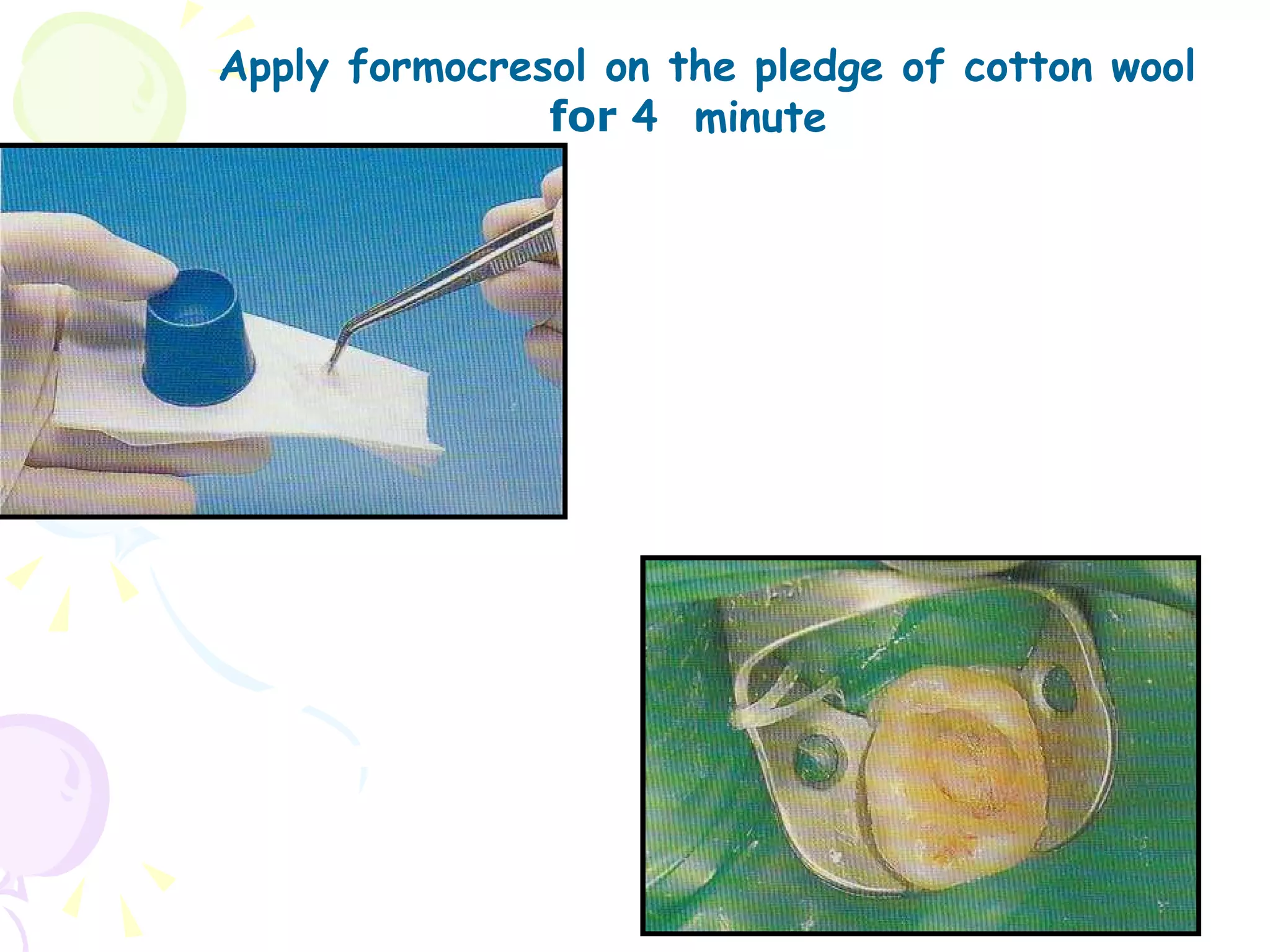
Apply formocresol on the pledge of cotton wool for   4  minute
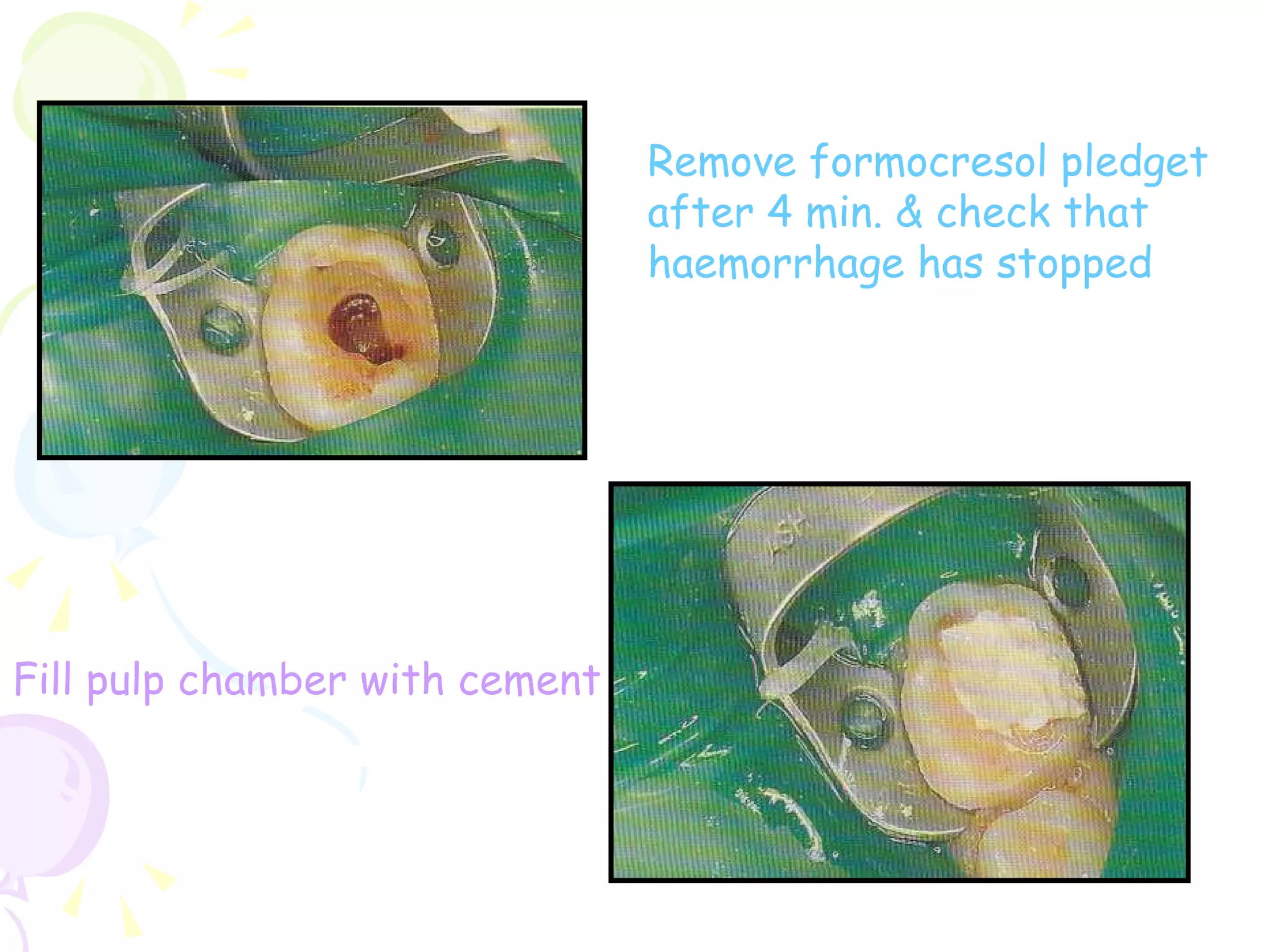
Remove formocresol pledget after 4 min. & check that haemorrhage has stopped Fill pulp chamber with cement
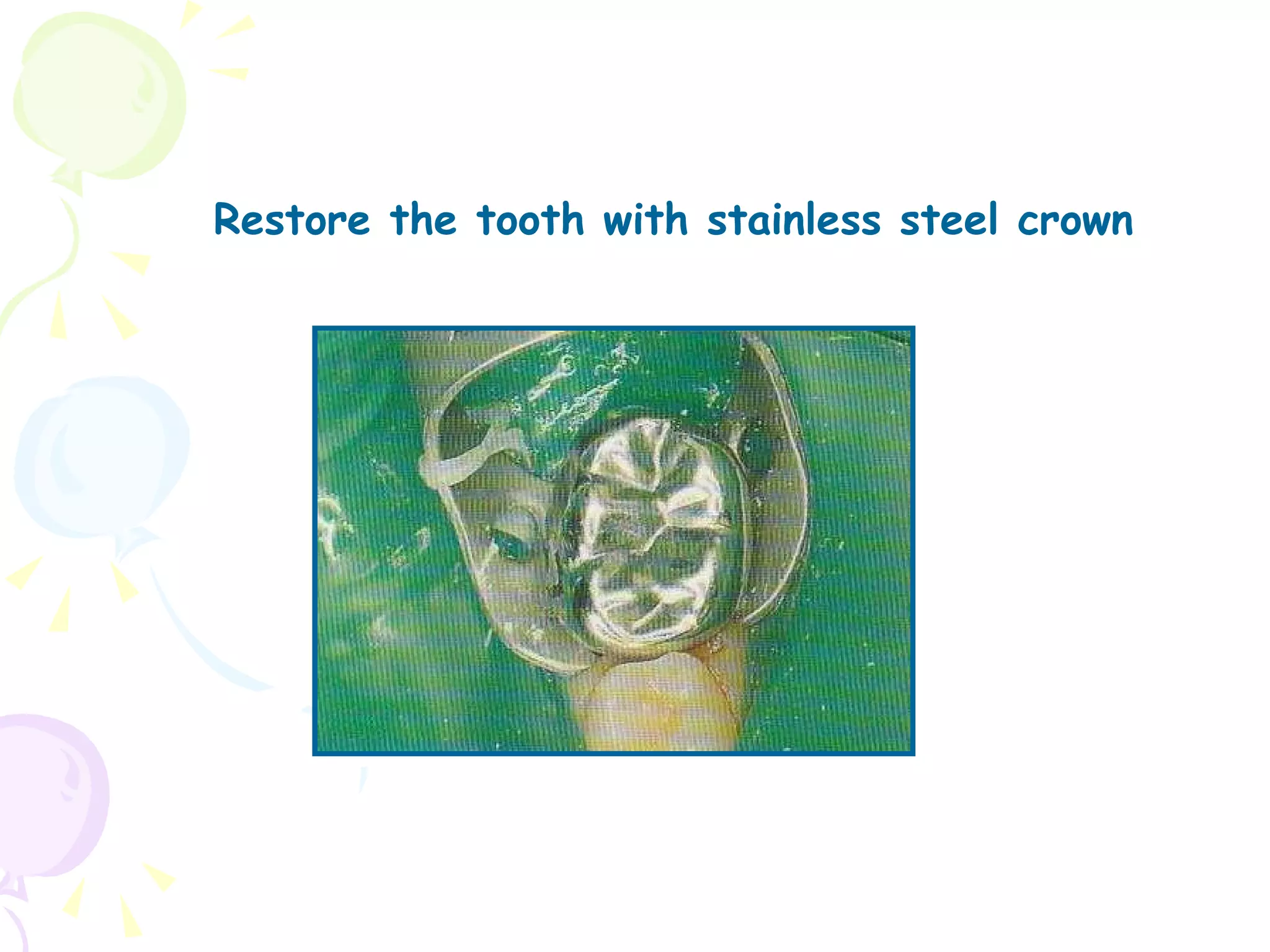
Restore the tooth with stainless steel crown
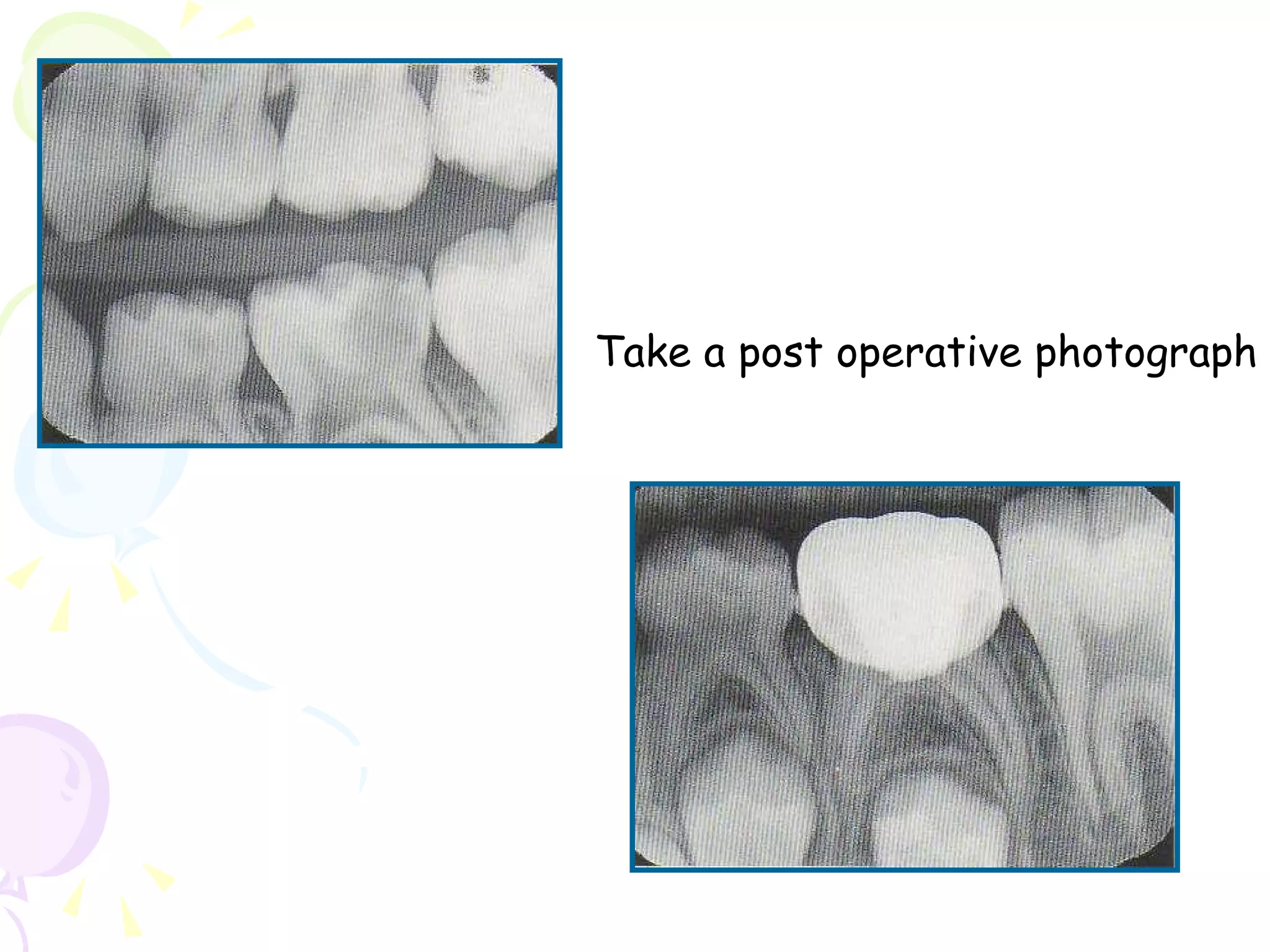
Take a post operative photograph
Two-Appointment Pulpotomy. Indications (1) Evidence of sluggish or profuse bleeding at the amputation site (2) Difficult-to-control bleeding (3) Slight purulence in the chamber but  none  at the amputation site (4) Thickening of the periodontal ligament (5) A history of spontaneous pain without other  contraindications.  Contraindications. (1) Nonrestorable (2) Soon To Be Exfoliated (3) Necrotic.
Procedure 1.   The steps are the same as for the one-appointment procedure 2. A cotton pellet moistened with  diluted  formocresol is sealed into the chamber for 5 to 7 days with a durable temporary cement. 3. At the second visit, the temporary filling and cotton pellet are removed and the chamber is irrigated with hydrogen peroxide. 4. A ZOE cement base is placed. 5. The tooth is restored with a stainless steel crown.
Partial pulpotomy (pulp curretage ) It is removal of coronal pulp tissue up to the level of healthy pulp. This process is also known as partial pulpotomy. INDICATIONS : -- when zones of inflammation has extended more than 2 mm. in an apical direction but has not reached root pulp. Eg.  A traumatic exposure (a few days post  injury in a large young pulp)
TECHNIQUE Area is anaesthetised and isolated A 2 mm. deep cavity is prepared into pulp using sterile diamond bur and copius water coolent Excess blood is removed by saline & small cotton pelletes  Calcium hydroxide is placed onto cavity Sealed with ZOE reinforced IRM restoration. IT IS RARELY SUCESSFUL AND HENCE HAS NO CLINICAL SIGNIFICANT.
REASONS FOR FAILURE Pulp is highly vascular so, even with slightest infection in any corner of pulp , the whole of it gets infected very quickly. Its practically impossible to remove one part of coronal pulp without disturbing the other parts of it in pulp chamber.
DEVITALIZATION PULPOTOMY It is two stage procedure involving the use of paraformaldehyde to fix the entire coronal & radicular pulp tissue. The medicament used have a devitalizing, mummifying, & bactericidal action.
TECHNIQUE First appointment :- Same as formocresol pulpotomy but place the paraformaldehyde paste in cotton pellete over the exposure  & seal the tooth for 1 to 2 weeks. Formaldehyde gas liberates from the paraformaldehyde permeates through the coronal and radicular pulp, fixing the tissue.  Second appointment :- pulpotomy is carried out with the help of local anaesthesia
ELECROSURGICAL PULPOTOMY Given by mack & dean (1933 ) It is a non chemical devitalizaton technique. Electrocautery carbonizes and heat denatures the pulp & bacterial contamination After amputation of coronal pulp,the pulp stumps are cauterized through this method
Laser pulpotomy Jeng-fen liu et al in 1999 studied the effect on Nd:YAG laser for pulpotomy in primary teeth
Glutaraldehyde   by kopel (1979 ) Advantages over formocresol Superior fixative property Self limiting penetration Low antigenicity Low toxicity Elimination of cresol 2-5 % concentration
Ferric sulphate It forms a metal protein clot at the surface of the pulp stump and this act as a barrier to irritating components of the sub-base
references Restorative technique for paediatric   dentistry  -   Ms DUGGAL, MEJ CURZON, SA FAYLE, KJ TOUMBA, AJ ROBERTSON Endodontic – Fifth Edition  -   JOHN I. INGLE, LEIF K. BAKLAND Text Book Of Pedodontics  -   SHOBHA TANDON Clinical Pedodontics   -   FINN INTERNET   ( www.google.com)

pulpotomy procedures in primary dentition

  • 1.
    PULPOTOMY PROCEDURES INPRIMARY DENTITION
  • 2.
    index Definition ClassificationTechnique Formocresol pulpotomy Ca(OH) 2 pulpotomy Other procedures Summary References
  • 3.
    A pulpotomy isdefined as the surgical removal of the entire coronal pulp pre-sumed to be partially or totally inflamed and quite possibly infected, leaving intact the vital radicular pulp within the canals . The aim is to relieve pain due to pulpalgia and leave the vital pulp in roots for its completion , if incomplete (apexogenesis ) DEFINITION
  • 4.
    classification Pulpotomy Partialpulpotomy complete pulpotomy calcium hydroxide formocresol pulpotomy pulpotomy
  • 5.
    CLASSIFICATION Non vitalpulpotomy Vital pulpotomy Beechwood cresol Devitalization Formocresol Preservation Regeneration
  • 6.
    Vital pulpotomy techniqueDevitalization Preservation Glutaraldehyde Ferric sulphate Regeneration Bone morphogenetic protein Dentin chips Single sitting – Formocresol Electrosurgery Laser Two stage – Gysi triopaste Easlick’s formaldehyde Paraform devitalising pastePreservation
  • 7.
    Formocresol pulpotomy Formocresolwas introduced in 1904 by Buckley, who contended that equal parts of formalin and tricresol would react chemically with the intermediate and end products of pulp inflammation to form a “ new, colorless, and non-infective compound of a harmless nature.” Buckley’s formula formocresol, consists of tricresol, 19% aqueous formaldehyde, glycerine, and water.
  • 8.
    indications Carious /mechanical exposure in vital asymptomatic tooth Tooth free of radicular pulpitis Presence of atleast 2/3 rd root length Absence of abscess or fistula. Absence of inter radicular bone loss Absence of internal root resorption Permanent posterior teeth for the expedient treatment of pulpalgia. (it relieves pain in emergency as formocresol fixes the contiguous pulp left in the root canal.)
  • 9.
    Contraindications Local :- Spontaneous pain / pain at night Pathologic mobility Swelling or fistula Internal resorption Less than 2/3 rd root remaining Periapical inter radicular radiolucency Pus / serous exudate at exposure site Uncontrolled haemorrhage from amputed pulp Excesive pulp calcification Medical : - Cardiac condition Immunocompromised children
  • 10.
    TECHNIQUE The formocresolpulpotomy technique was first advocated by SWEET [1930] He used a multiple sitting technique, which has been subsequently modified to either a single or two stage technique. FORMULA :- 19% Formaldehyde 35% cresol 15% Glycerin & Water To prepare 1.5%concentration of this formula, first mix 3 parts of glycerin with 1 part of distilled water , then add 4 parts of this preparation to 1 part buckley’s formocresol , and throughly mix again.
  • 11.
    Mechanism of actionFormocresol causes coagulation necrosis in tissues in immediate vicinity of the application with fixation of tissue cells and micro organism.
  • 12.
    One-Appointment Pulpotomy. Indications:- only on those restorable teeth in which it has been determined that inflammation is confined to the coronal portion of the pulp. Contraindications :- Teeth with a history of spontaneous pain Profuse haemorrhage Pathologic or internal root resorption Inter radicular bone loss Presence of fistulas or pus in the chamber
  • 13.
    PROCEDURE Anesthetize thetooth and tissue.
  • 14.
    Isolate the toothwith rubber dam
  • 15.
    Remove caries &determine site of pulp exposure Remove roof of pulp chamber
  • 16.
    Remove coronal pulpwith a large excavator or a large round bur
  • 17.
    Apply formocresol onthe pledge of cotton wool for 4 minute
  • 18.
    Remove formocresol pledgetafter 4 min. & check that haemorrhage has stopped Fill pulp chamber with cement
  • 19.
    Restore the toothwith stainless steel crown
  • 20.
    Take a postoperative photograph
  • 21.
    Two-Appointment Pulpotomy. Indications(1) Evidence of sluggish or profuse bleeding at the amputation site (2) Difficult-to-control bleeding (3) Slight purulence in the chamber but none at the amputation site (4) Thickening of the periodontal ligament (5) A history of spontaneous pain without other contraindications. Contraindications. (1) Nonrestorable (2) Soon To Be Exfoliated (3) Necrotic.
  • 22.
    Procedure 1. The steps are the same as for the one-appointment procedure 2. A cotton pellet moistened with diluted formocresol is sealed into the chamber for 5 to 7 days with a durable temporary cement. 3. At the second visit, the temporary filling and cotton pellet are removed and the chamber is irrigated with hydrogen peroxide. 4. A ZOE cement base is placed. 5. The tooth is restored with a stainless steel crown.
  • 23.
    Partial pulpotomy (pulpcurretage ) It is removal of coronal pulp tissue up to the level of healthy pulp. This process is also known as partial pulpotomy. INDICATIONS : -- when zones of inflammation has extended more than 2 mm. in an apical direction but has not reached root pulp. Eg. A traumatic exposure (a few days post injury in a large young pulp)
  • 24.
    TECHNIQUE Area isanaesthetised and isolated A 2 mm. deep cavity is prepared into pulp using sterile diamond bur and copius water coolent Excess blood is removed by saline & small cotton pelletes Calcium hydroxide is placed onto cavity Sealed with ZOE reinforced IRM restoration. IT IS RARELY SUCESSFUL AND HENCE HAS NO CLINICAL SIGNIFICANT.
  • 25.
    REASONS FOR FAILUREPulp is highly vascular so, even with slightest infection in any corner of pulp , the whole of it gets infected very quickly. Its practically impossible to remove one part of coronal pulp without disturbing the other parts of it in pulp chamber.
  • 26.
    DEVITALIZATION PULPOTOMY Itis two stage procedure involving the use of paraformaldehyde to fix the entire coronal & radicular pulp tissue. The medicament used have a devitalizing, mummifying, & bactericidal action.
  • 27.
    TECHNIQUE First appointment:- Same as formocresol pulpotomy but place the paraformaldehyde paste in cotton pellete over the exposure & seal the tooth for 1 to 2 weeks. Formaldehyde gas liberates from the paraformaldehyde permeates through the coronal and radicular pulp, fixing the tissue. Second appointment :- pulpotomy is carried out with the help of local anaesthesia
  • 28.
    ELECROSURGICAL PULPOTOMY Givenby mack & dean (1933 ) It is a non chemical devitalizaton technique. Electrocautery carbonizes and heat denatures the pulp & bacterial contamination After amputation of coronal pulp,the pulp stumps are cauterized through this method
  • 29.
    Laser pulpotomy Jeng-fenliu et al in 1999 studied the effect on Nd:YAG laser for pulpotomy in primary teeth
  • 30.
    Glutaraldehyde by kopel (1979 ) Advantages over formocresol Superior fixative property Self limiting penetration Low antigenicity Low toxicity Elimination of cresol 2-5 % concentration
  • 31.
    Ferric sulphate Itforms a metal protein clot at the surface of the pulp stump and this act as a barrier to irritating components of the sub-base
  • 32.
    references Restorative techniquefor paediatric dentistry - Ms DUGGAL, MEJ CURZON, SA FAYLE, KJ TOUMBA, AJ ROBERTSON Endodontic – Fifth Edition - JOHN I. INGLE, LEIF K. BAKLAND Text Book Of Pedodontics - SHOBHA TANDON Clinical Pedodontics - FINN INTERNET ( www.google.com)