
TEMPORIZATION IN FIXED
PROSTHODONTICS
-DR PALAK MISHRA
1ST YEAR PG
RESIDENT
DEFINITION
 According to GPT-9
 Temporization is to establish esthetics, occlusal
stability, and function for a limited time in
preparation for the definitive prosthesis; to verify
therapeutic outcome and patient acceptance
before the definitive prosthesis.
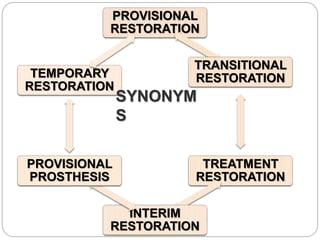
PROVISIONAL
RESTORATION
TRANSITIONAL
RESTORATION
TREATMENT
RESTORATION
INTERIM
RESTORATION
PROVISIONAL
PROSTHESIS
TEMPORARY
RESTORATION
SYNONYM
S
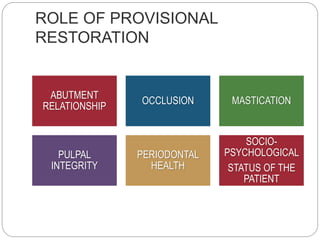
ROLE OF PROVISIONAL
RESTORATION
ABUTMENT
RELATIONSHIP
OCCLUSION MASTICATION
PULPAL
INTEGRITY
PERIODONTAL
HEALTH
SOCIO-
PSYCHOLOGICAL
STATUS OF THE
PATIENT
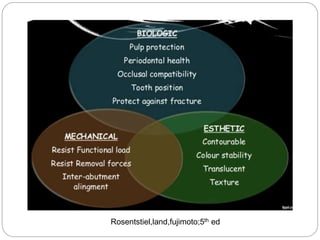
Rosentstiel,land,fujimoto;5th ed
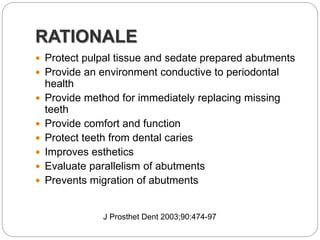
RATIONALE
 Protect pulpal tissue and sedate prepared abutments
 Provide an environment conductive to periodontal
health
 Provide method for immediately replacing missing
teeth
 Provide comfort and function
 Protect teeth from dental caries
 Improves esthetics
 Evaluate parallelism of abutments
 Prevents migration of abutments
J Prosthet Dent 2003;90:474-97
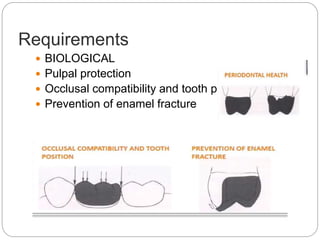
Requirements
 BIOLOGICAL
 Pulpal protection
 Occlusal compatibility and tooth position
 Prevention of enamel fracture
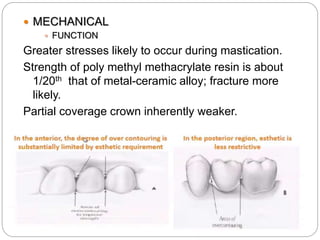
 MECHANICAL
 FUNCTION
Greater stresses likely to occur during mastication.
Strength of poly methyl methacrylate resin is about
1/20th that of metal-ceramic alloy; fracture more
likely.
Partial coverage crown inherently weaker.
 Displacement
To avoid irritation to the pulp and tooth
movement, a displaced provisional
must be recemented promptly.
Best prevented: proper tooth
preparation and a provisional with a
closely adapted tooth surface
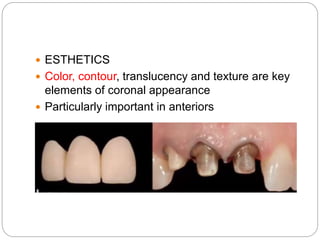
 ESTHETICS
 Color, contour, translucency and texture are key
elements of coronal appearance
 Particularly important in anteriors
PROPERTIES
 Better fit, particularly at the margins
 Increased strength
 Better wear resistance
 Easier to keep clean
 Better esthetics and color stability
 Greater occlusal reliability and stability
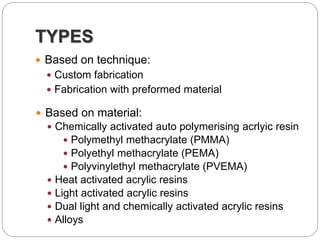
TYPES
 Based on technique:
 Custom fabrication
 Fabrication with preformed material
 Based on material:
 Chemically activated auto polymerising acrlyic resin
 Polymethyl methacrylate (PMMA)
 Polyethyl methacrylate (PEMA)
 Polyvinylethyl methacrylate (PVEMA)
 Heat activated acrylic resins
 Light activated acrylic resins
 Dual light and chemically activated acrylic resins
 Alloys
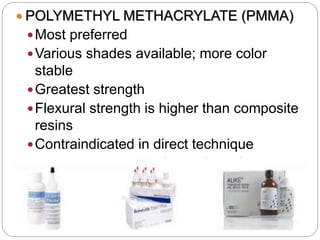
 POLYMETHYL METHACRYLATE (PMMA)
Most preferred
Various shades available; more color
stable
Greatest strength
Flexural strength is higher than composite
resins
Contraindicated in direct technique
Indicated in INDIRECT TECHNIQUE
Low abrasion resistance; good polishability
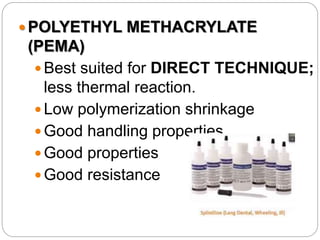
 POLYETHYL METHACRYLATE
(PEMA)
 Best suited for DIRECT TECHNIQUE;
less thermal reaction.
 Low polymerization shrinkage
 Good handling properties
 Good properties
 Good resistance
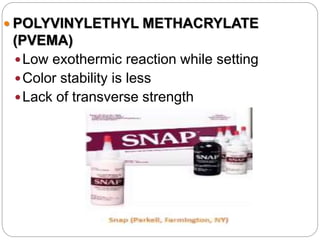
 POLYVINYLETHYL METHACRYLATE
(PVEMA)
Low exothermic reaction while setting
Color stability is less
Lack of transverse strength
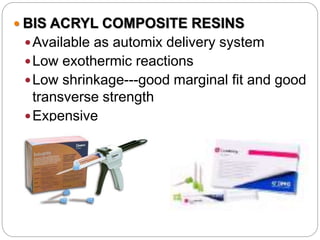
 BIS ACRYL COMPOSITE RESINS
Available as automix delivery system
Low exothermic reactions
Low shrinkage---good marginal fit and good
transverse strength
Expensive
 Repair or modification of bis acryl restoration with
composite : difficult ; dissimal chemistry
 Koumjian & Nimmo demonstrated an 85%
decrease in transverse strength after repair ;
suggesting that the fabrication of a new
provisional restoration is more advantageous
than repair
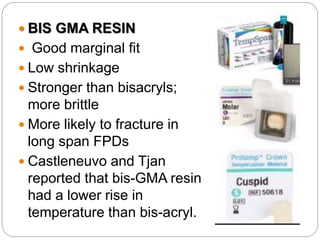
 BIS GMA RESIN
 Good marginal fit
 Low shrinkage
 Stronger than bisacryls;
more brittle
 More likely to fracture in
long span FPDs
 Castleneuvo and Tjan
reported that bis-GMA resin
had a lower rise in
temperature than bis-acryl.
 Tempspan- dual curing resin; automixing
cartirage
 Protemp crown (3M ESPE, St Paul, MN)
: preformed bisGMA provisional crown ;
single unit posterior teeth and canine
 Preshaped as adaptable putty needing
marginal trimming, adaptation to the
preparation,light curing, removal,
finishing and cementation.
 Visible Light Cured Urethane
Dimethacrylate Resins
Poor stain resistance
Urethanedimethacrylate added; resin
requiring visible light and a
camphoroquinine amine photo initiator ;
polymerization
Prestipino has shown that VLC resins are
brittle; poor choice for a high strength
posterior provisional restorations.
Available in limited shades
More expensive
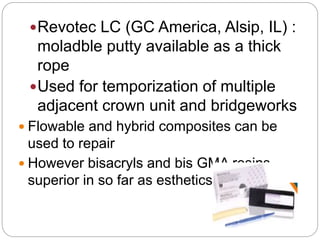
Revotec LC (GC America, Alsip, IL) :
moladble putty available as a thick
rope
Used for temporization of multiple
adjacent crown unit and bridgeworks
 Flowable and hybrid composites can be
used to repair
 However bisacryls and bis GMA resins are
superior in so far as esthetics is concerned
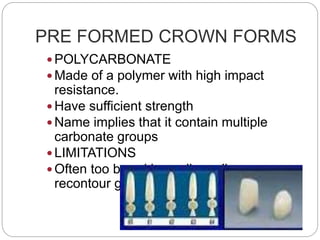
PRE FORMED CROWN FORMS
 POLYCARBONATE
 Made of a polymer with high impact
resistance.
 Have sufficient strength
 Name implies that it contain multiple
carbonate groups
 LIMITATIONS
 Often too broad buccolingually so
recontour gingivally
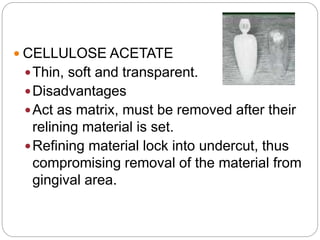
 CELLULOSE ACETATE
Thin, soft and transparent.
Disadvantages
Act as matrix, must be removed after their
relining material is set.
Refining material lock into undercut, thus
compromising removal of the material from
gingival area.
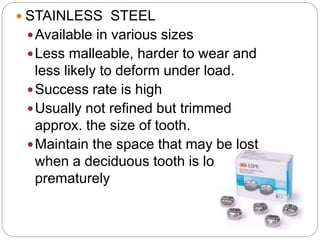
 STAINLESS STEEL
Available in various sizes
Less malleable, harder to wear and
less likely to deform under load.
Success rate is high
Usually not refined but trimmed
approx. the size of tooth.
Maintain the space that may be lost
when a deciduous tooth is lost
prematurely
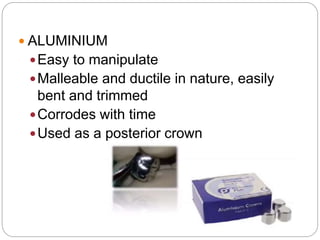
 ALUMINIUM
Easy to manipulate
Malleable and ductile in nature, easily
bent and trimmed
Corrodes with time
Used as a posterior crown
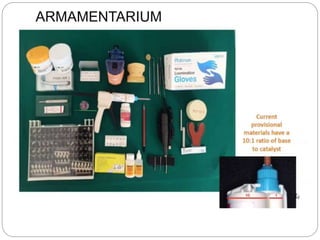
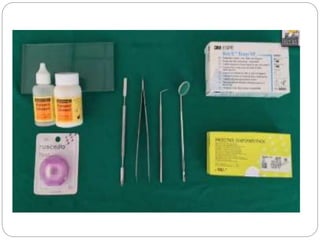
ARMAMENTARIUM
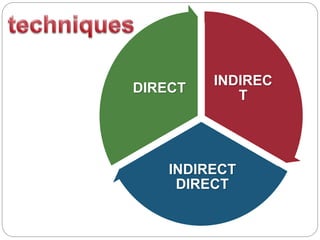
INDIREC
T
INDIRECT
DIRECT
DIRECT
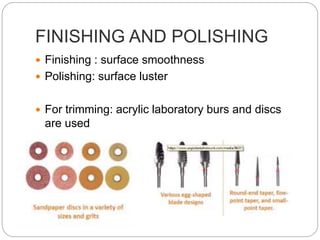
FINISHING AND POLISHING
 Finishing : surface smoothness
 Polishing: surface luster
 For trimming: acrylic laboratory burs and discs
are used
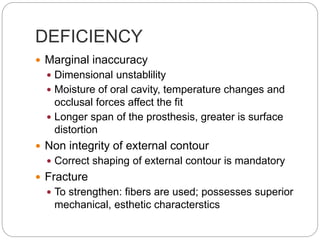
DEFICIENCY
 Marginal inaccuracy
 Dimensional unstablility
 Moisture of oral cavity, temperature changes and
occlusal forces affect the fit
 Longer span of the prosthesis, greater is surface
distortion
 Non integrity of external contour
 Correct shaping of external contour is mandatory
 Fracture
 To strengthen: fibers are used; possesses superior
mechanical, esthetic characterstics
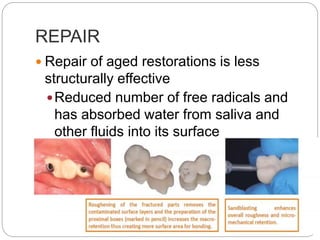
REPAIR
 Repair of aged restorations is less
structurally effective
Reduced number of free radicals and
has absorbed water from saliva and
other fluids into its surface
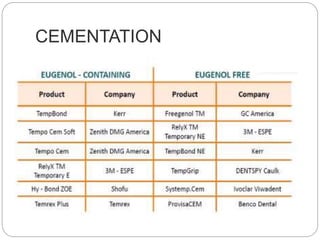
CEMENTATION
PROVISIONAL LUTING
MATERIALS
 • Provisional luting agents should
possess :
 -good mechanical properties,
 -low solubility,
 -tooth adhesion to resist bacterial and
molecular penetration. • The most
important function of these materials is
to provide an adequate seal between
the provisional restoration and prepared
tooth. This is necessary to prevent
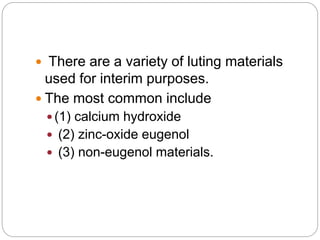
 There are a variety of luting materials
used for interim purposes.
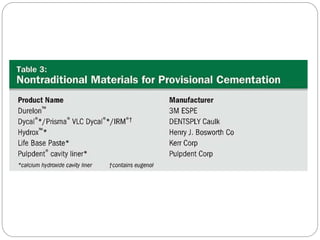
 The most common include
 (1) calcium hydroxide
 (2) zinc-oxide eugenol
 (3) non-eugenol materials.
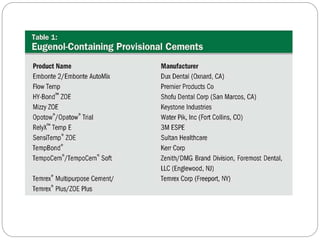
 Some of the most commonly used
cements with provisional prostheses are
those containing zinc-oxide and
eugenol. They provide:
 sedative effects that reduce dentin
hypersensitivity
 possess antibacterial properties.
 Unfortunately, free radical production
necessary for polymerization of
methacrylate materials can be
significantly hampered by the presence
of eugenol found in eugenol based
provisional luting materials.; Eugenol
interferes with the acrylic resin
polymerization and hardening process .
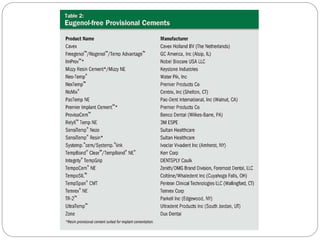
 Therefore Eugenol-free provisional
luting materials are commercially
available
 Baldissara et al recommended that
interim restorations be frequently
evaluated and used for only short
periods of time. Literature reports
advise that if provisional treatment is
required over a protracted time period,
it is best to remove and replace the
provisional luting agent on a regular
basis.
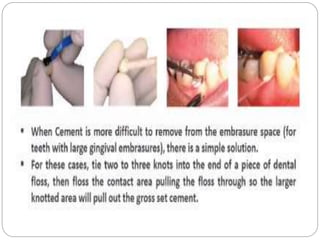
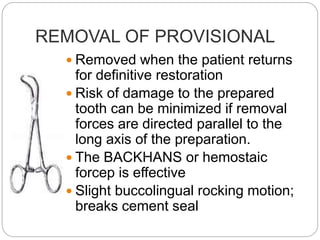
REMOVAL OF PROVISIONAL
 Removed when the patient returns
for definitive restoration
 Risk of damage to the prepared
tooth can be minimized if removal
forces are directed parallel to the
long axis of the preparation.
 The BACKHANS or hemostaic
forcep is effective
 Slight buccolingual rocking motion;
breaks cement seal
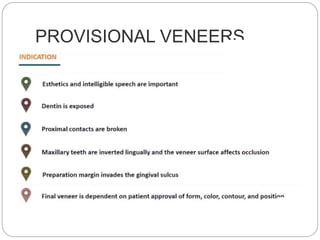
PROVISIONAL VENEERS
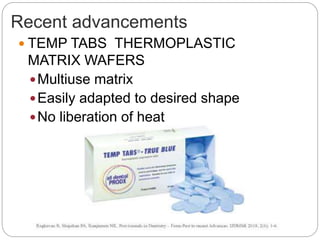
Recent advancements
 TEMP TABS THERMOPLASTIC
MATRIX WAFERS
Multiuse matrix
Easily adapted to desired shape
No liberation of heat
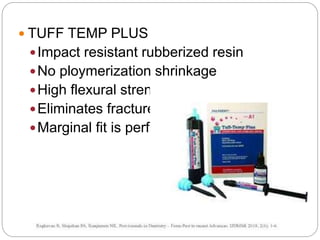
 TUFF TEMP PLUS
Impact resistant rubberized resin
No ploymerization shrinkage
High flexural strength
Eliminates fractures
Marginal fit is perfect
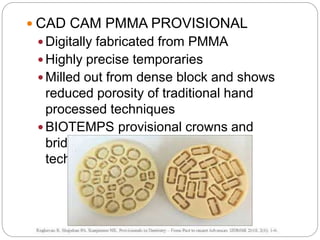
 CAD CAM PMMA PROVISIONAL
 Digitally fabricated from PMMA
 Highly precise temporaries
 Milled out from dense block and shows
reduced porosity of traditional hand
processed techniques
 BIOTEMPS provisional crowns and
bridges are created with CAD/CAM
technology
So the perfect provisional …
 Super strong
 Highly esthetic
 Gingival sculpting
 Patient fixed
 Universal use
 Cost
 Gentle
Temporization in fixed prosthodontics

Temporization in fixed prosthodontics

  • 1.
    TEMPORIZATION IN FIXED PROSTHODONTICS -DRPALAK MISHRA 1ST YEAR PG RESIDENT
  • 2.
    DEFINITION  According toGPT-9  Temporization is to establish esthetics, occlusal stability, and function for a limited time in preparation for the definitive prosthesis; to verify therapeutic outcome and patient acceptance before the definitive prosthesis.
  • 3.
  • 4.
    ROLE OF PROVISIONAL RESTORATION ABUTMENT RELATIONSHIP OCCLUSIONMASTICATION PULPAL INTEGRITY PERIODONTAL HEALTH SOCIO- PSYCHOLOGICAL STATUS OF THE PATIENT
  • 5.
  • 6.
    RATIONALE  Protect pulpaltissue and sedate prepared abutments  Provide an environment conductive to periodontal health  Provide method for immediately replacing missing teeth  Provide comfort and function  Protect teeth from dental caries  Improves esthetics  Evaluate parallelism of abutments  Prevents migration of abutments J Prosthet Dent 2003;90:474-97
  • 7.
    Requirements  BIOLOGICAL  Pulpalprotection  Occlusal compatibility and tooth position  Prevention of enamel fracture
  • 8.
     MECHANICAL  FUNCTION Greaterstresses likely to occur during mastication. Strength of poly methyl methacrylate resin is about 1/20th that of metal-ceramic alloy; fracture more likely. Partial coverage crown inherently weaker.
  • 9.
     Displacement To avoidirritation to the pulp and tooth movement, a displaced provisional must be recemented promptly. Best prevented: proper tooth preparation and a provisional with a closely adapted tooth surface
  • 10.
     ESTHETICS  Color,contour, translucency and texture are key elements of coronal appearance  Particularly important in anteriors
  • 11.
    PROPERTIES  Better fit,particularly at the margins  Increased strength  Better wear resistance  Easier to keep clean  Better esthetics and color stability  Greater occlusal reliability and stability
  • 12.
    TYPES  Based ontechnique:  Custom fabrication  Fabrication with preformed material  Based on material:  Chemically activated auto polymerising acrlyic resin  Polymethyl methacrylate (PMMA)  Polyethyl methacrylate (PEMA)  Polyvinylethyl methacrylate (PVEMA)  Heat activated acrylic resins  Light activated acrylic resins  Dual light and chemically activated acrylic resins  Alloys
  • 13.
     POLYMETHYL METHACRYLATE(PMMA) Most preferred Various shades available; more color stable Greatest strength Flexural strength is higher than composite resins Contraindicated in direct technique Indicated in INDIRECT TECHNIQUE Low abrasion resistance; good polishability
  • 14.
     POLYETHYL METHACRYLATE (PEMA) Best suited for DIRECT TECHNIQUE; less thermal reaction.  Low polymerization shrinkage  Good handling properties  Good properties  Good resistance
  • 15.
     POLYVINYLETHYL METHACRYLATE (PVEMA) Lowexothermic reaction while setting Color stability is less Lack of transverse strength
  • 16.
     BIS ACRYLCOMPOSITE RESINS Available as automix delivery system Low exothermic reactions Low shrinkage---good marginal fit and good transverse strength Expensive
  • 17.
     Repair ormodification of bis acryl restoration with composite : difficult ; dissimal chemistry  Koumjian & Nimmo demonstrated an 85% decrease in transverse strength after repair ; suggesting that the fabrication of a new provisional restoration is more advantageous than repair
  • 18.
     BIS GMARESIN  Good marginal fit  Low shrinkage  Stronger than bisacryls; more brittle  More likely to fracture in long span FPDs  Castleneuvo and Tjan reported that bis-GMA resin had a lower rise in temperature than bis-acryl.
  • 19.
     Tempspan- dualcuring resin; automixing cartirage  Protemp crown (3M ESPE, St Paul, MN) : preformed bisGMA provisional crown ; single unit posterior teeth and canine  Preshaped as adaptable putty needing marginal trimming, adaptation to the preparation,light curing, removal, finishing and cementation.
  • 20.
     Visible LightCured Urethane Dimethacrylate Resins Poor stain resistance Urethanedimethacrylate added; resin requiring visible light and a camphoroquinine amine photo initiator ; polymerization Prestipino has shown that VLC resins are brittle; poor choice for a high strength posterior provisional restorations. Available in limited shades More expensive
  • 21.
    Revotec LC (GCAmerica, Alsip, IL) : moladble putty available as a thick rope Used for temporization of multiple adjacent crown unit and bridgeworks  Flowable and hybrid composites can be used to repair  However bisacryls and bis GMA resins are superior in so far as esthetics is concerned
  • 22.
    PRE FORMED CROWNFORMS  POLYCARBONATE  Made of a polymer with high impact resistance.  Have sufficient strength  Name implies that it contain multiple carbonate groups  LIMITATIONS  Often too broad buccolingually so recontour gingivally
  • 23.
     CELLULOSE ACETATE Thin,soft and transparent. Disadvantages Act as matrix, must be removed after their relining material is set. Refining material lock into undercut, thus compromising removal of the material from gingival area.
  • 24.
     STAINLESS STEEL Availablein various sizes Less malleable, harder to wear and less likely to deform under load. Success rate is high Usually not refined but trimmed approx. the size of tooth. Maintain the space that may be lost when a deciduous tooth is lost prematurely
  • 25.
     ALUMINIUM Easy tomanipulate Malleable and ductile in nature, easily bent and trimmed Corrodes with time Used as a posterior crown
  • 26.
  • 27.
  • 28.
    FINISHING AND POLISHING Finishing : surface smoothness  Polishing: surface luster  For trimming: acrylic laboratory burs and discs are used
  • 29.
    DEFICIENCY  Marginal inaccuracy Dimensional unstablility  Moisture of oral cavity, temperature changes and occlusal forces affect the fit  Longer span of the prosthesis, greater is surface distortion  Non integrity of external contour  Correct shaping of external contour is mandatory  Fracture  To strengthen: fibers are used; possesses superior mechanical, esthetic characterstics
  • 30.
    REPAIR  Repair ofaged restorations is less structurally effective Reduced number of free radicals and has absorbed water from saliva and other fluids into its surface
  • 32.
  • 35.
    PROVISIONAL LUTING MATERIALS  •Provisional luting agents should possess :  -good mechanical properties,  -low solubility,  -tooth adhesion to resist bacterial and molecular penetration. • The most important function of these materials is to provide an adequate seal between the provisional restoration and prepared tooth. This is necessary to prevent
  • 36.
     There area variety of luting materials used for interim purposes.  The most common include  (1) calcium hydroxide  (2) zinc-oxide eugenol  (3) non-eugenol materials.
  • 40.
     Some ofthe most commonly used cements with provisional prostheses are those containing zinc-oxide and eugenol. They provide:  sedative effects that reduce dentin hypersensitivity  possess antibacterial properties.
  • 41.
     Unfortunately, freeradical production necessary for polymerization of methacrylate materials can be significantly hampered by the presence of eugenol found in eugenol based provisional luting materials.; Eugenol interferes with the acrylic resin polymerization and hardening process .  Therefore Eugenol-free provisional luting materials are commercially available
  • 42.
     Baldissara etal recommended that interim restorations be frequently evaluated and used for only short periods of time. Literature reports advise that if provisional treatment is required over a protracted time period, it is best to remove and replace the provisional luting agent on a regular basis.
  • 43.
    REMOVAL OF PROVISIONAL Removed when the patient returns for definitive restoration  Risk of damage to the prepared tooth can be minimized if removal forces are directed parallel to the long axis of the preparation.  The BACKHANS or hemostaic forcep is effective  Slight buccolingual rocking motion; breaks cement seal
  • 44.
  • 45.
    Recent advancements  TEMPTABS THERMOPLASTIC MATRIX WAFERS Multiuse matrix Easily adapted to desired shape No liberation of heat
  • 46.
     TUFF TEMPPLUS Impact resistant rubberized resin No ploymerization shrinkage High flexural strength Eliminates fractures Marginal fit is perfect
  • 47.
     CAD CAMPMMA PROVISIONAL  Digitally fabricated from PMMA  Highly precise temporaries  Milled out from dense block and shows reduced porosity of traditional hand processed techniques  BIOTEMPS provisional crowns and bridges are created with CAD/CAM technology
  • 48.
    So the perfectprovisional …  Super strong  Highly esthetic  Gingival sculpting  Patient fixed  Universal use  Cost  Gentle