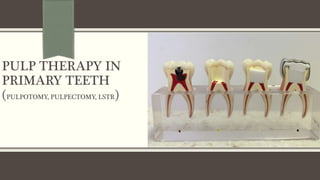
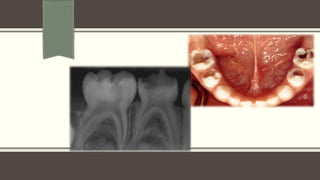
PULP THERAPY IN
PRIMARY TEETH
(PULPOTOMY, PULPECTOMY, LSTR)
CONTENTS:
Introduction
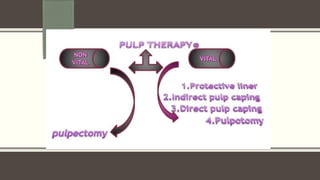
Pulpotomy:
definitions
case selection
indication
Contraindications
Procedure
Materials used
Partial pulpotomy
Pulpectomy
AIM:
1. A comprehensive medical history.
2. A review of past and present dental history and treatment,
including current symptoms and chief complaint.
3. A subjective evaluation of the area associated with the current
symptoms/chief complaint by questioning the child and parent on
the location, intensity, duration, stimulus, relief, and spontaneity.
AAPD - 2014
4. A objective extraoral examination as well as examination of the
intraoral soft and hard tissues.
5. If obtainable, radiograph(s) to diagnose pulpitis or necrosis
showing the involved tooth, furcation, periapical area, and the
surrounding bone.
6. Clinical tests such as palpation, percussion, and mobility.
DEFINITION
Pulpotomy :
Brahan and Morris (I985) defined as the amputation of vital pulp from the coronal
chamber followed by placement of a medicament over the radicular pulp stumps to
stimulate repair, fixation or mummification of the remaining vital radicular pulp.
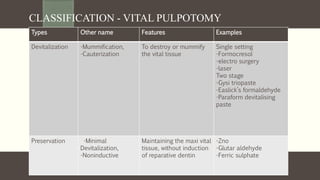
CLASSIFICATION - VITAL PULPOTOMY
Types Other name Features Examples
Devitalization -Mummification,
-Cauterization
To destroy or mummify
the vital tissue
Single setting
-Formocresol
-electro surgery
-laser
Two stage
-Gysi triopaste
-Easlick’s formaldehyde
-Paraform devitalising
paste
Preservation -Minimal
Devitalization,
-Noninductive
Maintaining the maxi vital
tissue, without induction
of reparative dentin
-Zno
-Glutar aldehyde
-Ferric sulphate
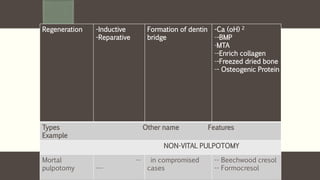
Regeneration -Inductive
-Reparative
Formation of dentin
bridge
-Ca (oH) 2
--BMP
-MTA
--Enrich collagen
--Freezed dried bone
-- Osteogenic Protein
Types Other name Features
Example
NON-VITAL PULPOTOMY
Mortal
pulpotomy
--
---
in compromised
cases
-- Beechwood cresol
-- Formocresol
CASE SELECTION : WATERHOUSE ET AL (2000 )
Teeth with deep DC ( x ray – approximating to pulp)
Teeth should be restorable after procedure
Absence of symptoms of advanced pulpal inflammation
Absence of Cl signs or sympytoms
Absence of Cl & x-ray signs of pulpal necrosis
Hamorrhage should stop within 5 min
INDICATIONS
• Mechanically exposed vital primary teeth are indicated for single visit
pulpotomy procedure.
• A vital carious exposure in an asymptomatic primary tooth
• An iatrogenic exposure under proper isolation is the appropriate indication for
the pulpotomy procedure.
• In the treatment of pulpally involved vital primary teeth with clinical
manifestation of inflammatory response confined to coronal pulp.
CONTRAINDICATIONS
Any sign or symptom, which suggest that inflammation, has extended
beyond the coronal pulp into the root canals. These include
• Spontaneous pain
• Tenderness to percussion
• Swelling and fistula
• Pus or serous exudate at the exposure site.
• Pathologic mobility
• Uncontrollable hemorrhage from the amputated pulp stumps.
• Pathological external root resorption
• Periapical or interradicular radiolucency
• Internal Root resorption
MEDICAMENTS USED FOR PULPOTOMY
• Formocresol
• Gluteraldehyde
• Calcium hydroxide
• Zinc oxide eugenol
• Ferric Sulphate
• Bone Morphogenic protein and osteogenic protein
• Devitalizing Para formaldehyde paste
• MTA
• Beech wood cresol
• Enriched collagen solution
• Freezed dried Bone
PROCEDURE
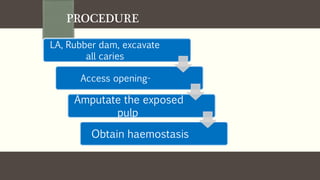
LA, Rubber dam, excavate
all caries
Access opening-
Amputate the exposed
pulp
Obtain haemostasis
INADEQUATE ACCESS OPENING
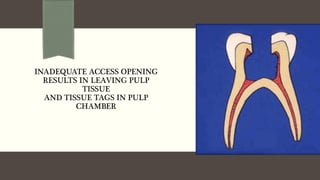
RESULTS IN LEAVING PULP
TISSUE
AND TISSUE TAGS IN PULP
CHAMBER
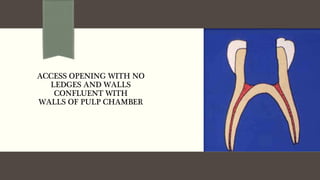
ACCESS OPENING WITH NO
LEDGES AND WALLS
CONFLUENT WITH
WALLS OF PULP CHAMBER
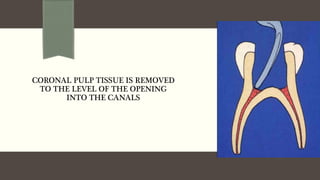
CORONAL PULP TISSUE IS REMOVED
TO THE LEVEL OF THE OPENING
INTO THE CANALS
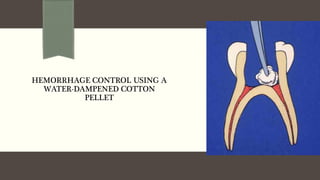
HEMORRHAGE CONTROL USING A
WATER-DAMPENED COTTON
PELLET
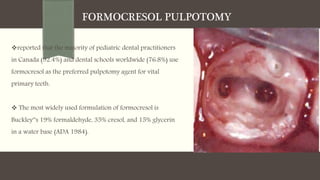
FORMOCRESOL PULPOTOMY
reported that the majority of pediatric dental practitioners
in Canada (92.4%) and dental schools worldwide (76.8%) use
formocresol as the preferred pulpotomy agent for vital
primary teeth.
 The most widely used formulation of formocresol is
Buckley‟s 19% formaldehyde, 35% cresol, and 15% glycerin
in a water base (ADA 1984).
PREPARATION OF BUCKLEY’S SOLUTION (150ML )
3 parts of glycerin (90 ml) + 1 part of distilled water (30) gives diluent (
120 ml )
Then diluent is added to 30 ml of full concentration formacresol
FORMOCRESOL PULPOTOMY
Formocresol - Buckley [1904]
Sweet – 1930 - Formulated multivisit technique
Doyle – 1962 - Advocated 2 sitting procedure [ complete
devitalization ]
Spedding [ 1965 ] - Gave 5 min protocol partial devitalization
Venham – 1967 - Proposed 15 sec procedure
Current concept uses 4 min of application time
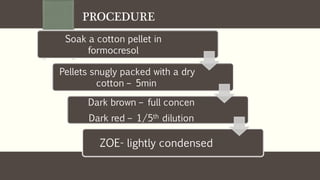
PROCEDURE
Soak a cotton pellet in
formocresol
Pellets snugly packed with a dry
cotton – 5min
Dark brown – full concen
Dark red – 1/5th dilution
ZOE- lightly condensed
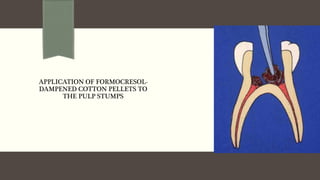
APPLICATION OF FORMOCRESOL-
DAMPENED COTTON PELLETS TO
THE PULP STUMPS
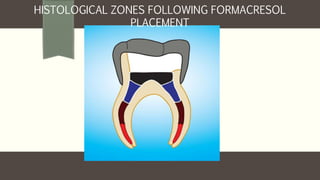
HISTOLOGICAL ZONES FOLLOWING FORMACRESOL
PLACEMENT
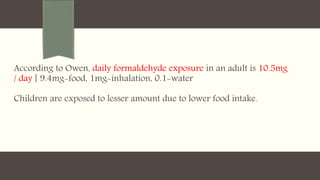
According to Owen, daily formaldehyde exposure in an adult is 10.5mg
/ day [ 9.4mg-food, 1mg-inhalation, 0.1-water
Children are exposed to lesser amount due to lower food intake.
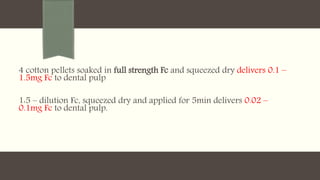
4 cotton pellets soaked in full strength Fc and squeezed dry delivers 0.1 –
1.5mg Fc to dental pulp
1:5 – dilution Fc, squeezed dry and applied for 5min delivers 0.02 –
0.1mg Fc to dental pulp.
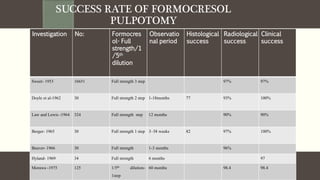
SUCCESS RATE OF FORMOCRESOL
PULPOTOMY
Investigation No: Formocres
ol- Full
strength/1
/5th
dilution
Observatio
nal period
Histological
success
Radiological
success
Clinical
success
Sweet- 1953 16651 Full strength 3 step 97% 97%
Doyle et al-1962 30 Full strength 2 step 1-18months 77 93% 100%
Law and Lewis -1964 324 Full strength step 12 months 90% 90%
Berger- 1965 30 Full strength 1 step 3–38 weeks 82 97% 100%
Beaver- 1966 30 Full strength 1-3 months 96%
Hyland- 1969 34 Full strength 6 months 97
Morawa -1975 125 1/5th dilution-
1step
60 months 98.4 98.4
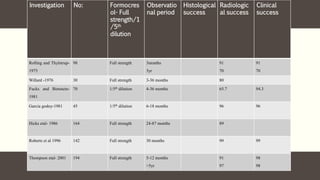
Investigation No: Formocres
ol- Full
strength/1
/5th
dilution
Observatio
nal period
Histological
success
Radiologic
al success
Clinical
success
Rolling and Thylstrup-
1975
98 Full strength 3months
3yr
91
70
91
70
Willard -1976 30 Full strength 3-36 months 80
Fucks and Bimstein-
1981
70 1/5th dilution 4-36 months 65.7 94.3
Garcia godoy-1981 45 1/5th dilution 6-18 months 96 96
Hicks etal- 1986 164 Full strength 24-87 months 89
Roberts et al 1996 142 Full strength 30 months 99 99
Thompson etal- 2001 194 Full strength 5-12 months
>5yr
91
97
98
98
DISADVANTAGES
• Systemic toxicity:
• May produce irreversible damage to the protein portion of the enzyme, genetic
material, membranes and connective tissue.
• It directly affects the protein biosynthesis and cell reproduction by interacting
with DNA and RNA and destroys the lipid component of the cell membrane .
GLUTARALDEHYDE
It was introduced by Kopel in 1979.
It is alternative to formocresol due to:
superior fixative properties,
self limiting penetration,
low antigenecity, low toxicity and elimination of cresol.
Formaldehyde are reversible, but GD are not.
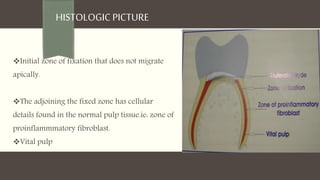
HISTOLOGICPICTURE
Initial zone of fixation that does not migrate
apically.
The adjoining the fixed zone has cellular
details found in the normal pulp tissue.ie: zone of
proinflammmatory fibroblast.
Vital pulp
PROPERTIES
antimicrobial activity:
3.125% for glutraldehyde and 0.75% for formaldehyde.
Glutraldehyde was seen to exert less cytotoxic effect on immediate and
surrounding tissues as pulpotomy agent.
W.B.KARP, COMPARED METABOLISM OF GLUTERALDEHYDE AND
FORMOCRESOL
FC is absorbed and distributed rapidly throughout the body within min of being
placed on pulpotomy site.
Only small fraction of formaldehyde is metabolized to Co2 and most of
formaldehyde is tissue bound, but GD has low tissue binding ability and readily
metabolized.
CALCIUM HYDROXIDE
History
Zander (1938) & Herman (1958)-- pulpotomy in deciduous and
young permanent teeth.
Granath (1959 )to stimulate apexification
Calcium hydroxide is considered a safe drug relative to formocresol.
A study, 51 in which a hard-setting calcium hydroxide cement was used instead of the
inorganic compound, showed a higher success rate.
However, the pulpotomized teeth were followed for only 9 months.
Whether calcium hydroxide in a cement vehicle can elicit more favorable responses
remains to be determined.
Pulpdent: Paste contains 52.5% ca (oH) 2 suspended in aqueous methylcellulose
solution.
Dycal: L.D Caulk Company 1962. 2- paste system
Base: Titanium dioxide in glycol salicylate with a pigment.
Catalyst: Calcium hydroxide and zinc oxide in ethyltoludine sulfonamide.
Hydrose : two-paste non-essential oil, hard setting compound that contains calcium
hydroxide, barium Sulphate, titanium dioxide and a selected resin
MECHANISM OF CA(OH)2
- the hydroxyl ions destroy phospholipids so the cellular membrane is destroyed
- the high alkalinity breaks down ionic bonds so that bacterial proteins are
denatured
- the hydroxyl ions react with bacterial DNA, inhibiting replication
FERRIC SULFATE
It is non- aldehyde hemostatic compound.
It prevent problems encountered with clot formation and so minimizes
the chances of inflammation and internal resorption.
BONE MORPHOGENIC PROTEIN
Urist (1965) bone matrix contains a factor capable of auto
induction and named this as bone morphogenic protein.
LASER PULPOTOMY
The use of lasers in pulpotomies was first published by Shoji et al.
(1985).
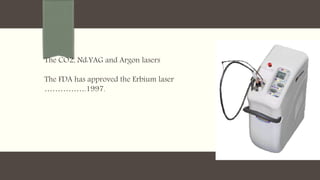
The CO2, Nd:YAG and Argon lasers
The FDA has approved the Erbium laser
…………….1997.
Laser pulpotomy:
 Lasers eliminate placing chemicals (such as pulpotomies formocresol) into
the tooth chamber to complete the pulpotomy.
 Water laser cuts with no smear layer, providing better surface for bonding
Er laser , air water spray
micro explosive force on water droplets
Hard tissue cutting
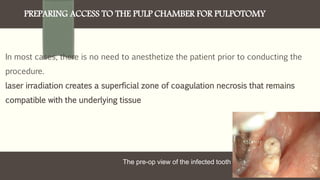
PREPARING ACCESS TO THE PULP CHAMBER FOR PULPOTOMY
In most cases, there is no need to anesthetize the patient prior to conducting the
procedure.
laser irradiation creates a superficial zone of coagulation necrosis that remains
compatible with the underlying tissue
The pre-op view of the infected tooth.
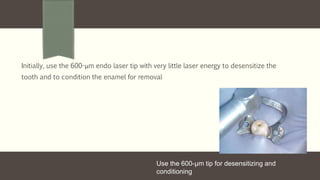
Initially, use the 600-μm endo laser tip with very little laser energy to desensitize the
tooth and to condition the enamel for removal
Use the 600-μm tip for desensitizing and
conditioning
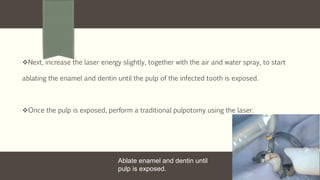
Next, increase the laser energy slightly, together with the air and water spray, to start
ablating the enamel and dentin until the pulp of the infected tooth is exposed.
Once the pulp is exposed, perform a traditional pulpotomy using the laser.
Ablate enamel and dentin until
pulp is exposed.
ELECTROSURGICAL PULPOTOMY
Mark was the first US dentist to perform Electrosurgical pulpotomy in
1993 with success rate of 99% in primary teeth.
After removal of the coronal pulp a layer of coagulation necrosis is produced by
electrosurgery and this was postulated to provide a barrier between healthy radicular pulp and
the base material thus sealing the pulp chamber.
It was thought that odontoblasts would then be stimulated to form a dentin bridge and the
tooth be maintained until it was ready to exfoliate (Sheller & Morton, 1987).
PROCEDURE
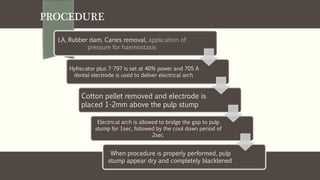
LA, Rubber dam, Caries removal, application of
pressure for haemostasis
Hyfrecator plus 7-797 is set at 40% power and 705 A
dental electrode is used to deliver electrical arch
Cotton pellet removed and electrode is
placed 1-2mm above the pulp stump
Electrical arch is allowed to bridge the gap to pulp
stump for 1sec, followed by the cool down period of
2sec
When procedure is properly performed, pulp
stump appear dry and completely blacklened
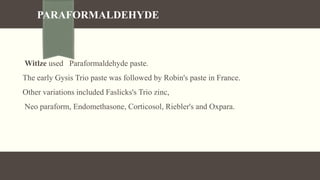
PARAFORMALDEHYDE
Witlze used Paraformaldehyde paste.
The early Gysis Trio paste was followed by Robin's paste in France.
Other variations included Faslicks's Trio zinc,
Neo paraform, Endomethasone, Corticosol, Riebler's and Oxpara.
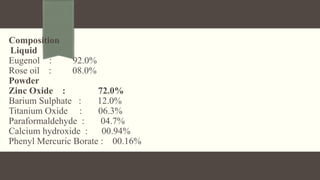
Composition
Liquid
Eugenol : 92.0%
Rose oil : 08.0%
Powder
Zinc Oxide : 72.0%
Barium Sulphate : 12.0%
Titanium Oxide : 06.3%
Paraformaldehyde : 04.7%
Calcium hydroxide : 00.94%
Phenyl Mercuric Borate : 00.16%
MTA
Dr M.Torabinejad
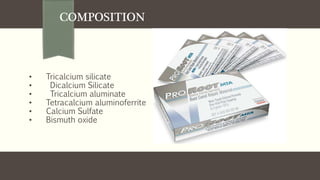
COMPOSITION
• Tricalcium silicate
• Dicalcium Silicate
• Tricalcium aluminate
• Tetracalcium aluminoferrite
• Calcium Sulfate
• Bismuth oxide
PROPERTIES
Low or no solubility
PH value10.2 after mixing and rises to 12.5 after 3 hours
Antibacterial effect
Induces pulpal cell proliferation
Stimulation of mineralized tissue formation
• Mineral Trioxide Aggregate: A Comprehensive LiteratureReview—Part I: Chemical,
Physical, and Antibacteria lProperties
• Direct pulp capping with mineral trioxide aggregateJ Am Dent Assoc
2008;139;305-315.
• MTA AND CALCIUM HYDROXIDE FOR PULP CAPPINGJ Appl Oral Sci 2005; 13(2):
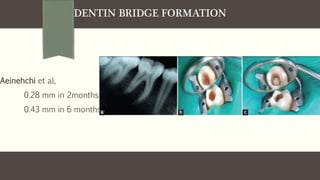
DENTIN BRIDGE FORMATION
Aeinehchi et al,
0.28 mm in 2months
0.43 mm in 6 months
ENRICHED COLLAGEN
Animal studies have been done with this material
Shown dentinal bridge formation in 8 weeks
FREEZE DRIED BONE
This material induces new bone and stimulates osteogenesis along with
cementogenesis.
Since pulp and dentin, freeze dried bone also may serve as an nidus of a calcific
barrier at the amputation site.
Dentin chip in contact with pulp tissue may serve as a nidus for calcific barrier
formation.
ENAMEL MATRIX DERIVATIVE
Like amelogenins from the pre-ameloblasts, are translocated during
odontogenesis to differentiating odontoblasts in dental papilla,
Suggesting that amelogenins may be associated with odontoblast changes during
development.
Enamel matrix derivative (EMD), obtained from embryonic enamel of amelogenin,
was demonstrated in vitro, using a wound healing model, to be capable of stimulating
periodontal ligament cell proliferation at earlier times (i.e., days one to three)
compared to gingival fibroblasts and bone cells
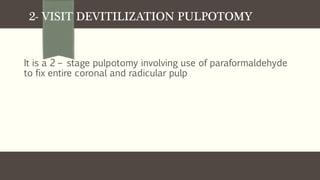
2- VISIT DEVITILIZATION PULPOTOMY
It is a 2 – stage pulpotomy involving use of paraformaldehyde
to fix entire coronal and radicular pulp
TECHNIQUE – [1ST VISIT]
LA, excavate caries,
Incorporate paraformaldehyde
and place it on pulp exposure
and seal for 1- 2weeks
Formaldehyde gass liberated
from paraformaldehyde enters
coronal and radicular pulp and
fixes tissue
2ND VISIT
Pulpotomy is carried
out
Clean the cavity with saline
and dry with cotton pellet
Pulp chamber is filled with
antiseptic paste and the tooth is
restored
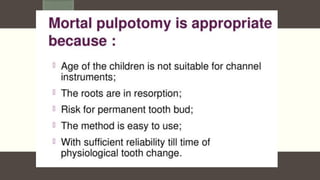
MORTAL PULPOTOMY/NON-VITAL
PULPOTOMY
Indications
Non negociable root canals and
Limited patient cooperation
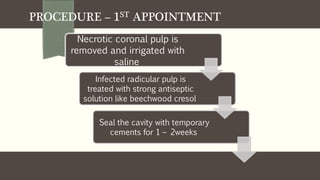
PROCEDURE – 1ST APPOINTMENT
Necrotic coronal pulp is
removed and irrigated with
saline
Infected radicular pulp is
treated with strong antiseptic
solution like beechwood cresol
Seal the cavity with temporary
cements for 1 – 2weeks
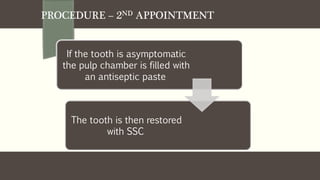
PROCEDURE – 2ND APPOINTMENT
If the tooth is asymptomatic
the pulp chamber is filled with
an antiseptic paste
The tooth is then restored
with SSC
Pulpotomy

Pulpotomy

  • 2.
    PULP THERAPY IN PRIMARYTEETH (PULPOTOMY, PULPECTOMY, LSTR)
  • 3.
  • 5.
  • 7.
    1. A comprehensivemedical history. 2. A review of past and present dental history and treatment, including current symptoms and chief complaint. 3. A subjective evaluation of the area associated with the current symptoms/chief complaint by questioning the child and parent on the location, intensity, duration, stimulus, relief, and spontaneity. AAPD - 2014
  • 8.
    4. A objectiveextraoral examination as well as examination of the intraoral soft and hard tissues. 5. If obtainable, radiograph(s) to diagnose pulpitis or necrosis showing the involved tooth, furcation, periapical area, and the surrounding bone. 6. Clinical tests such as palpation, percussion, and mobility.
  • 11.
    DEFINITION Pulpotomy : Brahan andMorris (I985) defined as the amputation of vital pulp from the coronal chamber followed by placement of a medicament over the radicular pulp stumps to stimulate repair, fixation or mummification of the remaining vital radicular pulp.
  • 12.
    CLASSIFICATION - VITALPULPOTOMY Types Other name Features Examples Devitalization -Mummification, -Cauterization To destroy or mummify the vital tissue Single setting -Formocresol -electro surgery -laser Two stage -Gysi triopaste -Easlick’s formaldehyde -Paraform devitalising paste Preservation -Minimal Devitalization, -Noninductive Maintaining the maxi vital tissue, without induction of reparative dentin -Zno -Glutar aldehyde -Ferric sulphate
  • 13.
    Regeneration -Inductive -Reparative Formation ofdentin bridge -Ca (oH) 2 --BMP -MTA --Enrich collagen --Freezed dried bone -- Osteogenic Protein Types Other name Features Example NON-VITAL PULPOTOMY Mortal pulpotomy -- --- in compromised cases -- Beechwood cresol -- Formocresol
  • 14.
    CASE SELECTION :WATERHOUSE ET AL (2000 ) Teeth with deep DC ( x ray – approximating to pulp) Teeth should be restorable after procedure Absence of symptoms of advanced pulpal inflammation Absence of Cl signs or sympytoms Absence of Cl & x-ray signs of pulpal necrosis Hamorrhage should stop within 5 min
  • 15.
    INDICATIONS • Mechanically exposedvital primary teeth are indicated for single visit pulpotomy procedure. • A vital carious exposure in an asymptomatic primary tooth • An iatrogenic exposure under proper isolation is the appropriate indication for the pulpotomy procedure.
  • 16.
    • In thetreatment of pulpally involved vital primary teeth with clinical manifestation of inflammatory response confined to coronal pulp.
  • 17.
    CONTRAINDICATIONS Any sign orsymptom, which suggest that inflammation, has extended beyond the coronal pulp into the root canals. These include • Spontaneous pain • Tenderness to percussion • Swelling and fistula • Pus or serous exudate at the exposure site.
  • 18.
    • Pathologic mobility •Uncontrollable hemorrhage from the amputated pulp stumps. • Pathological external root resorption • Periapical or interradicular radiolucency • Internal Root resorption
  • 19.
    MEDICAMENTS USED FORPULPOTOMY • Formocresol • Gluteraldehyde • Calcium hydroxide • Zinc oxide eugenol • Ferric Sulphate • Bone Morphogenic protein and osteogenic protein • Devitalizing Para formaldehyde paste • MTA • Beech wood cresol • Enriched collagen solution • Freezed dried Bone
  • 20.
    PROCEDURE LA, Rubber dam,excavate all caries Access opening- Amputate the exposed pulp Obtain haemostasis
  • 21.
    INADEQUATE ACCESS OPENING RESULTSIN LEAVING PULP TISSUE AND TISSUE TAGS IN PULP CHAMBER
  • 22.
    ACCESS OPENING WITHNO LEDGES AND WALLS CONFLUENT WITH WALLS OF PULP CHAMBER
  • 23.
    CORONAL PULP TISSUEIS REMOVED TO THE LEVEL OF THE OPENING INTO THE CANALS
  • 24.
    HEMORRHAGE CONTROL USINGA WATER-DAMPENED COTTON PELLET
  • 25.
    FORMOCRESOL PULPOTOMY reported thatthe majority of pediatric dental practitioners in Canada (92.4%) and dental schools worldwide (76.8%) use formocresol as the preferred pulpotomy agent for vital primary teeth.  The most widely used formulation of formocresol is Buckley‟s 19% formaldehyde, 35% cresol, and 15% glycerin in a water base (ADA 1984).
  • 26.
    PREPARATION OF BUCKLEY’SSOLUTION (150ML ) 3 parts of glycerin (90 ml) + 1 part of distilled water (30) gives diluent ( 120 ml ) Then diluent is added to 30 ml of full concentration formacresol
  • 27.
    FORMOCRESOL PULPOTOMY Formocresol -Buckley [1904] Sweet – 1930 - Formulated multivisit technique Doyle – 1962 - Advocated 2 sitting procedure [ complete devitalization ] Spedding [ 1965 ] - Gave 5 min protocol partial devitalization Venham – 1967 - Proposed 15 sec procedure Current concept uses 4 min of application time
  • 28.
    PROCEDURE Soak a cottonpellet in formocresol Pellets snugly packed with a dry cotton – 5min Dark brown – full concen Dark red – 1/5th dilution ZOE- lightly condensed
  • 29.
    APPLICATION OF FORMOCRESOL- DAMPENEDCOTTON PELLETS TO THE PULP STUMPS
  • 30.
    HISTOLOGICAL ZONES FOLLOWINGFORMACRESOL PLACEMENT
  • 31.
    According to Owen,daily formaldehyde exposure in an adult is 10.5mg / day [ 9.4mg-food, 1mg-inhalation, 0.1-water Children are exposed to lesser amount due to lower food intake.
  • 32.
    4 cotton pelletssoaked in full strength Fc and squeezed dry delivers 0.1 – 1.5mg Fc to dental pulp 1:5 – dilution Fc, squeezed dry and applied for 5min delivers 0.02 – 0.1mg Fc to dental pulp.
  • 33.
    SUCCESS RATE OFFORMOCRESOL PULPOTOMY Investigation No: Formocres ol- Full strength/1 /5th dilution Observatio nal period Histological success Radiological success Clinical success Sweet- 1953 16651 Full strength 3 step 97% 97% Doyle et al-1962 30 Full strength 2 step 1-18months 77 93% 100% Law and Lewis -1964 324 Full strength step 12 months 90% 90% Berger- 1965 30 Full strength 1 step 3–38 weeks 82 97% 100% Beaver- 1966 30 Full strength 1-3 months 96% Hyland- 1969 34 Full strength 6 months 97 Morawa -1975 125 1/5th dilution- 1step 60 months 98.4 98.4
  • 34.
    Investigation No: Formocres ol-Full strength/1 /5th dilution Observatio nal period Histological success Radiologic al success Clinical success Rolling and Thylstrup- 1975 98 Full strength 3months 3yr 91 70 91 70 Willard -1976 30 Full strength 3-36 months 80 Fucks and Bimstein- 1981 70 1/5th dilution 4-36 months 65.7 94.3 Garcia godoy-1981 45 1/5th dilution 6-18 months 96 96 Hicks etal- 1986 164 Full strength 24-87 months 89 Roberts et al 1996 142 Full strength 30 months 99 99 Thompson etal- 2001 194 Full strength 5-12 months >5yr 91 97 98 98
  • 35.
    DISADVANTAGES • Systemic toxicity: •May produce irreversible damage to the protein portion of the enzyme, genetic material, membranes and connective tissue. • It directly affects the protein biosynthesis and cell reproduction by interacting with DNA and RNA and destroys the lipid component of the cell membrane .
  • 36.
    GLUTARALDEHYDE It was introducedby Kopel in 1979. It is alternative to formocresol due to: superior fixative properties, self limiting penetration, low antigenecity, low toxicity and elimination of cresol. Formaldehyde are reversible, but GD are not.
  • 37.
    HISTOLOGICPICTURE Initial zone offixation that does not migrate apically. The adjoining the fixed zone has cellular details found in the normal pulp tissue.ie: zone of proinflammmatory fibroblast. Vital pulp
  • 38.
    PROPERTIES antimicrobial activity: 3.125% forglutraldehyde and 0.75% for formaldehyde. Glutraldehyde was seen to exert less cytotoxic effect on immediate and surrounding tissues as pulpotomy agent.
  • 39.
    W.B.KARP, COMPARED METABOLISMOF GLUTERALDEHYDE AND FORMOCRESOL FC is absorbed and distributed rapidly throughout the body within min of being placed on pulpotomy site. Only small fraction of formaldehyde is metabolized to Co2 and most of formaldehyde is tissue bound, but GD has low tissue binding ability and readily metabolized.
  • 40.
    CALCIUM HYDROXIDE History Zander (1938)& Herman (1958)-- pulpotomy in deciduous and young permanent teeth. Granath (1959 )to stimulate apexification
  • 41.
    Calcium hydroxide isconsidered a safe drug relative to formocresol. A study, 51 in which a hard-setting calcium hydroxide cement was used instead of the inorganic compound, showed a higher success rate. However, the pulpotomized teeth were followed for only 9 months. Whether calcium hydroxide in a cement vehicle can elicit more favorable responses remains to be determined.
  • 42.
    Pulpdent: Paste contains52.5% ca (oH) 2 suspended in aqueous methylcellulose solution. Dycal: L.D Caulk Company 1962. 2- paste system Base: Titanium dioxide in glycol salicylate with a pigment. Catalyst: Calcium hydroxide and zinc oxide in ethyltoludine sulfonamide. Hydrose : two-paste non-essential oil, hard setting compound that contains calcium hydroxide, barium Sulphate, titanium dioxide and a selected resin
  • 43.
    MECHANISM OF CA(OH)2 -the hydroxyl ions destroy phospholipids so the cellular membrane is destroyed - the high alkalinity breaks down ionic bonds so that bacterial proteins are denatured - the hydroxyl ions react with bacterial DNA, inhibiting replication
  • 44.
    FERRIC SULFATE It isnon- aldehyde hemostatic compound. It prevent problems encountered with clot formation and so minimizes the chances of inflammation and internal resorption.
  • 45.
    BONE MORPHOGENIC PROTEIN Urist(1965) bone matrix contains a factor capable of auto induction and named this as bone morphogenic protein.
  • 46.
    LASER PULPOTOMY The useof lasers in pulpotomies was first published by Shoji et al. (1985).
  • 47.
    The CO2, Nd:YAGand Argon lasers The FDA has approved the Erbium laser …………….1997.
  • 48.
    Laser pulpotomy:  Laserseliminate placing chemicals (such as pulpotomies formocresol) into the tooth chamber to complete the pulpotomy.  Water laser cuts with no smear layer, providing better surface for bonding
  • 49.
    Er laser ,air water spray micro explosive force on water droplets Hard tissue cutting
  • 50.
    PREPARING ACCESS TOTHE PULP CHAMBER FOR PULPOTOMY In most cases, there is no need to anesthetize the patient prior to conducting the procedure. laser irradiation creates a superficial zone of coagulation necrosis that remains compatible with the underlying tissue The pre-op view of the infected tooth.
  • 51.
    Initially, use the600-μm endo laser tip with very little laser energy to desensitize the tooth and to condition the enamel for removal Use the 600-μm tip for desensitizing and conditioning
  • 52.
    Next, increase thelaser energy slightly, together with the air and water spray, to start ablating the enamel and dentin until the pulp of the infected tooth is exposed. Once the pulp is exposed, perform a traditional pulpotomy using the laser. Ablate enamel and dentin until pulp is exposed.
  • 53.
    ELECTROSURGICAL PULPOTOMY Mark wasthe first US dentist to perform Electrosurgical pulpotomy in 1993 with success rate of 99% in primary teeth.
  • 54.
    After removal ofthe coronal pulp a layer of coagulation necrosis is produced by electrosurgery and this was postulated to provide a barrier between healthy radicular pulp and the base material thus sealing the pulp chamber. It was thought that odontoblasts would then be stimulated to form a dentin bridge and the tooth be maintained until it was ready to exfoliate (Sheller & Morton, 1987).
  • 55.
    PROCEDURE LA, Rubber dam,Caries removal, application of pressure for haemostasis Hyfrecator plus 7-797 is set at 40% power and 705 A dental electrode is used to deliver electrical arch Cotton pellet removed and electrode is placed 1-2mm above the pulp stump Electrical arch is allowed to bridge the gap to pulp stump for 1sec, followed by the cool down period of 2sec When procedure is properly performed, pulp stump appear dry and completely blacklened
  • 56.
    PARAFORMALDEHYDE Witlze used Paraformaldehydepaste. The early Gysis Trio paste was followed by Robin's paste in France. Other variations included Faslicks's Trio zinc, Neo paraform, Endomethasone, Corticosol, Riebler's and Oxpara.
  • 57.
    Composition Liquid Eugenol : 92.0% Roseoil : 08.0% Powder Zinc Oxide : 72.0% Barium Sulphate : 12.0% Titanium Oxide : 06.3% Paraformaldehyde : 04.7% Calcium hydroxide : 00.94% Phenyl Mercuric Borate : 00.16%
  • 58.
  • 59.
    COMPOSITION • Tricalcium silicate •Dicalcium Silicate • Tricalcium aluminate • Tetracalcium aluminoferrite • Calcium Sulfate • Bismuth oxide
  • 60.
    PROPERTIES Low or nosolubility PH value10.2 after mixing and rises to 12.5 after 3 hours Antibacterial effect Induces pulpal cell proliferation Stimulation of mineralized tissue formation • Mineral Trioxide Aggregate: A Comprehensive LiteratureReview—Part I: Chemical, Physical, and Antibacteria lProperties • Direct pulp capping with mineral trioxide aggregateJ Am Dent Assoc 2008;139;305-315. • MTA AND CALCIUM HYDROXIDE FOR PULP CAPPINGJ Appl Oral Sci 2005; 13(2):
  • 61.
    DENTIN BRIDGE FORMATION Aeinehchiet al, 0.28 mm in 2months 0.43 mm in 6 months
  • 62.
    ENRICHED COLLAGEN Animal studieshave been done with this material Shown dentinal bridge formation in 8 weeks
  • 63.
    FREEZE DRIED BONE Thismaterial induces new bone and stimulates osteogenesis along with cementogenesis. Since pulp and dentin, freeze dried bone also may serve as an nidus of a calcific barrier at the amputation site. Dentin chip in contact with pulp tissue may serve as a nidus for calcific barrier formation.
  • 64.
    ENAMEL MATRIX DERIVATIVE Likeamelogenins from the pre-ameloblasts, are translocated during odontogenesis to differentiating odontoblasts in dental papilla, Suggesting that amelogenins may be associated with odontoblast changes during development.
  • 65.
    Enamel matrix derivative(EMD), obtained from embryonic enamel of amelogenin, was demonstrated in vitro, using a wound healing model, to be capable of stimulating periodontal ligament cell proliferation at earlier times (i.e., days one to three) compared to gingival fibroblasts and bone cells
  • 66.
    2- VISIT DEVITILIZATIONPULPOTOMY It is a 2 – stage pulpotomy involving use of paraformaldehyde to fix entire coronal and radicular pulp
  • 67.
    TECHNIQUE – [1STVISIT] LA, excavate caries, Incorporate paraformaldehyde and place it on pulp exposure and seal for 1- 2weeks Formaldehyde gass liberated from paraformaldehyde enters coronal and radicular pulp and fixes tissue
  • 68.
    2ND VISIT Pulpotomy iscarried out Clean the cavity with saline and dry with cotton pellet Pulp chamber is filled with antiseptic paste and the tooth is restored
  • 69.
    MORTAL PULPOTOMY/NON-VITAL PULPOTOMY Indications Non negociableroot canals and Limited patient cooperation
  • 70.
    PROCEDURE – 1STAPPOINTMENT Necrotic coronal pulp is removed and irrigated with saline Infected radicular pulp is treated with strong antiseptic solution like beechwood cresol Seal the cavity with temporary cements for 1 – 2weeks
  • 71.
    PROCEDURE – 2NDAPPOINTMENT If the tooth is asymptomatic the pulp chamber is filled with an antiseptic paste The tooth is then restored with SSC

Editor's Notes

  • #5  DESPITE tge modern advances in preventive caries and increase understanding of the importance of maintaining the natural dentn, many teeth are still lost prematurely. Primary tooth pulp therapy is aimed at preserving the primary teeth until normal exfoliation. Management of the cariously involved primary tooth where the carious lesion approximates the pulp requires a knowledgeable approach to pulp therapy, and a successful outcome depends on accurate diagnosis of the status of the pulp prior to therapy
  • #6 Primary tooth pulp therapy is aimed at preserving the primary teeth until normal exfoliation. Management of the cariously involved primary tooth where the carious lesion approximates the pulp requires a knowledgeable approach to pulp therapy, and a successful outcome depends on accurate diagnosis of the status of the pulp prior to therapy
  • #7 Preliminary data gathering and interpretation must be focused on determining whether the primary tooth pulp is normal, reversibly inflamed, irreversibly inflamed or necrotic. If it is determined to be vital or reversibly inflamed, the vital pulp therapy techniques of pulpotomy or indirect pulp treatment (IPT) are indicated. If the pulp is determined to be irreversibly inflamed or necrotic, either a pulpectomy or extraction would be appropriate. The process of determining that vital pulp therapy can be performed on a primary tooth starts with gathering clinical and radiographic diagnostic data aimed at determining the vitality status of the pulp.
  • #8 AAPD 2014Guideline on Pulp Therapy for Primary and Immature Permanent Teeth
  • #10 FUKS AB CLASSIFIED
  • #26 Avram & Pulver
  • #31 Formocresol acts through the aldehyde group of formaldehyde, forming bonds with the side groups of the amino acids of both the bacterial proteins and those of the remaining pulp tissue. It is therefore both a bactericidal and devitalizing agent 7- 14 days later , 3 distinct zones appear…mass and .zilberman 1933 Broad acidophilic zone of fixation Broad pale zone staining zone of atrophy with few cells and fibers Broad zone of inflammatory cells extending from the border of the pale staining zone.
  • #37 Gluteraldehyde application in 2 – 5 % concentration was advocated safe for clinical success
  • #42 Bolt et al
  • #59  ProRoot To seal communications between the root canal system and the external tooth surface at all levels and recently indicated in pulp treatment as direct pulp capping.
  • #60 Mech mixt 75 % Portland cement,20 % bismuth oxide 5% gypsum Mixed with sterile water in a 3:1 powder-to-liquid ratio, MTA sets in 5 minutes
  • #73 IN PAST some authors suggest