Prepared by azheen mohamad
References
 contemporary-fixed- prosthodonics
4th edition ,chapter 26 ,pp805
www.slideshare.com
https://everythingdentistry.wordpress.
com/tag/lost-salt-technique/
http://www.slideserve.com/jana/resin-
bonded-fixed-partial-dentures-rbfpd
Introduction
A prosthesis that requires minimal removal
of tooth structure , particularly for abutment
teeth that are intact and caries free.
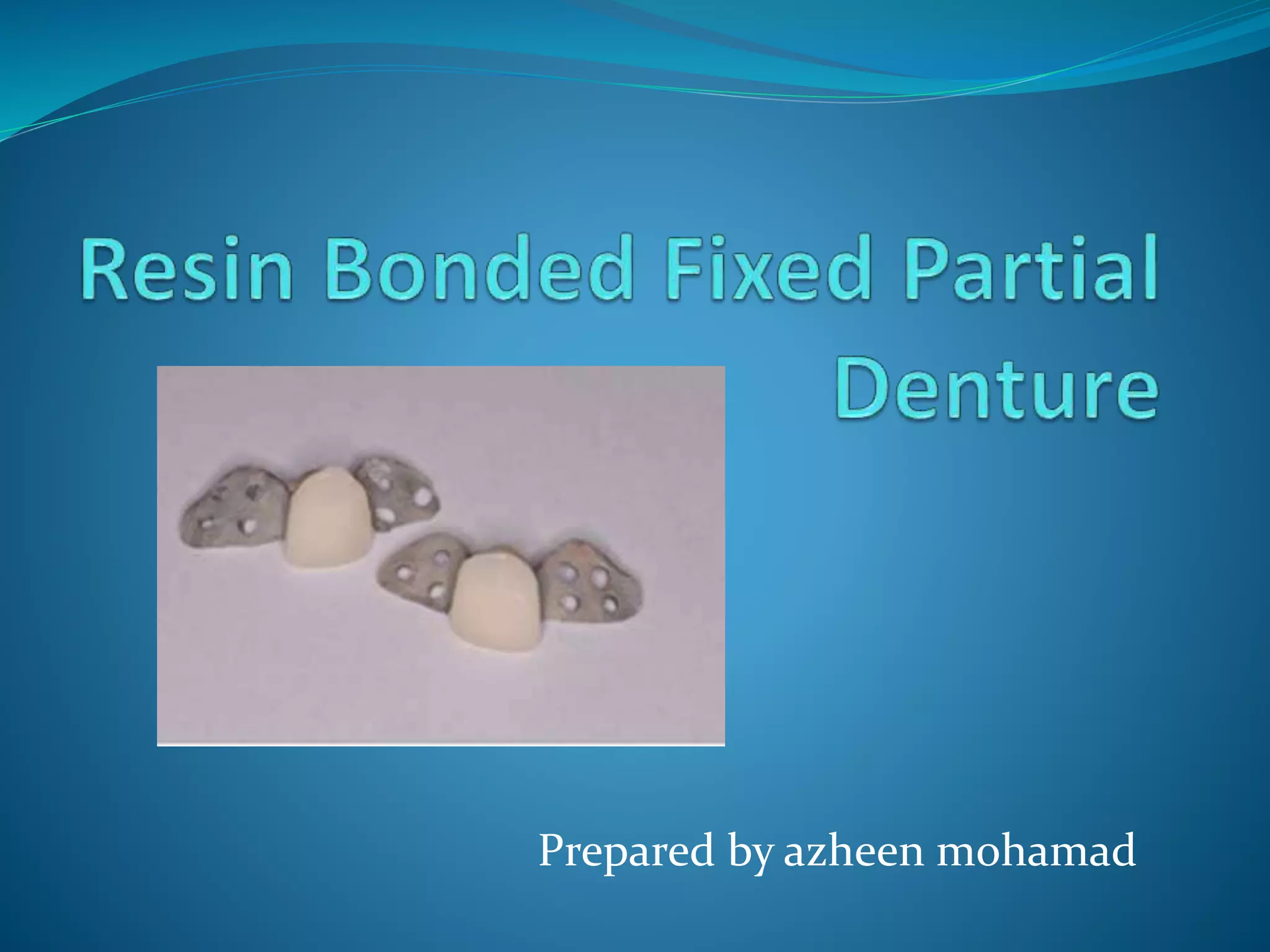
The primary goal of the resin bonded
FPD is the replacement of missing
teeth and maximum conservation of tooth
structure.
Definition
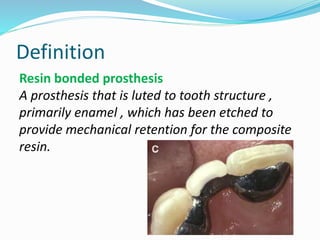
Resin bonded prosthesis
A prosthesis that is luted to tooth structure ,
primarily enamel , which has been etched to
provide mechanical retention for the composite
resin.
Types of FPD:-
Cantilever
Fixed-fixed
Fixed-movable
Hybrid
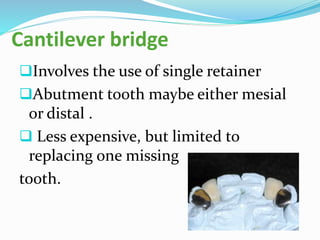
Cantilever bridge
Involves the use of single retainer
Abutment tooth maybe either mesial
or distal .
 Less expensive, but limited to
replacing one missing
tooth.
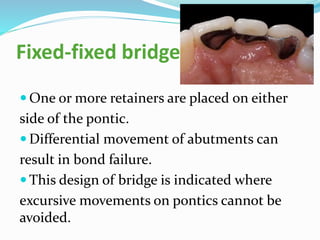
Fixed-fixed bridge
 One or more retainers are placed on either
side of the pontic.
 Differential movement of abutments can
result in bond failure.
 This design of bridge is indicated where
excursive movements on pontics cannot be
avoided.
Fixed-movable
bridge
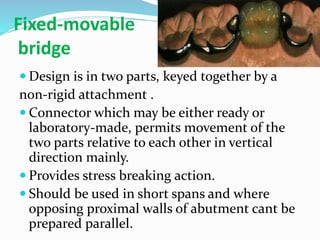
 Design is in two parts, keyed together by a
non-rigid attachment .
 Connector which may be either ready or
laboratory-made, permits movement of the
two parts relative to each other in vertical
direction mainly.
 Provides stress breaking action.
 Should be used in short spans and where
opposing proximal walls of abutment cant be
prepared parallel.
Hybrid bridge
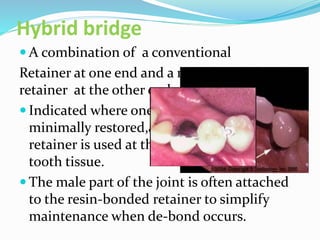
 A combination of a conventional
Retainer at one end and a resin-bonded
retainer at the other end of the pontic.
 Indicated where one of the abutments is
minimally restored,and a resin-bonded
retainer is used at this site to conserve
tooth tissue.
 The male part of the joint is often attached
to the resin-bonded retainer to simplify
maintenance when de-bond occurs.
Advantages of Resin bonded
bridges.
1) Reduced cost .
2) No anesthetic needed.
3) Supragingival margins.
4) Minimal tooth preparation.
5) Rebonding possible.
Disadvantages
Irreversible.
Uncertain longevity.
No space correction.
No alignment correction.
Difficult temporization.
Indications.
1) Adolescents with single missing teeth
(traumatic or congenital).
2) Caries- free abutment teeth and good oral
hygiene.
3) Maxillary incisor replacements (most
favorable prognosis) and Mandibular
incisor replacements.
4) Periodontal splints.
5) Single posterior tooth replacements.
Contraindications
Extensive caries.
Nickel sensitivity.
Deep vertical overbite.
Extensive restoration on abutment
teeth.
Parafuncitonal habits
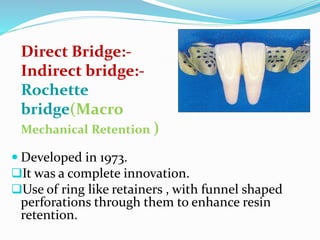
 Developed in 1973.
It was a complete innovation.
Use of ring like retainers , with funnel shaped
perforations through them to enhance resin
retention.
Direct Bridge:-
Indirect bridge:-
Rochette
bridge(Macro
Mechanical Retention )
The Perforation Technique Presents The
Following Limitations:
1. Weakening of the metal retainer by the
perforations.
2. Exposure to wear of the resin at the
perforations.
3. Limited adhesion of the metal
provided by the perforations.
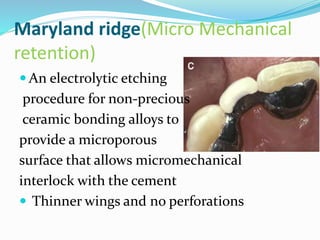
Maryland ridge(Micro Mechanical
retention)
 An electrolytic etching
procedure for non-precious
ceramic bonding alloys to
provide a microporous
surface that allows micromechanical
interlock with the cement
 Thinner wings and no perforations
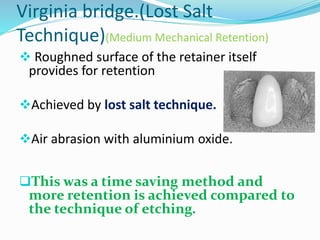
Virginia bridge.(Lost Salt
Technique)(Medium Mechanical Retention)
 Roughned surface of the retainer itself
provides for retention
Achieved by lost salt technique.
Air abrasion with aluminium oxide.
This was a time saving method and
more retention is achieved compared to
the technique of etching.
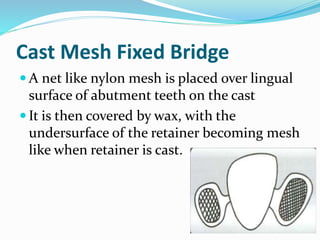
Cast Mesh Fixed Bridge
 A net like nylon mesh is placed over lingual
surface of abutment teeth on the cast
 It is then covered by wax, with the
undersurface of the retainer becoming mesh
like when retainer is cast.
Principle of abutment
preparation:-
1-distinct path of insertion
2-proximal undercuts removed.
3-occlusal or cingulum rest.
4-proximal groove or slots to increase
resistance.
5-definitive supra gingival margin
established.
Tooth preparation
 The strength of bonding to
prepared and etched enamel is
greater than that to etched but
unprepared enamel.
Preparation should cover as large as
area as esthetically possible
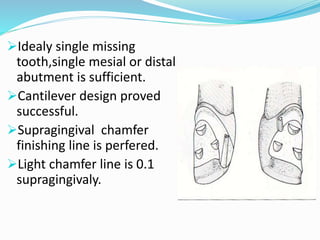
Idealy single missing
tooth,single mesial or distal
abutment is sufficient.
Cantilever design proved
successful.
Supragingival chamfer
finishing line is perfered.
Light chamfer line is 0.1
supragingivaly.
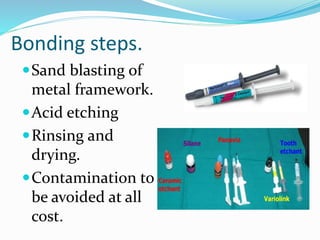
Bonding steps.
Sand blasting of
metal framework.
Acid etching
Rinsing and
drying.
Contamination to
be avoided at all
cost.
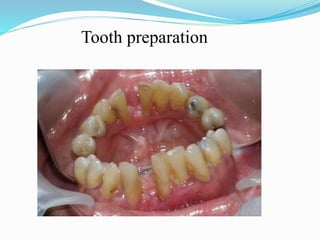
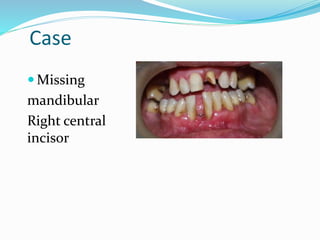
Case
 Missing
mandibular
Right central
incisor
Bone loss and
gingival
recession in
abutment teeth.
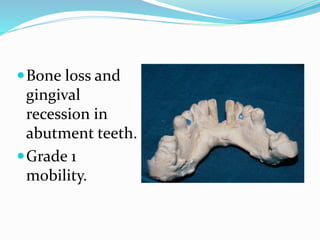
Grade 1
mobility.
Treatment plan.
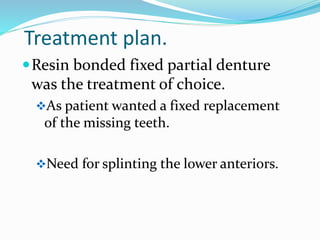
Resin bonded fixed partial denture
was the treatment of choice.
As patient wanted a fixed replacement
of the missing teeth.
Need for splinting the lower anteriors.
Treatment plan.
Resin bonded fixed partial denture
was the treatment of choice.
As patient wanted a fixed replacement
of the missing teeth.
Need for splinting the lower anteriors.
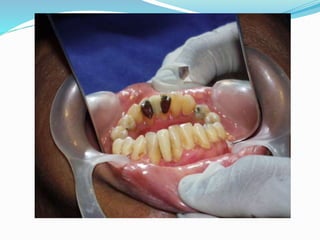
Tooth preparation
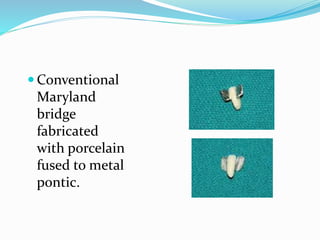
 Conventional
Maryland
bridge
fabricated
with porcelain
fused to metal
pontic.
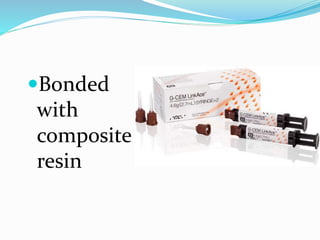
Bonded
with
composite
resin
Resin bonded fixed partial denture

Resin bonded fixed partial denture

  • 1.
  • 2.
    References  contemporary-fixed- prosthodonics 4thedition ,chapter 26 ,pp805 www.slideshare.com https://everythingdentistry.wordpress. com/tag/lost-salt-technique/ http://www.slideserve.com/jana/resin- bonded-fixed-partial-dentures-rbfpd
  • 3.
    Introduction A prosthesis thatrequires minimal removal of tooth structure , particularly for abutment teeth that are intact and caries free. The primary goal of the resin bonded FPD is the replacement of missing teeth and maximum conservation of tooth structure.
  • 4.
    Definition Resin bonded prosthesis Aprosthesis that is luted to tooth structure , primarily enamel , which has been etched to provide mechanical retention for the composite resin.
  • 5.
  • 6.
    Cantilever bridge Involves theuse of single retainer Abutment tooth maybe either mesial or distal .  Less expensive, but limited to replacing one missing tooth.
  • 7.
    Fixed-fixed bridge  Oneor more retainers are placed on either side of the pontic.  Differential movement of abutments can result in bond failure.  This design of bridge is indicated where excursive movements on pontics cannot be avoided.
  • 8.
    Fixed-movable bridge  Design isin two parts, keyed together by a non-rigid attachment .  Connector which may be either ready or laboratory-made, permits movement of the two parts relative to each other in vertical direction mainly.  Provides stress breaking action.  Should be used in short spans and where opposing proximal walls of abutment cant be prepared parallel.
  • 9.
    Hybrid bridge  Acombination of a conventional Retainer at one end and a resin-bonded retainer at the other end of the pontic.  Indicated where one of the abutments is minimally restored,and a resin-bonded retainer is used at this site to conserve tooth tissue.  The male part of the joint is often attached to the resin-bonded retainer to simplify maintenance when de-bond occurs.
  • 10.
    Advantages of Resinbonded bridges. 1) Reduced cost . 2) No anesthetic needed. 3) Supragingival margins. 4) Minimal tooth preparation. 5) Rebonding possible.
  • 11.
    Disadvantages Irreversible. Uncertain longevity. No spacecorrection. No alignment correction. Difficult temporization.
  • 12.
    Indications. 1) Adolescents withsingle missing teeth (traumatic or congenital). 2) Caries- free abutment teeth and good oral hygiene. 3) Maxillary incisor replacements (most favorable prognosis) and Mandibular incisor replacements. 4) Periodontal splints. 5) Single posterior tooth replacements.
  • 13.
    Contraindications Extensive caries. Nickel sensitivity. Deepvertical overbite. Extensive restoration on abutment teeth. Parafuncitonal habits
  • 14.
     Developed in1973. It was a complete innovation. Use of ring like retainers , with funnel shaped perforations through them to enhance resin retention. Direct Bridge:- Indirect bridge:- Rochette bridge(Macro Mechanical Retention )
  • 15.
    The Perforation TechniquePresents The Following Limitations: 1. Weakening of the metal retainer by the perforations. 2. Exposure to wear of the resin at the perforations. 3. Limited adhesion of the metal provided by the perforations.
  • 16.
    Maryland ridge(Micro Mechanical retention) An electrolytic etching procedure for non-precious ceramic bonding alloys to provide a microporous surface that allows micromechanical interlock with the cement  Thinner wings and no perforations
  • 17.
    Virginia bridge.(Lost Salt Technique)(MediumMechanical Retention)  Roughned surface of the retainer itself provides for retention Achieved by lost salt technique. Air abrasion with aluminium oxide. This was a time saving method and more retention is achieved compared to the technique of etching.
  • 18.
    Cast Mesh FixedBridge  A net like nylon mesh is placed over lingual surface of abutment teeth on the cast  It is then covered by wax, with the undersurface of the retainer becoming mesh like when retainer is cast.
  • 19.
    Principle of abutment preparation:- 1-distinctpath of insertion 2-proximal undercuts removed. 3-occlusal or cingulum rest. 4-proximal groove or slots to increase resistance. 5-definitive supra gingival margin established.
  • 20.
    Tooth preparation  Thestrength of bonding to prepared and etched enamel is greater than that to etched but unprepared enamel. Preparation should cover as large as area as esthetically possible
  • 21.
    Idealy single missing tooth,singlemesial or distal abutment is sufficient. Cantilever design proved successful. Supragingival chamfer finishing line is perfered. Light chamfer line is 0.1 supragingivaly.
  • 22.
    Bonding steps. Sand blastingof metal framework. Acid etching Rinsing and drying. Contamination to be avoided at all cost.
  • 23.
  • 24.
    Bone loss and gingival recessionin abutment teeth. Grade 1 mobility.
  • 25.
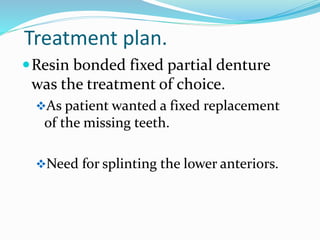
    Treatment plan. Resin bondedfixed partial denture was the treatment of choice. As patient wanted a fixed replacement of the missing teeth. Need for splinting the lower anteriors.
  • 26.
    Treatment plan. Resin bondedfixed partial denture was the treatment of choice. As patient wanted a fixed replacement of the missing teeth. Need for splinting the lower anteriors.
  • 27.
  • 28.
  • 29.