PULMONARY FUNCTION TEST
AMEENA KADAR K A
FIRST SEM M PHARM
PHARMACY PRACTICE
SANJO COLLEGE OF PHARMACEUTICAL STUDIES
INTRODUCTION
 Pulmonary function tests (PFTs) provide objective and quantifiable measures
of lung function and are useful in the diagnosis, evaluation, and monitoring of
respiratory disease.
 They are non invasive tests that show how well the lungs are working.
 Diagnosis and monitoring of many pulmonary diseases, including diseases of
gas exchange, often require measurement of the flow or volume of air inhaled
and exhaled by the patient.
 This information can help health care provider diagnosis and decide the
treatment of certain lung disorders.
 The purpose of the LUNGS is to take oxygen from the atmosphere and
exchange it for carbon dioxide in the blood.
 The movement of air in and out of the lungs is called ventilation; the movement
of blood through the lungs is termed perfusion.
2
3
TYPES OF RESPIRATORY DISEASES
4
OBSTRUCTIVE Vs. RESTRICTIVE
5
LUNG VOLUMES & CAPACITIES
6
1. TIDAL VOLUME (TV)
 It is the amount of air inhaled or exhaled during normal breathing.
 Tidal volume of an adult is about 500 ml.
2. INSPIRATORY RESERVE VOLUME (IRV)
 It is the additional volume of air that can be inhaled into the lungs by a forced
inspiration after a normal inspiration.
 It is about 3.1 liters in male and 1.9 liters in females.
3. EXPIRATORY RESERVE VOLUME (ERV)
 It is the volume of the air that can be exhaled from the lungs by forced expiration
after a normal expiration.
 It is about 1.2 liters in males and 700 ml in females.
7
4. RESIDUAL VOLUME
 It is the volume of air that remains in the lungs following a maximal expiration.
 It cannot be measured by spirometer.
5. VITAL CAPACITY
 It is the maximum volume of air that can be breathed out of the lungs by forced
expiration after a forced inspiration.
 Vital capacity = Tidal volume + IRV + ERV.
 For Males: 4800 ml
 For Females: 3100 ml.
 Vital capacity in athletes when compared to individuals who lead sedentary
lifestyle is higher by 30-40%.
8
6. INSPIRATORY CAPACITY
 It is the amount of air that can be breathed in by a forced expiration.
 Inspiratory capacity = Tidal volume + IRV
 For males: 3600ml
 For females: 2400 ml.
7. FUNCTIONAL RESIDUAL CAPACITY
 The amount of air left in lungs after a tidal breath out.
 The amount of air that can be stay in lungs during normal breathing.
 Sum of Residual volume + ERV.
 For males: 2400ml
 For females: 1800ml
9
8. TOTAL LUNG CAPACITY
 This is the total volume of the air in the lungs after a maximum inspiration.
 Total Lung Capacity = Vital capacity + Residual volume
 For males: 6 Liters
 For females: 4.2 Liters
9. FORCED VITAL CAPACITY
 It is the amount of air which can be forcibly exhaled from the lungs after taking
the deepest breath possible.
 It is used to determine both presence and severity of diseases.
 For Males: 4.8 L
 For Females: 3.7 L.
10
11
12
PULMONARY FUNCTION TESTS
13
 USES OF PFT
DIAGNOSIS
Signs and symptoms of respiratory disease.
 Follow up of laboratory findings
 Disease effect on pulmonary function.
EVALUATION
Medical legal issues
 Rehabilitation
MONITORING
Respiratory disease progression
 Prognosis
 Occupational or environmental exposure to toxins.
 Therapeutic drug effectiveness.
 Drug effects on pulmonary function.
14
METHODS FOR PFT
SPIROMETRY
PEAK FLOW METER
PLETHYSMOGRAPHY
15
SPIROMETRY
 A spirometer is a device with a mouthpiece hooked up to a small electronic
machine.
 Spirometry is a PFT that helps detect airway obstruction, manifested in asthma
or COPD.
 It measures the maximum amount of air that can be exhaled by the patient after
complete inhalation.
 It takes only 15-20 min .
 Provides information about obstructive and restrictive disease.
 Cornerstone of the laboratory evaluation to demonstrate airflow obstruction.
 Allows the measurement of all lung volumes and capacities.
16
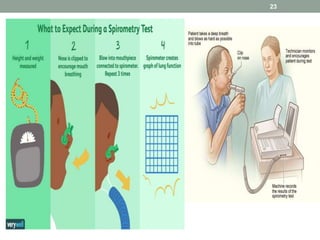
PERFORMING A SPIROMETRY TEST
 You will be asked to place a mouth piece attached to the spirometer in your
mouth.
 It is important to make a tight seal with your lips so all of the air will go into the
spirometer to be measured.
 You will also wear nose clips to keep air from leaking out of your nose.
After breathing normally you will be asked to slowly blowout until your lungs are
empty.
 Then you will take a big, deep breath to fill up your lungs completely.
 As soon as your lungs are full, you will blowout as hard and as fast as you can
until your lungs are absolutely empty.
 You will be asked to repeat the test until there are 3 good efforts.
17
SPIROMETRY MEASURMENTS
Spirometry routinely assesses forced vital capacity (FVC), forced expiratory
volume in one second (FEV1), and FEV1/FVC.
FORCED VITAL CAPACITY
 The FVC is the total volume of air, measured in liters, forcefully and rapidly
exhaled in one breath (from maximum inhalation to maximum exhalation).
 When the full inhalation-exhalation procedure is repeated slowly—instead of
forcefully and rapidly—it is called the slow vital capacity (SVC).
 This value is the maximum amount of air exhaled after a full and complete
inhalation.
 In patients with normal airway function, FVC and SVC are usually similar and
constitute the vital capacity (VC).
18
 In patients with diseases such as COPD, the FVC may be lower than the SVC
due to collapse of narrowed or floppy airways during forced expiration.
 Because of this, some interpretive strategies recommend using the FEV1/SVC
ratio to determine the presence of airway obstruction especially for pronounced
airflow limitation.
FORCED EXPIRATORY VOLUME IN ONE SECOND
 It is the volume of air (in liters) exhaled in the first second during forced
exhalation after maximal inspiration.
 Usually, a patient’s value is described in liters and as a percentage of a
predicted value based on population normal values adjusted for age, height,
and sex.
 FEV1 has the most clinical relevance, primarily as an indicator of airway
function.
19
 A value ≥80% of the predicted normal value is considered normal.
 Normal values are often seen in patients with reversible airway obstruction when
the disease is mild or well controlled.
FEV1/FVC
 The ratio of FEV1 to the FVC is used to estimate the presence and amount of
obstruction in the airways.
 This ratio indicates the amount of air mobilized in one second as a percentage of
the total amount of movable air.
 Patients with obstructive disease usually show a decreased ratio, and the actual
percentage reduction varies with the severity of obstruction.
 In COPD, the Global Initiative for Chronic Obstructive Lung Disease (GOLD)
guidelines define chronic airway obstruction as an FEV1/FVC ratio <70% for
both men and women.
20
• 85% - intermittent asthma.
• >80% -mild to moderate asthma.
• <75% - severe or very poorly controlled asthma
• <70% -COPD
 Spirometry alone is not sufficient to diagnose or assess asthma severity.
 Frequency of asthma symptoms and quick-relief medication use is also
necessary to assess asthma severity.
 Generally, the FEV1/FVC is normal (or high) in patients with restrictive
diseases.
 In mild restriction, the FVC alone may be decreased resulting in a high ratio.
 Often in restrictive lung disease, both the FVC and FEV1 are similarly reduced
compared to predicted values resulting in a normal ratio.
21
FORCED EXPIRATORY FLOW
 Forced expiratory flow (FEF) measures airflow rate during forced expiration.
 Although FEV measures the volume of air per specific unit of time at the
beginning of expiration, FEF measures the rate of air movement during a later
portion.
 The FEF from 25% to 75% of VC is known as FEF25–75.
 This test is thought to measure the flow rate of air in the medium and small
airways (bronchioles and terminal bronchioles), but it is not used clinically.
 The flow from 75% to 100% of VC (i.e., the end of expiration) is called alveolar
airflow.
 This parameter may markedly diminish as airways collapse with increased intra-
thoracic pressure.
 Such pressure occurs in severe acute asthma when large obstructions are present
in terminal bronchioles.
22
 Severity of Airway Obstruction for Asthma and COPD Based on
Spirometry Results
23
24
PEAK EXPIRATORY FLOW RATE
 PEFR obtained through the patient forcefully breathing out into a peak flow
meter.
 PEFR is best measured in early morning, before medication administration and
again at midday (after taking medication).
 Peak flow meters are designed for both pediatric and adult patients with PEFR
between 60–400 L/min for children and between 60–850 L/min for adults.
 PEFR is measured by having a patient perform the following steps:
1. Stand up.
2. Move the indicator on the peak flow meter to the end nearest the mouthpiece.
3. Hold the meter and avoid blocking the movement of the indicator and the holes
on the end of the meter.
4. Take a deep breath in and then seal mouth around the mouthpiece.
25
5. Blow out into the meter as hard and as fast as possible without coughing into the
meter (like blowing out candles on a cake).
6. Examine the indicator on the meter to identify the number corresponding to the
peak flow measurement.
7. Repeat the test two more times (remembering to move the indicator to the base of
the meter each time).
8. Record the highest value of the three measurements in a diary (readings in the
morning and afternoon are ideal).
26
 It can be measured at home.
 PEFR is less accurate than spirometry because it measures more of the upper
airway over a shorter period of time, and readings can vary depending on the
patient’s efforts and meter type.
 PEFR is not the preferred method for determining airflow obstruction.
27
BODY PLETHYSMOGRAPHY
 It is a method used to obtain lung volume measures.
 Lung volume tests indicate the amount of gas contained in the lungs at the
various stages of inflation.
 A patient sits in an airtight box and is told to inhale and exhale against a closed
shutter.
 Inside, a mouthpiece contains a pressure transducer.
 This is done to measure the change in pressure within the box during
respiration.
 It senses the intra-thoracic pressure generated when the patient rapidly and
forcefully puffs against the closed mouthpiece.
 These data are then placed into the equation for boyle’s law:
P1 × V1 = P2 × V2
28
• P1 = pressure inside the box where the patient is seated (atmospheric pressure)
• V1 = volume of the box
• P2 = intra-thoracic pressure generated by the patient
• V2 = calculated volume of the patient’s thoracic cavity.
Because temperature (T1 and T2) is constant throughout testing, it is not included in the
calculations.
 By applying Boyle’s law, this test will provide a measure of the functional
residual capacity (FRC) or the volume of gas remaining at the end of a normal
breath.
 Once the FRC is determined, the other lung volumes and capacities can be
calculated based on this FRC and volumes obtained in static spirometry.
 After these data are generated, the patient’s plethysmography results are usually
compared to references from a presumed normal population.
29
30
BRONCHODILATOR REVERSIBILITY TEST
 One of many tests that may be useful in the diagnostic workup of asthma is
spirometry with reversibility.
 Before the testing day, the patient is asked to
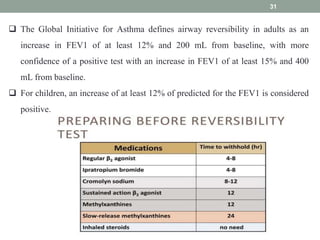
(1) hold certain inhalers and medications that will influence the testing results.
(2) perform spirometry immediately before and 15–30 minutes after the
administration of an inhaled, short-acting β2-adrenergic agonist.
 The ATS (American Thoracic Society) defines a positive bronchodilator
response using changes in either the FEV1 or the FVC using the percent increase
and the increase in the volume exhaled after using a bronchodilator from
baseline.
 A positive bronchodilator response is defined as an improvement of the FEV1
and FVC by at least 12% and 200 mL from baseline.
31
 The Global Initiative for Asthma defines airway reversibility in adults as an
increase in FEV1 of at least 12% and 200 mL from baseline, with more
confidence of a positive test with an increase in FEV1 of at least 15% and 400
mL from baseline.
 For children, an increase of at least 12% of predicted for the FEV1 is considered
positive.
32
DIFFUSION CAPACITY TESTS
 Tests of gas exchange measure the ability of gases to cross (diffuse) the alveolar-
capillary membrane and are useful in assessing interstitial lung disease.
 Typically, these tests measure the per minute transfer of a gas, usually carbon
monoxide (CO), from the alveoli to the blood.
 CO is used because it is a gas that is not normally present in the lung, has a high
affinity for Hgb in red blood cells, and is easily delivered and measured.
 The diffusion capacity may be lessened following losses in the surface area of
the alveoli or thickening of the alveolar capillary membrane.
 Membrane thickening may be due to infiltration of inflammatory cells or fibrotic
changes.
 The diffusion capacity of the lungs to CO can be measured by either a single-
breath test or steady-state test.
33
34
 These diffusion capacity test are useful for assessing gas exchange.
 A normal DLCO (Diffusing Capacity Of The Lungs For Carbon Monoxide) is
considered ≥70% of the predicted value for the patient.
 Diffusion capacity is decreased in diseases that cause alveolar fibrotic changes.
 Changes may be idiopathic, such as those seen with sarcoidosis or
environmental or occupational disease (asbestosis and silicosis), or be induced
by drugs (e.g., nitrofurantoin, amiodarone, and bleomycin).
 An increase in this volume (pulmonary edema or asthma) may increase the
DLCO.
35
ARTERIAL BLOOD GAS ANALYSIS (ABG ANALYSIS)
 An arterial blood gas (ABG) test is a blood test that requires a sample from an
artery in your body to measure the levels of oxygen and carbon dioxide in your
blood.
 The test also checks the balance of acids and bases, known as the pH balance, in
your blood.
What is measured in an arterial blood gas test?
1. Oxygen content (O2CT): This measures the amount of oxygen in your blood.
2. Hemoglobin: This measures the amount of hemoglobin, the protein
responsible for carrying oxygen to your cells, in your blood.
3. Oxygen saturation (O2Sat): This measures how much hemoglobin in your
blood is carrying oxygen. Hemoglobin is a protein in your red blood cells that
carries oxygen from your lungs to the rest of your body.
36
4. Partial pressure of oxygen (PaO2): This measures the pressure of oxygen
dissolved in your blood. It helps show how well oxygen moves from your lungs
to your bloodstream.
5. Partial pressure of carbon dioxide (PaCO2): This measures the amount of
carbon dioxide in your blood and how well carbon dioxide can move out of
your body.
6. pH: This measures the balance of acids and bases in your blood, known as your
blood pH level. The pH of blood is usually between 7.35 and 7.45. If it’s lower
than that, your blood is considered too acidic. If it’s higher than that range, your
blood is considered too basic (alkaline).
7. Bicarbonate (HCO3): This is calculated using the measured values of pH and
PaCO2 to determine the amount of the basic compound made from carbon
dioxide (CO2.)
37
38
 Healthcare providers evaluate several conditions using an ABG, including:
1. Acute respiratory distress syndrome (ARDS
2. Severe sepsis
3. Hypovolemic shock
4. Diabetes-related ketoacidosis (DKA)
5. Renal tubular acidosis (RTA)
6. Acute respiratory failure
7. Acute heart failure
8. Cardiac arrest
9. Asthma attack.
10. Inborn errors of metabolism.
11. Asthma.
12. Chronic obstructive pulmonary disease (COPD).
13. Cystic fibrosis.
39
BRONCHIAL PROVOCATION CHALLENGE TEST
 BPT measure the reactivity of the airways to known concentrations of agents
that induce airway narrowing.
 Airways are challenged with increase in doses of a provoking agent until a
desired drop in lung function occur.
 Agents used include methacholine, histamine, adenosine, and specific
allergens.
 During BPT the patient may experience transient respiratory symptoms such as
cough, shortness of breath, wheezing and chest tightness.
 An inhaled short acting β2 agonists or anticholinergic agent may be
administered to alleviate symptoms and quicken the return of the FEV1 to the
baseline.
40
 It produces severe, life threatening bronchospasm, trained personnel and
medication to treat severe bronchospasm should be in the test area.
 Used to diagnose the asthma when more tests (spirometry, symptoms) cannot
confirm .
 In this magnitude and duration of different drugs effects on airways may be
compared.
EXERCISE CHALLENGE TESTING
 Exercise challenge testing is used to confirm or rule out exerciseinduced
bronchospasm (EIB) and to evaluate the effectiveness of medications used to
treat or prevent EIB, which occurs usually in patients with normal PFTs who
become symptomatic with exercise.
 Mainly due to the rapid cooling and drying of the airways during exercise.
41
 Tests are done by treadmill or an electromagnetically braked cycle ergometer.
 After the exercise is completed, the patient does serial spirometry at five-minute
intervals for 20–30 minutes.
 FEV1 is the primary outcome variable.
 A 10% or more decrease in FEV1 from baseline is generally accepted as an
abnormal response, although some clinicians feel a 15% decrease is more
diagnostic of EIB.
42
SIX MINUTE WALK TEST
 It is the distance a patient can walk on a flat, hard surface in 6 min.
 Correlate to the patient quality of life and abilities to complete daily activities.
 Help to predict morbidity and mortality in CHF patients, COPD and pulmonary
hypertension.
 500-630 meters in normal healthy adults & 470 meters in 4-11 years old
children.
 Test results are improved by,
Younger age
Male gender
Taller height
Longer Corridor length
Less weight
Encouragement
43
 Used to monitor the amount of oxygen needed with exertion.
 Patients with mild to moderate pulmonary disease may have normal oxygen
saturation at rest and poor saturation with exertion.
 An oxygen saturation of 88% or lower indicates the need for supplement oxygen.
CARBON MONOXIDE BREATH TEST
 Carbon monoxide easily binds with hemoglobin causing shortness of breath and
fatigue.
 Using hand held CO meter, a smoker can see how much CO is in the body (ppm)
and in the blood (%COHgb).
 1-2 ppm or less indicates a non smoker in clinical practice, 10 ppm or less is
often indicates a non smoker.
 The test is an objective value that patients can visually see the effects of inhaling
smoke with higher values of CO detected. After 8–12 hours without smoking, CO
levels become undetectable.
44
INFLAMMATORY MARKERS
 Airway inflammation is involved in a number of diseases.
 Inflammatory markers are used to identify these airway inflammation.
 Inflammatory markers involves 3 methods:
Bronchial alveolar lavage
Induced sputum
Fractional exhaled nitric oxide(NO)
45
BRONCHIAL ALVEOLAR LAVAGE
 Method of collecting the cells or proteins found in pulmonary secretions for
measurement.
 Samples are attained during the bronchoscopy.
 It is the direct visualization of the lumen of the airway.
 A small amount of warmed, buffered ,and sterile normal saline solution is
flushed into the airways and then drawn back out and send to the laboratory
analysis.
 Mainly looks the cellular components and proteins in the airways.
 Cells including eosinophil, mast cells, neutrophil, macrophages etc., and
proteins include histamine & subcellular components etc.
46
47
INDUCED SPUTUM
48
FRACTIONAL EXHALED NITRIC OXIDE
 Measurement of exhaled concentrations of nitric oxide (NO) is a noninvasive
biomarker test of airway inflammation for both diagnosing and monitoring
eosinophilic airway inflammation.
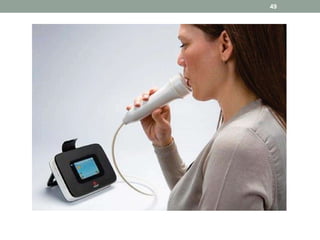
 Various handheld devices using the patient’s breath are available that include
an electrochemical sensor to determine the exhaled nitric oxide concentration.
 Fractional exhaled nitric oxide (FENO) results >50 parts per billion (ppb) in
adults and >35 ppb in children younger than 12 years of age indicate
eosinophilic inflammation with a high likelihood to respond to corticosteroids.
 As a monitoring test, FENO results are best interpreted as changes from
baseline for each patient rather than using population normal readings.
49
50
REFERENCE
1. Basic skills in interpreting laboratory data sixth edition, by MARY LEE, 315-
326.
2. www.hopkins medicine.org
3. https://my.clevelandclinic.org/health/diagnostics/22409-arterial-blood-gas-abg
THANK YOU!

PULMONARY FUNCTION TEST.pptx

  • 1.
    PULMONARY FUNCTION TEST AMEENAKADAR K A FIRST SEM M PHARM PHARMACY PRACTICE SANJO COLLEGE OF PHARMACEUTICAL STUDIES
  • 2.
    INTRODUCTION  Pulmonary functiontests (PFTs) provide objective and quantifiable measures of lung function and are useful in the diagnosis, evaluation, and monitoring of respiratory disease.  They are non invasive tests that show how well the lungs are working.  Diagnosis and monitoring of many pulmonary diseases, including diseases of gas exchange, often require measurement of the flow or volume of air inhaled and exhaled by the patient.  This information can help health care provider diagnosis and decide the treatment of certain lung disorders.  The purpose of the LUNGS is to take oxygen from the atmosphere and exchange it for carbon dioxide in the blood.  The movement of air in and out of the lungs is called ventilation; the movement of blood through the lungs is termed perfusion. 2
  • 3.
  • 4.
  • 5.
    5 LUNG VOLUMES &CAPACITIES
  • 6.
    6 1. TIDAL VOLUME(TV)  It is the amount of air inhaled or exhaled during normal breathing.  Tidal volume of an adult is about 500 ml. 2. INSPIRATORY RESERVE VOLUME (IRV)  It is the additional volume of air that can be inhaled into the lungs by a forced inspiration after a normal inspiration.  It is about 3.1 liters in male and 1.9 liters in females. 3. EXPIRATORY RESERVE VOLUME (ERV)  It is the volume of the air that can be exhaled from the lungs by forced expiration after a normal expiration.  It is about 1.2 liters in males and 700 ml in females.
  • 7.
    7 4. RESIDUAL VOLUME It is the volume of air that remains in the lungs following a maximal expiration.  It cannot be measured by spirometer. 5. VITAL CAPACITY  It is the maximum volume of air that can be breathed out of the lungs by forced expiration after a forced inspiration.  Vital capacity = Tidal volume + IRV + ERV.  For Males: 4800 ml  For Females: 3100 ml.  Vital capacity in athletes when compared to individuals who lead sedentary lifestyle is higher by 30-40%.
  • 8.
    8 6. INSPIRATORY CAPACITY It is the amount of air that can be breathed in by a forced expiration.  Inspiratory capacity = Tidal volume + IRV  For males: 3600ml  For females: 2400 ml. 7. FUNCTIONAL RESIDUAL CAPACITY  The amount of air left in lungs after a tidal breath out.  The amount of air that can be stay in lungs during normal breathing.  Sum of Residual volume + ERV.  For males: 2400ml  For females: 1800ml
  • 9.
    9 8. TOTAL LUNGCAPACITY  This is the total volume of the air in the lungs after a maximum inspiration.  Total Lung Capacity = Vital capacity + Residual volume  For males: 6 Liters  For females: 4.2 Liters 9. FORCED VITAL CAPACITY  It is the amount of air which can be forcibly exhaled from the lungs after taking the deepest breath possible.  It is used to determine both presence and severity of diseases.  For Males: 4.8 L  For Females: 3.7 L.
  • 10.
  • 11.
  • 12.
  • 13.
    13  USES OFPFT DIAGNOSIS Signs and symptoms of respiratory disease.  Follow up of laboratory findings  Disease effect on pulmonary function. EVALUATION Medical legal issues  Rehabilitation MONITORING Respiratory disease progression  Prognosis  Occupational or environmental exposure to toxins.  Therapeutic drug effectiveness.  Drug effects on pulmonary function.
  • 14.
    14 METHODS FOR PFT SPIROMETRY PEAKFLOW METER PLETHYSMOGRAPHY
  • 15.
    15 SPIROMETRY  A spirometeris a device with a mouthpiece hooked up to a small electronic machine.  Spirometry is a PFT that helps detect airway obstruction, manifested in asthma or COPD.  It measures the maximum amount of air that can be exhaled by the patient after complete inhalation.  It takes only 15-20 min .  Provides information about obstructive and restrictive disease.  Cornerstone of the laboratory evaluation to demonstrate airflow obstruction.  Allows the measurement of all lung volumes and capacities.
  • 16.
    16 PERFORMING A SPIROMETRYTEST  You will be asked to place a mouth piece attached to the spirometer in your mouth.  It is important to make a tight seal with your lips so all of the air will go into the spirometer to be measured.  You will also wear nose clips to keep air from leaking out of your nose. After breathing normally you will be asked to slowly blowout until your lungs are empty.  Then you will take a big, deep breath to fill up your lungs completely.  As soon as your lungs are full, you will blowout as hard and as fast as you can until your lungs are absolutely empty.  You will be asked to repeat the test until there are 3 good efforts.
  • 17.
    17 SPIROMETRY MEASURMENTS Spirometry routinelyassesses forced vital capacity (FVC), forced expiratory volume in one second (FEV1), and FEV1/FVC. FORCED VITAL CAPACITY  The FVC is the total volume of air, measured in liters, forcefully and rapidly exhaled in one breath (from maximum inhalation to maximum exhalation).  When the full inhalation-exhalation procedure is repeated slowly—instead of forcefully and rapidly—it is called the slow vital capacity (SVC).  This value is the maximum amount of air exhaled after a full and complete inhalation.  In patients with normal airway function, FVC and SVC are usually similar and constitute the vital capacity (VC).
  • 18.
    18  In patientswith diseases such as COPD, the FVC may be lower than the SVC due to collapse of narrowed or floppy airways during forced expiration.  Because of this, some interpretive strategies recommend using the FEV1/SVC ratio to determine the presence of airway obstruction especially for pronounced airflow limitation. FORCED EXPIRATORY VOLUME IN ONE SECOND  It is the volume of air (in liters) exhaled in the first second during forced exhalation after maximal inspiration.  Usually, a patient’s value is described in liters and as a percentage of a predicted value based on population normal values adjusted for age, height, and sex.  FEV1 has the most clinical relevance, primarily as an indicator of airway function.
  • 19.
    19  A value≥80% of the predicted normal value is considered normal.  Normal values are often seen in patients with reversible airway obstruction when the disease is mild or well controlled. FEV1/FVC  The ratio of FEV1 to the FVC is used to estimate the presence and amount of obstruction in the airways.  This ratio indicates the amount of air mobilized in one second as a percentage of the total amount of movable air.  Patients with obstructive disease usually show a decreased ratio, and the actual percentage reduction varies with the severity of obstruction.  In COPD, the Global Initiative for Chronic Obstructive Lung Disease (GOLD) guidelines define chronic airway obstruction as an FEV1/FVC ratio <70% for both men and women.
  • 20.
    20 • 85% -intermittent asthma. • >80% -mild to moderate asthma. • <75% - severe or very poorly controlled asthma • <70% -COPD  Spirometry alone is not sufficient to diagnose or assess asthma severity.  Frequency of asthma symptoms and quick-relief medication use is also necessary to assess asthma severity.  Generally, the FEV1/FVC is normal (or high) in patients with restrictive diseases.  In mild restriction, the FVC alone may be decreased resulting in a high ratio.  Often in restrictive lung disease, both the FVC and FEV1 are similarly reduced compared to predicted values resulting in a normal ratio.
  • 21.
    21 FORCED EXPIRATORY FLOW Forced expiratory flow (FEF) measures airflow rate during forced expiration.  Although FEV measures the volume of air per specific unit of time at the beginning of expiration, FEF measures the rate of air movement during a later portion.  The FEF from 25% to 75% of VC is known as FEF25–75.  This test is thought to measure the flow rate of air in the medium and small airways (bronchioles and terminal bronchioles), but it is not used clinically.  The flow from 75% to 100% of VC (i.e., the end of expiration) is called alveolar airflow.  This parameter may markedly diminish as airways collapse with increased intra- thoracic pressure.  Such pressure occurs in severe acute asthma when large obstructions are present in terminal bronchioles.
  • 22.
    22  Severity ofAirway Obstruction for Asthma and COPD Based on Spirometry Results
  • 23.
  • 24.
    24 PEAK EXPIRATORY FLOWRATE  PEFR obtained through the patient forcefully breathing out into a peak flow meter.  PEFR is best measured in early morning, before medication administration and again at midday (after taking medication).  Peak flow meters are designed for both pediatric and adult patients with PEFR between 60–400 L/min for children and between 60–850 L/min for adults.  PEFR is measured by having a patient perform the following steps: 1. Stand up. 2. Move the indicator on the peak flow meter to the end nearest the mouthpiece. 3. Hold the meter and avoid blocking the movement of the indicator and the holes on the end of the meter. 4. Take a deep breath in and then seal mouth around the mouthpiece.
  • 25.
    25 5. Blow outinto the meter as hard and as fast as possible without coughing into the meter (like blowing out candles on a cake). 6. Examine the indicator on the meter to identify the number corresponding to the peak flow measurement. 7. Repeat the test two more times (remembering to move the indicator to the base of the meter each time). 8. Record the highest value of the three measurements in a diary (readings in the morning and afternoon are ideal).
  • 26.
    26  It canbe measured at home.  PEFR is less accurate than spirometry because it measures more of the upper airway over a shorter period of time, and readings can vary depending on the patient’s efforts and meter type.  PEFR is not the preferred method for determining airflow obstruction.
  • 27.
    27 BODY PLETHYSMOGRAPHY  Itis a method used to obtain lung volume measures.  Lung volume tests indicate the amount of gas contained in the lungs at the various stages of inflation.  A patient sits in an airtight box and is told to inhale and exhale against a closed shutter.  Inside, a mouthpiece contains a pressure transducer.  This is done to measure the change in pressure within the box during respiration.  It senses the intra-thoracic pressure generated when the patient rapidly and forcefully puffs against the closed mouthpiece.  These data are then placed into the equation for boyle’s law: P1 × V1 = P2 × V2
  • 28.
    28 • P1 =pressure inside the box where the patient is seated (atmospheric pressure) • V1 = volume of the box • P2 = intra-thoracic pressure generated by the patient • V2 = calculated volume of the patient’s thoracic cavity. Because temperature (T1 and T2) is constant throughout testing, it is not included in the calculations.  By applying Boyle’s law, this test will provide a measure of the functional residual capacity (FRC) or the volume of gas remaining at the end of a normal breath.  Once the FRC is determined, the other lung volumes and capacities can be calculated based on this FRC and volumes obtained in static spirometry.  After these data are generated, the patient’s plethysmography results are usually compared to references from a presumed normal population.
  • 29.
  • 30.
    30 BRONCHODILATOR REVERSIBILITY TEST One of many tests that may be useful in the diagnostic workup of asthma is spirometry with reversibility.  Before the testing day, the patient is asked to (1) hold certain inhalers and medications that will influence the testing results. (2) perform spirometry immediately before and 15–30 minutes after the administration of an inhaled, short-acting β2-adrenergic agonist.  The ATS (American Thoracic Society) defines a positive bronchodilator response using changes in either the FEV1 or the FVC using the percent increase and the increase in the volume exhaled after using a bronchodilator from baseline.  A positive bronchodilator response is defined as an improvement of the FEV1 and FVC by at least 12% and 200 mL from baseline.
  • 31.
    31  The GlobalInitiative for Asthma defines airway reversibility in adults as an increase in FEV1 of at least 12% and 200 mL from baseline, with more confidence of a positive test with an increase in FEV1 of at least 15% and 400 mL from baseline.  For children, an increase of at least 12% of predicted for the FEV1 is considered positive.
  • 32.
    32 DIFFUSION CAPACITY TESTS Tests of gas exchange measure the ability of gases to cross (diffuse) the alveolar- capillary membrane and are useful in assessing interstitial lung disease.  Typically, these tests measure the per minute transfer of a gas, usually carbon monoxide (CO), from the alveoli to the blood.  CO is used because it is a gas that is not normally present in the lung, has a high affinity for Hgb in red blood cells, and is easily delivered and measured.  The diffusion capacity may be lessened following losses in the surface area of the alveoli or thickening of the alveolar capillary membrane.  Membrane thickening may be due to infiltration of inflammatory cells or fibrotic changes.  The diffusion capacity of the lungs to CO can be measured by either a single- breath test or steady-state test.
  • 33.
  • 34.
    34  These diffusioncapacity test are useful for assessing gas exchange.  A normal DLCO (Diffusing Capacity Of The Lungs For Carbon Monoxide) is considered ≥70% of the predicted value for the patient.  Diffusion capacity is decreased in diseases that cause alveolar fibrotic changes.  Changes may be idiopathic, such as those seen with sarcoidosis or environmental or occupational disease (asbestosis and silicosis), or be induced by drugs (e.g., nitrofurantoin, amiodarone, and bleomycin).  An increase in this volume (pulmonary edema or asthma) may increase the DLCO.
  • 35.
    35 ARTERIAL BLOOD GASANALYSIS (ABG ANALYSIS)  An arterial blood gas (ABG) test is a blood test that requires a sample from an artery in your body to measure the levels of oxygen and carbon dioxide in your blood.  The test also checks the balance of acids and bases, known as the pH balance, in your blood. What is measured in an arterial blood gas test? 1. Oxygen content (O2CT): This measures the amount of oxygen in your blood. 2. Hemoglobin: This measures the amount of hemoglobin, the protein responsible for carrying oxygen to your cells, in your blood. 3. Oxygen saturation (O2Sat): This measures how much hemoglobin in your blood is carrying oxygen. Hemoglobin is a protein in your red blood cells that carries oxygen from your lungs to the rest of your body.
  • 36.
    36 4. Partial pressureof oxygen (PaO2): This measures the pressure of oxygen dissolved in your blood. It helps show how well oxygen moves from your lungs to your bloodstream. 5. Partial pressure of carbon dioxide (PaCO2): This measures the amount of carbon dioxide in your blood and how well carbon dioxide can move out of your body. 6. pH: This measures the balance of acids and bases in your blood, known as your blood pH level. The pH of blood is usually between 7.35 and 7.45. If it’s lower than that, your blood is considered too acidic. If it’s higher than that range, your blood is considered too basic (alkaline). 7. Bicarbonate (HCO3): This is calculated using the measured values of pH and PaCO2 to determine the amount of the basic compound made from carbon dioxide (CO2.)
  • 37.
  • 38.
    38  Healthcare providersevaluate several conditions using an ABG, including: 1. Acute respiratory distress syndrome (ARDS 2. Severe sepsis 3. Hypovolemic shock 4. Diabetes-related ketoacidosis (DKA) 5. Renal tubular acidosis (RTA) 6. Acute respiratory failure 7. Acute heart failure 8. Cardiac arrest 9. Asthma attack. 10. Inborn errors of metabolism. 11. Asthma. 12. Chronic obstructive pulmonary disease (COPD). 13. Cystic fibrosis.
  • 39.
    39 BRONCHIAL PROVOCATION CHALLENGETEST  BPT measure the reactivity of the airways to known concentrations of agents that induce airway narrowing.  Airways are challenged with increase in doses of a provoking agent until a desired drop in lung function occur.  Agents used include methacholine, histamine, adenosine, and specific allergens.  During BPT the patient may experience transient respiratory symptoms such as cough, shortness of breath, wheezing and chest tightness.  An inhaled short acting β2 agonists or anticholinergic agent may be administered to alleviate symptoms and quicken the return of the FEV1 to the baseline.
  • 40.
    40  It producessevere, life threatening bronchospasm, trained personnel and medication to treat severe bronchospasm should be in the test area.  Used to diagnose the asthma when more tests (spirometry, symptoms) cannot confirm .  In this magnitude and duration of different drugs effects on airways may be compared. EXERCISE CHALLENGE TESTING  Exercise challenge testing is used to confirm or rule out exerciseinduced bronchospasm (EIB) and to evaluate the effectiveness of medications used to treat or prevent EIB, which occurs usually in patients with normal PFTs who become symptomatic with exercise.  Mainly due to the rapid cooling and drying of the airways during exercise.
  • 41.
    41  Tests aredone by treadmill or an electromagnetically braked cycle ergometer.  After the exercise is completed, the patient does serial spirometry at five-minute intervals for 20–30 minutes.  FEV1 is the primary outcome variable.  A 10% or more decrease in FEV1 from baseline is generally accepted as an abnormal response, although some clinicians feel a 15% decrease is more diagnostic of EIB.
  • 42.
    42 SIX MINUTE WALKTEST  It is the distance a patient can walk on a flat, hard surface in 6 min.  Correlate to the patient quality of life and abilities to complete daily activities.  Help to predict morbidity and mortality in CHF patients, COPD and pulmonary hypertension.  500-630 meters in normal healthy adults & 470 meters in 4-11 years old children.  Test results are improved by, Younger age Male gender Taller height Longer Corridor length Less weight Encouragement
  • 43.
    43  Used tomonitor the amount of oxygen needed with exertion.  Patients with mild to moderate pulmonary disease may have normal oxygen saturation at rest and poor saturation with exertion.  An oxygen saturation of 88% or lower indicates the need for supplement oxygen. CARBON MONOXIDE BREATH TEST  Carbon monoxide easily binds with hemoglobin causing shortness of breath and fatigue.  Using hand held CO meter, a smoker can see how much CO is in the body (ppm) and in the blood (%COHgb).  1-2 ppm or less indicates a non smoker in clinical practice, 10 ppm or less is often indicates a non smoker.  The test is an objective value that patients can visually see the effects of inhaling smoke with higher values of CO detected. After 8–12 hours without smoking, CO levels become undetectable.
  • 44.
    44 INFLAMMATORY MARKERS  Airwayinflammation is involved in a number of diseases.  Inflammatory markers are used to identify these airway inflammation.  Inflammatory markers involves 3 methods: Bronchial alveolar lavage Induced sputum Fractional exhaled nitric oxide(NO)
  • 45.
    45 BRONCHIAL ALVEOLAR LAVAGE Method of collecting the cells or proteins found in pulmonary secretions for measurement.  Samples are attained during the bronchoscopy.  It is the direct visualization of the lumen of the airway.  A small amount of warmed, buffered ,and sterile normal saline solution is flushed into the airways and then drawn back out and send to the laboratory analysis.  Mainly looks the cellular components and proteins in the airways.  Cells including eosinophil, mast cells, neutrophil, macrophages etc., and proteins include histamine & subcellular components etc.
  • 46.
  • 47.
  • 48.
    48 FRACTIONAL EXHALED NITRICOXIDE  Measurement of exhaled concentrations of nitric oxide (NO) is a noninvasive biomarker test of airway inflammation for both diagnosing and monitoring eosinophilic airway inflammation.  Various handheld devices using the patient’s breath are available that include an electrochemical sensor to determine the exhaled nitric oxide concentration.  Fractional exhaled nitric oxide (FENO) results >50 parts per billion (ppb) in adults and >35 ppb in children younger than 12 years of age indicate eosinophilic inflammation with a high likelihood to respond to corticosteroids.  As a monitoring test, FENO results are best interpreted as changes from baseline for each patient rather than using population normal readings.
  • 49.
  • 50.
    50 REFERENCE 1. Basic skillsin interpreting laboratory data sixth edition, by MARY LEE, 315- 326. 2. www.hopkins medicine.org 3. https://my.clevelandclinic.org/health/diagnostics/22409-arterial-blood-gas-abg THANK YOU!