 Muscles are red, fleshy mass of the body 
located under deep fascia. 
 The muscles are also found in heart and in 
various organs like stomach, intestine, 
urinogenital organs and also in blood 
vessels.
 Muscle is a contractile tissue which 
brings about movements. 
 Muscles can be regarded as motors of 
body. 
 Study of muscle is called General 
myology.
TYPES OF MUSCULAR 
TISSUES 
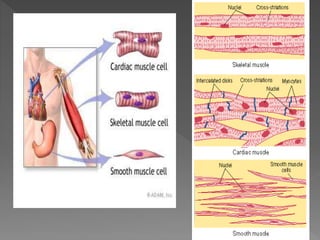
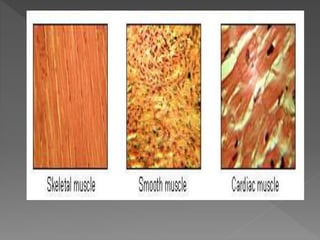
• Smooth Muscle tissue 
• Cardiac Muscle tissue 
• Skeletal Muscle tissue
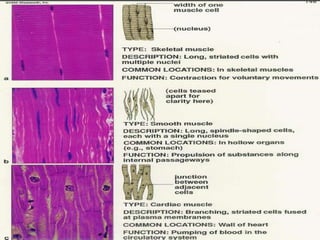
 Smkuellteitnaul c(vleoaltuendt acryyli n&d srtirciaalt esdtr)u mctuusrcelse hfiabveirnsg a are c lear display of longitudinal and cross striations. 
 Skeletal muscle or "voluntary muscle" is anchored tboybteonndeoannsd( oisr ubsyeda ptoo neeffuercots siskealte ata flemwo pvleamceesn) t such tahsilso pcoosmtuortaiol ncoanntdr oinl i ms gaeinntearianlilny gm paoinsttuarine.e Tdh aosu ag h tsou bccoonnscscioiouus sc roenftlreoxl, ltihkee mnounsc-lpeos srteusrpaol nmsiubslcel erse.a Actn amvuesrcalgee a anddu altn m aavleer aisg me aaddue lut pfe omf a4le2 %is omf asdkee luepta ol f 36% (as a percentage of body mass) 
 Skeletal muscle fibers is striated, or striped and is under control of the individual’s will. 
 For this reason, it is often called “voluntary” muscle tissue.
 Skeletal muscle tissues are usually attached to 
bones. That is known as osseous tissues which 
is innervated with somatic nerves through 
which volitional control is performed. 
 When muscle fibers are stimulated by an 
action of a never fiber, the fibers contract 
and relax. 
 This interaction between muscle and nerve 
fibers produces movement. 
 It can perform works of rapid, powerful 
contraction as well as that of prolonged slow 
sustained tonic contraction.
Musculoskeletal system: comprises 
those muscles that have an attachment 
to skeletal system. 
 There are over 600 muscles in the 
musculoskeletal system. 
 Axial skeleton muscles: control facial 
expression; mastication; eye; tongue 
and neck movements; respiration; the 
abdominal wall; pelvic region; 
movement of the vertebral column. 
 Appendicular skeletal muscles: include 
the pectoral girdle, pelvic girdle, and 
upper and lower extremities.
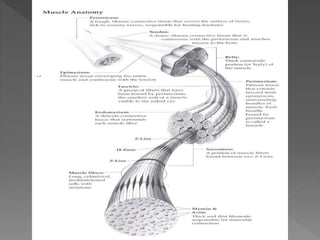
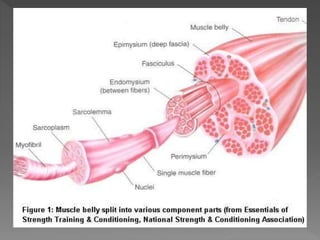
1. Muscle Belly: The fleshy bulging, central part of a muscle. 
2. Muscle fiber: A cylindrical, multinucleate cell composed of numerous myofibrils that 
contracts when stimulated. 
3. Myofibrils: A myofibril is a basic unit of a muscle. Muscles are composed of tubular cells 
called myocytes or myofibers. Myofibers are composed of tubular myofibrils. Myofibrils 
are composed of long proteins such as actin, myosin, and titin, and other proteins that 
hold them together. 
 Myofilaments: Myofilaments, the filaments of myofibrils constructed from proteins. The 
principal types of muscle are striated muscle, obliquely striated muscle and smooth 
muscle. Various arrangements of myofilaments create different muscles. S has transverse 
bands of filaments. In obliquely striated muscle, the filaments are staggered, and 
smooth muscle has irregular arrangements of filaments. 
 There are three different types of myofilaments: thick, thin, and elastic filaments. 
 Thick filaments consist primarily of the protein myosin. Each thick filament are 
approximately 15 nm in diameter, and each is made of several hundred molecules 
of myosin. 
 Thin filaments, 7 nm in diameter, consist primarily of the protein actin. All thin filaments 
are attached the Z disc. 
 Elastic filaments, 1 nm in diameter, are made of titin, a large springy protein. They flank 
each thick filament and anchor it to the Z disc, the end point of a sarcomere. 
1. Origin 
2. Insertion 
3. Tendon 
4. Aponeurosis
9. Epimysium 
10. Perimysium 
11. Endomysium 
12. Sarcomere 
13. Sarcolemma 
14. Sarcoplasm 
15. Sarcoplasmic reticulum 
16. Motor nerve 
17. Motor end-plate 
18. Neurovascular hilum 
19. Motor point 
20. Myotome
21. Dermatome 
22. Prime movers 
23. Antagonists 
24. Fixators 
25. Synergists
Arrangement of fibers Shape 
• The arrangement of muscle fibers varies according to the 
direction, force and range of habitual movement at a 
particular joint. 
• The force of movement is directly proportional to the 
number and size of muscle fibers and range of movement 
is directly proportional to length of muscle fibers.
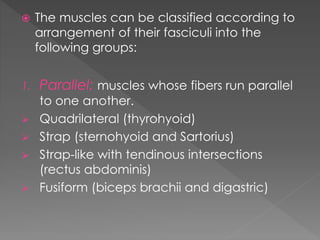
 The muscles can be classified according to 
arrangement of their fasciculi into the 
following groups: 
1. Parallel: muscles whose fibers run parallel 
to one another. 
 Quadrilateral (thyrohyoid) 
 Strap (sternohyoid and Sartorius) 
 Strap-like with tendinous intersections 
(rectus abdominis) 
 Fusiform (biceps brachii and digastric)
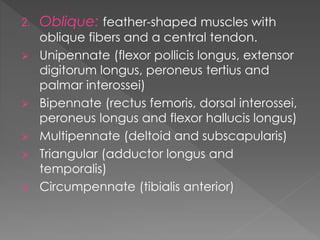
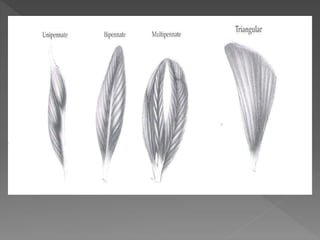
2. Oblique: feather-shaped muscles with 
oblique fibers and a central tendon. 
 Unipennate (flexor pollicis longus, extensor 
digitorum longus, peroneus tertius and 
palmar interossei) 
 Bipennate (rectus femoris, dorsal interossei, 
peroneus longus and flexor hallucis longus) 
 Multipennate (deltoid and subscapularis) 
 Triangular (adductor longus and 
temporalis) 
 Circumpennate (tibialis anterior)
3. Circular: muscles whose 
fibers encompass an 
opening. 
 Sphincter radial 
4. Convergent: fan-shaped 
muscle fibers at 
the origin that converge 
at the insertion point. 
 tricipital

Know about Muscular tissue

  • 2.
     Muscles arered, fleshy mass of the body located under deep fascia.  The muscles are also found in heart and in various organs like stomach, intestine, urinogenital organs and also in blood vessels.
  • 4.
     Muscle isa contractile tissue which brings about movements.  Muscles can be regarded as motors of body.  Study of muscle is called General myology.
  • 5.
    TYPES OF MUSCULAR TISSUES • Smooth Muscle tissue • Cardiac Muscle tissue • Skeletal Muscle tissue
  • 10.
     Smkuellteitnaul c(vleoaltuendtacryyli n&d srtirciaalt esdtr)u mctuusrcelse hfiabveirnsg a are c lear display of longitudinal and cross striations.  Skeletal muscle or "voluntary muscle" is anchored tboybteonndeoannsd( oisr ubsyeda ptoo neeffuercots siskealte ata flemwo pvleamceesn) t such tahsilso pcoosmtuortaiol ncoanntdr oinl i ms gaeinntearianlilny gm paoinsttuarine.e Tdh aosu ag h tsou bccoonnscscioiouus sc roenftlreoxl, ltihkee mnounsc-lpeos srteusrpaol nmsiubslcel erse.a Actn amvuesrcalgee a anddu altn m aavleer aisg me aaddue lut pfe omf a4le2 %is omf asdkee luepta ol f 36% (as a percentage of body mass)  Skeletal muscle fibers is striated, or striped and is under control of the individual’s will.  For this reason, it is often called “voluntary” muscle tissue.
  • 11.
     Skeletal muscletissues are usually attached to bones. That is known as osseous tissues which is innervated with somatic nerves through which volitional control is performed.  When muscle fibers are stimulated by an action of a never fiber, the fibers contract and relax.  This interaction between muscle and nerve fibers produces movement.  It can perform works of rapid, powerful contraction as well as that of prolonged slow sustained tonic contraction.
  • 13.
    Musculoskeletal system: comprises those muscles that have an attachment to skeletal system.  There are over 600 muscles in the musculoskeletal system.  Axial skeleton muscles: control facial expression; mastication; eye; tongue and neck movements; respiration; the abdominal wall; pelvic region; movement of the vertebral column.  Appendicular skeletal muscles: include the pectoral girdle, pelvic girdle, and upper and lower extremities.
  • 16.
    1. Muscle Belly:The fleshy bulging, central part of a muscle. 2. Muscle fiber: A cylindrical, multinucleate cell composed of numerous myofibrils that contracts when stimulated. 3. Myofibrils: A myofibril is a basic unit of a muscle. Muscles are composed of tubular cells called myocytes or myofibers. Myofibers are composed of tubular myofibrils. Myofibrils are composed of long proteins such as actin, myosin, and titin, and other proteins that hold them together.  Myofilaments: Myofilaments, the filaments of myofibrils constructed from proteins. The principal types of muscle are striated muscle, obliquely striated muscle and smooth muscle. Various arrangements of myofilaments create different muscles. S has transverse bands of filaments. In obliquely striated muscle, the filaments are staggered, and smooth muscle has irregular arrangements of filaments.  There are three different types of myofilaments: thick, thin, and elastic filaments.  Thick filaments consist primarily of the protein myosin. Each thick filament are approximately 15 nm in diameter, and each is made of several hundred molecules of myosin.  Thin filaments, 7 nm in diameter, consist primarily of the protein actin. All thin filaments are attached the Z disc.  Elastic filaments, 1 nm in diameter, are made of titin, a large springy protein. They flank each thick filament and anchor it to the Z disc, the end point of a sarcomere. 1. Origin 2. Insertion 3. Tendon 4. Aponeurosis
  • 19.
    9. Epimysium 10.Perimysium 11. Endomysium 12. Sarcomere 13. Sarcolemma 14. Sarcoplasm 15. Sarcoplasmic reticulum 16. Motor nerve 17. Motor end-plate 18. Neurovascular hilum 19. Motor point 20. Myotome
  • 20.
    21. Dermatome 22.Prime movers 23. Antagonists 24. Fixators 25. Synergists
  • 21.
    Arrangement of fibersShape • The arrangement of muscle fibers varies according to the direction, force and range of habitual movement at a particular joint. • The force of movement is directly proportional to the number and size of muscle fibers and range of movement is directly proportional to length of muscle fibers.
  • 22.
     The musclescan be classified according to arrangement of their fasciculi into the following groups: 1. Parallel: muscles whose fibers run parallel to one another.  Quadrilateral (thyrohyoid)  Strap (sternohyoid and Sartorius)  Strap-like with tendinous intersections (rectus abdominis)  Fusiform (biceps brachii and digastric)
  • 24.
    2. Oblique: feather-shapedmuscles with oblique fibers and a central tendon.  Unipennate (flexor pollicis longus, extensor digitorum longus, peroneus tertius and palmar interossei)  Bipennate (rectus femoris, dorsal interossei, peroneus longus and flexor hallucis longus)  Multipennate (deltoid and subscapularis)  Triangular (adductor longus and temporalis)  Circumpennate (tibialis anterior)
  • 26.
    3. Circular: muscleswhose fibers encompass an opening.  Sphincter radial 4. Convergent: fan-shaped muscle fibers at the origin that converge at the insertion point.  tricipital