Pulmonary Function Tests
Dr. C. C. Chemonges
Arterial Blood Gases (ABGs)
Definition:
Measurement of oxygen and carbon dioxide levels in arterial blood.
Components:
pH, PaO2, PaCO2, HCO3-, SaO2.
Clinical Significance:
Assessment of respiratory and metabolic status.
Mixed Venous Blood Gases
Definition:
Measurement of oxygen and carbon dioxide levels in mixed venous blood.
Components:
SvO2 (mixed venous oxygen saturation).
Clinical Significance:
Evaluation of oxygen extraction and utilization.
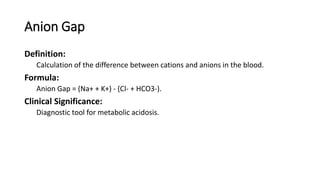
Anion Gap
Definition:
Calculation of the difference between cations and anions in the blood.
Formula:
Anion Gap = (Na+ + K+) - (Cl- + HCO3-).
Clinical Significance:
Diagnostic tool for metabolic acidosis.
Angiotensin-Converting Enzyme (ACE)
Function:
Conversion of angiotensin I to angiotensin II.
Clinical Significance:
Used in the diagnosis and monitoring of sarcoidosis.
Other Roles:
Regulation of blood pressure and electrolyte balance.
Lactic Acid
Definition:
Measurement of lactic acid levels in the blood.
Types:
L-lactate (Lactic acid) and D-lactate.
Clinical Significance:
Indication of tissue hypoxia and metabolic stress.
Indications and Interpretations
When to Perform These Tests:
Clinical scenarios and symptoms.
Interpretation Guidelines:
Normal ranges and values for each test.
Integration into Patient Care:
How results influence diagnosis and treatment decisions.
PULMONARY FUNCTION TEST
PFT
• Pulmonary function tests (PFTs) are a group of tests that
measure how well your lungs works, how well the lungs take
in and exhale air, and how efficiently they transfer oxygen
into the blood
• PFT or LFT are useful in assessing the functional status of
the respiratory system both in physiological and pathological
condition
• It is based on the measurement of volumes of air breathed
in and out in normal breathing and forced breathing
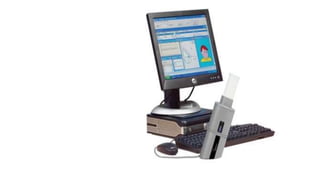
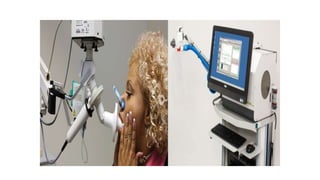
• It is carried out by using a spirometer
Lung volume and capacities
• Lung volumes are the static volumes of air breathed by an individual,
i.e volume of air present in lung under specific position of the thorax
• 4 lung volumes
• Depends on age, weight, gender and body position
• 2 or more vol: when combined are capacity
Lung volumes
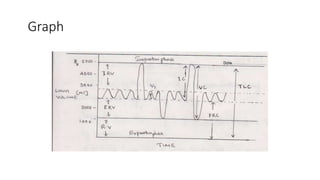
• TV-the vol: of gas exchanged during a relaxed insp:
followed by an exp: 500ml
• IRV-extra vol: of gas that can be inspired above tidal insp:
3000ml
• ERV-extra vol: of gas that can be expired after a normal
tidal exp: 1000ml
• RV-vol: of gas remain in lungs after a forceful exp: 1500ml
• IC-max: amount of gas inspired in to the lungs after a
normal tidal exp: [IC=TV+IRV] 3500ml
• FRC-amount of gas remain in the lungs after normal exp:[
FRC=ERV+RV] 2500ml
• VC-max: amount of gas expired from the lungs after a max:
insp: [VC=IRV+TV+ ERV] 4500ml
• TLC-max: amount of gas inspired to expand the lungs to its
max:extend [TLC=TV+IRV +ERV +RV] 6000ml
Lung capacity
Graph
Mechanics of Breathing
• Inspiration
Active process
• Expiration
Quiet breathing: passive
Can become active
Pulmonary Function Tests Evaluates 1 or more major
aspects of the respiratory system
• Lung volumes
• Airway function
• Gas exchange
Indications/purpose
• Detect disease, It serve as a diagnostic tool investigation
role
• Evaluate severity, extent and monitor the course of disease
• Evaluate treatment
• Measure effects and result of treatment exposures
PFTs can help diagnose
• Asthma
• Chronic bronchitis
• Respiratory infections
• Lung fibrosis
• Bronchiectasis
• Allergy
• Emphysema
• Cystic fibrosis
• Asbestosis which is a condition caused by exposure to
asbestos
• Sarcoidosis, which is an inflammation of the lungs, liver,
lymph nodes, eyes, skin, or other tissues
• Pulmonary tumors
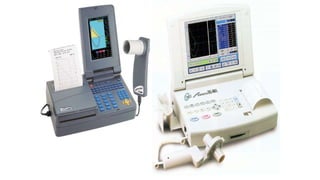
Spirometry
• It is an instrument for measuring the air capacity of the
lungs
• Measurement of the pattern of air movement in and out of
the lungs during controlled ventilatory maneuvers.
• spirometer is used to measure the air flow, ventilatory
regulation, ventilatory mechanics and lung volume during a
forced expiratory maneuver from full inspiration.
• PFT used to evaluate physiological aspect of breathing from
respiratory muscle function to the diffusion of gas at the
alveolar wall.
• PFT helps physiotherapists to distinguish between
obstructive and restrictive lung problem and to select
appropriate treatment
• It also measures the effect of the given treatment.
Lung Factors Affecting Spirometry
• Mechanical properties
• Resistive elements
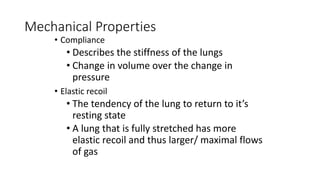
Mechanical Properties
• Compliance
• Describes the stiffness of the lungs
• Change in volume over the change in
pressure
• Elastic recoil
• The tendency of the lung to return to it’s
resting state
• A lung that is fully stretched has more
elastic recoil and thus larger/ maximal flows
of gas
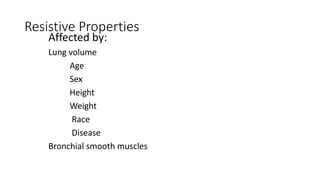
Resistive Properties
Affected by:
Lung volume
Age
Sex
Height
Weight
Race
Disease
Bronchial smooth muscles
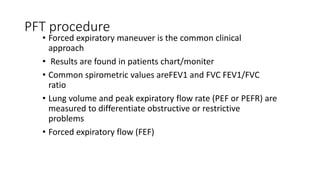
PFT procedure
• Forced expiratory maneuver is the common clinical
approach
• Results are found in patients chart/moniter
• Common spirometric values areFEV1 and FVC FEV1/FVC
ratio
• Lung volume and peak expiratory flow rate (PEF or PEFR) are
measured to differentiate obstructive or restrictive
problems
• Forced expiratory flow (FEF)
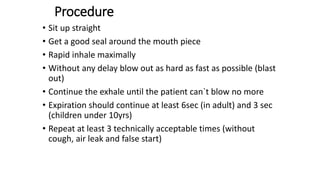
• Sit up straight
• Get a good seal around the mouth piece
• Rapid inhale maximally
• Without any delay blow out as hard as fast as possible (blast
out)
• Continue the exhale until the patient can`t blow no more
• Expiration should continue at least 6sec (in adult) and 3 sec
(children under 10yrs)
• Repeat at least 3 technically acceptable times (without
cough, air leak and false start)
Procedure
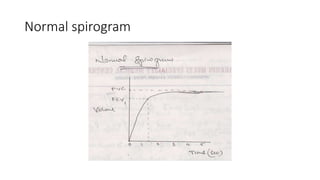
Normal spirogram
How to interpret abnormal PFT
• If FVC & FEV1 is less than 80% (total vol:of air expelling is approx: 80%
within 1sec ie; FEV1), this suggests either an obstructive/ restrictive
lung pathology.
Forced expiratory volume in 1 second (FEV1)
• FEV1 is the volume of air that can forcibly be blown out in
one second, after full inspiration.
• Average values for FEV1 in healthy people depend mainly
on sex and age height and mass.
• Values between 80% and 120% are considered normal.
Forced vital capacity (FVC)
• Forced vital capacity(FVC) is the volume of air that can forcibly be
blown out after full inspiration
FEV1/FVC ratio (FEV1%)
• FEV1/FVC (FEV1%) is the ratio of FEV1 to FVC. In healthy adults this
should be approximately 75–80%.
Forced expiratory flow (FEF)
• Forced expiratory flow (FEF) is the flow (or speed) of air
coming out of the lung during the middle portion of a forced
expiration.
• generally defined by fraction, The usual intervals are 25%,
50% and 75% (FEF25, FEF50 and FEF75)
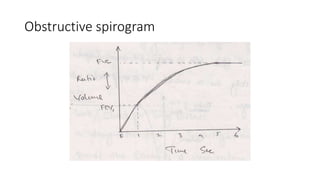
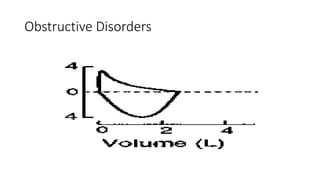
Identify an obstructive problem
• Obstructive disorders (asthma, COPD)
- air flow reduces because of narrowing of air ways
-FEV1 is reduced
• Spirogram is continued to 6 sec to empty lung, FVC also reduced
because gas is trapped behind the obstructed bronchi
• Cardinal feature of obstructive defect is reduction in the FEV1/FVC
ratio
• In obstructive diseases (asthma, COPD, chronic bronchitis,
emphysema) FEV1 is diminished because of increased airway
resistance to expiratory flow.
• The FVC may be decreased due to the premature closure of
airway in expiration
• This generates a reduced value (<80%, often 45%).
60-80% -mild
40-60% -moderate
<40% -severe obstructions
Obstructive spirogram
Obstructive Disorders
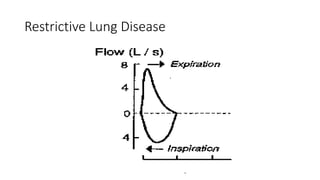
Restrictive problem
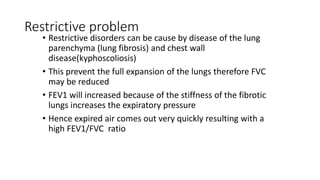
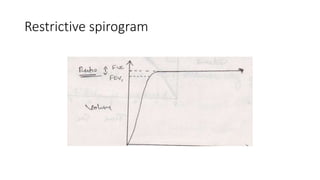
• Restrictive disorders can be cause by disease of the lung
parenchyma (lung fibrosis) and chest wall
disease(kyphoscoliosis)
• This prevent the full expansion of the lungs therefore FVC
may be reduced
• FEV1 will increased because of the stiffness of the fibrotic
lungs increases the expiratory pressure
• Hence expired air comes out very quickly resulting with a
high FEV1/FVC ratio
Restrictive spirogram
Restrictive Lung Disease
References
1. Carl A. Burtis, David E. Bruns (2023) Tietz Fundamentals of Clinical
Chemistry, 9th Ed.
2. Lawrence A. Kaplan, Amadeo J. Pesce (2009) Clinical Chemistry:
Theory, Analysis,Correlation, 5 th Ed.
3. Robert L. Sunheimer (2010) Clinical Laboratory Chemistry.

Pulmonary Function Tests-Nursing Maseno.pptx

  • 1.
  • 2.
    Arterial Blood Gases(ABGs) Definition: Measurement of oxygen and carbon dioxide levels in arterial blood. Components: pH, PaO2, PaCO2, HCO3-, SaO2. Clinical Significance: Assessment of respiratory and metabolic status.
  • 3.
    Mixed Venous BloodGases Definition: Measurement of oxygen and carbon dioxide levels in mixed venous blood. Components: SvO2 (mixed venous oxygen saturation). Clinical Significance: Evaluation of oxygen extraction and utilization.
  • 4.
    Anion Gap Definition: Calculation ofthe difference between cations and anions in the blood. Formula: Anion Gap = (Na+ + K+) - (Cl- + HCO3-). Clinical Significance: Diagnostic tool for metabolic acidosis.
  • 5.
    Angiotensin-Converting Enzyme (ACE) Function: Conversionof angiotensin I to angiotensin II. Clinical Significance: Used in the diagnosis and monitoring of sarcoidosis. Other Roles: Regulation of blood pressure and electrolyte balance.
  • 6.
    Lactic Acid Definition: Measurement oflactic acid levels in the blood. Types: L-lactate (Lactic acid) and D-lactate. Clinical Significance: Indication of tissue hypoxia and metabolic stress.
  • 7.
    Indications and Interpretations Whento Perform These Tests: Clinical scenarios and symptoms. Interpretation Guidelines: Normal ranges and values for each test. Integration into Patient Care: How results influence diagnosis and treatment decisions.
  • 9.
  • 10.
    PFT • Pulmonary functiontests (PFTs) are a group of tests that measure how well your lungs works, how well the lungs take in and exhale air, and how efficiently they transfer oxygen into the blood
  • 11.
    • PFT orLFT are useful in assessing the functional status of the respiratory system both in physiological and pathological condition • It is based on the measurement of volumes of air breathed in and out in normal breathing and forced breathing • It is carried out by using a spirometer
  • 14.
    Lung volume andcapacities • Lung volumes are the static volumes of air breathed by an individual, i.e volume of air present in lung under specific position of the thorax • 4 lung volumes • Depends on age, weight, gender and body position • 2 or more vol: when combined are capacity
  • 15.
    Lung volumes • TV-thevol: of gas exchanged during a relaxed insp: followed by an exp: 500ml • IRV-extra vol: of gas that can be inspired above tidal insp: 3000ml • ERV-extra vol: of gas that can be expired after a normal tidal exp: 1000ml • RV-vol: of gas remain in lungs after a forceful exp: 1500ml
  • 16.
    • IC-max: amountof gas inspired in to the lungs after a normal tidal exp: [IC=TV+IRV] 3500ml • FRC-amount of gas remain in the lungs after normal exp:[ FRC=ERV+RV] 2500ml • VC-max: amount of gas expired from the lungs after a max: insp: [VC=IRV+TV+ ERV] 4500ml • TLC-max: amount of gas inspired to expand the lungs to its max:extend [TLC=TV+IRV +ERV +RV] 6000ml Lung capacity
  • 17.
  • 18.
    Mechanics of Breathing •Inspiration Active process • Expiration Quiet breathing: passive Can become active Pulmonary Function Tests Evaluates 1 or more major aspects of the respiratory system • Lung volumes • Airway function • Gas exchange
  • 19.
    Indications/purpose • Detect disease,It serve as a diagnostic tool investigation role • Evaluate severity, extent and monitor the course of disease • Evaluate treatment • Measure effects and result of treatment exposures
  • 20.
    PFTs can helpdiagnose • Asthma • Chronic bronchitis • Respiratory infections • Lung fibrosis • Bronchiectasis • Allergy
  • 21.
    • Emphysema • Cysticfibrosis • Asbestosis which is a condition caused by exposure to asbestos • Sarcoidosis, which is an inflammation of the lungs, liver, lymph nodes, eyes, skin, or other tissues • Pulmonary tumors
  • 22.
    Spirometry • It isan instrument for measuring the air capacity of the lungs • Measurement of the pattern of air movement in and out of the lungs during controlled ventilatory maneuvers. • spirometer is used to measure the air flow, ventilatory regulation, ventilatory mechanics and lung volume during a forced expiratory maneuver from full inspiration.
  • 24.
    • PFT usedto evaluate physiological aspect of breathing from respiratory muscle function to the diffusion of gas at the alveolar wall. • PFT helps physiotherapists to distinguish between obstructive and restrictive lung problem and to select appropriate treatment • It also measures the effect of the given treatment.
  • 25.
    Lung Factors AffectingSpirometry • Mechanical properties • Resistive elements
  • 26.
    Mechanical Properties • Compliance •Describes the stiffness of the lungs • Change in volume over the change in pressure • Elastic recoil • The tendency of the lung to return to it’s resting state • A lung that is fully stretched has more elastic recoil and thus larger/ maximal flows of gas
  • 27.
    Resistive Properties Affected by: Lungvolume Age Sex Height Weight Race Disease Bronchial smooth muscles
  • 28.
    PFT procedure • Forcedexpiratory maneuver is the common clinical approach • Results are found in patients chart/moniter • Common spirometric values areFEV1 and FVC FEV1/FVC ratio • Lung volume and peak expiratory flow rate (PEF or PEFR) are measured to differentiate obstructive or restrictive problems • Forced expiratory flow (FEF)
  • 29.
    • Sit upstraight • Get a good seal around the mouth piece • Rapid inhale maximally • Without any delay blow out as hard as fast as possible (blast out) • Continue the exhale until the patient can`t blow no more • Expiration should continue at least 6sec (in adult) and 3 sec (children under 10yrs) • Repeat at least 3 technically acceptable times (without cough, air leak and false start) Procedure
  • 30.
  • 31.
    How to interpretabnormal PFT • If FVC & FEV1 is less than 80% (total vol:of air expelling is approx: 80% within 1sec ie; FEV1), this suggests either an obstructive/ restrictive lung pathology.
  • 32.
    Forced expiratory volumein 1 second (FEV1) • FEV1 is the volume of air that can forcibly be blown out in one second, after full inspiration. • Average values for FEV1 in healthy people depend mainly on sex and age height and mass. • Values between 80% and 120% are considered normal.
  • 33.
    Forced vital capacity(FVC) • Forced vital capacity(FVC) is the volume of air that can forcibly be blown out after full inspiration
  • 34.
    FEV1/FVC ratio (FEV1%) •FEV1/FVC (FEV1%) is the ratio of FEV1 to FVC. In healthy adults this should be approximately 75–80%.
  • 35.
    Forced expiratory flow(FEF) • Forced expiratory flow (FEF) is the flow (or speed) of air coming out of the lung during the middle portion of a forced expiration. • generally defined by fraction, The usual intervals are 25%, 50% and 75% (FEF25, FEF50 and FEF75)
  • 36.
    Identify an obstructiveproblem • Obstructive disorders (asthma, COPD) - air flow reduces because of narrowing of air ways -FEV1 is reduced • Spirogram is continued to 6 sec to empty lung, FVC also reduced because gas is trapped behind the obstructed bronchi • Cardinal feature of obstructive defect is reduction in the FEV1/FVC ratio
  • 37.
    • In obstructivediseases (asthma, COPD, chronic bronchitis, emphysema) FEV1 is diminished because of increased airway resistance to expiratory flow. • The FVC may be decreased due to the premature closure of airway in expiration • This generates a reduced value (<80%, often 45%). 60-80% -mild 40-60% -moderate <40% -severe obstructions
  • 38.
  • 39.
  • 40.
    Restrictive problem • Restrictivedisorders can be cause by disease of the lung parenchyma (lung fibrosis) and chest wall disease(kyphoscoliosis) • This prevent the full expansion of the lungs therefore FVC may be reduced • FEV1 will increased because of the stiffness of the fibrotic lungs increases the expiratory pressure • Hence expired air comes out very quickly resulting with a high FEV1/FVC ratio
  • 41.
  • 42.
  • 43.
    References 1. Carl A.Burtis, David E. Bruns (2023) Tietz Fundamentals of Clinical Chemistry, 9th Ed. 2. Lawrence A. Kaplan, Amadeo J. Pesce (2009) Clinical Chemistry: Theory, Analysis,Correlation, 5 th Ed. 3. Robert L. Sunheimer (2010) Clinical Laboratory Chemistry.