CASE PRESENTATION 
Sharmin Susiwala
Name: Dixit Hasmukhbhai Sabhani 
Age: 6 yrs 3 months Gender: Male 
DOB: 21st Oct, 2007 
Weight: 15.9 kg 
Head Circumference: 47 cm Height/ Length: 
Address: Katargam 
Chief complaint: 
–Unable to walk 
–Falls frequently while walking 
–Unable to speak
HISTORY: 
Prenatal History= 
 His mother Mrs Joshanaben Sabhani was 22 years old when she got married. 
 She conceived 5 times. 
 5th time- Dixit. 
 Confirmation of pregnancy was done through missed periods. 
 Didnt undertook any antenatal checkups. 
 No H/O infection or fever 
 No H/O trauma or stress 
 No co-morbid conditions present 
 Proper Weight Gain 
 No H/O any addiction.
Natal History= 
 Term: 36 weeks+2 days 
 Place of delivery: Hospital 
 Time of delivery: 7:00 pm 
 Type of delivery: Normal 
 Presentation: Head first 
 Birth weight: 2.5 kg 
Postnatal History= 
 Delayed birth cry- 5 min 
 H/O meconium stained liquor aspiration 
 Cyanosis 
 NICU admission- 5 days
 Around 4-5 months, Mother observed that 
Baby is not doing any activity at all 
Not keeping his head in midline 
Head was completely laging 
 Around 6-7 months, she observed that 
Dixit used to sleep more on right side 
Uses his left side little less than right 
 At 7 month- Ahemadabad to consult Dr. Darshana Naik. 
Dr. told parents that dixit's brain has been damaged. 
Investigation: EEG 
Dr advised for PT so they stayed there for 1 week. 
 Returned to surat- 
Started PT at Ayurvedic Hospital for 2 years 
During this time, he achieved head control and sitting with support 
Discontinued PT after 2 years.
 At home 
Mother used to give massage 
Continued for 1 year 
 When dixit was 3 years old, 
Their neighbour referred them to some Dr near their residence for 
exercise 
She took dixit there and continued for 2 and 1/2 years 
During this time, he achieved standing with support 
 When dixit was 5 and 1/2 years old, he started coming to our 
department.
 Before 6 months, he got attack of seizure. 
1. On 28 Aug 2013, at 2:00 pm- had high grade fever 
Attack: There was sudden contraction of his limbs (L>R), eyeballs 
rolling and frothing at the mouth followed by unconsciousness. On 
the way to the hospital, he soiled himself. 
Lasted for 10 min 
1. On 23 Nov 2013, at 10-11 pm- deep sleep 
Attack: Sudden contraction and relaxation of his limbs (L>R), eyeballs 
rolling, deviation of face to one side and frothing at the mouth. 
Lasted for 15 min
3. At night- he was conscious 
Attack: Little less intensity. Lasted for 15 min. 
4. On 17th Jan 2014 in afternoon-while watching TV 
Attack: Rapid contraction and relaxation of limb muscles (L>R). No 
frothing at the mouth. Lasted for 10 min.
DIFFERENTIAL DIAGNOSIS: 
• Developmental Delay 
• Hypoxic Ischemic Encephalopathy 
• Hemiplegic CP
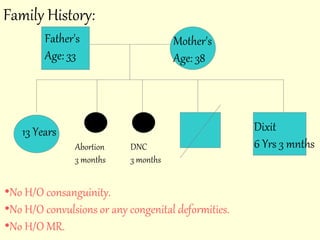
Family History: 
Father's 
Age: 33 
Mother's 
Age: 38 
13 Years Dixit 
Abortion DNC 
6 Yrs 3 mnths 
3 months 
3 months 
•No H/O consanguinity. 
•No H/O convulsions or any congenital deformities. 
•No H/O MR.
Socio-Economic Status: Fair 
Feeding History: 
• All types of food given. 
• No preference to any particular food. 
• Able to swallow normally. 
• He is able to chew from both sides but comparatively less on 
left side.
ON OBSERVATION: 
Posture and Movement: 
1. Supine: 
• Head in midline. 
• Attempts to look around him. 
• Midline Activities- Present 
• Eye Hand coordination- not very accurate 
• Tracks objects vertically and horizontally 
• Rib Flaring- Absent 
• Transitions- Supine- Sidelying- Side-Sitting
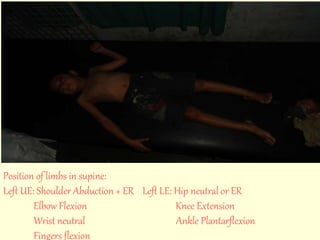
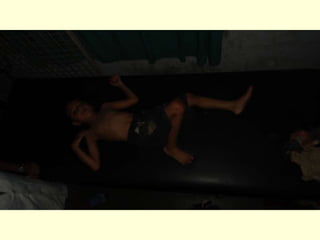
Position of limbs in supine: 
Left UE: Shoulder Abduction + ER Left LE: Hip neutral or ER 
Elbow Flexion Knee Extension 
Wrist neutral Ankle Plantarflexion 
Fingers flexion
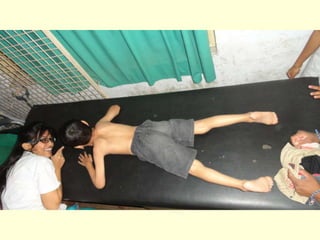
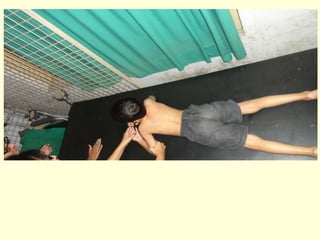
2. Prone: 
• Head Control is present 
• Point of support- mostly chest and upper abdomen 
• Weightbearing on forearm 
• Trunk Extension- for a short period 
• Position of limbs: 
Left UE: Shoulder abduction + IR Right UE: Shoulder abduction + IR 
Elbow Flexion Elbow Flexion 
Forearm Pronation Forearm Pronation 
Fingers flexed Fingers Extended 
LEs are placed away from each other. 
• Transition:
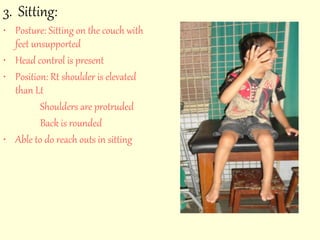
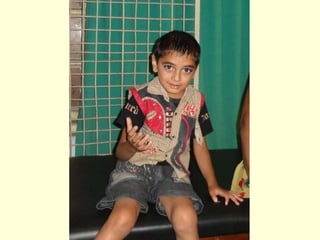
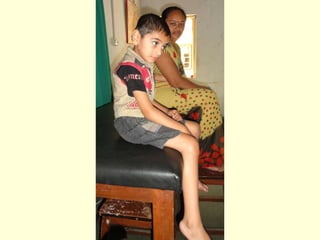
3. Sitting: 
• Posture: Sitting on the couch with 
feet unsupported 
• Head control is present 
• Position: Rt shoulder is elevated 
than Lt 
Shoulders are protruded 
Back is rounded 
• Able to do reach outs in sitting
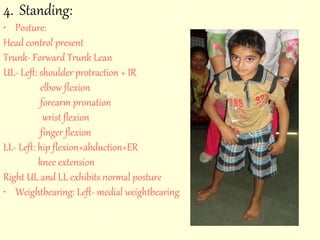
4. Standing: 
• Posture: 
Head control present 
Trunk- Forward Trunk Lean 
UL- Left: shoulder protraction + IR 
elbow flexion 
forearm pronation 
wrist flexion 
finger flexion 
LL- Left: hip flexion+abduction+ER 
knee extension 
Right UL and LL exhibits normal posture 
• Weightbearing: Left- medial weightbearing
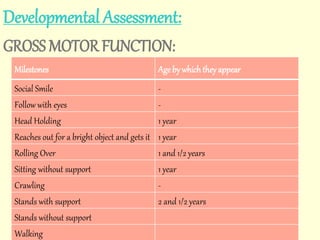
Developmental Assessment: 
GROSS MOTOR FUNCTION: 
Milestones Age by which they appear 
Social Smile - 
Follow with eyes - 
Head Holding 1 year 
Reaches out for a bright object and gets it 1 year 
Rolling Over 1 and 1/2 years 
Sitting without support 1 year 
Crawling - 
Stands with support 2 and 1/2 years 
Stands without support 
Walking
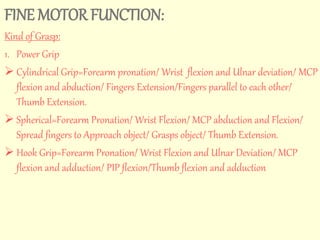
FINE MOTOR FUNCTION: 
Kind of Grasp: 
1. Power Grip 
 Cylindrical Grip=Forearm pronation/ Wrist flexion and Ulnar deviation/ MCP 
flexion and abduction/ Fingers Extension/Fingers parallel to each other/ 
Thumb Extension. 
 Spherical=Forearm Pronation/ Wrist Flexion/ MCP abduction and Flexion/ 
Spread fingers to Approach object/ Grasps object/ Thumb Extension. 
 Hook Grip=Forearm Pronation/ Wrist Flexion and Ulnar Deviation/ MCP 
flexion and adduction/ PIP flexion/Thumb flexion and adduction
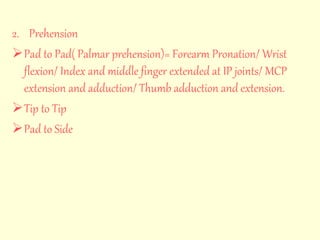
2. Prehension 
Pad to Pad( Palmar prehension)= Forearm Pronation/ Wrist 
flexion/ Index and middle finger extended at IP joints/ MCP 
extension and adduction/ Thumb adduction and extension. 
Tip to Tip 
Pad to Side
ON EXAMINATION 
1. SENSORY SYSTEM: 
Touch 
Normal 
Pain 
2. MOTOR SYSTEM: 
• Joint ROM- Passively full 
• Tone- Normal 
• Clonus- Absent
• Primitive Reflexes: 
Neonatal - Sucking 
Rooting 
Swallowing 
UL and LL placing 
Automatic Walking 
Moro's Reflex 
Grasp 
Spinal level - Flexor Withdrawal- Present 
Integrated 
Extensor Thrust- Present 
Crossed Extensor Thrust- Integrated
Brainstem level - ATNR 
STNR 
TLR 
Positive supporting- Present 
Negative Supporting 
Midbrain level - Optical- Present 
Labyrinthine 
Neck Righting 
Body on Body 
Automatic Reactions- Landau's Reflex- Integrated 
Gallant's trunk incurvatum- Integrated 
Parachute- Present
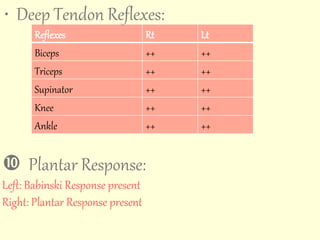
• Deep Tendon Reflexes: 
Reflexes Rt Lt 
Biceps ++ ++ 
Triceps ++ ++ 
Supinator ++ ++ 
Knee ++ ++ 
Ankle ++ ++ 
 Plantar Response: 
Left: Babinski Response present 
Right: Plantar Response present
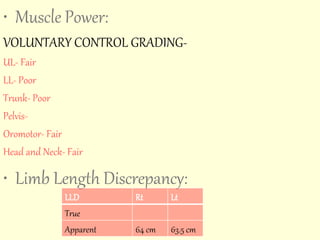
• Muscle Power: 
VOLUNTARY CONTROL GRADING-UL- 
Fair 
LL- Poor 
Trunk- Poor 
Pelvis- 
Oromotor- Fair 
Head and Neck- Fair 
• Limb Length Discrepancy: 
LLD Rt Lt 
True 
Apparent 64 cm 63.5 cm
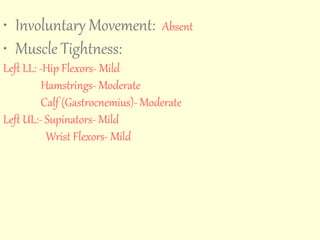
• Involuntary Movement: Absent 
• Muscle Tightness: 
Left LL: -Hip Flexors- Mild 
Hamstrings- Moderate 
Calf (Gastrocnemius)- Moderate 
Left UL:- Supinators- Mild 
Wrist Flexors- Mild
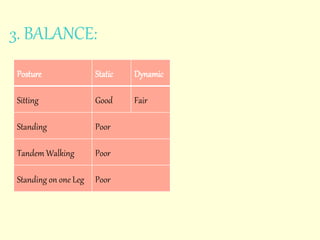
3. BALANCE: 
Posture Static Dynamic 
Sitting Good Fair 
Standing Poor 
Tandem Walking Poor 
Standing on one Leg Poor
4. GAIT EXAMINATION:
5. COGNITVE EVALUATION: 
• Behaviour: 
Alert but sometimes irritable. 
No self- injurious behaviour present. 
Sense of common danger such as fire. 
• Attention: Good 
• Emotional Status: Abnormal 
• Cooperation in ADL skills: Poor 
• Indication for micturition: Absent 
• Sleep: Normal
6. SPECIAL SENSES: 
• Vision: 
Attempts to look around. 
Shifts his vision from one person to another. 
• Auditory: 
Turns head in direction of sound. 
Able to hear. 
• Verbal: 
Communicates with mother through Mono-syllables. 
Understands anything spoken to him. 
Indication of need through gestures, sounds or finger pointing.
PROBLEM LIST 
• Weakness of left side of body 
• Difficulty with walking 
• Difficulty with balance during standing and walking 
• Difficulty in performing gross and fine motor tasks 
• Behavioural problems
PROVISIONAL DIAGNOSIS 
• Weakness of left side of body with difficulty in walking
PLAN OF TREATMENT 
• Aims: 
Muscle Re-education 
Strengthening of weak muscles 
Preventing Contractures and deformities 
Improve balance 
To improve efficiency of gait 
Enhancement of hand Function 
Improve Functional Skills 
Parental Counselling

Case presentation- A Pediatric Neurological case..!!

  • 1.
  • 2.
    Name: Dixit HasmukhbhaiSabhani Age: 6 yrs 3 months Gender: Male DOB: 21st Oct, 2007 Weight: 15.9 kg Head Circumference: 47 cm Height/ Length: Address: Katargam Chief complaint: –Unable to walk –Falls frequently while walking –Unable to speak
  • 3.
    HISTORY: Prenatal History=  His mother Mrs Joshanaben Sabhani was 22 years old when she got married.  She conceived 5 times.  5th time- Dixit.  Confirmation of pregnancy was done through missed periods.  Didnt undertook any antenatal checkups.  No H/O infection or fever  No H/O trauma or stress  No co-morbid conditions present  Proper Weight Gain  No H/O any addiction.
  • 4.
    Natal History= Term: 36 weeks+2 days  Place of delivery: Hospital  Time of delivery: 7:00 pm  Type of delivery: Normal  Presentation: Head first  Birth weight: 2.5 kg Postnatal History=  Delayed birth cry- 5 min  H/O meconium stained liquor aspiration  Cyanosis  NICU admission- 5 days
  • 5.
     Around 4-5months, Mother observed that Baby is not doing any activity at all Not keeping his head in midline Head was completely laging  Around 6-7 months, she observed that Dixit used to sleep more on right side Uses his left side little less than right  At 7 month- Ahemadabad to consult Dr. Darshana Naik. Dr. told parents that dixit's brain has been damaged. Investigation: EEG Dr advised for PT so they stayed there for 1 week.  Returned to surat- Started PT at Ayurvedic Hospital for 2 years During this time, he achieved head control and sitting with support Discontinued PT after 2 years.
  • 6.
     At home Mother used to give massage Continued for 1 year  When dixit was 3 years old, Their neighbour referred them to some Dr near their residence for exercise She took dixit there and continued for 2 and 1/2 years During this time, he achieved standing with support  When dixit was 5 and 1/2 years old, he started coming to our department.
  • 7.
     Before 6months, he got attack of seizure. 1. On 28 Aug 2013, at 2:00 pm- had high grade fever Attack: There was sudden contraction of his limbs (L>R), eyeballs rolling and frothing at the mouth followed by unconsciousness. On the way to the hospital, he soiled himself. Lasted for 10 min 1. On 23 Nov 2013, at 10-11 pm- deep sleep Attack: Sudden contraction and relaxation of his limbs (L>R), eyeballs rolling, deviation of face to one side and frothing at the mouth. Lasted for 15 min
  • 8.
    3. At night-he was conscious Attack: Little less intensity. Lasted for 15 min. 4. On 17th Jan 2014 in afternoon-while watching TV Attack: Rapid contraction and relaxation of limb muscles (L>R). No frothing at the mouth. Lasted for 10 min.
  • 9.
    DIFFERENTIAL DIAGNOSIS: •Developmental Delay • Hypoxic Ischemic Encephalopathy • Hemiplegic CP
  • 10.
    Family History: Father's Age: 33 Mother's Age: 38 13 Years Dixit Abortion DNC 6 Yrs 3 mnths 3 months 3 months •No H/O consanguinity. •No H/O convulsions or any congenital deformities. •No H/O MR.
  • 11.
    Socio-Economic Status: Fair Feeding History: • All types of food given. • No preference to any particular food. • Able to swallow normally. • He is able to chew from both sides but comparatively less on left side.
  • 12.
    ON OBSERVATION: Postureand Movement: 1. Supine: • Head in midline. • Attempts to look around him. • Midline Activities- Present • Eye Hand coordination- not very accurate • Tracks objects vertically and horizontally • Rib Flaring- Absent • Transitions- Supine- Sidelying- Side-Sitting
  • 13.
    Position of limbsin supine: Left UE: Shoulder Abduction + ER Left LE: Hip neutral or ER Elbow Flexion Knee Extension Wrist neutral Ankle Plantarflexion Fingers flexion
  • 15.
    2. Prone: •Head Control is present • Point of support- mostly chest and upper abdomen • Weightbearing on forearm • Trunk Extension- for a short period • Position of limbs: Left UE: Shoulder abduction + IR Right UE: Shoulder abduction + IR Elbow Flexion Elbow Flexion Forearm Pronation Forearm Pronation Fingers flexed Fingers Extended LEs are placed away from each other. • Transition:
  • 18.
    3. Sitting: •Posture: Sitting on the couch with feet unsupported • Head control is present • Position: Rt shoulder is elevated than Lt Shoulders are protruded Back is rounded • Able to do reach outs in sitting
  • 22.
    4. Standing: •Posture: Head control present Trunk- Forward Trunk Lean UL- Left: shoulder protraction + IR elbow flexion forearm pronation wrist flexion finger flexion LL- Left: hip flexion+abduction+ER knee extension Right UL and LL exhibits normal posture • Weightbearing: Left- medial weightbearing
  • 24.
    Developmental Assessment: GROSSMOTOR FUNCTION: Milestones Age by which they appear Social Smile - Follow with eyes - Head Holding 1 year Reaches out for a bright object and gets it 1 year Rolling Over 1 and 1/2 years Sitting without support 1 year Crawling - Stands with support 2 and 1/2 years Stands without support Walking
  • 25.
    FINE MOTOR FUNCTION: Kind of Grasp: 1. Power Grip  Cylindrical Grip=Forearm pronation/ Wrist flexion and Ulnar deviation/ MCP flexion and abduction/ Fingers Extension/Fingers parallel to each other/ Thumb Extension.  Spherical=Forearm Pronation/ Wrist Flexion/ MCP abduction and Flexion/ Spread fingers to Approach object/ Grasps object/ Thumb Extension.  Hook Grip=Forearm Pronation/ Wrist Flexion and Ulnar Deviation/ MCP flexion and adduction/ PIP flexion/Thumb flexion and adduction
  • 26.
    2. Prehension Padto Pad( Palmar prehension)= Forearm Pronation/ Wrist flexion/ Index and middle finger extended at IP joints/ MCP extension and adduction/ Thumb adduction and extension. Tip to Tip Pad to Side
  • 27.
    ON EXAMINATION 1.SENSORY SYSTEM: Touch Normal Pain 2. MOTOR SYSTEM: • Joint ROM- Passively full • Tone- Normal • Clonus- Absent
  • 28.
    • Primitive Reflexes: Neonatal - Sucking Rooting Swallowing UL and LL placing Automatic Walking Moro's Reflex Grasp Spinal level - Flexor Withdrawal- Present Integrated Extensor Thrust- Present Crossed Extensor Thrust- Integrated
  • 29.
    Brainstem level -ATNR STNR TLR Positive supporting- Present Negative Supporting Midbrain level - Optical- Present Labyrinthine Neck Righting Body on Body Automatic Reactions- Landau's Reflex- Integrated Gallant's trunk incurvatum- Integrated Parachute- Present
  • 30.
    • Deep TendonReflexes: Reflexes Rt Lt Biceps ++ ++ Triceps ++ ++ Supinator ++ ++ Knee ++ ++ Ankle ++ ++  Plantar Response: Left: Babinski Response present Right: Plantar Response present
  • 31.
    • Muscle Power: VOLUNTARY CONTROL GRADING-UL- Fair LL- Poor Trunk- Poor Pelvis- Oromotor- Fair Head and Neck- Fair • Limb Length Discrepancy: LLD Rt Lt True Apparent 64 cm 63.5 cm
  • 32.
    • Involuntary Movement:Absent • Muscle Tightness: Left LL: -Hip Flexors- Mild Hamstrings- Moderate Calf (Gastrocnemius)- Moderate Left UL:- Supinators- Mild Wrist Flexors- Mild
  • 33.
    3. BALANCE: PostureStatic Dynamic Sitting Good Fair Standing Poor Tandem Walking Poor Standing on one Leg Poor
  • 34.
  • 35.
    5. COGNITVE EVALUATION: • Behaviour: Alert but sometimes irritable. No self- injurious behaviour present. Sense of common danger such as fire. • Attention: Good • Emotional Status: Abnormal • Cooperation in ADL skills: Poor • Indication for micturition: Absent • Sleep: Normal
  • 36.
    6. SPECIAL SENSES: • Vision: Attempts to look around. Shifts his vision from one person to another. • Auditory: Turns head in direction of sound. Able to hear. • Verbal: Communicates with mother through Mono-syllables. Understands anything spoken to him. Indication of need through gestures, sounds or finger pointing.
  • 37.
    PROBLEM LIST •Weakness of left side of body • Difficulty with walking • Difficulty with balance during standing and walking • Difficulty in performing gross and fine motor tasks • Behavioural problems
  • 38.
    PROVISIONAL DIAGNOSIS •Weakness of left side of body with difficulty in walking
  • 39.
    PLAN OF TREATMENT • Aims: Muscle Re-education Strengthening of weak muscles Preventing Contractures and deformities Improve balance To improve efficiency of gait Enhancement of hand Function Improve Functional Skills Parental Counselling