CARDIAC TAMPONADE 
Prepared By: 
Sharmin Susiwala
INTRODUCTION 
“Cardiac tamponade, also known as pericardial tamponade, is an 
acute type of pericardial effusion in which fluid accumulates in the 
pericardium leads to pressure on the heart muscle which 
occurs when the pericardial space fills up with fluid faster than the 
pericardial sac can stretch.” 
 Cardiac tamponade is a clinical syndrome caused by the 
accumulation of fluid in the pericardial space, resulting in reduced 
ventricular filling and subsequent hemodynamic compromise. 
 The condition is a medical emergency
ETIOLOGY 
 For all patients, malignant diseases are the most common cause of 
pericardial tamponade 
Malignant diseases - 30-60% of cases 
 Tamponade can occur as a result of any type of pericarditis. 
Pericarditis can result from the following: 
Human immunodeficiency virus (HIV) infection 
 Infection - Viral, bacterial (tuberculosis), fungal
 Other causes are: 
Trauma to the chest(either penetrating trauma involving the 
pericardium or blunt chest trauma) 
Drugs - Hydralazine, procainamide, isoniazid, minoxidil 
Postcoronary intervention - Ie, coronary dissection and perforation 
Acupuncture 
Postcardiac percutaneous procedures – 
- Including mitral valvuloplasty 
- atrial septal defect (ASD) closure 
- left atrial appendage occlusion
 Cardiovascular surgery - Postoperative pericarditis 
 Postmyocardial infarction - Free wall ventricular rupture, Dressler 
syndrome 
 Connective tissue diseases - Systemic lupus erythematosus, 
rheumatoid arthritis, dermatomyositis 
 Radiation therapy to the chest 
 Iatrogenic – 
- After sternal biopsy 
- transvenous pacemaker lead implantation 
- pericardiocentesis 
- central line insertion 
- In first 24 to 48 hours after heart surgery. After heart surgery, chest 
tubes are placed to drain blood. These chest tubes, however, are 
prone to clot formation. When a chest tube becomes occluded or 
clogged, the blood that should be drained can accumulate around 
the heart, leading to tamponade.
 Anticoagulation treatment 
 Idiopathic pericarditis 
 Complication of surgery at the esophagogastric junction - Eg, 
antireflux surgery 
 Pneumopericardium - Due to mechanical ventilation or 
gastropericardial fistula 
 Hypothyroidism 
 Still disease 
 Duchenne muscular dystrophy 
 Type A aortic dissection
PATHOPHYSIOLOGY 
 The outer layer of the heart is made of fibrous tissue which 
does not easily stretch, and so once fluid begins to enter 
the pericardial space, pressure starts to increase. 
 If fluid continues to accumulate, then with each successive 
diastolic period less and less blood enters the 
ventricles the increasing pressure presses on the 
heart and forces the septum to bend into the left ventricle 
leading to decreased stroke volume 
 This causes obstructive shock to develop, and if left 
untreated then cardiac arrest may occur
SYMPTOMS 
 Dyspnea,Tachycardia,Tachypnea 
 Dizziness, drowsiness, or palpitations 
 Cold, clammy extremities 
 H/0 Malignancy – weight loss, fatigue, anorexia 
 Chest pain – pericarditis, MI 
 MS pain – Fever , connective tissue disorder 
 Renal failure – uremia 
 Medications – drug related lupus 
 Recent cardiovascular surgery, coronary intervention, or 
trauma 
 Recent procedure – pacemaker, central line 
 TB – night sweats, fever 
 Radiation – cancer history
PHYSICAL EXAMINATION 
 Beck triad 
 Described in 1935, this complex of physical findings, 
also called the acute compression triad. 
 Refers to increased jugular venous pressure, 
hypotension, and diminished heart sounds. 
 These findings result from a rapid accumulation of 
pericardial fluid. 
 This classic triad is usually observed in patients with 
acute cardiac tamponade.
 Tachycardia 
 Distant or muffled heart sounds 
 Hepatomegaly 
 Evidence of chest wall trauma 
 Pulsus paradoxsus > 12 mm Hg 
 Pulsus paradoxus (or paradoxical pulse) is an exaggeration (>12 
mm Hg or 9%) of the normal inspiratory decrease in systemic 
blood pressure. 
 Kussmaul sign - paradoxical increase in venous distention and 
pressure during inspiration 
 Abolished y descent
DIAGNOSIS 
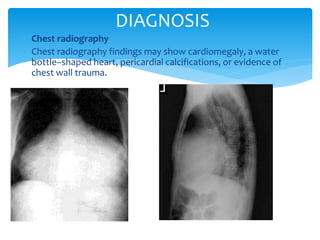
 Chest radiography 
 Chest radiography findings may show cardiomegaly, a water 
bottle–shaped heart, pericardial calcifications, or evidence of 
chest wall trauma.
 CT scanning 
 Reveals compression of the coronary sinus an earlier marker for cardiac 
tamponade in 46% of patients. 
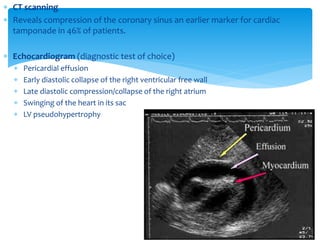
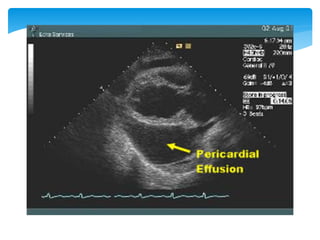
 Echocardiogram (diagnostic test of choice) 
 Pericardial effusion 
 Early diastolic collapse of the right ventricular free wall 
 Late diastolic compression/collapse of the right atrium 
 Swinging of the heart in its sac 
 LV pseudohypertrophy
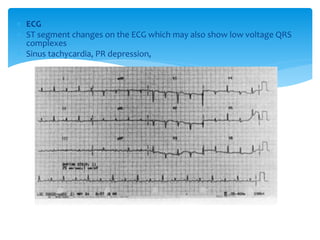
 ECG 
 ST segment changes on the ECG which may also show low voltage QRS 
complexes 
 Sinus tachycardia, PR depression,
 Pulse Oximetry 
 Respiratory variability in pulse-oximetry waveform is noted 
in patients with pulsus paradoxus. 
 Lab Studies
TREATMENT 
 Pre-hospital care 
 Initial treatment given will usually be supportive in nature. 
 Oxygen 
 Volume expansion with blood, plasma, or saline to 
maintain adequate intravascular volume 
 Bed rest with leg elevation 
- This may help increase venous return. 
 Inotropic drugs (i.e. dobutamine) 
- Choose inotropes that do not increase systemic vascular 
resistance while increasing cardiac output.
Hospital management 
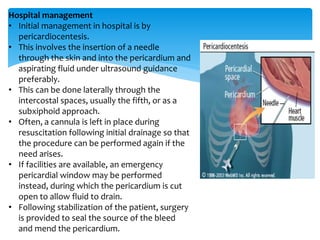
• Initial management in hospital is by 
pericardiocentesis. 
• This involves the insertion of a needle 
through the skin and into the pericardium and 
aspirating fluid under ultrasound guidance 
preferably. 
• This can be done laterally through the 
intercostal spaces, usually the fifth, or as a 
subxiphoid approach. 
• Often, a cannula is left in place during 
resuscitation following initial drainage so that 
the procedure can be performed again if the 
need arises. 
• If facilities are available, an emergency 
pericardial window may be performed 
instead, during which the pericardium is cut 
open to allow fluid to drain. 
• Following stabilization of the patient, surgery 
is provided to seal the source of the bleed 
and mend the pericardium.
COMPLICATIONS 
 Cardiogenic shock 
 AMI 
 Arrhythmia 
 Heart failure 
 Aneurysm 
 Carditis 
 Embolism 
 Rupture

Cardiac tamponade-Pericardial Effusion...

  • 1.
    CARDIAC TAMPONADE PreparedBy: Sharmin Susiwala
  • 2.
    INTRODUCTION “Cardiac tamponade,also known as pericardial tamponade, is an acute type of pericardial effusion in which fluid accumulates in the pericardium leads to pressure on the heart muscle which occurs when the pericardial space fills up with fluid faster than the pericardial sac can stretch.”  Cardiac tamponade is a clinical syndrome caused by the accumulation of fluid in the pericardial space, resulting in reduced ventricular filling and subsequent hemodynamic compromise.  The condition is a medical emergency
  • 3.
    ETIOLOGY  Forall patients, malignant diseases are the most common cause of pericardial tamponade Malignant diseases - 30-60% of cases  Tamponade can occur as a result of any type of pericarditis. Pericarditis can result from the following: Human immunodeficiency virus (HIV) infection  Infection - Viral, bacterial (tuberculosis), fungal
  • 4.
     Other causesare: Trauma to the chest(either penetrating trauma involving the pericardium or blunt chest trauma) Drugs - Hydralazine, procainamide, isoniazid, minoxidil Postcoronary intervention - Ie, coronary dissection and perforation Acupuncture Postcardiac percutaneous procedures – - Including mitral valvuloplasty - atrial septal defect (ASD) closure - left atrial appendage occlusion
  • 5.
     Cardiovascular surgery- Postoperative pericarditis  Postmyocardial infarction - Free wall ventricular rupture, Dressler syndrome  Connective tissue diseases - Systemic lupus erythematosus, rheumatoid arthritis, dermatomyositis  Radiation therapy to the chest  Iatrogenic – - After sternal biopsy - transvenous pacemaker lead implantation - pericardiocentesis - central line insertion - In first 24 to 48 hours after heart surgery. After heart surgery, chest tubes are placed to drain blood. These chest tubes, however, are prone to clot formation. When a chest tube becomes occluded or clogged, the blood that should be drained can accumulate around the heart, leading to tamponade.
  • 6.
     Anticoagulation treatment  Idiopathic pericarditis  Complication of surgery at the esophagogastric junction - Eg, antireflux surgery  Pneumopericardium - Due to mechanical ventilation or gastropericardial fistula  Hypothyroidism  Still disease  Duchenne muscular dystrophy  Type A aortic dissection
  • 7.
    PATHOPHYSIOLOGY  Theouter layer of the heart is made of fibrous tissue which does not easily stretch, and so once fluid begins to enter the pericardial space, pressure starts to increase.  If fluid continues to accumulate, then with each successive diastolic period less and less blood enters the ventricles the increasing pressure presses on the heart and forces the septum to bend into the left ventricle leading to decreased stroke volume  This causes obstructive shock to develop, and if left untreated then cardiac arrest may occur
  • 8.
    SYMPTOMS  Dyspnea,Tachycardia,Tachypnea  Dizziness, drowsiness, or palpitations  Cold, clammy extremities  H/0 Malignancy – weight loss, fatigue, anorexia  Chest pain – pericarditis, MI  MS pain – Fever , connective tissue disorder  Renal failure – uremia  Medications – drug related lupus  Recent cardiovascular surgery, coronary intervention, or trauma  Recent procedure – pacemaker, central line  TB – night sweats, fever  Radiation – cancer history
  • 9.
    PHYSICAL EXAMINATION Beck triad  Described in 1935, this complex of physical findings, also called the acute compression triad.  Refers to increased jugular venous pressure, hypotension, and diminished heart sounds.  These findings result from a rapid accumulation of pericardial fluid.  This classic triad is usually observed in patients with acute cardiac tamponade.
  • 10.
     Tachycardia Distant or muffled heart sounds  Hepatomegaly  Evidence of chest wall trauma  Pulsus paradoxsus > 12 mm Hg  Pulsus paradoxus (or paradoxical pulse) is an exaggeration (>12 mm Hg or 9%) of the normal inspiratory decrease in systemic blood pressure.  Kussmaul sign - paradoxical increase in venous distention and pressure during inspiration  Abolished y descent
  • 11.
    DIAGNOSIS  Chestradiography  Chest radiography findings may show cardiomegaly, a water bottle–shaped heart, pericardial calcifications, or evidence of chest wall trauma.
  • 12.
     CT scanning  Reveals compression of the coronary sinus an earlier marker for cardiac tamponade in 46% of patients.  Echocardiogram (diagnostic test of choice)  Pericardial effusion  Early diastolic collapse of the right ventricular free wall  Late diastolic compression/collapse of the right atrium  Swinging of the heart in its sac  LV pseudohypertrophy
  • 14.
     ECG ST segment changes on the ECG which may also show low voltage QRS complexes  Sinus tachycardia, PR depression,
  • 15.
     Pulse Oximetry  Respiratory variability in pulse-oximetry waveform is noted in patients with pulsus paradoxus.  Lab Studies
  • 16.
    TREATMENT  Pre-hospitalcare  Initial treatment given will usually be supportive in nature.  Oxygen  Volume expansion with blood, plasma, or saline to maintain adequate intravascular volume  Bed rest with leg elevation - This may help increase venous return.  Inotropic drugs (i.e. dobutamine) - Choose inotropes that do not increase systemic vascular resistance while increasing cardiac output.
  • 17.
    Hospital management •Initial management in hospital is by pericardiocentesis. • This involves the insertion of a needle through the skin and into the pericardium and aspirating fluid under ultrasound guidance preferably. • This can be done laterally through the intercostal spaces, usually the fifth, or as a subxiphoid approach. • Often, a cannula is left in place during resuscitation following initial drainage so that the procedure can be performed again if the need arises. • If facilities are available, an emergency pericardial window may be performed instead, during which the pericardium is cut open to allow fluid to drain. • Following stabilization of the patient, surgery is provided to seal the source of the bleed and mend the pericardium.
  • 18.
    COMPLICATIONS  Cardiogenicshock  AMI  Arrhythmia  Heart failure  Aneurysm  Carditis  Embolism  Rupture