THE CONCEPT OF PUBLIC
AWARENESS AND HEALTH
EDUCATION
Professor Tarek Tawfik Amin
Public Health
Cairo University
amin55@myway.com
Objectives
By theend of thissession traineeswould beable
to:
1. Recognizetheconcept of public awareness
and itsvaluein health education.
2. Thebasic componentsof communication and
education processes.
3. Thebasic theoriesof health education and
themeritsof each.
Introduction
o Awarenessisabroad and vagueterm, yet
intuitively widely understood.
o It isapermanent-interactive-planned
communication processwhich opensopportunities
for:
1. Information exchange in order to improvemutual
understanding of ahealth problem and
2. To develop competenciesof theindividualsand
3. Skillsnecessary to enablechangesin social attitude
and behavior.
Raising public awareness
o To beeffective, theprocessmust meet and maintain
themutual needsand interests of thoseinvolved
(Providers-patients).
o Theultimateobjectiveisto influencecommunity
attitudes, behaviorsand beliefs that isreflected in
positively favorable outcome.
Public awareness
o Thetheory and practiceof public health
awarenessbased on:
- Masscommunication and
- Social or "social change" marketing.
o Social “change” marketing: communicating or
selling a'good idea' with thestated objective
of changing community attitudesand actions.
Communication
Effectivecommunication formsthebasisof all
social marketing and public awareness-raising.
"anegotiation and exchangeof meanings, in which
messages, people-in-culturesand 'reality' interact
so asto enablemeaning to beproduced or
understanding to occur."
Communication
Communication asathree-partsprocessby
which we
(1) Transmit and
(2) Receiveinformation
(3) Makesenseof themessageor messages
embedded in theinformation.
This finalpart o f the co mmunicatio n pro cess is
typically the least successful.
Communication: challenges
✦ Communication isomnipresent and inescapable- it's
everywhere! Thechallengeisto separatequality from
quantity.
✦ Communication isirreversible- oncesaid or
published it cannot beundone. Opportunitiesfor
misunderstanding and misinterpretation.
✦ Communication iscomplicated- thedegreeof
complexity isoften determined by factorsthat wecan
anticipateand to someextent control.
Communication
Critical factorsinfluencecommunication
complexity:
1. Channel or medium used
2. Personal experiencesand opinionsof the
communicators(speaker and listener, writer
and reader)
3. Environmental factors
Communication: Common environmental factors
✦ Thephysical spacein which thecommunication is
occurring - meeting room
✦ External distractionsthat causethemessageto be
missed or, misunderstood
✦ Credibility of thecommunicator - can I believethis
person?
✦ Listener or reader'slevel of education and
background knowledgeof thetopic.
✦ Design of themessage- isit appropriateto the
audience?
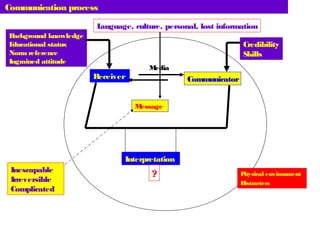
Communication process
Receiver Communicator
Media
Message
Interpretation
Inescapable
Irreversible
Complicated
Background knowledge
Educational status
Norm reference
Ingrained attitude
Credibility
Skills
Physical environment
Distracters
?
Language, culture, personal, lost information
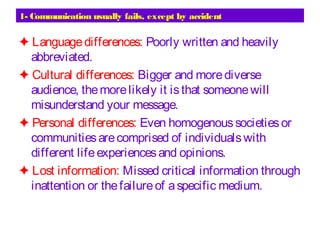
1- Communication usually fails, except by accident
✦ Languagedifferences: Poorly written and heavily
abbreviated.
✦ Cultural differences: Bigger and morediverse
audience, themorelikely it isthat someonewill
misunderstand your message.
✦ Personal differences: Even homogenoussocietiesor
communitiesarecomprised of individualswith
different lifeexperiencesand opinions.
✦ Lost information: Missed critical information through
inattention or thefailureof aspecific medium.
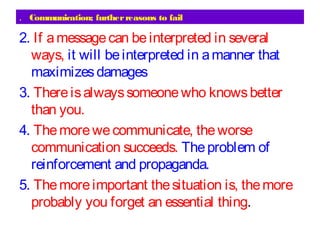
Communication; furtherreasons to fail.
2. If amessagecan beinterpreted in several
ways, it will beinterpreted in amanner that
maximizesdamages
3. Thereisalwayssomeonewho knowsbetter
than you.
4. Themorewecommunicate, theworse
communication succeeds. Theproblem of
reinforcement and propaganda.
5. Themoreimportant thesituation is, themore
probably you forget an essential thing.
Communication - Hearing, Seeing and Doing
"Tell me, and Iwill forget. Show me, and I
may remember. Involve me, and Iwill
understand."
Confucius, circa450BC
Learning
o Our effectivenessascommunicatorsrelieson
two key senses: sight and hearing.
o Adultslearn best when what they seeand hear
isreinforced with action.
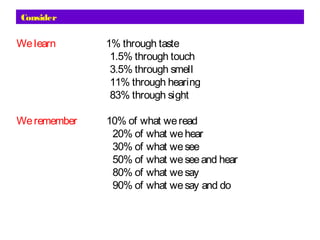
Consider
Welearn 1% through taste
1.5% through touch
3.5% through smell
11% through hearing
83% through sight
Weremember 10% of what weread
20% of what wehear
30% of what wesee
50% of what weseeand hear
80% of what wesay
90% of what wesay and do
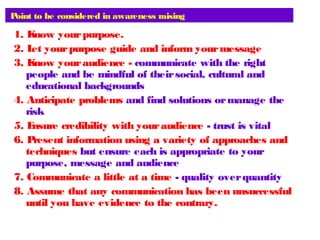
Point to be considered in awareness raising
1. Know yourpurpose.
2. Let yourpurpose guide and inform yourmessage
3. Know youraudience - communicate with the right
people and be mindful of theirsocial, cultural and
educational backgrounds
4. Anticipate problems and find solutions ormanage the
risk
5. Ensure credibility with youraudience - trust is vital
6. Present information using a variety of approaches and
techniques but ensure each is appropriate to your
purpose, message and audience
7. Communicate a little at a time - quality overquantity
8. Assume that any communication has been unsuccessful
until you have evidence to the contrary.
Key components MAST
Therearefour key componentsof an effective
awarenessraising:
1. Message
2. Audience
3. Strategy
4. Timing
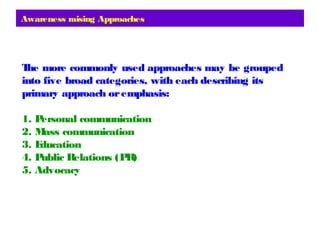
Awareness raising Approaches
The more commonly used approaches may be grouped
into five broad categories, with each describing its
primary approach oremphasis:
1. Personal communication
2. Mass communication
3. Education
4. Public Relations (PR)
5. Advocacy
HEALTHEDUCATION BEHAVIORMODELS ANDTHEORIES
Current models/theoriesthat help to explain
human behavior related to health education,
can beclassified on thebasisof being
directed at thelevel of:
a) Individual (Intrapersonal);
b) Interpersonal; or
c) Community.
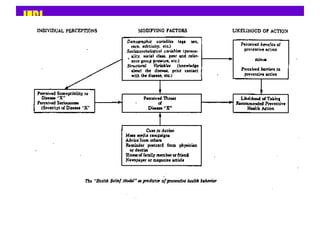
Individual (Intrapersonal) Health BehaviorModels/Theories
TheHBM can beoutlined using four constructswhich represent
theperceived threat and net benefits:
1) Perceived susceptibility, aperson'sopinion of thechances
of getting acertain condition;
2) Perceived severity, aperson'sopinion of how seriousthis
condition is;
3) Perceived benefits, aperson'sopinion of theeffectiveness
of someadvised action to reducetherisk or seriousnessof
theimpact; and
4) Perceived barriers, aperson'sopinion of theconcreteand
psychological costsof thisadvised action
1-Health Belief Model (HBM) 
HBM
Individual (Intrapersonal) Health BehaviorModels/Theories
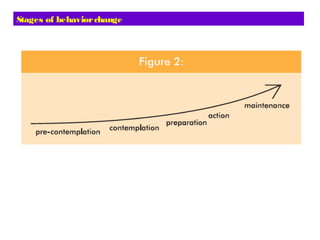
Behavior changeisviewed asaprocess, not an
event, with individualsat variouslevelsof
motivation or "readiness“ to change.
Sincepeopleareat different pointsin this
process, planned interventionsshould match
their stage.
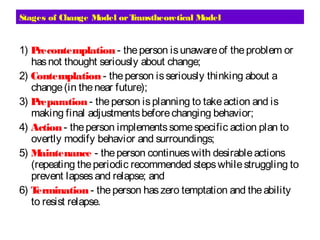
2- Stages of Change Model orTranstheoretical Model 
Stages of Change Model orTranstheoretical Model
1) Precontemplation - theperson isunawareof theproblem or
hasnot thought seriously about change;
2) Contemplation - theperson isseriously thinking about a
change(in thenear future);
3) Preparation - theperson isplanning to takeaction and is
making final adjustmentsbeforechanging behavior;
4) Action - theperson implementssomespecific action plan to
overtly modify behavior and surroundings;
5) Maintenance - theperson continueswith desirableactions
(repeating theperiodic recommended stepswhilestruggling to
prevent lapsesand relapse; and
6) Termination - theperson haszero temptation and theability
to resist relapse.
Stages of behaviorchange
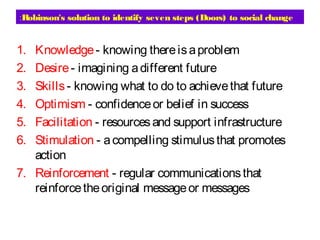
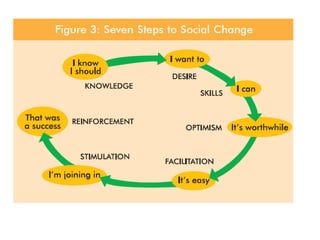
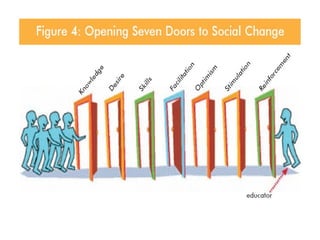
Robinson's solution to identify seven steps (Doors) to social change:
1. Knowledge- knowing thereisaproblem
2. Desire- imagining adifferent future
3. Skills- knowing what to do to achievethat future
4. Optimism - confidenceor belief in success
5. Facilitation - resourcesand support infrastructure
6. Stimulation - acompelling stimulusthat promotes
action
7. Reinforcement - regular communicationsthat
reinforcetheoriginal messageor messages
Individual (Intrapersonal) Health BehaviorModels/Theories
o Developed out of thestudy of human problem
solving and information processing.
3- ConsumerInformation Processing Model (CIP)
CIP
CIPisacyclical processof information
search, choice, useand learning, and feedback
for futuredecision-making.
Beforepeoplewill usehealth information, it
must be:
1. Available,
2. Seen asuseful and new,
3. In afriendly format.
Individual (Intrapersonal) Health BehaviorModels/Theories
 Thistheory isbased on theassumption that
most behaviorsof social relevanceareunder
willful control.
 In addition, aperson'sintention to perform (or
not perform) thebehavior istheimmediate
determinant of that behavior.
4-Theory of Reasoned Action
Interpersonal model
Social networkshavecertain typesof characteristics:
1) Structural:
size(number of people) and
density (extent to which membersreally know oneanother)
2) Interactional:
reciprocity (mutual sharing),
durability (length of timein relationship),
intensity (frequency of interactionsbetween members), and
dispersion (easewith which memberscan contact each other)
3) Functional:
providing social support,
connectionsto social contactsand resources, and
maintenanceof social identity.
Social support refersto thevarying typesof aid that aregiven to membersof a
social network.
Research indicatesthat therearefour kindsof supportivebehaviorsor acts:
1) Emotional support - listening, showing trust and concern;
2) Instrumental support - offering real aid in theform of labor, money,
time;
3) Informational support - providing advice, suggestions, directives,
referrals; and
4) Appraisal support -affirming each other and giving feedback.
Community Level Models/Theories
 Thephrase Community Organization has
emerged from peopleas

they attempt to "definetheir own goals,

mobilizeresources, and

develop action plans" for meeting their
identified needs
1- Community Organization
Community model
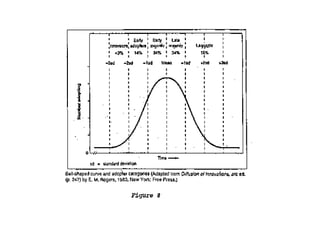
o Diffusion of InnovationsTheory providesan
explanation for how new ideas, productsand
social practicesdiffuseor spread within a
society or from onesociety to another.
2- Diffusion of Innovations Theory
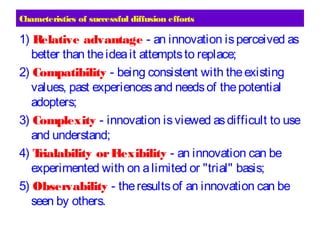
Characteristics of successful diffusion efforts
1) Relative advantage - an innovation isperceived as
better than theideait attemptsto replace;
2) Compatibility - being consistent with theexisting
values, past experiencesand needsof thepotential
adopters;
3) Complexity - innovation isviewed asdifficult to use
and understand;
4) Trialability orFlexibility - an innovation can be
experimented with on alimited or "trial" basis;
5) Observability - theresultsof an innovation can be
seen by others.
References
• Doll R, Peto R: The causes of cancer: quantitative estimates of avoidable risks of cancerin the United States
today.
• JNatlCancer Inst 1981, 66:1191-1308. PubMed Abstract 
•  Harvard Report on CancerPrevention. Volume 1: Causes of human cancer
• Cancer Causes Co ntro l 1996, 7(Suppl 1):S3-59. PubMed Abstract | Publisher Full Text 
• World Cancer Research Fund/American Institutefor Cancer Research: Fo o d, nutritio n and the preventio n o f cancer: A
glo bal perspective. Washington, DC: American Institutefor Cancer Research; 1997.
•  Colditz GA, Atwood KA, EmmonsK, Monson RR, Willett WC, TrichopoulosD, Hunter DJ:Harvard report on cancer
prevention volume 4: Harvard cancerrisk index.
• Cancer Causes Co ntro l 2000, 11:477-488. PubMed Abstract | Publisher Full Text 
• World Health Organization: WHO technical reports series 916. Diet, Nutrition, the prevention of chronic
disease. In Repo rt o f a jo int WHO/FAO Expert Co nsultatio n. Geneva: WHO; 2003. 
•  BoyleP, Autier P, Bartelink H, BaselgaJ, BoffettaP, Burn J, BurnsHJ, Christensen L, DenisL, Dicato M, Diehl V, Doll
R, Franceschi S, GillisCR, Gray N, GriciuteL, Hackshaw A, Kasler M, KogevinasM, Kvinnsland S, LaVecchiaC, Levi
F, McVieJG, MaisonneuveP, Martin-Moreno JM, Bishop JN, Oleari F, Perrin P, Quinn M, RichardsM, Ringborg U,
Scully C, SirackaE, Storm H, TubianaM, Tursz T, Veronesi U, Wald N, Weber W, ZaridzeDG, Zatonski W, zur Hausen
H: European Code Against Cancerand scientific justification: (third version 2003).
• Ann Onco l 2003, 14:973-1005. PubMed Abstract | Publisher Full Text 
• National Cancer Center Tokyo Japan: Twelve recommendations forcancerprevention. [
http://www.ncc.go.jp/jp/ncc-cis/pub/index/about.html] webcite
• Japan Health Promotion and FitnessFoundation Tokyo Japan: Healthy People Japan 21.[
http://www.kenkounippon21.gr.jp/] webcite
•  WardleJ, Waller J, Brunswick N, JarvisMJ: Awareness of risk factors forcanceramong British adults.
• Public Health 2001, 115:173-174. PubMed Abstract | Publisher Full Text 
•  Breslow RA, Sorkin JD, Frey CM, Kessler LG: American's knowledge of cancerrisk and survival.
• Prev Med 1997, 26:170-177. PubMed Abstract | Publisher Full Text 
•  PohlsUG, Renner SP, Fasching PA, Lux MP, KreisH, Ackermann S, Bender HG, Beckmann MW: Awareness of
breast cancerincidence and risk factors among healthy women.
• Eur JCancer Prev 2004, 13:249-256. PubMed Abstract | Publisher Full Text 
•  Keighley MR, O'Morain C, GiacosaA, Ashorn M, BurroughsA, Crespi M, Delvaux M, FaivreJ, Hagenmuller F, Lamy
V, Manger F, MillsHT, Neumann C, Nowak A, Pehrsson A, SmitsS, Spencer K, United European Gastroenterology
Federation Public AffairsCommittee: Public awareness of risk factors and screening forcolorectal cancerin
Europe.
References
• Eur JCancer Prev 2004, 13:249-256. PubMed Abstract | Publisher Full Text 
•  Keighley MR, O'Morain C, GiacosaA, Ashorn M, BurroughsA, Crespi M, Delvaux M, FaivreJ,
Hagenmuller F, Lamy V, Manger F, MillsHT, Neumann C, Nowak A, Pehrsson A, SmitsS, Spencer K,
United European Gastroenterology Federation Public AffairsCommittee: Public awareness of risk
factors and screening forcolorectal cancerin Europe.
• Eur JCancer Prev 2004, 13:257-262. PubMed Abstract | Publisher Full Text 
•  MilesA, Waller J, Hiom S, Swanston D: SunSmart? Skin cancerknowledge and preventive
behaviourin a British population representative sample.
• Health Educ Res 2005, 20:579-585. PubMed Abstract | Publisher Full Text 
•  McMenamin M, Barry H, Lennon AM, Purcell H, Baum M, Keegan D, McDermott E, O'DonoghueD,
Daly L, Mulcahy H: A survey of breast cancerawareness and knowledge in a Western
population: lots of light but little illumination.
• Eur JCancer 2005, 41:393-397. PubMed Abstract | Publisher Full Text 
• StataCorporation: Stata statisticalso ftware, S.E. ver. 8 . StataCorporation, Texas; 2003.
•  Sanderson SC, WardleJ, JarvisMJ, HumphriesSE: Public interest in genetic testing for
susceptibility to heart disease and cancer: a population-based survey in the UK.
• Prev Med 2004, 39:458-464. PubMed Abstract | Publisher Full Text 
•  WardleJ, SteptoeA: Socioeconomic differences in attitudes and beliefs about healthy lifestyles.
• JEpidemio l Co mmunity Health 2003, 57:440-443. PubMed Abstract | Publisher Full Text 
•  Pinnock CB, Weller DP, Marshall VR: Self-reported prevalence of prostate-specific antigen testing
in South
Thank you

Public awareness

  • 1.
    THE CONCEPT OFPUBLIC AWARENESS AND HEALTH EDUCATION Professor Tarek Tawfik Amin Public Health Cairo University amin55@myway.com
  • 2.
    Objectives By theend ofthissession traineeswould beable to: 1. Recognizetheconcept of public awareness and itsvaluein health education. 2. Thebasic componentsof communication and education processes. 3. Thebasic theoriesof health education and themeritsof each.
  • 3.
    Introduction o Awarenessisabroad andvagueterm, yet intuitively widely understood. o It isapermanent-interactive-planned communication processwhich opensopportunities for: 1. Information exchange in order to improvemutual understanding of ahealth problem and 2. To develop competenciesof theindividualsand 3. Skillsnecessary to enablechangesin social attitude and behavior.
  • 4.
    Raising public awareness oTo beeffective, theprocessmust meet and maintain themutual needsand interests of thoseinvolved (Providers-patients). o Theultimateobjectiveisto influencecommunity attitudes, behaviorsand beliefs that isreflected in positively favorable outcome.
  • 5.
    Public awareness o Thetheoryand practiceof public health awarenessbased on: - Masscommunication and - Social or "social change" marketing. o Social “change” marketing: communicating or selling a'good idea' with thestated objective of changing community attitudesand actions.
  • 6.
    Communication Effectivecommunication formsthebasisof all socialmarketing and public awareness-raising. "anegotiation and exchangeof meanings, in which messages, people-in-culturesand 'reality' interact so asto enablemeaning to beproduced or understanding to occur."
  • 7.
    Communication Communication asathree-partsprocessby which we (1)Transmit and (2) Receiveinformation (3) Makesenseof themessageor messages embedded in theinformation. This finalpart o f the co mmunicatio n pro cess is typically the least successful.
  • 8.
    Communication: challenges ✦ Communicationisomnipresent and inescapable- it's everywhere! Thechallengeisto separatequality from quantity. ✦ Communication isirreversible- oncesaid or published it cannot beundone. Opportunitiesfor misunderstanding and misinterpretation. ✦ Communication iscomplicated- thedegreeof complexity isoften determined by factorsthat wecan anticipateand to someextent control.
  • 9.
    Communication Critical factorsinfluencecommunication complexity: 1. Channelor medium used 2. Personal experiencesand opinionsof the communicators(speaker and listener, writer and reader) 3. Environmental factors
  • 10.
    Communication: Common environmentalfactors ✦ Thephysical spacein which thecommunication is occurring - meeting room ✦ External distractionsthat causethemessageto be missed or, misunderstood ✦ Credibility of thecommunicator - can I believethis person? ✦ Listener or reader'slevel of education and background knowledgeof thetopic. ✦ Design of themessage- isit appropriateto the audience?
  • 11.
    Communication process Receiver Communicator Media Message Interpretation Inescapable Irreversible Complicated Backgroundknowledge Educational status Norm reference Ingrained attitude Credibility Skills Physical environment Distracters ? Language, culture, personal, lost information
  • 12.
    1- Communication usuallyfails, except by accident ✦ Languagedifferences: Poorly written and heavily abbreviated. ✦ Cultural differences: Bigger and morediverse audience, themorelikely it isthat someonewill misunderstand your message. ✦ Personal differences: Even homogenoussocietiesor communitiesarecomprised of individualswith different lifeexperiencesand opinions. ✦ Lost information: Missed critical information through inattention or thefailureof aspecific medium.
  • 13.
    Communication; furtherreasons tofail. 2. If amessagecan beinterpreted in several ways, it will beinterpreted in amanner that maximizesdamages 3. Thereisalwayssomeonewho knowsbetter than you. 4. Themorewecommunicate, theworse communication succeeds. Theproblem of reinforcement and propaganda. 5. Themoreimportant thesituation is, themore probably you forget an essential thing.
  • 14.
    Communication - Hearing,Seeing and Doing "Tell me, and Iwill forget. Show me, and I may remember. Involve me, and Iwill understand." Confucius, circa450BC
  • 15.
    Learning o Our effectivenessascommunicatorsrelieson twokey senses: sight and hearing. o Adultslearn best when what they seeand hear isreinforced with action.
  • 16.
    Consider Welearn 1% throughtaste 1.5% through touch 3.5% through smell 11% through hearing 83% through sight Weremember 10% of what weread 20% of what wehear 30% of what wesee 50% of what weseeand hear 80% of what wesay 90% of what wesay and do
  • 17.
    Point to beconsidered in awareness raising 1. Know yourpurpose. 2. Let yourpurpose guide and inform yourmessage 3. Know youraudience - communicate with the right people and be mindful of theirsocial, cultural and educational backgrounds 4. Anticipate problems and find solutions ormanage the risk 5. Ensure credibility with youraudience - trust is vital 6. Present information using a variety of approaches and techniques but ensure each is appropriate to your purpose, message and audience 7. Communicate a little at a time - quality overquantity 8. Assume that any communication has been unsuccessful until you have evidence to the contrary.
  • 18.
    Key components MAST Therearefourkey componentsof an effective awarenessraising: 1. Message 2. Audience 3. Strategy 4. Timing
  • 21.
    Awareness raising Approaches Themore commonly used approaches may be grouped into five broad categories, with each describing its primary approach oremphasis: 1. Personal communication 2. Mass communication 3. Education 4. Public Relations (PR) 5. Advocacy
  • 23.
    HEALTHEDUCATION BEHAVIORMODELS ANDTHEORIES Currentmodels/theoriesthat help to explain human behavior related to health education, can beclassified on thebasisof being directed at thelevel of: a) Individual (Intrapersonal); b) Interpersonal; or c) Community.
  • 24.
    Individual (Intrapersonal) HealthBehaviorModels/Theories TheHBM can beoutlined using four constructswhich represent theperceived threat and net benefits: 1) Perceived susceptibility, aperson'sopinion of thechances of getting acertain condition; 2) Perceived severity, aperson'sopinion of how seriousthis condition is; 3) Perceived benefits, aperson'sopinion of theeffectiveness of someadvised action to reducetherisk or seriousnessof theimpact; and 4) Perceived barriers, aperson'sopinion of theconcreteand psychological costsof thisadvised action 1-Health Belief Model (HBM) 
  • 25.
  • 26.
    Individual (Intrapersonal) HealthBehaviorModels/Theories Behavior changeisviewed asaprocess, not an event, with individualsat variouslevelsof motivation or "readiness“ to change. Sincepeopleareat different pointsin this process, planned interventionsshould match their stage. 2- Stages of Change Model orTranstheoretical Model 
  • 27.
    Stages of ChangeModel orTranstheoretical Model 1) Precontemplation - theperson isunawareof theproblem or hasnot thought seriously about change; 2) Contemplation - theperson isseriously thinking about a change(in thenear future); 3) Preparation - theperson isplanning to takeaction and is making final adjustmentsbeforechanging behavior; 4) Action - theperson implementssomespecific action plan to overtly modify behavior and surroundings; 5) Maintenance - theperson continueswith desirableactions (repeating theperiodic recommended stepswhilestruggling to prevent lapsesand relapse; and 6) Termination - theperson haszero temptation and theability to resist relapse.
  • 28.
  • 29.
    Robinson's solution toidentify seven steps (Doors) to social change: 1. Knowledge- knowing thereisaproblem 2. Desire- imagining adifferent future 3. Skills- knowing what to do to achievethat future 4. Optimism - confidenceor belief in success 5. Facilitation - resourcesand support infrastructure 6. Stimulation - acompelling stimulusthat promotes action 7. Reinforcement - regular communicationsthat reinforcetheoriginal messageor messages
  • 32.
    Individual (Intrapersonal) HealthBehaviorModels/Theories o Developed out of thestudy of human problem solving and information processing. 3- ConsumerInformation Processing Model (CIP)
  • 33.
    CIP CIPisacyclical processof information search,choice, useand learning, and feedback for futuredecision-making. Beforepeoplewill usehealth information, it must be: 1. Available, 2. Seen asuseful and new, 3. In afriendly format.
  • 34.
    Individual (Intrapersonal) HealthBehaviorModels/Theories  Thistheory isbased on theassumption that most behaviorsof social relevanceareunder willful control.  In addition, aperson'sintention to perform (or not perform) thebehavior istheimmediate determinant of that behavior. 4-Theory of Reasoned Action
  • 35.
    Interpersonal model Social networkshavecertaintypesof characteristics: 1) Structural: size(number of people) and density (extent to which membersreally know oneanother) 2) Interactional: reciprocity (mutual sharing), durability (length of timein relationship), intensity (frequency of interactionsbetween members), and dispersion (easewith which memberscan contact each other) 3) Functional: providing social support, connectionsto social contactsand resources, and maintenanceof social identity.
  • 36.
    Social support referstothevarying typesof aid that aregiven to membersof a social network. Research indicatesthat therearefour kindsof supportivebehaviorsor acts: 1) Emotional support - listening, showing trust and concern; 2) Instrumental support - offering real aid in theform of labor, money, time; 3) Informational support - providing advice, suggestions, directives, referrals; and 4) Appraisal support -affirming each other and giving feedback.
  • 37.
    Community Level Models/Theories Thephrase Community Organization has emerged from peopleas  they attempt to "definetheir own goals,  mobilizeresources, and  develop action plans" for meeting their identified needs 1- Community Organization
  • 38.
    Community model o Diffusionof InnovationsTheory providesan explanation for how new ideas, productsand social practicesdiffuseor spread within a society or from onesociety to another. 2- Diffusion of Innovations Theory
  • 40.
    Characteristics of successfuldiffusion efforts 1) Relative advantage - an innovation isperceived as better than theideait attemptsto replace; 2) Compatibility - being consistent with theexisting values, past experiencesand needsof thepotential adopters; 3) Complexity - innovation isviewed asdifficult to use and understand; 4) Trialability orFlexibility - an innovation can be experimented with on alimited or "trial" basis; 5) Observability - theresultsof an innovation can be seen by others.
  • 41.
    References • Doll R,Peto R: The causes of cancer: quantitative estimates of avoidable risks of cancerin the United States today. • JNatlCancer Inst 1981, 66:1191-1308. PubMed Abstract  •  Harvard Report on CancerPrevention. Volume 1: Causes of human cancer • Cancer Causes Co ntro l 1996, 7(Suppl 1):S3-59. PubMed Abstract | Publisher Full Text  • World Cancer Research Fund/American Institutefor Cancer Research: Fo o d, nutritio n and the preventio n o f cancer: A glo bal perspective. Washington, DC: American Institutefor Cancer Research; 1997. •  Colditz GA, Atwood KA, EmmonsK, Monson RR, Willett WC, TrichopoulosD, Hunter DJ:Harvard report on cancer prevention volume 4: Harvard cancerrisk index. • Cancer Causes Co ntro l 2000, 11:477-488. PubMed Abstract | Publisher Full Text  • World Health Organization: WHO technical reports series 916. Diet, Nutrition, the prevention of chronic disease. In Repo rt o f a jo int WHO/FAO Expert Co nsultatio n. Geneva: WHO; 2003.  •  BoyleP, Autier P, Bartelink H, BaselgaJ, BoffettaP, Burn J, BurnsHJ, Christensen L, DenisL, Dicato M, Diehl V, Doll R, Franceschi S, GillisCR, Gray N, GriciuteL, Hackshaw A, Kasler M, KogevinasM, Kvinnsland S, LaVecchiaC, Levi F, McVieJG, MaisonneuveP, Martin-Moreno JM, Bishop JN, Oleari F, Perrin P, Quinn M, RichardsM, Ringborg U, Scully C, SirackaE, Storm H, TubianaM, Tursz T, Veronesi U, Wald N, Weber W, ZaridzeDG, Zatonski W, zur Hausen H: European Code Against Cancerand scientific justification: (third version 2003). • Ann Onco l 2003, 14:973-1005. PubMed Abstract | Publisher Full Text  • National Cancer Center Tokyo Japan: Twelve recommendations forcancerprevention. [ http://www.ncc.go.jp/jp/ncc-cis/pub/index/about.html] webcite • Japan Health Promotion and FitnessFoundation Tokyo Japan: Healthy People Japan 21.[ http://www.kenkounippon21.gr.jp/] webcite •  WardleJ, Waller J, Brunswick N, JarvisMJ: Awareness of risk factors forcanceramong British adults. • Public Health 2001, 115:173-174. PubMed Abstract | Publisher Full Text  •  Breslow RA, Sorkin JD, Frey CM, Kessler LG: American's knowledge of cancerrisk and survival. • Prev Med 1997, 26:170-177. PubMed Abstract | Publisher Full Text  •  PohlsUG, Renner SP, Fasching PA, Lux MP, KreisH, Ackermann S, Bender HG, Beckmann MW: Awareness of breast cancerincidence and risk factors among healthy women. • Eur JCancer Prev 2004, 13:249-256. PubMed Abstract | Publisher Full Text  •  Keighley MR, O'Morain C, GiacosaA, Ashorn M, BurroughsA, Crespi M, Delvaux M, FaivreJ, Hagenmuller F, Lamy V, Manger F, MillsHT, Neumann C, Nowak A, Pehrsson A, SmitsS, Spencer K, United European Gastroenterology Federation Public AffairsCommittee: Public awareness of risk factors and screening forcolorectal cancerin Europe.
  • 42.
    References • Eur JCancerPrev 2004, 13:249-256. PubMed Abstract | Publisher Full Text  •  Keighley MR, O'Morain C, GiacosaA, Ashorn M, BurroughsA, Crespi M, Delvaux M, FaivreJ, Hagenmuller F, Lamy V, Manger F, MillsHT, Neumann C, Nowak A, Pehrsson A, SmitsS, Spencer K, United European Gastroenterology Federation Public AffairsCommittee: Public awareness of risk factors and screening forcolorectal cancerin Europe. • Eur JCancer Prev 2004, 13:257-262. PubMed Abstract | Publisher Full Text  •  MilesA, Waller J, Hiom S, Swanston D: SunSmart? Skin cancerknowledge and preventive behaviourin a British population representative sample. • Health Educ Res 2005, 20:579-585. PubMed Abstract | Publisher Full Text  •  McMenamin M, Barry H, Lennon AM, Purcell H, Baum M, Keegan D, McDermott E, O'DonoghueD, Daly L, Mulcahy H: A survey of breast cancerawareness and knowledge in a Western population: lots of light but little illumination. • Eur JCancer 2005, 41:393-397. PubMed Abstract | Publisher Full Text  • StataCorporation: Stata statisticalso ftware, S.E. ver. 8 . StataCorporation, Texas; 2003. •  Sanderson SC, WardleJ, JarvisMJ, HumphriesSE: Public interest in genetic testing for susceptibility to heart disease and cancer: a population-based survey in the UK. • Prev Med 2004, 39:458-464. PubMed Abstract | Publisher Full Text  •  WardleJ, SteptoeA: Socioeconomic differences in attitudes and beliefs about healthy lifestyles. • JEpidemio l Co mmunity Health 2003, 57:440-443. PubMed Abstract | Publisher Full Text  •  Pinnock CB, Weller DP, Marshall VR: Self-reported prevalence of prostate-specific antigen testing in South
  • 43.