What is Man-Made Disaster?
“A disastrous event caused directly & principally by one or
more identifiable deliberate or negligent HUMAN ACTIONS.”
They are Intentionally or Unintentionally.
All kinds of Man-Made disaster affects a person’s :-
Mental
Physical &
Social Well-being
Mainly they affects :-
- Loss of life
- Damage to Nation’s Economy
- Social Disruptions
- Longterm damage & Widespread effects (For exp;
Nuclear Explosion)
Man-Made Disaster Model by Prof. Barry Turner (1978) :-
According to him :-
“ Disasters arise from an interaction between the human and
organizational arrangements of the socio-technical systems set
up to manage complex and ill-structured risk problems. “
Technological disasters are usually associated with Man-
Made infrastructures and are typically Accidental.
Consequences of Natural disasters can be increased as a
result of Technological Advances & Human Activities such as
Agriculture and Forestry.
Current interest is ‘Safety Culture’.
Human-Induced Disasters by NDMP :-
The NDMP notes that rise in population, rapid urbanization and
industrialization, development within high-risk zones,
environmental degradation, and climate change aggravates the
vulnerabilities to various kinds of disasters. Due to inadequate
disaster preparedness, communities, and animals are at
increased risk from many kinds of human-induced hazards
arising from accidents (industrial, road, air, rail, on river or sea,
building collapse, fires, mine flooding, oil spills, etc.). Chemical,
Biological, Radiological, and Nuclear (CBRN) hazards rank very
high in among the human-induced risks. Terrorist activities and
secondary incidents add to these risks and call for adequate
preparedness and planning.
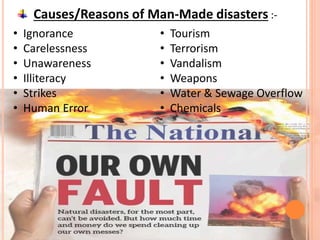
Causes/Reasons of Man-Made disasters :-
• Ignorance
• Carelessness
• Unawareness
• Illiteracy
• Strikes
• Human Error
• Tourism
• Terrorism
• Vandalism
• Weapons
• Water & Sewage Overflow
• Chemicals
The following factors that contributes to the
inevitability of Man-Made disaster :-
 Size & Population Densities of cities / Overcrowding
 Intensive utilization of rapid forms of mass transport
 Poorly organized emergency services
 Lack of warning to the people
 Use of high technology sources of energy
 Increasing pressure to mine fossil fuels
General categorization of Man-Made disaster :-
(1) Those in which the disaster occurred in a circumscribed
community.
-> For example; A landslide (in form of slurry) occurred at the
mining site during rain that killed workers & their family
members who are present at that time.
(2) Those in which the victims of the disaster did not come from
a circumscribed community.
-> For example; Transportation disasters and Oil rig fires
Types of Man-Made Disaster :-
 Structural Collapse
 Transportation Accidents
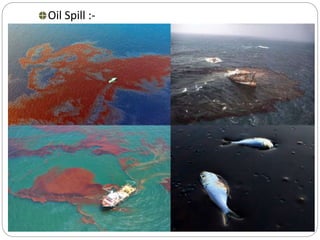
 Oil Spill
 Arson
 War
 Terrorist Attacks
 Deforestation &
Desertification
 Power Outage
 Economic Collapse
 Epidemic
 Fire Accidents
 Industrial Accidents
 C-B-R-N
Oil Spill :-
Arson :-
Terrorist Attack :-
Deforestation :-
Structural Collapse :-
Structural collapses are often caused by engineering failure.
Sudden fall down or cave in of any type of structure due to
various natural reason (Corrosion attack, Floods, Tsunami,
Tornado, etc.) and artificial reason (Terrorist Attack, Under-
Design, Arson, etc.) is called Structural Failure/Collapse.
Such as Building collapse, Bridge Collapse, Dam failure,
Balcony collapse, etc.
Bridge & Balcony Collapse :-
Causes of Building Collapse :-
Bad Design
Faulty Construction
Foundation Failure
Extraordinary Loads
Unexpected Failure Mode
Combination of Causes
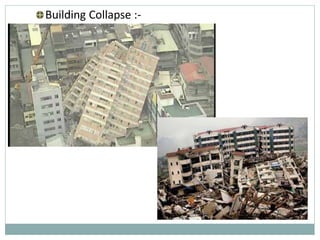
Building Collapse :-
Buildings are designed to support certain loads without
deforming excessively. The loads are the weights of people
and objects.
Effects & Consequences of Building Collapse :-
1) The collapse of structures, including building, may result in
death or serious injury to employees and the public.
2) It may damage the adjacent structure.
3) There is a loss of property.
Immediate Action :-
• Check for injuries & administer first aid.
• Don’t move seriously injured individuals.
• Communicate number & identity of missing persons to
emergency services.
• Don’t enter damaged/unstable building to search for missing
persons.
Prevention & Remedies :-
1) Always hire professional for building design and construction
work.
2) Managing materials: When building any high rising
structure, don’t manage. Use right amount and good quality
materials.
3) Understanding reinforcement/foundation: An excellent
structure wont sit on a faulty foundation.
4) Using the right steel : There is a big difference between
8mm, 10mm, 12mm, etc. The professionals know.
5) Using the right Concrete Mix Ratio when doing your
reinforcement : The proper & particular mixer is needed.
Mixer is different for a Bungalow & Flat, Black cotton soil &
Sandy soil, Pile & Raft foundation, etc.
6) Understanding Loads/Weight : Any structure can not be
deformed under any certain loads.
7) Poor structural Design & Building Plan
8) Follow the books, if structure collapsed.
9) Excessive alternation : Don’t change the plan too much
during construction process.
10) There is a lack of adherence to specifications by unqualified
and unskilled personnel.
Building Collapse :-
Transportation Accidents :-
1) Road Accidents :-
Traffic collisions are the leading cause of death, and road-
based pollution creates a substantial health hazard, especially
in major conurbations.
Road networks are developed for better connectivity and
service. Increased number of vehicles, violation of traffic rules,
speeding, drunken driving and poor maintenance of vehicles
as well as of roads are some of the main causes of road
accidents.
Safety measures :-
• Look on either side of the road before crossing.
• Use zebra crossing while crossing the road by foot.
• Wear helmet while riding a two-wheeler.
• Use seat belt provided in your car.
• Maintain a safety distance from the vehicle in front.
• Do not jump lanes. The best way to be safe on roads is to
follow “lane driving”.
• While driving avoid sudden acceleration and deceleration.
• Check the tyre pressure, radiator water, brake oil and fuel
frequently.
• Replace the worn tyres and faulty headlamps.
• Dip your beam whenever you spot an oncoming vehicle.
• In case of fire, try to get out as early as possible and do not
worry about the baggage.
• Overcome impatience, anger and intoxication during driving.
Road Accident :-
2) Rail Accidents :-
A railroad disaster is an occurrence associated with the
operation of a passenger train which results in substantial loss
of life. Usually accidents with freight (goods) trains are not
considered disasters, unless they cause substantial loss of life
or property.
The most common type of rail accident is derailment due to
human error, sabotage or natural landslide in a hilly track, fire.
It may be classified into :
1. Mechanical failure
2. Manual error
3. Civil Works failure
It can be further classified as :
1. Head on collision
2. Rear end collision
3. Derailments
4. Driver’s error
5. Signal man’s error
6. Poor design & maintenance
7. Obstruction on railway line
8. Fires & explosion
9. Fall from the train
10. Civil engineering works failure
11. Terrorism
12. Suicidal act
Common Causes for train accidents :-
• Train or parts that are defective.
• Negligence by conductor.
• Crossing that are unprotected.
• Safety gates not in place.
• Inadequate maintenance of track.
• Sabotage or terror attack.
• Bad weather particularly fog.
• Failing mechanics.
• Malfunctioning train signals or lights.
Consequences & Effects :-
1. Loss of human lives
2. Loss of property
3. Inconvenience to commuters.
4. Loss of time, traffic has to be diverted.
5. Loss of reputation.
Safety Measures :-
1. At railway crossings pay attention to the signal and the swing
barrier. Do not get underneath and try to get across.
2. In case of a unmanned crossing, get down from the vehicle
and look at either sides of the track before crossing.
3. Do not stop the train on a bridge or tunnel where evacuation
is not possible.
4. Do not carry inflammable material in a train.
5. Do not lean out of a moving train.
6. Do not smoke in train.
7. Do not pull the emergency cord unnecessarily.
Rail Accident :-
3) Aviation/Air Accidents :-
 An aviation incident is an occurrence other than an accident,
associated with the operation of an aircraft, which affects or
could affect the safety of operations, passengers, or pilots.
 Air accidents may occur due to technical problems, fire, poor
landing and take-off, weather conditions, hijacking,
bombing,etc.
4) Sea travel Accidents :-
 Ships can sink, capsize or crash in disasters. Perhaps the most
infamous sinking was that of the Titanic which hit an iceberg
and sank, resulting in the worst maritime disasters in history.
5) Space Accidents :-
 Space travel presents significant hazards, mostly to the direct
participants (astronauts or cosmonauts and ground support
personnel), but also carry the potential of disaster to the public
at large.
 Accidents can occur on the ground during launch, preparation,
or in flight, due to equipment malfunction or the naturally
hostile environment of space itself. An additional risk is posed
by (unmanned) low-orbiting satellites whose orbits eventually
decay due to friction with the extremely thin atmosphere. If
they are large enough, massive pieces travelling at great speed
can fall to the Earth before burning up, with the potential to do
damage.
Man-Made Disaster PPT

Man-Made Disaster PPT

  • 2.
    What is Man-MadeDisaster? “A disastrous event caused directly & principally by one or more identifiable deliberate or negligent HUMAN ACTIONS.” They are Intentionally or Unintentionally. All kinds of Man-Made disaster affects a person’s :- Mental Physical & Social Well-being Mainly they affects :- - Loss of life - Damage to Nation’s Economy - Social Disruptions - Longterm damage & Widespread effects (For exp; Nuclear Explosion)
  • 3.
    Man-Made Disaster Modelby Prof. Barry Turner (1978) :- According to him :- “ Disasters arise from an interaction between the human and organizational arrangements of the socio-technical systems set up to manage complex and ill-structured risk problems. “ Technological disasters are usually associated with Man- Made infrastructures and are typically Accidental. Consequences of Natural disasters can be increased as a result of Technological Advances & Human Activities such as Agriculture and Forestry. Current interest is ‘Safety Culture’.
  • 4.
    Human-Induced Disasters byNDMP :- The NDMP notes that rise in population, rapid urbanization and industrialization, development within high-risk zones, environmental degradation, and climate change aggravates the vulnerabilities to various kinds of disasters. Due to inadequate disaster preparedness, communities, and animals are at increased risk from many kinds of human-induced hazards arising from accidents (industrial, road, air, rail, on river or sea, building collapse, fires, mine flooding, oil spills, etc.). Chemical, Biological, Radiological, and Nuclear (CBRN) hazards rank very high in among the human-induced risks. Terrorist activities and secondary incidents add to these risks and call for adequate preparedness and planning.
  • 6.
    Causes/Reasons of Man-Madedisasters :- • Ignorance • Carelessness • Unawareness • Illiteracy • Strikes • Human Error • Tourism • Terrorism • Vandalism • Weapons • Water & Sewage Overflow • Chemicals
  • 7.
    The following factorsthat contributes to the inevitability of Man-Made disaster :-  Size & Population Densities of cities / Overcrowding  Intensive utilization of rapid forms of mass transport  Poorly organized emergency services  Lack of warning to the people  Use of high technology sources of energy  Increasing pressure to mine fossil fuels
  • 8.
    General categorization ofMan-Made disaster :- (1) Those in which the disaster occurred in a circumscribed community. -> For example; A landslide (in form of slurry) occurred at the mining site during rain that killed workers & their family members who are present at that time. (2) Those in which the victims of the disaster did not come from a circumscribed community. -> For example; Transportation disasters and Oil rig fires
  • 9.
    Types of Man-MadeDisaster :-  Structural Collapse  Transportation Accidents  Oil Spill  Arson  War  Terrorist Attacks  Deforestation & Desertification  Power Outage  Economic Collapse  Epidemic  Fire Accidents  Industrial Accidents  C-B-R-N
  • 10.
  • 11.
  • 12.
  • 13.
  • 14.
    Structural Collapse :- Structuralcollapses are often caused by engineering failure. Sudden fall down or cave in of any type of structure due to various natural reason (Corrosion attack, Floods, Tsunami, Tornado, etc.) and artificial reason (Terrorist Attack, Under- Design, Arson, etc.) is called Structural Failure/Collapse. Such as Building collapse, Bridge Collapse, Dam failure, Balcony collapse, etc.
  • 15.
    Bridge & BalconyCollapse :-
  • 16.
    Causes of BuildingCollapse :- Bad Design Faulty Construction Foundation Failure Extraordinary Loads Unexpected Failure Mode Combination of Causes Building Collapse :- Buildings are designed to support certain loads without deforming excessively. The loads are the weights of people and objects.
  • 17.
    Effects & Consequencesof Building Collapse :- 1) The collapse of structures, including building, may result in death or serious injury to employees and the public. 2) It may damage the adjacent structure. 3) There is a loss of property. Immediate Action :- • Check for injuries & administer first aid. • Don’t move seriously injured individuals. • Communicate number & identity of missing persons to emergency services. • Don’t enter damaged/unstable building to search for missing persons.
  • 18.
    Prevention & Remedies:- 1) Always hire professional for building design and construction work. 2) Managing materials: When building any high rising structure, don’t manage. Use right amount and good quality materials. 3) Understanding reinforcement/foundation: An excellent structure wont sit on a faulty foundation. 4) Using the right steel : There is a big difference between 8mm, 10mm, 12mm, etc. The professionals know. 5) Using the right Concrete Mix Ratio when doing your reinforcement : The proper & particular mixer is needed. Mixer is different for a Bungalow & Flat, Black cotton soil & Sandy soil, Pile & Raft foundation, etc.
  • 19.
    6) Understanding Loads/Weight: Any structure can not be deformed under any certain loads. 7) Poor structural Design & Building Plan 8) Follow the books, if structure collapsed. 9) Excessive alternation : Don’t change the plan too much during construction process. 10) There is a lack of adherence to specifications by unqualified and unskilled personnel.
  • 20.
  • 21.
    Transportation Accidents :- 1)Road Accidents :- Traffic collisions are the leading cause of death, and road- based pollution creates a substantial health hazard, especially in major conurbations. Road networks are developed for better connectivity and service. Increased number of vehicles, violation of traffic rules, speeding, drunken driving and poor maintenance of vehicles as well as of roads are some of the main causes of road accidents.
  • 22.
    Safety measures :- •Look on either side of the road before crossing. • Use zebra crossing while crossing the road by foot. • Wear helmet while riding a two-wheeler. • Use seat belt provided in your car. • Maintain a safety distance from the vehicle in front. • Do not jump lanes. The best way to be safe on roads is to follow “lane driving”. • While driving avoid sudden acceleration and deceleration. • Check the tyre pressure, radiator water, brake oil and fuel frequently. • Replace the worn tyres and faulty headlamps. • Dip your beam whenever you spot an oncoming vehicle. • In case of fire, try to get out as early as possible and do not worry about the baggage. • Overcome impatience, anger and intoxication during driving.
  • 23.
  • 24.
    2) Rail Accidents:- A railroad disaster is an occurrence associated with the operation of a passenger train which results in substantial loss of life. Usually accidents with freight (goods) trains are not considered disasters, unless they cause substantial loss of life or property. The most common type of rail accident is derailment due to human error, sabotage or natural landslide in a hilly track, fire. It may be classified into : 1. Mechanical failure 2. Manual error 3. Civil Works failure
  • 25.
    It can befurther classified as : 1. Head on collision 2. Rear end collision 3. Derailments 4. Driver’s error 5. Signal man’s error 6. Poor design & maintenance 7. Obstruction on railway line 8. Fires & explosion 9. Fall from the train 10. Civil engineering works failure 11. Terrorism 12. Suicidal act
  • 26.
    Common Causes fortrain accidents :- • Train or parts that are defective. • Negligence by conductor. • Crossing that are unprotected. • Safety gates not in place. • Inadequate maintenance of track. • Sabotage or terror attack. • Bad weather particularly fog. • Failing mechanics. • Malfunctioning train signals or lights. Consequences & Effects :- 1. Loss of human lives 2. Loss of property 3. Inconvenience to commuters. 4. Loss of time, traffic has to be diverted. 5. Loss of reputation.
  • 27.
    Safety Measures :- 1.At railway crossings pay attention to the signal and the swing barrier. Do not get underneath and try to get across. 2. In case of a unmanned crossing, get down from the vehicle and look at either sides of the track before crossing. 3. Do not stop the train on a bridge or tunnel where evacuation is not possible. 4. Do not carry inflammable material in a train. 5. Do not lean out of a moving train. 6. Do not smoke in train. 7. Do not pull the emergency cord unnecessarily.
  • 28.
  • 29.
    3) Aviation/Air Accidents:-  An aviation incident is an occurrence other than an accident, associated with the operation of an aircraft, which affects or could affect the safety of operations, passengers, or pilots.  Air accidents may occur due to technical problems, fire, poor landing and take-off, weather conditions, hijacking, bombing,etc. 4) Sea travel Accidents :-  Ships can sink, capsize or crash in disasters. Perhaps the most infamous sinking was that of the Titanic which hit an iceberg and sank, resulting in the worst maritime disasters in history.
  • 30.
    5) Space Accidents:-  Space travel presents significant hazards, mostly to the direct participants (astronauts or cosmonauts and ground support personnel), but also carry the potential of disaster to the public at large.  Accidents can occur on the ground during launch, preparation, or in flight, due to equipment malfunction or the naturally hostile environment of space itself. An additional risk is posed by (unmanned) low-orbiting satellites whose orbits eventually decay due to friction with the extremely thin atmosphere. If they are large enough, massive pieces travelling at great speed can fall to the Earth before burning up, with the potential to do damage.