F
acilitate Student’s L
earning

Dr Tarek Tawfik Amin
Objectives of the session.
o T define the meaning of learning.
o
o T conceptualize the different intelligences
o
involved in the learning process.
o T portray the role of teacher in learning
o
facilitation using different strategies.
W
hat is learning?
 Can be viewed as the process of acquiring
new knowledge, skills, insights and
attitudes (1).
 Useful and pragmatic definition developed
by Senge 1990; as increasing knowledge to
increase the capacity for effective action (2) .

1

A yris C. Te aching smart pe o ple ho w to le arn; Harvard B
rg
usine ss Re vie w, 1 9 9 1 : 9 9 -1 0 9 .
2
Se ng e P. The fifth discipline , Do uble day De ll Publishing Gro up, N 1 9 9 0 .
Y,
F
orms of learning and their contexts.
Formal

P
lanned teaching
and learning activities

Problem-based
F
ormal /informal

Informal

Under the control
of the learner

Incidental

B product of other
y
activities

Situated

Situation-acquired
knowledge
E
xperience and learning

Co ne o f le arning , de ve lo pe d and
re vise d by B
rucy Hyland fro m
mate rials by Edg ar Dale .

We tend to remember
10% of what we read
20% of what we hear
30% of what we see
50% of what we
hear & see

Our level of involvement

Reading

Verbal receiving

Hearing words
Looking at pictures
Watching a movie

Visual receiving

Looking at an exhibit
Watching a demonstration
Seeing done on location

70% of what we say

Participation in discussion
Giving a talk
Doing a dramatic presentation

90% of what we
both say and
do

Simulating the real experience
Doing the real thing

Receiving
Participating
Doing
Educational Environment
Content
How to deliver

Faculty and Curriculum
What to learn
Students

How to learn

Student
performance

Assessment

A
dapte d fro m A EE Educatio n Guide 1 4. Outco me B d Educatio n
M
ase
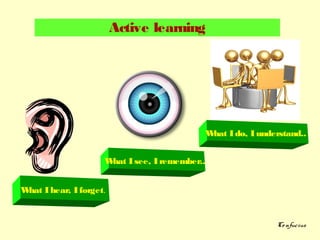
Active learning

W
hat I do, I understand..
W
hat I see, I remember..
W
hat I hear, I forget.

Co nfucius
W ays we lear n and r etain lear ning.
100

80

90
80

70

70
60
50
40
30
20

95

50
30
18

20

%

10
0
R ea
di n

H ea
S
r i n g eei n g
g

S ee

D is
P er
T ea
c us
son
c hin
& H
sw
al E
g
ear
ith
xpe
o th
r i en
er s
ce

William Glasse r 1 9 9 7 .
M
ultiple intelligences and types of
learners.
•Verbal/
•L
inguistic
“ Word Smart”

L
ogical/
M
athematical

“Number/
Reasoning Smart”

B
odilyK
inesthetic
“ Body Smart”

Visual/
Spatial
“ Picture Smart”

Select and Apply instructional strategies along these intelligences.

Naturalist

“ Nature Smart”

M
usical

“ Music Smart”

Interpersonal
“ People Smart”

Intrapersonal
“ Self Smart”

Garde ne r H. Harvard, 1 9 8 3.
M
ultiple intelligences learning
centers.
•Verbal/
•L
inguistic
“ Word Smart”

L
ogical/
M
athematical

“Number/
Reasoning Smart”

Reading center
M
ath & Science center
Analyze and organize Problem solving, deductive
Reasoning, experiments
information

Newly added

M
usic center

B
odilyK
inesthetic

Visual/
Spatial
“ Picture Smart”

“ Body Smart”

B
uilding center

Art center
M
edia, demos, charts
P
ictures, simulation

M
odels, dramatize

W
orking together
Center

P
ersonal work center

P
roblem solving, questions

earn in rhythmic ways Brain storming, discussion
Observation, meditation L

Naturalist

“ Nature Smart”

M
usical

“ Music Smart”

Interpersonal
“ People Smart”

Research, projects

Intrapersonal
“ Self Smart”

Garde ne r H. Harvard, 1 9 8 3.
H to facilitate learning
ow
•
•
•
•

B prepared “first day”
e
E
ffective teaching
E
ffective communications
Appropriate instructional strategies
I- F
rom T F Day.
he irst
Instructor’s
demeanor

oT
eacher's behavior set the tone for the course.
oAllow for self and student introduction.
oAllow for student stories and individual attention.
oSmile.

E
mpowering
students

oFind your student goals and expectations for the course.
oCorrelate expectations with learning outcomes and course content.
oT to explore the learning intelligences in the class.
ry

1st day DOs

oP
lan-rehearse first lesson.
oAppear confident all the times.
oH
ave syllabus and / grading criteria written out for the student to have.
or
oT
reat all students the same.
oM
odel the appropriate language and behaviors you want students to use in class or
institution.
oSmile.
oT your students about your credentials, experience and your personal desire to
ell
success.
oB enthusiastic.
e
oT to be their friend “one of the guy”.
ry
oYell
oT ethnic, sexist jokes.
ell
oB unprepared.
e

1st day
DON’T
s
I- F
rom T F Day.
he irst
Ice breakers Develop teamwork and small peer groups.
and
community
builder.
oA syllabus “plan of action of course over a certain period of time” both
contents and expected behavior.
oF
ocus on expectations and outcomes.
oP
hilosophy of teaching should be explicit.
oR
espond politely and honestly to students questions and concerns.
oF name of the course and course ID #.
Syllabus
ull
developme oM
eeting times (including dates and places ‘room #’”
nt and
oName, P
hone no., e-mail, office number and office hours.
essential
oStudent learning outcomes, competencies, skills, and knowledge to be gained.
information.
oF name of the texts (date of publication), and materials needed for the
ull
course.
oOutline of work to be covered either daily or weekly.
oM
ajor assignments and activities (tests, projects, field visits, etc. )
oGrading policy and criteria.
oAttendance policy.
oCalendar for activities, and due dates.
H
ave
syllabus
Ready
II- E
ffective teaching
Instructor conduct:

Responsive & helpful to students
Avoid bluffing, sarcasm or ridicule
Demonstrates patience
Avoid profanity
Gestures, standing, sitting,
circulating.
Smiling, speaking louder, softer
Seeks out students input &
questions
Consistently assesses student
learning.

Instructor traits:

E
ffective teaching

P
rinciples:

Demonstrates concern for learners
K
nowledge of subject and skills
P
ositive approachable personality
P
rofessional attitudes
Role model for students
Commitment to student learning
Available to coach and mentor
Use feedback to improve.
Active listening skills.

oVary ur instructional methods.
oActively involve students
oE
mpower students
oW
ork to achieve outcomes
oAdequate resources &
motivation
oF
ocus on students rather content
oSelf and student –assessments
oE
valuate based on learning OCs
oM
aintain flexibility
III- E
ffective Communications for L
earning.
Effective
communication

oMessage, decoding, feedback.
oListening: hearing and understanding.
oPresent subject matter in logical matter.
oUse examples and analogies to amplify and support key points.
oStimulate thinking with comparisons and contrast.
oActive involvement ‘ questions, reviews, exercise labs, field visits’

Communicating
with diverse
learners

- Be sensitive to the cultural and intellectual diversities.

Active listening

About 70% of our working day is spent in some form of verbal
communication.
We listen at a rate of 300-500 words /minutes.
Students listen based on interest, mood, respect for speaker, and if
information is important and needed.
IV- Instructional Strategies
L
ectures (± Audiovisuals)
Instructional strategies
Strengths and limitations of each Discussion

Active-student-centered
strategies

Facilitation as teaching

Demonstration
Small group work.
Simulation
W
eb-based
Individual conferencing
oB
rain storming
oInteractive lectures
oRole play
oP
rojects and demonstrations
oCase studies
oGroup work
oF
ield study
oW
hole class-small group discussion.
L
aboratory environment
Different learning activities simultaneously
Student focused group learning
Assessment
IV- Instructional Strategies
Demonstrations done by the
instructors

B
eing a role model
M
odeling significant technical skills
Showing skills in step-by step sequence slowly
Repeating the demonstrations using students
Streamline oral explanations
Allow students to ask at every step

Lectures “ giving and receiving
feedback”

oAvoid “sage on stage syndrome”
oAsk real questions
oGive students time to think
oAssess students understanding “questions-body
language”
oDevise opportunities for students to apply the
information.
Avoid relying too much
Get students actively involved after reading assignments.

Using textbooks
Ideas to develop effective learning
assignments and class room activities.

















Audiovisuals
B
rainstorming
Case studies
Community study
Computers
Demonstrations
Discussion
Display
F
ield research
F
ilms
F charts
lip
Graphics
Assignments
Independent study
Investigation/
reporting
L
aboratory work
























L
arge-small group instruction
L
ibrary search
W
eb-based search
L
istening
P and other electronic based information
DA
Oral recitations
P
anels symposium
P
rojects
Reading out loud
Resource persons
Reviews
Role playing
Simulation
Slides
T
eam teaching
Coaching and mentoring
T
eam teaching
Supervised study
Verbal illustrations
Visual illustrations
W
ork study
W
riting
Conclusions
1. L
earning intelligences should be explored
and employed in multiplicity.
2. L
earning strategies should be adjusted
according to the importance of skills to be
acquired and the learning centers operating
through different intelligences
3. E
ffective teaching, communication, and
instructional strategies all operating to
facilitate learning if effectively applied.
T
hank you

Facilitate student learning

  • 1.
  • 2.
    Objectives of thesession. o T define the meaning of learning. o o T conceptualize the different intelligences o involved in the learning process. o T portray the role of teacher in learning o facilitation using different strategies.
  • 3.
    W hat is learning? Can be viewed as the process of acquiring new knowledge, skills, insights and attitudes (1).  Useful and pragmatic definition developed by Senge 1990; as increasing knowledge to increase the capacity for effective action (2) . 1 A yris C. Te aching smart pe o ple ho w to le arn; Harvard B rg usine ss Re vie w, 1 9 9 1 : 9 9 -1 0 9 . 2 Se ng e P. The fifth discipline , Do uble day De ll Publishing Gro up, N 1 9 9 0 . Y,
  • 4.
    F orms of learningand their contexts. Formal P lanned teaching and learning activities Problem-based F ormal /informal Informal Under the control of the learner Incidental B product of other y activities Situated Situation-acquired knowledge
  • 5.
    E xperience and learning Cone o f le arning , de ve lo pe d and re vise d by B rucy Hyland fro m mate rials by Edg ar Dale . We tend to remember 10% of what we read 20% of what we hear 30% of what we see 50% of what we hear & see Our level of involvement Reading Verbal receiving Hearing words Looking at pictures Watching a movie Visual receiving Looking at an exhibit Watching a demonstration Seeing done on location 70% of what we say Participation in discussion Giving a talk Doing a dramatic presentation 90% of what we both say and do Simulating the real experience Doing the real thing Receiving Participating Doing
  • 6.
    Educational Environment Content How todeliver Faculty and Curriculum What to learn Students How to learn Student performance Assessment A dapte d fro m A EE Educatio n Guide 1 4. Outco me B d Educatio n M ase
  • 7.
    Active learning W hat Ido, I understand.. W hat I see, I remember.. W hat I hear, I forget. Co nfucius
  • 8.
    W ays welear n and r etain lear ning. 100 80 90 80 70 70 60 50 40 30 20 95 50 30 18 20 % 10 0 R ea di n H ea S r i n g eei n g g S ee D is P er T ea c us son c hin & H sw al E g ear ith xpe o th r i en er s ce William Glasse r 1 9 9 7 .
  • 9.
    M ultiple intelligences andtypes of learners. •Verbal/ •L inguistic “ Word Smart” L ogical/ M athematical “Number/ Reasoning Smart” B odilyK inesthetic “ Body Smart” Visual/ Spatial “ Picture Smart” Select and Apply instructional strategies along these intelligences. Naturalist “ Nature Smart” M usical “ Music Smart” Interpersonal “ People Smart” Intrapersonal “ Self Smart” Garde ne r H. Harvard, 1 9 8 3.
  • 10.
    M ultiple intelligences learning centers. •Verbal/ •L inguistic “Word Smart” L ogical/ M athematical “Number/ Reasoning Smart” Reading center M ath & Science center Analyze and organize Problem solving, deductive Reasoning, experiments information Newly added M usic center B odilyK inesthetic Visual/ Spatial “ Picture Smart” “ Body Smart” B uilding center Art center M edia, demos, charts P ictures, simulation M odels, dramatize W orking together Center P ersonal work center P roblem solving, questions earn in rhythmic ways Brain storming, discussion Observation, meditation L Naturalist “ Nature Smart” M usical “ Music Smart” Interpersonal “ People Smart” Research, projects Intrapersonal “ Self Smart” Garde ne r H. Harvard, 1 9 8 3.
  • 11.
    H to facilitatelearning ow • • • • B prepared “first day” e E ffective teaching E ffective communications Appropriate instructional strategies
  • 12.
    I- F rom TF Day. he irst Instructor’s demeanor oT eacher's behavior set the tone for the course. oAllow for self and student introduction. oAllow for student stories and individual attention. oSmile. E mpowering students oFind your student goals and expectations for the course. oCorrelate expectations with learning outcomes and course content. oT to explore the learning intelligences in the class. ry 1st day DOs oP lan-rehearse first lesson. oAppear confident all the times. oH ave syllabus and / grading criteria written out for the student to have. or oT reat all students the same. oM odel the appropriate language and behaviors you want students to use in class or institution. oSmile. oT your students about your credentials, experience and your personal desire to ell success. oB enthusiastic. e oT to be their friend “one of the guy”. ry oYell oT ethnic, sexist jokes. ell oB unprepared. e 1st day DON’T s
  • 13.
    I- F rom TF Day. he irst Ice breakers Develop teamwork and small peer groups. and community builder. oA syllabus “plan of action of course over a certain period of time” both contents and expected behavior. oF ocus on expectations and outcomes. oP hilosophy of teaching should be explicit. oR espond politely and honestly to students questions and concerns. oF name of the course and course ID #. Syllabus ull developme oM eeting times (including dates and places ‘room #’” nt and oName, P hone no., e-mail, office number and office hours. essential oStudent learning outcomes, competencies, skills, and knowledge to be gained. information. oF name of the texts (date of publication), and materials needed for the ull course. oOutline of work to be covered either daily or weekly. oM ajor assignments and activities (tests, projects, field visits, etc. ) oGrading policy and criteria. oAttendance policy. oCalendar for activities, and due dates. H ave syllabus Ready
  • 14.
    II- E ffective teaching Instructorconduct: Responsive & helpful to students Avoid bluffing, sarcasm or ridicule Demonstrates patience Avoid profanity Gestures, standing, sitting, circulating. Smiling, speaking louder, softer Seeks out students input & questions Consistently assesses student learning. Instructor traits: E ffective teaching P rinciples: Demonstrates concern for learners K nowledge of subject and skills P ositive approachable personality P rofessional attitudes Role model for students Commitment to student learning Available to coach and mentor Use feedback to improve. Active listening skills. oVary ur instructional methods. oActively involve students oE mpower students oW ork to achieve outcomes oAdequate resources & motivation oF ocus on students rather content oSelf and student –assessments oE valuate based on learning OCs oM aintain flexibility
  • 15.
    III- E ffective Communicationsfor L earning. Effective communication oMessage, decoding, feedback. oListening: hearing and understanding. oPresent subject matter in logical matter. oUse examples and analogies to amplify and support key points. oStimulate thinking with comparisons and contrast. oActive involvement ‘ questions, reviews, exercise labs, field visits’ Communicating with diverse learners - Be sensitive to the cultural and intellectual diversities. Active listening About 70% of our working day is spent in some form of verbal communication. We listen at a rate of 300-500 words /minutes. Students listen based on interest, mood, respect for speaker, and if information is important and needed.
  • 16.
    IV- Instructional Strategies L ectures(± Audiovisuals) Instructional strategies Strengths and limitations of each Discussion Active-student-centered strategies Facilitation as teaching Demonstration Small group work. Simulation W eb-based Individual conferencing oB rain storming oInteractive lectures oRole play oP rojects and demonstrations oCase studies oGroup work oF ield study oW hole class-small group discussion. L aboratory environment Different learning activities simultaneously Student focused group learning Assessment
  • 17.
    IV- Instructional Strategies Demonstrationsdone by the instructors B eing a role model M odeling significant technical skills Showing skills in step-by step sequence slowly Repeating the demonstrations using students Streamline oral explanations Allow students to ask at every step Lectures “ giving and receiving feedback” oAvoid “sage on stage syndrome” oAsk real questions oGive students time to think oAssess students understanding “questions-body language” oDevise opportunities for students to apply the information. Avoid relying too much Get students actively involved after reading assignments. Using textbooks
  • 18.
    Ideas to developeffective learning assignments and class room activities.                 Audiovisuals B rainstorming Case studies Community study Computers Demonstrations Discussion Display F ield research F ilms F charts lip Graphics Assignments Independent study Investigation/ reporting L aboratory work                       L arge-small group instruction L ibrary search W eb-based search L istening P and other electronic based information DA Oral recitations P anels symposium P rojects Reading out loud Resource persons Reviews Role playing Simulation Slides T eam teaching Coaching and mentoring T eam teaching Supervised study Verbal illustrations Visual illustrations W ork study W riting
  • 19.
    Conclusions 1. L earning intelligencesshould be explored and employed in multiplicity. 2. L earning strategies should be adjusted according to the importance of skills to be acquired and the learning centers operating through different intelligences 3. E ffective teaching, communication, and instructional strategies all operating to facilitate learning if effectively applied.
  • 20.